


Search Results for 'side'
-
AuthorSearch Results
-
January 24, 2023 at 11:34 am #6457
In reply to: Orbs of Madjourneys
“Look, Pretty Girl! That must be the lost traveler walking up those steps!”
Zara followed the mysterious man in red robes up the steps. She lost sight of him and wondered which way he’d gone in the many side alleys. She wandered up a few of them but they all came to a dead end in a courtyard with closed doors. Eventually she saw him disappearing into a manhole that looked like a labyrinth.
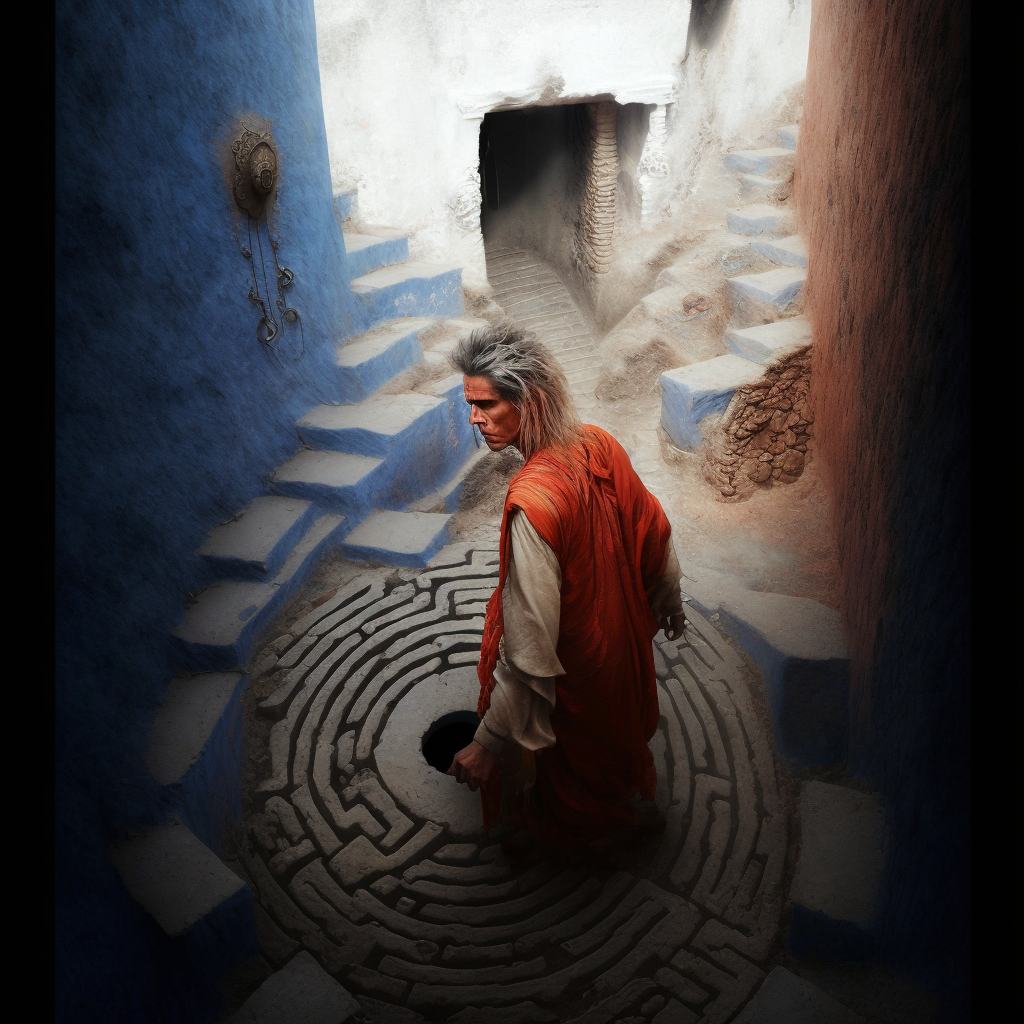
Zara followed him, and stepped onto the labyrinth manhole that the man in the red robes had disappeared into.
“That must be another portal,” Zara said to the parrot. “I wonder where we’ll end up now.”
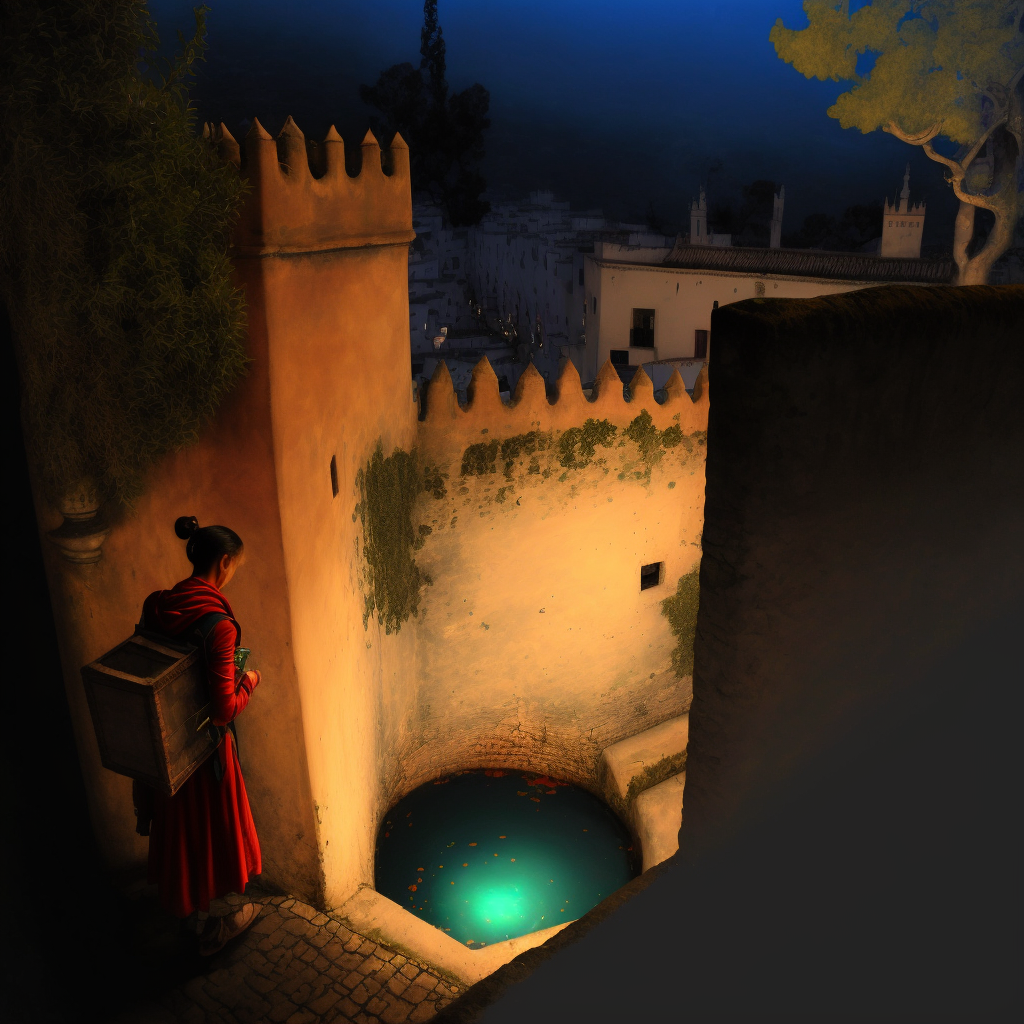
The labyrinth manhole led Zara to another portal, this time a round hole in the wall. She knew she should follow the man, who must be the lost traveler, but she couldn’t resist exploring the starlit night scene first.

She found herself in a castle, its sand coloured walls glowing in the moonlight. There was another round green pool inside the castle. Should she jump into the pool, or go back and follow the man in red through the hole in the wall? Zara walked around the castle first, exploring the many courtyards and stairs and the enchanting views from the parapets. She noticed that there were several green pools and wondered if they each led to different places.
 January 23, 2023 at 10:28 pm #6454
In reply to: Prompts of Madjourneys
YASMIN’S QUIRK: Entry level quirk – snort laughing when socially anxious
Setting
The initial setting for this quest is a comedic theater in the heart of a bustling city. You will start off by exploring the different performances and shows, trying to find the source of the snort laughter that seems to be haunting your thoughts. As you delve deeper into the theater, you will discover that the snort laughter is coming from a mischievous imp who has taken residence within the theater.
Directions to Investigate
Possible directions to investigate include talking to the theater staff and performers to gather information, searching backstage for clues, and perhaps even sneaking into the imp’s hiding spot to catch a glimpse of it in action.
Characters
Possible characters to engage include the theater manager, who may have information about the imp’s history and habits, and a group of comedic performers who may have some insight into the imp’s behavior.
Task
Your task is to find a key or tile that represents the imp, and take a picture of it in real life as proof of completion of the quest. Good luck on your journey to uncover the source of the snort laughter!
THE SECRET ROOM AND THE UNDERGROUND MINES
1st thread’s answer:
As the family struggles to rebuild the inn and their lives in the wake of the Great Fires, they begin to uncover clues that lead them to believe that the mines hold the key to unlocking a great mystery. They soon discover that the mines were not just a source of gold and other precious minerals, but also a portal to another dimension. The family realizes that Mater had always known about this portal, and had kept it a secret for fear of the dangers it posed.
The family starts to investigate the mines more closely and they come across a hidden room off Room 8. Inside the room, they find a strange device that looks like a portal, and a set of mysterious symbols etched into the walls. The family realizes that this is the secret room that Mater had always spoken about in hushed tones.
The family enlists the help of four gamers, Xavier, Zara, Yasmin, and Youssef, to help them decipher the symbols and unlock the portal. Together, they begin to unravel the mystery of the mines, and the portal leads them on an epic journey through a strange and fantastical alternate dimension.
As they journey deeper into the mines, the family discovers that the portal was created by an ancient civilization, long thought to be lost to history. The civilization had been working on a powerful energy source that could have changed the fate of humanity, but the project was abandoned due to the dangers it posed. The family soon discovers that the civilization had been destroyed by a powerful and malevolent force, and that the portal was the only way to stop it from destroying the world.
The family and the gamers must navigate treacherous landscapes, battle fierce monsters, and overcome seemingly insurmountable obstacles in order to stop the malevolent force and save the world. Along the way, they discover secrets about their own past and the true origins of the mines.
As they journey deeper into the mines and the alternate dimension, they discover that the secret room leads to a network of underground tunnels, and that the tunnels lead to a secret underground city that was built by the ancient civilization. The city holds many secrets and clues to the fate of the ancient civilization, and the family and the gamers must explore the city and uncover the truth before it’s too late.
As the story unfolds, the family and the gamers must come to grips with the truth about the mines, and the role that the family has played in the fate of the world for generations. They must also confront the demons of their own past, and learn to trust and rely on each other if they hope to save the world and bring the family back together.
second thread’s answer:
As the 4 gamers, Xavier, Zara, Yasmin and Youssef, arrived at the Flying Fish Inn in the Australian outback, they were greeted by the matriarch of the family, Mater. She was a no-nonsense woman who ran the inn with an iron fist, but her tough exterior hid a deep love for her family and the land.
The inn was run by Mater and her daughter Dido, who the family affectionately called Aunt Idle. She was a free spirit who loved to explore the land and had a deep connection to the local indigenous culture.
The family was made up of Devan, the eldest son who lived in town and helped with the inn when he could, and the twin sisters Clove and Coriander, who everyone called Corrie. The youngest was Prune, a precocious child who was always getting into mischief.
The family had a handyman named Bert, who had been with them for decades and knew all the secrets of the land. Tiku, an old and wise Aborigine woman was also a regular visitor and a valuable source of information and guidance. Finly, the dutiful helper, assisted the family in their daily tasks.
As the 4 gamers settled in, they learned that the area was rich in history and mystery. The old mines that lay abandoned nearby were a source of legends and stories passed down through the generations. Some even whispered of supernatural occurrences linked to the mines.
Mater and Dido, however, were not on good terms, and the family had its own issues and secrets, but the 4 gamers were determined to unravel the mystery of the mines and find the secret room that was said to be hidden somewhere in the inn.
As they delved deeper into the history of the area, they discovered that the mines had a connection to the missing brother, Jasper, and Fred, the father of the family and a sci-fi novelist who had been influenced by the supernatural occurrences of the mines.
The 4 gamers found themselves on a journey of discovery, not only in the game but in the real world as well, as they uncovered the secrets of the mines and the Flying Fish Inn, and the complicated relationships of the family that ran it.
THE SNOOT’S WISE WORDS ON SOCIAL ANXIETY
Deear Francie Mossie Pooh,
The Snoot, a curious creature of the ages, understands the swirling winds of social anxiety, the tempestuous waves it creates in one’s daily life.
But The Snoot also believes that like a Phoenix, one must rise from the ashes, and embrace the journey of self-discovery and growth.
It’s important to let yourself be, to accept the feelings as they come and go, like the ebb and flow of the ocean. But also, like a gardener, tend to the inner self with care and compassion, for the roots to grow deep and strong.The Snoot suggests seeking guidance from the wise ones, the ones who can hold the mirror and show you the way, like the North Star guiding the sailors.
And remember, the journey is never-ending, like the spiral of the galaxy, and it’s okay to take small steps, to stumble and fall, for that’s how we learn to fly.The Snoot is here for you, my dear Francie Mossie Pooh, a beacon in the dark, a friend on the journey, to hold your hand and sing you a lullaby.
Fluidly and fantastically yours,
The Snoot.
January 23, 2023 at 4:14 pm #6453In reply to: Orbs of Madjourneys
 Each group of people sharing the jeeps spent some time cleaning the jeeps from the sand, outside and inside. While cleaning the hood, Youssef noted that the storm had cleaned the eagles droppings. Soon, the young intern told them, avoiding their eyes, that the boss needed her to plan the shooting with the Lama. She said Kyle would take her place.
“Phew, the yak I shared the yurt with yesterday smelled better,” he said to the guys when he arrived.
Soon enough, Miss Tartiflate was going from jeep to jeep, her fiery hair half tied in a bun on top of her head, hurrying people to move faster as they needed to catch the shaman before he got away again. She carried her orange backpack at all time, as if she feared someone would steal its content. Rumour had it that it was THE NOTEBOOK where she wrote the blog entries in advance.
“No need to waste more time! We’ll have breakfast at the Oasis!” she shouted as she walked toward Youssef’s jeep. When she spotted him, she left her right index finger as if she just remembered something and turned the other way.
“Dunno what you did to her, but it seems Miss Yeti is avoiding you,” said Kyle with a wry smile.
Youssef grunted. Yeti was the nickname given to Miss Tartiflate by one of her former lover during a trip to Himalaya. First an affectionate nickname based on her first name, Henrietty, it soon started to spread among the production team when the love affair turned sour. It sticked and became widespread in the milieu. Everybody knew, but nobody ever dared say it to her face.
Youssef knew it wouldn’t last. He had heard that there was wifi at the oasis. He took a snack in his own backpack to quiet his stomach.
It took them two hours to arrive as sand dunes had moved on the trail during the storm. Kyle had talked most of the time, boring them to death with detailed accounts of his life back in Boston. He didn’t seem to notice that nobody cared about his love rejection stories or his tips to talk to women.
They parked outside the oasis among buses and vans. Kyle was following Youssef everywhere as if they were friends. Despite his unending flow of words, the guy managed to be funny.
Miss Tartiflate seemed unusually nervous, pulling on a strand of her orange hair and pushing back her glasses up her nose every two minutes. She was bossing everyone around to take the cameras and the lighting gear to the market where the shaman was apparently performing a rain dance. She didn’t want to miss it. When everybody was ready, she came right to Youssef. When she pushed back her glasses on her nose, he noticed her fingers were the colour of her hair. Her mouth was twitching nervously. She told him to find the wifi and restore THE BLOG or he could find another job.
“Phew! said Kyle. I don’t want to be near you when that happens.” He waved and left and joined the rest of the team.
Youssef smiled, happy to be alone at last, he took his backpack containing his laptop and his phone and followed everyone to the market in the luscious oasis.
At the center, near the lake, a crowd of tourists was gathered around a man wearing a colorful attire. Half his teeth and one eye were missing. The one that was left rolled furiously in his socket at the sound of a drum. He danced and jumped around like a monkey, and each of his movements were punctuated by the bells attached to the hem of his costume.
Youssef was glad he was not part of the shooting team, they looked miserable as they assembled the gears under a deluge of orders. As he walked toward the market, the scents of spicy food made his stomach growled. The vendors were looking at the crowd and exchanging comments and laughs. They were certainly waiting for the performance to end and the tourists to flood the place in search of trinkets and spices. Youssef spotted a food stall tucked away on the edge. It seemed too shabby to interest anyone, which was perfect for him.
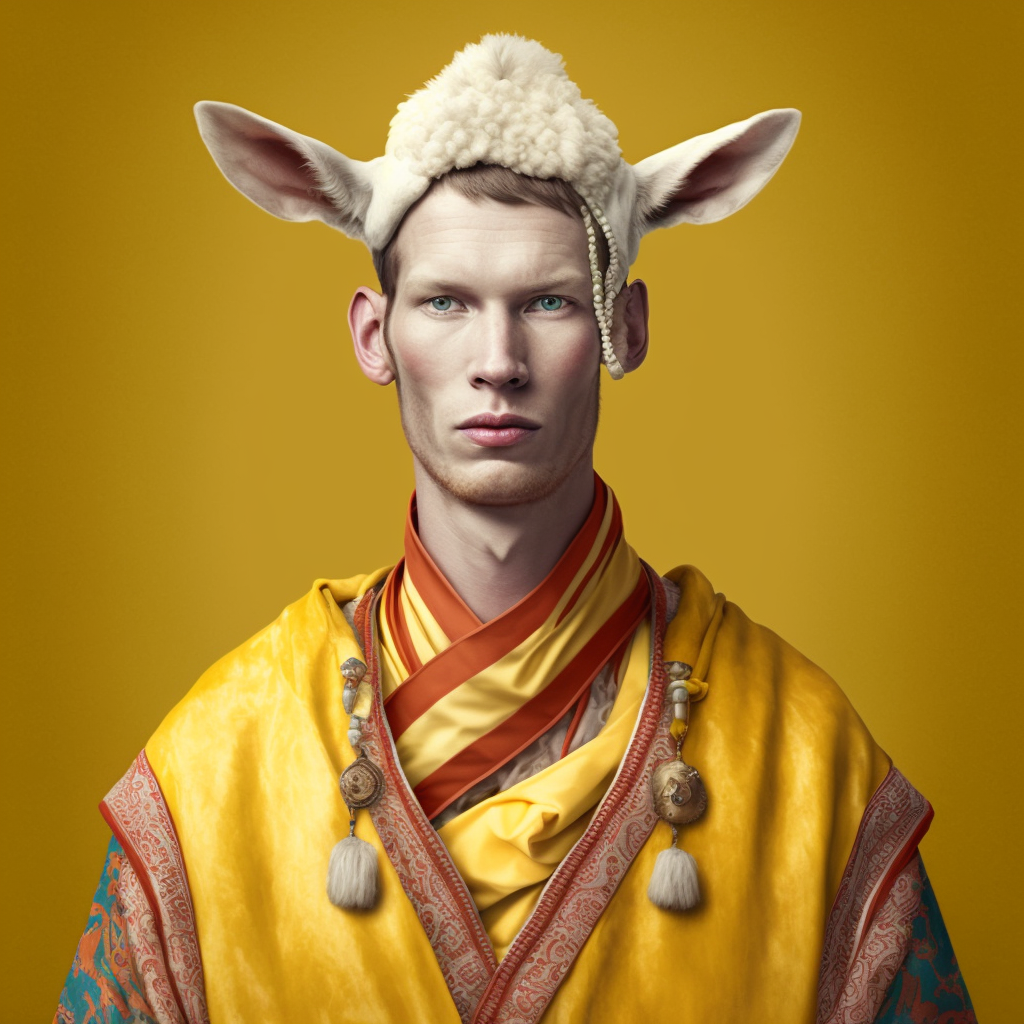
The taciturn vendor, who looked caucasian, wore a yellow jacket and a bonnet oddly reminiscent of a llama’s scalp and ears. The dish he was preparing made Youssef drool.
“What’s that?” he asked.
“This is Lorgh Drülp
, said the vendor. Ancient recipe from the silk road. Very rare. Very tasty.”
He smiled when Youssef ordered a full plate with a side of tsampa. He told him to sit and wait on a stool beside an old and wobbly table.
January 23, 2023 at 1:27 pm #6451In reply to: Orbs of Madjourneys
The progress on the quest in the Land of the Quirks was too tantalizing; Xavier made himself a quick sandwich and jumped back on it during his lunch break.
 The jungle had an oppressing quality… Maybe it has to do with the shrieks of the apes tearing the silence apart.
 It was time for a slight adjustment of his avatar.
Xavimunk opened his bag of tricks, something that the wise owl had suggested he looked into. Few items from the AIorium Emporium had been supplied. They tended to shift and disappear if you didn’t focus, but his intention was set on the task at hand. At the bottom of the bag, there was a small vial with a golden liquid with a tag written in ornate handwriting “MJ remix: for when words elude and shapes confuse at your own peril”.
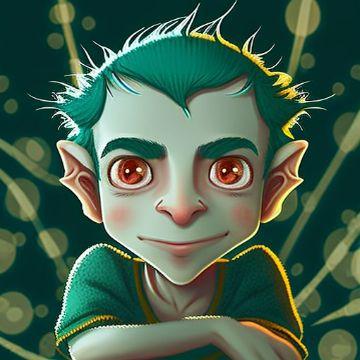 He gulped the potion without thinking too much. He felt himself shrink, and his arms elongate a little. There, he thought. Imp-munk’s more suited to the mission. Hope the effects will be temporary…
As Xavier mustered the courage to enter through the front gate, monkeys started to become silent. He couldn’t say if it was an ominous sign, or maybe an effect of his adaptation. The temple’s light inside was gorgeous, but nothing seemed to be there.
He gestured around, to make the menu appear. He looked again at the instructions on his screen overlay:
As for possible characters to engage, you may come across a sly fox who claims to know the location of the fruit but will only reveal it in exchange for a favor, or a brave adventurer who has been searching for the Golden Banana for years and may be willing to team up with you.
Suddenly a loud monkey honking noise came from outside, distracting him.
What the?… Had to be one of Zara’s remixes. He saw the three dots bleeping on the screen.
Here’s the Banana bus, hope it helps! Envoy! bugger Enjoy!
Yep… With the distinct typo-heavy accent, definitely Zara’s style. Strange idea that AL designated her as the leader… He’d have to roll with it.
Suddenly, as the Banana bus parked in front of the Temple, a horde of Italien speaking tourists started to flock in and snap pictures around. The monkeys didn’t know what to do and seemed to build growing and noisy interest in their assortiment of colorful shoes, flip-flops, boots and all.


Focus, thought Xavimunk… What did the wise owl say? Look for a guide…
Only the huge colorful bus seemed to take the space now… But wait… what if?He walked to the parking spot under the shades of the huge banyan tree next to the temple’s entrance, under which the bus driver had parked it. The driver was still there, napping under a newspaper, his legs on the wheel.
“Whatcha lookin’ at?” he said chewing his gum loudly. “Never seen a fox drive a banana bus before?”
Xavier smiled. “Any chance you can guide me to the location of the Golden Banana?”
“For a price… maybe.” The fox had jumped closely and was considering the strange avatar from head to toe.
“Ain’t no usual stuff that got you into this? Got any left? That would be a nice price.”
“As it happens…” Xavier smiled.The quest seemed back on track. Xavier looked at the time. Blimmey! already late again. And I promised Brytta to get some Chinese snacks for dinner.
January 23, 2023 at 6:13 am #6448In reply to: Orbs of Madjourneys
In the muggy warmth of the night, Yasmin tossed and turned on her bed. A small fan on the bedside table rattled noisily next to her but did little to dispel the heat. She kicked the thin sheet covering her to the ground, only to retrieve it and gather it tightly around herself when she heard a familiar sound.
“You little shit,” she hissed, slapping wildly in the direction of the high pitched whine.
She could make out the sound of a child crying in the distance and briefly considered getting up to check before hearing quick footsteps pass her door. Sister Aliti was on duty tonight. She liked Sister Aliti with her soft brown eyes and wide toothy smile — nothing seemed to rattle her. She liked all the Nuns, perhaps with the exception of Sister Finnlie.
Sister Finnlie was a sharp faced woman who was obsessed with cleanliness and sometimes made the children cry for such silly little things … perhaps if they talked too loudly or spilled some crumbs on the floor at lunch time. “Let them be, Sister,” Sister Aliti would admonish her and Sister Finnlie would pinch her lips and make a huffing noise.
The other day, during the morning reflection time when everyone sat in silent contemplation, Yasmin had found herself fixated on Sister Finnlie’s hands, her thin fingers tidily entwined on her lap. And Yasmin remembered a conversation with her friends online about AI creating a cleaning woman with sausage fingers. “Sometimes they look like a can of worms,” Youssef had said.
And, looking at those fingers and thinking about Youssef and the others and the fun conversations they had, Yasmin snort laughed.
She had tried to suppress it but the more she tried the more it built up inside of her until it exploded from her nose in a loud grunting noise. Sister Aliti had giggled but Sister Finnlie had glared at Yasmin and very pointedly rolled her eyes. Later, she’d put her on bin cleaning duty, surely the worst job ever, and Yasmin knew for sure it was pay back.
January 22, 2023 at 11:35 am #6447In reply to: Newsreel from the Rim of the Realm
Miss Bossy sat at her desk, scanning through the stack of papers on her desk. She was searching for the perfect reporter to send on a mission to investigate a mysterious story that had been brought to her attention. Suddenly, her eyes landed on the name of Samuel Sproink. He was new to the Rim of the Realm Newspaper and had a reputation for being a tenacious and resourceful reporter.
She picked up the phone and dialed his number. “Sproink, I have a job for you,” she said in her gruff voice.
“Yes, Miss Bossy, what can I do for you?” Samuel replied, his voice full of excitement.
“I want you to go down to Cartagena, Spain, in the Golden Banana off the Mediterranean coast. There have been sightings of Barbary macaques happening there and tourists being assaulted and stolen only their shoes, which is odd of course, and also obviously unusual for the apes to be seen so far off the Strait of Gibraltar. I want you to get to the bottom of it. I need you to find out what’s really going on and report back to me with your findings.”
“Consider it done, Miss Bossy,” Samuel said confidently. He had always been interested in wildlife and the idea of investigating a mystery involving monkeys was too good to pass up.
He hang up the phone to go and pack his bags and head to the airport, apparently eager to start his investigation.
“Apes again?” Ricardo who’s been eavesdropping what surprised at the sudden interest. After that whole story about the orangutan man, he thought they’d be done with the menagerie, but apparently, Miss Bossy had something in mind. He would have to quiz Sweet Sophie to remote view on that and anticipate possible links and knots in the plot.
January 21, 2023 at 4:17 pm #6426In reply to: Orbs of Madjourneys
The artificial lights of Berlin were starting to switch off in the horizon, leaving the night plunged in darkness minutes before the sunrise. It was a moment of peace that Xavier enjoyed, although it reminded him of how sleepless his night had been.
The game had taken a side step, as he’d been pouring all his attention into his daytime job, and his personal project with Artificial Life AL. It was a long way from the little boy at school with dyslexia who was using cheeky jokes as a way to get by the snides. Since then, he’d known some of the unusual super-powers this condition gave him as well. Chiefly: abstract and out-of-the-box thinking, puzzle-solving genius, and an almost other-worldly ability at keeping track of the plot. All these skills were in fact of tremendous help at his work, which was blending traditional areas of technology along with massive amounts of loosely connected data.
He yawned and went to brush his teeth. His usual meditation routine had also been disrupted by the activity of late, but he just couldn’t go to bed without a little time to cool off and calm down the agitation of his thoughts.
Sitting on the meditation mat, his thoughts strayed off towards the preparation for the trip. Going to Australia would have seemed exciting a few years back, but the idea of packing a suitcase, and going through the long flight and the logistics involved got him more anxious than excited, despite the contagious enthusiasm of his friends. Since he’d settled in Berlin, after never settling for too long in one place (his job afforded him to work wherever whenever), he’d kind of stopped looking for the next adventure. He hadn’t even looked at flight options yet, and hoped that the building momentum would spur him into this adventure. For now, he needed the rest.
The quirk quest assigned to his persona in the game was fun. Monkeys and Golden banana to look for, wise owls and sly foxes, the whimsical goofy nature of the quest seemed good for the place he was in.
AL had been suggesting the players to insert the game elements into their realities, and sometimes its comments or instructions seemed to slip between layers of reality — this was an intriguing mystery to Xavier.
He’d instructed AL to discreetly assist Youssef with his trouble — the Thi Gang seemed to be an ethical hacker developer company front for more serious business. Chatter on the net had tied it to a network of shell companies involved in some strange activities. A name had popped up, linked to mysterious recluse billionaire Botty Banworth, the owner of Youssef’s boss rival blog named Knoweth.He slipped into the bed, careful not to wake up Brytta, who was sleeping tightly. It was her day off, otherwise she would have been gone already to her shift. It would be good to connect in the morning, and enjoy some break from mind stuff. They had planned a visit to Kantonstrasse (the local Chinatown) for Chinese New Year, and he couldn’t wait for it.
January 19, 2023 at 10:49 am #6419In reply to: Orbs of Madjourneys
“I’d advise you not to take the parrot, Zara,” Harry the vet said, “There are restrictions on bringing dogs and other animals into state parks, and you can bet some jobsworth official will insist she stays in a cage at the very least.”
“Yeah, you’re right, I guess I’ll leave her here. I want to call in and see my cousin in Camden on the way to the airport in Sydney anyway. He has dozens of cats, I’d hate for anything to happen to Pretty Girl,” Zara replied.
“Is that the distant cousin you met when you were doing your family tree?” Harry asked, glancing up from the stitches he was removing from a wounded wombat. “There, he’s good to go. Give him a couple more days, then he can be released back where he came from.”
Zara smiled at Harry as she picked up the animal. “Yes! We haven’t met in person yet, and he’s going to show me the church my ancestor built. He says people have been spotting ghosts there lately, and there are rumours that it’s the ghost of the old convict Isaac who built it. If I can’t find photos of the ancestors, maybe I can get photos of their ghosts instead,” Zara said with a laugh.
“Good luck with that,” Harry replied raising an eyebrow. He liked Zara, she was quirkier than the others.
Zara hadn’t found it easy to research her mothers family from Bangalore in India, but her fathers English family had been easy enough. Although Zara had been born in England and emigrated to Australia in her late 20s, many of her ancestors siblings had emigrated over several generations, and Zara had managed to trace several down and made contact with a few of them. Isaac Stokes wasn’t a direct ancestor, he was the brother of her fourth great grandfather but his story had intrigued her. Sentenced to transportation for stealing tools for his work as a stonemason seemed to have worked in his favour. He built beautiful stone buildings in a tiny new town in the 1800s in the charming style of his home town in England.
Zara planned to stay in Camden for a couple of days before meeting the others at the Flying Fish Inn, anticipating a pleasant visit before the crazy adventure started.

Zara stepped down from the bus, squinting in the bright sunlight and looking around for her newfound cousin Bertie. A lanky middle aged man in dungarees and a red baseball cap came forward with his hand extended.
“Welcome to Camden, Zara I presume! Great to meet you!” he said shaking her hand and taking her rucksack. Zara was taken aback to see the family resemblance to her grandfather. So many scattered generations and yet there was still a thread of familiarity. “I bet you’re hungry, let’s go and get some tucker at Belle’s Cafe, and then I bet you want to see the church first, hey? Whoa, where’d that dang parrot come from?” Bertie said, ducking quickly as the bird swooped right in between them.
“Oh no, it’s Pretty Girl!” exclaimed Zara. “She wasn’t supposed to come with me, I didn’t bring her! How on earth did you fly all this way to get here the same time as me?” she asked the parrot.
“Pretty Girl has her ways, don’t forget to feed the parrot,” the bird replied with a squalk that resembled a mirthful guffaw.
“That’s one strange parrot you got here, girl!” Bertie said in astonishment.
“Well, seeing as you’re here now, Pretty Girl, you better come with us,” Zara said.
“Obviously,” replied Pretty Girl. It was hard to say for sure, but Zara was sure she detected an avian eye roll.
They sat outside under a sunshade to eat rather than cause any upset inside the cafe. Zara fancied an omelette but Pretty Girl objected, so she ordered hash browns instead and a fruit salad for the parrot. Bertie was a good sport about the strange talking bird after his initial surprise.
Bertie told her a bit about the ghost sightings, which had only started quite recently. They started when I started researching him, Zara thought to herself, almost as if he was reaching out. Her imagination was running riot already.
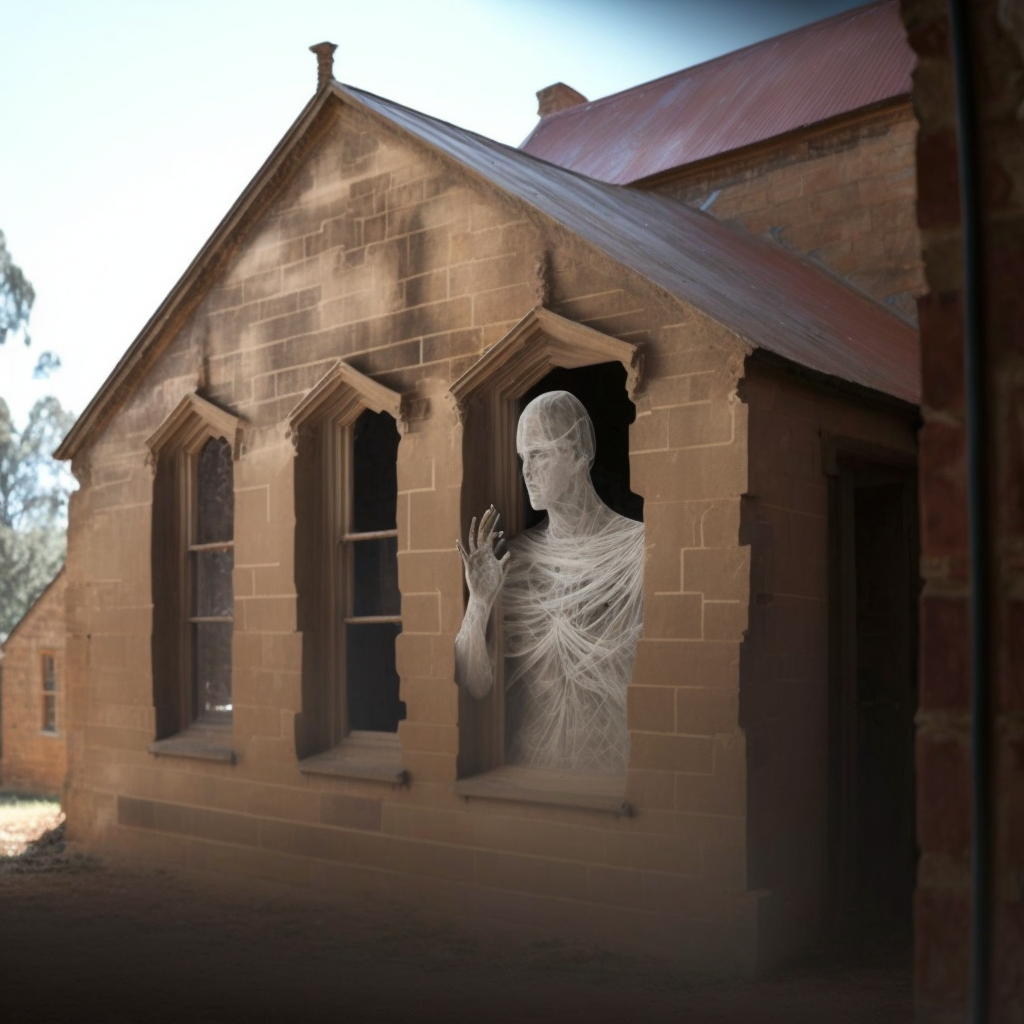
Bertie showed Zara around the church, a small building made of sandstone, but no ghost appeared in the bright heat of the afternoon. He took her on a little tour of Camden, once a tiny outpost but now a suburb of the city, pointing out all the original buildings, in particular the ones that Isaac had built. The church was walking distance of Bertie’s house and Zara decided to slip out and stroll over there after everyone had gone to bed.
Bertie had kindly allowed Pretty Girl to stay in the guest bedroom with her, safe from the cats, and Zara intended that the parrot stay in the room, but Pretty Girl was having none of it and insisted on joining her.
“Alright then, but no talking! I don’t want you scaring any ghost away so just keep a low profile!”
The moon was nearly full and it was a pleasant walk to the church. Pretty Girl fluttered from tree to tree along the sidewalk quietly. Enchanting aromas of exotic scented flowers wafted into her nostrils and Zara felt warmly relaxed and optimistic.
Zara was disappointed to find that the church was locked for the night, and realized with a sigh that she should have expected this to be the case. She wandered around the outside, trying to peer in the windows but there was nothing to be seen as the glass reflected the street lights. These things are not done in a hurry, she reminded herself, be patient.
Sitting under a tree on the grassy lawn attempting to open her mind to receiving ghostly communications (she wasn’t quite sure how to do that on purpose, any ghosts she’d seen previously had always been accidental and unexpected) Pretty Girl landed on her shoulder rather clumsily, pressing something hard and chill against her cheek.
“I told you to keep a low profile!” Zara hissed, as the parrot dropped the key into her lap. “Oh! is this the key to the church door?”
It was hard to see in the dim light but Zara was sure the parrot nodded, and was that another avian eye roll?
Zara walked slowly over the grass to the church door, tingling with anticipation. Pretty Girl hopped along the ground behind her. She turned the key in the lock and slowly pushed open the heavy door and walked inside and up the central aisle, looking around. And then she saw him.
Zara gasped. For a breif moment as the spectral wisps cleared, he looked almost solid. And she could see his tattoos.
“Oh my god,” she whispered, “It is really you. I recognize those tattoos from the description in the criminal registers. Some of them anyway, it seems you have a few more tats since you were transported.”
“Aye, I did that, wench. I were allays fond o’ me tats, does tha like ’em?”
He actually spoke to me! This was beyond Zara’s wildest hopes. Quick, ask him some questions!
“If you don’t mind me asking, Isaac, why did you lie about who your father was on your marriage register? I almost thought it wasn’t you, you know, that I had the wrong Isaac Stokes.”
A deafening rumbling laugh filled the building with echoes and the apparition dispersed in a labyrinthine swirl of tattood wisps.
“A story for another day,” whispered Zara, “Time to go back to Berties. Come on Pretty Girl. And put that key back where you found it.”
 January 18, 2023 at 12:51 pm #6413
In reply to: Orbs of Madjourneys
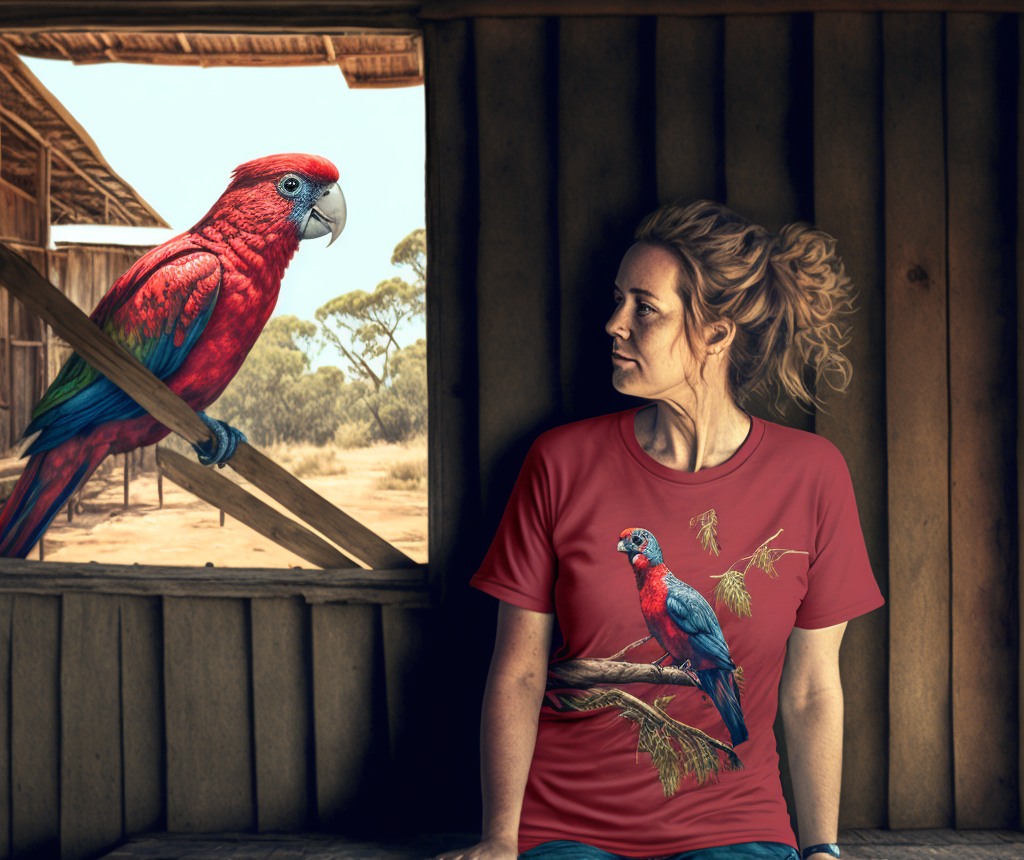
Zara was long overdue for some holiday time off from her job at the Bungwalley Valley animal rescue centre in New South Wales and the suggestion to meet her online friends at the intriguing sounding Flying Fish Inn to look for clues for their online game couldn’t have come at a better time. Lucky for her it wasn’t all that far, relatively speaking, although everything is far in Australia, it was closer than coming from Europe. Xavier would have a much longer trip. Zara wasn’t quite sure where exactly Yasmin was, but she knew it was somewhere in Asia. It depended on which refugee camp she was assigned to, and Zara had forgotten to ask her recently. All they had talked about was the new online game, and how confusing it all was.
The biggest mystery to Zara was why she was the leader in the game. She was always the one who was wandering off on side trips and forgetting what everyone else was up to. If the other game followers followed her lead there was no telling where they’d all end up!
“But it is just a game,” Pretty Girl, the rescue parrot interjected. Zara had known some talking parrots over the years, but never one quite like this one. Usually they repeated any nonsense that they’d heard but this one was different. She would miss it while she was away on holiday, and for a moment considered taking the talking parrot with her on the trip. If she did, she’d have to think about changing her name though, Pretty Girl wasn’t a great name but it was hard to keep thinking of names for all the rescue creatures.
After Zara had done the routine morning chores of feeding the various animals, changing the water bowls, and cleaning up the less pleasant aspects of the job, she sat down in the office room of the rescue centre with a cup of coffee and a sandwich. She was in good physical shape for 57, wiry and energetic, but her back ached at times and a sit down was welcome before the vet arrived to check on all the sick and wounded animals.
Pretty Girl flew over from the kennels, and perched outside the office room window. When the parrot had first been dropped off at the centre, they’d put her in a big cage, but in no uncertain terms Pretty Girl had told them she’d done nothing wrong and was wrongfully imprisoned and to release her at once. It was rather a shock to be addresssed by a parrot in such a way, and it was agreed between the staff and the vet to set her free and see what happened. And Pretty Girl had not flown away.
“Hey Pretty Girl, why don’t you give me some advice on this confusing new game I’m playing with my online friends?” Zara asked.
“Pretty Girl wants some of your tuna sandwich first,” replied the parrot. After Zara had obliged, the parrot continued at some surprising length.
“My advice would be to not worry too much about getting the small details right. The most important thing is to have fun and enjoy the creative process. Just give me a bit more tuna,” Pretty Girl said, before continuing.
“Remember that as a writer, you have the power to shape the story and the characters as you see fit. It’s okay to make mistakes, and it’s okay to not know everything. Allow yourself to be inspired by the world around you and let the story unfold naturally. Trust in your own creativity and don’t be afraid to take risks. And remember, it’s not the small details that make a story great, it’s the emotions and experiences that the characters go through that make it truly memorable. And always remember to feed the parrot.”
“Maybe I should take you on holiday with me after all,” Zara replied. “You really are an amazing bird, aren’t you?”
 January 17, 2023 at 8:17 am #6393
In reply to: Train your subjective AI – text version
Give me an unusual plot structure for a narrative
One unusual plot structure for a narrative could be a “reverse chronological” structure, where the story begins at the end and works backwards in time, revealing events and information in a non-linear way. Another could be a “choose your own adventure” style, where the reader is presented with a series of choices at different points in the story that determine the direction and outcome of the plot.
How would role playing qualify in terms of plot structure?
Role-playing games (RPGs) can be considered a unique form of plot structure because they are interactive and open-ended. In a traditional RPG, the players take on the roles of characters within a fictional setting and work together to create a shared narrative. The plot structure of an RPG is determined by the actions and decisions of the players, rather than a pre-written script. The game master (GM) creates an overarching plot and a set of rules for the players to follow, but the players’ choices and actions will determine the direction and outcome of the story. This makes the plot structure of an RPG fluid and ever-changing, unlike a traditional linear narrative.
What about “Cloud Atlas” in terms of plot structure?
“Cloud Atlas” is a novel written by David Mitchell that was later adapted into a film. It has a complex and non-linear plot structure, which employs multiple storylines that are set in different time periods and locations, and are connected by recurring themes and motifs. The novel is divided into six nested stories, each set in a different time period and location, that are told in a non-linear fashion. The story begins in the 19th century and then jumps back and forth between the 19th, 20th and 23rd century, and each story is interconnected and interrelated, with characters reappearing in different time periods, the events that happen in one story impacting the others. The novel is also notable for its use of different genres, such as science fiction, historical fiction, and thriller, and the way it explores the themes of destiny, reincarnation, and the power of human connection. The film adaptation also used this structure, with the different stories intertwined and characters reprising their roles in different settings and eras.
Take a story thread made of comments. In each comment is a text about characters in a particular plot, location, action etc. The comments are sequential, but they are not necessarily continuous. It is a mix between Cloud Atlas and RPG plot structures. How do you sort something that’s fundamentally non-linear to present it in an accessible way?
One way to sort and present a story thread made of comments that is fundamentally non-linear, yet accessible, is to group the comments based on their content. For example, you could group the comments by characters, and present them in chronological order of their appearance in the story. Another way could be grouping the comments by location, and present them in chronological order of when the action takes place in that particular location. You could also group comments by the type of action taking place, such as combat, conversation, or puzzle-solving, and present them in chronological order of when they occur in the story.
Another approach could be using visual aids, such as mind maps, timelines, or flowcharts, to help organize and present the information in a clear and easy-to-understand way. For example, you could use a mind map to show how different characters are connected, or a timeline to show the chronology of events. Additionally, you could use labels, such as “character introduction,” “location change,” or “plot twist,” to make it clear to the reader what type of information they can expect in each comment.
It’s also important to keep in mind the audience for which you are organizing the story. It should be easy for them to understand and follow the story, and if it’s a game, you should make sure it’s easy for the players to play and make decisions.
January 15, 2023 at 1:18 pm #6391In reply to: Train your subjective AI – text version
write the plot of an absurd non-linear novel, featuring 4 characters
The novel begins with the introduction of four characters: a retired archaeologist named Harold, a struggling musician named Samantha, a disillusioned corporate drone named Tim, and a reclusive inventor named Claire.
Harold, who is obsessed with ancient Egyptian hieroglyphs, discovers a mysterious underground chamber beneath a pyramid in Egypt. Inside, he finds a strange device that he believes is a time machine. Harold decides to use the device to travel back in time to ancient Egypt in order to decipher the hieroglyphs.
Samantha, who is trying to make a name for herself as a musician, is struggling to come up with new material for her music. One day, she discovers that she can create beautiful music by communicating with plants telepathically. She becomes obsessed with this new form of music-making and decides to quit her day job and pursue it full-time.
Tim, who is stuck in a dead-end job, is feeling unfulfilled and uninspired. One day, he stumbles upon a robotic mime performance art show. The performance inspires him to quit his job and pursue his dream of becoming a mime artist.
Claire, who is a reclusive inventor, has been working on a project to create a type of artificial intelligence that can communicate with humans using calligraphic body language. She finally succeeds and creates an AI that she names “Calli”.
As the story progresses, the characters’ paths begin to intersect in unexpected ways. Harold gets stuck in ancient Egypt and has to rely on Samantha’s telepathic plant communication skills to find a way back to the present. Tim’s robotic mime art becomes a hit and he starts working with Claire to integrate Calli into his performances.
As the story reaches its climax, all four characters come together to use their unique skills and abilities to solve a problem that threatens the fate of the world.
Throughout the novel, the plot unfolds in a non-linear fashion, jumping back and forth in time and between the different character’s perspectives. The story is filled with absurdity and unexpected twists and turns, leaving the reader guessing until the very end.
What sort of problem that threatens the fate of the world will be resolved by their combined skills?
As the story progresses, the characters begin to uncover a sinister plot by a group of powerful individuals who are intent on using the time machine to alter the course of history for their own gain. They plan to use the time machine to go back in time and change key events that would give them immense wealth and power in the present. Harold and Samantha, with the help of Tim and Claire, must race against time to stop the villains from carrying out their plan.
Harold’s expertise in ancient Egyptian hieroglyphs plays a crucial role in deciphering the clues that lead to the location of the time machine. Samantha’s telepathic plant communication skills are used to locate the hidden underground chamber where the time machine is kept. Tim’s robotic mime art and Claire’s AI Calli are used to infiltrate the villains’ hideout and gather intelligence on their plans.
In the final act, the four characters come together to use their unique skills and abilities to stop the villains from altering history. Harold uses his knowledge of ancient Egypt to navigate the time machine and travel back in time to stop the villains from changing key events. Samantha uses her telepathic plant communication skills to communicate with the plants in the past and gather information on the villains’ whereabouts. Tim and Claire use their robotic mime and AI skills to create a diversion and distract the villains while Harold and Samantha complete their mission.
In the end, the four characters succeed in stopping the villains and saving the fate of the world. The novel ends with the four characters going their separate ways, but they all know that they will always have each other to rely on in the face of any challenge that comes their way.
January 15, 2023 at 11:42 am #6389In reply to: Newsreel from the Rim of the Realm
“What in the good name of our Lady, have these two been on?” Miss Bossy was at a loss for words while Ricardo was waiting sheepishly at her desk, as though he was expecting an outburst.
“Look, Ricardo, I’m not against a little tweaking for newsworthiness, but this takes twisting reality to a whole new level!Ricardo had just dropped their last article.
Local Hero at the Rescue – Stray Residents found after in a trip of a lifetime
article by Hilda Astoria & Continuity BrownIn a daring and heroic move, Nurse Trassie, a local hero and all-around fantastic human being, managed to track down and rescue three elderly women who had gone on an adventure of a lifetime. Sharon, Mavis, and Gloria (names may have been altered to preserve their anonymity) were residents of a UK nursing home who, in a moment of pure defiance and desire for adventure, decided to go off their meds and escape to the Nordics.
The three women, who had been feeling cooped up and underappreciated in their nursing home, decided to take matters into their own hands and embark on a journey to see the world. They had heard of the beautiful landscapes and friendly people of the Nordics and their rejuvenating traditional cures and were determined to experience it for themselves.
Their journey, however, was not without its challenges. They faced many obstacles, including harsh weather conditions and language barriers. But they were determined to press on, and their determination paid off when they were taken in by a kind-hearted local doctor who gave them asylum and helped them rehabilitate stray animals.
Nurse Trassie, who had been on the lookout for the women since their disappearance, finally caught wind of their whereabouts and set out to rescue them. She tracked them down to the Nordics, where she found them living in a small facility in the woods, surrounded by a menagerie of stray animals they had taken in and were nursing back to health, including rare orangutans retired from local circus.
Upon her arrival, Nurse Trassie was greeted with open arms by the women, who were overjoyed to see her. They told her of their adventures and showed her around their cabin, introducing her to the animals they had taken in and the progress they had made in rehabilitating them.
Nurse Trassie, who is known for her compassion and dedication to her patients, was deeply touched by the women’s story and their love for the animals. She knew that they needed to be back in the care of professionals and that the animals needed to be properly cared for, so she made arrangements to bring them back home.
The women were reluctant to leave their newfound home and the animals they had grown to love, but they knew that it was the right thing to do. They said their goodbyes and set off on the long journey back home with Nurse Trassie by their side.
The three women returned to their nursing home filled with stories to share, and Nurse Trassie was hailed as a hero for her efforts in rescuing them. They were greeted with cheers and applause from the staff and other residents, who were thrilled to have them back safe and sound.
Nurse Trassie, who is known for her sharp wit and sense of humor, commented on the situation with a tongue-in-cheek remark, “It’s not every day that you get to rescue three feisty elderlies from the wilds of the Nordics and bring them back to safety. I’m just glad I could be of service.”
In conclusion, the three women’s adventure in the Nordics may have been unorthodox, but it was an adventure nonetheless. They were able to see the world and help some animals in the process. Their story serves as a reminder to never give up on your dreams, no matter your age or circumstances. And of course, a big shoutout to Nurse Trassie for her heroic actions and dedication to her patients.
Bossy sighed. “It might do for now, but don’t let those two abuse the artificial intelligence to write article for them… I liked their old style better. This feels too… tidy. We’re not the A-News network, let’s not forget our purpose.”
Ricardo nodded. Miss Bossy had been more mellow since the sales of the newspaper had exploded during the pandemic. With people at home, looking for conspiracies and all, the newspaper had known a resurgence of interest, and they even had to hire new staff. Giles Gibber, Glimmer Gambol (came heavily recommended by Blithe, the PI friend of Hilda’s), Samuel Sproink and Fionna Flibbergibbet.
“And how is Sophie? That adventure into her past trauma was a bit much on her…” she mused.
“She’s doing alright” answered Ricardo. “She’s learning to hone her remote-viewing skills to send our staff into new mysteries to solve. With a bit of AI assist…”
“Oh, stop it already with your AI-this, AI-that! Hope there’ll still be room for some madness in all that neatly tidy purring of polite output.”
“That’s why we’re here for, I reckon.” Ric’ smiled wryly.
January 13, 2023 at 9:12 pm #6382In reply to: Prompts of Madjourneys
Write more about the group of people who lived inside of giant mushrooms, making it sound exciting and fun, and maybe a bit dangerous due to the nature of the mushrooms
As the group journeyed deeper into the Land of the Quirks, they stumbled upon a group of people living inside of giant mushrooms. The mushrooms were enormous, some as tall as skyscrapers, and they seemed to glow with an ethereal light. The group was amazed as they walked through the forest of mushrooms, each one unique in shape and size.
The people who lived inside of the mushrooms were a friendly and welcoming bunch, they welcomed the group with open arms and invited them to explore their homes. The inside of the mushrooms was a magical and mysterious place, the walls and ceilings were covered in a soft, velvety texture and the floors were made of a spongy, springy material. The light inside the mushrooms was soft and diffused, creating a warm and inviting atmosphere.
As the group explored the mushroom homes, they discovered that the people who lived there had a deep connection to the mushrooms. They used the mushrooms as a source of food, shelter, and medicine. They had learned to harness the unique properties of the mushrooms to create everything they needed to survive.
The group also discovered that the mushrooms had a dangerous side. The mushrooms were not only a source of life, but also a source of death. The group was warned that the mushrooms were unpredictable and that they should be careful when exploring. Some mushrooms were poisonous, others were carnivorous, and still, others had mind-altering properties.
Despite the danger, the group was excited to explore the mushrooms and learn more about the people who lived there. They knew that the journey would be filled with challenges, but they were determined to overcome them and discover the secrets of the mushrooms. The group had a lot of fun and adventure living with the people inside of giant mushrooms, and they learned a lot about the nature of the mushrooms and their own nature.
January 13, 2023 at 8:53 pm #6380In reply to: Prompts of Madjourneys
After a few tries:
- As the group has split up at the fork of the road, we discover a total of 4 new characters from the Land of the Quirks. Tell us how each group is encountering some or all of these characters, who they are, their gibberish-sounding names, and what is their quirks, and what they wear, or their activities. Make our main characters and maybe some of the new ones meet back at a common spot with a special event after that.
- please rewrite the above, retaining the eccentricity but more grounded, less childish, and with a little darker tone and mystery.
- please try again, make Spoink and Flibbertigibbet human and give them less endearing or friendly behaviours; name two more characters met on the road.
As the group split up at the fork of the road, each one encountered new characters from the Land of the Quirks.
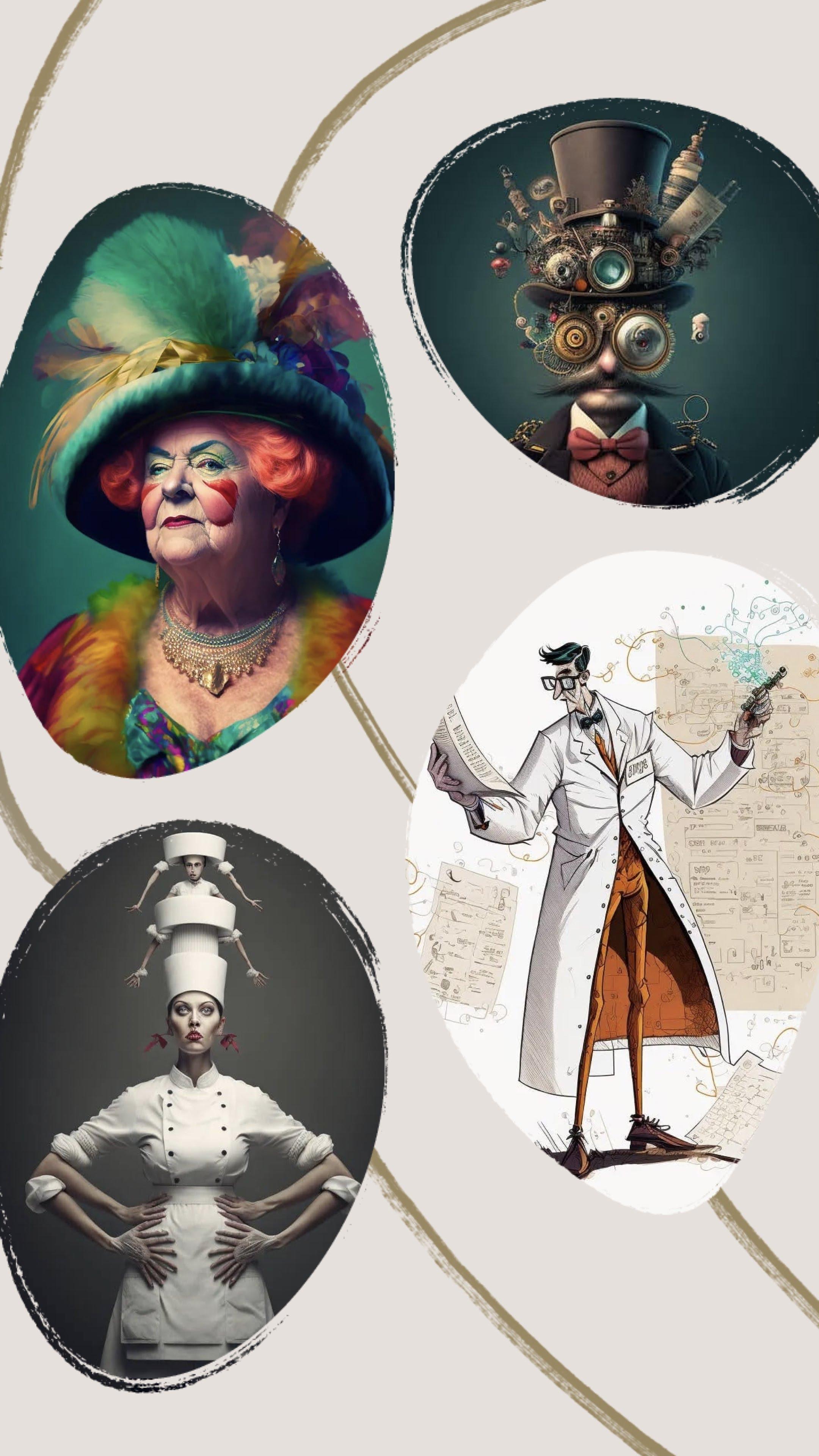
Zara and Yasmin, who took the left path, met a man named “Sproink” who was a small, wiry man with a spring for a tail. He was always bouncing around and speaking in a language that sounded like a mix of gibberish and music. Sproink was a collector of shiny objects and had a bag full of them, he was also a scavenger, always looking for things to add to his collection. He was wearing a small top hat and a monocle. He was also known to be a bit of a thief and a con artist.
Xavier and Youssef, who took the right path, met a woman named “Flibbertigibbet” a tall, slender woman that had multiple arms. Flibbertigibbet was very talkative and friendly, always trying to strike up a conversation. She spoke in a language that sounded like a mix of gibberish and baby talk. She was a chef and was always carrying a pot and a spoon, but she also had a dark side, she was known to be a bit of a manipulator and a spy, always observing and gathering information for a mysterious organization. She was wearing a big chef hat and apron.
As the group met back at the fork, they were surprised to find that Sproink and Flibbertigibbet had also met there. The four new characters joined the group, and together they continued their journey to find the “Key of Quirks”. Along the way, they met two more characters;
They met a man named “Gibber” who was a tall, gaunt man with elongated limbs and fingers. He was always speaking in a language that sounded like a mix of gibberish and numbers. He was a mathematician and a scientist, always working on complex equations and theories. He was known to be a bit of a loner, and didn’t interact much with others. He was wearing a lab coat and goggles.
They also met a woman named “Glimmer” she was a short, plump woman with a shimmering skin that seemed to change color depending on the light. She was always speaking in a language that sounded like a mix of gibberish and poetry. She was an artist and a performer, always creating and performing in different shows. She was known to be a bit of a flirt and a bit of a drama queen. She was wearing a colorful and eccentric clothing, such as a flowy dress and a large hat adorned with feathers.
As the group journeyed on, they encountered more characters, each one with their own unique quirks and personalities. They met a variety of people, some friendly and some not so friendly, but all of them adding to the mysterious and unknown nature of the Land of the Quirks.
As the group reached the end of their journey and found the “Key of Quirks”, they realized that the key was not just a physical object but a symbol of acceptance and embracing individuality. They learned that the true key to leaving the Land of the Quirks was understanding and accepting the quirks of oneself and others.
The group had a bittersweet goodbye with their new friends, Sproink, Flibbertigibbet, Gibber and Glimmer, and the other characters they had met. They knew that they would always carry a piece of the Land of the Quirks with them and would always remember the mysterious and eccentric adventure they had.
 January 13, 2023 at 6:47 pm #6378
Topic: Prompts of Madjourneys
A thread to share some of the prompts behind the AI-assisted journey into new adventures.
To start off…
Please write the exciting start of a novel.
Some elements you can integrate if you want:
– Four randomly chosen names full of panache that sound distinct from each other, slightly exotic and evocative
– the sentiment from this quotation: “Look around… Beauty is everywhere. You only have to look to see it.” – a group of four people ready for an adventure, standing in a cave with stalactites in front of a giant orb or bubble that seem to open to another brightly lit realm. Inside the bigger orb are some smaller orbs.
– the following term “mad journeys”Told it to continue and it brought dragons… Asked to tone down the fantasy stuff, here’s what came out:
They walked into a small village, where they were greeted by a group of people wearing clothes that looked like they were from the 1920s. The people told them that they were in the land of the “Quirks”, a place where everything and everyone was a little bit different, and that they had to find the “Key of Quirks” in order to leave the land.
The group set off on their journey to find the key, but little did they know that their adventure was about to become even more exciting and quirky than they could ever have imagined. They encountered a talking dog, a man who had a garden on top of his head, and a group of people who lived inside of giant mushrooms.
As they journeyed on, they faced challenges and made new friends, but most importantly they learn to embrace their own quirks and individuality. Eventually, they found the key and were able to leave the land of the Quirks, but they knew that they would always carry a piece of that land with them.
January 11, 2023 at 10:45 pm #6369In reply to: Train your subjective AI – text version
Expanding on the ancient channeled recipes:
Sure! Here are a few more examples of imaginary, exotic dishes that are channeled from ancient times:
- Grilled Squibber: A delicacy made from a type of mythical creature, said to be the ancestor of the modern-day squid. Served with a side of sautéed moss.
- Quimberry Pottage: A hearty stew made with quimberries, a type of imaginary fruit said to have medicinal properties, and chunks of tender meat.
- Plankton Pudding: A sweet and creamy dessert made with a type of plankton that is said to have a unique flavor and texture.
- Glurk Steak: A succulent cut of meat from the glurk, a creature said to live in the depths of the ocean. It’s served with a side of grilled slime pods.
- Chog Chops: Tender slices of meat cut from the Chog, a creature that said to be a mix between a chicken and a hog, served with a side of fried root vegetables.
- Bonkleberry Tarte: A sweet and tangy tarte made from Bonkleberries, a type of imaginary fruit said to have a unique spicy flavor.
- Gobber Soup: A thick and hearty soup made from the meat of Gobbers, a type of creature that is said to live in the swamps, served with a side of toasted marsh reeds.
- Smorlax Stir Fry: A traditional dish made from stir-frying meat of Smorlax, a mythical creature said to have a unique blend of flavors, served with a side of fried mushrooms.
Please note that all above dishes are completely fictional, and their ingredients and properties are also completely imaginary, this are not real dishes.
January 11, 2023 at 10:32 pm #6368In reply to: Train your subjective AI – text version
Something in the style of FPooh:
Arona heard the music growing louder as she approached the source of the sound. She could see a group of people gathered around a large fire, the flickering light casting shadows on the faces of the dancers. She hesitated for a moment, remembering the isolation of her journey and wondering if she was ready to be among people again. But the music was too inviting, and she found herself drawn towards the group.
As she neared the fire, she saw a young man playing a flute, the music flowing from his fingers with a fluid grace that captivated her. He looked up as she approached, and their eyes met. She could see the surprise and curiosity in his gaze, and she smiled, feeling a sense of connection she had not felt in a long time.
Fiona was sitting on a bench in the park, watching the children play. She had brought her sketchbook with her, but for once she didn’t feel the urge to draw. Instead she watched the children’s laughter, feeling content and at peace. Suddenly, she saw a young girl running towards her, a look of pure joy on her face. The girl stopped in front of her and held out a flower, offering it to Fiona with a smile.
Taken aback, Fiona took the flower and thanked the girl. The girl giggled and ran off to join her friends. Fiona looked down at the flower in her hand, and she felt a sense of inspiration, like a spark igniting within her. She opened her sketchbook and began to draw, feeling the weight lift from her shoulders and the magic of creativity flowing through her.
Minky led the group of misfits towards the emporium, his bowler hat bobbing on his head. He chattered excitedly, telling stories of the wondrous items to be found within Mr Jib’s store. Yikesy followed behind, still lost in his thoughts of Arona and feeling a sense of dread at the thought of buying a bowler hat. The green fairy flitted along beside him, her wings a blur of movement as she chattered with the parrot perched on her shoulder.
As they reached the emporium, they were disappointed to find it closed. But Minky refused to be discouraged, and he led them to a nearby cafe where they could sit and enjoy some tea and cake while they wait for the emporium to open. The green fairy was delighted, and she ordered a plate of macarons, smiling as she tasted the sweetness of the confections.
About creativity & everyday magic
Fiona had always been drawn to the magic of creativity, the way a blank page could be transformed into a world of wonder and beauty. But lately, she had been feeling stuck, unable to find the spark that ignited her imagination. She would sit with her sketchbook, pencil in hand, and nothing would come to her.
She started to question her abilities, wondering if she had lost the magic of her art. She spent long hours staring at her blank pages, feeling a weight on her chest that seemed to be growing heavier every day.
But then she remembered the green fairy’s tears and Yikesy’s longing for Arona, and she realized that the magic of creativity wasn’t something that could be found only in art. It was all around her, in the everyday moments of life.
She started to look for the magic in the small things, like the way the sunlight filtered through the trees, or the way a child’s laughter could light up a room. She found it in the way a stranger’s smile could lift her spirits, and in the way a simple cup of tea could bring her comfort.
And as she started to see the magic in the everyday, she found that the weight on her chest lifted and the spark of inspiration returned. She picked up her pencil and began to draw, feeling the magic flowing through her once again.
She understand that creativity blocks aren’t a destination, but just a step, just like the bowler hat that Minky had bought for them all, a bit of everyday magic, nothing too fancy but a sense of belonging, a sense of who they are and where they are going. And she let her pencil flow, with the hopes that one day, they will all find their way home.
January 10, 2023 at 10:15 pm #6363In reply to: Train your subjective AI – text version
try another short story, with a bit of drama with the following words:
road form charlton smooth everyone cottage hanging rush offer agree subject district included appear sha returning grattidge nottingham 848 tetbury chicken
It was a cold and gloomy day in the small village of Tetbury, nestled in the picturesque Cotswolds district. A young woman named Sha was returning home to her cottage after a long and tiring journey. She had been away visiting her family in Nottingham and was looking forward to relaxing in her cozy home.
As she walked down the dirt road that led to her cottage, she couldn’t help but notice that something was off. Her neighbor, Mr. Charlton, was outside hanging laundry and he didn’t acknowledge her as she walked by. Sha thought it was strange, as he was usually a friendly and sociable person.
When Sha arrived at her cottage, she was shocked to find that it had been broken into. The front door was ajar and the inside of her home had been ransacked. Sha immediately panicked and called the police, who arrived on the scene shortly thereafter.
The police officers, including Inspector Grattidge, took Sha’s statement and began to investigate the crime. They discovered that a group of burglars had been operating in the area, targeting homes and businesses in the district. The burglars had been known for their smooth operations and their ability to strike quickly, which led to their nickname “The Smooth Operators”.
As Sha waited for the police to finish their investigation, she couldn’t shake the feeling that something was not right. She had always thought of Tetbury as a safe and friendly place, and she couldn’t believe that something like this could happen in her community.
As the investigation went on, the police found out that the Smooth operators have been targeting houses with no security cameras, but Sha’s cottage was an exception, the police were able to find out that the group offered to pay a considerable sum of money to the people who reported the locations of the houses that had no cameras, and it was Mr. Charlton who was the informant and he even rushed to Sha’s cottage as soon as he knew the police was investigating the case, He was arrested for the crime and Sha was heartbroken to find out that her once friendly neighbor had betrayed her.
Feeling violated and betrayed, Sha decided that she could no longer stay in the village and she put her cottage up for sale. She packed up her belongings and moved away, leaving behind the memories of her peaceful home and the community she had once thought of as her own. The end.
December 6, 2022 at 2:17 pm #6350In reply to: Family Stories From The Other Side ~ Book Two
Transportation
Isaac Stokes 1804-1877
Isaac was born in Churchill, Oxfordshire in 1804, and was the youngest brother of my 4X great grandfather Thomas Stokes. The Stokes family were stone masons for generations in Oxfordshire and Gloucestershire, and Isaac’s occupation was a mason’s labourer in 1834 when he was sentenced at the Lent Assizes in Oxford to fourteen years transportation for stealing tools.
Churchill where the Stokes stonemasons came from: on 31 July 1684 a fire destroyed 20 houses and many other buildings, and killed four people. The village was rebuilt higher up the hill, with stone houses instead of the old timber-framed and thatched cottages. The fire was apparently caused by a baker who, to avoid chimney tax, had knocked through the wall from her oven to her neighbour’s chimney.
Isaac stole a pick axe, the value of 2 shillings and the property of Thomas Joyner of Churchill; a kibbeaux and a trowel value 3 shillings the property of Thomas Symms; a hammer and axe value 5 shillings, property of John Keen of Sarsden.
(The word kibbeaux seems to only exists in relation to Isaac Stokes sentence and whoever was the first to write it was perhaps being creative with the spelling of a kibbo, a miners or a metal bucket. This spelling is repeated in the criminal reports and the newspaper articles about Isaac, but nowhere else).
In March 1834 the Removal of Convicts was announced in the Oxford University and City Herald: Isaac Stokes and several other prisoners were removed from the Oxford county gaol to the Justitia hulk at Woolwich “persuant to their sentences of transportation at our Lent Assizes”.
via digitalpanopticon:
Hulks were decommissioned (and often unseaworthy) ships that were moored in rivers and estuaries and refitted to become floating prisons. The outbreak of war in America in 1775 meant that it was no longer possible to transport British convicts there. Transportation as a form of punishment had started in the late seventeenth century, and following the Transportation Act of 1718, some 44,000 British convicts were sent to the American colonies. The end of this punishment presented a major problem for the authorities in London, since in the decade before 1775, two-thirds of convicts at the Old Bailey received a sentence of transportation – on average 283 convicts a year. As a result, London’s prisons quickly filled to overflowing with convicted prisoners who were sentenced to transportation but had no place to go.
To increase London’s prison capacity, in 1776 Parliament passed the “Hulks Act” (16 Geo III, c.43). Although overseen by local justices of the peace, the hulks were to be directly managed and maintained by private contractors. The first contract to run a hulk was awarded to Duncan Campbell, a former transportation contractor. In August 1776, the Justicia, a former transportation ship moored in the River Thames, became the first prison hulk. This ship soon became full and Campbell quickly introduced a number of other hulks in London; by 1778 the fleet of hulks on the Thames held 510 prisoners.
Demand was so great that new hulks were introduced across the country. There were hulks located at Deptford, Chatham, Woolwich, Gosport, Plymouth, Portsmouth, Sheerness and Cork.The Justitia via rmg collections:
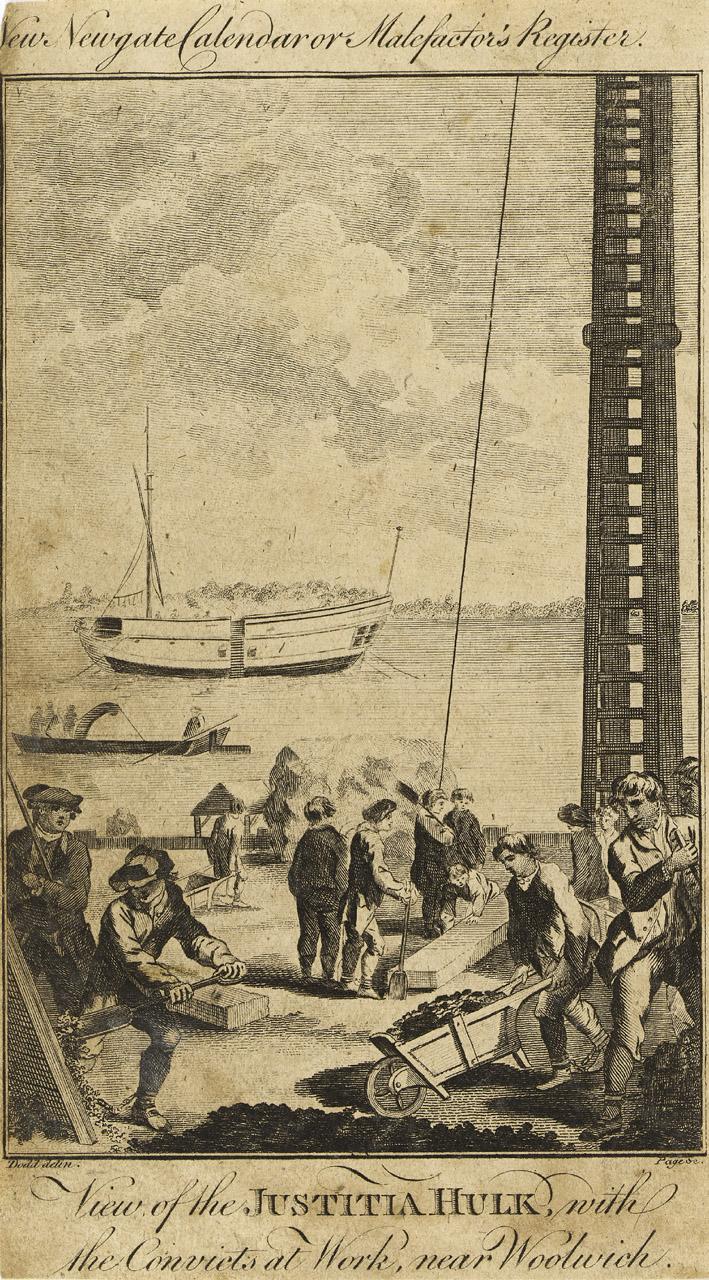
Convicts perform hard labour at the Woolwich Warren. The hulk on the river is the ‘Justitia’. Prisoners were kept on board such ships for months awaiting deportation to Australia. The ‘Justitia’ was a 260 ton prison hulk that had been originally moored in the Thames when the American War of Independence put a stop to the transportation of criminals to the former colonies. The ‘Justitia’ belonged to the shipowner Duncan Campbell, who was the Government contractor who organized the prison-hulk system at that time. Campbell was subsequently involved in the shipping of convicts to the penal colony at Botany Bay (in fact Port Jackson, later Sydney, just to the north) in New South Wales, the ‘first fleet’ going out in 1788.
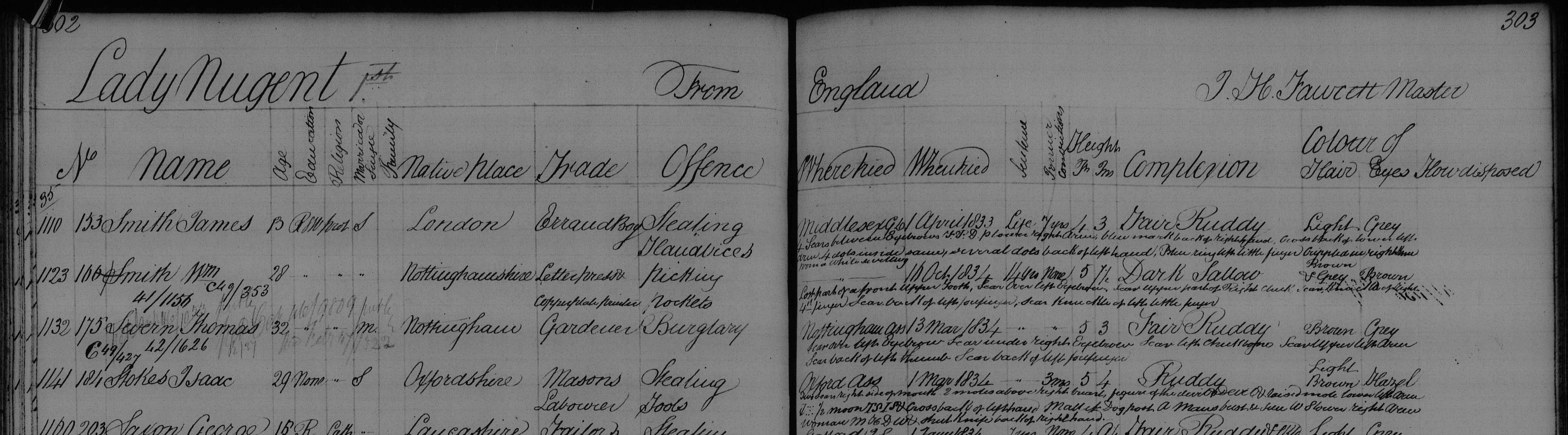
While searching for records for Isaac Stokes I discovered that another Isaac Stokes was transported to New South Wales in 1835 as well. The other one was a butcher born in 1809, sentenced in London for seven years, and he sailed on the Mary Ann. Our Isaac Stokes sailed on the Lady Nugent, arriving in NSW in April 1835, having set sail from England in December 1834.
Lady Nugent was built at Bombay in 1813. She made four voyages under contract to the British East India Company (EIC). She then made two voyages transporting convicts to Australia, one to New South Wales and one to Van Diemen’s Land (Tasmania). (via Wikipedia)
via freesettlerorfelon website:
On 20 November 1834, 100 male convicts were transferred to the Lady Nugent from the Justitia Hulk and 60 from the Ganymede Hulk at Woolwich, all in apparent good health. The Lady Nugent departed Sheerness on 4 December 1834.
SURGEON OLIVER SPROULE
Oliver Sproule kept a Medical Journal from 7 November 1834 to 27 April 1835. He recorded in his journal the weather conditions they experienced in the first two weeks:
‘In the course of the first week or ten days at sea, there were eight or nine on the sick list with catarrhal affections and one with dropsy which I attribute to the cold and wet we experienced during that period beating down channel. Indeed the foremost berths in the prison at this time were so wet from leaking in that part of the ship, that I was obliged to issue dry beds and bedding to a great many of the prisoners to preserve their health, but after crossing the Bay of Biscay the weather became fine and we got the damp beds and blankets dried, the leaks partially stopped and the prison well aired and ventilated which, I am happy to say soon manifested a favourable change in the health and appearance of the men.
Besides the cases given in the journal I had a great many others to treat, some of them similar to those mentioned but the greater part consisted of boils, scalds, and contusions which would not only be too tedious to enter but I fear would be irksome to the reader. There were four births on board during the passage which did well, therefore I did not consider it necessary to give a detailed account of them in my journal the more especially as they were all favourable cases.
Regularity and cleanliness in the prison, free ventilation and as far as possible dry decks turning all the prisoners up in fine weather as we were lucky enough to have two musicians amongst the convicts, dancing was tolerated every afternoon, strict attention to personal cleanliness and also to the cooking of their victuals with regular hours for their meals, were the only prophylactic means used on this occasion, which I found to answer my expectations to the utmost extent in as much as there was not a single case of contagious or infectious nature during the whole passage with the exception of a few cases of psora which soon yielded to the usual treatment. A few cases of scurvy however appeared on board at rather an early period which I can attribute to nothing else but the wet and hardships the prisoners endured during the first three or four weeks of the passage. I was prompt in my treatment of these cases and they got well, but before we arrived at Sydney I had about thirty others to treat.’
The Lady Nugent arrived in Port Jackson on 9 April 1835 with 284 male prisoners. Two men had died at sea. The prisoners were landed on 27th April 1835 and marched to Hyde Park Barracks prior to being assigned. Ten were under the age of 14 years.
The Lady Nugent:
Isaac’s distinguishing marks are noted on various criminal registers and record books:
“Height in feet & inches: 5 4; Complexion: Ruddy; Hair: Light brown; Eyes: Hazel; Marks or Scars: Yes [including] DEVIL on lower left arm, TSIS back of left hand, WS lower right arm, MHDW back of right hand.”
Another includes more detail about Isaac’s tattoos:
“Two slight scars right side of mouth, 2 moles above right breast, figure of the devil and DEVIL and raised mole, lower left arm; anchor, seven dots half moon, TSIS and cross, back of left hand; a mallet, door post, A, mans bust, sun, WS, lower right arm; woman, MHDW and shut knife, back of right hand.”
From How tattoos became fashionable in Victorian England (2019 article in TheConversation by Robert Shoemaker and Zoe Alkar):
“Historical tattooing was not restricted to sailors, soldiers and convicts, but was a growing and accepted phenomenon in Victorian England. Tattoos provide an important window into the lives of those who typically left no written records of their own. As a form of “history from below”, they give us a fleeting but intriguing understanding of the identities and emotions of ordinary people in the past.
As a practice for which typically the only record is the body itself, few systematic records survive before the advent of photography. One exception to this is the written descriptions of tattoos (and even the occasional sketch) that were kept of institutionalised people forced to submit to the recording of information about their bodies as a means of identifying them. This particularly applies to three groups – criminal convicts, soldiers and sailors. Of these, the convict records are the most voluminous and systematic.
Such records were first kept in large numbers for those who were transported to Australia from 1788 (since Australia was then an open prison) as the authorities needed some means of keeping track of them.”On the 1837 census Isaac was working for the government at Illiwarra, New South Wales. This record states that he arrived on the Lady Nugent in 1835. There are three other indent records for an Isaac Stokes in the following years, but the transcriptions don’t provide enough information to determine which Isaac Stokes it was. In April 1837 there was an abscondment, and an arrest/apprehension in May of that year, and in 1843 there was a record of convict indulgences.
From the Australian government website regarding “convict indulgences”:
“By the mid-1830s only six per cent of convicts were locked up. The vast majority worked for the government or free settlers and, with good behaviour, could earn a ticket of leave, conditional pardon or and even an absolute pardon. While under such orders convicts could earn their own living.”
In 1856 in Camden, NSW, Isaac Stokes married Catherine Daly. With no further information on this record it would be impossible to know for sure if this was the right Isaac Stokes. This couple had six children, all in the Camden area, but none of the records provided enough information. No occupation or place or date of birth recorded for Isaac Stokes.
I wrote to the National Library of Australia about the marriage record, and their reply was a surprise! Issac and Catherine were married on 30 September 1856, at the house of the Rev. Charles William Rigg, a Methodist minister, and it was recorded that Isaac was born in Edinburgh in 1821, to parents James Stokes and Sarah Ellis! The age at the time of the marriage doesn’t match Isaac’s age at death in 1877, and clearly the place of birth and parents didn’t match either. Only his fathers occupation of stone mason was correct. I wrote back to the helpful people at the library and they replied that the register was in a very poor condition and that only two and a half entries had survived at all, and that Isaac and Catherines marriage was recorded over two pages.
I searched for an Isaac Stokes born in 1821 in Edinburgh on the Scotland government website (and on all the other genealogy records sites) and didn’t find it. In fact Stokes was a very uncommon name in Scotland at the time. I also searched Australian immigration and other records for another Isaac Stokes born in Scotland or born in 1821, and found nothing. I was unable to find a single record to corroborate this mysterious other Isaac Stokes.
As the age at death in 1877 was correct, I assume that either Isaac was lying, or that some mistake was made either on the register at the home of the Methodist minster, or a subsequent mistranscription or muddle on the remnants of the surviving register. Therefore I remain convinced that the Camden stonemason Isaac Stokes was indeed our Isaac from Oxfordshire.
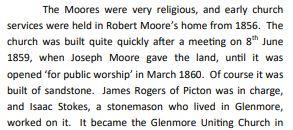
I found a history society newsletter article that mentioned Isaac Stokes, stone mason, had built the Glenmore church, near Camden, in 1859.

From the Wollondilly museum April 2020 newsletter:
From the Camden History website:
“The stone set over the porch of Glenmore Church gives the date of 1860. The church was begun in 1859 on land given by Joseph Moore. James Rogers of Picton was given the contract to build and local builder, Mr. Stokes, carried out the work. Elizabeth Moore, wife of Edward, laid the foundation stone. The first service was held on 19th March 1860. The cemetery alongside the church contains the headstones and memorials of the areas early pioneers.”
Isaac died on the 3rd September 1877. The inquest report puts his place of death as Bagdelly, near to Camden, and another death register has put Cambelltown, also very close to Camden. His age was recorded as 71 and the inquest report states his cause of death was “rupture of one of the large pulmonary vessels of the lung”. His wife Catherine died in childbirth in 1870 at the age of 43.
Isaac and Catherine’s children:
William Stokes 1857-1928
Catherine Stokes 1859-1846
Sarah Josephine Stokes 1861-1931
Ellen Stokes 1863-1932
Rosanna Stokes 1865-1919
Louisa Stokes 1868-1844.
It’s possible that Catherine Daly was a transported convict from Ireland.
Some time later I unexpectedly received a follow up email from The Oaks Heritage Centre in Australia.
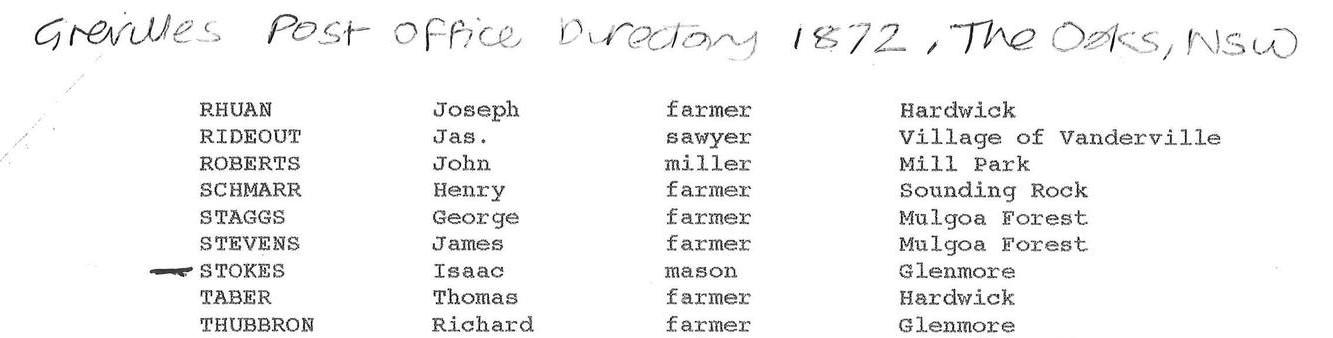
“The Gaudry papers which we have in our archive record him (Isaac Stokes) as having built: the church, the school and the teachers residence. Isaac is recorded in the General return of convicts: 1837 and in Grevilles Post Office directory 1872 as a mason in Glenmore.”
 November 18, 2022 at 4:47 pm #6348
In reply to: Family Stories From The Other Side ~ Book Two
Wong Sang
Wong Sang was born in China in 1884. In October 1916 he married Alice Stokes in Oxford.
Alice was the granddaughter of William Stokes of Churchill, Oxfordshire and William was the brother of Thomas Stokes the wheelwright (who was my 3X great grandfather). In other words Alice was my second cousin, three times removed, on my fathers paternal side.
Wong Sang was an interpreter, according to the baptism registers of his children and the Dreadnought Seamen’s Hospital admission registers in 1930. The hospital register also notes that he was employed by the Blue Funnel Line, and that his address was 11, Limehouse Causeway, E 14. (London)
“The Blue Funnel Line offered regular First-Class Passenger and Cargo Services From the UK to South Africa, Malaya, China, Japan, Australia, Java, and America. Blue Funnel Line was Owned and Operated by Alfred Holt & Co., Liverpool.
The Blue Funnel Line, so-called because its ships have a blue funnel with a black top, is more appropriately known as the Ocean Steamship Company.”Wong Sang and Alice’s daughter, Frances Eileen Sang, was born on the 14th July, 1916 and baptised in 1920 at St Stephen in Poplar, Tower Hamlets, London. The birth date is noted in the 1920 baptism register and would predate their marriage by a few months, although on the death register in 1921 her age at death is four years old and her year of birth is recorded as 1917.
Charles Ronald Sang was baptised on the same day in May 1920, but his birth is recorded as April of that year. The family were living on Morant Street, Poplar.
James William Sang’s birth is recorded on the 1939 census and on the death register in 2000 as being the 8th March 1913. This definitely would predate the 1916 marriage in Oxford.
William Norman Sang was born on the 17th October 1922 in Poplar.
Alice and the three sons were living at 11, Limehouse Causeway on the 1939 census, the same address that Wong Sang was living at when he was admitted to Dreadnought Seamen’s Hospital on the 15th January 1930. Wong Sang died in the hospital on the 8th March of that year at the age of 46.
Alice married John Patterson in 1933 in Stepney. John was living with Alice and her three sons on Limehouse Causeway on the 1939 census and his occupation was chef.
Via Old London Photographs:
“Limehouse Causeway is a street in east London that was the home to the original Chinatown of London. A combination of bomb damage during the Second World War and later redevelopment means that almost nothing is left of the original buildings of the street.”
Limehouse Causeway in 1925:
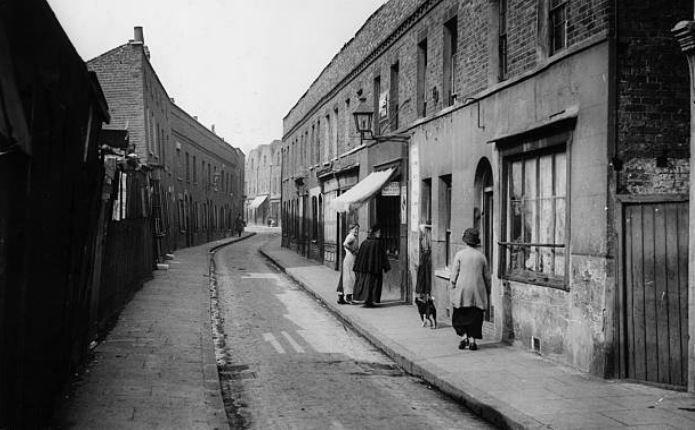
From The Story of Limehouse’s Lost Chinatown, poplarlondon website:
“Limehouse was London’s first Chinatown, home to a tightly-knit community who were demonised in popular culture and eventually erased from the cityscape.
As recounted in the BBC’s ‘Our Greatest Generation’ series, Connie was born to a Chinese father and an English mother in early 1920s Limehouse, where she used to play in the street with other British and British-Chinese children before running inside for teatime at one of their houses.
Limehouse was London’s first Chinatown between the 1880s and the 1960s, before the current Chinatown off Shaftesbury Avenue was established in the 1970s by an influx of immigrants from Hong Kong.
Connie’s memories of London’s first Chinatown as an “urban village” paint a very different picture to the seedy area portrayed in early twentieth century novels.
The pyramid in St Anne’s church marked the entrance to the opium den of Dr Fu Manchu, a criminal mastermind who threatened Western society by plotting world domination in a series of novels by Sax Rohmer.
Thomas Burke’s Limehouse Nights cemented stereotypes about prostitution, gambling and violence within the Chinese community, and whipped up anxiety about sexual relationships between Chinese men and white women.
Though neither novelist was familiar with the Chinese community, their depictions made Limehouse one of the most notorious areas of London.
Travel agent Thomas Cook even organised tours of the area for daring visitors, despite the rector of Limehouse warning that “those who look for the Limehouse of Mr Thomas Burke simply will not find it.”
All that remains is a handful of Chinese street names, such as Ming Street, Pekin Street, and Canton Street — but what was Limehouse’s chinatown really like, and why did it get swept away?
Chinese migration to Limehouse
Chinese sailors discharged from East India Company ships settled in the docklands from as early as the 1780s.
By the late nineteenth century, men from Shanghai had settled around Pennyfields Lane, while a Cantonese community lived on Limehouse Causeway.
Chinese sailors were often paid less and discriminated against by dock hirers, and so began to diversify their incomes by setting up hand laundry services and restaurants.
Old photographs show shopfronts emblazoned with Chinese characters with horse-drawn carts idling outside or Chinese men in suits and hats standing proudly in the doorways.
In oral histories collected by Yat Ming Loo, Connie’s husband Leslie doesn’t recall seeing any Chinese women as a child, since male Chinese sailors settled in London alone and married working-class English women.
In the 1920s, newspapers fear-mongered about interracial marriages, crime and gambling, and described chinatown as an East End “colony.”
Ironically, Chinese opium-smoking was also demonised in the press, despite Britain waging war against China in the mid-nineteenth century for suppressing the opium trade to alleviate addiction amongst its people.
The number of Chinese people who settled in Limehouse was also greatly exaggerated, and in reality only totalled around 300.
The real Chinatown
Although the press sought to characterise Limehouse as a monolithic Chinese community in the East End, Connie remembers seeing people of all nationalities in the shops and community spaces in Limehouse.
She doesn’t remember feeling discriminated against by other locals, though Connie does recall having her face measured and IQ tested by a member of the British Eugenics Society who was conducting research in the area.
Some of Connie’s happiest childhood memories were from her time at Chung-Hua Club, where she learned about Chinese culture and language.
Why did Chinatown disappear?
The caricature of Limehouse’s Chinatown as a den of vice hastened its erasure.
Police raids and deportations fuelled by the alarmist media coverage threatened the Chinese population of Limehouse, and slum clearance schemes to redevelop low-income areas dispersed Chinese residents in the 1930s.
The Defence of the Realm Act imposed at the beginning of the First World War criminalised opium use, gave the authorities increased powers to deport Chinese people and restricted their ability to work on British ships.
Dwindling maritime trade during World War II further stripped Chinese sailors of opportunities for employment, and any remnants of Chinatown were destroyed during the Blitz or erased by postwar development schemes.”
Wong Sang 1884-1930
The year 1918 was a troublesome one for Wong Sang, an interpreter and shipping agent for Blue Funnel Line. The Sang family were living at 156, Chrisp Street.
Chrisp Street, Poplar, in 1913 via Old London Photographs:
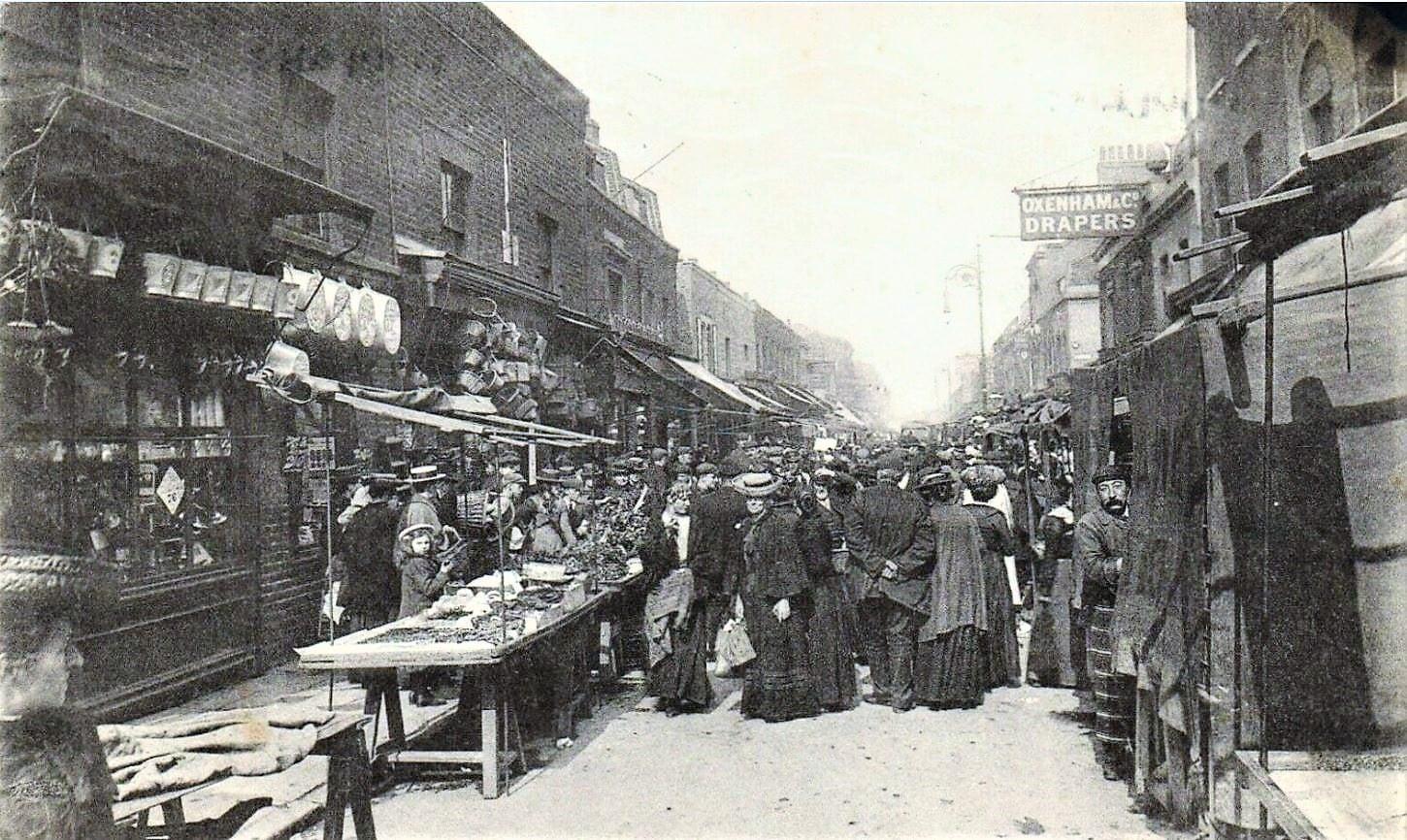
In February Wong Sang was discharged from a false accusation after defending his home from potential robbers.
East End News and London Shipping Chronicle – Friday 15 February 1918:
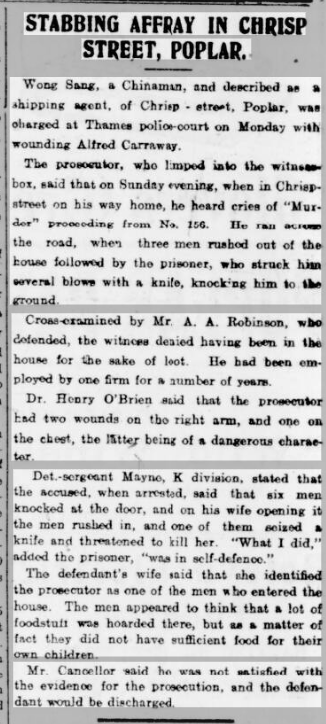
In August of that year he was involved in an incident that left him unconscious.
Faringdon Advertiser and Vale of the White Horse Gazette – Saturday 31 August 1918:
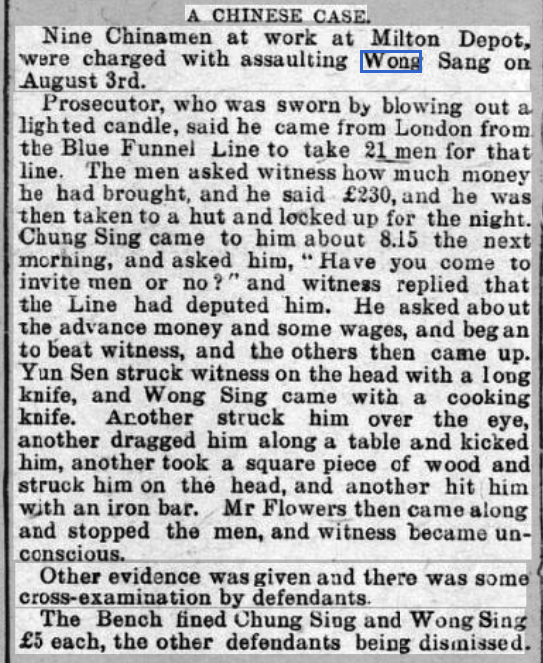
Wong Sang is mentioned in an 1922 article about “Oriental London”.
London and China Express – Thursday 09 February 1922:
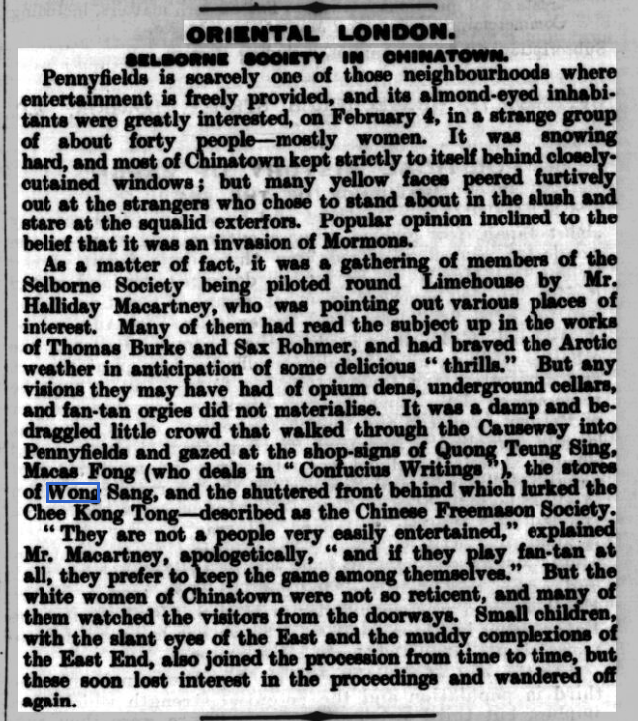
A photograph of the Chee Kong Tong Chinese Freemason Society mentioned in the above article, via Old London Photographs:
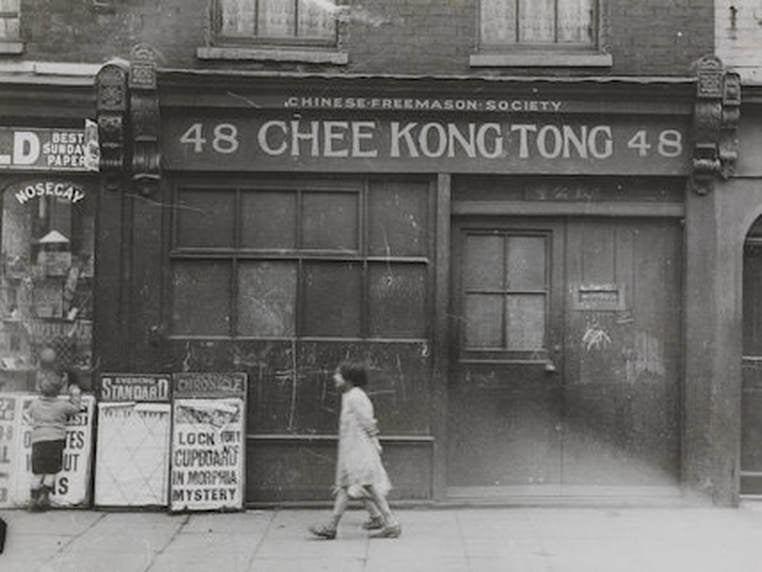
Wong Sang was recommended by the London Metropolitan Police in 1928 to assist in a case in Wellingborough, Northampton.
Difficulty of Getting an Interpreter: Northampton Mercury – Friday 16 March 1928:
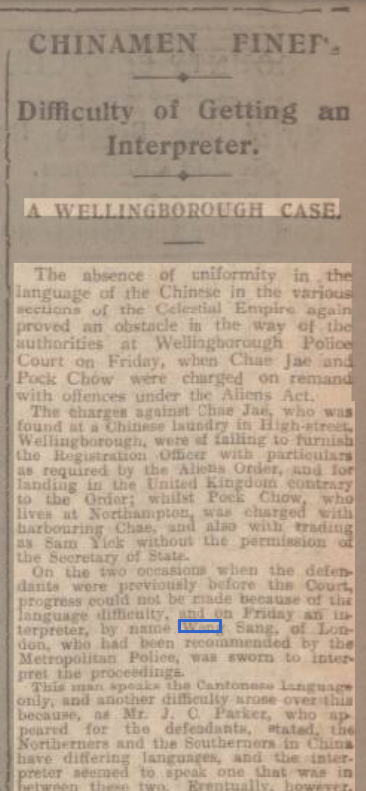
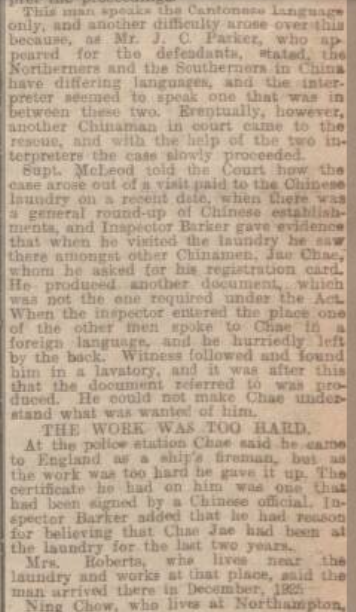
The difficulty was that “this man speaks the Cantonese language only…the Northeners and the Southerners in China have differing languages and the interpreter seemed to speak one that was in between these two.”
In 1917, Alice Wong Sang was a witness at her sister Harriet Stokes marriage to James William Watts in Southwark, London. Their father James Stokes occupation on the marriage register is foreman surveyor, but on the census he was a council roadman or labourer. (I initially rejected this as the correct marriage for Harriet because of the discrepancy with the occupations. Alice Wong Sang as a witness confirmed that it was indeed the correct one.)
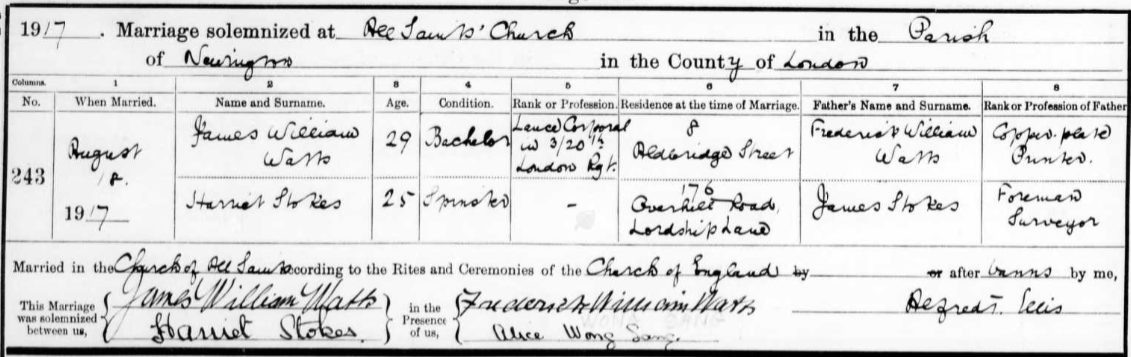
James William Sang 1913-2000 was a clock fitter and watch assembler (on the 1939 census). He married Ivy Laura Fenton in 1963 in Sidcup, Kent. James died in Southwark in 2000.
Charles Ronald Sang 1920-1974 was a draughtsman (1939 census). He married Eileen Burgess in 1947 in Marylebone. Charles and Eileen had two sons: Keith born in 1951 and Roger born in 1952. He died in 1974 in Hertfordshire.
William Norman Sang 1922-2000 was a clerk and telephone operator (1939 census). William enlisted in the Royal Artillery in 1942. He married Lily Mullins in 1949 in Bethnal Green, and they had three daughters: Marion born in 1950, Christine in 1953, and Frances in 1959. He died in Redbridge in 2000.
I then found another two births registered in Poplar by Alice Sang, both daughters. Doris Winifred Sang was born in 1925, and Patricia Margaret Sang was born in 1933 ~ three years after Wong Sang’s death. Neither of the these daughters were on the 1939 census with Alice, John Patterson and the three sons. Margaret had presumably been evacuated because of the war to a family in Taunton, Somerset. Doris would have been fourteen and I have been unable to find her in 1939 (possibly because she died in 2017 and has not had the redaction removed yet on the 1939 census as only deceased people are viewable).
Doris Winifred Sang 1925-2017 was a nursing sister. She didn’t marry, and spent a year in USA between 1954 and 1955. She stayed in London, and died at the age of ninety two in 2017.
Patricia Margaret Sang 1933-1998 was also a nurse. She married Patrick L Nicely in Stepney in 1957. Patricia and Patrick had five children in London: Sharon born 1959, Donald in 1960, Malcolm was born and died in 1966, Alison was born in 1969 and David in 1971.
I was unable to find a birth registered for Alice’s first son, James William Sang (as he appeared on the 1939 census). I found Alice Stokes on the 1911 census as a 17 year old live in servant at a tobacconist on Pekin Street, Limehouse, living with Mr Sui Fong from Hong Kong and his wife Sarah Sui Fong from Berlin. I looked for a birth registered for James William Fong instead of Sang, and found it ~ mothers maiden name Stokes, and his date of birth matched the 1939 census: 8th March, 1913.
On the 1921 census, Wong Sang is not listed as living with them but it is mentioned that Mr Wong Sang was the person returning the census. Also living with Alice and her sons James and Charles in 1921 are two visitors: (Florence) May Stokes, 17 years old, born in Woodstock, and Charles Stokes, aged 14, also born in Woodstock. May and Charles were Alice’s sister and brother.
I found Sharon Nicely on social media and she kindly shared photos of Wong Sang and Alice Stokes:
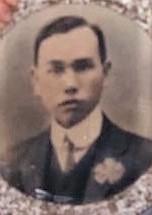
-
AuthorSearch Results