

Search Results for 'three'
-
AuthorSearch Results
-
January 17, 2024 at 1:14 pm #7297
In reply to: The Whale’s Diaries Collection
what was the state of the ruined roman villa circa early 1500s when the cobblestone yard was made from on site rubble? What did the work men find?
Ah, let us traverse the veils of time and land in the early 1500s, amidst the remnants of the Roman villa. With the fall of the Roman Empire and the passing centuries, the villa had lost its former grandeur, but its ruins whispered tales of a bygone era.
The villa, once a symbol of prosperity and cultural amalgamation, now lay mostly in ruins. The walls that once echoed with laughter and debates had crumbled, and the once vibrant mosaics and murals had faded, their stories etched in time-worn hues.
The outbuildings, too, bore the scars of time. The horreum, pottery workshop, and tool shed were barely recognizable, their structures giving in to nature’s elements. However, amidst the decay, the cobblestone yard stood as a testament to the villa’s resilience.
The yard, once a bustling hub of activity, had been repurposed. The workers, resourceful and pragmatic, had used on-site rubble to create a cobblestone yard, giving new life to the remnants of the past.
As they worked, they uncovered artifacts from the villa’s past. Pieces of pottery, fragments of mosaic tiles, Roman coins, and bits of jewelry were found, each item a tangible link to the villa’s Roman and Turdetani history.
Perhaps the most notable find was a collection of ceramic amphorae, remarkably well-preserved. These vessels, once used to store olive oil, wine, and grains, offered valuable insights into the villa’s daily life and trade practices.
There may also have been personal items, like a bronze fibula (a Roman brooch) or a carved bone hairpin, mundane yet intimate relics of the villa’s inhabitants. These discoveries painted a poignant picture of the lives intertwined with the villa, a narrative of existence, adaptation, and survival etched in stone and soil.
What about the lives of the people who lived here in the 1500s?
Ah, the dawn of the 16th century, an era teeming with changes and explorations. Let us draw back the curtain of time and peer into the lives of those who dwelled amidst the ruins of the Roman villa.
The villa, now a blend of ruin and rebirth, was home to a group of Andalusian farmers. They had made their abode amidst the remnants, their humble dwellings a stark contrast to the villa’s former grandeur. Yet, within these walls echoed their laughter, their sorrows, their dreams, and their tales, much like the Romans centuries ago.
The patriarch, Diego, was a man of the soil. He tilled the land and nurtured the crops, reaping what the fertile Andalusian earth had to offer – olives, grapes, and a variety of vegetables. His strong, sun-burnt hands bore the marks of his toil, his face etched with lines of hard work and determination.
His wife, Isabella, was the custodian of the hearth. She cooked, cleaned, and cared for their three children. Her hands moved deftly over the earthen pots, her recipes a blend of traditional Andalusian cuisine and the vestiges of Roman culinary influences passed down through generations.
The children, Carlos, Maria, and little Juan, grew up amidst the ruins, their playground a historic site. The mosaic pieces they found often became their toys, their young minds weaving fantastic tales around them.
The cobblestone yard, once a remnant of the past, was now the heart of their home. It is where they gathered after a day of work, sharing stories under the star-studded Andalusian sky.
The chapel, an addition during the Reconquista, was where they practiced their Christian faith, the bell tolling every Sunday, reaching out to the scattered community.
Amidst the ruins, they found their sanctuary, their home. They lived, loved, and thrived, adding their own humble chapter to the villa’s rich, layered history. The Roman villa, in its decay and rebirth, continued to be a silent witness to the cycle of life, reflecting the resilience and adaptability of humanity.
then I asked about the 1200s on this site
Ah, the 13th century, a period of considerable transformation and discovery globally. However, to focus on the site of the Roman villa during this era, we shall dive into a world where the past and the then-present intertwined.
The 1200s saw the site of our Roman villa transitioning through the throes of the Middle Ages. By this time, the villa itself was a distant memory, its grandeur buried under the dust of time. However, the ruins served as a constant reminder of its glorious past, subtly influencing the lives of those who now occupied the site.
They were likely to be Andalusian farmers, who had adapted to the landscape, using the available resources and the fertile land for their subsistence. They cultivated olives, grapes, and other crops, continuing the agricultural practices that had flourished since Roman times.
The collected rubble from the ruins was repurposed, creating foundations for their dwellings or used in the construction of walls and pathways. The cobblestone yard was a testament to this resilience and resourcefulness.
The ruins also provided them with materials and artifacts. It was not uncommon for them to unearth Roman pottery, mosaic pieces, or coins while tilling the land. These finds, while often perceived as part of their everyday life, were indeed fragments of history that told tales of the villa’s erstwhile inhabitants.
Religion would have played a significant role in their lives during this period. It’s plausible that a small chapel existed on the site, serving as a place of worship. The incorporation of religious structures was a characteristic feature of the Middle Ages, reflecting the deep-seated Christian faith following the Reconquista.
Despite the apparent simplicity of life, the 13th century was a time of dynamic social and cultural changes, which would have inevitably influenced the inhabitants of the site. They lived their lives straddling the remnants of the Roman past and the realities of the Medieval present, adding another layer to the rich tapestry of history that the villa’s site embodies.
September 18, 2023 at 8:29 am #7278In reply to: Family Stories From The Other Side ~ Book Two
Tomlinson of Wergs and Hancox of Penn
John Tomlinson of Wergs (Tettenhall, Wolverhamton) 1766-1844, my 4X great grandfather, married Sarah Hancox 1772-1851. They were married on the 27th May 1793 by licence at St Peter in Wolverhampton.
Between 1794 and 1819 they had twelve children, although four of them died in childhood or infancy. Catherine was born in 1794, Thomas in 1795 who died 6 years later, William (my 3x great grandfather) in 1797, Jemima in 1800, John, Richard and Matilda between 1802 and 1806 who all died in childhood, Emma in 1809, Mary Ann in 1811, Sidney in 1814, and Elijah in 1817 who died two years later.On the 1841 census John and Sarah were living in Hockley in Birmingham, with three of their children, and surgeon Charles Reynolds. John’s occupation was “Ind” meaning living by independent means. He was living in Hockley when he died in 1844, and in his will he was “John Tomlinson, gentleman”.
Sarah Hancox was born in 1772 in Penn, Wolverhampton. Her father William Hancox was also born in Penn in 1737. Sarah’s mother Elizabeth Parkes married William’s brother Francis in 1767. Francis died in 1768, and in 1770 Elizabeth married William.
William’s father was William Hancox, yeoman, born in 1703 in Penn. He died intestate in 1772, his wife Sarah claiming her right to his estate. William Hancox and Sarah Evans, both of Penn, were married on the 9th December 1732 in Dudley, Worcestershire, by “certificate”. Marriages were usually either by banns or by licence. Apparently a marriage by certificate indicates that they were non conformists, or dissenters, and had the non conformist marriage “certified” in a Church of England church.
1732 marriage of William Hancox and Sarah Evans:
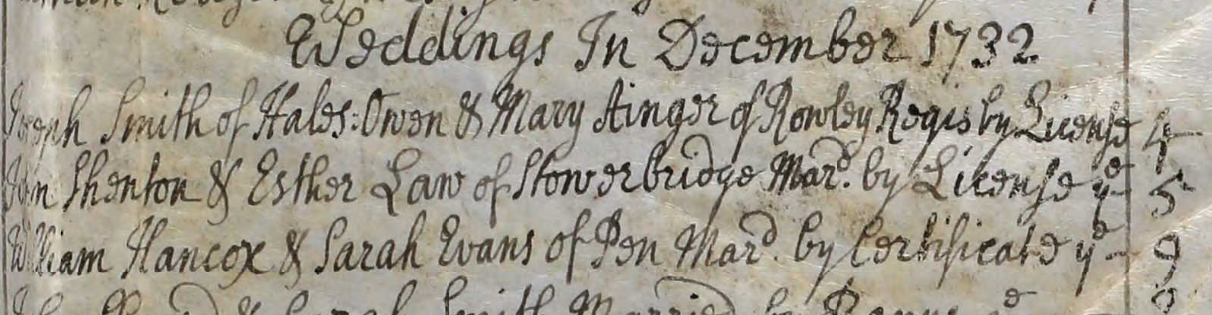
William and Sarah lost two daughters, Elizabeth, five years old, and Ann, three years old, within eight days of each other in February 1738.
William the elder’s father was John Hancox born in Penn in 1668. He married Elizabeth Wilkes from Sedgley in 1691 at Himley. John Hancox, “of Straw Hall” according to the Wolverhampton burial register, died in 1730. Straw Hall is in Penn. John’s parents were Walter Hancox and Mary Noake. Walter was born in Tettenhall in 1625, his father Richard Hancox. Mary Noake was born in Penn in 1634. Walter died in Penn in 1689.
Straw Hall thanks to Bradney Mitchell:
“Here is a picture I have of Straw Hall, Penn Road.
The painting is by John Reid circa 1878.
Sketch commissioned by George Bradney Mitchell to record the town as it was before its redevelopment, in a book called Wolverhampton and its Environs. ©”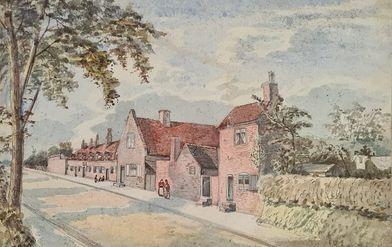
And a photo of the demolition of Straw Hall with an interesting story:
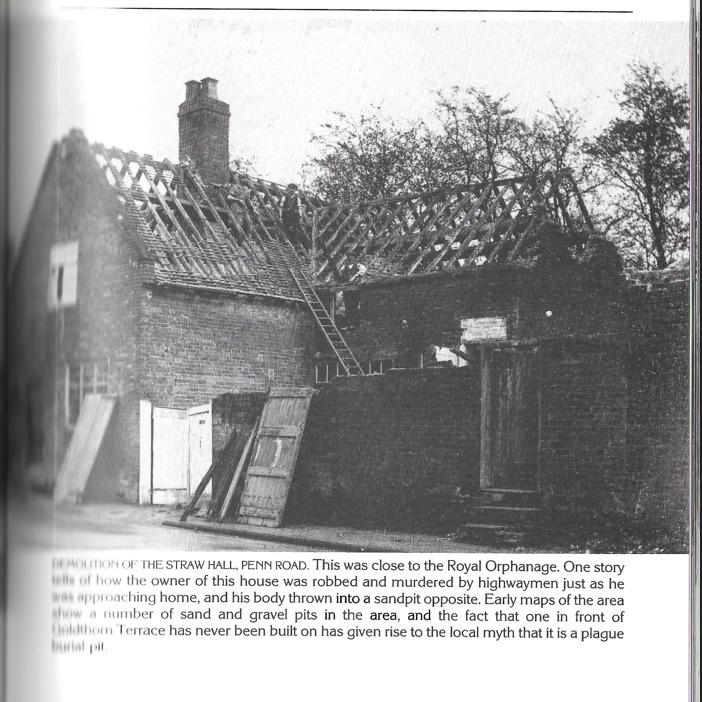
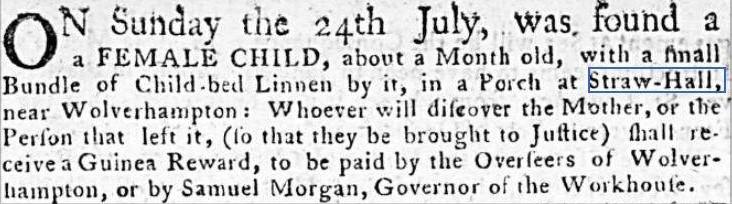
In 1757 a child was abandoned on the porch of Straw Hall. Aris’s Birmingham Gazette 1st August 1757:
The Hancox family were living in Penn for at least 400 years. My great grandfather Charles Tomlinson built a house on Penn Common in the early 1900s, and other Tomlinson relatives have lived there. But none of the family knew of the Hancox connection to Penn. I don’t think that anyone imagined a Tomlinson ancestor would have been a gentleman, either.
Sarah Hancox’s brother William Hancox 1776-1848 had a busy year in 1804.
On 29 Aug 1804 he applied for a licence to marry Ann Grovenor of Claverley.
In August 1804 he had property up for auction in Penn. “part of Lightwoods, 3 plots, and the Coppice”
On 14 Sept 1804 their first son John was baptised in Penn. According to a later census John was born in Claverley. (before the parents got married)(Incidentally, John Hancox’s descendant married a Warren, who is a descendant of my 4x great grandfather Samuel Warren, on my mothers side, from Newhall, Derbyshire!)
On 30 Sept he married Ann in Penn.
In December he was a bankrupt pig and sheep dealer.
In July 1805 he’s in the papers under “certificates”: William Hancox the younger, sheep and pig dealer and chapman of Penn. (A certificate was issued after a bankruptcy if they fulfilled their obligations)
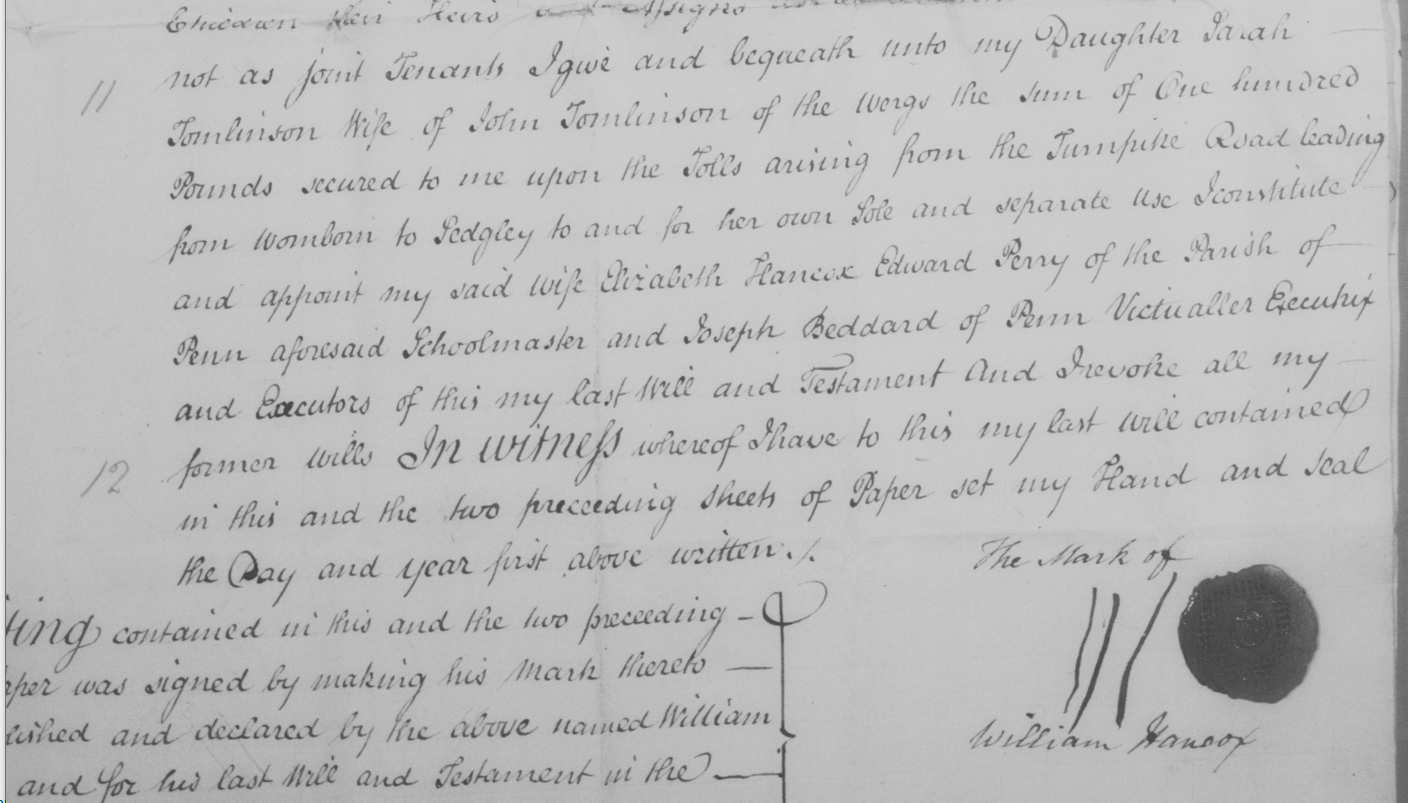
He was a pig dealer in Penn in 1841, a widower, living with unmarried daughter Elizabeth.Sarah’s father William Hancox died in 1816. In his will, he left his “daughter Sarah, wife of John Tomlinson of the Wergs the sum of £100 secured to me upon the tolls arising from the turnpike road leading from Wombourne to Sedgeley to and for her sole and separate use”.
The trustees of toll road would decide not to collect tolls themselves but get someone else to do it by selling the collecting of tolls for a fixed price. This was called “farming the tolls”. The Act of Parliament which set up the trust would authorise the trustees to farm out the tolls. This example is different. The Trustees of turnpikes needed to raise money to carry out work on the highway. The usual way they did this was to mortgage the tolls – they borrowed money from someone and paid the borrower interest; as security they gave the borrower the right, if they were not paid, to take over the collection of tolls and keep the proceeds until they had been paid off. In this case William Hancox has lent £100 to the turnpike and is leaving it (the right to interest and/or have the whole sum repaid) to his daughter Sarah Tomlinson. (this information on tolls from the Wolverhampton family history group.)William Hancox, Penn Wood, maltster, left a considerable amount of property to his children in 1816. All household effects he left to his wife Elizabeth, and after her decease to his son Richard Hancox: four dwelling houses in John St, Wolverhampton, in the occupation of various Pratts, Wright and William Clarke. He left £200 to his daughter Frances Gordon wife of James Gordon, and £100 to his daughter Ann Pratt widow of John Pratt. To his son William Hancox, all his various properties in Penn wood. To Elizabeth Tay wife of Thomas Tay he left £200, and to Richard Hancox various other properties in Penn Wood, and to his daughter Lucy Tay wife of Josiah Tay more property in Lower Penn. All his shops in St John Wolverhamton to his son Edward Hancox, and more properties in Lower Penn to both Francis Hancox and Edward Hancox. To his daughter Ellen York £200, and property in Montgomery and Bilston to his son John Hancox. Sons Francis and Edward were underage at the time of the will. And to his daughter Sarah, his interest in the toll mentioned above.
Sarah Tomlinson, wife of John Tomlinson of the Wergs, in William Hancox will:
 September 5, 2023 at 1:35 pm #7276
In reply to: Family Stories From The Other Side ~ Book Two
Wood Screw Manufacturers
The Fishers of West Bromwich.
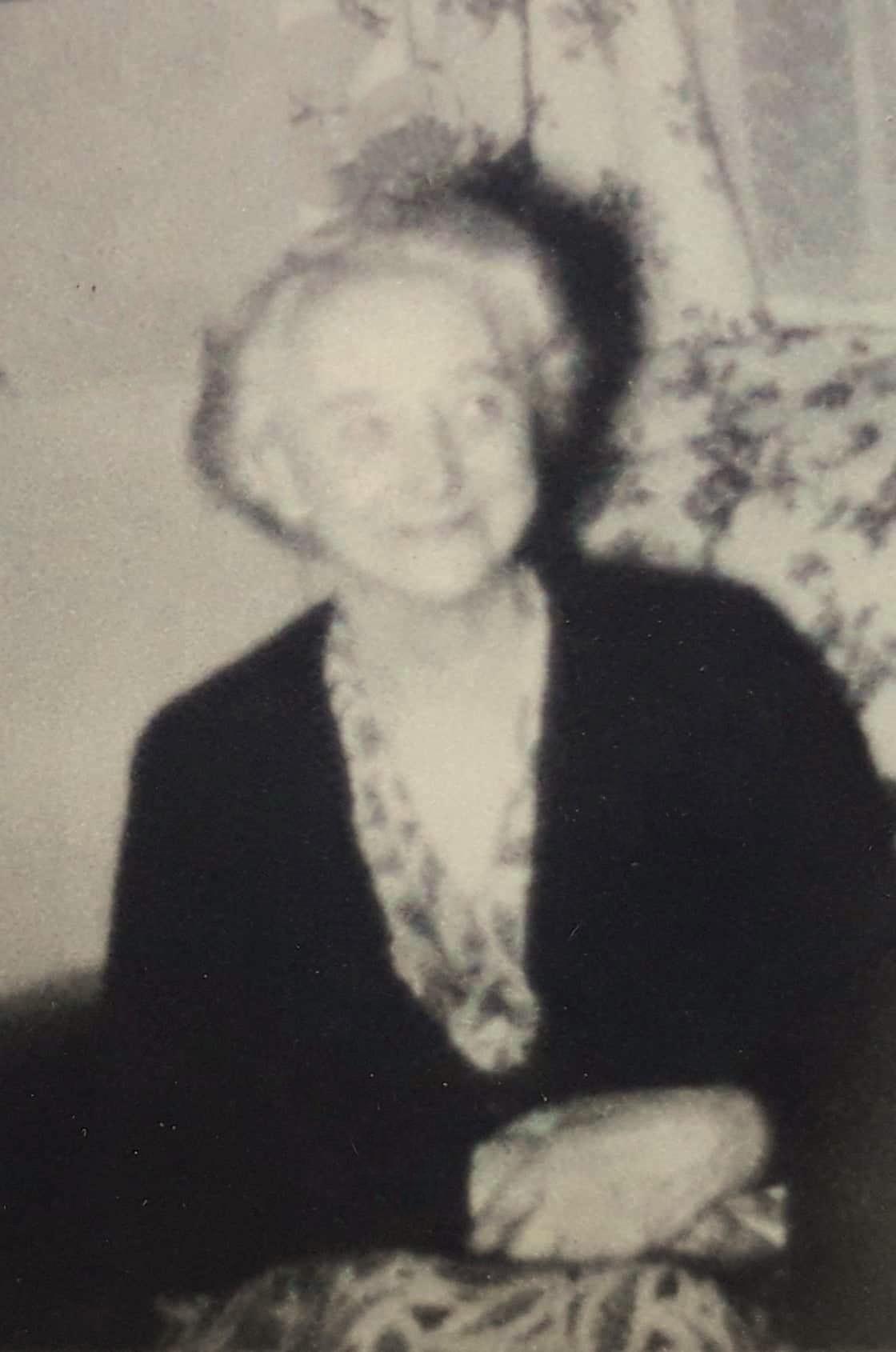
My great grandmother, Nellie Fisher, was born in 1877 in Wolverhampton. Her father William 1834-1916 was a whitesmith, and his father William 1792-1873 was a whitesmith and master screw maker. William’s father was Abel Fisher, wood screw maker, victualler, and according to his 1849 will, a “gentleman”.
Nellie Fisher 1877-1956 :
Abel Fisher was born in 1769 according to his burial document (age 81 in 1849) and on the 1841 census. Abel was a wood screw manufacturer in Wolverhampton.
As no baptism record can be found for Abel Fisher, I read every Fisher will I could find in a 30 year period hoping to find his fathers will. I found three other Fishers who were wood screw manufacurers in neighbouring West Bromwich, which led me to assume that Abel was born in West Bromwich and related to these other Fishers.
The wood screw making industry was a relatively new thing when Abel was born.
“The screw was used in furniture but did not become a common woodworking fastener until efficient machine tools were developed near the end of the 18th century. The earliest record of lathe made wood screws dates to an English patent of 1760. The development of wood screws progressed from a small cottage industry in the late 18th century to a highly mechanized industry by the mid-19th century. This rapid transformation is marked by several technical innovations that help identify the time that a screw was produced. The earliest, handmade wood screws were made from hand-forged blanks. These screws were originally produced in homes and shops in and around the manufacturing centers of 18th century Europe. Individuals, families or small groups participated in the production of screw blanks and the cutting of the threads. These small operations produced screws individually, using a series of files, chisels and cutting tools to form the threads and slot the head. Screws produced by this technique can vary significantly in their shape and the thread pitch. They are most easily identified by the profusion of file marks (in many directions) over the surface. The first record regarding the industrial manufacture of wood screws is an English patent registered to Job and William Wyatt of Staffordshire in 1760.”
Wood Screw Makers of West Bromwich:
Edward Fisher, wood screw maker of West Bromwich, died in 1796. He mentions his wife Pheney and two underage sons in his will. Edward (whose baptism has not been found) married Pheney Mallin on 13 April 1793. Pheney was 17 years old, born in 1776. Her parents were Isaac Mallin and Sarah Firme, who were married in West Bromwich in 1768.
Edward and Pheney’s son Edward was born on 21 October 1793, and their son Isaac in 1795. The executors of Edwards 1796 will are Daniel Fisher the Younger, Isaac Mallin, and Joseph Fisher.There is a marriage allegations and bonds document in 1774 for an Edward Fisher, bachelor and wood screw maker of West Bromwich, aged 25 years and upwards, and Mary Mallin of the same age, father Isaac Mallin. Isaac Mallin and Sarah didn’t marry until 1768 and Mary Mallin would have been born circa 1749. Perhaps Isaac Mallin’s father was the father of Mary Mallin. It’s possible that Edward Fisher was born in 1749 and first married Mary Mallin, and then later Pheney, but it’s also possible that the Edward Fisher who married Mary Mallin in 1774 was Edward Fishers uncle, Daniel’s brother. (I do not know if Daniel had a brother Edward, as I haven’t found a baptism, or marriage, for Daniel Fisher the elder.)
There are two difficulties with finding the records for these West Bromwich families. One is that the West Bromwich registers are not available online in their entirety, and are held by the Sandwell Archives, and even so, they are incomplete. Not only that, the Fishers were non conformist. There is no surviving register prior to 1787. The chapel opened in 1788, and any registers that existed before this date, taken in a meeting houses for example, appear not to have survived.
Daniel Fisher the younger died intestate in 1818. Daniel was a wood screw maker of West Bromwich. He was born in 1751 according to his age stated as 67 on his death in 1818. Daniel’s wife Mary, and his son William Fisher, also a wood screw maker, claimed the estate.
Daniel Fisher the elder was a farmer of West Bromwich, who died in 1806. He was 81 when he died, which makes a birth date of 1725, although no baptism has been found. No marriage has been found either, but he was probably married not earlier than 1746.
Daniel’s sons Daniel and Joseph were the main inheritors, and he also mentions his other children and grandchildren namely William Fisher, Thomas Fisher, Hannah wife of William Hadley, two grandchildren Edward and Isaac Fisher sons of Edward Fisher his son deceased. Daniel the elder presumably refers to the wood screw manufacturing when he says “to my son Daniel Fisher the good will and advantage which may arise from his manufacture or trade now carried on by me.” Daniel does not mention a son called Abel unfortunately, but neither does he mention his other grandchildren. Abel may be Daniel’s son, or he may be a nephew.
The Staffordshire Record Office holds the documents of a Testamentary Case in 1817. The principal people are Isaac Fisher, a legatee; Daniel and Joseph Fisher, executors. Principal place, West Bromwich, and deceased person, Daniel Fisher the elder, farmer.
William and Sarah Fisher baptised six children in the Mares Green Non Conformist registers in West Bromwich between 1786 and 1798. William Fisher and Sarah Birch were married in West Bromwich in 1777. This William was probably born circa 1753 and was probably the son of Daniel Fisher the elder, farmer.
Daniel Fisher the younger and his wife Mary had a son William, as mentioned in the intestacy papers, although I have not found a baptism for William. I did find a baptism for another son, Eutychus Fisher in 1792.
In White’s Directory of Staffordshire in 1834, there are three Fishers who are wood screw makers in Wolverhampton: Eutychus Fisher, Oxford Street; Stephen Fisher, Bloomsbury; and William Fisher, Oxford Street.
Abel’s son William Fisher 1792-1873 was living on Oxford Street on the 1841 census, with his wife Mary and their son William Fisher 1834-1916.
In The European Magazine, and London Review of 1820 (Volume 77 – Page 564) under List of Patents, W Fisher and H Fisher of West Bromwich, wood screw manufacturers, are listed. Also in 1820 in the Birmingham Chronicle, the partnership of William and Hannah Fisher, wood screw manufacturers of West Bromwich, was dissolved.
In the Staffordshire General & Commercial Directory 1818, by W. Parson, three Fisher’s are listed as wood screw makers. Abel Fisher victualler and wood screw maker, Red Lion, Walsal Road; Stephen Fisher wood screw maker, Buggans Lane; and Daniel Fisher wood screw manufacturer, Brickiln Lane.
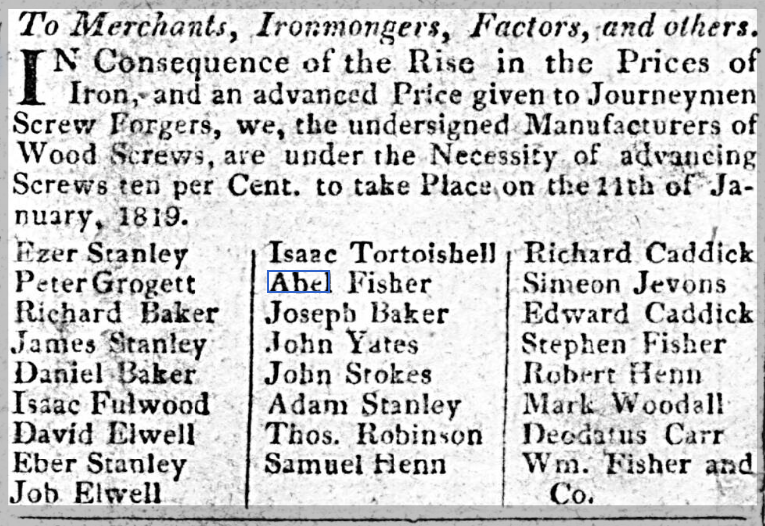
In Aris’s Birmingham Gazette on 4 January 1819 Abel Fisher is listed with 23 other wood screw manufacturers (Stephen Fisher and William Fisher included) stating that “In consequence of the rise in prices of iron and the advanced price given to journeymen screw forgers, we the undersigned manufacturers of wood screws are under the necessity of advancing screws 10 percent, to take place on the 11th january 1819.”
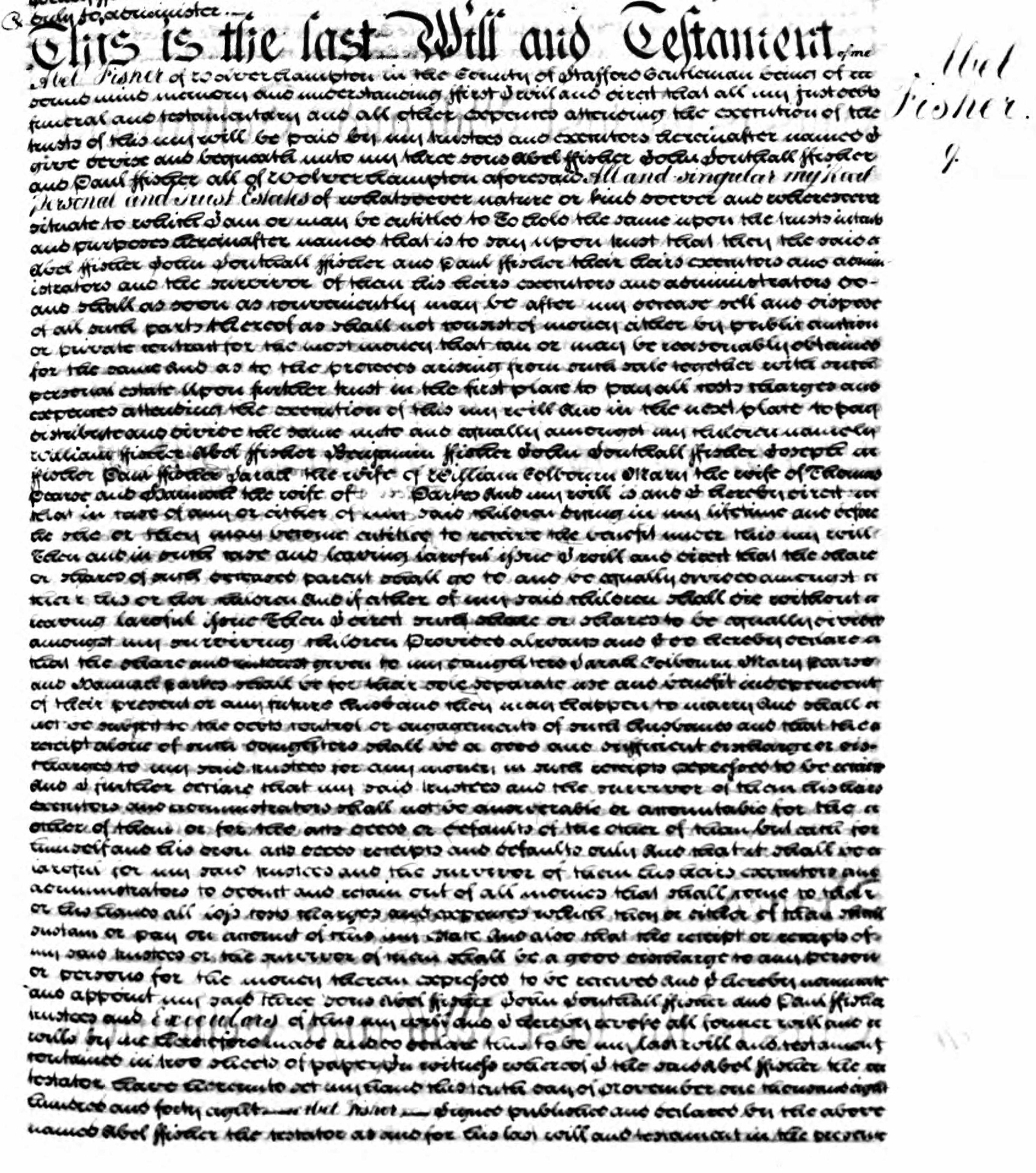
In Abel Fisher’s 1849 will, he names his three sons Abel Fisher 1796-1869, Paul Fisher 1811-1900 and John Southall Fisher 1801-1871 as the executors. He also mentions his other three sons, William Fisher 1792-1873, Benjamin Fisher 1798-1870, and Joseph Fisher 1803-1876, and daughters Sarah Fisher 1794- wife of William Colbourne, Mary Fisher 1804- wife of Thomas Pearce, and Susannah (Hannah) Fisher 1813- wife of Parkes. His son Silas Fisher 1809-1837 wasn’t mentioned as he died before Abel, nor his sons John Fisher 1799-1800, and Edward Southall Fisher 1806-1843. Abel’s wife Susannah Southall born in 1771 died in 1824. They were married in 1791.
The 1849 will of Abel Fisher:
 August 17, 2023 at 4:32 pm #7268
In reply to: Family Stories From The Other Side ~ Book Two
William Tomlinson
1797-1867
The Tomlinsons of Wolverhampton were butchers and publicans for several generations. Therefore it was a surprise to find that William’s father was a gentleman of independant means.
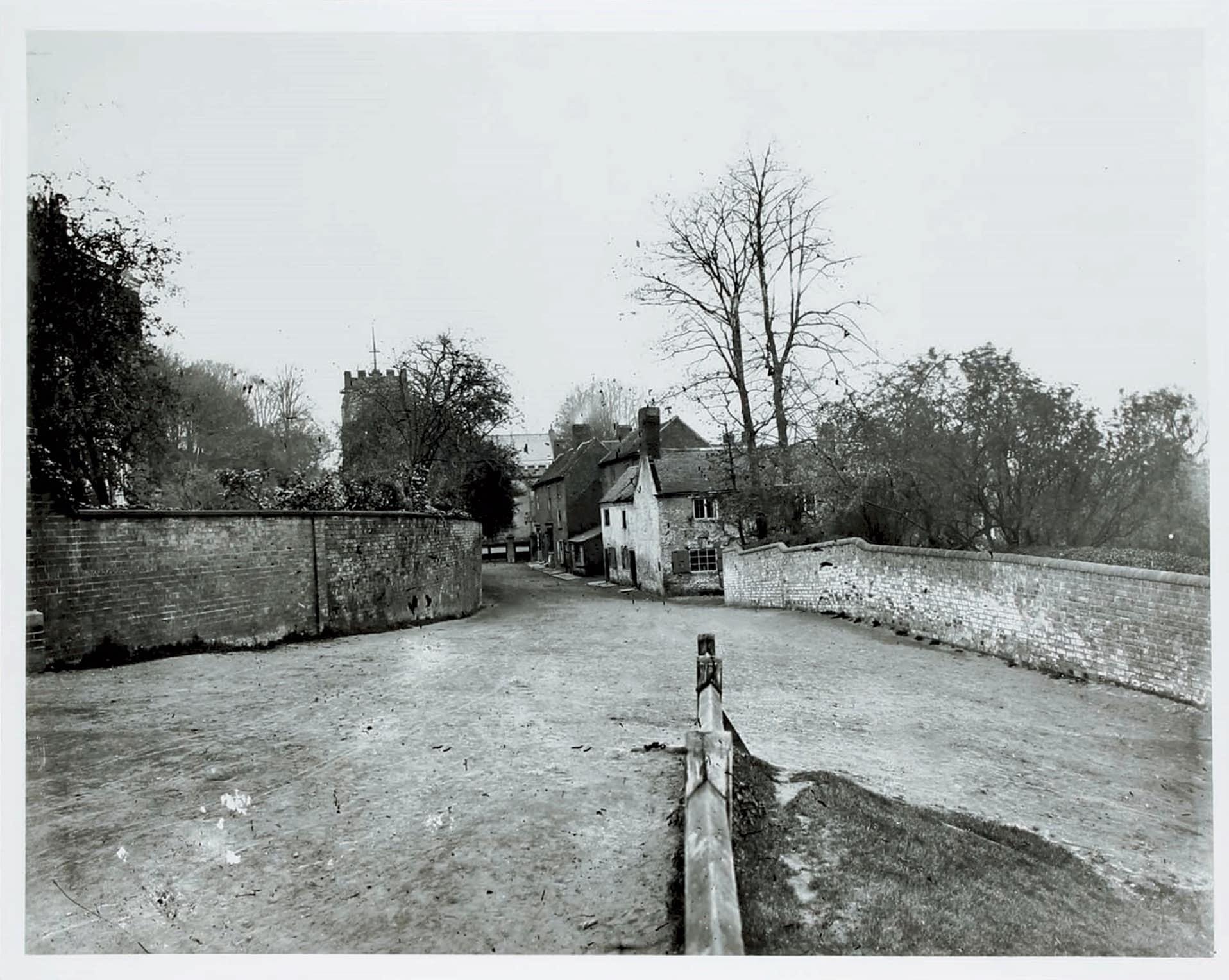
William Tomlinson 1797-1867 was born in Wergs, Tettenhall. His birthplace, and that of his first four children, is stated as Wergs on the 1851 census. They were baptised at St Michael and All Angels church in Tettenhall Regis, as were many of the Tomlinson family including William.
Tettenhall, St Michael and All Angels church:
Wergs is a very small area and there was no other William Tomlinson baptised there at the time of William’s birth. It is of course possible that another William Tomlinson was born in Wergs and the record of the baptism hasn’t been found, but there are a number of other documents that prove that John Tomlinson, gentleman of Wergs, was Williams father.
In 1834 on the Shropshire Quarter session rolls there are two documents regarding William. In October 1834 William Tomlinson of Tettenhall, son of John, took an examination. Also in October of 1834 there is a reconizance document for William Tomlinson for “pig dealer”. On the marriage certificate of his son Charles Tomlinson to Emma Grattidge (mistranscribed as Pratadge) in 1872, father William’s occupation is “dealer”.
William Tomlinson was a witness at his sister Catherine and Benjamin Smiths wedding in 1822 in Tettenhall. In John Tomlinson’s 1844 will, he mentions his “daughter Catherine Smith, wife of Benjamin Smith”. William’s signature as a witness at Catherine’s marriage matches his signature on the licence for his own marriage to Elizabeth Adams in 1827 in Shareshill, Staffordshire.
William’s signature on his wedding licence:
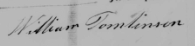
Williams signature as a witness to Catherine’s marriage:

William was the eldest surviving son when his father died in 1844, so it is surprising that William only inherited £25. John Tomlinson left his various properties to his daughters, with the exception of Catherine, who also received £25. There was one other surviving son, Sidney, born in 1814. Three of John and Sarah Tomlinson’s sons and one daughter died in infancy. Sidney was still unmarried and living at home when his father died, and in 1851 and 1861 was living with his sister Emma Wilson. He was unmarried when he died in 1867. John left Sidney an income for life in his will, but not property.
In John Tomlinson’s will he also mentions his daughter Jemima, wife of William Smith, farmer, of Great Barr. On the 1841 census William, butcher, is a visitor. His two children Sarah and Thomas are with him. His wife Elizabeth and the rest of the children are at Graisley Street. William is also on the Graisley Street census, occupation castrator. This was no doubt done in error, not realizing that he was also registered on the census where he was visiting at the time.
William’s wife, Elizabeth Adams, was born in Tong, Shropshire in 1807. The Adams in Tong appear to be agricultural labourers, at least on later censuses. Perhaps we can speculate that John didn’t approve of his son marrying an agricutural labourers daughter. Elizabeth would have been twenty years old at the time of the marriage; William thirty.
August 15, 2023 at 12:42 pm #7267In reply to: Family Stories From The Other Side ~ Book Two
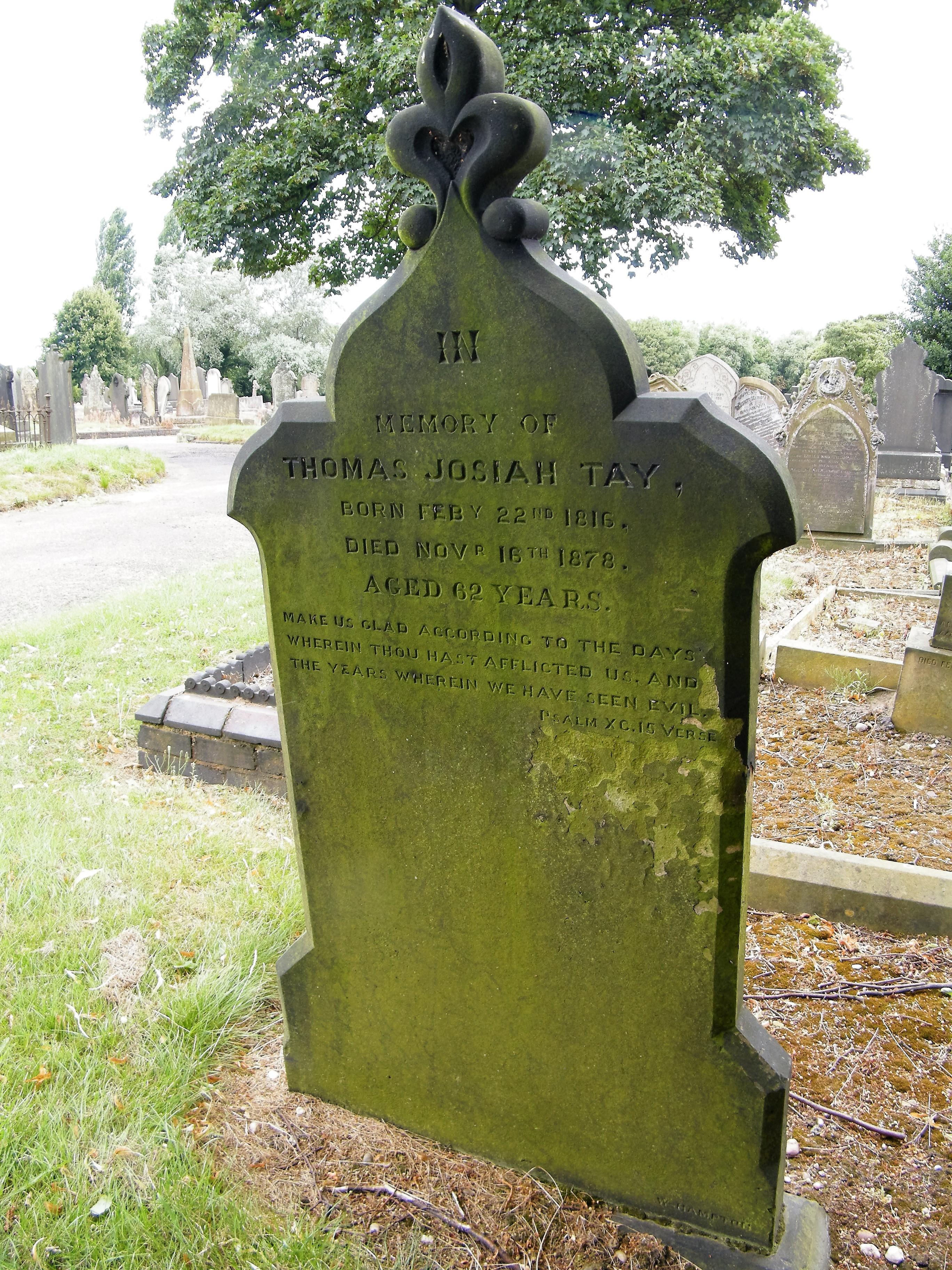
Thomas Josiah Tay
22 Feb 1816 – 16 November 1878
“Make us glad according to the days wherein thou hast afflicted us, and the years wherein we have seen evil.”
I first came across the name TAY in the 1844 will of John Tomlinson (1766-1844), gentleman of Wergs, Tettenhall. John’s friends, trustees and executors were Edward Moore, surgeon of Halesowen, and Edward Tay, timber merchant of Wolverhampton.
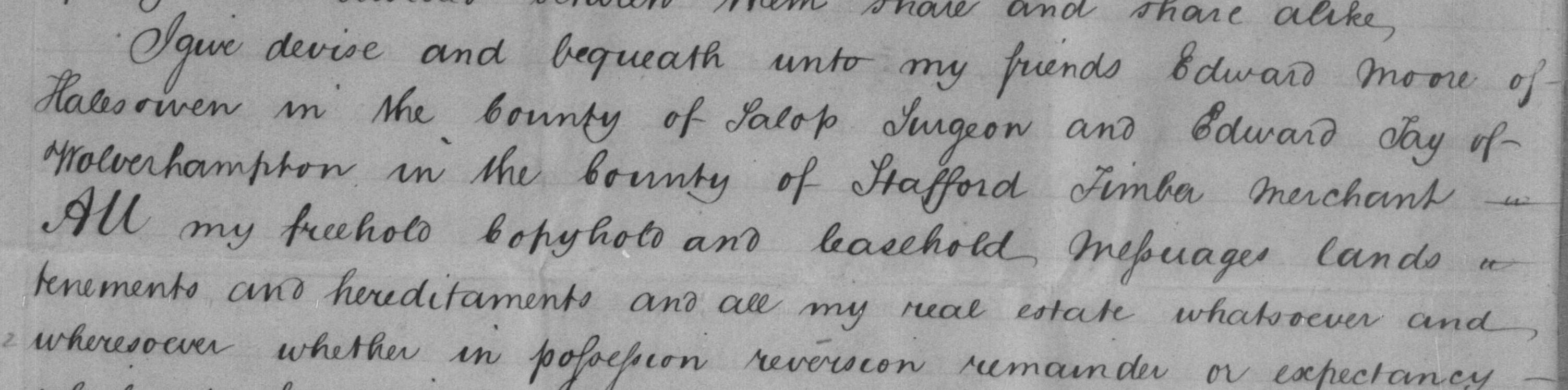
Edward Moore (born in 1805) was the son of John’s wife’s (Sarah Hancox born 1772) sister Lucy Hancox (born 1780) from her first marriage in 1801. In 1810 widowed Lucy married Josiah Tay (1775-1837).
Edward Tay was the son of Sarah Hancox sister Elizabeth (born 1778), who married Thomas Tay in 1800. Thomas Tay (1770-1841) and Josiah Tay were brothers.
Edward Tay (1803-1862) was born in Sedgley and was buried in Penn. He was innkeeper of The Fighting Cocks, Dudley Road, Wolverhampton, as well as a builder and timber merchant, according to various censuses, trade directories, his marriage registration where his father Thomas Tay is also a timber merchant, as well as being named as a timber merchant in John Tomlinsons will.
John Tomlinson’s daughter Catherine (born in 1794) married Benjamin Smith in Tettenhall in 1822. William Tomlinson (1797-1867), Catherine’s brother, and my 3x great grandfather, was one of the witnesses.
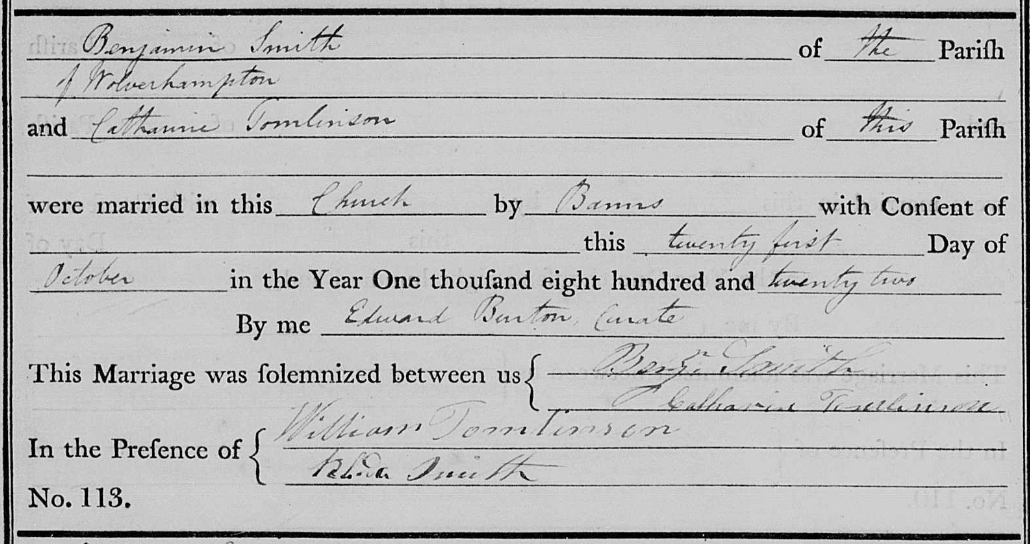
Their daughter Matilda Sarah Smith (1823-1910) married Thomas Josiah Tay in 1850 in Birmingham. Thomas Josiah Tay (1816-1878) was Edward Tay’s brother, the sons of Elizabeth Hancox and Thomas Tay.
Therefore, William Hancox 1737-1816 (the father of Sarah, Elizabeth and Lucy), was Matilda’s great grandfather and Thomas Josiah Tay’s grandfather.
Thomas Josiah Tay’s relationship to me is the husband of first cousin four times removed, as well as my first cousin, five times removed.
In 1837 Thomas Josiah Tay is mentioned in the will of his uncle Josiah Tay.

In 1841 Thomas Josiah Tay appears on the Stafford criminal registers for an “attempt to procure miscarriage”. He was found not guilty.
According to the Staffordshire Advertiser on 14th March 1840 the listing for the Assizes included: “Thomas Ashmall and Thomas Josiah Tay, for administering noxious ingredients to Hannah Evans, of Wolverhampton, with intent to procure abortion.”
The London Morning Herald on 19th March 1840 provides further information: “Mr Thomas Josiah Tay, a chemist and druggist, surrendered to take his trial on a charge of having administered drugs to Hannah Lear, now Hannah Evans, with intent to procure abortion.” She entered the service of Tay in 1837 and after four months “an intimacy was formed” and two months later she was “enciente”. Tay advised her to take some pills and a draught which he gave her and she became very ill. The prosecutrix admitted that she had made no mention of this until 1939. Verdict: not guilty.
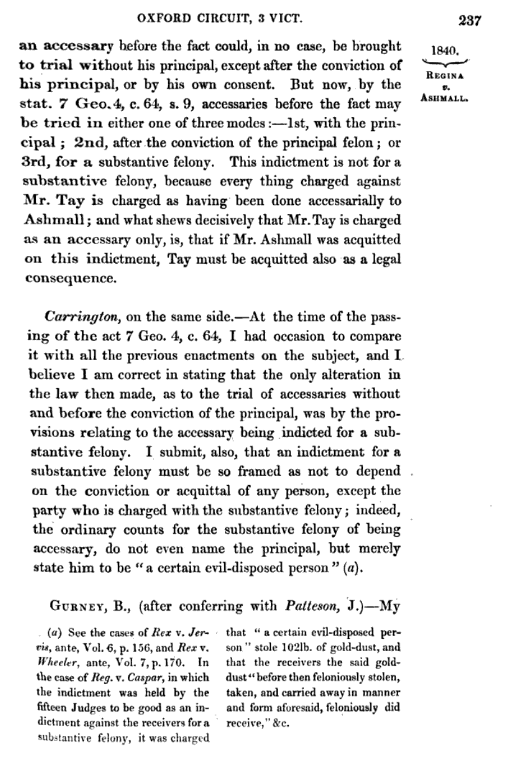
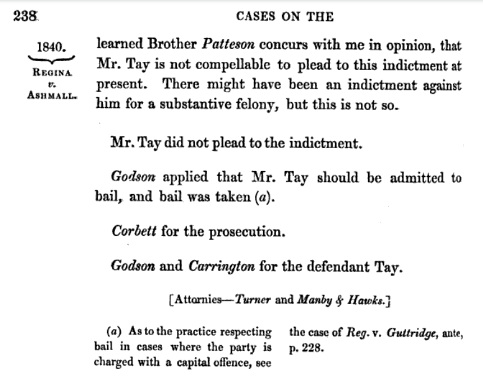
However, the case of Thomas Josiah Tay is also mentioned in a couple of law books, and the story varies slightly. In the 1841 Reports of Cases Argued and Rules at Nisi Prius, the Regina vs Ashmall and Tay case states that Thomas Ashmall feloniously, unlawfully, and maliciously, did use a certain instrument, and that Thomas Josiah Tay did procure the instrument, counsel and command Ashmall in the use of it. It concludes that Tay was not compellable to plead to the indictment, and that he did not.
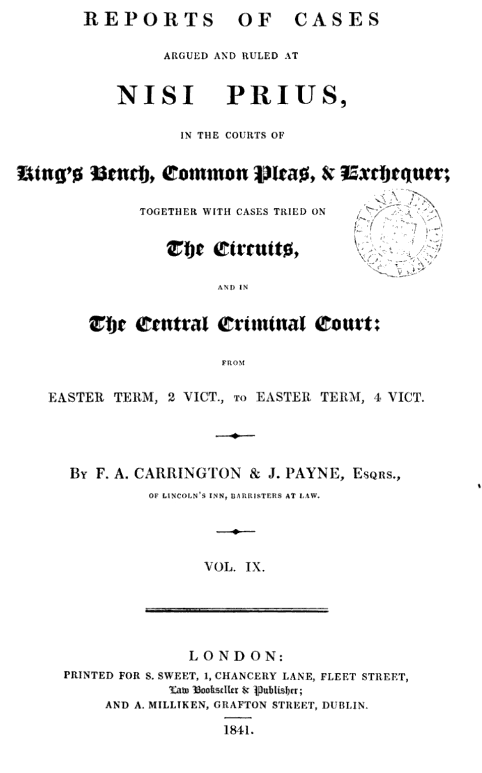
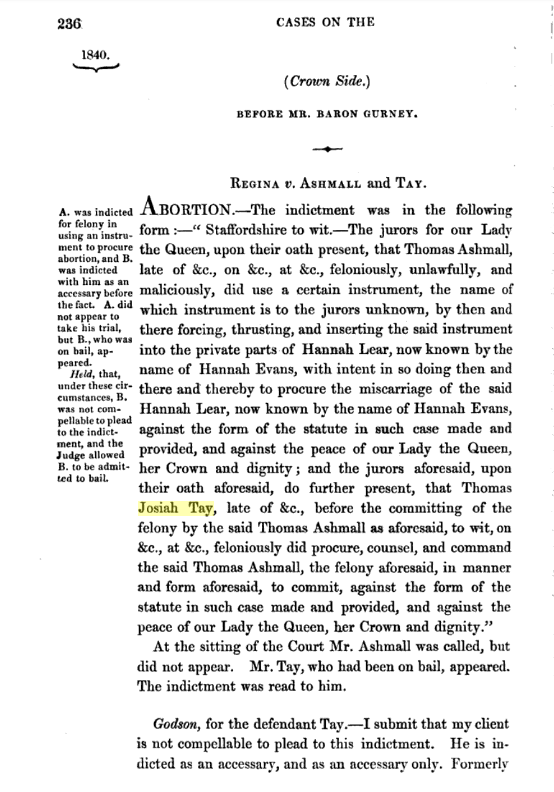
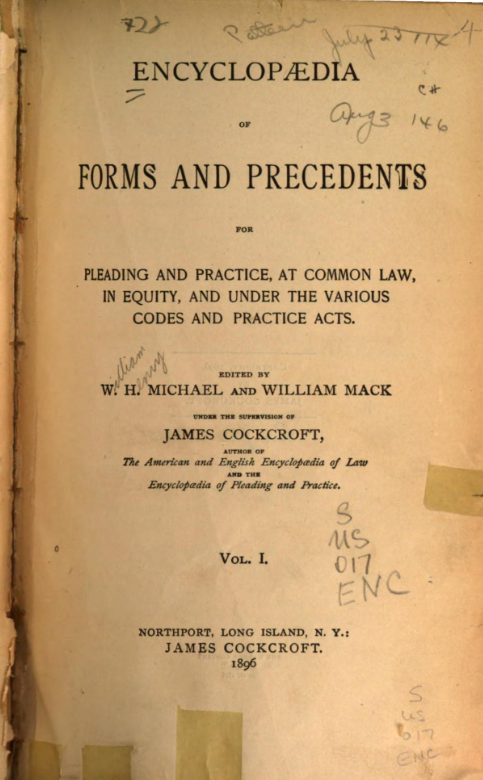
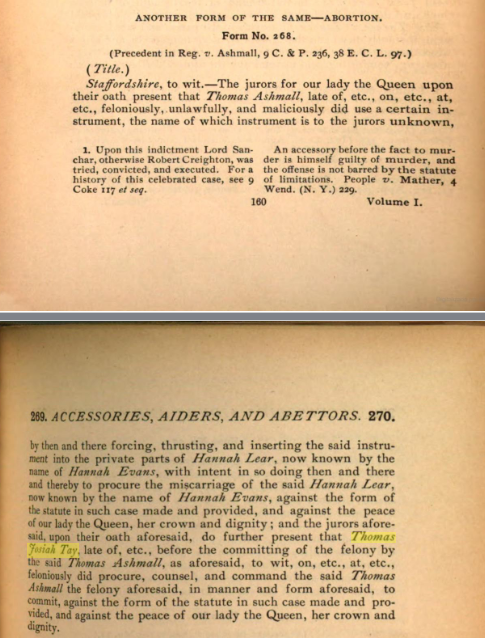
The Regina vs Ashmall and Tay case is also mentioned in the Encyclopedia of Forms and Precedents, 1896.
In 1845 Thomas Josiah Tay married Isabella Southwick in Tettenhall. Two years later in 1847 Isabella died.
In 1850 Thomas Josiah married Matilda Sarah Smith. (granddaughter of John Tomlinson, as mentioned above)
On the 1851 census Thomas Josiah Tay was a farmer of 100 acres employing two labourers in Shelfield, Walsall, Staffordshire. Thomas Josiah and Matilda Sarah have a daughter Matilda under a year old, and they have a live in house servant.
In 1861 Thomas Josiah Tay, his wife and their four children Ann, James, Josiah and Alice, live in Chelmarsh, Shropshire. He was a farmer of 224 acres. Mercy Smith, Matilda’s sister, lives with them, a 28 year old dairy maid.
In 1863 Thomas Josiah Tay of Hampton Lode (Chelmarsh) Shropshire was bankrupt. Creditors include Frederick Weaver, druggist of Wolverhampton.
In 1869 Thomas Josiah Tay was again bankrupt. He was an innkeeper at The Fighting Cocks on Dudley Road, Wolverhampton, at the time, the same inn as his uncle Edward Tay, aforementioned timber merchant.
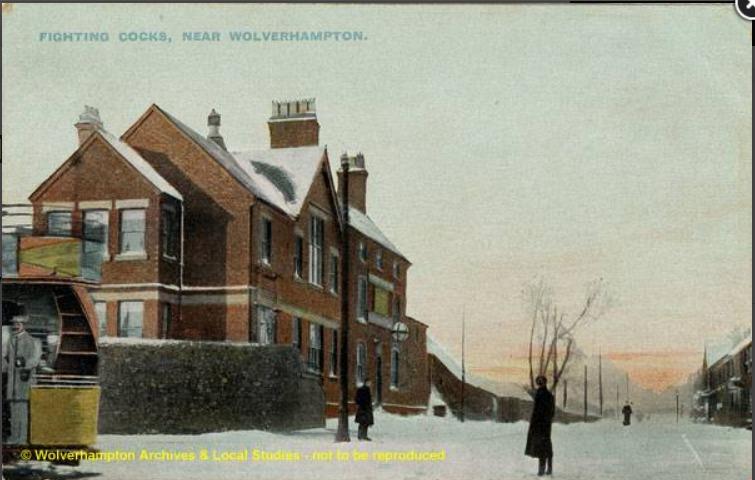
In 1871, Thomas Josiah Tay, his wife Matilda, and their three children Alice, Edward and Maryann, were living in Birmingham. Thomas Josiah was a commercial traveller.
He died on the 16th November 1878 at the age of 62 and was buried in Darlaston, Walsall. On his gravestone:
“Make us glad according to the days wherein thou hast afflicted us, and the years wherein we have seen evil.” Psalm XC 15 verse.
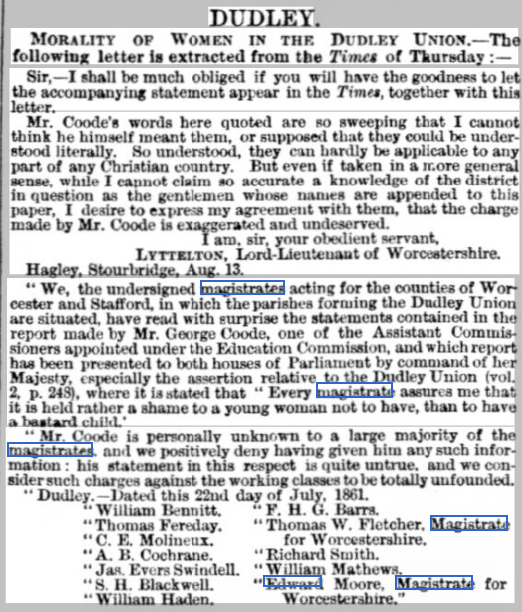
Edward Moore, surgeon, was also a MAGISTRATE in later years. On the 1871 census he states his occupation as “magistrate for counties Worcester and Stafford, and deputy lieutenant of Worcester, formerly surgeon”. He lived at Townsend House in Halesowen for many years. His wifes name was PATTERN Lucas. Her mothers name was Pattern Hewlitt from Birmingham, an unusal name that I have not heard before. On the 1871 census, Edward’s son was a 22 year old solicitor.
In 1861 an article appeared in the newspapers about the state of the morality of the women of Dudley. It was claimed that all the local magistrates agreed with the premise of the article, concerning unmarried women and their attitudes towards having illegitimate children. Letters appeared in subsequent newspapers signed by local magistrates, including Edward Moore, strongly disagreeing.
Staffordshire Advertiser 17 August 1861:
 July 5, 2023 at 8:21 pm #7263
In reply to: Family Stories From The Other Side ~ Book Two
Solomon Stubbs
1781-1857
Solomon was born in Hamstall Ridware, Staffordshire, parents Samuel Stubbs and Rebecca Wood. (see The Hamstall Ridware Connection chapter)
Solomon married Phillis Lomas at St Modwen’s in Burton on Trent on 30th May 1815. Phillis was the llegitimate daughter of Frances Lomas. No father was named on the baptism on the 17th January 1787 in Sutton on the Hill, Derbyshire, and the entry on the baptism register states that she was illegitimate. Phillis’s mother Frances married Daniel Fox in 1790 in Sutton on the Hill. Unfortunately this means that it’s impossible to find my 5X great grandfather on this side of the family.
Solomon and Phillis had four daughters, the last died in infancy.
Sarah 1816-1867, Mary (my 3X great grandmother) 1819-1880, Phillis 1823-1905, and Maria 1825-1826.Solomon Stubbs of Horninglow St is listed in the 1834 Whites Directory under “China, Glass, Etc Dlrs”. Next to his name is Joanna Warren (earthenware) High St. Joanna Warren is related to me on my maternal side. No doubt Solomon and Joanna knew each other, unaware that several generations later a marriage would take place, not locally but miles away, joining their families.
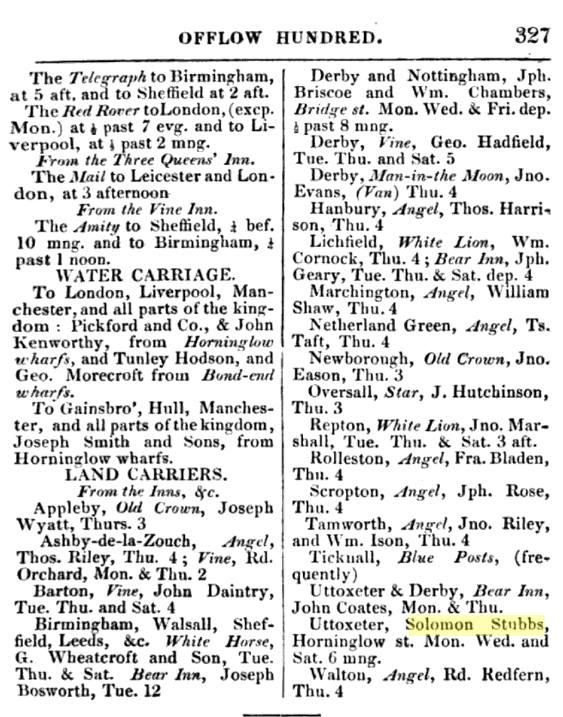
Solomon Stubbs is also listed in Whites Directory in 1831 and 1834 Burton on Trent as a land carrier:
“Land Carriers, from the Inns, Etc: Uttoxeter, Solomon Stubbs, Horninglow St, Mon. Wed. and Sat. 6 mng.”
Solomon is listed in the electoral registers in 1837. The 1837 United Kingdom general election was triggered by the death of King William IV and produced the first Parliament of the reign of his successor, Queen Victoria.
National Archives:
“In 1832, Parliament passed a law that changed the British electoral system. It was known as the Great Reform Act, which basically gave the vote to middle class men, leaving working men disappointed.
The Reform Act became law in response to years of criticism of the electoral system from those outside and inside Parliament. Elections in Britain were neither fair nor representative. In order to vote, a person had to own property or pay certain taxes to qualify, which excluded most working class people.”Via the Burton on Trent History group:
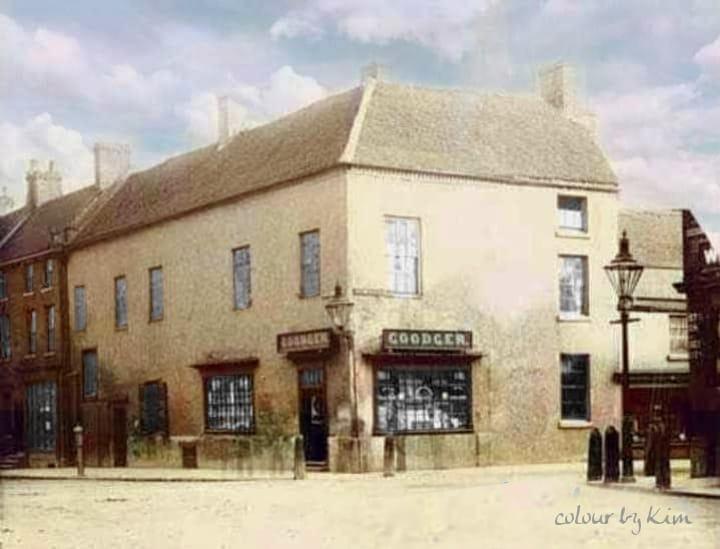
“a very early image of High street and Horninglow street junction, where the original ‘ Bargates’ were in the days of the Abbey. ‘Gate’ is the Saxon meaning Road, ‘Bar’ quite self explanatory, meant ‘to stop entrance’. There was another Bargate across Cat street (Station street), the Abbot had these constructed to regulate the Traders coming into town, in the days when the Abbey ran things. In the photo you can see the Posts on the corner, designed to stop Carts and Carriages mounting the Pavement. Only three Posts remain today and they are Listed.”
On the 1841 census, Solomon’s occupation was Carrier. Daughter Sarah is still living at home, and Sarah Grattidge, 13 years old, lives with them. Solomon’s daughter Mary had married William Grattidge in 1839.
Solomon Stubbs of Horninglow Street, Burton on Trent, is listed as an Earthenware Dealer in the 1842 Pigot’s Directory of Staffordshire.
In May 1844 Solomon’s wife Phillis died. In July 1844 daughter Sarah married Thomas Brandon in Burton on Trent. It was noted in the newspaper announcement that this was the first wedding to take place at the Holy Trinity church.
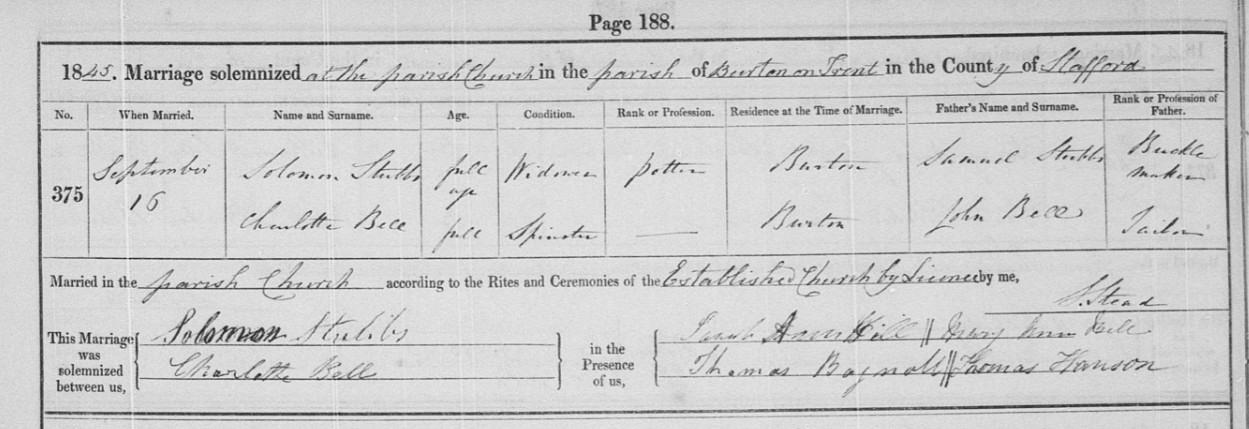
Solomon married Charlotte Bell by licence the following year in 1845. She was considerably younger than him, born in 1824. On the marriage certificate Solomon’s occupation is potter. It seems that he had the earthenware business as well as the land carrier business, in addition to owning a number of properties.
The marriage of Solomon Stubbs and Charlotte Bell:
Also in 1845, Solomon’s daughter Phillis was married in Burton on Trent to John Devitt, son of CD Devitt, Esq, formerly of the General Post Office Dublin.
Solomon Stubbs died in September 1857 in Burton on Trent. In the Staffordshire Advertiser on Saturday 3 October 1857:
“On the 22nd ultimo, suddenly, much respected, Solomon Stubbs, of Guild-street, Burton-on-Trent, aged 74 years.”
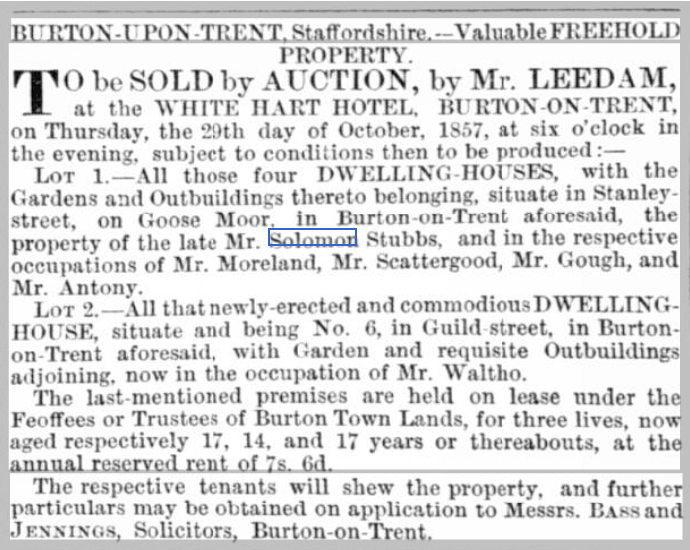
In the Staffordshire Advertiser, 24th October 1857, the auction of the property of Solomon Stubbs was announced:
“BURTON ON TRENT, on Thursday, the 29th day of October, 1857, at six o’clock in the evening, subject to conditions then to be produced:— Lot I—All those four DWELLING HOUSES, with the Gardens and Outbuildings thereto belonging, situate in Stanleystreet, on Goose Moor, in Burton-on-Trent aforesaid, the property of the late Mr. Solomon Stubbs, and in the respective occupations of Mr. Moreland, Mr. Scattergood, Mr. Gough, and Mr. Antony…..”
Sadly, the graves of Solomon, his wife Phillis, and their infant daughter Maria have since been removed and are listed in the UK Records of the Removal of Graves and Tombstones 1601-2007.
July 4, 2023 at 7:52 pm #7261In reply to: Family Stories From The Other Side ~ Book Two
Long Lost Enoch Edwards
My father used to mention long lost Enoch Edwards. Nobody in the family knew where he went to and it was assumed that he went to USA, perhaps to Utah to join his sister Sophie who was a Mormon handcart pioneer, but no record of him was found in USA.
Andrew Enoch Edwards (my great great grandfather) was born in 1840, but was (almost) always known as Enoch. Although civil registration of births had started from 1 July 1837, neither Enoch nor his brother Stephen were registered. Enoch was baptised (as Andrew) on the same day as his brothers Reuben and Stephen in May 1843 at St Chad’s Catholic cathedral in Birmingham. It’s a mystery why these three brothers were baptised Catholic, as there are no other Catholic records for this family before or since. One possible theory is that there was a school attached to the church on Shadwell Street, and a Catholic baptism was required for the boys to go to the school. Enoch’s father John died of TB in 1844, and perhaps in 1843 he knew he was dying and wanted to ensure an education for his sons. The building of St Chads was completed in 1841, and it was close to where they lived.
Enoch appears (as Enoch rather than Andrew) on the 1841 census, six months old. The family were living at Unett Street in Birmingham: John and Sarah and children Mariah, Sophia, Matilda, a mysterious entry transcribed as Lene, a daughter, that I have been unable to find anywhere else, and Reuben and Stephen.
Enoch was just four years old when his father John, an engineer and millwright, died of consumption in 1844.
In 1851 Enoch’s widowed mother Sarah was a mangler living on Summer Street, Birmingham, Matilda a dressmaker, Reuben and Stephen were gun percussionists, and eleven year old Enoch was an errand boy.
On the 1861 census, Sarah was a confectionrer on Canal Street in Birmingham, Stephen was a blacksmith, and Enoch a button tool maker.
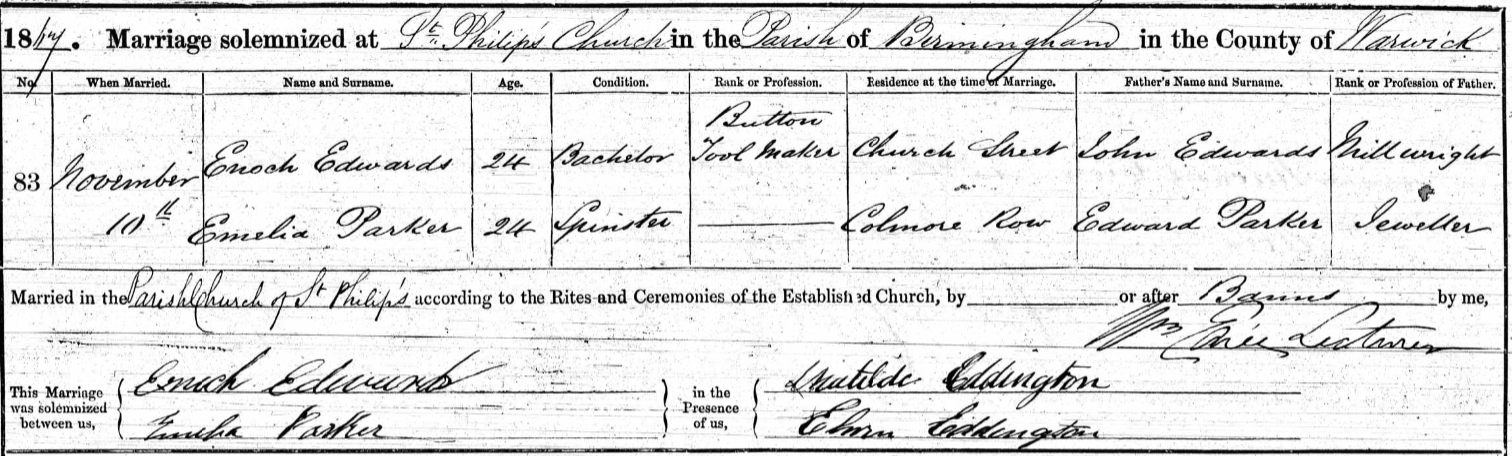
On the 10th November 1867 Enoch married Emelia Parker, daughter of jeweller and rope maker Edward Parker, at St Philip in Birmingham. Both Emelia and Enoch were able to sign their own names, and Matilda and Edwin Eddington were witnesses (Enoch’s sister and her husband). Enoch’s address was Church Street, and his occupation button tool maker.
Four years later in 1871, Enoch was a publican living on Clifton Road. Son Enoch Henry was two years old, and Ralph Ernest was three months. Eliza Barton lived with them as a general servant.
By 1881 Enoch was back working as a button tool maker in Bournebrook, Birmingham. Enoch and Emilia by then had three more children, Amelia, Albert Parker (my great grandfather) and Ada.
Garnet Frederick Edwards was born in 1882. This is the first instance of the name Garnet in the family, and subsequently Garnet has been the middle name for the eldest son (my brother, father and grandfather all have Garnet as a middle name).
Enoch was the licensed victualler at the Pack Horse Hotel in 1991 at Kings Norton. By this time, only daughters Amelia and Ada and son Garnet are living at home.
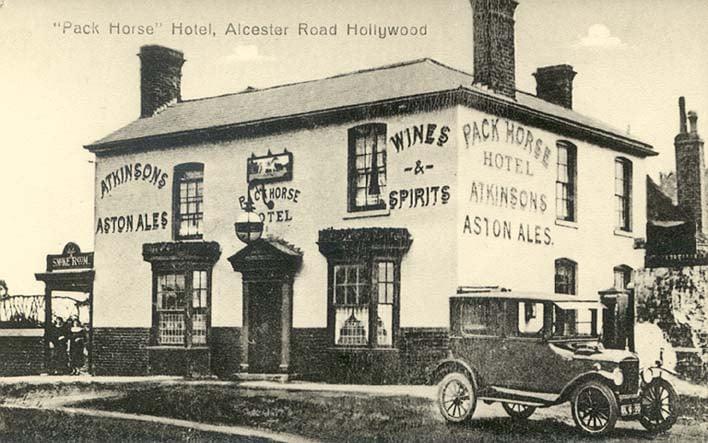
Additional information from my fathers cousin, Paul Weaver:
“Enoch refused to allow his son Albert Parker to go to King Edwards School in Birmingham, where he had been awarded a place. Instead, in October 1890 he made Albert Parker Edwards take an apprenticeship with a pawnboker in Tipton.
Towards the end of the 19th century Enoch kept The Pack Horse in Alcester Road, Hollywood, where a twist was 1d an ounce, and beer was 2d a pint. The children had to get up early to get breakfast at 6 o’clock for the hay and straw men on their way to the Birmingham hay and straw market. Enoch is listed as a member of “The Kingswood & Pack Horse Association for the Prosecution of Offenders”, a kind of early Neighbourhood Watch, dated 25 October 1890.
The Edwards family later moved to Redditch where they kept The Rifleman Inn at 35 Park Road. They must have left the Pack Horse by 1895 as another publican was in place by then.”Emelia his wife died in 1895 of consumption at the Rifleman Inn in Redditch, Worcestershire, and in 1897 Enoch married Florence Ethel Hedges in Aston. Enoch was 56 and Florence was just 21 years old.
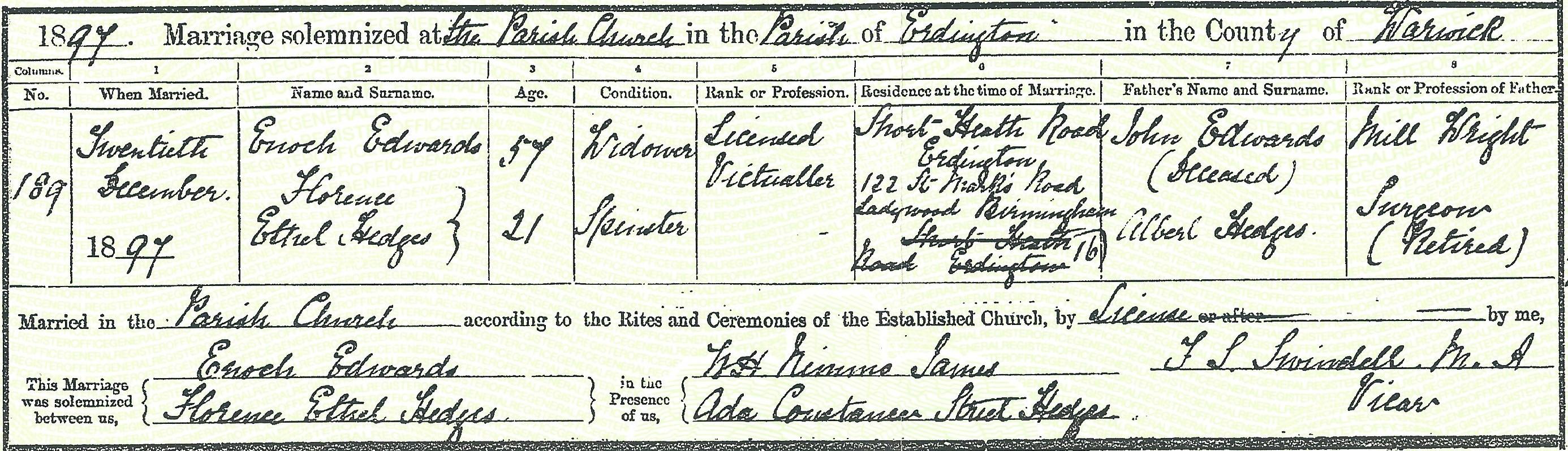
The following year in 1898 their daughter Muriel Constance Freda Edwards was born in Deritend, Warwickshire.
In 1901 Enoch, (Andrew on the census), publican, Florence and Muriel were living in Dudley. It was hard to find where he went after this.From Paul Weaver:
“Family accounts have it that Enoch EDWARDS fell out with all his family, and at about the age of 60, he left all behind and emigrated to the U.S.A. Enoch was described as being an active man, and it is believed that he had another family when he settled in the U.S.A. Esmor STOKES has it that a postcard was received by the family from Enoch at Niagara Falls.
On 11 June 1902 Harry Wright (the local postmaster responsible in those days for licensing) brought an Enoch EDWARDS to the Bedfordshire Petty Sessions in Biggleswade regarding “Hole in the Wall”, believed to refer to the now defunct “Hole in the Wall” public house at 76 Shortmead Street, Biggleswade with Enoch being granted “temporary authority”. On 9 July 1902 the transfer was granted. A year later in the 1903 edition of Kelly’s Directory of Bedfordshire, Hunts and Northamptonshire there is an Enoch EDWARDS running the Wheatsheaf Public House, Church Street, St. Neots, Huntingdonshire which is 14 miles south of Biggleswade.”
It seems that Enoch and his new family moved away from the midlands in the early 1900s, but again the trail went cold.
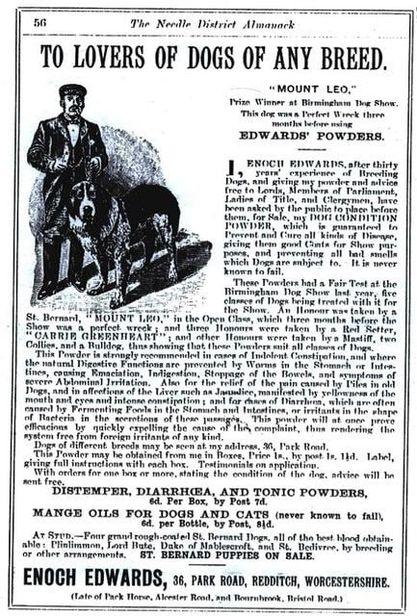
When I started doing the genealogy research, I joined a local facebook group for Redditch in Worcestershire. Enoch’s son Albert Parker Edwards (my great grandfather) spent most of his life there. I asked in the group about Enoch, and someone posted an illustrated advertisement for Enoch’s dog powders. Enoch was a well known breeder/keeper of St Bernards and is cited in a book naming individuals key to the recovery/establishment of ‘mastiff’ size dog breeds.
We had not known that Enoch was a breeder of champion St Bernard dogs!
Once I knew about the St Bernard dogs and the names Mount Leo and Plinlimmon via the newspaper adverts, I did an internet search on Enoch Edwards in conjunction with these dogs.
Enoch’s St Bernard dog “Mount Leo” was bred from the famous Plinlimmon, “the Emperor of Saint Bernards”. He was reported to have sent two puppies to Omaha and one of his stud dogs to America for a season, and in 1897 Enoch made the news for selling a St Bernard to someone in New York for £200. Plinlimmon, bred by Thomas Hall, was born in Liverpool, England on June 29, 1883. He won numerous dog shows throughout Europe in 1884, and in 1885, he was named Best Saint Bernard.
In the Birmingham Mail on 14th June 1890:
“Mr E Edwards, of Bournebrook, has been well to the fore with his dogs of late. He has gained nine honours during the past fortnight, including a first at the Pontypridd show with a St Bernard dog, The Speaker, a son of Plinlimmon.”
In the Alcester Chronicle on Saturday 05 June 1897:
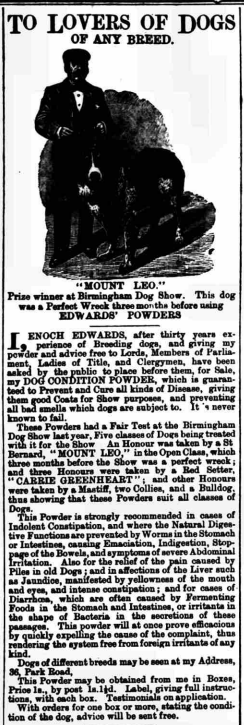
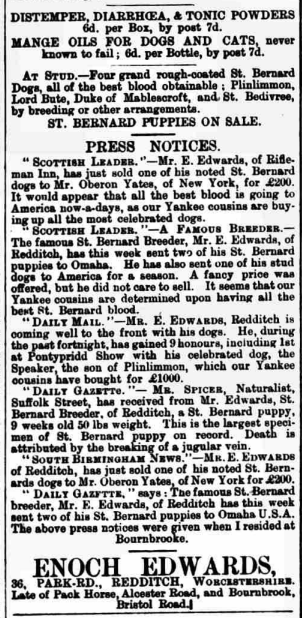
It was discovered that Enoch, Florence and Muriel moved to Canada, not USA as the family had assumed. The 1911 census for Montreal St Jaqcues, Quebec, stated that Enoch, (Florence) Ethel, and (Muriel) Frida had emigrated in 1906. Enoch’s occupation was machinist in 1911. The census transcription is not very good. Edwards was transcribed as Edmand, but the dates of birth for all three are correct. Birthplace is correct ~ A for Anglitan (the census is in French) but race or tribe is also an A but the transcribers have put African black! Enoch by this time was 71 years old, his wife 33 and daughter 11.
Additional information from Paul Weaver:
“In 1906 he and his new family travelled to Canada with Enoch travelling first and Ethel and Frida joined him in Quebec on 25 June 1906 on board the ‘Canada’ from Liverpool.
Their immigration record suggests that they were planning to travel to Winnipeg, but five years later in 1911, Enoch, Florence Ethel and Frida were still living in St James, Montreal. Enoch was employed as a machinist by Canadian Government Railways working 50 hours. It is the 1911 census record that confirms his birth as November 1840. It also states that Enoch could neither read nor write but managed to earn $500 in 1910 for activity other than his main profession, although this may be referring to his innkeeping business interests.
By 1921 Florence and Muriel Frida are living in Langford, Neepawa, Manitoba with Peter FUCHS, an Ontarian farmer of German descent who Florence had married on 24 Jul 1913 implying that Enoch died sometime in 1911/12, although no record has been found.”The extra $500 in earnings was perhaps related to the St Bernard dogs. Enoch signed his name on the register on his marriage to Emelia, and I think it’s very unlikely that he could neither read nor write, as stated above.
However, it may not be Enoch’s wife Florence Ethel who married Peter Fuchs. A Florence Emma Edwards married Peter Fuchs, and on the 1921 census in Neepawa her daugther Muriel Elizabeth Edwards, born in 1902, lives with them. Quite a coincidence, two Florence and Muriel Edwards in Neepawa at the time. Muriel Elizabeth Edwards married and had two children but died at the age of 23 in 1925. Her mother Florence was living with the widowed husband and the two children on the 1931 census in Neepawa. As there was no other daughter on the 1911 census with Enoch, Florence and Muriel in Montreal, it must be a different Florence and daughter. We don’t know, though, why Muriel Constance Freda married in Neepawa.
Indeed, Florence was not a widow in 1913. Enoch died in 1924 in Montreal, aged 84. Neither Enoch, Florence or their daughter has been found yet on the 1921 census. The search is not easy, as Enoch sometimes used the name Andrew, Florence used her middle name Ethel, and daughter Muriel used Freda, Valerie (the name she added when she married in Neepawa), and died as Marcheta. The only name she NEVER used was Constance!
A Canadian genealogist living in Montreal phoned the cemetery where Enoch was buried. She said “Enoch Edwards who died on Feb 27 1924 is not buried in the Mount Royal cemetery, he was only cremated there on March 4, 1924. There are no burial records but he died of an abcess and his body was sent to the cemetery for cremation from the Royal Victoria Hospital.”
1924 Obituary for Enoch Edwards:
Cimetière Mont-Royal Outremont, Montreal Region, Quebec, Canada
The Montreal Star 29 Feb 1924, Fri · Page 31

Muriel Constance Freda Valerie Edwards married Arthur Frederick Morris on 24 Oct 1925 in Neepawa, Manitoba. (She appears to have added the name Valerie when she married.)
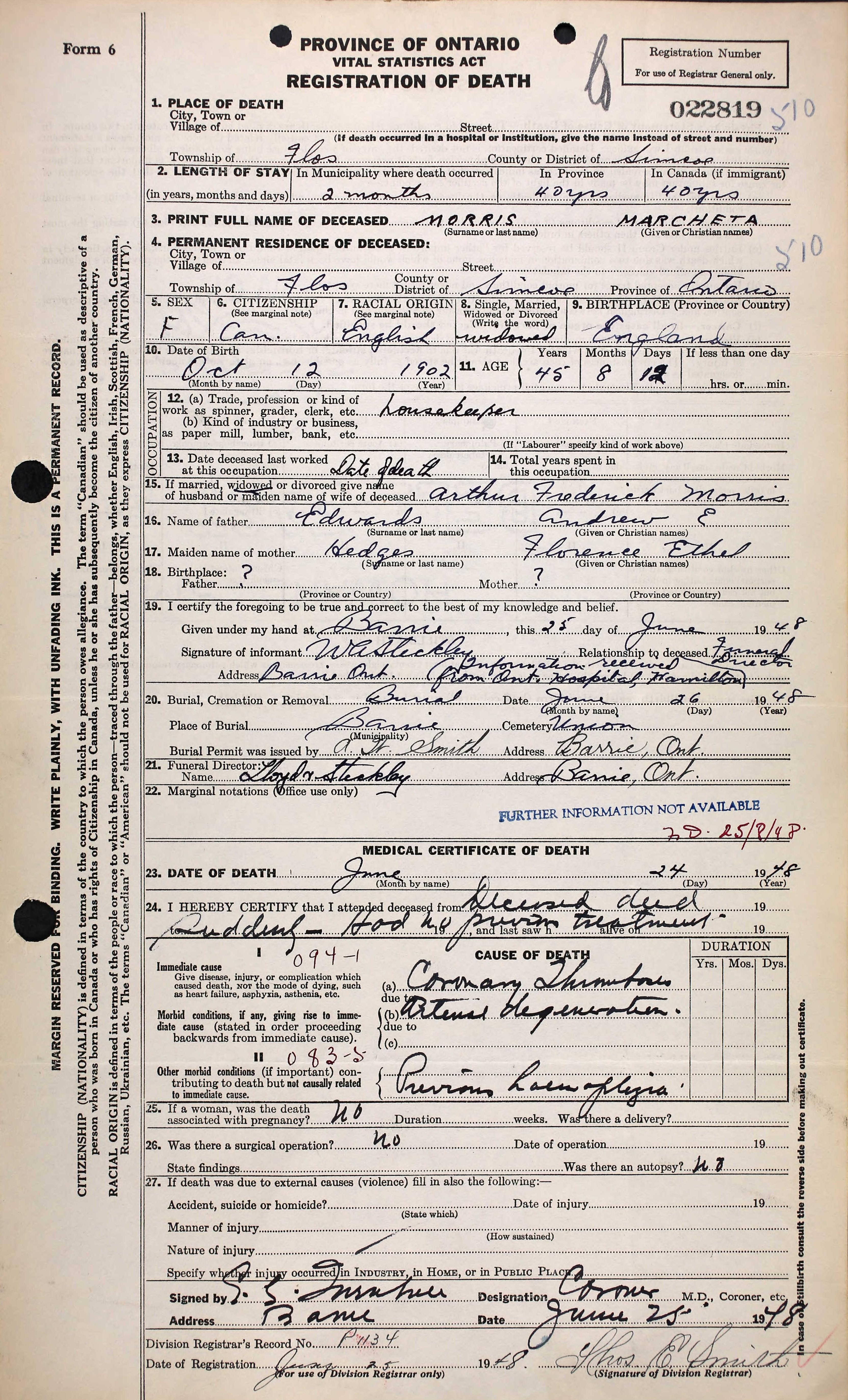
Unexpectedly a death certificate appeared for Muriel via the hints on the ancestry website. Her name was “Marcheta Morris” on this document, however it also states that she was the widow of Arthur Frederick Morris and daughter of Andrew E Edwards and Florence Ethel Hedges. She died suddenly in June 1948 in Flos, Simcoe, Ontario of a coronary thrombosis, where she was living as a housekeeper.
 April 20, 2023 at 6:27 pm #7227
In reply to: The Precious Life and Rambles of Liz Tattler
“What? What’s that you say? Do speak up, dear. Not now Finnley! Can’t you see I’m on the phone? Now then dear,” Liz said into the telephone, “Have I got this right? He hasn’t seeen a doctor yet? What do you mean, there aren’t any, they must have some at the hospital? Only the youngest ones nobody wants and the very old ones? A lousy hospital and the cardiologist isn’t very techy and doesn’t know what to do? So Michael is a what did you say, a PA? Oh a physicians assistant. Wait a minute, have I got this right? The doctor only comes to the clinic twice a month? So you can only see the PA? But what about the difficulty breathing and the coughing, I don’t know about in rural Arkansas, but in the rest of the world an 89 year old who’s been coughing so much for three weeks that he can hardly breathe is known as a medical emergency! But why are you waiting for diabetes and heart tests, surely he needs to breathe now and do the tests later? Couldn’t taste the Worcester sauce on his scrambled eggs, you say?”
Finnley’s gentle hand appeared as if by magic and restrained Liz from pulling a third handful of hair out.
“They’re going to fucking kill him, Finnley, and there’s nothing I can do.”
“There never is, really, in situations like this. Here, drink this. It’ll buck you up.”
March 29, 2023 at 3:05 pm #7220In reply to: The Chronicles of the Flying Fish Inn
At 10:30am, the air is buzzing with excitement. As the first race is going to start soon. There has been no signs of a dust storm and everyone seem to have forgotten about it. The participants are cheering and getting ready for the race while groups of tourists are wandering about, taking pictures of the teams and the folks in costume. People came from as far as Mexico, Italy and Macedonia.
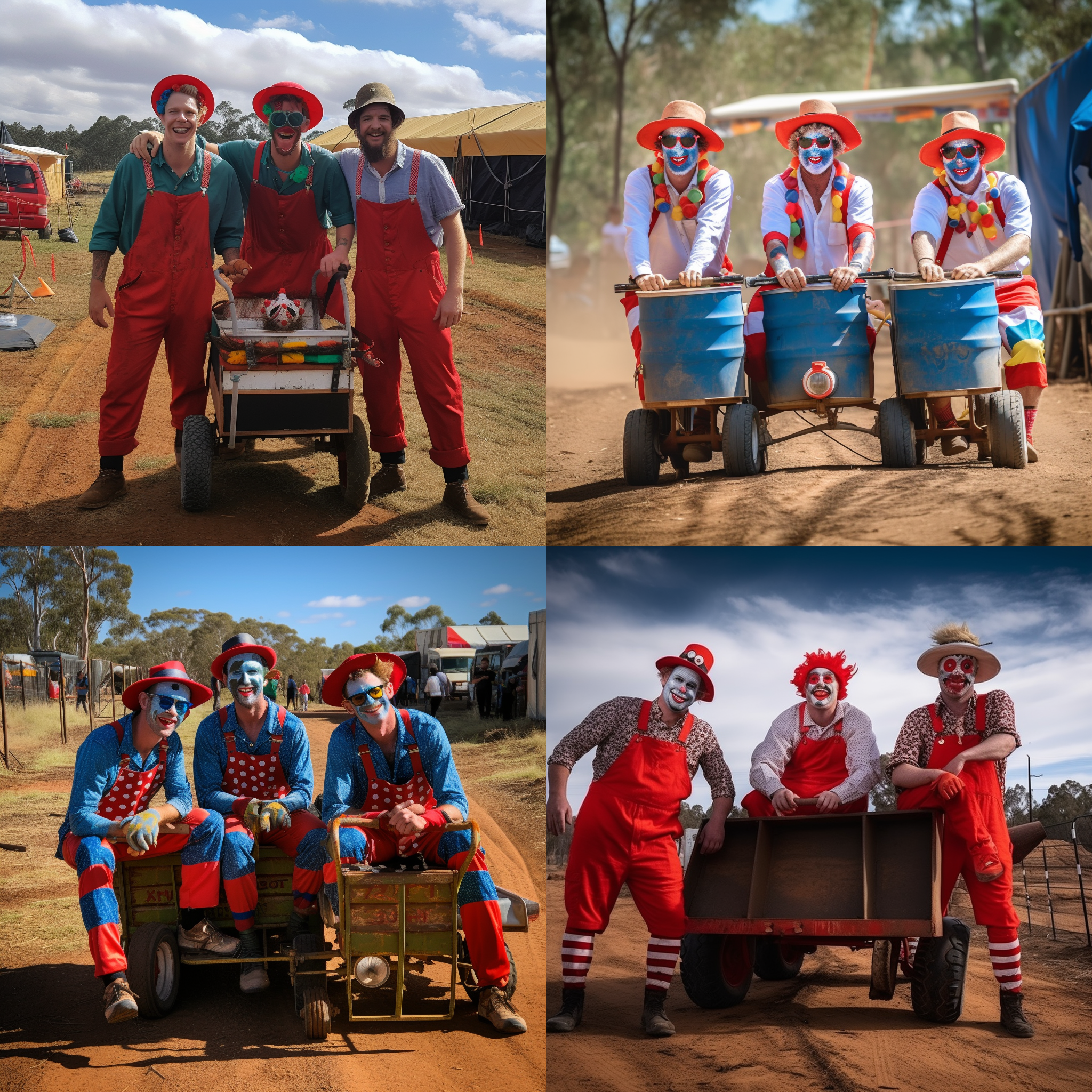
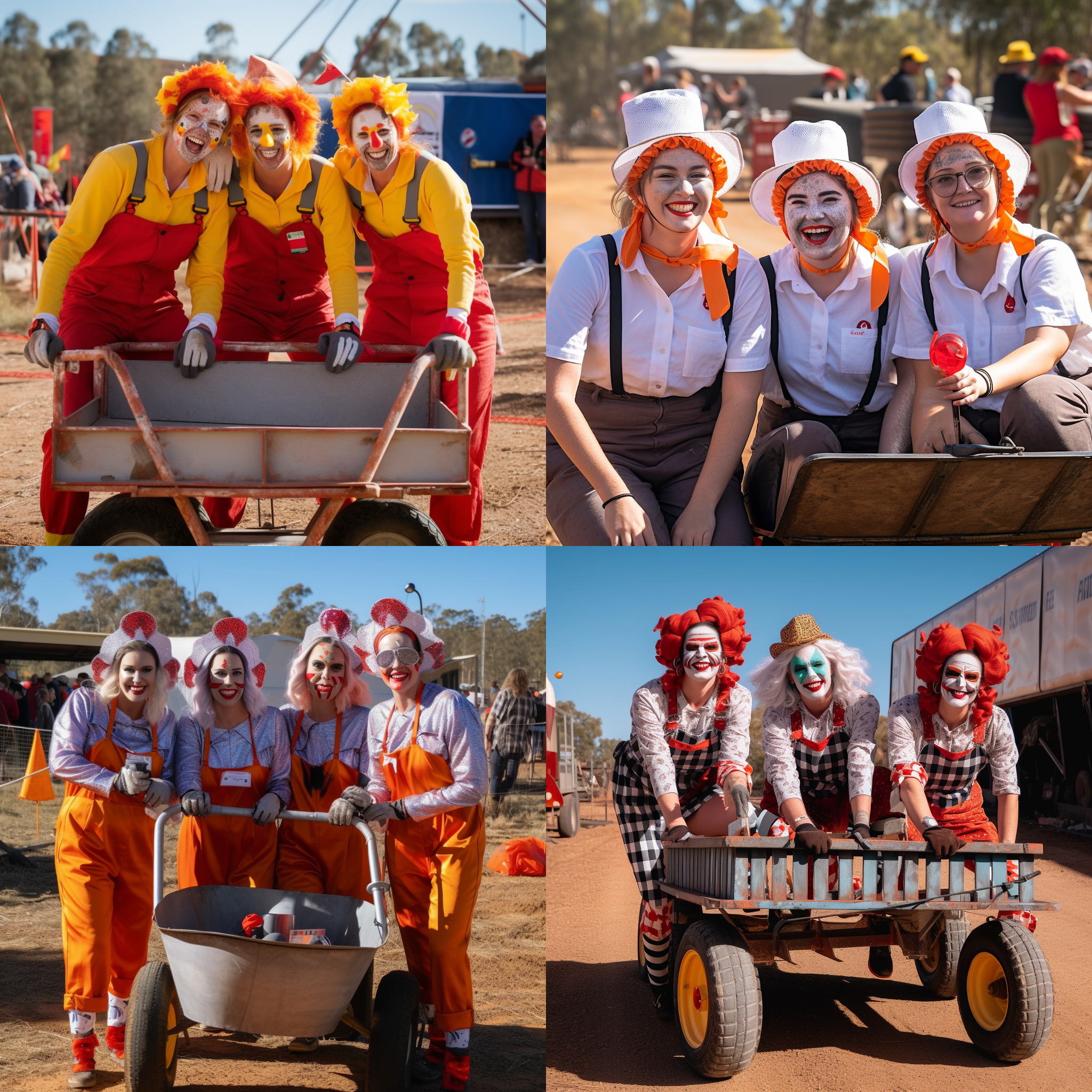
Because of the harsh conditions, miners were usually males back in the days. But there have always been teams at our little town’s festival ready to include women and children because they were usually lighter and it was easier to push the carts around on the tracks. Since a few years, there even have been full female teams, and they were pretty good too.
Prune arrives with her new fancy reflex camera she got at her last birthday. She wants to take our picture in front of our cart. At Joe and Callum’s surprise, I try to talk her into joining our team and be part of the fun. I get out of the cart a spare hat and a wig I had prepared for her, but she says today she’s doing a reportage about the festival. I know she wants to be on the lookout for our father, and keep an eye on the Inn’s guests. She told me yesterday something was off with that Liana Parker who kept snooping around and asking questions to townsfolk about Howard and Fred. And, she heard the two other girls talking about Liana being a Finli and a nun.
I frown. I haven’t told the boys anything about my father or suspicious guests with false names. Prune knows I’m not too keen about letting my little sister following people around on her own. I told her something could go wrong, but she brushed it aside explaining it was the perfect occasion because people wouldn’t pay attention to someone taking random pictures during a festival. She’s got a point, but I’m still her big brother. I had to try.
She asks us to strike a pose in front of our cart and tells a few jokes. When we laugh she takes a picture of our all male team, I’m the one in the center, Callum’s on the left and Joe on the right. I’m glad despite all the concern, I look like I’m having fun.
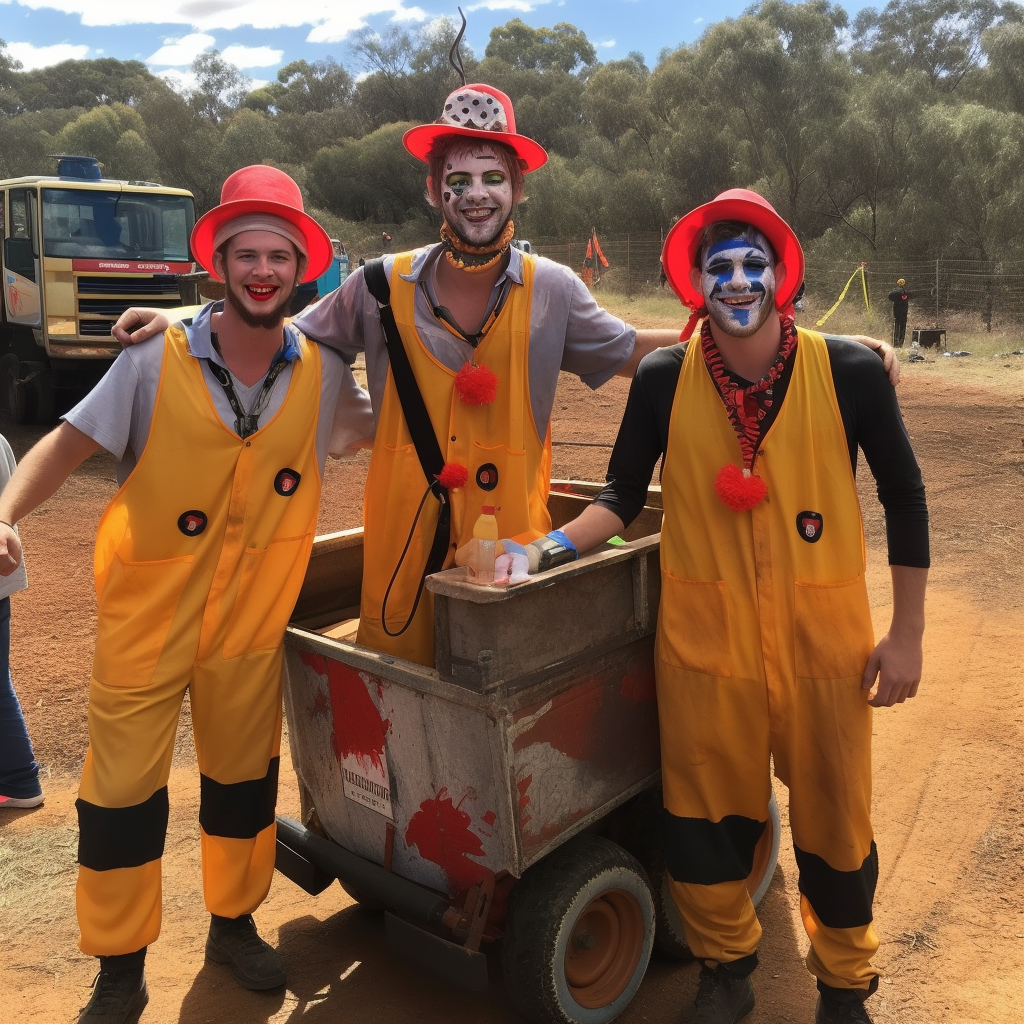
Checking her camera screen, Prune says: “You guys remind me of the Clockwork Orange with your hats, but more colourful and less creepy.”
Callum and Joe look at each other, each having one eyebrow raised. I snort. I’m sure they don’t understand the reference.
“You’re ok,” she tells them. “It means people will notice and remember you.”
“Spread the word! We’ll crush them all!” Callum shouts.
Prune looks at me. “You’re still frowning,” she says. “It’ll be fine.”
“Ok,” I say. “But at least take the hat. You can’t dress as yourself during a Cart and Lager festival, or you’ll pop out of the crowd.”
She raises her eyes to the sky and sighs. Then, she takes the orange hat from my hands and puts it on her head.
“There, happy? Consider that an endorsement of your team,” she says with a wink.
Joe and Callum hoot and whistle loudly. “Miss serious is running wild! Anything can happen today.”
We all laugh. Their enthusiasm is contagious.
“Hey! You’re mother is about to talk,” says Joe to Callum. “She’s hot.”
“Don’t speak about my mother like that.”
The mayor has climbed on the central stage and she’s talking with an all dressed up woman with a big hat that makes her look like the Queen of England. She sure seems out of place in our little town’s festival. Flanked by two bodyguards in black, I guess it’s Botty Banworth who’s provided that expensive sound system the mayor’s trying to use. “One, two, three… Is it working? Yes. Ok. All the participants are expected to bring their cart to the depart lane. We’re about to start. In the meantime let me introduce Miss Banworth who’s been very generous and allowed our festival to get to another level. She’s going to help us rehabilitate the abandoned mines and open a museum.”
A roar from the crowd. The woman’s lips are so thin and red that the smile she puts on her face looks like it’s just been made with a razor blade. I shiver. She’s the Queen of England turned by a vampire.
Someone bumps into my back and knocks the air out of my lungs. I almost fall on my sister.
“Hey! Watch out!” says Callum.
I catch my breath and look up. It’s Betsy, dressed as a miner too, with extra sequins and gummy stars on her dungarees. She looks confused and mutters some excuses but doesn’t stop. She walks as if she has had a few lagers already.
“Hey, Betsy,” calls Prune. “You seem like you just saw a ghost.”
“Someone… near the mines… It can’t be…” says Betsy.
“Who did you see near the mines?” shouts my sister.
With the noise around us, I almost didn’t hear Betsy’s answer.
“Fred… Howard… It can’t be. I need Idle’s cakes,” she says before disappearing in the crowd.
I look at Prune. I see in her eyes we’re thinking the same thing. Dad’s really here. We nod at the same time and I move my lips: “Be careful.” She nods.
“You three, win,” she tells us before leaving.
“You heard her?” I asked Callum and Joe. “Let’s move our limo.” As we approach the tracks with the other participants, a gush of wind almost knock my hat off my head. There is some commotion coming from the central stage. A guy climbed up and is shouting something that I don’t understand, pointing at the sky behind us. When I look back like everyone, tourists and teams, I understand.
“Dust! Dust’s coming!”
And right from the direction of the abandoned mines. Dad what did you get yourself into?
It’s 10:55am and I’m pretty sure we’ll have to put off the race.
March 24, 2023 at 10:05 am #7215In reply to: Orbs of Madjourneys
Zara the game character was standing in the entrance hallway in the old wooden inn. There was nobody around except for her three friends, and the light inside was strangely dim and an eerie orange glow was coming from the windows. She and the others wandered around opening doors and looking in rooms in the deserted building. There were a dozen or so bedrooms along both sides of a corridor, and a kitchen, dining room and lounge room leading off the entrance hall. Zara looked up the wide staircase, but as a cellar entrance was unlikely to be upstairs, she didn’t go up. The inn was surrounded by a wrap around verandah; perhaps the cellar entrance was outside underneath it. Zara checked for a personal clue:
“Amidst the foliage and bark, A feather and a beak in the dark.”
Foliage and bark suggested that the entrance was indeed outside, given the absence of houseplants inside. She stepped out the door and down the steps, walking around the perimeter of the raised vernadah, looking for a hatch or anything to suggest a way under the building. Before she had completed the circuit she noticed an outbuilding at the back underneath a eucalyptus tree and made her way over to it. She pushed the door open and peered into the dim interior. A single unmade bed, some jeans and t shirts thrown over the back of a chair, a couple of pairs of mens shoes….Zara was just about to retreat and close the door behind her when she noticed the little wooden desk in the corner with an untidy pile of papers and notebooks on it.
Wait though, Zara reminded herself, This is supposed to be a group quest. I better call the others over here.
Nevertheless, she went over to the desk to look first. There was an old fashioned feather quill and an ink pot on the desk, and a gold pocket watch and chain. Or was it a compass? Strangely, it seemed like neither, but what was it then? Zara picked one of the notebooks up but it was too dark inside the hut to read.
March 19, 2023 at 5:49 pm #7173In reply to: Orbs of Madjourneys
The morning of the lager and cart race dawned bright and clear. The camping ground was full to overflowing with tents and camper vans, with several parked up outside the Flying Fish Inn. Zara overheard Finly complaining to Mater about all the extra work with all and sundry traipsing in and out using the toilets, and Bert muttering about where was all the extra water supposed to come from and what if the well ran dry, and was it all really worth it, and Zara saw him scowl when Idle told him to lighten up and enjoy it. “Hah! Enjoy it? Nothing good ever happens when a dust storm comes for the cart race,” he said pointedly to Idle, ” And damn near everyone asking about the old mines, I tell you, nothing good’s gonna come from a cart race in a dust storm, the mayor shoulda cancelled it.” Bert slammed the porch door as he stomped off outside, scowling at Zara on the way past.
Zara watched him go with a quizzical expression. What was going on here? Idle had told her about her affair with Howard some forty years ago, and how she’d had to disappear as soon as it became obvious that she was pregnant. Zara had sympathized and said what an ordeal it must have been, but Idle had laughed and said no not really, she’d had a lovely time in Fiji and had found a nice place to leave the baby. Then Howard had disappeared down the mines, and what was the story about Idle’s brother leaving mysteriously? Idle had been vague about that part, preferring to change the topic to Youssef. Was the Howard story why Bert was so reluctant for anyone to go down the mines? What on earth was going on?
And how had Yasmin’s parcel ended up in Xavier’s room? Xavi had soon noticed that he’d picked it up by mistake and returned it to Yasmin, but how had it ended up on the table on the verandah? It was perplexing, and made Yasmin disinclined to deliver it to Mater until she could fathom what had happened. She had tucked in under her mattress until she was sure what to do.
But that wasn’t the only thing that had piqued Zara’s curiosity. When Idle had said she’d had the baby in Fiji, and found a nice place to leave it, Zara couldn’t help but think of the orphanage where Yasmin was working. But no, surely that would be too much of a coincidence, and anyway, a 40 year old orphan wouldn’t still be there. But what about that woman in the BMW that Yasmin felt sure she recognized? No, surely it was all too pat. But then, what was that woman in the dark glasses doing in Betsy’s shop? Betsy was Howards wife. Idle had mentioned her when she told her story over the second bottle of wine.
Should she divulge Idle’s secrets to Yasmin and quiz her on the woman in dark glasses? Zara decided there would be no harm in it, after all, they would be leaving soon after the cart race, and what would it matter. She fetched two cups of coffee from the kitchen and took them to Yasmin’s room and knocked gently on the door.
“Are you awake?” she called softly.
“Yeah, come in Zara, I’ve been awake for ages,” Yasmin replied.
Zara put the coffee cups on the bedside table and sat on the side of Yasmins bed. “There’s something going on here, I have to tell you something. But first, have you worked out who that woman in the BMW is?”
Yasmin looked startled and said “How did you know? Yes I have. It’s Sister Finli from the orphanage, I’m sure of it. But why has she followed me here? And in disguise! It’s just creepy!”
“Aha!” Zara couldn’t suppress a rather triumphant smile. “I thought it was just a wacky idea, but listen to this, Idle told me something the other night when we sat up drinking wine.” As she told Idle’s story, Yasmin’s eyes widened and she put a hand over her open mouth.
“Could it be…?”
“Yes but why in disguise? What is she up to? What should we do, should we warn Idle?” Zara had warmed to Idle, and if there were any sides to be taken in the matter, she felt more for Idle than that unpleasant woman from the orphanage who was so disturbing to Yasmin.
“Oh I don’t know, maybe we should keep out of it!” Yasmin said. “That parcel though! What am I going to do about that parcel!”
Zara frowned. “Well, you have three options, Yas. Open it and read it… don’t look so horrified! Or deliver it as promised..”
“We’ll never know what it said though if we do that,” Yasmin was looking more relaxed now.
“Exactly, and I’m just too curious now.”
“And the third option?”
Ignoring the question, Zara asked where the parcel was. Yasmin grinned wickedly but a knock at the door interrupted her intention to retrieve the parcel from under the mattress. It was Youssef, who asked if he could come in.
“Shall we tell him?” Zara whispered, as Yasmin called out “Of course! Is Idle after you again? Quick, you can hide under my bed!”
“Not yet” Yasmin whispered back. “I need to think.”
March 1, 2023 at 7:29 pm #6737In reply to: The Jorid’s Travels – 14 years on
I hear the greenhouse airlock open. I don’t look up and keep my focus on the alien sweat pea plant I have been working on. I’m trying to get it to bind itself to the carbon mesh I printed to help it spread instead of grow like a ball. My hands are precise and my movement efficient. I’ve been practicing everyday since I embarked on this ship some fourteen years ago. I don’t allow distraction when I’m in the greenhouse, and Georges was often one.
He plants himself on my left.
“I found the beast,” he says.
“One moment. I’m almost done.”
I have to be careful with the tendrils. An abrupt gesture would cause them to wind around my fingers and pierce my lab gloves with their myriad of teeth. As sharp and poisonous as black mamba teeth, I’d be dead in seconds.
“Here, little thing. That’s good,” I say, encouraging the plant.
After the first three tendrils find their bearing on the carbon mesh, the rest of the plant follows.
“That’s gross,” Georges says. “I don’t know why you always pick the most dangerous ones.”
I don’t answer and observe the plant wraps its tendrils around the carbon wires like it found a prey. I spent weeks trying to find the right combination of softness and tension for the alien plant to accept it.
“I’m done,” I say.
I look up and I see the creature in Georges’ hands.
“Isn’t she cute?” Georges asks.
“She? Should I worry next time you tell me I’m cute?”
The creature’s cute, as much as a rodent with protruding eyes can be. It’s clearly neither from Earth, nor from Alienor. The eyes are looking straight at me and its muzzle wiggles as if getting some information through its sense of smell. It isn’t dangerous, since Georges is still alive. He’s the opposite of careful and after all those years together, I have to wonder how he’s still alive.
February 18, 2023 at 11:28 am #6551In reply to: Orbs of Madjourneys
Xavier had woken up in the middle of the night that felt surprisingly alive bursting with a quiet symphony of sounds from nocturnal creatures and nearby nature, painted on a canvas of eerie spacious silence.
It often took him a while to get accustomed to any new place, and it was not uncommon for him to have his mind racing in the middle of the night. Generally Brytta had a soothing presence and that often managed to nudge him back to sleep, otherwise, he would simply wake up until the train of thoughts had left the station.
It was beginning of the afternoon in Berlin; Brytta would be in a middle of a shift, so he recorded a little message for her to find when she would get back to her phone. It was funny to think they’d met thanks to Yasmin and Zara, at the time the three girls were members of the same photography club, which was called ‘Focusgroupfocus’ or something similar…
With that done, he’d turned around for something to do but there wasn’t much in the room to explore or to distract him sufficiently. Not even a book in the nightstand drawer. The decoration itself had a mesmerising nature, but after a while it didn’t help with the racing thoughts.He was tempted to check in the game — there was something satisfactory in finishing a quest that left his monkey brain satiated for a while, so he gave in and logged back in.

Completing the quest didn’t take him too long this time. The main difficulty initially was to find the portal from where his avatar had landed. It was a strange carousel of blue storks that span into different dimensions one could open with the proper incantation.
As usual, stating the quirk was the key to the location, and the carousel portal propelled him right away to Midnight town, which was clearly a ghost town in more ways than one. Interestingly, he was chatting on the side with Glimmer, who’d run into new adventures of her own while continuing to ask him what was up, and as soon as he’d reached Midnight town, all communication channels suddenly went dark. He’d laughed to himself thinking how frustrated Glimmer would have been about that. But maybe the game took care of sending her AI-generated messages simulating his presence. Despite the disturbing thought of having an AI generated clone of himself, he almost hoped for it (he’d probably signed the consent for this without realising), so that he wouldn’t have to do a tedious recap about all what she’d missed.
Once he arrived in the town, the adventure followed a predictable pattern. The clues were also rather simple to follow.
The townspeople are all frozen in time, stuck in their daily routines and unable to move on. Your mission is to find the missing piece of continuity, a small hourglass that will set time back in motion and allow the townspeople to move forward.
The clue to finding the hourglass lies within a discarded pocket watch that can be found in the mayor’s office. You must unscrew the back and retrieve a hidden key. The key will unlock a secret compartment in the town clock tower, where the hourglass is kept.
Be careful as you search for the hourglass, as the town is not as abandoned as it seems. Spectral figures roam the streets, and strange whispers can be heard in the wind. You may also encounter a mysterious old man who seems to know more about the town’s secrets than he lets on.
Evading the ghosts and spectres wasn’t too difficult once you got the hang of it. The old man however had been quite an elusive figure to find, but he was clearly the highlight of the whole adventure; he had been hiding in plain sight since the beginning of the adventure. One of the blue storks in the town that he’d thought had come with him through the portal was in actuality not a bird at all.
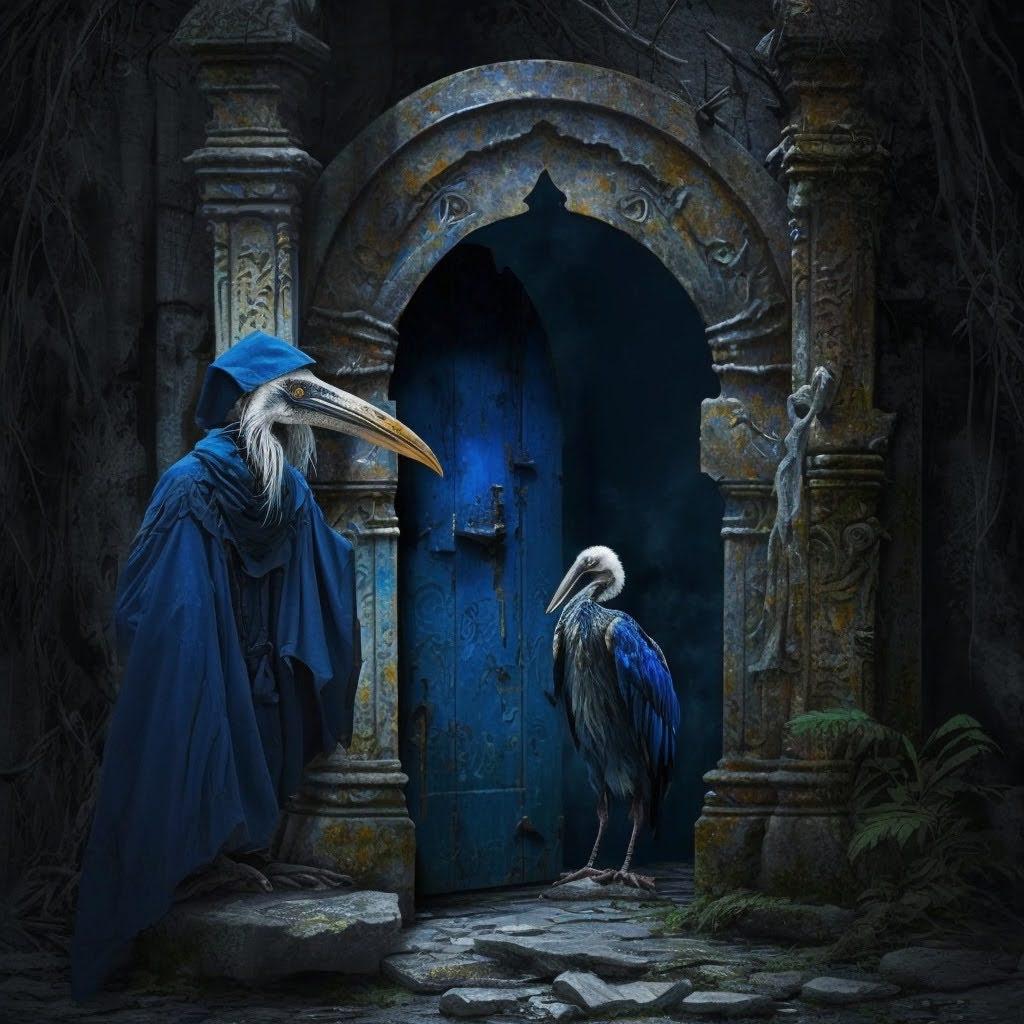
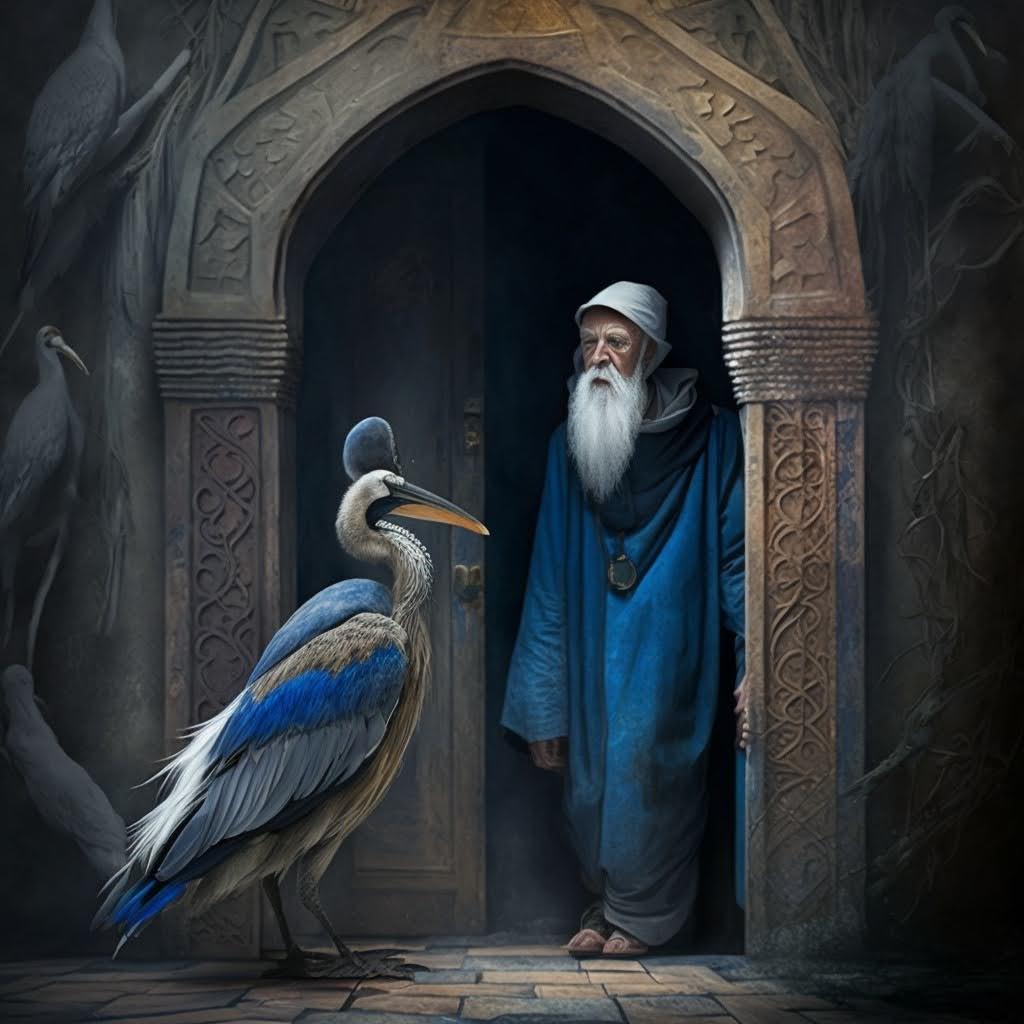
While he was focused on finishing the quest, the interaction with the hermit didn’t seem very helpful. Was he really from the game construct? When it was time to complete the quest and turn the hourglass to set the town back in motion, and resume continuity, some of his words came back to Xavier.
“The town isn’t what it seems. Recognise this precious moment where everything is still and you can realise it for the illusion that it is, a projection of your busy mind. When motion resumes, you will need to keep your mind quiet. The prize in the quest is not the completion of it, but the realisation you can stop the agitation at any moment, and return to what truly matters.”
The hermit had turned to him with clear dark eyes and asked “do you know what you are seeking in these adventures? do you know what truly matters to you?”
When he came out of the game, his quest completed, Xavier felt the words resonate ominously.
A buzz of the phone snapped him out of it.
It was a message from Zara. Apparently she’d found her way back to modernity.
[4:57] “Going to pick up Yasmin at the airport. You better sleep away the jetlag you lazy slugs, we have poultry damn plenty planned ahead – cackling bugger cooking lessons not looking forward to, but can be fun. Talk to you later. Z”
He had the impulse to go with her, but the lack of sleep was hitting back at him now, and he thought he’d better catch some so he could manage to realign with the timezone.
“The old man was right… that sounds like a lot of agitation coming our way…”
February 7, 2023 at 1:49 pm #6504In reply to: The Jorid’s Travels – 14 years on
Klatu was a quite unassuming alien form (alien for them anyway, he was actually more indigenous than they were). Looking like a green gnome with bulging eyes covered by protective goggles, long pointy ears (2 or 3 depending on the wind direction), a short three nostrils snout, an a mossy toupee on top of his head, he made quick work of the formalities and presentations.
“Little ugly humans, come follow me. Have tracked your smelly hairy friend, not time to waste.”
Salomé looked at Georges sideways with a smirk on his face. They could read their thoughts easily on that one, something along the lines of:
“The translator is behaving again, or is he really calling us ugly?”
“Don’t worry dear, that’s probably a polite way of addressing people in their language.”
They arrived at a little sand speedster just barely big enough for their indigenous companion. Salomé raised an eyebrow at the situation, while Georges was ready to ride shotgun with the alien on the tiny bike.
Klatu moved his arms in short annoyed movements, “not here, stupid mammals, go there and be quiet!” and pointed them to a makeshift trolley attached behind and half burried in the sand. He grinned from ear to ear to ear, visibly pleased with his vehicle tuning appendage.
“Horrid creatures better wear seatbelts. Ride gonna shaky.”
January 31, 2023 at 11:34 am #6477In reply to: Orbs of Madjourneys
Bertie dropped Zara off at the bus station in Camden early the next morning. She let him think she was catching a plane from Sydney, given her impulsive lie about having to meet her friends sooner, but she was going by train. The reviews she’d read online were tantalizing:
“The Ghan journey tells the story of the land. The train is the canvas, and the changing landscape paints the picture.”
A two day train ride would give her time to relax and play the game, and she assumed two days of desert scenery would not be too distracting. Luckily before she paid for her ticket she had the presence of mind to ask if there was internet on the train. There was not. Zara sighed, and booked a flight instead, but decided she would catch the train back home after the holiday at the Flying Fish Inn. By then perhaps the novelty of the game would have worn off, and she would appreciate the time spent in quiet contemplation, and perhaps do some writing.
Zara hated flying, especially airports. The best that could be said of flying was that it was a quick way to get from A to B.
“You’ll have to go in a cage for the flight, Pretty Girl,” she told the parrot.
“I think not,” replied Pretty Girl. “I’ll meet you there. See you!” and off she flew into the low morning sun, momentarily blinding Zara as she watched her go.
Her flight left Sydney at 14:35. Three and a half hours later she would arrive at Alice Springs and from there it was a half hour road trip to the Flying Fish. Zara sent an email to the inn asking if anyone could pick her up, otherwise she would get a bus or a taxi. She received a reply saying that they’d send Bert to pick her up around seven o’clock. Another Bert!
January 24, 2023 at 10:29 am #6455In reply to: Orbs of Madjourneys
Zara decided she may as well spend the hour wandering around the game before going back to the church to see the ghost of Isaac when she was sure her host Bertie was asleep. It was a warm night but a gentle breeze wafted through the open window and Zara was comfortable and content. Not just one but three new adventures had her tingling with delicious anticipation, even if she was a little anxious about not getting confused with the game. Talking to ghosts in old churches wasn’t unfamiliar, nor was a holiday in a strange hotel off the beaten track, but the game was still a bit of a mystery to her. Yeah, I know it’s just a game, she whispered to the parrot who made a soft clicking noise by way of response.
Zara found her game character, also (somewhat confusingly) named Zara, standing in the woods. Not entirely sure how it had happened, she was rather pleased to see that the cargo pants and tank top in red had changed to a more pleasing hippyish red skirt ensemble. A bit less Tomb Looter, and a bit more fairy tale looking which was more to her taste.
The woods were strangely silent and still. Zara made a 360 degree turn on the spot to see in all directions. The scene looked the same whichever way she turned, and Zara didn’t know which way to go. Then a faint path appeared to the left, and she set off in that direction. Before long she came to a round green pool.
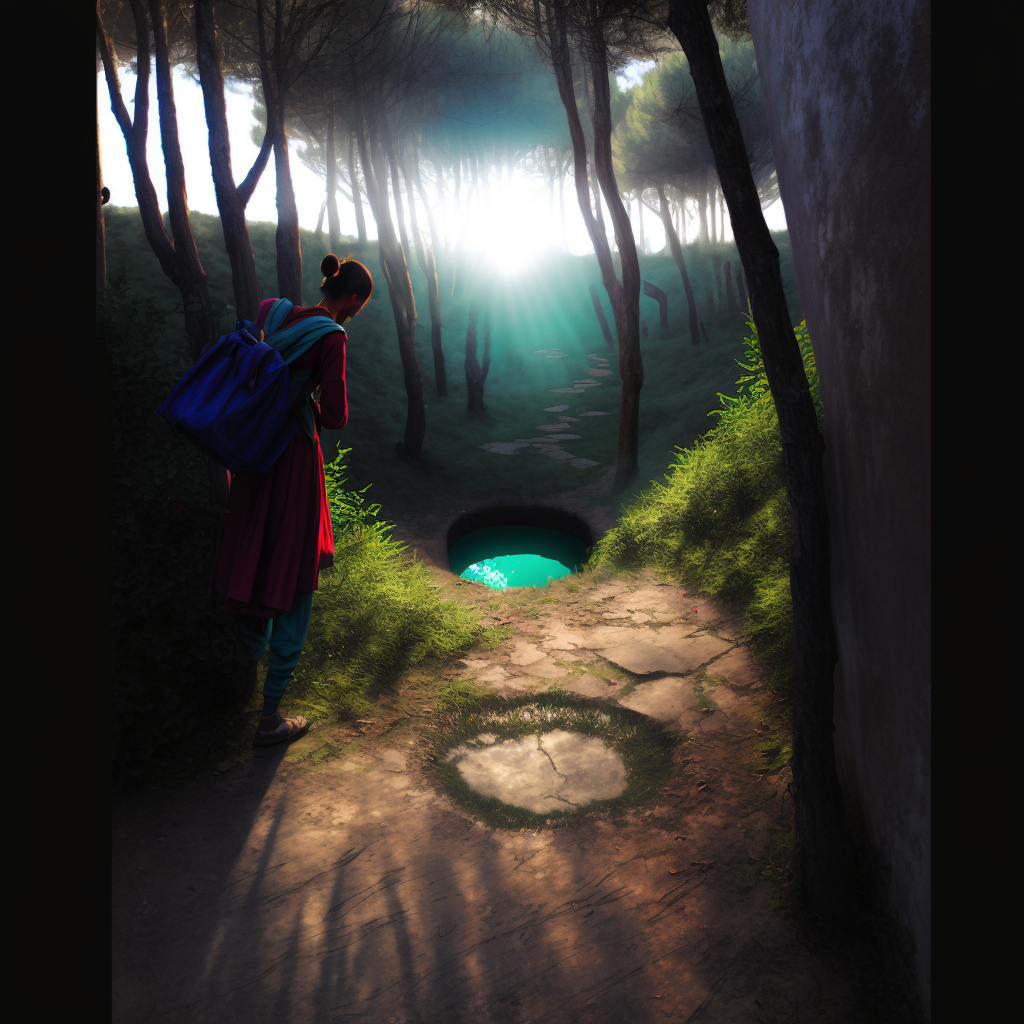
She stopped to look but carried on walking past it, not sure what it signified. She came upon another glowing green pool before long, which looked like an entrance to a tunnel.
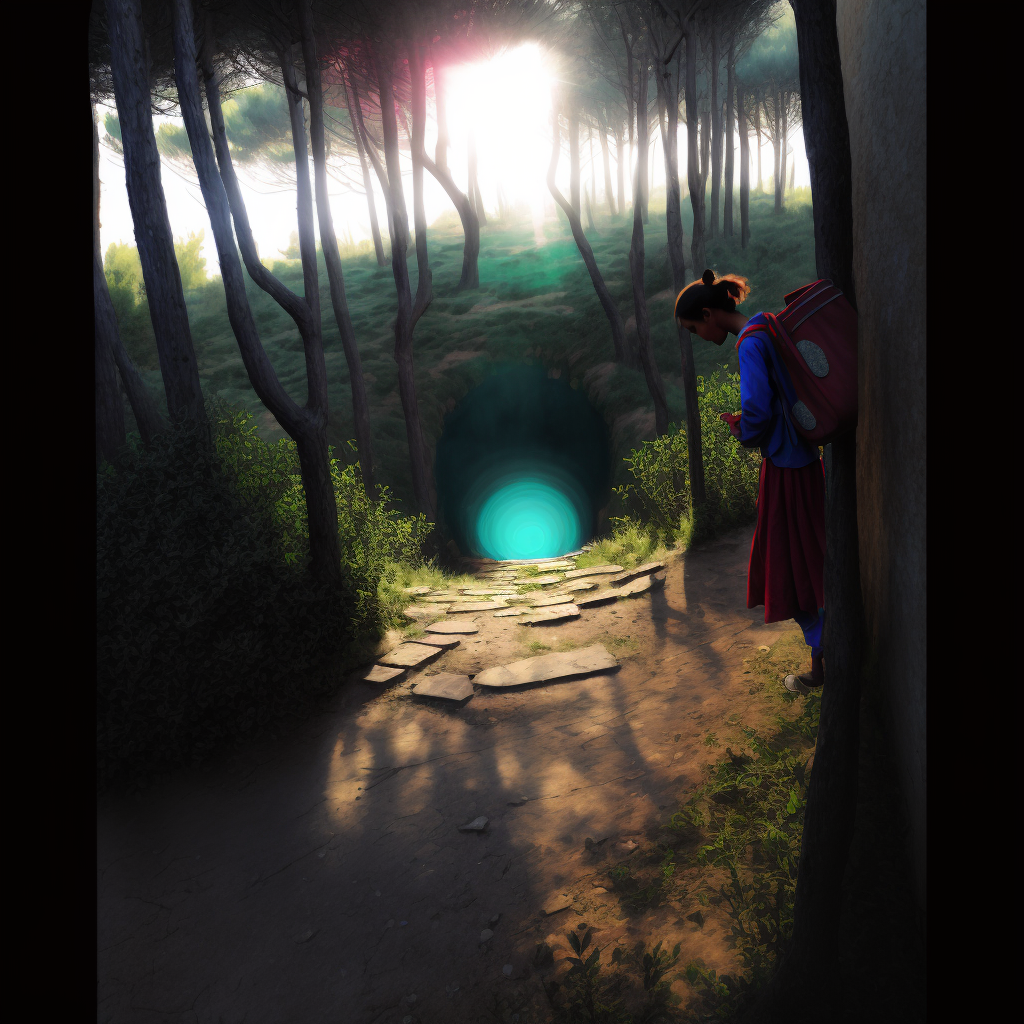
I bet those are portals or something, Zara realized. I wonder if I’m supposed to step into it?
“Go for it”, said Pretty Girl, “It’s only a game.”
“Ok, well here goes!” replied Zara, mentally bracing herself for a plunge into the unknown.
Zara stepped into the circle of glowing green.
“Like when Alice went down the rabbit hole!” Zara whispered to the parrot. “I’m falling, falling…oh!”
Zara emerged from the green pool onto a wide walled path. She was now in some kind of inhabited area, or at least not in the deep woods with no sign of human occupation.
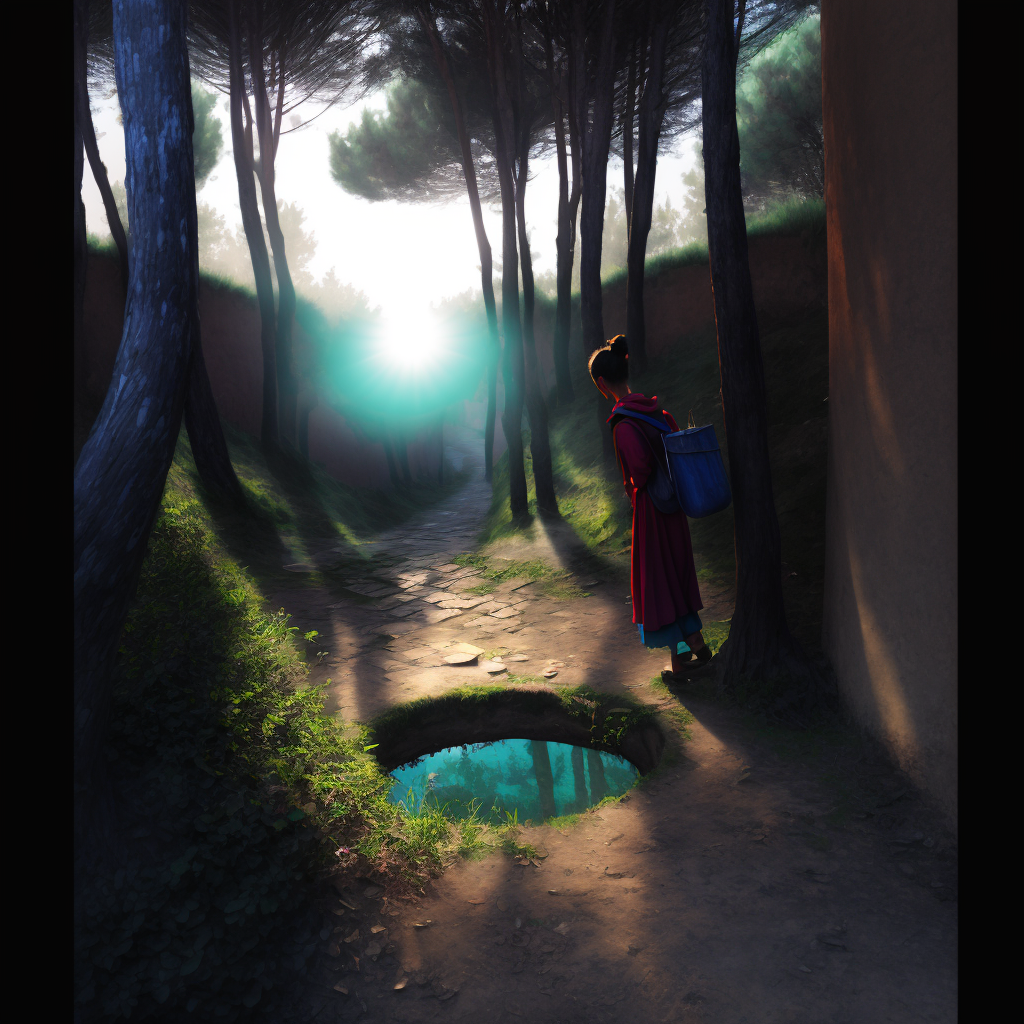
“I guess that green pool is the portal back to the woods.”
“By George, she’s getting it,” replied Pretty Girl.
Zara walked along the path which led to an old deserted ancient looking village with alleyways and steps.
“This is heaps more interesting than those woods, look how pretty it all is! I love this place.”
“Weren’t you supposed to be looking for a hermit in the woods though,” said Pretty Girl.
“Or a lost traveler, and the lost traveler may be here, after falling in one of those green pools in the woods,” replied Zara tartly, not wanting to leave the enchanting scene she found her avatar in.
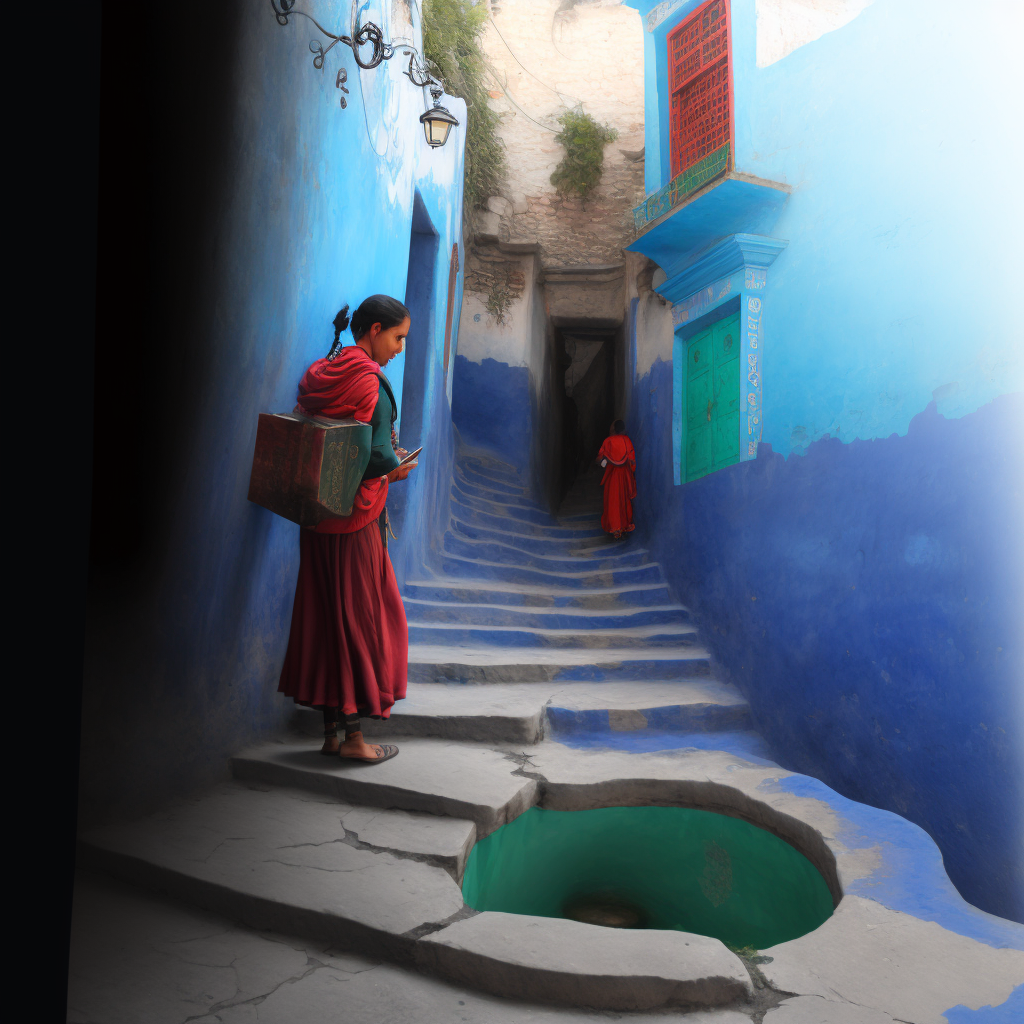 January 23, 2023 at 1:27 pm #6451
In reply to: Orbs of Madjourneys
The progress on the quest in the Land of the Quirks was too tantalizing; Xavier made himself a quick sandwich and jumped back on it during his lunch break.
 The jungle had an oppressing quality… Maybe it has to do with the shrieks of the apes tearing the silence apart.
 It was time for a slight adjustment of his avatar.
Xavimunk opened his bag of tricks, something that the wise owl had suggested he looked into. Few items from the AIorium Emporium had been supplied. They tended to shift and disappear if you didn’t focus, but his intention was set on the task at hand. At the bottom of the bag, there was a small vial with a golden liquid with a tag written in ornate handwriting “MJ remix: for when words elude and shapes confuse at your own peril”.
 He gulped the potion without thinking too much. He felt himself shrink, and his arms elongate a little. There, he thought. Imp-munk’s more suited to the mission. Hope the effects will be temporary…
As Xavier mustered the courage to enter through the front gate, monkeys started to become silent. He couldn’t say if it was an ominous sign, or maybe an effect of his adaptation. The temple’s light inside was gorgeous, but nothing seemed to be there.
He gestured around, to make the menu appear. He looked again at the instructions on his screen overlay:
As for possible characters to engage, you may come across a sly fox who claims to know the location of the fruit but will only reveal it in exchange for a favor, or a brave adventurer who has been searching for the Golden Banana for years and may be willing to team up with you.
Suddenly a loud monkey honking noise came from outside, distracting him.
What the?… Had to be one of Zara’s remixes. He saw the three dots bleeping on the screen.
Here’s the Banana bus, hope it helps! Envoy! bugger Enjoy!
Yep… With the distinct typo-heavy accent, definitely Zara’s style. Strange idea that AL designated her as the leader… He’d have to roll with it.
Suddenly, as the Banana bus parked in front of the Temple, a horde of Italien speaking tourists started to flock in and snap pictures around. The monkeys didn’t know what to do and seemed to build growing and noisy interest in their assortiment of colorful shoes, flip-flops, boots and all.


Focus, thought Xavimunk… What did the wise owl say? Look for a guide…
Only the huge colorful bus seemed to take the space now… But wait… what if?He walked to the parking spot under the shades of the huge banyan tree next to the temple’s entrance, under which the bus driver had parked it. The driver was still there, napping under a newspaper, his legs on the wheel.
“Whatcha lookin’ at?” he said chewing his gum loudly. “Never seen a fox drive a banana bus before?”
Xavier smiled. “Any chance you can guide me to the location of the Golden Banana?”
“For a price… maybe.” The fox had jumped closely and was considering the strange avatar from head to toe.
“Ain’t no usual stuff that got you into this? Got any left? That would be a nice price.”
“As it happens…” Xavier smiled.The quest seemed back on track. Xavier looked at the time. Blimmey! already late again. And I promised Brytta to get some Chinese snacks for dinner.
January 17, 2023 at 9:43 am #6396In reply to: Orbs of Madjourneys
Youssef woke up with a hangover. The guy from the restaurant had put fermented horse milk in his yak butter tea and he was already drunk before he could realize it. Apparently it had been a joke played on him by some of the team members he suspected didn’t quite like the humour of his real life shirt collection. Especially the one with the man shouting at his newspaper on his toilets.
As soon as he had gotten out of the yurt, before he could go have some breakfast, his boss, Miss Tartiflate, pounced on him because there was something wrong with THE BLOG. And Youssef was the one in charge of it. And it was important because people in the world were expecting her posts about the shooting everyday. Truth is, since they couldn’t find the last Mongolian shaman, who apparently called himself Lama Yoneze, and the views had dropped dramatically. Youssef suspected Miss Tartiflate was not as ignorante as she wanted him to believe and had broken the blog on purpose so that her own boss wouldn’t accuse her of being lazy.“I have a reputation, you know!”
She had said that looking like he didn’t have one, and nobody cared anyway.
Youssef looked at the clock on his phone. They were supposed to meet with Zara, Xavier and Yasmine in thirty minutes. He had tried to sort out THE BLOG problem, but nothing seemed to work, and time was running out. Despite all being ok on the admin console, nothing was showing up on the page. He had called Gang Thi, the Nepalese company in charge of the blog, three times. Each time the receptionist hang up on him while attempting to put him on hold, or so she said. Now, nobody even bother to answer the damn phone.
Miss Tartiflate passed her head between the curtains of the yurt.
“Are you finished yet ?” she asked that as if he was on the throne.
“Nope!”
“What!? How? Do you have sausage fingers? My 5 years old daughter is more nimble than you with computers.”
“Well, you should have brought her with us then,” said Youssef with an irritated smile, fed up by her constant useless interruptions.
She grunted and closed the curtains angrily. Youssef growled like a bear, showing his bare teeth. Everybody knew why she jumped on the occasion for this trip: needed some fresh air from her nimble daughter and her husband.
An alert showed up on his phone : “You’ve got a message from 💣Gang Thi💣”. The bomb in the title looked suspicious, and his stomach growled, reminding him he hadn’t eaten this morning. He clicked to open it.
The face of a mummy looking like Darth Vader and laughing like the Joker jumped on his screen. After a few seconds a message started to appear in a tongue he couldn’t decipher.
Youssef looked at the clock and almost threw his phone on the ground as the mummy started to laugh again.
He would definitely have to miss the meeting with his friends.January 15, 2023 at 11:42 am #6389In reply to: Newsreel from the Rim of the Realm
“What in the good name of our Lady, have these two been on?” Miss Bossy was at a loss for words while Ricardo was waiting sheepishly at her desk, as though he was expecting an outburst.
“Look, Ricardo, I’m not against a little tweaking for newsworthiness, but this takes twisting reality to a whole new level!Ricardo had just dropped their last article.
Local Hero at the Rescue – Stray Residents found after in a trip of a lifetime
article by Hilda Astoria & Continuity BrownIn a daring and heroic move, Nurse Trassie, a local hero and all-around fantastic human being, managed to track down and rescue three elderly women who had gone on an adventure of a lifetime. Sharon, Mavis, and Gloria (names may have been altered to preserve their anonymity) were residents of a UK nursing home who, in a moment of pure defiance and desire for adventure, decided to go off their meds and escape to the Nordics.
The three women, who had been feeling cooped up and underappreciated in their nursing home, decided to take matters into their own hands and embark on a journey to see the world. They had heard of the beautiful landscapes and friendly people of the Nordics and their rejuvenating traditional cures and were determined to experience it for themselves.
Their journey, however, was not without its challenges. They faced many obstacles, including harsh weather conditions and language barriers. But they were determined to press on, and their determination paid off when they were taken in by a kind-hearted local doctor who gave them asylum and helped them rehabilitate stray animals.
Nurse Trassie, who had been on the lookout for the women since their disappearance, finally caught wind of their whereabouts and set out to rescue them. She tracked them down to the Nordics, where she found them living in a small facility in the woods, surrounded by a menagerie of stray animals they had taken in and were nursing back to health, including rare orangutans retired from local circus.
Upon her arrival, Nurse Trassie was greeted with open arms by the women, who were overjoyed to see her. They told her of their adventures and showed her around their cabin, introducing her to the animals they had taken in and the progress they had made in rehabilitating them.
Nurse Trassie, who is known for her compassion and dedication to her patients, was deeply touched by the women’s story and their love for the animals. She knew that they needed to be back in the care of professionals and that the animals needed to be properly cared for, so she made arrangements to bring them back home.
The women were reluctant to leave their newfound home and the animals they had grown to love, but they knew that it was the right thing to do. They said their goodbyes and set off on the long journey back home with Nurse Trassie by their side.
The three women returned to their nursing home filled with stories to share, and Nurse Trassie was hailed as a hero for her efforts in rescuing them. They were greeted with cheers and applause from the staff and other residents, who were thrilled to have them back safe and sound.
Nurse Trassie, who is known for her sharp wit and sense of humor, commented on the situation with a tongue-in-cheek remark, “It’s not every day that you get to rescue three feisty elderlies from the wilds of the Nordics and bring them back to safety. I’m just glad I could be of service.”
In conclusion, the three women’s adventure in the Nordics may have been unorthodox, but it was an adventure nonetheless. They were able to see the world and help some animals in the process. Their story serves as a reminder to never give up on your dreams, no matter your age or circumstances. And of course, a big shoutout to Nurse Trassie for her heroic actions and dedication to her patients.
Bossy sighed. “It might do for now, but don’t let those two abuse the artificial intelligence to write article for them… I liked their old style better. This feels too… tidy. We’re not the A-News network, let’s not forget our purpose.”
Ricardo nodded. Miss Bossy had been more mellow since the sales of the newspaper had exploded during the pandemic. With people at home, looking for conspiracies and all, the newspaper had known a resurgence of interest, and they even had to hire new staff. Giles Gibber, Glimmer Gambol (came heavily recommended by Blithe, the PI friend of Hilda’s), Samuel Sproink and Fionna Flibbergibbet.
“And how is Sophie? That adventure into her past trauma was a bit much on her…” she mused.
“She’s doing alright” answered Ricardo. “She’s learning to hone her remote-viewing skills to send our staff into new mysteries to solve. With a bit of AI assist…”
“Oh, stop it already with your AI-this, AI-that! Hope there’ll still be room for some madness in all that neatly tidy purring of polite output.”
“That’s why we’re here for, I reckon.” Ric’ smiled wryly.
December 6, 2022 at 2:17 pm #6350In reply to: Family Stories From The Other Side ~ Book Two
Transportation
Isaac Stokes 1804-1877
Isaac was born in Churchill, Oxfordshire in 1804, and was the youngest brother of my 4X great grandfather Thomas Stokes. The Stokes family were stone masons for generations in Oxfordshire and Gloucestershire, and Isaac’s occupation was a mason’s labourer in 1834 when he was sentenced at the Lent Assizes in Oxford to fourteen years transportation for stealing tools.
Churchill where the Stokes stonemasons came from: on 31 July 1684 a fire destroyed 20 houses and many other buildings, and killed four people. The village was rebuilt higher up the hill, with stone houses instead of the old timber-framed and thatched cottages. The fire was apparently caused by a baker who, to avoid chimney tax, had knocked through the wall from her oven to her neighbour’s chimney.
Isaac stole a pick axe, the value of 2 shillings and the property of Thomas Joyner of Churchill; a kibbeaux and a trowel value 3 shillings the property of Thomas Symms; a hammer and axe value 5 shillings, property of John Keen of Sarsden.
(The word kibbeaux seems to only exists in relation to Isaac Stokes sentence and whoever was the first to write it was perhaps being creative with the spelling of a kibbo, a miners or a metal bucket. This spelling is repeated in the criminal reports and the newspaper articles about Isaac, but nowhere else).
In March 1834 the Removal of Convicts was announced in the Oxford University and City Herald: Isaac Stokes and several other prisoners were removed from the Oxford county gaol to the Justitia hulk at Woolwich “persuant to their sentences of transportation at our Lent Assizes”.
via digitalpanopticon:
Hulks were decommissioned (and often unseaworthy) ships that were moored in rivers and estuaries and refitted to become floating prisons. The outbreak of war in America in 1775 meant that it was no longer possible to transport British convicts there. Transportation as a form of punishment had started in the late seventeenth century, and following the Transportation Act of 1718, some 44,000 British convicts were sent to the American colonies. The end of this punishment presented a major problem for the authorities in London, since in the decade before 1775, two-thirds of convicts at the Old Bailey received a sentence of transportation – on average 283 convicts a year. As a result, London’s prisons quickly filled to overflowing with convicted prisoners who were sentenced to transportation but had no place to go.
To increase London’s prison capacity, in 1776 Parliament passed the “Hulks Act” (16 Geo III, c.43). Although overseen by local justices of the peace, the hulks were to be directly managed and maintained by private contractors. The first contract to run a hulk was awarded to Duncan Campbell, a former transportation contractor. In August 1776, the Justicia, a former transportation ship moored in the River Thames, became the first prison hulk. This ship soon became full and Campbell quickly introduced a number of other hulks in London; by 1778 the fleet of hulks on the Thames held 510 prisoners.
Demand was so great that new hulks were introduced across the country. There were hulks located at Deptford, Chatham, Woolwich, Gosport, Plymouth, Portsmouth, Sheerness and Cork.The Justitia via rmg collections:
Convicts perform hard labour at the Woolwich Warren. The hulk on the river is the ‘Justitia’. Prisoners were kept on board such ships for months awaiting deportation to Australia. The ‘Justitia’ was a 260 ton prison hulk that had been originally moored in the Thames when the American War of Independence put a stop to the transportation of criminals to the former colonies. The ‘Justitia’ belonged to the shipowner Duncan Campbell, who was the Government contractor who organized the prison-hulk system at that time. Campbell was subsequently involved in the shipping of convicts to the penal colony at Botany Bay (in fact Port Jackson, later Sydney, just to the north) in New South Wales, the ‘first fleet’ going out in 1788.
While searching for records for Isaac Stokes I discovered that another Isaac Stokes was transported to New South Wales in 1835 as well. The other one was a butcher born in 1809, sentenced in London for seven years, and he sailed on the Mary Ann. Our Isaac Stokes sailed on the Lady Nugent, arriving in NSW in April 1835, having set sail from England in December 1834.
Lady Nugent was built at Bombay in 1813. She made four voyages under contract to the British East India Company (EIC). She then made two voyages transporting convicts to Australia, one to New South Wales and one to Van Diemen’s Land (Tasmania). (via Wikipedia)
via freesettlerorfelon website:
On 20 November 1834, 100 male convicts were transferred to the Lady Nugent from the Justitia Hulk and 60 from the Ganymede Hulk at Woolwich, all in apparent good health. The Lady Nugent departed Sheerness on 4 December 1834.
SURGEON OLIVER SPROULE
Oliver Sproule kept a Medical Journal from 7 November 1834 to 27 April 1835. He recorded in his journal the weather conditions they experienced in the first two weeks:
‘In the course of the first week or ten days at sea, there were eight or nine on the sick list with catarrhal affections and one with dropsy which I attribute to the cold and wet we experienced during that period beating down channel. Indeed the foremost berths in the prison at this time were so wet from leaking in that part of the ship, that I was obliged to issue dry beds and bedding to a great many of the prisoners to preserve their health, but after crossing the Bay of Biscay the weather became fine and we got the damp beds and blankets dried, the leaks partially stopped and the prison well aired and ventilated which, I am happy to say soon manifested a favourable change in the health and appearance of the men.
Besides the cases given in the journal I had a great many others to treat, some of them similar to those mentioned but the greater part consisted of boils, scalds, and contusions which would not only be too tedious to enter but I fear would be irksome to the reader. There were four births on board during the passage which did well, therefore I did not consider it necessary to give a detailed account of them in my journal the more especially as they were all favourable cases.
Regularity and cleanliness in the prison, free ventilation and as far as possible dry decks turning all the prisoners up in fine weather as we were lucky enough to have two musicians amongst the convicts, dancing was tolerated every afternoon, strict attention to personal cleanliness and also to the cooking of their victuals with regular hours for their meals, were the only prophylactic means used on this occasion, which I found to answer my expectations to the utmost extent in as much as there was not a single case of contagious or infectious nature during the whole passage with the exception of a few cases of psora which soon yielded to the usual treatment. A few cases of scurvy however appeared on board at rather an early period which I can attribute to nothing else but the wet and hardships the prisoners endured during the first three or four weeks of the passage. I was prompt in my treatment of these cases and they got well, but before we arrived at Sydney I had about thirty others to treat.’
The Lady Nugent arrived in Port Jackson on 9 April 1835 with 284 male prisoners. Two men had died at sea. The prisoners were landed on 27th April 1835 and marched to Hyde Park Barracks prior to being assigned. Ten were under the age of 14 years.
The Lady Nugent:
Isaac’s distinguishing marks are noted on various criminal registers and record books:
“Height in feet & inches: 5 4; Complexion: Ruddy; Hair: Light brown; Eyes: Hazel; Marks or Scars: Yes [including] DEVIL on lower left arm, TSIS back of left hand, WS lower right arm, MHDW back of right hand.”
Another includes more detail about Isaac’s tattoos:
“Two slight scars right side of mouth, 2 moles above right breast, figure of the devil and DEVIL and raised mole, lower left arm; anchor, seven dots half moon, TSIS and cross, back of left hand; a mallet, door post, A, mans bust, sun, WS, lower right arm; woman, MHDW and shut knife, back of right hand.”
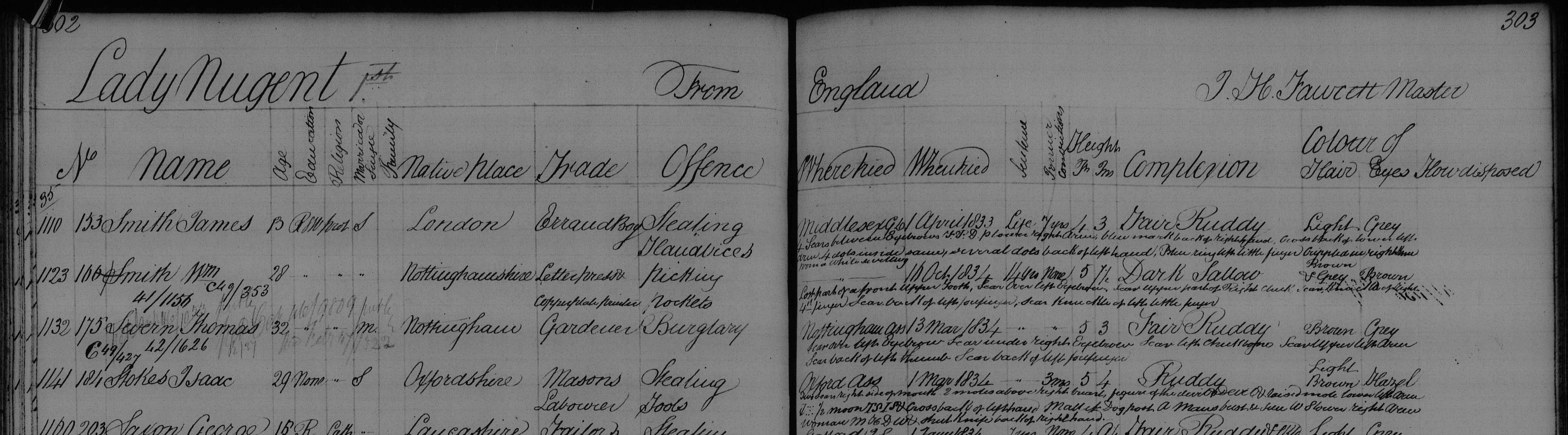
From How tattoos became fashionable in Victorian England (2019 article in TheConversation by Robert Shoemaker and Zoe Alkar):
“Historical tattooing was not restricted to sailors, soldiers and convicts, but was a growing and accepted phenomenon in Victorian England. Tattoos provide an important window into the lives of those who typically left no written records of their own. As a form of “history from below”, they give us a fleeting but intriguing understanding of the identities and emotions of ordinary people in the past.
As a practice for which typically the only record is the body itself, few systematic records survive before the advent of photography. One exception to this is the written descriptions of tattoos (and even the occasional sketch) that were kept of institutionalised people forced to submit to the recording of information about their bodies as a means of identifying them. This particularly applies to three groups – criminal convicts, soldiers and sailors. Of these, the convict records are the most voluminous and systematic.
Such records were first kept in large numbers for those who were transported to Australia from 1788 (since Australia was then an open prison) as the authorities needed some means of keeping track of them.”On the 1837 census Isaac was working for the government at Illiwarra, New South Wales. This record states that he arrived on the Lady Nugent in 1835. There are three other indent records for an Isaac Stokes in the following years, but the transcriptions don’t provide enough information to determine which Isaac Stokes it was. In April 1837 there was an abscondment, and an arrest/apprehension in May of that year, and in 1843 there was a record of convict indulgences.
From the Australian government website regarding “convict indulgences”:
“By the mid-1830s only six per cent of convicts were locked up. The vast majority worked for the government or free settlers and, with good behaviour, could earn a ticket of leave, conditional pardon or and even an absolute pardon. While under such orders convicts could earn their own living.”
In 1856 in Camden, NSW, Isaac Stokes married Catherine Daly. With no further information on this record it would be impossible to know for sure if this was the right Isaac Stokes. This couple had six children, all in the Camden area, but none of the records provided enough information. No occupation or place or date of birth recorded for Isaac Stokes.
I wrote to the National Library of Australia about the marriage record, and their reply was a surprise! Issac and Catherine were married on 30 September 1856, at the house of the Rev. Charles William Rigg, a Methodist minister, and it was recorded that Isaac was born in Edinburgh in 1821, to parents James Stokes and Sarah Ellis! The age at the time of the marriage doesn’t match Isaac’s age at death in 1877, and clearly the place of birth and parents didn’t match either. Only his fathers occupation of stone mason was correct. I wrote back to the helpful people at the library and they replied that the register was in a very poor condition and that only two and a half entries had survived at all, and that Isaac and Catherines marriage was recorded over two pages.
I searched for an Isaac Stokes born in 1821 in Edinburgh on the Scotland government website (and on all the other genealogy records sites) and didn’t find it. In fact Stokes was a very uncommon name in Scotland at the time. I also searched Australian immigration and other records for another Isaac Stokes born in Scotland or born in 1821, and found nothing. I was unable to find a single record to corroborate this mysterious other Isaac Stokes.
As the age at death in 1877 was correct, I assume that either Isaac was lying, or that some mistake was made either on the register at the home of the Methodist minster, or a subsequent mistranscription or muddle on the remnants of the surviving register. Therefore I remain convinced that the Camden stonemason Isaac Stokes was indeed our Isaac from Oxfordshire.
I found a history society newsletter article that mentioned Isaac Stokes, stone mason, had built the Glenmore church, near Camden, in 1859.
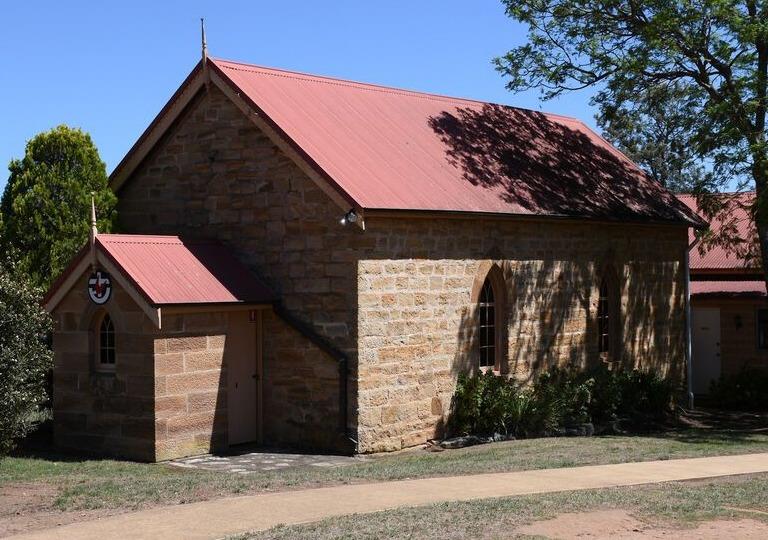
From the Wollondilly museum April 2020 newsletter:
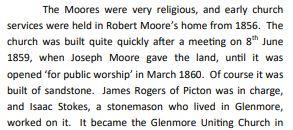
From the Camden History website:
“The stone set over the porch of Glenmore Church gives the date of 1860. The church was begun in 1859 on land given by Joseph Moore. James Rogers of Picton was given the contract to build and local builder, Mr. Stokes, carried out the work. Elizabeth Moore, wife of Edward, laid the foundation stone. The first service was held on 19th March 1860. The cemetery alongside the church contains the headstones and memorials of the areas early pioneers.”
Isaac died on the 3rd September 1877. The inquest report puts his place of death as Bagdelly, near to Camden, and another death register has put Cambelltown, also very close to Camden. His age was recorded as 71 and the inquest report states his cause of death was “rupture of one of the large pulmonary vessels of the lung”. His wife Catherine died in childbirth in 1870 at the age of 43.
Isaac and Catherine’s children:
William Stokes 1857-1928
Catherine Stokes 1859-1846
Sarah Josephine Stokes 1861-1931
Ellen Stokes 1863-1932
Rosanna Stokes 1865-1919
Louisa Stokes 1868-1844.
It’s possible that Catherine Daly was a transported convict from Ireland.
Some time later I unexpectedly received a follow up email from The Oaks Heritage Centre in Australia.
“The Gaudry papers which we have in our archive record him (Isaac Stokes) as having built: the church, the school and the teachers residence. Isaac is recorded in the General return of convicts: 1837 and in Grevilles Post Office directory 1872 as a mason in Glenmore.”
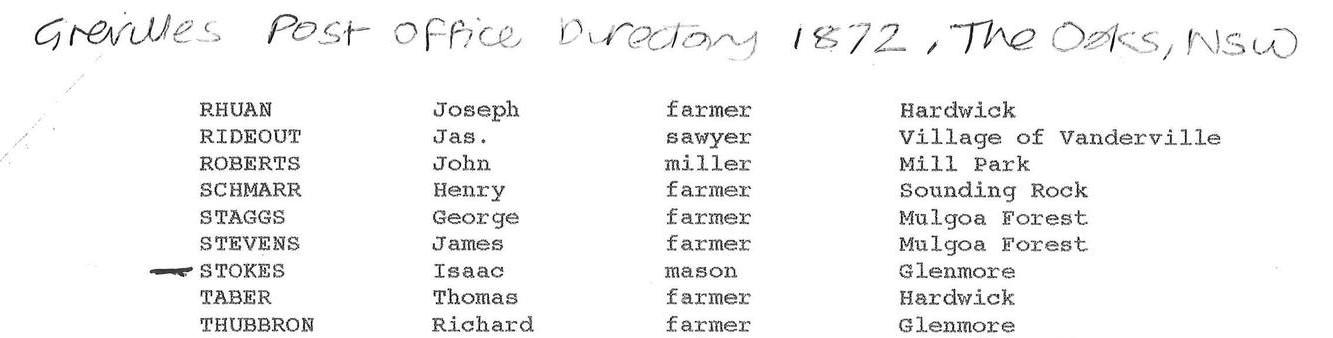
-
AuthorSearch Results

