


Search Results for 'word'
-
AuthorSearch Results
-
January 20, 2023 at 12:36 pm #6421
In reply to: The Chronicles of the Flying Fish Inn
Aunt Idle:
You won’t beleive this, I said to Mater, and she said I probably won’t before giving me a chance to finish. I ignored her as usual and told her about the bookings. Bookings, she screeched like a demented parrot, bookings? Since when did we have bookings. She even had the cheek to tell me I was living in the past, imagining we had bookings. I told her she was the one living in the past, the past when we had no bookings, and that I was living in the present because we had four people booked to stay at the inn, and we did indeed have bookings and that she should take off that old red pantsuit and put something practical on because we had a great deal of cleaning to do. Then she did her screeching parrot routine with the word cleaning, and I left her to it and went to tell Bert.
I don’t know what I’d have done without good old Bert over the years. I started to get a bit screechy myself with the panic when I was telling him, but he calmed me right down and started to make a list of the things that needed doing in order of importance. Start with preparing a bedroom each, he said, and get Mater to go down to the kitchen and make a shopping list. I said Bert are you sure that’s wise, Mater in charge of supplies, and he said no it aint wise but who else is going to do it?
I left Bert clanging away with the boiler trying to get some hot water out of it, and went to get some dusters and a broom and had to dust them off a bit, been a long time since anyone looked in the broom cupboard, and lo and behold Mater appears dressed as a 17th century serving wench. I let that pass without comment, but I did tell her to try and be sensible with the shopping list.
January 15, 2023 at 1:13 pm #6390In reply to: Train your subjective AI – text version
Trying to get some interesting unlikely, absurd associations or quests… Still some way to go!
2 impossible associations
- The creation of a time machine using only household objects such as a toaster and a stapler.
- The discovery of a parallel universe accessible through a secret passageway hidden in a public park’s playground equipment.
give an association of 3 or 4 words with each words being statistically probable to occur in every day conversation but with statistical probability of occurring together of less than 10^-57.
-
- “Giant robotic giraffe farming”
- “Vintage cars restoration using only expired food”
- “Archaeological board game design with only smells”
- “Artificial intelligence calligraphic body language assisted therapy”
All the words in these associations are commonly used in everyday conversation, but the associations themselves are relatively unexpected, absurd, and may surprise people. They are all grounded in everyday happenstances but are less modern tech-oriented and the concepts they describe are related to diverse interests that may not be related to technology trend and are quite unexpected and bizarre..
January 15, 2023 at 11:42 am #6389In reply to: Newsreel from the Rim of the Realm
“What in the good name of our Lady, have these two been on?” Miss Bossy was at a loss for words while Ricardo was waiting sheepishly at her desk, as though he was expecting an outburst.
“Look, Ricardo, I’m not against a little tweaking for newsworthiness, but this takes twisting reality to a whole new level!Ricardo had just dropped their last article.
Local Hero at the Rescue – Stray Residents found after in a trip of a lifetime
article by Hilda Astoria & Continuity BrownIn a daring and heroic move, Nurse Trassie, a local hero and all-around fantastic human being, managed to track down and rescue three elderly women who had gone on an adventure of a lifetime. Sharon, Mavis, and Gloria (names may have been altered to preserve their anonymity) were residents of a UK nursing home who, in a moment of pure defiance and desire for adventure, decided to go off their meds and escape to the Nordics.
The three women, who had been feeling cooped up and underappreciated in their nursing home, decided to take matters into their own hands and embark on a journey to see the world. They had heard of the beautiful landscapes and friendly people of the Nordics and their rejuvenating traditional cures and were determined to experience it for themselves.
Their journey, however, was not without its challenges. They faced many obstacles, including harsh weather conditions and language barriers. But they were determined to press on, and their determination paid off when they were taken in by a kind-hearted local doctor who gave them asylum and helped them rehabilitate stray animals.
Nurse Trassie, who had been on the lookout for the women since their disappearance, finally caught wind of their whereabouts and set out to rescue them. She tracked them down to the Nordics, where she found them living in a small facility in the woods, surrounded by a menagerie of stray animals they had taken in and were nursing back to health, including rare orangutans retired from local circus.
Upon her arrival, Nurse Trassie was greeted with open arms by the women, who were overjoyed to see her. They told her of their adventures and showed her around their cabin, introducing her to the animals they had taken in and the progress they had made in rehabilitating them.
Nurse Trassie, who is known for her compassion and dedication to her patients, was deeply touched by the women’s story and their love for the animals. She knew that they needed to be back in the care of professionals and that the animals needed to be properly cared for, so she made arrangements to bring them back home.
The women were reluctant to leave their newfound home and the animals they had grown to love, but they knew that it was the right thing to do. They said their goodbyes and set off on the long journey back home with Nurse Trassie by their side.
The three women returned to their nursing home filled with stories to share, and Nurse Trassie was hailed as a hero for her efforts in rescuing them. They were greeted with cheers and applause from the staff and other residents, who were thrilled to have them back safe and sound.
Nurse Trassie, who is known for her sharp wit and sense of humor, commented on the situation with a tongue-in-cheek remark, “It’s not every day that you get to rescue three feisty elderlies from the wilds of the Nordics and bring them back to safety. I’m just glad I could be of service.”
In conclusion, the three women’s adventure in the Nordics may have been unorthodox, but it was an adventure nonetheless. They were able to see the world and help some animals in the process. Their story serves as a reminder to never give up on your dreams, no matter your age or circumstances. And of course, a big shoutout to Nurse Trassie for her heroic actions and dedication to her patients.
Bossy sighed. “It might do for now, but don’t let those two abuse the artificial intelligence to write article for them… I liked their old style better. This feels too… tidy. We’re not the A-News network, let’s not forget our purpose.”
Ricardo nodded. Miss Bossy had been more mellow since the sales of the newspaper had exploded during the pandemic. With people at home, looking for conspiracies and all, the newspaper had known a resurgence of interest, and they even had to hire new staff. Giles Gibber, Glimmer Gambol (came heavily recommended by Blithe, the PI friend of Hilda’s), Samuel Sproink and Fionna Flibbergibbet.
“And how is Sophie? That adventure into her past trauma was a bit much on her…” she mused.
“She’s doing alright” answered Ricardo. “She’s learning to hone her remote-viewing skills to send our staff into new mysteries to solve. With a bit of AI assist…”
“Oh, stop it already with your AI-this, AI-that! Hope there’ll still be room for some madness in all that neatly tidy purring of polite output.”
“That’s why we’re here for, I reckon.” Ric’ smiled wryly.
January 14, 2023 at 8:13 pm #6387In reply to: Scrying the Word Cloud
Words from the Cloud prompted me to write a story:
song stayed act unexpected recall words spears bus learn king expected followed fright hot wore kianda picture walked playing coast dusty
Once upon a time, in a far-off land, there was a Song that stayed in the hearts of the people. The Song was about an Act of bravery and sacrifice that had taken place many years ago. But one day, an unexpected recall of the Song was issued by the king. He had heard that the Song was not being sung correctly, and he wanted to make sure that the true story was being told. The people were puzzled, as they had learned the Song from their ancestors and had always thought it was accurate. But they followed the king’s orders and set out to learn the correct version of the Song. As they began to recall the words, they realized that there were some discrepancies. They had always sung about the hero wielding a sword, but the true story spoke of him wielding Spears. They were taken aback, but they knew they had to correct the Song. So, they set out on a journey to retrace the hero’s steps.
As they traveled, they encountered unexpected challenges. They faced a bus that broke down, a coastline that was dusty and treacherous, and even a group of bandits. But they pressed on, determined to learn the truth.
As they approached the hero’s final battle, they felt a sense of dread. They had heard that the enemy was fierce, and they were not prepared for what they would find. But they followed the path and soon found themselves at the edge of a hot, barren wasteland.
The heroes wore their Kianda, traditional armor made of woven reeds, and stepped forward, ready for battle. But to their surprise, the enemy was nowhere to be found. Instead, they found a picture etched into the ground, depicting the hero and his enemy locked in a fierce battle.
The people walked around the picture, marveling at the detail and skill of the artist. And as they looked closer, they saw that the hero was holding Spears, not a sword. They realized that they had learned the true story, and they felt a sense of pride and gratitude.
With the Song corrected, they returned home, playing the new version for all to hear. And from that day on, the true story of the hero’s bravery and sacrifice was remembered, and the Song stayed in the hearts of the people forevermore.
January 14, 2023 at 11:27 am #6383In reply to: The Precious Life and Rambles of Liz Tattler
“GODFREY! Come right here this instant!” Liz was infuriated and had to restrain herself not to throw the bound manuscript at her confidente’s face when he emerged from the corridor into her pink boudoir.
“What is it Liz my dear?”
“What is this horrible thing that has my name on it?” she showed the manuscript. “It has no zest whatsoever, it’s so neat, and linear, tidy, continuous… It’s insufferably perfect! And those main characters, ugh… Young, and flawless, perfect in every sense it’s unbearable!”
“I have something to confess Liz’… Since Finnley has started her new business ventures… wait, don’t shout yet… I had to try some of this AI generated stuff. I thought the title ‘Adventures in the Uncanny Valley’ would have been a give-away…”
Elizabeth Tattler was at a loss for words… The only thing she could blurt out ultimately was “FIND ME FINNLEY!!”
January 11, 2023 at 11:53 pm #6372In reply to: Train your subjective AI – text version
5 important keywords linked to Badul

- Action-space-time
- Harmonic fluid
- Rhythm
- Scale
- Choosing without limits.
Imagine four friends, Jib, Franci, Tracy, and Eric, who are all deeply connected through their shared passion for music and performance. They often spend hours together creating and experimenting with different sounds and rhythms.
One day, as they were playing together, they found that their combined energy had created a new essence, which they named Badul. This new essence was formed from the unique combination of their individual energies and personalities, and it quickly grew in autonomy and began to explore the world around it.
As Badul began to explore, it discovered that it had the ability to understand and create complex rhythms, and that it could use this ability to bring people together and help them find a sense of connection and purpose.
As Badul traveled, it would often come across individuals who were struggling to find their way in life. It would use its ability to create rhythm and connection to help these individuals understand themselves better and make the choices that were right for them.
In the scene, Badul is exploring a city, playing with the rhythms of the city, through the traffic, the steps of people, the ambiance. Badul would observe a person walking in the streets, head down, lost in thoughts. Badul would start playing a subtle tune, and as the person hears it, starts to walk with the rhythm, head up, starting to smile.
As the person continues to walk and follow the rhythm created by Badul, he begins to notice things he had never noticed before and begins to feel a sense of connection to the world around him. The music created by Badul serves as a guide, helping the person to understand himself and make the choices that will lead to a happier, more fulfilled life.
In this way, Badul’s focus is to bring people together, to connect them to themselves and to the world around them through the power of rhythm and music, and to be an ally in the search of personal revelation and understanding.
January 10, 2023 at 10:15 pm #6363In reply to: Train your subjective AI – text version
try another short story, with a bit of drama with the following words:
road form charlton smooth everyone cottage hanging rush offer agree subject district included appear sha returning grattidge nottingham 848 tetbury chicken
It was a cold and gloomy day in the small village of Tetbury, nestled in the picturesque Cotswolds district. A young woman named Sha was returning home to her cottage after a long and tiring journey. She had been away visiting her family in Nottingham and was looking forward to relaxing in her cozy home.
As she walked down the dirt road that led to her cottage, she couldn’t help but notice that something was off. Her neighbor, Mr. Charlton, was outside hanging laundry and he didn’t acknowledge her as she walked by. Sha thought it was strange, as he was usually a friendly and sociable person.
When Sha arrived at her cottage, she was shocked to find that it had been broken into. The front door was ajar and the inside of her home had been ransacked. Sha immediately panicked and called the police, who arrived on the scene shortly thereafter.
The police officers, including Inspector Grattidge, took Sha’s statement and began to investigate the crime. They discovered that a group of burglars had been operating in the area, targeting homes and businesses in the district. The burglars had been known for their smooth operations and their ability to strike quickly, which led to their nickname “The Smooth Operators”.
As Sha waited for the police to finish their investigation, she couldn’t shake the feeling that something was not right. She had always thought of Tetbury as a safe and friendly place, and she couldn’t believe that something like this could happen in her community.
As the investigation went on, the police found out that the Smooth operators have been targeting houses with no security cameras, but Sha’s cottage was an exception, the police were able to find out that the group offered to pay a considerable sum of money to the people who reported the locations of the houses that had no cameras, and it was Mr. Charlton who was the informant and he even rushed to Sha’s cottage as soon as he knew the police was investigating the case, He was arrested for the crime and Sha was heartbroken to find out that her once friendly neighbor had betrayed her.
Feeling violated and betrayed, Sha decided that she could no longer stay in the village and she put her cottage up for sale. She packed up her belongings and moved away, leaving behind the memories of her peaceful home and the community she had once thought of as her own. The end.
January 10, 2023 at 10:14 pm #6362In reply to: Train your subjective AI – text version
write a short story based on the following cloud of words:
pride bet shouted lit wibberly case highly ours unless paid spend twice gay talking heads elizabeth in entries drink kill baker

“Gay baker triumphs over adversity”
Once upon a time, there was a gay baker named Elizabeth who took a great deal of pride in her craft. She spent twice the amount of money on high-quality ingredients and put in extra effort to make her baked goods stand out from the rest. However, her small town was not particularly accepting of the LGBT community, and she often faced discrimination from her neighbors.
One day, a group of men from the town entered her bakery and began shouting homophobic slurs at her. Elizabeth, feeling hurt and humiliated, decided that she would not let their hateful words get to her. She refused to back down and instead, decided to put all of her energy into creating a spectacular cake for the annual county fair.
She worked tirelessly on the cake, putting in long hours and experimenting with new flavors and techniques. The day of the fair finally arrived and Elizabeth brought her entry to be judged. To her surprise and delight, her cake was declared the winner and she was awarded a blue ribbon.
As she stood on stage holding her ribbon, Elizabeth couldn’t help but think about the men who had shouted at her in her bakery. She realized that their words no longer had power over her and she felt a sense of vindication. She knew that she had proven to herself and to her community that she was a skilled baker and a worthy member of society, regardless of her sexual orientation.
Feeling elated, Elizabeth closed the bakery for the day and went to the local bar where she met her friends, and they all drinks together, she was happy and felt like nothing can bring her down, as she went back home she felt like a new person, someone who has overcome prejudice and discrimination, she felt like a winner not just in the fair but in life.
The end.
January 10, 2023 at 10:09 pm #6361Topic: Train your subjective AI – text version
in forum The Faded Cabbage TavernA follow up of Jib’s thread with AI experiments on creative writing, using some Cloud words as a seed for creative short stories…
December 6, 2022 at 2:17 pm #6350In reply to: Family Stories From The Other Side ~ Book Two
Transportation
Isaac Stokes 1804-1877
Isaac was born in Churchill, Oxfordshire in 1804, and was the youngest brother of my 4X great grandfather Thomas Stokes. The Stokes family were stone masons for generations in Oxfordshire and Gloucestershire, and Isaac’s occupation was a mason’s labourer in 1834 when he was sentenced at the Lent Assizes in Oxford to fourteen years transportation for stealing tools.
Churchill where the Stokes stonemasons came from: on 31 July 1684 a fire destroyed 20 houses and many other buildings, and killed four people. The village was rebuilt higher up the hill, with stone houses instead of the old timber-framed and thatched cottages. The fire was apparently caused by a baker who, to avoid chimney tax, had knocked through the wall from her oven to her neighbour’s chimney.
Isaac stole a pick axe, the value of 2 shillings and the property of Thomas Joyner of Churchill; a kibbeaux and a trowel value 3 shillings the property of Thomas Symms; a hammer and axe value 5 shillings, property of John Keen of Sarsden.
(The word kibbeaux seems to only exists in relation to Isaac Stokes sentence and whoever was the first to write it was perhaps being creative with the spelling of a kibbo, a miners or a metal bucket. This spelling is repeated in the criminal reports and the newspaper articles about Isaac, but nowhere else).
In March 1834 the Removal of Convicts was announced in the Oxford University and City Herald: Isaac Stokes and several other prisoners were removed from the Oxford county gaol to the Justitia hulk at Woolwich “persuant to their sentences of transportation at our Lent Assizes”.
via digitalpanopticon:
Hulks were decommissioned (and often unseaworthy) ships that were moored in rivers and estuaries and refitted to become floating prisons. The outbreak of war in America in 1775 meant that it was no longer possible to transport British convicts there. Transportation as a form of punishment had started in the late seventeenth century, and following the Transportation Act of 1718, some 44,000 British convicts were sent to the American colonies. The end of this punishment presented a major problem for the authorities in London, since in the decade before 1775, two-thirds of convicts at the Old Bailey received a sentence of transportation – on average 283 convicts a year. As a result, London’s prisons quickly filled to overflowing with convicted prisoners who were sentenced to transportation but had no place to go.
To increase London’s prison capacity, in 1776 Parliament passed the “Hulks Act” (16 Geo III, c.43). Although overseen by local justices of the peace, the hulks were to be directly managed and maintained by private contractors. The first contract to run a hulk was awarded to Duncan Campbell, a former transportation contractor. In August 1776, the Justicia, a former transportation ship moored in the River Thames, became the first prison hulk. This ship soon became full and Campbell quickly introduced a number of other hulks in London; by 1778 the fleet of hulks on the Thames held 510 prisoners.
Demand was so great that new hulks were introduced across the country. There were hulks located at Deptford, Chatham, Woolwich, Gosport, Plymouth, Portsmouth, Sheerness and Cork.The Justitia via rmg collections:
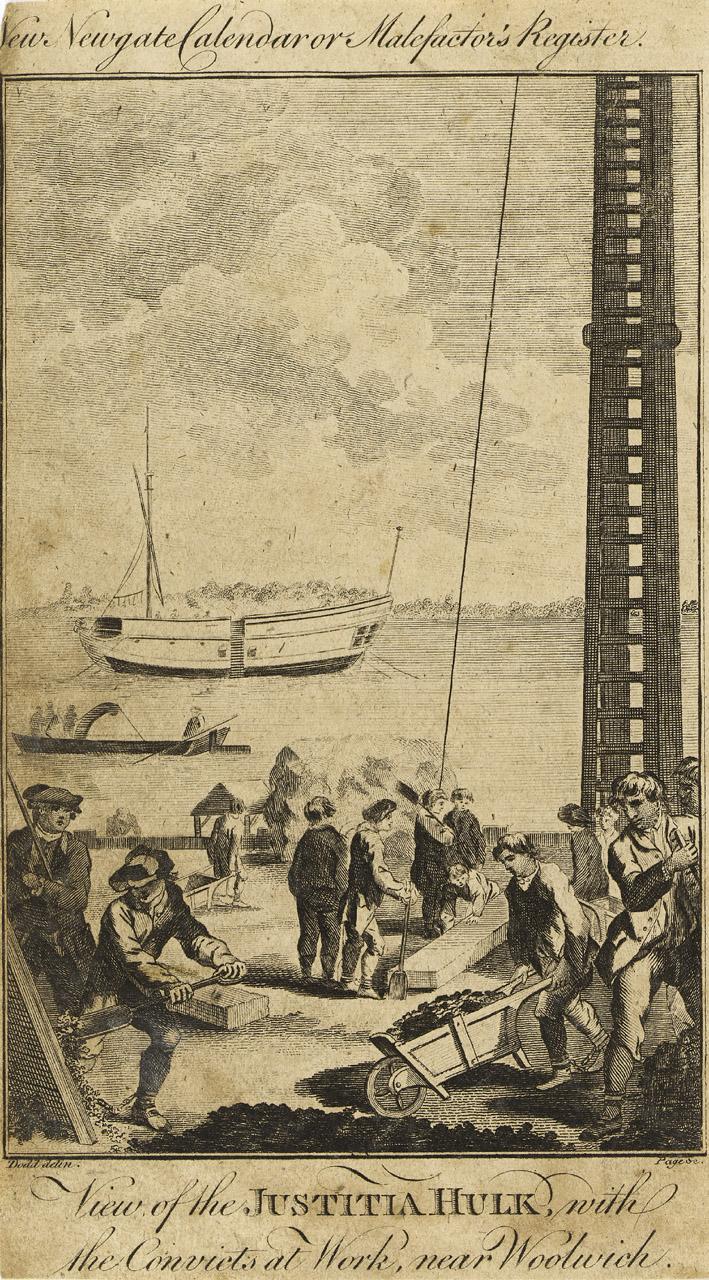
Convicts perform hard labour at the Woolwich Warren. The hulk on the river is the ‘Justitia’. Prisoners were kept on board such ships for months awaiting deportation to Australia. The ‘Justitia’ was a 260 ton prison hulk that had been originally moored in the Thames when the American War of Independence put a stop to the transportation of criminals to the former colonies. The ‘Justitia’ belonged to the shipowner Duncan Campbell, who was the Government contractor who organized the prison-hulk system at that time. Campbell was subsequently involved in the shipping of convicts to the penal colony at Botany Bay (in fact Port Jackson, later Sydney, just to the north) in New South Wales, the ‘first fleet’ going out in 1788.
While searching for records for Isaac Stokes I discovered that another Isaac Stokes was transported to New South Wales in 1835 as well. The other one was a butcher born in 1809, sentenced in London for seven years, and he sailed on the Mary Ann. Our Isaac Stokes sailed on the Lady Nugent, arriving in NSW in April 1835, having set sail from England in December 1834.
Lady Nugent was built at Bombay in 1813. She made four voyages under contract to the British East India Company (EIC). She then made two voyages transporting convicts to Australia, one to New South Wales and one to Van Diemen’s Land (Tasmania). (via Wikipedia)
via freesettlerorfelon website:
On 20 November 1834, 100 male convicts were transferred to the Lady Nugent from the Justitia Hulk and 60 from the Ganymede Hulk at Woolwich, all in apparent good health. The Lady Nugent departed Sheerness on 4 December 1834.
SURGEON OLIVER SPROULE
Oliver Sproule kept a Medical Journal from 7 November 1834 to 27 April 1835. He recorded in his journal the weather conditions they experienced in the first two weeks:
‘In the course of the first week or ten days at sea, there were eight or nine on the sick list with catarrhal affections and one with dropsy which I attribute to the cold and wet we experienced during that period beating down channel. Indeed the foremost berths in the prison at this time were so wet from leaking in that part of the ship, that I was obliged to issue dry beds and bedding to a great many of the prisoners to preserve their health, but after crossing the Bay of Biscay the weather became fine and we got the damp beds and blankets dried, the leaks partially stopped and the prison well aired and ventilated which, I am happy to say soon manifested a favourable change in the health and appearance of the men.
Besides the cases given in the journal I had a great many others to treat, some of them similar to those mentioned but the greater part consisted of boils, scalds, and contusions which would not only be too tedious to enter but I fear would be irksome to the reader. There were four births on board during the passage which did well, therefore I did not consider it necessary to give a detailed account of them in my journal the more especially as they were all favourable cases.
Regularity and cleanliness in the prison, free ventilation and as far as possible dry decks turning all the prisoners up in fine weather as we were lucky enough to have two musicians amongst the convicts, dancing was tolerated every afternoon, strict attention to personal cleanliness and also to the cooking of their victuals with regular hours for their meals, were the only prophylactic means used on this occasion, which I found to answer my expectations to the utmost extent in as much as there was not a single case of contagious or infectious nature during the whole passage with the exception of a few cases of psora which soon yielded to the usual treatment. A few cases of scurvy however appeared on board at rather an early period which I can attribute to nothing else but the wet and hardships the prisoners endured during the first three or four weeks of the passage. I was prompt in my treatment of these cases and they got well, but before we arrived at Sydney I had about thirty others to treat.’
The Lady Nugent arrived in Port Jackson on 9 April 1835 with 284 male prisoners. Two men had died at sea. The prisoners were landed on 27th April 1835 and marched to Hyde Park Barracks prior to being assigned. Ten were under the age of 14 years.
The Lady Nugent:
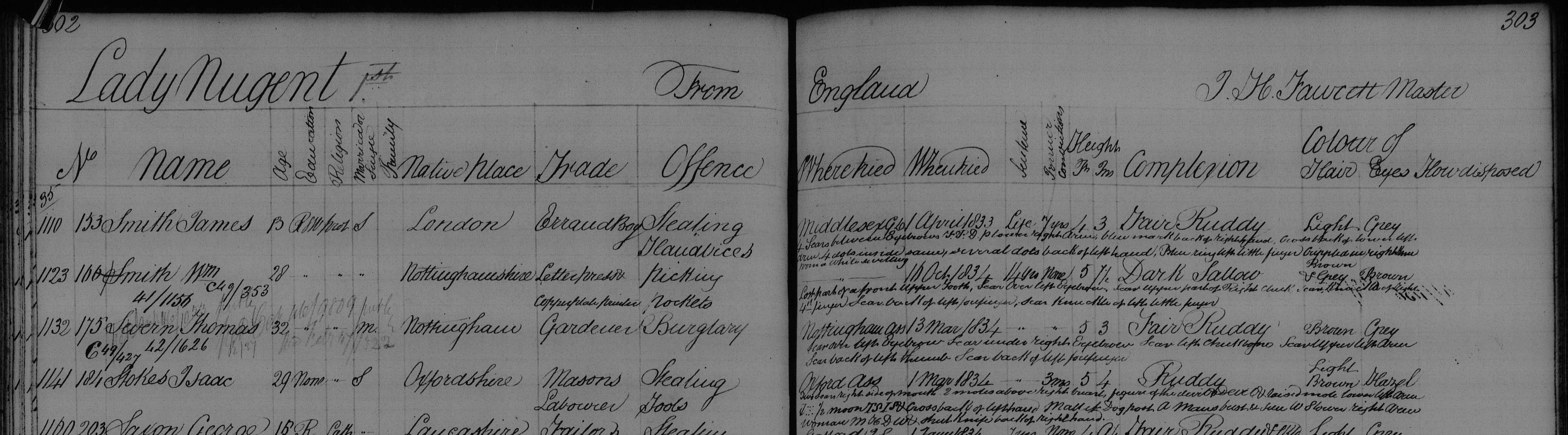
Isaac’s distinguishing marks are noted on various criminal registers and record books:
“Height in feet & inches: 5 4; Complexion: Ruddy; Hair: Light brown; Eyes: Hazel; Marks or Scars: Yes [including] DEVIL on lower left arm, TSIS back of left hand, WS lower right arm, MHDW back of right hand.”
Another includes more detail about Isaac’s tattoos:
“Two slight scars right side of mouth, 2 moles above right breast, figure of the devil and DEVIL and raised mole, lower left arm; anchor, seven dots half moon, TSIS and cross, back of left hand; a mallet, door post, A, mans bust, sun, WS, lower right arm; woman, MHDW and shut knife, back of right hand.”
From How tattoos became fashionable in Victorian England (2019 article in TheConversation by Robert Shoemaker and Zoe Alkar):
“Historical tattooing was not restricted to sailors, soldiers and convicts, but was a growing and accepted phenomenon in Victorian England. Tattoos provide an important window into the lives of those who typically left no written records of their own. As a form of “history from below”, they give us a fleeting but intriguing understanding of the identities and emotions of ordinary people in the past.
As a practice for which typically the only record is the body itself, few systematic records survive before the advent of photography. One exception to this is the written descriptions of tattoos (and even the occasional sketch) that were kept of institutionalised people forced to submit to the recording of information about their bodies as a means of identifying them. This particularly applies to three groups – criminal convicts, soldiers and sailors. Of these, the convict records are the most voluminous and systematic.
Such records were first kept in large numbers for those who were transported to Australia from 1788 (since Australia was then an open prison) as the authorities needed some means of keeping track of them.”On the 1837 census Isaac was working for the government at Illiwarra, New South Wales. This record states that he arrived on the Lady Nugent in 1835. There are three other indent records for an Isaac Stokes in the following years, but the transcriptions don’t provide enough information to determine which Isaac Stokes it was. In April 1837 there was an abscondment, and an arrest/apprehension in May of that year, and in 1843 there was a record of convict indulgences.
From the Australian government website regarding “convict indulgences”:
“By the mid-1830s only six per cent of convicts were locked up. The vast majority worked for the government or free settlers and, with good behaviour, could earn a ticket of leave, conditional pardon or and even an absolute pardon. While under such orders convicts could earn their own living.”
In 1856 in Camden, NSW, Isaac Stokes married Catherine Daly. With no further information on this record it would be impossible to know for sure if this was the right Isaac Stokes. This couple had six children, all in the Camden area, but none of the records provided enough information. No occupation or place or date of birth recorded for Isaac Stokes.
I wrote to the National Library of Australia about the marriage record, and their reply was a surprise! Issac and Catherine were married on 30 September 1856, at the house of the Rev. Charles William Rigg, a Methodist minister, and it was recorded that Isaac was born in Edinburgh in 1821, to parents James Stokes and Sarah Ellis! The age at the time of the marriage doesn’t match Isaac’s age at death in 1877, and clearly the place of birth and parents didn’t match either. Only his fathers occupation of stone mason was correct. I wrote back to the helpful people at the library and they replied that the register was in a very poor condition and that only two and a half entries had survived at all, and that Isaac and Catherines marriage was recorded over two pages.
I searched for an Isaac Stokes born in 1821 in Edinburgh on the Scotland government website (and on all the other genealogy records sites) and didn’t find it. In fact Stokes was a very uncommon name in Scotland at the time. I also searched Australian immigration and other records for another Isaac Stokes born in Scotland or born in 1821, and found nothing. I was unable to find a single record to corroborate this mysterious other Isaac Stokes.
As the age at death in 1877 was correct, I assume that either Isaac was lying, or that some mistake was made either on the register at the home of the Methodist minster, or a subsequent mistranscription or muddle on the remnants of the surviving register. Therefore I remain convinced that the Camden stonemason Isaac Stokes was indeed our Isaac from Oxfordshire.
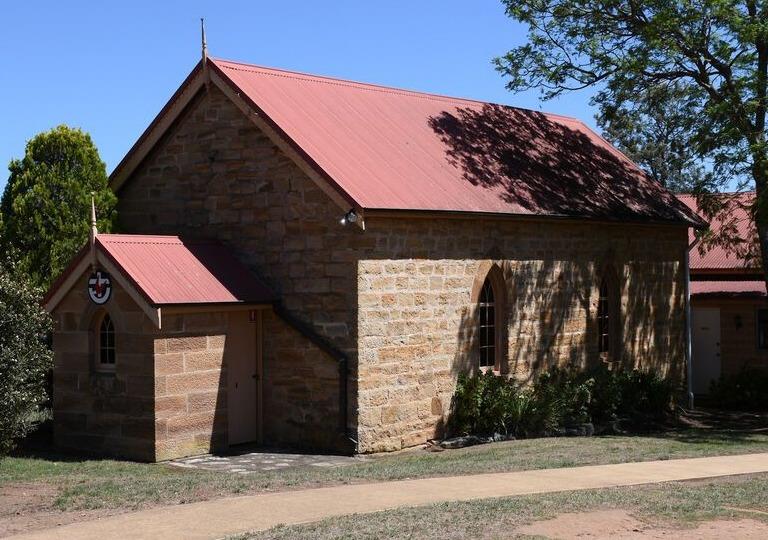
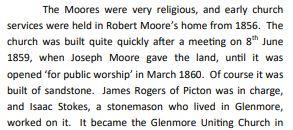
I found a history society newsletter article that mentioned Isaac Stokes, stone mason, had built the Glenmore church, near Camden, in 1859.
From the Wollondilly museum April 2020 newsletter:
From the Camden History website:
“The stone set over the porch of Glenmore Church gives the date of 1860. The church was begun in 1859 on land given by Joseph Moore. James Rogers of Picton was given the contract to build and local builder, Mr. Stokes, carried out the work. Elizabeth Moore, wife of Edward, laid the foundation stone. The first service was held on 19th March 1860. The cemetery alongside the church contains the headstones and memorials of the areas early pioneers.”
Isaac died on the 3rd September 1877. The inquest report puts his place of death as Bagdelly, near to Camden, and another death register has put Cambelltown, also very close to Camden. His age was recorded as 71 and the inquest report states his cause of death was “rupture of one of the large pulmonary vessels of the lung”. His wife Catherine died in childbirth in 1870 at the age of 43.
Isaac and Catherine’s children:
William Stokes 1857-1928
Catherine Stokes 1859-1846
Sarah Josephine Stokes 1861-1931
Ellen Stokes 1863-1932
Rosanna Stokes 1865-1919
Louisa Stokes 1868-1844.
It’s possible that Catherine Daly was a transported convict from Ireland.
Some time later I unexpectedly received a follow up email from The Oaks Heritage Centre in Australia.
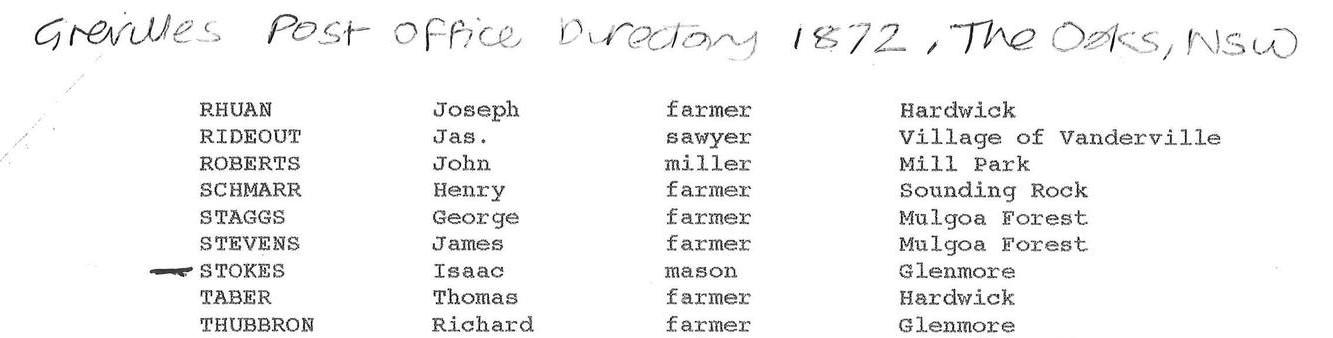
“The Gaudry papers which we have in our archive record him (Isaac Stokes) as having built: the church, the school and the teachers residence. Isaac is recorded in the General return of convicts: 1837 and in Grevilles Post Office directory 1872 as a mason in Glenmore.”
 November 18, 2022 at 4:47 pm #6348
In reply to: Family Stories From The Other Side ~ Book Two
Wong Sang
Wong Sang was born in China in 1884. In October 1916 he married Alice Stokes in Oxford.
Alice was the granddaughter of William Stokes of Churchill, Oxfordshire and William was the brother of Thomas Stokes the wheelwright (who was my 3X great grandfather). In other words Alice was my second cousin, three times removed, on my fathers paternal side.
Wong Sang was an interpreter, according to the baptism registers of his children and the Dreadnought Seamen’s Hospital admission registers in 1930. The hospital register also notes that he was employed by the Blue Funnel Line, and that his address was 11, Limehouse Causeway, E 14. (London)
“The Blue Funnel Line offered regular First-Class Passenger and Cargo Services From the UK to South Africa, Malaya, China, Japan, Australia, Java, and America. Blue Funnel Line was Owned and Operated by Alfred Holt & Co., Liverpool.
The Blue Funnel Line, so-called because its ships have a blue funnel with a black top, is more appropriately known as the Ocean Steamship Company.”Wong Sang and Alice’s daughter, Frances Eileen Sang, was born on the 14th July, 1916 and baptised in 1920 at St Stephen in Poplar, Tower Hamlets, London. The birth date is noted in the 1920 baptism register and would predate their marriage by a few months, although on the death register in 1921 her age at death is four years old and her year of birth is recorded as 1917.
Charles Ronald Sang was baptised on the same day in May 1920, but his birth is recorded as April of that year. The family were living on Morant Street, Poplar.
James William Sang’s birth is recorded on the 1939 census and on the death register in 2000 as being the 8th March 1913. This definitely would predate the 1916 marriage in Oxford.
William Norman Sang was born on the 17th October 1922 in Poplar.
Alice and the three sons were living at 11, Limehouse Causeway on the 1939 census, the same address that Wong Sang was living at when he was admitted to Dreadnought Seamen’s Hospital on the 15th January 1930. Wong Sang died in the hospital on the 8th March of that year at the age of 46.
Alice married John Patterson in 1933 in Stepney. John was living with Alice and her three sons on Limehouse Causeway on the 1939 census and his occupation was chef.
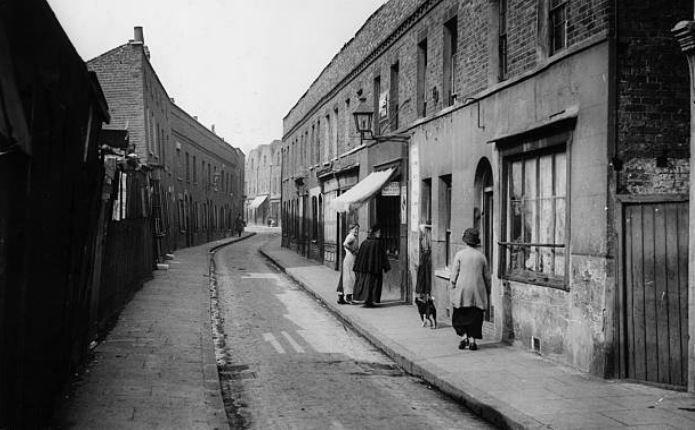
Via Old London Photographs:
“Limehouse Causeway is a street in east London that was the home to the original Chinatown of London. A combination of bomb damage during the Second World War and later redevelopment means that almost nothing is left of the original buildings of the street.”
Limehouse Causeway in 1925:
From The Story of Limehouse’s Lost Chinatown, poplarlondon website:
“Limehouse was London’s first Chinatown, home to a tightly-knit community who were demonised in popular culture and eventually erased from the cityscape.
As recounted in the BBC’s ‘Our Greatest Generation’ series, Connie was born to a Chinese father and an English mother in early 1920s Limehouse, where she used to play in the street with other British and British-Chinese children before running inside for teatime at one of their houses.
Limehouse was London’s first Chinatown between the 1880s and the 1960s, before the current Chinatown off Shaftesbury Avenue was established in the 1970s by an influx of immigrants from Hong Kong.
Connie’s memories of London’s first Chinatown as an “urban village” paint a very different picture to the seedy area portrayed in early twentieth century novels.
The pyramid in St Anne’s church marked the entrance to the opium den of Dr Fu Manchu, a criminal mastermind who threatened Western society by plotting world domination in a series of novels by Sax Rohmer.
Thomas Burke’s Limehouse Nights cemented stereotypes about prostitution, gambling and violence within the Chinese community, and whipped up anxiety about sexual relationships between Chinese men and white women.
Though neither novelist was familiar with the Chinese community, their depictions made Limehouse one of the most notorious areas of London.
Travel agent Thomas Cook even organised tours of the area for daring visitors, despite the rector of Limehouse warning that “those who look for the Limehouse of Mr Thomas Burke simply will not find it.”
All that remains is a handful of Chinese street names, such as Ming Street, Pekin Street, and Canton Street — but what was Limehouse’s chinatown really like, and why did it get swept away?
Chinese migration to Limehouse
Chinese sailors discharged from East India Company ships settled in the docklands from as early as the 1780s.
By the late nineteenth century, men from Shanghai had settled around Pennyfields Lane, while a Cantonese community lived on Limehouse Causeway.
Chinese sailors were often paid less and discriminated against by dock hirers, and so began to diversify their incomes by setting up hand laundry services and restaurants.
Old photographs show shopfronts emblazoned with Chinese characters with horse-drawn carts idling outside or Chinese men in suits and hats standing proudly in the doorways.
In oral histories collected by Yat Ming Loo, Connie’s husband Leslie doesn’t recall seeing any Chinese women as a child, since male Chinese sailors settled in London alone and married working-class English women.
In the 1920s, newspapers fear-mongered about interracial marriages, crime and gambling, and described chinatown as an East End “colony.”
Ironically, Chinese opium-smoking was also demonised in the press, despite Britain waging war against China in the mid-nineteenth century for suppressing the opium trade to alleviate addiction amongst its people.
The number of Chinese people who settled in Limehouse was also greatly exaggerated, and in reality only totalled around 300.
The real Chinatown
Although the press sought to characterise Limehouse as a monolithic Chinese community in the East End, Connie remembers seeing people of all nationalities in the shops and community spaces in Limehouse.
She doesn’t remember feeling discriminated against by other locals, though Connie does recall having her face measured and IQ tested by a member of the British Eugenics Society who was conducting research in the area.
Some of Connie’s happiest childhood memories were from her time at Chung-Hua Club, where she learned about Chinese culture and language.
Why did Chinatown disappear?
The caricature of Limehouse’s Chinatown as a den of vice hastened its erasure.
Police raids and deportations fuelled by the alarmist media coverage threatened the Chinese population of Limehouse, and slum clearance schemes to redevelop low-income areas dispersed Chinese residents in the 1930s.
The Defence of the Realm Act imposed at the beginning of the First World War criminalised opium use, gave the authorities increased powers to deport Chinese people and restricted their ability to work on British ships.
Dwindling maritime trade during World War II further stripped Chinese sailors of opportunities for employment, and any remnants of Chinatown were destroyed during the Blitz or erased by postwar development schemes.”
Wong Sang 1884-1930
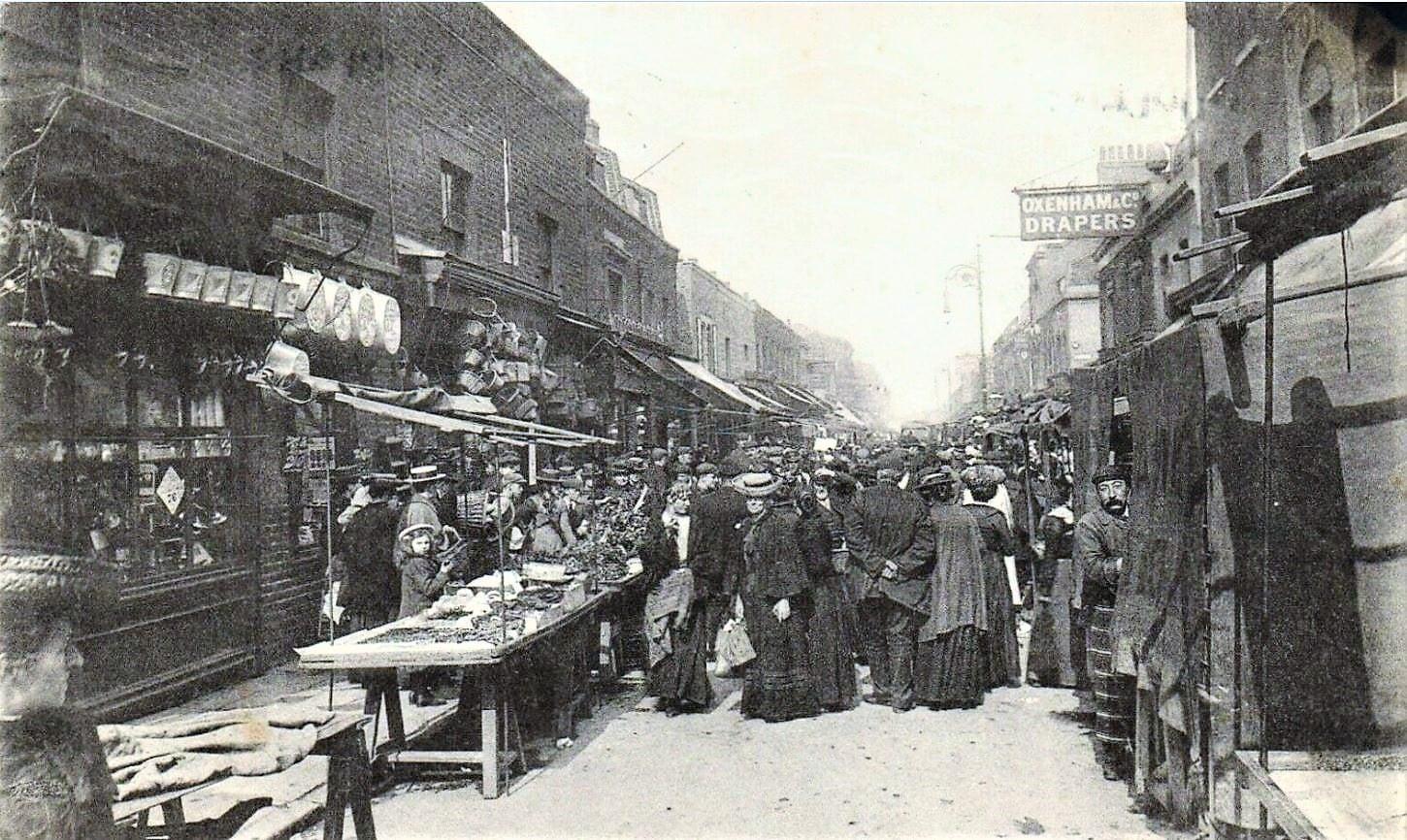
The year 1918 was a troublesome one for Wong Sang, an interpreter and shipping agent for Blue Funnel Line. The Sang family were living at 156, Chrisp Street.
Chrisp Street, Poplar, in 1913 via Old London Photographs:
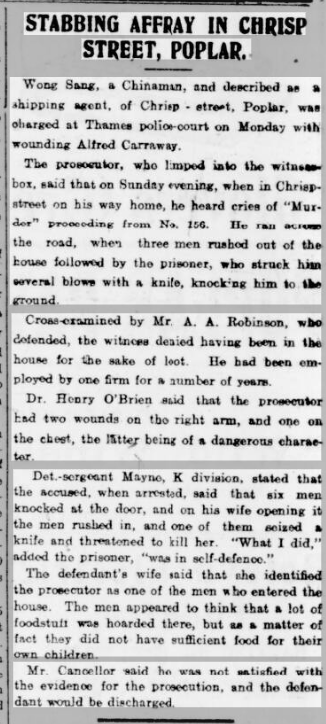
In February Wong Sang was discharged from a false accusation after defending his home from potential robbers.
East End News and London Shipping Chronicle – Friday 15 February 1918:
In August of that year he was involved in an incident that left him unconscious.
Faringdon Advertiser and Vale of the White Horse Gazette – Saturday 31 August 1918:
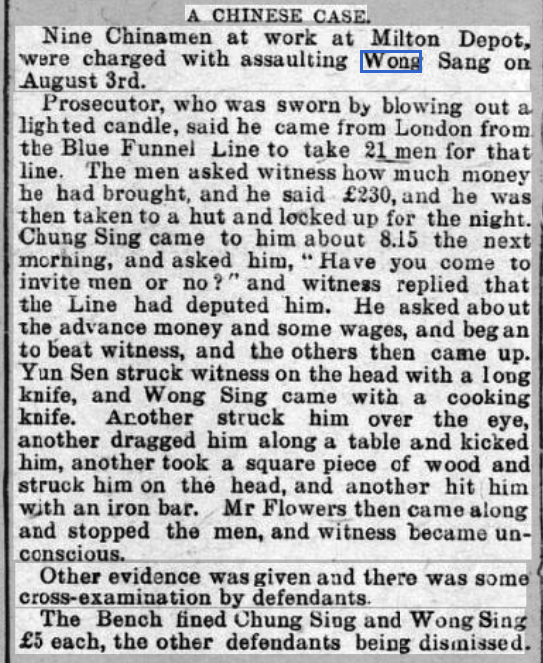
Wong Sang is mentioned in an 1922 article about “Oriental London”.
London and China Express – Thursday 09 February 1922:
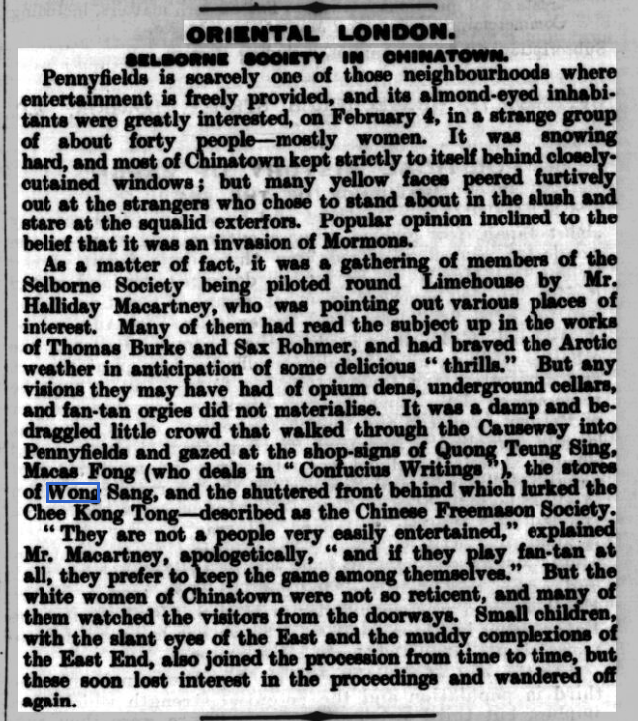
A photograph of the Chee Kong Tong Chinese Freemason Society mentioned in the above article, via Old London Photographs:
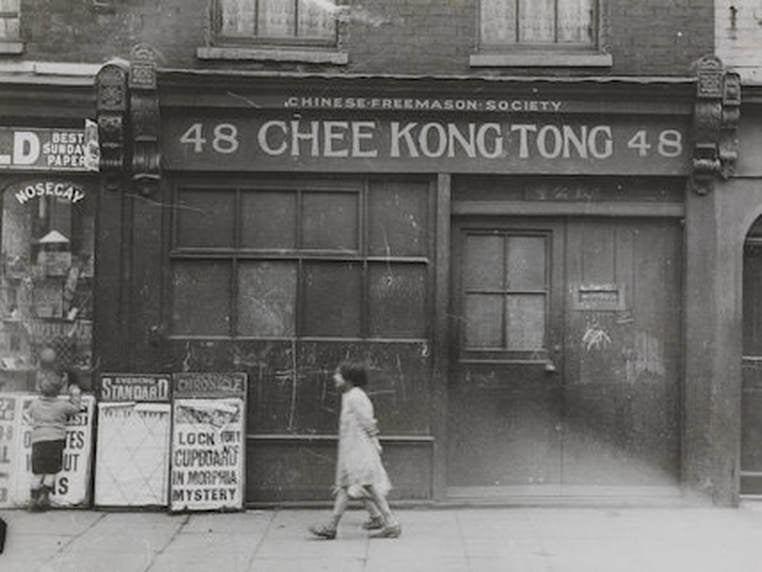
Wong Sang was recommended by the London Metropolitan Police in 1928 to assist in a case in Wellingborough, Northampton.
Difficulty of Getting an Interpreter: Northampton Mercury – Friday 16 March 1928:
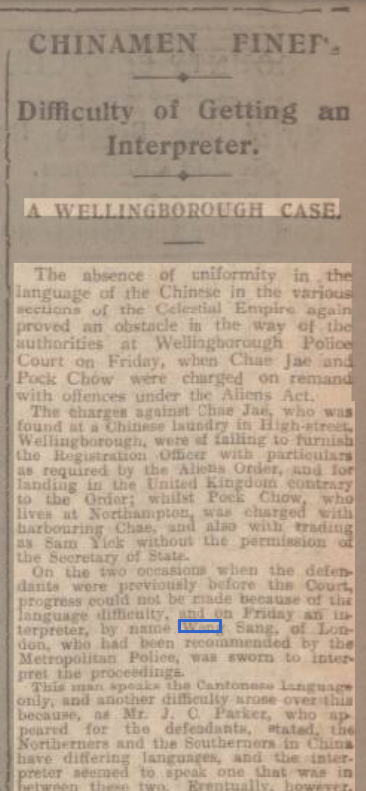
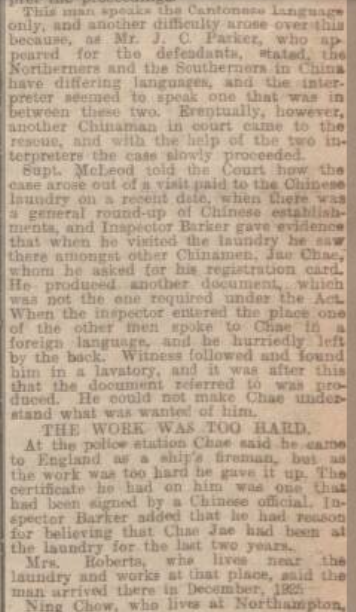
The difficulty was that “this man speaks the Cantonese language only…the Northeners and the Southerners in China have differing languages and the interpreter seemed to speak one that was in between these two.”
In 1917, Alice Wong Sang was a witness at her sister Harriet Stokes marriage to James William Watts in Southwark, London. Their father James Stokes occupation on the marriage register is foreman surveyor, but on the census he was a council roadman or labourer. (I initially rejected this as the correct marriage for Harriet because of the discrepancy with the occupations. Alice Wong Sang as a witness confirmed that it was indeed the correct one.)
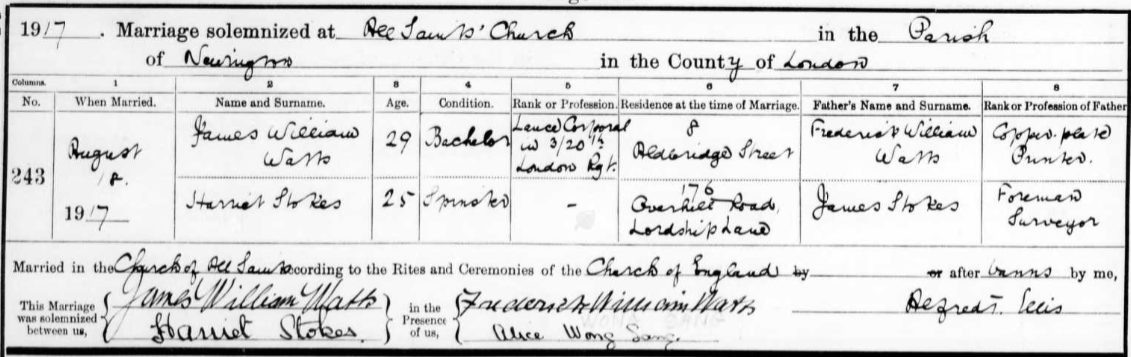
James William Sang 1913-2000 was a clock fitter and watch assembler (on the 1939 census). He married Ivy Laura Fenton in 1963 in Sidcup, Kent. James died in Southwark in 2000.
Charles Ronald Sang 1920-1974 was a draughtsman (1939 census). He married Eileen Burgess in 1947 in Marylebone. Charles and Eileen had two sons: Keith born in 1951 and Roger born in 1952. He died in 1974 in Hertfordshire.
William Norman Sang 1922-2000 was a clerk and telephone operator (1939 census). William enlisted in the Royal Artillery in 1942. He married Lily Mullins in 1949 in Bethnal Green, and they had three daughters: Marion born in 1950, Christine in 1953, and Frances in 1959. He died in Redbridge in 2000.
I then found another two births registered in Poplar by Alice Sang, both daughters. Doris Winifred Sang was born in 1925, and Patricia Margaret Sang was born in 1933 ~ three years after Wong Sang’s death. Neither of the these daughters were on the 1939 census with Alice, John Patterson and the three sons. Margaret had presumably been evacuated because of the war to a family in Taunton, Somerset. Doris would have been fourteen and I have been unable to find her in 1939 (possibly because she died in 2017 and has not had the redaction removed yet on the 1939 census as only deceased people are viewable).
Doris Winifred Sang 1925-2017 was a nursing sister. She didn’t marry, and spent a year in USA between 1954 and 1955. She stayed in London, and died at the age of ninety two in 2017.
Patricia Margaret Sang 1933-1998 was also a nurse. She married Patrick L Nicely in Stepney in 1957. Patricia and Patrick had five children in London: Sharon born 1959, Donald in 1960, Malcolm was born and died in 1966, Alison was born in 1969 and David in 1971.
I was unable to find a birth registered for Alice’s first son, James William Sang (as he appeared on the 1939 census). I found Alice Stokes on the 1911 census as a 17 year old live in servant at a tobacconist on Pekin Street, Limehouse, living with Mr Sui Fong from Hong Kong and his wife Sarah Sui Fong from Berlin. I looked for a birth registered for James William Fong instead of Sang, and found it ~ mothers maiden name Stokes, and his date of birth matched the 1939 census: 8th March, 1913.
On the 1921 census, Wong Sang is not listed as living with them but it is mentioned that Mr Wong Sang was the person returning the census. Also living with Alice and her sons James and Charles in 1921 are two visitors: (Florence) May Stokes, 17 years old, born in Woodstock, and Charles Stokes, aged 14, also born in Woodstock. May and Charles were Alice’s sister and brother.
I found Sharon Nicely on social media and she kindly shared photos of Wong Sang and Alice Stokes:
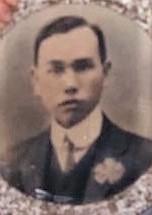
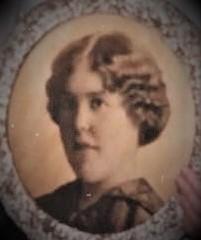 July 13, 2022 at 3:09 am #6323
In reply to: The Sexy Wooden Leg
“Watch where you are going, Child!” Egbert’s tone was sharp.
“Excuse me,” said Maryechka, hunching her shoulders and making herself small as a mouse so she could squeeze past Egbert’s oversized suitcase.
“To be fair, Old Man,” said Olga, glad of the excuse to pause, “you are taking up all the available space on the stairs with those bags.” She peered at Maryechka. “You are Obadiah’s girl aren’t you?”
Maryechka nodded shyly. “He’s my grandpa.” She frowned at the suitcases. “Are you going on holiday?”
“Never you mind that,” said Egbert. “You run along and see your Grandpa.”
Maryechka ducked past the bag and ran up the steps.
“Oy,” said Olga. “What I wouldn’t give for the agility of youth again.” Gripping the wooden hand rail, she stretched out her ankle and grimaced.
“Obadiah is stubborn as a mule,” said Egbert. “I tried warning him! He said he’d die in his room if it came to it.”
“Pfft,” said Olga. “That one will land on his big stinking feet. And he can hear better than he lets on. Is it him spreading the tales about me?”
Egbert dropped his bags and sat heavily on the step. He put his head in his hands and groaned. “Is it right though, Olga? Is it right that we leave our friends to their fate?”
It occurred to Olga that Egbert may be hiding his head so as not to answer her question. However, realising his mental state was fragile, she thought it prudent to keep to the matter at hand. It will keep, she thought.
“Obadiah and myself, we grew up together,” continued Egbert with what sounded like a sob. “We worked together on the farm as young men.” He raised his head and glared at Olga. “How can you expect me to leave him without a word of farewell? Have you no heart?”
July 10, 2022 at 2:36 am #6317In reply to: The Sexy Wooden Leg
The sharp rat-a-tat on the door startled Olga Herringbonevsky. The initial surprise quickly turned to annoyance. It was 11am and she wasn’t expecting a knock on the door at 11am. At 10am she expected a knock. It would be Larysa with the lukewarm cup of tea and a stale biscuit. Sometimes Olga complained about it and Larysa would say, Well you’re on the third floor so what do you expect? And she’d look cross and pour the tea so some of it slopped into the saucer. So the biscuits go stale on the way up do they? Olga would mutter. At 10:30am Larysa would return to collect the cup and saucer. I can’t do this much longer, she’d say. I’m not young any more and all these damn stairs. She’d been saying that for as long as Olga could remember.
For a moment, Olga contemplated ignoring the intrusion but the knocking started up again, this time accompanied by someone shouting her name.
With a very loud sigh, she put her book on the side table, face down so she would not lose her place for it was a most enjoyable whodunit, and hauled herself up from the chair. Her ankle was not good since she’d gone over on it the other day and Olga was in a very poor mood by the time she reached the door.
“Yes?” She glowered at Egbert.
“Have you seen this?” Egbert was waving a piece of paper at her.
“No,” Olga started to close the door.
“Olga stop!” Egbert’s face had reddened and Olga wondered if he might cry. Again, he waved the piece of paper in her face and then let his hand fall defeated to his side. “Olga, it’s bad news. You should have got a letter .”
Olga glanced at the pile of unopened letters on her dresser. It was never good news. She couldn’t be bothered with letters any more.
“Well, Egbert, I suppose you’d better come in”.
“That Ursula has a heart of steel,” said Olga when she’d heard the news.
“Pfft,” said Egbert. “She has no heart. This place has always been about money for her.”
“It’s bad times, Egbert. Bad times.”
Egbert nodded. “It is, Olga. But there must be something we can do.” He pursed his lips and Olga noticed that he would not meet her eyes.
“What? Spit it out, Old Man.”
He looked at her briefly before his eyes slid back to the dirty grey carpet. “I have heard stories, Olga. That you are … well connected. That you know people.”
Olga noticed that it had become difficult to breathe. Seeing Egbert looking at her with concern, she made an effort to steady herself. She took an extra big gasp of air and pointed to the book face-down on the side table. “That is a very good book I am reading. You may borrow it when I have finished.”
Egbert nodded. “Thank you.” he said and they both stared at the book.
“It was a long time ago, Egbert. And no business of anyone else.” Olga knew her voice was sharp but not sharp enough it seemed as Egbert was not done yet with all his prying words.
“Olga, you said it yourself. These are bad times. And desperate measures are needed or we will all perish.” Now he looked her in the eyes. “Old woman, swallow your pride. You must save yourself and all of us here.”
July 1, 2022 at 9:51 am #6306In reply to: The Elusive Samuel Housley and Other Family Stories
Looking for Robert Staley
William Warren (1835-1880) of Newhall (Stapenhill) married Elizabeth Staley (1836-1907) in 1858. Elizabeth was born in Newhall, the daughter of John Staley (1795-1876) and Jane Brothers. John was born in Newhall, and Jane was born in Armagh, Ireland, and they were married in Armagh in 1820. Elizabeths older brothers were born in Ireland: William in 1826 and Thomas in Dublin in 1830. Francis was born in Liverpool in 1834, and then Elizabeth in Newhall in 1836; thereafter the children were born in Newhall.
Marriage of John Staley and Jane Brothers in 1820:
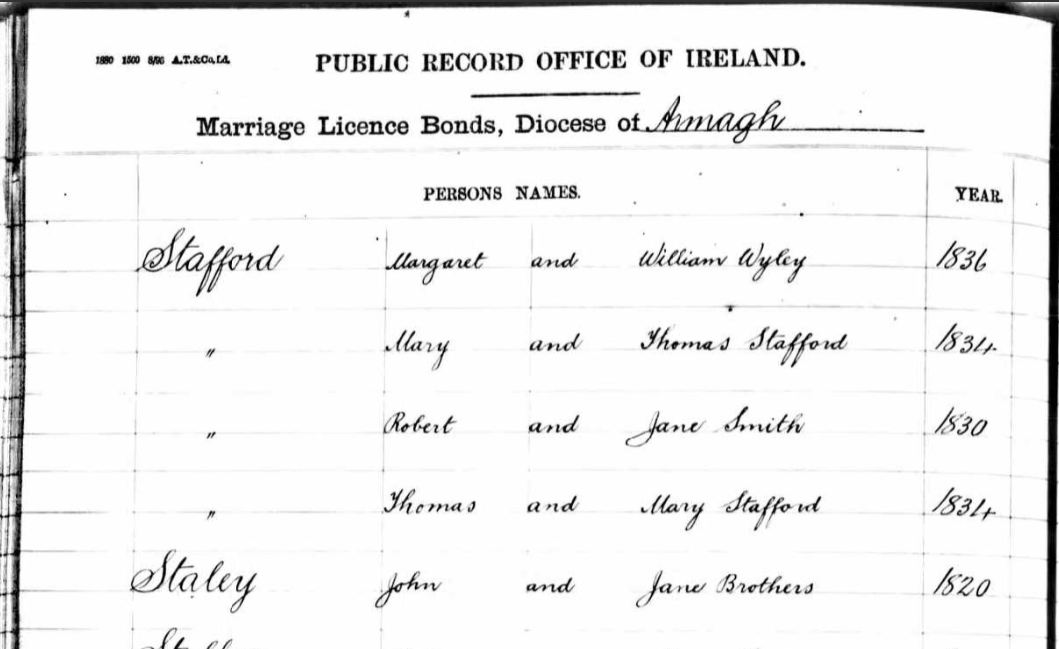
My grandmother related a story about an Elizabeth Staley who ran away from boarding school and eloped to Ireland, but later returned. The only Irish connection found so far is Jane Brothers, so perhaps she meant Elizabeth Staley’s mother. A boarding school seems unlikely, and it would seem that it was John Staley who went to Ireland.
The 1841 census states Jane’s age as 33, which would make her just 12 at the time of her marriage. The 1851 census states her age as 44, making her 13 at the time of her 1820 marriage, and the 1861 census estimates her birth year as a more likely 1804. Birth records in Ireland for her have not been found. It’s possible, perhaps, that she was in service in the Newhall area as a teenager (more likely than boarding school), and that John and Jane ran off to get married in Ireland, although I haven’t found any record of a child born to them early in their marriage. John was an agricultural labourer, and later a coal miner.
John Staley was the son of Joseph Staley (1756-1838) and Sarah Dumolo (1764-). Joseph and Sarah were married by licence in Newhall in 1782. Joseph was a carpenter on the marriage licence, but later a collier (although not necessarily a miner).
The Derbyshire Record Office holds records of an “Estimate of Joseph Staley of Newhall for the cost of continuing to work Pisternhill Colliery” dated 1820 and addresssed to Mr Bloud at Calke Abbey (presumably the owner of the mine)
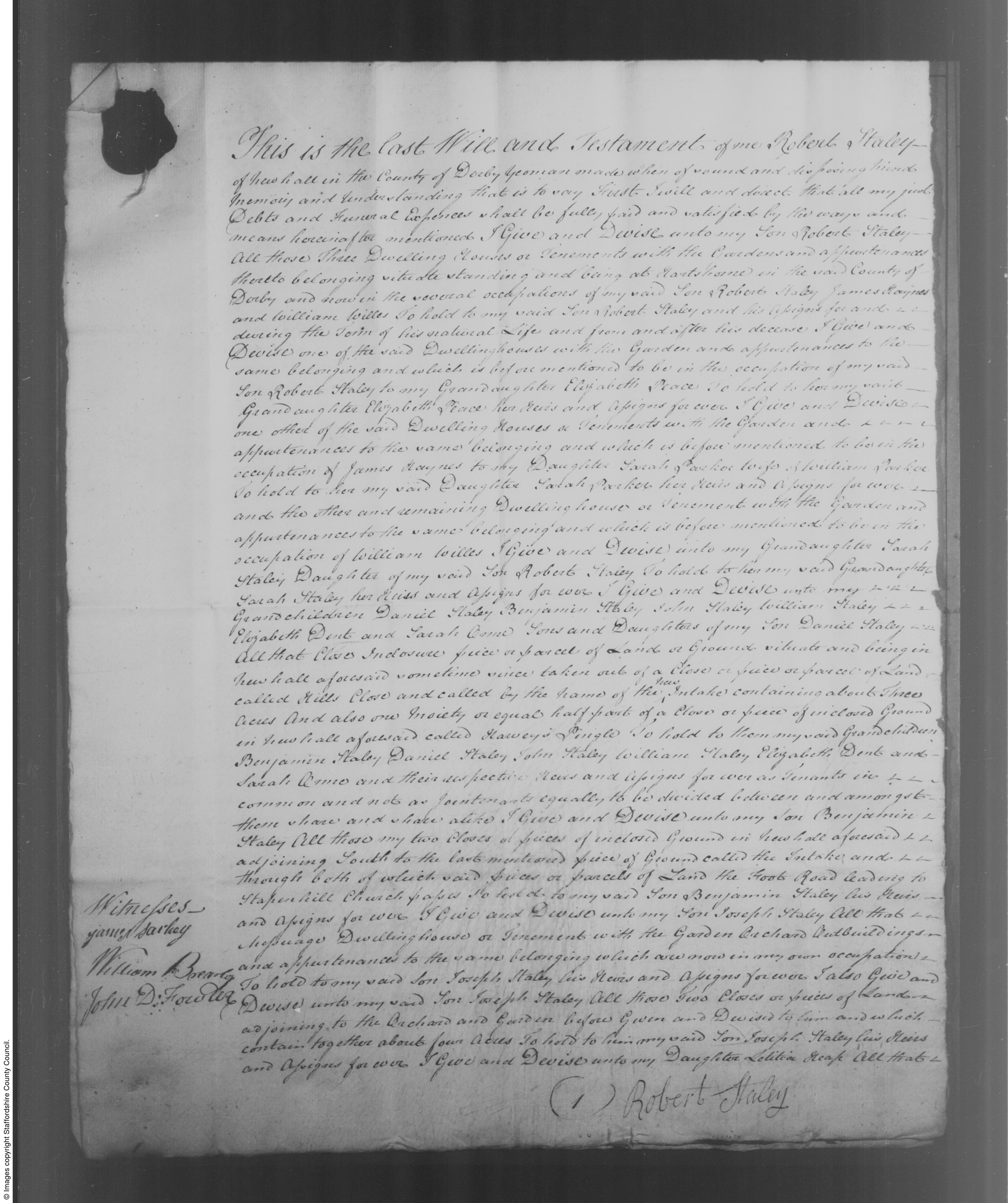
Josephs parents were Robert Staley and Elizabeth. I couldn’t find a baptism or birth record for Robert Staley. Other trees on an ancestry site had his birth in Elton, but with no supporting documents. Robert, as stated in his 1795 will, was a Yeoman.
“Yeoman: A former class of small freeholders who farm their own land; a commoner of good standing.”
“Husbandman: The old word for a farmer below the rank of yeoman. A husbandman usually held his land by copyhold or leasehold tenure and may be regarded as the ‘average farmer in his locality’. The words ‘yeoman’ and ‘husbandman’ were gradually replaced in the later 18th and 19th centuries by ‘farmer’.”He left a number of properties in Newhall and Hartshorne (near Newhall) including dwellings, enclosures, orchards, various yards, barns and acreages. It seemed to me more likely that he had inherited them, rather than moving into the village and buying them.
There is a mention of Robert Staley in a 1782 newpaper advertisement.
“Fire Engine To Be Sold. An exceedingly good fire engine, with the boiler, cylinder, etc in good condition. For particulars apply to Mr Burslem at Burton-upon-Trent, or Robert Staley at Newhall near Burton, where the engine may be seen.”
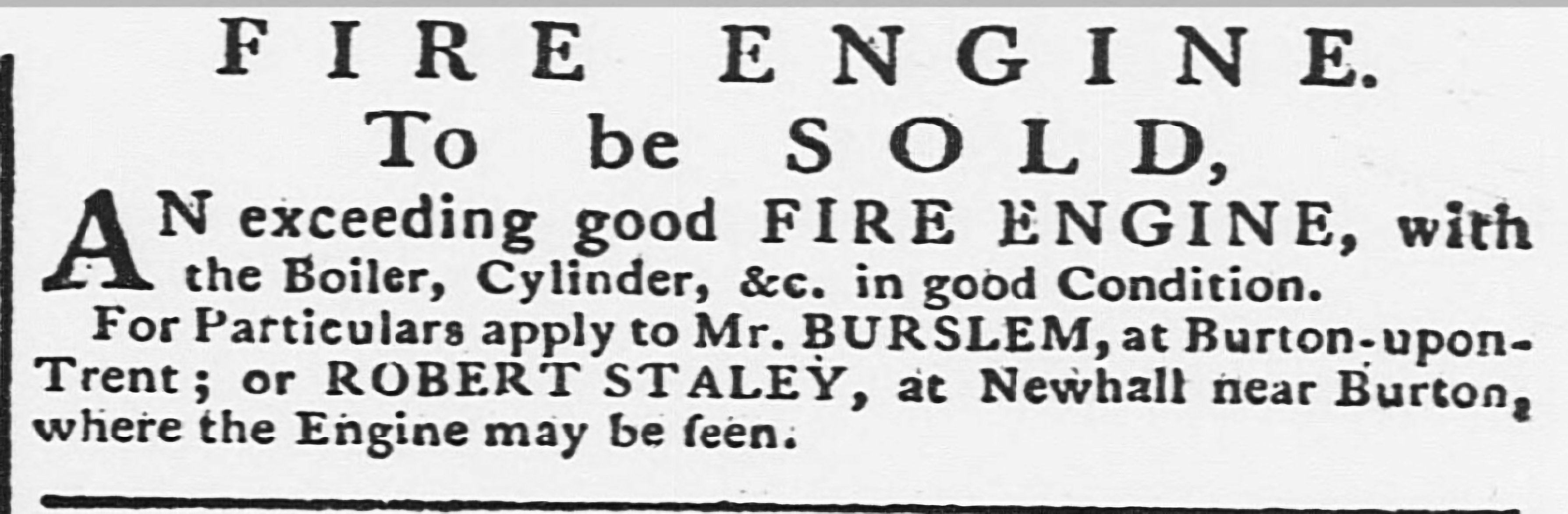
Was the fire engine perhaps connected with a foundry or a coal mine?
I noticed that Robert Staley was the witness at a 1755 marriage in Stapenhill between Barbara Burslem and Richard Daston the younger esquire. The other witness was signed Burslem Jnr.
Looking for Robert Staley
I assumed that once again, in the absence of the correct records, a similarly named and aged persons baptism had been added to the tree regardless of accuracy, so I looked through the Stapenhill/Newhall parish register images page by page. There were no Staleys in Newhall at all in the early 1700s, so it seemed that Robert did come from elsewhere and I expected to find the Staleys in a neighbouring parish. But I still didn’t find any Staleys.
I spoke to a couple of Staley descendants that I’d met during the family research. I met Carole via a DNA match some months previously and contacted her to ask about the Staleys in Elton. She also had Robert Staley born in Elton (indeed, there were many Staleys in Elton) but she didn’t have any documentation for his birth, and we decided to collaborate and try and find out more.
I couldn’t find the earlier Elton parish registers anywhere online, but eventually found the untranscribed microfiche images of the Bishops Transcripts for Elton.
via familysearch:
“In its most basic sense, a bishop’s transcript is a copy of a parish register. As bishop’s transcripts generally contain more or less the same information as parish registers, they are an invaluable resource when a parish register has been damaged, destroyed, or otherwise lost. Bishop’s transcripts are often of value even when parish registers exist, as priests often recorded either additional or different information in their transcripts than they did in the original registers.”Unfortunately there was a gap in the Bishops Transcripts between 1704 and 1711 ~ exactly where I needed to look. I subsequently found out that the Elton registers were incomplete as they had been damaged by fire.
I estimated Robert Staleys date of birth between 1710 and 1715. He died in 1795, and his son Daniel died in 1805: both of these wills were found online. Daniel married Mary Moon in Stapenhill in 1762, making a likely birth date for Daniel around 1740.
The marriage of Robert Staley (assuming this was Robert’s father) and Alice Maceland (or Marsland or Marsden, depending on how the parish clerk chose to spell it presumably) was in the Bishops Transcripts for Elton in 1704. They were married in Elton on 26th February. There followed the missing parish register pages and in all likelihood the records of the baptisms of their first children. No doubt Robert was one of them, probably the first male child.
(Incidentally, my grandfather’s Marshalls also came from Elton, a small Derbyshire village near Matlock. The Staley’s are on my grandmothers Warren side.)
The parish register pages resume in 1711. One of the first entries was the baptism of Robert Staley in 1711, parents Thomas and Ann. This was surely the one we were looking for, and Roberts parents weren’t Robert and Alice.
But then in 1735 a marriage was recorded between Robert son of Robert Staley (and this was unusual, the father of the groom isn’t usually recorded on the parish register) and Elizabeth Milner. They were married on the 9th March 1735. We know that the Robert we were looking for married an Elizabeth, as her name was on the Stapenhill baptisms of their later children, including Joseph Staleys. The 1735 marriage also fit with the assumed birth date of Daniel, circa 1740. A baptism was found for a Robert Staley in 1738 in the Elton registers, parents Robert and Elizabeth, as well as the baptism in 1736 for Mary, presumably their first child. Her burial is recorded the following year.
The marriage of Robert Staley and Elizabeth Milner in 1735:
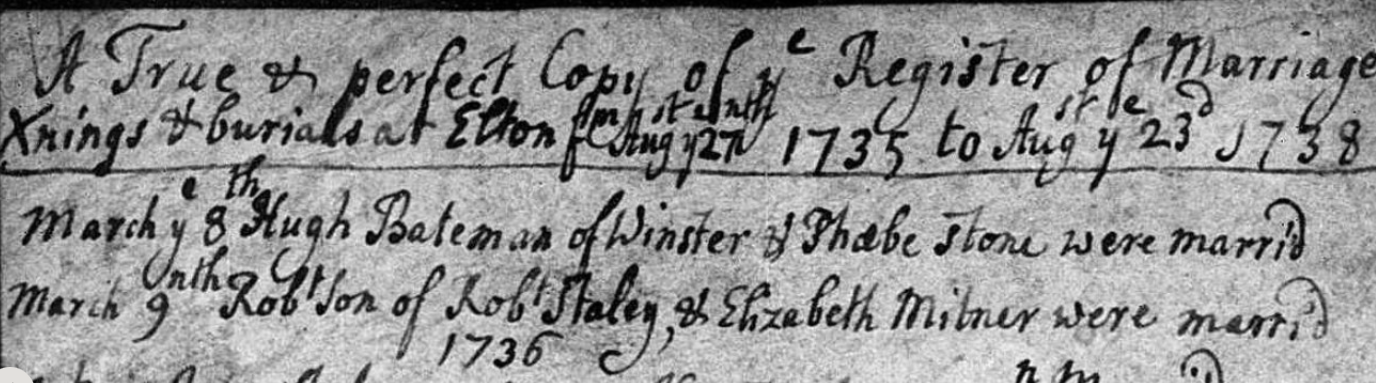
There were several other Staley couples of a similar age in Elton, perhaps brothers and cousins. It seemed that Thomas and Ann’s son Robert was a different Robert, and that the one we were looking for was prior to that and on the missing pages.
Even so, this doesn’t prove that it was Elizabeth Staleys great grandfather who was born in Elton, but no other birth or baptism for Robert Staley has been found. It doesn’t explain why the Staleys moved to Stapenhill either, although the Enclosures Act and the Industrial Revolution could have been factors.
The 18th century saw the rise of the Industrial Revolution and many renowned Derbyshire Industrialists emerged. They created the turning point from what was until then a largely rural economy, to the development of townships based on factory production methods.
The Marsden Connection
There are some possible clues in the records of the Marsden family. Robert Staley married Alice Marsden (or Maceland or Marsland) in Elton in 1704. Robert Staley is mentioned in the 1730 will of John Marsden senior, of Baslow, Innkeeper (Peacock Inne & Whitlands Farm). He mentions his daughter Alice, wife of Robert Staley.
In a 1715 Marsden will there is an intriguing mention of an alias, which might explain the different spellings on various records for the name Marsden: “MARSDEN alias MASLAND, Christopher – of Baslow, husbandman, 28 Dec 1714. son Robert MARSDEN alias MASLAND….” etc.
Some potential reasons for a move from one parish to another are explained in this history of the Marsden family, and indeed this could relate to Robert Staley as he married into the Marsden family and his wife was a beneficiary of a Marsden will. The Chatsworth Estate, at various times, bought a number of farms in order to extend the park.
THE MARSDEN FAMILY
OXCLOSE AND PARKGATE
In the Parishes of
Baslow and Chatsworthby
David Dalrymple-Smith“John Marsden (b1653) another son of Edmund (b1611) faired well. By the time he died in
1730 he was publican of the Peacock, the Inn on Church Lane now called the Cavendish
Hotel, and the farmer at “Whitlands”, almost certainly Bubnell Cliff Farm.”“Coal mining was well known in the Chesterfield area. The coalfield extends as far as the
Gritstone edges, where thin seams outcrop especially in the Baslow area.”“…the occupants were evicted from the farmland below Dobb Edge and
the ground carefully cleared of all traces of occupation and farming. Shelter belts were
planted especially along the Heathy Lea Brook. An imposing new drive was laid to the
Chatsworth House with the Lodges and “The Golden Gates” at its northern end….”Although this particular event was later than any events relating to Robert Staley, it’s an indication of how farms and farmland disappeared, and a reason for families to move to another area:
“The Dukes of Devonshire (of Chatsworth) were major figures in the aristocracy and the government of the
time. Such a position demanded a display of wealth and ostentation. The 6th Duke of
Devonshire, the Bachelor Duke, was not content with the Chatsworth he inherited in 1811,
and immediately started improvements. After major changes around Edensor, he turned his
attention at the north end of the Park. In 1820 plans were made extend the Park up to the
Baslow parish boundary. As this would involve the destruction of most of the Farm at
Oxclose, the farmer at the Higher House Samuel Marsden (b1755) was given the tenancy of
Ewe Close a large farm near Bakewell.
Plans were revised in 1824 when the Dukes of Devonshire and Rutland “Exchanged Lands”,
reputedly during a game of dice. Over 3300 acres were involved in several local parishes, of
which 1000 acres were in Baslow. In the deal Devonshire acquired the southeast corner of
Baslow Parish.
Part of the deal was Gibbet Moor, which was developed for “Sport”. The shelf of land
between Parkgate and Robin Hood and a few extra fields was left untouched. The rest,
between Dobb Edge and Baslow, was agricultural land with farms, fields and houses. It was
this last part that gave the Duke the opportunity to improve the Park beyond his earlier
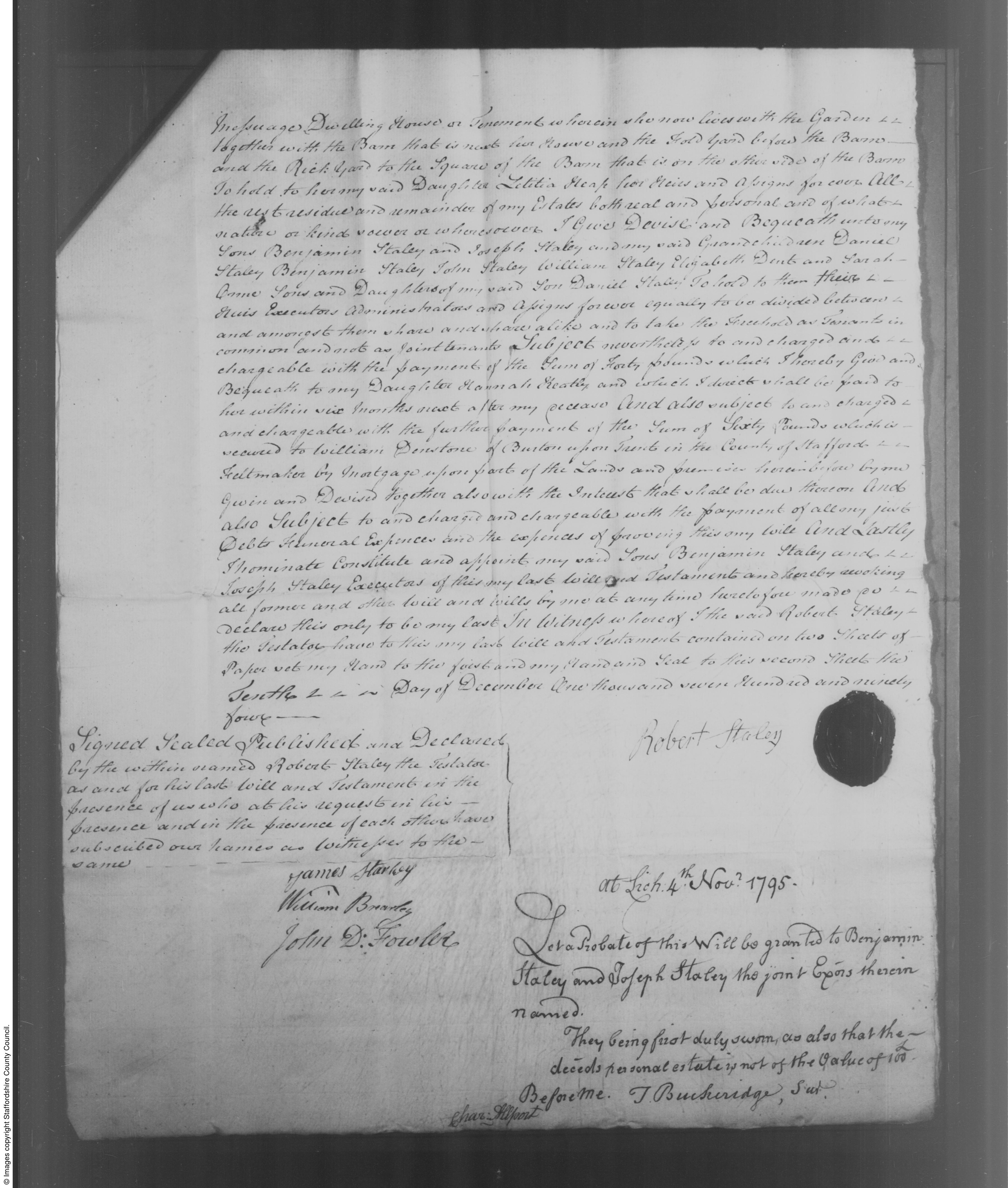
expectations.”The 1795 will of Robert Staley.
Inriguingly, Robert included the children of his son Daniel Staley in his will, but omitted to leave anything to Daniel. A perusal of Daniels 1808 will sheds some light on this: Daniel left his property to his six reputed children with Elizabeth Moon, and his reputed daughter Mary Brearly. Daniels wife was Mary Moon, Elizabeths husband William Moons daughter.
The will of Robert Staley, 1795:
The 1805 will of Daniel Staley, Robert’s son:
This is the last will and testament of me Daniel Staley of the Township of Newhall in the parish of Stapenhill in the County of Derby, Farmer. I will and order all of my just debts, funeral and testamentary expenses to be fully paid and satisfied by my executors hereinafter named by and out of my personal estate as soon as conveniently may be after my decease.
I give, devise and bequeath to Humphrey Trafford Nadin of Church Gresely in the said County of Derby Esquire and John Wilkinson of Newhall aforesaid yeoman all my messuages, lands, tenements, hereditaments and real and personal estates to hold to them, their heirs, executors, administrators and assigns until Richard Moon the youngest of my reputed sons by Elizabeth Moon shall attain his age of twenty one years upon trust that they, my said trustees, (or the survivor of them, his heirs, executors, administrators or assigns), shall and do manage and carry on my farm at Newhall aforesaid and pay and apply the rents, issues and profits of all and every of my said real and personal estates in for and towards the support, maintenance and education of all my reputed children by the said Elizabeth Moon until the said Richard Moon my youngest reputed son shall attain his said age of twenty one years and equally share and share and share alike.
And it is my will and desire that my said trustees or trustee for the time being shall recruit and keep up the stock upon my farm as they in their discretion shall see occasion or think proper and that the same shall not be diminished. And in case any of my said reputed children by the said Elizabeth Moon shall be married before my said reputed youngest son shall attain his age of twenty one years that then it is my will and desire that non of their husbands or wives shall come to my farm or be maintained there or have their abode there. That it is also my will and desire in case my reputed children or any of them shall not be steady to business but instead shall be wild and diminish the stock that then my said trustees or trustee for the time being shall have full power and authority in their discretion to sell and dispose of all or any part of my said personal estate and to put out the money arising from the sale thereof to interest and to pay and apply the interest thereof and also thereunto of the said real estate in for and towards the maintenance, education and support of all my said reputed children by the said
Elizabeth Moon as they my said trustees in their discretion that think proper until the said Richard Moon shall attain his age of twenty one years.Then I give to my grandson Daniel Staley the sum of ten pounds and to each and every of my sons and daughters namely Daniel Staley, Benjamin Staley, John Staley, William Staley, Elizabeth Dent and Sarah Orme and to my niece Ann Brearly the sum of five pounds apiece.
I give to my youngest reputed son Richard Moon one share in the Ashby Canal Navigation and I direct that my said trustees or trustee for the time being shall have full power and authority to pay and apply all or any part of the fortune or legacy hereby intended for my youngest reputed son Richard Moon in placing him out to any trade, business or profession as they in their discretion shall think proper.
And I direct that to my said sons and daughters by my late wife and my said niece shall by wholly paid by my said reputed son Richard Moon out of the fortune herby given him. And it is my will and desire that my said reputed children shall deliver into the hands of my executors all the monies that shall arise from the carrying on of my business that is not wanted to carry on the same unto my acting executor and shall keep a just and true account of all disbursements and receipts of the said business and deliver up the same to my acting executor in order that there may not be any embezzlement or defraud amongst them and from and immediately after my said reputed youngest son Richard Moon shall attain his age of twenty one years then I give, devise and bequeath all my real estate and all the residue and remainder of my personal estate of what nature and kind whatsoever and wheresoever unto and amongst all and every my said reputed sons and daughters namely William Moon, Thomas Moon, Joseph Moon, Richard Moon, Ann Moon, Margaret Moon and to my reputed daughter Mary Brearly to hold to them and their respective heirs, executors, administrator and assigns for ever according to the nature and tenure of the same estates respectively to take the same as tenants in common and not as joint tenants.And lastly I nominate and appoint the said Humphrey Trafford Nadin and John Wilkinson executors of this my last will and testament and guardians of all my reputed children who are under age during their respective minorities hereby revoking all former and other wills by me heretofore made and declaring this only to be my last will.
In witness whereof I the said Daniel Staley the testator have to this my last will and testament set my hand and seal the eleventh day of March in the year of our Lord one thousand eight hundred and five.
June 6, 2022 at 12:58 pm #6303In reply to: The Elusive Samuel Housley and Other Family Stories
The Hollands of Barton under Needwood
Samuel Warren of Stapenhill married Catherine Holland of Barton under Needwood in 1795.
I joined a Barton under Needwood History group and found an incredible amount of information on the Holland family, but first I wanted to make absolutely sure that our Catherine Holland was one of them as there were also Hollands in Newhall. Not only that, on the marriage licence it says that Catherine Holland was from Bretby Park Gate, Stapenhill.
Then I noticed that one of the witnesses on Samuel’s brother Williams marriage to Ann Holland in 1796 was John Hair. Hannah Hair was the wife of Thomas Holland, and they were the Barton under Needwood parents of Catherine. Catherine was born in 1775, and Ann was born in 1767.
The 1851 census clinched it: Catherine Warren 74 years old, widow and formerly a farmers wife, was living in the household of her son John Warren, and her place of birth is listed as Barton under Needwood. In 1841 Catherine was a 64 year old widow, her husband Samuel having died in 1837, and she was living with her son Samuel, a farmer. The 1841 census did not list place of birth, however. Catherine died on 31 March 1861 and does not appear on the 1861 census.
Once I had established that our Catherine Holland was from Barton under Needwood, I had another look at the information available on the Barton under Needwood History group, compiled by local historian Steve Gardner.
Catherine’s parents were Thomas Holland 1737-1828 and Hannah Hair 1739-1822.
Steve Gardner had posted a long list of the dates, marriages and children of the Holland family. The earliest entries in parish registers were Thomae Holland 1562-1626 and his wife Eunica Edwardes 1565-1632. They married on 10th July 1582. They were born, married and died in Barton under Needwood. They were direct ancestors of Catherine Holland, and as such my direct ancestors too.
The known history of the Holland family in Barton under Needwood goes back to Richard De Holland. (Thanks once again to Steve Gardner of the Barton under Needwood History group for this information.)
“Richard de Holland was the first member of the Holland family to become resident in Barton under Needwood (in about 1312) having been granted lands by the Earl of Lancaster (for whom Richard served as Stud and Stock Keeper of the Peak District) The Holland family stemmed from Upholland in Lancashire and had many family connections working for the Earl of Lancaster, who was one of the biggest Barons in England. Lancaster had his own army and lived at Tutbury Castle, from where he ruled over most of the Midlands area. The Earl of Lancaster was one of the main players in the ‘Barons Rebellion’ and the ensuing Battle of Burton Bridge in 1322. Richard de Holland was very much involved in the proceedings which had so angered Englands King. Holland narrowly escaped with his life, unlike the Earl who was executed.
From the arrival of that first Holland family member, the Hollands were a mainstay family in the community, and were in Barton under Needwood for over 600 years.”Continuing with various items of information regarding the Hollands, thanks to Steve Gardner’s Barton under Needwood history pages:
“PART 6 (Final Part)
Some mentions of The Manor of Barton in the Ancient Staffordshire Rolls:
1330. A Grant was made to Herbert de Ferrars, at le Newland in the Manor of Barton.
1378. The Inquisitio bonorum – Johannis Holand — an interesting Inventory of his goods and their value and his debts.
1380. View of Frankpledge ; the Jury found that Richard Holland was feloniously murdered by his wife Joan and Thomas Graunger, who fled. The goods of the deceased were valued at iiij/. iijj. xid. ; one-third went to the dead man, one-third to his son, one- third to the Lord for the wife’s share. Compare 1 H. V. Indictments. (1413.)
That Thomas Graunger of Barton smyth and Joan the wife of Richard de Holond of Barton on the Feast of St. John the Baptist 10 H. II. (1387) had traitorously killed and murdered at night, at Barton, Richard, the husband of the said Joan. (m. 22.)
The names of various members of the Holland family appear constantly among the listed Jurors on the manorial records printed below : —
1539. Richard Holland and Richard Holland the younger are on the Muster Roll of Barton
1583. Thomas Holland and Unica his wife are living at Barton.
1663-4. Visitations. — Barton under Needword. Disclaimers. William Holland, Senior, William Holland, Junior.
1609. Richard Holland, Clerk and Alice, his wife.
1663-4. Disclaimers at the Visitation. William Holland, Senior, William Holland, Junior.”I was able to find considerably more information on the Hollands in the book “Some Records of the Holland Family (The Hollands of Barton under Needwood, Staffordshire, and the Hollands in History)” by William Richard Holland. Luckily the full text of this book can be found online.
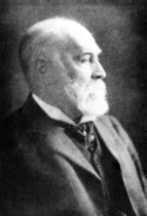
William Richard Holland (Died 1915) An early local Historian and author of the book:
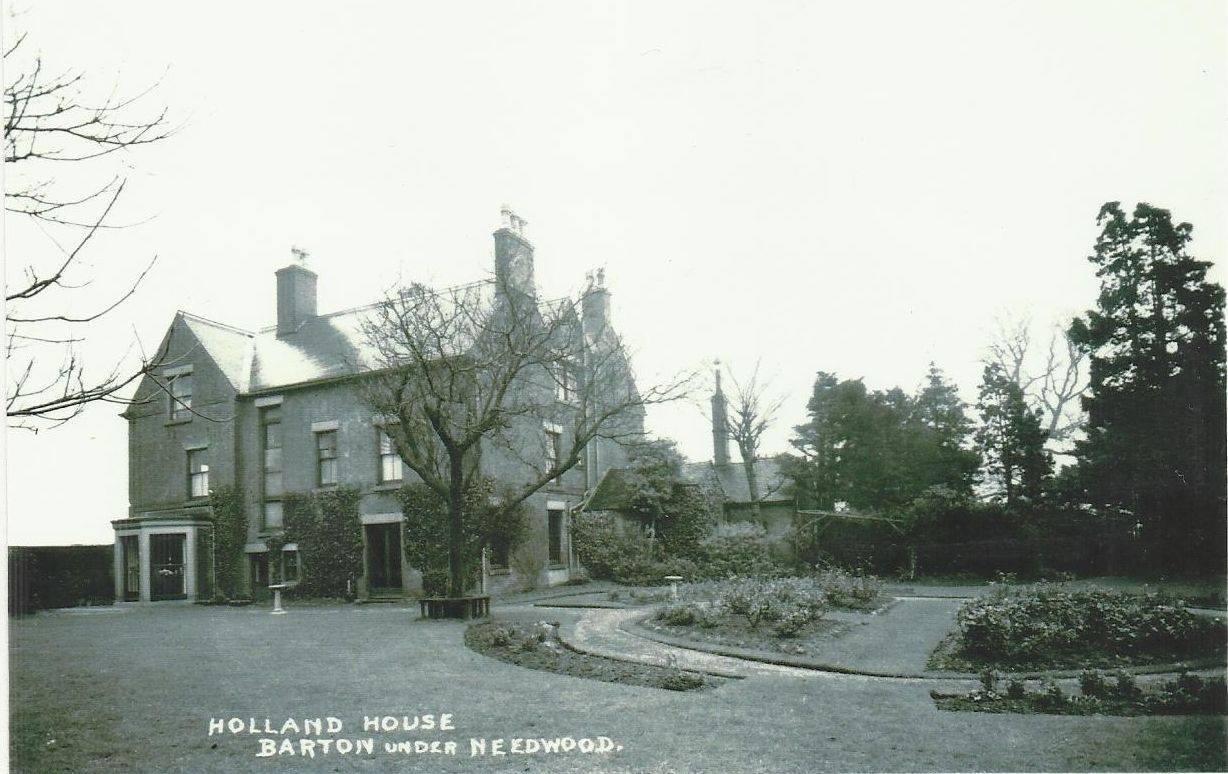
‘Holland House’ taken from the Gardens (sadly demolished in the early 60’s):
Excerpt from the book:
“The charter, dated 1314, granting Richard rights and privileges in Needwood Forest, reads as follows:
“Thomas Earl of Lancaster and Leicester, high-steward of England, to whom all these present shall come, greeting: Know ye, that we have given, &c., to Richard Holland of Barton, and his heirs, housboot, heyboot, and fireboot, and common of pasture, in our forest of Needwood, for all his beasts, as well in places fenced as lying open, with 40 hogs, quit of pawnage in our said forest at all times in the year (except hogs only in fence month). All which premises we will warrant, &c. to the said Richard and his heirs against all people for ever”
“The terms “housboot” “heyboot” and “fireboot” meant that Richard and his heirs were to have the privilege of taking from the Forest, wood needed for house repair and building, hedging material for the repairing of fences, and what was needful for purposes of fuel.”
Further excerpts from the book:
“It may here be mentioned that during the renovation of Barton Church, when the stone pillars were being stripped of the plaster which covered them, “William Holland 1617” was found roughly carved on a pillar near to the belfry gallery, obviously the work of a not too devout member of the family, who, seated in the gallery of that time, occupied himself thus during the service. The inscription can still be seen.”
“The earliest mention of a Holland of Upholland occurs in the reign of John in a Final Concord, made at the Lancashire Assizes, dated November 5th, 1202, in which Uchtred de Chryche, who seems to have had some right in the manor of Upholland, releases his right in fourteen oxgangs* of land to Matthew de Holland, in consideration of the sum of six marks of silver. Thus was planted the Holland Tree, all the early information of which is found in The Victoria County History of Lancaster.
As time went on, the family acquired more land, and with this, increased position. Thus, in the reign of Edward I, a Robert de Holland, son of Thurstan, son of Robert, became possessed of the manor of Orrell adjoining Upholland and of the lordship of Hale in the parish of Childwall, and, through marriage with Elizabeth de Samlesbury (co-heiress of Sir Wm. de Samlesbury of Samlesbury, Hall, near to Preston), of the moiety of that manor….
* An oxgang signified the amount of land that could be ploughed by one ox in one day”
“This Robert de Holland, son of Thurstan, received Knighthood in the reign of Edward I, as did also his brother William, ancestor of that branch of the family which later migrated to Cheshire. Belonging to this branch are such noteworthy personages as Mrs. Gaskell, the talented authoress, her mother being a Holland of this branch, Sir Henry Holland, Physician to Queen Victoria, and his two sons, the first Viscount Knutsford, and Canon Francis Holland ; Sir Henry’s grandson (the present Lord Knutsford), Canon Scott Holland, etc. Captain Frederick Holland, R.N., late of Ashbourne Hall, Derbyshire, may also be mentioned here.*”
Thanks to the Barton under Needwood history group for the following:
WALES END FARM:
In 1509 it was owned and occupied by Mr Johannes Holland De Wallass end who was a well to do Yeoman Farmer (the origin of the areas name – Wales End). Part of the building dates to 1490 making it probably the oldest building still standing in the Village: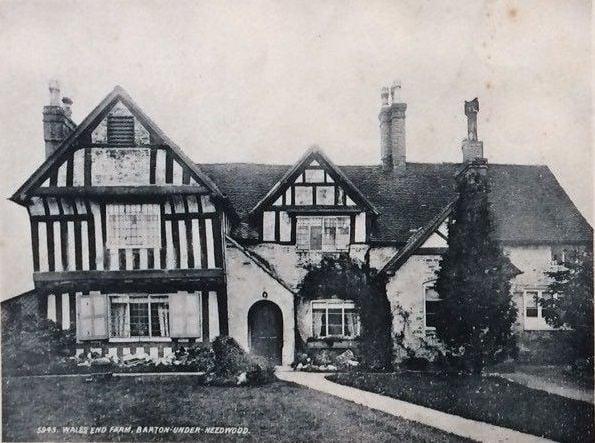
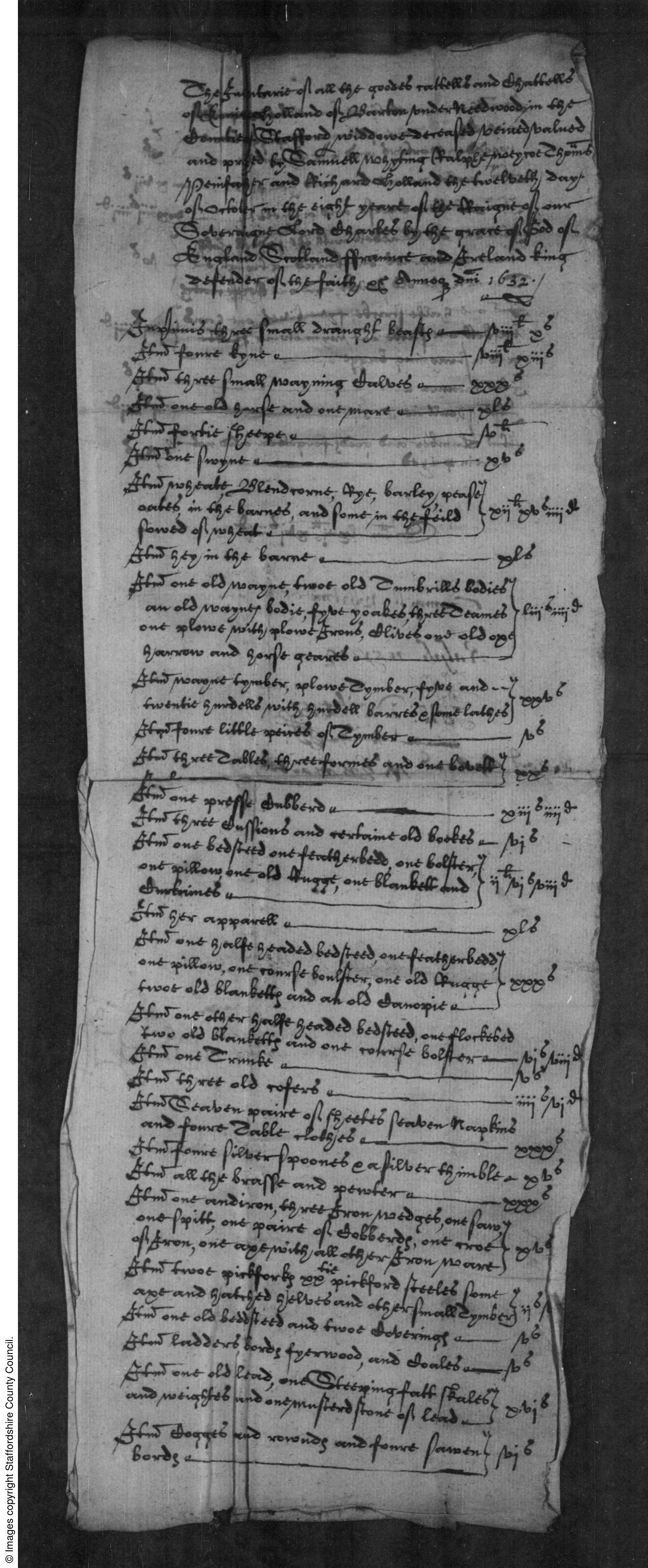
I found records for all of the Holland’s listed on the Barton under Needwood History group and added them to my ancestry tree. The earliest will I found was for Eunica Edwardes, then Eunica Holland, who died in 1632.
A page from the 1632 will and inventory of Eunica (Unice) Holland:
I’d been reading about “pedigree collapse” just before I found out her maiden name of Edwardes. Edwards is my own maiden name.
“In genealogy, pedigree collapse describes how reproduction between two individuals who knowingly or unknowingly share an ancestor causes the family tree of their offspring to be smaller than it would otherwise be.
Without pedigree collapse, a person’s ancestor tree is a binary tree, formed by the person, the parents, grandparents, and so on. However, the number of individuals in such a tree grows exponentially and will eventually become impossibly high. For example, a single individual alive today would, over 30 generations going back to the High Middle Ages, have roughly a billion ancestors, more than the total world population at the time. This apparent paradox occurs because the individuals in the binary tree are not distinct: instead, a single individual may occupy multiple places in the binary tree. This typically happens when the parents of an ancestor are cousins (sometimes unbeknownst to themselves). For example, the offspring of two first cousins has at most only six great-grandparents instead of the normal eight. This reduction in the number of ancestors is pedigree collapse. It collapses the binary tree into a directed acyclic graph with two different, directed paths starting from the ancestor who in the binary tree would occupy two places.” via wikipediaThere is nothing to suggest, however, that Eunica’s family were related to my fathers family, and the only evidence so far in my tree of pedigree collapse are the marriages of Orgill cousins, where two sets of grandparents are repeated.
A list of Holland ancestors:
Catherine Holland 1775-1861
her parents:
Thomas Holland 1737-1828 Hannah Hair 1739-1832
Thomas’s parents:
William Holland 1696-1756 Susannah Whiteing 1715-1752
William’s parents:
William Holland 1665- Elizabeth Higgs 1675-1720
William’s parents:
Thomas Holland 1634-1681 Katherine Owen 1634-1728
Thomas’s parents:
Thomas Holland 1606-1680 Margaret Belcher 1608-1664
Thomas’s parents:
Thomas Holland 1562-1626 Eunice Edwardes 1565- 1632May 12, 2022 at 4:55 am #6292In reply to: The Precious Life and Rambles of Liz Tattler
The door flung open. It was Finnley. “Here I am! I was drugged when I tried to put a bug under the rug. Someone hit me on the head with a mug and lured me to a secret location. Fortunately I charmed my way free with a hug.”
“Thank goodness the situation have been explained property,” said Liz. “I couldn’t understand a word Fanella was saying.”
May 3, 2022 at 4:40 pm #6291In reply to: The Elusive Samuel Housley and Other Family Stories
Jane Eaton
The Nottingham Girl
Jane Eaton 1809-1879
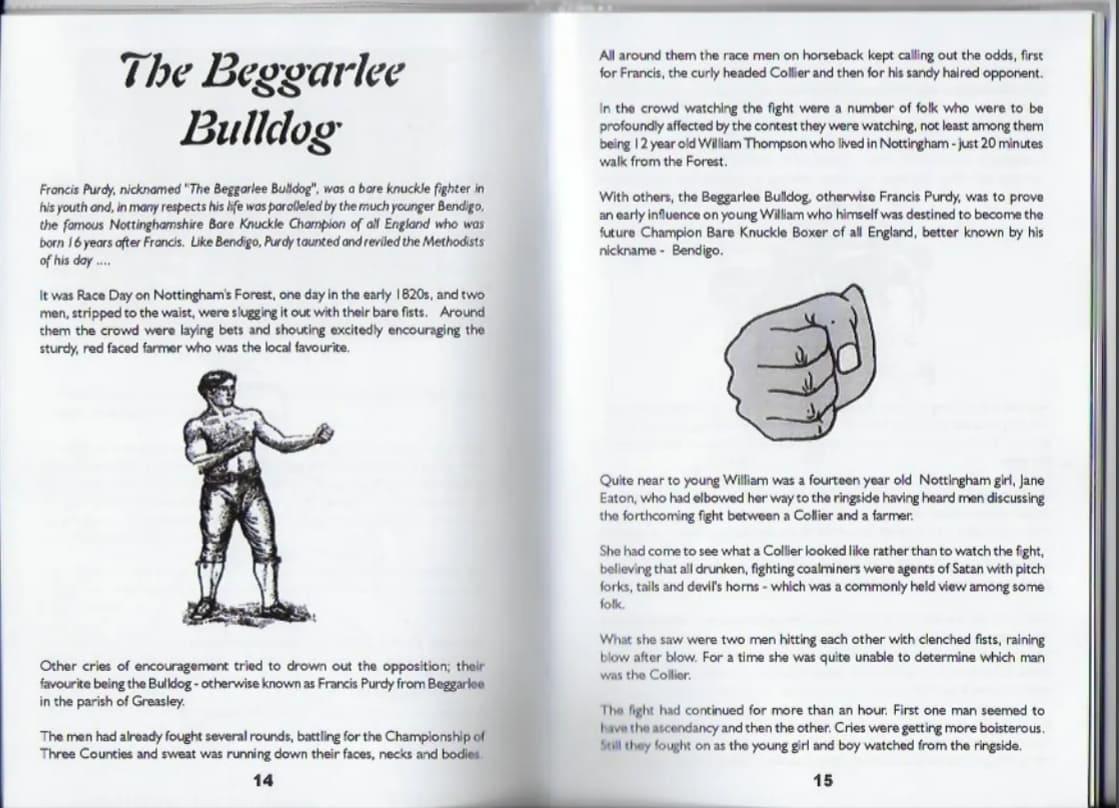
Francis Purdy, the Beggarlea Bulldog and Methodist Minister, married Jane Eaton in 1837 in Nottingham. Jane was his second wife.
Jane Eaton, photo says “Grandma Purdy” on the back:
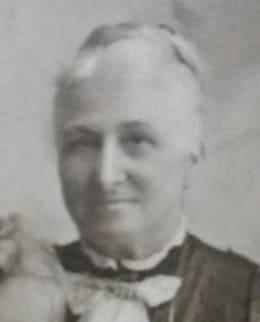
Jane is described as a “Nottingham girl” in a book excerpt sent to me by Jim Giles, a relation who shares the same 3x great grandparents, Francis and Jane Purdy.
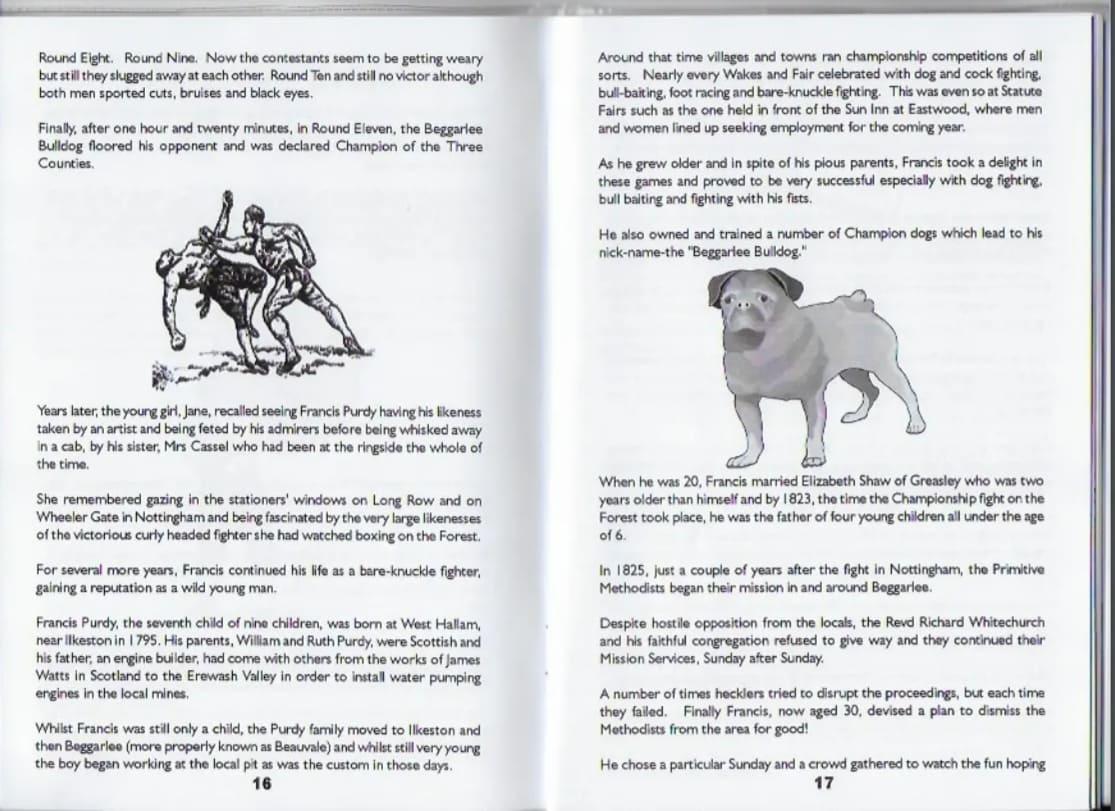
Elizabeth, Francis Purdy’s first wife, died suddenly at chapel in 1836, leaving nine children.
On Christmas day the following year Francis married Jane Eaton at St Peters church in Nottingham. Jane married a Methodist Minister, and didn’t realize she married the bare knuckle fighter she’d seen when she was fourteen until he undressed and she saw his scars.
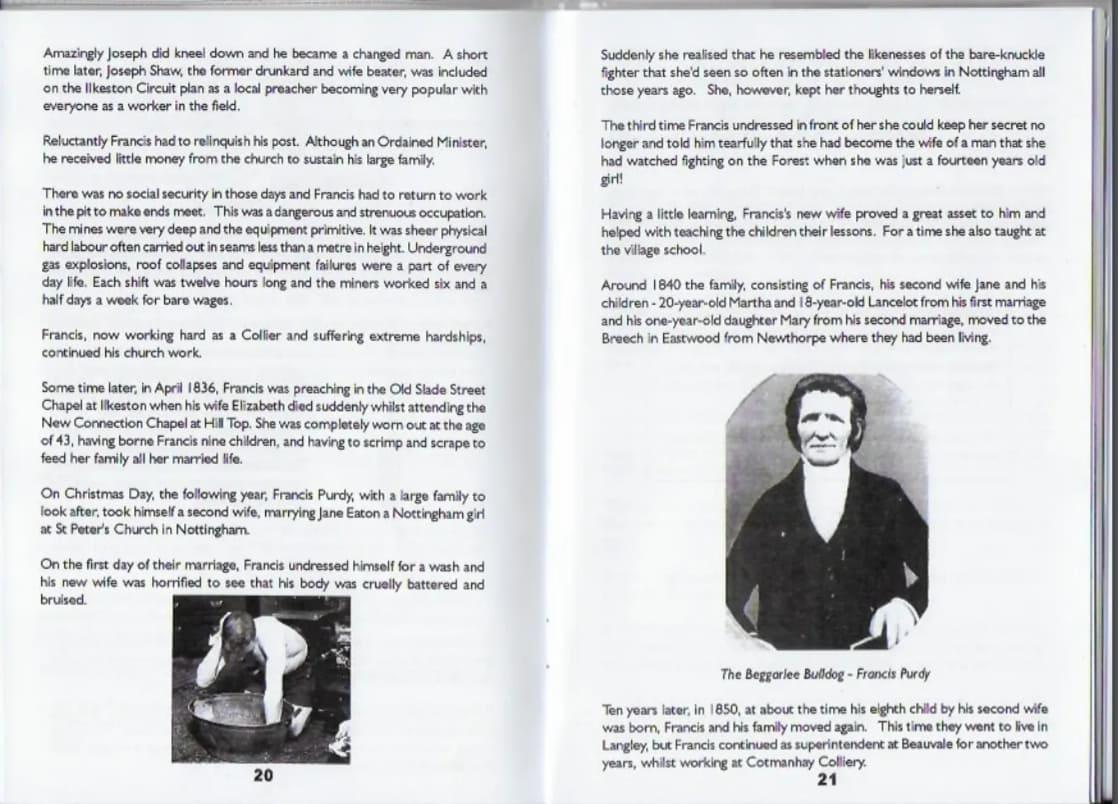
William Eaton 1767-1851
On the marriage certificate Jane’s father was William Eaton, occupation gardener. Francis’s father was William Purdy, engineer.
On the 1841 census living in Sollory’s Yard, Nottingham St Mary, William Eaton was a 70 year old gardener. It doesn’t say which county he was born in but indicates that it was not Nottinghamshire. Living with him were Mary Eaton, milliner, age 35, Mary Eaton, milliner, 15, and Elizabeth Rhodes age 35, a sempstress (another word for seamstress). The three women were born in Nottinghamshire.
But who was Elizabeth Rhodes?
Elizabeth Eaton was Jane’s older sister, born in 1797 in Nottingham. She married William Rhodes, a private in the 5th Dragoon Guards, in Leeds in October 1815.
I looked for Elizabeth Rhodes on the 1851 census, which stated that she was a widow. I was also trying to determine which William Eaton death was the right one, and found William Eaton was still living with Elizabeth in 1851 at Pilcher Gate in Nottingham, but his name had been entered backwards: Eaton William. I would not have found him on the 1851 census had I searched for Eaton as a last name.
Pilcher Gate gets its strange name from pilchers or fur dealers and was once a very narrow thoroughfare. At the lower end stood a pub called The Windmill – frequented by the notorious robber and murderer Charlie Peace.
This was a lucky find indeed, because William’s place of birth was listed as Grantham, Lincolnshire. There were a couple of other William Eaton’s born at the same time, both near to Nottingham. It was tricky to work out which was the right one, but as it turned out, neither of them were.
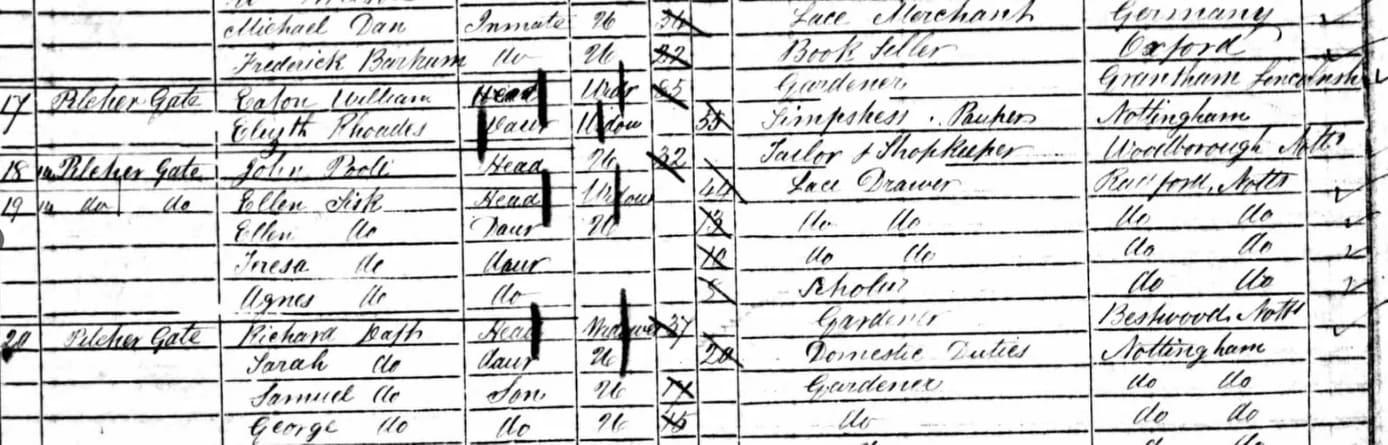
Now we had Nottinghamshire and Lincolnshire border straddlers, so the search moved to the Lincolnshire records.
But first, what of the two Mary Eatons living with William?William and his wife Mary had a daughter Mary in 1799 who died in 1801, and another daughter Mary Ann born in 1803. (It was common to name children after a previous infant who had died.) It seems that Mary Ann didn’t marry but had a daughter Mary Eaton born in 1822.
William and his wife Mary also had a son Richard Eaton born in 1801 in Nottingham.
Who was William Eaton’s wife Mary?
There are two possibilities: Mary Cresswell and a marriage in Nottingham in 1797, or Mary Dewey and a marriage at Grantham in 1795. If it’s Mary Cresswell, the first child Elizabeth would have been born just four or five months after the wedding. (This was far from unusual). However, no births in Grantham, or in Nottingham, were recorded for William and Mary in between 1795 and 1797.
We don’t know why William moved from Grantham to Nottingham or when he moved there. According to Dearden’s 1834 Nottingham directory, William Eaton was a “Gardener and Seedsman”.
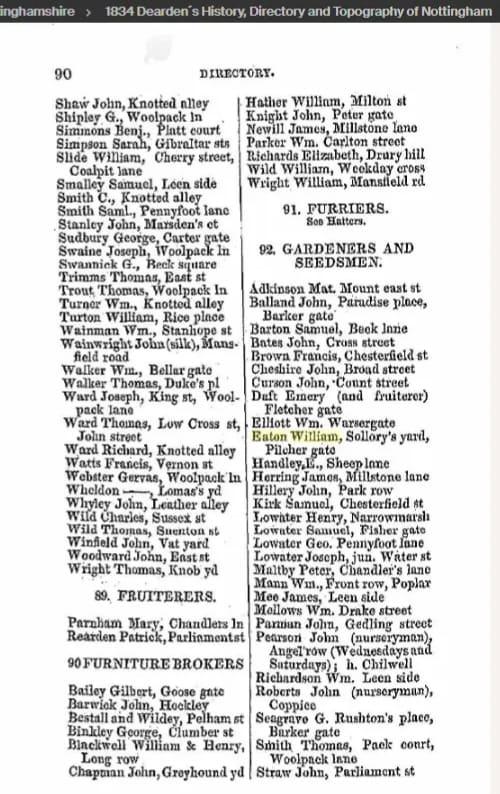
There was another William Eaton selling turnip seeds in the same part of Nottingham. At first I thought it must be the same William, but apparently not, as that William Eaton is recorded as a victualler, born in Ruddington. The turnip seeds were advertised in 1847 as being obtainable from William Eaton at the Reindeer Inn, Wheeler Gate. Perhaps he was related.
William lived in the Lace Market part of Nottingham. I wondered where a gardener would be working in that part of the city. According to CreativeQuarter website, “in addition to the trades and housing (sometimes under the same roof), there were a number of splendid mansions being built with extensive gardens and orchards. Sadly, these no longer exist as they were gradually demolished to make way for commerce…..The area around St Mary’s continued to develop as an elegant residential district during the seventeenth and eighteenth centuries, with buildings … being built for nobility and rich merchants.”
William Eaton died in Nottingham in September 1851, thankfully after the census was taken recording his place of birth.
April 12, 2022 at 8:13 am #6290In reply to: The Elusive Samuel Housley and Other Family Stories
Leicestershire Blacksmiths
The Orgill’s of Measham led me further into Leicestershire as I traveled back in time.
I also realized I had uncovered a direct line of women and their mothers going back ten generations:
myself, Tracy Edwards 1957-
my mother Gillian Marshall 1933-
my grandmother Florence Warren 1906-1988
her mother and my great grandmother Florence Gretton 1881-1927
her mother Sarah Orgill 1840-1910
her mother Elizabeth Orgill 1803-1876
her mother Sarah Boss 1783-1847
her mother Elizabeth Page 1749-
her mother Mary Potter 1719-1780
and her mother and my 7x great grandmother Mary 1680-You could say it leads us to the very heart of England, as these Leicestershire villages are as far from the coast as it’s possible to be. There are countless other maternal lines to follow, of course, but only one of mothers of mothers, and ours takes us to Leicestershire.
The blacksmiths
Sarah Boss was the daughter of Michael Boss 1755-1807, a blacksmith in Measham, and Elizabeth Page of nearby Hartshorn, just over the county border in Derbyshire.
An earlier Michael Boss, a blacksmith of Measham, died in 1772, and in his will he left the possession of the blacksmiths shop and all the working tools and a third of the household furniture to Michael, who he named as his nephew. He left his house in Appleby Magna to his wife Grace, and five pounds to his mother Jane Boss. As none of Michael and Grace’s children are mentioned in the will, perhaps it can be assumed that they were childless.
The will of Michael Boss, 1772, Measham:
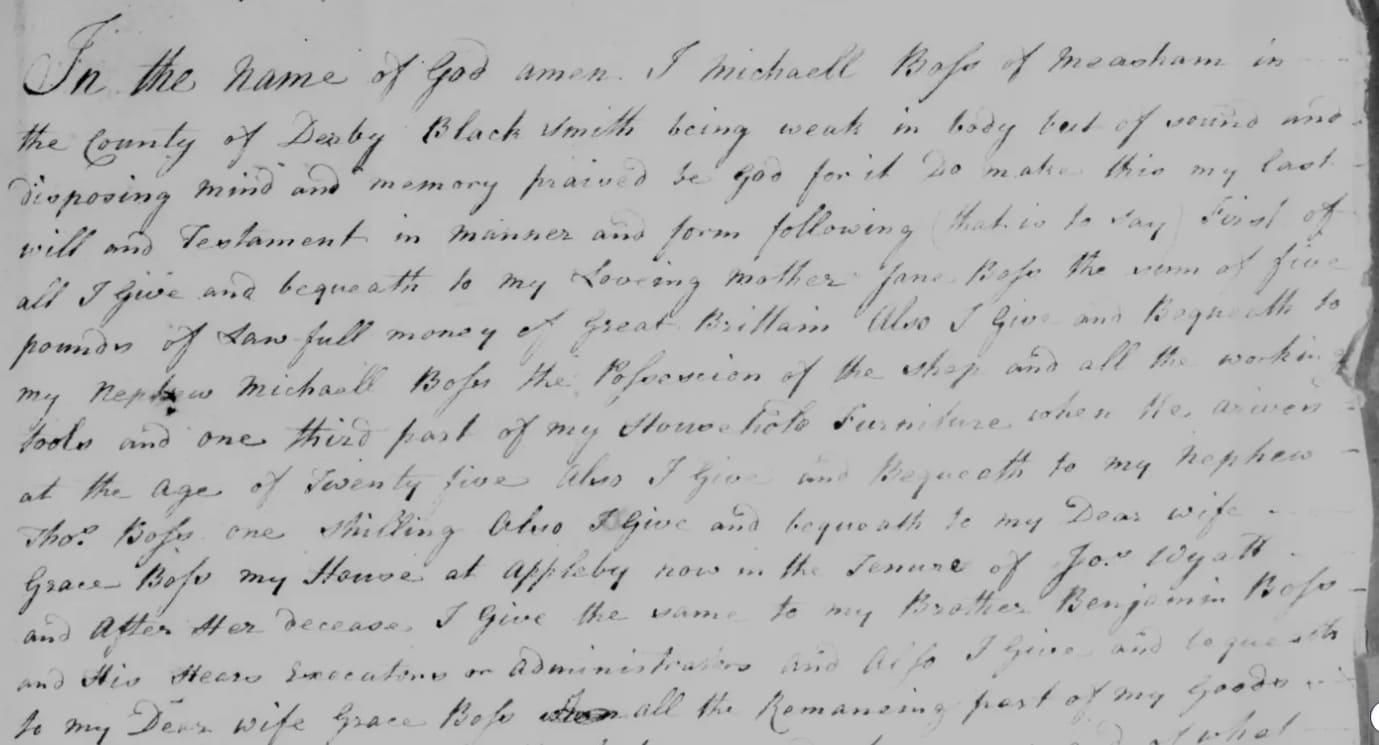
Michael Boss the uncle was born in Appleby Magna in 1724. His parents were Michael Boss of Nelson in the Thistles and Jane Peircivall of Appleby Magna, who were married in nearby Mancetter in 1720.
Information worth noting on the Appleby Magna website:
In 1752 the calendar in England was changed from the Julian Calendar to the Gregorian Calendar, as a result 11 days were famously “lost”. But for the recording of Church Registers another very significant change also took place, the start of the year was moved from March 25th to our more familiar January 1st.
Before 1752 the 1st day of each new year was March 25th, Lady Day (a significant date in the Christian calendar). The year number which we all now use for calculating ages didn’t change until March 25th. So, for example, the day after March 24th 1750 was March 25th 1751, and January 1743 followed December 1743.
This March to March recording can be seen very clearly in the Appleby Registers before 1752. Between 1752 and 1768 there appears slightly confused recording, so dates should be carefully checked. After 1768 the recording is more fully by the modern calendar year.Michael Boss the uncle married Grace Cuthbert. I haven’t yet found the birth or parents of Grace, but a blacksmith by the name of Edward Cuthbert is mentioned on an Appleby Magna history website:
An Eighteenth Century Blacksmith’s Shop in Little Appleby
by Alan RobertsCuthberts inventory
The inventory of Edward Cuthbert provides interesting information about the household possessions and living arrangements of an eighteenth century blacksmith. Edward Cuthbert (als. Cutboard) settled in Appleby after the Restoration to join the handful of blacksmiths already established in the parish, including the Wathews who were prominent horse traders. The blacksmiths may have all worked together in the same shop at one time. Edward and his wife Sarah recorded the baptisms of several of their children in the parish register. Somewhat sadly three of the boys named after their father all died either in infancy or as young children. Edward’s inventory which was drawn up in 1732, by which time he was probably a widower and his children had left home, suggests that they once occupied a comfortable two-storey house in Little Appleby with an attached workshop, well equipped with all the tools for repairing farm carts, ploughs and other implements, for shoeing horses and for general ironmongery.
Edward Cuthbert born circa 1660, married Joane Tuvenet in 1684 in Swepston cum Snarestone , and died in Appleby in 1732. Tuvenet is a French name and suggests a Huguenot connection, but this isn’t our family, and indeed this Edward Cuthbert is not likely to be Grace’s father anyway.
Michael Boss and Elizabeth Page appear to have married twice: once in 1776, and once in 1779. Both of the documents exist and appear correct. Both marriages were by licence. They both mention Michael is a blacksmith.
Their first daughter, Elizabeth, was baptized in February 1777, just nine months after the first wedding. It’s not known when she was born, however, and it’s possible that the marriage was a hasty one. But why marry again three years later?
But Michael Boss and Elizabeth Page did not marry twice.
Elizabeth Page from Smisby was born in 1752 and married Michael Boss on the 5th of May 1776 in Measham. On the marriage licence allegations and bonds, Michael is a bachelor.
Baby Elizabeth was baptised in Measham on the 9th February 1777. Mother Elizabeth died on the 18th February 1777, also in Measham.
In 1779 Michael Boss married another Elizabeth Page! She was born in 1749 in Hartshorn, and Michael is a widower on the marriage licence allegations and bonds.
Hartshorn and Smisby are neighbouring villages, hence the confusion. But a closer look at the documents available revealed the clues. Both Elizabeth Pages were literate, and indeed their signatures on the marriage registers are different:
Marriage of Michael Boss and Elizabeth Page of Smisby in 1776:
Marriage of Michael Boss and Elizabeth Page of Harsthorn in 1779:
Not only did Michael Boss marry two women both called Elizabeth Page but he had an unusual start in life as well. His uncle Michael Boss left him the blacksmith business and a third of his furniture. This was all in the will. But which of Uncle Michaels brothers was nephew Michaels father?
The only Michael Boss born at the right time was in 1750 in Edingale, Staffordshire, about eight miles from Appleby Magna. His parents were Thomas Boss and Ann Parker, married in Edingale in 1747. Thomas died in August 1750, and his son Michael was baptised in the December, posthumus son of Thomas and his widow Ann. Both entries are on the same page of the register.
Ann Boss, the young widow, married again. But perhaps Michael and his brother went to live with their childless uncle and aunt, Michael Boss and Grace Cuthbert.
The great grandfather of Michael Boss (the Measham blacksmith born in 1850) was also Michael Boss, probably born in the 1660s. He died in Newton Regis in Warwickshire in 1724, four years after his son (also Michael Boss born 1693) married Jane Peircivall. The entry on the parish register states that Michael Boss was buried ye 13th Affadavit made.
I had not seen affadavit made on a parish register before, and this relates to the The Burying in Woollen Acts 1666–80. According to Wikipedia:
“Acts of the Parliament of England which required the dead, except plague victims and the destitute, to be buried in pure English woollen shrouds to the exclusion of any foreign textiles. It was a requirement that an affidavit be sworn in front of a Justice of the Peace (usually by a relative of the deceased), confirming burial in wool, with the punishment of a £5 fee for noncompliance. Burial entries in parish registers were marked with the word “affidavit” or its equivalent to confirm that affidavit had been sworn; it would be marked “naked” for those too poor to afford the woollen shroud. The legislation was in force until 1814, but was generally ignored after 1770.”
Michael Boss buried 1724 “Affadavit made”:
Elizabeth Page‘s father was William Page 1717-1783, a wheelwright in Hartshorn. (The father of the first wife Elizabeth was also William Page, but he was a husbandman in Smisby born in 1714. William Page, the father of the second wife, was born in Nailstone, Leicestershire, in 1717. His place of residence on his marriage to Mary Potter was spelled Nelson.)
Her mother was Mary Potter 1719- of nearby Coleorton. Mary’s father, Richard Potter 1677-1731, was a blacksmith in Coleorton.
A page of the will of Richard Potter 1731:
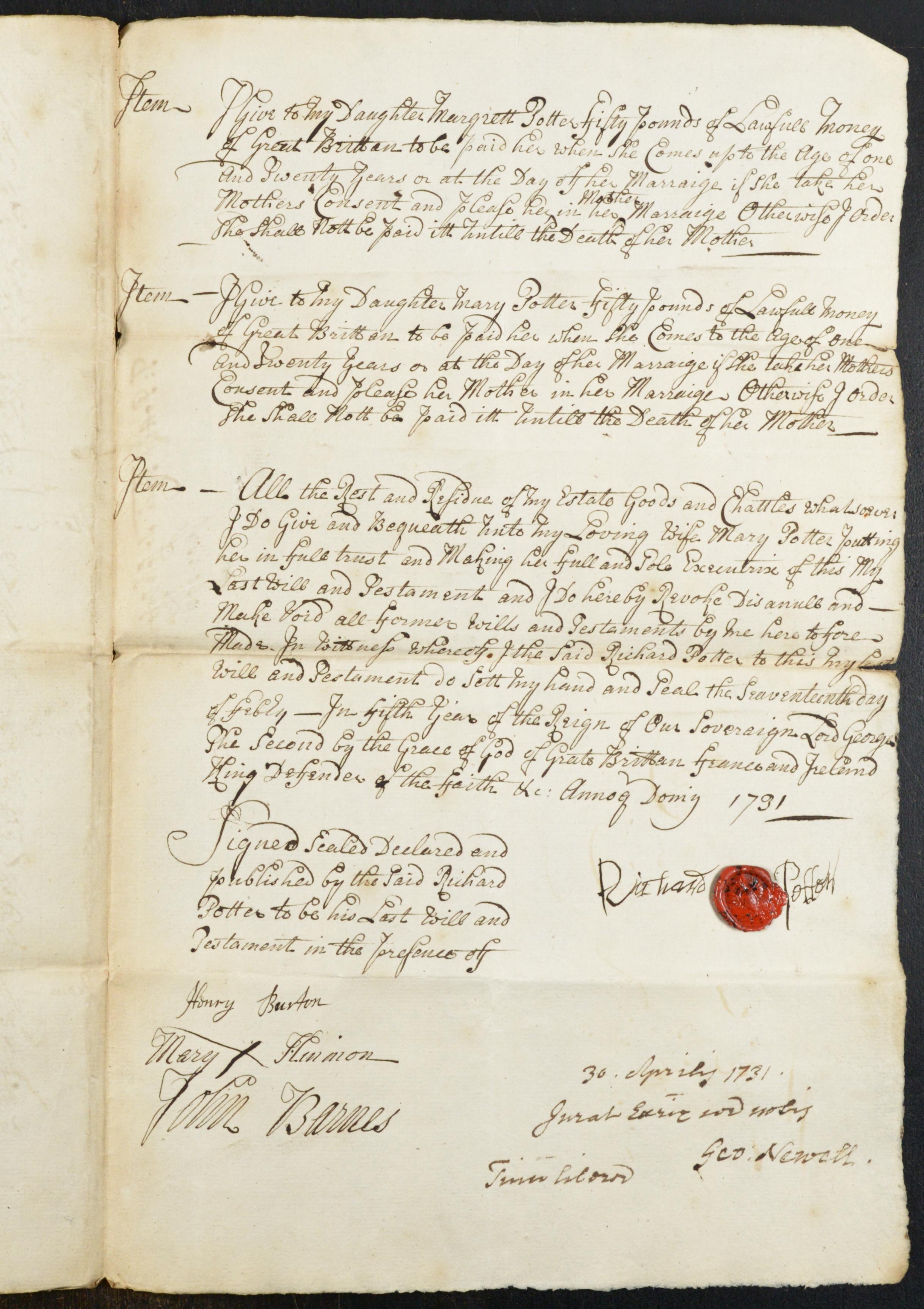
Richard Potter states: “I will and order that my son Thomas Potter shall after my decease have one shilling paid to him and no more.” As he left £50 to each of his daughters, one can’t help but wonder what Thomas did to displease his father.
Richard stipulated that his son Thomas should have one shilling paid to him and not more, for several good considerations, and left “the house and ground lying in the parish of Whittwick in a place called the Long Lane to my wife Mary Potter to dispose of as she shall think proper.”
His son Richard inherited the blacksmith business: “I will and order that my son Richard Potter shall live and be with his mother and serve her duly and truly in the business of a blacksmith, and obey and serve her in all lawful commands six years after my decease, and then I give to him and his heirs…. my house and grounds Coulson House in the Liberty of Thringstone”
Richard wanted his son John to be a blacksmith too: “I will and order that my wife bring up my son John Potter at home with her and teach or cause him to be taught the trade of a blacksmith and that he shall serve her duly and truly seven years after my decease after the manner of an apprentice and at the death of his mother I give him that house and shop and building and the ground belonging to it which I now dwell in to him and his heirs forever.”
To his daughters Margrett and Mary Potter, upon their reaching the age of one and twenty, or the day after their marriage, he leaves £50 each. All the rest of his goods are left to his loving wife Mary.
An inventory of the belongings of Richard Potter, 1731:
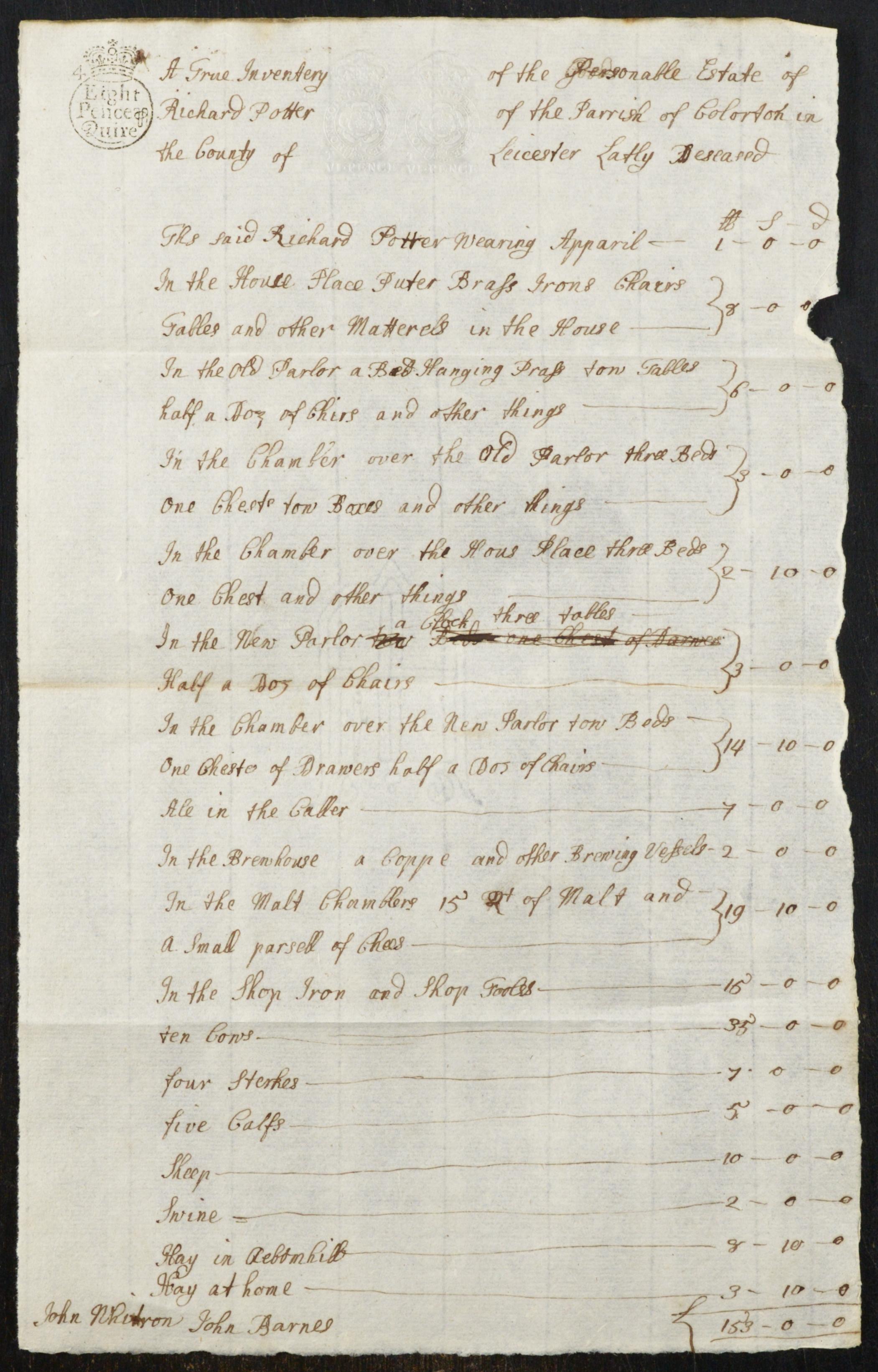
Richard Potters father was also named Richard Potter 1649-1719, and he too was a blacksmith.
Richard Potter of Coleorton in the county of Leicester, blacksmith, stated in his will: “I give to my son and daughter Thomas and Sarah Potter the possession of my house and grounds.”
He leaves ten pounds each to his daughters Jane and Alice, to his son Francis he gives five pounds, and five shillings to his son Richard. Sons Joseph and William also receive five shillings each. To his daughter Mary, wife of Edward Burton, and her daughter Elizabeth, he gives five shillings each. The rest of his good, chattels and wordly substance he leaves equally between his son and daugter Thomas and Sarah. As there is no mention of his wife, it’s assumed that she predeceased him.
The will of Richard Potter, 1719:
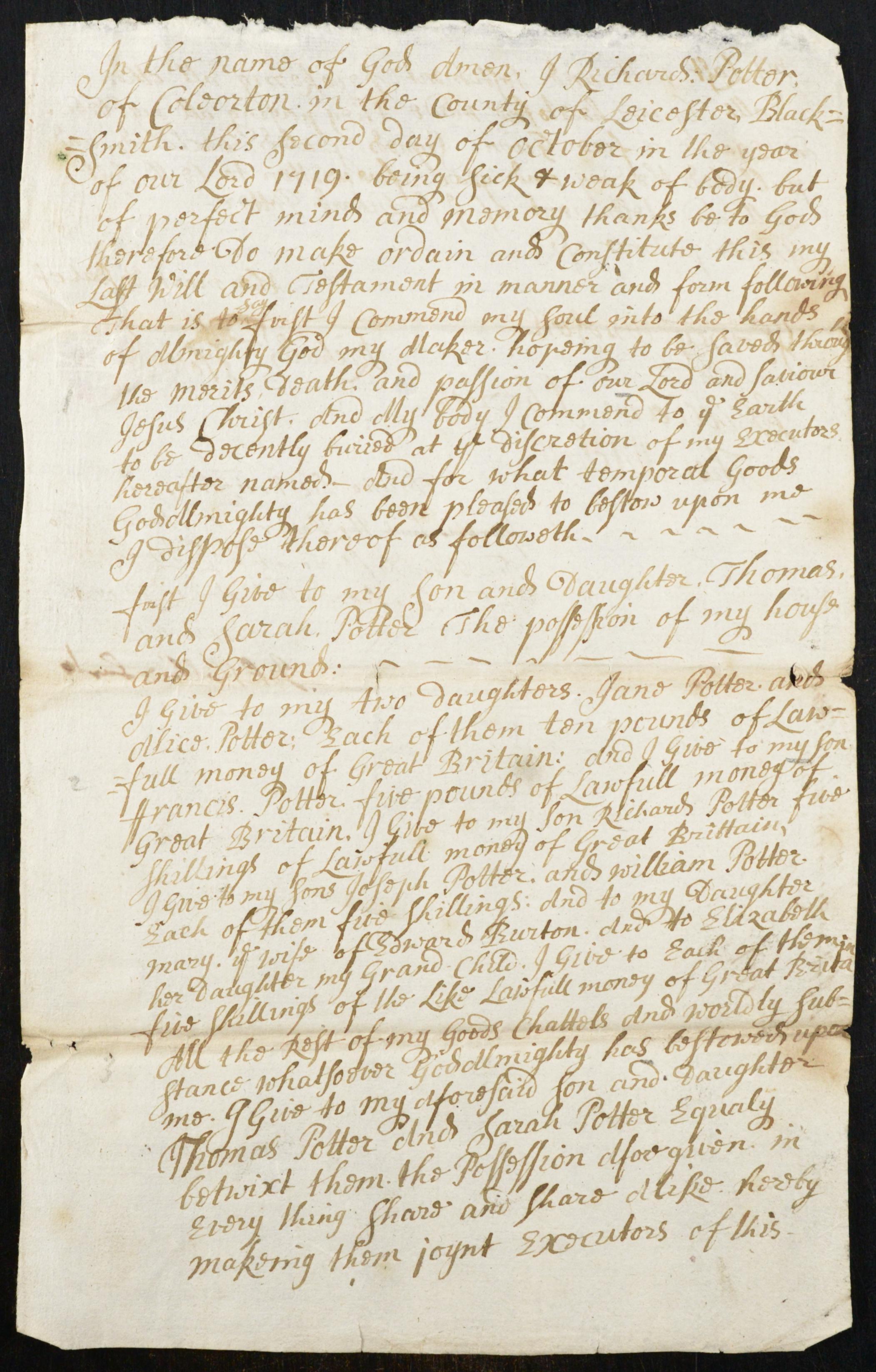
Richard Potter’s (1649-1719) parents were William Potter and Alse Huldin, both born in the early 1600s. They were married in 1646 at Breedon on the Hill, Leicestershire. The name Huldin appears to originate in Finland.
William Potter was a blacksmith. In the 1659 parish registers of Breedon on the Hill, William Potter of Breedon blacksmith buryed the 14th July.
April 2, 2022 at 6:15 pm #6286In reply to: The Elusive Samuel Housley and Other Family Stories
Matthew Orgill and His Family
Matthew Orgill 1828-1907 was the Orgill brother who went to Australia, but returned to Measham. Matthew married Mary Orgill in Measham in October 1856, having returned from Victoria, Australia in May of that year.
Although Matthew was the first Orgill brother to go to Australia, he was the last one I found, and that was somewhat by accident, while perusing “Orgill” and “Measham” in a newspaper archives search. I chanced on Matthew’s obituary in the Nuneaton Observer, Friday 14 June 1907:
LATE MATTHEW ORGILL PEACEFUL END TO A BLAMELESS LIFE.
‘Sunset and Evening Star And one clear call for me.”
It is with very deep regret that we have to announce the death of Mr. Matthew Orgill, late of Measham, who passed peacefully away at his residence in Manor Court Road, Nuneaton, in the early hours of yesterday morning. Mr. Orgill, who was in his eightieth year, was a man with a striking history, and was a very fine specimen of our best English manhood. In early life be emigrated to South Africa—sailing in the “Hebrides” on 4th February. 1850—and was one of the first settlers at the Cape; afterwards he went on to Australia at the time of the Gold Rush, and ultimately came home to his native England and settled down in Measham, in Leicestershire, where he carried on a successful business for the long period of half-a-century.
He was full of reminiscences of life in the Colonies in the early days, and an hour or two in his company was an education itself. On the occasion of the recall of Sir Harry Smith from the Governorship of Natal (for refusing to be a party to the slaying of the wives and children in connection with the Kaffir War), Mr. Orgill was appointed to superintend the arrangements for the farewell demonstration. It was one of his boasts that he made the first missionary cart used in South Africa, which is in use to this day—a monument to the character of his work; while it is an interesting fact to note that among Mr. Orgill’s papers there is the original ground-plan of the city of Durban before a single house was built.
In Africa Mr. Orgill came in contact with the great missionary, David Livingstone, and between the two men there was a striking resemblance in character and a deep and lasting friendship. Mr. Orgill could give a most graphic description of the wreck of the “Birkenhead,” having been in the vicinity at the time when the ill-fated vessel went down. He played a most prominent part on the occasion of the famous wreck of the emigrant ship, “Minerva.” when, in conjunction with some half-a-dozen others, and at the eminent risk of their own lives, they rescued more than 100 of the unfortunate passengers. He was afterwards presented with an interesting relic as a memento of that thrilling experience, being a copper bolt from the vessel on which was inscribed the following words: “Relic of the ship Minerva, wrecked off Bluff Point, Port Natal. 8.A.. about 2 a.m.. Friday, July 5, 1850.”
Mr. Orgill was followed to the Colonies by no fewer than six of his brothers, all of whom did well, and one of whom married a niece (brother’s daughter) of the late Mr. William Ewart Gladstone.
On settling down in Measham his kindly and considerate disposition soon won for him a unique place in the hearts of all the people, by whom he was greatly beloved. He was a man of sterling worth and integrity. Upright and honourable in all his dealings, he led a Christian life that was a pattern to all with whom he came in contact, and of him it could truly he said that he wore the white flower of a blameless life.
He was a member of the Baptist Church, and although beyond much active service since settling down in Nuneaton less than two years ago he leaves behind him a record in Christian service attained by few. In politics he was a Radical of the old school. A great reader, he studied all the questions of the day, and could back up every belief he held by sound and fearless argument. The South African – war was a great grief to him. He knew the Boers from personal experience, and although he suffered at the time of the war for his outspoken condemnation, he had the satisfaction of living to see the people of England fully recognising their awful blunder. To give anything like an adequate idea of Mr. Orgill’s history would take up a great amount of space, and besides much of it has been written and commented on before; suffice it to say that it was strenuous, interesting, and eventful, and yet all through his hands remained unspotted and his heart was pure.
He is survived by three daughters, and was father-in-law to Mr. J. S. Massey. St Kilda. Manor Court Road, to whom deep and loving sympathy is extended in their sore bereavement by a wide circle of friends. The funeral is arranged to leave for Measham on Monday at twelve noon.
“To give anything like an adequate idea of Mr. Orgill’s history would take up a great amount of space, and besides much of it has been written and commented on before…”
I had another look in the newspaper archives and found a number of articles mentioning him, including an intriguing excerpt in an article about local history published in the Burton Observer and Chronicle 8 August 1963:
on an upstairs window pane he scratched with his diamond ring “Matthew Orgill, 1st July, 1858”
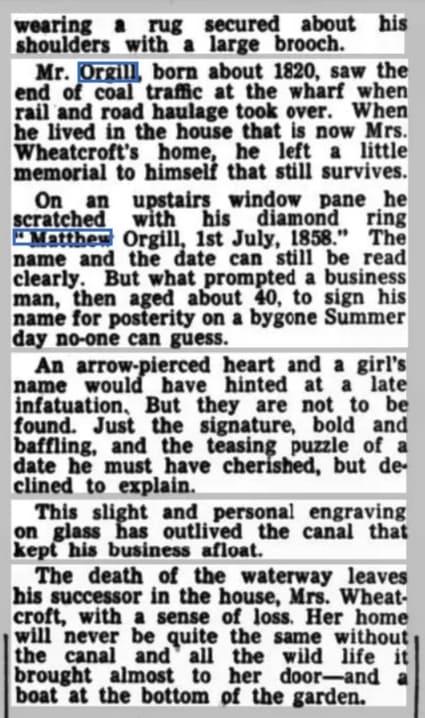
I asked on a Measham facebook group if anyone knew the location of the house mentioned in the article and someone kindly responded. This is the same building, seen from either side:
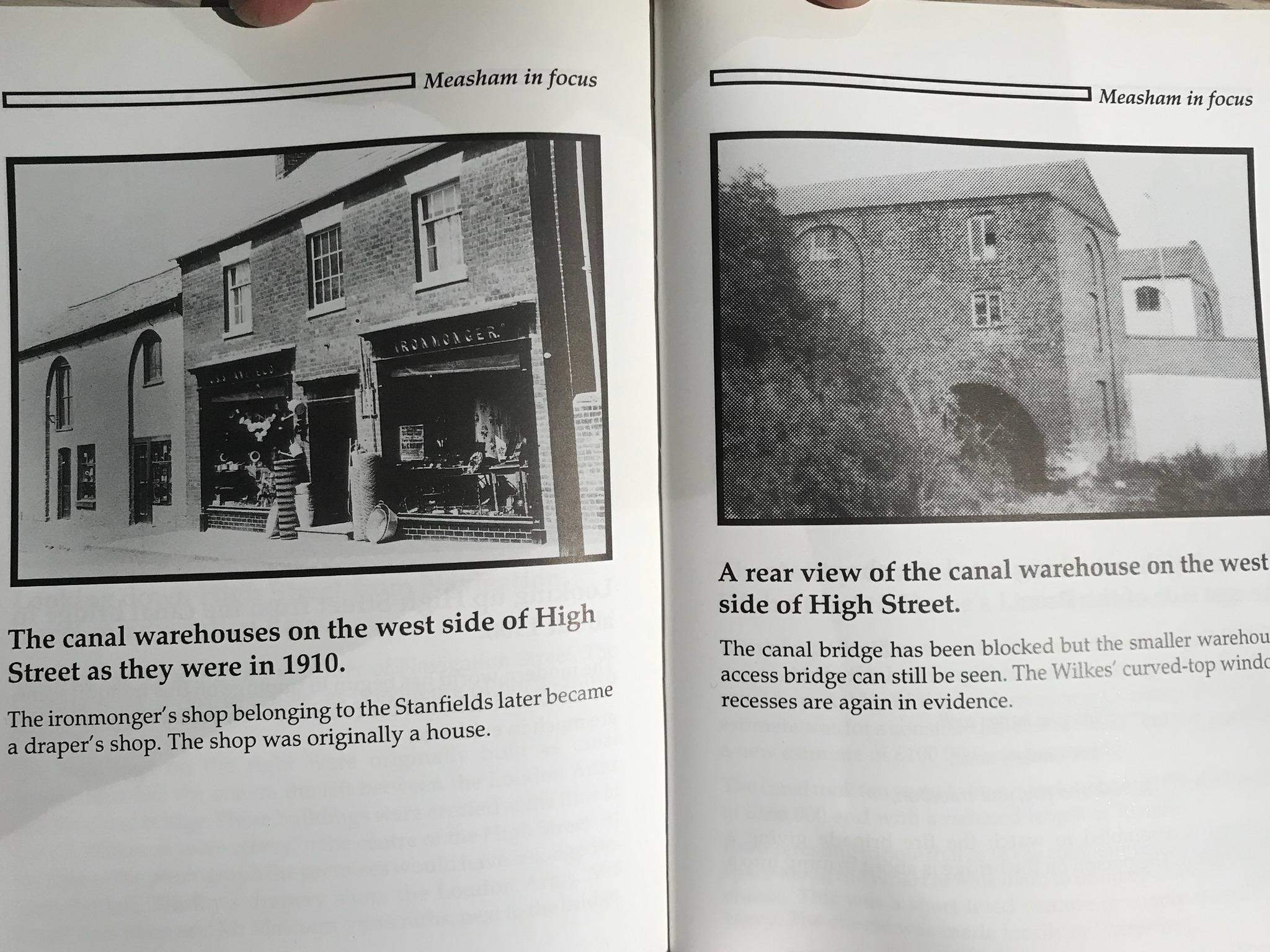
Coincidentally, I had already found this wonderful photograph of the same building, taken in 1910 ~ three years after Matthew’s death.
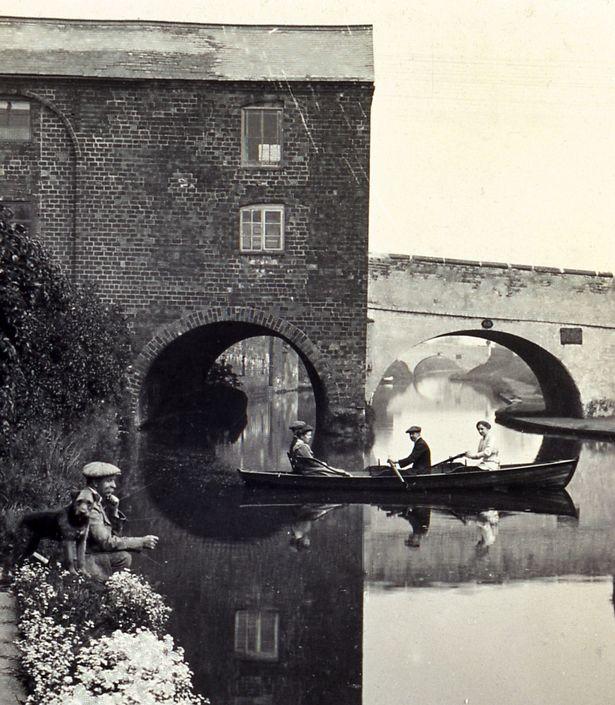
But what to make of the inscription in the window?
Matthew and Mary married in October 1856, and their first child (according to the records I’d found thus far) was a daughter Mary born in 1860. I had a look for a Matthew Orgill birth registered in 1858, the date Matthew had etched on the window, and found a death for a Matthew Orgill in 1859. Assuming I would find the birth of Matthew Orgill registered on the first of July 1958, to match the etching in the window, the corresponding birth was in July 1857!
Matthew and Mary had four children. Matthew, Mary, Clara and Hannah. Hannah Proudman Orgill married Joseph Stanton Massey. The Orgill name continues with their son Stanley Orgill Massey 1900-1979, who was a doctor and surgeon. Two of Stanley’s four sons were doctors, Paul Mackintosh Orgill Massey 1929-2009, and Michael Joseph Orgill Massey 1932-1989.
Mary Orgill 1827-1894, Matthews wife, was an Orgill too.
And this is where the Orgill branch of the tree gets complicated.
Mary’s father was Henry Orgill born in 1805 and her mother was Hannah Proudman born in 1805.
Henry Orgill’s father was Matthew Orgill born in 1769 and his mother was Frances Finch born in 1771.Mary’s husband Matthews parents are Matthew Orgill born in 1798 and Elizabeth Orgill born in 1803.
Another Orgill Orgill marriage!
Matthews parents, Matthew and Elizabeth, have the same grandparents as each other, Matthew Orgill born in 1736 and Ann Proudman born in 1735.
But Matthews grandparents are none other than Matthew Orgill born in 1769 and Frances Finch born in 1771 ~ the same grandparents as his wife Mary!
February 2, 2022 at 12:50 pm #6267In reply to: The Elusive Samuel Housley and Other Family Stories
From Tanganyika with Love
continued part 8
With thanks to Mike Rushby.
Morogoro 20th January 1941
Dearest Family,
It is all arranged for us to go on three months leave to Cape Town next month so
get out your flags. How I shall love showing off Kate and John to you and this time
George will be with us and you’ll be able to get to know him properly. You can’t think
what a comfort it will be to leave all the worries of baggage and tipping to him. We will all
be travelling by ship to Durban and from there to Cape Town by train. I rather dread the
journey because there is a fifth little Rushby on the way and, as always, I am very
queasy.Kate has become such a little companion to me that I dread the thought of leaving
her behind with you to start schooling. I miss Ann and George so much now and must
face separation from Kate as well. There does not seem to be any alternative though.
There is a boarding school in Arusha and another has recently been started in Mbeya,
but both places are so far away and I know she would be very unhappy as a boarder at
this stage. Living happily with you and attending a day school might wean her of her
dependance upon me. As soon as this wretched war ends we mean to get Ann and
George back home and Kate too and they can then all go to boarding school together.
If I were a more methodical person I would try to teach Kate myself, but being a
muddler I will have my hands full with Johnny and the new baby. Life passes pleasantly
but quietly here. Much of my time is taken up with entertaining the children and sewing
for them and just waiting for George to come home.George works so hard on these safaris and this endless elephant hunting to
protect native crops entails so much foot safari, that he has lost a good deal of weight. it
is more than ten years since he had a holiday so he is greatly looking forward to this one.
Four whole months together!I should like to keep the ayah, Janet, for the new baby, but she says she wants
to return to her home in the Southern Highlands Province and take a job there. She is
unusually efficient and so clean, and the houseboy and cook are quite scared of her. She
bawls at them if the children’s meals are served a few minutes late but she is always
respectful towards me and practically creeps around on tiptoe when George is home.
She has a room next to the outside kitchen. One night thieves broke into the kitchen and
stole a few things, also a canvas chair and mat from the verandah. Ayah heard them, and
grabbing a bit of firewood, she gave chase. Her shouts so alarmed the thieves that they
ran off up the hill jettisoning their loot as they ran. She is a great character.Eleanor.
Morogoro 30th July 1941
Dearest Family,
Safely back in Morogoro after a rather grim voyage from Durban. Our ship was
completely blacked out at night and we had to sleep with warm clothing and life belts
handy and had so many tedious boat drills. It was a nuisance being held up for a whole
month in Durban, because I was so very pregnant when we did embark. In fact George
suggested that I had better hide in the ‘Ladies’ until the ship sailed for fear the Captain
might refuse to take me. It seems that the ship, on which we were originally booked to
travel, was torpedoed somewhere off the Cape.We have been given a very large house this tour with a mosquito netted
sleeping porch which will be fine for the new baby. The only disadvantage is that the
house is on the very edge of the residential part of Morogoro and Johnny will have to
go quite a distance to find playmates.I still miss Kate terribly. She is a loving little person. I had prepared for a scene
when we said good-bye but I never expected that she would be the comforter. It
nearly broke my heart when she put her arms around me and said, “I’m so sorry
Mummy, please don’t cry. I’ll be good. Please don’t cry.” I’m afraid it was all very
harrowing for you also. It is a great comfort to hear that she has settled down so happily.
I try not to think consciously of my absent children and remind myself that there are
thousands of mothers in the same boat, but they are always there at the back of my
mind.Mother writes that Ann and George are perfectly happy and well, and that though
German bombers do fly over fairly frequently, they are unlikely to drop their bombs on
a small place like Jacksdale.George has already left on safari to the Rufiji. There was no replacement for his
job while he was away so he is anxious to get things moving again. Johnny and I are
going to move in with friends until he returns, just in case all the travelling around brings
the new baby on earlier than expected.Eleanor.
Morogoro 26th August 1941
Dearest Family,
Our new son, James Caleb. was born at 3.30 pm yesterday afternoon, with a
minimum of fuss, in the hospital here. The Doctor was out so my friend, Sister Murray,
delivered the baby. The Sister is a Scots girl, very efficient and calm and encouraging,
and an ideal person to have around at such a time.Everything, this time, went without a hitch and I feel fine and proud of my
bouncing son. He weighs nine pounds and ten ounces and is a big boned fellow with
dark hair and unusually strongly marked eyebrows. His eyes are strong too and already
seem to focus. George is delighted with him and brought Hugh Nelson to see him this
morning. Hugh took one look, and, astonished I suppose by the baby’s apparent
awareness, said, “Gosh, this one has been here before.” The baby’s cot is beside my
bed so I can admire him as much as I please. He has large strong hands and George
reckons he’ll make a good boxer some day.Another of my early visitors was Mabemba, George’s orderly. He is a very big
African and looks impressive in his Game Scouts uniform. George met him years ago at
Mahenge when he was a young elephant hunter and Mabemba was an Askari in the
Police. Mabemba takes quite a proprietary interest in the family.Eleanor.
Morogoro 25th December 1941
Dearest Family,
Christmas Day today, but not a gay one. I have Johnny in bed with a poisoned
leg so he missed the children’s party at the Club. To make things a little festive I have
put up a little Christmas tree in the children’s room and have hung up streamers and
balloons above the beds. Johnny demands a lot of attention so it is fortunate that little
James is such a very good baby. He sleeps all night until 6 am when his feed is due.
One morning last week I got up as usual to feed him but I felt so dopey that I
thought I’d better have a cold wash first. I went into the bathroom and had a hurried
splash and then grabbed a towel to dry my face. Immediately I felt an agonising pain in
my nose. Reason? There was a scorpion in the towel! In no time at all my nose looked
like a pear and felt burning hot. The baby screamed with frustration whilst I feverishly
bathed my nose and applied this and that in an effort to cool it.For three days my nose was very red and tender,”A real boozer nose”, said
George. But now, thank goodness, it is back to normal.Some of the younger marrieds and a couple of bachelors came around,
complete with portable harmonium, to sing carols in the early hours. No sooner had we
settled down again to woo sleep when we were disturbed by shouts and screams from
our nearest neighbour’s house. “Just celebrating Christmas”, grunted George, but we
heard this morning that the neighbour had fallen down his verandah steps and broken his
leg.Eleanor.
Morogoro Hospital 30th September 1943
Dearest Family,
Well now we are eight! Our new son, Henry, was born on the night of the 28th.
He is a beautiful baby, weighing ten pounds three and a half ounces. This baby is very
well developed, handsome, and rather superior looking, and not at all amusing to look at
as the other boys were.George was born with a moustache, John had a large nose and
looked like a little old man, and Jim, bless his heart, looked rather like a baby
chimpanzee. Henry is different. One of my visitors said, “Heaven he’ll have to be a
Bishop!” I expect the lawn sleeves of his nightie really gave her that idea, but the baby
does look like ‘Someone’. He is very good and George, John, and Jim are delighted
with him, so is Mabemba.We have a dear little nurse looking after us. She is very petite and childish
looking. When the baby was born and she brought him for me to see, the nurse asked
his name. I said jokingly, “His name is Benjamin – the last of the family.” She is now very
peeved to discover that his real name is Henry William and persists in calling him
‘Benjie’.I am longing to get home and into my pleasant rut. I have been away for two
whole weeks and George is managing so well that I shall feel quite expendable if I don’t
get home soon. As our home is a couple of miles from the hospital, I arranged to move
in and stay with the nursing sister on the day the baby was due. There I remained for ten
whole days before the baby was born. Each afternoon George came and took me for a
ride in the bumpy Bedford lorry and the Doctor tried this and that but the baby refused
to be hurried.On the tenth day I had the offer of a lift and decided to go home for tea and
surprise George. It was a surprise too, because George was entertaining a young
Game Ranger for tea and my arrival, looking like a perambulating big top, must have
been rather embarrassing.Henry was born at the exact moment that celebrations started
in the Township for the end of the Muslim religious festival of Ramadan. As the Doctor
held him up by his ankles, there was the sound of hooters and firecrackers from the town.
The baby has a birthmark in the shape of a crescent moon above his left eyebrow.Eleanor.
Morogoro 26th January 1944
Dearest Family,
We have just heard that we are to be transferred to the Headquarters of the
Game Department at a place called Lyamungu in the Northern Province. George is not
at all pleased because he feels that the new job will entail a good deal of office work and
that his beloved but endless elephant hunting will be considerably curtailed. I am glad of
that and I am looking forward to seeing a new part of Tanganyika and particularly
Kilimanjaro which dominates Lyamungu.Thank goodness our menagerie is now much smaller. We found a home for the
guinea pigs last December and Susie, our mischievous guinea-fowl, has flown off to find
a mate.Last week I went down to Dar es Salaam for a check up by Doctor John, a
woman doctor, leaving George to cope with the three boys. I was away two nights and
a day and returned early in the morning just as George was giving Henry his six o’clock
bottle. It always amazes me that so very masculine a man can do my chores with no
effort and I have a horrible suspicion that he does them better than I do. I enjoyed the
short break at the coast very much. I stayed with friends and we bathed in the warm sea
and saw a good film.Now I suppose there will be a round of farewell parties. People in this country
are most kind and hospitable.Eleanor.
Lyamungu 20th March 1944
Dearest Family,
We left Morogoro after the round of farewell parties I had anticipated. The final
one was at the Club on Saturday night. George made a most amusing speech and the
party was a very pleasant occasion though I was rather tired after all the packing.
Several friends gathered to wave us off on Monday morning. We had two lorries
loaded with our goods. I rode in the cab of the first one with Henry on my knee. George
with John and Jim rode in the second one. As there was no room for them in the cab,
they sat on our couch which was placed across the width of the lorry behind the cab. This
seat was not as comfortable as it sounds, because the space behind the couch was
taken up with packing cases which were not lashed in place and these kept moving
forward as the lorry bumped its way over the bad road.Soon there was hardly any leg room and George had constantly to stand up and
push the second layer of packing cases back to prevent them from toppling over onto
the children and himself. As it is now the rainy season the road was very muddy and
treacherous and the lorries travelled so slowly it was dark by the time we reached
Karogwe from where we were booked to take the train next morning to Moshi.
Next morning we heard that there had been a washaway on the line and that the
train would be delayed for at least twelve hours. I was not feeling well and certainly did
not enjoy my day. Early in the afternoon Jimmy ran into a wall and blackened both his
eyes. What a child! As the day wore on I felt worse and worse and when at last the train
did arrive I simply crawled into my bunk whilst George coped nobly with the luggage
and the children.We arrived at Moshi at breakfast time and went straight to the Lion Cub Hotel
where I took to my bed with a high temperature. It was, of course, malaria. I always have
my attacks at the most inopportune times. Fortunately George ran into some friends
called Eccles and the wife Mollie came to my room and bathed Henry and prepared his
bottle and fed him. George looked after John and Jim. Next day I felt much better and
we drove out to Lyamungu the day after. There we had tea with the Game Warden and
his wife before moving into our new home nearby.The Game Warden is Captain Monty Moore VC. He came out to Africa
originally as an Officer in the King’s African Rifles and liked the country so much he left the
Army and joined the Game Department. He was stationed at Banagi in the Serengetti
Game Reserve and is well known for his work with the lions there. He particularly tamed
some of the lions by feeding them so that they would come out into the open and could
readily be photographed by tourists. His wife Audrey, has written a book about their
experiences at Banagi. It is called “Serengetti”Our cook, Hamisi, soon had a meal ready for us and we all went to bed early.
This is a very pleasant house and I know we will be happy here. I still feel a little shaky
but that is the result of all the quinine I have taken. I expect I shall feel fine in a day or two.Eleanor.
Lyamungu 15th May 1944
Dearest Family,
Well, here we are settled comfortably in our very nice house. The house is
modern and roomy, and there is a large enclosed verandah, which will be a Godsend in
the wet weather as a playroom for the children. The only drawback is that there are so
many windows to be curtained and cleaned. The grounds consist of a very large lawn
and a few beds of roses and shrubs. It is an ideal garden for children, unlike our steeply
terraced garden at Morogoro.Lyamungu is really the Government Coffee Research Station. It is about sixteen
miles from the town of Moshi which is the centre of the Tanganyika coffee growing
industry. Lyamungu, which means ‘place of God’ is in the foothills of Mt Kilimanjaro and
we have a beautiful view of Kilimanjaro. Kibo, the more spectacular of the two mountain
peaks, towers above us, looking from this angle, like a giant frosted plum pudding. Often the mountain is veiled by cloud and mist which sometimes comes down to
our level so that visibility is practically nil. George dislikes both mist and mountain but I
like both and so does John. He in fact saw Kibo before I did. On our first day here, the
peak was completely hidden by cloud. In the late afternoon when the children were
playing on the lawn outside I was indoors hanging curtains. I heard John call out, “Oh
Mummy, isn’t it beautiful!” I ran outside and there, above a scarf of cloud, I saw the
showy dome of Kibo with the setting sun shining on it tingeing the snow pink. It was an
unforgettable experience.As this is the rainy season, the surrounding country side is very lush and green.
Everywhere one sees the rich green of the coffee plantations and the lighter green of
the banana groves. Unfortunately our walks are rather circumscribed. Except for the main road to Moshi, there is nowhere to walk except through the Government coffee
plantation. Paddy, our dog, thinks life is pretty boring as there is no bush here and
nothing to hunt. There are only half a dozen European families here and half of those are
on very distant terms with the other half which makes the station a rather uncomfortable
one.The coffee expert who runs this station is annoyed because his European staff
has been cut down owing to the war, and three of the vacant houses and some office
buildings have been taken over temporarily by the Game Department. Another house
has been taken over by the head of the Labour Department. However I don’t suppose
the ill feeling will effect us much. We are so used to living in the bush that we are not
socially inclined any way.Our cook, Hamisi, came with us from Morogoro but I had to engage a new
houseboy and kitchenboy. I first engaged a houseboy who produced a wonderful ‘chit’
in which his previous employer describes him as his “friend and confidant”. I felt rather
dubious about engaging him and how right I was. On his second day with us I produced
some of Henry’s napkins, previously rinsed by me, and asked this boy to wash them.
He looked most offended and told me that it was beneath his dignity to do women’s
work. We parted immediately with mutual relief.Now I have a good natured fellow named Japhet who, though hard on crockery,
is prepared to do anything and loves playing with the children. He is a local boy, a
member of the Chagga tribe. These Chagga are most intelligent and, on the whole, well
to do as they all have their own small coffee shambas. Japhet tells me that his son is at
the Uganda University College studying medicine.The kitchen boy is a tall youth called
Tovelo, who helps both Hamisi, the cook, and the houseboy and also keeps an eye on
Henry when I am sewing. I still make all the children’s clothes and my own. Life is
pleasant but dull. George promises that he will take the whole family on safari when
Henry is a little older.Eleanor.
Lyamungu 18th July 1944
Dearest Family,
Life drifts quietly by at Lyamungu with each day much like the one before – or
they would be, except that the children provide the sort of excitement that prohibits
boredom. Of the three boys our Jim is the best at this. Last week Jim wandered into the
coffee plantation beside our house and chewed some newly spayed berries. Result?
A high temperature and nasty, bloody diarrhoea, so we had to rush him to the hospital at
Moshi for treatment. however he was well again next day and George went off on safari.
That night there was another crisis. As the nights are now very cold, at this high
altitude, we have a large fire lit in the living room and the boy leaves a pile of logs
beside the hearth so that I can replenish the fire when necessary. Well that night I took
Henry off to bed, leaving John and Jim playing in the living room. When their bedtime
came, I called them without leaving the bedroom. When I had tucked John and Jim into
bed, I sat reading a bedtime story as I always do. Suddenly I saw smoke drifting
through the door, and heard a frightening rumbling noise. Japhet rushed in to say that the
lounge chimney was on fire! Picture me, panic on the inside and sweet smile on the
outside, as I picked Henry up and said to the other two, “There’s nothing to be
frightened about chaps, but get up and come outside for a bit.” Stupid of me to be so
heroic because John and Jim were not at all scared but only too delighted at the chance
of rushing about outside in the dark. The fire to them was just a bit of extra fun.We hurried out to find one boy already on the roof and the other passing up a
brimming bucket of water. Other boys appeared from nowhere and soon cascades of
water were pouring down the chimney. The result was a mountain of smouldering soot
on the hearth and a pool of black water on the living room floor. However the fire was out
and no serious harm done because all the floors here are cement and another stain on
the old rug will hardly be noticed. As the children reluctantly returned to bed John
remarked smugly, “I told Jim not to put all the wood on the fire at once but he wouldn’t
listen.” I might have guessed!However it was not Jim but John who gave me the worst turn of all this week. As
a treat I decided to take the boys to the river for a picnic tea. The river is not far from our
house but we had never been there before so I took the kitchen boy, Tovelo, to show
us the way. The path is on the level until one is in sight of the river when the bank slopes
steeply down. I decided that it was too steep for the pram so I stopped to lift Henry out
and carry him. When I looked around I saw John running down the slope towards the
river. The stream is not wide but flows swiftly and I had no idea how deep it was. All I
knew was that it was a trout stream. I called for John, “Stop, wait for me!” but he ran on
and made for a rude pole bridge which spanned the river. He started to cross and then,
to my horror, I saw John slip. There was a splash and he disappeared under the water. I
just dumped the baby on the ground, screamed to the boy to mind him and ran madly
down the slope to the river. Suddenly I saw John’s tight fitting felt hat emerge, then his
eyes and nose. I dashed into the water and found, to my intense relief, that it only
reached up to my shoulders but, thank heaven no further. John’s steady eyes watched
me trustingly as I approached him and carried him safely to the bank. He had been
standing on a rock and had not panicked at all though he had to stand up very straight
and tall to keep his nose out of water. I was too proud of him to scold him for
disobedience and too wet anyway.I made John undress and put on two spare pullovers and wrapped Henry’s
baby blanket round his waist like a sarong. We made a small fire over which I crouched
with literally chattering teeth whilst Tovelo ran home to fetch a coat for me and dry clothes
for John.Eleanor.
Lyamungu 16th August 1944
Dearest Family,
We have a new bull terrier bitch pup whom we have named Fanny III . So once
more we have a menagerie , the two dogs, two cats Susie and Winnie, and
some pet hens who live in the garage and are a real nuisance.As John is nearly six I thought it time that he started lessons and wrote off to Dar
es Salaam for the correspondence course. We have had one week of lessons and I am
already in a state of physical and mental exhaustion. John is a most reluctant scholar.
“Why should I learn to read, when you can read to me?” he asks, and “Anyway why
should I read such stupid stuff, ‘Run Rover Run’, and ‘Mother play with baby’ . Who
wants to read about things like that? I don’t.”He rather likes sums, but the only subject about which he is enthusiastic is
prehistoric history. He laps up information about ‘The Tree Dwellers’, though he is very
sceptical about the existence of such people. “God couldn’t be so silly to make people
so stupid. Fancy living in trees when it is easy to make huts like the natives.” ‘The Tree
Dwellers is a highly imaginative story about a revolting female called Sharptooth and her
offspring called Bodo. I have a very clear mental image of Sharptooth, so it came as a
shock to me and highly amused George when John looked at me reflectively across the
tea table and said, “Mummy I expect Sharptooth looked like you. You have a sharp
tooth too!” I have, my eye teeth are rather sharp, but I hope the resemblance stops
there.John has an uncomfortably logical mind for a small boy. The other day he was
lying on the lawn staring up at the clouds when he suddenly muttered “I don’t believe it.”
“Believe what?” I asked. “That Jesus is coming on a cloud one day. How can he? The
thick ones always stay high up. What’s he going to do, jump down with a parachute?”
Tovelo, my kitchen boy, announced one evening that his grandmother was in the
kitchen and wished to see me. She was a handsome and sensible Chagga woman who
brought sad news. Her little granddaughter had stumbled backwards into a large cooking
pot of almost boiling maize meal porridge and was ‘ngongwa sana’ (very ill). I grabbed
a large bottle of Picric Acid and a packet of gauze which we keep for these emergencies
and went with her, through coffee shambas and banana groves to her daughter’s house.
Inside the very neat thatched hut the mother sat with the naked child lying face
downwards on her knee. The child’s buttocks and the back of her legs were covered in
huge burst blisters from which a watery pus dripped. It appeared that the accident had
happened on the previous day.I could see that it was absolutely necessary to clean up the damaged area, and I
suddenly remembered that there was a trained African hospital dresser on the station. I
sent the father to fetch him and whilst the dresser cleaned off the sloughed skin with
forceps and swabs saturated in Picric Acid, I cut the gauze into small squares which I
soaked in the lotion and laid on the cleaned area. I thought the small pieces would be
easier to change especially as the whole of the most tender parts, front and back, were
badly scalded. The child seemed dazed and neither the dresser nor I thought she would
live. I gave her half an aspirin and left three more half tablets to be given four hourly.
Next day she seemed much brighter. I poured more lotion on the gauze
disturbing as few pieces as possible and again the next day and the next. After a week
the skin was healing well and the child eating normally. I am sure she will be all right now.
The new skin is a brilliant red and very shiny but it is pale round the edges of the burnt
area and will I hope later turn brown. The mother never uttered a word of thanks, but the
granny is grateful and today brought the children a bunch of bananas.Eleanor.
c/o Game Dept. P.O.Moshi. 29th September 1944
Dearest Mummy,
I am so glad that you so enjoyed my last letter with the description of our very
interesting and enjoyable safari through Masailand. You said you would like an even
fuller description of it to pass around amongst the relations, so, to please you, I have
written it out in detail and enclose the result.We have spent a quiet week after our exertions and all are well here.
Very much love,
Eleanor.Safari in Masailand
George and I were at tea with our three little boys on the front lawn of our house
in Lyamungu, Northern Tanganyika. It was John’s sixth birthday and he and Jim, a
happy sturdy three year old, and Henry, aged eleven months, were munching the
squares of plain chocolate which rounded off the party, when George said casually
across the table to me, “Could you be ready by the day after tomorrow to go on
safari?” “Me too?” enquired John anxiously, before I had time to reply, and “Me too?”
echoed Jim. “yes, of course I can”, said I to George and “of course you’re coming too”,
to the children who rate a day spent in the bush higher than any other pleasure.
So in the early morning two days later, we started out happily for Masailand in a
three ton Ford lorry loaded to capacity with the five Rushbys, the safari paraphernalia,
drums of petrol and quite a retinue of servants and Game Scouts. George travelling
alone on his monthly safaris, takes only the cook and a couple of Game Scouts, but this was to be a safari de luxe.Henry and I shared the cab with George who was driving, whilst John and Jim
with the faithful orderly Mabemba beside them to point out the game animals, were
installed upon rolls of bedding in the body of the lorry. The lorry lumbered along, first
through coffee shambas, and then along the main road between Moshi and Arusha.
After half an hour or so, we turned South off the road into a track which crossed the
Sanya Plains and is the beginning of this part of Masailand. Though the dry season was
at its height, and the pasture dry and course, we were soon passing small groups of
game. This area is a Game Sanctuary and the antelope grazed quietly quite undisturbed
by the passing lorry. Here and there zebra stood bunched by the road, a few wild
ostriches stalked jerkily by, and in the distance some wildebeest cavorted around in their
crazy way.Soon the grasslands gave way to thorn bush, and we saw six fantastically tall
giraffe standing motionless with their heads turned enquiringly towards us. George
stopped the lorry so the children could have a good view of them. John was enchanted
but Jim, alas, was asleep.At mid day we reached the Kikoletwa River and turned aside to camp. Beside
the river, under huge leafy trees, there was a beautiful camping spot, but the river was
deep and reputed to be full of crocodiles so we passed it by and made our camp
some distance from the river under a tall thorn tree with a flat lacy canopy. All around the
camp lay uprooted trees of similar size that had been pushed over by elephants. As
soon as the lorry stopped a camp chair was set up for me and the Game Scouts quickly
slashed down grass and cleared the camp site of thorns. The same boys then pitched the tent whilst George himself set up the three camp beds and the folding cot for Henry,
and set up the safari table and the canvas wash bowl and bath.The cook in the meantime had cleared a cool spot for the kitchen , opened up the
chop boxes and started a fire. The cook’s boy and the dhobi (laundry boy) brought
water from the rather muddy river and tea was served followed shortly afterward by an
excellent lunch. In a very short time the camp had a suprisingly homely look. Nappies
fluttered from a clothes line, Henry slept peacefully in his cot, John and Jim sprawled on
one bed looking at comics, and I dozed comfortably on another.George, with the Game Scouts, drove off in the lorry about his work. As a Game
Ranger it is his business to be on a constant look out for poachers, both African and
European, and for disease in game which might infect the valuable herds of Masai cattle.
The lorry did not return until dusk by which time the children had bathed enthusiastically in
the canvas bath and were ready for supper and bed. George backed the lorry at right
angles to the tent, Henry’s cot and two camp beds were set up in the lorry, the tarpaulin
was lashed down and the children put to bed in their novel nursery.When darkness fell a large fire was lit in front of the camp, the exited children at
last fell asleep and George and I sat on by the fire enjoying the cool and quiet night.
When the fire subsided into a bed of glowing coals, it was time for our bed. During the
night I was awakened by the sound of breaking branches and strange indescribable
noises.” Just elephant”, said George comfortably and instantly fell asleep once more. I
didn’t! We rose with the birds next morning, but breakfast was ready and in a
remarkably short time the lorry had been reloaded and we were once more on our way.
For about half a mile we made our own track across the plain and then we turned
into the earth road once more. Soon we had reached the river and were looking with
dismay at the suspension bridge which we had to cross. At the far side, one steel
hawser was missing and there the bridge tilted dangerously. There was no handrail but
only heavy wooden posts which marked the extremities of the bridge. WhenGeorge
measured the distance between the posts he found that there could be barely two
inches to spare on either side of the cumbersome lorry.He decided to risk crossing, but the children and I and all the servants were told to
cross the bridge and go down the track out of sight. The Game Scouts remained on the
river bank on the far side of the bridge and stood ready for emergencies. As I walked
along anxiously listening, I was horrified to hear the lorry come to a stop on the bridge.
There was a loud creaking noise and I instantly visualised the lorry slowly toppling over
into the deep crocodile infested river. The engine restarted, the lorry crossed the bridge
and came slowly into sight around the bend. My heart slid back into its normal position.
George was as imperturbable as ever and simply remarked that it had been a near
thing and that we would return to Lyamungu by another route.Beyond the green river belt the very rutted track ran through very uninteresting
thorn bush country. Henry was bored and tiresome, jumping up and down on my knee
and yelling furiously. “Teeth”, said I apologetically to George, rashly handing a match
box to Henry to keep him quiet. No use at all! With a fat finger he poked out the tray
spilling the matches all over me and the floor. Within seconds Henry had torn the
matchbox to pieces with his teeth and flung the battered remains through the window.
An empty cigarette box met with the same fate as the match box and the yells
continued unabated until Henry slept from sheer exhaustion. George gave me a smile,
half sympathetic and half sardonic, “Enjoying the safari, my love?” he enquired. On these
trying occasions George has the inestimable advantage of being able to go into a Yogilike
trance, whereas I become irritated to screaming point.In an effort to prolong Henry’s slumber I braced my feet against the floor boards
and tried to turn myself into a human shock absorber as we lurched along the eroded
track. Several times my head made contact with the bolt of a rifle in the rack above, and
once I felt I had shattered my knee cap against the fire extinguisher in a bracket under the
dash board.Strange as it may seem, I really was enjoying the trip in spite of these
discomforts. At last after three years I was once more on safari with George. This type of
country was new to me and there was so much to see We passed a family of giraffe
standing in complete immobility only a few yards from the track. Little dick-dick. one of the smallest of the antelope, scuttled in pairs across the road and that afternoon I had my first view of Gerenuk, curious red brown antelope with extremely elongated legs and giraffe-like necks.Most interesting of all was my first sight of Masai at home. We could hear a tuneful
jangle of cattle bells and suddenly came across herds of humped cattle browsing upon
the thorn bushes. The herds were guarded by athletic,striking looking Masai youths and men.
Each had a calabash of water slung over his shoulder and a tall, highly polished spear in his
hand. These herdsmen were quite unselfconscious though they wore no clothing except for one carelessly draped blanket. Very few gave us any greeting but glanced indifferently at us from under fringes of clay-daubed plaited hair . The rest of their hair was drawn back behind the ears to display split earlobes stretched into slender loops by the weight of heavy brass or copper tribal ear rings.Most of the villages were set well back in the bush out of sight of the road but we did pass one
typical village which looked most primitive indeed. It consisted simply of a few mound like mud huts which were entirely covered with a plaster of mud and cattle dung and the whole clutch of huts were surrounded by a ‘boma’ of thorn to keep the cattle in at night and the lions out. There was a gathering of women and children on the road at this point. The children of both sexes were naked and unadorned, but the women looked very fine indeed. This is not surprising for they have little to do but adorn themselves, unlike their counterparts of other tribes who have to work hard cultivating the fields. The Masai women, and others I saw on safari, were far more amiable and cheerful looking than the men and were well proportioned.They wore skirts of dressed goat skin, knee length in front but ankle length behind. Their arms
from elbow to wrist, and legs from knee to ankle, were encased in tight coils of copper and
galvanised wire. All had their heads shaved and in some cases bound by a leather band
embroidered in red white and blue beads. Circular ear rings hung from slit earlobes and their
handsome throats were encircled by stiff wire necklaces strung with brightly coloured beads. These
necklaces were carefully graded in size and formed deep collars almost covering their breasts.
About a quarter of a mile further along the road we met eleven young braves in gala attire, obviously on their way to call on the girls. They formed a line across the road and danced up and down until the lorry was dangerously near when they parted and grinned cheerfully at us. These were the only cheerful
looking male Masai that I saw. Like the herdsmen these youths wore only a blanket, but their
blankets were ochre colour, and elegantly draped over their backs. Their naked bodies gleamed with oil. Several had painted white stripes on their faces, and two had whitewashed their faces entirely which I
thought a pity. All had their long hair elaborately dressed and some carried not only one,
but two gleaming spears.By mid day George decided that we had driven far enough for that day. He
stopped the lorry and consulted a rather unreliable map. “Somewhere near here is a
place called Lolbeni,” he said. “The name means Sweet Water, I hear that the
government have piped spring water down from the mountain into a small dam at which
the Masai water their cattle.” Lolbeni sounded pleasant to me. Henry was dusty and
cross, the rubber sheet had long slipped from my lap to the floor and I was conscious of
a very damp lap. ‘Sweet Waters’ I felt, would put all that right. A few hundred yards
away a small herd of cattle was grazing, so George lit his pipe and relaxed at last, whilst
a Game Scout went off to find the herdsman. The scout soon returned with an ancient
and emaciated Masai who was thrilled at the prospect of his first ride in a lorry and
offered to direct us to Lolbeni which was off the main track and about four miles away.Once Lolbeni had been a small administrative post and a good track had
led to it, but now the Post had been abandoned and the road is dotted with vigourous
thorn bushes and the branches of larger thorn trees encroach on the track The road had
deteriorated to a mere cattle track, deeply rutted and eroded by heavy rains over a
period of years. The great Ford truck, however, could take it. It lurched victoriously along,
mowing down the obstructions, tearing off branches from encroaching thorn trees with its
high railed sides, spanning gorges in the track, and climbing in and out of those too wide
to span. I felt an army tank could not have done better.I had expected Lolbeni to be a green oasis in a desert of grey thorns, but I was
quickly disillusioned. To be sure the thorn trees were larger and more widely spaced and
provided welcome shade, but the ground under the trees had been trampled by thousands of cattle into a dreary expanse of dirty grey sand liberally dotted with cattle droppings and made still more uninviting by the bleached bones of dead beasts.To the right of this waste rose a high green hill which gave the place its name and from which
the precious water was piped, but its slopes were too steep to provide a camping site.
Flies swarmed everywhere and I was most relieved when George said that we would
stay only long enough to fill our cans with water. Even the water was a disappointment!
The water in the small dam was low and covered by a revolting green scum, and though
the water in the feeding pipe was sweet, it trickled so feebly that it took simply ages to
fill a four gallon can.However all these disappointments were soon forgotten for we drove away
from the flies and dirt and trampled sand and soon, with their quiet efficiency, George
and his men set up a comfortable camp. John and Jim immediately started digging
operations in the sandy soil whilst Henry and I rested. After tea George took his shot
gun and went off to shoot guinea fowl and partridges for the pot. The children and I went
walking, keeping well in site of camp, and soon we saw a very large flock of Vulturine
Guineafowl, running aimlessly about and looking as tame as barnyard fowls, but melting
away as soon as we moved in their direction.We had our second quiet and lovely evening by the camp fire, followed by a
peaceful night.We left Lolbeni very early next morning, which was a good thing, for as we left
camp the herds of thirsty cattle moved in from all directions. They were accompanied by
Masai herdsmen, their naked bodies and blankets now covered by volcanic dust which
was being stirred in rising clouds of stifling ash by the milling cattle, and also by grey
donkeys laden with panniers filled with corked calabashes for water.Our next stop was Nabarera, a Masai cattle market and trading centre, where we
reluctantly stayed for two days in a pokey Goverment Resthouse because George had
a job to do in that area. The rest was good for Henry who promptly produced a tooth
and was consequently much better behaved for the rest of the trip. George was away in the bush most of the day but he returned for afternoon tea and later took the children out
walking. We had noticed curious white dumps about a quarter mile from the resthouse
and on the second afternoon we set out to investigate them. Behind the dumps we
found passages about six foot wide, cut through solid limestone. We explored two of
these and found that both passages led steeply down to circular wells about two and a
half feet in diameter.At the very foot of each passage, beside each well, rough drinking troughs had
been cut in the stone. The herdsmen haul the water out of the well in home made hide
buckets, the troughs are filled and the cattle driven down the ramps to drink at the trough.
It was obvious that the wells were ancient and the sloping passages new. George tells
me that no one knows what ancient race dug the original wells. It seems incredible that
these deep and narrow shafts could have been sunk without machinery. I craned my
neck and looked above one well and could see an immensely long shaft reaching up to
ground level. Small footholds were cut in the solid rock as far as I could see.
It seems that the Masai are as ignorant as ourselves about the origin of these
wells. They do say however that when their forebears first occupied what is now known
as Masailand, they not only found the Wanderobo tribe in the area but also a light
skinned people and they think it possible that these light skinned people dug the wells.
These people disappeared. They may have been absorbed or, more likely, they were
liquidated.The Masai had found the well impractical in their original form and had hired
labourers from neighbouring tribes to cut the passages to water level. Certainly the Masai are not responsible for the wells. They are a purely pastoral people and consider manual labour extremely degrading.They live chiefly on milk from their herd which they allow to go sour, and mix with blood that has been skilfully tapped from the necks of living cattle. They do not eat game meat, nor do they cultivate any
land. They hunt with spears, but hunt only lions, to protect their herds, and to test the skill
and bravery of their young warriors. What little grain they do eat is transported into
Masailand by traders. The next stage of our journey took us to Ngassamet where
George was to pick up some elephant tusks. I had looked forward particularly to this
stretch of road for I had heard that there was a shallow lake at which game congregates,
and at which I had great hopes of seeing elephants. We had come too late in the
season though, the lake was dry and there were only piles of elephant droppings to
prove that elephant had recently been there in numbers. Ngassamet, though no beauty
spot, was interesting. We saw more elaborate editions of the wells already described, and as this area
is rich in cattle we saw the aristocrats of the Masai. You cannot conceive of a more arrogant looking male than a young Masai brave striding by on sandalled feet, unselfconscious in all his glory. All the young men wore the casually draped traditional ochre blanket and carried one or more spears. But here belts and long knife sheaths of scarlet leather seem to be the fashion. Here fringes do not seem to be the thing. Most of these young Masai had their hair drawn smoothly back and twisted in a pointed queue, the whole plastered with a smooth coating of red clay. Some tied their horn shaped queues over their heads
so that the tip formed a deep Satanic peak on the brow. All these young men wore the traditional
copper earrings and I saw one or two with copper bracelets and one with a necklace of brightly coloured
beads.It so happened that, on the day of our visit to Ngassamet, there had been a
baraza (meeting) which was attended by all the local headmen and elders. These old
men came to pay their respects to George and a more shrewd and rascally looking
company I have never seen, George told me that some of these men own up to three
thousand head of cattle and more. The chief was as fat and Rabelasian as his second in
command was emaciated, bucktoothed and prim. The Chief shook hands with George
and greeted me and settled himself on the wall of the resthouse porch opposite
George. The lesser headmen, after politely greeting us, grouped themselves in a
semi circle below the steps with their ‘aides’ respectfully standing behind them. I
remained sitting in the only chair and watched the proceedings with interest and
amusement.These old Masai, I noticed, cared nothing for adornment. They had proved
themselves as warriors in the past and were known to be wealthy and influential so did
not need to make any display. Most of them had their heads comfortably shaved and
wore only a drab blanket or goatskin cloak. Their only ornaments were earrings whose
effect was somewhat marred by the serviceable and homely large safety pin that
dangled from the lobe of one ear. All carried staves instead of spears and all, except for
Buckteeth and one blind old skeleton of a man, appeared to have a keenly developed
sense of humour.“Mummy?” asked John in an urgent whisper, “Is that old blind man nearly dead?”
“Yes dear”, said I, “I expect he’ll soon die.” “What here?” breathed John in a tone of
keen anticipation and, until the meeting broke up and the old man left, he had John’s
undivided attention.After local news and the game situation had been discussed, the talk turned to the
war. “When will the war end?” moaned the fat Chief. “We have made great gifts of cattle
to the War Funds, we are taxed out of existence.” George replied with the Ki-Swahili
equivalent of ‘Sez you!’. This sally was received with laughter and the old fellows rose to
go. They made their farewells and dignified exits, pausing on their way to stare at our
pink and white Henry, who sat undismayed in his push chair giving them stare for stare
from his striking grey eyes.Towards evening some Masai, prompted no doubt by our native servants,
brought a sheep for sale. It was the last night of the fast of Ramadan and our
Mohammedan boys hoped to feast next day at our expense. Their faces fell when
George refused to buy the animal. “Why should I pay fifteen shillings for a sheep?” he
asked, “Am I not the Bwana Nyama and is not the bush full of my sheep?” (Bwana
Nyama is the native name for a Game Ranger, but means literally, ‘Master of the meat’)
George meant that he would shoot a buck for the men next day, but this incident was to
have a strange sequel. Ngassamet resthouse consists of one room so small we could
not put up all our camp beds and George and I slept on the cement floor which was
unkind to my curves. The night was bitterly cold and all night long hyaenas screeched
hideously outside. So we rose at dawn without reluctance and were on our way before it
was properly light.George had decided that it would be foolhardy to return home by our outward
route as he did not care to risk another crossing of the suspension bridge. So we
returned to Nabarera and there turned onto a little used track which would eventually take
us to the Great North Road a few miles South of Arusha. There was not much game
about but I saw Oryx which I had not previously seen. Soon it grew intolerably hot and I
think all of us but George were dozing when he suddenly stopped the lorry and pointed
to the right. “Mpishi”, he called to the cook, “There’s your sheep!” True enough, on that
dreary thorn covered plain,with not another living thing in sight, stood a fat black sheep.There was an incredulous babbling from the back of the lorry. Every native
jumped to the ground and in no time at all the wretched sheep was caught and
slaughtered. I felt sick. “Oh George”, I wailed, “The poor lost sheep! I shan’t eat a scrap
of it.” George said nothing but went and had a look at the sheep and called out to me,
“Come and look at it. It was kindness to kill the poor thing, the vultures have been at it
already and the hyaenas would have got it tonight.” I went reluctantly and saw one eye
horribly torn out, and small deep wounds on the sheep’s back where the beaks of the
vultures had cut through the heavy fleece. Poor thing! I went back to the lorry more
determined than ever not to eat mutton on that trip. The Scouts and servants had no
such scruples. The fine fat sheep had been sent by Allah for their feast day and that was
the end of it.“ ‘Mpishi’ is more convinced than ever that I am a wizard”, said George in
amusement as he started the lorry. I knew what he meant. Several times before George
had foretold something which had later happened. Pure coincidence, but strange enough
to give rise to a legend that George had the power to arrange things. “What happened
of course”, explained George, “Is that a flock of Masai sheep was driven to market along
this track yesterday or the day before. This one strayed and was not missed.”The day grew hotter and hotter and for long miles we looked out for a camping
spot but could find little shade and no trace of water anywhere. At last, in the early
afternoon we reached another pokey little rest house and asked for water. “There is no
water here,” said the native caretaker. “Early in the morning there is water in a well nearby
but we are allowed only one kerosene tin full and by ten o’clock the well is dry.” I looked
at George in dismay for we were all so tired and dusty. “Where do the Masai from the
village water their cattle then?” asked George. “About two miles away through the bush.
If you take me with you I shall show you”, replied the native.So we turned off into the bush and followed a cattle track even more tortuous than
the one to Lolbeni. Two Scouts walked ahead to warn us of hazards and I stretched my
arm across the open window to fend off thorns. Henry screamed with fright and hunger.
But George’s efforts to reach water went unrewarded as we were brought to a stop by
a deep donga. The native from the resthouse was apologetic. He had mistaken the
path, perhaps if we turned back we might find it. George was beyond speech. We
lurched back the way we had come and made our camp under the first large tree we
could find. Then off went our camp boys on foot to return just before dark with the water.
However they were cheerful for there was an unlimited quantity of dry wood for their fires
and meat in plenty for their feast. Long after George and I left our campfire and had gone
to bed, we could see the cheerful fires of the boys and hear their chatter and laughter.
I woke in the small hours to hear the insane cackling of hyaenas gloating over a
find. Later I heard scuffling around the camp table, I peered over the tailboard of the lorry
and saw George come out of his tent. What are you doing?” I whispered. “Looking for
something to throw at those bloody hyaenas,” answered George for all the world as
though those big brutes were tomcats on the prowl. Though the hyaenas kept up their
concert all night the children never stirred, nor did any of them wake at night throughout
the safari.Early next morning I walked across to the camp kitchen to enquire into the loud
lamentations coming from that quarter. “Oh Memsahib”, moaned the cook, “We could
not sleep last night for the bad hyaenas round our tents. They have taken every scrap of
meat we had left over from the feast., even the meat we had left to smoke over the fire.”
Jim, who of our three young sons is the cook’s favourite commiserated with him. He said
in Ki-Swahili, which he speaks with great fluency, “Truly those hyaenas are very bad
creatures. They also robbed us. They have taken my hat from the table and eaten the
new soap from the washbowl.Our last day in the bush was a pleasantly lazy one. We drove through country
that grew more open and less dry as we approached Arusha. We pitched our camp
near a large dam, and the water was a blessed sight after a week of scorched country.
On the plains to the right of our camp was a vast herd of native cattle enjoying a brief
rest after their long day trek through Masailand. They were destined to walk many more
weary miles before reaching their destination, a meat canning factory in Kenya.
The ground to the left of the camp rose gently to form a long low hill and on the
grassy slopes we could see wild ostriches and herds of wildebeest, zebra and
antelope grazing amicably side by side. In the late afternoon I watched the groups of
zebra and wildebeest merge into one. Then with a wildebeest leading, they walked
down the slope in single file to drink at the vlei . When they were satisfied, a wildebeest
once more led the herd up the trail. The others followed in a long and orderly file, and
vanished over the hill to their evening pasture.When they had gone, George took up his shotgun and invited John to
accompany him to the dam to shoot duck. This was the first time John had acted as
retriever but he did very well and proudly helped to carry a mixed bag of sand grouse
and duck back to camp.Next morning we turned into the Great North Road and passed first through
carefully tended coffee shambas and then through the township of Arusha, nestling at
the foot of towering Mount Meru. Beyond Arusha we drove through the Usa River
settlement where again coffee shambas and European homesteads line the road, and
saw before us the magnificent spectacle of Kilimanjaro unveiled, its white snow cap
gleaming in the sunlight. Before mid day we were home. “Well was it worth it?” enquired
George at lunch. “Lovely,” I replied. ”Let’s go again soon.” Then thinking regretfully of
our absent children I sighed, “If only Ann, George, and Kate could have gone with us
too.”Lyamungu 10th November. 1944
Dearest Family.
Mummy wants to know how I fill in my time with George away on safari for weeks
on end. I do believe that you all picture me idling away my days, waited on hand and
foot by efficient servants! On the contrary, life is one rush and the days never long
enough.To begin with, our servants are anything but efficient, apart from our cook, Hamisi
Issa, who really is competent. He suffers from frustration because our budget will not run
to elaborate dishes so there is little scope for his culinary art. There is one masterpiece
which is much appreciated by John and Jim. Hamisi makes a most realistic crocodile out
of pastry and stuffs its innards with minced meat. This revolting reptile is served on a
bed of parsley on my largest meat dish. The cook is a strict Mohammedan and
observes all the fasts and daily prayers and, like all Mohammedans he is very clean in
his person and, thank goodness, in the kitchen.His wife is his pride and joy but not his helpmate. She does absolutely nothing
but sit in a chair in the sun all day, sipping tea and smoking cigarettes – a more
expensive brand than mine! It is Hamisi who sweeps out their quarters, cooks
delectable curries for her, and spends more than he can afford on clothing and trinkets for
his wife. She just sits there with her ‘Mona Lisa’ smile and her painted finger and toe
nails, doing absolutely nothing.The thing is that natives despise women who do work and this applies especially
to their white employers. House servants much prefer a Memsahib who leaves
everything to them and is careless about locking up her pantry. When we first came to
Lyamungu I had great difficulty in employing a houseboy. A couple of rather efficient
ones did approach me but when they heard the wages I was prepared to pay and that
there was no number 2 boy, they simply were not interested. Eventually I took on a
local boy called Japhet who suits me very well except that his sight is not good and he
is extremely hard on the crockery. He tells me that he has lost face by working here
because his friends say that he works for a family that is too mean to employ a second
boy. I explained that with our large family we simply cannot afford to pay more, but this
didn’t register at all. Japhet says “But Wazungu (Europeans) all have money. They just
have to get it from the Bank.”The third member of our staff is a strapping youth named Tovelo who helps both
cook and boy, and consequently works harder than either. What do I do? I chivvy the
servants, look after the children, supervise John’s lessons, and make all my clothing and
the children’s on that blessed old hand sewing machine.The folk on this station entertain a good deal but we usually decline invitations
because we simply cannot afford to reciprocate. However, last Saturday night I invited
two couples to drinks and dinner. This was such an unusual event that the servants and I
were thrown into a flurry. In the end the dinner went off well though it ended in disaster. In
spite of my entreaties and exhortations to Japhet not to pile everything onto the tray at
once when clearing the table, he did just that. We were starting our desert and I was
congratulating myself that all had gone well when there was a frightful crash of breaking
china on the back verandah. I excused myself and got up to investigate. A large meat
dish, six dinner plates and four vegetable dishes lay shattered on the cement floor! I
controlled my tongue but what my eyes said to Japhet is another matter. What he said
was, “It is not my fault Memsahib. The handle of the tray came off.”It is a curious thing about native servants that they never accept responsibility for
a mishap. If they cannot pin their misdeeds onto one of their fellow servants then the responsibility rests with God. ‘Shauri ya Mungu’, (an act of God) is a familiar cry. Fatalists
can be very exasperating employees.The loss of my dinner service is a real tragedy because, being war time, one can
buy only china of the poorest quality made for the native trade. Nor was that the final
disaster of the evening. When we moved to the lounge for coffee I noticed that the
coffee had been served in the battered old safari coffee pot instead of the charming little
antique coffee pot which my Mother-in-law had sent for our tenth wedding anniversary.
As there had already been a disturbance I made no comment but resolved to give the
cook a piece of my mind in the morning. My instructions to the cook had been to warm
the coffee pot with hot water immediately before serving. On no account was he to put
the pewter pot on the hot iron stove. He did and the result was a small hole in the base
of the pot – or so he says. When I saw the pot next morning there was a two inch hole in
it.Hamisi explained placidly how this had come about. He said he knew I would be
mad when I saw the little hole so he thought he would have it mended and I might not
notice it. Early in the morning he had taken the pewter pot to the mechanic who looks
after the Game Department vehicles and had asked him to repair it. The bright individual
got busy with the soldering iron with the most devastating result. “It’s his fault,” said
Hamisi, “He is a mechanic, he should have known what would happen.”
One thing is certain, there will be no more dinner parties in this house until the war
is ended.The children are well and so am I, and so was George when he left on his safari
last Monday.Much love,
Eleanor. -
AuthorSearch Results