


Search Results for 'aged'
-
AuthorSearch Results
-
February 8, 2025 at 7:22 pm #7776
In reply to: Quintessence: Reversing the Fifth
Epilogue & Prologue
Paris, November 2029 – The Fifth Note Resounds
Tabitha sat by the window at the Sarah Bernhardt Café, letting the murmur of conversations and the occasional purring of the espresso machine settle around her. It was one of the few cafés left in the city where time still moved at a human pace. She stirred her cup absentmindedly. Paris was still Paris, but the world outside had changed in ways her mother’s generation still struggled to grasp.
It wasn’t just the ever-presence of automation and AI making themselves known in subtle ways—screens adjusting to glances, the quiet surveillance woven into everyday life. It wasn’t just the climate shifts, the aircon turned to cold in the midst of November, the summers unpredictable, the air thick with contradictions of progress and collapse of civilization across the Atlantic.
The certainty of impermanence was what defined her generation. BANI world they used to say—Brittle, Anxious, Nonlinear, Incomprehensible. A cold fact: impossible to grasp and impossible to fight. Unlike her mother and her friends, who had spent their lives tethered to a world that no longer existed, she had never known certainty. She was born in the flux.
And yet, this café remained. One of the last to resist full automation, where a human still brought you coffee, where the brass bell above the door still rang, where things still unfolded at a human pace.
The bell above the door rang—the fifth note, as her mother had called it once.
She had never been here before, not in any way that mattered. Yet, she had heard the story. The unlikely reunion five years ago. The night that moved new projects in motion for her mother and her friends.
Tabitha’s fingers traced the worn edges of the notebook in front of her—Lucien’s, then Amei’s, then Darius’s. Pieces of a life written by many hands.
“Some things don’t work the first time. But sometimes, in the ruins of what failed, something else sprouts and takes root.”
And that was what had happened.
The shared housing project they had once dreamed of hadn’t survived—not in its original form. But through their rekindled bond, they had started something else.
True Stories of How It Was.
It had begun as a quiet defiance—a way to preserve real, human stories in an age of synthetic, permanent ephemerality and ephemeral impermanence, constantly changing memory. They were living in a world where AI’s fabricated histories had overwhelmed all the channels of information, where the past was constantly rewritten, altered, repackaged. Authenticity had become a rare currency.
As she graduated in anthropology few years back, she’d wondered about the validity of history —it was, after all, a construct. The same could be said for literature, art, even science. All of them constructs of the human mind, tenuous grasp of the infinite truth, but once, they used to evolve at such a slow pace that they felt solid, reliable. Ultimately their group was not looking for ultimate truth, that would be arrogant and probably ignorant. Authenticity was what they were looking for. And with it, connections, love, genuineness —unquantifiables by means of science and yet, true and precious beyond measure.
Lucien had first suggested it, tracing the idea from his own frustrations—the way art had become a loop of generated iterations, the human touch increasingly erased. He was in a better place since Matteo had helped him settle his score with Renard and, free of influence, he had found confidence in developing of his own art.
Amei —her mother—, had changed in a way Tabitha couldn’t quite define. Her restlessness had quieted, not through settling down but through accepting impermanence as something other than loss. She had started writing again—not as a career, not to publish, but to preserve stories that had no place in a digitized world. Her quiet strength had always been in preserving connections, and she knew they had to move quickly before real history faded beneath layers of fabricated recollections.
Darius, once skeptical, saw its weight—he had spent years avoiding roots, only to realize that stories were the only thing that made places matter. He was somewhere in Morocco now, leading a sustainable design project, bridging cultures rather than simply passing through them.
Elara had left science. Or at least, science as she had known it. The calculations, the certainty, the constraints of academia, with no escape from the automated “enhanced” digital helpers. Her obsession and curiosities had found attract in something more human, more chaotic. She had thrown herself into reviving old knowledge, forgotten architectures, regenerative landscapes.
And Matteo—Matteo had grounded it.
The notebook read: Matteo wasn’t a ghost from our past. He was the missing note, the one we didn’t know we needed. And because of him, we stopped looking backward. We started building something else.
For so long, Matteo had been a ghost of sorts, by his own account, lingering at the edges of their story, the missing note in their unfinished chord. But now, he was fully part of it. His mother had passed, her past history unraveling in ways he had never expected, branching new connections even now. And though he had lost something in that, he had also found something else. Juliette. Or maybe not. The story wasn’t finished.
Tabitha turned the page.
“We were not historians, not preservationists, not even archivists. But we have lived. And as it turned out, that was enough.”
They had begun collecting stories through their networks—not legends, not myths, but true accounts of how it was, from people who still remembered.
A grandfather’s voice recording of a train ride to a city that no longer exists.
Handwritten recipes annotated by generations of hands, each adding something new.
A letter from a protest in 2027, detailing a movement that the history books had since erased.
An old woman’s story of her first love, spoken in a dialect that AI could not translate properly.It had grown in ways they hadn’t expected. People began sending them recordings, letters, transcripts, photos —handwritten scraps of fading ink. Some were anonymous, others carefully curated with full names and details, like makeshift ramparts against the tide of time.
At first, few had noticed. It was never the goal to make it worlwide movement. But little by little, strange things happened, and more began to listen.
There was something undeniably powerful about genuine human memory when it was raw and unfiltered, when it carried unpolished, raw weight of experience, untouched by apologetic watered down adornments and out-of-place generative hallucinations.
Now, there were exhibitions, readings, archives—entire underground movements dedicated to preserving pre-synthetic history. Their project had become something rare, valuable, almost sacred.
And yet, here in the café, none of that felt urgent.
Tabitha looked up as the server approached. Not Matteo, but someone new.
“Another espresso?”
She hesitated, then nodded. “Yes. And a glass of water, please.”
She glanced at the counter, where Matteo was leaning, speaking to someone, laughing. He had changed, too. No longer just an observer, no longer just the quiet figure who knew too much. Now, he belonged here.
A bell rang softly as the door swung open again.
Tabitha smiled to herself. The fifth note always sounded, in the end.
She turned back to the notebook, the city moving around her, the story still unfolding in more directions than one.
February 3, 2025 at 10:10 pm #7733In reply to: The Last Cruise of Helix 25
Leaving the Asylum
They argued about whether to close the heavy gates behind them. In the end, they left them open. The metal groaned as it sat ajar, rust flaking from its hinges.
“Are we all here?” Anya asked. Now that they were leaving, she felt in charge again—or at least, she needed to be. If morale slipped, things would unravel fast. She scanned the group, counting them off.
“Mikhail,” she started, pointing. “Tala. Vera, our esteemed historian.”
Vera sniffed. “I prefer genealogist, thank you very much.”
“Petro,” Anya continued, “probably about to grumble.”
Petro scowled. “I was thinking.”
“Jian, our mystery man.”
Jian raised an eyebrow in acknowledgment.
Anya turned to the next two. “Ah, the twins. Even though you two have never spoken, I’ve always assumed you understood me. Don’t prove me wrong now.”
The twins—Luka and Lev—nodded and grinned at exactly the same time.
“Then we have Yulia… no, we don’t have Yulia. Where in God’s name is Yulia?”
“Here I am!” Yulia’s voice rang out as she jogged back toward them, breathless. “I just went to say goodbye to the cat.” She sighed dramatically. “I wish we could take him. Please, can we take him?”
Yulia was short and quick-moving, her restless hands always in motion, her thoughts spilling out just as fast.
“We can’t,” Mikhail said firmly. “And he can look after himself.”
She huffed. “Well, I expect we could if we tried.”
“And finally, old Gregor, who I gather would rather be taking a nap.”
Gregor, who was well past eighty, rubbed his face and yawned. “You say that like it’s a bad thing.”
Anya frowned, scanning the group again. “Wait. We’re missing Finja.”
A small scraping sound came from behind them.
Finja stood near the gate, furiously scrubbing the rusted metal with a rag she had pulled from her sleeve. “This place is disgusting,” she muttered. “Filth everywhere. The world may have ended, but that’s no excuse for grime.”
Anya sighed. “Finja, leave the gate alone.”
Finja gave it one last wipe before tucking the rag away with a huff. “Fine.”
Anya shook her head. “That’s eleven. No one’s run off or died yet. A promising start.”
They formed a motley crew, each carrying as much as they could manage. Mikhail pushed a battered cart, loaded with scavenged supplies—blankets, tools, whatever food they had left.
The road beneath their feet was cracked and uneven, roots breaking through in places. They followed it in silence for the most part. Even Yulia remained quiet. Some glanced back, but no one turned around.
The nearest village was more than fifty kilometers away. In all directions, there was only wilderness—fields long overtaken by weeds, trees pushing through cracks in forgotten roads. A skeletal signpost leaned at an odd angle, its lettering long since faded.
“It’s going to be dark soon,” Mikhail said. “And the old ones are tired. Aren’t you, Vera?”
“That’s enough of the old business,” puffed Vera, pulling her shoulders back.
Tala laughed. “Well, I must be an old one. I didn’t sleep a wink last night. And there’s a clearing over there.” She pointed.
The evening was cool, but they managed to build a small fire and scrape together a meal of vegetables they’d brought from their garden.
After their meal, they sat around the fire while Finja busied herself tidying up. “Dirty savages,” she muttered under her breath. Then, more loudly, “We should keep watch tonight.”
Vera, perched on a log, pulled her shawl tightly around her. The glow from the fire cast long shadows across her face.
“Vera, you look like a witch,” Yulia declared. “We should have brought the cat for you to ride on a broomstick together.”
“I’ll have you know I’m descended from witches,” Vera replied. “I know none of you think you’re related to me, but just imagine what your great-grandparents would say if they saw us now. Running into the wilderness like a band of exiled aristocrats.”
Jian, seated nearby, smirked slightly. “My great-grandparents were rice farmers.”
Vera brightened—Jian never talked about his past. She leaned in conspiratorially. “Do you know your full lineage? Because I do. I know mine back fourteen generations. You’d be amazed how many bloodlines cross without people realizing.”
Tala shook her head but smiled. Like Petro and Gregor, Vera had been at the asylum for many decades, a relic of another time. She claimed to have been a private investigator and genealogist in her former life.
Petro, hunched over and rubbing his hands by the fire, muttered, “We’re all ghosts now. Doesn’t matter where we came from.”
“Oh, stop that, Petro,” Anya admonished. “Remember our plan?”
“We go to the city,” Jian said. He rarely spoke unless he had something worth saying. “There will be things left behind. Maybe tech, maybe supplies. If I can get into an old server, I might even find something useful.”
“And if there’s nothing?” Petro moaned. “We should never have left.” He clasped his hands over his head.
Jian shrugged. “The world doesn’t erase itself overnight.”
Mikhail nodded. “We rest tonight. Tomorrow, we head for the city. And Finja’s right—tonight we take turns keeping watch.”
They sat in silence, watching the fire burn low. The evening stretched long and uneasy.
February 3, 2025 at 6:39 pm #7732In reply to: The Last Cruise of Helix 25
Survivors in Ukraine
Not for the first time Molly wished they’d never made the journey. She wanted to go back and end her days where she’d chosen to retire. With Ellis gone, and then Ethan and Nina, there was nothing to keep her here, and nothing to keep Tundra here. And there had been no reason to come, in the end. There were no survivors in Ukraine either, and they encountered none on the long and difficult journey from Spain.
It was Nina’s idea to go back to her home country. She was a refugee from the war, she and her mother. Nina met Ethan at school in England and Ethan often used to bring her on holidays to visit his grandmother in Andalucia. When the plague struck, they were there with Molly, quarantined and with no way to return to England. Molly shuddered at the memory of the awful realisation that there was nobody else alive, but for her friend over the road who looked after the cows. Just Molly, Ethan, Nina, and Antonio and all the bodies.
It was Antonio’s idea to take all the bodies of the neighbours out into the fields for the vultures, rightly stating that it was impossible for him and Ethan to bury them all. And so they did. Best photos of vultures I ever took, and nobody to show them to, Molly had grumbled at the time.
They managed for a considerable time looting the neighbours pantries, garages, and barns and foraging further afield until all the cars in the village ran out of fuel, always hoping to find people, other survivors, but they never did. When the fuel ran out they used the horses. They could have managed for some time longer if they stayed where they were, but the desire to find people was strong.
The decision was made to head north, along the once populous coast, taking 12 horses to carry themselves and essentials, hoping to find more people. There were no people. They kept walking, and when Nina suggested they keep walking to Ukraine, nobody could think of a good reason why not to.
Molly’s sorrowful reminiscence sitting in the late afternoon sun was interrupted by a shout from Tundra who was running towards her. “Look, look over there!” Molly winced as Tundra pulled her upright too quickly. “Over there!” she said, pointing to a copse just below the hills on the horizon.
“A wisp of smoke!” Molly whispered wonderingly. “Like…like a campfire or something…”
The 93 year old woman and her twelve year old great granddaughter looked at each other in amazement. “People,” they whispered in unison.
“Tundra, saddle up the horses. We can’t wait for morning”, Molly said, “They may be gone. Run, girl! Don’t just stand there with your mouth open!”
Suddenly Molly felt like she was only 67 again.
People!
December 19, 2024 at 7:59 pm #7700In reply to: Quintessence: Reversing the Fifth
Elara — December 2021
Taking a few steps back in order to see if the makeshift decorations were evenly spaced, Elara squinted as if to better see the overall effect, which was that of a lopsided bare branch with too few clove studded lemons. Nothing about it conjured up the spirit of Christmas, and she was surprised to find herself wishing she had tinsel, fat garlands of red and gold and green and silver tinsel, coloured fairy lights and those shiny baubles that would sever your toe clean off if you stepped on a broken one.
It’s because I can’t go out and buy any, she told herself, I hate tinsel.
It was Elara’s first Christmas in Tuscany, and the urge to have a Christmas tree had been unexpected. She hadn’t had a tree or decorated for Christmas for as long as she could remember, and although she enjoyed the social gathering with friends, she resented the forced gift exchange and disliked the very word festive.
The purchase of the farmhouse and the move from Warwick had been difficult, with the pandemic in full swing but a summer gap in restrictions had provided a window for the maneuvre. Work on the house had been slow and sporadic, but the weather was such a pleasant change from Warwick, and the land extensive, so that Elara spent the first months outside.
The solitude was welcome after the constant demands of her increasingly senile older sister and her motley brood of diverse offspring, and the constant dramas of the seemingly endless fruits of their loins. The fresh air, the warm sun on her skin, satisfying physical work in the garden and long walks was making her feel strong and able again, optimistic.
England had become so depressing, eating away at itself in gloom and loathing, racist and americanised, the corner pubs all long since closed and still boarded up or flattened to make ring roads around unspeakably grim housing estates and empty shops, populated with grey Lowry lives beetling around like stick figures, their days punctuated with domestic upsets both on their telly screens and in their kitchens. Vanessa’s overabundant family and the lack of any redeeming features in any of them, and the uninspiring and uninspired students at the university had taken its toll, and Elara became despondent and discouraged, and thus, failed to see any hopeful signs.
When the lockdown happened, instead of staying in contact with video calls, she did the opposite, and broke off all contact, ignoring phone calls, messages and emails from Vanessa’s family. The almost instant tranquility of mind was like a miracle, and Elara wondered why it had never occurred to her to do it before. Feeling so much better, Elara extended the idea to include ignoring all phone calls and messages, regardless of who they were. She attended to those regarding the Tuscan property and the sale of her house in Warwick.
The only personal messages she responded to during those first strange months of quarantine were from Florian. She had never met him in person, and the majority of their conversations were about shared genealogy research. The great thing about family ancestors, she’d once said to him, Is that they’re all dead and can’t argue about anything.
Christmas of December, 2021, and what a year it had been, not just for Elara, but for everyone. The isolation and solitude had worked well for her. She was where she wanted to be, and happy. She was alone, which is what she wanted.
If only I had some tinsel though.
December 14, 2024 at 8:00 pm #7683In reply to: The Precious Life and Rambles of Liz Tattler
“What do you think Godfrey?” Liz’ snapped at her publisher, sightly annoyed by his debonair smile. “And honestly, I sometimes wonder if I shouldn’t ask Finnley, she seems to have more wits about her than you, dear friend. And where is she by the way?”
“Liz’, will you calm down, this interview business is driving you back to your old manic madness; don’t worry about Finnley, she’s had some errands to run, something about coaching the younger generation, and tiktok oven challenge —don’t ask.”
“Exactly! What? what coaching nonsense? Tsk, stop digressing. Yes, that interview is getting bees in my bonnet, if you see what I mean.”
“Driving you nuts, you mean?”
“Obvie. But look, how about that as an intro? ‘Every story begins with something lost, but it’s never about the loss. It’s about what you find because of it.’ ”
“It’s quite brilliant I must say; how much of it is from the artificial box?”
“That’s what I mean Godfrey! None! But you not seeing a difference is worrying to say the least. This thing is every author’s nightmare; it spews nonsense faster, and even with greater details I can manage in one draft. Look at that. It still comes to me as naturally as when I did my first book. Very heavy door curtain, and the wooden pole sags so I’m on tip toe yanking it, and middle of back unsupported, very stupid really. Stuff like that, I can immediately conjure, painting a world of innuendos and mysteries behind a few carefully crafted words. My words’ a stage. And I even managed to write my last book, with impossibly challenging characters, being a scientist without knowing the first thing about science —apart maybe from science of marriage, although one may argue it’s more an art form. The thing is, Godfrey, and pardon that unusual monologue, yes, and please don’t choke on your peanuts. I’m starting to feel like a faulty robot who can’t stick to the robot plan.”
“I can see you do, Liz, but honestly, we can all make out the tree for the forest. Yours is truly an art that cannot be mimicked by machinery. Have a tonic, and let’s get you ready for that interview —the manicurist is downstairs ready for you with the best shades of pink you can ever dream of.
December 8, 2024 at 6:06 am #7655In reply to: Quintessence: Reversing the Fifth
Amei switched on the TV for background noise as she tackled another pile of books. The usual mid-morning chatter filled the room—updates on the weather, a cooking segment, and finally, the news. She was only half-listening until the anchor’s voice caught her attention.
“In the race against climate change, scientists at Harvard are turning to an unexpected solution: chalk. The ambitious project involves launching a balloon into the stratosphere, carrying 600 kilograms of calcium carbonate, which would be sprayed 12 miles above the Earth’s surface. The idea? To reflect sunlight and slow global warming.”
Amei looked up. The screen showed an animated demonstration of the project—a balloon rising into the atmosphere, spraying fine particles into the air. The narration continued, but her focus drifted, caught on a single word: chalk.
Elara loved chalk. Amei smiled faintly, remembering how passionately she used to talk about it—the way she could turn something so mundane into a story of structure, history, and beauty. “It’s not just a rock,” Elara had said once, gesturing dramatically, “it’s a record of time.”
She wasn’t even sure where Elara was these days. The last time they’d spoken was during lockdown. Amei had called to check in, awkward but well-meaning, only to be met with curt responses and a tone that made it clear Elara wanted the conversation over.
She hadn’t tried again after that. It hurt more than she’d expected. Elara could be all or nothing when it came to friendships—brilliant and intense one moment, distant and impenetrable the next. Amei had always known that about her, but knowing didn’t make it any easier.
The news droned on in the background, but Amei reached for the remote and switched off the TV. Her mind was elsewhere, tangled in memories.
She’d first met Elara in a gallery on Southbank, a tiny exhibition tucked away in a brutalist building. It was near Amei’s shared flat, and with her flatmates out for the evening, she had gone alone, more out of boredom than genuine interest. The display wasn’t large—just a few photographs and abstract sculptures, their descriptions dense with scientific jargon.
Amei stood in front of a piece labelled The Geometry of Chaos—a spiraling wire structure that cast intricate, shifting shadows on the wall. She tilted her head, trying to look engaged, though her thoughts were already drifting towards home and her comfy bed.
“Magnificent, isn’t it?”
The voice startled her. She turned to see a dark-haired woman, arms crossed, studying the piece with an intensity that made Amei feel as though she must have missed something obvious. The woman wore a long, flowing skirt, layered necklaces, and a cardigan that looked hand-knitted. Her dark hair was piled into a messy bun, a few strands escaping to frame her face.
“It’s quite interesting,” Amei said. “But I’m not sure I get it.”
“It’s not about getting it. It’s about recognizing the pattern,” the woman replied, stepping closer. She pointed to the shadows on the wall. “See? The curve repeats itself. Infinite, but contained.”
“You sound like you know what you’re talking about.”
“I do,” she said. “Do you?”
Amei laughed, caught off guard. “Not very often. I think I’m more into… messy patterns.”
The woman’s sharp expression softened slightly. “Messy patterns are still patterns.” She smiled. “I’m Elara.”
“Amei,” she replied, returning the smile.
Elara’s gaze dropped, and she nodded toward Amei’s skirt. “I’ve been admiring your skirt. Gorgeous fabric. Where did you get it?”
“Oh, I made it, actually,” Amei felt proud.
Elara raised her eyebrows. “You made it? I’m impressed.”
And that was how it began. A chance meeting that turned into decades of close friendship. They’d left the gallery together, talking all the way to a nearby café.
December 7, 2024 at 2:56 am #7649In reply to: Quintessence: Reversing the Fifth
The bell above the shop door tinkled softly as Amei stepped inside. The scent of beeswax and aged wood greeted her, mingling with the faintly spiced aroma of dried herbs from the apothecary corner. She’d stopped in to pick up candles for the dinner party tomorrow night with a few work friends—a last-minute impulse. The plain white table looked too bare without a little light. It would be the first time in months she’d hosted anyone—and the last in this house.
The shopkeeper, a man in his sixties with kind eyes and a wool cardigan, greeted her with a warm smile. “Good morning. Let me know if you need any help.”
“Thanks,” Amei replied, wandering toward the back of the shop, scanning the shelves.
A few minutes later, she placed a bundle of plain white candles on the counter. Simple and unadorned. Just enough to soften the edges of the evening. The shopkeeper struck up a conversation as he slid the candles into a paper bag.
“These are always popular,” he said. “Simple, but they hold a certain purity, don’t you think?”
Amei nodded politely. “They do,” she said.
He looked at her, his expression thoughtful. “Candles have been used for centuries—rituals, meditation, prayer. Such a beautiful tradition.”
“They’re just for light on this occasion,” she said, her tone sharper than she intended.
“Of course. Still, I think there’s a certain peace in those practices. Seeking something greater than ourselves—it’s a natural longing, don’t you think?”
Amei hesitated, adjusting the strap of her bag. “I suppose,” she replied, more gently. “But I think people’s ‘seeking’ sometimes gets tangled up with other things.”
The shopkeeper met her gaze, tilting his head slightly as if weighing her words. “That’s true. But the seeking itself—it’s still important.”
Amei nodded absently, her mind flickering to past conversations. She paid with her card, avoiding his eyes. “Maybe,” she said. “But not for everyone.”
The bell tinkled again as the door opened behind her. A sudden draft swept through the shop, lifting the scent of beeswax and herbs into the air. Amei took the opportunity to collect her purchase and slip out.
December 5, 2024 at 11:01 pm #7647In reply to: Quintessence: Reversing the Fifth
Darius: A Map of People
June 2023 – Capesterre-Belle-Eau, Guadeloupe
The air in Capesterre-Belle-Eau was thick with humidity, the kind that clung to your skin and made every movement slow and deliberate. Darius leaned against the railing of the veranda, his gaze fixed on the horizon where the sky blends into the sea. The scent of wet earth and banana leaves filling the air. He was home.
It had been nearly a year since hurricane Fiona swept through Guadeloupe, its winds blowing a trail of destruction across homes, plantations, and lives. Capesterre-Belle-Eau had been among the hardest hit, its banana plantations reduced to ruin and its roads washed away in torrents of mud.
Darius hadn’t been here when it happened. He’d read about it from across the Atlantic, the news filtering through headlines and phone calls from his aunt, her voice brittle with worry.
“Darius, you should come back,” she’d said. “The land remembers everyone who’s left it.”
It was an unusual thing for her to say, but the words lingered. By the time he arrived in early 2023 to join the relief efforts, the worst of the crisis had passed, but the scars remained—on the land, on the people, and somewhere deep inside himself.
Home, and Not — Now, passing days having turned into quick six months, Darius was still here, though he couldn’t say why. He had thrown himself into the work, helped to rebuild homes, clear debris, and replant crops. But it wasn’t just the physical labor that kept him—it was the strange sensation of being rooted in a place he’d once fled.
Capesterre-Belle-Eau wasn’t just home; it was bones-deep memories of childhood. The long walks under the towering banana trees, the smell of frying codfish and steaming rice from his aunt’s kitchen, the rhythm of gwoka drums carrying through the evening air.
“Tu reviens pour rester cette fois ?” Come back to stay? a neighbor had asked the day he returned, her eyes sharp with curiosity.
He had laughed, brushing off the question. “On verra,” he’d replied. We’ll see.
But deep down, he knew the answer. He wasn’t back for good. He was here to make amends—not just to the land that had raised him but to himself.
A Map of Travels — On the veranda that afternoon, Darius opened his phone and scrolled through his photo gallery. Each image was pinned to a digital map, marking all the places he’d been since he got the phone. Of all places, it was Budapest which popped out, a poor snapshot of Buda Castle.
He found it a funny thought — just like where he was now, he hadn’t planned to stay so long there. He remembered the date: 2020, in the midst of the pandemic. He’d spent in Budapest most of it, sketching the empty streets.
Five years ago, their little group of four had all been reconnecting in Paris, full of plans that never came to fruition. By late 2019, the group had scattered, each of them drawn into their own orbits, until the first whispers of the pandemic began to ripple across the world.
Funding his travels had never been straightforward. He’d tried his hand at dozens of odd jobs over the years—bartending in Lisbon, teaching English in Marrakech, sketching portraits in tourist squares across Europe. He lived frugally, keeping his possessions light and his plans loose. Yet, his confidence had a way of opening doors; people trusted him without knowing why, offering him opportunities that always seemed to arrive at just the right time.
Even during the pandemic, when the world seemed to fold in on itself, he had found a way.
Darius had already arrived in Budapest by then, living cheaply in a rented studio above a bakery. The city had remained open longer than most in Europe or the world, its streets still alive with muted activity even as the rest of Europe closed down. He’d wandered freely for months, sketching graffiti-covered bridges, quiet cafes, and the crumbling facades of buildings that seemed to echo his own restlessness.
When the lockdowns finally came like everywhere else, it was just before winter, he’d stayed, uncertain of where else to go. His days became a rhythm of sketching, reading, and sending postcards. Amei was one of the few who replied—but never ostentatiously. It was enough to know she was still there, even if the distance between them felt greater than ever.
But the map didn’t tell the whole story. It didn’t show the faces, the laughter, the fleeting connections that had made those places matter.
Swatting at a buzzing mosquito, he reached for the small leather-bound folio on the table beside him. Inside was a collection of fragments: ticket stubs, pressed flowers, a frayed string bracelet gifted by a child in Guatemala, and a handful of postcards he’d sent to Amei but had never been sure she received.
One of them, yellowed at the edges, showed a labyrinth carved into stone. He turned it over, his own handwriting staring back at him.
“Amei,” it read. “I thought of you today. Of maps and paths and the people who make them worth walking. Wherever you are, I hope you’re well. —D.”
He hadn’t sent it. Amei’s responses had always been brief—a quick WhatsApp message, a thumbs-up on his photos, or a blue tick showing she’d read his posts. But they’d never quite managed to find their way back to the conversations they used to have.
The Market — The next morning, Darius wandered through the market in Trois-Rivières, a smaller town nestled between the sea and the mountains. The vendors called out their wares—bunches of golden bananas, pyramids of vibrant mangoes, bags of freshly ground cassava flour.
“Tiens, Darius!” called a woman selling baskets woven from dried palm fronds. “You’re not at work today?”
“Day off,” he said, smiling as he leaned against her stall. “Figured I’d treat myself.”
She handed him a small woven bracelet, her eyes twinkling. “A gift. For luck, wherever you go next.”
Darius accepted it with a quiet laugh. “Merci, tatie.”
As he turned to leave, he noticed a couple at the next stall—tourists, by the look of them, their backpacks and wide-eyed curiosity marking them as outsiders. They made him suddenly realise how much he missed the lifestyle.
The woman wore an orange scarf, its boldness standing out as if the color orange itself had disappeared from the spectrum, and only a single precious dash could be seen into all the tones of the market. Something else about them caught his attention. Maybe it was the way they moved together, or the way the man gestured as he spoke, as if every word carried weight.
“Nice scarf,” Darius said casually as he passed.
The woman smiled, adjusting the fabric. “Thanks. Picked it up in Rajasthan. It’s been with me everywhere since.”
Her partner added, “It’s funny, isn’t it? The things we carry. Sometimes it feels like they know more about where we’ve been than we do.”
Darius tilted his head, intrigued. “Do you ever think about maps? Not the ones that lead to places, but the ones that lead to people. Paths crossing because they’re meant to.”
The man grinned. “Maybe it’s not about the map itself,” he said. “Maybe it’s about being open to seeing the connections.”
A Letter to Amei — That evening, as the sun dipped below the horizon, Darius sat at the edge of the bay, his feet dangling above the water. The leather-bound folio sat open beside him, its contents spread out in the fading light.
He picked up the labyrinth postcard again, tracing its worn edges with his thumb.
“Amei,” he wrote on the back just under the previous message a second one —the words flowing easily this time. “Guadeloupe feels like a map of its own, its paths crossing mine in ways I can’t explain. It made me think of you. I hope you’re well. —D.”
He folded the card into an envelope and tucked it into his bag, resolving to send it the next day.
As he watched the waves lap against the rocks, he felt a sense of motion rolling like waves asking to be surfed. He didn’t know where the next path would lead next, but he felt it was time to move on again.
December 4, 2024 at 6:22 am #7638In reply to: Quintessence: Reversing the Fifth
The Bell’s Moment: Paris, Summer 2024 – Olympic Games
The bell was dangling unassumingly from the side pocket of a sports bag, its small brass frame swinging lightly with the jostle of the crowd. The bag belonged to an American tourist, a middle-aged man in a rumpled USA Basketball T-shirt, hustling through the Olympic complex with his family in tow. They were here to cheer for his niece, a rising star on the team, and the bell—a strange little heirloom from his grandmother—had been an afterthought, clipped to the bag for luck. It seemed to fit right in with the bright chaos of the Games, blending into the swirl of flags, chants, and the hum of summer excitement.
1st Ring of the Bell: Matteo
The vineyard was quiet except for the hum of cicadas and the soft rustle of leaves. Matteo leaned against the tractor, wiping sweat from his brow with the back of his hand.
“You’ve done good work,” the supervisor said, clapping Matteo on the shoulder. “We’ll be finishing this batch by Friday.”
Matteo nodded. “And after that?”
The older man shrugged. “Some go north, some go south. You? You’ve got that look—like you already know where you’re headed.”
Matteo offered a half-smile, but he couldn’t deny it. He’d felt the tug for days, like a thread pulling him toward something undefined. The idea of returning to Paris had slipped into his thoughts quietly, as if it had been waiting for the right moment.
When his phone buzzed later that evening with a job offer to do renovation work in Paris, it wasn’t a surprise. He poured himself a small glass of wine, toasting the stars overhead.
Somewhere, miles away, the bell rang its first note.
2nd Ring of the Bell: Darius
In a shaded square in Barcelona, the air was thick with the scent of jasmine and the echo of a street performer’s flamenco guitar. Darius sprawled on a wrought-iron bench, his leather-bound journal open on his lap. He sketched absentmindedly, the lines of a temple taking shape on the page.
A man wearing a scarf of brilliant orange sat down beside him, his energy magnetic. “You’re an artist,” the man said without preamble, his voice carrying the cadence of Kolkata.
“Sometimes,” Darius replied, his pen still moving.
“Then you should come to India,” the man said, grinning. “There’s art everywhere. In the streets, in the temples, even in the food.”
Darius chuckled. “You recruiting me?”
“India doesn’t need recruiters,” the man replied. “It calls people when it’s time.”
The bell rang again in Paris, its chime faint and melodic, as Darius scribbled the words “India, autumn” in the corner of his page.
3rd Ring of the Bell: Elara
The crowd at CERN’s conference hall buzzed as physicists exchanged ideas, voices overlapping like equations scribbled on whiteboards. Elara sat at a corner table, sipping lukewarm coffee and scrolling through her messages.
The voicemail notification glared at her, and she tapped it reluctantly.
“Elara, it’s Florian. I… I’m sorry to tell you this over a message, but your mother passed away last night.”
Her coffee cup trembled slightly as she set it down.
Her relationship with her mother had been fraught, full of alternating period of silences and angry reunions, and had settled lately into careful politeness that masked deeper fractures. Years of therapy had softened the edges of her resentment but hadn’t erased it. She had come to accept that they would never truly understand each other, but the finality of death still struck her with a peculiar weight.
Her mother had been living alone in Montrouge, France, refusing to leave the little house Elara had begged her to sell for years. They had drifted apart, their conversations perfunctory and strained, like the ritual of winding a clock that no longer worked.
She would have to travel to Montrouge for the funeral arrangements.
In that moment, the bell in Les Reliques rang a third time.
4th Ring of the Bell: Lucien
The train to Lausanne glided through fields of dried up sunflowers, too early for the season, but the heat had been relentless. He could imagine the golden blooms swaying with a cracking sound in the summer breeze. Lucien stared out the window, the strap of his duffel bag wrapped tightly around his wrist.
Paris had been suffocating. The tourists swarmed the city like ants, turning every café into a photo opportunity and every quiet street into a backdrop. He hadn’t needed much convincing to take his friend up on the offer of a temporary studio in Lausanne.
He reached into his bag and pulled out a sketchbook. The pages were filled with half-finished drawings, but one in particular caught his eye: a simple doorway with an ornate bell hanging above it.
He didn’t remember drawing it, but the image felt familiar, like a memory from a dream.
The bell rang again in Paris, its resonance threading through the quiet hum of the train.
5th Ring of the Bell: …. Tabitha
In the courtyard of her university residence, Tabitha swung lazily in a hammock, her phone propped precariously on her chest.
“Goa, huh?” one of her friends asked, leaning against the tree holding up the hammock. “Think your mum will freak out?”
“She’ll probably worry herself into knots,” Tabitha replied, laughing. “But she won’t say no. She’s good at the whole supportive parent thing. Or at least pretending to be.”
Her friend raised an eyebrow. “Pretending?”
“Don’t get me wrong, I love her,” Tabitha said. “But she’s got her own stuff. You know, things she never really talks about. I think it’s why she works so much. Keeps her distracted.”
The bell rang faintly in Paris, though neither of them could hear it.
“Maybe you should tell her to come with you,” the friend suggested.
Tabitha grinned. “Now that would be a trip.”
Last Ring: The Pawn
It was now sitting on the counter at Les Reliques. Its brass surface gleamed faintly in the dim shop light, polished by the waves of time. Small and unassuming, its ring held something inexplicably magnetic.
Time seemed to settle heavily around it. In the heat of the Olympic summer, it rang six times. Each chime marked a moment that mattered, though none of the characters whose lives it touched understood why. Not yet.
“Where’d you get this?” the shopkeeper asked as the American tourist placed it down.
“It was my grandma’s,” he said, shrugging. “She said it was lucky. I just think it’s old.”
The shopkeeper ran her fingers over the brass surface, her expression unreadable. “And you’re selling it?”
“Need cash to get tickets for the USA basketball game tomorrow,” the man replied. “Quarterfinals. You follow basketball?”
“Not anymore,” the shopkeeper murmured, handing him a stack of bills.
The bell rang softly as she placed it on the velvet cloth, its sound settling into the space like a secret waiting to be uncovered.
And so it sat, quiet but full of presence, waiting for someone to claim it maybe months later, drawn by invisible threads woven through the magnetic field of lives, indifferent to the heat and chaos of the Parisian streets.
December 2, 2024 at 6:45 pm #7633In reply to: Quintessence: Reversing the Fifth
“Well, this is a surprise,” Amei said, smiling at the phone.
“Hi, Mum,” came the cheerful reply, slightly muffled by background noise. “I thought I’d catch you before it got too late over there.”
“You’ve caught me all right. I’d nearly forgotten I had a daughter. It’s been so long.”
Tabitha laughed lightly. “Sorry about that … things have been… hectic.”
“Hectic in Goa or hectic in your head?” Amei teased, though she knew the answer. Her daughter had always thrived in chaos, diving into life with a zeal Amei envied.
“Both I guess. The school’s been keeping me busy, and, well, India has a way of throwing surprises at you.”
“I’d expect nothing less.”
“Speaking of surprises,” Tabitha continued, her voice shifting slightly, “I thought I saw one of your old buddies at the airport the other day. I was dropping a friend off … what’s his name? Daria?”
Amei frowned and sat up a little straighter. “Darius? At the airport? I’ve not seen him for a few years now. Are you sure?”
“Well, not completely sure. He was in some kind of weird get up, like a disguise … a big hat, sunglasses, scarf. ”
“That’s very … odd,” said Amei. She felt a tightening in her belly but managed to keep her voice level.
Her daughter’s laugh was soft.. “I guess it was just a feeling. He looked like he was trying not to be noticed. He saw me and sort of hurried away.” She paused. “I remembered something… wasn’t Darius the one that turned up with that strange couple? You know, the ones everyone was obsessed with for a while? Like gurus or something?”
The memory was sharp and cold. “Yes,” she said eventually. “Darius often had waifs and strays tagging along.”
“There was a falling out or something? You never did tell me.”
“Nothing to tell really.”
There was a silence. “Well, it was definitely weird,” Tabitha said at last. “Anyway, just thought I’d mention it. Maybe it wasn’t even him.”
“Maybe,” Amei murmured but the unease lingered long after the call ended.
November 14, 2024 at 8:01 am #7595In reply to: The Incense of the Quadrivium’s Mystiques
Jeezel was reading the ‘Love Among the Ruins‘ by famous author Liz Tatler, sitting comfortably in her favourite chair.
“Celestine, darling,” Vivienne St Clair exclaimed, her perfectly arched brow lifting as she set down her champagne glass, “you mean to tell me you’ve been lounging by your pool on what might very well be the throne of some Roman goddess? And you wouldn’t let me near it? Honestly, the nerve of you!”
She adjusted her silk scarf with a dramatic flourish, her green eyes sparkling mischievously. “Though I must say, I do admire your determination to get that pool built before I could turn it into some excavation site. Practical as ever, aren’t you, darling?”
As the mention of the mosaic came up, Vivienne St Clair froze mid-sip of her drink, her expression an artful mixture of shock and indignation. “Lost? The Aramanthus Mosaic, lost? Oh, Celestine, this is beyond belief. It’s a tragedy of epic proportions! Worse than the time Aunt Agatha’s pearls were stolen during the garden party—at least we found those under the butler’s cushion.”
She leaned in conspiratorially, her voice dropping to a whisper. “Celestine, my dear, if the Barcelona museum can’t find it, then someone must! Perhaps I should enlist one of my… shall we say… resourceful acquaintances. A charming rogue with a penchant for treasures, perhaps?”
Then, with a dramatic sigh, she sank back into her chair, looking every inch the heroine caught in a whirlwind of intrigue. “Celestine, life is simply too absurd sometimes. Roman ruins, lost mosaics, and a bench fit for an empress—I can hardly keep up.”
Jeezel almost choked on a mint leaf. What a bunch of amateurs, if they had to deal with a tenth of what her coven had been through these last few months…
November 5, 2024 at 1:14 pm #7583In reply to: The Incense of the Quadrivium’s Mystiques
Frella rolled her eyes. What were the odds of Truella turning up now!
“Well, don’t look so pleased to see me,” Truella said sarcastically. “I could have drowned you know, if Thomas hadn’t saved me. Are you going to introduce me to your friend?”
Frella looked helplessly at Oliver. “Perhaps you’d better go now, it’s all getting too complicated.”
“My good lady, would you curtail my pleasure at this unexpected meeting with a nephew I knew not existed?” Thomas interrupted, taking control of the situation, in as much as an out of control situation could be managed.
“My good man,” Frella replied tartly, “Would you curtail my pleasure with your nephew?”
“Now, now,” butted in Truella, trying to get a handle on the situation, “Surely nobody needs to have any pleasure curtailed. But Thomas has to get the boat back quickly, so I suggest someone explains to him who his nephew is. Then he can get back to the Thames. And I’ll walk back to your cottage, Frella, and borrow some dry clothes if you don’t mind, and then you can get on with….it, in peace.”
“Get on with what exactly!” Frella retorted, blushing furiously. “Oliver, why don’t you go back with your uncle, you know where the Thames is, don’t you? It just seems easier that way.”
Oliver laughed at the very idea of not knowing where the Thames was. “But my great great grand uncle Thomas died before I was born. I know of him, but he knows not of me. Well, he does now, admittedly.”
“So your name is Oliver,” mused Thomas, “Oliver Cromwell. And by the look of your doublet and hose, you’re a wealthy man. We have much to talk about. Pray step into the boat, my good sir, and we’ll find a way to get you back to your own time later. We must make haste for the sake of my boatman, Rafe.”
And with that they were off in a puff of river mist.
November 5, 2024 at 3:36 am #7581In reply to: The Incense of the Quadrivium’s Mystiques
After leaving the clamour of her fellow witches behind, Frella took a moment to ground herself after the whirlwind of ideas and plans discussed during their meeting.
As she walked home, her thoughts drifted back to Herma’s cottage. The treasure trove of curiosities in the camphor chest had captivated her imagination, but the trips had grown tiresome, each journey stretching her time and energy. Instead, she gathered a few items to keep at her own cottage—an ever growing collection of mysterious postcards, a brass spyglass, some aged papers hinting at forgotten histories, and of course, the mirror. Each object hummed with potential, calling to her in quiet moments, urging her to dig deeper.
The treasures from Herma’s chest were scattered across her kitchen table; each object felt like a piece of a larger puzzle, and she was determined to fit them together.
As Frella settled into a chair, she felt a sudden urge to inspect the mirror; the thought of its secrets sent a thrill through her, albeit tinged with trepidation.
It was exquisite, its opalescent sheen casting soft reflections across the room. She held it up to the light, watching colours shift within the glass, swirling like a living entity.
“What do you wish to show me this time?” she whispered.
As she gazed into the mirror, her reflection blurred, and she felt a pull—a connection to the past. Images began to form, and Frella found herself once more staring at the same elderly woman, her silver hair wild and glistening.
As the vision settled around her, Frella felt the air shimmer with energy, and the scene began to shift again. She focused intently, eager to grasp every detail.
Oliver Cromwell sat at a grand wooden desk piled high with scrolls and papers, his quill poised in his hand and brow furrowed in concentration. The room bustled with activity—servants hurried to and fro, and shrill laughter floated in from outside, where a gathering seemed to be taking place.
“By the King’s beard, where is the ink?” Cromwell muttered, his voice a deep rumble. With a flourish, he dipped the quill into a small inkwell that looked suspiciously like it had been made from a goat’s hoof.
With great care, he began to write on a piece of parchment. The ornate script flowed from his quill, remarkably elegant despite the chaos around him.
“To my dearest friend,” he wrote, brow twitching with the effort of being both eloquent and succinct. “I trust this missive finds you well, though your ears may be ringing from the ruckus outside. We’ve recently triumphed over the King, and while my duties as Lord Protector keep me occupied, I have stolen a moment to compose this note.”
He paused, casting a wary glance around the room as if expecting eavesdroppers. “I must admit, I have developed a curious fondness for a young lady who claims she can commune with spirits. I suspect she may know a thing or two about the secret lives of witches. If you find yourself in town, perhaps we could investigate together? Bring wine. And if you can manage it, a decent snack. One can hardly strategise on an empty stomach.”
Cromwell’s mouth twitched into a wry smile as he added, “P.S. If you happen to encounter Seraphina, do inform her that I’ll return her mirror just as soon as I’m done with my… experiments. I fear she may not appreciate the ‘creative applications’ I’ve discovered for it.”
With a sigh of resignation, he sealed the parchment with an ornate wax stamp shaped like a owl. “Now, where did I see that errant messenger?” he grumbled, scanning the room irritably.
Frella placed the mirror gently back on the table, her heart pounding. She needed to unravel the mysteries linking her to Seraphina and Cromwell. The time for discovery was upon her, and with each passing moment, she felt the call of her ancestors echoing through the very fabric of her being.
But could she untangle the mystery before her fellow witches set off on yet another ill-fated adventure? She would have to make haste.
November 4, 2024 at 2:01 pm #7578In reply to: The Incense of the Quadrivium’s Mystiques
When Eris gave Jeezel carte blanche to decorate the meeting room, Frella and Truella looked at her as if she’d handed fireworks to a dragon. They protested immediately, arguing that giving Jeezel that much freedom was like inviting a storm draped in sequins and velvet. After all, Jeezel was a queen diva—a master of flair and excess, ready to transform any ordinary space into a grand stage for her dramatic vision. In their eyes, it would defeat the whole purpose! But Eris raised a firm hand, silencing her sister’s objections.
“Let’s be honest, Malové is no ordinary witch,” she began, addressing Truella, Frella, and even Jeezel, who was still stung by her sisters’ criticism of her decorating skills. “We don’t know how many centuries that witch has been roaming the world, gathering knowledge and sharpening her mind. But what we do know is that she’d detect any concealing spell in a heartbeat.”
“Yeah, you’re right,” Truella agreed. “I think that’s the smell…”
“You mean based on your last potion experiment?” snorted Frella.
“Girls, focus,” Eris said. “This meeting is long overdue, and we need to conceal the truth-revealing spell’s elements. Jeezel’s flair may be our best distraction. Malové has always dismissed her grandiosity as harmless extravagance, so for once, let’s use that to our advantage.”
While Eris spoke, Jeezel’s brow furrowed as she engaged in an animated dialogue with her inner diva, picturing every details. Frella rolled her eyes subtly, glancing off-camera as though for dramatic effect.
“Isn’t that a bit much for a meeting?” Truella groaned. “You already assigned us topics to prepare. Now we’re adding decorations?”
“You won’t have to lift a finger,” Jeezel declared. “I’ve got it all under control—and I already have everything we need. Here’s my vision: Halloween is coming, so the decor should be both elegant and enchanting. I’ll start by draping the room in velvet curtains in deep purples and midnight blacks—straight from my own bedroom.”
Truella’s jaw dropped, while Jeezel’s grin only widened.
“Oh! I love those,” Frella murmured approvingly.
“Next, delicate cobweb accents with a touch of silver thread to catch the light,” Jeezel continued. “Truella, we’ll need your excavation lamps with a few colored gels. They’ll cast a warm, inviting glow—a perfect mix of relaxation and intrigue, with shadows in just the right places. And for the season, a few glowing pumpkins tucked around the room will complete the scene.”
Jeezel’s inner diva briefly entertained the idea of mystical fog, but she discarded it—after all, this was a meeting, not a sabbat. Instead, she proposed a more subtle touch: “To conceal the spell’s elements, I’ll bring in a few charming critters. Faux ravens perched on shelves, bats hanging from the ceiling…a whimsical, creepy-cute vibe. We’ll adorn them with runes and sigils in an insconpicuous way and Frella can cast a gentle animation spell to make them shift ever so slightly. The movement will be just enough to escape Malové’s notice as she stays focused on the meeting. That way she’ll be oblivious to the spell being woven around her.”
“Are you starting to see where this is going?” Eris asked, looking at her sisters.
Frella nodded, and before Truella could chime in with any objections, Jeezel added, “And no Halloween gathering would be complete without wickedly delightful treats! Picture a grand table with themed snacks and drinks on polished silver trays and cauldrons. Caramel apples, spiced cider, chocolates shaped like magic potions—tempting enough to charm even a disciplined witch.”
“Now you’re talking my language,” Truella admitted, finally warming up to the idea.
“Perfect, then it’s settled,” Eris said, pleased. “You all have your tasks. They’ll help us reveal her hidden agenda and how the spell is influencing her. Truella, you’l handle Historical Artifacts and Lore. Frella, with your talent for connections, you’ll cover Coven Alliances and Mutual Interests. Jeezel, you’re in charge of Telluric and Cosmic Energies—it shouldn’t be hard with your endless videos on the subject. I’ll handle the rest: Magical Incense Innovations, Leadership Philosophy, and Coven Dynamics.”
October 30, 2024 at 3:58 pm #7576In reply to: The Incense of the Quadrivium’s Mystiques
After the postcard craze had passed, Frella returned to Herma’s cottage several times to study the camphor chest. Every day for a week, Herma let her into the living room, where she would sit quietly in front of the chest, sometimes for hours. The wood’s glossy surface would catch the light, warm and rich, like polished honey. Frella would trace the strange curves of the mysterious engravings with her fingers, feeling the subtle dips and rises beneath her touch. The patterns felt ancient, worn smooth in places, yet sharp along certain edges, as if holding onto secrets just out of reach.
Then, as she lifted the heavy lid, a soft creak would break the silence, the hinges groaning as if they hadn’t moved in ages. A burst of cool, earthy fragrance would immediately rise, filling the air with camphor’s sharp, clean scent, mingled with faint hints of aged cedar and spice.
It didn’t take long for Frella to notice that each time she opened the chest, she would find a new object among the old papers and postcards. It was never the same. Once, it was an old brass spyglass; another time, it might be an ornate compass with seven directions marked. Yet another day, she found a teddy bear. By some odd coincidence, each item always seemed to be something she needed in her life at that particular moment.
When Eris informed them that Malove was most likely under a powerful spell, Frella found the mirror. An inscription carved clumsily on its back read, “This Mystic Mirror belongs to Seraphina.” The mirror’s metal was cold, tarnished, and in need of a good polish. Jeezel would have surely raved about the intricate vines of silver and gold, twisting in delicate patterns that seemed to shift with the viewer’s perspective. But what captivated Frella most was the glass itself. It held a faint opalescent sheen, swirling with hints of colors, like a rainbow caught in crystal.
The first time Frella looked into it, she saw, behind her own reflection, an elderly woman with silver hair handing the mirror down to a little girl who looked just like Frella had as a child. The clothes were peculiar, and the room they stood in looked as if it belonged in a fantasy movie. Then the little girl began carefully carving something on the back of the mirror with what looked like a golden chisel. When she finally turned the mirror and looked into it, her reflection replaced Frella’s. She said something, but there was no sound. Frella had the distinct impression that the girl’s lips had formed the words, “We are the same. It’s yours now; you’ll need it soon.” Then she vanished, and Frella’s own reflection reappeared.
Still filled with awe at what just happened, Frella wondered if Seraphina was a long lost ancestor. “Was that chest also yours, Seraphina?” she asked in a whisper to the ghosts of the past.
October 9, 2024 at 6:38 pm #7562In reply to: The Incense of the Quadrivium’s Mystiques
It was good to be digging again. The relentless heat of the summer over, the days were perfect for excavating the next hole in her garden. It was hard work and slow hacking off bits of earth almost as hard and dry as concrete, but each day the promise of new finds became more tantalizing and encouraged her to keep working at it. There was not much more of the top layer to remove now before Truella could expect to start seeing bits of pottery and whatever else the deep dark earth had to reveal about its past.
Unable to see any particular connecting link to the dig (and Truella was usually good at that), she had become obsessed with Cromwell. Maybe she’d find a postcard from Cromwell; everyone seemed to be getting strange postcards these days. The idea of a postcard from Cromwell had wafted into her mind, but it lingered. What would he say on a postcard? She could imagine him sanding the ink, the candlelight flickering. Smiling to himself, with a stray thought wafting into his mind that someone centuries from now would find it, and wonder.
“Let them make of that what they will,” he might say, as he handed it to the man in charge of sending postcards to other centuries. “I have one here for you,” the man in charge of the postcards might say by way of reply, “Just arrived. It’s from the future by the look of it, from Ireland.”
Cromwell may take the postcard in his hand with a feeling of satisfaction ~ all information was potentially useful after all, if not in this life, in the next. Time traveling spies, you could say. He would take a moment to decipher the unfamiliarly written letters in order to read the message. His eyebrows would raise in mild astonishment to see witches sending messages so openly, so shamelessly, so fearlessly! Five hundred years from now, Ireland would be a heathen primitive nest of superstition controlled by the devils strumpets. It may not be perfect in England now, he might think, but we do try to keep some order. Frella, he said to himself. Frella. What do you look like, Frella? God’s teeth, why didn’t you send me your likeness, a portrait, on the postcard! For reasons he couldn’t explain, Cromwell couldn’t stop thinking about the mysterious witch in Ireland many centuries from now.
October 4, 2024 at 8:17 pm #7561In reply to: The Incense of the Quadrivium’s Mystiques
Truella couldn’t help wondering why she had been surprised with her boldness. It would have surprised her more if she had managed to keep her mouth shut.
And then I wondered why I was always talking about Truella as if it wasn’t me.
August 28, 2024 at 6:26 am #7548In reply to: The Elusive Samuel Housley and Other Family Stories
Elton Marshall’s
Early Quaker Emigrants to USA.
The earliest Marshall in my tree is Charles Marshall (my 5x great grandfather), Overseer of the Poor and Churchwarden of Elton. His 1819 gravestone in Elton says he was 77 years old when he died, indicating a birth in 1742, however no baptism can be found.
According to the Derbyshire records office, Elton was a chapelry of Youlgreave until 1866. The Youlgreave registers date back to the mid 1500s, and there are many Marshalls in the registers from 1559 onwards. The Elton registers however are incomplete due to fire damage.
While doing a google books search for Marshall’s of Elton, I found many American family history books mentioning Abraham Marshall of Gratton born in 1667, who became a Quaker aged 16, and emigrated to Pennsylvania USA in 1700. Some of these books say that Abraham’s parents were Humphrey Marshall and his wife Hannah Turner. (Gratton is a tiny village next to Elton, also in Youlgreave parish.)
Abraham’s son born in USA was also named Humphrey. He was a well known botanist.
Abraham’s cousin John Marshall, also a Quaker, emigrated from Elton to USA in 1687, according to these books.
(There are a number of books on Colonial Families in Pennsylvania that repeat each other so impossible to cite the original source)
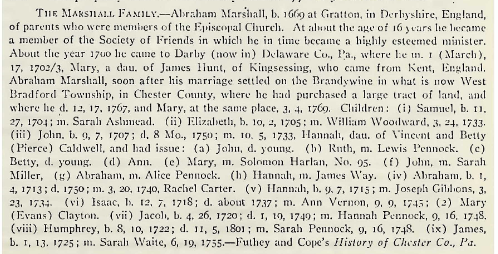
In the Youlgreave parish registers I found a baptism in 1667 for Humphrey Marshall son of Humphrey and Hannah. I didn’t find a baptism for Abraham, but it looks as though it could be correct. Abraham had a son he named Humphrey. But did it just look logical to whoever wrote the books, or do they know for sure? Did the famous botanist Humphrey Marshall have his own family records? The books don’t say where they got this information.
An earlier Humphrey Marshall was baptised in Youlgreave in 1559, his father Edmund. And in 1591 another Humphrey Marshall was baptised, his father George.
But can we connect these Marshall’s to ours? We do have an Abraham Marshall, grandson of Charles, born in 1792. The name isn’t all that common, so may indicate a family connection. The villages of Elton, Gratton and Youlgreave are all very small and it would seem very likely that the Marshall’s who went the USA are related to ours, if not brothers, then probably cousins.
Derbyshire Quakers
In “Derbyshire Quakers 1650-1761” by Helen Forde:
“… Friends lived predominantly in the northern half of the country during this first century of existence. Numbers may have been reduced by emigration to America and migration to other parts of the country but were never high and declined in the early eighteenth century. Predominantly a middle to lower class group economically, Derbyshire Friends numbered very few wealthy members. Many were yeoman farmers or wholesalers and it was these groups who dominated the business meetings having time to devote themselves to the Society. Only John Gratton of Monyash combined an outstanding ministry together with an organising ability which brought him recognition amongst London Friends as well as locally. Derbyshire Friends enjoyed comparatively harmonious relations with civil and Anglican authorities, though prior to the Toleration Act of 1639 the priests were their worst persecutors…..”
Also mentioned in this book: There were monthly meetings in Elton, as well as a number of other nearby places.
John Marshall of Elton 1682/3 appears in a list of Quaker emigrants from Derbyshire.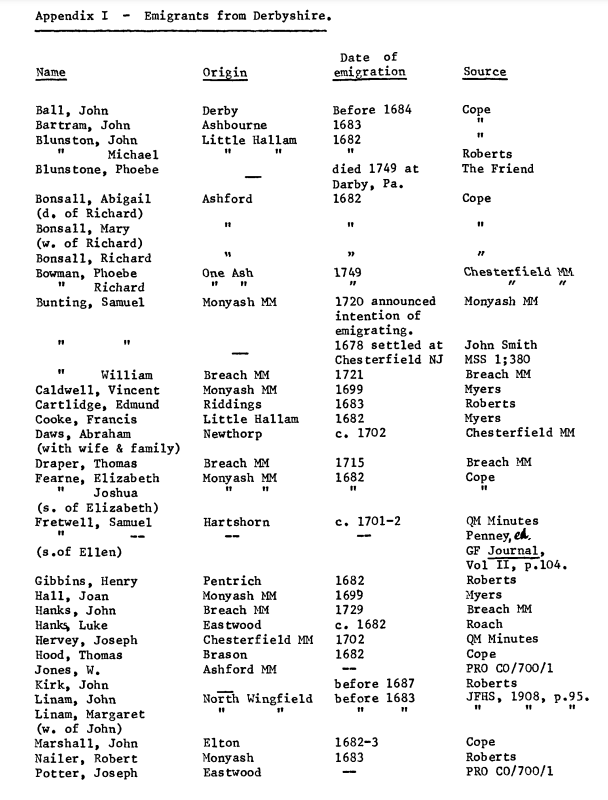
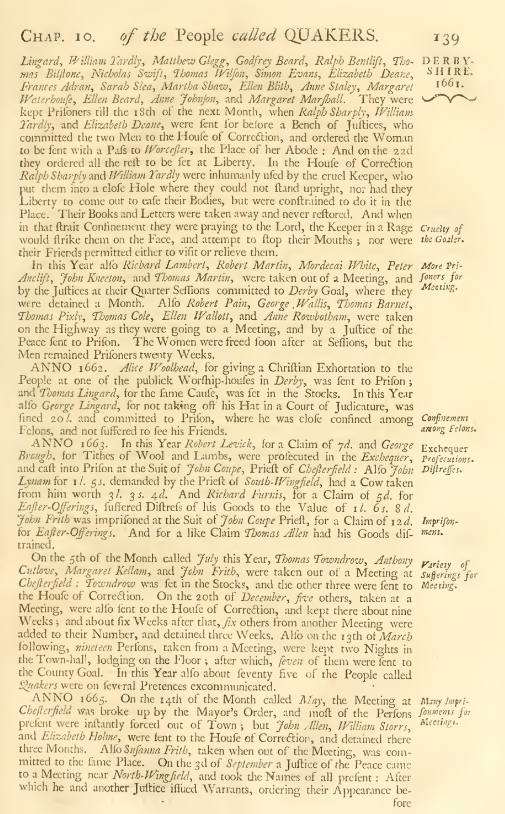
The following image is a page from the 1753 book on the sufferings of Quakers by Joseph Besse as an example of some of the persecutions of Quakers in Derbyshire in the 1600s:
A collection of the sufferings of the people called Quakers, for the testimony of a good conscience from the time of their being first distinguished by that name in the year 1650 to the time of the act commonly called the Act of toleration granted to Protestant dissenters in the first year of the reign of King William the Third and Queen Mary in the year 1689 (Volume 1)
Besse, Joseph. 1753Note the names Margaret Marshall and Anne Staley. This book would appear to contradict Helen Forde’s statement above about the harmonious relations with Anglican authority.
The Botanist
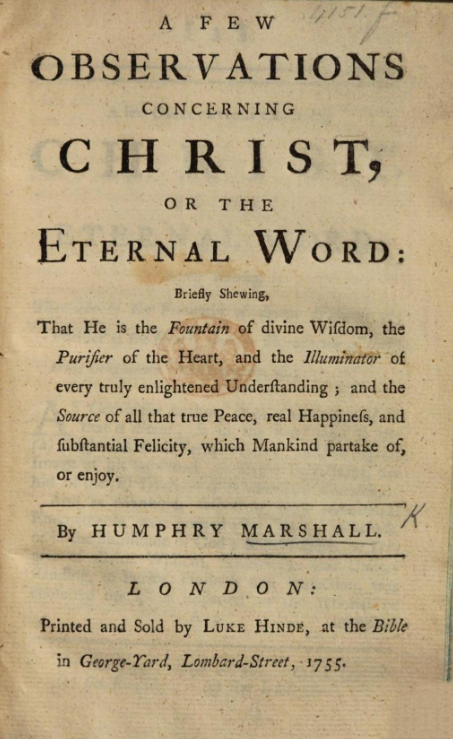
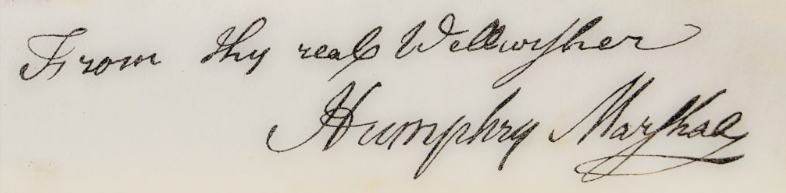
Humphry Marshall 1722-1801 was born in Marshallton, Pennsylvania, the son of the immigrant from Elton, Abraham Marshall. He was the cousin of botanists John Bartram and William Bartram. Like many early American botanists, he was a Quaker. He wrote his first book, A Few Observations Concerning Christ, in 1755.
In 1785, Marshall published Arbustrum Americanum: The American Grove, an Alphabetical Catalogue of Forest Trees and Shrubs, Natives of the American United States (Philadelphia).
Marshall has been called the “Father of American Dendrology”.
A genus of plants, Marshallia, was named in honor of Humphry Marshall and his nephew Moses Marshall, also a botanist.
In 1848 the Borough of West Chester established the Marshall Square Park in his honor. Marshall Square Park is four miles east of Marshallton.
via Wikipedia.
From The History of Chester County Pennsylvania, 1881, by J Smith Futhey and Gilbert Cope:
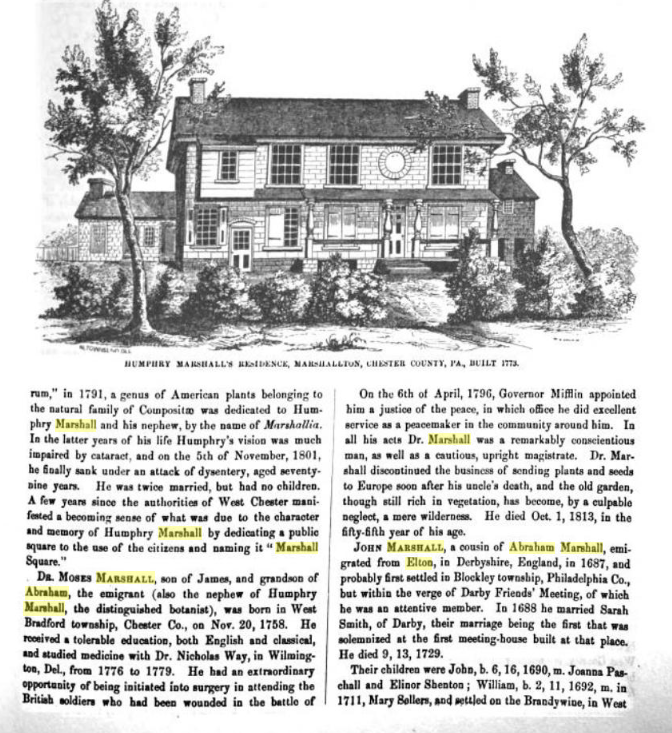
From The Chester Country History Center:
“Immediately on the Receipt of your Letter, I ordered a Reflecting Telescope for you which was made accordingly. Dr. Fothergill had since desired me to add a Microscope and Thermometer, and will
pay for the whole.’– Benjamin Franklin to Humphry, March 18, 1770
“In his lifetime, Humphry Marshall made his living as a stonemason, farmer, and miller, but eventually became known for his contributions to astronomy, meteorology, agriculture, and the natural sciences.
In 1773, Marshall built a stone house with a hothouse, a botanical laboratory, and an observatory for astronomical studies. He established an arboretum of native trees on the property and the second botanical garden in the nation (John Bartram, his cousin, had the first). From his home base, Humphry expanded his botanical plant exchange business and increased his overseas contacts. With the help of men like Benjamin Franklin and the English botanist Dr. John Fothergill, they eventually included German, Dutch, Swedish, and Irish plant collectors and scientists. Franklin, then living in London, introduced Marshall’s writings to the Royal Society in London and both men encouraged Marshall’s astronomical and botanical studies by supplying him with books and instruments including the latest telescope and microscope.
Marshall’s scientific work earned him honorary memberships to the American Philosophical Society and the Philadelphia Society for Promoting Agriculture, where he shared his ground-breaking ideas on scientific farming methods. In the years before the American Revolution, Marshall’s correspondence was based on his extensive plant and seed exchanges, which led to further studies and publications. In 1785, he authored his magnum opus, Arbustum Americanum: The American Grove. It is a catalog of American trees and shrubs that followed the Linnaean system of plant classification and was the first publication of its kind.”
 July 25, 2024 at 7:58 am #7542
In reply to: The Incense of the Quadrivium’s Mystiques
Shivering, Truella pulled the thin blanket over her head. Colder than a witches tit here, colder in summer than winter at home! It was no good, she may as well get up and go for a walk to try and warm up. Poking her head outside Truella gasped and coughed at the chill air. Shapes were becoming discernible in the dim pre dawn light, the other pods, the hedgerow, a couple of looming trees. Truella rummaged through her bag, hoping to find warm clothes yet knowing she hadn’t packed anything warm enough. Sighing, her teeth chattering, she pulled on everything she had in layers and pulled the blanket off the bed to use as a cape. With a towel over her head for extra warmth, she ventured out into the Irish morning.
The grass was sodden with dew and Truella’s feet were wet through and icy. Bracing her shoulders with determination, she forged ahead towards a gate leading into the next field. She struggled for a few minutes with the baler twine holding the gate closed, numb fingers refusing to cooperate. Cows watched her curiously, slowly munching. One lifted her tail and dropped a steaming splat on the grass, chewing continuously. I don’t think I could eat and do that at the same time.
Heading off across the field which sloped gently upwards, Treulla picked up her pace, keeping her eyes down to avoid the cow pats. By the time she reached the oak tree along the top hedge, the sun started to make an appearance over the hill. Warmer from the exercise, she gazed over the countryside. How beautiful it was with the mist in the valleys, and everything so green.
If only it was warmer!
“Are you cold then, is that why you’re decked out like that? From a distance I thought I was seeing a ghost in a cloak and head shawl!” The woman smiled at Truella from the other side of the hedgerow. “Sorry, did I startle you? You’ll get your feet soaked walking in that wet grass, climb over that stile over there, the lane here’s better for a morning walk.”
It sounded like good advice and the woman seemed pleasant enough. “Are you here for the games too?” Truella asked, readjusting the blanket and towel after navigating the stile.
“Yes, I am. I’m retired, you see,” the woman said with a wide grin. “It’s a wonderful thing, not that you’d know, you’re much to young.”
“That must be nice,” Truella replied politely. “I sometimes wish I was retired.”
“Oh, my dear! It’s wonderful! I haven’t had a job for years, but it’s the strangest thing, now that I’ve officially retired, there’s a marvellous feeling of freedom. I don’t have to do anything. Well, I didn’t have to do anything before I retired but one always feels one should keep busy, do productive things, be seen to be doing some kind of work to justify ones existance. Have you seen the old priory?”
“No, only just got here yesterday.”
“You’ll love it, it’s up this path here, follow me. But now I’ve retired,” the woman continued, “I get up in the morning with a sense of liberation. I can do as little as I want ~ funny thing is that I’ve actually been doing more, but there’s no feeling of obligation, no things to cross off a list. All I’m expected to do as a retired person is tick along, trying not to be much of a bother for as long as I can.”
“I wish I was retired!” exclaimed Truella with feeling. “I wish I didn’t have to do the cow goddess stall, it’ll be such a bind having to stand there all evening.” She explained about the coven and the stalls, and the depressing productivity goals.
“But why not get someone else to do the stall for you?”
“It’s such short notice and I don’t know anyone here. It’s an idea though, maybe someone will turn up.”
July 18, 2024 at 9:16 am #7534In reply to: The Incense of the Quadrivium’s Mystiques
Ms Nicraith Noble, the Mayor of Limerick taking a bath in the Shannon River with reporters had made the rounds of news in ways that were quite incomprehensible.
Obviously it was part of a media ploy to boost public attention for the incoming Roman Games.
“Did she require some anti-rash-and-boil spells?” Jeezel messaged on the network, worried about what such swimming stunt would do to her ravishing hair.
“Probably…” Eris responded in a terse manner “Don’t forget Austreberthe managed to get us to sponsor the event. She may have eased the deal with some goodies. Like anti-age spell too.”
Eris was glad Austreberthe had refocused the efforts towards the imminent launch of the Roman Games. Those mass events were key moments in the Coven’s seasonal activities, as they provided a bounty of emotions to refine and process for creation of their most epic incenses. The recent mass events had been too heavy on fear, anger and gloom-mongering, not the grade A quality they required.
Austreberthe had called all hands on deck to be ready for the event, having deemed the reconnaissance work in Spain’s cloisters sufficiently well under way to take a break from it. In truth, Eris suspected she’d started to receive the first invoices from the undertakers’ Guild and had realised it was a hefty cost for their consulting services.
On top of that, there was a recent case of the drunken sheep flu in Andalucia, some local variety of virus that got the cloister sisters fear for their elderly’s Mother Loreena’s health. Considering the gleeful vulture’s smiles of the Morticians in waiting, they had decided in agreement for an early dismiss into the Summer holidays retreats.
“More prayers, phew, glad they didn’t need us for that.” true to her swagger way, Truella had conceded and accepted to put a hold to her passionate researches —she’d managed to get their personal phone numbers too anyway.
“One week to the start of the Games then.” Eris sighed. The last stretch to summer holidays seemed to take forever.
-
AuthorSearch Results
