

Search Results for 'bert'
-
AuthorSearch Results
-
February 8, 2022 at 2:24 pm #6275
In reply to: The Elusive Samuel Housley and Other Family Stories
“AND NOW ABOUT EMMA”
and a mystery about George
I had overlooked this interesting part of Barbara Housley’s “Narrative on the Letters” initially, perhaps because I was more focused on finding Samuel Housley. But when I did eventually notice, I wondered how I had missed it! In this particularly interesting letter excerpt from Joseph, Barbara has not put the date of the letter ~ unusually, because she did with all of the others. However I dated the letter to later than 1867, because Joseph mentions his wife, and they married in 1867. This is important, because there are two Emma Housleys. Joseph had a sister Emma, born in 1836, two years before Joseph was born. At first glance, one would assume that a reference to Emma in the letters would mean his sister, but Emma the sister was married in Derby in 1858, and by 1869 had four children.
But there was another Emma Housley, born in 1851.
From Barbara Housley’s Narrative on the Letters:
“AND NOW ABOUT EMMA”
A MYSTERY
A very mysterious comment is contained in a letter from Joseph:
“And now about Emma. I have only seen her once and she came to me to get your address but I did not feel at liberty to give it to her until I had wrote to you but however she got it from someone. I think it was in this way. I was so pleased to hear from you in the first place and with John’s family coming to see me I let them read one or two of your letters thinking they would like to hear of you and I expect it was Will that noticed your address and gave it to her. She came up to our house one day when I was at work to know if I had heard from you but I had not heard from you since I saw her myself and then she called again after that and my wife showed her your boys’ portraits thinking no harm in doing so.”
At this point Joseph interrupted himself to thank them for sending the portraits. The next sentence is:
“Your son JOHN I have never seen to know him but I hear he is rather wild,” followed by: “EMMA has been living out service but don’t know where she is now.”
Since Joseph had just been talking about the portraits of George’s three sons, one of whom is John Eley, this could be a reference to things George has written in despair about a teen age son–but could Emma be a first wife and John their son? Or could Emma and John both be the children of a first wife?
Elsewhere, Joseph wrote, “AMY ELEY died 14 years ago. (circa 1858) She left a son and a daughter.”
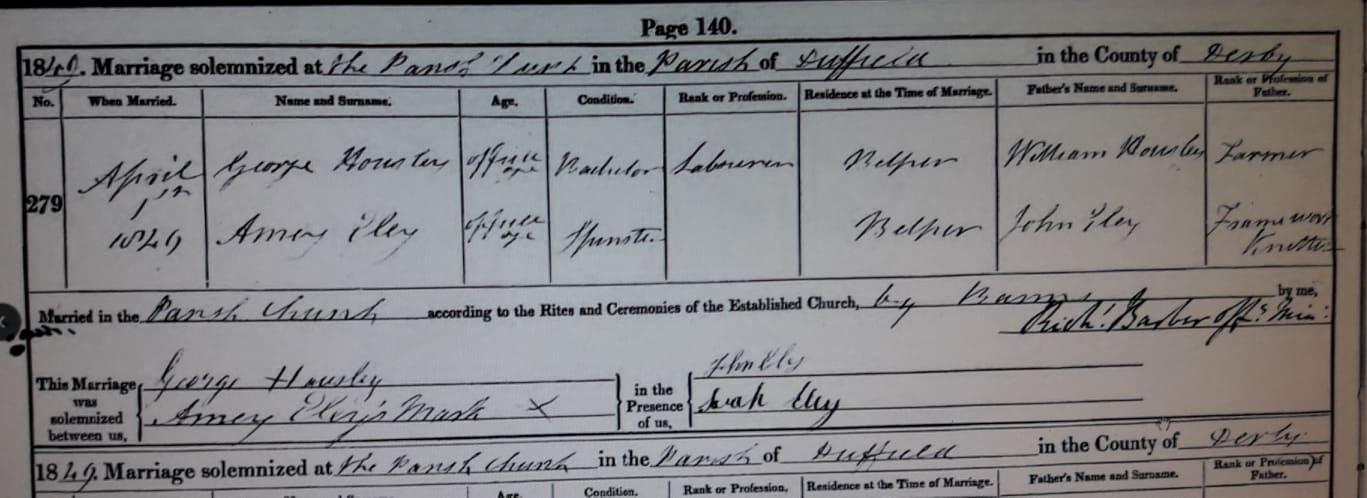
An Amey Eley and a George Housley were married on April 1, 1849 in Duffield which is about as far west of Smalley as Heanor is East. She was the daughter of John, a framework knitter, and Sarah Eley. George’s father is listed as William, a farmer. Amey was described as “of full age” and made her mark on the marriage document.
Anne wrote in August 1854: “JOHN ELEY is living at Derby Station so must take the first opportunity to get the receipt.” Was John Eley Housley named for him?
(John Eley Housley is George Housley’s son in USA, with his second wife, Sarah.)
George Housley married Amey Eley in 1849 in Duffield. George’s father on the register is William Housley, farmer. Amey Eley’s father is John Eley, framework knitter.
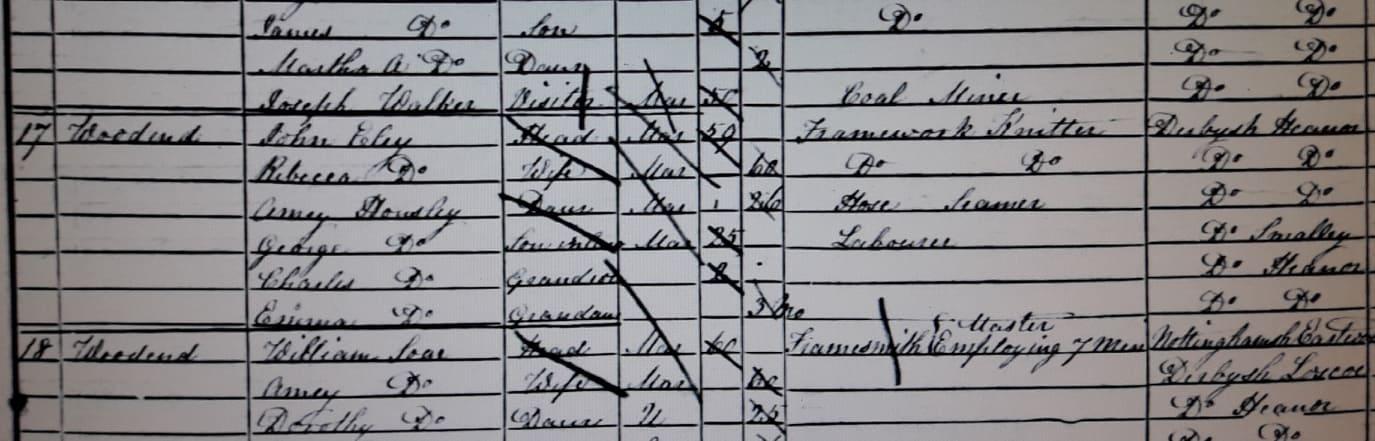
On the 1851 census, George Housley and his wife Amey Housley are living with her parents in Heanor, John Eley, a framework knitter, and his wife Rebecca. Also on the census are Charles J Housley, born in 1849 in Heanor, and Emma Housley, three months old at the time of the census, born in 1851. George’s birth place is listed as Smalley.
On the 31st of July 1851 George Housley arrives in New York. In 1854 George Housley marries Sarah Ann Hill in USA.
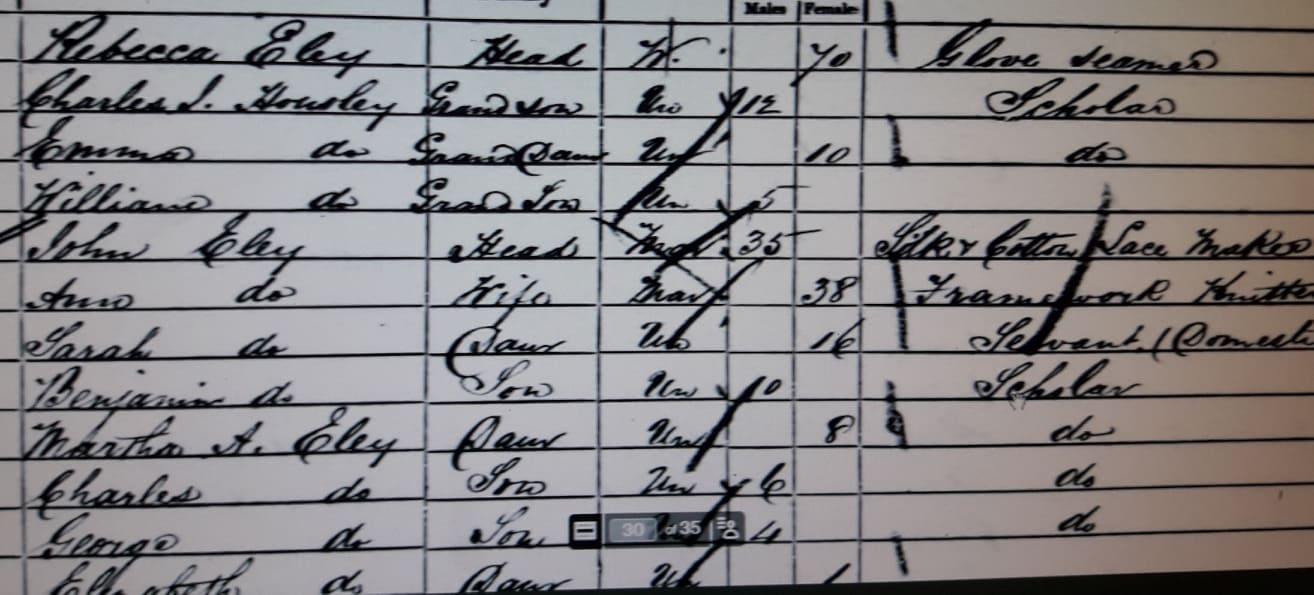
On the 1861 census in Heanor, Rebecca Eley was a widow, her husband John having died in 1852, and she had three grandchildren living with her: Charles J Housley aged 12, Emma Housley, 10, and mysteriously a William Housley aged 5! Amey Housley, the childrens mother, died in 1858.
Back to the mysterious comment in Joseph’s letter. Joseph couldn’t have been speaking of his sister Emma. She was married with children by the time Joseph wrote that letter, so was not just out of service, and Joseph would have known where she was. There is no reason to suppose that the sister Emma was trying unsuccessfully to find George’s addresss: she had been sending him letters for years. Joseph must have been referring to George’s daughter Emma.
Joseph comments to George “Your son John…is rather wild.” followed by the remark about Emma’s whereabouts. Could Charles John Housley have used his middle name of John instead of Charles?
As for the child William born five years after George left for USA, despite his name of Housley, which was his mothers married name, we can assume that he was not a Housley ~ not George’s child, anyway. It is not clear who his father was, as Amey did not remarry.
A further excerpt from Barbara Housley’s Narrative on the Letters:
Certainly there was some mystery in George’s life. George apparently wanted his whereabouts kept secret. Anne wrote: “People are at a loss to know where you are. The general idea is you are with Charles. We don’t satisfy them.” In that same letter Anne wrote: “I know you could not help thinking of us very often although you neglected writing…and no doubt would feel grieved for the trouble you at times caused (our mother). She freely forgives all.” Near the end of the letter, Anne added: “Mother sends her love to you and hopes you will write and if you want to tell her anything you don’t want all to see you must write it on a piece of loose paper and put it inside the letter.”
In a letter to George from his sister Emma:
Emma wrote in 1855, “We write in love to your wife and yourself and you must write soon and tell us whether there is a little nephew or niece and what you call them.”
In June of 1856, Emma wrote: “We want to see dear Sarah Ann and the dear little boy. We were much pleased with the “bit of news” you sent.” The bit of news was the birth of John Eley Housley, January 11, 1855. Emma concluded her letter “Give our very kindest love to dear sister and dearest Johnnie.”
It would seem that George Housley named his first son with his second wife after his first wife’s father ~ while he was married to both of them.
Emma Housley
1851-1935
In 1871 Emma was 20 years old and “in service” living as a lodger in West Hallam, not far from Heanor. As she didn’t appear on a 1881 census, I looked for a marriage, but the only one that seemed right in every other way had Emma Housley’s father registered as Ralph Wibberly!
Who was Ralph Wibberly? A family friend or neighbour, perhaps, someone who had been a father figure? The first Ralph Wibberly I found was a blind wood cutter living in Derby. He had a son also called Ralph Wibberly. I did not think Ralph Wibberly would be a very common name, but I was wrong.
I then found a Ralph Wibberly living in Heanor, with a son also named Ralph Wibberly. A Ralph Wibberly married an Emma Salt from Heanor. In 1874, a 36 year old Ralph Wibberly (born in 1838) was on trial in Derby for inflicting grevious bodily harm on William Fretwell of Heanor. His occupation is “platelayer” (a person employed in laying and maintaining railway track.) The jury found him not guilty.
In 1851 a 23 year old Ralph Wibberly (born in 1828) was a prisoner in Derby Gaol. However, Ralph Wibberly, a 50 year old labourer born in 1801 and his son Ralph Wibberly, aged 13 and born in 1838, are living in Belper on the 1851 census. Perhaps the son was the same Ralph Wibberly who was found not guilty of GBH in 1874. This appears to be the one who married Emma Salt, as his wife on the 1871 census is called Emma, and his occupation is “Midland Company Railway labourer”.
Which was the Ralph Wibberly that Emma chose to name as her father on the marriage register? We may never know, but perhaps we can assume it was Ralph Wibberly born in 1801. It is unlikely to be the blind wood cutter from Derby; more likely to be the local Ralph Wibberly. Maybe his son Ralph, who we know was involved in a fight in 1874, was a friend of Emma’s brother Charles John, who was described by Joseph as a “wild one”, although Ralph was 11 years older than Charles John.
Emma Housley married James Slater on Christmas day in Heanor in 1873. Their first child, a daughter, was called Amy. Emma’s mother was Amy Eley. James Slater was a colliery brakesman (employed to work the steam-engine, or other machinery used in raising the coal from the mine.)
It occurred to me to wonder if Emma Housley (George’s daughter) knew Elizabeth, Mary Anne and Catherine (Samuel’s daughters). They were cousins, lived in the vicinity, and they had in common with each other having been deserted by their fathers who were brothers. Emma was born two years after Catherine. Catherine was living with John Benniston, a framework knitter in Heanor, from 1851 to 1861. Emma was living with her grandfather John Ely, a framework knitter in Heanor. In 1861, George Purdy was also living in Heanor. He was listed on the census as a 13 year old coal miner! George Purdy and Catherine Housley married in 1866 in Eastwood, Nottinghamshire ~ just over the county border. Emma’s first child Amy was born in Heanor, but the next two children, Eliza and Lilly, were born in Eastwood, in 1878 and 1880. Catherine and George’s fifth child, my great grandmother Mary Ann Gilman Purdy, was born in Eastwood in 1880, the same year as Lilly Slater.
By 1881 Emma and James Slater were living in Woodlinkin, Codnor and Loscoe, close to Heanor and Eastwood, on the Derbyshire side of the border. On each census up to 1911 their address on the census is Woodlinkin. Emma and James had nine children: six girls and 3 boys, the last, Alfred Frederick, born in 1901.
Emma and James lived three doors up from the Thorn Tree pub in Woodlinkin, Codnor:
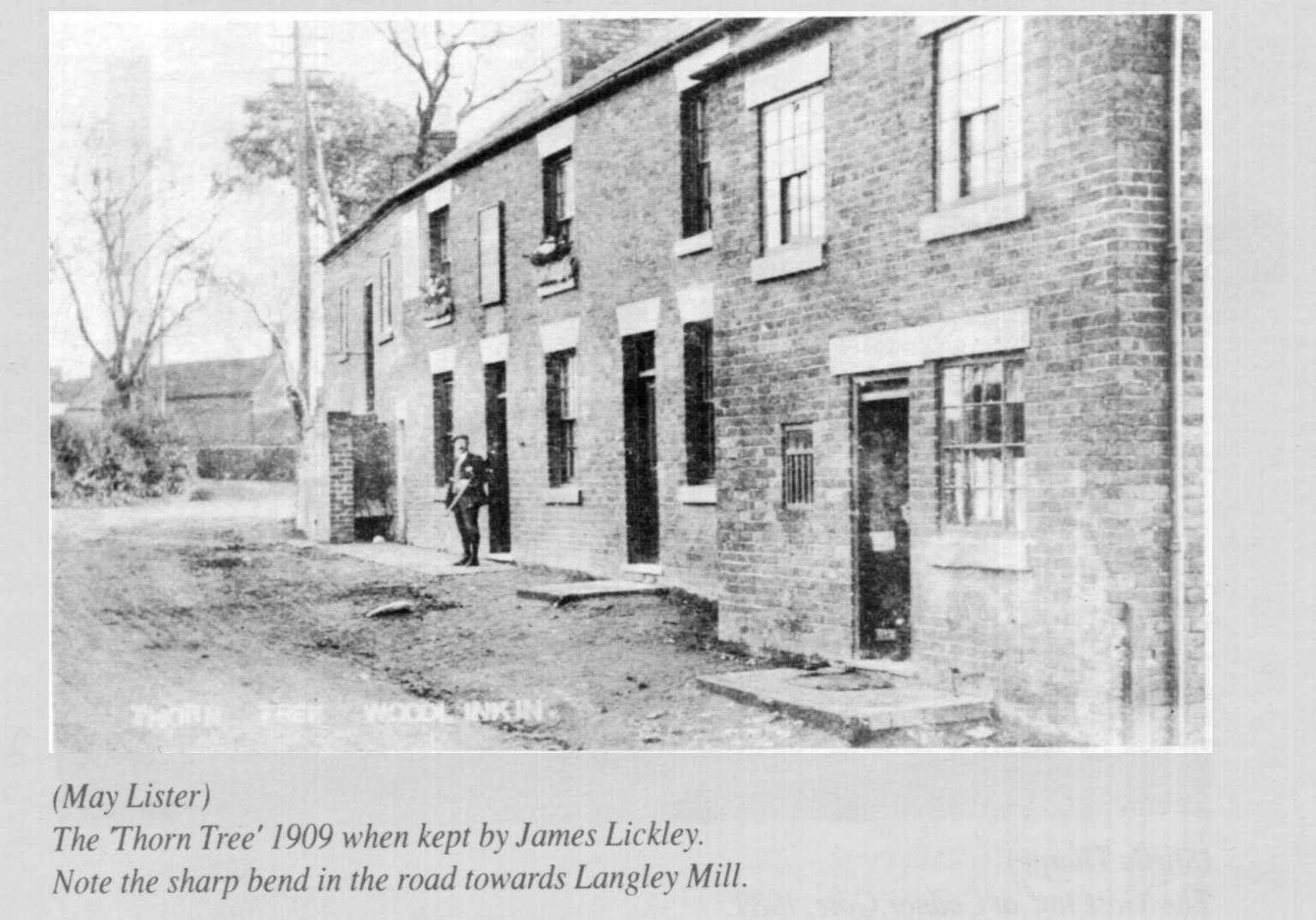
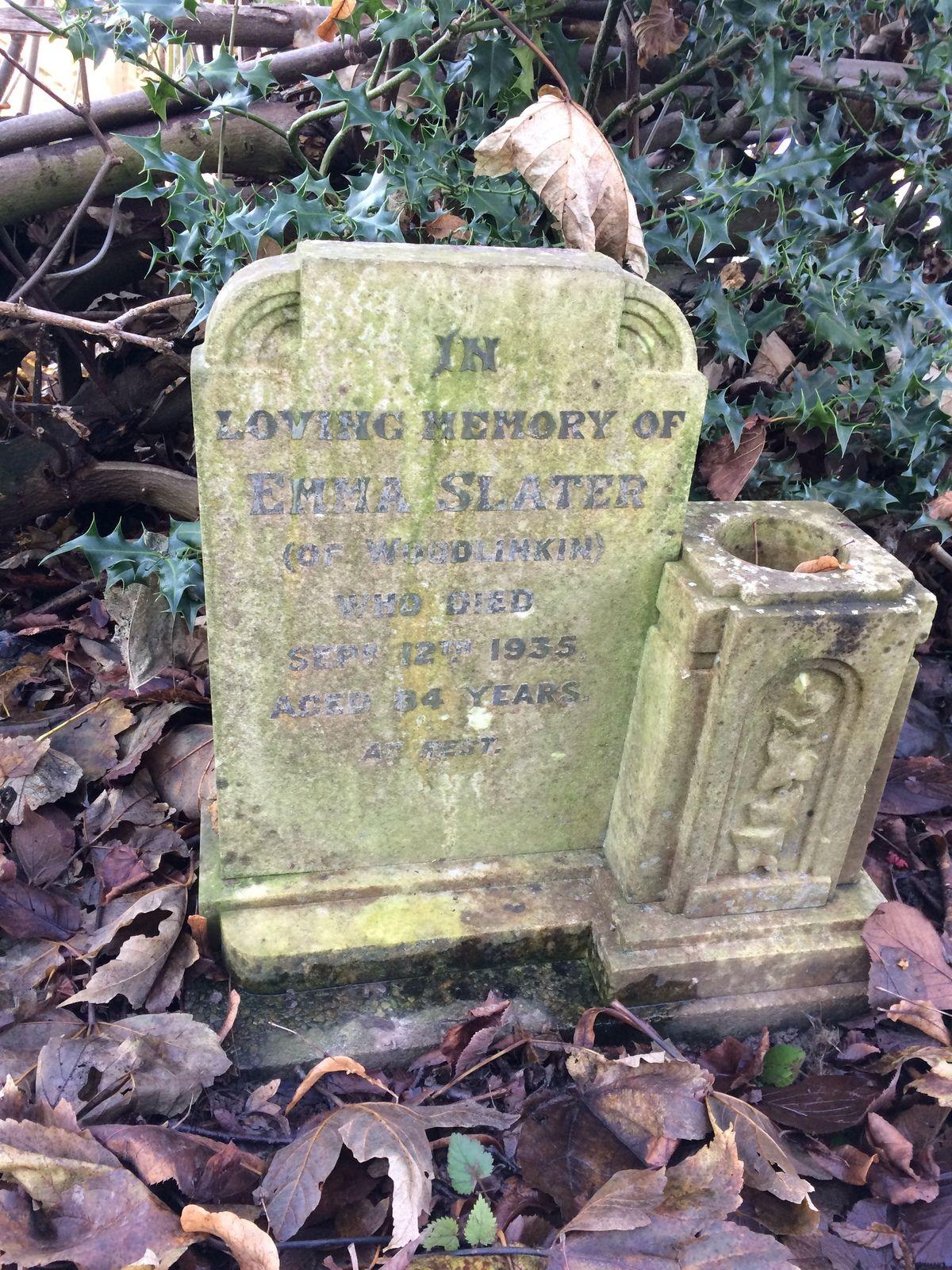
Emma Slater died in 1935 at the age of 84.
IN
LOVING MEMORY OF
EMMA SLATER
(OF WOODLINKIN)
WHO DIED
SEPT 12th 1935
AGED 84 YEARS
AT RESTCrosshill Cemetery, Codnor, Amber Valley Borough, Derbyshire, England:
Charles John Housley
1949-
February 5, 2022 at 1:59 pm #6272In reply to: The Elusive Samuel Housley and Other Family Stories
The Housley Letters
The Carringtons
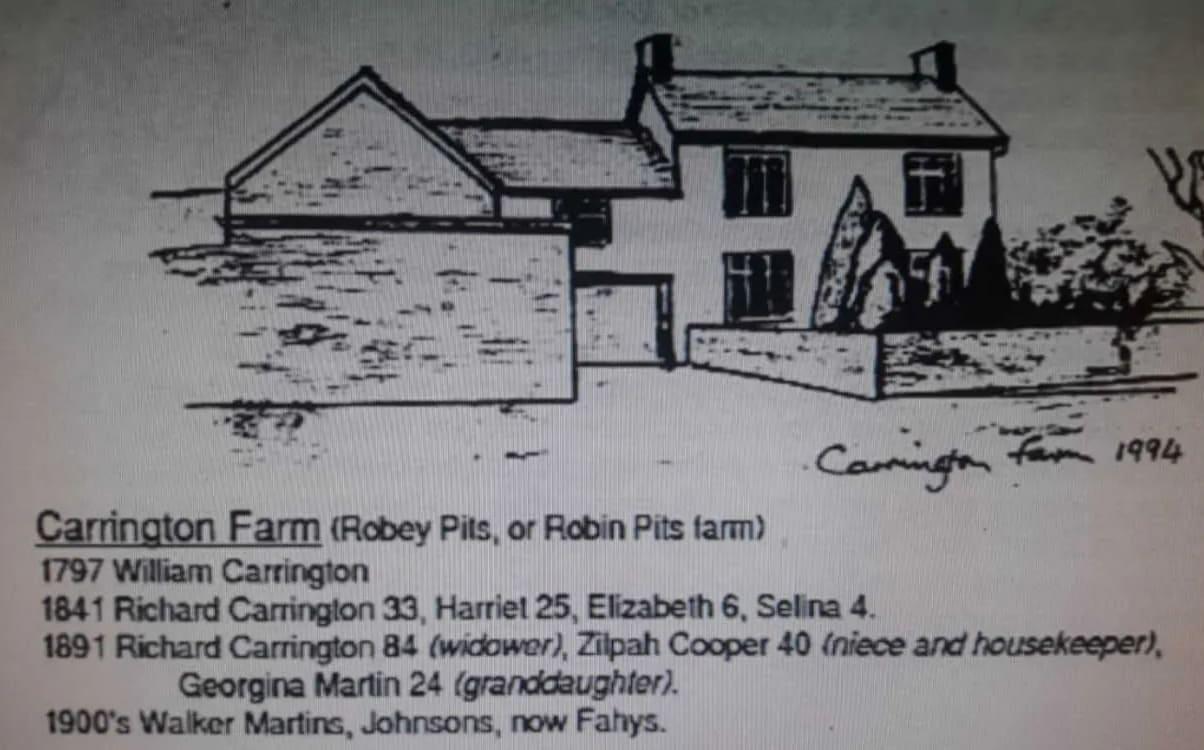
Carrington Farm, Smalley:
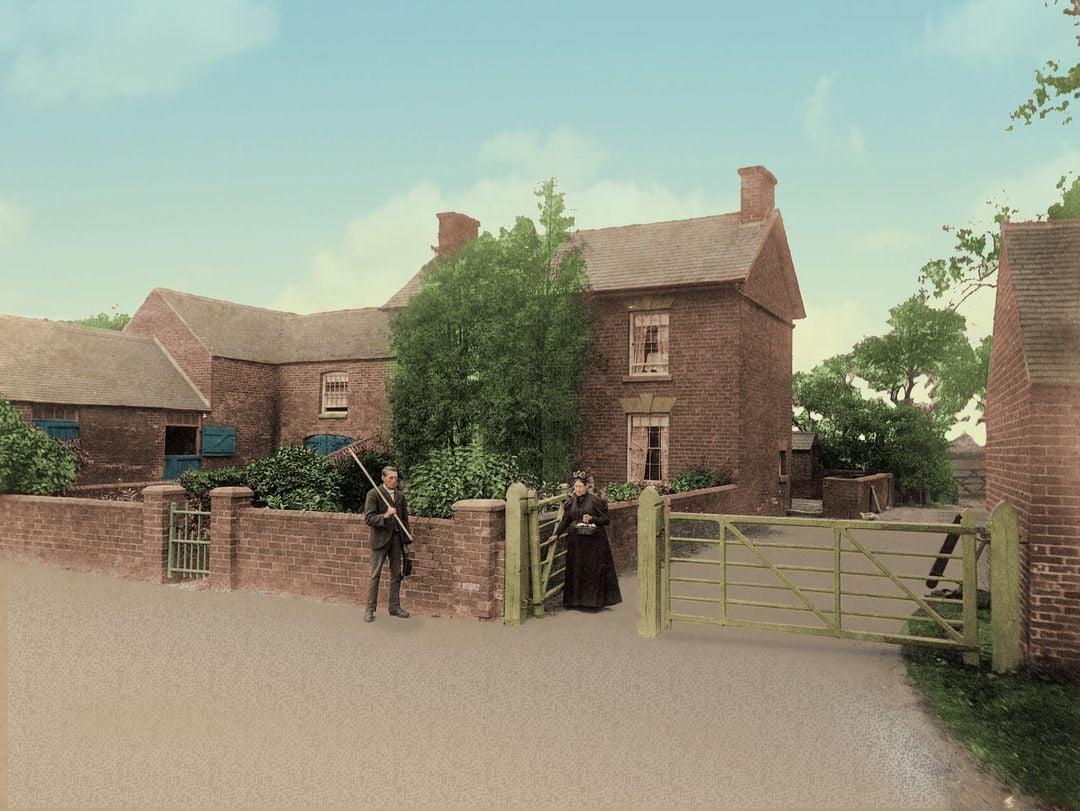
Ellen Carrington was born in 1795. Her father William Carrington 1755-1833 was from Smalley. Her mother Mary Malkin 1765-1838 was from Ellastone, in Staffordshire. Ellastone is on the Derbyshire border and very close to Ashboure, where Ellen married William Housley.
From Barbara Housley’s Narrative on the Letters:
Ellen’s family was evidently rather prominant in Smalley. Two Carringtons (John and William) served on the Parish Council in 1794. Parish records are full of Carrington marriages and christenings.
The letters refer to a variety of “uncles” who were probably Ellen’s brothers, but could be her uncles. These include:
RICHARD
Probably the youngest Uncle, and certainly the most significant, is Richard. He was a trustee for some of the property which needed to be settled following Ellen’s death. Anne wrote in 1854 that Uncle Richard “has got a new house built” and his daughters are “fine dashing young ladies–the belles of Smalley.” Then she added, “Aunt looks as old as my mother.”
Richard was born somewhere between 1808 and 1812. Since Richard was a contemporary of the older Housley children, “Aunt,” who was three years younger, should not look so old!
Richard Carrington and Harriet Faulkner were married in Repton in 1833. A daughter Elizabeth was baptised March 24, 1834. In July 1872, Joseph wrote: “Elizabeth is married too and a large family and is living in Uncle Thomas’s house for he is dead.” Elizabeth married Ayres (Eyres) Clayton of Lascoe. His occupation was listed as joiner and shopkeeper. They were married before 1864 since Elizabeth Clayton witnessed her sister’s marriage. Their children in April 1871 were Selina (1863), Agnes Maria (1866) and Elizabeth Ann (1868). A fourth daughter, Alice Augusta, was born in 1872 or 1873, probably by July 1872 to fit Joseph’s description “large family”! A son Charles Richard was born in 1880.
An Elizabeth Ann Clayton married John Arthur Woodhouse on May 12, 1913. He was a carpenter. His father was a miner. Elizabeth Ann’s father, Ayres, was also a carpenter. John Arthur’s age was given as 25. Elizabeth Ann’s age was given as 33 or 38. However, if she was born in 1868, her age would be 45. Possibly this is another case of a child being named for a deceased sibling. If she were 38 and born in 1875, she would fill the gap between Alice Augusta and Charles Richard.
Selina Clayton, who would have been 18, is not listed in the household in 1881. She died on June 11, 1914 at age 51. Agnes Maria Clayton died at the age of 25 and was buried March 31, 1891. Charles Richard died at the age of 5 and was buried on February 4, 1886. A Charles James Clayton, 18 months, was buried June 8, 1889 in Heanor.
Richard Carrington’s second daughter, Selina, born in 1837, married Walker Martin (b.1835) on February 11, 1864 and they were living at Kidsley Park Farm in 1872, according to a letter from Joseph, and, according to the census, were still there in 1881. This 100 acre farm was formerly the home of Daniel Smith and his daughter Elizabeth Davy Barber. Selina and Walker had at least five children: Elizabeth Ann (1865), Harriet Georgianna (1866/7), Alice Marian (September 6, 1868), Philip Richard (1870), and Walker (1873). In December 1972, Joseph mentioned the death of Philip Walker, a farmer of Prospect Farm, Shipley. This was probably Walker Martin’s grandfather, since Walker was born in Shipley. The stock was to be sold the following Monday, but his daughter (Walker’s mother?) died the next day. Walker’s father was named Thomas. An Annie Georgianna Martin age 13 of Shipley died in April of 1859.
Selina Martin died on October 29, 1906 but her estate was not settled until November 14, 1910. Her gross estate was worth L223.56. Her son Walker and her daughter Harriet Georgiana were her trustees and executers. Walker was to get Selina’s half of Richard’s farm. Harriet Georgiana and Alice Marian were to be allowed to live with him. Philip Richard received L25. Elizabeth Ann was already married to someone named Smith.
Richard and Harriet may also have had a son George. In 1851 a Harriet Carrington and her three year old son George were living with her step-father John Benniston in Heanor. John may have been recently widowed and needed her help. Or, the Carrington home may have been inadequate since Anne reported a new one was built by 1854. Selina’s second daughter’s name testifies to the presence of a “George” in the family! Could the death of this son account for the haggard appearance Anne described when she wrote: “Aunt looks as old as my mother?”
Harriet was buried May 19, 1866. She was 55 when she died.In 1881, Georgianna then 14, was living with her grandfather and his niece, Zilpah Cooper, age 38–who lived with Richard on his 63 acre farm as early as 1871. A Zilpah, daughter of William and Elizabeth, was christened October 1843. Her brother, William Walter, was christened in 1846 and married Anna Maria Saint in 1873. There are four Selina Coopers–one had a son William Thomas Bartrun Cooper christened in 1864; another had a son William Cooper christened in 1873.
Our Zilpah was born in Bretley 1843. She died at age 49 and was buried on September 24, 1892. In her will, which was witnessed by Selina Martin, Zilpah’s sister, Frances Elizabeth Cleave, wife of Horatio Cleave of Leicester is mentioned. James Eley and Francis Darwin Huish (Richard’s soliciter) were executers.
Richard died June 10, 1892, and was buried on June 13. He was 85. As might be expected, Richard’s will was complicated. Harriet Georgiana Martin and Zilpah Cooper were to share his farm. If neither wanted to live there it was to go to Georgiana’s cousin Selina Clayton. However, Zilpah died soon after Richard. Originally, he left his piano, parlor and best bedroom furniture to his daughter Elizabeth Clayton. Then he revoked everything but the piano. He arranged for the payment of £150 which he owed. Later he added a codicil explaining that the debt was paid but he had borrowed £200 from someone else to do it!
Richard left a good deal of property including: The house and garden in Smalley occupied by Eyres Clayton with four messuages and gardens adjoining and large garden below and three messuages at the south end of the row with the frame work knitters shop and garden adjoining; a dwelling house used as a public house with a close of land; a small cottage and garden and four cottages and shop and gardens.
THOMAS
In August 1854, Anne wrote “Uncle Thomas is about as usual.” A Thomas Carrington married a Priscilla Walker in 1810.
Their children were baptised in August 1830 at the same time as the Housley children who at that time ranged in age from 3 to 17. The oldest of Thomas and Priscilla’s children, Henry, was probably at least 17 as he was married by 1836. Their youngest son, William Thomas, born 1830, may have been Mary Ellen Weston’s beau. However, the only Richard whose christening is recorded (1820), was the son of Thomas and Lucy. In 1872 Joseph reported that Richard’s daughter Elizabeth was married and living in Uncle Thomas’s house. In 1851, Alfred Smith lived in house 25, Foulks lived in 26, Thomas and Priscilla lived in 27, Bennetts lived in 28, Allard lived in 29 and Day lived in 30. Thomas and Priscilla do not appear in 1861. In 1871 Elizabeth Ann and Ayres Clayton lived in House 54. None of the families listed as neighbors in 1851 remained. However, Joseph Carrington, who lived in house 19 in 1851, lived in house 51 in 1871.
JOHN
In August 1854, Anne wrote: “Uncle John is with Will and Frank has been home in a comfortable place in Cotmanhay.” Although John and William are two of the most popular Carrington names, only two John’s have sons named William. John and Rachel Buxton Carrington had a son William christened in 1788. At the time of the letters this John would have been over 100 years old. Their son John and his wife Ann had a son William who was born in 1805. However, this William age 46 was living with his widowed mother in 1851. A Robert Carrington and his wife Ann had a son John born 1n 1805. He would be the right age to be a brother to Francis Carrington discussed below. This John was living with his widowed mother in 1851 and was unmarried. There are no known Williams in this family grouping. A William Carrington of undiscovered parentage was born in 1821. It is also possible that the Will in question was Anne’s brother Will Housley.
–Two Francis Carringtons appear in the 1841 census both of them aged 35. One is living with Richard and Harriet Carrington. The other is living next door to Samuel and Ellen Carrington Kerry (the trustee for “father’s will”!). The next name in this sequence is John Carrington age 15 who does not seem to live with anyone! but may be part of the Kerry household.
FRANK (see above)
While Anne did not preface her mention of the name Frank with an “Uncle,” Joseph referred to Uncle Frank and James Carrington in the same sentence. A James Carrington was born in 1814 and had a wife Sarah. He worked as a framework knitter. James may have been a son of William and Anne Carrington. He lived near Richard according to the 1861 census. Other children of William and Anne are Hannah (1811), William (1815), John (1816), and Ann (1818). An Ann Carrington married a Frank Buxton in 1819. This might be “Uncle Frank.”
An Ellen Carrington was born to John and Rachel Carrington in 1785. On October 25, 1809, a Samuel Kerry married an Ellen Carrington. However this Samuel Kerry is not the trustee involved in settling Ellen’s estate. John Carrington died July 1815.
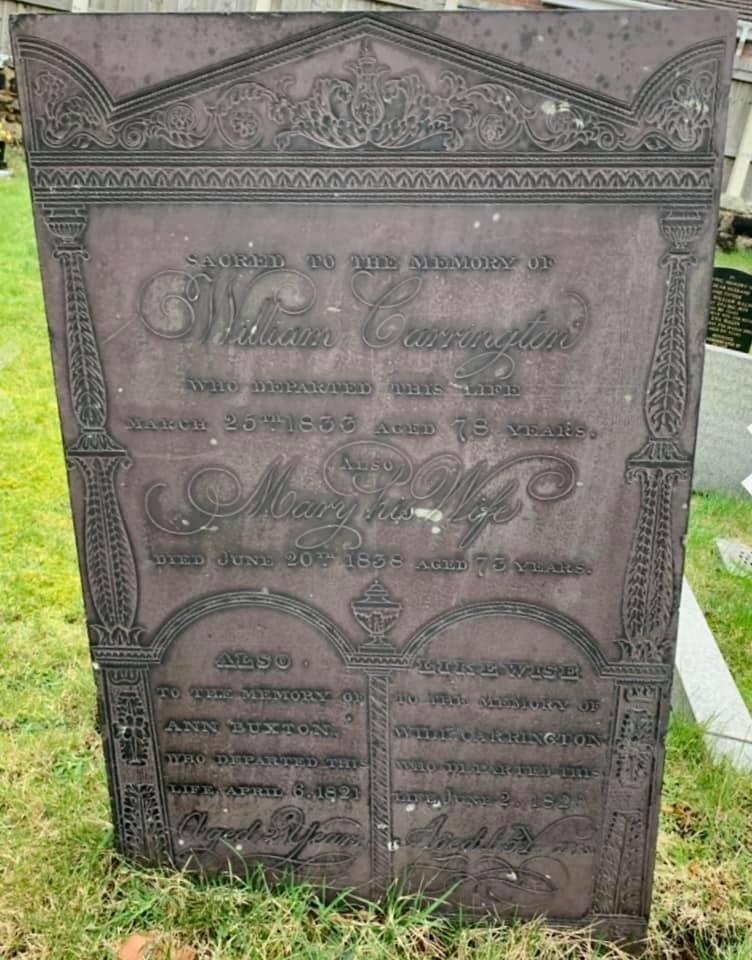
William and Mary Carrington:
 February 5, 2022 at 10:50 am #6271
In reply to: The Elusive Samuel Housley and Other Family Stories
The Housley Letters
FRIENDS AND NEIGHBORS
from Barbara Housley’s Narrative on the Letters:
George apparently asked about old friends and acquaintances and the family did their best to answer although Joseph wrote in 1873: “There is very few of your old cronies that I know of knocking about.”
In Anne’s first letter she wrote about a conversation which Robert had with EMMA LYON before his death and added “It (his death) was a great trouble to Lyons.” In her second letter Anne wrote: “Emma Lyon is to be married September 5. I am going the Friday before if all is well. There is every prospect of her being comfortable. MRS. L. always asks after you.” In 1855 Emma wrote: “Emma Lyon now Mrs. Woolhouse has got a fine boy and a pretty fuss is made with him. They call him ALFRED LYON WOOLHOUSE.”
(Interesting to note that Elizabeth Housley, the eldest daughter of Samuel and Elizabeth, was living with a Lyon family in Derby in 1861, after she left Belper workhouse. The Emma listed on the census in 1861 was 10 years old, and so can not be the Emma Lyon mentioned here, but it’s possible, indeed likely, that Peter Lyon the baker was related to the Lyon’s who were friends of the Housley’s. The mention of a sea captain in the Lyon family begs the question did Elizabeth Housley meet her husband, George William Stafford, a seaman, through some Lyon connections, but to date this remains a mystery.)
Elizabeth Housley living with Peter Lyon and family in Derby St Peters in 1861:
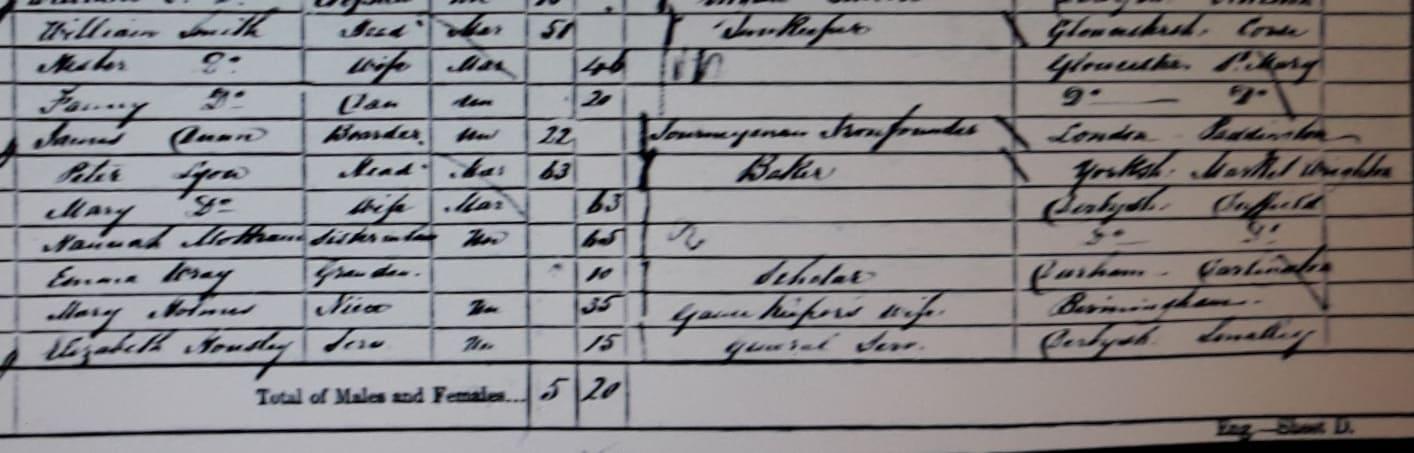
A Henrietta Lyon was married in 1860. Her father was Matthew, a Navy Captain. The 1857 Derby Directory listed a Richard Woolhouse, plumber, glazier, and gas fitter on St. Peter’s Street. Robert lived in St. Peter’s parish at the time of his death. An Alfred Lyon, son of Alfred and Jemima Lyon 93 Friargate, Derby was baptised on December 4, 1877. An Allen Hewley Lyon, born February 1, 1879 was baptised June 17 1879.
Anne wrote in August 1854: “KERRY was married three weeks since to ELIZABETH EATON. He has left Smith some time.” Perhaps this was the same person referred to by Joseph: “BILL KERRY, the blacksmith for DANIEL SMITH, is working for John Fletcher lace manufacturer.” According to the 1841 census, Elizabeth age 12, was the oldest daughter of Thomas and Rebecca Eaton. She would certainly have been of marriagable age in 1854. A William Kerry, age 14, was listed as a blacksmith’s apprentice in the 1851 census; but another William Kerry who was 29 in 1851 was already working for Daniel Smith as a blacksmith. REBECCA EATON was listed in the 1851 census as a widow serving as a nurse in the John Housley household. The 1881 census lists the family of William Kerry, blacksmith, as Jane, 19; William 13; Anne, 7; and Joseph, 4. Elizabeth is not mentioned but Bill is not listed as a widower.
Anne also wrote in 1854 that she had not seen or heard anything of DICK HANSON for two years. Joseph wrote that he did not know Old BETTY HANSON’S son. A Richard Hanson, age 24 in 1851, lived with a family named Moore. His occupation was listed as “journeyman knitter.” An Elizabeth Hanson listed as 24 in 1851 could hardly be “Old Betty.” Emma wrote in June 1856 that JOE OLDKNOW age 27 had married Mrs. Gribble’s servant age 17.
Anne wrote that “JOHN SPENCER had not been since father died.” The only John Spencer in Smalley in 1841 was four years old. He would have been 11 at the time of William Housley’s death. Certainly, the two could have been friends, but perhaps young John was named for his grandfather who was a crony of William’s living in a locality not included in the Smalley census.
TAILOR ALLEN had lost his wife and was still living in the old house in 1872. JACK WHITE had died very suddenly, and DR. BODEN had died also. Dr. Boden’s first name was Robert. He was 53 in 1851, and was probably the Robert, son of Richard and Jane, who was christened in Morely in 1797. By 1861, he had married Catherine, a native of Smalley, who was at least 14 years his junior–18 according to the 1871 census!
Among the family’s dearest friends were JOSEPH AND ELIZABETH DAVY, who were married some time after 1841. Mrs. Davy was born in 1812 and her husband in 1805. In 1841, the Kidsley Park farm household included DANIEL SMITH 72, Elizabeth 29 and 5 year old Hannah Smith. In 1851, Mr. Davy’s brother William and 10 year old Emma Davy were visiting from London. Joseph reported the death of both Davy brothers in 1872; Joseph apparently died first.
Mrs. Davy’s father, was a well known Quaker. In 1856, Emma wrote: “Mr. Smith is very hearty and looks much the same.” He died in December 1863 at the age of 94. George Fox, the founder of the Quakers visited Kidsley Park in 1650 and 1654.
Mr. Davy died in 1863, but in 1854 Anne wrote how ill he had been for two years. “For two last winters we never thought he would live. He is now able to go out a little on the pony.” In March 1856, his wife wrote, “My husband is in poor health and fell.” Later in 1856, Emma wrote, “Mr. Davy is living which is a great wonder. Mrs. Davy is very delicate but as good a friend as ever.”
In The Derbyshire Advertiser and Journal, 15 May 1863:
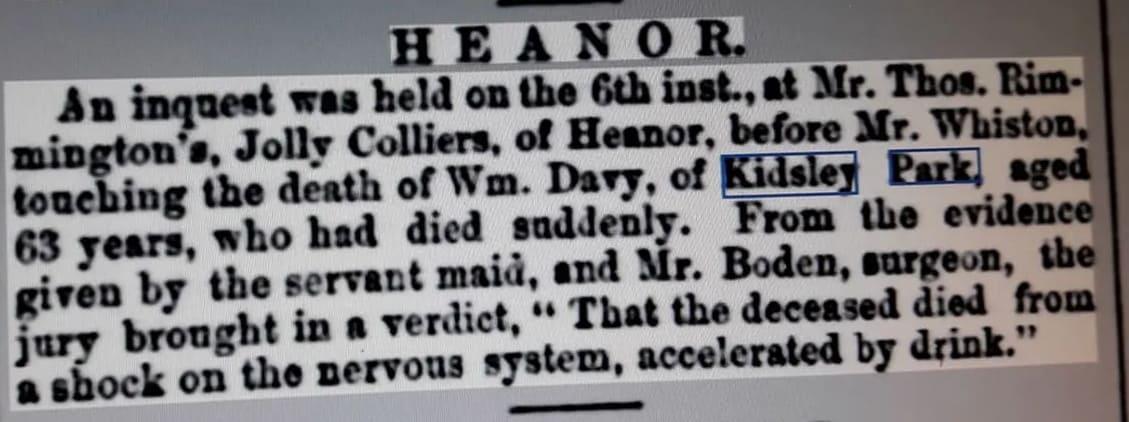
Whenever the girls sent greetings from Mrs. Davy they used her Quaker speech pattern of “thee and thy.” Mrs. Davy wrote to George on March 21 1856 sending some gifts from his sisters and a portrait of their mother–“Emma is away yet and A is so much worse.” Mrs. Davy concluded: “With best wishes for thy health and prosperity in this world and the next I am thy sincere friend.”
Mrs. Davy later remarried. Her new husband was W.T. BARBER. The 1861 census lists William Barber, 35, Bachelor of Arts, Cambridge, living with his 82 year old widowed mother on an 135 acre farm with three servants. One of these may have been the Ann who, according to Joseph, married Jack Oldknow. By 1871 the farm, now occupied by William, 47 and Elizabeth, 57, had grown to 189 acres. Meanwhile, Kidsley Park Farm became the home of the Housleys’ cousin Selina Carrington and her husband Walker Martin. Both Barbers were still living in 1881.
Mrs. Davy was described in Kerry’s History of Smalley as “an accomplished and exemplary lady.” A piece of her poetry “Farewell to Kidsley Park” was published in the history. It was probably written when Elizabeth moved to the Barber farm. Emma sent one of her poems to George. It was supposed to be about their house. “We have sent you a piece of poetry that Mrs. Davy composed about our ‘Old House.’ I am sure you will like it though you may not understand all the allusions she makes use of as well as we do.”
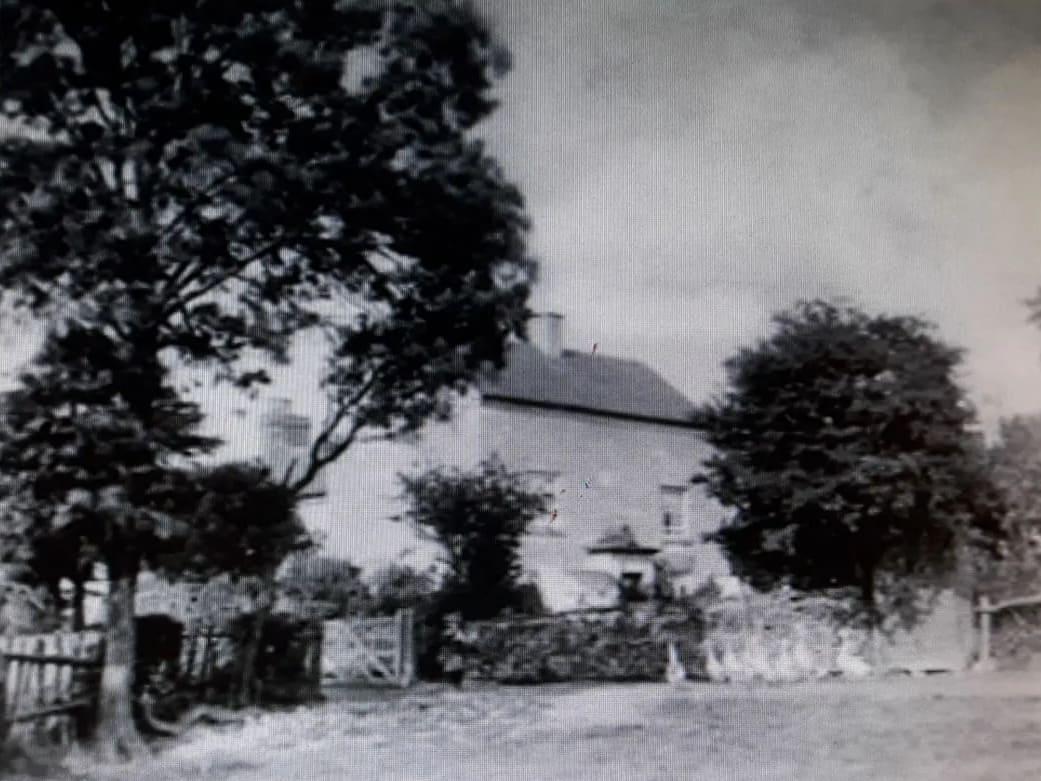
Kiddsley Park Farm, Smalley, in 1898. (note that the Housley’s lived at Kiddsley Grange Farm, and the Davy’s at neighbouring Kiddsley Park Farm)
Emma was not sure if George wanted to hear the local gossip (“I don’t know whether such little particulars will interest you”), but shared it anyway. In November 1855: “We have let the house to Mr. Gribble. I dare say you know who he married, Matilda Else. They came from Lincoln here in March. Mrs. Gribble gets drunk nearly every day and there are such goings on it is really shameful. So you may be sure we have not very pleasant neighbors but we have very little to do with them.”
John Else and his wife Hannah and their children John and Harriet (who were born in Smalley) lived in Tag Hill in 1851. With them lived a granddaughter Matilda Gribble age 3 who was born in Lincoln. A Matilda, daughter of John and Hannah, was christened in 1815. (A Sam Else died when he fell down the steps of a bar in 1855.)
February 4, 2022 at 3:17 pm #6269In reply to: The Elusive Samuel Housley and Other Family Stories
The Housley Letters
From Barbara Housley’s Narrative on the Letters.
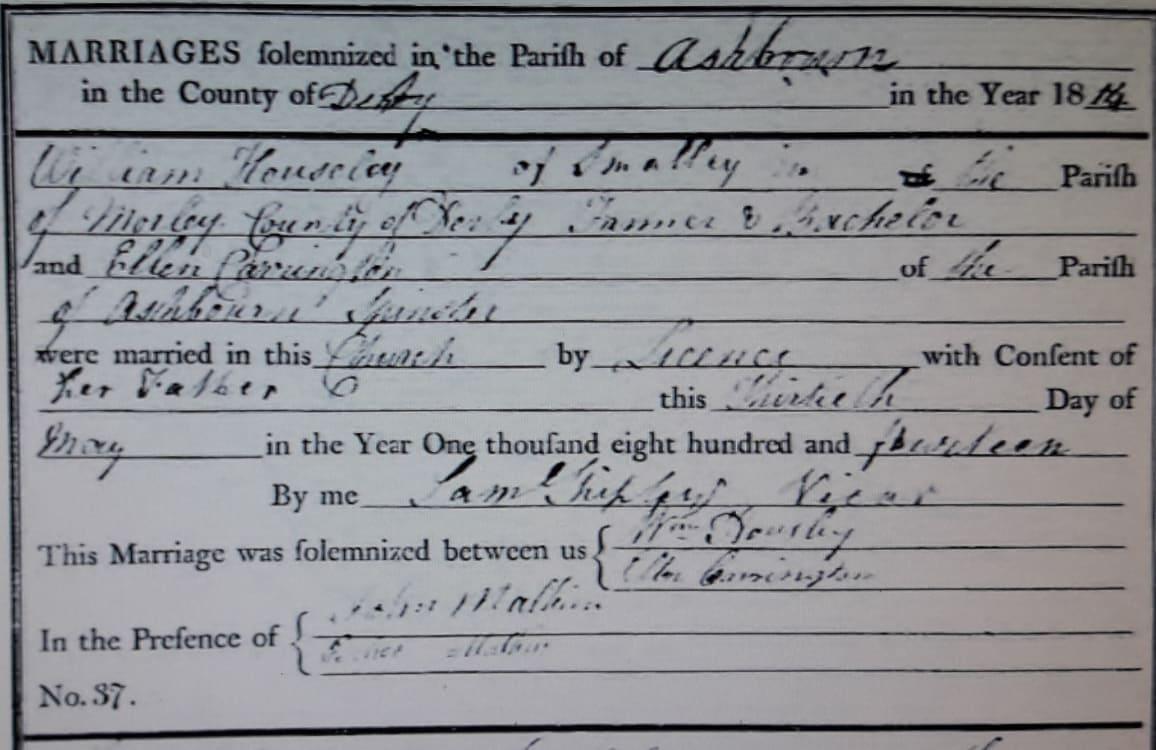
William Housley (1781-1848) and Ellen Carrington were married on May 30, 1814 at St. Oswald’s church in Ashbourne. William died in 1848 at the age of 67 of “disease of lungs and general debility”. Ellen died in 1872.
Marriage of William Housley and Ellen Carrington in Ashbourne in 1814:
Parish records show three children for William and his first wife, Mary, Ellens’ sister, who were married December 29, 1806: Mary Ann, christened in 1808 and mentioned frequently in the letters; Elizabeth, christened in 1810, but never mentioned in any letters; and William, born in 1812, probably referred to as Will in the letters. Mary died in 1813.
William and Ellen had ten children: John, Samuel, Edward, Anne, Charles, George, Joseph, Robert, Emma, and Joseph. The first Joseph died at the age of four, and the last son was also named Joseph. Anne never married, Charles emigrated to Australia in 1851, and George to USA, also in 1851. The letters are to George, from his sisters and brothers in England.
The following are excerpts of those letters, including excerpts of Barbara Housley’s “Narrative on Historic Letters”. They are grouped according to who they refer to, rather than chronological order.
ELLEN HOUSLEY 1795-1872
Joseph wrote that when Emma was married, Ellen “broke up the comfortable home and the things went to Derby and she went to live with them but Derby didn’t agree with her so she left again leaving her things behind and came to live with John in the new house where she died.” Ellen was listed with John’s household in the 1871 census.
In May 1872, the Ilkeston Pioneer carried this notice: “Mr. Hopkins will sell by auction on Saturday next the eleventh of May 1872 the whole of the useful furniture, sewing machine, etc. nearly new on the premises of the late Mrs. Housley at Smalley near Heanor in the county of Derby. Sale at one o’clock in the afternoon.”Ellen’s family was evidently rather prominant in Smalley. Two Carringtons (John and William) served on the Parish Council in 1794. Parish records are full of Carrington marriages and christenings; census records confirm many of the family groupings.
In June of 1856, Emma wrote: “Mother looks as well as ever and was told by a lady the other day that she looked handsome.” Later she wrote: “Mother is as stout as ever although she sometimes complains of not being able to do as she used to.”
Mary’s children:
MARY ANN HOUSLEY 1808-1878
There were hard feelings between Mary Ann and Ellen and her children. Anne wrote: “If you remember we were not very friendly when you left. They never came and nothing was too bad for Mary Ann to say of Mother and me, but when Robert died Mother sent for her to the funeral but she did not think well to come so we took no more notice. She would not allow her children to come either.”
Mary Ann was unlucky in love! In Anne’s second letter she wrote: “William Carrington is paying Mary Ann great attention. He is living in London but they write to each other….We expect it will be a match.” Apparantly the courtship was stormy for in 1855, Emma wrote: “Mary Ann’s wedding with William Carrington has dropped through after she had prepared everything, dresses and all for the occassion.” Then in 1856, Emma wrote: “William Carrington and Mary Ann are separated. They wore him out with their nonsense.” Whether they ever married is unclear. Joseph wrote in 1872: “Mary Ann was married but her husband has left her. She is in very poor health. She has one daughter and they are living with their mother at Smalley.”
Regarding William Carrington, Emma supplied this bit of news: “His sister, Mrs. Lily, has eloped with a married man. Is she not a nice person!”
WILLIAM HOUSLEY JR. 1812-1890
According to a letter from Anne, Will’s two sons and daughter were sent to learn dancing so they would be “fit for any society.” Will’s wife was Dorothy Palfry. They were married in Denby on October 20, 1836 when Will was 24. According to the 1851 census, Will and Dorothy had three sons: Alfred 14, Edwin 12, and William 10. All three boys were born in Denby.
In his letter of May 30, 1872, after just bemoaning that all of his brothers and sisters are gone except Sam and John, Joseph added: “Will is living still.” In another 1872 letter Joseph wrote, “Will is living at Heanor yet and carrying on his cattle dealing.” The 1871 census listed Will, 59, and his son William, 30, of Lascoe Road, Heanor, as cattle dealers.
Ellen’s children:
JOHN HOUSLEY 1815-1893
John married Sarah Baggally in Morely in 1838. They had at least six children. Elizabeth (born 2 May 1838) was “out service” in 1854. In her “third year out,” Elizabeth was described by Anne as “a very nice steady girl but quite a woman in appearance.” One of her positions was with a Mrs. Frearson in Heanor. Emma wrote in 1856: “Elizabeth is still at Mrs. Frearson. She is such a fine stout girl you would not know her.” Joseph wrote in 1872 that Elizabeth was in service with Mrs. Eliza Sitwell at Derby. (About 1850, Miss Eliza Wilmot-Sitwell provided for a small porch with a handsome Norman doorway at the west end of the St. John the Baptist parish church in Smalley.)
According to Elizabeth’s birth certificate and the 1841 census, John was a butcher. By 1851, the household included a nurse and a servant, and John was listed as a “victular.” Anne wrote in February 1854, “John has left the Public House a year and a half ago. He is living where Plumbs (Ann Plumb witnessed William’s death certificate with her mark) did and Thomas Allen has the land. He has been working at James Eley’s all winter.” In 1861, Ellen lived with John and Sarah and the three boys.
John sold his share in the inheritance from their mother and disappeared after her death. (He died in Doncaster, Yorkshire, in 1893.) At that time Charles, the youngest would have been 21. Indeed, Joseph wrote in July 1872: “John’s children are all grown up”.
In May 1872, Joseph wrote: “For what do you think, John has sold his share and he has acted very bad since his wife died and at the same time he sold all his furniture. You may guess I have never seen him but once since poor mother’s funeral and he is gone now no one knows where.”
In February 1874 Joseph wrote: “You want to know what made John go away. Well, I will give you one reason. I think I told you that when his wife died he persuaded me to leave Derby and come to live with him. Well so we did and dear Harriet to keep his house. Well he insulted my wife and offered things to her that was not proper and my dear wife had the power to resist his unmanly conduct. I did not think he could of served me such a dirty trick so that is one thing dear brother. He could not look me in the face when we met. Then after we left him he got a woman in the house and I suppose they lived as man and wife. She caught the small pox and died and there he was by himself like some wild man. Well dear brother I could not go to him again after he had served me and mine as he had and I believe he was greatly in debt too so that he sold his share out of the property and when he received the money at Belper he went away and has never been seen by any of us since but I have heard of him being at Sheffield enquiring for Sam Caldwell. You will remember him. He worked in the Nag’s Head yard but I have heard nothing no more of him.”
A mention of a John Housley of Heanor in the Nottinghma Journal 1875. I don’t know for sure if the John mentioned here is the brother John who Joseph describes above as behaving improperly to his wife. John Housley had a son Joseph, born in 1840, and John’s wife Sarah died in 1870.
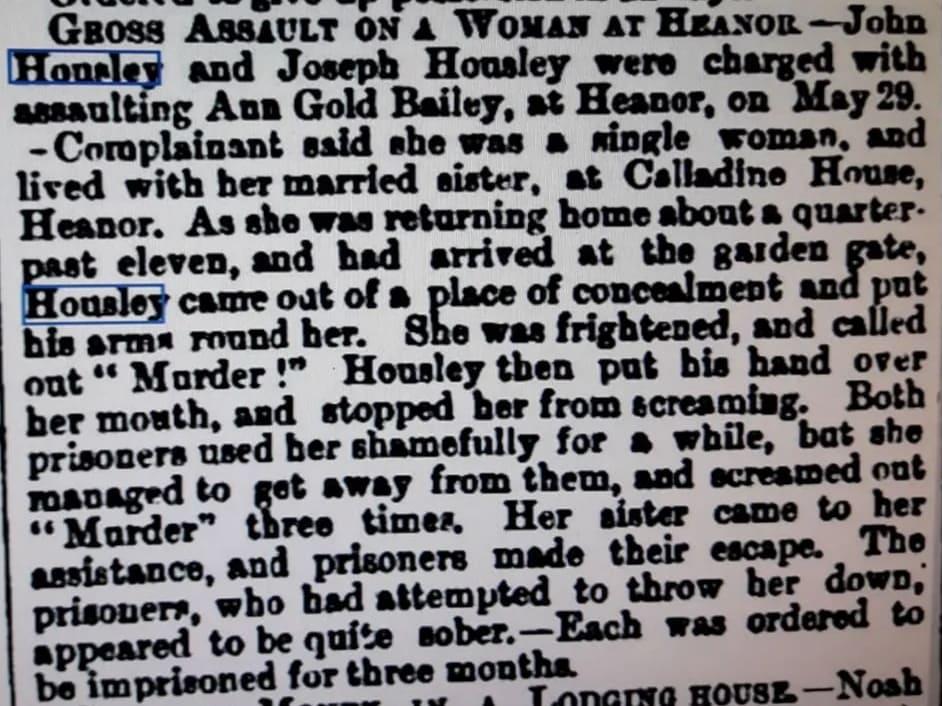
In 1876, the solicitor wrote to George: “Have you heard of John Housley? He is entitled to Robert’s share and I want him to claim it.”
SAMUEL HOUSLEY 1816-
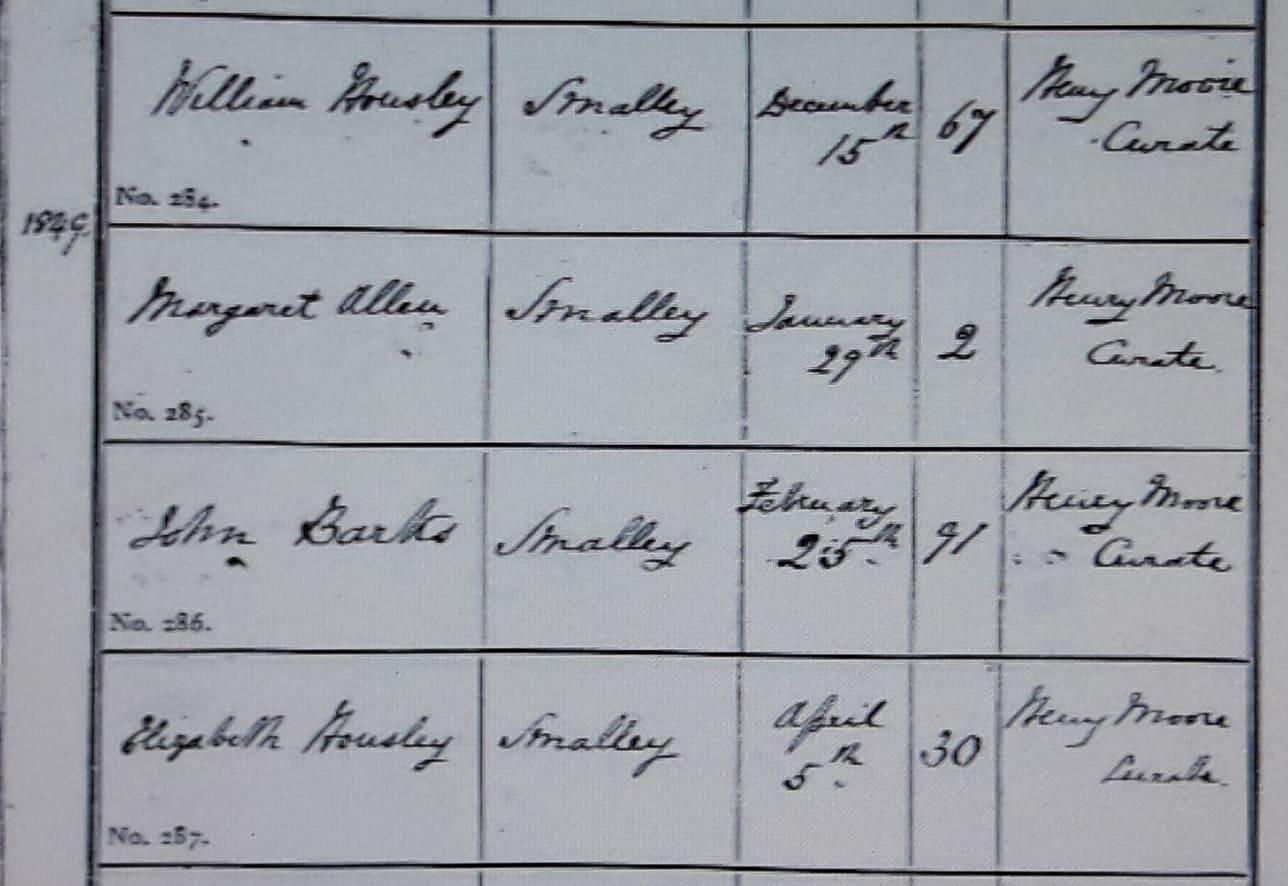
Sam married Elizabeth Brookes of Sutton Coldfield, and they had three daughters: Elizabeth, Mary Anne and Catherine. Elizabeth his wife died in 1849, a few months after Samuel’s father William died in 1848. The particular circumstances relating to these individuals have been discussed in previous chapters; the following are letter excerpts relating to them.
Death of William Housley 15 Dec 1848, and Elizabeth Housley 5 April 1849, Smalley:
Joseph wrote in December 1872: “I saw one of Sam’s daughters, the youngest Kate, you would remember her a baby I dare say. She is very comfortably married.”
In the same letter (December 15, 1872), Joseph wrote: “I think we have now found all out now that is concerned in the matter for there was only Sam that we did not know his whereabouts but I was informed a week ago that he is dead–died about three years ago in Birmingham Union. Poor Sam. He ought to have come to a better end than that….His daughter and her husband went to Brimingham and also to Sutton Coldfield that is where he married his wife from and found out his wife’s brother. It appears he has been there and at Birmingham ever since he went away but ever fond of drink.”
(Sam, however, was still alive in 1871, living as a lodger at the George and Dragon Inn, Henley in Arden. And no trace of Sam has been found since. It would appear that Sam did not want to be found.)
EDWARD HOUSLEY 1819-1843
Edward died before George left for USA in 1851, and as such there is no mention of him in the letters.
ANNE HOUSLEY 1821-1856
Anne wrote two letters to her brother George between February 1854 and her death in 1856. Apparently she suffered from a lung disease for she wrote: “I can say you will be surprised I am still living and better but still cough and spit a deal. Can do nothing but sit and sew.” According to the 1851 census, Anne, then 29, was a seamstress. Their friend, Mrs. Davy, wrote in March 1856: “This I send in a box to my Brother….The pincushion cover and pen wiper are Anne’s work–are for thy wife. She would have made it up had she been able.” Anne was not living at home at the time of the 1841 census. She would have been 19 or 20 and perhaps was “out service.”
In her second letter Anne wrote: “It is a great trouble now for me to write…as the body weakens so does the mind often. I have been very weak all summer. That I continue is a wonder to all and to spit so much although much better than when you left home.” She also wrote: “You know I had a desire for America years ago. Were I in health and strength, it would be the land of my adoption.”
In November 1855, Emma wrote, “Anne has been very ill all summer and has not been able to write or do anything.” Their neighbor Mrs. Davy wrote on March 21, 1856: “I fear Anne will not be long without a change.” In a black-edged letter the following June, Emma wrote: “I need not tell you how happy she was and how calmly and peacefully she died. She only kept in bed two days.”
Certainly Anne was a woman of deep faith and strong religious convictions. When she wrote that they were hoping to hear of Charles’ success on the gold fields she added: “But I would rather hear of him having sought and found the Pearl of great price than all the gold Australia can produce, (For what shall it profit a man if he gain the whole world and lose his soul?).” Then she asked George: “I should like to learn how it was you were first led to seek pardon and a savior. I do feel truly rejoiced to hear you have been led to seek and find this Pearl through the workings of the Holy Spirit and I do pray that He who has begun this good work in each of us may fulfill it and carry it on even unto the end and I can never doubt the willingness of Jesus who laid down his life for us. He who said whoever that cometh unto me I will in no wise cast out.”
Anne’s will was probated October 14, 1856. Mr. William Davy of Kidsley Park appeared for the family. Her estate was valued at under £20. Emma was to receive fancy needlework, a four post bedstead, feather bed and bedding, a mahogany chest of drawers, plates, linen and china. Emma was also to receive Anne’s writing desk. There was a condition that Ellen would have use of these items until her death.
The money that Anne was to receive from her grandfather, William Carrington, and her father, William Housley was to be distributed one third to Joseph, one third to Emma, and one third to be divided between her four neices: John’s daughter Elizabeth, 18, and Sam’s daughters Elizabeth, 10, Mary Ann, 9 and Catharine, age 7 to be paid by the trustees as they think “most useful and proper.” Emma Lyon and Elizabeth Davy were the witnesses.
The Carrington Farm:
CHARLES HOUSLEY 1823-1855
Charles went to Australia in 1851, and was last heard from in January 1853. According to the solicitor, who wrote to George on June 3, 1874, Charles had received advances on the settlement of their parent’s estate. “Your promissory note with the two signed by your brother Charles for 20 pounds he received from his father and 20 pounds he received from his mother are now in the possession of the court.”
Charles and George were probably quite close friends. Anne wrote in 1854: “Charles inquired very particularly in both his letters after you.”
According to Anne, Charles and a friend married two sisters. He and his father-in-law had a farm where they had 130 cows and 60 pigs. Whatever the trade he learned in England, he never worked at it once he reached Australia. While it does not seem that Charles went to Australia because gold had been discovered there, he was soon caught up in “gold fever”. Anne wrote: “I dare say you have heard of the immense gold fields of Australia discovered about the time he went. Thousands have since then emigrated to Australia, both high and low. Such accounts we heard in the papers of people amassing fortunes we could not believe. I asked him when I wrote if it was true. He said this was no exaggeration for people were making their fortune daily and he intended going to the diggings in six weeks for he could stay away no longer so that we are hoping to hear of his success if he is alive.”
In March 1856, Mrs. Davy wrote: “I am sorry to tell thee they have had a letter from Charles’s wife giving account of Charles’s death of 6 months consumption at the Victoria diggings. He has left 2 children a boy and a girl William and Ellen.” In June of the same year in a black edged letter, Emma wrote: “I think Mrs. Davy mentioned Charles’s death in her note. His wife wrote to us. They have two children Helen and William. Poor dear little things. How much I should like to see them all. She writes very affectionately.”
In December 1872, Joseph wrote: “I’m told that Charles two daughters has wrote to Smalley post office making inquiries about his share….” In January 1876, the solicitor wrote: “Charles Housley’s children have claimed their father’s share.”
GEORGE HOUSLEY 1824-1877
George emigrated to the United states in 1851, arriving in July. The solicitor Abraham John Flint referred in a letter to a 15-pound advance which was made to George on June 9, 1851. This certainly was connected to his journey. George settled along the Delaware River in Bucks County, Pennsylvania. The letters from the solicitor were addressed to: Lahaska Post Office, Bucks County, Pennsylvania.
George married Sarah Ann Hill on May 6, 1854 in Doylestown, Bucks County, Pennsylvania. In her first letter (February 1854), Anne wrote: “We want to know who and what is this Miss Hill you name in your letter. What age is she? Send us all the particulars but I would advise you not to get married until you have sufficient to make a comfortable home.”
Upon learning of George’s marriage, Anne wrote: “I hope dear brother you may be happy with your wife….I hope you will be as a son to her parents. Mother unites with me in kind love to you both and to your father and mother with best wishes for your health and happiness.” In 1872 (December) Joseph wrote: “I am sorry to hear that sister’s father is so ill. It is what we must all come to some time and hope we shall meet where there is no more trouble.”
Emma wrote in 1855, “We write in love to your wife and yourself and you must write soon and tell us whether there is a little nephew or niece and what you call them.” In June of 1856, Emma wrote: “We want to see dear Sarah Ann and the dear little boy. We were much pleased with the “bit of news” you sent.” The bit of news was the birth of John Eley Housley, January 11, 1855. Emma concluded her letter “Give our very kindest love to dear sister and dearest Johnnie.”
In September 1872, Joseph wrote, “I was very sorry to hear that John your oldest had met with such a sad accident but I hope he is got alright again by this time.” In the same letter, Joseph asked: “Now I want to know what sort of a town you are living in or village. How far is it from New York? Now send me all particulars if you please.”
In March 1873 Harriet asked Sarah Ann: “And will you please send me all the news at the place and what it is like for it seems to me that it is a wild place but you must tell me what it is like….”. The question of whether she was referring to Bucks County, Pennsylvania or some other place is raised in Joseph’s letter of the same week.
On March 17, 1873, Joseph wrote: “I was surprised to hear that you had gone so far away west. Now dear brother what ever are you doing there so far away from home and family–looking out for something better I suppose.”The solicitor wrote on May 23, 1874: “Lately I have not written because I was not certain of your address and because I doubted I had much interesting news to tell you.” Later, Joseph wrote concerning the problems settling the estate, “You see dear brother there is only me here on our side and I cannot do much. I wish you were here to help me a bit and if you think of going for another summer trip this turn you might as well run over here.”
Apparently, George had indicated he might return to England for a visit in 1856. Emma wrote concerning the portrait of their mother which had been sent to George: “I hope you like mother’s portrait. I did not see it but I suppose it was not quite perfect about the eyes….Joseph and I intend having ours taken for you when you come over….Do come over before very long.”
In March 1873, Joseph wrote: “You ask me what I think of you coming to England. I think as you have given the trustee power to sign for you I think you could do no good but I should like to see you once again for all that. I can’t say whether there would be anything amiss if you did come as you say it would be throwing good money after bad.”
On June 10, 1875, the solicitor wrote: “I have been expecting to hear from you for some time past. Please let me hear what you are doing and where you are living and how I must send you your money.” George’s big news at that time was that on May 3, 1875, he had become a naturalized citizen “renouncing and abjuring all allegiance and fidelity to every foreign prince, potentate, state and sovereignity whatsoever, and particularly to Victoria Queen of Great Britain of whom he was before a subject.”
ROBERT HOUSLEY 1832-1851
In 1854, Anne wrote: “Poor Robert. He died in August after you left he broke a blood vessel in the lung.”
From Joseph’s first letter we learn that Robert was 19 when he died: “Dear brother there have been a great many changes in the family since you left us. All is gone except myself and John and Sam–we have heard nothing of him since he left. Robert died first when he was 19 years of age. Then Anne and Charles too died in Australia and then a number of years elapsed before anyone else. Then John lost his wife, then Emma, and last poor dear mother died last January on the 11th.”Anne described Robert’s death in this way: “He had thrown up blood many times before in the spring but the last attack weakened him that he only lived a fortnight after. He died at Derby. Mother was with him. Although he suffered much he never uttered a murmur or regret and always a smile on his face for everyone that saw him. He will be regretted by all that knew him”.
Robert died a resident of St. Peter’s Parish, Derby, but was buried in Smalley on August 16, 1851.
Apparently Robert was apprenticed to be a joiner for, according to Anne, Joseph took his place: “Joseph wanted to be a joiner. We thought we could do no better than let him take Robert’s place which he did the October after and is there still.”In 1876, the solicitor wrote to George: “Have you heard of John Housley? He is entitled to Robert’s share and I want him to claim it.”
EMMA HOUSLEY 1836-1871
Emma was not mentioned in Anne’s first letter. In the second, Anne wrote that Emma was living at Spondon with two ladies in her “third situation,” and added, “She is grown a bouncing woman.” Anne described her sister well. Emma wrote in her first letter (November 12, 1855): “I must tell you that I am just 21 and we had my pudding last Sunday. I wish I could send you a piece.”
From Emma’s letters we learn that she was living in Derby from May until November 1855 with Mr. Haywood, an iron merchant. She explained, “He has failed and I have been obliged to leave,” adding, “I expect going to a new situation very soon. It is at Belper.” In 1851 records, William Haywood, age 22, was listed as an iron foundry worker. In the 1857 Derby Directory, James and George were listed as iron and brass founders and ironmongers with an address at 9 Market Place, Derby.
In June 1856, Emma wrote from “The Cedars, Ashbourne Road” where she was working for Mr. Handysides.
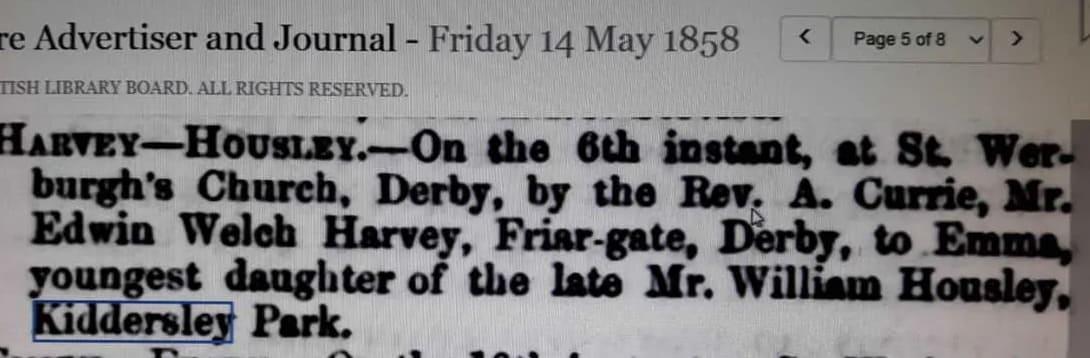
While she was working for Mr. Handysides, Emma wrote: “Mother is thinking of coming to live at Derby. That will be nice for Joseph and I.”Friargate and Ashbourne Road were located in St. Werburgh’s Parish. (In fact, St. Werburgh’s vicarage was at 185 Surrey Street. This clue led to the discovery of the record of Emma’s marriage on May 6, 1858, to Edwin Welch Harvey, son of Samuel Harvey in St. Werburgh’s.)
In 1872, Joseph wrote: “Our sister Emma, she died at Derby at her own home for she was married. She has left two young children behind. The husband was the son of the man that I went apprentice to and has caused a great deal of trouble to our family and I believe hastened poor Mother’s death….”. Joseph added that he believed Emma’s “complaint” was consumption and that she was sick a good bit. Joseph wrote: “Mother was living with John when I came home (from Ascension Island around 1867? or to Smalley from Derby around 1870?) for when Emma was married she broke up the comfortable home and the things went to Derby and she went to live with them but Derby did not agree with her so she had to leave it again but left all her things there.”
Emma Housley and Edwin Welch Harvey wedding, 1858:
JOSEPH HOUSLEY 1838-1893
We first hear of Joseph in a letter from Anne to George in 1854. “Joseph wanted to be a joiner. We thought we could do no better than let him take Robert’s place which he did the October after (probably 1851) and is there still. He is grown as tall as you I think quite a man.” Emma concurred in her first letter: “He is quite a man in his appearance and quite as tall as you.”
From Emma we learn in 1855: “Joseph has left Mr. Harvey. He had not work to employ him. So mother thought he had better leave his indenture and be at liberty at once than wait for Harvey to be a bankrupt. He has got a very good place of work now and is very steady.” In June of 1856, Emma wrote “Joseph and I intend to have our portraits taken for you when you come over….Mother is thinking of coming to Derby. That will be nice for Joseph and I. Joseph is very hearty I am happy to say.”
According to Joseph’s letters, he was married to Harriet Ballard. Joseph described their miraculous reunion in this way: “I must tell you that I have been abroad myself to the Island of Ascension. (Elsewhere he wrote that he was on the island when the American civil war broke out). I went as a Royal Marine and worked at my trade and saved a bit of money–enough to buy my discharge and enough to get married with but while I was out on the island who should I meet with there but my dear wife’s sister. (On two occasions Joseph and Harriet sent George the name and address of Harriet’s sister, Mrs. Brooks, in Susquehanna Depot, Pennsylvania, but it is not clear whether this was the same sister.) She was lady’s maid to the captain’s wife. Though I had never seen her before we got to know each other somehow so from that me and my wife recommenced our correspondence and you may be sure I wanted to get home to her. But as soon as I did get home that is to England I was not long before I was married and I have not regretted yet for we are very comfortable as well as circumstances will allow for I am only a journeyman joiner.”
Proudly, Joseph wrote: “My little family consists of three nice children–John, Joseph and Susy Annie.” On her birth certificate, Susy Ann’s birthdate is listed as 1871. Parish records list a Lucy Annie christened in 1873. The boys were born in Derby, John in 1868 and Joseph in 1869. In his second letter, Joseph repeated: “I have got three nice children, a good wife and I often think is more than I have deserved.” On August 6, 1873, Joseph and Harriet wrote: “We both thank you dear sister for the pieces of money you sent for the children. I don’t know as I have ever see any before.” Joseph ended another letter: “Now I must close with our kindest love to you all and kisses from the children.”
In Harriet’s letter to Sarah Ann (March 19, 1873), she promised: “I will send you myself and as soon as the weather gets warm as I can take the children to Derby, I will have them taken and send them, but it is too cold yet for we have had a very cold winter and a great deal of rain.” At this time, the children were all under 6 and the baby was not yet two.
In March 1873 Joseph wrote: “I have been working down at Heanor gate there is a joiner shop there where Kings used to live I have been working there this winter and part of last summer but the wages is very low but it is near home that is one comfort.” (Heanor Gate is about 1/4 mile from Kidsley Grange. There was a school and industrial park there in 1988.) At this time Joseph and his family were living in “the big house–in Old Betty Hanson’s house.” The address in the 1871 census was Smalley Lane.
A glimpse into Joseph’s personality is revealed by this remark to George in an 1872 letter: “Many thanks for your portrait and will send ours when we can get them taken for I never had but one taken and that was in my old clothes and dear Harriet is not willing to part with that. I tell her she ought to be satisfied with the original.”
On one occasion Joseph and Harriet both sent seeds. (Marks are still visible on the paper.) Joseph sent “the best cow cabbage seed in the country–Robinson Champion,” and Harriet sent red cabbage–Shaw’s Improved Red. Possibly cow cabbage was also known as ox cabbage: “I hope you will have some good cabbages for the Ox cabbage takes all the prizes here. I suppose you will be taking the prizes out there with them.” Joseph wrote that he would put the name of the seeds by each “but I should think that will not matter. You will tell the difference when they come up.”
George apparently would have liked Joseph to come to him as early as 1854. Anne wrote: “As to his coming to you that must be left for the present.” In 1872, Joseph wrote: “I have been thinking of making a move from here for some time before I heard from you for it is living from hand to mouth and never certain of a job long either.” Joseph then made plans to come to the United States in the spring of 1873. “For I intend all being well leaving England in the spring. Many thanks for your kind offer but I hope we shall be able to get a comfortable place before we have been out long.” Joseph promised to bring some things George wanted and asked: “What sort of things would be the best to bring out there for I don’t want to bring a lot that is useless.” Joseph’s plans are confirmed in a letter from the solicitor May 23, 1874: “I trust you are prospering and in good health. Joseph seems desirous of coming out to you when this is settled.”
George must have been reminiscing about gooseberries (Heanor has an annual gooseberry show–one was held July 28, 1872) and Joseph promised to bring cuttings when they came: “Dear Brother, I could not get the gooseberries for they was all gathered when I received your letter but we shall be able to get some seed out the first chance and I shall try to bring some cuttings out along.” In the same letter that he sent the cabbage seeds Joseph wrote: “I have got some gooseberries drying this year for you. They are very fine ones but I have only four as yet but I was promised some more when they were ripe.” In another letter Joseph sent gooseberry seeds and wrote their names: Victoria, Gharibaldi and Globe.
In September 1872 Joseph wrote; “My wife is anxious to come. I hope it will suit her health for she is not over strong.” Elsewhere Joseph wrote that Harriet was “middling sometimes. She is subject to sick headaches. It knocks her up completely when they come on.” In December 1872 Joseph wrote, “Now dear brother about us coming to America you know we shall have to wait until this affair is settled and if it is not settled and thrown into Chancery I’m afraid we shall have to stay in England for I shall never be able to save money enough to bring me out and my family but I hope of better things.”
On July 19, 1875 Abraham Flint (the solicitor) wrote: “Joseph Housley has removed from Smalley and is working on some new foundry buildings at Little Chester near Derby. He lives at a village called Little Eaton near Derby. If you address your letter to him as Joseph Housley, carpenter, Little Eaton near Derby that will no doubt find him.”
George did not save any letters from Joseph after 1874, hopefully he did reach him at Little Eaton. Joseph and his family are not listed in either Little Eaton or Derby on the 1881 census.
In his last letter (February 11, 1874), Joseph sounded very discouraged and wrote that Harriet’s parents were very poorly and both had been “in bed for a long time.” In addition, Harriet and the children had been ill.
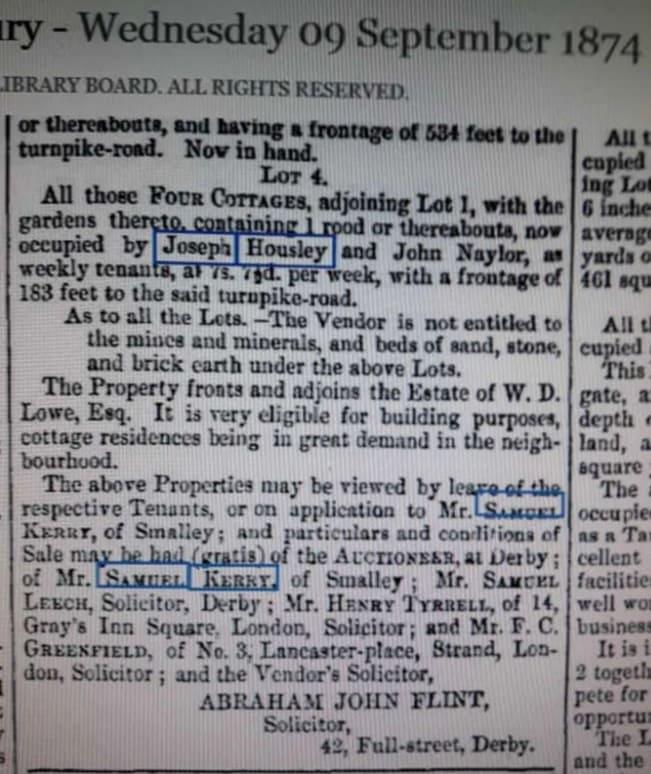
The move to Little Eaton may indicate that Joseph received his settlement because in August, 1873, he wrote: “I think this is bad news enough and bad luck too, but I have had little else since I came to live at Kiddsley cottages but perhaps it is all for the best if one could only think so. I have begun to think there will be no chance for us coming over to you for I am afraid there will not be so much left as will bring us out without it is settled very shortly but I don’t intend leaving this house until it is settled either one way or the other. “Joseph Housley and the Kiddsley cottages:
 January 28, 2022 at 9:30 pm #6264
In reply to: The Elusive Samuel Housley and Other Family Stories
From Tanganyika with Love
continued ~ part 5
With thanks to Mike Rushby.
Chunya 16th December 1936
Dearest Family,
Since last I wrote I have visited Chunya and met several of the diggers wives.
On the whole I have been greatly disappointed because there is nothing very colourful
about either township or women. I suppose I was really expecting something more like
the goldrush towns and women I have so often seen on the cinema screen.
Chunya consists of just the usual sun-dried brick Indian shops though there are
one or two double storied buildings. Most of the life in the place centres on the
Goldfields Hotel but we did not call there. From the store opposite I could hear sounds
of revelry though it was very early in the afternoon. I saw only one sight which was quite
new to me, some elegantly dressed African women, with high heels and lipsticked
mouths teetered by on their way to the silk store. “Native Tarts,” said George in answer
to my enquiry.Several women have called on me and when I say ‘called’ I mean called. I have
grown so used to going without stockings and wearing home made dresses that it was
quite a shock to me to entertain these ladies dressed to the nines in smart frocks, silk
stockings and high heeled shoes, handbags, makeup and whatnot. I feel like some
female Rip van Winkle. Most of the women have a smart line in conversation and their
talk and views on life would make your nice straight hair curl Mummy. They make me feel
very unsophisticated and dowdy but George says he has a weakness for such types
and I am to stay exactly as I am. I still do not use any makeup. George says ‘It’s all right
for them. They need it poor things, you don’t.” Which, though flattering, is hardly true.
I prefer the men visitors, though they also are quite unlike what I had expected
diggers to be. Those whom George brings home are all well educated and well
groomed and I enjoy listening to their discussion of the world situation, sport and books.
They are extremely polite to me and gentle with the children though I believe that after a
few drinks at the pub tempers often run high. There were great arguments on the night
following the abdication of Edward VIII. Not that the diggers were particularly attached to
him as a person, but these men are all great individualists and believe in freedom of
choice. George, rather to my surprise, strongly supported Edward. I did not.Many of the diggers have wireless sets and so we keep up to date with the
news. I seldom leave camp. I have my hands full with the three children during the day
and, even though Janey is a reliable ayah, I would not care to leave the children at night
in these grass roofed huts. Having experienced that fire on the farm, I know just how
unlikely it would be that the children would be rescued in time in case of fire. The other
women on the diggings think I’m crazy. They leave their children almost entirely to ayahs
and I must confess that the children I have seen look very well and happy. The thing is
that I simply would not enjoy parties at the hotel or club, miles away from the children
and I much prefer to stay at home with a book.I love hearing all about the parties from George who likes an occasional ‘boose
up’ with the boys and is terribly popular with everyone – not only the British but with the
Germans, Scandinavians and even the Afrikaans types. One Afrikaans woman said “Jou
man is ‘n man, al is hy ‘n Engelsman.” Another more sophisticated woman said, “George
is a handsome devil. Aren’t you scared to let him run around on his own?” – but I’m not. I
usually wait up for George with sandwiches and something hot to drink and that way I
get all the news red hot.There is very little gold coming in. The rains have just started and digging is
temporarily at a standstill. It is too wet for dry blowing and not yet enough water for
panning and sluicing. As this camp is some considerable distance from the claims, all I see of the process is the weighing of the daily taking of gold dust and tiny nuggets.
Unless our luck changes I do not think we will stay on here after John Molteno returns.
George does not care for the life and prefers a more constructive occupation.
Ann and young George still search optimistically for gold. We were all saddened
last week by the death of Fanny, our bull terrier. She went down to the shopping centre
with us and we were standing on the verandah of a store when a lorry passed with its
canvas cover flapping. This excited Fanny who rushed out into the street and the back
wheel of the lorry passed right over her, killing her instantly. Ann was very shocked so I
soothed her by telling her that Fanny had gone to Heaven. When I went to bed that
night I found Ann still awake and she asked anxiously, “Mummy, do you think God
remembered to give Fanny her bone tonight?”Much love to all,
Eleanor.Itewe, Chunya 23rd December 1936
Dearest Family,
Your Christmas parcel arrived this morning. Thank you very much for all the
clothing for all of us and for the lovely toys for the children. George means to go hunting
for a young buffalo this afternoon so that we will have some fresh beef for Christmas for
ourselves and our boys and enough for friends too.I had a fright this morning. Ann and Georgie were, as usual, searching for gold
whilst I sat sewing in the living room with Kate toddling around. She wandered through
the curtained doorway into the store and I heard her playing with the paraffin pump. At
first it did not bother me because I knew the tin was empty but after ten minutes or so I
became irritated by the noise and went to stop her. Imagine my horror when I drew the
curtain aside and saw my fat little toddler fiddling happily with the pump whilst, curled up
behind the tin and clearly visible to me lay the largest puffadder I have ever seen.
Luckily I acted instinctively and scooped Kate up from behind and darted back into the
living room without disturbing the snake. The houseboy and cook rushed in with sticks
and killed the snake and then turned the whole storeroom upside down to make sure
there were no more.I have met some more picturesque characters since I last wrote. One is a man
called Bishop whom George has known for many years having first met him in the
Congo. I believe he was originally a sailor but for many years he has wandered around
Central Africa trying his hand at trading, prospecting, a bit of elephant hunting and ivory
poaching. He is now keeping himself by doing ‘Sign Writing”. Bish is a gentle and
dignified personality. When we visited his camp he carefully dusted a seat for me and
called me ‘Marm’, quite ye olde world. The only thing is he did spit.Another spitter is the Frenchman in a neighbouring camp. He is in bed with bad
rheumatism and George has been going across twice a day to help him and cheer him
up. Once when George was out on the claim I went across to the Frenchman’s camp in
response to an SOS, but I think he was just lonely. He showed me snapshots of his
two daughters, lovely girls and extremely smart, and he chatted away telling me his life
history. He punctuated his remarks by spitting to right and left of the bed, everywhere in
fact, except actually at me.George took me and the children to visit a couple called Bert and Hilda Farham.
They have a small gold reef which is worked by a very ‘Heath Robinson’ type of
machinery designed and erected by Bert who is reputed to be a clever engineer though
eccentric. He is rather a handsome man who always looks very spruce and neat and
wears a Captain Kettle beard. Hilda is from Johannesburg and quite a character. She
has a most generous figure and literally masses of beetroot red hair, but she also has a
warm deep voice and a most generous disposition. The Farhams have built
themselves a more permanent camp than most. They have a brick cottage with proper
doors and windows and have made it attractive with furniture contrived from petrol
boxes. They have no children but Hilda lavishes a great deal of affection on a pet
monkey. Sometimes they do quite well out of their gold and then they have a terrific
celebration at the Club or Pub and Hilda has an orgy of shopping. At other times they
are completely broke but Hilda takes disasters as well as triumphs all in her stride. She
says, “My dear, when we’re broke we just live on tea and cigarettes.”I have met a young woman whom I would like as a friend. She has a dear little
baby, but unfortunately she has a very wet husband who is also a dreadful bore. I can’t
imagine George taking me to their camp very often. When they came to visit us George
just sat and smoked and said,”Oh really?” to any remark this man made until I felt quite
hysterical. George looks very young and fit and the children are lively and well too. I ,
however, am definitely showing signs of wear and tear though George says,
“Nonsense, to me you look the same as you always did.” This I may say, I do not
regard as a compliment to the young Eleanor.Anyway, even though our future looks somewhat unsettled, we are all together
and very happy.With love,
Eleanor.Itewe, Chunya 30th December 1936
Dearest Family,
We had a very cheery Christmas. The children loved the toys and are so proud
of their new clothes. They wore them when we went to Christmas lunch to the
Cresswell-Georges. The C-Gs have been doing pretty well lately and they have a
comfortable brick house and a large wireless set. The living room was gaily decorated
with bought garlands and streamers and balloons. We had an excellent lunch cooked by
our ex cook Abel who now works for the Cresswell-Georges. We had turkey with
trimmings and plum pudding followed by nuts and raisons and chocolates and sweets
galore. There was also a large variety of drinks including champagne!There were presents for all of us and, in addition, Georgie and Ann each got a
large tin of chocolates. Kate was much admired. She was a picture in her new party frock
with her bright hair and rosy cheeks. There were other guests beside ourselves and
they were already there having drinks when we arrived. Someone said “What a lovely
child!” “Yes” said George with pride, “She’s a Marie Stopes baby.” “Truby King!” said I
quickly and firmly, but too late to stop the roar of laughter.Our children played amicably with the C-G’s three, but young George was
unusually quiet and surprised me by bringing me his unopened tin of chocolates to keep
for him. Normally he is a glutton for sweets. I might have guessed he was sickening for
something. That night he vomited and had diarrhoea and has had an upset tummy and a
slight temperature ever since.Janey is also ill. She says she has malaria and has taken to her bed. I am dosing
her with quinine and hope she will soon be better as I badly need her help. Not only is
young George off his food and peevish but Kate has a cold and Ann sore eyes and
they all want love and attention. To complicate things it has been raining heavily and I
must entertain the children indoors.Eleanor.
Itewe, Chunya 19th January 1937
Dearest Family,
So sorry I have not written before but we have been in the wars and I have had neither
the time nor the heart to write. However the worst is now over. Young George and
Janey are both recovering from Typhoid Fever. The doctor had Janey moved to the
native hospital at Chunya but I nursed young George here in the camp.As I told you young George’s tummy trouble started on Christmas day. At first I
thought it was only a protracted bilious attack due to eating too much unaccustomed rich
food and treated him accordingly but when his temperature persisted I thought that the
trouble might be malaria and kept him in bed and increased the daily dose of quinine.
He ate less and less as the days passed and on New Years Day he seemed very
weak and his stomach tender to the touch.George fetched the doctor who examined small George and said he had a very
large liver due no doubt to malaria. He gave the child injections of emertine and quinine
and told me to give young George frequent and copious drinks of water and bi-carb of
soda. This was more easily said than done. Young George refused to drink this mixture
and vomited up the lime juice and water the doctor had suggested as an alternative.
The doctor called every day and gave George further injections and advised me
to give him frequent sips of water from a spoon. After three days the child was very
weak and weepy but Dr Spiers still thought he had malaria. During those anxious days I
also worried about Janey who appeared to be getting worse rather that better and on
January the 3rd I asked the doctor to look at her. The next thing I knew, the doctor had
put Janey in his car and driven her off to hospital. When he called next morning he
looked very grave and said he wished to talk to my husband. I said that George was out
on the claim but if what he wished to say concerned young George’s condition he might
just as well tell me.With a good deal of reluctance Dr Spiers then told me that Janey showed all the
symptoms of Typhoid Fever and that he was very much afraid that young George had
contracted it from her. He added that George should be taken to the Mbeya Hospital
where he could have the professional nursing so necessary in typhoid cases. I said “Oh
no,I’d never allow that. The child had never been away from his family before and it
would frighten him to death to be sick and alone amongst strangers.” Also I was sure that
the fifty mile drive over the mountains in his weak condition would harm him more than
my amateur nursing would. The doctor returned to the camp that afternoon to urge
George to send our son to hospital but George staunchly supported my argument that
young George would stand a much better chance of recovery if we nursed him at home.
I must say Dr Spiers took our refusal very well and gave young George every attention
coming twice a day to see him.For some days the child was very ill. He could not keep down any food or liquid
in any quantity so all day long, and when he woke at night, I gave him a few drops of
water at a time from a teaspoon. His only nourishment came from sucking Macintosh’s
toffees. Young George sweated copiously especially at night when it was difficult to
change his clothes and sponge him in the draughty room with the rain teeming down
outside. I think I told you that the bedroom is a sort of shed with only openings in the wall
for windows and doors, and with one wall built only a couple of feet high leaving a six
foot gap for air and light. The roof leaked and the damp air blew in but somehow young
George pulled through.Only when he was really on the mend did the doctor tell us that whilst he had
been attending George, he had also been called in to attend to another little boy of the same age who also had typhoid. He had been called in too late and the other little boy,
an only child, had died. Young George, thank God, is convalescent now, though still on a
milk diet. He is cheerful enough when he has company but very peevish when left
alone. Poor little lad, he is all hair, eyes, and teeth, or as Ann says” Georgie is all ribs ribs
now-a-days Mummy.” He shares my room, Ann and Kate are together in the little room.
Anyway the doctor says he should be up and around in about a week or ten days time.
We were all inoculated against typhoid on the day the doctor made the diagnosis
so it is unlikely that any of us will develop it. Dr Spiers was most impressed by Ann’s
unconcern when she was inoculated. She looks gentle and timid but has always been
very brave. Funny thing when young George was very ill he used to wail if I left the
room, but now that he is convalescent he greatly prefers his dad’s company. So now I
have been able to take the girls for walks in the late afternoons whilst big George
entertains small George. This he does with the minimum of effort, either he gets out
cartons of ammunition with which young George builds endless forts, or else he just sits
beside the bed and cleans one of his guns whilst small George watches with absorbed
attention.The Doctor tells us that Janey is also now convalescent. He says that exhusband
Abel has been most attentive and appeared daily at the hospital with a tray of
food that made his, the doctor’s, mouth water. All I dare say, pinched from Mrs
Cresswell-George.I’ll write again soon. Lots of love to all,
Eleanor.Chunya 29th January 1937
Dearest Family,
Georgie is up and about but still tires very easily. At first his legs were so weak
that George used to carry him around on his shoulders. The doctor says that what the
child really needs is a long holiday out of the Tropics so that Mrs Thomas’ offer, to pay all
our fares to Cape Town as well as lending us her seaside cottage for a month, came as
a Godsend. Luckily my passport is in order. When George was in Mbeya he booked
seats for the children and me on the first available plane. We will fly to Broken Hill and go
on to Cape Town from there by train.Ann and George are wildly thrilled at the idea of flying but I am not. I remember
only too well how airsick I was on the old Hannibal when I flew home with the baby Ann.
I am longing to see you all and it will be heaven to give the children their first seaside
holiday.I mean to return with Kate after three months but, if you will have him, I shall leave
George behind with you for a year. You said you would all be delighted to have Ann so
I do hope you will also be happy to have young George. Together they are no trouble
at all. They amuse themselves and are very independent and loveable.
George and I have discussed the matter taking into consideration the letters from
you and George’s Mother on the subject. If you keep Ann and George for a year, my
mother-in-law will go to Cape Town next year and fetch them. They will live in England
with her until they are fit enough to return to the Tropics. After the children and I have left
on this holiday, George will be able to move around and look for a job that will pay
sufficiently to enable us to go to England in a few years time to fetch our children home.
We both feel very sad at the prospect of this parting but the children’s health
comes before any other consideration. I hope Kate will stand up better to the Tropics.
She is plump and rosy and could not look more bonny if she lived in a temperate
climate.We should be with you in three weeks time!
Very much love,
Eleanor.Broken Hill, N Rhodesia 11th February 1937
Dearest Family,
Well here we are safe and sound at the Great Northern Hotel, Broken Hill, all
ready to board the South bound train tonight.We were still on the diggings on Ann’s birthday, February 8th, when George had
a letter from Mbeya to say that our seats were booked on the plane leaving Mbeya on
the 10th! What a rush we had packing up. Ann was in bed with malaria so we just
bundled her up in blankets and set out in John Molteno’s car for the farm. We arrived that
night and spent the next day on the farm sorting things out. Ann and George wanted to
take so many of their treasures and it was difficult for them to make a small selection. In
the end young George’s most treasured possession, his sturdy little boots, were left
behind.Before leaving home on the morning of the tenth I took some snaps of Ann and
young George in the garden and one of them with their father. He looked so sad. After
putting us on the plane, George planned to go to the fishing camp for a day or two
before returning to the empty house on the farm.John Molteno returned from the Cape by plane just before we took off, so he
will take over the running of his claims once more. I told John that I dreaded the plane trip
on account of air sickness so he gave me two pills which I took then and there. Oh dear!
How I wished later that I had not done so. We had an extremely bumpy trip and
everyone on the plane was sick except for small George who loved every moment.
Poor Ann had a dreadful time but coped very well and never complained. I did not
actually puke until shortly before we landed at Broken Hill but felt dreadfully ill all the way.
Kate remained rosy and cheerful almost to the end. She sat on my lap throughout the
trip because, being under age, she travelled as baggage and was not entitled to a seat.
Shortly before we reached Broken Hill a smartly dressed youngish man came up
to me and said, “You look so poorly, please let me take the baby, I have children of my
own and know how to handle them.” Kate made no protest and off they went to the
back of the plane whilst I tried to relax and concentrate on not getting sick. However,
within five minutes the man was back. Kate had been thoroughly sick all over his collar
and jacket.I took Kate back on my lap and then was violently sick myself, so much so that
when we touched down at Broken Hill I was unable to speak to the Immigration Officer.
He was so kind. He sat beside me until I got my diaphragm under control and then
drove me up to the hotel in his own car.We soon recovered of course and ate a hearty dinner. This morning after
breakfast I sallied out to look for a Bank where I could exchange some money into
Rhodesian and South African currency and for the Post Office so that I could telegraph
to George and to you. What a picnic that trip was! It was a terribly hot day and there was
no shade. By the time we had done our chores, the children were hot, and cross, and
tired and so indeed was I. As I had no push chair for Kate I had to carry her and she is
pretty heavy for eighteen months. George, who is still not strong, clung to my free arm
whilst Ann complained bitterly that no one was helping her.Eventually Ann simply sat down on the pavement and declared that she could
not go another step, whereupon George of course decided that he also had reached his
limit and sat down too. Neither pleading no threats would move them so I had to resort
to bribery and had to promise that when we reached the hotel they could have cool
drinks and ice-cream. This promise got the children moving once more but I am determined that nothing will induce me to stir again until the taxi arrives to take us to the
station.This letter will go by air and will reach you before we do. How I am longing for
journeys end.With love to you all,
Eleanor.Leaving home 10th February 1937, George Gilman Rushby with Ann and Georgie (Mike) Rushby:
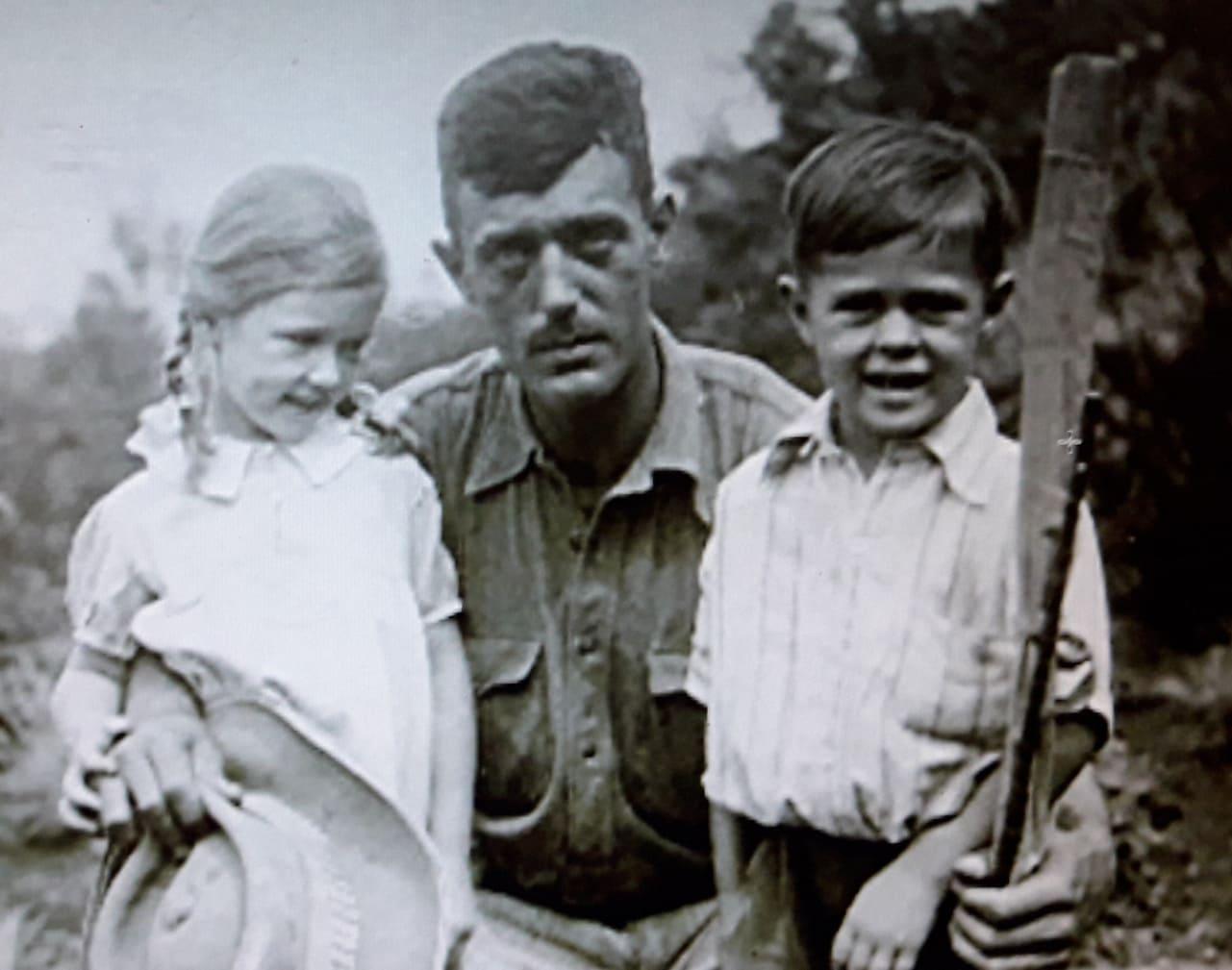
NOTE
We had a very warm welcome to the family home at Plumstead Cape Town.
After ten days with my family we moved to Hout Bay where Mrs Thomas lent us her
delightful seaside cottage. She also provided us with two excellent maids so I had
nothing to do but rest and play on the beach with the children.After a month at the sea George had fully recovered his health though not his
former gay spirits. After another six months with my parents I set off for home with Kate,
leaving Ann and George in my parent’s home under the care of my elder sister,
Marjorie.One or two incidents during that visit remain clearly in my memory. Our children
had never met elderly people and were astonished at the manifestations of age. One
morning an elderly lady came around to collect church dues. She was thin and stooped
and Ann surveyed her with awe. She turned to me with a puzzled expression and
asked in her clear voice, “Mummy, why has that old lady got a moustache – oh and a
beard?’ The old lady in question was very annoyed indeed and said, “What a rude little
girl.” Ann could not understand this, she said, “But Mummy, I only said she had a
moustache and a beard and she has.” So I explained as best I could that when people
have defects of this kind they are hurt if anyone mentions them.A few days later a strange young woman came to tea. I had been told that she
had a most disfiguring birthmark on her cheek and warned Ann that she must not
comment on it. Alas! with the kindest intentions Ann once again caused me acute
embarrassment. The young woman was hardly seated when Ann went up to her and
gently patted the disfiguring mark saying sweetly, “Oh, I do like this horrible mark on your
face.”I remember also the afternoon when Kate and George were christened. My
mother had given George a white silk shirt for the occasion and he wore it with intense
pride. Kate was baptised first without incident except that she was lost in admiration of a
gold bracelet given her that day by her Godmother and exclaimed happily, “My
bangle, look my bangle,” throughout the ceremony. When George’s turn came the
clergyman held his head over the font and poured water on George’s forehead. Some
splashed on his shirt and George protested angrily, “Mum, he has wet my shirt!” over
and over again whilst I led him hurriedly outside.My last memory of all is at the railway station. The time had come for Kate and
me to get into our compartment. My sisters stood on the platform with Ann and George.
Ann was resigned to our going, George was not so, at the last moment Sylvia, my
younger sister, took him off to see the engine. The whistle blew and I said good-bye to
my gallant little Ann. “Mummy”, she said urgently to me, “Don’t forget to wave to
George.”And so I waved good-bye to my children, never dreaming that a war would
intervene and it would be eight long years before I saw them again.January 15, 2022 at 6:54 pm #6254In reply to: The Elusive Samuel Housley and Other Family Stories
The Gladstone Connection
My grandmother had said that we were distantly related to Gladstone the prime minister. Apparently Grandma’s mothers aunt had a neice that was related to him, or some combination of aunts and nieces on the Gretton side. I had not yet explored all the potential great grandmothers aunt’s nieces looking for this Gladstone connection, but I accidentally found a Gladstone on the tree on the Gretton side.
I was wandering around randomly looking at the hints for other people that had my grandparents in their trees to see who they were and how they were connected, and noted a couple of photos of Orgills. Richard Gretton, grandma’s mother Florence Nightingale Gretton’s father, married Sarah Orgill. Sarah’s brother John Orgill married Elizabeth Mary Gladstone. It was the photographs that caught my eye, but then I saw the Gladstone name, and that she was born in Liverpool. Her father was William Gladstone born 1809 in Liverpool, just like the prime minister. And his father was John Gladstone, just like the prime minister.
But the William Gladstone in our family tree was a millwright, who emigrated to Australia with his wife and two children rather late in life at the age of 54, in 1863. He died three years later when he was thrown out of a cart in 1866. This was clearly not William Gladstone the prime minister.
John Orgill emigrated to Australia in 1865, and married Elizabeth Mary Gladstone in Victoria in 1870. Their first child was born in December that year, in Dandenong. Their three sons all have the middle name Gladstone.
John Orgill 1835-1911 (Florence Nightingale Gretton’s mothers brother)
Elizabeth Mary Gladstone 1845-1926
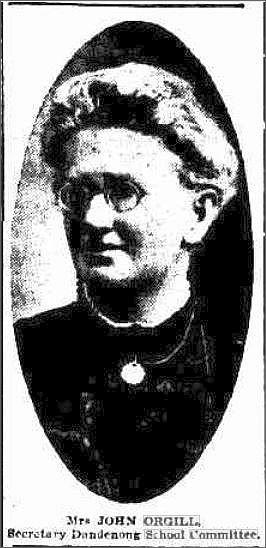
I did not think that the link to Gladstone the prime minister was true, until I found an article in the Australian newspapers while researching the family of John Orgill for the Australia chapter.
In the Letters to the Editor in The Argus, a Melbourne newspaper, dated 8 November 1921:
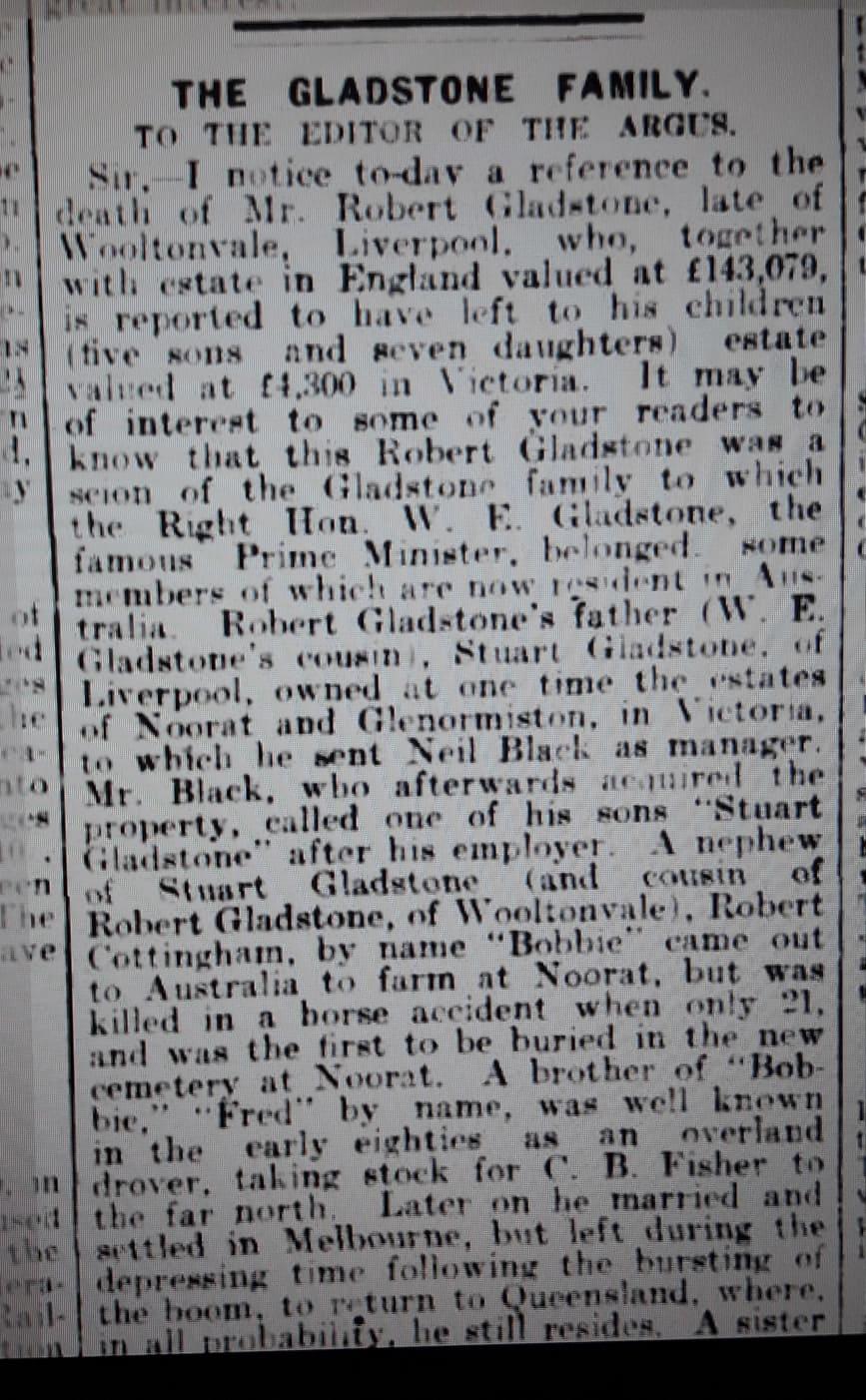
THE GLADSTONE FAMILY.
TO THE EDITOR OF THE ARGUS.
Sir,—I notice to-day a reference to the
death of Mr. Robert Gladstone, late of
Wooltonvale. Liverpool, who, together
with estate in England valued at £143,079,
is reported to have left to his children
(five sons and seven daughters) estate
valued at £4,300 in Victoria. It may be
of interest to some of your readers to
know that this Robert Gladstone was a
son of the Gladstone family to which
the Right Hon. W. E. Gladstone, the
famous Prime Minister, belonged, some
members of which are now resident in Aus-
tralia. Robert Gladstone’s father (W. E.
Gladstone’s cousin), Stuart Gladstone, of
Liverpool, owned at one time the estates
of Noorat and Glenormiston, in Victoria,
to which he sent Neil Black as manager.
Mr. Black, who afterwards acquired the
property, called one of his sons “Stuart
Gladstone” after his employer. A nephew
of Stuart Gladstone (and cousin of
Robert Gladstone, of Wooltonvale), Robert
Cottingham, by name “Bobbie” came out
to Australia to farm at Noorat, but was
killed in a horse accident when only 21,
and was the first to be buried in the new
cemetery at Noorat. A brother, of “Bob-
bie,” “Fred” by name, was well known
in the early eighties as an overland
drover, taking stock for C. B. Fisher to
the far north. Later on he married and
settled in Melbourne, but left during the
depressing time following the bursting of
the boom, to return to Queensland, where,
in all probability, he still resides. A sister
of “Bobbie” and “Fred” still lives in the
neighbourhood of Melbourne. Their
father, Montgomery Gladstone, who was in
the diplomatic service, and travelled about
a great deal, was a brother of Stuart Glad-
stone, the owner of Noorat, and a full
cousin of William Ewart Gladstone, his
father, Robert, being a brother of W. E.
Gladstone’s father, Sir John, of Liverpool.
The wife of Robert Gladstone, of Woolton-
vale, Ella Gladstone by name, was also
his second cousin, being the daughter of
Robertson Gladstone, of Courthaize, near
Liverpool, W. E. Gladstone’s older
brother.
A cousin of Sir John Gladstone
(W. E. G.’s father), also called John, was
a foundry owner in Castledouglas, and the
inventor of the first suspension bridge, a
model of which was made use of in the
erection of the Menai Bridge connecting
Anglesea with the mainland, and was after-
wards presented to the Liverpool Stock
Exchange by the inventor’s cousin, Sir
John. One of the sons of this inventive
engineer, William by name, left England
in 1863 with his wife and son and daugh-
ter, intending to settle in New Zealand,
but owing to the unrest caused there by
the Maori war, he came instead to Vic-
toria, and bought land near Dandenong.
Three years later he was killed in a horse
accident, but his name is perpetuated in
the name “Gladstone road” in Dandenong.
His daughter afterwards married, and lived
for many years in Gladstone House, Dande-
nong, but is now widowed and settled in
Gippsland. Her three sons and four daugh-
ters are all married and perpetuating the
Gladstone family in different parts of Aus-
tralia. William’s son (also called Wil-
liam), who came out with his father,
mother, and sister in 1863 still lives in the
Fix this textneighbourhood of Melbourne, with his son
and grandson. An aunt of Sir John Glad-
stone (W. E. G.’s father), Christina Glad-
stone by name, married a Mr. Somerville,
of Biggar. One of her great-grandchildren
is Professor W. P. Paterson, of Edinburgh
University, another is a professor in the
West Australian University, and a third
resides in Melbourne. Yours. &c.Melbourne, Nov.7, FAMILY TREE
According to the Old Dandenong website:
“Elizabeth Mary Orgill (nee Gladstone) operated Gladstone House until at least 1911, along with another hydropathic hospital (Birthwood) on Cheltenham road. She was the daughter of William Gladstone (Nephew of William Ewart Gladstone, UK prime minister in 1874).”
The story of the Orgill’s continues in the chapter on Australia.
January 14, 2022 at 7:27 am #6252In reply to: The Elusive Samuel Housley and Other Family Stories
The USA Housley’s
This chapter is copied from Barbara Housley’s Narrative on Historic Letters, with thanks to her brother Howard Housley for sharing it with me. Interesting to note that Housley descendants (on the Marshall paternal side) and Gretton descendants (on the Warren maternal side) were both living in Trenton, New Jersey at the same time.
GEORGE HOUSLEY 1824-1877
George emigrated to the United states in 1851, arriving in July. The solicitor Abraham John Flint referred in a letter to a 15-pound advance which was made to George on June 9, 1851. This certainly was connected to his journey. George settled along the Delaware River in Bucks County, Pennsylvania. The letters from the solicitor were addressed to: Lahaska Post Office, Bucks County, Pennsylvania. George married Sarah Ann Hill on May 6, 1854 in Doylestown, Bucks County, Pennsylvania. The service was performed by Attorney James Gilkyson.
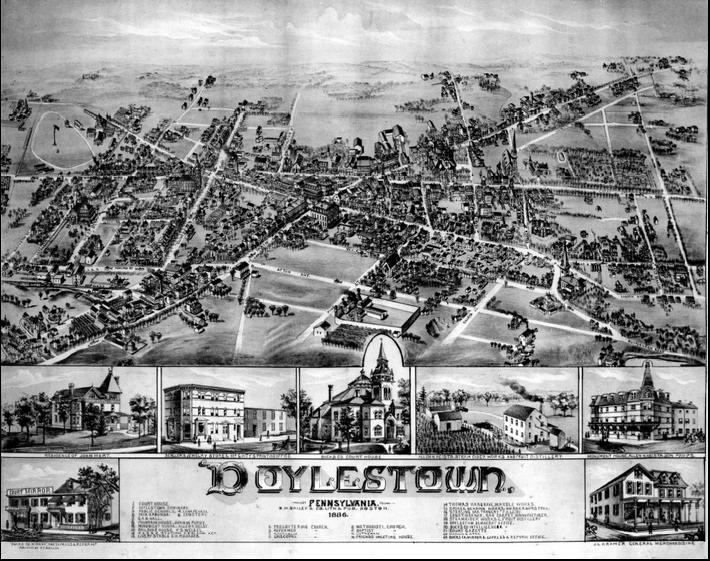
In her first letter (February 1854), Anne (George’s sister in Smalley, Derbyshire) wrote: “We want to know who and what is this Miss Hill you name in your letter. What age is she? Send us all the particulars but I would advise you not to get married until you have sufficient to make a comfortable home.”
Upon learning of George’s marriage, Anne wrote: “I hope dear brother you may be happy with your wife….I hope you will be as a son to her parents. Mother unites with me in kind love to you both and to your father and mother with best wishes for your health and happiness.” In 1872 (December) Joseph (George’s brother) wrote: “I am sorry to hear that sister’s father is so ill. It is what we must all come to some time and hope we shall meet where there is no more trouble.”
Emma (George’s sister) wrote in 1855, “We write in love to your wife and yourself and you must write soon and tell us whether there is a little nephew or niece and what you call them.” In June of 1856, Emma wrote: “We want to see dear Sarah Ann and the dear little boy. We were much pleased with the “bit of news” you sent.” The bit of news was the birth of John Eley Housley, January 11, 1855. Emma concluded her letter “Give our very kindest love to dear sister and dearest Johnnie.”
According to his obituary, John Eley was born at Wrightstown and “removed” to Lumberville at the age of 19. John was married first to Lucy Wilson with whom he had three sons: George Wilson (1883), Howard (1893) and Raymond (1895); and then to Elizabeth Kilmer with whom he had one son Albert Kilmer (1907). John Eley Housley died November 20, 1926 at the age of 71. For many years he had worked for John R. Johnson who owned a store. According to his son Albert, John was responsible for caring for Johnson’s horses. One named Rex was considered to be quite wild, but was docile in John’s hands. When John would take orders, he would leave the wagon at the first house and walk along the backs of the houses so that he would have access to the kitchens. When he reached the seventh house he would climb back over the fence to the road and whistle for the horses who would come to meet him. John could not attend church on Sunday mornings because he was working with the horses and occasionally Albert could convince his mother that he was needed also. According to Albert, John was regular in attendance at church on Sunday evenings.
John was a member of the Carversville Lodge 261 IOOF and the Carversville Lodge Knights of Pythias. Internment was in the Carversville cemetery; not, however, in the plot owned by his father. In addition to his sons, he was survived by his second wife Elizabeth who lived to be 80 and three grandchildren: George’s sons, Kenneth Worman and Morris Wilson and Raymond’s daughter Miriam Louise. George had married Katie Worman about the time John Eley married Elizabeth Kilmer. Howard’s first wife Mary Brink and daughter Florence had died and he remarried Elsa Heed who also lived into her eighties. Raymond’s wife was Fanny Culver.
Two more sons followed: Joseph Sackett, who was known as Sackett, September 12, 1856 and Edwin or Edward Rose, November 11, 1858. Joseph Sackett Housley married Anna Hubbs of Plumsteadville on January 17, 1880. They had one son Nelson DeC. who in turn had two daughters, Eleanor Mary and Ruth Anna, and lived on Bert Avenue in Trenton N.J. near St. Francis Hospital. Nelson, who was an engineer and built the first cement road in New Jersey, died at the age of 51. His daughters were both single at the time of his death. However, when his widow, the former Eva M. Edwards, died some years later, her survivors included daughters, Mrs. Herbert D. VanSciver and Mrs. James J. McCarrell and four grandchildren. One of the daughters (the younger) was quite crippled in later years and would come to visit her great-aunt Elizabeth (John’s widow) in a chauffeur driven car. Sackett died in 1929 at the age of 70. He was a member of the Warrington Lodge IOOF of Jamison PA, the Uncas tribe and the Uncas Hayloft 102 ORM of Trenton, New Jersey. The interment was in Greenwood cemetery where he had been caretaker since his retirement from one of the oldest manufacturing plants in Trenton (made milk separators for one thing). Sackett also was the caretaker for two other cemeteries one located near the Clinton Street station and the other called Riverside.
Ed’s wife was named Lydia. They had two daughters, Mary and Margaret and a third child who died in infancy. Mary had seven children–one was named for his grandfather–and settled in lower Bucks county. Margaret never married. She worked for Woolworths in Flemington, N. J. and then was made manager in Somerville, N.J., where she lived until her death. Ed survived both of his brothers, and at the time of Sackett’s death was living in Flemington, New Jersey where he had worked as a grocery clerk.
In September 1872, Joseph wrote, “I was very sorry to hear that John your oldest had met with such a sad accident but I hope he is got alright again by this time.” In the same letter, Joseph asked: “Now I want to know what sort of a town you are living in or village. How far is it from New York? Now send me all particulars if you please.”
In March 1873 Harriet asked Sarah Ann: “And will you please send me all the news at the place and what it is like for it seems to me that it is a wild place but you must tell me what it is like….” The question of whether she was referring to Bucks County, Pennsylvania or some other place is raised in Joseph’s letter of the same week.
On March 17, 1873, Joseph wrote: “I was surprised to hear that you had gone so far away west. Now dear brother what ever are you doing there so far away from home and family–looking out for something better I suppose.” The solicitor wrote on May 23, 1874: “Lately I have not written because I was not certain of your address and because I doubted I had much interesting news to tell you.” Later, Joseph wrote concerning the problems settling the estate, “You see dear brother there is only me here on our side and I cannot do much. I wish you were here to help me a bit and if you think of going for another summer trip this turn you might as well run over here.”
Apparently, George had indicated he might return to England for a visit in 1856. Emma wrote concerning the portrait of their mother which had been sent to George: “I hope you like mother’s portrait. I did not see it but I suppose it was not quite perfect about the eyes….Joseph and I intend having ours taken for you when you come over….Do come over before very long.”
In March 1873, Joseph wrote: “You ask me what I think of you coming to England. I think as you have given the trustee power to sign for you I think you could do no good but I should like to see you once again for all that. I can’t say whether there would be anything amiss if you did come as you say it would be throwing good money after bad.”
On June 10, 1875, the solicitor wrote: “I have been expecting to hear from you for some time past. Please let me hear what you are doing and where you are living and how I must send you your money.” George’s big news at that time was that on May 3, 1875, he had become a naturalized citizen “renouncing and abjuring all allegiance and fidelity to every foreign prince, potentate, state and sovereignity whatsoever, and particularly to Victoria Queen of Great Britain of whom he was before a subject.”
Another matter which George took care of during the years the estate was being settled was the purchase of a cemetery plot! On March 24, 1873, George purchased plot 67 section 19 division 2 in the Carversville (Bucks County PA) Cemetery (incorporated 1859). The plot cost $15.00, and was located at the very edge of the cemetery. It was in this cemetery, in 1991, while attending the funeral of Sarah Lord Housley, wife of Albert Kilmer Housley, that sixteen month old Laura Ann visited the graves of her great-great-great grandparents, George and Sarah Ann Hill Housley.
George died on August 13, 1877 and was buried three days later. The text for the funeral sermon was Proverbs 27:1: “Do not boast about tomorrow, for you do not know what a day may bring forth.”
December 21, 2021 at 1:47 pm #6247In reply to: The Elusive Samuel Housley and Other Family Stories
Warren Brothers Boiler Makers
Samuel Warren, my great grandfather, and husband of Florence Nightingale Gretton, worked with the family company of boiler makers in Newhall in his early years. He developed an interest in motor cars, and left the family business to start up on his own. By all accounts, he made some bad decisions and borrowed a substantial amount of money from his sister. It was because of this disastrous state of affairs that the impoverished family moved from Swadlincote/Newhall to Stourbridge.
1914: Tram no 10 on Union Road going towards High Street Newhall. On the left Henry Harvey Engineer, on the right Warren Bros Boiler Manufacturers & Engineers:
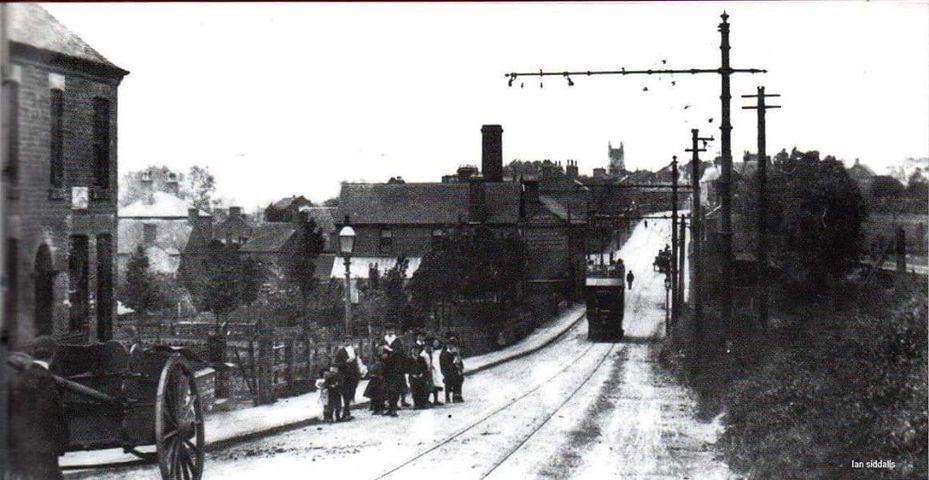
I found a newspaper article in the Derbyshire Advertiser and Journal dated the 2nd October 1915 about a Samuel Warren of Warren Brothers Boilermakers, but it was about my great grandfathers uncle, also called Samuel.
DEATH OF MR. SAMUEL WARREN, OF NEWHALL. Samuel Warren, of Rose Villa, Newhall, passed away on Saturday evening at the age of 85.. Of somewhat retiring disposition, he took little or no active part in public affairs, but for many years was trustee of the loyal British Oak Lodge of the M.U. of Oddfellows, and in many other ways served His community when opportunity permitted. He was member of the firm of Warren Bros., of the Boiler Works, Newhall. This thriving business was established by the late Mr. Benjamin Bridge, over 60 years ago, and on his death it was taken over by his four nephews. Mr. William Warren died several years ago, and with the demise Mr. Samuel Warren, two brothers remain, Messrs. Henry and Benjamin Warren. He leaves widow, six daughters, and three sons to mourn his loss.
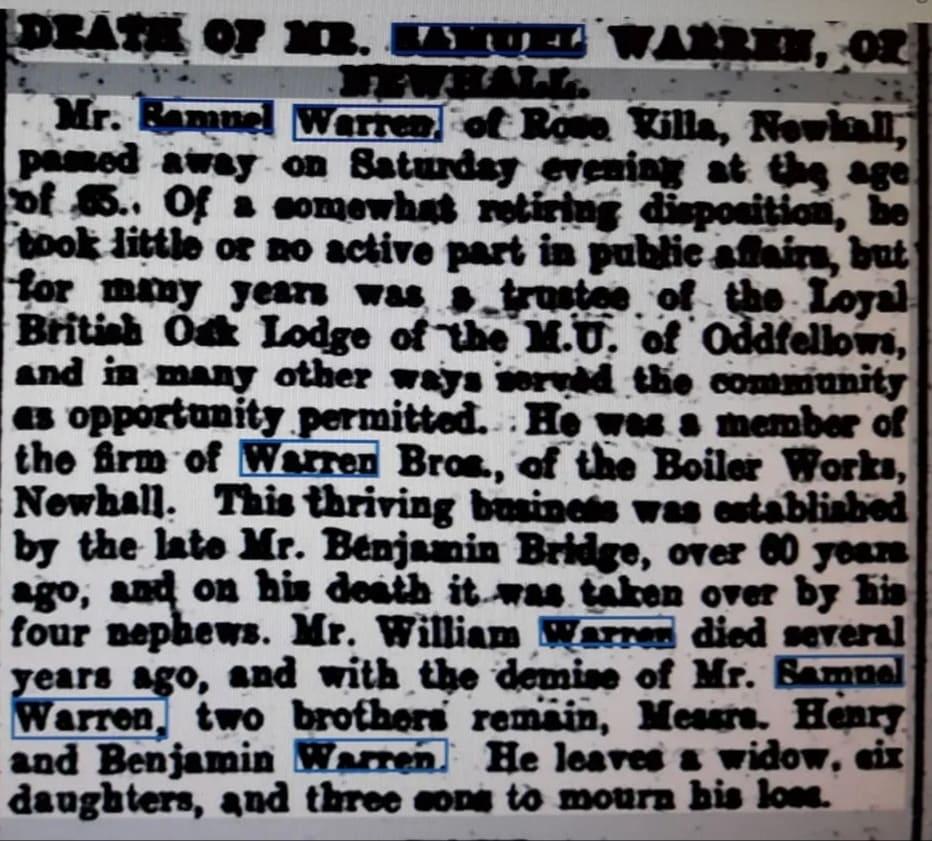
This was the first I’d heard of Benjamin Bridge. William Warren mentioned in the article as having died previously was Samuel’s father, my great great grandfather. William’s brother Henry was the father of Ben Warren, the footballer.
But who was Benjamin Bridge?
Samuel’s father was William Warren 1835-1881. He had a brother called Samuel, mentioned above, and William’s father was also named Samuel. Samuel Warren 1800-1882 married Elizabeth Bridge 1813-1872. Benjamin Bridge 1811-1898 was Elizabeth’s brother.
Burton Chronicle 28 July 1898:
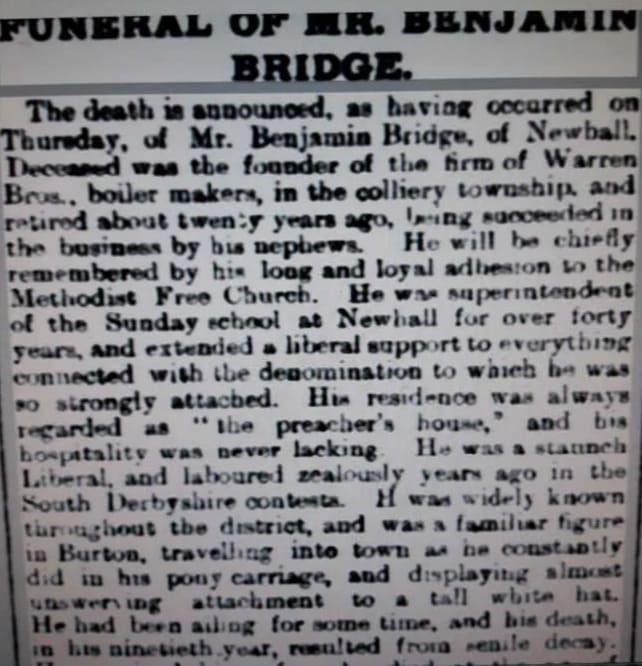
Benjamin and his wife Jane had no children. According to the obituary in the newspaper, the couple were fondly remembered for their annual tea’s for the widows of the town. Benjamin Bridge’s house was known as “the preachers house”. He was superintendent of Newhall Sunday School and member of Swadlincote’s board of health. And apparently very fond of a tall white hat!
On the 1881 census, Benjamin Bridge and his wife live near to the Warren family in Newhall. The Warren’s live in the “boiler yard” and the family living in between the Bridge’s and the Warren’s include an apprentice boiler maker, so we can assume these were houses incorporated in the boiler works property. Benjamin is a 72 year old retired boiler maker. Elizabeth Warren is a widow (William died in 1881), two of her sons are boiler makers, and Samuel, my great grandfather, is on the next page of the census, at seven years old.
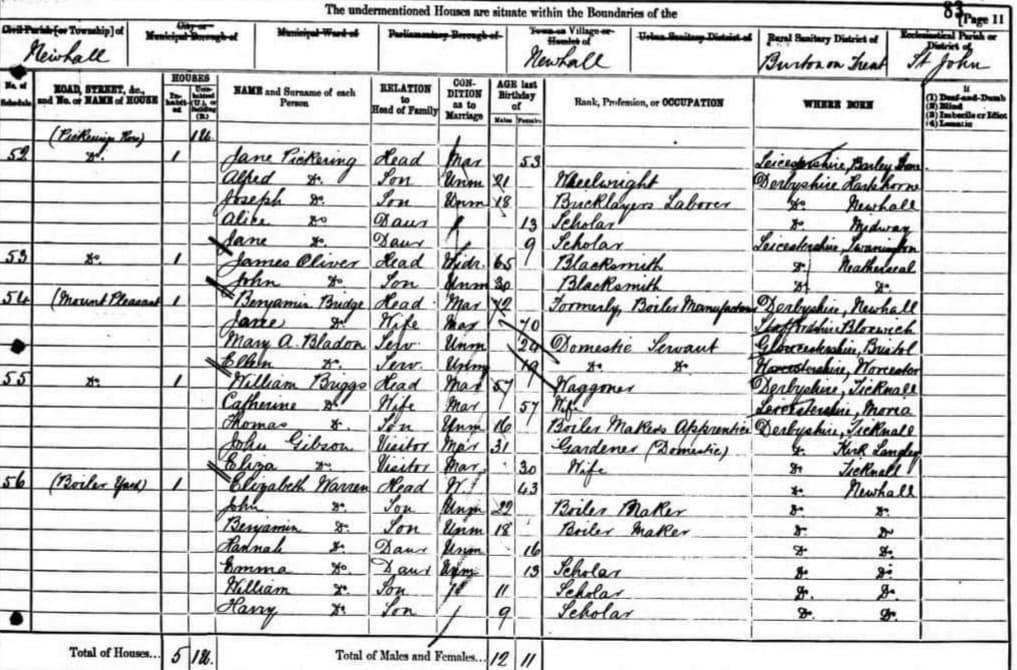
Warren Brothers made boilers for the Burton breweries, including Bass, Ratcliff and Gretton.
This receipt from Warrens Boiler yard for a new boiler in 1885 was purchased off Ebay by Colin Smith. He gave it to one of the grandsons of Robert Adolphus Warren, to keep in the Warren family. It is in his safe at home, and he promised Colin that it will stay in the family forever.
 December 18, 2021 at 7:05 pm #6246
In reply to: The Elusive Samuel Housley and Other Family Stories
Florence Nightingale Gretton
1881-1927
Florence’s father was Richard Gretton, a baker in Swadlincote, Derbyshire. When Richard married Sarah Orgill in 1861, they lived with her mother, a widow, in Measham, Ashby de la Zouch in Leicestershire. On the 1861 census Sarah’s mother, Elizabeth, is a farmer of two acres.
(Swadlincote and Ashby de la Zouch are on the Derbyshire Leicestershire border and not far from each other. Swadlincote is near to Burton upon Trent which is sometimes in Staffordshire, sometimes in Derbyshire. Newhall, Church Gresley, and Swadlincote are all very close to each other or districts in the same town.)
Ten years later in 1871 Richard and Sarah have their own place in Swadlincote, he is a baker, and they have four children. A fourteen year old apprentice or servant is living with them.
In the Ashby-de-la-Zouch Gazette on 28 February 1880, it was reported that Richard Gretton, baker, of Swadlincote, was charged by Captain Bandys with carrying bread in a cart for sale, the said cart not being provided with scales and weights, according to the requirements of the Act, on the 17th January last.—Defendant pleaded guilty, but urged in extenuation of the offence that in the hurry he had forgotten to put the scales in the cart before his son started.—The Bench took this view of the case, regarding it as an oversight, and fined him one shilling only and costs. This was not his only offence.
In 1883, he was fined twenty shillings, and ten shillings and sixpence costs.
By 1881 they have 4 more children, and Florence Nightingale is the youngest at four months. Richard is 48 by now, and Sarah is 44. Florence’s older brother William is a blacksmith.
Interestingly on the same census page, two doors down Thomas and Selina Warren live at the Stanhope Arms. Richards son John Gretton lives at the pub, a 13 year old servant. Incidentally, I noticed on Thomas and Selena’s marriage register that Richard and Sarah Gretton were the witnesses at the wedding.
Ten years later in 1891, Florence Nightingale and her sister Clara are living with Selina Warren, widow, retired innkeeper, one door down from the Stanhope Arms. Florence is ten, Clara twelve and they are scholars.
Richard and Sarah are still living three doors up on the other side of the Stanhope Arms, with three of their sons. But the two girls lived up the road with the Warren widow!The Stanhope Arms, Swadlincote: it’s possible that the shop with the awning was Richard Gretton’s bakers shop (although not at the time of this later photo).
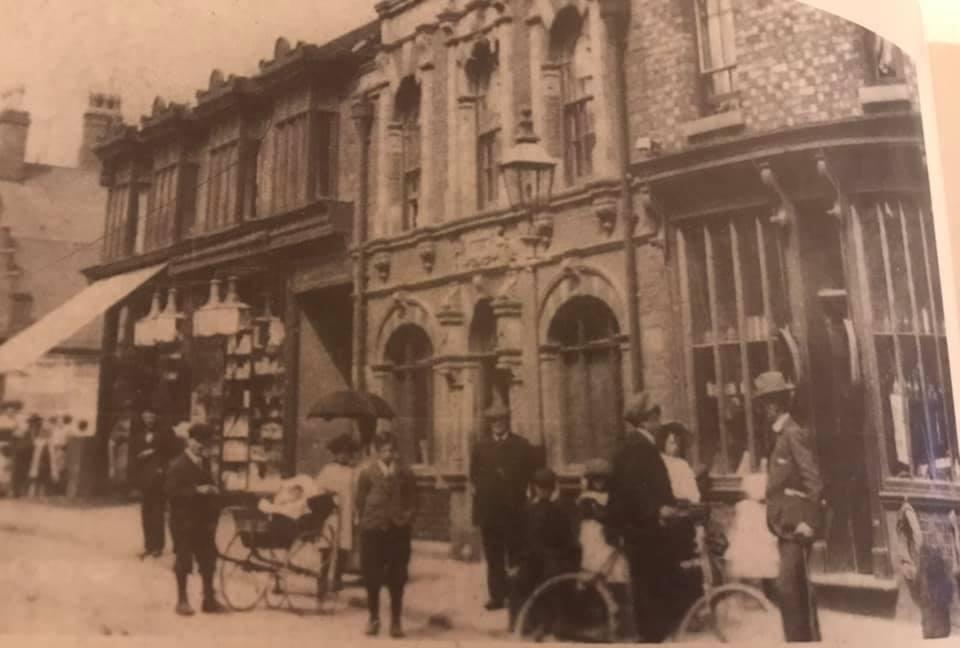
Richard died in 1898, a year before Florence married Samuel Warren.
Sarah is a widowed 60 year old baker on the 1901 census. Her son 26 year old son Alf, also a baker, lives at the same address, as does her 22 year old daughter Clara who is a district nurse.
Clara Gretton and family, photo found online:
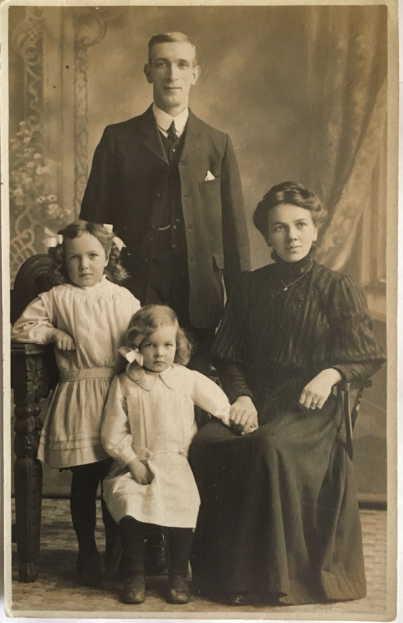
In 1901 Florence Nightingale (who we don’t have a photograph of!) is now married and is Florrie Warren on the census, and she, her husband Samuel, and their one year old daughter Hildred are visitors at the address of Elizabeth (Staley)Warren, 60 year old widow and Samuel’s mother, and Samuel’s 36 year old brother William. Samuel and William are engineers.
Samuel and Florrie had ten children between 1900 and 1925 (and all but two of them used their middle name and not first name: my mother and I had no idea until I found all the records. My grandmother Florence Noreen was known as Nora, which we knew of course, uncle Jack was actually Douglas John, and so on).
Hildred, Clara, Billy, and Nora were born in Swadlincote. Sometime between my grandmother’s birth in 1907 and Kay’s birth in 1911, the family moved to Oldswinford, in Stourbridge. Later they moved to Market Street.
1911 census, Oldswinford, Stourbridge:
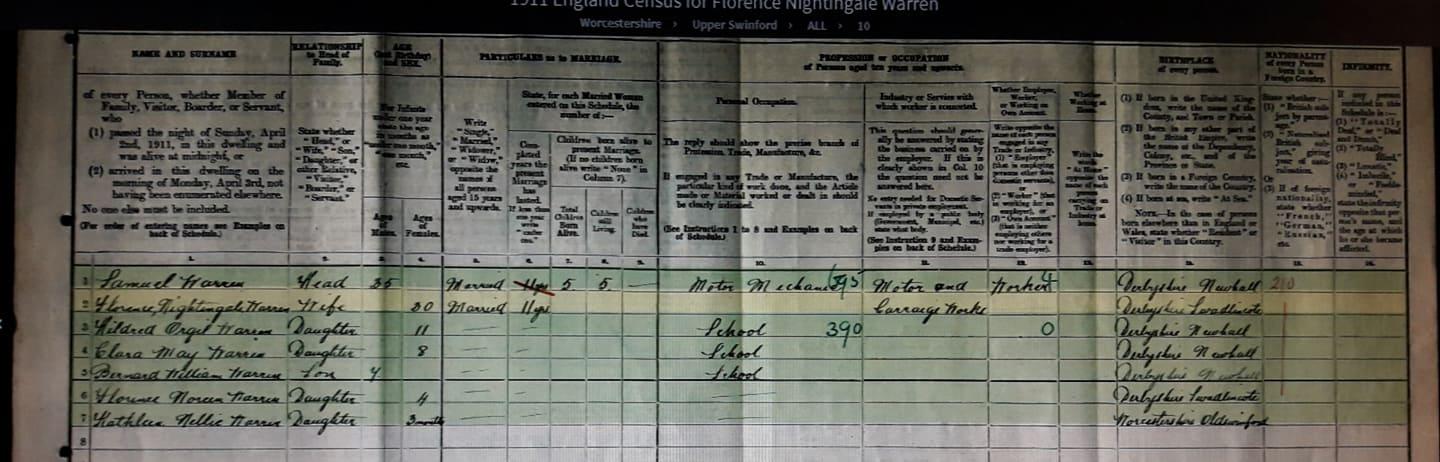
Oddly, nobody knew when Florrie Warren died. My mothers cousin Ian Warren researched the Warren family some years ago, while my grandmother was still alive. She contributed family stories and information, but couldn’t remember if her mother died in 1929 or 1927. A recent search of records confirmed that it was the 12th November 1927.
She was 46 years old. We were curious to know how she died, so my mother ordered a paper copy of her death certificate. It said she died at 31 Market Street, Stourbridge at the age of 47. Clara May Warren, her daughter, was in attendance. Her husband Samuel Warren was a motor mechanic. The Post mortem was by Percival Evans, coroner for Worcestershire, who clarified the cause of death as vascular disease of the heart. There was no inquest. The death was registered on 15 Nov 1927.
I looked for a photo of 31 Market Street in Stourbridge, and was astonished to see that it was the house next door to one I lived in breifly in the 1980s. We didn’t know that the Warren’s lived in Market Street until we started searching the records.
Market Street, Stourbridge. I lived in the one on the corner on the far right, my great grandmother died in the one next door.
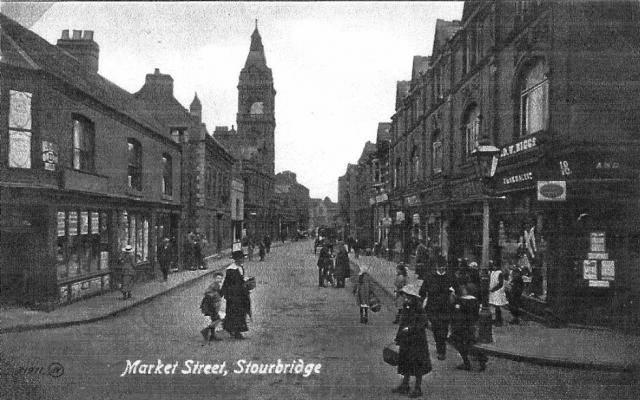
I found some hitherto unknown emigrants in the family. Florence Nightingale Grettons eldest brother William 1861-1940 stayed in Swadlincote. John Orgill Gretton born in 1868 moved to Trenton New Jersey USA in 1888, married in 1892 and died in 1949 in USA. Michael Thomas born in 1870 married in New York in 1893 and died in Trenton in 1940. Alfred born 1875 stayed in Swadlincote. Charles Herbert born 1876 married locally and then moved to Australia in 1912, and died in Victoria in 1954. Clara Elizabeth was a district nurse, married locally and died at the age of 99.
December 18, 2021 at 12:59 pm #6243In reply to: The Elusive Samuel Housley and Other Family Stories
William Housley’s Will and the Court Case
William Housley died in 1848, but his widow Ellen didn’t die until 1872. The court case was in 1873. Details about the court case are archived at the National Archives at Kew, in London, but are not available online. They can be viewed in person, but that hasn’t been possible thus far. However, there are a great many references to it in the letters.
William Housley’s first wife was Mary Carrington 1787-1813. They had three children, Mary Anne, Elizabeth and William. When Mary died, William married Mary’s sister Ellen, not in their own parish church at Smalley but in Ashbourne. Although not uncommon for a widower to marry a deceased wife’s sister, it wasn’t legal. This point is mentioned in one of the letters.
One of the pages of William Housley’s will:
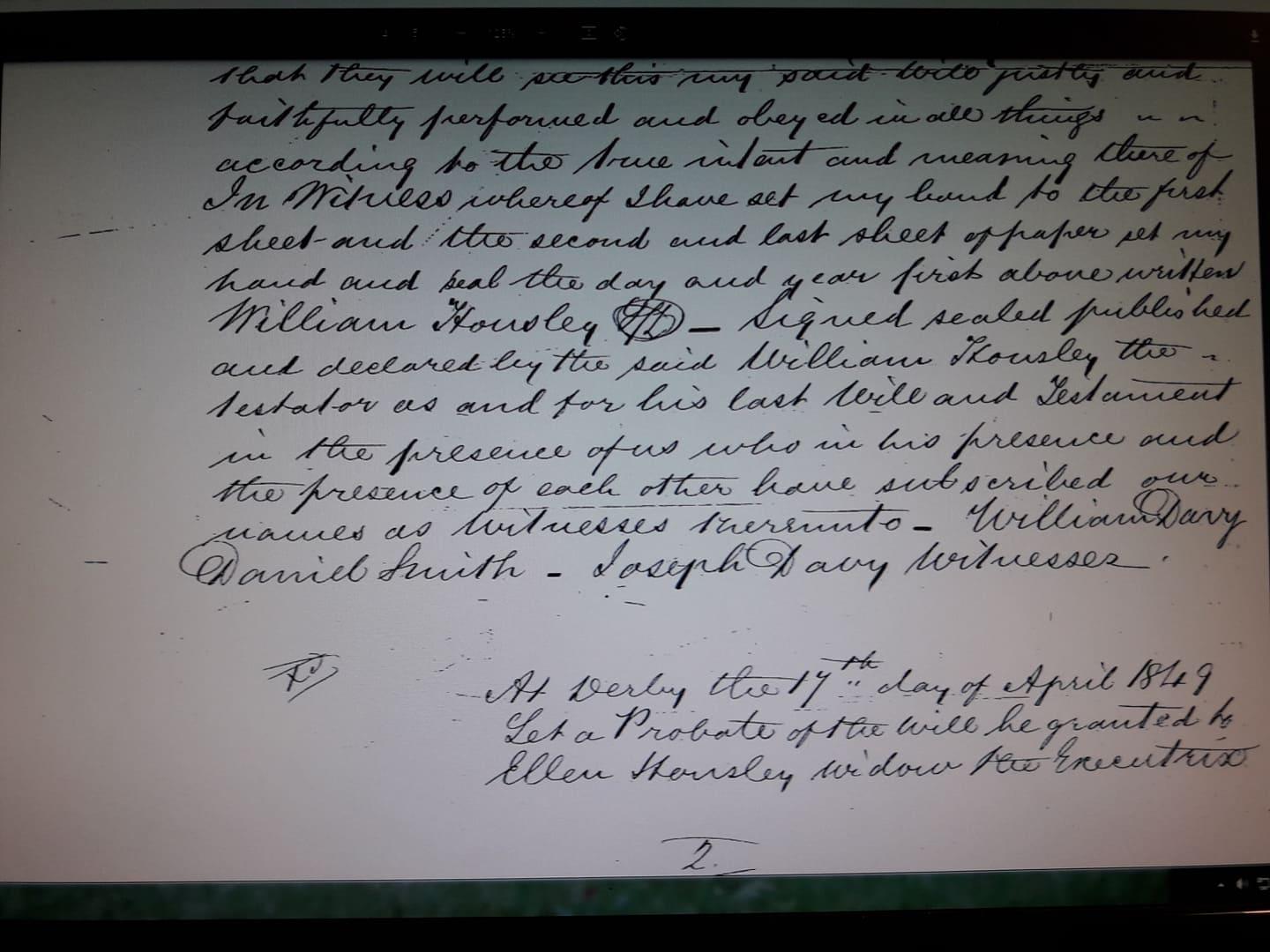
An excerpt from Barbara Housley’s Narrative on the Letters:
A comment in a letter from Joseph (August 6, 1873) indicated that William was married twice and that his wives were sisters: “What do you think that I believe that Mary Ann is trying to make our father’s will of no account as she says that my father’s marriage with our mother was not lawful he marrying two sisters. What do you think of her? I have heard my mother say something about paying a fine at the time of the marriage to make it legal.” Markwell and Saul in The A-Z Guide to Tracing Ancestors in Britain explain that marriage to a deceased wife’s sister was not permissible under Canon law as the relationship was within the prohibited degrees. However, such marriages did take place–usually well away from the couple’s home area. Up to 1835 such marriages were not void but were voidable by legal action. Few such actions were instituted but the risk was always there.
Joseph wrote that when Emma was married, Ellen “broke up the comfortable home and the things went to Derby and she went to live with them but Derby didn’t agree with her so she left again leaving her things behind and came to live with John in the new house where she died.” Ellen was listed with John’s household in the 1871 census.
In May 1872, the Ilkeston Pioneer carried this notice: “Mr. Hopkins will sell by auction on Saturday next the eleventh of May 1872 the whole of the useful furniture, sewing machine, etc. nearly new on the premises of the late Mrs. Housley at Smalley near Heanor in the county of Derby. Sale at one o’clock in the afternoon.”There were hard feelings between Mary Ann and Ellen and her children. Anne wrote: “If you remember we were not very friendly when you left. They never came and nothing was too bad for Mary Ann to say of Mother and me, but when Robert died Mother sent for her to the funeral but she did not think well to come so we took no more notice. She would not allow her children to come either.”
Mary Ann was still living in May 1872. Joseph implied that she and her brother, Will “intend making a bit of bother about the settlement of the bit of property” left by their mother. The 1871 census listed Mary Ann’s occupation as “income from houses.”In July 1872, Joseph introduced Ruth’s husband: “No doubt he is a bad lot. He is one of the Heath’s of Stanley Common a miller and he lives at Smalley Mill” (Ruth Heath was Mary Anne Housley’s daughter)
In 1873 Joseph wrote, “He is nothing but a land shark both Heath and his wife and his wife is the worst of the two. You will think these is hard words but they are true dear brother.” The solicitor, Abraham John Flint, was not at all pleased with Heath’s obstruction of the settlement of the estate. He wrote on June 30, 1873: “Heath agreed at first and then because I would not pay his expenses he refused and has since instructed another solicitor for his wife and Mrs. Weston who have been opposing us to the utmost. I am concerned for all parties interested except these two….The judge severely censured Heath for his conduct and wanted to make an order for sale there and then but Heath’s council would not consent….” In June 1875, the solicitor wrote: “Heath bid for the property but it fetched more money than he could give for it. He has been rather quieter lately.”In May 1872, Joseph wrote: “For what do you think, John has sold his share and he has acted very bad since his wife died and at the same time he sold all his furniture. You may guess I have never seen him but once since poor mother’s funeral and he is gone now no one knows where.”
In 1876, the solicitor wrote to George: “Have you heard of John Housley? He is entitled to Robert’s share and I want him to claim it.”
Anne intended that one third of the inheritance coming to her from her father and her grandfather, William Carrington, be divided between her four nieces: Sam’s three daughters and John’s daughter Elizabeth.
In the same letter (December 15, 1872), Joseph wrote:
“I think we have now found all out now that is concerned in the matter for there was only Sam that we did not know his whereabouts but I was informed a week ago that he is dead–died about three years ago in Birmingham Union. Poor Sam. He ought to have come to a better end than that”However, Samuel was still alive was on the 1871 census in Henley in Arden, and no record of his death can be found. Samuel’s brother in law said he was dead: we do not know why he lied, or perhaps the brothers were lying to keep his share, or another possibility is that Samuel himself told his brother in law to tell them that he was dead. I am inclined to think it was the latter.
Excerpts from Barbara Housley’s Narrative on the Letters continued:
Charles went to Australia in 1851, and was last heard from in January 1853. According to the solicitor, who wrote to George on June 3, 1874, Charles had received advances on the settlement of their parent’s estate. “Your promissory note with the two signed by your brother Charles for 20 pounds he received from his father and 20 pounds he received from his mother are now in the possession of the court.”
In December 1872, Joseph wrote: “I’m told that Charles two daughters has wrote to Smalley post office making inquiries about his share….” In January 1876, the solicitor wrote: “Charles Housley’s children have claimed their father’s share.”
In the Adelaide Observer 28 Aug 1875
HOUSLEY – wanted information
as to the Death, Will, or Intestacy, and
Children of Charles Housley, formerly of
Smalley, Derbyshire, England, who died at
Geelong or Creewick Creek Diggings, Victoria
August, 1855. His children will hear of something to their advantage by communicating with
Mr. A J. Flint, solicitor, Derby, England.
June 16,1875.The Diggers & Diggings of Victoria in 1855. Drawn on Stone by S.T. Gill:
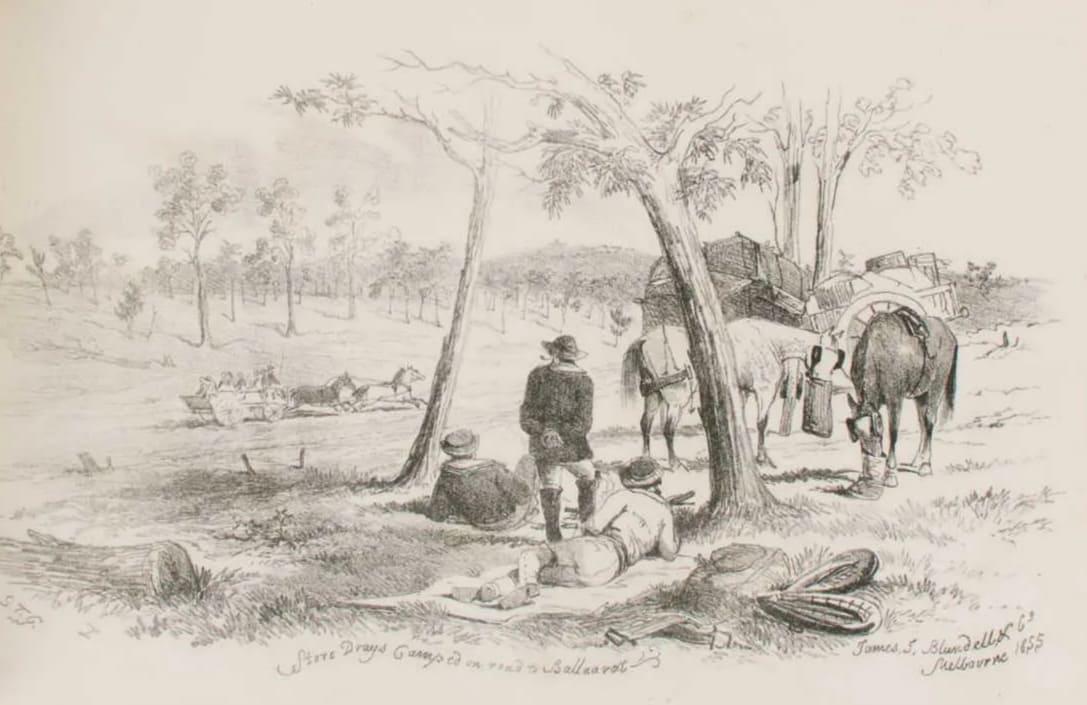
The court case:
Kerry v Housley.
Documents: Bill, demurrer.
Plaintiffs: Samuel Kerry and Joseph Housley.
Defendants: William Housley, Joseph Housley (deleted), Edwin Welch Harvey, Eleanor Harvey (deleted), Ernest Harvey infant, William Stafford, Elizabeth Stafford his wife, Mary Ann Housley, George Purdy and Catherine Purdy his wife, Elizabeth Housley, Mary Ann Weston widow and William Heath and Ruth Heath his wife (deleted).
Provincial solicitor employed in Derbyshire.
Date: 1873From the Narrative on the Letters:
The solicitor wrote on May 23, 1874: “Lately I have not written because I was not certain of your address and because I doubted I had much interesting news to tell you.” Later, Joseph wrote concerning the problems settling the estate, “You see dear brother there is only me here on our side and I cannot do much. I wish you were here to help me a bit and if you think of going for another summer trip this turn you might as well run over here.”
In March 1873, Joseph wrote: “You ask me what I think of you coming to England. I think as you have given the trustee power to sign for you I think you could do no good but I should like to see you once again for all that. I can’t say whether there would be anything amiss if you did come as you say it would be throwing good money after bad.”
In September 1872 Joseph wrote; “My wife is anxious to come. I hope it will suit her health for she is not over strong.” Elsewhere Joseph wrote that Harriet was “middling sometimes. She is subject to sick headaches. It knocks her up completely when they come on.” In December 1872 Joseph wrote, “Now dear brother about us coming to America you know we shall have to wait until this affair is settled and if it is not settled and thrown into Chancery I’m afraid we shall have to stay in England for I shall never be able to save money enough to bring me out and my family but I hope of better things.”
On July 19, 1875 Abraham Flint (the solicitor) wrote: “Joseph Housley has removed from Smalley and is working on some new foundry buildings at Little Chester near Derby. He lives at a village called Little Eaton near Derby. If you address your letter to him as Joseph Housley, carpenter, Little Eaton near Derby that will no doubt find him.”In his last letter (February 11, 1874), Joseph sounded very discouraged and wrote that Harriet’s parents were very poorly and both had been “in bed for a long time.” In addition, Harriet and the children had been ill.
The move to Little Eaton may indicate that Joseph received his settlement because in August, 1873, he wrote: “I think this is bad news enough and bad luck too, but I have had little else since I came to live at Kiddsley cottages but perhaps it is all for the best if one could only think so. I have begun to think there will be no chance for us coming over to you for I am afraid there will not be so much left as will bring us out without it is settled very shortly but I don’t intend leaving this house until it is settled either one way or the other. ”Joseph’s letters were much concerned with the settling of their mother’s estate. In 1854, Anne wrote, “As for my mother coming (to America) I think not at all likely. She is tied here with her property.” A solicitor, Abraham John Flint of 42 Full Street Derby, was engaged by John following the death of their mother. On June 30, 1873 the solicitor wrote: “Dear sir, On the death of your mother I was consulted by your brother John. I acted for him with reference to the sale and division of your father’s property at Smalley. Mr. Kerry was very unwilling to act as trustee being over 73 years of age but owing to the will being a badly drawn one we could not appoint another trustee in his place nor could the property be sold without a decree of chancery. Therefore Mr. Kerry consented and after a great deal of trouble with Heath who has opposed us all throughout whenever matters did not suit him, we found the title deeds and offered the property for sale by public auction on the 15th of July last. Heath could not find his purchase money without mortaging his property the solicitor which the mortgagee employed refused to accept Mr. Kerry’s title and owing to another defect in the will we could not compel them.”
In July 1872, Joseph wrote, “I do not know whether you can remember who the trustee was to my father’s will. It was Thomas Watson and Samuel Kerry of Smalley Green. Mr. Watson is dead (died a fortnight before mother) so Mr. Kerry has had to manage the affair.”
On Dec. 15, 1972, Joseph wrote, “Now about this property affair. It seems as far off of being settled as ever it was….” and in the following March wrote: “I think we are as far off as ever and farther I think.”
Concerning the property which was auctioned on July 15, 1872 and brought 700 pounds, Joseph wrote: “It was sold in five lots for building land and this man Heath bought up four lots–that is the big house, the croft and the cottages. The croft was made into two lots besides the piece belonging to the big house and the cottages and gardens was another lot and the little intake was another. William Richardson bought that.” Elsewhere Richardson’s purchase was described as “the little croft against Smith’s lane.” Smith’s Lane was probably named for their neighbor Daniel Smith, Mrs. Davy’s father.
But in December 1872, Joseph wrote that they had not received any money because “Mr. Heath is raising all kinds of objections to the will–something being worded wrong in the will.” In March 1873, Joseph “clarified” matters in this way: “His objection was that one trustee could not convey the property that his signature was not guarantee sufficient as it states in the will that both trustees has to sign the conveyance hence this bother.”
Joseph indicated that six shares were to come out of the 700 pounds besides Will’s 20 pounds. Children were to come in for the parents shares if dead. The solicitor wrote in 1873, “This of course refers to the Kidsley property in which you take a one seventh share and which if the property sells well may realize you about 60-80 pounds.” In March 1873 Joseph wrote: “You have an equal share with the rest in both lots of property, but I am afraid there will be but very little for any of us.”The other “lot of property” was “property in Smalley left under another will.” On July 17, 1872, Joseph wrote: “It was left by my grandfather Carrington and Uncle Richard is trustee. He seems very backward in bringing the property to a sale but I saw him and told him that I for one expect him to proceed with it.” George seemed to have difficulty understanding that there were two pieces of property so Joseph explained further: “It was left by my grandfather Carrington not by our father and Uncle Richard is the trustee for it but the will does not give him power to sell without the signatures of the parties concerned.” In June 1873 the solicitor Abraham John Flint asked: “Nothing has been done about the other property at Smalley at present. It wants attention and the other parties have asked me to attend to it. Do you authorize me to see to it for you as well?”
After Ellen’s death, the rent was divided between Joseph, Will, Mary Ann and Mr. Heath who bought John’s share and was married to Mary Ann’s daughter, Ruth. Joseph said that Mr. Heath paid 40 pounds for John’s share and that John had drawn 110 pounds in advance. The solicitor said Heath said he paid 60. The solicitor said that Heath was trying to buy the shares of those at home to get control of the property and would have defied the absent ones to get anything.
In September 1872 Joseph wrote that the lawyer said the trustee cannot sell the property at the bottom of Smalley without the signatures of all parties concerned in it and it will have to go through chancery court which will be a great expense. He advised Joseph to sell his share and Joseph advised George to do the same.George sent a “portrait” so that it could be established that it was really him–still living and due a share. Joseph wrote (July 1872): “the trustee was quite willing to (acknowledge you) for the portrait I think is a very good one.” Several letters later in response to an inquiry from George, Joseph wrote: “The trustee recognized you in a minute…I have not shown it to Mary Ann for we are not on good terms….Parties that I have shown it to own you again but they say it is a deal like John. It is something like him, but I think is more like myself.”
In September 1872 Joseph wrote that the lawyer required all of their ages and they would have to pay “succession duty”. Joseph requested that George send a list of birth dates.On May 23, 1874, the solicitor wrote: “I have been offered 240 pounds for the three cottages and the little house. They sold for 200 pounds at the last sale and then I was offered 700 pounds for the whole lot except Richardson’s Heanor piece for which he is still willing to give 58 pounds. Thus you see that the value of the estate has very materially increased since the last sale so that this delay has been beneficial to your interests than other-wise. Coal has become much dearer and they suppose there is coal under this estate. There are many enquiries about it and I believe it will realize 800 pounds or more which increase will more than cover all expenses.” Eventually the solicitor wrote that the property had been sold for 916 pounds and George would take a one-ninth share.
January 14, 1876: “I am very sorry to hear of your lameness and illness but I trust that you are now better. This matter as I informed you had to stand over until December since when all the costs and expenses have been taxed and passed by the court and I am expecting to receive the order for these this next week, then we have to pay the legacy duty and them divide the residue which I doubt won’t come to very much amongst so many of you. But you will hear from me towards the end of the month or early next month when I shall have to send you the papers to sign for your share. I can’t tell you how much it will be at present as I shall have to deduct your share with the others of the first sale made of the property before it went to court.
Wishing you a Happy New Year, I am Dear Sir, Yours truly
Abram J. Flint”September 15, 1876 (the last letter)
“I duly received your power of attorney which appears to have been properly executed on Thursday last and I sent it on to my London agent, Mr. Henry Lyvell, who happens just now to be away for his annual vacation and will not return for 14 or 20 days and as his signature is required by the Paymaster General before he will pay out your share, it must consequently stand over and await his return home. It shall however receive immediate attention as soon as he returns and I hope to be able to send your checque for the balance very shortly.”1874 in chancery:
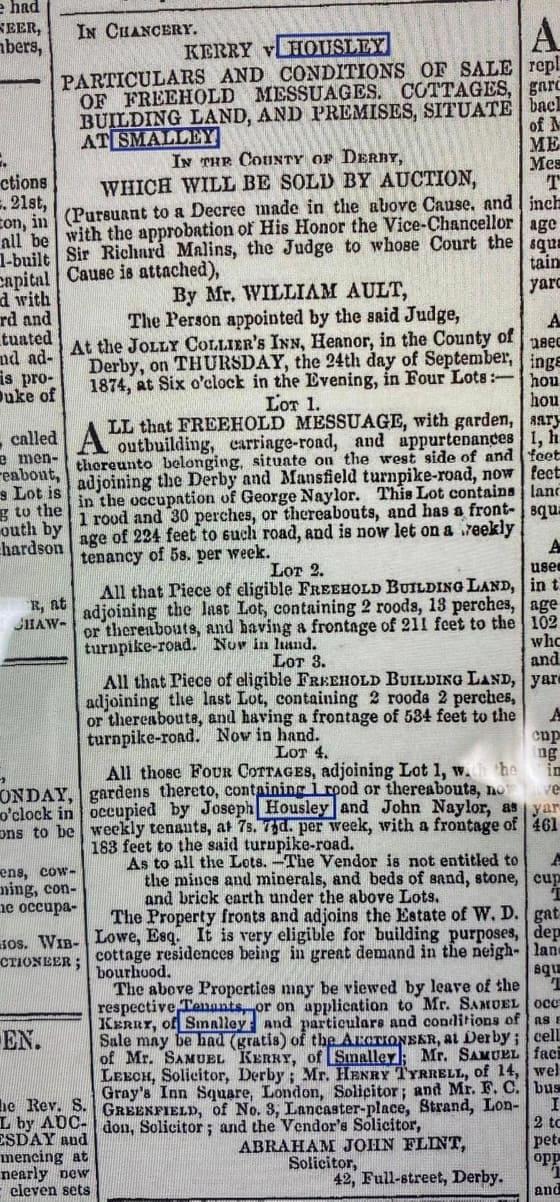 December 18, 2021 at 10:02 am #6242
In reply to: The Elusive Samuel Housley and Other Family Stories
The Housley Letters
We discovered that one of Samuel’s brothers, George Housley 1826-1877, emigrated to America in 1851, to Solebury, in Pennsylvania. Another brother, Charles 1823-1856, emigrated to Australia at the same time.
I wrote to the Solebury Historical Society to ask them if they had any information on the Housleys there. About a month later I had a very helpful and detailed reply from them.
There were Housley people in Solebury Township and nearby communities from 1854 to at least 1973, perhaps 1985. George Housley immigrated in 1851, arriving in New York from London in July 1851 on the ship “Senator”. George was in Solebury by 1854, when he is listed on the tax roles for the Township He didn’t own land at that time. Housley family members mostly lived in the Lumberville area, a village in Solebury, or in nearby Buckingham or Wrightstown. The second wife of Howard (aka Harry) Housley was Elsa (aka Elsie) R. Heed, the daughter of the Lumberville Postmaster. Elsie was the proprietor of the Lumberville General Store from 1939 to 1973, and may have continued to live in Lumberville until her death in 1985. The Lumberville General Store was, and still is, a focal point of the community. The store was also the official Post Office at one time, hence the connection between Elsie’s father as Postmaster, and Elsie herself as the proprietor of the store. The Post Office function at Lumberville has been reduced now to a bank of cluster mailboxes, and official U.S. Postal functions are now in Point Pleasant, PA a few miles north of Lumberville.
We’ve attached a pdf of the Housley people buried in Carversville Cemetery, which is in the town next to Lumberville, and is still in Solebury Township. We hope this list will confirm that these are your relatives.It doesn’t seem that any Housley people still live in the area. Some of George’s descendents moved to Wilkes-Barre, PA and Flemington, NJ. One descendent, Barbara Housley, lived in nearby Doylestown, PA, which is the county seat for Bucks County. She actually visited Solebury Township Historical Society looking for Housley relatives, and it would have been nice to connect you with her. Unfortunately she died in 2018. Her obituary is attached in case you want to follow up with the nieces and great nieces who are listed.
Lumberville General Store, Pennsylvania, Elsie Housley:
I noticed the name of Barbara’s brother Howard Housley in her obituary, and found him on facebook. I knew it was the right Howard Housley as I recognized Barbara’s photograph in his friends list as the same photo in the obituary. Howard didn’t reply initially to a friend request from a stranger, so I found his daughter Laura on facebook and sent her a message. She replied, spoke to her father, and we exchanged email addresses and were able to start a correspondence. I simply could not believe my luck when Howard sent me a 17 page file of Barbara’s Narrative on the Letters with numerous letter excerpts interspersed with her own research compiled on a six month trip to England.
The letters were written to George between 1851 and the 1870s, from the Housley family in Smalley.
Narrative of Historic Letters ~ Barbara Housley.
AND BELIEVE ME EVER MY DEAR BROTHER, YOUR AFFECTIONATE FAMILY
In February 1991, I took a picture of my 16 month old niece Laura Ann Housley standing near the tombstones of her great-great-great-grandparents, George and Sarah Ann Hill Housley. The occassion was the funeral of another Sarah Housley, Sarah Lord Housley, wife of Albert Kilmer Housley, youngest son of John Eley Housley (George and Sarah Ann’s first born). Laura Ann’s great-grandfather (my grandfather) was another George, John Eley’s first born. It was Aunt Sarah who brought my mother, Lois, a packet of papers which she had found in the attic. Mom spent hours transcribing the letters which had been written first horizontally and then vertically to save paper. What began to emerge was a priceless glimpse into the lives and concerns of Housleys who lived and died over a century ago. All of the letters ended with the phrase “And believe me ever my dear brother, your affectionate….”
The greeting and opening remarks of each of the letters are included in a list below. The sentence structure and speech patterns have not been altered however spelling and some punctuation has been corrected. Some typical idiosyncrasies were: as for has, were for where and vice versa, no capitals at the beginnings of sentences, occasional commas and dashes but almost no periods. Emma appears to be the best educated of the three Housley letter-writers. Sister-in-law Harriet does not appear to be as well educated as any of the others. Since their mother did not write but apparently was in good health, it must be assumed that she could not.
The people discussed and described in the following pages are for the most part known to be the family and friends of the Housleys of Smalley, Derbyshire, England. However, practically every page brings conjectures about the significance of persons who are mentioned in the letters and information about persons whose names seem to be significant but who have not yet been established as actual members of the family.To say this was a priceless addition to the family research is an understatement. I have since, with Howard’s permission, sent the file to the Derby Records Office for their family history section. We are hoping that Howard will find the actual letters in among the boxes he has of his sisters belongings. Some of the letters mention photographs that were sent. Perhaps some will be found.
December 15, 2021 at 7:53 am #6234In reply to: The Elusive Samuel Housley and Other Family Stories
Ben Warren
Derby County and England football legend who died aged 37 penniless and ‘insane’
Ben Warren 1879 – 1917 was Samuel Warren’s (my great grandfather) cousin.
From the Derby Telegraph:
Just 17 months after earning his 22nd England cap, against Scotland at Everton on April 1, 1911, he was certified insane. What triggered his decline was no more than a knock on the knee while playing for Chelsea against Clapton Orient.
The knee would not heal and the longer he was out, the more he fretted about how he’d feed his wife and four children. In those days, if you didn’t play, there was no pay.
…..he had developed “brain fever” and this mild-mannered man had “become very strange and, at times, violent”. The coverage reflected his celebrity status.
On December 15, 1911, as Rick Glanvill records in his Official Biography of Chelsea FC: “He was admitted to a private clinic in Nottingham, suffering from acute mania, delusions that he was being poisoned and hallucinations of hearing and vision.”
He received another blow in February, 1912, when his mother, Emily, died. She had congestion of the lungs and caught influenza, her condition not helped, it was believed, by worrying about Ben.
She had good reason: her famous son would soon be admitted to the unfortunately named Derby County Lunatic Asylum.
As Britain sleepwalked towards the First World War, Ben’s condition deteriorated. Glanvill writes: “His case notes from what would be a five-year stay, catalogue a devastating decline in which he is at various times described as incoherent, restless, destructive, ‘stuporose’ and ‘a danger to himself’.’”
photo: Football 27th April 1914. A souvenir programme for the testimonial game for Chelsea and England’s Ben Warren, (pictured) who had been declared insane and sent to a lunatic asylum. The game was a select XI for the North playing a select XI from The South proceeds going to Warren’s family.
In September, that decline reached a new and pitiable low. The following is an abridged account of what The Courier called “an amazing incident” that took place on September 4.
“Spotted by a group of men while walking down Derby Road in Nottingham, a man was acting strangely, smoking a cigarette and had nothing on but a collar and tie.
“He jumped about the pavement and roadway, as though playing an imaginary game of football. When approached, he told them he was going to Trent Bridge to play in a match and had to be there by 3.30.”
Eventually he was taken to a police station and recognised by a reporter as England’s erstwhile right-half. What made the story even harder to digest was that Ben had escaped from the asylum and walked the 20 miles to Nottingham apparently unnoticed.
He had played at “Trent Bridge” many times – at least on Nottingham Forest’s adjacent City Ground.
As a shocked nation came to terms with the desperate plight of one of its finest footballers, some papers suggested his career was not yet over. And his relatives claimed that he had been suffering from nothing more than a severe nervous breakdown.
He would never be the same again – as a player or a man. He wasn’t even a shadow of the weird “footballer” who had walked 20 miles to Nottingham.
Then, he had nothing on, now he just had nothing – least of all self-respect. He ripped sheets into shreds and attempted suicide, saying: “I’m no use to anyone – and ought to be out of the way.”
“A year before his suicide attempt in 1916 the ominous symptom of ‘dry cough’ had been noted. Two months after it, in October 1916, the unmistakable signs of tuberculosis were noted and his enfeebled body rapidly succumbed.
At 11.30pm on 15 January 1917, international footballer Ben Warren was found dead by a night attendant.
He was 37 and when they buried him the records described him as a “pauper’.”
However you look at it, it is the salutary tale of a footballer worrying about money. And it began with a knock on the knee.
On 14th November 2021, Gill Castle posted on the Newhall and Swadlincote group:
I would like to thank Colin Smith and everyone who supported him in getting my great grandfather’s grave restored (Ben Warren who played for Derby, Chelsea and England)
The month before, Colin Smith posted:
My Ben Warren Journey is nearly complete.
It started two years ago when I was sent a family wedding photograph asking if I recognised anyone. My Great Great Grandmother was on there. But soon found out it was the wedding of Ben’s brother Robert to my 1st cousin twice removed, Eveline in 1910.
I researched Ben and his football career and found his resting place in St Johns Newhall, all overgrown and in a poor state with the large cross all broken off. I stood there and decided he needed to new memorial & headstone. He was our local hero, playing Internationally for England 22 times. He needs to be remembered.
After seeking family permission and Council approval, I had a quote from Art Stone Memorials, Burton on Trent to undertake the work. Fundraising then started and the memorial ordered.
Covid came along and slowed the process of getting materials etc. But we have eventually reached the final installation today.
I am deeply humbled for everyone who donated in January this year to support me and finally a massive thank you to everyone, local people, football supporters of Newhall, Derby County & Chelsea and football clubs for their donations.
Ben will now be remembered more easily when anyone walks through St Johns and see this beautiful memorial just off the pathway.
Finally a huge thank you for Art Stone Memorials Team in everything they have done from the first day I approached them. The team have worked endlessly on this project to provide this for Ben and his family as a lasting memorial. Thank you again Alex, Pat, Matt & Owen for everything. Means a lot to me.
The final chapter is when we have a dedication service at the grave side in a few weeks time,
Ben was born in The Thorntree Inn Newhall South Derbyshire and lived locally all his life.
He played local football for Swadlincote, Newhall Town and Newhall Swifts until Derby County signed Ben in May 1898. He made 242 appearances and scored 19 goals at Derby County.
28th July 1908 Chelsea won the bidding beating Leicester Fosse & Manchester City bids.
Ben also made 22 appearance’s for England including the 1908 First Overseas tour playing Austria twice, Hungary and Bohemia all in a week.
28 October 1911 Ben Injured his knee and never played football again
Ben is often compared with Steven Gerard for his style of play and team ethic in the modern era.
Herbert Chapman ( Player & Manager ) comments “ Warren was a human steam engine who played through 90 minutes with intimidating strength and speed”.
Charles Buchan comments “I am certain that a better half back could not be found, Part of the Best England X1 of all time”
Chelsea allowed Ben to live in Sunnyside Newhall, he used to run 5 miles every day round Bretby Park and had his own gym at home. He was compared to the likes of a Homing Pigeon, as he always came back to Newhall after his football matches.
Ben married Minnie Staley 21st October 1902 at Emmanuel Church Swadlincote and had four children, Harry, Lillian, Maurice & Grenville. Harry went on to be Manager at Coventry & Southend following his father in his own career as football Manager.
After Ben’s football career ended in 1911 his health deteriorated until his passing at Derby Pastures Hospital aged 37yrs
Ben’s youngest son, Grenville passed away 22nd May 1929 and is interred together in St John’s Newhall with his Father
His wife, Minnie’s ashes are also with Ben & Grenville.
Thank you again everyone.
RIP Ben Warren, our local Newhall Hero. You are remembered.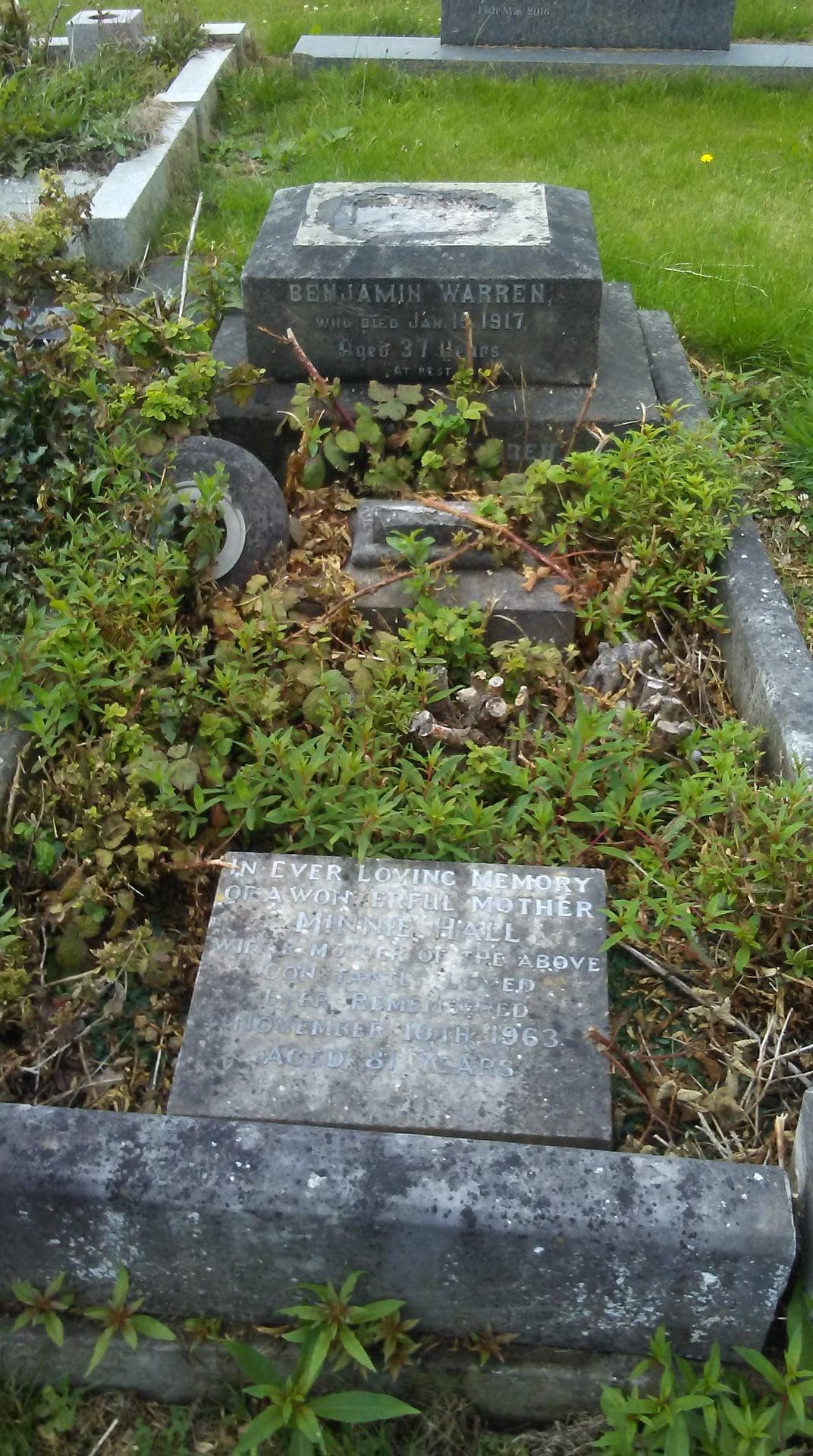
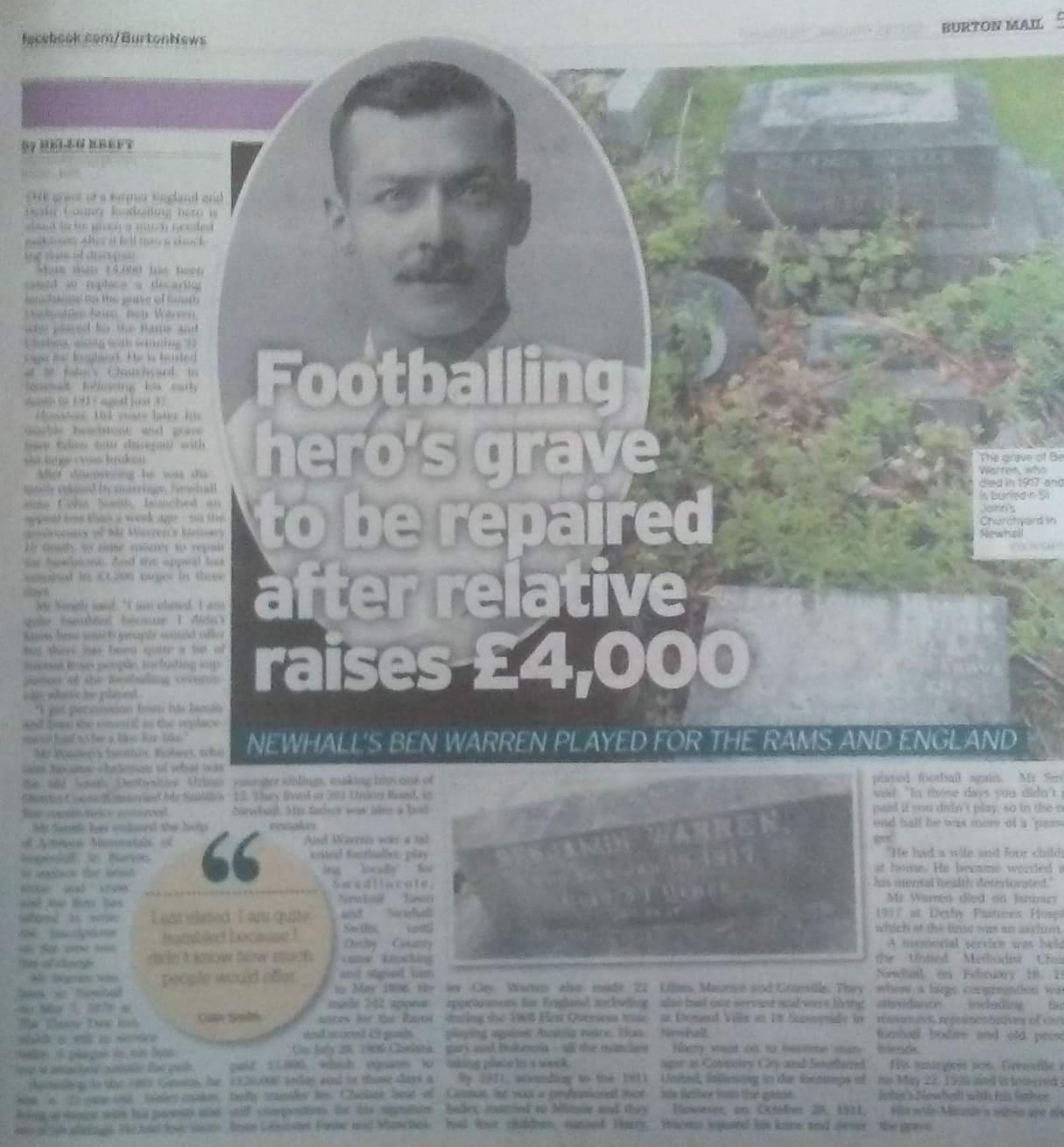
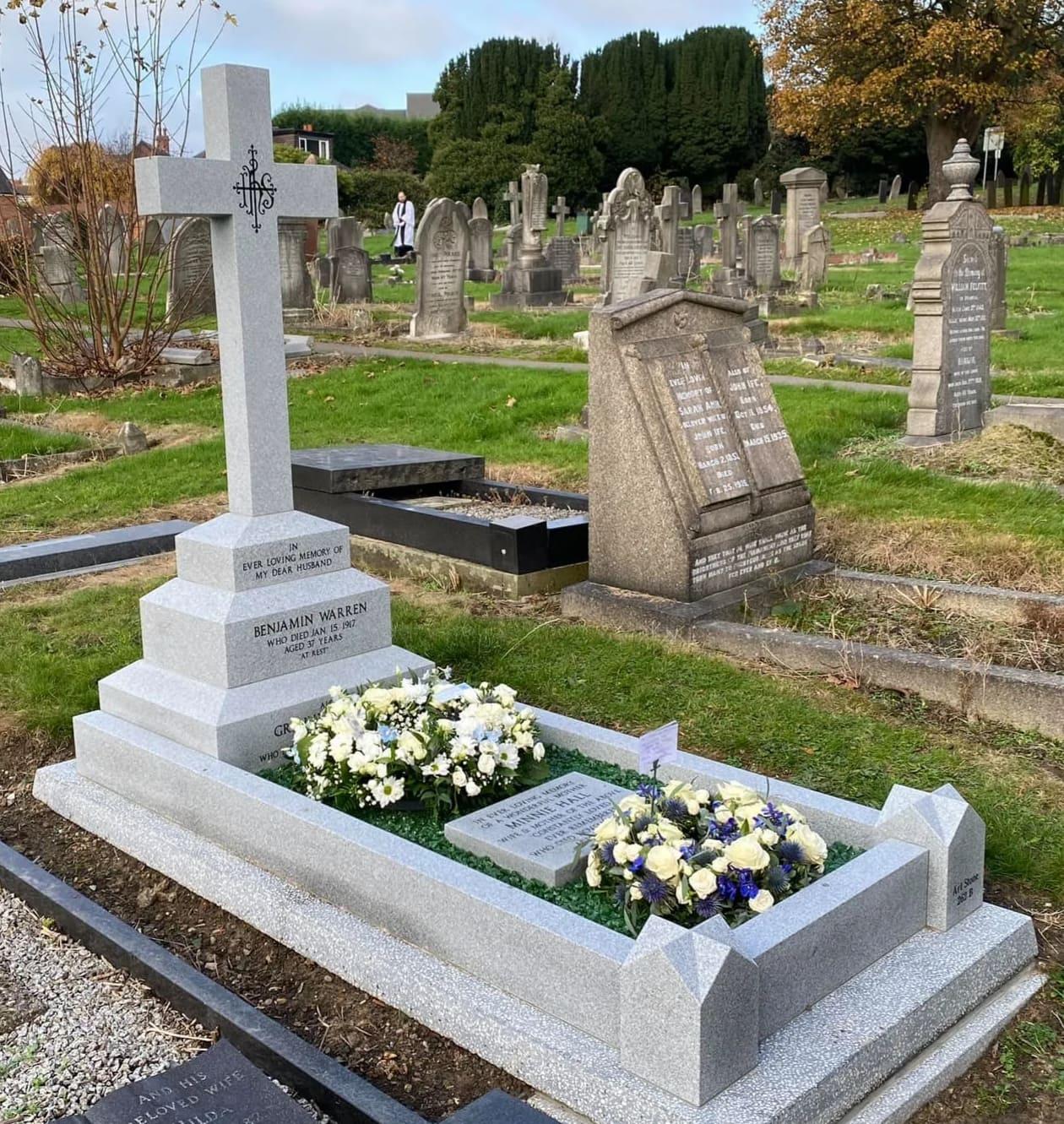 December 14, 2021 at 10:26 pm #6232
In reply to: The Elusive Samuel Housley and Other Family Stories
Looking for Photographs
I appreciate how fortunate I am that there are so many family photographs on various sides of the family, however, on some sides, for example the Warrens and the Grettons, there are no photographs. I’d love to find a photograph of my great grandmother Florence Nightingale Gretton, as she is the only great grandparent I don’t have a photo of.
I look on other people’s family trees on ancestry websites, and I join local town memories and old photos groups on facebook hoping to find photos. And I have found a few, and what a prize it is to find a photograph of someone in your tree. None found so far of Florence Nightingale Gretton, although I found one of her sister Clara, her brother Charles, and another potential one, posted on a Swadlincote group: a Warren wedding group in 1910.
Charles Herbert Gretton 1876-1954 and his wife Mary Ann Illsley:
The wedding of Robert Adolphus Warren and Eveline Crofts. Photo in the collection of Colin Smith, Eveline Crofts first cousin twice removed. Reposted with permission:
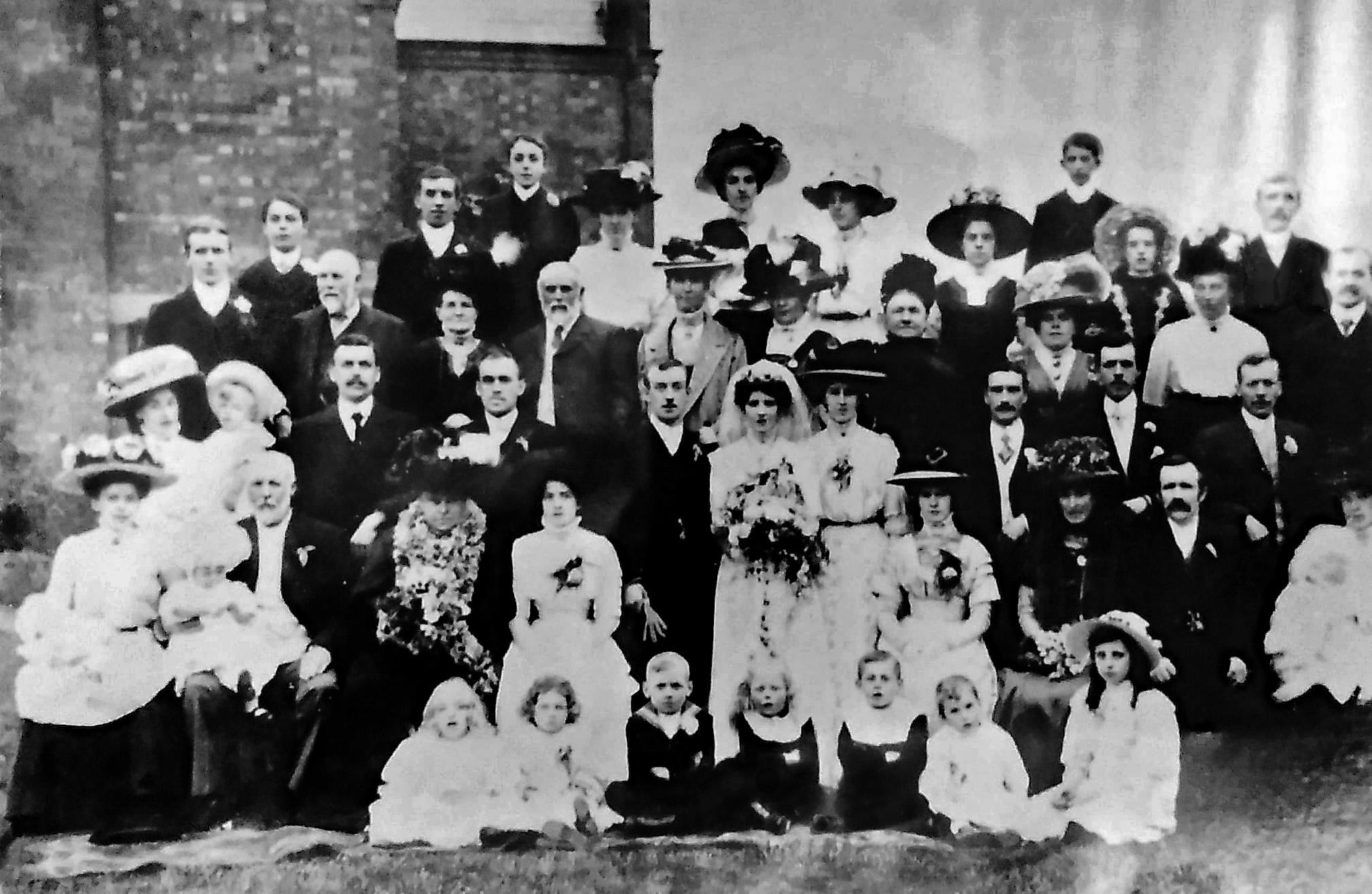
The groom was Florence’s husbands cousin, but identifying my great grandparents in the crowd would be guesswork. My grandmother was born in 1906, and could be one of the children sitting at the front. It was an interesting exercise to note the family likenesses.
Ben Warren the footballer is the man on the far right, on the same line as the groom. His children are sitting in front of the bride.
There are many mentions of Ben Warren the footballer on the Newhall and Swadlincote groups ~ Ben Warren was my great grandfathers cousin, and is a story in itself ~ and a photograph of Ben’s daughter, Lillian Warren was posted.
Lillian Warren (reposted with permission)
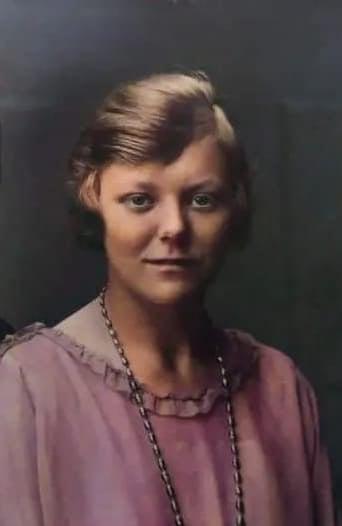
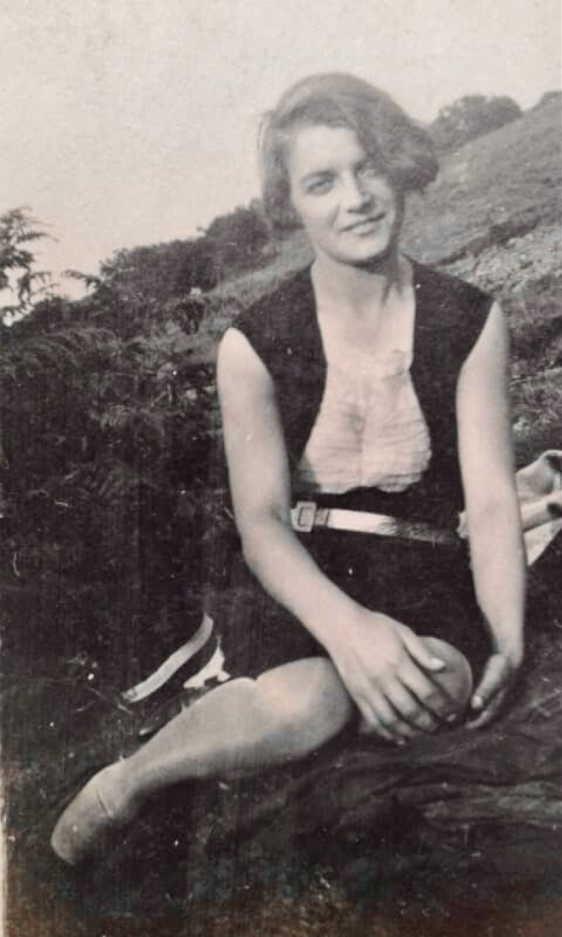
Lillian was my grandmothers first cousin once removed or second cousin. The resemblance to my grandmother, Florence Noreen Warren, seems striking.
December 13, 2021 at 3:38 pm #6229In reply to: The Elusive Samuel Housley and Other Family Stories
Gretton Tailoresses of Swadlincote and the Single Journalist Boot Maker Next Door
The Purdy’s, Housley’s and Marshall’s are my mothers fathers side of the family. The Warrens, Grettons and Staleys are from my mothers mothers side.
I decided to add all the siblings to the Gretton side of the family, in search of some foundation to a couple of family anecdotes. My grandmother, Nora Marshall, whose mother was Florence Nightingale Gretton, used to mention that our Gretton side of the family were related to the Burton Upon Trent Grettons of Bass, Ratcliff and Gretton, the brewery. She also said they were related to Lord Gretton of Stableford Park in Leicestershire. When she was a child, she said parcels of nice clothes were sent to them by relatives.
It should be noted however that Baron Gretton is a title in the Peerage of the United Kingdom, and was created in 1944 for the brewer and Conservative politician John Gretton. He was head of the brewery firm of Bass, Ratcliff & Gretton Ltd of Burton upon Trent. So they were not members of the Peerage at the time of this story.
What I found was unexpected.
My great great grandfather Richard Gretton 1833-1898, a baker in Swadlincote, didn’t have any brothers, but he did have a couple of sisters.
One of them, Frances, born 1831, never married, but had four children. She stayed in the family home, and named her children Gretton. In 1841 and 1851 she’s living with parents and siblings. In 1861 she is still living with parents and now on the census she has four children all named Gretton listed as grandchildren of her father.
In 1871, her mother having died in 1866, she’s still living with her father William Gretton, Frances is now 40, and her son William 19 and daughter Jane 15 live there.
By the time she is 50 in 1881 and her parents have died she’s head of the house with 5 children all called Gretton, including her daughter Jane Gretton aged 24.Twenty five year old Robert Staley is listed on the census transcription as living in the same household, but when viewing the census image it becomes clear that he lived next door, on his own and was a bootmaker, and on the other side, his parents Benjamin and Sarah Staley lived at the Prince of Wales pub with two other siblings.
Who was fathering all these Gretton children?
It seems that Jane did the same thing as her mother: she stayed at home and had three children, all with the name Gretton. Jane Gretton named her son, born in 1878, Michael William Staley Gretton, which would suggest that Staley was the name of the father of the child/children of Jane Gretton.
The father of Frances Gretton’s four children is not known, and there is no father on the birth registers, although they were all baptized.
I found a photo of Jane Gretton on a family tree on an ancestry site, so I contacted the tree owner hoping that she had some more information, but she said no, none of the older family members would explain when asked about it. Jane later married Tom Penn, and Jane Gretton’s children are listed on census as Tom Penn’s stepchildren.
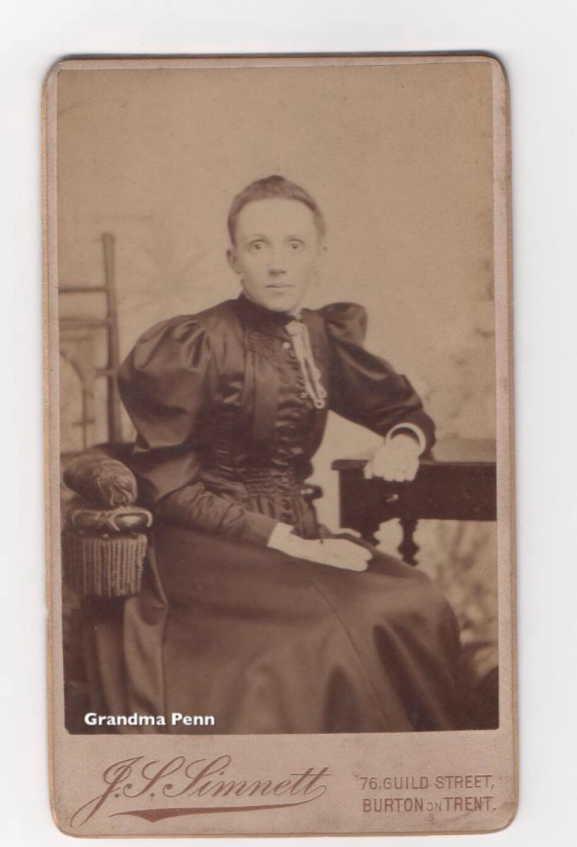
It seems that Robert Staley (who may or may not be the father of Jane’s children) never married. In 1891 Robert is 35, single, living with widowed mother Sarah in Swadlincote. Sarah is living on own means and Robert has no occupation. On the 1901 census Robert is an unmarried 45 year old journalist and author, living with his widowed mother Sarah Staley aged 79, in Swadlincote.
There are at least three Staley Warren marriages in the family, and at least one Gretton Staley marriage.
There is a possibility that the father of Frances’s children could be a Gretton, but impossible to know for sure. William Gretton was a tailor, and several of his children and grandchildren were tailoresses. The Gretton family who later bought Stableford Park lived not too far away, and appear to be well off with a dozen members of live in staff on the census. Did our Gretton’s the tailors make their clothes? Is that where the parcels of nice clothes came from?
Perhaps we’ll find a family connection to the brewery Grettons, or find the family connection was an unofficial one, or that the connection is further back.
I suppose luckily, this isn’t my direct line but an exploration of an offshoot, so the question of paternity is merely a matter of curiosity. It is a curious thing, those Gretton tailors of Church Gresley near Burton upon Trent, and there are questions remaining.
September 14, 2021 at 3:38 pm #6211In reply to: The Precious Life and Rambles of Liz Tattler
Today the planets are aligned, thought Liz as she looked at the blue sky out the French door. The frills of her glitter pink Charnel bathing suit wiggled with excitement.
It was one of those rare days of this summer where rain wasn’t pouring somewhere in the garden. Every single day: clouds, clouds, clouds. If they weren’t above the mansion, they were above the pool. If they weren’t above the pool, they were flooding the lawn in between the mansion and the pool.
But today, the sun had risen in a sky free of clouds and Liz was determined to have that dip in the newly repaired swimming pool with a watermelon mojito served by Roberto in his shiny leather speedo. The pool had been half frozen half boiling for so long that they had forgotten the swimming part. Once fixed, the summer had turned into a mid season rainy weather.
‘I don’t want to get wet before I get into the pool’, Liz had said to Finnley.
Liz looked at her pink notebook lying on the coffee table. Resisting the temptation to fill in the empty pages with gripping stories, she hopped on the patio, flounces bouncing and her goocci flip-flops clacking. With a sparkling foot, Liz tested the grass. It was dry enough, which meant she would not inadvertently walk on a slug or a snail. She particularly hated the cracking noise and the wetness afterward under her feet.
Roberto was bent forward. Liz frowned. He was not wearing his leather speedo. And his hands and pants were covered in green goo.
‘What happened?’ she asked in front of the disaster.
Roberto shrugged, obviously overwhelmed by the goo.
‘Green algae’, said Godfrey popping up out of nowhere with a handful of cashews. ‘The ice and fire had kept it at bay for some time. But once it was back to normal the pool was a perfect environment for their development. I already called the maintenance company. They come next week.’
‘What? Next week?’
‘Yes. That’s sad. It’s the season. We are not the only ones to have that problem.’
That said he threw a cashew in his mouth and popped back to nowhere he came from.
June 5, 2021 at 11:17 pm #6200In reply to: The Precious Life and Rambles of Liz Tattler
“Clean it up yourself,” snarled Finnley throwing a piece of bhum bottle towards Liz. “You were the one what knocked it over.” She glared menacingly at Liz who jumped behind the philodendron plant in alarm.
“Finnley you are looking very ferocious … whatever is wrong?”
“I am not going to waste my life cleaning up after you!” Finnley tilted her chin defiantly. “I have aspirations, Madam.”
“But Finnley, cleaning is what I pay you to do.” Liz shook her head in bewilderment at the girl’s audacity. “We all have our gifts. I was blessed with the gift of writing. Roberto is visually fetching and potters in the garden. Godfrey … well I don’t know what he does but it could be something to do with peanuts—I must ask one day. And you, Finnley, you clean. It’s your vocation in life.”
Finnley beamed. “Vacation! now you’re talking, Madam! Where shall we go?”
“Vacation! I suppose you’ve heard of glowvid?” Liz waved her right hand at Finnley and then held the palm to her up to her face and considered it carefully. “Look, Finnley! The glow has all but gone.”
August 30, 2020 at 12:52 am #6107In reply to: Tart Wreck Repackage
Star paused in the lobby. “I need some more persuading,” she said. “What if she dies in that wardrobe? What will we do with the body? Or, worse, what if she doesn’t die and sues us?”
Tara decided to ignore Star’s dubious reasoning; after all it was late. “She’s probably going to sue anyway,” said Tara morosely. “Another night won’t make any difference.”
“I’m going back. I can’t leave Rosamund to face the consequences of our drunken stupidity.” Star headed defiantly towards the stairs; the lift was out of order, again. “We would have to be on the eight bloody floor,” she muttered. “You do what you like,” she flung over her shoulder to Tara.
Tara sighed. “Wait up,” she shouted.
Star was relieved that Tara decided to follow. The building was scary at night – the few tenants who did lease office space, were, much like themselves, dodgy start-ups that couldn’t afford anything better. Missing bulbs meant the lighting in the stairwell was dim, and, on some floors, non-existent.
“I’m amazed they managed to bring that wardrobe up,” puffed Tara. “Just slow down and let me get my breath will you, Star.”
“My gym membership is really paying off,” said Star proudly. “Come on,Tara! just one floor to go!”
As they approached the door to their office, they paused to listen. “Can you hear something … ?” whispered Star.
“Is it … singing?”
“That’s never Rosamund singing. She’s got a voice like … well let’s just say you wouldn’t wish it on your worst enemy.”
“I’m going in,” hissed Tara and flung open the door.
“Don’t come any closer!” cried a woman in a mink coat; she did make a peculiar sight, surrounded by empty pizza boxes and brandishing a broom. “And you, shut up!” she said reaching out to bang the wardrobe with her broom. There were muffled cries from within, and then silence.
“Was that you singing?” asked Star in her most polite voice.
“Yes, what’s it to you?”
“It was rather… lovely.”
The woman smirked. “I was rehearsing.”
“We are awfully sorry about locking you in the wardrobe. We thought you were a masked intruder.”
“Well, I’m not. I am Rosamund’s Aunt April, and you …” she glowered at Star … “should have recognised me, seeing as how I am your cousin.”
“Oh!” Star put her hand to her head. “Silly me! Of course, Cousin April! But I have not seen you for so many years. Not since I was a child and you were off to Europe to study music!”
Tara groaned. “Really, Star, you are hopeless.”
Loud banging emanated from the wardrobe followed by mostly unintelligible shouting but it went something like: “Bloody-let-me-out-or-I-will-friggin-kill-you-stupid-bloody-tarts!”
“It wasn’t really Rosamund’s fault,” said Star. “I don’t suppose we could …?”
April nodded. “Go on then, little fool’s learnt her lesson. The cheek of her not letting me have pineapple on my pizza.”
“About bloody time,” sniffed Rosamund when the door was opened. She made a sorry sight, mascara streaked under her eyes and her red fingernails broken from where she had tried to force the door.
“Now, then,” said Tara decisively, “now we’ve said our sorries and whatnot, what’s all this really about, April?”
April crinkled her brow.”Well, as I may of mentioned on the phone, my husband, Albert — that’s your Uncle Albie,” she said to Rosamund, “is cheating on me. He denies it vehemently of course, but I found this note in his pocket.” She reached into her Louis Vuitton hand-bag and pulled out a sheet of paper. “That’s his handwriting and the paper is from the Royal Albert Hotel. He was there on a business trip last month.” Her face crumpled.
“Chin up,” said Tara quickly, handing April a tissue from the desk. “What does the note say?”. Really, this case did seem a bit beneath them, a straightforward occurrence of adultery from the sounds.
April sniffed. “It says, meet you at the usual place. Bring the money and the suitcase and I will make it worth your while.”
“Let me see that,” said Rosamund, snatching the note from April. She reached into the front of her tee-shirt and pulled out another crumpled note which had been stuffed into her bra. She smirked. “I found this in the wardrobe. I was keeping it secret to pay you back but … ” She brandished both notes triumphantly. “The handwriting is the same!”
“What does your note say, Rosamund?” asked Star.
“It says, If you find this note, please help me. All is not what it seems..”
“Wow, cool!” said Tara, her face lit up. This was more like it!
Star, noticing April’s wretched face, frowned warningly at Tara. “So,” she mused, “I suggest we explore this wardrobe further and see what we can find out.”
May 11, 2020 at 6:29 pm #6081In reply to: The Chronicles of the Flying Fish Inn
Aunt Idle:
I’ll admit Mater did well with the get back into shape programme, despite my skepticism. She did hone her muscles a bit, but she was still harping on about wanting plastic surgery. I probably shouldn’t have asked her if she was showing off her biceps or her bingo wings the other day, because that started her off again. I tried to make it up by complimenting her thigh muscles, but spoiled it by saying it was a shame the skin hung down past her kneecaps. Bert said maybe she could hold the skin up with some suspenders and made me spit my eucalyptus tea out and nearly choke to death. Mater was all set to take offence until she saw me choking, and then she started laughing too. I’m smiling remembering it, because we all saw the funny side then and couldn’t stop laughing for ages. God knows we needed a good laugh.
I’d had another one of those telepathic chats with Corrie the day before. If I’d known those silly girls were going to navigate their way here via that route I’d have said something, but I never thought they’d be so daft. There’s me envisioning a pleasant drift through the Mediterranean, and an unexpected sail across an immense shallow lake that had appeared in the middle east with crystal clear waters and a sandy bottom (I could picture it all, I tell you) and then an invitingly tropical trip along the Indian coast with ports of call at virgin new coastlines ~ but no, they’d gone the other way. Across the Atlantic. And now they were fighting off bandits every step of the way and having to go miles out of their way to avoid plague ridden slums. They hadn’t even made their way past the eastern seaboard yet, despite it being considerably narrower now.
They lost Pan for days in one of those half submerged coastal cities, rife with lawless floating shanties. I hope my impressions are wrong, I do really, but it seemed like he’d been kidnapped for a barbecue. Tender and juicy.
His ability to stay submerged under the water for so long saved him, that and Corrie’s ability to stay in telepathic contact with him.
They left the coastline and headed south after that and didn’t head back towards land for awhile but when they did, they found the lagoons and inlets were infested with alligators and some kind of water pig. Not sure if I picked that up right, but seems like the hogs had escaped from the farms during the Great Floods and taken to the water. Pan was forbidden to waterlark in these waters and had to stay confined to the raft.
I don’t know if they’ll get here in time for Mater’s birthday. Might be my hundredth birthday by the time they get here at this rate.
April 27, 2020 at 4:57 pm #6077In reply to: The Precious Life and Rambles of Liz Tattler
“Finnley, stop pacing like that with that concerned look of yours, you make me dizzy. Is that too difficult a task to hire a secretary?”
Finnley rolled her eyes. “Not at all, Madam. I already found you a pearl.”
“You mean the perfect one for me?”
“No I mean, she’s called Pearl. She’ll start tomorrow. What concerns me is something else entirely. Something strange, if you ask me. But you never ask, so I’m telling you.”
“Well, this whole conversation started because I asked you.”
“You asked me because you thought it was related to your previous request.”
“Then tell me and stop brooding. It’s killing the mood.”
Finnley snorted. “If you want to know, someone is throwing things on the balcony. Children things. The other day I found that cheap toy to make soap bubbles. And then it was a small blue children’s plastic sand shovel. And today they dropped a red bucket.”
Liz tried to laugh, but it was more of a cackle. “Isn’t that Godfrey or Roberto playing with you?” she asked.
“I’ve asked Godfrey and I’m positive it’s not him because it’s driving him nut too. We asked Roberto because he’s been attempting to teach tricks to the dogs. A waste of time if you ask me, letting the garden going to the dogs,” she smirked.
“Then, was it Roberto and the dogs?”
“Not at all! We kept an eye on him while he was training the dogs. Nothing. But the objects keep coming. I’m telling you either we have a ghost or a portal to another dimension in this mansion.”
“That sounds like a nice idea,” said Liz, pouting at the possibilities.
“You wouldn’t say that if another you came into this thread.”
April 19, 2020 at 10:42 am #6063In reply to: Scrying the Word Cloud
turning head high roberto needed kitchen breath
star kept thread gave woods fox
mine taste mad
told vince next normal change
-
AuthorSearch Results
