-
AuthorSearch Results
-
February 23, 2025 at 1:35 pm #7828
In reply to: The Last Cruise of Helix 25
Helix 25 – The Murder Board
Evie sat cross-legged on the floor of her cramped workspace, staring at the scattered notes, datapads, and threads taped to the wall. Finding some yarn on the ship had not been as easy as she thought, but it was a nice touch she thought.
The Murder Board, as Riven Holt had started calling it, was becoming an increasingly frustrating mess of unanswered questions.
Riven stood nearby, arms crossed, with a an irritated skepticism. “Almost a week,” he muttered. “We’re no closer than when we started.”
Evie exhaled sharply. “Then let’s go back to the basics.”
She tapped the board, where the crime scene was crudely sketched. The Drying Machine. Granary. Jardenery. Blood that shouldn’t exist.
She turned to Riven. “Alright, let’s list it out. Who are our suspects?”
He looked at his notes, dejected for a moment; “too many, obviously.” Last census on the ship was not accurate by far, but by all AI’s accounts cross-referenced with Finkley’s bots data, they estimated the population to be between 15,000 and 50,000. Give or take.
They couldn’t interview possibly all of them, all the more since there the interest in the murder had waned very rapidly. Apart from the occasional trio of nosy elderly ladies, the ship had returned mostly to the lull of the day-to-day routine.
So they’d focused on a few, and hoped TP’s machine brain could see patterns where they couldn’t.- First, the Obvious Candidates: People with Proximity to the Crime Scene
Romualdo, the Gardener – Friendly, unassuming. He lends books, grows plants, and talks about Elizabeth Tattler novels. But Herbert visited him often. Why?
Dr. Amara Voss – The geneticist. Her research proves the Crusader DNA link, but could she be hiding more? Despite being Evie’s godmother, she couldn’t be ruled out just yet.
Sue Forgelot – The socialite with connections everywhere. She had eluded their request for interviews. —does she know more than she lets on?
The Cleaning Staff – they had access everywhere. And the murder had a clean elegance to it… - Second, The Wild Cards: People with Unknown Agendas
The Lower Deck Engineers – Talented mechanic, with probable cybernetic knowledge, with probable access to unauthorized modifications. Could they kill for a reason, or for hire?
Zoya Kade and her Followers – They believe Helix 25 is on a doomed course, manipulated by a long-dead tycoon’s plan. Would they kill to force exposure of an inconvenient truth?
The Crew – Behind the sense of duty and polite smiles, could any of them be covering something up? - Third, The AI Factor: Sentient or Insentient?
Synthia, the AI – Controls the ship. Omnipresent. Can see everything, and yet… didn’t notice or report the murder. Too convenient.
Other personal AIs – Like Trevor Pee’s programme, most had in-built mechanisms to make them incapable of lying or harming humans. But could one of their access be compromised?
Riven frowned. “And what about Herbert himself? Who was he, really? He called himself Mr. Herbert, but the cat erm… Mandrake says that wasn’t his real name. If we figure out his past, maybe we find out why he was killed.”
Evie rubbed her temples. “We also still don’t know how he was killed. The ship’s safety systems should have shut the machine down. But something altered how the system perceived him before he went in.”
She gestured to another note. “And there’s still the genetic link. What was Herbert doing with Crusader DNA?”
A heavy silence settled between them.
Then TP’s voice chimed in. “Might I suggest an old detective’s trick? When stumped, return to who benefits.”
Riven exhaled. “Fine. Who benefits from Herbert’s death?”
Evie chewed the end of her stylus. “Depends. If it was personal, the killer is on this ship, and it’s someone who knew him. If it was bigger than Herbert, then we’re dealing with something… deeper.”
TP hummed. “I do hate deeper mysteries. They tend to involve conspiracies, misplaced prophecies, and far too many secret societies.”
Evie and Riven exchanged a glance.
Riven sighed. “We need a break.”
Evie scoffed. “Time means nothing here.”
Riven gestured out the window. “Then let’s go see it. The Sun.”
Helix 25 – The Sun-Gazing Chamber
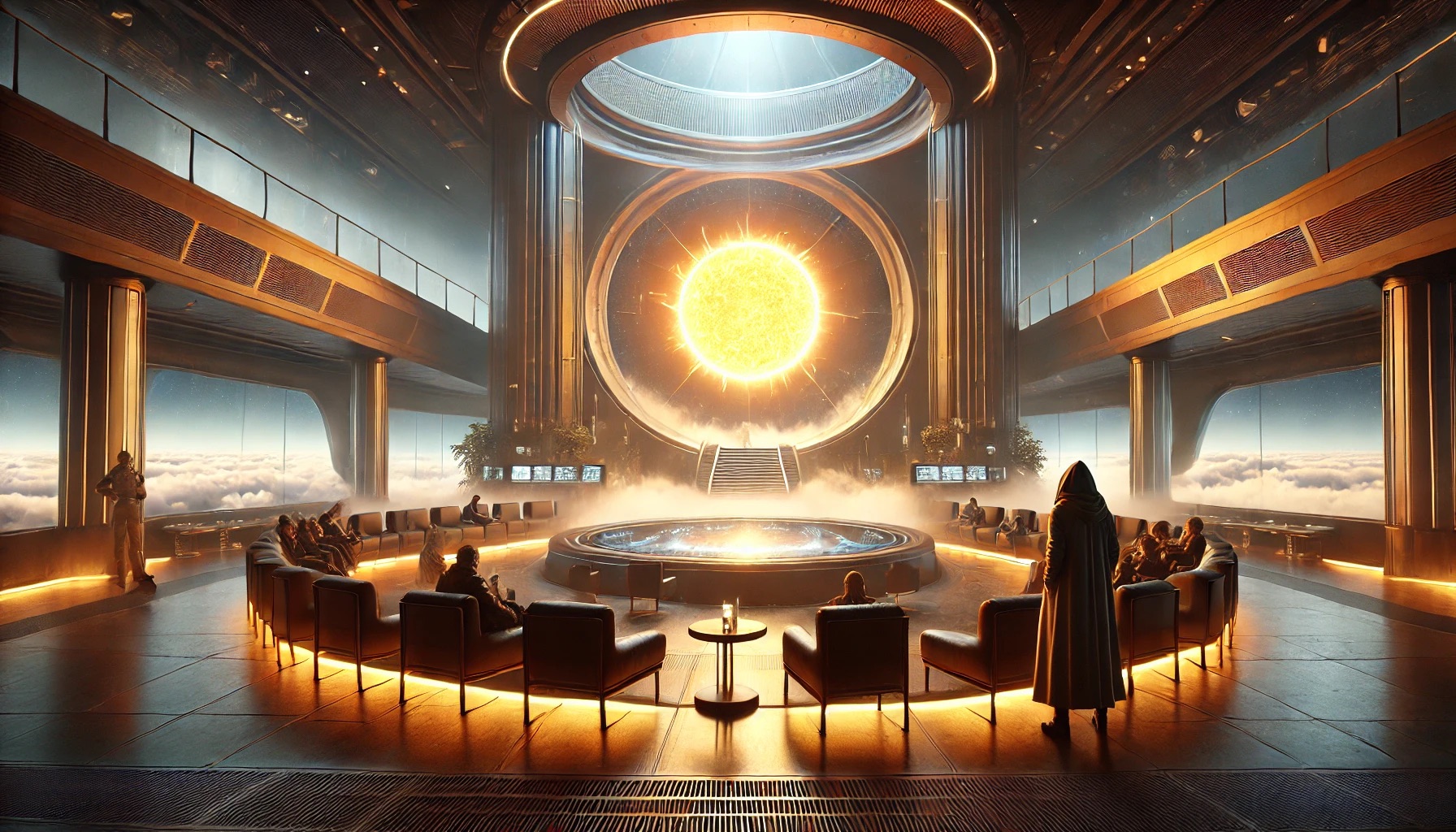
The Sun-Gazing Chamber was one of Helix 25’s more poetic and yet practical inventions —an optically and digitally-enhanced projection of the Sun, positioned at the ship’s perihelion. It was meant to provide a psychological tether, a sense of humanity’s connection to the prime provider of life as they drifted in the void of the Solar System.
It was a beautifully designed setting where people would simply sit and relax, attuned to the shift of days and nights as if still on Earth. The primary setting had been voted to a massive 83.5% to be like in Hawai’i latitude and longitude, as its place was believed to be a reflection of Earth’s heart. That is was a State in the USA was a second thought of course.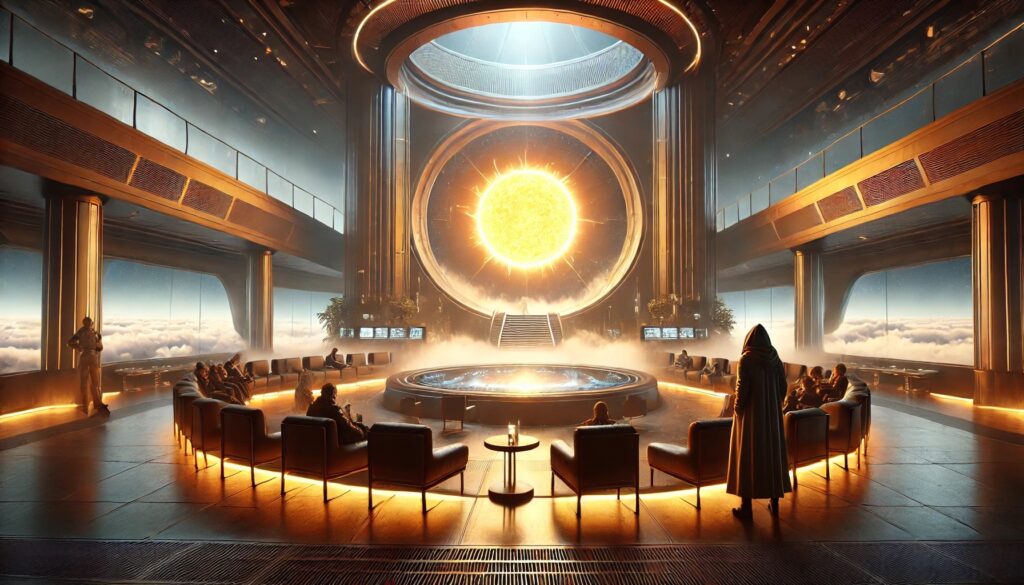
Evie sat on the observation bench, staring at the massive, golden sphere suspended in the darkness. “Do you think people back on Earth are still watching the sunrise?” she murmured.
Riven was quiet for a moment. “If there’s anyone left.”
Evie frowned. “If they are, I doubt they got much of a choice.”
TP materialized beside them, adjusting his holographic tie. “Ah, the age-old existential debate: are we the lucky ones who left Earth, or the tragic fools who abandoned it?”
Evie ignored him, glancing at the other ship residents in the chamber. Most people just sat quietly, basking in the light. But she caught snippets of whispers, doubt, something spreading through the ranks.
“Some people think we’re not really where they say we are,” she muttered.
Riven raised an eyebrow. “What, like conspiracy theories?”
TP scoffed. “Oh, you mean the Flat-Earthers?” He tsked. “Who couldn’t jump on the Helix lifeboats for their lives, convinced as they were we couldn’t make it to the stars. They deserved what came to them. Next they’ll be saying Helix 25 never even launched and we’re all just trapped in a simulation of a luxury cruise.”
Evie was shocked at Trevor Pee’s eructation and rubbed her face. “Damn Effin Muck tech, and those “Truth Control” rubbish datasets. I thought I’d thoroughly scrubbed all the old propaganda tech from the system.”
“Ah,” TP said, “but conspiracies are like mold. Persistent. Annoying. Occasionally toxic.”
Riven shook his head. “It’s nonsense. We’re moving. We’ve been moving for decades.”
Evie didn’t look convinced. “Then why do we feel stuck?”
A chime interrupted them.
A voice, over the comms. Solar flare alert.
Evie stiffened.
Then: Stay calm and return to your quarters until further notice.
Evie raised an eyebrow. This was the first time something like that happened. She turned to Riven who was looking at his datapad who was flashing and buzzing.
He said to her: “Stay quiet and come with me, a new death has been reported. Crazy coincidence. It’s just behind the Sun-Gazing chamber actually, in the Zero-G sector.”
February 18, 2025 at 2:37 pm #7826In reply to: The Precious Life and Rambles of Liz Tattler
“Roberto, darling, pass the figs,” Liz said with a gracious smile.
“And as for you, Godfrey, you may address me as Elizabeth henceforward, to prevent further misunderstandings. My books are ELIZABETH Tatler, not that bumptious trash by that LIZ Tattler.”
February 16, 2025 at 12:50 pm #7810In reply to: The Last Cruise of Helix 25
Helix 25 – Below Lower Decks – Shadow Sector
Kai Nova moved cautiously through the underbelly of Helix 25, entering a part of the Lower Decks where the usual throb of the ship’s automated systems turned muted. The air had a different smell here— it was less sterile, more… human. It was warm, the heat from outdated processors and unmonitored power nodes radiating through the bulkheads. The Upper Decks would have reported this inefficiency.
Here, it simply went unnoticed, or more likely, ignored.
He was being watched.
He knew it the moment he passed a cluster of workers standing by a storage unit, their voices trailing off as he walked by. Not unusual, except these weren’t Lower Deck engineers. They had the look of people who existed outside of the ship’s official structure—clothes unmarked by department insignias, movements too intentional for standard crew assignments.
He stopped at the rendezvous point: an unlit access panel leading to what was supposed to be an abandoned sublevel. The panel had been manually overridden, its system logs erased. That alone told him enough—whoever he was meeting had the skills to work outside of Helix 25’s omnipresent oversight.
A voice broke the silence.
“You’re late.”
Kai turned, keeping his stance neutral. The speaker was of indistinct gender, shaved head, tall and wiry, with sharp green eyes locked on his movements. They wore layered robes that, at a glance, could have passed as scavenged fabric—until Kai noticed the intricate stitching of symbols hidden in the folds.
They looked like Zoya’s brand —he almost thought… or let’s just say, Zoya’s influence. Zoya Kade’s litanies had a farther reach he would expect.
“Wasn’t aware this was a job interview,” Kai quipped, leaning casually against the bulkhead.
“Everything’s a test,” they replied. “Especially for outsiders.”
Kai smirked. “I didn’t come to join your book club. I came for answers.”
A low chuckle echoed from the shadows, followed by the shifting of figures stepping into the faint light. Three, maybe four of them. It could have been an ambush, but that was a display.
“Pilot,” the woman continued, avoiding names. “Seeker of truth? Or just another lost soul looking for something to believe in?”
Kai rolled his shoulders, sensing the tension in the air. “I believe in not running out of fuel before reaching nowhere.”
That got their attention.
The recruiter studied him before nodding slightly. “Good. You understand the problem.”
Kai crossed his arms. “I understand a lot of problems. I also understand you’re not just a bunch of doomsayers whispering in the dark. You’re organized. And you think this ship is heading toward a dead end.”
“You say that like it isn’t.”
Kai exhaled, glancing at the flickering emergency light above. “Synthia doesn’t make mistakes.”
They smiled, but it wasn’t friendly. “No. It makes adjustments.” — the heavy tone on the “it” struck him. Techno-bigots, or something else? Were they denying Synthia’s sentience, or just adjusting for gender misnomers, it was hard to tell, and he had a hard time to gauge the sanity of this group.
A low murmur of agreement rippled through the gathered figures.
Kai tilted his head. “You think she’s leading us into the abyss?”
The person stepped closer. “What do you think happened to the rest of the fleet, Pilot?”
Kai stiffened slightly. The Helix Fleet, the original grand exodus of humanity—once multiple ships, now only Helix 25, drifting further into the unknown.
He had never been given a real answer.
“Think about it,” they pressed. “This ship wasn’t built for endless travel. Its original mission was altered. Its course reprogrammed. You fly the vessel, but you don’t control it.” She gestured to the others. “None of us do. We’re passengers on a ride to oblivion, on a ship driven by a dead man’s vision.”
Kai had heard the whispers—about the tycoon who had bankrolled Helix 25, about how the ship’s true directive had been rewritten when the Earth refugees arrived. But this group… they didn’t just speculate. They were ready to act.
He kept his voice steady. “You planning on mutiny?”
They smiled, stepping back into the half-shadow. “Mutiny is such a crude word. We’re simply ensuring that we survive.”
Before Kai could respond, a warning prickle ran up his spine.
Someone else was watching.
He turned slowly, catching the faintest silhouette lingering just beyond the corridor entrance. He recognized the stance instantly—Cadet Taygeta.
Damn it.
She had followed him.
The group noticed, shifting slightly. Not hostile, but suddenly alert.
“Well, well,” the woman murmured. “Seems you have company. You weren’t as careful as you thought. How are you going to deal with this problem now?”
Kai exhaled, weighing his options. If Taygeta had followed him, she’d already flagged this meeting in her records. If he tried to run, she’d report it. If he didn’t run, she might just dig deeper.
And the worst part?
She wasn’t corruptible. She wasn’t the type to look the other way.
“You should go,” the movement person said. “Before your shadow decides to interfere.”
Kai hesitated for half a second, before stepping back.
“This isn’t over,” he said.
Her smile returned. “No, Pilot. It’s just beginning.”
With that, Kai turned and walked toward the exit—toward Taygeta, who was waiting for him with arms crossed, expression unreadable.
He didn’t speak first.
She did.
“You’re terrible at being subtle.”
Kai sighed, thinking quickly of how much of the conversation could be accessed by the central system. They were still in the shadow zone, but that wasn’t sufficient. “How much did you hear?”
“Enough.” Her voice was even, but her fingers twitched at her side. “You know this is treason, right?”
Kai ran a hand through his hair. “You really think we’re on course for a fresh new paradise?”
Taygeta didn’t answer right away. That was enough of an answer.
Finally, she exhaled. “You should report this.”
“You should,” Kai corrected.
She frowned.
He pressed on. “You know me, Taygeta. I don’t follow lost causes. I don’t get involved in politics. I fly. I survive. But if they’re right—if there’s even a chance that we’re being sent to our deaths—I need to know.”
Taygeta’s fingers twitched again.
Then, with a sharp breath, she turned.
“I didn’t see anything tonight.”
Kai blinked. “What?”
Her back was already to him, her voice tight. “Whatever you’re doing, Nova, be careful. Because next time?” She turned her head slightly, just enough to let him see the edge of her conflicted expression.
“I will report you.”
Then she was gone.
Kai let out a slow breath, glancing back toward the hidden movement behind him.
No turning back now.
February 16, 2025 at 12:20 pm #7809In reply to: The Last Cruise of Helix 25
Earth, Black Sea Coastal Island near Lazurne, Ukraine – The Tinkerer
Cornishman Merdhyn Winstrom had grown accustomed to the silence.
It wasn’t the kind of silence one found in an empty room or a quiet night in Cornwall, but the profound, devouring kind—the silence of a world were life as we knew it had disappeared. A world where its people had moved on without him.
The Black Sea stretched before him, vast and unknowable, still as a dark mirror reflecting a sky that had long since stopped making promises. He stood on the highest point of the islet, atop a jagged rock behind which stood in contrast to the smooth metal of the wreckage.
His wreckage.
That’s how he saw it, maybe the last man standing on Earth.
It had been two years since he stumbled upon the remains of Helix 57 shuttle —or what was left of it. Of all the Helixes cruise ships that were lost, the ones closest to Earth during the Calamity had known the most activity —people trying to leave and escape Earth, while at the same time people in the skies struggling to come back to loved ones. Most of the orbital shuttles didn’t make it during the chaos, and those who did were soon lost to space’s infinity, or Earth’s last embrace.
This shuttle should have been able to land a few hundred people to safety —Merdhyn couldn’t find much left inside when he’d discovered it, survivors would have been long dispersed looking for food networks and any possible civilisation remnants near the cities. It was left here, a gutted-out orbital shuttle, fractured against the rocky coast, its metal frame corroded by salt air, its systems dead. The beauty of mechanics was that dead wasn’t the same as useless.
And Merdhyn never saw anything as useless.
With slow, methodical care, he adjusted the small receiver strapped to his wrist—a makeshift contraption built from salvaged components, scavenged antennae, and the remains of an old Soviet radio. He tapped the device twice. The static fizzled, cracked. Nothing.
“Still deaf,” he muttered.
Perched at his shoulder, Tuppence chattered at him, a stuborn rodent that attached himself and that Merdhyn had adopted months ago as he was scouting the area. He reached his pocket and gave it a scrap of food off a stale biscuit still wrapped in the shiny foil.
Merdhyn exhaled, rolling his shoulders. He was getting too old for this. Too many years alone, too many hours hunched over corroded circuits, trying to squeeze life from what had already died.
But the shuttle wasn’t dead. After his first check, he was quite sure. Now it was time to get to work.
He stepped inside, ducking beneath an exposed beam, brushing past wiring that had long since lost its insulation. The stale scent of metal and old circuitry greeted him. The interior was a skeletal mess—panels missing, control consoles shattered, displays reduced to nothing but flickering ghosts of their former selves.
Still, he had power.
Not much. Just enough to light a few panels, enough to make him think he wasn’t mad for trying.
As it happened, Merdhyn had a plan: a ridiculous, impossible, brilliant plan.
He would fix it.
The whole thing if he could, but if anything. It would certainly take him months before the shuttle from Helix 57 could go anywhere— that is, in one piece. He could surely start to repair the comms, get a signal out, get something moving, then maybe—just maybe—he could find out if there was anything left out there.
Anything that wasn’t just sea and sky and ghosts.
He ran his fingers along the edge of the console, feeling the warped metal. The ship had crashed hard. It shouldn’t have made it down in one piece, but something had slowed it. Some system had tried to function, even in its dying moments.
That meant something was still alive.
He just had to wake it up.
Tuppence chittered, scurrying onto his shoulder.
Merdhyn chuckled. “Aye, I know. One of these days, I’ll start talking to people instead of rats.”
Tuppence flicked her tail.
He pulled out a battered datapad—one of his few working relics—and tapped the screen. The interface stuttered, but held. He navigated to his schematics, his notes, his carefully built plans.
The transponder array.
If he could get it working, even partially, he might be able to listen.
To hear something—anything—on the waves beyond this rock.
A voice. A signal. A trace of the world that had forgotten him.
Merdhyn exhaled. “Let’s see if we can get you talking again, eh?”
He adjusted his grip, tools clinking at his belt, and got to work.
February 15, 2025 at 9:21 am #7789In reply to: The Last Cruise of Helix 25
Helix 25 – Poop Deck – The Jardenery
Evie stepped through the entrance of the Jardenery, and immediately, the sterile hum of Helix 25’s corridors faded into a world of green. Of all the spotless clean places on the ship, it was the only where Finkley’s bots tolerated the scent of damp earth. A soft rustle of hydroponic leaves shifting under artificial sunlight made the place an ecosystem within an ecosystem, designed to nourrish both body and mind.
Yet, for all its cultivated serenity, today it was a crime scene. The Drying Machine was connected to the Jardenery and the Granary, designed to efficiently extract precious moisture for recycling, while preserving the produce.
Riven Holt, walking beside her, didn’t share her reverence. “I don’t see why this place is relevant,” he muttered, glancing around at the towering bioluminescent vines spiraling up trellises. “The body was found in the drying machine, not in a vegetable patch.”
Evie ignored him, striding toward the far corner where Amara Voss was hunched over a sleek terminal, frowning at a glowing screen. The renowned geneticist barely noticed their approach, her fingers flicking through analysis results faster than human eyes could process.
A flicker of light.
“Ah-ha!” TP materialized beside Evie, adjusting his holographic lapels. “Madame Voss, I must say, your domain is quite the delightful contrast to our usual haunts of murder and mystery.” He twitched his mustache. “Alas, I suspect you are not admiring the flora?”
Amara exhaled sharply, rubbing her temples, not at all surprised by the holographic intrusion. She was Evie’s godmother, and had grown used to her experiments.
“No, indeed. I’m admiring this.” She turned the screen toward them.
The DNA profile glowed in crisp lines of data, revealing a sequence highlighted in red.
Evie frowned. “What are we looking at?”
Amara pinched the bridge of her nose. “A genetic anomaly.”
Riven crossed his arms. “You’ll have to be more specific.”
Amara gave him a sharp look but turned back to the display. “The sample we found at the crime scene—blood residue on the drying machine and some traces on the granary floor—matches an ancient DNA profile from my research database. A perfect match.”
Evie felt a prickle of unease. “Ancient? What do you mean? From the 2000s?”
Amara chuckled, then nodded grimly. “No, ancient as in Medieval ancient. Specifically, Crusader DNA, from the Levant. A profile we mapped from preserved remains centuries ago.”
Silence stretched between them.
Finally, Riven scoffed. “That’s impossible.”
TP hummed thoughtfully, twirling his cane. “Impossible, yet indisputable. A most delightful contradiction.”
Evie’s mind raced. “Could the database be corrupted?”
Amara shook her head. “I checked. The sequencing is clean. This isn’t an error. This DNA was present at the crime scene.” She hesitated, then added, “The thing is…” she paused before considering to continue. They were all hanging on her every word, waiting for what she would say next.
Amara continued “I once theorized that it might be possible to reawaken dormant ancestral DNA embedded in human cells. If the right triggers were applied, someone could manifest genetic markers—traits, even memories—from long-dead ancestors. Awakening old skills, getting access to long lost secrets of states…”
Riven looked at her as if she’d grown a second head. “You’re saying someone on Helix 25 might have… transformed into a medieval Crusader?”
Amara exhaled. “I’m saying I don’t know. But either someone aboard has a genetic profile that shouldn’t exist, or someone created it.”
TP’s mustache twitched. “Ah! A puzzle worthy of my finest deductive faculties. To find the source, we must trace back the lineage! And perhaps a… witness.”
Evie turned toward Amara. “Did Herbert ever come here?”
Before Amara could answer, a voice cut through the foliage.
“Herbert?”
They turned to find Romualdo, the Jardenery’s caretaker, standing near a towering fruit-bearing vine, his arms folded, a leaf-tipped stem tucked behind his ear like a cigarette. He was a broad-shouldered man with sun-weathered skin, dressed in a simple coverall, his presence almost too casual for someone surrounded by murder investigators.
Romualdo scratched his chin. “Yeah, he used to come around. Not for the plants, though. He wasn’t the gardening type.”
Evie stepped closer. “What did he want?”
Romualdo shrugged. “Questions, mostly. Liked to chat about history. Said he was looking for something old. Always wanted to know about heritage, bloodlines, forgotten things.” He shook his head. “Didn’t make much sense to me. But then again, I like practical things. Things that grow.”
Amara blushed, quickly catching herself. “Did he ever mention anything… specific? Like a name?”
Romualdo thought for a moment, then grinned. “Oh yeah. He asked about the Crusades.”
Evie stiffened. TP let out an appreciative hum.
“Fascinating,” TP mused. “Our dearly departed Herbert was not merely a victim, but perhaps a seeker of truths unknown. And, as any good mystery dictates, seekers who get too close often find themselves…” He tipped his hat. “Extinguished.”
Riven scowled. “That’s a bit dramatic.”
Romualdo snorted. “Sounds about right, though.” He picked up a tattered book from his workbench and waved it. “I lend out my books. Got myself the only complete collection of works of Liz Tattler in the whole ship. Doc Amara’s helping me with the reading. Before I could read, I only liked the covers, they were so romantic and intriguing, but now I can read most of them on my own.” Noticing he was making the Doctor uncomfortable, he switched back to the topic. “So yes, Herbert knew I was collector of books and he borrowed this one a few weeks ago. Kept coming back with more questions after reading it.”
Evie took the book and glanced at the cover. The Blood of the Past: Genetic Echoes Through History by Dr. Amara Voss.
She turned to Amara. “You wrote this?”
Amara stared at the book, her expression darkening. “A long time ago. Before I realized some theories should stay theories.”
Evie closed the book. “Looks like someone didn’t agree.”
Romualdo wiped his hands on his coveralls. “Well, I hope you figure it out soon. Hate to think the plants are breathing in murder residue.”
TP sighed dramatically. “Ah, the tragedy of contaminated air! Shall I alert the sanitation team?”
Riven rolled his eyes. “Let’s go.”
As they walked away, Evie’s grip tightened around the book. The deeper they dug, the stranger this murder became.
February 15, 2025 at 2:26 am #7788In reply to: The Last Cruise of Helix 25
At first, no one noticed.
They were still speculating about the truck—where it had come from, where it might be going, whether following it was a brilliant idea or a spectacularly bad one.
And, after all, Finja was always muttering about something. Dust, filth, things not put back where they belonged.
But then her voice rose till she was all but shouting.
“Of course, they’re all savages. I don’t know how I put up with them! Honestly, I AM AT MY WIT’S END!”
“Finja?” Anya called. “Are you okay?”
Finja strode on, intent on her diatribe.
“No, I don’t know where they are going,” she yelled. “If I knew that, I probably wouldn’t be here, would I?”
Tala hurried to catch up and stepped in front of Finja, blocking her path. “Finja, are you okay? Who are you talking to?”
Finja sighed loudly; it was tedious. People were so obsessed with explanations.
“If you must know,” she said, “I am conversing with my Auntie Finnley in Australia.”
“Ooooh!” Vera’s eyes lit up. “ A relative!”
Yulia, walking between Luka and Lev, giggled. She adored the twins and couldn’t decide which one she liked more. They were both so tall and handsome. Others found it hard to tell them apart but she always could. It was rumoured that at birth they had been joined at the hip.
“Finja is totally bonkers,” she declared cheerfully and the twins smiled in unison.
“I will have you know I’m not bonkers.” Finja felt deeply offended and misunderstood. “I have been communicating with Auntie Finnley since childhood. She was highly influential in my formative years.”
“How so?” asked Tala.
“Few people appreciate the importance of hygiene like my Auntie Finnley. She works as a cleaner at the Flying Fish Inn in the Australian Outback. Lovely establishment I gather. But terrible dust.”
Vera nodded sagely. “A sensible place to survive the apocalypse.”
“Exactly.” Finja rewarded her with a tight smile.
Jian raised an eyebrow. “And she’s alive? Your aunt?”
“I don’t converse with ghosts!” Finja waved a hand dismissively. “They all survived there thanks to the bravery of Aunt Finnley. Had to disinfect the whole inn, mind you. Said it was an absolute nightmare.” Finja shuddered at the thought of it.
Gregor snorted. “You’re telling us you have a telepathic connection with your aunt in Australia… and she is also mostly concerned about … hygiene?”
Finja glared at him. “Standards must be maintained,” she admonished. “Even after the end of the world.”
“Do you talk to anyone else?” Tala asked. “Or is it just your aunt?”
Finja regarded Tala through slitted eyes. “I’m also talking to Finkley.”
“Where is this Finkley, dear?” asked Anja gently. “Also at the outback?”
“OMG,” Finja said. “Can you imagine those two together?” She cackled at the thought, then pulled herself together. “No. Finkley is on the Helix 25. Practically runs it by all accounts. But also keeps it spotless, of course.”
“Helix 25? The spaceship?” Mikhail asked, suddenly interested. He exchanged glances with Tala who shrugged helplessly.
Yulia laughed. “She’s definitely mad!”
“So what? Aren’t we all,” said Petro.
Molly, who had been quietly watching with Tundra, finally spoke. “And you say they are both… cleaners?” She wasn’t sure what to make of this group. She wondered if it would be better to continue on alone with Tundra? She didn’t want to put the child in any danger.
“Cleanliness runs in the family,” Finja said. “Now, if you’ll all excuse me, I was mid-conversation.”
She closed her eyes, concentrating. The group watched with interest as her lips moved silently, her brow furrowed in deep thought.
Then, suddenly, she opened her eyes and threw her hands in the air.
“Oh, for goodness’ sake,” she muttered. “Finkley is complaining about dust floating in low gravity. Finnley is complaining about the family not taking their boots off at the door. What a pair of whingers. At least I didn’t inherit THAT.”
She sniffed, adjusted her backpack, and walked on.
The others stood there for a moment, letting it all sink in.
Gregor clapped his hands together. “That was the most wonderfully insane thing I’ve heard since the world ended.”
Mikhail sighed. “So, we are following the direction of the truck?”
Anya nodded. “I’ll keep an eye on Finja. The stress is getting to her, and we have no meds if it escalates.”
February 14, 2025 at 10:02 am #7780In reply to: The Last Cruise of Helix 25
Orrin Holt gripped the wheel of the battered truck, his knuckles white as the vehicle rumbled over the dry, cracked road. The leather wrap was a patchwork of smooth and worn, stichted together from whatever scraps they had—much like the quilts his mother used to make before her hands gave out. The main road was a useless, unpredictable mess of asphalt gravels and sinkholes. Years of war with Russia, then the collapse, left it to rot before anyone could fix it. Orrin stuck to the dirt path beside it. That was the only safe way through. The engine coughed but held. A miracle, considering how many times it had been patched together.
The cargo in the back was too important for a breakdown now. Medical supplies—antibiotics, painkillers, and a few salvaged vials of something even rarer. They’d traded well for it, risking much. Now he had to get it back to Base Klyutch (Ukrainian word for Key) without incident. If he continued like that he could make it before noon.
Still, something bothered him. That group of people he’d seen.
They had been barely more than silhouettes on top of a hill. Strangers, a rarity in these times. His first instinct had been to stop and evaluate who they were. But his instructions let room for no delay. So, he’d pushed forward and ignored them. The world wasn’t kind to the wandering. But they hadn’t looked like raiders or scavengers. Lost, perhaps. Or searching.
The truck lurched forward as he pushed it harder. The fences of the base rose in the distance, grey and wiry against the blue sky. Base Klyutch was a former military complex, fortified over the years with scavenged materials, steel sheets, and watchtowers. It wasn’t perfect, but it kept them alive.
As he rolled up to the main gate, the sentries swung the barricade open. Before he could fully cut the engine, a woman wearing a pristine white lab coat stepped forward, her sharp eyes scanning the truck’s cargo bed. Dr. Yelena Markova, the camp’s chief doctor, a former nurse who had to step up when the older one died in a raid on their camp three years ago. Stern-faced and wiry, with a perpetual air of exhaustion, she moved with the efficiency of someone who had long stopped hoping for ease. She had been waiting for this delivery.
“Finally,” she murmured, motioning for her assistants to start unloading. “We were running low. This will keep us going for a while.”
Orrin barely had time to nod before Dmytro Koval, the de facto leader of the base, strode toward him with the gait of a tall bear. His face seemed to have been carved out by a dulled blade, hardened by years of survival. A scar barred his mouth, pulling slightly at the corner when he spoke, giving the impression of a permanent sneer.
“Did you get it?” Koval asked, voice low.
Orrin reached into his kaki jacket and pulled out a sealed letter, along with a small package.
Koval took both, his expression unreadable. “Anything on the road?”
Orrin exhaled and adjusted his stance. “Saw something on the way back. A group, about a dozen, on a hill ten kilometers out. They seemed lost.”
“Armed?” asked Koval with a frown.
“Can’t say for sure.”
Dr. Markova straightened. “Lost? Unarmed? Out in the open like that, they won’t last long with Sokolov’s gang roaming the land. We have to go take them in.”
Koval grimaced. “Or they’re Sokolov’s spies. Trying to infiltrate us and find a weakness in our defenses. You know how it works.”
Before Koval could argue, a new voice cut in. “Or they could just be people.”
Solara Ortega had stepped into the conversation, brushing dirt from her overalls. A woman of lean strength, with the tan of someone spending long hours outside. Her sharp amber eyes carried the weight of someone who had survived too much but refused to be hardened by it. Orrin shoved down a mix of joy and ache at her sight. Her voice was calm but firm. “We can’t always assume the worst. We need more hands and we don’t leave people to die if we can help it. And in case you forgot, Koval, you don’t make all the decisions around here. I say we send a team to assess them.”
Koval narrowed his eyes, but he held his tongue. There was tension between them, but the council wasn’t a dictatorship.
“Fine,” Koval said after a moment, his jaw tense. “A team of two. They scout first. No direct contact until we’re sure. Orrin, you one of them take whoever wants to accompany you, but not one of my men. We need to maintain tight security.”
Dr. Markova sighed with relief when the man left. “If he wasn’t good at what he does, I would gladly kick him out of our camp.”
Solara, her face framed by strands of dark hair, shot a glance at Orrin. “I’m coming with you.”
This time, Orrin couldn’t repress a longing for a time before everything fell apart, when she had been his wife. The collapse had torn them apart in an instant, and by the time he found her again, years later, she had built a new life within the base in Ukraine. She had a husband now, one of the scientists managing the radio equipment, and two children. Orrin kept his expression neutral, but the weight of time pressed heavy on him.
“Then let’s get on the move. They might not stay there long.”
February 8, 2025 at 7:22 pm #7776In reply to: Quintessence: Reversing the Fifth
Epilogue & Prologue
Paris, November 2029 – The Fifth Note Resounds
Tabitha sat by the window at the Sarah Bernhardt Café, letting the murmur of conversations and the occasional purring of the espresso machine settle around her. It was one of the few cafés left in the city where time still moved at a human pace. She stirred her cup absentmindedly. Paris was still Paris, but the world outside had changed in ways her mother’s generation still struggled to grasp.
It wasn’t just the ever-presence of automation and AI making themselves known in subtle ways—screens adjusting to glances, the quiet surveillance woven into everyday life. It wasn’t just the climate shifts, the aircon turned to cold in the midst of November, the summers unpredictable, the air thick with contradictions of progress and collapse of civilization across the Atlantic.
The certainty of impermanence was what defined her generation. BANI world they used to say—Brittle, Anxious, Nonlinear, Incomprehensible. A cold fact: impossible to grasp and impossible to fight. Unlike her mother and her friends, who had spent their lives tethered to a world that no longer existed, she had never known certainty. She was born in the flux.
And yet, this café remained. One of the last to resist full automation, where a human still brought you coffee, where the brass bell above the door still rang, where things still unfolded at a human pace.
The bell above the door rang—the fifth note, as her mother had called it once.
She had never been here before, not in any way that mattered. Yet, she had heard the story. The unlikely reunion five years ago. The night that moved new projects in motion for her mother and her friends.
Tabitha’s fingers traced the worn edges of the notebook in front of her—Lucien’s, then Amei’s, then Darius’s. Pieces of a life written by many hands.
“Some things don’t work the first time. But sometimes, in the ruins of what failed, something else sprouts and takes root.”
And that was what had happened.
The shared housing project they had once dreamed of hadn’t survived—not in its original form. But through their rekindled bond, they had started something else.
True Stories of How It Was.
It had begun as a quiet defiance—a way to preserve real, human stories in an age of synthetic, permanent ephemerality and ephemeral impermanence, constantly changing memory. They were living in a world where AI’s fabricated histories had overwhelmed all the channels of information, where the past was constantly rewritten, altered, repackaged. Authenticity had become a rare currency.
As she graduated in anthropology few years back, she’d wondered about the validity of history —it was, after all, a construct. The same could be said for literature, art, even science. All of them constructs of the human mind, tenuous grasp of the infinite truth, but once, they used to evolve at such a slow pace that they felt solid, reliable. Ultimately their group was not looking for ultimate truth, that would be arrogant and probably ignorant. Authenticity was what they were looking for. And with it, connections, love, genuineness —unquantifiables by means of science and yet, true and precious beyond measure.
Lucien had first suggested it, tracing the idea from his own frustrations—the way art had become a loop of generated iterations, the human touch increasingly erased. He was in a better place since Matteo had helped him settle his score with Renard and, free of influence, he had found confidence in developing of his own art.
Amei —her mother—, had changed in a way Tabitha couldn’t quite define. Her restlessness had quieted, not through settling down but through accepting impermanence as something other than loss. She had started writing again—not as a career, not to publish, but to preserve stories that had no place in a digitized world. Her quiet strength had always been in preserving connections, and she knew they had to move quickly before real history faded beneath layers of fabricated recollections.
Darius, once skeptical, saw its weight—he had spent years avoiding roots, only to realize that stories were the only thing that made places matter. He was somewhere in Morocco now, leading a sustainable design project, bridging cultures rather than simply passing through them.
Elara had left science. Or at least, science as she had known it. The calculations, the certainty, the constraints of academia, with no escape from the automated “enhanced” digital helpers. Her obsession and curiosities had found attract in something more human, more chaotic. She had thrown herself into reviving old knowledge, forgotten architectures, regenerative landscapes.
And Matteo—Matteo had grounded it.
The notebook read: Matteo wasn’t a ghost from our past. He was the missing note, the one we didn’t know we needed. And because of him, we stopped looking backward. We started building something else.
For so long, Matteo had been a ghost of sorts, by his own account, lingering at the edges of their story, the missing note in their unfinished chord. But now, he was fully part of it. His mother had passed, her past history unraveling in ways he had never expected, branching new connections even now. And though he had lost something in that, he had also found something else. Juliette. Or maybe not. The story wasn’t finished.
Tabitha turned the page.
“We were not historians, not preservationists, not even archivists. But we have lived. And as it turned out, that was enough.”
They had begun collecting stories through their networks—not legends, not myths, but true accounts of how it was, from people who still remembered.
A grandfather’s voice recording of a train ride to a city that no longer exists.
Handwritten recipes annotated by generations of hands, each adding something new.
A letter from a protest in 2027, detailing a movement that the history books had since erased.
An old woman’s story of her first love, spoken in a dialect that AI could not translate properly.It had grown in ways they hadn’t expected. People began sending them recordings, letters, transcripts, photos —handwritten scraps of fading ink. Some were anonymous, others carefully curated with full names and details, like makeshift ramparts against the tide of time.
At first, few had noticed. It was never the goal to make it worlwide movement. But little by little, strange things happened, and more began to listen.
There was something undeniably powerful about genuine human memory when it was raw and unfiltered, when it carried unpolished, raw weight of experience, untouched by apologetic watered down adornments and out-of-place generative hallucinations.
Now, there were exhibitions, readings, archives—entire underground movements dedicated to preserving pre-synthetic history. Their project had become something rare, valuable, almost sacred.
And yet, here in the café, none of that felt urgent.
Tabitha looked up as the server approached. Not Matteo, but someone new.
“Another espresso?”
She hesitated, then nodded. “Yes. And a glass of water, please.”
She glanced at the counter, where Matteo was leaning, speaking to someone, laughing. He had changed, too. No longer just an observer, no longer just the quiet figure who knew too much. Now, he belonged here.
A bell rang softly as the door swung open again.
Tabitha smiled to herself. The fifth note always sounded, in the end.
She turned back to the notebook, the city moving around her, the story still unfolding in more directions than one.
February 7, 2025 at 1:09 pm #7737In reply to: The Last Cruise of Helix 25
Evie stared at TP, waiting for further elaboration. He simply steepled his fingers and smirked, a glitchy picture of insufferable patience.
“You can’t just drop a bombshell like that and leave it hanging,” she said.
“But my dear Evie, I must!” TP declared, flickering theatrically. “For as the great Pea Stoll once mused—‘It was suspicious in a Pea Saucerer’s ways…’”
Evie groaned. “TP—”
“A jest! A mere jest!” He twirled an imaginary cane. “And yet, what do we truly know of the elusive Mr. Herbert? If we wish to uncover his secrets, we must look into his… associations.”
Evie frowned. “Funny you said that, I would have thought ‘means, motive, alibis’ but I must be getting ahead of myself…” He had a point. “By associations, you mean —Seren Vega?”
“Indeed!” TP froze accessing invisible records, then clapped his hands together. “Seren Vega, archivist extraordinaire of the wondrous past, keeper resplendent of forgotten knowledge… and, if the ship’s whisperings hold any weight, a woman Herbert was particularly keen on seeing.”
Evie exhaled, already halfway to the door. “Alright, let’s go see Seren.”

Seren Vega’s quarters weren’t standard issue—too many rugs, too many hanging ornaments, a hint of a passion for hoarding, and an unshakable musky scent of an animal’s den. The place felt like the ship itself had grown around it, heavy with the weight of history.
And then, there was Mandrake.
The bionic-enhanced cat perched on a high shelf, tail flicking, eyes glowing faintly. “What do you want?” he asked flatly, his tone dripping with a well-practiced blend of boredom and disdain.
Evie arched a brow. “Nice to see you too, Mandrake.”
Seren, cross-legged on a cushion, glanced up from her console. “Evie,” she greeted calmly. “And… oh no.” She sighed, already bracing herself. “You’ve brought it —what do you call him already? Orion Reed?”
Evie replied “Great memory Ms Vega, as expected. Yes, this was the name of the beta version —this one’s improved but still working the kinks of the programme, he goes by ‘TP’ nowadays. Hope you don’t mind, he’s helping me gather clues.” She caught herself, almost telling too much to a potential suspect.
TP puffed up indignantly. “I must protest, Madame Vega! Our past encounters, while lively, have been nothing but the height of professional discourse!”
Mandrake yawned. “She means you talk too much.”
Evie hid a smirk. “I need your help, Seren. It’s about Mr. Herbert.”
Seren’s fingers paused over her console. “He’s the one they found in the dryer.” It wasn’t a question.
Evie nodded. “What do you know about him?”
Seren studied her for a moment, then, with a slow exhale, tapped a command into her console. The room dimmed as the walls flickered to life, displaying a soft cascade of memories—public logs, old surveillance feeds, snippets of conversations once lost to time.
“He wasn’t supposed to be here,” Seren said at last. “He arrived without a record. No one really questioned it, because, well… no one questions much anymore. But if you looked closely, the ship never registered him properly.”
Evie’s pulse quickened. TP let out an approving hum.
Seren continued, scrolling through the visuals. “He came to me, sometimes. Asked about old Earth history. Strange, fragmented questions. He wanted to know how records were kept, how things could be erased.”
Evie and TP exchanged a glance.
Seren frowned slightly, as if piecing together a thought she hadn’t dared before. “And then… he stopped coming.”
Mandrake, still watching from his shelf, stretched lazily. Then, with perfect nonchalance, he added, “Oh yeah. And he wasn’t using his real name.”
Evie snapped to attention. “What?”
The cat flicked his tail. “Mr. Herbert. The name was fake. He called himself that, but it wasn’t what the system had logged when he first stepped on board.”
Seren turned sharply toward him. “Mandrake, you never mentioned this before.”
The cat yawned. “You never asked.”
Evie felt a chill roll through her. “So what was his real name?”
Mandrake’s eyes glowed, data scrolling in his enhanced vision.
“Something about… Ethan,” he mused. “Ethan… M.”
The room went very still.
Evie swallowed hard. “Ethan Marlowe?”
Seren paled. “Ellis Marlowe’s son.”
TP, for once, was silent.
February 6, 2025 at 7:38 am #7734In reply to: The Last Cruise of Helix 25
It was quite dark by the time Molly and Tundra entered the woods but the firelight flickered through the trees, guiding them to the clearing. Now that the meeting with the strangers was close, the initial excitement gave way to trepidition, particularly for Molly. Despite not seeing other people for years, the old world caution about strangers resurfaced.
“Slow down, Tundra, we don’t want to shock them. They may be hostile,” whispered Molly.
“Hostile? What does that mean?” asked Tundra, who had never come into contact with other people.
Molly looked at her in amazement. The dear innocent poppet has never known the fear of strangers in dark woods! And not once did I think to appreciate that, Molly marvelled silently.
“Never mind that now. Come on.” No need to fill the childs head with fear. “Haloooo! We come in peace!” Molly shouted. “Haloooo! We’re coming in pieces!” echoed Tundra, who was unfamiliar with the word peace, not having had any call the use the word in any conversation thus far.
There was a pregnant silence and then an animated burble of exclamations from the clearing, and then silence again as Molly and Tundra emerged from the darkness.
Dear god, there are so many of them. Molly’s initial reaction was overwhelm. She tried to look at them all individually and it made her head swim. She wondered for a moment if it would be rude to just turn around and leave. But no, it was dark already, and the rapturous excitement on Tundra’s face put paid to that idea.
Gregor was the first to move forward. His leathery old face creased in smiles, he offered his hand to Molly.
February 3, 2025 at 10:10 pm #7733In reply to: The Last Cruise of Helix 25
Leaving the Asylum
They argued about whether to close the heavy gates behind them. In the end, they left them open. The metal groaned as it sat ajar, rust flaking from its hinges.
“Are we all here?” Anya asked. Now that they were leaving, she felt in charge again—or at least, she needed to be. If morale slipped, things would unravel fast. She scanned the group, counting them off.
“Mikhail,” she started, pointing. “Tala. Vera, our esteemed historian.”
Vera sniffed. “I prefer genealogist, thank you very much.”
“Petro,” Anya continued, “probably about to grumble.”
Petro scowled. “I was thinking.”
“Jian, our mystery man.”
Jian raised an eyebrow in acknowledgment.
Anya turned to the next two. “Ah, the twins. Even though you two have never spoken, I’ve always assumed you understood me. Don’t prove me wrong now.”
The twins—Luka and Lev—nodded and grinned at exactly the same time.
“Then we have Yulia… no, we don’t have Yulia. Where in God’s name is Yulia?”
“Here I am!” Yulia’s voice rang out as she jogged back toward them, breathless. “I just went to say goodbye to the cat.” She sighed dramatically. “I wish we could take him. Please, can we take him?”
Yulia was short and quick-moving, her restless hands always in motion, her thoughts spilling out just as fast.
“We can’t,” Mikhail said firmly. “And he can look after himself.”
She huffed. “Well, I expect we could if we tried.”
“And finally, old Gregor, who I gather would rather be taking a nap.”
Gregor, who was well past eighty, rubbed his face and yawned. “You say that like it’s a bad thing.”
Anya frowned, scanning the group again. “Wait. We’re missing Finja.”
A small scraping sound came from behind them.
Finja stood near the gate, furiously scrubbing the rusted metal with a rag she had pulled from her sleeve. “This place is disgusting,” she muttered. “Filth everywhere. The world may have ended, but that’s no excuse for grime.”
Anya sighed. “Finja, leave the gate alone.”
Finja gave it one last wipe before tucking the rag away with a huff. “Fine.”
Anya shook her head. “That’s eleven. No one’s run off or died yet. A promising start.”
They formed a motley crew, each carrying as much as they could manage. Mikhail pushed a battered cart, loaded with scavenged supplies—blankets, tools, whatever food they had left.
The road beneath their feet was cracked and uneven, roots breaking through in places. They followed it in silence for the most part. Even Yulia remained quiet. Some glanced back, but no one turned around.
The nearest village was more than fifty kilometers away. In all directions, there was only wilderness—fields long overtaken by weeds, trees pushing through cracks in forgotten roads. A skeletal signpost leaned at an odd angle, its lettering long since faded.
“It’s going to be dark soon,” Mikhail said. “And the old ones are tired. Aren’t you, Vera?”
“That’s enough of the old business,” puffed Vera, pulling her shoulders back.
Tala laughed. “Well, I must be an old one. I didn’t sleep a wink last night. And there’s a clearing over there.” She pointed.
The evening was cool, but they managed to build a small fire and scrape together a meal of vegetables they’d brought from their garden.
After their meal, they sat around the fire while Finja busied herself tidying up. “Dirty savages,” she muttered under her breath. Then, more loudly, “We should keep watch tonight.”
Vera, perched on a log, pulled her shawl tightly around her. The glow from the fire cast long shadows across her face.
“Vera, you look like a witch,” Yulia declared. “We should have brought the cat for you to ride on a broomstick together.”
“I’ll have you know I’m descended from witches,” Vera replied. “I know none of you think you’re related to me, but just imagine what your great-grandparents would say if they saw us now. Running into the wilderness like a band of exiled aristocrats.”
Jian, seated nearby, smirked slightly. “My great-grandparents were rice farmers.”
Vera brightened—Jian never talked about his past. She leaned in conspiratorially. “Do you know your full lineage? Because I do. I know mine back fourteen generations. You’d be amazed how many bloodlines cross without people realizing.”
Tala shook her head but smiled. Like Petro and Gregor, Vera had been at the asylum for many decades, a relic of another time. She claimed to have been a private investigator and genealogist in her former life.
Petro, hunched over and rubbing his hands by the fire, muttered, “We’re all ghosts now. Doesn’t matter where we came from.”
“Oh, stop that, Petro,” Anya admonished. “Remember our plan?”
“We go to the city,” Jian said. He rarely spoke unless he had something worth saying. “There will be things left behind. Maybe tech, maybe supplies. If I can get into an old server, I might even find something useful.”
“And if there’s nothing?” Petro moaned. “We should never have left.” He clasped his hands over his head.
Jian shrugged. “The world doesn’t erase itself overnight.”
Mikhail nodded. “We rest tonight. Tomorrow, we head for the city. And Finja’s right—tonight we take turns keeping watch.”
They sat in silence, watching the fire burn low. The evening stretched long and uneasy.
January 12, 2025 at 11:51 am #7711In reply to: Quintessence: Reversing the Fifth
Matteo — December 2022
Juliette leaned in, her phone screen glowing faintly between them. “Come on, pick something. It’s supposed to know everything—or at least sound like it does.”
Juliette was the one who’d introduced him to the app the whole world was abuzz talking about. MeowGPT.
At the New Year’s eve family dinner at Juliette’s parents, the whole house was alive with her sisters, nephews, and cousins. She entered a discussion with one of the kids, and they all seemed to know well about it. It was fun to see the adults were oblivious, himself included. He liked it about Juliette that she had such insatiable curiosity.
“It’s a life-changer, you know” she’d said “There’ll be a time, we won’t know about how we did without it. The kids born now will not know a world without it. Look, I’m sure my nephews are already cheating at their exams with it, or finding new ways to learn…”
“New ways to learn, that sounds like a mirage…. Bit of a drastic view to think we won’t live without; I’d like to think like with the mobile phones, we can still choose to live without.”
“And lose your way all the time with worn-out paper maps instead of GPS? That’s a grandpa mindset darling! I can see quite a few reasons not to choose!” she laughed.
“Anyway, we’ll see. What would you like to know about? A crazy recipe to grow hair? A fancy trip to a little known place? Write a technical instruction in the style of Elizabeth Tattler?”“Let me see…”
Matteo smirked, swirling the last sip of crémant in his glass. The lively discussions of Juliette’s family around them made the moment feel oddly private. “Alright, let’s try something practical. How about early signs of Alzheimer’s? You know, for Ma.”
Juliette’s smile softened as she tapped the query into the app. Matteo watched, half curious, half detached.
The app processed for a moment before responding in its overly chipper tone:
“Early signs of Alzheimer’s can include memory loss, difficulty planning or solving problems, and confusion with time or place. For personalized insights, understanding specific triggers, like stress or diet, can help manage early symptoms.”Matteo frowned. “That’s… general. I thought it was supposed to be revolutionary?”
“Wait for it,” Juliette said, tapping again, her tone teasing. “What if we ask it about long-term memory triggers? Something for nostalgia. Your Ma’s been into her old photos, right?”
The app spun its virtual gears and spat out a more detailed suggestion.
“Consider discussing familiar stories, music, or scents. Interestingly, recent studies on Alzheimer’s patients show a strong response to tactile memories. For example, one groundbreaking case involved genetic ancestry research coupled with personalized sensory cues.Juliette tilted her head, reading the screen aloud. “Huh, look at this—Dr. Elara V., a retired physicist, designed a patented method combining ancestral genetic research with soundwaves sensory stimuli to enhance attention and preserve memory function. Her work has been cited in connection with several studies on Alzheimer’s.”
“Elara?” Matteo’s brow furrowed. “Uncommon name… Where have I heard it before?”
Juliette shrugged. “Says here she retired to Tuscany after the pandemic. Fancy that.” She tapped the screen again, scrolling. “Apparently, she was a physicist with some quirky ideas. Had a side hustle on patents, one of which actually turned out useful. Something about genetic resonance? Sounds like a sci-fi movie.”
Matteo stared at the screen, a strange feeling tugging at him. “Genetic resonance…? It’s like these apps read your mind, huh? Do they just make this stuff up?”
Juliette laughed, nudging him. “Maybe! The system is far from foolproof, it may just have blurted out a completely imagined story, although it’s probably got it from somewhere on the internet. You better do your fact-checking. This woman would have published papers back when we were kids, and now the AI’s connecting dots.”
The name lingered with him, though. Elara. It felt distant yet oddly familiar, like the shadow of a memory just out of reach.
“You think she’s got more work like that?” he asked, more to himself than to Juliette.
Juliette handed him the phone. “You’re the one with the questions. Go ahead.”
Matteo hesitated before typing, almost without thinking: Elara Tuscany memory research.
The app processed again, and the next response was less clinical, more anecdotal.
“Elara V., known for her unconventional methods, retired to Tuscany where she invested in rural revitalization. A small village farmhouse became her retreat, and she occasionally supported artistic projects. Her most cited breakthrough involved pairing sensory stimuli with genetic lineage insights to enhance memory preservation.”Matteo tilted the phone towards Juliette. “She supports artists? Sounds like a soft spot for the dreamers.”
“Maybe she’s your type,” Juliette teased, grinning.
Matteo laughed, shaking his head. “Sure, if she wasn’t old enough to be my mother.”
The conversation shifted, but Matteo couldn’t shake the feeling the name had stirred. As Juliette’s family called them back to the table, he pocketed his phone, a strange warmth lingering—part curiosity, part recognition.
To think that months before, all that technologie to connect dots together didn’t exist. People would spend years of research, now accessible in a matter of seconds.
Later that night, as they were waiting for the new year countdown, he found himself wondering: What kind of person would spend their retirement investing in forgotten villages and forgotten dreams? Someone who believed in second chances, maybe. Someone who, like him, was drawn to the idea of piecing together a life from scattered connections.
December 23, 2024 at 11:20 am #7708In reply to: Quintessence: Reversing the Fifth
Elara — Nov 2021: The End of Genealogix
The numbers on the screen were almost comical in their smallness. Elara stared at the royalty statement, her lips pressed into a tight line as the cursor blinked on the final transaction: £12.37, marked Genealogix Royalty Deposit. Below it, the stark words: Final Payout.
She leaned back in her chair, pushing her glasses up onto her forehead, and sighed. The end wasn’t a surprise. For years, she’d known her genetic algorithm would be replaced by something faster, smarter, and infinitely more marketable. The AI companies had come, sweeping up data and patents like vultures at a sky burial. Genealogix, her improbable golden goose, had simply been outpaced.
Still, staring at the zero balance in the account felt oddly final, as if a door had quietly closed on a chapter of her life. She glanced toward the window, where the Tuscan hills rolled gently under the late afternoon sun. Most of the renovation work on the farmhouse had been finished, albeit slowly, over the years. There was no urgent financial burden, but the thought of her remaining savings made her stomach tighten all the same.
Elara had stumbled into success with Genealogix, though not without effort. It was one of her many patents—most of them quirky solutions to problems nobody else seemed interested in solving. A self-healing chalkboard coating? Useless. A way to chart audio waveforms onto three-dimensional paper models? Intriguing but commercially barren. Genealogix had been an afterthought at the time, something she tinkered with while traveling through Europe on a teaching fellowship.
When the royalties started rolling in unexpectedly, it had felt like a cosmic joke. “Finally,” she’d muttered to herself as she cashed her first sizeable check, “they like something useless.”
The freedom that money brought was a relief. It allowed her to drop the short-term contracts that tethered her to institutions and pursue science on her own terms. No rigid conventions, no endless grant applications, no academic politics. She’d call it “investigation,” free from the dogma that so often suffocated creativity.
And yet, she was no fool. She’d known Genealogix was a fluke, its lifespan limited.
She clicked away from the bank statement and opened her browser, absently scrolling through her bookmarked social accounts. An old post from Lucien caught her eye—a photograph of a half-finished painting, the colors dark and chaotic. His caption read: “When the labyrinth swallows the light.”
Her brow furrowed. She’d been quietly following Lucien for years, watching his work evolve through fits and starts. It was obvious he was struggling. This post was old, maybe Lucian had stopped updating after the pandemic. She’d sent anonymous payments to buy his paintings more than once, under names that would mean nothing to him —”Darlara Ameilikian” was a bit on the nose, but unlike Amei, Elara loved a good wink.
Her mind wandered to Darius, and her suggesting he looked into 1-euro housing schemes available in Italy. It had been during a long phone call, back when she was scouting options for herself. They still had tense exchanges, and he was smart to avoid any mention of his odd friends, otherwise she’d had hung the phone faster than a mouse chased by a pack of dogs. “You’d thrive in something like that,” she’d told him. “Build it with your own hands. Make it something meaningful.” He’d laughed but had sounded intrigued. She wondered if he’d ever followed up on it.
As for Amei—Elara had sent her a birthday gift earlier that year, a rare fabric she’d stumbled across in a tiny local shop. Amei hadn’t known it was from her, of course. That was Elara’s way. She preferred to keep her gestures quiet, almost random —it was best that way, she was rubbish at remembering the small stuff that mattered so much to people, she wasn’t even sure of Amei’s birthday to be honest; so she preferred to scatter little nods like seeds to the wind.
Her eyes drifted to a framed ticket stub on the bookshelf, a relic from 2007: Eliane Radigue — Naldjorlak II, Aarau Festival (Switzerland). Funny how the most unlikely event had made them into a group of friends. That concert had been a weird and improbable anchor point in their lives, a moment of serendipity that had drawn them toward something more than their own parts.
By that time, they were already good friends with Amei, and she’d agreed to join her to discover the music, although she could tell it was more for the strange appeal of something almost alien in experience, than for the hurdles of travel and logistics. But Elara’s enthusiasm and devil-may-care had won her over, and they were here.
Radigue’s strange sound sculptures, had rippled through the darkened festival scene, wavering and hauntingly delicate, and at the same time slow and deliberate, leading them towards an inevitability. Elara had been mesmerized, sitting alone near the back as Amei had gone for refreshments, when a stranger beside her had leaned over to ask, “What’s that sound? A bell? Or a drone?”
It was Lucien. Their conversation had lasted through the intermission soon joined by Amei, and spilled into a café afterward, where Darius had eventually joined them. They’d formed a bond that night, one that felt strange and tenuous at the time but proved to be resilient, even as the years pulled them apart.
Elara closed the laptop, resting her hand on its warm surface for a moment before standing. She walked to the window, the sun dipping lower over the horizon, casting long shadows across the vineyard. The farmhouse had been a gamble, a piece of the future she wasn’t entirely sure she believed in when she’d bought it. But now, as the light shifted and the hills glowed gold, she felt a quiet satisfaction.
The patent was gone, the money would fade, but she still had this. And perhaps, that was enough.
December 23, 2024 at 10:36 am #7707In reply to: Quintessence: Reversing the Fifth
Matteo — Easter Break 2023
The air in the streets carried the sweet intoxicating smell of orange blossoms, as Matteo stood at the edge of a narrow cobbled street in Xàtiva, the small town just a train ride from Valencia that Juliette had insisted on visiting. The weekend had been a blur of color and history—street markets in Italy, Venetian canals last month, and now this little-known hometown of the Borgias, nestled under the shadow of an ancient castle.
Post-pandemic tourism was reshaping the rhythm of Europe. The crowds in the big capitals felt different now—quieter in some places, overwhelming in others. Xàtiva, however, seemed untouched, its charm untouched. Matteo liked it. It felt authentic, a place with layers to uncover.
Juliette, as always, had planned everything. She had a knack for unearthing destinations that felt simultaneously curated and spontaneous. They had started with the obvious—Berlin, Amsterdam, Florence—but now her choices were becoming more eccentric.
“Where do you even find these places?” Matteo had asked on the flight to Valencia, his curiosity genuine.
She grinned, pulling out her phone and scrolling through saved videos. “Here,” she said, passing it to him. “This channel had great ideas before it went dark. He had listed all those places with 1-euro houses deals in many fantastic places in Europe. Once we’re ready to settle” she smiled at him.
The video that played featured sweeping shots of abandoned stone houses and misty mountain roads, narrated by a deep, calm voice. “There’s magic in forgotten places,” the narrator said. “A story waiting for the right hands to revive it.”
Matteo leaned closer, intrigued. The channel was called Wayfare, and the host, though unnamed in the video, had a quiet magnetism that made him linger. The content wasn’t polished—some shots were shaky, the editing rough—but there was an earnestness to it that immediately captured his attention.
“This guy’s great,” Matteo said. “What happened to him?”
“Darius, I think his name was,” Juliette replied. “I loved his videos. He didn’t have a huge audience, but it felt like he was speaking to you, you know?” She shrugged. “He shut it down a while back. Rumors about some drama with patrons or something.”
Matteo handed the phone back, his interest waning. “Too bad,” he said. “I like his style.”
The train ride to Xàtiva had been smooth, the rolling hills and sun-drenched orchards sliding slowly outside the window. The time seemed to move at a slower pace here. Matteo’d been working with an international moving company in Paris, mostly focused to expats in and out of France. Tips were good and it usually meant having a tiring week, but what the job lacked in interest, it compensated with with extra recuperation days.
As they climbed toward the castle overlooking the town, Juliette rattled off details she’d picked up online.
“The Borgias are fascinating,” she said, gesturing toward the town below. “They came from here, you know. Rose to power around the 13th century. Claimed they were descended from Visigoth kings, but most people think that’s all invention.”
“Clever, though,” Matteo said. “Makes you almost wish you had a magic box to smartly rewrite your ancestry, that people would believe it if you play it right.”
Juliette smiled. “Yeah! They were masters cheaters and gaslighters.”
“Reinventing where they came from, like us, always reinventing where we go…”
Juliette chuckled but didn’t reply.
Matteo’s mind wandered, threading Juliette’s history lesson with stories his grandmother used to tell—tales of the Borgias’ rise through cunning and charm, and how they were descended from the infamous family through Lucrecia, the Pope’s illegitimate daughter. It was strange how family lore could echo through places so distant from where he’d grown up.
As they reached the castle’s summit, Matteo paused to take it all in. The valley stretched below them, a patchwork of red-tiled rooftops and olive groves shimmering in the afternoon light. Somewhere in this region, Juliette said, Darius had explored foreclosed homes, hoping to revive them with new communities. Matteo couldn’t help but think how odd it was, these faint connections between lives—threads weaving places and people together, even when the patterns weren’t clear.
Later, over a shared plate of paella, Juliette nudged him with her fork. “What are you thinking about?”
“Nothing much,” Matteo said, swirling his glass of wine. “Just… how people tell stories. The Borgias, this Darius guy, even us—everyone’s looking for a way to leave a mark, even if it’s just on a weekend trip.”
Juliette smiled, her eyes glinting with mischief. “Well, you better leave your mark tomorrow. I want a picture of you standing on that castle wall.”
Matteo laughed, raising his glass. “Deal. But only if you promise not to fall off first.”
As the sun dipped below the horizon, the streets of Xàtiva began to glow with the warmth of lamplight. Matteo leaned back in his chair, the wine softening the edges of the day. For a moment, he thought of Darius again—of foreclosed homes and forgotten stories. He didn’t dwell on it, though. The present was enough.
December 22, 2024 at 10:49 pm #7704In reply to: Quintessence: Reversing the Fifth
Darius: Christmas 2022
Darius was expecting some cold snap, landing in Paris, but the weather was rather pleasant this time of the year.
It was the kind of day that begged for aimless wandering, but Darius had an appointment he couldn’t avoid—or so he told himself. His plane had been late, and looking at the time he would arrive at the apartment, he was already feeling quite drained. The streets were lively, tourists and locals intermingling dreamingly under strings of festive lights spread out over the boulevards. He listlessly took some snapshot videos —fleeting ideas, backgrounds for his channel.
The wellness channel had not done very well to be honest, and he was struggling with keeping up with the community he had drawn to himself. Most of the latest posts had drawn the usual encouragements and likes, but there were also the growing background chatter, gossiping he couldn’t be bothered to rein in — he was no guru, but it still took its toll, and he could feel it required more energy to be in this mode that he’d liked to.
His patrons had been kind, for a few years now, indulging his flights of fancy, funding his trips, introducing him to influencers. Seeing how little progress he’d made, he was starting to wonder if he should have paid more attention to the background chatter. Monsieur Renard had always taken a keen interest in his travels, looking for places to expand his promoter schemes of co-housing under the guide of low investment into conscious living spaces, or something well-marketed by Eloïse. The crude reality was starting to stare at his face. He wasn’t sure how long he could keep up pretending they were his friends.
By the time he reached the apartment, in a quiet street adjacent to rue Saint Dominique, nestled in 7th arrondissement with its well-kept façades, he was no longer simply fashionably late.
Without even the time to say his name, the door buzz clicked open, leading him to the old staircase. The apartment door opened before he could knock. There was a crackling tension hanging in the air even before Renard’s face appeared—his rotund face reddened by an annoyance he was poorly hiding beneath a polished exterior. He seemed far away from the guarded and meticulous man that Darius once knew.
“You’re late,” Renard said brusquely, stepping aside to let Darius in. The man was dressed impeccably, as always, but there was a sharpness to his movements.
Inside, the apartment was its usual display of cultivated sophistication—mid-century furniture, muted tones, and artful clutter that screamed effortless wealth. Eloïse sat on the couch, her legs crossed, a glass of wine poised delicately in her hand. She didn’t look up as Darius entered.
“Sorry,” Darius muttered, setting down his bag. “Flight delay.”
Renard waved it off impatiently, already pacing the room. “Do you know where Lucien is?” he asked abruptly, his gaze slicing toward Darius.
The question caught him off guard. “Lucien?” Darius echoed. “No. Why?”
Renard let out a sharp, humorless laugh. “Why? Because he owes me. He owes us. And he’s gone off the grid like some bloody enfant terrible who thinks the rules don’t apply to him.”
Darius hesitated. “I haven’t seen him in months,” he said carefully.
Renard stopped pacing, fixing him with a hard look. “Are you sure about that? You two were close, weren’t you? Don’t tell me you’re covering for him.”
“I’m not,” Darius said firmly, though the accusation sent a ripple of anger through him.
Renard snorted, turning away. “Typical. All you dreamers are the same—full of ideas but no follow-through. And when things fall apart, you scatter like rats, leaving the rest of us to clean up the mess.”
Darius stiffened. “I didn’t come here to be insulted,” he said, his voice a steady growl.
“Then why did you come, Darius?” Renard shot back, his tone cutting. “To float on someone else’s dime a little longer? To pretend you’re above all this while you leech off people who actually make things happen?”
The words hit like a slap. Darius glanced at Eloïse, expecting her to interject, to soften the blow. But she remained silent, her gaze fixed on her glass as if it held all the answers.
For the first time, he saw her clearly—not as a confidante or a muse, but as someone who had always been one step removed, always watching, always using.
“I think I’ve had enough,” Darius said finally, his voice calm despite the storm brewing inside him. “I think I’ve had enough for a long time.”
Renard turned, his expression a mix of incredulity and disdain. “Enough? You think you can walk away from this? From us?”
“Yes, I can.” Darius said simply, grabbing his bag.
“You’ll never make it on your own,” Renard called after him, his voice dripping with scorn.
Darius paused at the door, glancing back at Eloïse one last time. “I’ll take my chances,” he said, and then slammed the door.

The evening air was like a balm, open and soft unlike the claustrophobic tension of the apartment. Darius walked aimlessly at first, his thoughts caught between flares of wounded pride and muted anxiety, but as he walked and walked, it soon turned into a return of confidence, slow and steady.
His phone buzzed in his pocket, and he pulled it out to see a familiar name. It was a couple he knew from the south of France, friends he hadn’t spoken to in months. He answered, their warm voices immediately lifting his spirits.
“Darius!” one of them said. “What are you doing for Christmas? You should come down to stay with us. We’ve finally moved to a bigger space—and you owe us a visit.”
Darius smiled, the weight of Renard’s words falling away. “You know what? That sounds perfect.”
As he hung up, he looked up at the Parisian skyline, Darius wished he’d had the courage to take that step into the unknown a long time ago. Wherever Lucien was, he felt suddenly closer to him —as if inspired by his friend’s bold move away from this malicious web of influence.
December 19, 2024 at 9:52 am #7698In reply to: Quintessence: Reversing the Fifth
December 2023
Lights and Christmas decorations were starting to pop up everywhere, like frost and icicles after a frozen winter night. Lucien—no, Julien, as he had started calling himself a few years ago—enjoyed walking in the streets at the end of the day, when the balance between light and night shifted into the darkness. That was the time when decorations would start to come to life like a swarm of fireflies, flickering in time with the city’s heartbeat.
It was Julien’s first time in Paris after Lucien’s three years of exile, far from all his concerns and the glacial grasp of the dark couple. Julien had enjoyed his time traveling the world, discovering Asia, South America and even certain parts of Africa he would never have imagined he would dare enter. Julien made friends along the way, always curious about their ways of living and the way they looked at the world. But always the voice of Lucien made him wary of staying too long. He had the impression it would increase the possibility of chance encounters with Darius. And he longed to reconnect with his friend and his former life, it would lead to awkward moments, and he would have to give some explanations. But he feared it would make him want to go back, with the risk of attracting unwanted attention. So Julien had to leave in order to be free. That was the price he was willing to pay.
But in the end, it was the longing of French winter time that made him come back home.
“Lucien! Is that you?”
December 16, 2024 at 6:43 am #7684In reply to: Quintessence: Reversing the Fifth
Darla, Pedro’s assistant, took notes dutifully. The five of them were overdue for a reunion. She would have to organise mysterious odds and align random coincidences.
Lucien woke up from the strangest dream. For one, he didn’t realise that the Universe had an assistant —that seemed convenient. Then, another realisation occurred, she must have got it wrong somehow, they were only four of them. But maybe they were right. It was a long time they were together.
December 14, 2024 at 6:42 pm #7682In reply to: Quintessence: Reversing the Fifth
Matteo — Autumn 2023
The Jardin des Plantes park was quiet, the kind of quiet that settled after a brisk autumn rain. Matteo sat on a weathered wooden bench, watching a golden retriever chase the last of the fallen leaves tumbling across the gravel path. The damp air was carrying scents of the earth welcoming a retreat inside, and taking the time to be alone with his thoughts was something he’d missed.
His phone buzzed with a notification—a news update about the latest film adaptation from a Liz Tattler classic fiction. The name made him smile faintly. Juliette had loved Tattler’s novels, their whimsical characters, and the unflinching and unapologetic observations about life’s quiet mysteries and the unexpected rants about the virtues of cleaning and dustsceawung that propelled the word in the people’s top 100 favourite in the Oxford dictionary for several years consecutively.
“They’re so full of texture,” Juliette once said as she was sprawled on the bed of their tiny Parisian flat, a battered paperback in her hands. “Like you can feel the pages breathe.”
His image of her was still vivid, they’d stayed on good terms and he would still thumb up some of her posts from time to time —but it was only small moments rather than full scenes that used to come back, fragmented pieces of memories really —her dark hair falling messily over her face, her legs crossed in a casual way.
Paris had been a playground for them. For a while, they were caught in a whirlwind of late-night conversations in smoky cafés and lazy Sunday mornings wandering the Seine. They’d spent hours in bookstores, Juliette hunting for first editions and Matteo snapping pictures of the handwritten notes tucked between the pages of used novels.
A year ago, a different park in a different city—Hyde Park, London. She was there, twirling a scarf she’d picked up in Vienna the weekend before, the bright red of it like a ribbon of fire against the soft gray skies. They had been enamored with each other and with the spontaneity of hopping trains to new cities, their weekends folding into one another like pages of a travel journal. London one week, Paris the next, Berlin after that. Each city a postcard snapshot, vibrant and fleeting.
Juliette would tease him about his fascination with the little things—how he would linger too long over a cup of coffee at a café or stop to photograph a tree in the middle of nowhere. “You’re always looking for stories,” she’d said with a laugh, tucking a stray strand of hair behind her ear. “Even when you’re not sure what they mean.”
“Stories are everywhere,” he would reply, snapping a picture of her against the backdrop of the park, her scarf billowing in the wind. She had rolled her eyes but smiled, and in that moment, he had believed her smile was the most perfect thing he’d ever seen.
The break-up came unannounced, but not fully unexpected. There were signs here and there. Her love of the endless whirlwind of life, that was a match for his way of following life’s intents for him. When sometimes life went still during winter, he would also follow, but she wouldn’t. She had insatiable love for a life filled with animation, bursts of colours, sounds. It had been easy to be with her then, her curiosity pulling him along, their shared love of stories giving their time together a weight that felt timeless. It was when Drusilla’s condition worsened, that their rhythms became untangled, no longer synching at every heartbeat. And it was fine. Matteo had made his decision then to leave Paris and bring his mother to Avignon where she could receive the care she needed. Those past two weeks that brought the inevitable conclusion of their separation had left him surprisingly content. Happy for the past moments, and hopeful for the unwritten future.
He could see clearly that Juliette needed her freedom back; and she’d agreed. Regular train rides to Avignon, the weekends spent trying to make the sparse walls of his mother’s room feel like home as she started to forget her son’s girlfriend, and sometimes even her own son.
Last they were in this park together was one of their last shared moments of innocent happiness ; It was a beautiful sunny afternoon —or was it only coloured by memories? They had been sitting in the Jardin des Plantes, sharing a crêpe. Juliette had been scrolling through her phone, stopping at an announcement about an interview with Liz Tattler airing that evening. “You should watch it,” she’d said, her tone light but distant. “Her books are about people like us—drifting, figuring it out.”
He had smiled then, nodding, though he wasn’t sure if he’d meant it. A week later, she told him she was moving back to Lille, closer to her family until she figured out her next step. “It’s not you, Matteo,” she’d said, her eyes soft but resolute. “You need to be here, for her. I need… something else.”
Now, sitting in the park a few weeks later, Matteo pulled his phone from his pocket and opened his gallery. He scrolled through the pictures until he found one from their weekend in London—a black-and-white shot of Julia standing in front of a red telephone booth, her smile sharp and her eyes already focused on the next shooting star to catch.
Julia was right, he thought. People like them—they drifted, but they also found their way, sometimes in unexpected ways. He put on his earpods, listening to the beginning of Liz Tattler’s interview.
Her distinct raspy voice brimming with a cackling energy was already engrossing. Synchy as ever, she was saying:
“Every story begins with something lost, but it’s never about the loss. It’s about what you find because of it.”
December 14, 2024 at 1:40 pm #7669In reply to: Quintessence: A Portrait in Reverse
Quintessence – Looking for the 5th — A concept film trailer…
The scene begins in reverse motion at the Parisian café at dusk, vibrant with life as four friends sit together, laughter and connection tangible. The scenes fades backward into a flashback sequence, unraveling across time and space. Brief flashes rewind through their lives:
- Lucien, the artist, sketching furiously in his studio, charcoal dust flying as he creates a labyrinth of faces.
- Darius, a traveler, striding through sunlit banana trees in Guadeloupe, the dappled light casting moving patterns on his determined face.
- Amei, the fabric artist, flipping through a stack of vibrant postcards at her cluttered desk, her fingers brushing over familiar textures.
- Elara, the rebel scientist, chalking spiraling equations and shapes on a blackboard, her eyes alight with discovery.
The threads coil faster, converging in reverse at a vibrant field in the verdant South of France. The sun streams across open land dotted with wildflowers, a faint outline of a shared dream—a co-housing project—lingering in the golden light. The scene ends on an empty but inviting promise, the land glowing with warmth and possibility.
December 14, 2024 at 1:14 pm #7665A link to another previous video I quite like.
Some rushes from Corrie and Clove, as we try to advertise the Flying Fish Inn.
La escena comienza con una toma aérea del bush australiano, mostrando extensas áreas de matorrales verdes y marrones, con un camino serpenteante que lleva al Flying Fish Inn, un encantador edificio rústico rodeado de naturaleza salvaje.
La imagen transiciona a una anciana enérgica en el jardín del Inn, riendo junto a un kookaburra posado en su hombro. Su expresión es cálida y acogedora.
La escena cambia rápidamente a la Tía Idle, con trenzas, en una habitación vibrante llena de murales de dreamtime, con las gemelas Clove y Corrie trabajando en su arte.
La vista serena del atardecer desde la veranda del Inn muestra un cielo pintado con tonos de naranja y rosa, mientras el entorno se sumerge en una tranquilidad mágica.
La pantalla se desvanece al logo del Flying Fish Inn, acompañado de información de contacto y un suave toque musical. [Scene opens with a sweeping aerial shot of the Australian bush, transitioning to the rustic charm of the Flying Fish Inn nestled amidst the wild beauty.]
Narrator (calm, inviting voice): “Escape to the heart of the outback at the Flying Fish Inn, where stories come alive.”
[Cut to Mater, a sprightly centenarian, in the garden with her kookaburra friend, a warm smile on her face.]
Narrator: “Meet Mater, our beloved storyteller, celebrated for her legendary bush tucker cuisine.”
[Quick transition to Aunt Idle, in a vibrant room adorned with dreamtime murals, created by the twins Clove and Corrie.]
Narrator: “Join Aunt Idle, brimming with tales of adventure, and marvel at the dreamtime artwork by the creative twins.”
[Flashes of Prune with a telescope, gazing at the stars, embodying her dream of Mars.]Narrator: “And Prune, the stargazer, connecting dreams and reality under the vast desert sky.”[End with a serene sunset view from the Inn’s veranda, the sky painted with hues of orange and pink.]
Narrator: “Discover the magic of the bush and the warmth of community. Your outback adventure awaits at the Flying Fish Inn.”
[The screen fades to the Flying Fish Inn logo with contact information and a gentle musical flourish.]
- First, the Obvious Candidates: People with Proximity to the Crime Scene
-
AuthorSearch Results