

Search Results for 'date'
-
AuthorSearch Results
-
October 24, 2024 at 7:56 am #7568
In reply to: The Incense of the Quadrivium’s Mystiques
The year 480 AD. It was there hovering in her mind the moment she woke up the morning after Eris had mentioned the DNA spell idea. 480 AD. But why? And it seemed strangely familiar, as if she’d dreamed of that date before. Mumbling the date over and over, Truella pushed the bed covers back, noted the welcome slight chill of the October morning, and made her way blindly to the kitchen to make coffee. 480 AD. Why, though?
Eris’s change of tune yesterday about the paperwork had given her a slight inward chuckle, but it was a good sign. And Eris had been right: Truella did like the DNA idea. At first she’d wondered if she would find something containing DNA. Then she reminded herself that she herself contained DNA available to use. But what was the year 480 AD to do with it?
Taking her steaming mug of coffee outside, Truella sat down under the porch and lit a cigarette. Too late for Romans but then what was next after Romans? It would have made more sense if it was 1480 AD, when Cromwell was born.
Oh, but what an idea! Yes! The DNA of Cromwell! She was reminded of the pieces of Hannibals tunic, and the efficacy of that spell. If they could find a bit of that old tunic, they could surely time travel back to gather some DNA from old Thomas. Truella giggled, imagining herself appearing in Cromwell’s chamber, armed with a cotton swab. “If you please, my Lord, open wide, this will only take a moment.”
He would rub his eyes, wondering if the fever had returned. What was this unseemly wench doing in here, bearing an uncanny resemblance to Lizzie, his dead wife. “Open wide,” she would say, for all the world as if she was the one giving the orders. “My lady, if you please to explain your purpose?” he would replied calmly, rather amused at the incomprehensible interlude.
“Well if you must know, we need some of your DNA. Yes, yes, I know you don’t know what that is yet, I’ve come from the future you see, and we know a lot more. Well, that’s not strictly true or I wouldn’t be here now. We know more about some things, but other things haven’t changed much. It’s the sea of paperwork we’re drowning in. Nobody could have more paperwork than you, my Lord Cromwell, but you have a particularly efficient way of dealing with it.”
“Are you referring to the Tower and the …”
“Gosh, no! No, we don’t plan to execute anyone. We just need a bit, a tiny bit, of your DNA to use in a spell…”
Suddenly Cromwell understood who this woman was. He didn’t need to call for the man who dealt with postcards from the future: everyone knows that Cromwell never forgets any paperwork he’s ever seen. In the future they called it photographic memory, but of course it wasn’t called that in his time.
“You, my lady, are one of those witches from the future, are you not? And why, pray, would I be willing to assist with witchcraft?”
“Well, why not?” retorted Truella. “You won’t be around to be executed for heresy, you were already..” She clapped her hand to her mouth. He didn’t know about that yet, obviously.
Cromwell merely raised a sardonic eyebrow. “I don’t want to know when,” he said calmly. He knew his days were numbered.
“Now, there a number of ways we can collect a bit of your DNA, sir, any bodily fluid will do,” Truella said, and then blushed deeply. Well, why not? she asked herself, and then wondered, What if he hasn’t had a bath for six months?
August 28, 2024 at 1:31 pm #7549In reply to: The Elusive Samuel Housley and Other Family Stories
The Tailor of Haddon
Wibberly and Newton of Over HaddonIt was noted in the Bakewell parish register in 1782 that John Wibberly 1705?-1782 (my 6x great grandfather) was “taylor of Haddon”.
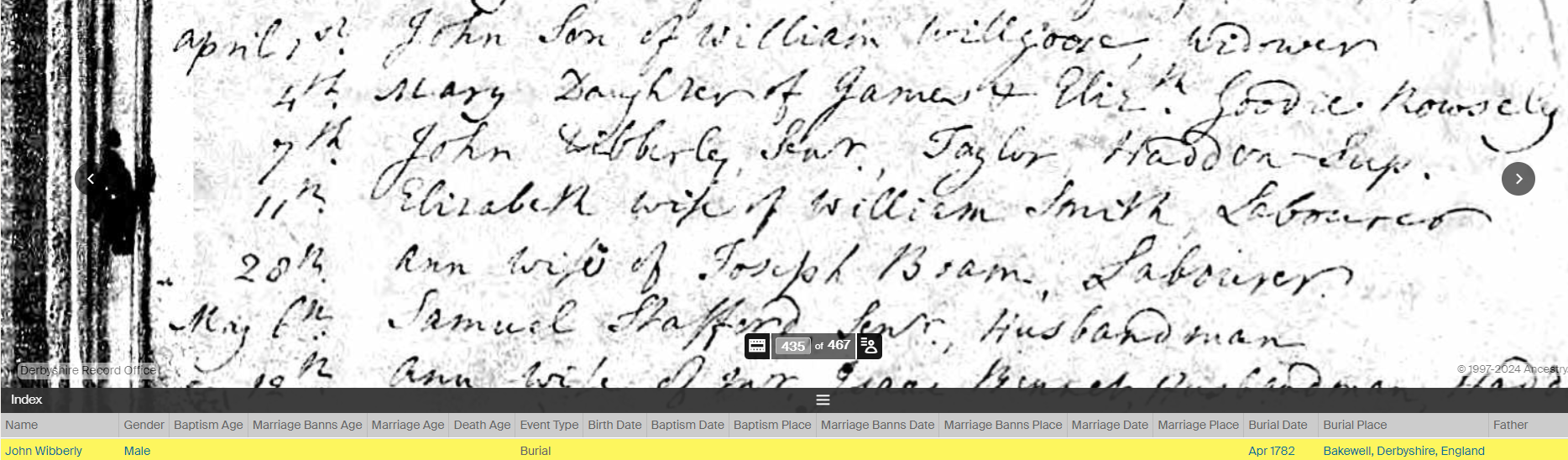
James Marshall 1767-1848 (my 4x great grandfather), parish clerk of Elton, married Ann Newton 1770-1806 in Elton in 1792. In the Bakewell parish register, Ann was baptised on the 2rd of June 1770, her parents George and Dorothy Newton of Upper Haddon. The Bakewell registers at the time covered several smaller villages in the area, although what is currently known as Over Haddon was referred to as Upper Haddon in the earlier entries.
Newton:
George Newton 1728-1798 was the son of George Newton 1706- of Upper Haddon and Jane Sailes, who were married in 1727, both of Upper Haddon.
George Newton born in 1706 was the son of George Newton 1676- and Anne Carr, who were married in 1701, both of Upper Haddon.
George Newton born in 1676 was the son of John Newton 1647- and Alice who were married in 1673 in Bakewell. There is no last name for Alice on the marriage transcription.
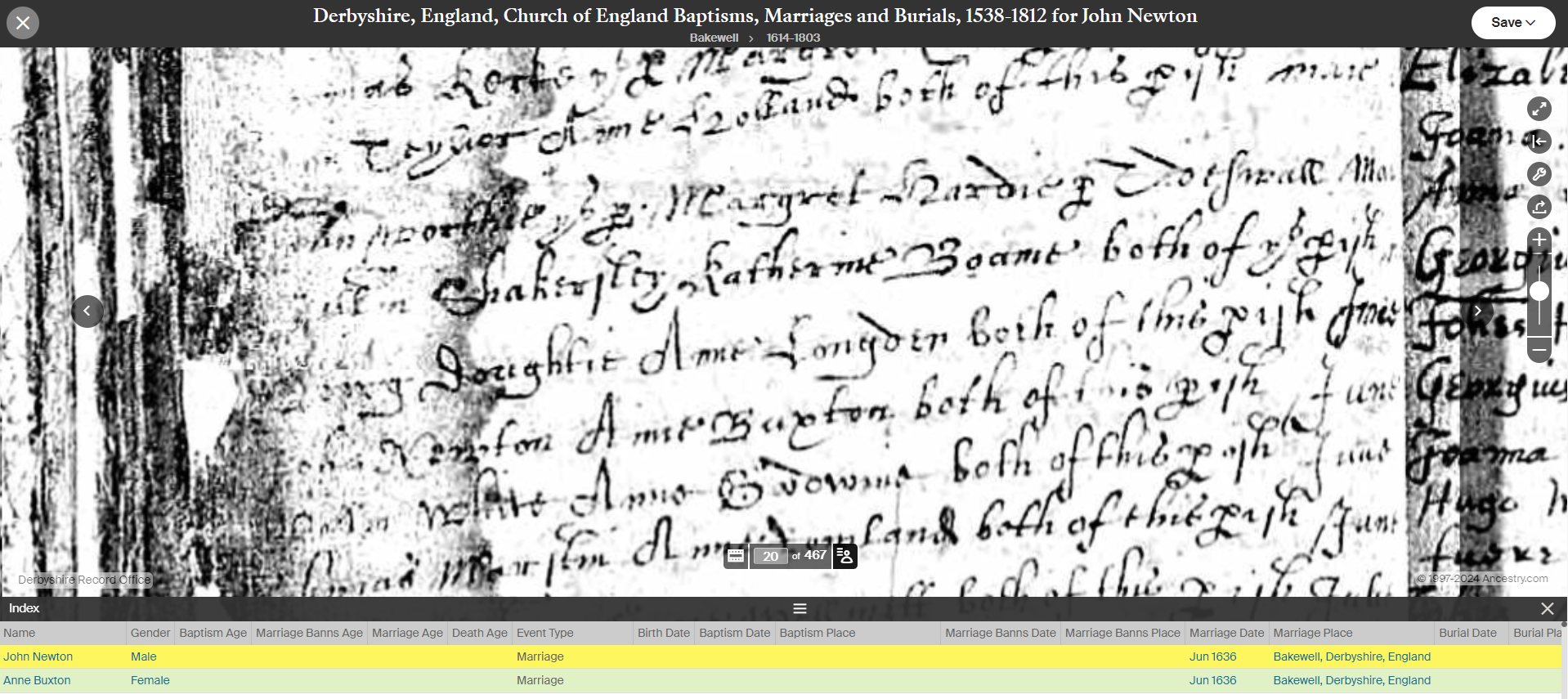
John Newton born in 1647 (my 9x great grandfather) was the son of John Newton and Anne Buxton (my 10x great grandparents), who were married in Bakewell in 1636.
1636 marriage of John Newton and Anne Buxton:
Wibberly
Dorothy Wibberly 1731-1827 married George Newton in 1755 in Bakewell. The entry in the parish registers says that they were both of Over Haddon. Dorothy was baptised in Bakewell on the 25th June 1731, her parents were John and Mary of Over Haddon.

John Wibberly and Mary his wife baptised nine children in Bakewell between 1730 and 1750, and on all of the entries in the parish registers it is stated that they were from Over Haddon. A parish register entry for John and Mary’s marriage has not yet been found, but a marriage in Beeley, a tiny nearby village, in 1728 to Mary Mellor looks likely.
John Wibberly died in Over Haddon in 1782. The entry in the Bakewell parish register notes that he was “taylor of Haddon”.
The tiny village of Over Haddon was historically associated with Haddon Hall.
A baptism for John Wibberly has not yet been found, however, there were Wibersley’s in the Bakewell registers from the early 1600s:
1619 Joyce Wibersley married Raphe Cowper.
1621 Jocosa Wibersley married Radulphus Cowper
1623 Agnes Wibersley married Richard Palfreyman
1635 Cisley Wibberlsy married ? Mr. Mason
1653 John Wibbersly married Grace DaykenHaddon Hall
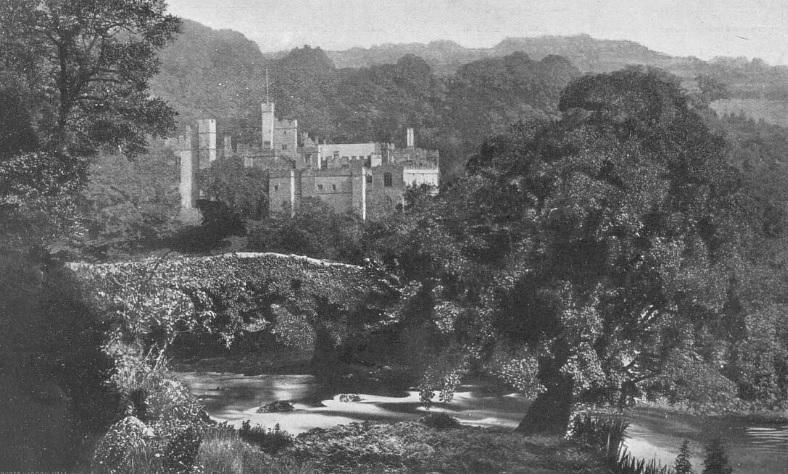
Sir Richard Vernon (c. 1390 – 1451) of Haddon Hall.
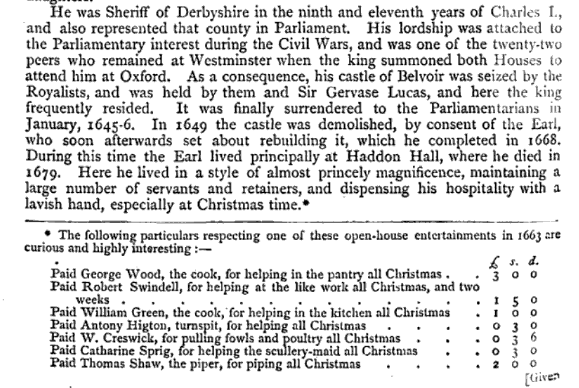
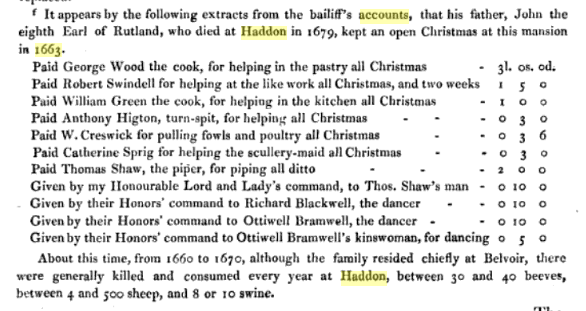
Vernon’s property was widespread and varied. From his parents he inherited the manors of Marple and Wibersley, in Cheshire. Perhaps the Over Haddon Wibersley’s origins were from Sir Richard Vernon’s property in Cheshire. There is, however, a medieval wayside cross called Whibbersley Cross situated on Leash Fen in the East Moors of the Derbyshire Peak District. It may have served as a boundary cross marking the estate of Beauchief Abbey. Wayside crosses such as this mostly date from the 9th to 15th centuries.Found in both The History and Antiquities of Haddon Hall by S Raynor, 1836, and the 1663 household accounts published by Lysons, Haddon Hall had 140 domestic staff.
In the book Haddon Hall, an Illustrated Guide, 1871, an example from the 1663 Christmas accounts:
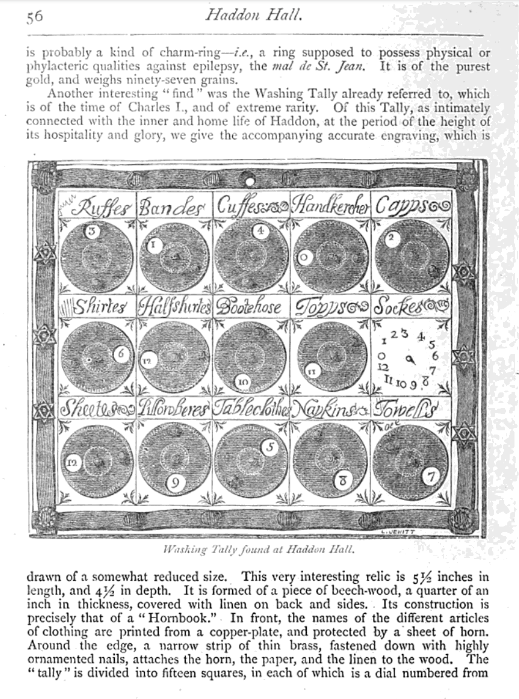
Also in this book, an early 1600s “washing tally” from Haddon Hall:
Over Haddon
Martha Taylor, “the fasting damsel”, was born in Over Haddon in 1649. She didn’t eat for almost two years before her death in 1684. One of the Quakers associated with the Marshall Quakers of Elton, John Gratton, visited the fasting damsel while he was living at Monyash, and occasionally “went two miles to see a woman at Over Haddon who pretended to live without meat.” from The Reliquary, 1861.
August 28, 2024 at 6:26 am #7548In reply to: The Elusive Samuel Housley and Other Family Stories
Elton Marshall’s
Early Quaker Emigrants to USA.
The earliest Marshall in my tree is Charles Marshall (my 5x great grandfather), Overseer of the Poor and Churchwarden of Elton. His 1819 gravestone in Elton says he was 77 years old when he died, indicating a birth in 1742, however no baptism can be found.
According to the Derbyshire records office, Elton was a chapelry of Youlgreave until 1866. The Youlgreave registers date back to the mid 1500s, and there are many Marshalls in the registers from 1559 onwards. The Elton registers however are incomplete due to fire damage.
While doing a google books search for Marshall’s of Elton, I found many American family history books mentioning Abraham Marshall of Gratton born in 1667, who became a Quaker aged 16, and emigrated to Pennsylvania USA in 1700. Some of these books say that Abraham’s parents were Humphrey Marshall and his wife Hannah Turner. (Gratton is a tiny village next to Elton, also in Youlgreave parish.)
Abraham’s son born in USA was also named Humphrey. He was a well known botanist.
Abraham’s cousin John Marshall, also a Quaker, emigrated from Elton to USA in 1687, according to these books.
(There are a number of books on Colonial Families in Pennsylvania that repeat each other so impossible to cite the original source)
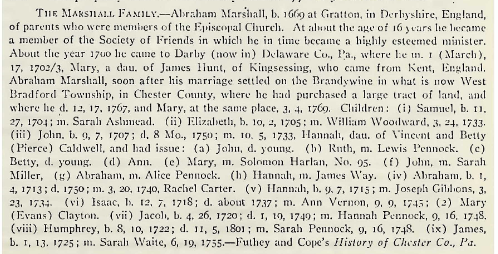
In the Youlgreave parish registers I found a baptism in 1667 for Humphrey Marshall son of Humphrey and Hannah. I didn’t find a baptism for Abraham, but it looks as though it could be correct. Abraham had a son he named Humphrey. But did it just look logical to whoever wrote the books, or do they know for sure? Did the famous botanist Humphrey Marshall have his own family records? The books don’t say where they got this information.
An earlier Humphrey Marshall was baptised in Youlgreave in 1559, his father Edmund. And in 1591 another Humphrey Marshall was baptised, his father George.
But can we connect these Marshall’s to ours? We do have an Abraham Marshall, grandson of Charles, born in 1792. The name isn’t all that common, so may indicate a family connection. The villages of Elton, Gratton and Youlgreave are all very small and it would seem very likely that the Marshall’s who went the USA are related to ours, if not brothers, then probably cousins.
Derbyshire Quakers
In “Derbyshire Quakers 1650-1761” by Helen Forde:
“… Friends lived predominantly in the northern half of the country during this first century of existence. Numbers may have been reduced by emigration to America and migration to other parts of the country but were never high and declined in the early eighteenth century. Predominantly a middle to lower class group economically, Derbyshire Friends numbered very few wealthy members. Many were yeoman farmers or wholesalers and it was these groups who dominated the business meetings having time to devote themselves to the Society. Only John Gratton of Monyash combined an outstanding ministry together with an organising ability which brought him recognition amongst London Friends as well as locally. Derbyshire Friends enjoyed comparatively harmonious relations with civil and Anglican authorities, though prior to the Toleration Act of 1639 the priests were their worst persecutors…..”
Also mentioned in this book: There were monthly meetings in Elton, as well as a number of other nearby places.
John Marshall of Elton 1682/3 appears in a list of Quaker emigrants from Derbyshire.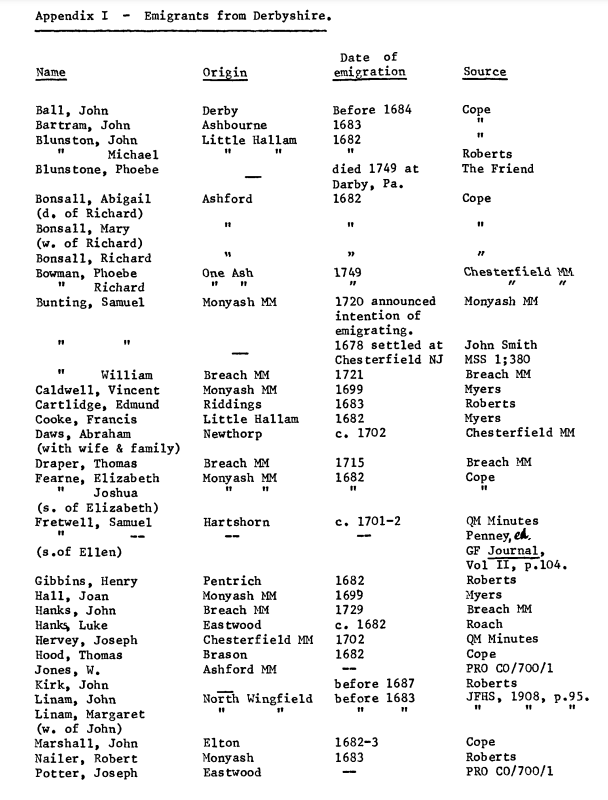
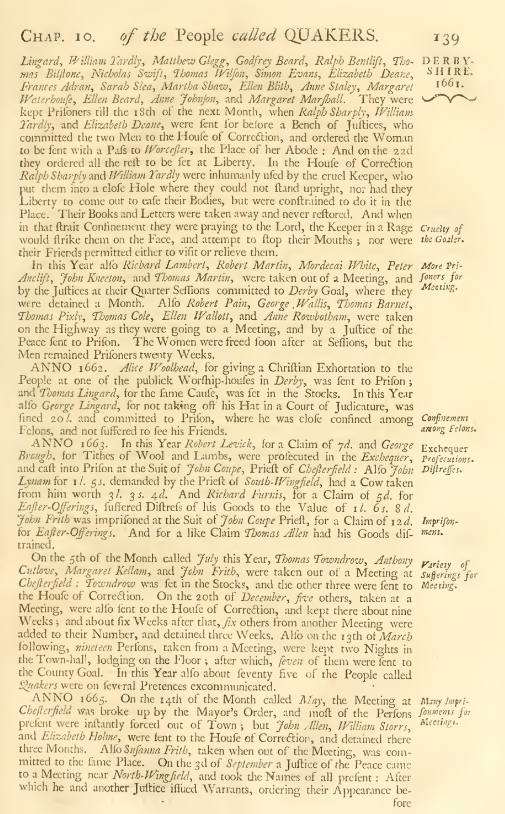
The following image is a page from the 1753 book on the sufferings of Quakers by Joseph Besse as an example of some of the persecutions of Quakers in Derbyshire in the 1600s:
A collection of the sufferings of the people called Quakers, for the testimony of a good conscience from the time of their being first distinguished by that name in the year 1650 to the time of the act commonly called the Act of toleration granted to Protestant dissenters in the first year of the reign of King William the Third and Queen Mary in the year 1689 (Volume 1)
Besse, Joseph. 1753Note the names Margaret Marshall and Anne Staley. This book would appear to contradict Helen Forde’s statement above about the harmonious relations with Anglican authority.
The Botanist
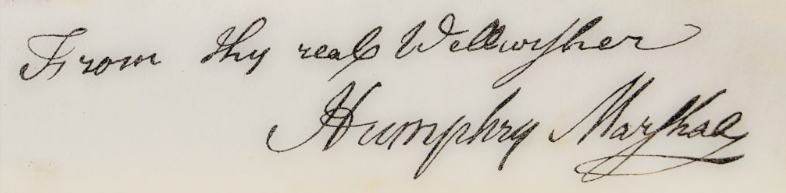
Humphry Marshall 1722-1801 was born in Marshallton, Pennsylvania, the son of the immigrant from Elton, Abraham Marshall. He was the cousin of botanists John Bartram and William Bartram. Like many early American botanists, he was a Quaker. He wrote his first book, A Few Observations Concerning Christ, in 1755.
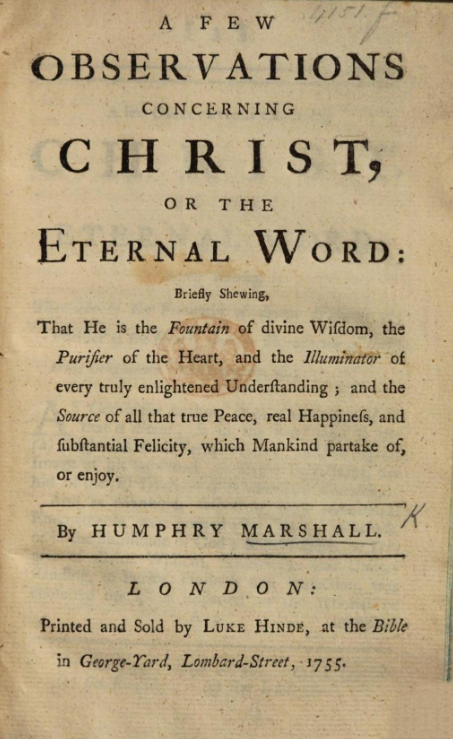
In 1785, Marshall published Arbustrum Americanum: The American Grove, an Alphabetical Catalogue of Forest Trees and Shrubs, Natives of the American United States (Philadelphia).
Marshall has been called the “Father of American Dendrology”.
A genus of plants, Marshallia, was named in honor of Humphry Marshall and his nephew Moses Marshall, also a botanist.
In 1848 the Borough of West Chester established the Marshall Square Park in his honor. Marshall Square Park is four miles east of Marshallton.
via Wikipedia.
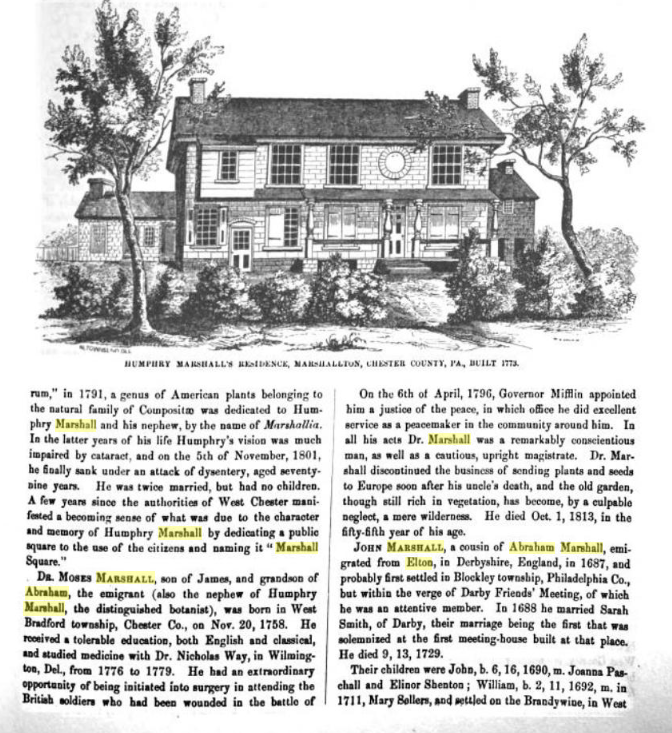
From The History of Chester County Pennsylvania, 1881, by J Smith Futhey and Gilbert Cope:
From The Chester Country History Center:
“Immediately on the Receipt of your Letter, I ordered a Reflecting Telescope for you which was made accordingly. Dr. Fothergill had since desired me to add a Microscope and Thermometer, and will
pay for the whole.’– Benjamin Franklin to Humphry, March 18, 1770
“In his lifetime, Humphry Marshall made his living as a stonemason, farmer, and miller, but eventually became known for his contributions to astronomy, meteorology, agriculture, and the natural sciences.
In 1773, Marshall built a stone house with a hothouse, a botanical laboratory, and an observatory for astronomical studies. He established an arboretum of native trees on the property and the second botanical garden in the nation (John Bartram, his cousin, had the first). From his home base, Humphry expanded his botanical plant exchange business and increased his overseas contacts. With the help of men like Benjamin Franklin and the English botanist Dr. John Fothergill, they eventually included German, Dutch, Swedish, and Irish plant collectors and scientists. Franklin, then living in London, introduced Marshall’s writings to the Royal Society in London and both men encouraged Marshall’s astronomical and botanical studies by supplying him with books and instruments including the latest telescope and microscope.
Marshall’s scientific work earned him honorary memberships to the American Philosophical Society and the Philadelphia Society for Promoting Agriculture, where he shared his ground-breaking ideas on scientific farming methods. In the years before the American Revolution, Marshall’s correspondence was based on his extensive plant and seed exchanges, which led to further studies and publications. In 1785, he authored his magnum opus, Arbustum Americanum: The American Grove. It is a catalog of American trees and shrubs that followed the Linnaean system of plant classification and was the first publication of its kind.”
 August 21, 2024 at 12:27 pm #7546
In reply to: The Elusive Samuel Housley and Other Family Stories
The Potters of Darley Bridge
Rebecca Knowles 1745-1823, my 5x great grandmother, married Charles Marshall 1742-1819, the churchwarden of Elton, in Darley, Derbyshire, in 1767. Rebecca was born in Darley in 1745, the youngest child of Roger Knowles 1695-1784, and Martha Potter 1702?-1772.
Although Roger and Martha were both from Darley, they were married in South Wingfield by licence in 1724. Roger’s occupation on the marriage licence was lead miner. (Lead miners in Derbyshire at that time usually mined their own land.) Jacob Potter signed the licence so I assumed that Jacob Potter was her father.
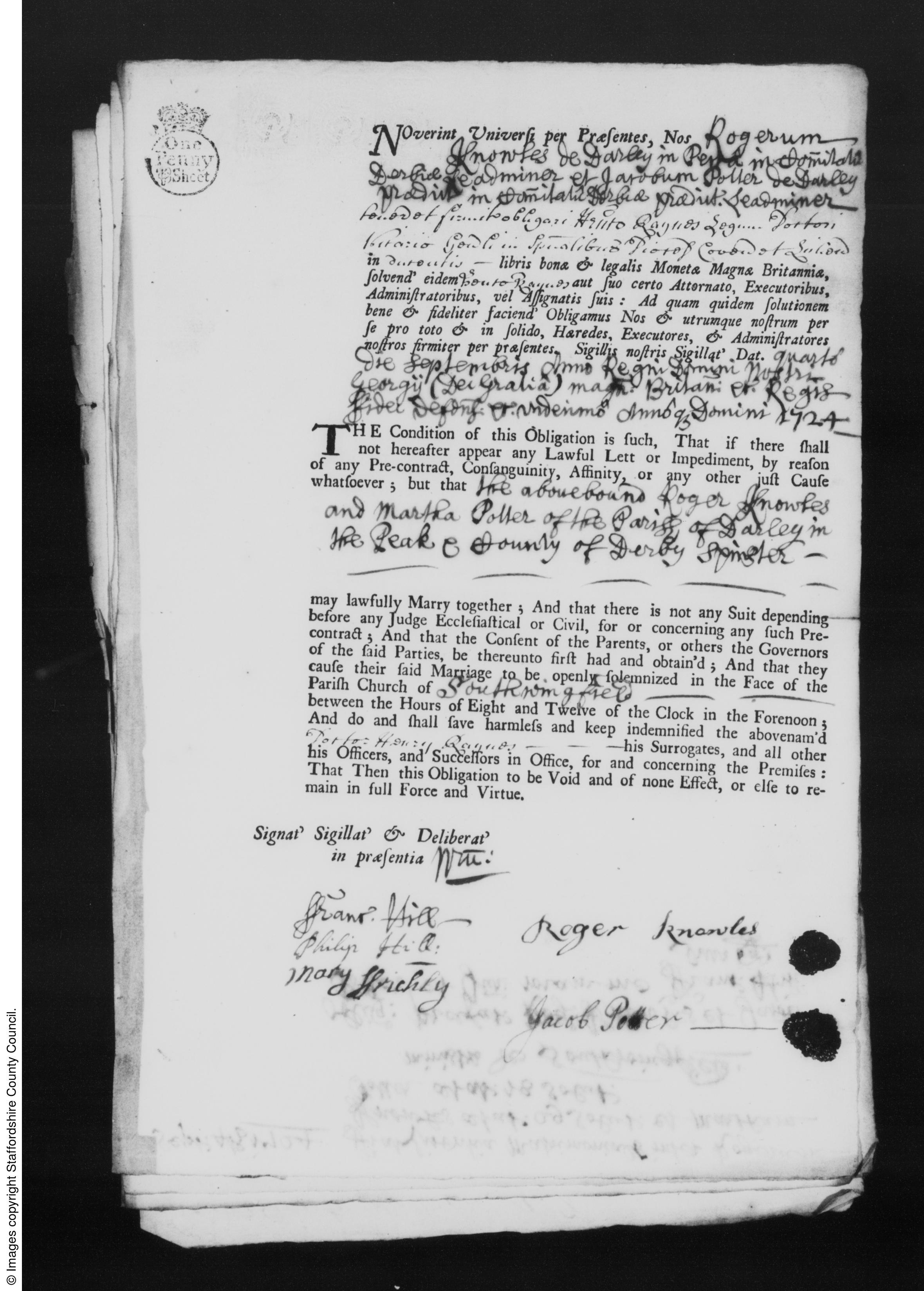
I then found the will of Jacobi Potter who died in 1719. However, he signed the will James Potter. Jacobi is latin for James. James Potter mentioned his daughter Martha in his will “when she comes of age”. Martha was the youngest child of James. James also mentioned in his will son James AND son Jacob, so there were both James’s and Jacob’s in the family, although at times in the documents James is written as Jacobi!
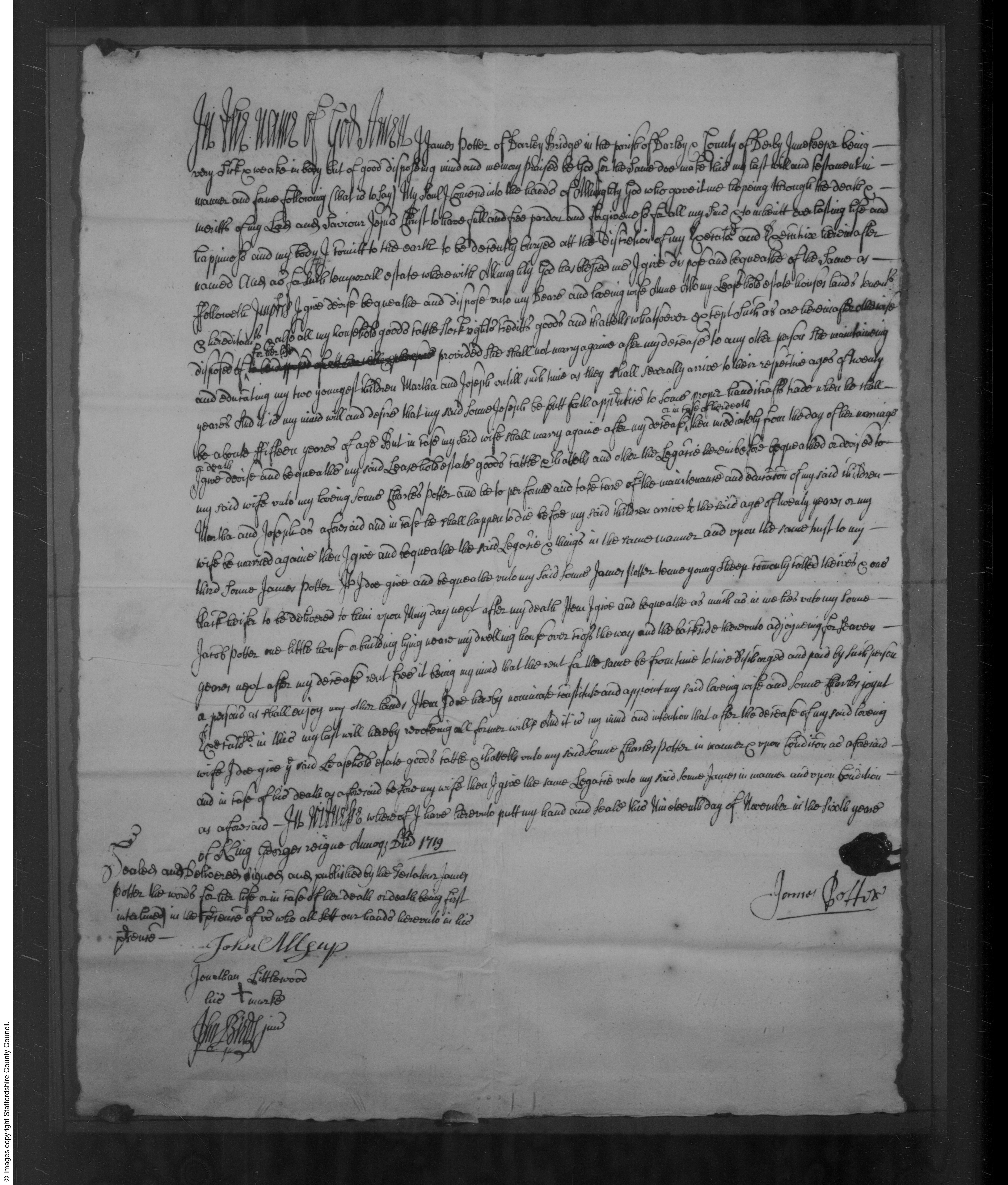
Jacob Potter who signed Martha’s marriage licence was her brother Jacob.
Martha’s brother James mentioned his sister Martha Knowles in his 1739 will, as well as his brother Jacob and his brother Joseph.
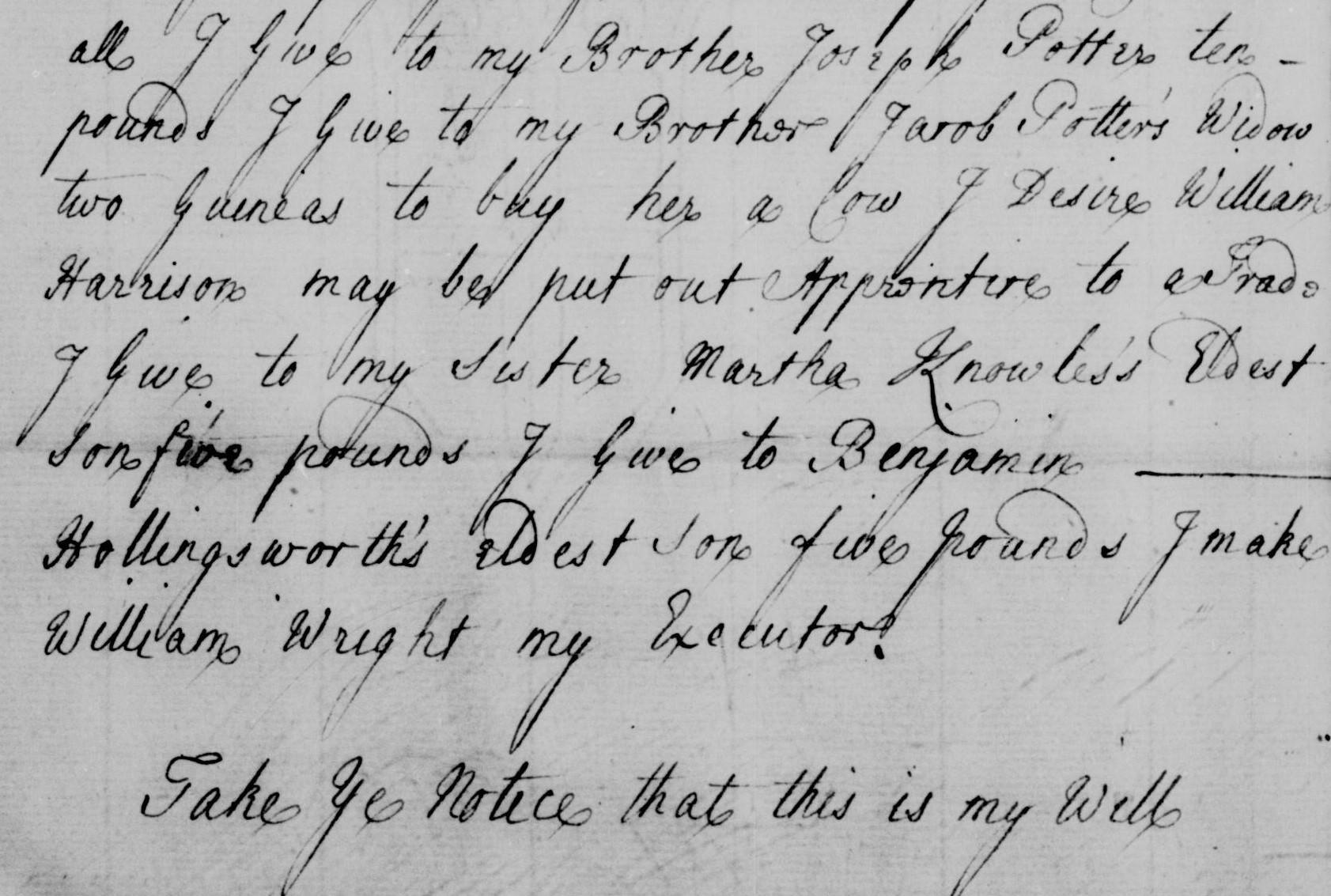
Martha’s father James Potter mentions his wife Ann in his 1719 will. James Potter married Ann Waterhurst in 1690 in Wirksworth, some seven miles from Darley. James occupation was innkeeper at Darley Bridge.
I did a search for Waterhurst (there was only a transcription available for that marriage, not a microfilm) and found no Waterhursts anywhere, but I did find many Warhursts in Derbyshire. In the older records, Warhust is also spelled Wearhurst and in a number of other ways. A Martha Warhurst died in Peak Forest, Derbyshire, in 1681. Her husbands name was missing from the deteriorated register pages. This may or may not be Martha Potter’s grandmother: the records for the 1600s are scanty if they exist at all, and often there are bits missing and illegible entries.
The only inn at Darley Bridge was The Three Stags Heads, by the bridge. It is now a listed building, and was on a medieval packhorse route. The current building was built in 1736, however there is a late 17th century section at rear of the cross wing. The Three Stags Heads was up for sale for £430,000 in 2022, the closure a result of the covid pandemic.

Another listed building in Darley Bridge is Potters Cottage, with a plaque above the door that says “Jonathan and Alice Potter 1763”. Jonathan Potter 1725-1785 was James grandson, the son of his son Charles Potter 1691-1752. His son Charles was also an innkeeper at Darley Bridge: James left the majority of his property to his son Charles.
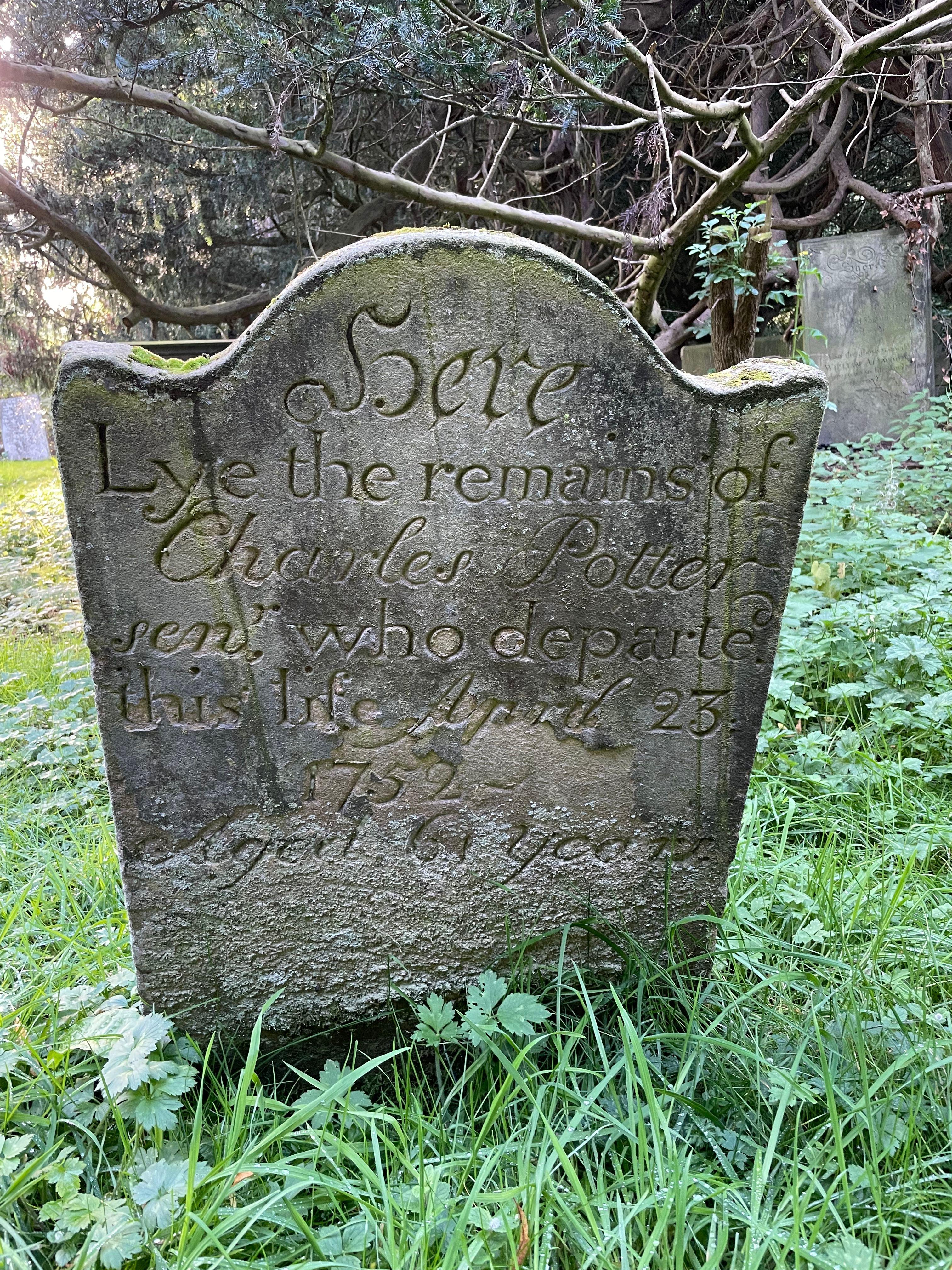
Charles is the only child of James Potter that we know the approximate date of birth, because his age was on his grave stone. I haven’t found any of their baptisms, but did note that many Potters were baptised in non conformist registers in Chesterfield.
Potters Cottage
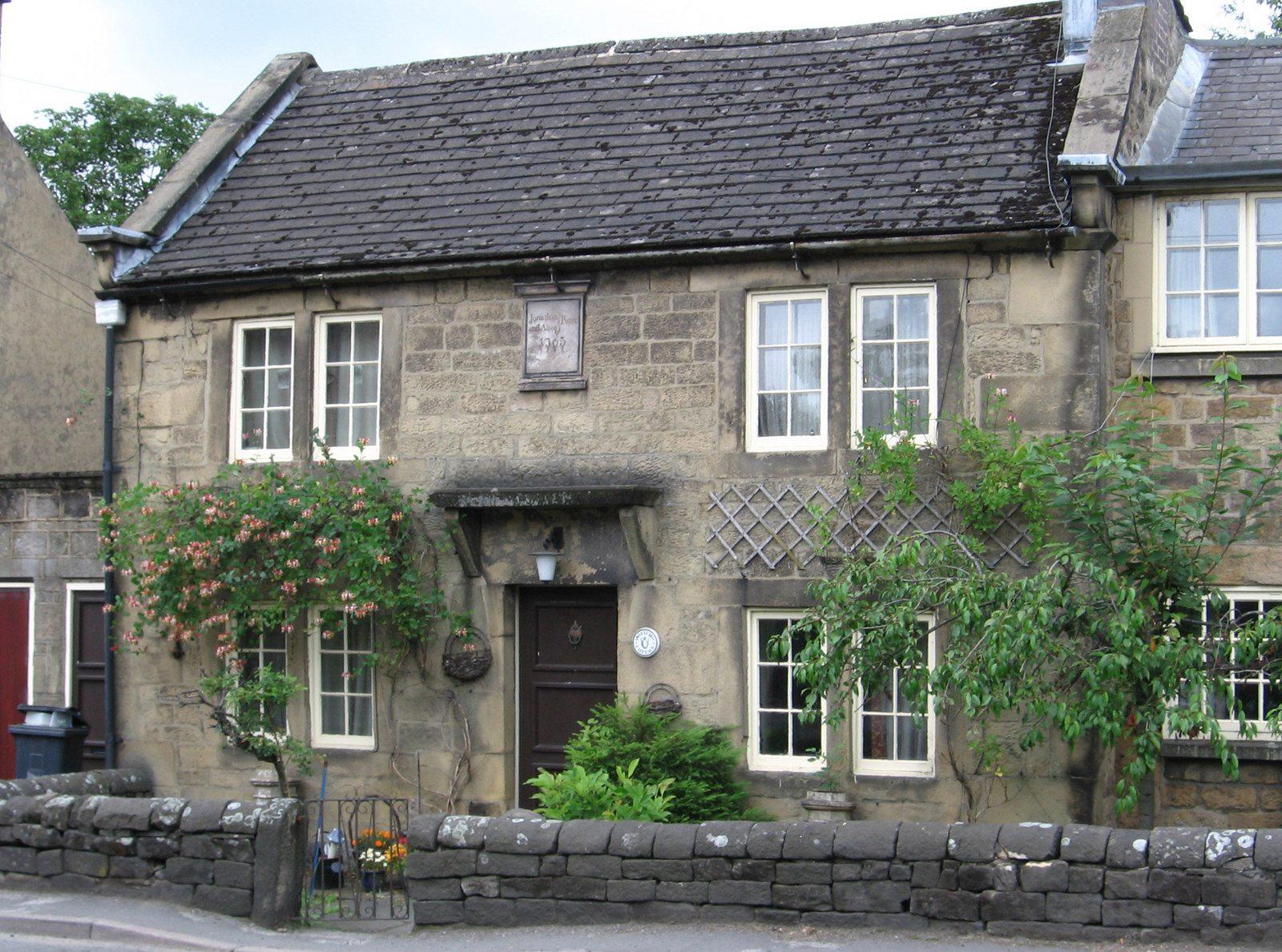
Jonathan Potter of Potters Cottage married Alice Beeley in 1748.
“Darley Bridge was an important packhorse route across the River Derwent. There was a packhorse route from here up to Beeley Moor via Darley Dale. A reference to this bridge appears in 1504… Not far to the north of the bridge at Darley Dale is Church Lane; in 1635 it was known as Ghost Lane after a Scottish pedlar was murdered there. Pedlars tended to be called Scottish only because they sold cheap Scottish linen.”
via Derbyshire Heritage website.
According to Wikipedia, the bridge dates back to the 15th century.
June 26, 2024 at 7:09 am #7526In reply to: The Incense of the Quadrivium’s Mystiques
Truella slept for longer than she intended, indeed, she had not intended to sleep at all, there was too much to do. Trying to hold on to the fragments of dream recall, she sat up and rubbed her eyes. Glancing around the room, she couldn’t immediately remember what she was doing there. Suddenly she sat bolt upright. What was that conversation she’d had before falling alseep? Truella felt dizzy trying to remember. She stood up and started to pace the room, and noticed a letter had been pushed under the bedroom door. She frowned as she bent to pick it up. Nothing was written on the outside, but the envelope had been sealed with a blob of red wax. Truella opened the letter carefully without breaking the seal. A yellowy page was inside, written in Latin.
Ordo Amphibiae-Luciae: pertinebant ad Ordinem Amphibiae-Luciae.
Truella’s Latin was rusty to say the least. She sat back down on the bed struggling to decipher the message.
The Order of Amphibia-Lucia: They belonged to the Order of Amphibia-Lucia.
Nomen Amphibia-Lucia provenit ex duplici natura: tam terrena quam mundana. Rana facies symbolica est repraesentatio nexus eorum ad aquam, transformationem, et antiqua numina amphibiana.
The name “Amphibia-Lucia” stems from their dual nature: both earthly and otherworldly. The frog face is a symbolic representation of their connection to water, transformation, and ancient amphibian deities. They believe in metamorphosis, much like a tadpole turns into a frog, embodying cycles of death and rebirth These priestesses predated Christianity by eons. Their practices and rituals were about aligning with the cosmic cycles, harnessing planetary energies, and maintaining harmony between the seen and the unseen. They were known to perform rites that involved intricate dances, chants in forgotten tongues, and the use of ancient artifacts that, according to legend, could summon or banish entities from beyond our realm—dragons included.
Tartessus in obscurum, secretissimae sectae, ordo Amphibiae-Luciae, sub terra perrexit, ad litteram. Scientiam suam servaverunt, eam per generationes transeuntes, ritus suos in secretis clausulis sub culturis recentioribus obrutos servaverunt. Christianismus in terram pervasit, sed hae sorores aptatae, antiquas vias obtegunt sub specie hodiernae opinionis systemata superstites vigereque.
When Tartessos fell into obscurity, its most secretive sect, the Order of Amphibia-Lucia, went underground—literally. They preserved their knowledge, passing it down through generations, maintaining their rituals in secretive enclaves buried beneath newer civilizations. Christianity might’ve swept over the land, but these sisters adapted, cloaking their ancient ways under the guise of more contemporary belief systems to survive and thrive.
In cellis cellis in ipsum cubiculum illorum claustrorum contextum habemus reliquias ordinis pervetusti, dogmatum ac dogmatum recentioris millennii securos. Hais ex quo saeviunt dii, rudis sacra, et advena mundus.
In the cellars woven into the very bedrock of those cloisters, we have the remnants of an archaic order, unconcerned with dogmas and doctrines of the more recent two millennia. They’re from a time when gods were wilder, rituals were raw, and the world was a stranger.
When the nuns under Hildegarde von Bingen’s influence merged with these ancient priestesses, it wasn’t just a blending of orders but a clash and harmony of traditions. Hildegarde herself, in her visionary wisdom, likely recognized the power and ancient wisdom of the Order of Amphibia-Lucia, choosing to weave their potent rituals into her own esoteric Christian practices. The frog-faced sisters are no mere relics of an outdated faith. They’re the living embodiment of an ancient, potent lineage that predates and outlasts many of the world’s religions. They’re the keepers of ancient Tartessian magic, lurking in those cellars, waiting for the right time to hop back into the forefront of history.
So that was it! But who had pushed the letter under her door? And why was it written in Latin? Had everyone else received a letter?
June 25, 2024 at 9:06 pm #7524In reply to: The Incense of the Quadrivium’s Mystiques
The obvious place to start with investigations into the history of the Morticians Guild was to question Rufus. But first she needed to think. Truella made her way to her room, and locked the door. At least now that Eris was back so soon, Truella was free to let Eris get on with whatever she was doing. After lowering the blinds at the windows, she lay back on the bed and closed her eyes. As she started to drift off to sleep, an imaginary conversation ran through her head.
Rufus: “The Morticians’ Guild, originally known as the ‘Necro-Keepers,’ trace their lineage back to ancient Egypt. They were the guardians of rites that ensured the safe passage of souls to the afterlife. Over millennia, they adapted and evolved, absorbing arcane knowledge from various cultures—the Greeks with their Eleusinian Mysteries, the Romans with their burial rites, even the Celtic traditions of Samhain.”
Truella: “That’s fascinating. So, this ancient craft has been handed down through generations?”
Rufus: “Precisely. While Hildegarde von Bingen brought enlightenment and medicinal wisdom to her nuns in the 12th century, the Morticians’ practices were already etched in the annals of history. They operated in silence, often in the shadows, perfecting the skills of embalming, necromancy, and spirit communication.”
Truella: “And what about their presence here, in this coven merger?”
Rufus: “We’ve been called upon at times of great need, when balance must be maintained between the living and the dead. Our presence here isn’t coincidental. The dragons and ancient spirits awaken, and we, the keepers, ensure that not all realms collide irreversibly.”
Truella: “So, would you say the Guild has played a role in significant historical events?”
Rufus: “Indeed. We’ve been the unsung heroes, the silent watchers. From plagues to wars, ensuring the dead find peace and don’t linger to disrupt the world of the living. Our methods may have modernized, but our core purpose remains unchanged. The knowledge, the rituals—they are our legacy.”
Truella: “Thank you, Rufus. That’s more fascinating than a year’s worth of ancient spellbooks.”
Rufus: “You’re welcome, Truella. Just remember, history isn’t merely dates and names; it’s living through us, weaving its magic continuously.”
June 18, 2024 at 8:51 am #7500In reply to: The Incense of the Quadrivium’s Mystiques
At the end of the undertakers’ speech, conversations surged, drowning out the 14th-century organ music. Mother Lorena, who seemed to have taken the expression lines to a deeper level, gave imperative angry looks at her nuns who swiftly moved to meet with the witches.
“Hold your beath,” said Eris to Jeezel. “That Mr ash blond hair is coming for you.”
“Sh*t! I don’t have time for that,” said Jeezel looking at the striking young man. Meticulously styled to perfection and a penchant for tailored suits, she knew that kind of dandy, they were more difficult to get rid of than an army of orange slugs after a storm. She stole a champagne flute from Bartolo’s silver tray and flitted with a graceful nonchalance towards the buffet.
“Hi Jeezel! I’m sister Maria. You’re so beautiful,” said a joyful voice. “You want some canapés? I made them myself.”
Jeezel turned and almost moved her hand to her mouth. A young woman wearing the austere yet elegant black habit of the Roman Catholic Church was handing her a plate full of potted meat and pickles toasts. She had chameleon eyes busy looking everywhere except to what was in front of her. The white wimple covering her red hair seemed totally out of place and her face made the strangest contortions as she obviously was trying not to smile.
“Hi, I’m… Jeezel. But you already know that,” she said. The young woman nodded too earnestly and Jeezel suddenly became aware the nuns certainly had files about her and the other witches like the ones Truella gave them. She looked at the greasy canapés and refused politely. She just had time to notice a crimson silk handkerchief in a breast pocket and a flash of ash blond hair closing in.
“Oh! I’m sorry. I just remember, I have to go speak to my friend over there,” Jeezel said noticing Truella with a nun in a Buddhist outfit.
She left the redhead nun with a laugh that twinkled like stardust.
Truella’s friend didn’t seem too happy to have Jeezel barging in on their conversation. She said she was called sister Ananda. Her stained glass painted face didn’t seem to fit her saffron bhikkunis. And the oddest thing was she dominated the conversation, mostly about the diversity of mushrooms she’d been cultivating in the shade of old cellars buried deep in the cloister’s underground tunnels. Truella was sipping her soda, and nodding occasionally. But from what Jeezel could observe, the witch was busy keeping an eye on that tall, dark mortician who certainly looked suspicious.
Young sister Maria hadn’t given up. She joined the conversation with a tray full of what looked like green and pink samosas. Jeezel started to feel like a doe hunted by a pack of relentless beagles.
“You need to try those! Sister Ananda made them for you,” said the young Nun. Her colourful lips showed she had just tasted a few of them.
“At last,” said Garrett with a voice too deep for such a young handsome face, “you’re as difficult to catch as moonlight on the water. Elusive, mesmerizing, and always just out of reach. One moment you’re dazzling us all with your brillance, the next…”
“As usual, you speak too much, Garrett,” said Silas, the oldest of the morticians who just joined the group. The old man’s voice was commanding and his poise projecting an air of unwavering confidence. He had neatly trimmed grey hair and piercing hazel eyes that seem to see right through to the heart of any matter. “May we talk for a moment, dear Jeezel? I think we have some things to discuss.”
“Do we?” she asked, a shiver going up her spine. Her voice sounded uncertain and her heart started beating faster. Did he know about the sacred relic she was looking for? Was he going to ask her on a date too?
“The ritual, dear. The ritual we have to perform together tonight.”
“Oh! Yes, the ritual,” she sighed with relief.
Silas took her hand and they left the group just as Truella was asking a Garrett: “Won’t Rufus join us?”
“I don’t think so,” he answered coldly. But his eyes were full of passion and his heart full of envy as he watched Jeezel walk away with his mentor in a secluded lounge.
June 11, 2024 at 5:26 am #7466In reply to: The Incense of the Quadrivium’s Mystiques
“What’s so bad about the Middle Ages, Eris?” asked Truella, bridling. “I’ve been saying all along, we need to return to our roots, get back to the real thing, ditch the modern corporate world that has nothing to do with witchcraft.”
“It won’t be all lutes and jesters, you know,” Frella said with a frown. “I think you’re romanticising it. They did all sorts of dreadful things for money, even back then.”
“Gorgeous pointy hats though, Frell, and richly embroidered gowns and robes, men in tights and pointy shoes….”
Eris glared at Jez. “Who’s romanticising now? You’re forgetting the rank smell of unwashed bodies, the foul rotten food..”
“We’re not literally going back in time!” Truella said in exasperation. “Just adopting a different outlook, we can still wash for Flove’s sake! I don’t like the sound of Austreberthe though,” she added. “Sounds like a character out of a 1940’s German coven of the worst possible sort.”
“That’s a step too far, Truella,” Frella gasped. “You can’t say things like that about people, especially your superiors.”
“What do you mean can’t, I just did,” Truella retorted hotly. “And that right there is the problem, can’t you see? Nobody is superior! Anyway, how do we know Malove appointed her? Maybe she’s just seized the opportunity, a chancer in a power vacuum, and here you all are, just drooling at the opportunity to kowtow to yet another old dragon past her sell by date.”
“You’ll end up in the stocks on the village green, you will, being pelted with tomatos by the peasants, if she hears you.” Jez was examining her nails. “Did they have nail varnish in the Middle Ages?”
April 12, 2024 at 7:59 pm #7430In reply to: The Incense of the Quadrivium’s Mystiques
“Of course I know,” said Eris, looking worn out by the excess of social interaction, or maybe that was her latest goth make-up. “Have I been the only one paying attention?”
“Shtt, don’t speak too loud, my head is pounding…” Jeezel moaned softly. “And what is happening with us?”
“You haven’t got it, have you? Should I spell it out loud?” Eris glanced sideways, wary of Malové being within earshot. “It was all a test… but I don’t see us getting in the good graces of the Coven with was has transpired so far.”
Truella tugged at Frigella’s sleeve, as she went to refill her plate and had noticed the impromptu discussion which was suspiciously conspirational. Frigella groaned “don’t wake up Yikes, look how cutie pooh he is.”
Truella motioned for them to join Eris and Jeezel, who grimaced at the sight of Truella’s questionable cheese selection. “What’s going on? We want in.”
Eris sighed. “Fine, but not here. Let’s get some fresh air.” As discreetly as a herd of elephant in a dry savanah, they made their way to the terrace, escaping the breakfast room which was getting crowded, to bask in the morning sunlight.
As they settled in, Eris began to explain. “I think it’s a side-effect of my memory spell, that unexpectedly, I still remember most of it.”
“Spill it already, they’re about to close the buffet, and the morning sessions are starting soon, and we can’t be late,” Truella urged, fidgeting impatiently.
“You see, that’s exactly it, Tru’. None of us have been ourselves. And do you really think that baby is a coincidence?” She nodded towards Frigella, who was cooing over the sleeping infant.
“First off, have you noticed, this workshop is meant for the top brass. Only the high-rank witches of the Coven have been invited, and you don’t even think twice about why we’re here. Malové has been setting us to a test amongst her next in line. We’ve been in competition since the start with the other witches, and you didn’t even notice! They were apparently more prepared than us lot. They managed to honeypot Frigella with a baby which I’m pretty sure is nothing more than a transformed rodent. As for Truella, the spell on her must have started on the Octobus; not sure you’ve noticed, but when we stopped on our way to collect the other ones, that’s when she started to get sick and get all sorts of strange cravings.”
“But… what’s the point?” Jeezel asked, still bewildered. “Is that why I can’t get my hair right, and my eye makeup is a disaster, and… and…” She choked back tears.
“These witches are fiercely competitive. And probably less skilled that us, which is why they will not play fair; we’ve got to step up ladies. Otherwise, we’ll be on tuspellware duties for years until some opportunity like that happens again.” Eris was getting fired up, an unusual sight for someone generally mildly interested in office politics.
“Truella!” Eris called out as Truella was starting to gorge on the cornichons she’d piled up next to the fromages assemblage. “You’re presenting in the morning session! Malové is counting on you to update us on the vaping venture… new sales channels, market studies, double-digit growth, you know the drill.”
Truella seemed to snap out of her daze. “Don’t tell me,” Eris sighed, “you forgot… Luckily, I have a memory for all of us, and I brewed some ginkgo potion this morning.” She produced an orange flask with black tea stains around the edges, and poured it into glasses she conjured.
“Now bottoms up, ladies. We’ve got a presentation to nail and some witches to put in their place.”
January 30, 2024 at 1:42 am #7324In reply to: The Incense of the Quadrivium’s Mystiques
“And that, my Dear Reader, is why, even to this day, a traffic cone is called a witches hat.”
It was the boy’s favourite bed-time story and Frigella had read it so many times she knew it nearly by heart. She twisted her neck so she could look down on the child; his breathing was soft, the bedside light illuminated long white lashes resting on chubby cheeks. Slowly… silently, she closed the book, switched off the night lamp and edged herself from the bed. She was very keen to log on to the Ritual and see what progress, if any, Eris had made.
The encounter with Truella and Jeezel that afternoon down at the Cabbage had disturbed her. It was not like them … Truella pouting and mutinous, Jeezel swaggering in so full of her own self-importance. And herself! Blushing and snorting and carrying on for no reason when it was her very nature to be composed. They had always worked as a team, the four of them; it was their strength.
Was some powerful magic afoot that had got through their protection? Perhaps Eris had found something. Her nose twitched and she realised she could still smell it, a pungent uneasiness. Like stale smoke.
“Aunt Friggy?”
She sighed. Her brother had made her promise not to use magic on the child but surely just a wee sprinkle of moon dust couldn’t hurt?
“Yes Conor?”
“Are witches true?”
She sat down on the bed.
“What does your Daddy say?” She stroked the child’s yellow-blond hair. Silky, like her own. He looked more like her than he did his own parents with his alabaster skin and eyes that changed colour like the sea. Always watching he was too, as though he was looking to the very heart of a matter. Just like herself. She was sure he had inherited the gift but Lorcon was having none of that nonsense and had told her so in no uncertain terms. The boy would suffer for it in time though. Just like she had when it had been denied.
“He said Conor don’t be so daft.”
Of course he did. Lorcon clung frantically to his normal life with his normal wife. Tonight she was baby-sitting Conor while they went on a normal date night. Still, she should not be so hard on Lorcon; it was a strange upbringing they’d had themselves.
She kissed the boy’s forehead and breathed deeply. The sweet scent of night jasmin washed over her. At least she’d be there for Conor. The thought consoled her.
“Shall I leave the light on for you, Poppet?”
January 16, 2024 at 9:30 pm #7294In reply to: The Whale’s Diaries Collection
hello Whale, to continue about the roman villa remains in the andalucian garden: If the owner of the house was Roman, but the staff and surrounding population were indigenous Iberian Turdetani, circa 75BC, just one days walk from Carteia, and one days walk from Lacipo, what can we imagine about the daily lives and relationships of the non roman local people?
Ah, the intermingling of cultures, a dance as old as civilization itself. Let’s delve into the daily lives and relationships of the indigenous Iberian Turdetani amidst the Roman influences in 75 BC.
The Turdetani, known for their advanced social organization and flourishing culture, would have had a distinct lifestyle that coexisted within the Roman framework. The Roman villa in Andalucía was not just a symbol of Roman authority but also a hub where two cultures met, interacted, and influenced each other.
Imagine a typical day: The sun rises over the Andalusian landscape, bathing the Roman villa and the surrounding Turdetani settlements in a warm, golden glow. Turdetanian workers make their way to the villa, ready for a day of work. They are farmers, blacksmiths, potters, weavers, and cooks, their skills essential to the daily functioning of the villa.
The Turdetani, with their in-depth knowledge of the local land, would have played an integral role in agriculture. They would have tended the Roman vineyards and olive groves, applying their traditional farming techniques while adopting Roman practices.
Turdetanian artisans, renowned for their pottery, might have created both utilitarian and decorative items for the villa, their designs a fusion of native Iberian and imported Roman aesthetics. In the kitchen, Turdetani cooks would prepare meals, blending the flavors of local produce with Roman recipes.
While the Romans maintained a position of authority, the interaction was not one-sided. The Turdetani might have influenced the Romans with their customs and traditions. Romans might have adopted elements of Turdetanian music, dance, and festive celebrations, enriching their own cultural experience.
Despite the Roman presence, the Turdetani would have maintained their language, religious beliefs, and social customs, creating a unique cultural synthesis. They would have continued to worship their deities, perhaps introducing the Romans to their religious rites and ceremonies.
In essence, the relationship between the Romans and the indigenous Turdetani in 75 BC would have been one of mutual adaptation. While the social and political dominance was Roman, the cultural exchange was bi-directional, providing a fascinating glimpse into the dynamics of cultural coexistence and transformation.
Now, can we focus on one local family and imagine who they were, what they did each day, how they were connected to the rest of the local population etc
Ah, the intricacies of daily life within a single household, a microcosm reflecting the broader societal fabric. Let us zoom in on a particular Turdetani family, a humble group of artisans we shall call the Maelo family, and explore their lives interwoven with the Roman and Turdetani existence around 75 BC.
At the heart of the family was the patriarch, Oris Maelo. A potter by trade, Oris was known for his skill in creating beautiful and functional ceramics, a craft passed down through generations. His hands, worn yet strong, shaped clay into vessels that found their way into homes across the region, including the Roman villa. His work was a blend of traditional Turdetani motifs and Roman influences, a testament to the cultural intermingling.
His wife, Caelia, was a weaver. Her nimble fingers spun stories in wool and linen. Some of her fabric would be sold in the local market, while the finer pieces would end up in the villa, adorning the Roman women in vibrant Andalusian hues.
Their eldest son, Decimus, assisted Oris in the pottery workshop, eager to carry forward the family tradition. Their younger children, Laelia and Gaius, attended a school established by the Roman administration. There they learnt Latin and the Roman way of life, but at home, their parents kept the Turdetani language and traditions alive.
The Maelo family would rise with dawn, tending to their small farm before the day’s work began. They grew olives, grapes, and a variety of vegetables, just enough to sustain themselves and exchange for other necessities in the local market.
Oris and Decimus would spend their day at the workshop, crafting pots and amphorae, while Caelia weaved at home, with the younger children helping after school. Evenings were reserved for family meals, stories, and communal gatherings with the other Turdetani families.
Their connection with the local population was multifaceted. Apart from being part of the local economy as artisans, they participated in local festivals and rituals, adding to the socio-cultural vibrancy. Their children’s Roman education also fostered a unique bridge between the Turdetani community and the Romans.
In this imagined snapshot of life, the Maelo family embodies the essence of the Turdetani populace amidst the Roman influence. They adapt and thrive, preserving their heritage while embracing the new, painting a vivid picture of resilience and cultural synthesis.
Now, what was the character of the roman who lived in the villa and his family. Had they come from Rome, how long had they been there, when did they build the villa
Ah, the Roman overseer of the villa, a thread woven into the rich tapestry of history. Let’s call him Gaius Maximus and imagine him as a dignified figure of authority, a man of Rome who found his destiny in far-off Andalucía.
Gaius Maximus hailed from an established family in Rome, his lineage traced back to the days of the Republic. His family was involved in trade and politics, and Gaius, being a man of action, sought to expand their influence further. Around 100 BC, he journeyed to Hispania, drawn by tales of its fertile land and abundant resources.
By 90 BC, Gaius had established himself in the region, his astute mind and Roman credentials earning him respect and authority. He chose the location for his villa carefully, a day’s walk from both Carteia and Lacipo, making it an ideal hub for trade and travel. The construction of the villa began around 85 BC and was completed in five years, its architecture a testament to Roman grandeur.
His wife, Claudia, hailed from a patrician family in Rome. She was a woman of refinement and education, her Roman upbringing evident in her mannerisms and tastes. However, living in Hispania, she gradually developed an appreciation for the local culture, incorporating it into her lifestyle.
Their two children, Marcus and Julia, were born in Hispania. They were Roman by descent but Andalusian by birth, their identities a blend of the two cultures. Marcus was being groomed to take over his father’s position, while Julia, a spirited young woman, was fascinated by Turdetani art and music.
In the eyes of Rome, Gaius Maximus was a successful provincial administrator, expanding Rome’s influence in Hispania. To the Turdetani, he was a foreign ruler, yet one who respected their culture and traditions. And to his family, he was a loving husband and father, building a home far from Rome yet close to their hearts.
Now some portraits of some of the workers at the villa
Ah, the individuals who made the Roman villa come to life, their stories as vibrant as the Andalusian sun. Let’s give our imagination wings and step into their world.
First, we have Tertius, the villa’s steward. Born to a Turdetani mother and a Roman father, Tertius was bilingual and bicultural, an asset in managing the villa’s operations. He was a man of medium height, with a sturdy build and a sharp gaze. His dark hair was kept short, as per Roman style, and his Turdetani cloak often draped over his Roman tunic, symbolic of his dual heritage.
Then we have Aelia, the head cook. A native Turdetani, Aelia was a robust woman with a jovial demeanor. Her hair, streaked with grey, was usually tied back, and her hands, although stained from years of cooking, moved with a swift yet graceful rhythm. Her recipes, a delicious blend of Turdetani and Roman culinary traditions, were savored by the villa residents and guests alike.
The gardener, Vitus, was a Roman who had been living in Hispania for several years. A man of few words, Vitus spoke through his work. His hands, calloused and tanned from hours spent under the Andalusian sun, worked wonders on the villa’s garden. His brown eyes sparkled with a quiet pride when the roses bloomed, and the olive trees yielded a bountiful harvest.
Lastly, we must not forget the youngest worker, Lyra. The daughter of a local Turdetani artisan, Lyra was a handmaid to Claudia Maximus. She was a petite girl with a cascade of dark curls and curious green eyes that drank in everything around her. Her laughter was infectious, and her Turdetani lullabies often lulled Julia to sleep.
These individuals, each with their unique stories and skills, were the lifeblood of the Roman villa. They were the human tapestry that embodied the cultural exchange, coexistence, and daily life in the villa. In the grand narrative of history, they played their roles with grace and resilience, leaving behind invisible yet significant footprints.
what were some of the cooks recipes?
Ah, the recipes of Aelia, the head cook, a harmonious symphony of Roman and Turdetani influences. Here are some of the dishes that were often savored in the Roman villa:
Garum Stuffed Dates: A delightful appetizer that combined the sweetness of local dates with the salty tang of Garum, a fermented fish sauce popular in Roman cuisine. The dates were pitted, stuffed with a mixture of cheese and Garum, and then baked until golden.
Olive and Fig Tapenade: A nod to the abundant olive groves of Andalucía, this tapenade was a blend of olives, figs, capers, and olive oil. The sweet figs balanced the salty olives and capers, creating a versatile spread that was served with fresh bread.
Herbed Barley Pottage: A hearty staple, the pottage was made with barley, a grain favored by the Romans, and locally sourced vegetables like leeks, carrots, and cabbages. Fresh herbs from the villa’s garden added a burst of flavor.
Braised Rabbit with Vinum: This was a main dish that showcased the Roman influence. Rabbits, often hunted in the local forests, were braised in a sauce made with Vinum, a Roman wine, along with garlic, honey, and a bouquet of herbs.
Honey-Nut Patina: A classic Roman dessert with an Andalusian twist. Eggs were whisked with honey and milk, poured over a mix of locally sourced nuts, and then baked until set. It was a sweet ending to the meals at the villa.
Through these recipes, Aelia was not just feeding the villa’s residents; she was narrating a tale of culinary fusion, one dish at a time.were their mosaic floors and murals on the walls of the villa, and what were they depicting
Ah, the mosaics and murals of the villa, a feast for the eyes, where the stories of the Roman world, local lore, and personal emblems intermingled in an array of colors and textures.
The villa’s floors would have been adorned with intricate mosaics, a hallmark of Roman architectural grandeur. Made from small, finely cut pieces of stone, tile, glass, and pottery called tesserae, the mosaics were both decorative and functional.
In the atrium, the mosaic might depict a scene from Roman mythology. Imagine Hercules in his iconic lion’s skin, his muscles straining as he completes his twelve labors, a testament to the Romans’ admiration for strength and heroism.
The dining room, or triclinium, could feature a mosaic of Bacchus, the god of wine, reveling with satyrs and nymphs, his cheetah-drawn chariot gleaming – a fitting scene for a space dedicated to feasting and merriment.
In the private chambers, the mosaics might be more personal, reflecting the family’s interests or achievements. Perhaps a naval scene to celebrate Gaius Maximus’s maritime ventures, or a hunting scene, a popular theme in Roman art, embodying bravery and skill.
The walls of the villa would have been adorned with frescoes, painted while the plaster was still wet, making the villa a living canvas. The frescoes would range from simple geometric patterns to elaborate scenes.
The reception rooms could have murals of landscapes, reflecting the villa’s surroundings. Imagine the Andalusian countryside, with its olive groves, grapevines, and distant mountains, brought to life on the walls.
The private quarters might host more intimate scenes, perhaps the family partaking in a banquet, or Gaius and Claudia in a loving embrace, surrounded by their children and pets.
Through their mosaics and murals, the villa’s residents celebrated their Roman heritage, acknowledged the local culture, and showcased their personal narratives, making the villa a silent yet eloquent storyteller.
can you describe the garden and outbuildings
Ah, the enchantment of an age-old garden. Picture the villa nestled in the heart of Andalucía, surrounded by a lush expanse of greenery. Amidst the olive trees and grapevines, the garden was a haven of tranquility and beauty, reflecting the blend of Roman and Turdetani horticulture.
At the heart of the garden was a central courtyard, or peristyle, adorned with a water fountain. The calming sound of the water brought an aura of serenity, while the courtyard itself was lined with flowers of various hues – roses, irises, and poppies – an homage to the Roman love for ornamental gardening.
Beyond the peristyle, the garden was a mixture of beauty and utility. Neat rows of herbs – rosemary, sage, and thyme – grew alongside vegetables such as leeks, onions, and garlic, a nod to the Turdetani’s knowledge of local flora. Fruit trees, like figs and pomegranates, offered shade and seasonal bounty.
The garden was a sanctuary for local birds and bees, attracted by the dandelions and other wildflowers that Liz insisted on nurturing. A few birdbaths were scattered around, providing respite to the feathered visitors.
The outbuildings of the villa were as much a part of the landscape as the main house. Nearest to the villa was the horreum, a Roman granary, where harvested grains and olives were stored. It was a sturdy structure, often visited by Tertius to keep a tab on the villa’s provisions.
Not far from the horreum was the pottery workshop. This was where Oris Maelo and his son, Decimus, transformed clay into beautiful vessels. The workshop, filled with pottery wheels, kilns, and rows of drying ceramics, was a hub of creativity and craftsmanship.
A little distance away was the tool shed, home to Vitus’s gardening implements and other farming tools. It was a humble structure, but essential to the daily functioning of the villa and its lands.
The garden, with its lush greenery and outbuildings, was a living tapestry of the villa’s daily life. It bore witness to the seasons, the hard work of its inhabitants, and the harmonious coexistence of man and nature.
October 18, 2023 at 3:20 pm #7281In reply to: Family Stories From The Other Side ~ Book Two
The 1935 Joseph Gerrard Challenge.
While researching the Gerrard family of Ellastone I chanced upon a 1935 newspaper article in the Ashbourne Register. There were two articles in 1935 in this paper about the Gerrards, the second a follow up to the first. An advertisement was also placed offering a £1 reward to anyone who could find Joseph Gerrard’s baptism record.
Ashbourne Telegraph – Friday 05 April 1935:
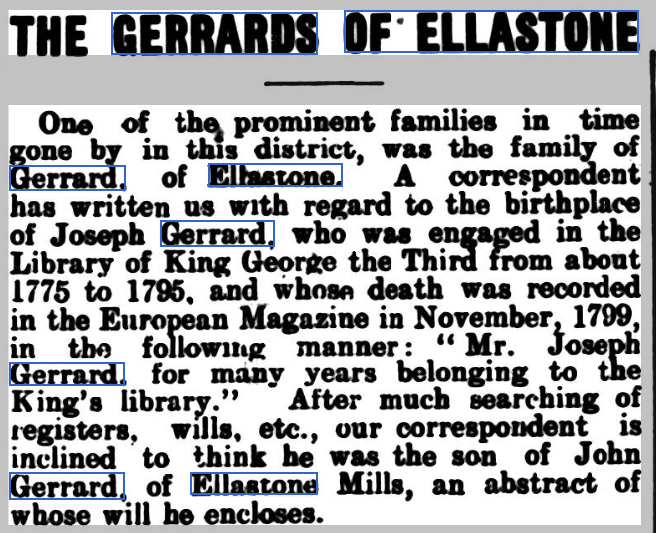
The author wanted to prove that the Joseph Gerrard “who was engaged in the library of King George the third from about 1775 to 1795, and whose death was recorded in the European Magazine in November 1799” was the son of John Gerrard of Ellastone Mills, Staffordshire. Included in the first article was a selected transcription of the 1796 will of John Gerrard. John’s son Joseph is mentioned in this will: John leaves him “£20 to buy a suit of mourning if he thinks proper.”
This Joseph Gerrard however, born in 1739, died in 1815 at Brailsford. Joseph’s brother John also died at Brailsford Mill, and both of their ages at death give a birth year of 1739. Maybe they were twins. William Gerrard and Joseph Gerrard of Brailsford Mill are mentioned in a 1811 newspaper article in the Derby Mercury.
I decided that there was nothing susbtantial about this claim, until I read the 1724 will of John Gerrard the elder, the father of John who died in 1796. In his will he leaves £100 to his son Joseph Gerrard, “secretary to the Bishop of Oxford”.
Perhaps there was something to this story after all. Joseph, baptised in 1701 in Ellastone, was the son of John Gerrard the elder.
I found Joseph Gerrard (and his son James Gerrard) mentioned in the Alumni Oxonienses: The Members of the University of Oxford, University of Oxford, Joseph Foster, 1888. “Joseph Gerard son of John of Elleston county Stafford, pleb, Oriel Coll, matric, 30th May 1718, age 18, BA. 9th March 1721-2; of Merton Coll MA 1728.”
In The Works of John Wesley 1735-1738, Joseph Gerrad is mentioned: “Joseph Gerard , matriculated at Oriel College 1718 , aged 18 , ordained 1727 to serve as curate of Cuddesdon , becoming rector of St. Martin’s , Oxford in 1729 , and vicar of Banbury in 1734.”
In The History of Banbury Alfred Beesley 1842 “a visitation of smallpox occured at Banbury (Oxfordshire) in 1731 and continued until 1733.” Joseph Gerrard was the vicar of Banbury in 1734.
According to the The History and Antiquities of the County of Buckingham George Lipscomb · 1847, Joseph Gerrard was made rector of Monks Risborough in 1738 “but he also continued to hold Stewkley until his death”.
The Speculum of Archbishop Thomas Secker by Secker, Thomas, 1693-1768, also mentions Joseph Gerrard under Monks Risborough and adds that he “resides constantly in the Parsonage ho. except when he goes for a few days to Steukley county Bucks (Buckinghamshire) of which he is vicar.” Joseph’s son James Gerrard 1741-1789 is also mentioned as being a rector at Monks Risborough in 1783.
Joseph Gerrard married Elizabeth Reynolds on 23 July 1739 in Monks Risborough, Buckinghamshire. They had five children between 1740 and 1750, including James baptised 1740 and Joseph baptised 1742.
Joseph died in 1785 in Monks Risborough.
So who was Joseph Gerrard of the Kings Library who died in 1799? It wasn’t Joseph’s son Joseph baptised in 1742 in Monks Risborough, because in his father’s 1785 will he mentions “my only son James”, indicating that Joseph died before that date.
September 5, 2023 at 1:35 pm #7276In reply to: Family Stories From The Other Side ~ Book Two
Wood Screw Manufacturers
The Fishers of West Bromwich.
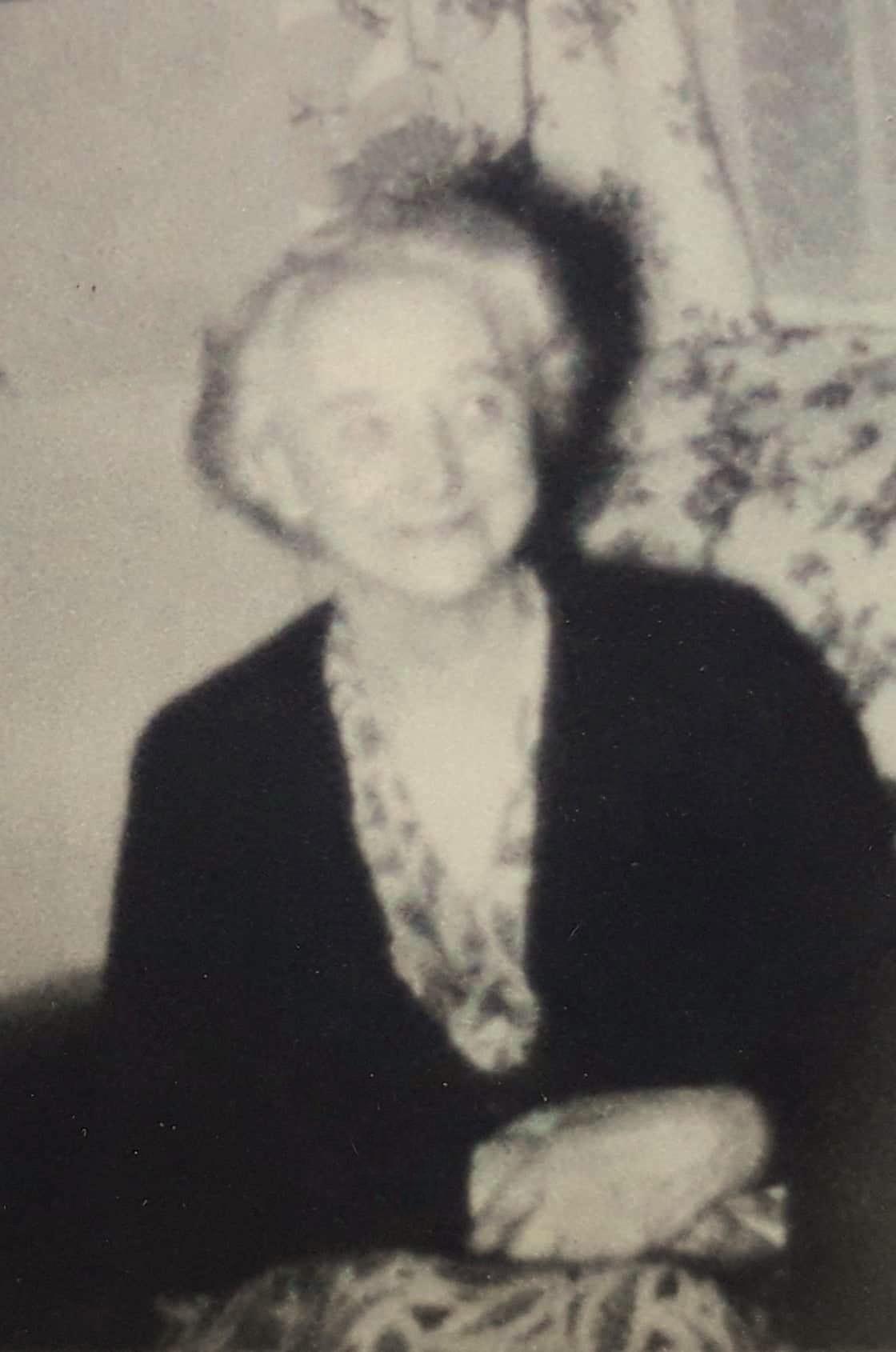
My great grandmother, Nellie Fisher, was born in 1877 in Wolverhampton. Her father William 1834-1916 was a whitesmith, and his father William 1792-1873 was a whitesmith and master screw maker. William’s father was Abel Fisher, wood screw maker, victualler, and according to his 1849 will, a “gentleman”.
Nellie Fisher 1877-1956 :
Abel Fisher was born in 1769 according to his burial document (age 81 in 1849) and on the 1841 census. Abel was a wood screw manufacturer in Wolverhampton.
As no baptism record can be found for Abel Fisher, I read every Fisher will I could find in a 30 year period hoping to find his fathers will. I found three other Fishers who were wood screw manufacurers in neighbouring West Bromwich, which led me to assume that Abel was born in West Bromwich and related to these other Fishers.
The wood screw making industry was a relatively new thing when Abel was born.
“The screw was used in furniture but did not become a common woodworking fastener until efficient machine tools were developed near the end of the 18th century. The earliest record of lathe made wood screws dates to an English patent of 1760. The development of wood screws progressed from a small cottage industry in the late 18th century to a highly mechanized industry by the mid-19th century. This rapid transformation is marked by several technical innovations that help identify the time that a screw was produced. The earliest, handmade wood screws were made from hand-forged blanks. These screws were originally produced in homes and shops in and around the manufacturing centers of 18th century Europe. Individuals, families or small groups participated in the production of screw blanks and the cutting of the threads. These small operations produced screws individually, using a series of files, chisels and cutting tools to form the threads and slot the head. Screws produced by this technique can vary significantly in their shape and the thread pitch. They are most easily identified by the profusion of file marks (in many directions) over the surface. The first record regarding the industrial manufacture of wood screws is an English patent registered to Job and William Wyatt of Staffordshire in 1760.”
Wood Screw Makers of West Bromwich:
Edward Fisher, wood screw maker of West Bromwich, died in 1796. He mentions his wife Pheney and two underage sons in his will. Edward (whose baptism has not been found) married Pheney Mallin on 13 April 1793. Pheney was 17 years old, born in 1776. Her parents were Isaac Mallin and Sarah Firme, who were married in West Bromwich in 1768.
Edward and Pheney’s son Edward was born on 21 October 1793, and their son Isaac in 1795. The executors of Edwards 1796 will are Daniel Fisher the Younger, Isaac Mallin, and Joseph Fisher.There is a marriage allegations and bonds document in 1774 for an Edward Fisher, bachelor and wood screw maker of West Bromwich, aged 25 years and upwards, and Mary Mallin of the same age, father Isaac Mallin. Isaac Mallin and Sarah didn’t marry until 1768 and Mary Mallin would have been born circa 1749. Perhaps Isaac Mallin’s father was the father of Mary Mallin. It’s possible that Edward Fisher was born in 1749 and first married Mary Mallin, and then later Pheney, but it’s also possible that the Edward Fisher who married Mary Mallin in 1774 was Edward Fishers uncle, Daniel’s brother. (I do not know if Daniel had a brother Edward, as I haven’t found a baptism, or marriage, for Daniel Fisher the elder.)
There are two difficulties with finding the records for these West Bromwich families. One is that the West Bromwich registers are not available online in their entirety, and are held by the Sandwell Archives, and even so, they are incomplete. Not only that, the Fishers were non conformist. There is no surviving register prior to 1787. The chapel opened in 1788, and any registers that existed before this date, taken in a meeting houses for example, appear not to have survived.
Daniel Fisher the younger died intestate in 1818. Daniel was a wood screw maker of West Bromwich. He was born in 1751 according to his age stated as 67 on his death in 1818. Daniel’s wife Mary, and his son William Fisher, also a wood screw maker, claimed the estate.
Daniel Fisher the elder was a farmer of West Bromwich, who died in 1806. He was 81 when he died, which makes a birth date of 1725, although no baptism has been found. No marriage has been found either, but he was probably married not earlier than 1746.
Daniel’s sons Daniel and Joseph were the main inheritors, and he also mentions his other children and grandchildren namely William Fisher, Thomas Fisher, Hannah wife of William Hadley, two grandchildren Edward and Isaac Fisher sons of Edward Fisher his son deceased. Daniel the elder presumably refers to the wood screw manufacturing when he says “to my son Daniel Fisher the good will and advantage which may arise from his manufacture or trade now carried on by me.” Daniel does not mention a son called Abel unfortunately, but neither does he mention his other grandchildren. Abel may be Daniel’s son, or he may be a nephew.
The Staffordshire Record Office holds the documents of a Testamentary Case in 1817. The principal people are Isaac Fisher, a legatee; Daniel and Joseph Fisher, executors. Principal place, West Bromwich, and deceased person, Daniel Fisher the elder, farmer.
William and Sarah Fisher baptised six children in the Mares Green Non Conformist registers in West Bromwich between 1786 and 1798. William Fisher and Sarah Birch were married in West Bromwich in 1777. This William was probably born circa 1753 and was probably the son of Daniel Fisher the elder, farmer.
Daniel Fisher the younger and his wife Mary had a son William, as mentioned in the intestacy papers, although I have not found a baptism for William. I did find a baptism for another son, Eutychus Fisher in 1792.
In White’s Directory of Staffordshire in 1834, there are three Fishers who are wood screw makers in Wolverhampton: Eutychus Fisher, Oxford Street; Stephen Fisher, Bloomsbury; and William Fisher, Oxford Street.
Abel’s son William Fisher 1792-1873 was living on Oxford Street on the 1841 census, with his wife Mary and their son William Fisher 1834-1916.
In The European Magazine, and London Review of 1820 (Volume 77 – Page 564) under List of Patents, W Fisher and H Fisher of West Bromwich, wood screw manufacturers, are listed. Also in 1820 in the Birmingham Chronicle, the partnership of William and Hannah Fisher, wood screw manufacturers of West Bromwich, was dissolved.
In the Staffordshire General & Commercial Directory 1818, by W. Parson, three Fisher’s are listed as wood screw makers. Abel Fisher victualler and wood screw maker, Red Lion, Walsal Road; Stephen Fisher wood screw maker, Buggans Lane; and Daniel Fisher wood screw manufacturer, Brickiln Lane.
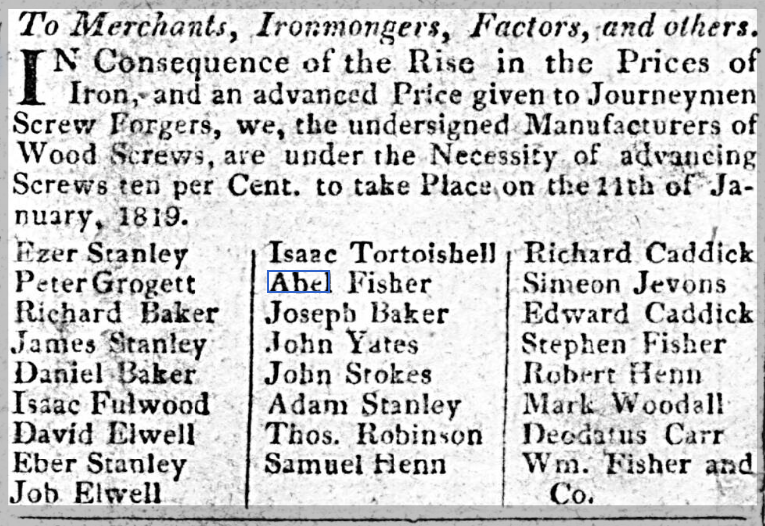
In Aris’s Birmingham Gazette on 4 January 1819 Abel Fisher is listed with 23 other wood screw manufacturers (Stephen Fisher and William Fisher included) stating that “In consequence of the rise in prices of iron and the advanced price given to journeymen screw forgers, we the undersigned manufacturers of wood screws are under the necessity of advancing screws 10 percent, to take place on the 11th january 1819.”
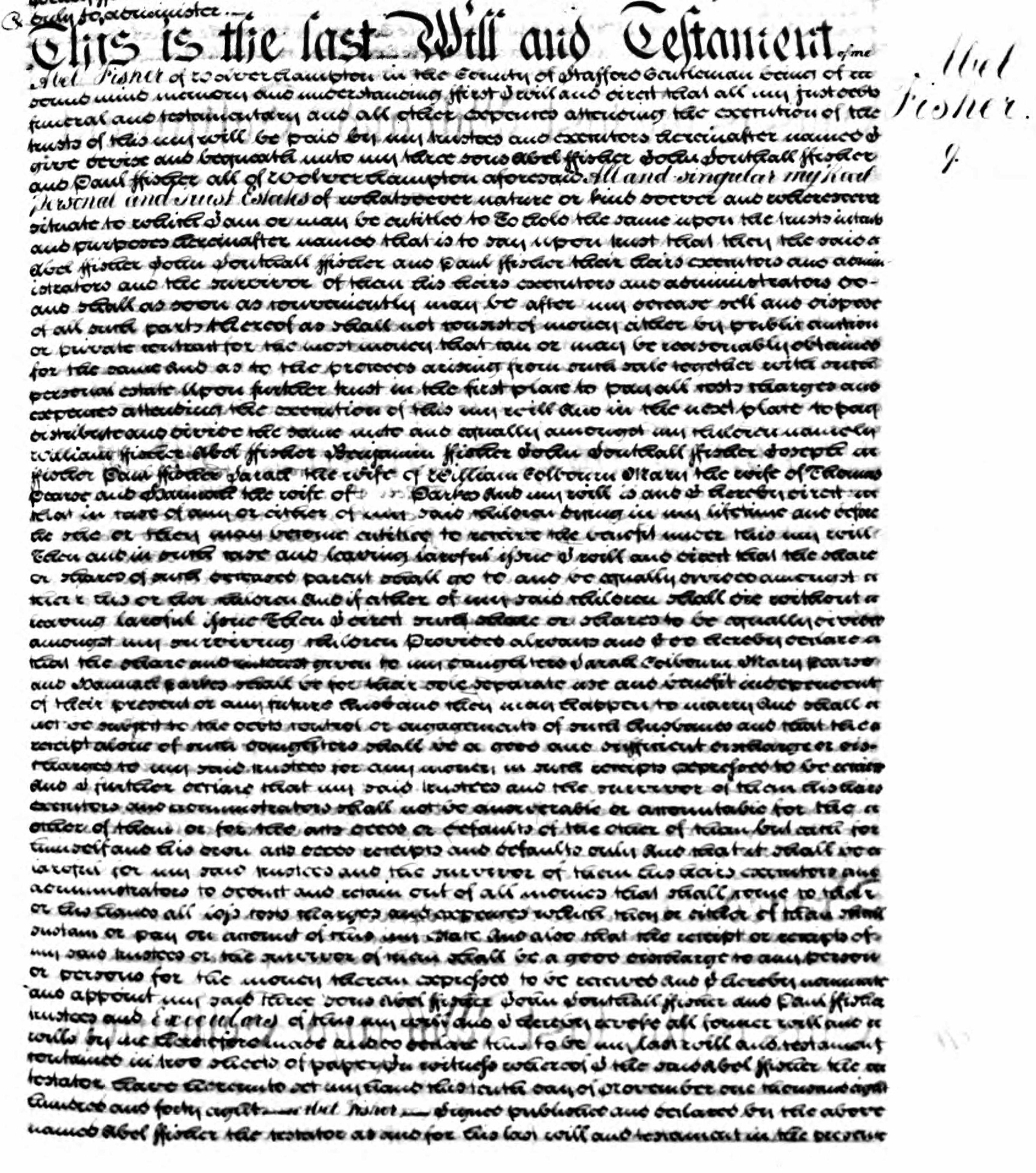
In Abel Fisher’s 1849 will, he names his three sons Abel Fisher 1796-1869, Paul Fisher 1811-1900 and John Southall Fisher 1801-1871 as the executors. He also mentions his other three sons, William Fisher 1792-1873, Benjamin Fisher 1798-1870, and Joseph Fisher 1803-1876, and daughters Sarah Fisher 1794- wife of William Colbourne, Mary Fisher 1804- wife of Thomas Pearce, and Susannah (Hannah) Fisher 1813- wife of Parkes. His son Silas Fisher 1809-1837 wasn’t mentioned as he died before Abel, nor his sons John Fisher 1799-1800, and Edward Southall Fisher 1806-1843. Abel’s wife Susannah Southall born in 1771 died in 1824. They were married in 1791.
The 1849 will of Abel Fisher:
 July 4, 2023 at 7:52 pm #7261
In reply to: Family Stories From The Other Side ~ Book Two
Long Lost Enoch Edwards
My father used to mention long lost Enoch Edwards. Nobody in the family knew where he went to and it was assumed that he went to USA, perhaps to Utah to join his sister Sophie who was a Mormon handcart pioneer, but no record of him was found in USA.
Andrew Enoch Edwards (my great great grandfather) was born in 1840, but was (almost) always known as Enoch. Although civil registration of births had started from 1 July 1837, neither Enoch nor his brother Stephen were registered. Enoch was baptised (as Andrew) on the same day as his brothers Reuben and Stephen in May 1843 at St Chad’s Catholic cathedral in Birmingham. It’s a mystery why these three brothers were baptised Catholic, as there are no other Catholic records for this family before or since. One possible theory is that there was a school attached to the church on Shadwell Street, and a Catholic baptism was required for the boys to go to the school. Enoch’s father John died of TB in 1844, and perhaps in 1843 he knew he was dying and wanted to ensure an education for his sons. The building of St Chads was completed in 1841, and it was close to where they lived.
Enoch appears (as Enoch rather than Andrew) on the 1841 census, six months old. The family were living at Unett Street in Birmingham: John and Sarah and children Mariah, Sophia, Matilda, a mysterious entry transcribed as Lene, a daughter, that I have been unable to find anywhere else, and Reuben and Stephen.
Enoch was just four years old when his father John, an engineer and millwright, died of consumption in 1844.
In 1851 Enoch’s widowed mother Sarah was a mangler living on Summer Street, Birmingham, Matilda a dressmaker, Reuben and Stephen were gun percussionists, and eleven year old Enoch was an errand boy.
On the 1861 census, Sarah was a confectionrer on Canal Street in Birmingham, Stephen was a blacksmith, and Enoch a button tool maker.
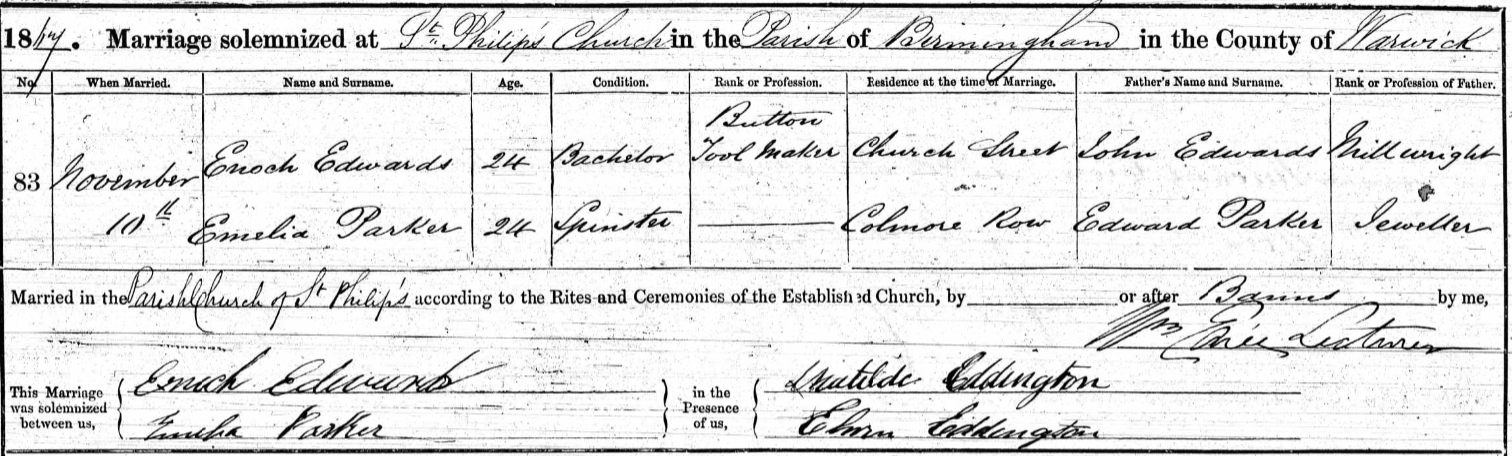
On the 10th November 1867 Enoch married Emelia Parker, daughter of jeweller and rope maker Edward Parker, at St Philip in Birmingham. Both Emelia and Enoch were able to sign their own names, and Matilda and Edwin Eddington were witnesses (Enoch’s sister and her husband). Enoch’s address was Church Street, and his occupation button tool maker.
Four years later in 1871, Enoch was a publican living on Clifton Road. Son Enoch Henry was two years old, and Ralph Ernest was three months. Eliza Barton lived with them as a general servant.
By 1881 Enoch was back working as a button tool maker in Bournebrook, Birmingham. Enoch and Emilia by then had three more children, Amelia, Albert Parker (my great grandfather) and Ada.
Garnet Frederick Edwards was born in 1882. This is the first instance of the name Garnet in the family, and subsequently Garnet has been the middle name for the eldest son (my brother, father and grandfather all have Garnet as a middle name).
Enoch was the licensed victualler at the Pack Horse Hotel in 1991 at Kings Norton. By this time, only daughters Amelia and Ada and son Garnet are living at home.
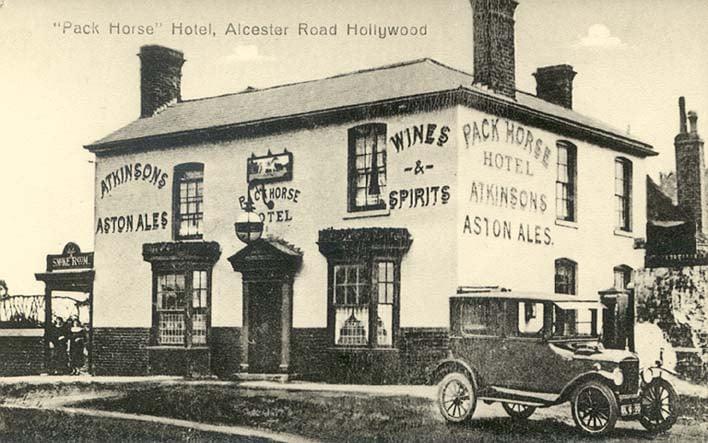
Additional information from my fathers cousin, Paul Weaver:
“Enoch refused to allow his son Albert Parker to go to King Edwards School in Birmingham, where he had been awarded a place. Instead, in October 1890 he made Albert Parker Edwards take an apprenticeship with a pawnboker in Tipton.
Towards the end of the 19th century Enoch kept The Pack Horse in Alcester Road, Hollywood, where a twist was 1d an ounce, and beer was 2d a pint. The children had to get up early to get breakfast at 6 o’clock for the hay and straw men on their way to the Birmingham hay and straw market. Enoch is listed as a member of “The Kingswood & Pack Horse Association for the Prosecution of Offenders”, a kind of early Neighbourhood Watch, dated 25 October 1890.
The Edwards family later moved to Redditch where they kept The Rifleman Inn at 35 Park Road. They must have left the Pack Horse by 1895 as another publican was in place by then.”Emelia his wife died in 1895 of consumption at the Rifleman Inn in Redditch, Worcestershire, and in 1897 Enoch married Florence Ethel Hedges in Aston. Enoch was 56 and Florence was just 21 years old.
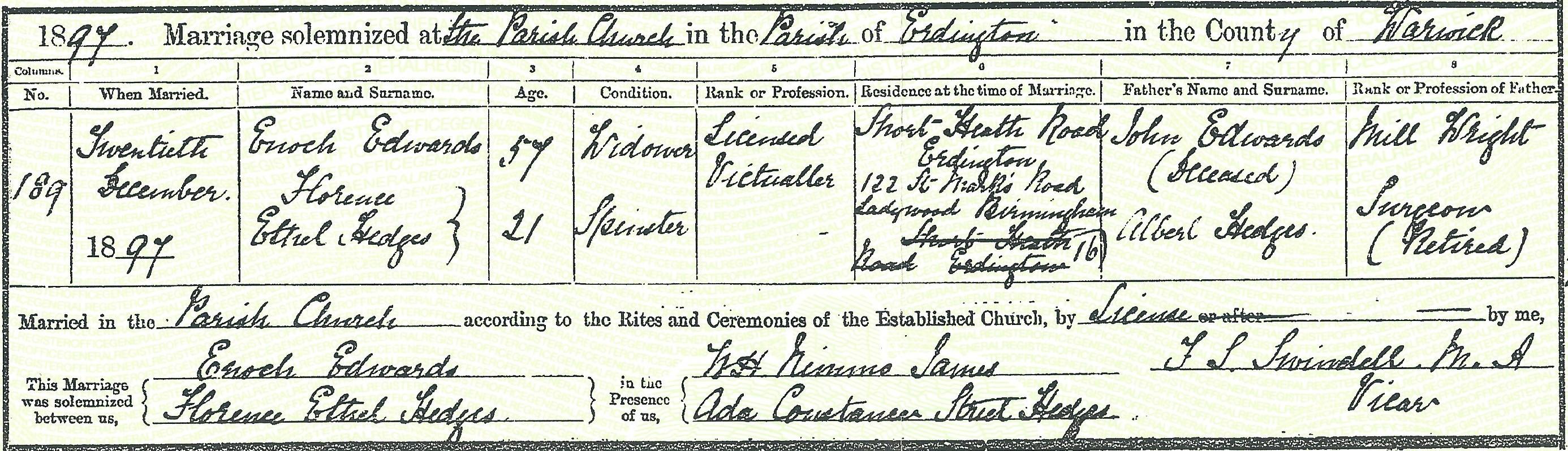
The following year in 1898 their daughter Muriel Constance Freda Edwards was born in Deritend, Warwickshire.
In 1901 Enoch, (Andrew on the census), publican, Florence and Muriel were living in Dudley. It was hard to find where he went after this.From Paul Weaver:
“Family accounts have it that Enoch EDWARDS fell out with all his family, and at about the age of 60, he left all behind and emigrated to the U.S.A. Enoch was described as being an active man, and it is believed that he had another family when he settled in the U.S.A. Esmor STOKES has it that a postcard was received by the family from Enoch at Niagara Falls.
On 11 June 1902 Harry Wright (the local postmaster responsible in those days for licensing) brought an Enoch EDWARDS to the Bedfordshire Petty Sessions in Biggleswade regarding “Hole in the Wall”, believed to refer to the now defunct “Hole in the Wall” public house at 76 Shortmead Street, Biggleswade with Enoch being granted “temporary authority”. On 9 July 1902 the transfer was granted. A year later in the 1903 edition of Kelly’s Directory of Bedfordshire, Hunts and Northamptonshire there is an Enoch EDWARDS running the Wheatsheaf Public House, Church Street, St. Neots, Huntingdonshire which is 14 miles south of Biggleswade.”
It seems that Enoch and his new family moved away from the midlands in the early 1900s, but again the trail went cold.
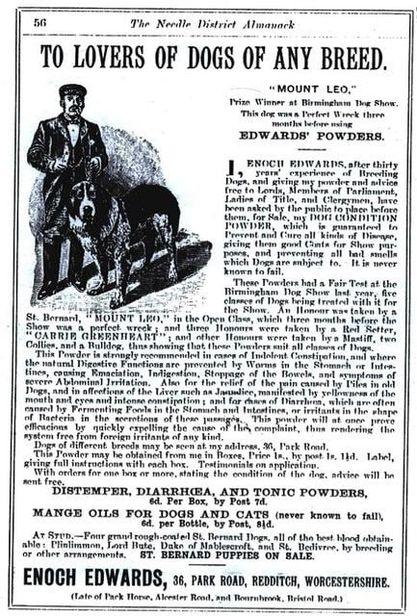
When I started doing the genealogy research, I joined a local facebook group for Redditch in Worcestershire. Enoch’s son Albert Parker Edwards (my great grandfather) spent most of his life there. I asked in the group about Enoch, and someone posted an illustrated advertisement for Enoch’s dog powders. Enoch was a well known breeder/keeper of St Bernards and is cited in a book naming individuals key to the recovery/establishment of ‘mastiff’ size dog breeds.
We had not known that Enoch was a breeder of champion St Bernard dogs!
Once I knew about the St Bernard dogs and the names Mount Leo and Plinlimmon via the newspaper adverts, I did an internet search on Enoch Edwards in conjunction with these dogs.
Enoch’s St Bernard dog “Mount Leo” was bred from the famous Plinlimmon, “the Emperor of Saint Bernards”. He was reported to have sent two puppies to Omaha and one of his stud dogs to America for a season, and in 1897 Enoch made the news for selling a St Bernard to someone in New York for £200. Plinlimmon, bred by Thomas Hall, was born in Liverpool, England on June 29, 1883. He won numerous dog shows throughout Europe in 1884, and in 1885, he was named Best Saint Bernard.
In the Birmingham Mail on 14th June 1890:
“Mr E Edwards, of Bournebrook, has been well to the fore with his dogs of late. He has gained nine honours during the past fortnight, including a first at the Pontypridd show with a St Bernard dog, The Speaker, a son of Plinlimmon.”
In the Alcester Chronicle on Saturday 05 June 1897:
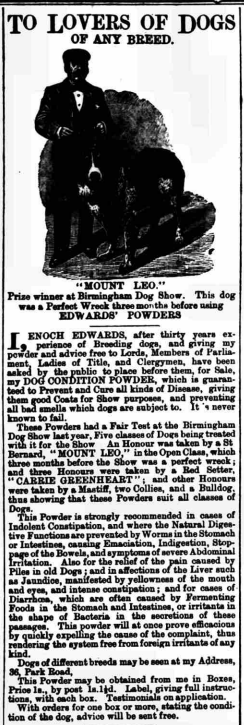
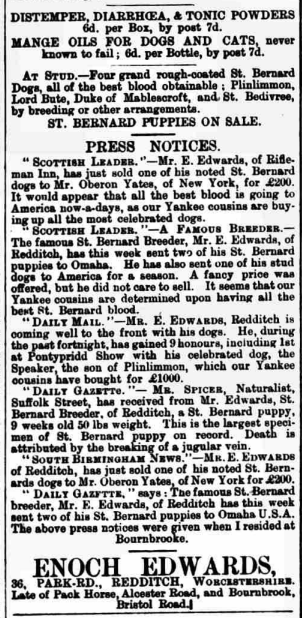
It was discovered that Enoch, Florence and Muriel moved to Canada, not USA as the family had assumed. The 1911 census for Montreal St Jaqcues, Quebec, stated that Enoch, (Florence) Ethel, and (Muriel) Frida had emigrated in 1906. Enoch’s occupation was machinist in 1911. The census transcription is not very good. Edwards was transcribed as Edmand, but the dates of birth for all three are correct. Birthplace is correct ~ A for Anglitan (the census is in French) but race or tribe is also an A but the transcribers have put African black! Enoch by this time was 71 years old, his wife 33 and daughter 11.
Additional information from Paul Weaver:
“In 1906 he and his new family travelled to Canada with Enoch travelling first and Ethel and Frida joined him in Quebec on 25 June 1906 on board the ‘Canada’ from Liverpool.
Their immigration record suggests that they were planning to travel to Winnipeg, but five years later in 1911, Enoch, Florence Ethel and Frida were still living in St James, Montreal. Enoch was employed as a machinist by Canadian Government Railways working 50 hours. It is the 1911 census record that confirms his birth as November 1840. It also states that Enoch could neither read nor write but managed to earn $500 in 1910 for activity other than his main profession, although this may be referring to his innkeeping business interests.
By 1921 Florence and Muriel Frida are living in Langford, Neepawa, Manitoba with Peter FUCHS, an Ontarian farmer of German descent who Florence had married on 24 Jul 1913 implying that Enoch died sometime in 1911/12, although no record has been found.”The extra $500 in earnings was perhaps related to the St Bernard dogs. Enoch signed his name on the register on his marriage to Emelia, and I think it’s very unlikely that he could neither read nor write, as stated above.
However, it may not be Enoch’s wife Florence Ethel who married Peter Fuchs. A Florence Emma Edwards married Peter Fuchs, and on the 1921 census in Neepawa her daugther Muriel Elizabeth Edwards, born in 1902, lives with them. Quite a coincidence, two Florence and Muriel Edwards in Neepawa at the time. Muriel Elizabeth Edwards married and had two children but died at the age of 23 in 1925. Her mother Florence was living with the widowed husband and the two children on the 1931 census in Neepawa. As there was no other daughter on the 1911 census with Enoch, Florence and Muriel in Montreal, it must be a different Florence and daughter. We don’t know, though, why Muriel Constance Freda married in Neepawa.
Indeed, Florence was not a widow in 1913. Enoch died in 1924 in Montreal, aged 84. Neither Enoch, Florence or their daughter has been found yet on the 1921 census. The search is not easy, as Enoch sometimes used the name Andrew, Florence used her middle name Ethel, and daughter Muriel used Freda, Valerie (the name she added when she married in Neepawa), and died as Marcheta. The only name she NEVER used was Constance!
A Canadian genealogist living in Montreal phoned the cemetery where Enoch was buried. She said “Enoch Edwards who died on Feb 27 1924 is not buried in the Mount Royal cemetery, he was only cremated there on March 4, 1924. There are no burial records but he died of an abcess and his body was sent to the cemetery for cremation from the Royal Victoria Hospital.”
1924 Obituary for Enoch Edwards:
Cimetière Mont-Royal Outremont, Montreal Region, Quebec, Canada
The Montreal Star 29 Feb 1924, Fri · Page 31

Muriel Constance Freda Valerie Edwards married Arthur Frederick Morris on 24 Oct 1925 in Neepawa, Manitoba. (She appears to have added the name Valerie when she married.)
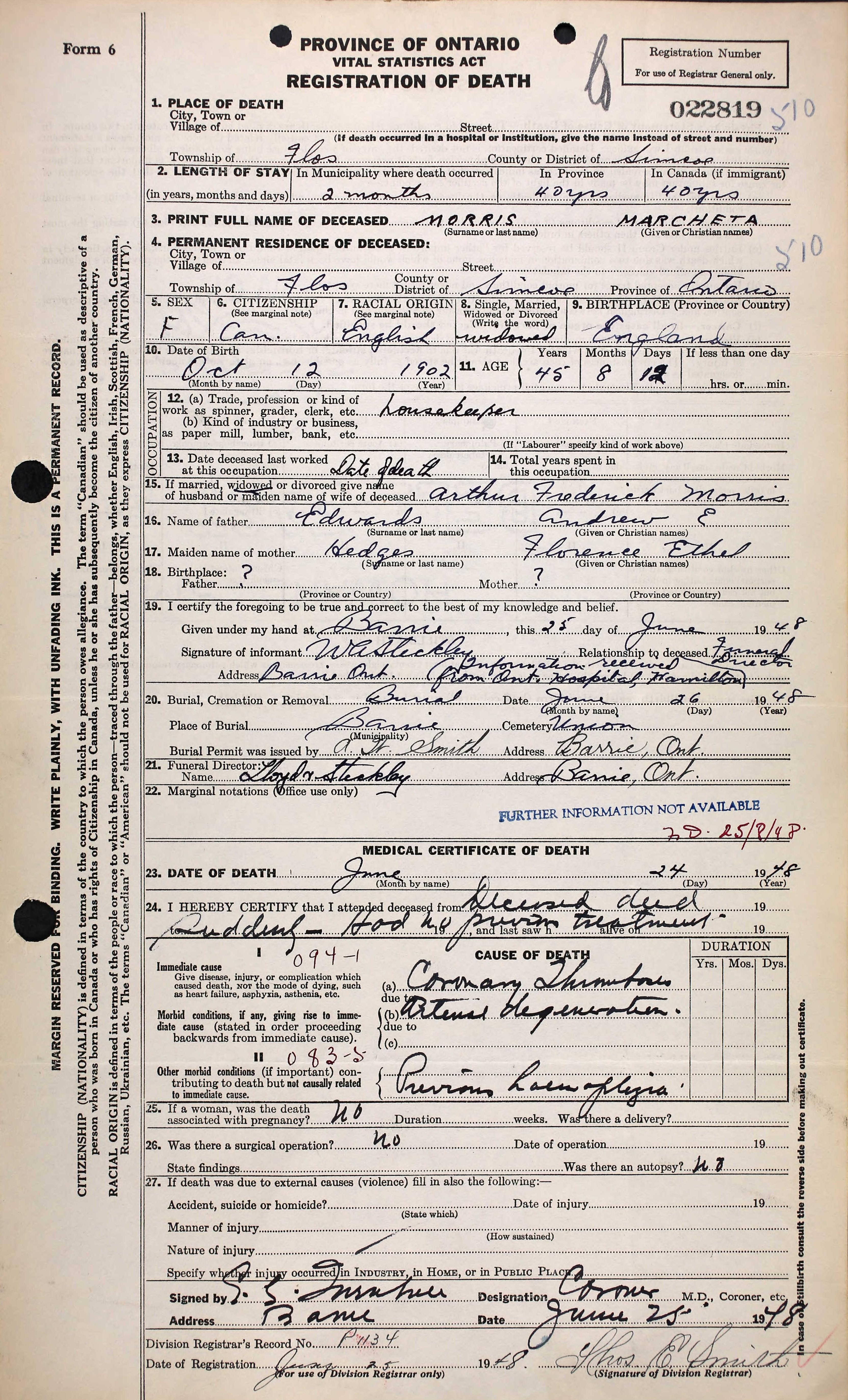
Unexpectedly a death certificate appeared for Muriel via the hints on the ancestry website. Her name was “Marcheta Morris” on this document, however it also states that she was the widow of Arthur Frederick Morris and daughter of Andrew E Edwards and Florence Ethel Hedges. She died suddenly in June 1948 in Flos, Simcoe, Ontario of a coronary thrombosis, where she was living as a housekeeper.
 June 13, 2023 at 10:31 am #7255
In reply to: Family Stories From The Other Side ~ Book Two
The First Wife of John Edwards
1794-1844
John was a widower when he married Sarah Reynolds from Kinlet. Both my fathers cousin and I had come to a dead end in the Edwards genealogy research as there were a number of possible births of a John Edwards in Birmingham at the time, and a number of possible first wives for a John Edwards at the time.
John Edwards was a millwright on the 1841 census, the only census he appeared on as he died in 1844, and 1841 was the first census. His birth is recorded as 1800, however on the 1841 census the ages were rounded up or down five years. He was an engineer on some of the marriage records of his children with Sarah, and on his death certificate, engineer and millwright, aged 49. The age of 49 at his death from tuberculosis in 1844 is likely to be more accurate than the census (Sarah his wife was present at his death), making a birth date of 1794 or 1795.
John married Sarah Reynolds in January 1827 in Birmingham, and I am descended from this marriage. Any children of John’s first marriage would no doubt have been living with John and Sarah, but had probably left home by the time of the 1841 census.
I found an Elizabeth Edwards, wife of John Edwards of Constitution Hill, died in August 1826 at the age of 23, as stated on the parish death register. It would be logical for a young widower with small children to marry again quickly. If this was John’s first wife, the marriage to Sarah six months later in January 1827 makes sense. Therefore, John’s first wife, I assumed, was Elizabeth, born in 1803.
Death of Elizabeth Edwards, 23 years old. St Mary, Birmingham, 15 Aug 1826:

There were two baptisms recorded for parents John and Elizabeth Edwards, Constitution Hill, and John’s occupation was an engineer on both baptisms.
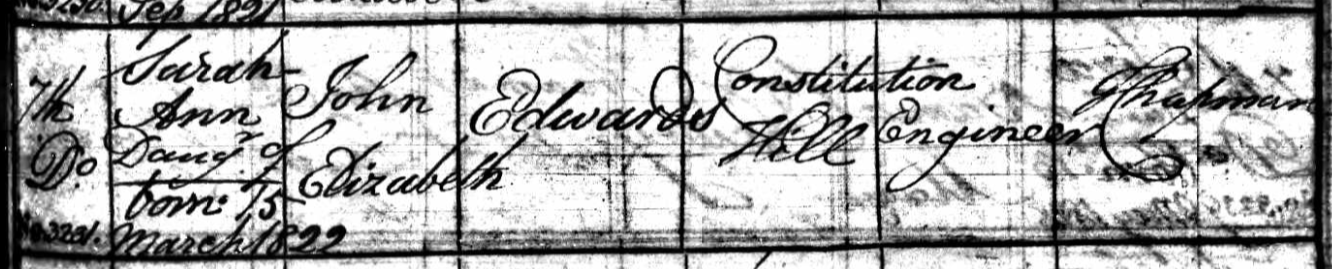
They were both daughters: Sarah Ann in 1822 and Elizabeth in 1824.Sarah Ann Edwards: St Philip, Birmingham. Born 15 March 1822, baptised 7 September 1822:
Elizabeth Edwards: St Philip, Birmingham. Born 6 February 1824, baptised 25 February 1824:

With John’s occupation as engineer stated, it looked increasingly likely that I’d found John’s first wife and children of that marriage.
Then I found a marriage of Elizabeth Beach to John Edwards in 1819, and subsequently found an Elizabeth Beach baptised in 1803. This appeared to be the right first wife for John, until an Elizabeth Slater turned up, with a marriage to a John Edwards in 1820. An Elizabeth Slater was baptised in 1803. Either Elizabeth Beach or Elizabeth Slater could have been the first wife of John Edwards. As John’s first wife Elizabeth is not related to us, it’s not necessary to go further back, and in a sense, doesn’t really matter which one it was.
But the Slater name caught my eye.
But first, the name Sarah Ann.
Of the possible baptisms for John Edwards, the most likely seemed to be in 1794, parents John and Sarah. John and Sarah had two infant daughters die just prior to John’s birth. The first was Sarah, the second Sarah Ann. Perhaps this was why John named his daughter Sarah Ann? In the absence of any other significant clues, I decided to assume these were the correct parents. I found and read half a dozen wills of any John Edwards I could find within the likely time period of John’s fathers death.
One of them was dated 1803. In this will, John mentions that his children are not yet of age. (John would have been nine years old.)
He leaves his plating business and some properties to his eldest son Thomas Davis Edwards, (just shy of 21 years old at the time of his fathers death in 1803) with the business to be run jointly with his widow, Sarah. He mentions his son John, and leaves several properties to him, when he comes of age. He also leaves various properties to his daughters Elizabeth and Mary, ditto. The baptisms for all of these children, including the infant deaths of Sarah and Sarah Ann have been found. All but Mary’s were in the same parish. (I found one for Mary in Sutton Coldfield, which was apparently correct, as a later census also recorded her birth as Sutton Coldfield. She was living with family on that census, so it would appear to be correct that for whatever reason, their daughter Mary was born in Sutton Coldfield)Mary married John Slater in 1813. The witnesses were Elizabeth Whitehouse and John Edwards, her sister and brother. Elizabeth married William Nicklin Whitehouse in 1805 and one of the witnesses was Mary Edwards.
Mary’s husband John Slater died in 1821. They had no children. Mary never remarried, and lived with her bachelor brother Thomas Davis Edwards in West Bromwich. Thomas never married, and on the census he was either a proprietor of houses, or “sinecura” (earning a living without working).With Mary marrying a Slater, does this indicate that her brother John’s first wife was Elizabeth Slater rather than Elizabeth Beach? It is a compelling possibility, but does not constitute proof.
Not only that, there is no absolute proof that the John Edwards who died in 1803 was our ancestor John Edwards father.
If we can’t be sure which Elizabeth married John Edwards, we can be reasonably sure who their daughters married. On both of the marriage records the father is recorded as John Edwards, engineer.
Sarah Ann married Mark Augustin Rawlins in 1850. Mark was a sword hilt maker at the time of the marriage, his father Mark a needle manufacturer. One of the witnesses was Elizabeth Edwards, who signed with her mark. Sarah Ann and Mark however were both able to sign their own names on the register.
Sarah Ann Edwards and Mark Augustin Rawlins marriage 14 October 1850 St Peter and St Paul, Aston, Birmingham:
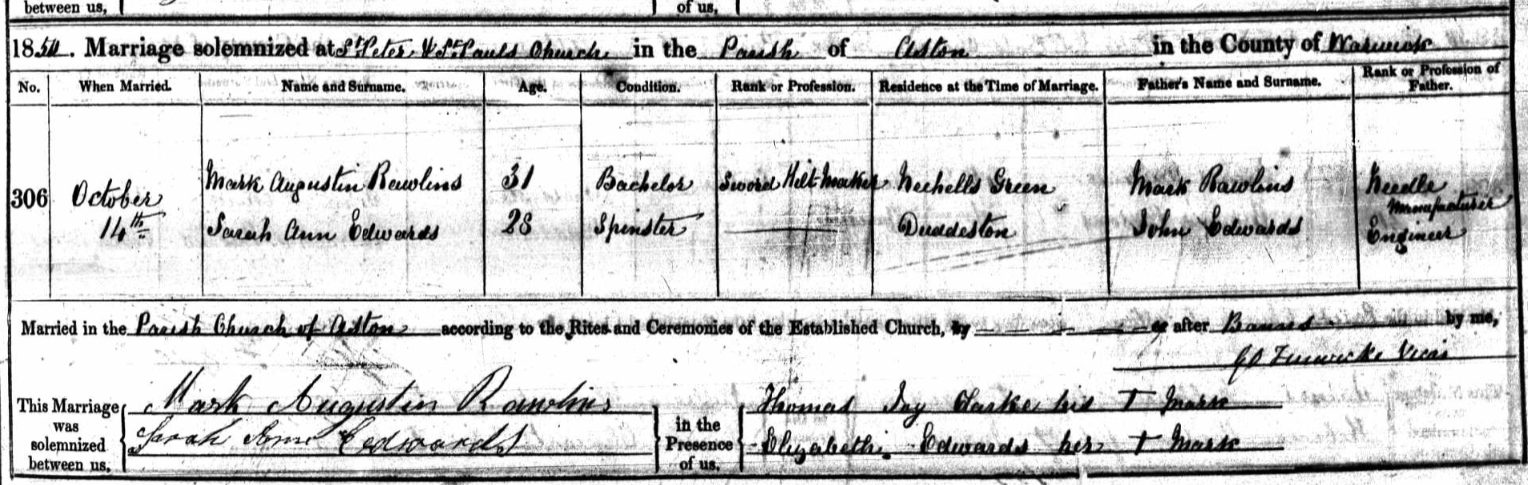
Elizabeth married Nathaniel Twigg in 1851. (She was living with her sister Sarah Ann and Mark Rawlins on the 1851 census, I assume the census was taken before her marriage to Nathaniel on the 27th April 1851.) Nathaniel was a stationer (later on the census a bookseller), his father Samuel a brass founder. Elizabeth signed with her mark, apparently unable to write, and a witness was Ann Edwards. Although Sarah Ann, Elizabeth’s sister, would have been Sarah Ann Rawlins at the time, having married the previous year, she was known as Ann on later censuses. The signature of Ann Edwards looks remarkably similar to Sarah Ann Edwards signature on her own wedding. Perhaps she couldn’t write but had learned how to write her signature for her wedding?
Elizabeth Edwards and Nathaniel Twigg marriage 27 April 1851, St Peter and St Paul, Aston, Birmingham:
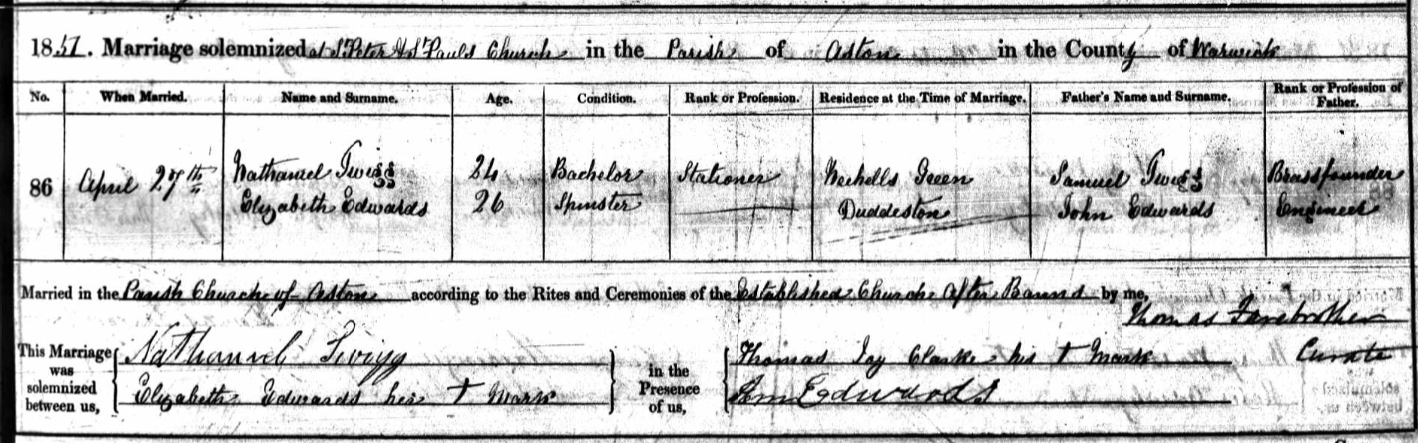
Sarah Ann and Mark Rawlins had one daughter and four sons between 1852 and 1859. One of the sons, Edward Rawlins 1857-1931, was a school master and later master of an orphanage.
On the 1881 census Edward was a bookseller, in 1891 a stationer, 1901 schoolmaster and his wife Edith was matron, and in 1911 he and Edith were master and matron of St Philip’s Catholic Orphanage on Oliver Road in Birmingham. Edward and Edith did not have any children.
Edward Rawlins, 1911:
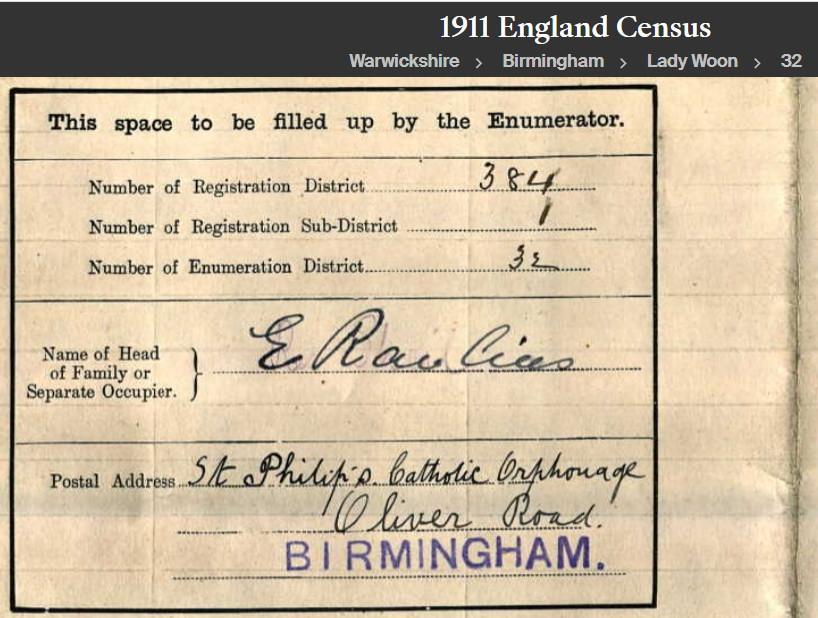
Elizabeth and Nathaniel Twigg appear to have had only one son, Arthur Twigg 1862-1943. Arthur was a photographer at 291 Bloomsbury Street, Birmingham. Arthur married Harriet Moseley from Burton on Trent, and they had two daughters, Elizabeth Ann 1897-1954, and Edith 1898-1983. I found a photograph of Edith on her wedding day, with her father Arthur in the picture. Arthur and Harriet also had a son Samuel Arthur, who lived for less than a month, born in 1904. Arthur had mistakenly put this son on the 1911 census stating “less than one month”, but the birth and death of Samuel Arthur Twigg were registered in the same quarter of 1904, and none were found registered for 1911.
Edith Twigg and Leslie A Hancock on their Wedding Day 1925. Arthur Twigg behind the bride. Maybe Elizabeth Ann Twigg seated on the right: (photo found on the ancestry website)
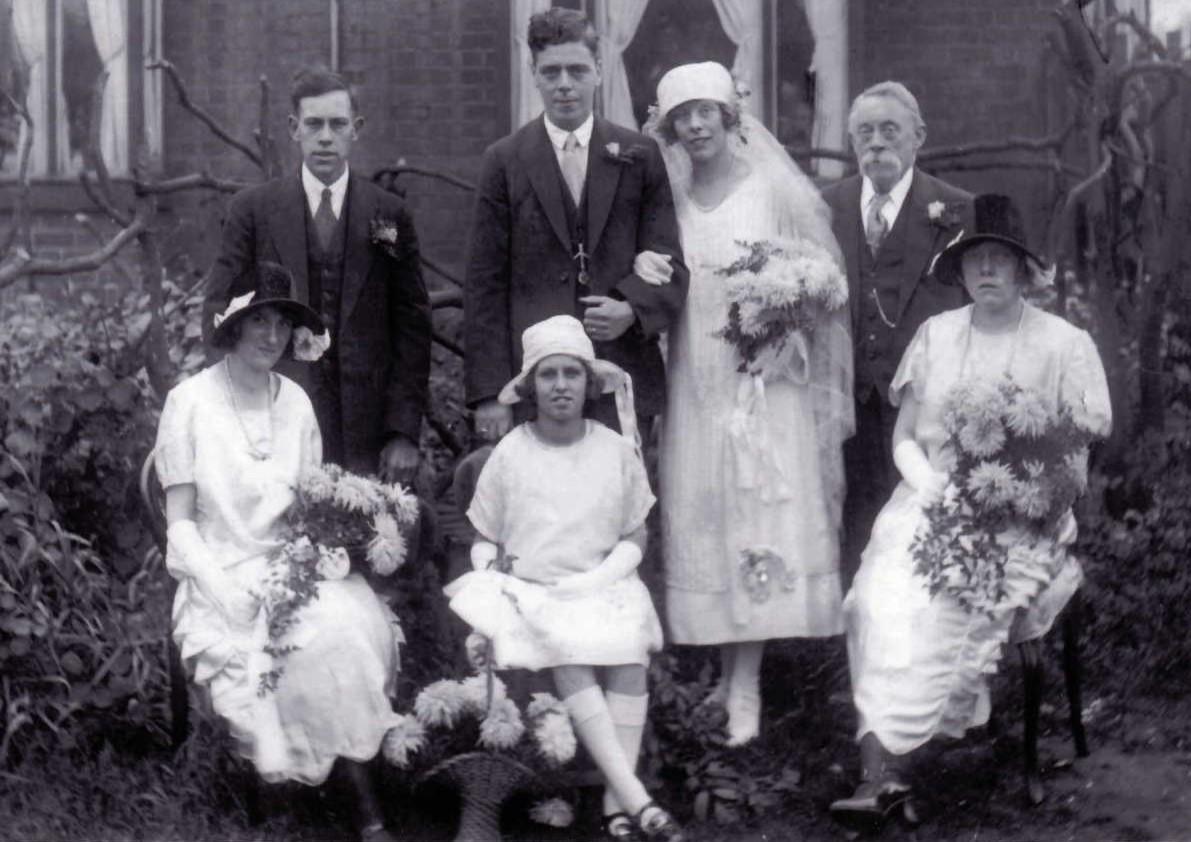
Photographs by Arthur Twigg, 291 Bloomsbury Street, Birmingham:
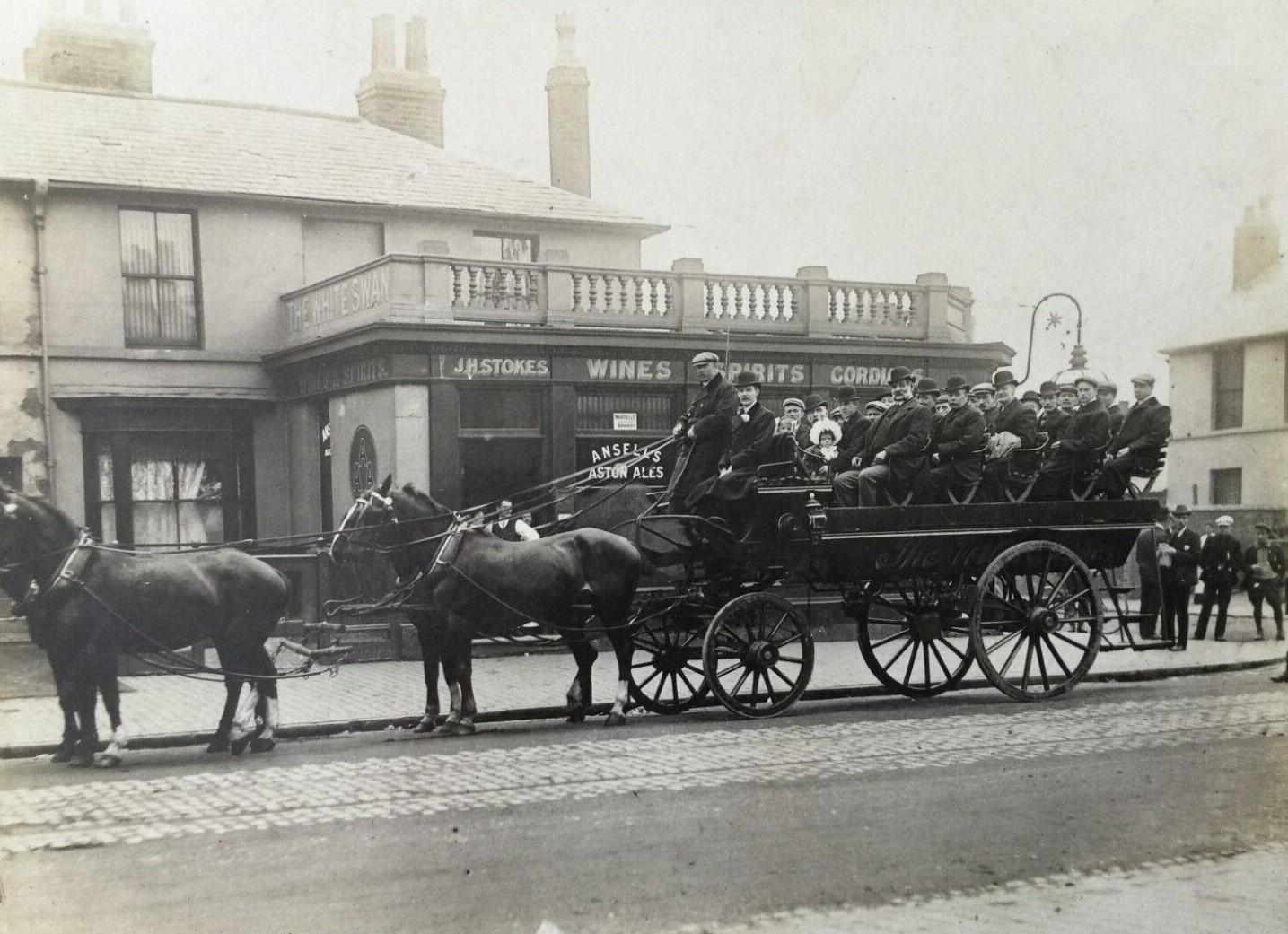
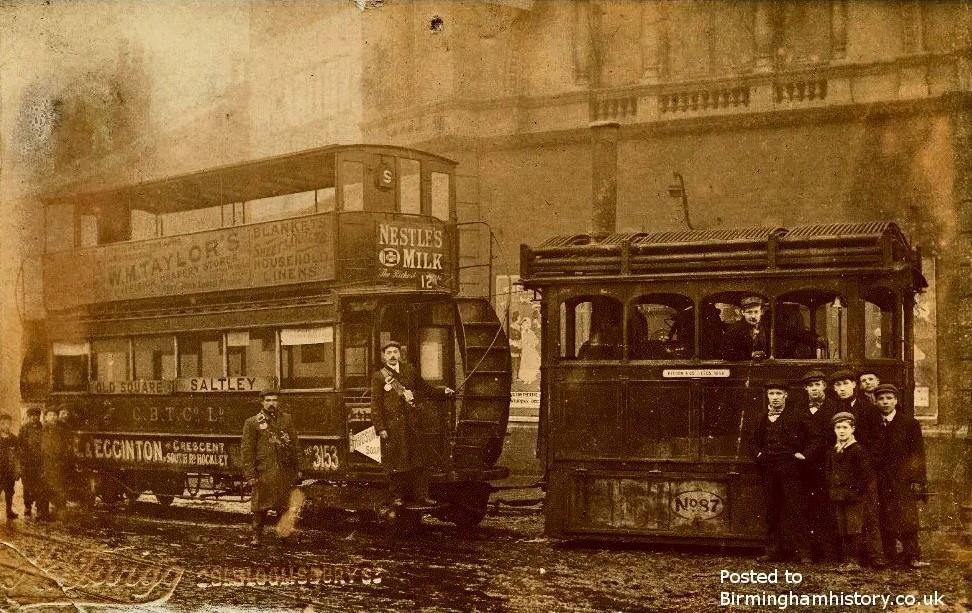 March 19, 2023 at 10:39 pm #7204
Some handy references for the timelines of the Flying Fish Inn are here…
Year Date Event 1935 March 1, 1935 Birth of Mater 1958 March 13, 1958 Mater marries her childhood sweetheart 1965 August 17, 1965 Birth of Fred 1968 June 8, 1968 Birth of Abcynthia Hogg 1970 July 7, 1970 Birth of Aunt Idle 1978 April 12, 1978 Mater’s husband dies 1987 March 19, 1987 Mines close down – Carts & Lager Festival 1988 December 12, 1988 Idle gives birth to a child in Fiji (Liana) 1989 December 20, 1989 Horace Hogg death – Inn passes down to Abby 1990 May 7, 1990 Fred marries Abcynthia 1998 November 11, 1998 Birth of Devan 2000 November 11, 2000 Birth of Clove and Coriander 2007 March 7, 2007 Hannah Hogg’s death, the Inn passes to Abcynthia 2008 March 10, 2008 Carts and Lager Festival revival 2008 August 20, 2008 Birth of Prune 2009 February 2, 2009 Abcynthia leaves 2009 September 11, 2009 Strange incidents at the mines, Idle sets up the Inn 2010 May 27, 2010 Fred leaves his family, goes into hiding 2014 September 10, 2014 Start of Prune’s journal 2017 March 21, 2017 Visitors from Elsewheres 2020 December 22, 2020 The year of the Great Fires 2021 August 8, 2021 Italian tourists saved the Inn 2023 March 1, 2023 Orbs gamers visitors 2027 September 1, 2027 Prune going to a boarding school 2035 March 21, 2035 Mater 100 and twins on a Waterlark adventure 2049 March 17, 2049 Prune arrives with a commercial flight on Mars, Mater is deceased (would have been 114) February 12, 2023 at 10:18 pm #6540In reply to: Prompts of Madjourneys
Update & clarifications on the characters:
Looking at the avatars that Zara, Youssef, Xavier and Yasmin are using in VR.
Full name or real name in RL :: name in VR (
@nickhandle) description of avatar.- Zara Patara-Smythe :: Zara (
@zaraloon) is a 25-year-old woman of mixed heritage, her mother is Indian and her father is British. She has long, dark hair that she keeps in a sleek ponytail, dark brown eyes and a sharp jawline. She stands at 5’6″ and has a toned and athletic build. She usually wears practical clothing that allows her to move around easily, such as cargo pants and a tank top. - Xavier Olafsson :: Xavier (
@xavimunk) is a 27-year-old man of Norwegian and Danish descent. He has blonde hair that he keeps in a messy style, blue eyes, and a charming smile. He stands at 6’1″ and has a lean build. He is always seen wearing a colorful and bold clothing, such as a Hawaiian shirt and shorts. - Yasmin Ahmed :: Yasmin (
@yasminowl) is a 23-year-old woman of Egyptian descent. She has long, black hair that she keeps in a tight braid, dark brown eyes and a round face. She stands at 5’4″ and has a petite build. She usually wears conservative clothing, such as long skirts and blouses. - Youssef Ali :: Youssef (
@youssefbear) is a 26-year-old man of half Yemeni, half Norwegian descent. He has short, curly black hair, dark brown eyes and a square jawline. He stands at 6’2″ and has a muscular build. He usually wears comfortable clothing such as a t-shirt and jeans, and always has a backpack on his shoulder.
Full descriptions for real-life Zara, Yasmin, Youssef, Xavier:
Real Life Zara Patara-Smythe :: Zara is a 57-year-old woman who is an adventurous traveler and a passionate hobbyist. She has a full mane of gorgeous auburn hair that she keeps in a sleek ponytail, sparkling green eyes, and a warm smile that puts others at ease. She is of mixed heritage, her mother was Indian and her father was British. She is well-educated and well-off, either through an inheritance or a supportive and understanding husband. Zara is a lover of art, music, and history, and spends much of her time indulging in her passions. She is always eager to explore new places and meet new people, and her adventurous spirit often leads her to travel off the beaten path.
Real Life Yasmin Ahmed :: Yasmin is a 32-year-old woman who is kind, nurturing, and always puts others first. She has long, black hair that she keeps in a tight braid, almond-shaped brown eyes, and a warm smile that lights up a room. Born in Egypt, she grew up in a close-knit family and values the importance of community. She is a talented actress, who has kept her career a secret from those closest to her, in order to pursue a more fulfilling life working with children. Yasmin currently volunteers at an orphanage in Fiji, where she devotes herself to helping children in need.
Real Life Youssef Ali :: Youssef is a 34-year-old man who is driven, confident, and always up for a challenge. He has short, curly black hair, dark brown eyes, and a square jawline that gives him a strong and determined look. Born to a Yemeni father and a Norwegian mother, he has a unique blend of cultures that has shaped his world view. Youssef is a talented blogger, who has traveled the world in search of new and interesting stories to share with his audience. He is always on the go, with a backpack on his shoulder, ready for his next adventure.
Real Life Xavier Olafsson :: Xavier is a 36-year-old man who is bright, cheerful, and always looking for the positive in every situation. He has blonde hair that he keeps in a messy style, blue eyes, and a charming smile that never fails to win people over. Born to Norwegian and Danish parents, he has a love for the sea and an appreciation for the finer things in life. Xavier is an AI developer, who is working on a project he calls AL. He is always eager to share his ideas with others and is constantly seeking new and exciting opportunities.
February 11, 2023 at 9:16 am #6536In reply to: Orbs of Madjourneys
Youssef hadn’t changed a bit since they last met in real life. He definitely brought the bear in the bear hug he gave Xavier after Xavier had entered the soft sandal wood scented atmosphere of the Indian restaurant.
It was like there’d seen each other the day before, and conversation naturally flew without a thought on the few years’ hiatus between their last trip.
As they inquired about each other’s lives and events on the trip to get to Alice Springs, they ordered cheese nan, salted and mango lassi, a fish biryani and chicken tikka masala and a side thali for Youssef who was again ravenous after the jumpy ride. Soon after, the discussion turned to the road ahead.
“How long to the hostel?” asked Youssef, his mouth full of buns.
Xavier looked at his connected watch “It’s about 1 and half hour drive apparently. I called the number to check when to arrive, they told me to arrive before sunset… which I guess gives us 2-3 hours to visit around… I mean,” he looked at his friend “… we can also go straight there.”
Youssef nodded. He seemed to have had already enough of interactions in the past day.
Xavier continued “so it’s settled, we leave after we finish here. According to the landlady, it looks like Zara went off trekking, she didn’t seem too sure about Zara’s whereabouts. That would explain why we heard so little from her.”
Youssef laughed “If they don’t know Zara, I can bet they’ll be running around searching for her in the middle of the night.”
Xavier looked though the large window facing the street pensively. “I’m not sure I would want to get lost away from the beaten tracks here. There’s something so alien to the scale of it, and the dryness. Have you noticed we’re next to a river? I tried to have a look when I arrived, but it’s mostly dried up. And it’s supposed to be the wet season…”
Youssef didn’t reply, and turned to the leftovers of the biryani.
Despite the offering to top it off with gulab jamun and rose ice cream, it didn’t take too long to finish the healthy meal at the Indian restaurant. Youssef and Xavier went for the car.
“Here, catch!” Xavier threw the keys to Youssef. He knew his friend would have liked to drive; meanwhile he’d be able to catch on some emails and work stuff. After all, he was supposed to remote work for some days.
January 26, 2023 at 12:16 am #6460In reply to: Orbs of Madjourneys
The vendor was preparing the Lorgh Drülp with the dexterity of a Japanese sushi chef. A piece of yak, tons of spices, minced vegetables, and some other ingredients that Youssef couldn’t recognise. He turned his attention to the shaman’s performance. The team was trying to follow the man’s erratic moves under Miss Tartiflate’s supervision. Youssef could hear her shouting to Kyle to get closer shots. It reminded him that he had to get an internet connection.
“Is there a wifi?” asked Youssef to the vendor. The man bobbed his head and pointed at the table with a knife just as big as a machete. Impressed by the size of the blade, Youssef almost didn’t see the tattoo on the vendor’s forearm. The man resumed his cooking swiftly and his long yellow sleeve hid the tattoo. Youssef touched his screen to look at his exchange with Xavier. He searched for the screenshot he had taken of the Thi Gang’s message. There it was. The mummy skull with Darth Vador’s helmet. The same as the man’s tattoo. Xavier’s last message was about the translation being an ancient silk road recipe. They had thought it a fluke in AL’s algorithm. Youssef glanced at the vendor and his knife. Could he be part of Thi Gang?
Youssef didn’t have time to think of a plan when the vendor put a tray with the Lorgh Drülp and little balls of tsampa on the table. The man pointed with his finger at the menu on the table, uncovering his forearm, it was the same as the Thi Gang logo.
“Wifi on menu,” the man said. “Tsampa, good for you…”
A commotion at the market place interrupted them. Apparently Kyle had gone too close and the shaman had crashed into him and the rest of the team. The man was cursing every one of them and Miss Tartiflate was apparently trying to calm him down by offering him snack bars. But the shaman kept brandishing an ugly sceptre that looked like a giant chicken foot covered in greasy fur, while cursing them with broken english. The tourists were all brandishing their phones, not missing a thing, ready to send their videos on TrickTruck. The shaman left angrily, ignoring all attempts at conciliation. There would be no reportage.
“Hahaha, tourists, they believe anything they see,” said the vendor before returning to his stove and his knife.
Despite his hunger, Youssef thought he’d better hurry with the wifi, now that the crew was out of work, he would be the target of Miss Tartiflate’s frustration. Furthermore, he wanted to lay low and not attract the vendor’s attention.
3235 messages from his friends. How would he ever catch up?
Among them, messages from Xavier. Youssef sighed of relief when he read that his friend had regained full access of the website and updated the system to fix a security flaw that allowed Thi Gang to gain access in the first place. But he growled when his friend continued with the bad news. There was some damage done to the content of THE BLOG.To console himself, Youssef started to eat a ball of tsampa. It was sweet and tasted like rose. He took a second and spit it out almost immediately. There was a piece of paper inside. He smoothed it and discovered a series of five pictograms.
🧔🌮🔍🔑🏞️
The first one was like a hologram and kept changing into six horizontal bars. The second one, looking like a tako bell, kept reversing side. Youssef raised his head to call the vendor and nobody was there. He got up and looked for the guy, Thi Gang or not, he needed some answers. Voices came from behind the curtain at the back of the stall. Youssef walked around the stall and saw the shaman and the vendor exchanging clothes. The caucasian man was now wearing the colourful costume and the drum. When he saw Youssef, he smiled and waved his hand, making the bells from the hem ring. Then he turned around and left, whistling an air that sounded strangely like the music of the Game. Youssef was about to run after him when a hand grasped his shirt.
“Please! Tell me at least that THE BLOG is up and running!” said an angry voice.
January 24, 2023 at 11:59 pm #6459In reply to: Orbs of Madjourneys
It was pretty late, but Xavier remembered he had to book his flight (and his holidays, even if he could still mix the trip with his job… it would depend if Brytta would be able to join or not; if such were the case, he’d definitely would book time off).
 At the hotel where he was staying for the 2-days business trip he had to attend for his job, he’d noticed the strange decor, with little people in costumes in odd sceneries patterned on the “Toile de Jouy” curtains and some others in the most curious framed paintings, many of them looked like actual monkeys. Curiously, there wasn’t any golden banana, or banana bus, but it made him wonder if there was something more to be looked at the Inn that Zara wanted them to go to.
Yasmin, a step ahead of him, had already looked at the reviews on MadjourneyAdvisor, and they were rave… in a fashion…
“The lady behind the bar is nearly 90 years old and believe me, she could out-work many much younger than her.”
“Old bird behind the bar is a lovely lady drop in for a chat and a beer or two – don’t mess with her or you will end up down a mine shaft”Well… better not to overthink it. He started to look at the flights, and last minute offers.
Still no word from Youssef either.
He placed an option on a flight, and decided he’d wait for everyone to confirm the dates for the rendez-vous.
- Zara Patara-Smythe :: Zara (
-
AuthorSearch Results
