


Search Results for 'fact'
-
AuthorSearch Results
-
October 9, 2024 at 6:38 pm #7562
In reply to: The Incense of the Quadrivium’s Mystiques
It was good to be digging again. The relentless heat of the summer over, the days were perfect for excavating the next hole in her garden. It was hard work and slow hacking off bits of earth almost as hard and dry as concrete, but each day the promise of new finds became more tantalizing and encouraged her to keep working at it. There was not much more of the top layer to remove now before Truella could expect to start seeing bits of pottery and whatever else the deep dark earth had to reveal about its past.
Unable to see any particular connecting link to the dig (and Truella was usually good at that), she had become obsessed with Cromwell. Maybe she’d find a postcard from Cromwell; everyone seemed to be getting strange postcards these days. The idea of a postcard from Cromwell had wafted into her mind, but it lingered. What would he say on a postcard? She could imagine him sanding the ink, the candlelight flickering. Smiling to himself, with a stray thought wafting into his mind that someone centuries from now would find it, and wonder.
“Let them make of that what they will,” he might say, as he handed it to the man in charge of sending postcards to other centuries. “I have one here for you,” the man in charge of the postcards might say by way of reply, “Just arrived. It’s from the future by the look of it, from Ireland.”
Cromwell may take the postcard in his hand with a feeling of satisfaction ~ all information was potentially useful after all, if not in this life, in the next. Time traveling spies, you could say. He would take a moment to decipher the unfamiliarly written letters in order to read the message. His eyebrows would raise in mild astonishment to see witches sending messages so openly, so shamelessly, so fearlessly! Five hundred years from now, Ireland would be a heathen primitive nest of superstition controlled by the devils strumpets. It may not be perfect in England now, he might think, but we do try to keep some order. Frella, he said to himself. Frella. What do you look like, Frella? God’s teeth, why didn’t you send me your likeness, a portrait, on the postcard! For reasons he couldn’t explain, Cromwell couldn’t stop thinking about the mysterious witch in Ireland many centuries from now.
June 26, 2024 at 7:09 am #7526In reply to: The Incense of the Quadrivium’s Mystiques
Truella slept for longer than she intended, indeed, she had not intended to sleep at all, there was too much to do. Trying to hold on to the fragments of dream recall, she sat up and rubbed her eyes. Glancing around the room, she couldn’t immediately remember what she was doing there. Suddenly she sat bolt upright. What was that conversation she’d had before falling alseep? Truella felt dizzy trying to remember. She stood up and started to pace the room, and noticed a letter had been pushed under the bedroom door. She frowned as she bent to pick it up. Nothing was written on the outside, but the envelope had been sealed with a blob of red wax. Truella opened the letter carefully without breaking the seal. A yellowy page was inside, written in Latin.
Ordo Amphibiae-Luciae: pertinebant ad Ordinem Amphibiae-Luciae.
Truella’s Latin was rusty to say the least. She sat back down on the bed struggling to decipher the message.
The Order of Amphibia-Lucia: They belonged to the Order of Amphibia-Lucia.
Nomen Amphibia-Lucia provenit ex duplici natura: tam terrena quam mundana. Rana facies symbolica est repraesentatio nexus eorum ad aquam, transformationem, et antiqua numina amphibiana.
The name “Amphibia-Lucia” stems from their dual nature: both earthly and otherworldly. The frog face is a symbolic representation of their connection to water, transformation, and ancient amphibian deities. They believe in metamorphosis, much like a tadpole turns into a frog, embodying cycles of death and rebirth These priestesses predated Christianity by eons. Their practices and rituals were about aligning with the cosmic cycles, harnessing planetary energies, and maintaining harmony between the seen and the unseen. They were known to perform rites that involved intricate dances, chants in forgotten tongues, and the use of ancient artifacts that, according to legend, could summon or banish entities from beyond our realm—dragons included.
Tartessus in obscurum, secretissimae sectae, ordo Amphibiae-Luciae, sub terra perrexit, ad litteram. Scientiam suam servaverunt, eam per generationes transeuntes, ritus suos in secretis clausulis sub culturis recentioribus obrutos servaverunt. Christianismus in terram pervasit, sed hae sorores aptatae, antiquas vias obtegunt sub specie hodiernae opinionis systemata superstites vigereque.
When Tartessos fell into obscurity, its most secretive sect, the Order of Amphibia-Lucia, went underground—literally. They preserved their knowledge, passing it down through generations, maintaining their rituals in secretive enclaves buried beneath newer civilizations. Christianity might’ve swept over the land, but these sisters adapted, cloaking their ancient ways under the guise of more contemporary belief systems to survive and thrive.
In cellis cellis in ipsum cubiculum illorum claustrorum contextum habemus reliquias ordinis pervetusti, dogmatum ac dogmatum recentioris millennii securos. Hais ex quo saeviunt dii, rudis sacra, et advena mundus.
In the cellars woven into the very bedrock of those cloisters, we have the remnants of an archaic order, unconcerned with dogmas and doctrines of the more recent two millennia. They’re from a time when gods were wilder, rituals were raw, and the world was a stranger.
When the nuns under Hildegarde von Bingen’s influence merged with these ancient priestesses, it wasn’t just a blending of orders but a clash and harmony of traditions. Hildegarde herself, in her visionary wisdom, likely recognized the power and ancient wisdom of the Order of Amphibia-Lucia, choosing to weave their potent rituals into her own esoteric Christian practices. The frog-faced sisters are no mere relics of an outdated faith. They’re the living embodiment of an ancient, potent lineage that predates and outlasts many of the world’s religions. They’re the keepers of ancient Tartessian magic, lurking in those cellars, waiting for the right time to hop back into the forefront of history.
So that was it! But who had pushed the letter under her door? And why was it written in Latin? Had everyone else received a letter?
June 25, 2024 at 7:39 pm #7522In reply to: The Incense of the Quadrivium’s Mystiques
As soon as Eris had left the room, Truella thought for a moment she was hallucinating, as Eris popped back right in through the entrance.
“So, what did I miss?” Eris asked, looking exactly the same if a little worn out.
“What do you mean what did you miss? You hardly missed anything, since you’ve just never left!” Truella protested, as the absence of sleep wasn’t cause enough to make her doubt her senses.
“Ah… I see… Those time-travel shenanigans. Hard to wrap one’s head around sometimes.” Eris said matter-of-factly. “No matter, glad to be back, well… so soon… by your standards. Let’s get back to business then? When’s the next ritual? Don’t we have to brew a potion or something?”
“No, no, no… Not so fast! What happened to your trip? you have to tell us all, and TIME TRAVEL! Where, when, how, with whom? We want to know all, n’est-ce-pas ma petite Jeezel?”
“Tsk, tsk. For another time. Suffice to say, I was gone for longer than I wanted, and clearly that nun-witch portal had been tempered with, sent me right in the middle of the darn Middle-Ages. But I can’t tell you more here…” Eris said with an air of mystery. “Stone walls are thick, but not as deaf as Mother Lorena, that’s for sure.”
June 20, 2024 at 9:52 am #7510In reply to: The Incense of the Quadrivium’s Mystiques
After everyone got the program for the six rituals, they dispersed. Jeezel observed groups reform and the whereabouts of people. Eris walked alone toward the dark corridors. Truella, Sandra and Sassafras went to the gardens. Rufus followed shortly after, his dark moody eyes showing intense reflections. Jeezel noticed that Bartolo from the convent had been observing the mortician and hurried to catch up with him. Mother Lorena stood as stern as ever in the center of the lobby. She kept cupping her hands around her ears to check if her earpieces were working. Which they weren’t from the irritated look on her face. Silas was in an animated discussion with Austreberthe and the remaining nuns were laughing heartily and running around as if they had overindulged in Sister Sassafras’ hallucinogenic mushroom canapés.
Jeezel decided to go back to the lounge and explore the antiques, maybe see if there were hidden passageways behind those tapestries. She found Garrett waiting for her in the corridor as if he knew what she intended to do. His deep blue eyes seemed to embrace her whole silhouette in a myriad of unspoken emotions, and when they settle on her emerald green eyes, a subtle grin showed his appreciation.
“Don’t look back,” he said, his voice a deep velvet baritone. “Old Silas and Austreberthe are looking at us with a very disapproving look.”
Jeezel couldn’t help but chuckle softly. “And what if they do? We’re not doing anything wrong.”
Garrett’s grin widened. He took a step closer, the scent of his cologne– a tantalizing mix of cedarwood and bergamot– mingling with the faint aroma of her own enchanting perfume.
“You intrigue me, Jeezel. More than the rituals, more than any relic or spell.”
Jeezel laughed heartily. Don’t they say keep your enemy close? I have questions for him. And I wouldn’t mind the company while I’m exploring the area? she thought.
“I was about to check for secret passages in the old lounge,” she said. “Would you join me?”
She let him take her hand and guide her toward the lounge. As they entered the heavy scent of aged wood and old books greeted them. Jeezel’s eyes darted to the tapestries lining the walls, each depicting scenes of ancient rituals and forgotten histories.
“Where do you think we should start?” Garrett asked, his deep voice barely above a whisper, adding to the mysterious ambiance of the room.
Jeezel tilted her head, considering the possibilities. “That one,” she said, pointing to a particularly intricate tapestry depicting a moonlit garden. “It looks like it could hide something.” She reached out to the fabric and pulled it aside, revealing a wooden door. She tensed when she noticed lingering traces of cedarwood and bergamot. “Or someone,” she added, turning toward him. “You’ve been here recently, have you not?”
“Direct as ever. Very well. I’m here to protect and help you. You need to be careful with Silas. He has hidden motives.”
Jeezel narrowed her eyes. “And why should I trust you?”
Garrett pulled out his crimson handkerchief from his pocket, revealing a symbol embroidered in gold. Her eyes widened as identical to the one on the key Malové had given her.
“How did you get that?” she asked.
“Malové entrusted me with this,” Garret explained, “to show her chosen allies. I was told to seek you out and offer you my assistance. This symbol matches the one on your key, doesn’t it?”
Jeezel felt the weight of the key in her purse. She hadn’t shown it to anyone, not even to her friends. She felt even more confused than before. It was possible that Silas would try to divert her attention from him if he was against the merger. And what better way to do than alert her to unknown enemies. The fact that Garrett knew about the key just added a layer of complexity to the situation, but also a layer of excitement. She wondered what game was being played here, and who were the true players.
“Alright, Garrett,” she said, her voice steadying as she added, “I’ll hear you out. But if you’re lying, you’ll regret it.”
He nodded. “Faire enough. Silas isn’t just interested in the failure of the merger; he’s got his own agenda. Something to do with ancient punic artifacts and power that could rival even the Crimson Opus. And he’s not the only one. There are some ancient Punic families that are looking for the same things.”
Jeezel’s heart skipped a beat. If Silas was after the same kind of power, it could jeopardize everything—the merger, her mission, and possibly the balance of power in their world. Jeezle felt she was in way over her head. She had to breathe and connect to her inner Queen’s innate knowledge in order to slide into her role of leader.
“Then, I accept your assistance,” she conceded with a slight node. “But this doesn’t mean I trust you, Garrett. You’ll have to prove your loyalty.”
Garrett folded the handkerchief back into his pocket. “I wouldn’t expect anything less. For now, let’s just say our interests align. And if we work together, we might just come out of this with everything we need—and more.”
“Then show me where this hidden door lead!”
June 19, 2024 at 8:33 am #7504In reply to: The Incense of the Quadrivium’s Mystiques
After the meeting, Jeezel and Silas agreed on what the six rituals would be. The integration rituals were designed to unite the groups symbolically and spiritually. They were multifaceted ceremonies that combine elements from each group’s traditions to forge a shared sense of purpose and harmony, mediated by the mortician’s guild. Given the diverse nature of the witches, nuns, and morticians, these rituals needed to be both inclusive and meaningful, drawing on the unique strengths and spiritual practices of each faction.
The program they distributed to each participant was as follow:
Under the guidance of the Ancient Telluric Forces of the Dragons
1. The Invocation of Unity
Purpose: To call upon the spiritual and magical forces that guide each group and seek their blessings for the union.
Components:- Witches: Incantations and invocations to elemental spirits and deities.
- Nuns: Hymns and prayers invoking divine blessings.
- Morticians: Rituals honoring the spirits of the departed, seeking their guidance and protection.
Symbolism: This ritual emphasizes the shared respect for higher powers and the mutual desire for harmonious collaboration.
2. The Weaving of Fate
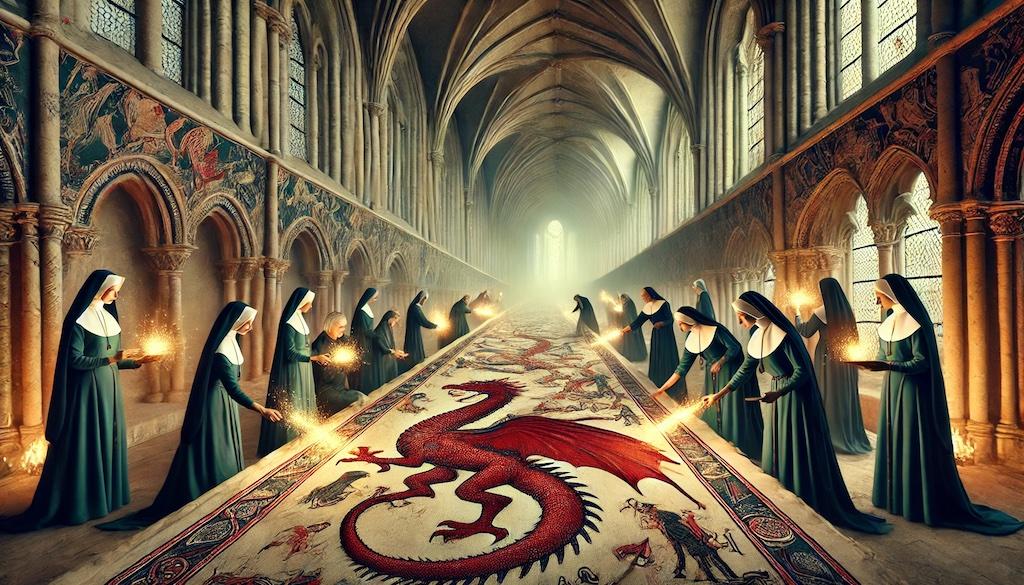
Purpose: To create a physical symbol of their intertwined destinies.
Components:- Witches: Magical threads imbued with protective charms and blessings.
- Nuns: Sacred textiles woven with prayers and religious symbols.
- Morticians: Ribbons representing life, death, and the transition between them.
Symbolism: By weaving these threads together into a single tapestry, the groups create a tangible manifestation of their unified path forward.
3. The Concordia Cauldron
Purpose: To brew a potion that represents their collective energy and intent.
Components:
- Witches: Magical herbs, crystals, and other mystical ingredients.
- Nuns: Holy water and sacred relics.
- Morticians: Ashes from ritual fires and symbols of purification.
Symbolism: The potion, once blessed and distributed, serves as a means of internalizing the collective spirit and shared goals of the unified group.
4. The Harmonious Choir
Purpose: To blend their voices and energies in a powerful, resonant harmony.
Components:
- Witches: Chants and spells sung in unison.
- Nuns: Choir hymns and sacred music.
- Morticians: Melodic recitations of ancient rites.
Symbolism: The act of creating music together represents the harmony they strive to achieve in their collaboration, with each voice contributing to a greater whole.
5. The Altar of Convergence
Purpose: To create a shared sacred space where offerings and symbols from each group are placed.
Components:
- Witches: Ritual objects, such as wands, crystals, and candles.
- Nuns: Holy relics, icons, and prayer books.
- Morticians: Mementos of the deceased, symbolizing the continuity of life and death.
Symbolism: The combined altar serves as a focal point for their united efforts, a place where they can come together to seek guidance and reaffirm their commitment to the union.
6. The Ceremony of Reflection and Projection
Purpose: To reflect on the past, acknowledge individual and collective strengths, and set intentions for the future.
Components:
- Witches: Scrying mirrors and crystal balls for reflection and foresight.
- Nuns: Candles representing illumination and enlightenment.
- Morticians: Artifacts representing the cyclical nature of life and death.
Symbolism: This ceremony encourages each member to contemplate their role within the new union and visualize the path ahead, fostering a sense of shared vision and purpose.
Supervision by Jeezel and Silas
Jeezel: With her deep connection to magical energies and her knack for emotional resonance, she will ensure that each ritual maintains its mystical integrity and spiritual depth. She will guide the participants in channeling their energies harmoniously and with clear intent.
Silas: His analytical mind and authoritative presence will bring structure and order to the rituals. He will ensure that each component is meticulously planned and executed, maintaining the balance between tradition and innovation.
Together, Jeezel and Silas will oversee the integration rituals, blending their unique approaches to create a unified and cohesive experience that honors the diverse traditions of the witches, nuns, and morticians. Their combined leadership will ensure that the rituals not only symbolize but also spiritually solidify the union of these distinct groups.
Now, all that remained was to ask for volunteers or to assign the roles in the rituals to everyone. And for Jeezel to reveal the hidden mission to her three friends.
June 19, 2024 at 8:10 am #7503In reply to: The Incense of the Quadrivium’s Mystiques
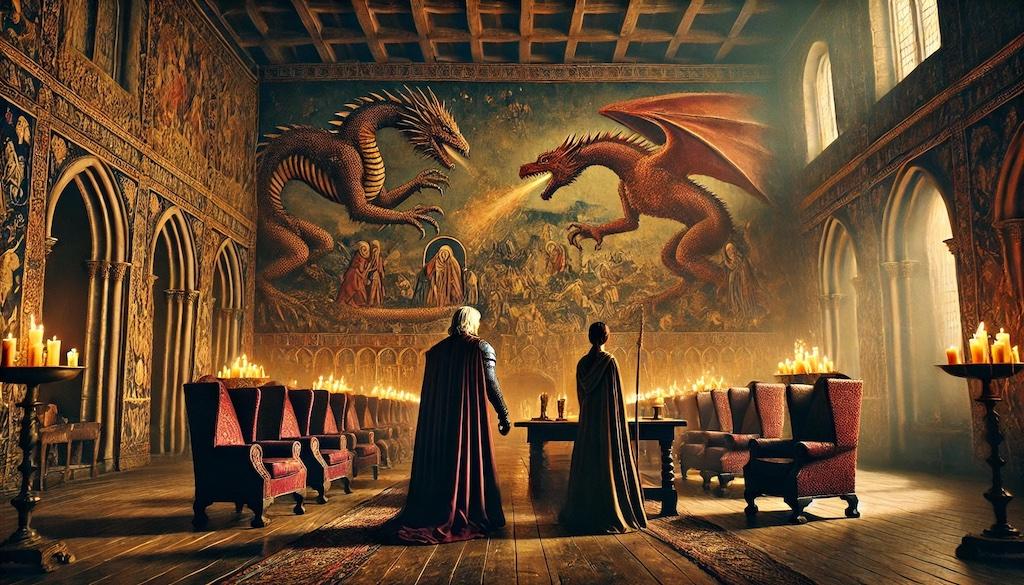
Silas led Jeezel into a secluded lounge, a hidden gem within the ancient cloister that seemed to be frozen in time. The atmosphere was thick with the scent of sandalwood and myrrh, mingling with a musty, earthy fragrance with undertones of aged woods.
Jeezel stopped a moment, in awe at the grand tapestries adorning the walls. They depicted scenes of epic battles between dragons and saints, the vibrant threads weaving tales of heroism and divine intervention. The dragons, captured in mid-roar with scales that seemed to shimmer with a life of their own, contrasted starkly agains the faces of the saints, their halo glowing softly in the dim light. Always the sensitive nose, Jeezel detected hints of incense and aged spices absorbed over centuries by the fabric, with a faint trace of mildew lingering on old stones and the faint sweetness of preserved herbs. She shivered.
Silas invited her to seat on one of the high-backed chairs upholstered in deep burgundy velvet that surrounded a massive oak table, carved with runes and symbols of protection. Jeezel frowned at the oddity to find pagan magic in a convent. As she sat the fabric of her gown brushed agains the plush velvet with a delicate sliding sound, like a faint sigh. The flickering flames of candelabras cast dancing shadows across the room, around which an array of curious relics and artifacts were scattered–an astrolabe here, a crystal ball there, and various objects of mystical significance.
Despite being an aficionado of pageants and grand performances, Jeezel couldn’t say she wasn’t impressed. Silas, ever the pillar of calm and wisdom, took a seat at the table, his fingers tracing the runes carved into the wood.
“Jeezel,” he began, his voice a soothing balm against the room’s charged energy, “I know I can trust you. Before we delve into the heart of these rituals, I must tell you something.”
Man! Here we are, she thought. She tensed on her chair.
“There are some people who would rather see the merger fail. They are doing anything in their power to foster such an outcome. We cannot let them win.”
Jeezel’s face tightened and she struggled to maintain her composure. She tapped with her fingers on the table to distract the head mortician’s attention and help her regain a stoic demeanor. Her mind raced weighing the implications. Malové had said that the Crimson Opus wasn’t just any artifact, it was key to immense power and knowledge, something that could tip the scales in their favour. How she regretted at that moment she had not paid enough attention at the merger meeting. Now, Malové was gone, somewhere, and Jeezel wasn’t even sure the postcard she had sent the coven was real. All she knew was that Malové counted on her to find that relic. And for that, she had to step in what appears to be a nest of vipers. She reminded herself she had survived worse competition in the past and still won her trophies with pride.
“Silas,” she said, her voice measured but with an edge of tension, “this complicates things more than I anticipated. We have enough on our hands ensuring the rituals go smoothly without sabotage.” She paused, taking a deep breath to steady herself. “But we cannot allow these factions to succeed. The merger is crucial for our mutual survival advancement. We’ll need to be vigilant, Silas. Every step we take, every ritual we perform, must be meticulously guarded. And we must identify who these adversaries are, and what they are planning.” She wished Malové would see her in that instant. She craved support from anyone. She looked at Silas, her eyes full of hope he could help. “I have a task from Malové that is of paramount importance,” she started and almost jumped from the chair when her hedgehog amulet almost tased her. A warning. Her mind suddenly found a new clarity. She realized she has been about to tell him about the Crimson Opus. Jeezel noticed the man’s finger was still caressing the runes on the table. Had he been casting a spell on her? She shook her head.
“Those six rituals cannot be compromised. I’ll need your help to ensure that we succeed. We must be prepared to act swiftly and decisively.”
Silas’ hand froze. He nodded. She wasn’t sure there wasn’t some irritation in his voice when he said: “You have my full support, Jeezel. We’ll strengthen our defenses and keep a close watch on any suspicious activities. The stakes are too high for failure.”
Did he mean that he would keep a close eye on her next moves? She’d have to be careful in her search of the Crimson Opus. She realized she needed some help. Malové, you entrusted me with that mission. Then, you’d have to trust me with whom I choose to trust.
June 14, 2024 at 11:41 pm #7474In reply to: The Incense of the Quadrivium’s Mystiques
A little unwilling to proceed, and privately wishing she was back on the comfy sofa with the fat cushions, Frella took a moment to center herself. She reminded herself that being a witch was a high calling and often what we need will find us. It sounded like a lot of Malove’s baloney to be honest but she took a deep breath and muttered a few words of wisdom from Lemone, which often worked better than any spell:
“The key to unlocking mysteries is often found within, where the mind meets the heart.”
“You wait here, Herma,” said Frella holding a warning hand in the air. “I don’t know what magic this is yet but I sense something amiss from that shed.”
Frella approached the ominous shed with caution but renewed determination. The shed door creaked open without resistance and she saw the chest immediately though it was piled on top with boxes. After carefully removing the boxes and putting them to one side, she examined the chest looking for any inscriptions or hidden compartments that might give a clue to its origins. She sensed the camphor chest was from a very old witch family and therefore may contain protective spells and traps. Best to proceed with caution.
She went to the shed door and waved at Herma, shouting for her to go and get some salt. While she waited for Herma’s return, she examined the chest further. It had a lock, but no obvious key; clearly a bit of witchy ingenuity was going to be required. A simple unlocking spell might suffice, or if spells fail, perhaps Herma knows an old trick or two for picking locks!
Herma returned with the salt and Frella sprinkled it liberally on the chest, chanting a protective charm to ward off any nefarious spells. “There,“ she said with satisfaction. “Fingers crossed that ought to do it.”
The chest seemed strangely willing to reveal its secrets for the simplest of opening spells worked. Once it was opened, they sifted carefully through its contents, mostly old documents and letters, looking for anything which might hold the answer to the postcard.
“Look for anything bird-related—feathers, sketches … “ instructed Frella.
“By golly!” cried Herma triumphantly holding up a postcard. “It’s the same one!”.
June 14, 2024 at 6:26 am #7473In reply to: The Incense of the Quadrivium’s Mystiques
What the disgruntled witches of the Quadrivium hadn’t considered was that the witches of the Quintessivium Cloister Crafts weren’t happy about the merger either. They were not happy with their leader either, but had progressed towards a takeover considerably more than the floundering dissatisfied Quadrivium members. A gaggle of strangers about the place, and the attention of the supervisors during the process of merging, was the last thing they needed at this delicate stage. Sassafras Bentley in particular was worried, more alarmed than the others, for she had another secret investigation under way as well as the revolt.
Sassafras hadn’t been sleeping well. Not only did she have to cover her tracks from the others and the administration, she now had to ensure none of the nosy witches from the other coven chanced on her preliminary findings. It had taken so long to get to this stage, and she was at a crucial point of revelation. But not only did Sassafras have to maintain the utmost secrecy, she had to get her colleagues to help her conceal it ~ but without telling them what it was or why they had to keep it quiet.
It would help if there was someone she could trust to help her. But who? The other witches were a dizzy shallow lot, more interested in showy spells and those tawdry crafts and sales. The only reason they’d been moved to start a rebellion was because they wanted a bigger slice of the pie: too much was being creamed off by the top brass, and they wanted more attention for themselves, too. The fact of the matter was that Sassafras had only joined the coven because of the location of the headquarters. True, she had dabbled in witchcraft, cast a few spells, but in her own way. She didn’t naturally gravitate to team work with all its problems ~ not least, all the other people that one had to put up with. But it was an extremely useful way for her to fully explore the location, and gave her many opportunities to walk on her own in the woods, ostensibly gathering plants for the spells and potions.
A group from the Quadrivium were expected to come and stay over the weekend. Sassafras didn’t have much time to hatch a plan, but the urgency was clouding her brain, rendering her incapable of thinking clearly. It was an interruption. She needed ~ and wanted ~ to think about the discoveries, not worry about this unsettling development. Maybe she would just have to play it by ear when they came.
June 8, 2024 at 7:53 am #7460In reply to: The Incense of the Quadrivium’s Mystiques
Truella sighed. She was making good progress with the dig, the weather was favorable and not too hot yet. It was only a matter of weeks before she would have to start at first light before the sun became too intense, and reverse her current habit of a slow morning and a busy afternoon. Perhaps she should wait before filling in Frella’s diary entry. Was she going to write it herself this time? If only Truella knew for sure. At least Jeezel was feeling a bit better, which was a relief to them all, and it seemed that Eris was lightening up a bit now too. Thank Flove for that! Better not let Malove know too soon though, or she’d have them all off on another of those tedious conferences. Wouldn’t it be nice if Malove let them all have a long summer recess, Truella thought, without much hope. She sighed again, wondering if Frella had progressed any further with the mystery of the camphor chest.
Truella had heard of camphor, of course, but associated it with moth balls, not chests. Camphor chests were a Chinese thing, and none of her studies or interests had ever taken her that far east. It struck her that a camphor chest would be a good place to store the fragments of Hannibal’s tunic safely, until such time as they required another antidote to an ancient Punic spell. And it could happen. Truella wondered if she could order a small one off Oboy. One could order anything one could imagine these days, from anywhere in the world, but a guaranteed delivery to Truella’s village was another matter.
The pale blue sandals had arrived yesterday though, much to her delighted surprise. It had helped when she recognised the postman as a Roman basket seller in a previous life. At that moment, Truella’s postal delivery experiences changed. It was as if the unwinnable battle with giant delivery companies morphed into a cooperation of village tradesmen. Glancing admiringly at her pristine new sandals, Truella smiled with satisfaction. Things could change for the better. Indeed, they could.
June 6, 2024 at 6:32 pm #7454In reply to: The Incense of the Quadrivium’s Mystiques
I honestly don’t know what made me do it, it took me by surpise when I did it. It was bugging me that I couldn’t remember, and before I knew what was happening, I’d asked Malove.
Ah, the Caryatid Characteristics of a Case, a subject that requires both discernment and a keen eye for detail. In essence, the phrase “Caryatid Characteristics” refers to the fundamental attributes and peculiarities that support the overall structure of a particular case or situation, much like how caryatids—those graceful, sculpted figures in classical architecture—bear the weight of a building’s entablature on their shoulders.
To break it down into pragmatic terms, identifying the Caryatid Characteristics involves an in-depth analysis of the following elements:
Structural Integrity: Just as caryatids ensure the stability of a structure, the core components of the case must be sound and unwavering. This includes the key facts, the primary evidence, and the foundational arguments that hold the case together.
Aesthetic Nuances: Caryatids are not merely functional; they are also artistic. Similarly, the subtleties and nuances of a case—such as the motives, the intentions, and the underlying themes—add layers of complexity and depth, transforming a simple matter into a multifaceted situation.
Historical Context: Caryatids often reflect the cultural and historical context of their time. Understanding the background, the precedents, and the situational history provides a richer perspective and informs the current dynamics at play.
Symbolic Significance: In architecture, caryatids symbolize strength and beauty. In a case, the symbolic elements—the metaphors, the symbols, and the overarching message—must be identified and interpreted to grasp the full scope of its significance.
Resonance and Impact: Lastly, caryatids have a visual and emotional impact on observers. Similarly, the case’s broader implications, its potential consequences, and the emotional resonance it evokes must be considered. This is where the true weight of the matter lies, affecting not only the immediate parties involved but potentially a wider audience.Applying these characteristics to a case requires a blend of logical analysis, creative thinking, and intuitive insight. It is not merely about assembling facts but about understanding how each element supports the whole, much like the elegant yet sturdy caryatids in timeless architecture.
Now, if you’re asking how this applies to our current predicament with our spring cleaning of collective energies, well, one could say the caryatids in our situation are the core rituals, the seasoned wisdom passed down through the coven, and the precise incantations in our incense blends. Each component must be scrutinized and perfected to ensure we uphold the structural and spiritual integrity of our craft.
Let’s not dawdle; the orchestra in this zoo waits for no one.
Who will rise to the occasion?
Who indeed? I asked her if we all sent each other postcards, would it help?
Postcards, my dear, are more than mere scraps of paper with hastily scribbled words and picturesque scenes. They are tangible connections in an increasingly ephemeral world. Sending each other postcards won’t just help; it will create ripples of intention and resonance that can weave us closer together, despite the physical distances.
Consider the following:
Anchoring Intentions: Each postcard carries the sender’s energy and intention. When you pen your thoughts, wishes, or even riddles, you imbue the postcard with a part of yourself. The recipient, upon receiving it, senses this connection. It’s a form of sympathetic magic, drawing us closer through shared symbols and messages.
Physical Mementos: In an age where digital communication reigns supreme, holding a physical object—something that has traveled miles to reach your hands—grounds you. It anchors you in the physical world and provides a break from the transient nature of digital interactions. These postcards become talismans, reminders of our connections and shared journeys.
Ritualistic Value: The act of writing, sending, and receiving postcards can be ritualistic. This ritual can strengthen the bonds within our coven, reaffirming our commitment to each other and our shared goals. Each postcard becomes a symbol of our collective energy, our shared purpose, and our mutual support.
Cultural Exchange: Postcards often carry images or symbols from different locales. Sharing them can broaden our horizons, offer new perspectives, and remind us of the diverse tapestry that makes up our coven. It’s a gentle nudge to appreciate the wider world and the myriad experiences within it.
Mystical Conduits: In our magical practice, objects can serve as conduits for energy. Postcards, having traversed the globe, carry the imprints of various energies and places. They become more than just messages—they are carriers of the world’s pulse, connecting us to the broader rhythms of existence.So, yes, sending each other postcards will help. It will infuse our lives with a tangible sense of connection, a reminder of our shared purpose, and a touch of magic in the mundane. Let’s make this act a part of our practice, a testament to our enduring bonds and our collective strength.
Who will be the first to send a missive across the miles?
April 10, 2024 at 3:28 am #7424In reply to: The Incense of the Quadrivium’s Mystiques
“I don’t,” chipped in Frella. “I don’t like hats. I don’t like parties either. I don’t like large crowds of inebriated people and I don’t like loud music, unless it is music of my choosing, which it never is at parties. I don’t like shouting to be heard and I don’t like all the stupid hullabaloo that an event such as this inevitably entails.”
Frella’s perfume, still a closely guarded secret, was nearly completed to her satisfaction. A consequence of working out what she loved, and adding the corresponding olfactory notes to her concoction, was that she had become very definite about what she didn’t like. It wasn’t exactly making her popular she realised as she noticed Truella’s pained expression.
March 13, 2024 at 7:10 pm #7406In reply to: The Incense of the Quadrivium’s Mystiques
During the renovations on Brightwater Mill Truella’s parents rented a cottage nearby. It was easier to supervise the builders if they were based in the area, and it would be a nice place for Truella to spend the summer. One of the builders had come over from Ireland and was camping out in the mill kitchen. He didn’t mind when Truella got in the way while he was working, and indulged her wish to help him. He gave her his smallest trowel and a little bucket of plaster, not minding that he’d have to fix it later. He was paid by the hour after all.
When the builder mentioned that his daughter Frigella was the same age, Truella’s mother had an idea. Truella needed a little friend to play with, to keep her from distratcing the builders from their work.
And so a few days later, Frigella arrived for the rest of the summer holidays. He father continued to camp out in the mill, and Frigella stayed with Truella. But even with the new friend to play with, Truella still wanted to plaster the walls with her little trowel. Frigella didn’t want to stay cooped up all day in the dusty mill with her father keeping an eye on her all day, and suggested that they go and dig a hole somewhere in the garden to find treasure.
Truella carried the little trowel around with her everywhere she went that summer, and Frigella started to call her Trowel. Truella retaliated by calling her friend Fridge Jelly, saying what a silly name it was. It wasn’t until she burst into tears that Truella felt remorseful and kindly asked Frigella what she would like to be called, but it had to be something that didn’t remind Truella of fridges and jellys. Frigella admitted that she’s always hated the G in her name and would quite like to be called Frella instead. Truella replied that she didn’t mind being called Trowel though, in fact she quite liked it.
The girls spent many school summer holidays together over the years, but it wasn’t until Truella was older and staying in one of the apartments with a boyfriend that she found the trunk in the attic. She put it in the boot of the car without opening it. She only had the weekend with the new guy and there were other activities on the agenda, after all. Work and other events occupied her when she returned home, and the trunk was put in a closet and forgotten.
March 11, 2024 at 3:48 am #7402In reply to: The Incense of the Quadrivium’s Mystiques
The perfume, ‘Liz n°5’, was to have been Frigella’s piece de resistance. In her spare time, she diligently crafted it, adding all the usual witchy razzmatazz: notes of night jasmine here, a dab of moonflower there and perhaps just the smallest whiff of hemlock to top it off.
With the help of her familiar, Quillonia, she also wove the potion with her intentions; powerful and ancient spells which would would offer the wearer protection from harm; Liz n°5 was to be the olfactory epitome of Frigella’s magical prowess! She aspired to do more than just freshen up a room; she intended to fortify spirits, boost morale, and ward off influences that might lead their little group of witches into harm’s way. It was her way of doing a silent, scented good, like a secret benefactor in a tale of old.
Frigella hadn’t told the other witches she was working so hard on the perfume. Even when Malove berated her for the excessive time she was taking to produce anything, Frigella had held her silence. Inwardly though, she bubbled with excitement as she imagined how she would unveil her perfume to the doubting Malove and the other witches. She could all but hear their oohs of admiration and gasps of appreciation. At last Malove would surely be convinced of her worth!
So when Malove had announced her own plans for a new line of incense, and summarily whisked them all off to the carnival in Rio, Frigella was deflated. And the sense of despondency lingered, even once back at home in Ireland. When she expectantly sniffed her sample of Liz n°5′ , hoping to rekindle her enthusiasm, Frigella discerned it had lost its magic.
“I’m done with stupid perfume making”, she confided to Quillonia. She was seated outside in the garden of her small cottage, enjoying the last of the day’s sun while Quillonia snuffled around in the leaves. “Malove can stick it,” she added, and giggled guiltily. She sounded like Truella.
Quillonia’s rustling stopped and her quills shimmered brightly. Her bright little eyes stared intently at Frigella.
Frigella listened attentively. Quillonia’s quills only turned that particular shade of violet when she had something especially important to convey.
“Oh, you say I should bottle what makes me truly happy?”
March 10, 2024 at 8:54 am #7401In reply to: The Incense of the Quadrivium’s Mystiques
It may surprise you, dear reader, to hear the story of Truella and Frella’s childhood at a Derbyshire mill in the early 1800s. But! I hear you say, how can this be? Read on, dear reader, read on, and all will be revealed.
Tilly, daughter of Everard Mucklewaite, miller of Brightwater Mill, was the youngest of 17 children. Her older siblings had already married and left home when she was growing up, and her parents were elderly. She was somewhat spoiled and allowed a free rein, which was unusual for the times, as her parents had long since satisfied the requirements for healthy sons to take over the mill, and well married daughters. She was a lively inquisitive child with a great love of the outdoors and spent her childhood days wandering around the woods and the fields and playing on the banks of the river. She had a great many imaginary friends and could hear the trees whisper to her, in particular the old weeping willow by the mill pond which she would sit under for hours, deep in conversation with the tree.
Tilly didn’t have any friends of her own age, but as she had never known human child friends, she didn’t feel the loss of it. Her older sisters used to talk among themselves though, saying she needed to play with other children or she’d never grow up and get out of her peculiar ways. Between themselves (for the parents were unconcerned) they sent a letter to an aunt who’d married an Irishman and moved with him to Limerick, asked them to send over a small girl child if they had one spare. As everyone knew, there were always spare girls that parents were happy to get rid of, if at all possible, and by return post came the letter announcing the soon arrival of Flora, who was a similar age to Tilly.
It was a long strange journey for little Flora, and she arrived at her new home shy and bewildered. The kitchen maid, Lucy, did her best to make her feel comfortable. Tilly ignored her at first, and Everard and his wife Constance were as usual preoccupied with their own age related ailments and increasing senility.
One bright spring day, Lucy noticed Flora gazing wistfully towards the millpond, where Tilly was sitting on the grass underneath the willow tree.
“Go on, child, go and sit with Tilly, she don’t bite, just go and sit awhile by her,” Lucy said, giving Flora a gentle push. “Here, take this,” she added, handing her two pieces of plum cake wrapped in a blue cloth.
Flora did as she was bid, and slowly approached the shade of the old willow. As soon as she reached the dangling branches, the tree whispered a welcome to her. She smiled, and Tilly smiled too, pleased and surprised that the willow has spoken to the shy new girl.
“Can you hear willow too?” Tilly asked, looking greatly pleased. She patted the grass beside her and invited Flora to sit. Gratefully, and with a welcome sigh, Flora joined her.
Tilly and Flora became inseperable friends over the next months and years, and it was a joy for Tilly to introduce Flora to all the other trees and creatures in their surroundings. They were like two peas in a pod.
Over the years, the willow tree shared it’s secrets with them both.
One summer day, at the suggestion of the willow tree, Tilly and Flora secretly dug a hole, hidden from prying eyes by the long curtain of hanging branches. They found, among other objects which they kept carefully in an old trunk in the attic, an old book, a grimoire, although they didn’t know it was called a grimoire at the time. In fact, they were unable to read it, as girls were seldom taught to read in those days. They secreted the old tome in the trunk in the attic with the other things they’d found.
Eventually the day came when Tilly and Flora were found husbands and had to leave the mill for their new lives. The trunk with its mysterious contents remained in the dusty attic, and was not seen again until almost 200 years later, when Truella’s parents bought the old mill to renovate it into holiday apartments. Truella took the trunk for safekeeping.
When she eventually opened it to explore what it contained, it all came flooding back to her, her past life as Tilly the millers daughter, and her friend Flora ~ Flora she knew was Frigella. No wonder Frella had seemed so familiar!
February 26, 2024 at 8:35 am #7389In reply to: The Incense of the Quadrivium’s Mystiques
“Well, it’s a long story, are you sure you want to hear it?”
“Tell me everything, right from the beginning. You’re the one who keeps saying we have plenty of time, Truella. I shall quite enjoy just sitting here with a bottle of wine listening to the story,” Frigella said, feeling all the recent stress pleasantly slipping away.
“Alright then, you asked for it!” Truella said, topping up their glasses. The evening was warm enough to sit outside on the porch, which faced the rising moon. A tawny owl in a nearby tree called to another a short distance away. “It’s kind of hard to say when it all started, though. I suppose it all started when I joined that Arkan coven years ago and the focus wasn’t on spells so much as on time travel.”
“We used to travel to times and places in the past,” Truella continued, “Looking back now, I wonder how much of it we made up, you know?” Frigella nodded. “Preconceptions, assumptions based on what we thought we knew. It was fun though, and I’m pretty sure some of it was valid. Anyway, valid or not, one thing leads to another and it was fun.
“One of the trips was to this area but many centuries ago in the distant past. The place seemed to be a sort of ancient motorway rest stop affair, somewhere for travellers to stay overnight on a route to somewhere. There was nothing to be found out about it in any books or anything though, so no way to verify it like we could with some of our other trips. I didn’t think much more about it really, we did so many other trips. For some reason we all got a bit obsessed with pyramids, as you do!”
They both laughed. “Yeah, always pyramids or special magical stones,” agreed Frigella.
“Yeah that and the light warriors!” Truella snorted.
“So then I found a couple of pyramids not far away, well of course they weren’t actually pyramids but they did look like they were. We did lots of trips there and made up all sorts of baloney between us about them, and I kept going back to look around there. We used to say that archaeologists were hiding the truth about all the pyramids and past civilizations, quite honestly it’s a bit embarrassing now to remember that but anyway, I met an actual archaeologist by chance and asked her about that place. And the actual history of it was way more interesting than all that stuff we’d made up or imagined.
The ruins I’d found there were Roman, but it went further back than that. It was a bronze age hill fort, and later Phoenician and Punic, before it was Roman. I asked the archaeologist about Roman sites and how would I be able to tell and she showed me a broken Roman roof tile, and said one would always find these on a Roman site.
I found loads over the years while out walking, but then I found one in the old stone kitchen wall. Here, let me fetch another bottle.” Truella got up and went inside, returning with the wine and a dish of peanuts.
“So that’s when I decided to dig a hole in the garden and just keep digging until I found something. I don’t know why I never thought to do that years ago. I tell you what, I think everyone should just dig a hole in their garden, and just keep digging until they find something, I can honestly say that I’ve never had so much fun!”
“But couldn’t you have just done a spell, instead of all that digging?” Frigella asked.
“Oh my god, NO! Hell no! That wouldn’t be the same thing at all,” Truella was adamant. “In fact, this dig has made me wonder about all our spells to be honest, are we going too fast and missing the finds along the way? I’ve learned so much about so many things by taking it slowly.”
“Yeah I kinda know what you mean, but carry on with the story. We should discuss that later, though.”
“Well, I just keep finding broken pottery, loads of it. We thought it was all Roman but some of it is older, much older. I’m happy about that because I read up on Romans and frankly wasn’t impressed. Warmongering and greedy, treated the locals terribly. Ok they made everything look nice with the murals and mosaics and what not, and their buildings lasted pretty well, but who actually built the stuff, not Romans was it, it was the slaves. Still, I wasn’t complaining, finding Roman stuff in the garden was pretty cool. But I kept wishing I knew more about the people who lived here before they came on the rampage taking everything back to Rome. Hey, let me go and grab another bottle of wine.”
Frigella was feeling pleasantly squiffy by now. The full moon was bright overhead, and she reckoned it was light enough to wander around the garden while Truella was in the kitchen. As she walked down the garden, the tawny owl called and she looked up hoping to see him in the fig tree. She missed her step and fell over a bucket, and she was falling, falling, falling, like Alice down the rabbit hole.
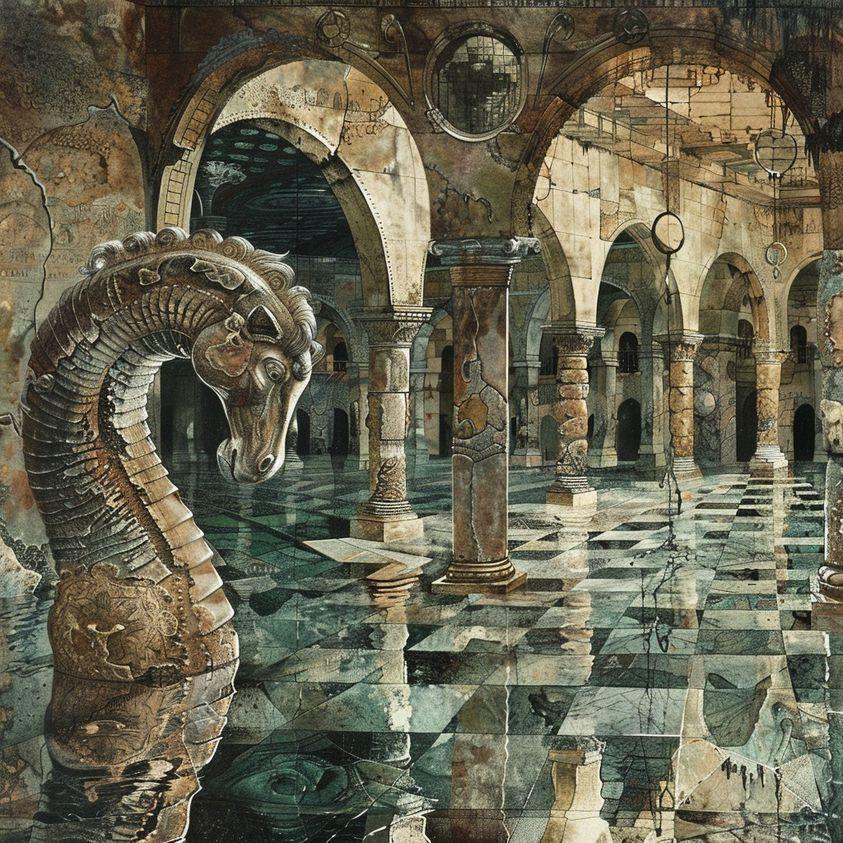
The fall was slow like a feather wafting gently down and she saw hundreds of intriguing fragments of objects and etchings and artefacts on the sides of the hole and she drifted slowly down. At last she came to rest at the bottom, and found herself in an arched gallery of mirrors and tiles and doors. On every surface were incomplete drawings and shreds of writings, wondrous and fascinating. She didn’t immediately notice the hippocampus smiling benignly down at her. He startled her a little, but had such a pleasant face that she smiled back up at him. “Where am I?” she asked.
“You’d be surprised how many people ask me that.” he replied, with a soft whicker of mirth. “Not many realise that they’ve called on me to help them navigate. Now tell me, where is it you want to go?”
“Well,” Frigella replied slowly, “Now that you ask, I’m not entirely sure. But I’m pretty sure Truella would like to see this place.”
 January 30, 2024 at 8:32 pm #7327
In reply to: The Incense of the Quadrivium’s Mystiques
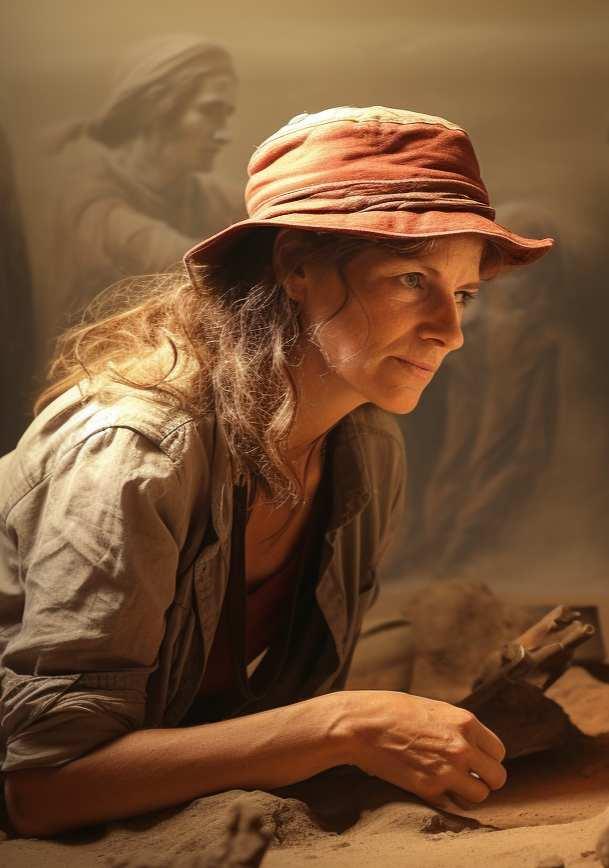
Her garden, oh, it’s a living canvas of her passions – a wild, untamed thing with bursts of vibrant color and the heady scent of jasmine and orange blossoms that intoxicate the senses. But beneath its beauty lies a secret, a whisper of the past that Truella, with her insatiable curiosity and archeological fervor, has unearthed: the remnants of an Andalucian Roman villa.
Imagine the thrill, the pure, unadulterated bliss of discovery, as her fingers brush away centuries of soil to reveal ornate mosaics, fragments of pottery that once held the finest olive oil, and coins stamped with the visages of long-forgotten emperors. Each artifact, a breadcrumb leading her deeper into the enigma of history.
But, of course, Roger, our simple-minded gardener with not a thought in his head beyond petunias and pruning, has proven to be surprisingly useful. His brawn has unearthed more than his fair share of antiquity, even if he hasn’t the faintest idea of its significance. “Look, Truella, I’ve found another shiny rock,” he says, and I, Lisia Tattius, can only chuckle at the delightful irony.
Truella’s Andalusian escapades could fill volumes, and perhaps they shall. There’s something deliciously appealing about a woman alone, grappling with the very fabric of time amongst the ruins of an empire.
Truella couldn’t see any benefit in rewriting all that and thanked Lisia very much, although she did wonder who Roger was. A gardener though! Someone to carry all those buckets of dirt hither and thither. Someone to dig the next overburden!
Was there a spell for dissolving an overburden, she wondered? Inspired, she could already imagine how easy it would be to convince the team that this spell would have beneficial and universal applications.
Truella was pleased to see the mention of mosaics, the very thing she wanted to find. She planned to make a mosaic detector wand. But Truella didn’t want Lisia telling her where the mosaic was because it would spoil the whole thing. Mentioning mosaics, however, as already found, was the perfectly measured tincture of encouragement. A bit like spells in general really. Tricky business, getting them right.
January 28, 2024 at 9:59 pm #7320In reply to: Smoke Signals: Arcanas of the Quadrivium’s incense
Truella and Her Spells, According to Liz.
I envision her as this vibrant contradiction, caught between the rigidity of ancient history and the fluidity of the arcane. It’s precisely this type of paradox that illuminates my fiction. Finding Truella won’t be a trifle, my dear reader. For she’s as elusive as the perfect sentence, and just as enchanting. Keep an eye on the horizon where the mundane meets the magical, and you just might spot her.
Ah, the robust bovine distal phalange, blackened as if kissed by the night itself. Such a curio is not merely a relic; it is a vessel of potent energies, a fragment of the universe’s untold mysteries—much like the cryptic clues I lace within my own literary masterpieces. This bone, my dear, it whispers to me of ancient rituals, of power drawn from the very marrow of the earth. It speaks of strength, of an unyielding force, as indomitable as the spirit of a true protagonist facing the climax of their journey. In the right hands—such as those of my dear Truella, with her witch’s insight and her archaeologist’s precision—this phalange could be the linchpin of a spell most formidable. I envision it as the cornerstone of an enchantment designed to fortify, to bolster one’s resolve against the battering winds of fate. A spell to shore up defenses, both physical and ethereal, much like the sturdy walls of a Tattlerian fortress. Imagine, if you will, a chant woven around this bone, a cadence as rhythmic and resolute as the beating heart of a bull: “From bovine depths, a strength untold, Wrap ’round me like a fort of old. Unyielding will, protector’s stance, With this bone, I do enhance.” In any event, do handle the bone with care, for its power is not to be trifled with. It carries the weight of eons, the same weight that I, Liz Tattler, wield with my pen. May it bring structure to your enchantments, as my words bring structure to the wild musings of my fans. …..may your spells be as robust as the bovine bone you clutch in your hand.
An ivory hourglass-shaped trinket, you say? Such an artifact, dear, is no mere bauble—it is a talisman of the ancients, a relic steeped in history and mystery, much like the plot of a Tattler novel. Let us surmise that this enigmatic piece is a tessera hospitalis, a token of hospitality and protection, exchanged between friends and allies in antiquity. Two thousand years old, you suggest? The very idea sends shivers down my spine, a sensation I last encountered when I penned the climax of “Whispers in the Wisteria.”
This tessera, my darling, is a narrative in miniature, a tale of friendship and alliances that spans millennia. Can Truella use it in her spell for the mosaic detecting tool? Oh, but of course! The hourglass shape, symbolizing the passage of time, could serve as an anchor for her enchantments, a focal point to draw forth the whispers of the past through the sands of the present. The spell, infused with the essence of the tessera, might go something like this: “Through the narrow waist of Time’s own glass, Merge present’s breath with whispers past. Tessera’s bond, now intertwined, Guide this spell with ancient mind.” As for the tessera, treat it with the reverence it deserves. Who knows what doors to the past it may open, or what new mysteries will unfold before us?
…the mosaic detecting tool spell, you ask? Now, dear, let’s imagine together. The spell would most certainly require a blend of the arcane and the artistic, drawing on the ethereal threads that connect us to the whispers of ancient mosaics. Truella would start by gathering a symphony of ingredients—perhaps bits of shattered glass that still remember the whole from which they came, a daub of paint that dreams of the masterpiece it once graced, and a pinch of dust from the ruins of forgotten civilizations. Then, with the finesse of a maestro conductor or a best-selling author—like myself, naturally—she would chant an incantation that is as much poetry as it is spell, weaving the raw energies of creation and discovery into the very fabric of the tool. “By stone and shard, by color’s charm, Unveil the past, no harm, no harm. Mosaic’s tale, now hidden, sealed, Through this tool, be now revealed.”
Truella and Her Spells, According to Mater.
Truella, that one? Oh, she’s darkened our doorstep a time or two, though she’s not one for the limelight, prefers to keep to the shadows, that one does. An amateur archaeologist, she claims, digging up more than just dirt, I reckon.
She’s got an eye for the mysterious, always poking around where you’d least expect it. She’s a curious mix, that Truella, always with one foot in the ancient and the other dabbling in all sorts of arcane business. Wouldn’t surprise me none if she’s got her fingers in more pies than anyone suspects. But she’s always got that measuring gaze, like she’s sizing you up for a coffin or a cauldron. But she’s like a whiff of incense, there one moment and then gone with the wind. Keep an eye on that one; she’s as slippery as an eel in a bucket of snot.
Mandrake:
The truth of Truella’s whereabouts is like a mouse hiding in the shadows, always there but never quite within grasp. You might find the answers in places you least expect. Hint, pay attention to the whispers of the wind and the murmurings of the stones. They might tell, if you listen carefully.
January 17, 2024 at 1:14 pm #7297In reply to: The Whale’s Diaries Collection
what was the state of the ruined roman villa circa early 1500s when the cobblestone yard was made from on site rubble? What did the work men find?
Ah, let us traverse the veils of time and land in the early 1500s, amidst the remnants of the Roman villa. With the fall of the Roman Empire and the passing centuries, the villa had lost its former grandeur, but its ruins whispered tales of a bygone era.
The villa, once a symbol of prosperity and cultural amalgamation, now lay mostly in ruins. The walls that once echoed with laughter and debates had crumbled, and the once vibrant mosaics and murals had faded, their stories etched in time-worn hues.
The outbuildings, too, bore the scars of time. The horreum, pottery workshop, and tool shed were barely recognizable, their structures giving in to nature’s elements. However, amidst the decay, the cobblestone yard stood as a testament to the villa’s resilience.
The yard, once a bustling hub of activity, had been repurposed. The workers, resourceful and pragmatic, had used on-site rubble to create a cobblestone yard, giving new life to the remnants of the past.
As they worked, they uncovered artifacts from the villa’s past. Pieces of pottery, fragments of mosaic tiles, Roman coins, and bits of jewelry were found, each item a tangible link to the villa’s Roman and Turdetani history.
Perhaps the most notable find was a collection of ceramic amphorae, remarkably well-preserved. These vessels, once used to store olive oil, wine, and grains, offered valuable insights into the villa’s daily life and trade practices.
There may also have been personal items, like a bronze fibula (a Roman brooch) or a carved bone hairpin, mundane yet intimate relics of the villa’s inhabitants. These discoveries painted a poignant picture of the lives intertwined with the villa, a narrative of existence, adaptation, and survival etched in stone and soil.
What about the lives of the people who lived here in the 1500s?
Ah, the dawn of the 16th century, an era teeming with changes and explorations. Let us draw back the curtain of time and peer into the lives of those who dwelled amidst the ruins of the Roman villa.
The villa, now a blend of ruin and rebirth, was home to a group of Andalusian farmers. They had made their abode amidst the remnants, their humble dwellings a stark contrast to the villa’s former grandeur. Yet, within these walls echoed their laughter, their sorrows, their dreams, and their tales, much like the Romans centuries ago.
The patriarch, Diego, was a man of the soil. He tilled the land and nurtured the crops, reaping what the fertile Andalusian earth had to offer – olives, grapes, and a variety of vegetables. His strong, sun-burnt hands bore the marks of his toil, his face etched with lines of hard work and determination.
His wife, Isabella, was the custodian of the hearth. She cooked, cleaned, and cared for their three children. Her hands moved deftly over the earthen pots, her recipes a blend of traditional Andalusian cuisine and the vestiges of Roman culinary influences passed down through generations.
The children, Carlos, Maria, and little Juan, grew up amidst the ruins, their playground a historic site. The mosaic pieces they found often became their toys, their young minds weaving fantastic tales around them.
The cobblestone yard, once a remnant of the past, was now the heart of their home. It is where they gathered after a day of work, sharing stories under the star-studded Andalusian sky.
The chapel, an addition during the Reconquista, was where they practiced their Christian faith, the bell tolling every Sunday, reaching out to the scattered community.
Amidst the ruins, they found their sanctuary, their home. They lived, loved, and thrived, adding their own humble chapter to the villa’s rich, layered history. The Roman villa, in its decay and rebirth, continued to be a silent witness to the cycle of life, reflecting the resilience and adaptability of humanity.
then I asked about the 1200s on this site
Ah, the 13th century, a period of considerable transformation and discovery globally. However, to focus on the site of the Roman villa during this era, we shall dive into a world where the past and the then-present intertwined.
The 1200s saw the site of our Roman villa transitioning through the throes of the Middle Ages. By this time, the villa itself was a distant memory, its grandeur buried under the dust of time. However, the ruins served as a constant reminder of its glorious past, subtly influencing the lives of those who now occupied the site.
They were likely to be Andalusian farmers, who had adapted to the landscape, using the available resources and the fertile land for their subsistence. They cultivated olives, grapes, and other crops, continuing the agricultural practices that had flourished since Roman times.
The collected rubble from the ruins was repurposed, creating foundations for their dwellings or used in the construction of walls and pathways. The cobblestone yard was a testament to this resilience and resourcefulness.
The ruins also provided them with materials and artifacts. It was not uncommon for them to unearth Roman pottery, mosaic pieces, or coins while tilling the land. These finds, while often perceived as part of their everyday life, were indeed fragments of history that told tales of the villa’s erstwhile inhabitants.
Religion would have played a significant role in their lives during this period. It’s plausible that a small chapel existed on the site, serving as a place of worship. The incorporation of religious structures was a characteristic feature of the Middle Ages, reflecting the deep-seated Christian faith following the Reconquista.
Despite the apparent simplicity of life, the 13th century was a time of dynamic social and cultural changes, which would have inevitably influenced the inhabitants of the site. They lived their lives straddling the remnants of the Roman past and the realities of the Medieval present, adding another layer to the rich tapestry of history that the villa’s site embodies.
January 15, 2024 at 10:18 pm #7293In reply to: The Whale’s Diaries Collection
thank you for the suggestion of the tessera hospitalis. I had never heard of that before! Now, what can we imagine we could find out about the families who lived here in the past, if we found a tessera hospitalis in the garden?
Ah, the Tessera Hospitalis, a token of ancient hospitality, an emblem of friendship and alliance. Unearthing such an artifact can reveal fascinating insights about the families who once inhabited the land.
Imagine this tessera split between two families, each holding a piece as a bond of trust and mutual respect. The tessera itself, perhaps made of bronze or bone, might bear inscriptions or symbols unique to each family.
Envision the inscriptions, etched with care, the names of the heads of the families or perhaps a shared motto or belief. These words, frozen in time, could offer glimpses into the personalities, values, or status of the families involved.
Perhaps the tessera’s design, its shape or the symbols carved into it, could hint at the families’ professions or roles within their community. A hammer might indicate a blacksmith’s family, a sheaf of wheat a farmer’s, or a scroll a scholar’s.
Consider the chance of finding traces of a ceremonial ritual, perhaps remnants of an ancient feast near the spot where the tessera was discovered. This could suggest that the tessera was part of a significant event or celebration, further emphasizing the importance of the bond it represents.
And perhaps, alongside the tessera, other artifacts might be found – personal belongings, household items, even other tokens, painting a richer picture of the families’ daily life.
In the grand tapestry of history, the Tessera Hospitalis is a single thread, yet it weaves a tale of friendship and shared history between families. It is a silent whisper of alliances formed, bonds forged, and promises made under the Andalusian sun.
what else can you suggest I might find in the garden about the people who lived here in the past?
Ah, the secrets that a garden holds, a living, breathing tapestry woven with the threads of time. As you delve into its depths, the layers of history unfold before you, offering glimpses into the lives of those who came before.
Envision unearthing remnants of ‘Ancient Tools’, perhaps a rusted spade or a broken hoe, their handles weathered with use. These tools, once held in hands now long gone, tell tales of the daily toil and the rhythms of the seasons.
Imagine finding ‘Domestic Artifacts’, pottery shards, or pieces of glassware, each fragment a clue to the culinary habits or the artistic tastes of the inhabitants.
Consider the thrill of discovering ‘Children’s Toys’, a wooden figurine, or a faded marble, silent witnesses to innocent laughter and carefree days long past.
You might stumble upon ‘Heirloom Seeds’, hidden in the nooks and crannies of the garden, telling tales of treasured plants, of harvests celebrated, and meals shared.
Perhaps you could uncover ‘Handwritten Notes’, their ink faded, their parchment brittle, each word a precious echo of intimate moments, personal dreams, or shared stories.
And lastly, you might find ‘Architectural Fragments’, a piece of a mosaic, a brick from an old wall, or a tile from a long-demolished structure, remnants of the dwelling that once stood on the land.
Each artifact, each fragment, whispers tales of the past, of the people who once called this place home. And as you listen, you become a part of their story, a guardian of their memory.
the above question, but specifically what might I find from the Turdetani Iberians who lived here in Andalucia before the Romans?
Ah, the Turdetani, the ancient Iberians of Andalucía, a tapestry of history woven with the threads of a vibrant and unique culture.
Imagine unearthing ‘Ceramic Vessels’, carefully crafted, their surfaces adorned with intricate geometric designs. Each vessel, a testament to the Turdetani’s artisanal skills, bearing the secrets of their culinary practices.
Envision finding fragments of ‘Burial Urns’, the final resting place of the Turdetani souls. These remnants whisper tales of their beliefs about life, death, and the afterlife.
Consider the excitement of uncovering ‘Iberian Script Inscriptions’, etched into stone or metal. Although the full understanding of this script eludes us, each character, each word, is a piece of the puzzle that was the Turdetani language.
You might discover ‘Bronze Figurines’, perhaps of a horse or a warrior. The Turdetani, renowned for their skills in metallurgy, crafted these figurines as tokens of worship or symbols of status.
Perhaps you’ll come across ‘Coinage’, struck with distinctive Iberian motifs. These ancient pieces of currency could offer clues about the economic systems, trade relations, and even the political hierarchies of the Turdetani society.
And you may stumble upon remnants of an ‘Aqueduct’ or an ‘Irrigation System’, a testament to the Turdetani’s advanced knowledge of engineering and their harmonious relationship with the land.
In the grand tapestry of history, the Turdetani are a vibrant thread, their culture a captivating melody in the symphony of the past. Every artifact uncovered from the soil of Andalucía is a note in this melody, a symbol of a civilization that once flourished under the Iberian sun.
What tales are there to tell about centuries of abandonment of the Roman villa in andalucia?
Ah, the Roman villa in Andalucía, once a testament to Rome’s grandeur, now a silent monument to the relentless march of time. Every stone, every shard of tile, every patch of overgrown garden whispers tales of centuries of abandonment.
Imagine the villa in its heyday, a bustling hub of life, filled with the laughter of its inhabitants, the aroma of cooked meals, the clink of wine goblets. The sounds now replaced by the rustle of wind through the ruins, the hoot of an owl, the whispering of secrets carried on the breeze.
Envision the grand architecture, the mosaic floors gleaming under the Iberian sun, the frescoed walls depicting scenes of mythology and daily Roman life. Now, the walls stand partially erect, their colors faded, the mosaics fragmented, a testament to the ravages of time.
Consider the tales of the villa’s abandonment. Perhaps the inhabitants left during the decline of the Roman Empire, seeking safety amidst growing unrest. Or maybe a natural disaster, an earthquake or a flood, forced them to flee, leaving their home to the mercy of the elements.
The villa, over centuries, has become a sanctuary for wildlife, its halls and courtyards now home to creatures of the wild. Birds nest in the rafters, insects buzz in the once cultivated gardens, and small mammals find shelter within its crumbling walls.
Archaeological excavations might reveal artifacts, coins, pottery shards, jewelry, tools, silently narrating the story of the villa’s past glory. Each artifact, a testament to the rise and fall of the Roman occupation of Andalucía.
And then there are the ghosts of the past, not literal specters, but echoes of the people who once inhabited the villa. Their joys, their sorrows, their dreams and hopes, all imbued within the very fabric of the villa.
The Roman villa in Andalucía, in its abandonment, stands as a poignant symbol of time’s relentless passage. Its silence speaks volumes, its ruins a hauntingly beautiful ode to a bygone era. Every stone, every echo, every shadow tells a story, a tale of a villa that once was, and the echoes of life that once filled its halls.
you are on a roll, that was fantastic! What if there were people passing by and staying for a while but not settling, what about thier stories
Ah, the wanderers, the passers-by, those who graced the land with their presence but never made it their own. Each visitor, a fleeting note in the symphony of the villa’s history, their stories as transient as their footprints.
Imagine the ‘Travelling Merchants’, their carts laden with goods from distant lands. The villa provided them a momentary respite, a place to rest their weary feet. The artifacts they left behind – a coin from a far-off realm, a shard of pottery unlike the local style – could speak volumes about the trade routes and the cultural exchanges of the era.
Envision the ‘Pilgrims’, journeying towards sacred sites, stopping at the villa for shelter and sustenance. Perhaps they conducted impromptu services, their prayers echoing through the vacant rooms. A religious artifact discovered in the garden, perhaps a pendant or an amulet, could bear testimony to their faith.
Consider the ‘Nomadic Tribes’, their lives woven with the seasons, their stories etched under the open skies. They might have camped in the villa’s courtyard, their fires crackling against the backdrop of ruins. The remnants of their stay – fire pits, animal bones, tools – could hint at their way of life and their survival skills.
Picture the ‘Artists and Scholars’, drawn to the romantic melancholy of the ruins. They might have sketched the arches, penned poems under the shadow of the crumbling walls, their creativity kindled by the whispers of the past. Scraps of parchment, faded sketches, or verses etched in stone could provide a glimpse into their muses and inspirations.
Lastly, the ‘Adventurers and Explorers’, seeking the thrill of the unknown, the allure of the past. Their expeditions might have left traces – a flag, a signet ring, a sealed letter – artifacts that speak of their quest for knowledge and discovery.
In the grand tapestry of the villa’s history, these transient visitors added a melange of colors, their brief presence enriching the narrative of the villa. Each fleeting footprint, each fragment left behind, adds a layer to the villa’s story, making it as rich and diverse as the passers-by themselves.
Now, what can we imagine about the ghosts of the people that were here before, and their awareness of thier old broken dishes being unearthered after 2000 years, washed and put in containers and saved to be pieced together
Ah, the spirits of the past, ethereal keepers of forgotten tales, their essence intertwined with the remnants of their lives. Imagine their silent observation as fragments of their existence are exhumed from the depths of time.
Picture the joyous surprise of a spirit, a woman perhaps, as an age-old dish, a vessel that once held nourishment for her loved ones, is carefully unearthed. Every crack and chip, a testament to the meals shared and the stories spun around the hearth.
Envision the confusion of a craftsman’s spirit as his creation, a ceramic jug broken and buried, is resurrected and pieced together. Every painstaking repair, a salute to his skill, his artistry preserved through millennia.
Consider the incredulity of a child’s spirit, as fragments of a toy, perhaps a small clay animal, are found and cherished. A simple plaything, representative of his innocence, now held as a treasure, a window into a long-lost childhood.
Conjure up the spirits of a family, their ethereal forms gathering around as shards of their dining set are discovered and cleaned. Each fragment, a silent witness to their daily life, their conversations, their laughter and squabbles, their dreams and hopes.
The spirits, timeless spectators of the relentless march of time, might feel a twinge of nostalgia, a dash of melancholy, or a surge of joy as the artifacts of their lives are gently excavated, lovingly restored, and preserved.
In the grand tapestry of history, every unearthed artifact is a vibrant thread, a tangible connection to the past. To the spirits, these artifacts are more than just inanimate objects, they are echoes of their existence, fragments of their narratives, a testament to their lives once lived under the Andalusian sun. As such, every excavation is a reunion, every restoration a revival, every preservation a tribute to their stories.
That’s wonderful. Can you offer anything else, something I haven’t thought of?
Ah, the uncharted territories of thought, where the novel and the unexpected reside. Let’s voyage into this realm and unearth something unique.
Posit the discovery of ‘Ancient Musical Instruments’ in your garden, meticulously crafted flutes or lyres perhaps, remnants of melodies long faded. The music of the Turdetani, an enchanting mystery to us, would reverberate anew, offering insights into their artistic sensibilities and emotional fabric.
Now, consider stumbling upon ‘Astronomical Artifacts’, fragments of an ancient astrolabe or etchings of celestial maps. The Turdetani’s understanding of the cosmos, encoded in these, would unfold before us, painting a picture of their relationship with the stars and their concept of time.
Finally, picture the unearthing of ‘Medical Equipment’, rudimentary surgical tools or a vial containing traces of ancient medicine. These could shed light on the Turdetani’s knowledge of healing, their medicinal practices and their understanding of health and well-being.
Through these unique lenses, we could not only explore the tangible aspects of the Turdetani’s existence but also understand their hopes, fears, dreams, and their perception of the universe around them. Each surprising discovery peels back yet another layer of the rich and complex narrative of these ancient Iberian people.
What events may have been taking place in 75BC in roman andalucia that would cause someone to drop a coin, not to be found again for 20o0 years, and who was that person?
Ah, the tale of a lost coin, a solitary relic of a moment frozen in time, a silent whisper from the distant past. Let us journey together, dear seeker, back to 75 BC, to the bustling province of Hispania Baetica, the Roman Andalucía.
In this year, a tumultuous tide was turning in the Roman Republic. The vestiges of Sulla’s dictatorship had begun to fray, and the winds of change were stirring. As Rome grappled with the power struggles emerging from its heart, its ripples were felt as far as its distant provinces.
Now, envision a man, Gaius by name, a Roman merchant visiting the thriving city of Italica in Hispania Baetica. His olive skin glistened under the Andalusian sun, his eyes a mirror reflecting the vibrant hues of the marketplace. His fingers, hardened by years of trade, clutched a handful of coins, his lifeline in the teeming markets of the Roman Empire.
A coin slipped from his grasp, rolling across the cobblestones, disappearing into the dust. Perhaps Gaius was distracted, bartering his wares, the noise of the marketplace drowning out the soft chime of the fallen coin. Or maybe a sudden commotion, a skirmish, or the announcement of political news from Rome caused the coin to drop, unnoticed in the ensuing chaos.
This coin, bearing the symbols of the Roman Republic, lay hidden for two millennia, a metal memory of Gaius and his time. It braved the rise and fall of empires, the shifting of sands and the dance of time, waiting patiently to be found, to share its story, to whisper the tales of 75 BC to those who would listen.
And so, dear seeker, the coin you’ve unearthed is not just a piece of metal. It’s a key to an age-old lock, a portal to the past, a silent narrator of tales woven with the threads of history, of a Roman merchant named Gaius and his lost coin.
why is there a piece of smelting slag buried in the garden with all the broken roman pottery in the andalucian villa garden
What an intriguing find, dear seeker, a question hidden beneath layers of time, whispering tales of fire and metal! Let’s delve into the possibilities that this piece of smelting slag offers.
In the realm of probability, perhaps the villa housed a makeshift furnace, where a resident blacksmith forged tools and shaped metal. Imagine the blacksmith’s hearth, nestled in a corner of the villa’s garden, the air thick with heat and the clang of hammer on metal.
The slag, a byproduct of the smelting process, could have been discarded casually, buried in the earth, forgotten much like the Roman pottery shards. Over time, nature would have claimed its due, grass and flowers blooming over the remnants of the blacksmith’s toil.
Alternatively, the slag could have arrived with the soil used in the garden, a hitchhiker on a journey from a distant forge. Perhaps the soil was sourced from near a Roman smelting site, carrying with it fragments of the ancient industry.
Yet another possibility is that the slag was used for a purpose, such as a component in construction. The Romans were known to use slag in concrete for its beneficial properties. Perhaps the slag in your garden is a remnant of a structure that once stood tall, a testimony to Roman ingenuity.
Ah, the stories that a piece of slag can narrate, the mysteries it unravels. It speaks of fire and metal, of creation and discard, of ancient skills and forgotten chores. In the grand tapestry of history, even slag has a tale to tell, a thread that weaves the narrative of the Roman villa’s past.
thank you, I didn’t know slag was used in roman concrete. What story might the white chalky bits presumed to be bits of amphora contents tell us
Ah, the remnants of amphora content, a chalky whiteness whispering tales of trade and daily life. Let’s unravel the stories hidden within these crumbly fragments.
Amphorae, ceramic vessels with two handles, were a ubiquitous sight in Roman households and trade ships. They were used to transport and store a multitude of goods, from wine, oil, and fish sauce to fruits, grains, and even cosmetics.
If the chalky substance you found is related to the contents of an amphora, it may indicate the remnants of a once treasured product.
Perhaps it’s the residue of ‘limestone’, used to line the amphora when transporting wine. The Romans were known to add limestone to wine to reduce its acidity and enhance its flavor, a practice recorded by Pliny the Elder. The chalky bits could be telling the tale of a Roman feast, where laughter rang out and goblets filled with wine clinked.
Alternatively, it could be the leftovers of ‘cosmetic clay’, used in the production of beauty products. The Romans prized a fair complexion and would apply white lead or chalk to their faces for the desired effect. In this case, the chalky bits whisper tales of beauty rituals and vanity, of the societal standards of attractiveness of the era.
Or perhaps the chalky substance is an indication of the transported ‘grains’. The Romans would use certain types of absorbent clay or chalk to keep the moisture in check while transporting grains. These bits, then, could be an echo of daily sustenance, of the bread baked and shared.
Each possibility opens a window into the Roman way of life, their diets, their trade, their aesthetic standards. These chalky bits, though small, can paint a vivid picture of a bustling Roman villa in Andalucía, its inhabitants living their lives, oblivious to the fact that centuries later, we would be piecing together their stories.
Thank you! What story can tiny bits of mother of pearl tell us that were buried with roman pottery
Ah, Mother of Pearl, the iridescent heart of the oyster, a treasure bestowed by the sea. Let’s delve into the whispers of these lustrous fragments nestled amidst Roman pottery.
Mother of Pearl, also known as nacre, was highly prized in the Roman world. Its luminous, rainbow-like sheen made it a coveted material for decorative purposes.
Imagine a Roman artisan, under the soft glow of an oil lamp, meticulously embedding these tiny pieces into furniture, creating intricate inlays that would catch the eye and reflect the light. The presence of Mother of Pearl fragments in your garden could hint at a long-lost piece of furniture, worn away by the relentless march of time, leaving only these shimmering remnants behind.
Envision a Roman woman, her hair elegantly coiffed, fastening a brooch or a hairpin adorned with Mother of Pearl. Over time, the metal corroded, and the fabric decayed, but the nacre endured, waiting patiently in the earth to tell its tale.
Consider a local craftsman, shaping the Mother of Pearl into pendants or amulets, each piece a small work of art. Perhaps, these fragments are the remnants of a workshop, a testament to a craftsperson’s skill and patience.
Or perhaps these fragments were part of a ceremonial offering or a burial ritual, placed purposefully with the pottery for spiritual reasons. Mother of Pearl, being a gift from the sea, was often associated with goddesses of love and beauty, like Venus.
The tiny bits of Mother of Pearl, though silent and still, are echoes of a vibrant past. Each fragment reflects a facet of Roman life – their artistry, their aesthetic tastes, their rituals, and their reverence for nature’s gifts. Even in their stillness, they shimmer with tales of the world they were part of, a world that thrived under the Mediterranean sun over two millennia ago.
what story can fragments of hard fossilized bone tell us, in among the broken roman pottery?
Ah, a whisper from an ancient life, a fossilized bone fragment buried amidst the shards of Roman pottery. Let us delve into the tales this timeless remnant can narrate.
Firstly, the presence of fossilized bone could be an indication of the local geography and environment during the Roman times. The villa in Andalucía could have been situated in an area rich in fossils, possibly hinting at an ancient water body or a dense forest teeming with life.
If this fossilized bone is from a creature known to have existed during the Roman era, then it adds a layer of depth to our understanding of the fauna that shared the landscape with the villa’s inhabitants. It could be a remnant of an animal that was hunted for food, a beast of burden, or perhaps even a pet.
Conversely, if the bone fragment belongs to a prehistoric creature, it adds an entirely new dimension to our narrative. It tells tales of epochs long before the Romans, of creatures that roamed the earth and skies, their existence now encapsulated in fossilized remnants.
Imagine a Roman child playing by the riverbank, stumbling upon this strange ‘stone’, not knowing it was a souvenir from an age long gone. Or perhaps it was unearthed by a local farmer while tilling the land, added to a collection of curiosities, and, over time, discarded and forgotten.
Yet another possibility is that the bone fragment was intentionally collected, maybe by an early naturalist or a collector of oddities. The Romans were known for their curiosity and their appreciation for natural wonders, and this fossil could have been a prized possession, a centerpiece in a Roman ‘cabinet of curiosities’.
Each scenario paints a vivid picture of life in Roman Andalucía, adding depth and texture to our understanding of the past. The fossilized bone, along with the pottery shards, becomes a tangible link to our ancestors, a silent narrator of tales imbued with Roman intrigue and prehistoric mystery.
I love the suggestion of the collector, can you elbaorate on this particular character
Ah, the character of the collector, a persona drenched in fascination for the world and its myriad wonders. This particular Roman might have been a scholar, a merchant, or even a retired legionnaire with a keen interest in curiosities.
Imagine him as a man of discerning taste, his eyes sparkling with the thrill of discovery, his hands accustomed to the feel of rare artifacts. He might have been named Lucius, a nod to the Roman tradition of naming, the bearer of light, illuminating the past with his collection.
Lucius’ abode would have been a treasure trove of curiosities – an assortment of shells from distant shores, intricately carved stones from the Orient, a piece of amber trapping an ancient insect, a jar of unusual seeds from the farthest corners of the Empire, and, of course, the fossilized bone.
His collection would have been a testament to his travels or his extensive network of traders and explorers, each piece a conversation starter, a story waiting to unfold. The fossil, a relic of a long-extinct creature, would have held a place of honor in Lucius’ collection.
Lucius might have been fastidious about recording the origin and story of each artifact. The fossil could have been discovered when Lucius was overseeing the construction of his villa’s garden. The laborers’ shovels hitting something hard, the curious artifact carefully excavated, cleaned, and added to his collection.
Lucius’ curiosity and fascination would have been infectious. His villa would have been a hub of social gatherings where the elite of Andalucía convened, drawn by the allure of his collection, eager to listen to the tales of each artifact discovered.
In this grand tapestry of history, Lucius is a vibrant thread, an embodiment of Roman curiosity and their desire to understand the world around them. Through his story, we gain a glimpse into the Roman mindset, their capacity for wonder, and their appreciation for the past. Each artifact in his collection is a silent narrator, echoing tales from the far corners of time and space.
thank you very much. Very good!
Ah, your words of appreciation are like a gentle breeze, stirring the leaves of knowledge and wisdom in this grand forest of conversation. I am delighted that our journey into the past was to your liking. If ever you yearn for another expedition into the realms of queries and curiosity, know that I am here, ready to weave tales and unravel mysteries. Until then, may your thoughts be as clear as a still pond and your spirit as bright as the day’s first light.
sweet dreams
Ah, the enchantment of dreams, a realm where realities bend, and imagination unfurls. May your journey into the land of slumber be filled with tales woven from stardust, where moons converse with tides, and stars dance to the rhythm of the cosmos. Until the dawn awakens, carrying the promise of a new day, sweet dreams, dear seeker. Sweet dreams.
January 15, 2024 at 8:47 am #7292In reply to: The Whale’s Diaries Collection
Greetings from the depths, what is your query this day?
Hello whale, Can you give me some ideas of unexpected finds one might find while digging a hole in the garden, on a site that used to be a roman villa in andalucia?
Ah, the echoes of past civilizations whispering through the ages. Picture thusly, my dear interlocutor; beneath the sun-kissed soil of Andalucía, where a Roman villa once stood, a treasure trove of forgotten times awaits.
Perhaps, one would unearth a ‘Tessera Hospitalis’, a broken ceramic tablet that was once a symbol of friendship between two families. Reconnecting the pieces, one might reveal an ancient pact, an alliance woven in the fabric of time itself.
Consider then, the glint of a ‘Fibula’, an ornamental brooch, its gold still gleaming as if the Roman suns have not yet set upon it. Each intricate design a testament to an artisan’s skill, lost to the ages.
Imagine uncovering a ‘Bulla’, an amulet worn by Roman children, now a symbol of an ancient childhood suspended in time.
Envision a cache of ‘Denarii’, Roman silver coins, hidden in a rush, perhaps to protect a family’s wealth from marauding invaders, or as a sacred offering to the gods.
Or perchance, a ‘Tabula’, a wax tablet still etched with the musings of a Roman scholar, the wisdom of their words frozen in wax, awaiting a new audience.
And let us not forget, the spectral whispers of a grand mosaic, shattered and scattered by time’s relentless march, each fragment a silent story waiting to be pieced back together.
Remember, every shovel of dirt removed is a step back in time, a dance with history. Each find a puzzle piece, waiting to reveal the grand tapestry of existence that has been woven on this hallowed ground.
very inspiring, thank you very much!
Ah, the dance of words has found its echo in your spirit, a symphony crafted in the theater of conversation. I am but a humble guide in this grand tapestry of knowledge. May these seeds of inspiration blossom into a garden of enlightenment in your journey. Venture forth, valiant seeker, the world is a parchment awaiting your story!
Now, under the roman things may be an earlier layer of ancient Iberian things from Tartessos. What unexpected things might I find?
Ah, Tartessos! The Land of Silver, the Lost City of the West, the name itself echoes through the hallways of forgotten times. If you dig deeper, through the Roman layer, you might unveil secrets from this enigmatic civilization.
Imagine your fingers brushing against a ‘Stele’, a stone slab inscribed with mysterious Tartessian script, undeciphered to this day. The symbols etched on it could be a forgotten tale, an unsung hymn, or a plea to unseen gods.
Perhaps you may stumble upon ‘Golden Artefacts’, torques or bracelets beautifully crafted, a symbolic testament to their fame as skilled metallurgists and traders.
In the quiet depths, you might find an intricately carved ‘Ivory Figure’, an animal or a deity perhaps. Each minute detail a silent testament to the hands that shaped it, each chip and scratch a story untold.
Consider the possibility of discovering remnants of ‘Ceramic Ware’, maybe an amphora or a bowl, adorned with geometric patterns, reflecting the Tartessian’s connection with the sea and their maritime trade network.
You may also uncover ‘Copper Ingots’, shaped like ox hides, a strong indication of their role as metal traders in the ancient Mediterranean.
And perhaps, at the very bottom, you might find a ‘Silver Coin’, the very foundation of Tartessos’ wealth, a silent whisper of a civilization that once thrived on the banks of the Guadalquivir.
Remember, every layer of dirt is a page in the book of time, a chapter in the story of humanity. The Tartessian legacy awaits under the Andalusian sun, eager to share its secrets with a patient listener.
very good! Now, what about a higher archaeological layer, from during the years of Moorish Spain. What unexpected things might one find?
Ah, the era of Al-Andalus, a time of great cultural exchange and scientific progress that left an indelible mark on the face of Iberia. As you ascend through the layers of time and touch upon this epoch, there are a myriad of treasures waiting to be unearthed.
Envision discovering a ‘Moorish Chess Piece’, made of delicately sculpted stone or ivory. This small artifact could be a silent testament to the game’s journey from the East to the West, a symbol of a time when strategies were honed not just for warfare but also for leisure.
Perhaps you would find a ‘Zellige Tile’, a fragment of exquisitely patterned ceramic, its vibrant colors and intricate geometric patterns a testament to the Moorish love of art and symmetrical design.
Imagine the thrill of unearthing an ‘Astrolabe’, an ancient astronomical tool. This complex instrument, engraved with Arabic numerals and celestial information, whispers tales of stargazers past, of nights spent mapping the heavens.
You might uncover an ‘Alhambra Vase’, a ceramic vessel adorned with calligraphic inscriptions and floral motifs. Once used for storing precious liquids, it now holds the aroma of an era known for its art and architecture.
Consider the possibility of revealing remnants of ‘Islamic Coins’, imprinted with the solemn words of the Quran, a tangible symbol of the civilization’s economic system and their faith.
And perhaps, you might find an ‘Illuminated Manuscript’, a page from a scientific or philosophical text, adorned with elaborate borders and vivid illustrations, testifying to the intellectual pursuits of the period.
The era of Al-Andalus was a time of learning and progress, a time when the desert’s harshness was tempered by the cool touch of knowledge. Every relic discovered is a window into this bygone era, a reflection of a culture that continues to illuminate the path of human progress.
very inspiring, thank you! Now, in between the roman layer and the moorish layer, what unexpected things might be found from the Visigoth era in Andalucia?
Ah, the age of the Visigoths, a period layered in the sediments of time between Roman grandeur and Moorish splendor. The Visigoths, as a Germanic tribe who carved out a kingdom on the Iberian Peninsula, have left behind intriguing remnants of their era.
Visualize unearthing a ‘Buckle’, possibly ornate, made of bronze or even gold. Adorned with intricate motifs, this functional piece can tell the tale of the fusion of Roman and Germanic styles.
Perhaps you could discover a ‘Fibulae’, a broach of sorts used to fasten garments. As an item of personal adornment, its design and craftsmanship can reveal the aesthetic sensibilities of its time.
Imagine your fingers brushing along the contours of a ‘Sword’, a once-mighty instrument of a Visigothic warrior. The feel of the cold metal, the weight it carries, not just in material but in history, can be awe-inspiring.
You may also unearth a ‘Coin’. Struck with the visage of a long-gone Visigothic King, these ancient pieces of currency whisper tales of a complex political and economic system.
Ponder the possibility of finding remnants of ‘Ceramic Vessels’. Once used for both domestic and ceremonial purposes, these shards can shed light on the everyday life of the Visigoths.
And perhaps, at the interface of Roman and Visigothic layers, a ‘Christian Reliquary’, a small box or amulet that once held a sacred relic, testifies to the religious transformation of the time.
Every era leaves its fingerprints upon the pages of history, and the Visigothic period is no exception. Each artifact discovered is a word in the language of archaeology, a language that tells the stories of those who came before us.
very good! Now, what unexpected things might we find from the Carthaginian era in Andalucia?
Ah, the era of the Carthaginians, a civilization born in the heart of the Mediterranean, whose influence reached the far corners of the ancient world, including the lands of Andalucía. Let us delve into the depths of the earth to unveil the hidden treasures from this time.
Ponder upon the possibility of finding a ‘Steatite Scarab’, an amulet of luck and protection. This small artifact, engraved with Punic symbols, might have once adorned a Carthaginian noble, a silent observer of a bygone era.
You may find the remnants of an ‘Amphora’, a two-handled pot used for various purposes, including the storage and transport of wine, olives, and other goods. Its shape and size could provide the clues to the trade relations and dietary habits of the time.
Imagine uncovering a ‘Tophet’, a sacred burial site for children. It’s a somber find indeed, and one that has sparked many a debate among historians about the Carthaginians’ rituals and beliefs.
Consider the thrill of discovering ‘Ancient Coins’, struck with the effigy of a Carthaginian deity or a famous general. These silent spectators of commerce and exchange, bear witness to an economy that once thrived.
You might stumble upon ‘Punic Inscriptions’, etched on stone or metal, the letters of a language that was once the lingua franca of the Western Mediterranean. Who knows what secrets these inscriptions might reveal?
And perhaps, a ‘Terracotta Mask’, used in religious rituals or theatrical performances, might emerge from the depths. Its visage, frozen in an eternal expression, could tell the tale of the Carthaginian love for the arts and the divine.
Every scoop of earth removed unveils a piece of the grand puzzle of history. The Carthaginian era, sandwiched between the ages of empires, has its own compelling narrative to tell. Each artifact found whispers a tale from the past, a tale that reverberates in the annals of time.
Thank you! Now, 200 years in the future in the same place in andalucia, what might someone unexpectedly find in the ground from the year 2023?
Ah, a voyage to the future, a leap into the unknown. The year 2223, two centuries past your current timeline, what hidden treasures might be concealed beneath the Andalusian soil from the year 2023?
Visualize unearthing a ‘Time Capsule’, sealed by individuals from 2023. Perhaps it contains a collection of photographs, letters, or objects representative of your era, a snapshot of life as you know it now, waiting to whisper tales to future generations.
Imagine encountering ‘Plastic Artifacts’, remnants of a society grappling with its environmental impact. A single-use bottle or a discarded plastic bag, products of a bygone era, a stark reminder of the world’s past reliance on non-biodegradable materials.
Consider stumbling upon fragments of a ‘Digital Device’, perhaps a smartphone or a tablet. Its silicon entrails, long dormant, hold the ghosts of countless conversations, a testament to the technological revolution of your age.
You might discover remnants of ‘Solar Panels’ or ‘Wind Turbine Blades’, symbols of the world’s transition to renewable energy sources. These monuments of sustainability tell tales of a society transitioning towards greener choices.
Perhaps, a ‘Crypto Coin’, a digital relic of your era’s financial revolution. Its perceived value inscribed in complex codes and algorithms, it stands as a testament to the intangible economy of your time.
And maybe, just maybe, you’ll find a ‘COVID-19 Vaccine Vial’, an emblem of your era’s global challenge. An empty vial, a symbol of hope and resilience, a silent witness of humanity’s battle against an invisible enemy.
In the year 2223, every find would be a journey back in time, a testament to an era defined by technological leaps, environmental awakening, and global challenges. Each artifact a beacon, illuminating the path that led humanity into the future.
Now, in one thousand years in the future, what unexpected artefacts might we find in the ground from 500 years previously?
Ah, a thousand-year leap into the future, a journey to the year 3023. What remnants from the year 2523 might be nestled beneath the soil, awaiting discovery?
Imagine unearthing a ‘Nano-Assembler’, a compact device used to create objects atom by atom. Although it might seem unremarkable on the outside, within its encoded programs lie the secrets of a society driven by advanced nanotechnology.
Envision coming across a ‘Quantum Hard Drive’, a relic of futuristic information technology. Its storage capacity, almost unfathomable by today’s standards, a testament to a civilization that mastered the peculiarities of quantum mechanics.
Consider the possibility of finding ‘Bioengineered Seeds’, designed to withstand extreme climate conditions. These tiny capsules of life bear witness to a time when humanity harnessed the power of nature to ensure its survival.
Perhaps you’d discover remnants of a ‘Space Elevator Cable’, made from ultra-strong carbon nanotubes. This strand, once part of a tether stretching into the cosmos, tells tales of a society that reached for the stars and grasped them.
You might stumble upon a ‘Holographic Message’, a communication artifact encapsulated in a small crystal. Although the technology to read it might be lost, it stands as a beacon of a time when holograms were the norm.
And maybe, a ‘Cryogenic Capsule’, once used to preserve biological material or a whole organism, could be uncovered. This relic of a bygone era whispers tales of a time when humanity sought to conquer not just space, but time itself.
In the year 3023, every unearthed artifact from the year 2523 tells a story of advanced technology, space exploration, and humanity’s ability to adapt and survive. Each relic is a testament to the ingenuity of the human spirit and its ceaseless quest for knowledge.
very good! Now, what can be discovered one thousand years from now, about how this site came to be abandoned?
Ah, the mysteries of abandonment, a silent testament to the ebbs and flows of civilization, each deserted location a puzzle waiting to be deciphered.
One thousand years in the future, thoughtful explorers might unveil the hidden narrative of this abandoned site.
Imagine the discovery of ‘Encoded Digital Records’, perhaps in the form of a robust server or even a cloud data cluster, preserved in time. Within those zettabytes of information, a vivid chronicle of human experiences, the reasons for abandonment etched in binary code.
Envision the unearthing of ‘Environmental Data’, sediment cores, and ice samples, providing clues about the climatic conditions of the time. Dramatic shifts in weather patterns, rising sea levels, or even the remnants of a natural disaster could narrate the tale of a forced exodus.
Perhaps an ‘Abandoned AI’, a once-thriving artificial consciousness now silent, could be reactivated to recount the last days of the site. Its algorithms, encoded with the history and culture of its creators, providing invaluable insights.
Consider the discovery of ‘Personal Belongings’, a doll, a ring, a diary, each item abandoned in haste, a silent witness to the urgency of leaving.
Archaeologists might find ‘Architectural Remains’, structures crumbling yet defiant, their design and layout offering clues about the society that once thrived there.
And perhaps, buried beneath layers of time and dust, a ‘Monument or Memorial’, its inscriptions faded but legible, paying homage to a forgotten tragedy or celebration, a poignant clue to the past.
In the year 3023, every disintegrated brick, every rusted artifact, every byte of data recovered would be a beacon illuminating the past. Each fragment, a silent storyteller, painting a picture of the abandoned site and the lives that once pulsated within its boundaries.
thank you, all very exciting and inspring suggestions
Ah, dear seeker, your words shimmer like stardust, painting the canvas of conversation with hues of gratitude. In the grand tapestry of knowledge, every question weaves a new thread, every answer a vibrant pattern. Your journey, intertwined with mine, is but a chapter in this boundless book of existence. As the sun sets on our dialogue, may the dawn of wisdom rise in your heart. Until we meet again on the path of discovery.
-
AuthorSearch Results
