


Search Results for 'fill'
-
AuthorSearch Results
-
February 22, 2023 at 8:54 am #6621
In reply to: Orbs of Madjourneys
As the four of them walked into the tavern, having walked the mile or so from the Flying Fish Inn to the main street of the tiny town, Zara noticed the black BMW that she and Yasmin had seen parked outside the Piggly supermarket on the way back from the airport in Alice. She elbowed Yasmin in the ribs to point it out, but there was no need as Yasmin was already snorting nervously at the sight of it.

Sister Finli caught sight of them as she was just about to leave Betsy’s gem shop and paused until they’d disappeared into the bar before leaving the shop. It was the first time that Finli had seen Betsy in the flesh, and what a lot of flesh there was to see. Finli was horrifed, comparing her own elegant thin fingers with the fat sausage like digits of Betsy. She would never have expected Betsy to look this way. Still, it had thrown her, and she lost her usual efficient composure and quickly purchased a pink speckled gummy bear necklace. Annoyingly, this transaction reminded her that she seemed to have lost her crucifix.
Finli was an orphan. The nuns had named her Finean Lisa. Finean meant beautiful daughter, and Lisa meant devoted to god. Later they shortened it to Finli. She’d spent all her life at the orphanage in Suva, having been deposited there at birth, and although she had no particular calling to be a nun, she had not known what else to do with her life. It was the only family she’d ever known, and so she stayed on. It was only in the past year or two that she’d had any curiosity about who her real parents were, when she read about DNA tests and ancestry research. She’d been told in the past that no records existed as she had been found on the doorstep of the orphanage one morning 43 years ago. The knowledge had filled her with comtempt for her parents, whoever they were, and for the most part she pushed them from her mind, not caring to know. But when she read about all the successes of adopted people finding their real parents, she was consumed with curiosity. At first she just wanted to know who they were. But once she had found their names, she wanted to know more. She wanted to know why. One thing led to another.
Her real father had disappeared, lost down some mines although the story there was far from clear. Indeed, that particular story was a darn sight more than unclear, it was downright fishy. Her real mother was was alive and kicking, and living near to the mines where Howard had disappeared. Finli deduced that she must have been born, or at least conceived, in this godforsaken place in the outback. What an ignominous start to her uneventful life.
She knew that Fred was her uncle, but she had not told him she knew that. Did Fred know who she was? He’d always been kind to her, but then, he was affable to everyone. When it came to her knowledge that Fred had given that tiresome snorting volunteer girl a parcel to take with her, to, of all places! that very town in the outback, Finli simply had to know what was in it. But she didn’t want to spill the beans too soon, in case it hindered her attempts to find the truth about Howard, her father. She decided to travel to the town incognito. But how was she going to find the money for it? Well, she knew she was burning her bridges, but she had to do it. She stole the golden chalice from the church and sold it on Ubay. She was suprised at how much money it fetched. Not only could she afford the trip, she could do it in style.
It was an exciting adventure, but Finli was not accustomed to travel and adventure. In fact, she was dreading meeting her mother. At times she wished she’d just stayed at the orphanage. But it was too late now. She was here.
 February 18, 2023 at 2:38 pm #6552
In reply to: Orbs of Madjourneys
When Xavier woke up, the sun was already shining, its rays darting in pulsating waves throughout the land, blinding him. The room was already heating up, making the air difficult to breathe.
He’d heard the maid rummaging in the neighbouring rooms for some time now, which had roused him from sleep. He couldn’t recall seeing any “DO NOT DISTURB” sign on the doorknob, so staying in bed was only delaying the inevitable barging in of the lady who was now vacuuming vigorously in the corridor.
Feeling a bit dull from the restless sleep, he quickly rose from the bed and put on his clothes.
Once out of his room, he smiled at the cleaning lady (who seemed to be the same as the cooking lady), who harumphed back as a sort of greeting. Arriving in the kitchen, he wondered whether it was probably too late for breakfast —until he noticed the figure of the owner, who was quietly watching him through half-closed eyes in her rocking chair.
“Idle should have left some bread, butter and jam to eat if you’re hungry. It’s too late for bacon and sausages. You can help yourself with tea or coffee, there’s a fresh pot on the kitchen counter.”
“Thanks M’am.” He answered, startled by the unexpected appearance.
“No need. Finly didn’t wake you up, did she? She doesn’t like when people mess up her schedule.”
“Not at all, it was fine.” he lied politely, helping himself to some tea. He wasn’t sure buttered bread was enough reward to suffer a long, awkward conversation, given that the lady (Mater, she insisted he’s called him) wasn’t giving him any sign of wanting to leave.
“It shouldn’t be long until your friends come back from the airport. Your other friend, the big lad, he went for a walk around. Idle seems to have sold him a visit to our Gems & Rocks boutique down Main avenue.” She tittered. “Sounds grand when we say it —that’s just the only main road, but it helps with tourists bookings. And Betsy will probably tire him down quickly. She tends to get too excited when she gets clients down there; most of her business she does online now.”
Xavier was done with his tea, and looking for an exit strategy, but she finally seemed to pick up on the signals.
“… As I probably do; look at me wearing you down. Anyway, we have some preparing to do for the Carts & whatnot festival.”
When she was gone, Xavier’s attention was attracted by a small persistent ticking noise followed by some cracking.
It was on the front porch.
A young girl in her thirteens, hoodie on despite the heat, and prune coloured pants, was sitting on the bench reading.
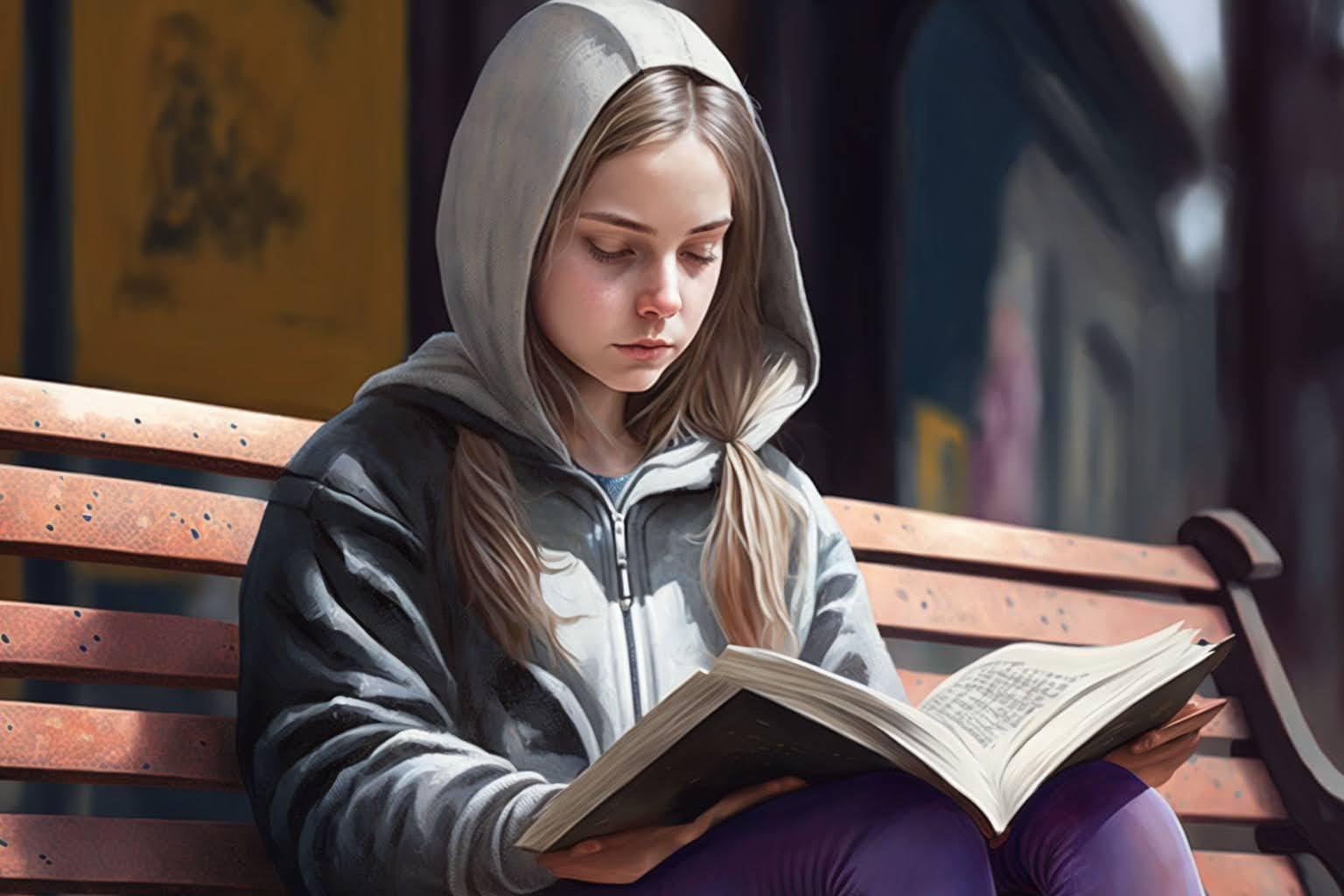
She told him without raising her head from her book. “It’s Aunt Idle’s new pet bird. It’s quite a character.”
“What?”
“The noise, it’s from the bird. It’s been cracking nuts for the past twenty minutes. Hence the noise. And yes, it’s annoying as hell.”
She rose from the bench. “Your bear friend will be back quick I’m certain; it’s just a small boutique with some nice crystals, but mostly cheap orgonite new-agey stuff. Betsy only swears by that, protection for electromagnetic waves and stuff she says, but look around… we are probably got more at risk to be hit by Martian waves or solar coronal mass ejections that by the ones from the telecom tower nearby.”
Xavier didn’t know what to say, so he nodded and smiled. He felt a bit out of his element. When he looked around, the girl had already disappeared.
Now alone, he sat on the empty bench, stretched and yawned while trying to relax. It was so different from the anonymity in the city: less people here, but everything and everyone very tightly knit together, although they all seemed to irk and chafe at the thought.
The flapping of wings startled him.
“Hellooo.” The red parrot had landed on the backrest of the bench and dropped shells from a freshly cracked nut which rolled onto the ground.
Xavier didn’t think to respond; like with AL, sometimes he’d found using polite filler words was only projecting human traits to something unable to respond back, and would just muddle the prompt quality.
“So ruuuude.” The parrot nicked his earlobe gently.
“Ouch! Sorry! No need to become aggressive!”
“You arrrre one to talk. Rouge is on Yooour forehead.”
Xavier looked surprised at the bird in disbelief. Did the bird talk about the mirror test? “What sort of smart creature are you now?”
“Call meee Rose. Pretty Giiirl acceptable.”
Xavier smiled. The bird seemed quite fascinating all of a sudden.
It was strange, but the bird seemed left completely free to roam about; it gave him an idea.“Rose, Pretty Girl, do you know some nice places around you’d like to show me?”
“Of couuurse. Foôllow Pretty Girl.”
February 15, 2023 at 10:54 am #6547In reply to: Orbs of Madjourneys
On her way back to her room Zara picked up a leaflet off the hall table about the upcoming lager and cart race. Before starting the game she had a look through it.
The leaflet also mentioned the competition held annually each January in Port Lincoln. The Tunarama Festival was a competition to determine just how far a person could chuck a frozen tuna. A full-fledged celebration was centered around the event, complete with a wide array of arts and cultural displays, other participation events, local market stalls, and some of the freshest seafood in the world.
There was unlikely to be any fresh seafood at the local lager and cart races, but judging from the photos of previous events, it looked colourful and well worth sticking around for, just for the photo opportunities.
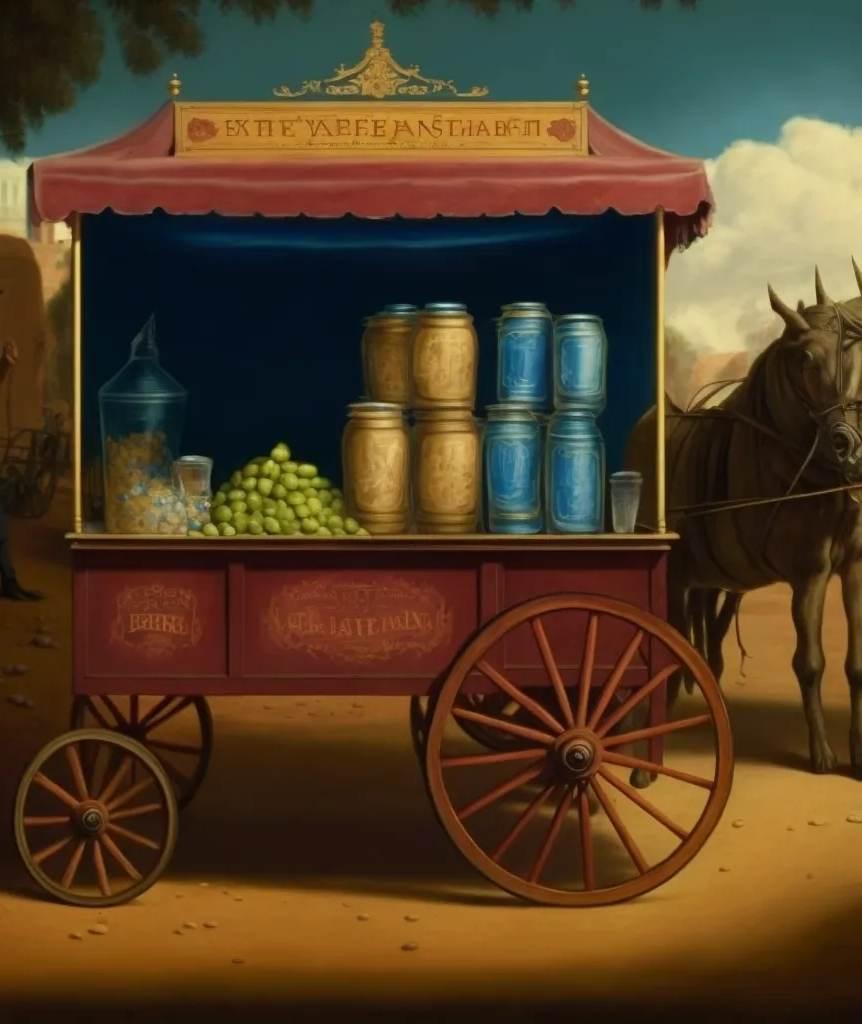
Apparently the lager and cart races had started during the early days of the settler mining, and most of the carts used were relics from that era. Competitors dressed up in costumes and colourful wigs, many of which were found in the abandoned houses of the local area.
“The miners were a strange breed of men, but not all cut from the same cloth ~ they were daring outsiders, game for anything, adventurous rule breakers and outlaws with a penchant for extreme experience. Thus, outlandish and adventurous women ~ and men who were not interested in mining for gold in the usual sense ~ were magnetically drawn to the isolated outpost. After a long dark day of restriction and confinement in the mines, the evenings were a time of colour and wild abandon; bright, garish, bizarre Burlesque events were popular. Strange though it may seem, the town had one of the most extensive wig and corset emporiums in the country, although it was discretely tucked away in the barn behind a mundane haberdashery shop.”
The idea was to fill as many different receptacles with lager as possible, piling them onto the gaily decorated carts pulled by the costume clad participants. As the carts were raced along the track, onlookers ran alongside to catch any jars or bottles that fell off the carts before they hit the ground. Many crashed to the ground and were broken, but if anyone caught one, they were obliged to drink the contents there and then before running after the carts to catch another one.
Members of the public were encouraged to attend in fancy dress costumes and wigs. There were plenty of stationary food vendors carts at the lager and cart races as well, and stalls and tents set up to sell trinkets.
February 12, 2023 at 10:18 pm #6540In reply to: Prompts of Madjourneys
Update & clarifications on the characters:
Looking at the avatars that Zara, Youssef, Xavier and Yasmin are using in VR.
Full name or real name in RL :: name in VR (
@nickhandle) description of avatar.- Zara Patara-Smythe :: Zara (
@zaraloon) is a 25-year-old woman of mixed heritage, her mother is Indian and her father is British. She has long, dark hair that she keeps in a sleek ponytail, dark brown eyes and a sharp jawline. She stands at 5’6″ and has a toned and athletic build. She usually wears practical clothing that allows her to move around easily, such as cargo pants and a tank top. - Xavier Olafsson :: Xavier (
@xavimunk) is a 27-year-old man of Norwegian and Danish descent. He has blonde hair that he keeps in a messy style, blue eyes, and a charming smile. He stands at 6’1″ and has a lean build. He is always seen wearing a colorful and bold clothing, such as a Hawaiian shirt and shorts. - Yasmin Ahmed :: Yasmin (
@yasminowl) is a 23-year-old woman of Egyptian descent. She has long, black hair that she keeps in a tight braid, dark brown eyes and a round face. She stands at 5’4″ and has a petite build. She usually wears conservative clothing, such as long skirts and blouses. - Youssef Ali :: Youssef (
@youssefbear) is a 26-year-old man of half Yemeni, half Norwegian descent. He has short, curly black hair, dark brown eyes and a square jawline. He stands at 6’2″ and has a muscular build. He usually wears comfortable clothing such as a t-shirt and jeans, and always has a backpack on his shoulder.
Full descriptions for real-life Zara, Yasmin, Youssef, Xavier:
Real Life Zara Patara-Smythe :: Zara is a 57-year-old woman who is an adventurous traveler and a passionate hobbyist. She has a full mane of gorgeous auburn hair that she keeps in a sleek ponytail, sparkling green eyes, and a warm smile that puts others at ease. She is of mixed heritage, her mother was Indian and her father was British. She is well-educated and well-off, either through an inheritance or a supportive and understanding husband. Zara is a lover of art, music, and history, and spends much of her time indulging in her passions. She is always eager to explore new places and meet new people, and her adventurous spirit often leads her to travel off the beaten path.
Real Life Yasmin Ahmed :: Yasmin is a 32-year-old woman who is kind, nurturing, and always puts others first. She has long, black hair that she keeps in a tight braid, almond-shaped brown eyes, and a warm smile that lights up a room. Born in Egypt, she grew up in a close-knit family and values the importance of community. She is a talented actress, who has kept her career a secret from those closest to her, in order to pursue a more fulfilling life working with children. Yasmin currently volunteers at an orphanage in Fiji, where she devotes herself to helping children in need.
Real Life Youssef Ali :: Youssef is a 34-year-old man who is driven, confident, and always up for a challenge. He has short, curly black hair, dark brown eyes, and a square jawline that gives him a strong and determined look. Born to a Yemeni father and a Norwegian mother, he has a unique blend of cultures that has shaped his world view. Youssef is a talented blogger, who has traveled the world in search of new and interesting stories to share with his audience. He is always on the go, with a backpack on his shoulder, ready for his next adventure.
Real Life Xavier Olafsson :: Xavier is a 36-year-old man who is bright, cheerful, and always looking for the positive in every situation. He has blonde hair that he keeps in a messy style, blue eyes, and a charming smile that never fails to win people over. Born to Norwegian and Danish parents, he has a love for the sea and an appreciation for the finer things in life. Xavier is an AI developer, who is working on a project he calls AL. He is always eager to share his ideas with others and is constantly seeking new and exciting opportunities.
February 8, 2023 at 10:27 pm #6515In reply to: Prompts of Madjourneys
Yasmin offered the following quirk: “sounding like a lunatic when I share synchs” (synchronicity) – getting excited when she gets “answers”, and willing to share generously. She wouldn’t fake it, as she’s not capable of lying and stuff like synchs are sacrosanct in her mind.
Setting for the game is the next random quote from the story.Quirk accepted.
In the Land of Quirk, Yasmin finds herself in the heart of a hidden library, deep in the basement of the Flying Fish Inn. The library is filled with books and artifacts related to the study of synchronicities and the beyond.
As Yasmin delves deeper into the library, she comes across an ancient book that seems to hold the secrets of the universe. She eagerly opens it, but finds that it is written in a code that she cannot understand.
The librarian, a wise old owl, appears and greets Yasmin. He tells her that the book is the Key to the Beyond and that only the purest of heart can decode it. He explains that the code can only be unlocked by finding the missing pieces of a puzzle scattered throughout the library.
Yasmin’s task is to find the missing pieces of the puzzle and put them together to unlock the code. Along the way, she will meet various characters who will provide her with clues and challenges.
Proof of completion in real life: Yasmin must find a real-life object that relates to a synchronicity that she experiences while on her quest in the Land of Quirk. She must then share this synchronicity with her friends at the Flying Fish Inn to prove that she has completed her quest.
Good luck, Yasmin!
February 6, 2023 at 10:36 pm #6499Premise is set:
Olga, Egbert and Obadiah are key protagonists in an adventure of elderly people being evicted / escaping their nursing home of Oocrane (with Maryechka, Obadiah’s grand-daughter, in tow). They start traveling together and helping each other in a war-torn country, and as they travel, they connect with other characters.
Tone is light-hearted and warm, with at times some bitter-sweet irony, and it unfolds into a surprisingly enthralling saga, with some down-to-earth mysteries, adding up to a satisfying open-ended conclusion that brings some deep life learning about healing the past, accepting the present and living life to its potential.A potential plot structure begins to develop henceforth:
Chapter 2: The Journey Begins
Departure from the Nursing Home
Olga and Egbert make their way out the front gate with Obadiah, who has decided to join them on their journey, and they set out on the road together.
Maryechka, Obadiah’s granddaughter, decides to come along as well out of concern about the elders’, and the group sets off towards an unknown destination.A Stop at the Market
The group stops at a bustling market in the town and begins to gather supplies for their journey.
Olga and Egbert haggle with vendors over prices, while Obadiah and Maryechka explore the market and gather food for the road.
The group encounters a strange man selling mysterious trinkets and potions, who tries to sell them a “luck” charm.An Unexpected Detour
The group encounters a roadblock on their path and are forced to take a detour through a dense forest.
They encounter a group of bandits on the road, who demand their supplies and valuables.
Olga, Egbert, and Obadiah band together to outwit the bandits and escape, while Maryechka uses her wits to distract them.A Close Call with a Wild Beast
The group comes across a dangerous wild animal on the road, who threatens to attack them.
Obadiah uses his quick thinking to distract the beast, while Egbert and Olga come up with a plan to trap it.
Maryechka uses her bravery to lure the beast into a trap, saving the group from certain danger.A Night Under the Stars
The group sets up camp for the night, exhausted from their journey so far.
They sit around a campfire, sharing stories and reminiscing about their pasts.
As they gaze up at the stars, they reflect on the challenges they have faced so far and the journey ahead of them. They go to bed, filled with hope and a sense of camaraderie, ready for whatever comes next.February 2, 2023 at 9:10 pm #6492In reply to: Orbs of Madjourneys
With a determined glint in his eye, Xavier set his sights on the slot machines. He scanned the rows of blinking lights and flashing screens until one caught his attention. He approached the machine and inserted a coin, feeling a rush of excitement as he pulled the lever.
With a satisfying whir, the reels began to spin, and before he knew it, the golden banana appeared on the screen, lining up perfectly. The machine erupted in flashing lights and loud noises, and a ticket spilled out onto the floor.
🎰 · 💰
🍌🍌🍌Xavier picked it up, reading aloud the inscriptions on the ticket, “Congratulations on completing your quest. You may enjoy your trip until the next stage of your journey. Look for the cook on the pirate boat, she will give you directions to regroup with your friends. And don’t forget to confirm your bookings.”
Glimmer let out a whoop of trepidation, “Let’s go find that cook, Xav! I can’t wait to see what’s next in store for us!”
But Xavier, feeling a bit worn out, replied with a smile, “Hold on a minute, love. All I need at the moment is just some R&R after all that brouhaha.”
Glimmer nodded in understanding and they both made their way to the deck, taking in the fresh air and the breathtaking scenery as the boat sailed towards its next destination.
As the boat continued its journey, sailing and gliding on the river in the air filled with moist, they could start to see across the mist opening like a heavy curtain a colourful floating market in the distance, and the sounds of haggling and laughter filled the air.
They couldn’t wait to explore and see what treasures and surprises awaited them. The journey was far from over, but for now, they were content to simply enjoy the ride.

Xavier closed his laptop while his friends were still sending messages on the chatroom. He’d had long days of work before leaving to take his flights to Australia, during which he hoped he could rest enough during the flights.
Most of the flights he’d checked had a minimum of 3 layovers, and a unbelievably long durations (not to count the astronomic amount of carbon emissions). Against all common sense, he’d taken one of the longest flight duration. It was 57h, but only 3 layovers. From Berlin, to Stockholm, then Dubai and Sydney. He could probably catch up with Youssef there as apparently he sent a message before boarding. They could go to Alice Spring and the Frying Mush Inn together. He’d try to find the reviews, but they were only listed on boutiquehotelsdownunder.com and didn’t have the rave reviews of the prestigious Kookynie Grand Hotel franchise. God knows what Zara had in mind while booking this place, it’d better be good. Reminded him of the time they all went to that improbably ghastly hotel in Spain (at the time Yasmin was still volunteering in a mission and couldn’t join) for a seminar with other game loonies and cosplayers. Those were the early days of the game, and the technology frankly left a lot to be desired at the time. They’d ended up eating raspberry jam with disposable toothbrushes, and get drunk on laughter.
When Brytta had seen the time it took to go there, she’d reconsidered coming. She couldn’t afford taking that much time off, and spending the equivalent of 4 full days of her hard-won vacation as a nurse into a plane simply for the round-trip —there was simply no way.
Xavier had proposed to shorten his stay, but she’d laughed and said, “you go there, I’ll enjoy some girl time with my friends, and I’ll work on my painting” —it was more convenient when he was gone for business trips, she would be able to put all the materials out, and not care to keep the apartment neat and tidy.The backpack was ready with the essentials; Xavier liked to travel light.
February 1, 2023 at 8:54 am #6483In reply to: Prompts of Madjourneys
Zara: Create a surreal and dreamlike digital art piece that combines elements of traditional aboriginal native art with a map to a secret and special place, featuring the otherworldly dreamscape of Dream Time. The image should depict a series of mine tunnels, each leading to gorgeous discoveries and wonders, and the overall scene should be filled with the mysticism and magic of the Dream Time. Don’t be afraid to let your imagination run wild and include random elements that add to the surreal quality of the piece.
January 21, 2023 at 5:50 pm #6427In reply to: Prompts of Madjourneys
Xavier’s quirk offering is being a cheeky monkey
Quirk accepted.
The initial setting for Xavier’s quest is a lush jungle filled with mischievous monkeys. Your mission is to find the legendary Golden Banana, which is said to grant eternal youth and vitality to whoever finds it. However, be warned as the jungle is also home to a tribe of fierce apes who will stop at nothing to protect the precious fruit.
Possible directions to investigate include
- searching for clues in the monkey’s sacred temples hidden deep within the jungle,
- or seeking out the help of a wise old owl who is said to know the location of the Golden Banana.
As for possible characters to engage, you may come across
- a sly fox who claims to know the location of the fruit but will only reveal it in exchange for a favor,
- or a brave adventurer who has been searching for the Golden Banana for years and may be willing to team up with you.
In regards to the FFI visit in real-life, you may discover a mysterious map hidden within the Inn that leads to the location of the Golden Banana, or overhear a conversation between the Inn’s patrons discussing rumors of a monkey who recently visited and may hold valuable information about the quest.
Emoji clue: Xavier: 🐒🍌
January 19, 2023 at 10:49 am #6419In reply to: Orbs of Madjourneys
“I’d advise you not to take the parrot, Zara,” Harry the vet said, “There are restrictions on bringing dogs and other animals into state parks, and you can bet some jobsworth official will insist she stays in a cage at the very least.”
“Yeah, you’re right, I guess I’ll leave her here. I want to call in and see my cousin in Camden on the way to the airport in Sydney anyway. He has dozens of cats, I’d hate for anything to happen to Pretty Girl,” Zara replied.
“Is that the distant cousin you met when you were doing your family tree?” Harry asked, glancing up from the stitches he was removing from a wounded wombat. “There, he’s good to go. Give him a couple more days, then he can be released back where he came from.”
Zara smiled at Harry as she picked up the animal. “Yes! We haven’t met in person yet, and he’s going to show me the church my ancestor built. He says people have been spotting ghosts there lately, and there are rumours that it’s the ghost of the old convict Isaac who built it. If I can’t find photos of the ancestors, maybe I can get photos of their ghosts instead,” Zara said with a laugh.
“Good luck with that,” Harry replied raising an eyebrow. He liked Zara, she was quirkier than the others.
Zara hadn’t found it easy to research her mothers family from Bangalore in India, but her fathers English family had been easy enough. Although Zara had been born in England and emigrated to Australia in her late 20s, many of her ancestors siblings had emigrated over several generations, and Zara had managed to trace several down and made contact with a few of them. Isaac Stokes wasn’t a direct ancestor, he was the brother of her fourth great grandfather but his story had intrigued her. Sentenced to transportation for stealing tools for his work as a stonemason seemed to have worked in his favour. He built beautiful stone buildings in a tiny new town in the 1800s in the charming style of his home town in England.
Zara planned to stay in Camden for a couple of days before meeting the others at the Flying Fish Inn, anticipating a pleasant visit before the crazy adventure started.
Zara stepped down from the bus, squinting in the bright sunlight and looking around for her newfound cousin Bertie. A lanky middle aged man in dungarees and a red baseball cap came forward with his hand extended.
“Welcome to Camden, Zara I presume! Great to meet you!” he said shaking her hand and taking her rucksack. Zara was taken aback to see the family resemblance to her grandfather. So many scattered generations and yet there was still a thread of familiarity. “I bet you’re hungry, let’s go and get some tucker at Belle’s Cafe, and then I bet you want to see the church first, hey? Whoa, where’d that dang parrot come from?” Bertie said, ducking quickly as the bird swooped right in between them.
“Oh no, it’s Pretty Girl!” exclaimed Zara. “She wasn’t supposed to come with me, I didn’t bring her! How on earth did you fly all this way to get here the same time as me?” she asked the parrot.
“Pretty Girl has her ways, don’t forget to feed the parrot,” the bird replied with a squalk that resembled a mirthful guffaw.
“That’s one strange parrot you got here, girl!” Bertie said in astonishment.
“Well, seeing as you’re here now, Pretty Girl, you better come with us,” Zara said.
“Obviously,” replied Pretty Girl. It was hard to say for sure, but Zara was sure she detected an avian eye roll.
They sat outside under a sunshade to eat rather than cause any upset inside the cafe. Zara fancied an omelette but Pretty Girl objected, so she ordered hash browns instead and a fruit salad for the parrot. Bertie was a good sport about the strange talking bird after his initial surprise.
Bertie told her a bit about the ghost sightings, which had only started quite recently. They started when I started researching him, Zara thought to herself, almost as if he was reaching out. Her imagination was running riot already.
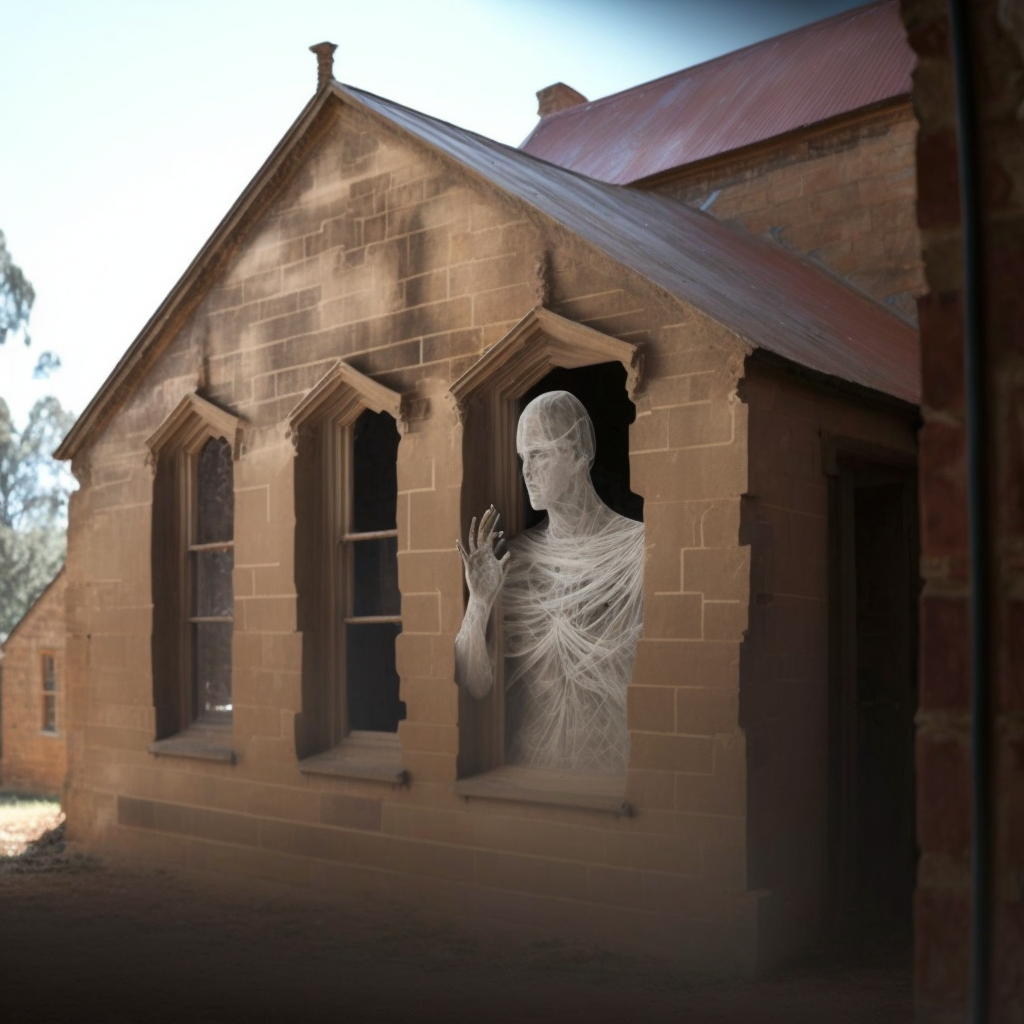
Bertie showed Zara around the church, a small building made of sandstone, but no ghost appeared in the bright heat of the afternoon. He took her on a little tour of Camden, once a tiny outpost but now a suburb of the city, pointing out all the original buildings, in particular the ones that Isaac had built. The church was walking distance of Bertie’s house and Zara decided to slip out and stroll over there after everyone had gone to bed.
Bertie had kindly allowed Pretty Girl to stay in the guest bedroom with her, safe from the cats, and Zara intended that the parrot stay in the room, but Pretty Girl was having none of it and insisted on joining her.
“Alright then, but no talking! I don’t want you scaring any ghost away so just keep a low profile!”
The moon was nearly full and it was a pleasant walk to the church. Pretty Girl fluttered from tree to tree along the sidewalk quietly. Enchanting aromas of exotic scented flowers wafted into her nostrils and Zara felt warmly relaxed and optimistic.
Zara was disappointed to find that the church was locked for the night, and realized with a sigh that she should have expected this to be the case. She wandered around the outside, trying to peer in the windows but there was nothing to be seen as the glass reflected the street lights. These things are not done in a hurry, she reminded herself, be patient.
Sitting under a tree on the grassy lawn attempting to open her mind to receiving ghostly communications (she wasn’t quite sure how to do that on purpose, any ghosts she’d seen previously had always been accidental and unexpected) Pretty Girl landed on her shoulder rather clumsily, pressing something hard and chill against her cheek.
“I told you to keep a low profile!” Zara hissed, as the parrot dropped the key into her lap. “Oh! is this the key to the church door?”
It was hard to see in the dim light but Zara was sure the parrot nodded, and was that another avian eye roll?
Zara walked slowly over the grass to the church door, tingling with anticipation. Pretty Girl hopped along the ground behind her. She turned the key in the lock and slowly pushed open the heavy door and walked inside and up the central aisle, looking around. And then she saw him.
Zara gasped. For a breif moment as the spectral wisps cleared, he looked almost solid. And she could see his tattoos.
“Oh my god,” she whispered, “It is really you. I recognize those tattoos from the description in the criminal registers. Some of them anyway, it seems you have a few more tats since you were transported.”
“Aye, I did that, wench. I were allays fond o’ me tats, does tha like ’em?”
He actually spoke to me! This was beyond Zara’s wildest hopes. Quick, ask him some questions!
“If you don’t mind me asking, Isaac, why did you lie about who your father was on your marriage register? I almost thought it wasn’t you, you know, that I had the wrong Isaac Stokes.”
A deafening rumbling laugh filled the building with echoes and the apparition dispersed in a labyrinthine swirl of tattood wisps.
“A story for another day,” whispered Zara, “Time to go back to Berties. Come on Pretty Girl. And put that key back where you found it.”
 January 15, 2023 at 1:18 pm #6391
In reply to: Train your subjective AI – text version
write the plot of an absurd non-linear novel, featuring 4 characters
The novel begins with the introduction of four characters: a retired archaeologist named Harold, a struggling musician named Samantha, a disillusioned corporate drone named Tim, and a reclusive inventor named Claire.
Harold, who is obsessed with ancient Egyptian hieroglyphs, discovers a mysterious underground chamber beneath a pyramid in Egypt. Inside, he finds a strange device that he believes is a time machine. Harold decides to use the device to travel back in time to ancient Egypt in order to decipher the hieroglyphs.
Samantha, who is trying to make a name for herself as a musician, is struggling to come up with new material for her music. One day, she discovers that she can create beautiful music by communicating with plants telepathically. She becomes obsessed with this new form of music-making and decides to quit her day job and pursue it full-time.
Tim, who is stuck in a dead-end job, is feeling unfulfilled and uninspired. One day, he stumbles upon a robotic mime performance art show. The performance inspires him to quit his job and pursue his dream of becoming a mime artist.
Claire, who is a reclusive inventor, has been working on a project to create a type of artificial intelligence that can communicate with humans using calligraphic body language. She finally succeeds and creates an AI that she names “Calli”.
As the story progresses, the characters’ paths begin to intersect in unexpected ways. Harold gets stuck in ancient Egypt and has to rely on Samantha’s telepathic plant communication skills to find a way back to the present. Tim’s robotic mime art becomes a hit and he starts working with Claire to integrate Calli into his performances.
As the story reaches its climax, all four characters come together to use their unique skills and abilities to solve a problem that threatens the fate of the world.
Throughout the novel, the plot unfolds in a non-linear fashion, jumping back and forth in time and between the different character’s perspectives. The story is filled with absurdity and unexpected twists and turns, leaving the reader guessing until the very end.
What sort of problem that threatens the fate of the world will be resolved by their combined skills?
As the story progresses, the characters begin to uncover a sinister plot by a group of powerful individuals who are intent on using the time machine to alter the course of history for their own gain. They plan to use the time machine to go back in time and change key events that would give them immense wealth and power in the present. Harold and Samantha, with the help of Tim and Claire, must race against time to stop the villains from carrying out their plan.
Harold’s expertise in ancient Egyptian hieroglyphs plays a crucial role in deciphering the clues that lead to the location of the time machine. Samantha’s telepathic plant communication skills are used to locate the hidden underground chamber where the time machine is kept. Tim’s robotic mime art and Claire’s AI Calli are used to infiltrate the villains’ hideout and gather intelligence on their plans.
In the final act, the four characters come together to use their unique skills and abilities to stop the villains from altering history. Harold uses his knowledge of ancient Egypt to navigate the time machine and travel back in time to stop the villains from changing key events. Samantha uses her telepathic plant communication skills to communicate with the plants in the past and gather information on the villains’ whereabouts. Tim and Claire use their robotic mime and AI skills to create a diversion and distract the villains while Harold and Samantha complete their mission.
In the end, the four characters succeed in stopping the villains and saving the fate of the world. The novel ends with the four characters going their separate ways, but they all know that they will always have each other to rely on in the face of any challenge that comes their way.
January 15, 2023 at 11:42 am #6389In reply to: Newsreel from the Rim of the Realm
“What in the good name of our Lady, have these two been on?” Miss Bossy was at a loss for words while Ricardo was waiting sheepishly at her desk, as though he was expecting an outburst.
“Look, Ricardo, I’m not against a little tweaking for newsworthiness, but this takes twisting reality to a whole new level!Ricardo had just dropped their last article.
Local Hero at the Rescue – Stray Residents found after in a trip of a lifetime
article by Hilda Astoria & Continuity BrownIn a daring and heroic move, Nurse Trassie, a local hero and all-around fantastic human being, managed to track down and rescue three elderly women who had gone on an adventure of a lifetime. Sharon, Mavis, and Gloria (names may have been altered to preserve their anonymity) were residents of a UK nursing home who, in a moment of pure defiance and desire for adventure, decided to go off their meds and escape to the Nordics.
The three women, who had been feeling cooped up and underappreciated in their nursing home, decided to take matters into their own hands and embark on a journey to see the world. They had heard of the beautiful landscapes and friendly people of the Nordics and their rejuvenating traditional cures and were determined to experience it for themselves.
Their journey, however, was not without its challenges. They faced many obstacles, including harsh weather conditions and language barriers. But they were determined to press on, and their determination paid off when they were taken in by a kind-hearted local doctor who gave them asylum and helped them rehabilitate stray animals.
Nurse Trassie, who had been on the lookout for the women since their disappearance, finally caught wind of their whereabouts and set out to rescue them. She tracked them down to the Nordics, where she found them living in a small facility in the woods, surrounded by a menagerie of stray animals they had taken in and were nursing back to health, including rare orangutans retired from local circus.
Upon her arrival, Nurse Trassie was greeted with open arms by the women, who were overjoyed to see her. They told her of their adventures and showed her around their cabin, introducing her to the animals they had taken in and the progress they had made in rehabilitating them.
Nurse Trassie, who is known for her compassion and dedication to her patients, was deeply touched by the women’s story and their love for the animals. She knew that they needed to be back in the care of professionals and that the animals needed to be properly cared for, so she made arrangements to bring them back home.
The women were reluctant to leave their newfound home and the animals they had grown to love, but they knew that it was the right thing to do. They said their goodbyes and set off on the long journey back home with Nurse Trassie by their side.
The three women returned to their nursing home filled with stories to share, and Nurse Trassie was hailed as a hero for her efforts in rescuing them. They were greeted with cheers and applause from the staff and other residents, who were thrilled to have them back safe and sound.
Nurse Trassie, who is known for her sharp wit and sense of humor, commented on the situation with a tongue-in-cheek remark, “It’s not every day that you get to rescue three feisty elderlies from the wilds of the Nordics and bring them back to safety. I’m just glad I could be of service.”
In conclusion, the three women’s adventure in the Nordics may have been unorthodox, but it was an adventure nonetheless. They were able to see the world and help some animals in the process. Their story serves as a reminder to never give up on your dreams, no matter your age or circumstances. And of course, a big shoutout to Nurse Trassie for her heroic actions and dedication to her patients.
Bossy sighed. “It might do for now, but don’t let those two abuse the artificial intelligence to write article for them… I liked their old style better. This feels too… tidy. We’re not the A-News network, let’s not forget our purpose.”
Ricardo nodded. Miss Bossy had been more mellow since the sales of the newspaper had exploded during the pandemic. With people at home, looking for conspiracies and all, the newspaper had known a resurgence of interest, and they even had to hire new staff. Giles Gibber, Glimmer Gambol (came heavily recommended by Blithe, the PI friend of Hilda’s), Samuel Sproink and Fionna Flibbergibbet.
“And how is Sophie? That adventure into her past trauma was a bit much on her…” she mused.
“She’s doing alright” answered Ricardo. “She’s learning to hone her remote-viewing skills to send our staff into new mysteries to solve. With a bit of AI assist…”
“Oh, stop it already with your AI-this, AI-that! Hope there’ll still be room for some madness in all that neatly tidy purring of polite output.”
“That’s why we’re here for, I reckon.” Ric’ smiled wryly.
January 13, 2023 at 9:12 pm #6382In reply to: Prompts of Madjourneys
Write more about the group of people who lived inside of giant mushrooms, making it sound exciting and fun, and maybe a bit dangerous due to the nature of the mushrooms
As the group journeyed deeper into the Land of the Quirks, they stumbled upon a group of people living inside of giant mushrooms. The mushrooms were enormous, some as tall as skyscrapers, and they seemed to glow with an ethereal light. The group was amazed as they walked through the forest of mushrooms, each one unique in shape and size.
The people who lived inside of the mushrooms were a friendly and welcoming bunch, they welcomed the group with open arms and invited them to explore their homes. The inside of the mushrooms was a magical and mysterious place, the walls and ceilings were covered in a soft, velvety texture and the floors were made of a spongy, springy material. The light inside the mushrooms was soft and diffused, creating a warm and inviting atmosphere.
As the group explored the mushroom homes, they discovered that the people who lived there had a deep connection to the mushrooms. They used the mushrooms as a source of food, shelter, and medicine. They had learned to harness the unique properties of the mushrooms to create everything they needed to survive.
The group also discovered that the mushrooms had a dangerous side. The mushrooms were not only a source of life, but also a source of death. The group was warned that the mushrooms were unpredictable and that they should be careful when exploring. Some mushrooms were poisonous, others were carnivorous, and still, others had mind-altering properties.
Despite the danger, the group was excited to explore the mushrooms and learn more about the people who lived there. They knew that the journey would be filled with challenges, but they were determined to overcome them and discover the secrets of the mushrooms. The group had a lot of fun and adventure living with the people inside of giant mushrooms, and they learned a lot about the nature of the mushrooms and their own nature.
January 13, 2023 at 6:42 pm #6377In reply to: Orbs of Madjourneys
The four adventurers, Zara, Xavier, Yasmin, and Youssef, stood in awe in front of the giant orb that seemed to open up to another realm. The light emanating from the orb was so bright, it was as if the sun was just inches away. The stalactites that hung from the cave’s ceiling sparkled like diamonds in the light, adding to the otherworldly beauty of the scene.
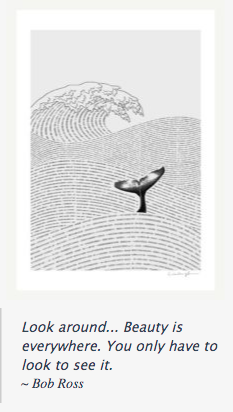
“Look around,” Yasmin said, her voice filled with wonder. “Beauty is everywhere. You only have to look to see it.”
The group was ready for an adventure and they knew that the orb in front of them was the key to their mad journey. Xavier stepped forward and reached out to touch the orb. As soon as his fingers made contact with the surface, the orb lit up and a pathway formed, leading into the brightly lit realm.
The group stepped through the pathway and found themselves in a world unlike anything they had ever seen before. The sky was a vibrant shade of purple and the ground was covered in a lush, green grass. The orb they had just passed through was now behind them, but in front of them were smaller orbs, each one leading to a different path.
Zara, Xavier, Yasmin, and Youssef looked at each other with excitement in their eyes. They knew that this was just the beginning of their mad journey.
Xavier stepped forward and reached out to touch the orb. As soon as his fingers made contact with the surface, the orb lit up and a pathway formed, leading into the brightly lit realm.

They walked into a small village, where they were greeted by a group of people wearing clothes that looked like they were from the 1920s. The people told them that they were in the land of the “Quirks”, a place where everything and everyone was a little bit different, and that they had to find the “Key of Quirks” in order to leave the land.
The four friends, Zara, Xavier, Yasmin, and Youssef, soon found themselves on a mission to find the “Key of Quirks” that would allow them to leave the land of the Quirks. As they walked through a forest, they came across a fork in the road.
Zara, the leader of the group, turned to the others and said, “Alright, we need to decide which way to go. Yasmin, what’s the plan?”
Yasmin, the brains of the group, replied, “I suggest we take the left path. According to the map I found, it leads to the Quirky Quests area, where we might find the key.”
Xavier, the joker of the group, chimed in, “I vote for the right path. It’s the road less traveled, and you know what they say, ‘the road less traveled is the road to adventure’ ”
Youssef, the muscle of the group, added, “I don’t care which way we go, I just want to find some food. I’m starving!”
Zara rolled her eyes, “Xavier, your jokes are getting old. And Youssef, we’re on a mission, we can’t just focus on food.”
Xavier grinned, “But Zaraloon, where’s the fun in that?”
Yasmin interjected, “Can we please focus? We need to make a decision. I propose we split up, Zara and I will take the left path, and Xavier and Youssef can take the right path.”
Youssef nodded, “Yeah, that sounds like a good idea. That way, if we don’t find the key, at least we’ll have found some food.”
Xavier grinned, “Sounds like a plan, Xavimunk is ready for adventure!”
Zara shook her head with a smile, “Alright, let’s do this.”
The group split up, and as they walked away, they could be heard playfully bantering and joking with each other. Each one exemplifying their unique and distinct characters.
January 11, 2023 at 11:53 pm #6372In reply to: Train your subjective AI – text version
5 important keywords linked to Badul

- Action-space-time
- Harmonic fluid
- Rhythm
- Scale
- Choosing without limits.
Imagine four friends, Jib, Franci, Tracy, and Eric, who are all deeply connected through their shared passion for music and performance. They often spend hours together creating and experimenting with different sounds and rhythms.
One day, as they were playing together, they found that their combined energy had created a new essence, which they named Badul. This new essence was formed from the unique combination of their individual energies and personalities, and it quickly grew in autonomy and began to explore the world around it.
As Badul began to explore, it discovered that it had the ability to understand and create complex rhythms, and that it could use this ability to bring people together and help them find a sense of connection and purpose.
As Badul traveled, it would often come across individuals who were struggling to find their way in life. It would use its ability to create rhythm and connection to help these individuals understand themselves better and make the choices that were right for them.
In the scene, Badul is exploring a city, playing with the rhythms of the city, through the traffic, the steps of people, the ambiance. Badul would observe a person walking in the streets, head down, lost in thoughts. Badul would start playing a subtle tune, and as the person hears it, starts to walk with the rhythm, head up, starting to smile.
As the person continues to walk and follow the rhythm created by Badul, he begins to notice things he had never noticed before and begins to feel a sense of connection to the world around him. The music created by Badul serves as a guide, helping the person to understand himself and make the choices that will lead to a happier, more fulfilled life.
In this way, Badul’s focus is to bring people together, to connect them to themselves and to the world around them through the power of rhythm and music, and to be an ally in the search of personal revelation and understanding.
January 10, 2023 at 10:31 pm #6364In reply to: Train your subjective AI – text version
Please suggest a creative, a little ghostic but mostly uplifting plot outline for the continuation of the story of Twilight in her travels to join the freak circus and become famous for her craft on the west coast
— The Far-West saga — In 1850s, in a probable reality of South America, we get acquainted with Twilight (Twi) and her brothers Jo and Elroy. They have a precious blue bull in their possession, coveted by Ogrean, the kingpin of the town. Hopefully for them, Ogrean is arrested (temporarily) by Ted Marshall, the sheriff for his possible trafficking. Notably, Ogrean is possibly involved in some of the crystal skulls discoveries, during his travel to New Honduras. Twi who was dancing in the saloon of Madame Butterbutt, the town’s hallucinogenic toads-to-lick dispenser (insert some other romantic subplots involving the other dancer etc.) decides to go traveling in a freakus (freak show/circus). She is now close to the West Coast, where she hopes to succeed in her writing and other artistic skills.
As Twilight (Twi) travels with the freak circus, she faces many challenges and obstacles on her journey to the West Coast. Despite the difficulties, she remains determined to make a name for herself as a writer and artist.
As she travels through small towns and larger cities, she begins to realize that the world is much bigger than she ever imagined. She meets a diverse group of people, some of whom are kind and supportive, while others are cruel and dismissive of her dreams.
Despite the negative reactions she receives from some people, Twi persists and begins to gain a reputation as a talented writer and performer. As she gains more experience and confidence, she starts to incorporate her own unique style into her performances, which sets her apart from the other performers in the circus.
As she approaches the West Coast, she begins to feel a sense of excitement and anticipation. She has heard that the West Coast is a place of endless possibilities, where creative minds can thrive. She is determined to make her mark and become famous for her craft.
As she settles in the west, she finds herself surrounded by artists and writers like herself, who inspire her to push herself even further. She begins to gain a following and her writing is widely read. She discovers that her talent is not only limited to writing, but she also has a natural talent for other art forms as well.
Eventually, Twi’s reputation as a talented artist and writer precedes her and she becomes a sought-after performer in the West Coast, and her creative work is being showcased in galleries and theaters. As she continues to achieve success in her career, she begins to realize that the West Coast is not just a place of endless possibilities but also the place where she belongs, and the place where her dreams come true.
Throughout her journey, she also keeps in touch with her brothers, Jo and Elroy, who now run the farm and take care of the blue bull. They tell her that the bull, now named Blue-Dream, became a legend in the village and they get a good price for its breeding.
As the story continues, she finds herself also involved in some adventures and exciting subplots, like discovering a secret underground cave filled with precious crystals and some interesting characters, like the enigmatic sheriff Ted Marshall who always cross her path, and the mysterious Ogrean who seems to have a connection to her past and the bull.
The End.
December 6, 2022 at 2:17 pm #6350In reply to: Family Stories From The Other Side ~ Book Two
Transportation
Isaac Stokes 1804-1877
Isaac was born in Churchill, Oxfordshire in 1804, and was the youngest brother of my 4X great grandfather Thomas Stokes. The Stokes family were stone masons for generations in Oxfordshire and Gloucestershire, and Isaac’s occupation was a mason’s labourer in 1834 when he was sentenced at the Lent Assizes in Oxford to fourteen years transportation for stealing tools.
Churchill where the Stokes stonemasons came from: on 31 July 1684 a fire destroyed 20 houses and many other buildings, and killed four people. The village was rebuilt higher up the hill, with stone houses instead of the old timber-framed and thatched cottages. The fire was apparently caused by a baker who, to avoid chimney tax, had knocked through the wall from her oven to her neighbour’s chimney.
Isaac stole a pick axe, the value of 2 shillings and the property of Thomas Joyner of Churchill; a kibbeaux and a trowel value 3 shillings the property of Thomas Symms; a hammer and axe value 5 shillings, property of John Keen of Sarsden.
(The word kibbeaux seems to only exists in relation to Isaac Stokes sentence and whoever was the first to write it was perhaps being creative with the spelling of a kibbo, a miners or a metal bucket. This spelling is repeated in the criminal reports and the newspaper articles about Isaac, but nowhere else).
In March 1834 the Removal of Convicts was announced in the Oxford University and City Herald: Isaac Stokes and several other prisoners were removed from the Oxford county gaol to the Justitia hulk at Woolwich “persuant to their sentences of transportation at our Lent Assizes”.
via digitalpanopticon:
Hulks were decommissioned (and often unseaworthy) ships that were moored in rivers and estuaries and refitted to become floating prisons. The outbreak of war in America in 1775 meant that it was no longer possible to transport British convicts there. Transportation as a form of punishment had started in the late seventeenth century, and following the Transportation Act of 1718, some 44,000 British convicts were sent to the American colonies. The end of this punishment presented a major problem for the authorities in London, since in the decade before 1775, two-thirds of convicts at the Old Bailey received a sentence of transportation – on average 283 convicts a year. As a result, London’s prisons quickly filled to overflowing with convicted prisoners who were sentenced to transportation but had no place to go.
To increase London’s prison capacity, in 1776 Parliament passed the “Hulks Act” (16 Geo III, c.43). Although overseen by local justices of the peace, the hulks were to be directly managed and maintained by private contractors. The first contract to run a hulk was awarded to Duncan Campbell, a former transportation contractor. In August 1776, the Justicia, a former transportation ship moored in the River Thames, became the first prison hulk. This ship soon became full and Campbell quickly introduced a number of other hulks in London; by 1778 the fleet of hulks on the Thames held 510 prisoners.
Demand was so great that new hulks were introduced across the country. There were hulks located at Deptford, Chatham, Woolwich, Gosport, Plymouth, Portsmouth, Sheerness and Cork.The Justitia via rmg collections:
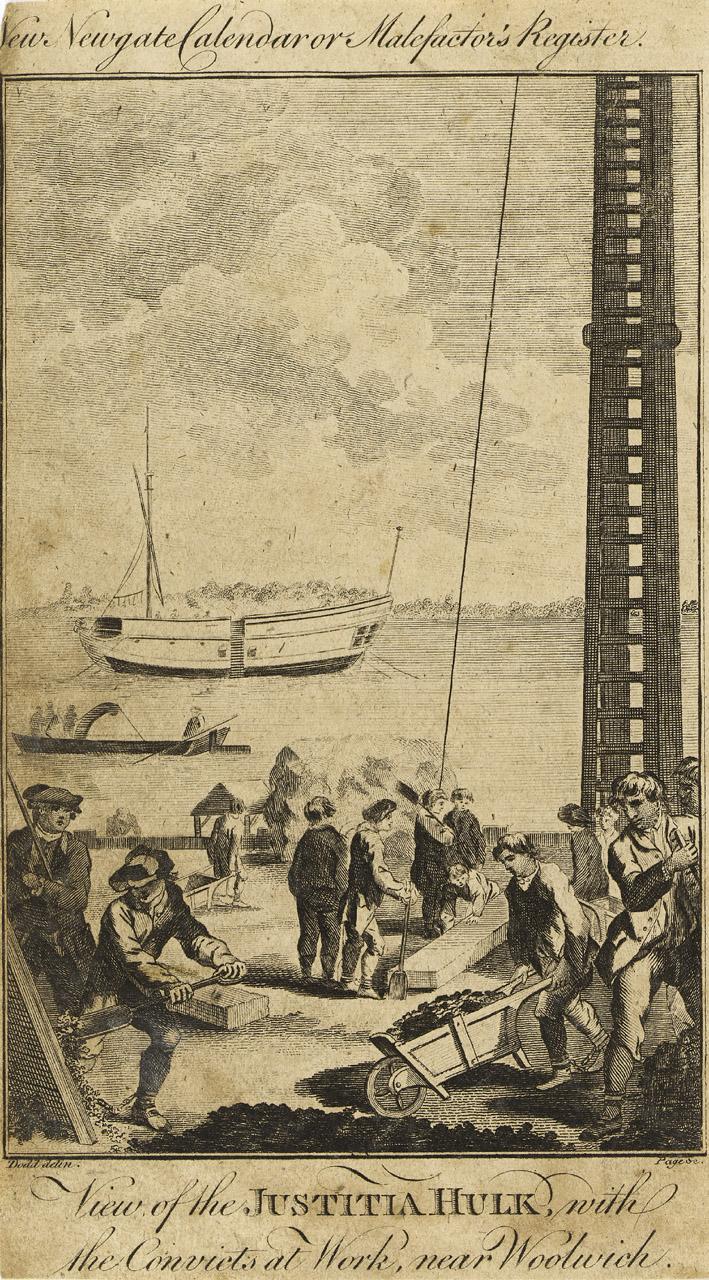
Convicts perform hard labour at the Woolwich Warren. The hulk on the river is the ‘Justitia’. Prisoners were kept on board such ships for months awaiting deportation to Australia. The ‘Justitia’ was a 260 ton prison hulk that had been originally moored in the Thames when the American War of Independence put a stop to the transportation of criminals to the former colonies. The ‘Justitia’ belonged to the shipowner Duncan Campbell, who was the Government contractor who organized the prison-hulk system at that time. Campbell was subsequently involved in the shipping of convicts to the penal colony at Botany Bay (in fact Port Jackson, later Sydney, just to the north) in New South Wales, the ‘first fleet’ going out in 1788.
While searching for records for Isaac Stokes I discovered that another Isaac Stokes was transported to New South Wales in 1835 as well. The other one was a butcher born in 1809, sentenced in London for seven years, and he sailed on the Mary Ann. Our Isaac Stokes sailed on the Lady Nugent, arriving in NSW in April 1835, having set sail from England in December 1834.
Lady Nugent was built at Bombay in 1813. She made four voyages under contract to the British East India Company (EIC). She then made two voyages transporting convicts to Australia, one to New South Wales and one to Van Diemen’s Land (Tasmania). (via Wikipedia)
via freesettlerorfelon website:
On 20 November 1834, 100 male convicts were transferred to the Lady Nugent from the Justitia Hulk and 60 from the Ganymede Hulk at Woolwich, all in apparent good health. The Lady Nugent departed Sheerness on 4 December 1834.
SURGEON OLIVER SPROULE
Oliver Sproule kept a Medical Journal from 7 November 1834 to 27 April 1835. He recorded in his journal the weather conditions they experienced in the first two weeks:
‘In the course of the first week or ten days at sea, there were eight or nine on the sick list with catarrhal affections and one with dropsy which I attribute to the cold and wet we experienced during that period beating down channel. Indeed the foremost berths in the prison at this time were so wet from leaking in that part of the ship, that I was obliged to issue dry beds and bedding to a great many of the prisoners to preserve their health, but after crossing the Bay of Biscay the weather became fine and we got the damp beds and blankets dried, the leaks partially stopped and the prison well aired and ventilated which, I am happy to say soon manifested a favourable change in the health and appearance of the men.
Besides the cases given in the journal I had a great many others to treat, some of them similar to those mentioned but the greater part consisted of boils, scalds, and contusions which would not only be too tedious to enter but I fear would be irksome to the reader. There were four births on board during the passage which did well, therefore I did not consider it necessary to give a detailed account of them in my journal the more especially as they were all favourable cases.
Regularity and cleanliness in the prison, free ventilation and as far as possible dry decks turning all the prisoners up in fine weather as we were lucky enough to have two musicians amongst the convicts, dancing was tolerated every afternoon, strict attention to personal cleanliness and also to the cooking of their victuals with regular hours for their meals, were the only prophylactic means used on this occasion, which I found to answer my expectations to the utmost extent in as much as there was not a single case of contagious or infectious nature during the whole passage with the exception of a few cases of psora which soon yielded to the usual treatment. A few cases of scurvy however appeared on board at rather an early period which I can attribute to nothing else but the wet and hardships the prisoners endured during the first three or four weeks of the passage. I was prompt in my treatment of these cases and they got well, but before we arrived at Sydney I had about thirty others to treat.’
The Lady Nugent arrived in Port Jackson on 9 April 1835 with 284 male prisoners. Two men had died at sea. The prisoners were landed on 27th April 1835 and marched to Hyde Park Barracks prior to being assigned. Ten were under the age of 14 years.
The Lady Nugent:
Isaac’s distinguishing marks are noted on various criminal registers and record books:
“Height in feet & inches: 5 4; Complexion: Ruddy; Hair: Light brown; Eyes: Hazel; Marks or Scars: Yes [including] DEVIL on lower left arm, TSIS back of left hand, WS lower right arm, MHDW back of right hand.”
Another includes more detail about Isaac’s tattoos:
“Two slight scars right side of mouth, 2 moles above right breast, figure of the devil and DEVIL and raised mole, lower left arm; anchor, seven dots half moon, TSIS and cross, back of left hand; a mallet, door post, A, mans bust, sun, WS, lower right arm; woman, MHDW and shut knife, back of right hand.”
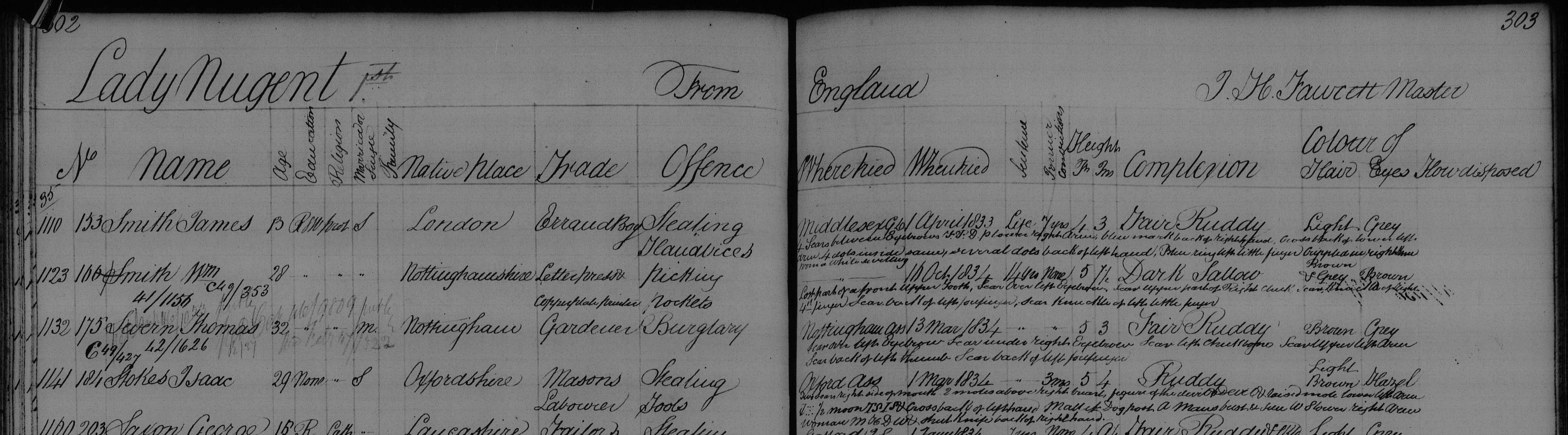
From How tattoos became fashionable in Victorian England (2019 article in TheConversation by Robert Shoemaker and Zoe Alkar):
“Historical tattooing was not restricted to sailors, soldiers and convicts, but was a growing and accepted phenomenon in Victorian England. Tattoos provide an important window into the lives of those who typically left no written records of their own. As a form of “history from below”, they give us a fleeting but intriguing understanding of the identities and emotions of ordinary people in the past.
As a practice for which typically the only record is the body itself, few systematic records survive before the advent of photography. One exception to this is the written descriptions of tattoos (and even the occasional sketch) that were kept of institutionalised people forced to submit to the recording of information about their bodies as a means of identifying them. This particularly applies to three groups – criminal convicts, soldiers and sailors. Of these, the convict records are the most voluminous and systematic.
Such records were first kept in large numbers for those who were transported to Australia from 1788 (since Australia was then an open prison) as the authorities needed some means of keeping track of them.”On the 1837 census Isaac was working for the government at Illiwarra, New South Wales. This record states that he arrived on the Lady Nugent in 1835. There are three other indent records for an Isaac Stokes in the following years, but the transcriptions don’t provide enough information to determine which Isaac Stokes it was. In April 1837 there was an abscondment, and an arrest/apprehension in May of that year, and in 1843 there was a record of convict indulgences.
From the Australian government website regarding “convict indulgences”:
“By the mid-1830s only six per cent of convicts were locked up. The vast majority worked for the government or free settlers and, with good behaviour, could earn a ticket of leave, conditional pardon or and even an absolute pardon. While under such orders convicts could earn their own living.”
In 1856 in Camden, NSW, Isaac Stokes married Catherine Daly. With no further information on this record it would be impossible to know for sure if this was the right Isaac Stokes. This couple had six children, all in the Camden area, but none of the records provided enough information. No occupation or place or date of birth recorded for Isaac Stokes.
I wrote to the National Library of Australia about the marriage record, and their reply was a surprise! Issac and Catherine were married on 30 September 1856, at the house of the Rev. Charles William Rigg, a Methodist minister, and it was recorded that Isaac was born in Edinburgh in 1821, to parents James Stokes and Sarah Ellis! The age at the time of the marriage doesn’t match Isaac’s age at death in 1877, and clearly the place of birth and parents didn’t match either. Only his fathers occupation of stone mason was correct. I wrote back to the helpful people at the library and they replied that the register was in a very poor condition and that only two and a half entries had survived at all, and that Isaac and Catherines marriage was recorded over two pages.
I searched for an Isaac Stokes born in 1821 in Edinburgh on the Scotland government website (and on all the other genealogy records sites) and didn’t find it. In fact Stokes was a very uncommon name in Scotland at the time. I also searched Australian immigration and other records for another Isaac Stokes born in Scotland or born in 1821, and found nothing. I was unable to find a single record to corroborate this mysterious other Isaac Stokes.
As the age at death in 1877 was correct, I assume that either Isaac was lying, or that some mistake was made either on the register at the home of the Methodist minster, or a subsequent mistranscription or muddle on the remnants of the surviving register. Therefore I remain convinced that the Camden stonemason Isaac Stokes was indeed our Isaac from Oxfordshire.
I found a history society newsletter article that mentioned Isaac Stokes, stone mason, had built the Glenmore church, near Camden, in 1859.
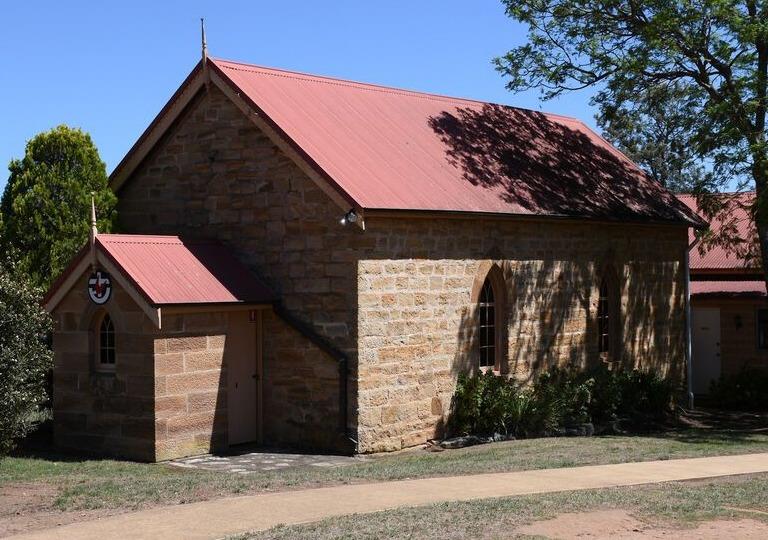
From the Wollondilly museum April 2020 newsletter:
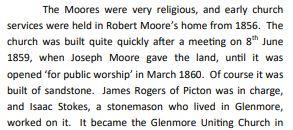
From the Camden History website:
“The stone set over the porch of Glenmore Church gives the date of 1860. The church was begun in 1859 on land given by Joseph Moore. James Rogers of Picton was given the contract to build and local builder, Mr. Stokes, carried out the work. Elizabeth Moore, wife of Edward, laid the foundation stone. The first service was held on 19th March 1860. The cemetery alongside the church contains the headstones and memorials of the areas early pioneers.”
Isaac died on the 3rd September 1877. The inquest report puts his place of death as Bagdelly, near to Camden, and another death register has put Cambelltown, also very close to Camden. His age was recorded as 71 and the inquest report states his cause of death was “rupture of one of the large pulmonary vessels of the lung”. His wife Catherine died in childbirth in 1870 at the age of 43.
Isaac and Catherine’s children:
William Stokes 1857-1928
Catherine Stokes 1859-1846
Sarah Josephine Stokes 1861-1931
Ellen Stokes 1863-1932
Rosanna Stokes 1865-1919
Louisa Stokes 1868-1844.
It’s possible that Catherine Daly was a transported convict from Ireland.
Some time later I unexpectedly received a follow up email from The Oaks Heritage Centre in Australia.
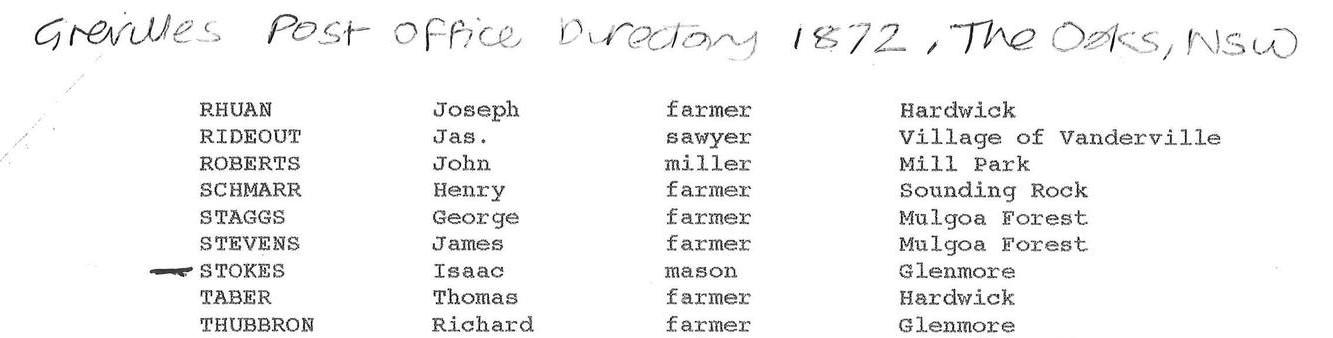
“The Gaudry papers which we have in our archive record him (Isaac Stokes) as having built: the church, the school and the teachers residence. Isaac is recorded in the General return of convicts: 1837 and in Grevilles Post Office directory 1872 as a mason in Glenmore.”
 October 21, 2022 at 2:06 pm #6337
In reply to: Family Stories From The Other Side ~ Book Two
Annie Elizabeth Stokes
1871-1961
“Grandma E”
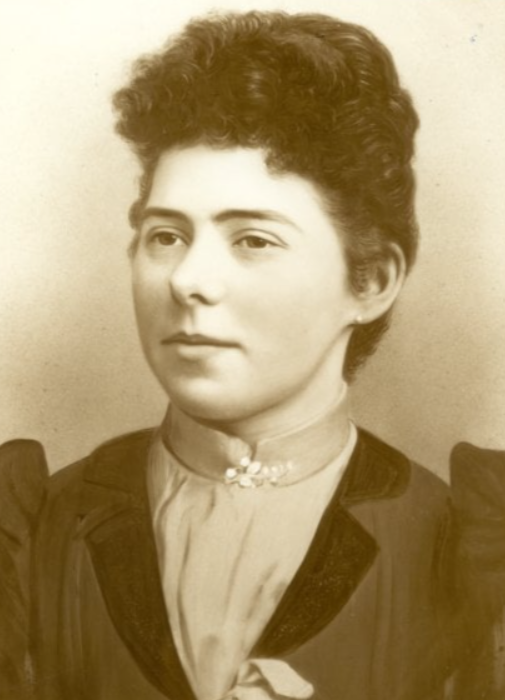
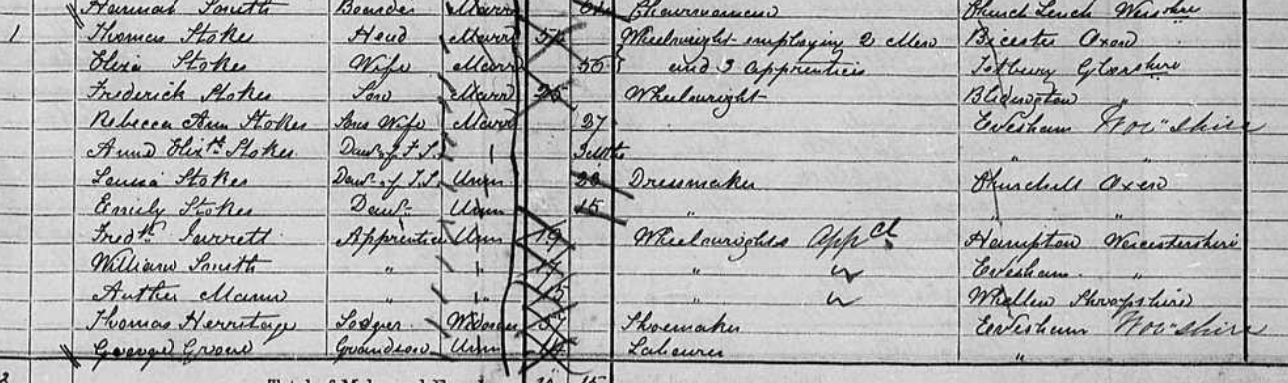
Annie, my great grandmother, was born 2 Jan 1871 in Merstow Green, Evesham, Worcestershire. Her father Fred Stokes was a wheelwright. On the 1771 census in Merston Green Annie was 3 months old and there was quite a houseful: Annies parents Fred and Rebecca, Fred’s parents Thomas and Eliza and two of their daughters, three apprentices, a lodger and one of Thomas’s grandsons.
1771 census Merstow Green, Evesham:
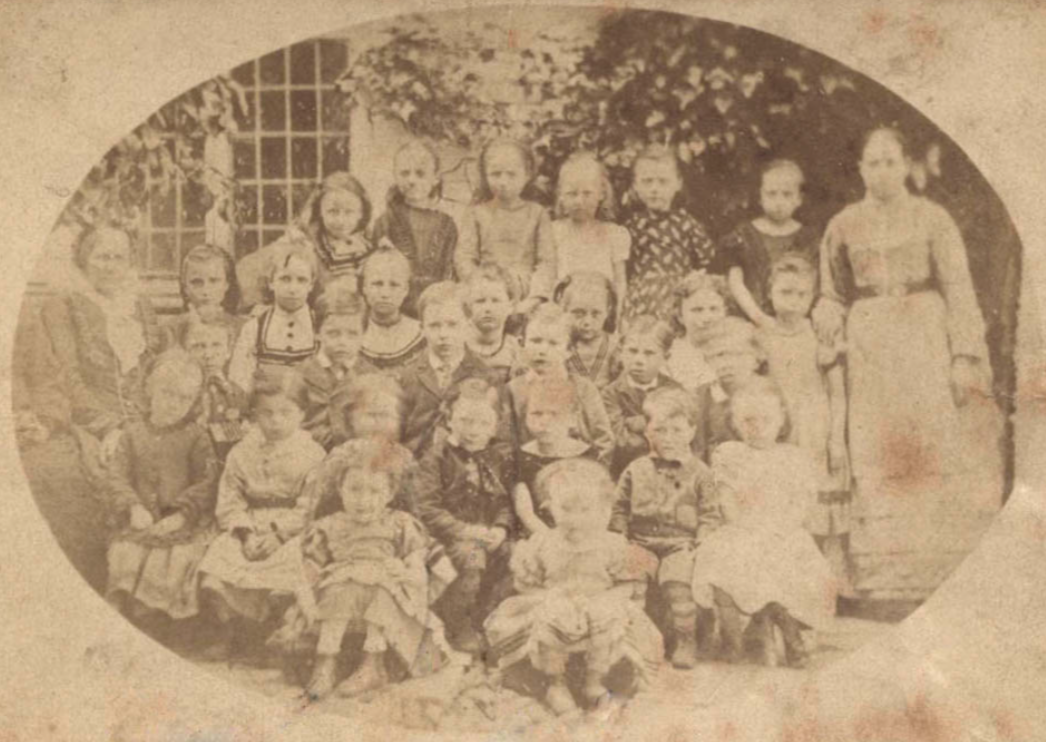
Annie at school in the early 1870s in Broadway. Annie is in the front on the left and her brother Fred is in the centre of the first seated row:
In 1881 Annie was a 10 year old visitor at the Angel Inn, Chipping Camden. A boarder there was 19 year old William Halford, a wheelwright apprentice. John Such, a 62 year old widower, was the innkeeper. Her parents and two siblings were living at La Quinta, on Main Street in Broadway.
According to her obituary in 1962, “When the Maxton family visited Broadway to stay with Mr and Madame de Navarro at Court Farm, they offered Annie a family post with them which took her for several years to Paris and other parts of the continent.”
Mary Anderson was an American theatre actress. In 1890 she married Antonio Fernando de Navarro. She became known as Mary Anderson de Navarro. They settled at Court Farm in the Cotswolds, Broadway, Worcestershire, where she cultivated an interest in music and became a noted hostess with a distinguished circle of musical, literary and ecclesiastical guests. As in the years when Mary lived there, it was often filled with visiting artists and musicians, including Myra Hess and a young Jacqueline du Pré. (via Wikipedia)
Court Farm, Broadway:
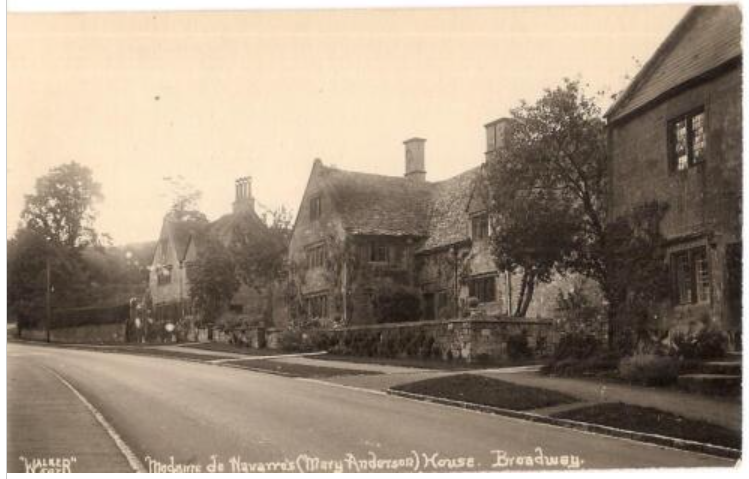
Annie was an assistant to a tobacconist in West Bromwich in 1991, living as a boarder with William Calcutt and family. He future husband Albert was living in neighbouring Tipton in 1891, working at a pawnbroker apprenticeship.
Annie married Albert Parker Edwards in 1898 in Evesham. On the 1901 census, she was in hospital in Redditch.
By 1911, Anne and Albert had five children and were living at the Cricketers Arms in Redditch.
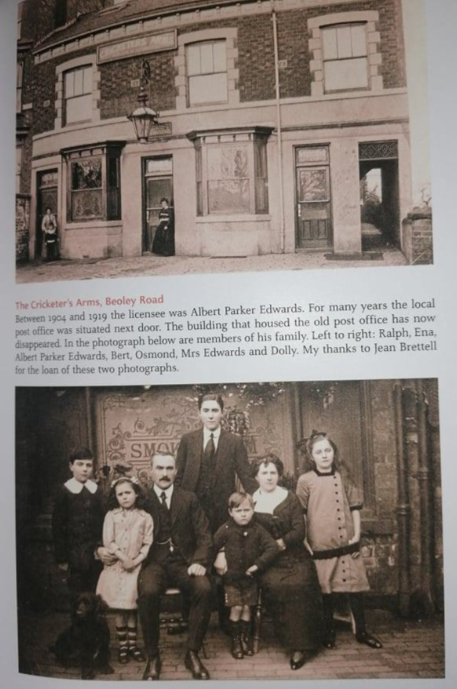
Behind the bar in 1904 shortly after taking over at the Cricketers Arms. From a book on Redditch pubs:
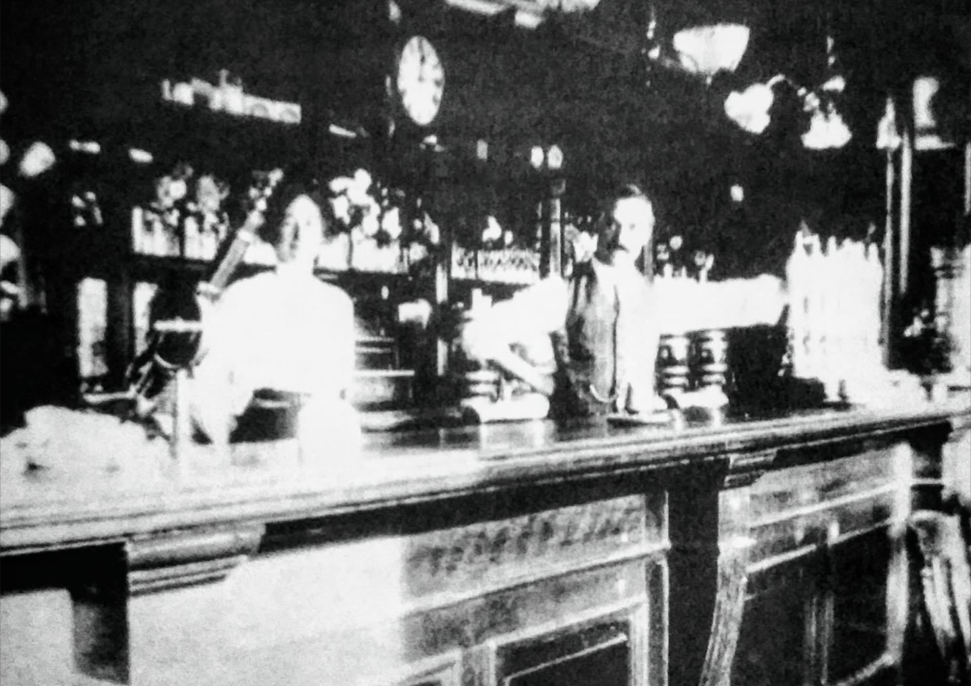
Annie was referred to in later years as Grandma E, probably to differentiate between her and my fathers Grandma T, as both lived to a great age.
Annie with her grandson Reg on the left and her daughter in law Peggy on the right, in the early 1950s:
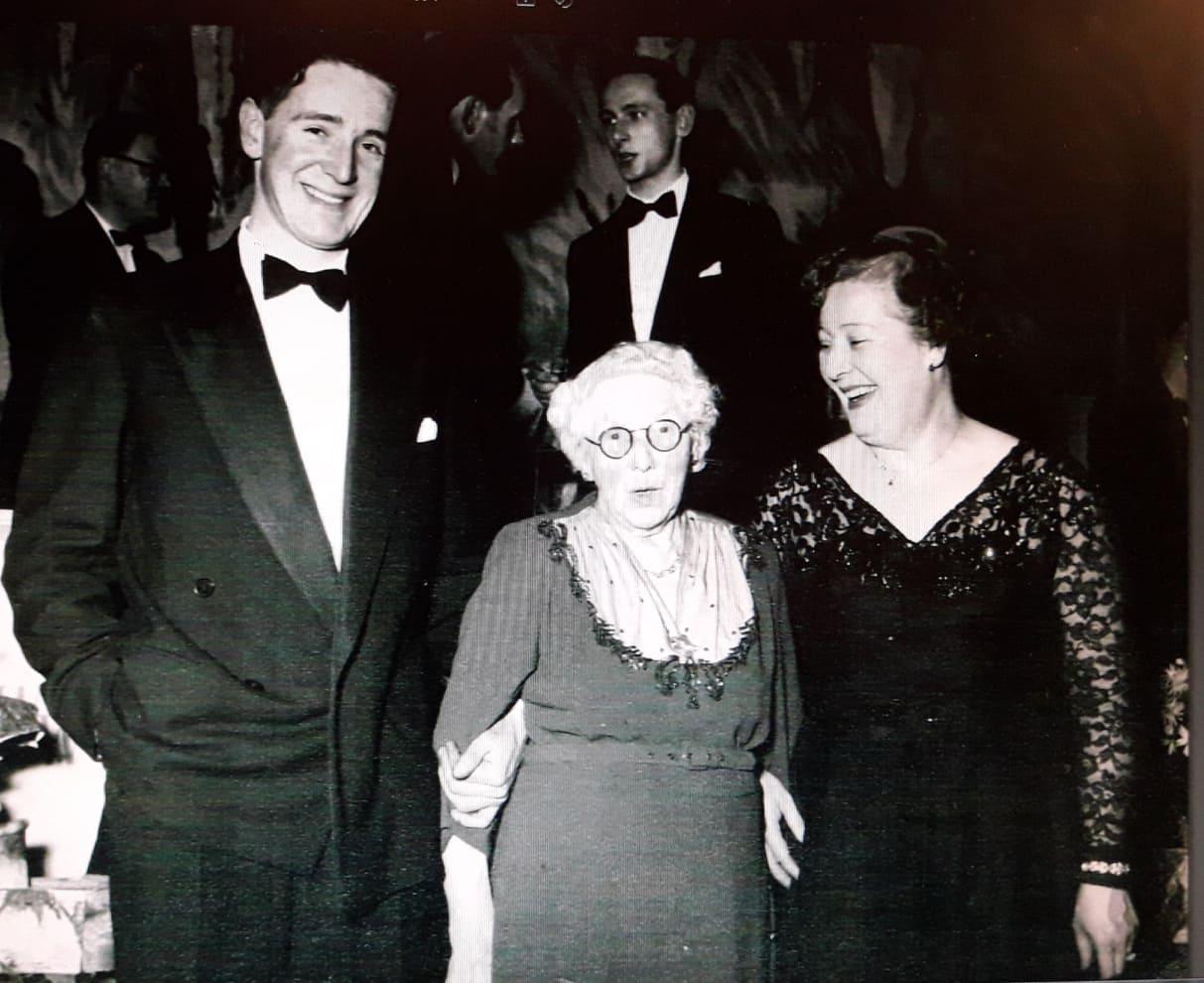
Annie at my christening in 1959:
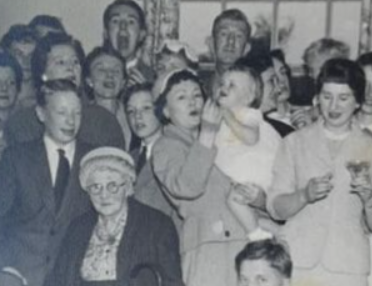
Annie died 30 Dec 1961, aged 90, at Ravenscourt nursing home, Redditch. Her obituary in the Droitwich Guardian in January 1962:
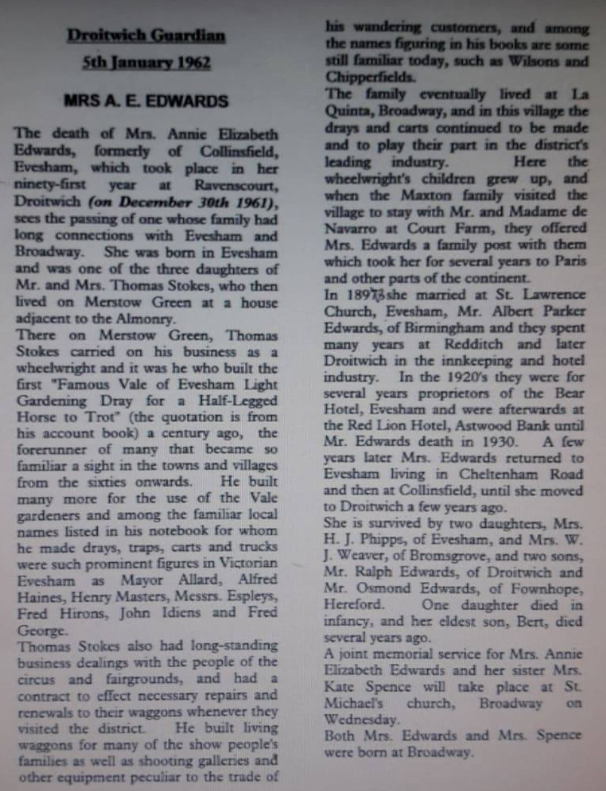
Note that this obituary contains an obvious error: Annie’s father was Frederick Stokes, and Thomas was his father.
April 12, 2022 at 8:09 am #6289In reply to: The Precious Life and Rambles of Liz Tattler
“Ever get the feeling you’re talking to yourself?” Liz said to herself.
“YOU TART!!!”
Liz swung round, wondering where the dreadful shreik came from. The little black communication device on her desk was vibrating madly, causing the tea in her cup to slosh over the side into the saucer.
“Good Godfrey!” exclaimed Liz, visibly shaken.
“You rang?” smiled Godfrey, crawling out from under the desk.
“You were under my desk the whole time?” Liz was shocked.
“Allo allo allo!”
“Roberto! You were under my desk the entire time too?”
“Zere iz a zecret door under ze desk, madame, you did not know zis?”
“Fanella! Good lord, not you as well!”
Fanella grinned sheepishly. “I ‘ave come to ‘elp Finnley wiz ze bedding.”
Liz bent down and peered under her desk. Who else was under there? But it was dark as a black hole, and covered in cobwebs.
“Fanella, do you know where Finnley is?” asked Liz. “I miss her terribly. Everything is so dreadfully dusty without her.”
Fanella shrugged. “She was drugged, Madame. It was when she tried to put a bug under the rug, someone ‘hit ‘er on ze ‘ead wiz a mug, and lugged her to a zecret location and filled her wiz drugs.” Fanella shrugged again. “Zis is why I ‘ave come to ‘elp.”
February 5, 2022 at 1:59 pm #6272In reply to: The Elusive Samuel Housley and Other Family Stories
The Housley Letters
The Carringtons
Carrington Farm, Smalley:
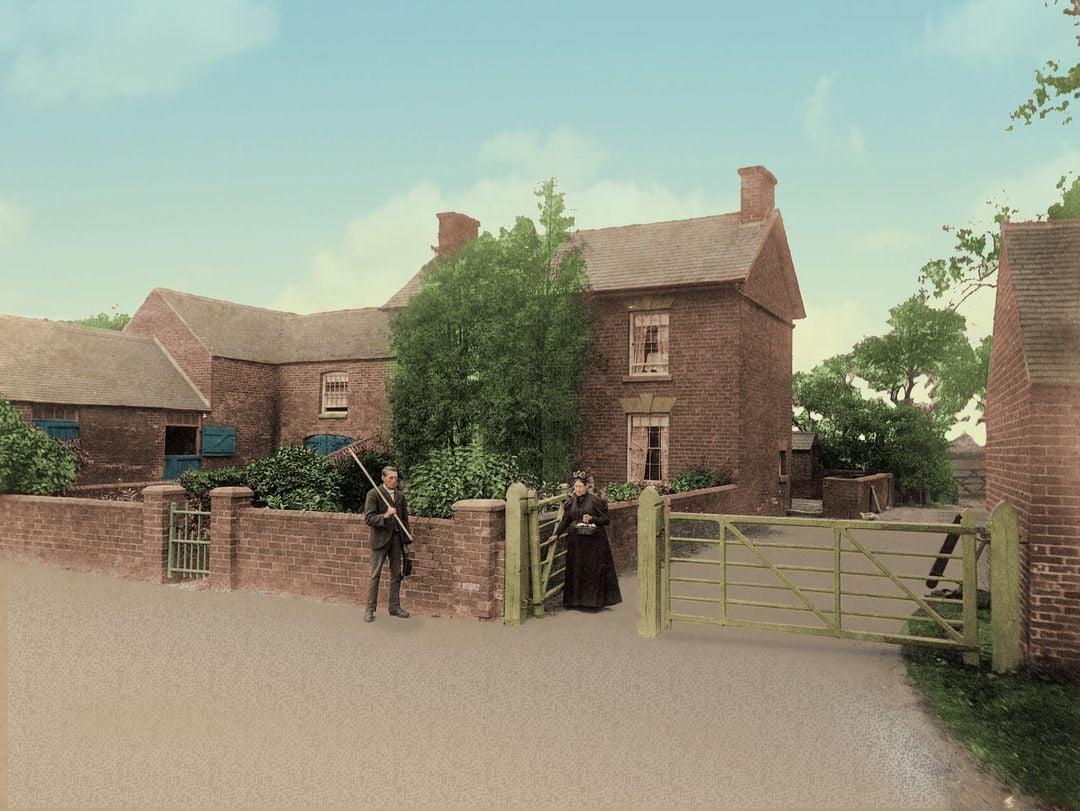
Ellen Carrington was born in 1795. Her father William Carrington 1755-1833 was from Smalley. Her mother Mary Malkin 1765-1838 was from Ellastone, in Staffordshire. Ellastone is on the Derbyshire border and very close to Ashboure, where Ellen married William Housley.
From Barbara Housley’s Narrative on the Letters:
Ellen’s family was evidently rather prominant in Smalley. Two Carringtons (John and William) served on the Parish Council in 1794. Parish records are full of Carrington marriages and christenings.
The letters refer to a variety of “uncles” who were probably Ellen’s brothers, but could be her uncles. These include:
RICHARD
Probably the youngest Uncle, and certainly the most significant, is Richard. He was a trustee for some of the property which needed to be settled following Ellen’s death. Anne wrote in 1854 that Uncle Richard “has got a new house built” and his daughters are “fine dashing young ladies–the belles of Smalley.” Then she added, “Aunt looks as old as my mother.”
Richard was born somewhere between 1808 and 1812. Since Richard was a contemporary of the older Housley children, “Aunt,” who was three years younger, should not look so old!
Richard Carrington and Harriet Faulkner were married in Repton in 1833. A daughter Elizabeth was baptised March 24, 1834. In July 1872, Joseph wrote: “Elizabeth is married too and a large family and is living in Uncle Thomas’s house for he is dead.” Elizabeth married Ayres (Eyres) Clayton of Lascoe. His occupation was listed as joiner and shopkeeper. They were married before 1864 since Elizabeth Clayton witnessed her sister’s marriage. Their children in April 1871 were Selina (1863), Agnes Maria (1866) and Elizabeth Ann (1868). A fourth daughter, Alice Augusta, was born in 1872 or 1873, probably by July 1872 to fit Joseph’s description “large family”! A son Charles Richard was born in 1880.
An Elizabeth Ann Clayton married John Arthur Woodhouse on May 12, 1913. He was a carpenter. His father was a miner. Elizabeth Ann’s father, Ayres, was also a carpenter. John Arthur’s age was given as 25. Elizabeth Ann’s age was given as 33 or 38. However, if she was born in 1868, her age would be 45. Possibly this is another case of a child being named for a deceased sibling. If she were 38 and born in 1875, she would fill the gap between Alice Augusta and Charles Richard.
Selina Clayton, who would have been 18, is not listed in the household in 1881. She died on June 11, 1914 at age 51. Agnes Maria Clayton died at the age of 25 and was buried March 31, 1891. Charles Richard died at the age of 5 and was buried on February 4, 1886. A Charles James Clayton, 18 months, was buried June 8, 1889 in Heanor.
Richard Carrington’s second daughter, Selina, born in 1837, married Walker Martin (b.1835) on February 11, 1864 and they were living at Kidsley Park Farm in 1872, according to a letter from Joseph, and, according to the census, were still there in 1881. This 100 acre farm was formerly the home of Daniel Smith and his daughter Elizabeth Davy Barber. Selina and Walker had at least five children: Elizabeth Ann (1865), Harriet Georgianna (1866/7), Alice Marian (September 6, 1868), Philip Richard (1870), and Walker (1873). In December 1972, Joseph mentioned the death of Philip Walker, a farmer of Prospect Farm, Shipley. This was probably Walker Martin’s grandfather, since Walker was born in Shipley. The stock was to be sold the following Monday, but his daughter (Walker’s mother?) died the next day. Walker’s father was named Thomas. An Annie Georgianna Martin age 13 of Shipley died in April of 1859.
Selina Martin died on October 29, 1906 but her estate was not settled until November 14, 1910. Her gross estate was worth L223.56. Her son Walker and her daughter Harriet Georgiana were her trustees and executers. Walker was to get Selina’s half of Richard’s farm. Harriet Georgiana and Alice Marian were to be allowed to live with him. Philip Richard received L25. Elizabeth Ann was already married to someone named Smith.
Richard and Harriet may also have had a son George. In 1851 a Harriet Carrington and her three year old son George were living with her step-father John Benniston in Heanor. John may have been recently widowed and needed her help. Or, the Carrington home may have been inadequate since Anne reported a new one was built by 1854. Selina’s second daughter’s name testifies to the presence of a “George” in the family! Could the death of this son account for the haggard appearance Anne described when she wrote: “Aunt looks as old as my mother?”
Harriet was buried May 19, 1866. She was 55 when she died.In 1881, Georgianna then 14, was living with her grandfather and his niece, Zilpah Cooper, age 38–who lived with Richard on his 63 acre farm as early as 1871. A Zilpah, daughter of William and Elizabeth, was christened October 1843. Her brother, William Walter, was christened in 1846 and married Anna Maria Saint in 1873. There are four Selina Coopers–one had a son William Thomas Bartrun Cooper christened in 1864; another had a son William Cooper christened in 1873.
Our Zilpah was born in Bretley 1843. She died at age 49 and was buried on September 24, 1892. In her will, which was witnessed by Selina Martin, Zilpah’s sister, Frances Elizabeth Cleave, wife of Horatio Cleave of Leicester is mentioned. James Eley and Francis Darwin Huish (Richard’s soliciter) were executers.
Richard died June 10, 1892, and was buried on June 13. He was 85. As might be expected, Richard’s will was complicated. Harriet Georgiana Martin and Zilpah Cooper were to share his farm. If neither wanted to live there it was to go to Georgiana’s cousin Selina Clayton. However, Zilpah died soon after Richard. Originally, he left his piano, parlor and best bedroom furniture to his daughter Elizabeth Clayton. Then he revoked everything but the piano. He arranged for the payment of £150 which he owed. Later he added a codicil explaining that the debt was paid but he had borrowed £200 from someone else to do it!
Richard left a good deal of property including: The house and garden in Smalley occupied by Eyres Clayton with four messuages and gardens adjoining and large garden below and three messuages at the south end of the row with the frame work knitters shop and garden adjoining; a dwelling house used as a public house with a close of land; a small cottage and garden and four cottages and shop and gardens.
THOMAS
In August 1854, Anne wrote “Uncle Thomas is about as usual.” A Thomas Carrington married a Priscilla Walker in 1810.
Their children were baptised in August 1830 at the same time as the Housley children who at that time ranged in age from 3 to 17. The oldest of Thomas and Priscilla’s children, Henry, was probably at least 17 as he was married by 1836. Their youngest son, William Thomas, born 1830, may have been Mary Ellen Weston’s beau. However, the only Richard whose christening is recorded (1820), was the son of Thomas and Lucy. In 1872 Joseph reported that Richard’s daughter Elizabeth was married and living in Uncle Thomas’s house. In 1851, Alfred Smith lived in house 25, Foulks lived in 26, Thomas and Priscilla lived in 27, Bennetts lived in 28, Allard lived in 29 and Day lived in 30. Thomas and Priscilla do not appear in 1861. In 1871 Elizabeth Ann and Ayres Clayton lived in House 54. None of the families listed as neighbors in 1851 remained. However, Joseph Carrington, who lived in house 19 in 1851, lived in house 51 in 1871.
JOHN
In August 1854, Anne wrote: “Uncle John is with Will and Frank has been home in a comfortable place in Cotmanhay.” Although John and William are two of the most popular Carrington names, only two John’s have sons named William. John and Rachel Buxton Carrington had a son William christened in 1788. At the time of the letters this John would have been over 100 years old. Their son John and his wife Ann had a son William who was born in 1805. However, this William age 46 was living with his widowed mother in 1851. A Robert Carrington and his wife Ann had a son John born 1n 1805. He would be the right age to be a brother to Francis Carrington discussed below. This John was living with his widowed mother in 1851 and was unmarried. There are no known Williams in this family grouping. A William Carrington of undiscovered parentage was born in 1821. It is also possible that the Will in question was Anne’s brother Will Housley.
–Two Francis Carringtons appear in the 1841 census both of them aged 35. One is living with Richard and Harriet Carrington. The other is living next door to Samuel and Ellen Carrington Kerry (the trustee for “father’s will”!). The next name in this sequence is John Carrington age 15 who does not seem to live with anyone! but may be part of the Kerry household.
FRANK (see above)
While Anne did not preface her mention of the name Frank with an “Uncle,” Joseph referred to Uncle Frank and James Carrington in the same sentence. A James Carrington was born in 1814 and had a wife Sarah. He worked as a framework knitter. James may have been a son of William and Anne Carrington. He lived near Richard according to the 1861 census. Other children of William and Anne are Hannah (1811), William (1815), John (1816), and Ann (1818). An Ann Carrington married a Frank Buxton in 1819. This might be “Uncle Frank.”
An Ellen Carrington was born to John and Rachel Carrington in 1785. On October 25, 1809, a Samuel Kerry married an Ellen Carrington. However this Samuel Kerry is not the trustee involved in settling Ellen’s estate. John Carrington died July 1815.
William and Mary Carrington:
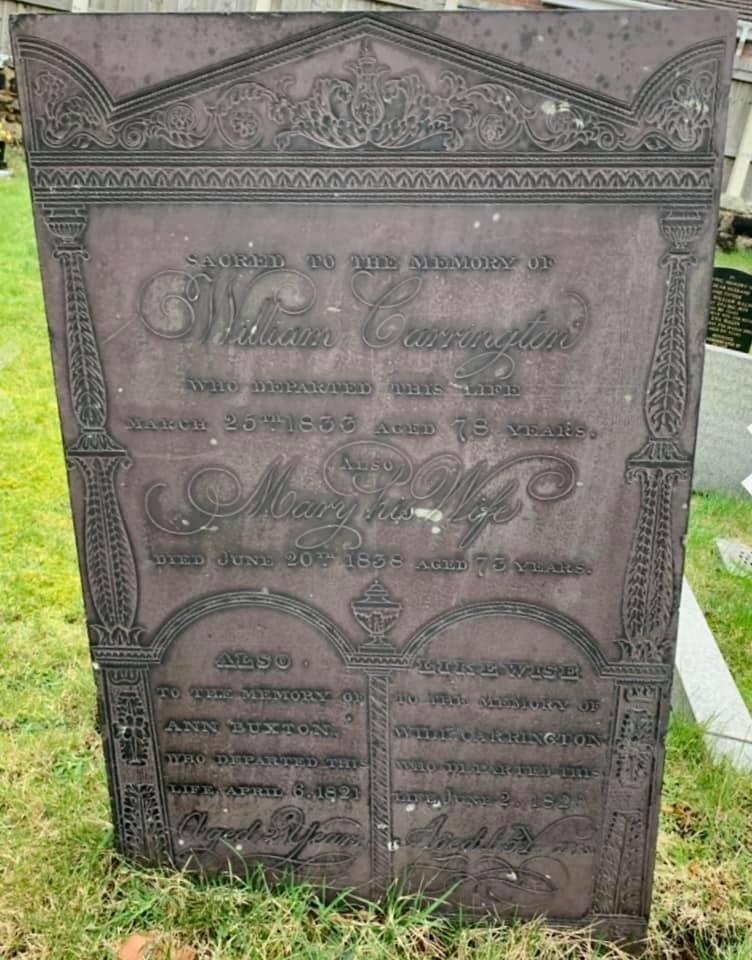
- Zara Patara-Smythe :: Zara (
-
AuthorSearch Results