


Search Results for 'sent'
-
AuthorSearch Results
-
December 4, 2024 at 8:16 am #7640
In reply to: Quintessence: Reversing the Fifth
Sat. Nov. 30, 2024 – before the meeting
The afternoon light slanted through the tall studio windows, thin and watery, barely illuminating the scattered tools of Lucien’s trade. Brushes lay in disarray on the workbench, their bristles stiff with dried paint. The smell of turpentine hung heavy in the air, mingling with the faint dampness creeping in from the rain. He stood before the easel, staring at the unfinished painting, brush poised but unmoving.
The scene on the canvas was a lavish banquet, the kind of composition designed to impress: a gleaming silver tray, folds of deep red velvet, fruit piled high and glistening. Each detail was rendered with care, but the painting felt hollow, as if the soul of it had been left somewhere else. He hadn’t painted what he felt—only what was expected of him.
Lucien set the brush down and stepped back, wiping his hands on his scarf without thinking. It was streaked with paint from hours of work, colors smeared in careless frustration. He glanced toward the corner of the studio, where a suitcase leaned against the wall. It was packed with sketchbooks, a bundle wrapped in linen, and clothes hastily thrown in—things that spoke of neither arrival nor departure, but of uncertainty. He wasn’t sure if he was leaving something behind or preparing for an escape.
How had it come to this? The thought surfaced before he could stop it, heavy and unrelenting. He had asked himself the same question many times, but the answer always seemed too elusive—or too daunting—to pursue. To find it, he would have to follow the trails of bad choices and chance encounters, decisions made in desperation or carelessness. He wasn’t sure he had the courage to look that closely, to untangle the web that had slowly wrapped itself around his life.
He turned his attention back to the painting, its gaudy elegance mocking him. He wondered if the patron who had commissioned it would even notice the subtle imperfections he had left, the faint warping of reflections, the fruit teetering on the edge of overripeness. A quiet rebellion, almost invisible. It wasn’t much, but it was something.
His friends had once known him as someone who didn’t compromise. Elara would have scoffed at the idea of him bending to anyone’s expectations. Why paint at all if it isn’t your vision? she’d asked once, her voice sharp, her black coffee untouched beside her. Amei, on the other hand, might have smiled and said something cryptic about how all choices, even the wrong ones, led somewhere meaningful. And Darius—Lucien couldn’t imagine telling Darius. The thought of his disappointment was like a weight in his chest. It had been easier not to tell them at all, easier to let the years widen the distance between them. And yet, here he was, preparing to meet them again.
The clock on the far wall chimed softly, pulling him back to the present. It was getting late. Lucien walked to the suitcase and picked it up, its weight pulling slightly on his arm. Outside, the rain had started, tapping gently against the windowpanes. He slung the paint-streaked scarf around his neck and hesitated, glancing once more at the easel. The painting loomed there, unfinished, like so many things in his life. He thought about staying, about burying himself in the work until the world outside receded again. But he knew it wouldn’t help.
With a deep breath, Lucien stepped out into the rain, the suitcase rattling softly behind him. The café wasn’t far, but it felt like a journey he might not be ready to take.
December 4, 2024 at 6:50 am #7639In reply to: Quintessence: A Portrait in Reverse
Work in Progress: Character Timelines and Events
Matteo
- November 2024 (Reunion):
- Newly employed at the Sarah Bernhardt Café, started after its reopening.
- Writes the names of Lucien, Elara, Darius, and Amei in his notebook without understanding why.
- Acquires the bell from Les Reliques, drawn to it as if guided by an unseen force.
- Serves the group during the reunion, surprised to see all four together, though he knows them individually.
- Summer 2024 (Olympics):
- Working in a vineyard in southern France, nearing the end of the harvest season.
- Receives a call for a renovation job in Paris, which pulls him toward the city.
- Feels an intuitive connection to Paris, as if something is waiting for him there.
- Past Events (Implied):
- Matteo has a mysterious ability to sense patterns and connections in people’s lives.
- Has likely crossed paths with the group in unremarkable but meaningful ways before.
Darius
- November 2024 (Reunion):
- Arrives at the café, a wanderer who rarely stays in one place.
- Reflects on his time in India during the autumn and the philosophical journey it sparked.
- Brings with him an artifact that ties into his travels and personal story.
- Summer 2024 (Olympics):
- Living in Barcelona, sketching temples and engaging with a bohemian crowd.
- Prompted by a stranger to consider a trip to India, sparking curiosity and the seeds of his autumn journey.
- Begins to plan his travels, sensing that India is calling him for a reason he doesn’t yet understand.
- Past Events (Implied):
- Has a history of introducing enigmatic figures to the group, often leading to tension.
- His intense, nomadic lifestyle creates both fascination and distance between him and the others.
Elara
- November 2024 (Reunion):
- Travels from England to Paris to attend the reunion, balancing work and emotional hesitation.
- Still processing her mother’s passing and reflecting on their strained relationship.
- Finds comfort in the shared dynamics of the group but remains analytical about the events around the bell.
- Summer 2024 (Olympics):
- (was revealed to be a dream event) Attends a CERN conference in Geneva, immersed in intellectual debates and cutting-edge research. Receives news of her mother’s death in Montrouge, prompting a reflective journey to make funeral arrangements. Struggles with unresolved feelings about her mother but finds herself strangely at peace with the finality.
- Dreams of her mother’s death during a nap in Tuscany, a surreal merging of past and present that leaves her unsettled.
- Hears a bell’s clang, only to find Florian fixing a bell to the farmhouse gate. The sound pulls her further into introspection about her mother and her life choices.
- Mentors Florian, encouraging him to explore his creativity, paralleling her own evolving relationship with her chalk research.
- Past Events (Implied):
- Moved to Tuscany after retiring from academia, pursuing independent research on chalk.
- Fondly remembers the creative writing she once shared with the group, though it now feels like a distant chapter of her life.
- Had a close but occasionally challenging relationship with Lucien and Amei during their younger years.
- Values intellectual connections over emotional ones but is gradually learning to reconcile the two.
Lucien
- November 2024 (Reunion):
- Sends the letter that brings the group together at the café, though his intentions are unclear even to himself.
- In his Paris studio, struggles with an unfinished commissioned painting. Feels disconnected from his art and his sense of purpose.
- Packs a suitcase with sketchbooks and a bundle wrapped in linen, symbolizing his uncertainty—neither a complete departure nor a definitive arrival.
- Heads to the café in the rain, reluctant but compelled to reconnect with the group. Confronts his feelings of guilt and estrangement from the group.
- Summer 2024 (Olympics):
- Escapes Paris, overwhelmed by the crowds and noise of the Games, and travels to Lausanne.
- Reflects on his artistic block and the emotional weight of his distance from the group.
- Notices a sketch in his book of a doorway with a bell he doesn’t recall drawing, sparking vague recognition.
- Past Events (Implied):
- Once the emotional “anchor” of the group, he drifted apart after a falling-out or personal crisis.
- Feels a lingering sense of responsibility to reunite the group but struggles with his own vulnerabilities.
Amei
- November 2024 (Reunion):
- Joins the reunion at Lucien’s insistence, hesitant but curious about reconnecting with the group.
- Brings with her notebooks filled with fragments of stories and a quiet hope for resolution.
- Feels the weight of the group’s shared history but refrains from dwelling on it outwardly.
- Summer 2024 (Olympics):
- Recently moved into a smaller flat in London, downsizing after her daughter Tabitha left for university.
- Has a conversation with Tabitha about life and change, hinting at unresolved emotions about motherhood and independence.
- Tabitha jokes about Amei joining her in Goa, a suggestion Amei dismisses but secretly considers.
- Past Events (Implied):
- The last group meeting five years ago left her with lingering emotional scars.
- Maintains a deep but quiet connection to Lucien and shares a playful dynamic with Elara.
Tabitha (Amei’s Daughter)
- November 2024:
- Calls Amei to share snippets of her life, teasing her mother about her workaholic tendencies.
- Reflects on their relationship, noting Amei’s supportive but emotionally guarded nature.
- Summer 2024 (Olympics):
- Planning her autumn trip to Goa with friends, viewing it as a rite of passage.
- Discusses her mother’s habits with her peers, acknowledging Amei’s complexities while expressing affection.
- Past Events (Implied):
- Represents a bridge between Amei’s past and present, highlighting generational contrasts and continuities.
Key Threads and Patterns
- The Bell: Acts as a silent witness and instigator, threading its presence through pivotal moments in each character’s journey, whether directly or indirectly.
- Shared Histories: While each character grapples with personal struggles, their paths hint at intersections in the past, tied to unresolved tensions and shared experiences.
- Forward and Backward Motion: The narrative moves between the characters’ immediate challenges and the ripples of their past decisions, with the bell serving as a focal point for both.
December 4, 2024 at 6:22 am #7638In reply to: Quintessence: Reversing the Fifth
The Bell’s Moment: Paris, Summer 2024 – Olympic Games
The bell was dangling unassumingly from the side pocket of a sports bag, its small brass frame swinging lightly with the jostle of the crowd. The bag belonged to an American tourist, a middle-aged man in a rumpled USA Basketball T-shirt, hustling through the Olympic complex with his family in tow. They were here to cheer for his niece, a rising star on the team, and the bell—a strange little heirloom from his grandmother—had been an afterthought, clipped to the bag for luck. It seemed to fit right in with the bright chaos of the Games, blending into the swirl of flags, chants, and the hum of summer excitement.
1st Ring of the Bell: Matteo
The vineyard was quiet except for the hum of cicadas and the soft rustle of leaves. Matteo leaned against the tractor, wiping sweat from his brow with the back of his hand.
“You’ve done good work,” the supervisor said, clapping Matteo on the shoulder. “We’ll be finishing this batch by Friday.”
Matteo nodded. “And after that?”
The older man shrugged. “Some go north, some go south. You? You’ve got that look—like you already know where you’re headed.”
Matteo offered a half-smile, but he couldn’t deny it. He’d felt the tug for days, like a thread pulling him toward something undefined. The idea of returning to Paris had slipped into his thoughts quietly, as if it had been waiting for the right moment.
When his phone buzzed later that evening with a job offer to do renovation work in Paris, it wasn’t a surprise. He poured himself a small glass of wine, toasting the stars overhead.
Somewhere, miles away, the bell rang its first note.
2nd Ring of the Bell: Darius
In a shaded square in Barcelona, the air was thick with the scent of jasmine and the echo of a street performer’s flamenco guitar. Darius sprawled on a wrought-iron bench, his leather-bound journal open on his lap. He sketched absentmindedly, the lines of a temple taking shape on the page.
A man wearing a scarf of brilliant orange sat down beside him, his energy magnetic. “You’re an artist,” the man said without preamble, his voice carrying the cadence of Kolkata.
“Sometimes,” Darius replied, his pen still moving.
“Then you should come to India,” the man said, grinning. “There’s art everywhere. In the streets, in the temples, even in the food.”
Darius chuckled. “You recruiting me?”
“India doesn’t need recruiters,” the man replied. “It calls people when it’s time.”
The bell rang again in Paris, its chime faint and melodic, as Darius scribbled the words “India, autumn” in the corner of his page.
3rd Ring of the Bell: Elara
The crowd at CERN’s conference hall buzzed as physicists exchanged ideas, voices overlapping like equations scribbled on whiteboards. Elara sat at a corner table, sipping lukewarm coffee and scrolling through her messages.
The voicemail notification glared at her, and she tapped it reluctantly.
“Elara, it’s Florian. I… I’m sorry to tell you this over a message, but your mother passed away last night.”
Her coffee cup trembled slightly as she set it down.
Her relationship with her mother had been fraught, full of alternating period of silences and angry reunions, and had settled lately into careful politeness that masked deeper fractures. Years of therapy had softened the edges of her resentment but hadn’t erased it. She had come to accept that they would never truly understand each other, but the finality of death still struck her with a peculiar weight.
Her mother had been living alone in Montrouge, France, refusing to leave the little house Elara had begged her to sell for years. They had drifted apart, their conversations perfunctory and strained, like the ritual of winding a clock that no longer worked.
She would have to travel to Montrouge for the funeral arrangements.
In that moment, the bell in Les Reliques rang a third time.
4th Ring of the Bell: Lucien
The train to Lausanne glided through fields of dried up sunflowers, too early for the season, but the heat had been relentless. He could imagine the golden blooms swaying with a cracking sound in the summer breeze. Lucien stared out the window, the strap of his duffel bag wrapped tightly around his wrist.
Paris had been suffocating. The tourists swarmed the city like ants, turning every café into a photo opportunity and every quiet street into a backdrop. He hadn’t needed much convincing to take his friend up on the offer of a temporary studio in Lausanne.
He reached into his bag and pulled out a sketchbook. The pages were filled with half-finished drawings, but one in particular caught his eye: a simple doorway with an ornate bell hanging above it.
He didn’t remember drawing it, but the image felt familiar, like a memory from a dream.
The bell rang again in Paris, its resonance threading through the quiet hum of the train.
5th Ring of the Bell: …. Tabitha
In the courtyard of her university residence, Tabitha swung lazily in a hammock, her phone propped precariously on her chest.
“Goa, huh?” one of her friends asked, leaning against the tree holding up the hammock. “Think your mum will freak out?”
“She’ll probably worry herself into knots,” Tabitha replied, laughing. “But she won’t say no. She’s good at the whole supportive parent thing. Or at least pretending to be.”
Her friend raised an eyebrow. “Pretending?”
“Don’t get me wrong, I love her,” Tabitha said. “But she’s got her own stuff. You know, things she never really talks about. I think it’s why she works so much. Keeps her distracted.”
The bell rang faintly in Paris, though neither of them could hear it.
“Maybe you should tell her to come with you,” the friend suggested.
Tabitha grinned. “Now that would be a trip.”
Last Ring: The Pawn
It was now sitting on the counter at Les Reliques. Its brass surface gleamed faintly in the dim shop light, polished by the waves of time. Small and unassuming, its ring held something inexplicably magnetic.
Time seemed to settle heavily around it. In the heat of the Olympic summer, it rang six times. Each chime marked a moment that mattered, though none of the characters whose lives it touched understood why. Not yet.
“Where’d you get this?” the shopkeeper asked as the American tourist placed it down.
“It was my grandma’s,” he said, shrugging. “She said it was lucky. I just think it’s old.”
The shopkeeper ran her fingers over the brass surface, her expression unreadable. “And you’re selling it?”
“Need cash to get tickets for the USA basketball game tomorrow,” the man replied. “Quarterfinals. You follow basketball?”
“Not anymore,” the shopkeeper murmured, handing him a stack of bills.
The bell rang softly as she placed it on the velvet cloth, its sound settling into the space like a secret waiting to be uncovered.
And so it sat, quiet but full of presence, waiting for someone to claim it maybe months later, drawn by invisible threads woven through the magnetic field of lives, indifferent to the heat and chaos of the Parisian streets.
December 3, 2024 at 8:45 pm #7637In reply to: Quintessence: Reversing the Fifth
Amei:
The flat was smaller than she’d remembered when she first viewed it, but it was hers—as long as she could manage the rent. She glanced at her phone to check the time. That guy, Felix, from the hospital would be here soon to see the place. He’d seemed really nice when they’d chatted—just looking for a base while working nearby.
The move had been a necessity; the old house had always felt big, but when Tabitha moved out and Amei’s relationship ended shortly after, the echoes became unbearable. Downsizing had been practical—a good move financially and a fresh start. Or so she kept telling herself.
Unpacking was slow. Some of her larger furniture had gone into storage, and she’d thrown out or donated a lot too. It was truly amazing how much one accumulated. The boxes she’d brought were filled with relics of her life—mostly functional, but also a few cartons of books, carefully wrapped ceramics she couldn’t part with, lengths of fabric she would probably never use but were just so beautiful, unframed art she hadn’t found space for yet, and a stack of notebooks dating back years. She pushed herself up from the floor and stretched, her knees stiff from crouching too long.
As she reached into another box, her hand paused on a photo album. She pulled it out and flipped it open, the pages falling naturally to a picture of her and her friends—Lucien, Elara, Darius, and herself, standing in a loose semicircle outside a weathered door. They were younger, glowing with the easy confidence of people who still believed they had endless time. A bell hung from the lintel above them, ornate and dark, its surface catching the light in the photo. Amei couldn’t remember the context or who had taken the photo, but the sight of it tugged at something deep.
The bell. Why did that stand out?
She traced the edge of the photo with her thumb. Lucien had his arm draped around her shoulder, his eyes squinting into the sun. Elara was mid-laugh, her head tilted back, carefree and radiant. Darius stood slightly apart, his gaze intense, as though the photo had captured him mid-thought. They’d all been so close back then. Closer than she’d ever been with anyone since.
The doorbell buzzed, snapping her back to the present. She slipped the photo back in the album and straightened up. Felix was punctual, at least.
December 3, 2024 at 7:51 am #7636In reply to: Quintessence: Reversing the Fifth
It was cold in Kent, much colder than Elara was used to at home in the Tuscan olive groves, but Mrs Lovejoy kept the guest house warm enough. On site at Samphire Hoe was another matter, the wind off the sea biting into her despite the many layers of clothing. It had been Florian’s idea to take the Mongolian hat with her. Laughing, she’d replied that it might come in handy if there was a costume party. Trust me, you’re going to need it, he’d said, and he was right. It had been a present from Amei, many years ago, but Elara had barely worn it. It wasn’t often that she found herself in a place cold enough to warrant it.
In a fortuitous twist of fate, Florian had asked if he could come and stay with her for awhile to find his feet after the tumultuous end of a disastrous relationship. It came at a time when Elara was starting to realise that there was too much work for her alone keeping the old farmhouse in order. Everyone wants to retire to the country but nobody thinks of all the work involved, at an age when one prefers to potter about, read books, and take naps.
Florian was a long lost (or more correctly never known) distant relative, a seventh cousin four times removed on her paternal side. They had come into contact while researching the family, comparing notes and photographs and family anecdotes. They became friends, finding they had much in common, and Elara was pleased to have him come to stay with her. Likewise, Florian was more than willing to help around the beautiful old place, and found it conducive to his writing. He spent the mornings gardening, decorating or running errands, and the afternoons tapping away at the novel he’d been inspired to start, sitting at the old desk in front of the French windows.
If it hadn’t been for Florian, Elara wouldn’t have accepted the invitation to join the chalk project. He had settled in so well, already had a working grasp of Italian, and got on well with her neighbours. She could leave him to look after everything and not worry about a thing.
Pulling the hat down over her ears, Elara ventured out into the early November chill. Mrs Lovejoy was coming up the path to the guesthouse, having been out to the corner shop. “I say, that’s a fine hat you have there, that’ll keep your cockles warm!” Mrs Lovejoy was bareheaded, wearing only a cardigan.
“It was a gift,” Elara told her, “I haven’t worn it much. A friend bought it for me years ago when we were in Mongolia.”
“Very nice, I’m sure,” replied the landlady, trying to remember where Mongolia was.
“Yes, she was nice,” Elara said wistfully. “We lost contact somehow.”
“Ah yes, well these things happen,” Mrs Lovejoy said. “People come into your life and then they go. Like my Bert…”
“Must go or I’ll be late!” Elara had already heard all about Bert a number of times.
December 2, 2024 at 10:50 pm #7635In reply to: Quintessence: Reversing the Fifth
Sat. Nov. 30, 2024 5:55am — Matteo’s morning
Matteo’s mornings began the same way, no matter the city, no matter the season. A pot of strong coffee brewed slowly on the stove, filling his small apartment with its familiar, sense-sharpening scent. Outside, Paris was waking up, its streets already alive with the sound of delivery trucks and the murmurs of shopkeepers rolling open shutters.
He sipped his coffee by the window, gazing down at the cobblestones glistening from last night’s rain. The new brass sign above the Sarah Bernhardt Café caught the morning light, its sheen too pristine, too new. He’d started the server job there less than a week ago, stepping into a rhythm he already knew instinctively, though he wasn’t sure why.
Matteo had always been good at fitting in. Jobs like this were placeholders—ways to blend into the scenery while he waited for whatever it was that kept pulling him forward. The café had reopened just days ago after months of being closed for renovations, but to Matteo, it felt like it had always been waiting for him.

He set his coffee mug on the counter, reaching absently for the notebook he kept nearby. The act was automatic, as natural as breathing. Flipping open to a blank page, Matteo wrote down four names without hesitation:
Lucien. Elara. Darius. Amei.
He stared at the list, his pen hovering over the page. He didn’t know why he wrote it. The names had come unbidden, as though they were whispered into his ear from somewhere just beyond his reach. He ran his thumb along the edge of the page, feeling the faint indentation of his handwriting.
The strangest part wasn’t the names— it was the certainty that he’d see them that day.
Matteo glanced at the clock. He still had time before his shift. He grabbed his jacket, tucked the notebook into the inside pocket, and stepped out into the cool Parisian air.
Matteo’s feet carried him to a side street near the Seine, one he hadn’t consciously decided to visit. The narrow alley smelled of damp stone and dogs piss. Halfway down the alley, he stopped in front of a small shop he hadn’t noticed before. The sign above the door was worn, its painted letters faded: Les Reliques. The display in the window was an eclectic mix—a chessboard missing pieces, a cracked mirror, a wooden kaleidoscope—but Matteo’s attention was drawn to a brass bell sitting alone on a velvet cloth.
The door creaked as he stepped inside, the distinctive scent of freshly burnt papier d’Arménie and old dust enveloping him. A woman emerged from the back, wiry and pale, with sharp eyes that seemed to size Matteo up in an instant.
“You’ve never come inside,” she said, her voice soft but certain.
“I’ve never had a reason to,” Matteo replied, though even as he spoke, the door closed shut the outside sounds.
“Today, you might,” the woman said, stepping forward. “Looking for something specific?”
“Not exactly,” Matteo replied. His gaze shifted back to the bell, its smooth surface gleaming faintly in the dim light.
“Ah.” The shopkeeper followed his eyes and smiled faintly. “You’re drawn to it. Not uncommon.”
“What’s uncommon about a bell?”
The woman chuckled. “It’s not the bell itself. It’s what it represents. It calls attention to what already exists—patterns you might not notice otherwise.”
Matteo frowned, stepping closer. The bell was unremarkable, small enough to fit in the palm of his hand, with a simple handle and no visible markings.
“How much?”
“For you?” The shopkeeper tilted his head. “A trade.”
Matteo raised an eyebrow. “A trade for what?”
“Your time,” the woman said cryptically, before waving her hand. “But don’t worry. You’ve already paid it.”
It didn’t make sense, but then again, it didn’t need to. Matteo handed over a few coins anyway, and the woman wrapped the bell in a square of linen.
Back on the street, Matteo slipped the bell into his pocket, its weight unfamiliar but strangely comforting. The list in his notebook felt heavier now, as though connected to the bell in a way he couldn’t quite articulate.
Walking back toward the café, Matteo’s mind wandered. The names. The bell. The shopkeeper’s words about patterns. They felt like pieces of something larger, though the shape of it remained elusive.
The day had begun to align itself, its pieces sliding into place. Matteo stepped inside, the familiar hum of the café greeting him like an old friend. He stowed his coat, slipped the bell into his bag, and picked up a tray.
Later that day, he noticed a figure standing by the window, suitcase in hand. Lucien. Matteo didn’t know how he recognized him, but the instant he saw the man’s rain-damp curls and paint-streaked scarf, he knew.
By the time Lucien settled into his seat, Matteo was already moving toward him, notebook in hand, his practiced smile masking the faint hum of inevitability coursing through him.
He didn’t need to check the list. He knew the others would come. And when they did, he’d be ready. Or so he hoped.
December 2, 2024 at 8:35 pm #7634In reply to: Quintessence: Reversing the Fifth
Nov.30, 2024 2:33pm – Darius: The Map and the Moment
Darius strolled along the Seine, the late morning sky a patchwork of rainclouds and stubborn sunlight. The bouquinistes’ stalls were already open, their worn green boxes overflowing with vintage books, faded postcards, and yellowed maps with a faint smell of damp paper overpowered by the aroma of crêpes and nearby french fries stalls. He moved along the stalls with a casual air, his leather duffel slung over one shoulder, boots clicking against the cobblestones.
The duffel had seen more continents than most people, its scuffed surface hinting at his nomadic life. India, Brazil, Morocco, Nepal—it carried traces of them all. Inside were a few changes of clothes, a knife he’d once bought off a blacksmith in Rajasthan, and a rolled-up leather journal that served more as a collection of ideas than a record of events.
Darius wasn’t in Paris for nostalgia, though it tugged at him in moments like this. The city had always been Lucien’s thing —artistic, brooding, and layered with history. For Darius, Paris was just another waypoint. Another stop on a map that never quite seemed to end.
It was the map that stopped him, actually. A tattered, hand-drawn thing propped against a pile of secondhand books, its edges curling like a forgotten leaf. Darius leaned in, frowning at its odd geometry. It wasn’t a city plan or a geographical rendering; it was… something else.
“Ah, you’ve found my prize,” said the bouquiniste, a short older man with a grizzled beard and a cigarette dangling from his lips.
“This?” Darius held up the map, his dark fingers tracing the looping, interconnected lines. They reminded him of something—a mandala, maybe, or one of those intricate yantras he’d seen in a temple in Varanasi.
“It’s not a real place,” the bouquiniste continued, leaning closer as though revealing a secret. “More of a… philosophical map.”
Darius raised an eyebrow. “A philosophical map?”
The man gestured toward the lines. “Each path represents a choice, a possibility. You could spend your life trying to follow it, or you could accept that you already have.”
Darius tilted his head, the edges of a smile forming. “That’s deep for ten euros.”
“It’s twenty,” the bouquiniste corrected, his grin flashing gold teeth.
Darius handed over the money without a second thought. The map was too strange to leave behind, and besides, it felt like something he was meant to find.
He rolled it up and tucked it into his duffel, turning back toward the city’s winding streets. The café wasn’t far now, but he still had time.
He stopped by a street vendor selling espresso shots and ordered one, the strong, bitter taste jolting his senses awake. As he leaned against a lamppost, he noticed his reflection in a shop window: a tall, broad-shouldered man, his dark skin glistening faintly in the misty air. His leather jacket was worn at the elbows, his boots dusted with dirt from some far-flung place.
He looked like a man who belonged everywhere and nowhere—a nomad who’d long since stopped wondering what home was supposed to feel like.
India had been the last big stop. It was messy, beautiful chaos. The temples had been impressive, sure, but it was the street food vendors, the crowded markets, the strolls on the beach with the peaceful cows sunbathing, and the quiet, forgotten alleys that stuck with him. He’d made some connections, met some people who’d lingered in his thoughts longer than they should have.
One of them had been a woman named Anila, who had handed him a fragment of something—an idea, a story, a warning. He couldn’t quite remember now. It felt like she’d been trying to tell him something important, but whatever it was had slipped through his fingers like water.
Darius shook his head, pushing the thought aside. The past was the past, and Paris was the present. He looked at the rolled-up map peeking out of his duffel and smirked. Maybe Lucien would know what to make of it. Or Elara, with her scientific mind and love of puzzles.
The group had always been a strange mix, like a band that shouldn’t work but somehow did. And now, after five years of silence, they were coming back together.
The idea made his stomach churn—not with nerves, exactly, but with a sense of inevitability. Things had been left unsaid back then, unfinished. And while Darius wasn’t usually one to linger on the past, something about this meeting felt… different.
The café was just around the corner now, its brass fixtures glinting through the drizzle. Darius slung his duffel higher on his shoulder and took one last sip of espresso before tossing the cup into a bin.
Whatever this reunion was about, he’d be ready for it.
But the map—it stayed on his mind, its looping lines and impossible paths pressing into his thoughts like a puzzle waiting to be solved.
December 1, 2024 at 10:36 pm #7630In reply to: Quintessence: Reversing the Fifth
Lucien pulled his suitcase through the rain-slick streets of Paris, the wheels rattling unevenly over the cobblestones. The rain fell in silver threads, blurring the city into streaks of light and shadow. His scarf, already streaked with paint, hung heavy and damp around his neck. Each step toward the café felt weighted, though he couldn’t tell if it was the suitcase behind him or the memories ahead.
The note he sent his friends had been simple. Sarah Bernhardt Café, November 30th , 4 PM. No excuses this time! Writing it had felt strange, as though summoning ghosts he wasn’t sure were ready to return. And now, with the café just blocks away, Lucien wasn’t sure if he wanted them to. Five years had passed since the four of them had last been together. He had told himself he needed this meeting—closure, perhaps—but a part of him still doubted.
He paused beneath a bookstore awning, the rain tracing fractured lines down the glass. His suitcase leaned against his leg, its weight pressing into him. Inside: a crumpled heap of clothes that smelled faintly of turpentine and the damp studio he had left behind, sketchbooks filled with forgotten drawings, and a small bundle wrapped in linen. Something he wasn’t ready to let go of—or couldn’t. He hadn’t decided yet if he was coming back or going away.
Lucien reached into his pocket and pulled out his last sketchbook. Flipping absently through its pages, he stopped at an old drawing of Darius, leaning over the edge of a rickety bridge, hand outstretched toward something unseen. He could still hear Darius’s voice: If you’re afraid of falling, you’ll never know what’s waiting. Lucien had scoffed then, but now the words lingered, uncomfortable in their truth.
The café came into view, its warm light pooling onto the wet street. Through the rain-speckled windows, he saw the familiar brass fixtures and etched glass, unchanged by time. He stepped inside, the warmth closing around him, and made his way to the corner table. Their table.
Setting the suitcase down, he folded into the chair and opened his sketchbook to a blank page. His pencil hovered. Outside, the rain fell softly, its rhythm steady against the glass. Inside, Lucien’s chest felt heavy. To make it go away, he started to scratch faint lines across the page.
December 1, 2024 at 8:26 pm #7628In reply to: Quintessence: Reversing the Fifth
The train rattled on, its rhythm almost hypnotic. Amei rested her forehead against the cool glass, watching the countryside blur into a smudge of grey fields and skeletal trees. The rain had not let up the entire trip, each station bringing her closer to Paris—and to the friends she had once thought she would never lose.
She unfolded a letter in her lap, its creased edges softened by too many readings. So old-school to have sent a letter, and yet so typical of Lucien. The message was brief, just a handful of words in his familiar scrawl: Sarah Bernhardt Cafe, November 30th , 4 PM. No excuses this time! Below the terse instruction, there was an ink smudge. Perhaps, she imagined, a moment of second-guessing himself before sealing the envelope? Vulnerability had never been Lucien’s strength.
Catching her reflection in the window, Amei frowned at her hair, unruly from the long journey. She reached for the scarf draped loosely around her neck—a gift from Elara, given years ago. It had been a token from one of their countless shared adventures, and despite everything that had unfolded since, she had never been able to let it go. She twisted the soft fabric around her fingers, its familiar texture reassuring her, before tying it over her hair.
At her feet sat a well-worn tote bag, weighed down with notebooks. It was madness to have brought so many. Maybe it was reflexive, a habit ingrained from years of recording her travels, as though every journey demanded she tell the story of her life. Or perhaps it was a subconscious offering—she couldn’t show up empty-handed, not after five years of silence.
Five years had slipped by quickly! What had started as the odd missed call or unanswered email, and one too many postponed plans had snowballed into a silence none of them seemed to know how to bridge.
Darius had tried. His postcards arrived sporadically, cryptic glimpses of his nomadic life. Amei had never written back, though she had saved the postcards, tucking them between the pages of her notebooks like fragments of a lost map.
Lucien, on the other hand, had faded into obscurity, his absence feeling strangely like betrayal. Amei had always believed he’d remain their anchor, the unspoken glue holding them together. When he didn’t, the silence felt personal, even though she knew it wasn’t. And yet, it was Lucien who had insisted on this reunion.
The train hissed into the station, jolting Amei from her thoughts. The platform was a flurry of umbrellas and hurried footsteps. Hoisting her bag onto her shoulder, she navigated the throng, letting the rhythm of the city wash over her. Paris felt foreign and familiar all at once.
By the time she reached her hotel, the rain had seeped through her boots. She stood for a long moment in the tiny room—the best she could find on her budget—and gazed at her reflection in the cracked mirror. A quiet sense of inevitability settled over her. They would have all changed, of course. How could they not? Yet there was something undeniably comforting about the fact that their paths, no matter how far they had strayed, had led them back here—to Paris, to the Sarah Bernhardt Café.
November 18, 2024 at 9:40 pm #7605In reply to: The Incense of the Quadrivium’s Mystiques
Although the small hotel was tucked in a relatively quiet corner, and despite the authentic but delightfully shabby interior of soothing dimensions ~ roomy and airy, but not vast and terrifyingly empty ~ the constant background hum of city life was making Truella yearn for the stillness of home. Not that home was silence, indeed not: the background tranquility was frequently punctuated with noises, many strident. A dog barks, a neighbour shouts, a car drives past from time to time. But the noises have an identifiable individuality and reason, unlike the continual maddening drone of the metropolis.
She was pleased to find her room had a little balcony. Even if the little wooden chair was rickety and uncomfortable, it was enough to perch on to enjoy a cigarette and breathe in the car fumes. Truella slept fitfully, waking to remember Tolkeinesque snapshots of dreams, drifting off again and returning to wakefullness with snatches of conversations in unknown tongues. Sitting on the balcony in the deep dark hours of the night, the street below, now quiet, shivered and changed, her head still swimming with dream images. She caught glimpses of people as they passed, vivid, clear and full of character. Many who passed were carrying bunches of grasses or herbs or wildflowers in their hands, the women with a basket over their arm and a shawl draped over their head or shoulders.
Hardly any men though, I wonder why?
When Truella mentioned it over breakfast the next moring, Eris said “You’ve been reading too much of that new gender and feminist anthropology stuff over on GreenGrotto.”
Laughing, Truella tipped another packet of sugar in her coffee. “I love the colour of the walls in here,” she said, gazing around the breakfast room. “A sort of bright but muted sun shining on a white wall. Nice old furniture, too.”
“Tell me about the old furniture, the mirror in my room is all speckled, makes me look like I have blemishes all over my face,” said Zeezel with a toss of her head. “Can I have your sugar, Frella, if you’re not having it,” adding I’m on holiday by way of excuse.
Absentmindely Frella passed over the paper packet. “I had strange dreams last night too…about that place we’re supposed to be going to a picnic to later.”
Catching everyones attention, she continued, “The abandoned colosseum with Giovanni, with all the vines and flowers. It was like a game board and the stone statues were the players and they moved around the board, Oh! and such a beautiful board it was with all the vines and flowers ….. ”
“Gosh” said Truella, leaning back and folding her hands. What an idea.
November 6, 2024 at 9:05 pm #7586In reply to: The Incense of the Quadrivium’s Mystiques
Eris was looking at the moving sausages in the frying pan, like they were possessed with unexplainable energy.
She was not doing the cooking, but Thorsten had thought to send her a video for reasons known to him only. It was making her hungry now. Looking at the moon outside, she was again burning the midnight oil, lost in between bits of plots, vagrant duties and other’s dumped concerns. When did she get caught up in everyone’s mess, she wondered.
She would have tried the doppelganger spell to ease off the pressure by sending a body double to the needful —in most situations, that would do the trick perfectly well. How many times people were sitting in boring meetings nowadays, only present physically while their minds were wandering in other places. That wouldn’t be so different. But the spell came with a bad case of hangover, and last Truella used it was a keen reminder to use with caution.
So she still hadn’t find a way to navigate the demands pressed upon her; to be dependable for her coven, the headwitchstress and basically everyone else with needy emotions.
It was time to get back home. If any of them were left, sausages were waiting.
November 5, 2024 at 3:36 am #7581In reply to: The Incense of the Quadrivium’s Mystiques
After leaving the clamour of her fellow witches behind, Frella took a moment to ground herself after the whirlwind of ideas and plans discussed during their meeting.
As she walked home, her thoughts drifted back to Herma’s cottage. The treasure trove of curiosities in the camphor chest had captivated her imagination, but the trips had grown tiresome, each journey stretching her time and energy. Instead, she gathered a few items to keep at her own cottage—an ever growing collection of mysterious postcards, a brass spyglass, some aged papers hinting at forgotten histories, and of course, the mirror. Each object hummed with potential, calling to her in quiet moments, urging her to dig deeper.
The treasures from Herma’s chest were scattered across her kitchen table; each object felt like a piece of a larger puzzle, and she was determined to fit them together.
As Frella settled into a chair, she felt a sudden urge to inspect the mirror; the thought of its secrets sent a thrill through her, albeit tinged with trepidation.
It was exquisite, its opalescent sheen casting soft reflections across the room. She held it up to the light, watching colours shift within the glass, swirling like a living entity.
“What do you wish to show me this time?” she whispered.
As she gazed into the mirror, her reflection blurred, and she felt a pull—a connection to the past. Images began to form, and Frella found herself once more staring at the same elderly woman, her silver hair wild and glistening.
As the vision settled around her, Frella felt the air shimmer with energy, and the scene began to shift again. She focused intently, eager to grasp every detail.
Oliver Cromwell sat at a grand wooden desk piled high with scrolls and papers, his quill poised in his hand and brow furrowed in concentration. The room bustled with activity—servants hurried to and fro, and shrill laughter floated in from outside, where a gathering seemed to be taking place.
“By the King’s beard, where is the ink?” Cromwell muttered, his voice a deep rumble. With a flourish, he dipped the quill into a small inkwell that looked suspiciously like it had been made from a goat’s hoof.
With great care, he began to write on a piece of parchment. The ornate script flowed from his quill, remarkably elegant despite the chaos around him.
“To my dearest friend,” he wrote, brow twitching with the effort of being both eloquent and succinct. “I trust this missive finds you well, though your ears may be ringing from the ruckus outside. We’ve recently triumphed over the King, and while my duties as Lord Protector keep me occupied, I have stolen a moment to compose this note.”
He paused, casting a wary glance around the room as if expecting eavesdroppers. “I must admit, I have developed a curious fondness for a young lady who claims she can commune with spirits. I suspect she may know a thing or two about the secret lives of witches. If you find yourself in town, perhaps we could investigate together? Bring wine. And if you can manage it, a decent snack. One can hardly strategise on an empty stomach.”
Cromwell’s mouth twitched into a wry smile as he added, “P.S. If you happen to encounter Seraphina, do inform her that I’ll return her mirror just as soon as I’m done with my… experiments. I fear she may not appreciate the ‘creative applications’ I’ve discovered for it.”
With a sigh of resignation, he sealed the parchment with an ornate wax stamp shaped like a owl. “Now, where did I see that errant messenger?” he grumbled, scanning the room irritably.
Frella placed the mirror gently back on the table, her heart pounding. She needed to unravel the mysteries linking her to Seraphina and Cromwell. The time for discovery was upon her, and with each passing moment, she felt the call of her ancestors echoing through the very fabric of her being.
But could she untangle the mystery before her fellow witches set off on yet another ill-fated adventure? She would have to make haste.
November 4, 2024 at 8:02 pm #7580In reply to: The Incense of the Quadrivium’s Mystiques
When Eris arrived at the meeting room, she overheard Malové requesting yet another of those delicious licorice spider. Jeezel sprang to her feet, flashing what looked like a welcoming gesture toward Eris, in fact asking to join her at the treats table.
“She arrived so tense,” Jeezel said, seizing the bowl of licorice spiders. “I was worried she’d pick up that something was off, but the incense you prepared, combined with my sigils, worked like a charm.” She winked. “Now she’s as mellow as a sweet old grandma. And I must say she’s actually enjoying the party.”
“I’m wondering if we didn’t went too far on the relaxing part,” Frella remarked as she joined her sisters at the treats table. “Malové just asked when we’re starting the karaoke.
“Now, that is spooky,” Eris replied, smirking, “but I suppose it’s in keeping with today’s theme. I think the spell she’s under is reacting to our own enchantments. By the way, where is Truella?”
Frella, sighed, slightly uneasy. “She mentioned a leak in the historic artifacts warehouse—or maybe a flood? Hard to tell with all the gurgling sounds in the background. Then the line cut off, and I haven’t been able to reach her since.”
“I’m afraid we’ll have to start without her,” said Eris, a hint of concern in her voice. “Echo,” she said to her familiar who just appeared in a rainbow swirl at the mention of its name, “do whatever it takes to reach her, see if she needs our help. She still has with her an essential element for our spell.”
Echo nodded before vanishing just as swiftly as it had arrived, leaving a trail of iridescent light in its wake.
“It’s so beautiful,” said Malové, suddenly appearing behind them and startling the three witches. “I want one too. You’re naughty to leave me alone at the big table, as if I were being punished.” She pouted playfully, her eyes darting toward the array of treats and decorations that had caught her attention.
Jeezel exchanged a quick, amused glance with Eris, who quickly composed herself. It was going to be one of those long meetings.
October 12, 2024 at 10:55 pm #7565In reply to: The Incense of the Quadrivium’s Mystiques
When Cromwell ran it by his postcard deciphering department, he realised his mistake. It was from Truella, not Frella. A second postcard from Truella provided more information.
Truella had been at the fair in Ireland when she sent the postcard. There had been a Tudor Camphor Magic stall that she was drawn to, partly because of Frella’s mysterious camphor chest, but not just because of that. Her encounter with Lovelace Maraschal and his souvenirs and 16th century postcards and paraphernalia was a fleeting obsession.
Five hundred years later the staff at the National Archives would roll their eyes at the sheer volume of postcards from Truella there were in the Thomas Cromwell collections.
September 20, 2024 at 10:13 pm #7557In reply to: The Incense of the Quadrivium’s Mystiques
The whole summer had been a blur. So much so it felt at times to Eris she’d woken up from a dream to enter another one; carefully crafted illusions as heavy as an obfuscating spell.
She could remember the fair, vaguely the Games too —each event felt like another layer of enchantment, casting a surreal pallor over everything. Indeed, the summer was a blur of fleeting images and half-remembered events, like how everyone quickly disbanded to go for a respite and a salutary holiday. Truth be told, the witches of the Quadrivium all needed it after the utter chaotic year they’d been through.
The resurgence of Malové at the fair, left unexplained, had appeared as an evidence. They all needed the tough love that only she as a head of Coven could provide, rather than the micro-management of the well-meaning but people-inapt Austreberthe. To be fair, Eris wasn’t sure Malové was still in charge or not —Eris had never as much struggled with continuity as now; she could feel they were all flipping through and sliding into potential realities opened by the incoming Samhain doorways on the horizons.
Standing on the cusp of autumn, Eris décided to prepare herself for a clarity spell under the iridescent harvest moon.
As the leaves began to turn and the air grew crisp, Eris stood poised to harness the energies of the propitious harvest moon. Preparation for a clarity spell required ascertained precision and intention waved into the elements.
Eris began by setting her space. The clearing near Lake Saimaa was her sanctum, a place where the natural energies converged seamlessly with her own. She laid out a circle of stones, each one representing a different aspect of clarity—vision, truth, focus, and discernment. In the center, she placed a mirror, a symbolic portal to the inner self and higher understanding.
Mandrake, her Norwegian Forest cat, watched with a knowing gaze, his presence grounding her as she moved through the rituals. Echo, the familiar sprite, flitted about, ensuring everything was in place.
“Mandrake, guard the perimeter,” Eris instructed. The cat slinked off into the shadows, his eyes glowing with an otherworldly light.
Eris took a deep breath and began to chant, her voice steady and resonant:
“By the light of the harvest moon,
I call forth clarity, swift and soon.
Let fog disperse and shadows flee,
Reveal the truth, illuminate me.”She sprinkled dried hellebores around the mirror, their protective and healing properties amplifying the spell’s potency. The hellebores, collected from Normandy, held within them the strength of her Viking ancestors and the promise of Imbolc’s rebirth. They were not just flowers; they were talismans of resilience and transformation.
As the moon reached its zenith, Eris held a vial of enchanted water. She poured it over the mirror, watching as the surface shimmered and rippled, reflecting the moonlight with an ethereal glow. The water, drawn from the depths of Lake Saimaa, was imbued with the ancient magic of the land.
Eris closed her eyes and focused on her intentions. She saw the faces of her sisters at the Quadrivium Emporium, each one struggling with their own burdens. Stalkers, postcards, camphor chests, ever prancing reindeers high on mushrooms. She saw the chaotic energies of early spring, swirling, and the potential and peril they carried. She saw Malové’s stern visage, a reminder of the standards they were meant to uphold, and a reminder to make more magical rejuvenating cream.
“Show me the path,” she whispered. “Guide me through the haze.”
The mirror began to clear, the ripples settling into a smooth, reflective surface. Images started to form—visions of the future, hints of what lay ahead. She saw herself within the coven with renewed purpose, her objectives clear and her drive rekindled. She saw her sisters working in harmony, each one contributing their unique strengths to the collective power.
The clarity spell was working, the fog lifting to reveal the roadmap she needed. Decisions that once seemed insurmountable now appeared manageable, their resolutions within grasp. The inefficiencies plaguing their organization were laid bare, offering a blueprint for the reforms necessary to streamline their efforts.
Eris opened her eyes, the vision fading yet leaving an indelible mark on her mind. She felt a surge of confidence, a sense of direction that had been sorely lacking.
“Thank you,” she murmured to the moon, to the elements, to the spirits that had guided her.
As she began to dismantle the circle, Echo fluttered down to her shoulder, a small smile on her ethereal face. Mandrake emerged from the shadows, his eyes reflecting the calm and order Eris had sought to instill.
“Well done, Eris,” Echo said softly. “The road ahead is clearer now. The harvest moon has gifted you its wisdom.”
Eris nodded, feeling ready as autumn would be a season of action, of turning vision into reality.
September 16, 2024 at 6:16 pm #7556In reply to: The Incense of the Quadrivium’s Mystiques
The chill drizzle felt cold to Truella, and she wondered not for the first time if her overheated drought stricken summer longing for cold and rain would quickly change to a desire for bone warming dry heat as soon as the weather properly changed to autumn.
“Lend me a sweater and a raincoat will you, Frella? I always forget to change before teleporting over here.”
Frella gave her a look that could only be described as nonplussed. Murmuring a short incantation, with a snap of her fingers and an indescribable gesture, the requested garments appeared on Truella’s lap, as if thrown forcefully from the other side of the room.
“Steady on, Frel!” Gratefully Truella slipped the sweater on and said, “But thanks. You know what? I forget I’m a witch, that’s the trouble. I keep forgetting I can just magic things up. Honestly, you have no idea…”
“Oh, trust me, I have an idea.”
“..the trouble I go to, doing things I could do in an instant with a spell…”
“Have you only just realised?” Frella smirked.
“Hell no, I remember all the time that I always forget. How the hell did I end up in a witches coven?”
“That fake resume you concocted when you were dazzled by the allure and the mystery, and jealous that I was in it and not you?”
“Well yes, I know, but I mean, why did Malove hire me? Why am I still here?”
“I can tell you the answer to that!” announced Eris, entering the room with a wide toothy grin.
Mouth agape, Truella leaned forward to hear what Eris had to say next, but at that moment Jeezel spun round the door frame and skidded to a halt in front of the girls, clutching her forehead dramatically.
“Who is sending all the postcards! Every morning this week I’ve had dozens of old postcards in my mailbox, there were so many stuffed in there today one was poking out! No, I can’t read who sent it, I can’t decipher any of the writing on any of them.”
“Where are they sent from? What are the pictures of?” asked Truella, her curiosity aroused.
“Pictures, who cares about the pictures, I want to know who’s sending them!”
“Steady on, Jez. The pictures might provide clues to the sender and purpose of the card,” Truella said mildly, raising an eyebrow at Jezeel’s agitated state. “What’s ruffled your feathers so much about a few postcards?”
“I received a postcard too,” Frella chimed in, causing Jeezel to gasp and clutch her heart. “I wasn’t all melodramatic about it as you though, I thought it was magical and I dunno, had a nice story to it.”
Before Truella had a chance to ask Eris to expound on the previous question, and indeed before anyone got to the bottom of Jeezel’s outburst, Malove strode in with her usual menacing demeanor. Truella braced herself for tedious profit mongering coercive diatribes to inch their way along the slimy walls of time.
September 15, 2024 at 8:46 am #7555In reply to: The Incense of the Quadrivium’s Mystiques
Someone’s been here again going through my books! Frella didn’t answer the call, so Truella sent a message. Whoever your time traveling friend is, she’s going through my book shelves during the night making a right mess.
August 28, 2024 at 6:26 am #7548In reply to: The Elusive Samuel Housley and Other Family Stories
Elton Marshall’s
Early Quaker Emigrants to USA.
The earliest Marshall in my tree is Charles Marshall (my 5x great grandfather), Overseer of the Poor and Churchwarden of Elton. His 1819 gravestone in Elton says he was 77 years old when he died, indicating a birth in 1742, however no baptism can be found.
According to the Derbyshire records office, Elton was a chapelry of Youlgreave until 1866. The Youlgreave registers date back to the mid 1500s, and there are many Marshalls in the registers from 1559 onwards. The Elton registers however are incomplete due to fire damage.
While doing a google books search for Marshall’s of Elton, I found many American family history books mentioning Abraham Marshall of Gratton born in 1667, who became a Quaker aged 16, and emigrated to Pennsylvania USA in 1700. Some of these books say that Abraham’s parents were Humphrey Marshall and his wife Hannah Turner. (Gratton is a tiny village next to Elton, also in Youlgreave parish.)
Abraham’s son born in USA was also named Humphrey. He was a well known botanist.
Abraham’s cousin John Marshall, also a Quaker, emigrated from Elton to USA in 1687, according to these books.
(There are a number of books on Colonial Families in Pennsylvania that repeat each other so impossible to cite the original source)
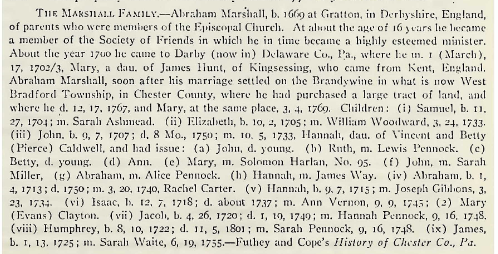
In the Youlgreave parish registers I found a baptism in 1667 for Humphrey Marshall son of Humphrey and Hannah. I didn’t find a baptism for Abraham, but it looks as though it could be correct. Abraham had a son he named Humphrey. But did it just look logical to whoever wrote the books, or do they know for sure? Did the famous botanist Humphrey Marshall have his own family records? The books don’t say where they got this information.
An earlier Humphrey Marshall was baptised in Youlgreave in 1559, his father Edmund. And in 1591 another Humphrey Marshall was baptised, his father George.
But can we connect these Marshall’s to ours? We do have an Abraham Marshall, grandson of Charles, born in 1792. The name isn’t all that common, so may indicate a family connection. The villages of Elton, Gratton and Youlgreave are all very small and it would seem very likely that the Marshall’s who went the USA are related to ours, if not brothers, then probably cousins.
Derbyshire Quakers
In “Derbyshire Quakers 1650-1761” by Helen Forde:
“… Friends lived predominantly in the northern half of the country during this first century of existence. Numbers may have been reduced by emigration to America and migration to other parts of the country but were never high and declined in the early eighteenth century. Predominantly a middle to lower class group economically, Derbyshire Friends numbered very few wealthy members. Many were yeoman farmers or wholesalers and it was these groups who dominated the business meetings having time to devote themselves to the Society. Only John Gratton of Monyash combined an outstanding ministry together with an organising ability which brought him recognition amongst London Friends as well as locally. Derbyshire Friends enjoyed comparatively harmonious relations with civil and Anglican authorities, though prior to the Toleration Act of 1639 the priests were their worst persecutors…..”
Also mentioned in this book: There were monthly meetings in Elton, as well as a number of other nearby places.
John Marshall of Elton 1682/3 appears in a list of Quaker emigrants from Derbyshire.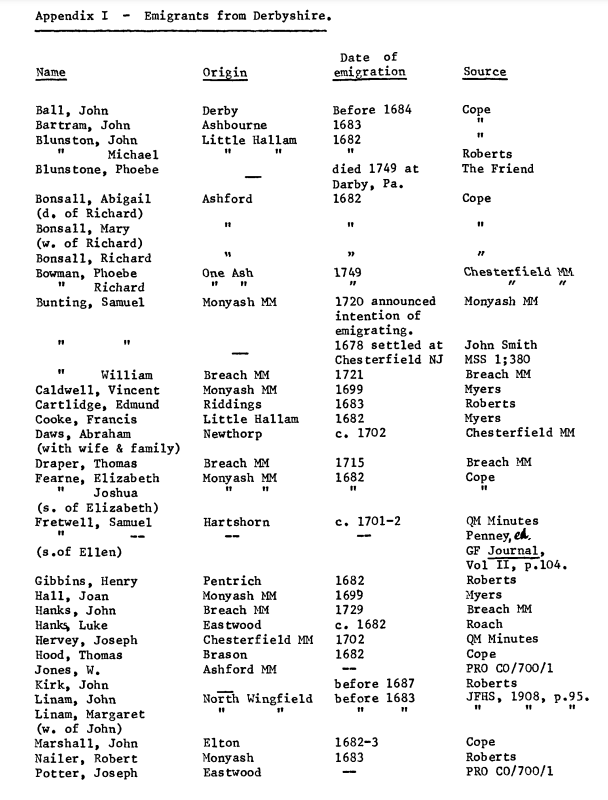
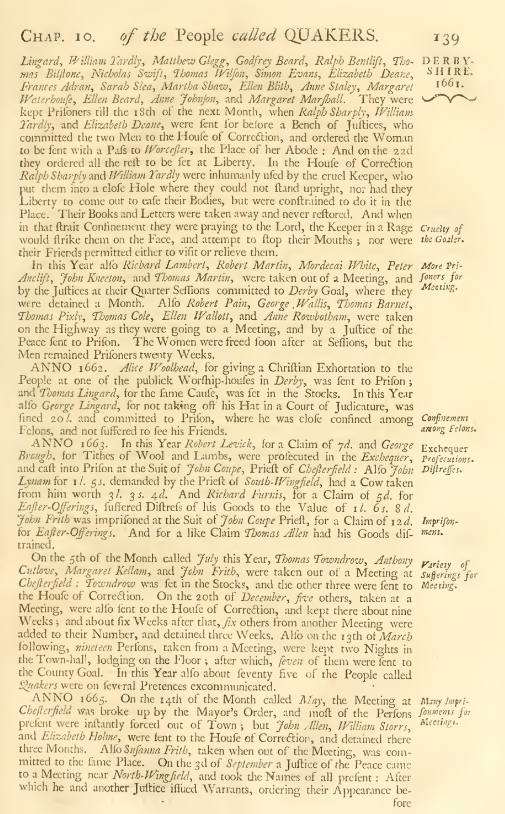
The following image is a page from the 1753 book on the sufferings of Quakers by Joseph Besse as an example of some of the persecutions of Quakers in Derbyshire in the 1600s:
A collection of the sufferings of the people called Quakers, for the testimony of a good conscience from the time of their being first distinguished by that name in the year 1650 to the time of the act commonly called the Act of toleration granted to Protestant dissenters in the first year of the reign of King William the Third and Queen Mary in the year 1689 (Volume 1)
Besse, Joseph. 1753Note the names Margaret Marshall and Anne Staley. This book would appear to contradict Helen Forde’s statement above about the harmonious relations with Anglican authority.
The Botanist
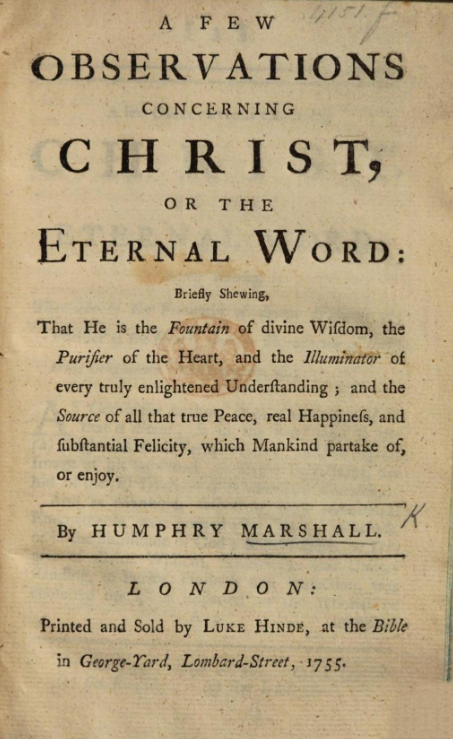
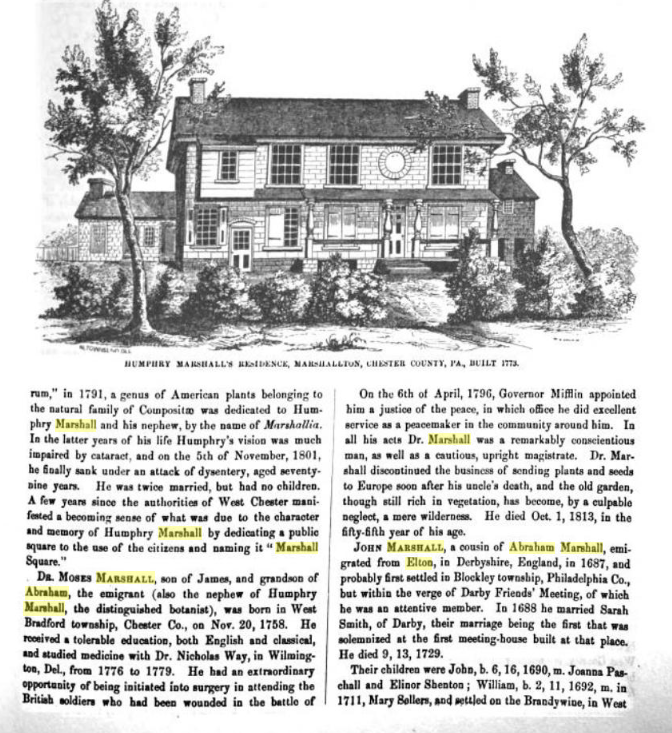
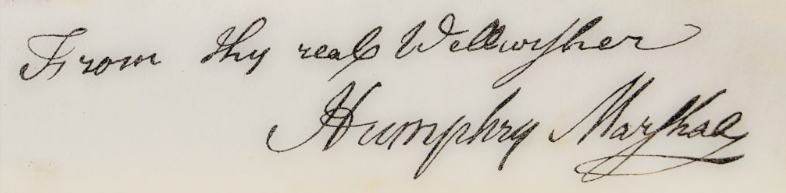
Humphry Marshall 1722-1801 was born in Marshallton, Pennsylvania, the son of the immigrant from Elton, Abraham Marshall. He was the cousin of botanists John Bartram and William Bartram. Like many early American botanists, he was a Quaker. He wrote his first book, A Few Observations Concerning Christ, in 1755.
In 1785, Marshall published Arbustrum Americanum: The American Grove, an Alphabetical Catalogue of Forest Trees and Shrubs, Natives of the American United States (Philadelphia).
Marshall has been called the “Father of American Dendrology”.
A genus of plants, Marshallia, was named in honor of Humphry Marshall and his nephew Moses Marshall, also a botanist.
In 1848 the Borough of West Chester established the Marshall Square Park in his honor. Marshall Square Park is four miles east of Marshallton.
via Wikipedia.
From The History of Chester County Pennsylvania, 1881, by J Smith Futhey and Gilbert Cope:
From The Chester Country History Center:
“Immediately on the Receipt of your Letter, I ordered a Reflecting Telescope for you which was made accordingly. Dr. Fothergill had since desired me to add a Microscope and Thermometer, and will
pay for the whole.’– Benjamin Franklin to Humphry, March 18, 1770
“In his lifetime, Humphry Marshall made his living as a stonemason, farmer, and miller, but eventually became known for his contributions to astronomy, meteorology, agriculture, and the natural sciences.
In 1773, Marshall built a stone house with a hothouse, a botanical laboratory, and an observatory for astronomical studies. He established an arboretum of native trees on the property and the second botanical garden in the nation (John Bartram, his cousin, had the first). From his home base, Humphry expanded his botanical plant exchange business and increased his overseas contacts. With the help of men like Benjamin Franklin and the English botanist Dr. John Fothergill, they eventually included German, Dutch, Swedish, and Irish plant collectors and scientists. Franklin, then living in London, introduced Marshall’s writings to the Royal Society in London and both men encouraged Marshall’s astronomical and botanical studies by supplying him with books and instruments including the latest telescope and microscope.
Marshall’s scientific work earned him honorary memberships to the American Philosophical Society and the Philadelphia Society for Promoting Agriculture, where he shared his ground-breaking ideas on scientific farming methods. In the years before the American Revolution, Marshall’s correspondence was based on his extensive plant and seed exchanges, which led to further studies and publications. In 1785, he authored his magnum opus, Arbustum Americanum: The American Grove. It is a catalog of American trees and shrubs that followed the Linnaean system of plant classification and was the first publication of its kind.”
 July 5, 2024 at 6:39 pm #7531
In reply to: Washed off the sea ~ Creative larks
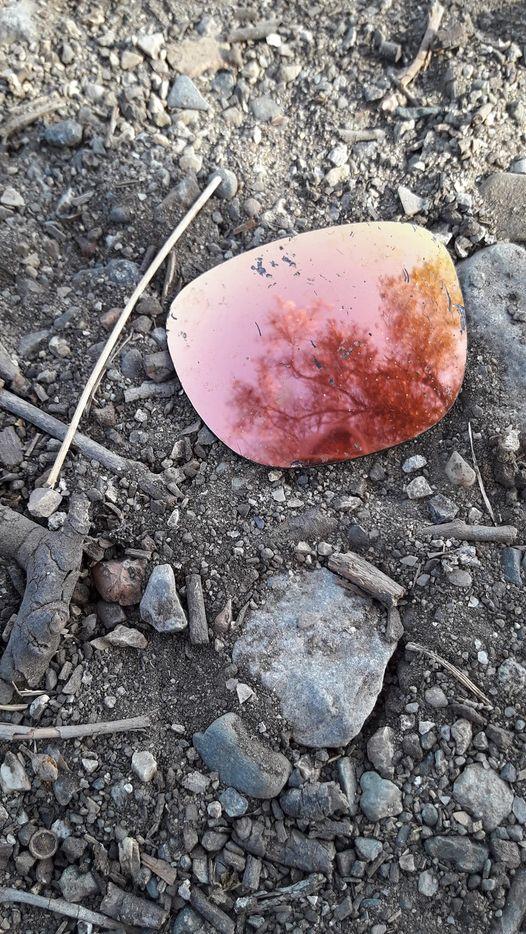
The rose coloured spectacle lens.
Aunt Idle:
“Well, crikey, finding one pink sunglass lens on the road is quite the curiosity, isn’t it? Let’s delve into the symbolic undertones of such an odd discovery. Pink lens, no less—a splash of color with quite the story to tell.
1. Seeing the World through Rose-Tinted Glasses: Finding a pink sunglass lens can symbolize optimism and seeing the world in a positive light. But here’s the kicker—it’s just one lens. This suggests a duality; perhaps you’re being asked to blend optimism with realism. Life isn’t always about sunshine and rainbows, but choosing to see the bright side can balance out the darker shades.
2. Fragmented Perspectives: A single lens means you don’t have the full picture. You’re seeing things partially, which can indicate missing information or a need to look at situations from multiple angles. It’s a nudge to take off those blinders and open your other eye, figuratively speaking. You might be clinging to a half-truth or ignoring an important aspect of your life.
3. Lost and Found: In practical terms, a lone lens on the road means someone has lost it. It’s a signifier of separation, maybe something in your life has split or broken apart. It can be a gentle reminder to look into areas where you might have lost connection—be it with loved ones, a project, or even a part of yourself.
4. Symbol of Love and Compassion: Pink is often associated with love, compassion, and femininity. The lens could be a reminder to look at things with kindness and empathy. Perhaps there’s a situation in your life that requires a softer, more loving approach.
5. Hindsight and Insight: The road is a metaphor for your life’s journey. Finding the lens there might hint at reflecting on past experiences (hindsight) while gaining new understanding or clarity (insight). Maybe there’s an opportunity to learn from what’s happened and apply it moving forward, seeing things with fresh, yet incomplete, clarity.
Putting it in Truella’s Context: If Truella found this lens, it could be a sign she needs to reassess her current path or research direction. Her overwhelming stack of books and discovery of the ancient manuscript hint at a bigger picture she might not be seeing clearly yet. Perhaps she’s overly focused on one aspect and neglecting others.
Personal Symbolism for Aunt Idle: For you, Aunt Idle, this lens could be a cheeky nudge to reassess some of your adventurous antics and half-remembered tales. Maybe there’s an old mystery or a relationship needing a fresh perspective. Or it’s just life’s way of saying, “Look closer, love—you might be missing out!”
In any case, a single pink sunglass lens is a quirky, delightful piece of life’s puzzle, inviting you to ponder, reflect, and adjust your view. So, next time you’re journeying on the dusty roads of life and stumble upon such oddities, take a moment—there just might be a zinger of wisdom waiting for you. Cheers!”
“A lone pink lens paves the road to the unseen clarity of kaleidoscopic sunrise.”
~Journey of Reflections, Enrich P. Lwellman. The Snoot:
“Ahhh, a single pink lens, lost and found amidst the stone and dust! Sings of mysteries and tales untold! Perhaps a sprite misplaced their vision or a pixie left a clue.
Lean close! Such a find whispers soft secrets:
Balance Broken, Yet Bright Like seeing life with a tint of whimsy! One eye tinted pink, the other clear. A call to mix reality with dreams, maybe?
Half Truth, Half Fantasy A hint that stories blend truths and imaginations. Seek both sides to find whole pictures.
Lost and Waiting Could be a sign someone’s journey is incomplete, needing you as a puzzle piece. Maybe the other lens waits for your path?Snootly wisdom: Use the lens not to see, but to imagine.Peer through the pink and let dreams color your heart. Could be you’re on the cusp of a grand adventure; just follow the allure of the pink!
Liz:
Oh, darling, how positively intriguing! A single pink sunglass lens left upon the road—why, it’s like a snippet from one of my novels, fraught with symbolism and brimming with untold stories.
Let’s unravel this little mystery together, shall we? First, the color pink itself is rich with meaning. It speaks of love, compassion, and a certain kind of whimsicality. It’s a hue that embodies the gentle side of passion, the tender whispers of the heart. Now, to find just one lens, separated from its twin, adds a layer of poignancy. It’s a fragment of something once whole, a poignant reminder of loss or incompletion.
One might surmise that this lens represents a part of oneself that has been misplaced or overlooked. Perhaps it’s a call to rediscover a piece of your own heart, the softer, more romantic side that life’s hustle and bustle may have sidelined. Or it could symbolize a different perspective—after all, sunglasses shield us from the sun’s glare, making things clearer in their own shaded way. This lone lens might be urging you to look at a situation with fresh eyes, to find beauty in the fragmented and the unexpected.
Imagine, if you will, a character in one of my novels stumbling upon this very lens. They’d be on the cusp of a grand adventure, naturally. The pink lens would become their talisman, a clue leading them to unforeseen revelations and untold treasures. It would be both a physical object and a metaphorical guide, urging them to view the world—and their place within it—through a lens of love and compassion.
Perhaps it is also a nod to the impermanence of things, a gentle reminder that beauty and meaning can be found even in life’s fleeting moments. Much like the single pink lens, our journeys are filled with fragments of experiences that, when pieced together, create a mosaic of our existence.
So, my dear, take this as a sign to embrace the whimsical, to seek out the overlooked pieces of your own story, and to cherish the beauty of the incomplete. After all, it’s the mysteries and the musings that make life a narrative worth living.
Mater:
Ah, a single pink sunglass lens on the road, you say? Now that’s a curious find. Objects like that can be teeming with symbolic meaning if you’ve got the eyes to see it. Let’s break it down a bit, shall we?
Firstly, the color pink. Traditionally, pink is associated with love, compassion, and nurturing. It’s a color that often brings to mind warmth and affection, something tender and gentle. But finding just one lens suggests something is missing or incomplete—a piece of a larger whole.
A sunglass lens, on the other hand, is meant to protect the eyes from harsh light, allowing you to see the world more clearly without being blinded. Seeing through a pink lens, metaphorically speaking, can mean looking at life with an optimistic or compassionate perspective. It’s like seeing the world through rose-colored glasses, as they say.
Now, finding just one lens on the road—well, roads are pathways, journeys, the direction we take in life. A single lens could indicate a moment of clarity or a shift in perspective on your journey. But it could also symbolize a need to find balance or the missing piece of your outlook to see the full picture clearly.
Maybe it’s a nudge from the universe to take a closer look at how you view your current path. Are you seeing things in the best light possible? Or perhaps it’s a reminder that while optimism and compassion are vital, you might be missing another crucial aspect—realism or practicality, perhaps?
Or, it could be as simple as a reminder to lighten up and find joy and playfulness in your journey.
Like a pink flamingo standing on one leg, sometimes life’s oddities are just there to make you smile and wonder.
Whatever the meaning, love, take it as a sign to reflect and consider. The road ahead is always full of mystery and wonder, and sometimes the smallest things can carry the biggest messages.
Finnley:
Pink sunglass lens on the road, you say? Well, ain’t that a curious bit of rubbish. If we’re dabbling in symbolism, it could mean a variety of things depending on how fanciful you want to get. Pink is often associated with love, compassion, and care. So, finding a lens could mean you’re only seeing half the picture when it comes to matters of the heart. Or maybe you’re missing the rosy view on life, and you need to adjust your perspective.
Then again, it could just mean some poor sod lost their sunnies and now they’ve got a squint and a sunburnt nose. Life’s not always riddled with deep meanings, sometimes it’s just a bit of lost plastic on the tarmac.
Now, if you ask me, you ought to be more concerned about the litter. If everyone went around leaving bits and bobs all over the place, we’d be living in a right tip. So pick it up, toss it in the bin, and let’s keep things tidy, shall we?
Mandrake:
Ah, the solitary pink sunglass lens on the road. Delightfully poetic. A symbol of half-seen truths, perhaps? Seeing the world through rose-tinted glasses, but only partially. Could it be urging you to seek balance, to view life with both optimism and realism? Or maybe just a nudge from the universe to pick up your litter. Such profundity from a piece of plastic. Life’s a riddle, darling.
Sha: A pink sunglass lens on the road, eh? Now that’s a right peculiar find if ever I ‘eard one. Makes you wonder what it means, don’t it?
Glo: Oh, Sha, you’re always lookin’ for the hidden meanin’ in things. It’s just a bit of plastic, ain’t it? Though, come to think of it, pink’s a powerful colour. Symbolises love, compassion, and all that mushy stuff.
Mavis: I reckon it might be a sign, ladies. A pink lens… maybe it’s tellin’ you to look at the world through rose-tinted glasses, y’know? See the good in things. Or it could be a message from the universe, remindin’ you to keep an eye out for the unusual.
Sha: Right you are, Mav! And let’s not forget the conspiracies! Maybe it’s a clue from them secret societies, leavin’ hints for those sharp enough to notice. Could be part of a bigger puzzle, a breadcrumb leadin’ to somethin’ magnificent.
Glo: Or maybe someone’s just dropped their specs out the car window in a rush, and it’s nothin’ more than that. But where’s the fun in that sort of thinkin’?
Mavis: True, true. We’ll go with the idea that it’s a symbol of keepin’ an open mind and lookin’ out for the small wonders of life. Who knows what other treasures we might find if we keep our eyes peeled?
Sha: And next time we’re out and about, let’s be on the lookout for the other lens. Could be a sign that we’re missin’ half the picture.
Glo: Oh, you and your signs, Sha! But alright, we’ll keep our peepers open. Never know what the universe might be tryin’ to tell us next.
June 29, 2024 at 10:01 pm #7527In reply to: The Incense of the Quadrivium’s Mystiques
It was good to get a break from the merger craziness. Eris was thankful for the small mercy of a quiet week-end back at the cottage, free of the second guessing of the suspicious if not philandering undertakers, and even more of the tedious homework to cement the improbable union of the covens.
The nun-witches had been an interesting lot to interact with, but Eris’d had it up to her eyeballs of the tense and meticulous ceremonies. They had been brewing potions for hours on, trying to get a suitable mixture between the herbs the nuns where fond of, and the general ingredients of their own Quadrivium coven’s incenses. Luckily they had been saved by the godlike apparition of another of Frella’s multi-tasking possessions, this time of a willing Sandra, and she’s had harmonized in no time the most perfect blend, in a stroke of brilliance and sheer inspiration, not unlike the magical talent she’d displayed when she invented the luminous world-famous wonder that is ‘Liz n°5’.
As she breathed in the sweet air, Eris could finally enjoy the full swing of summer in the cottage, while Thorsten was happily busy experimenting with an assortment of cybernetic appendages to cut, mulch, segment and compost the overgrown brambles and nettles in the woodland at the back of the property.
Interestingly, she’d received a letter in the mail — quaintly posted from Spain in a nondescript envelop —so anachronistic it was too tempting to resist looking.
Without distrust, but still with a swish of a magical counterspell in case the envelop had traces of unwanted magic, she opened it, only to find it burst with an annoying puff of blue glitter that decided to stick in every corner of the coffee table and other places.
Eris almost cursed at the amount of micro-plastics, but her attention was immediately caught by the Latin sentence mysteriously written in a psychopath ransom note manner: “QUAERO THESAURUM INCONTINUUM”
“Whisp! Elias? A little help here, my Latin must be wrong. What accumulation of incontinence? What sort of spell is that?!”
Echo appeared first, looking every bit like the reflection of Malové. “Quaero Thesaurum Incontinuum,” you say. How quaint, how cryptic, how annoyingly enigmatic. Eris, it seems the universe has a sense of humor—sending you this little riddle while you’re neck-deep in organizational chaos.
“Oh, Echo, stop that! I won’t spend my well-earned week-end on some riddle-riddled chase…”
“You’re no fun Eris” the sprite said, reverting into a more simple form. “It translates roughly to “I seek the endless treasure.” Do you want me to help you dissect this more?”
“Why not…” Eris answered pursing up her lips.
““Seek the endless treasure.” We’re talking obviously something deeper, more profound than simple gold; maybe knowledge —something truly inexhaustible. Given your current state of affairs, with the merger and the restructuring, this message could be a nudge—an invitation to look beyond the immediate chaos and find the opportunity within.”
“Sure,” Eris said, already tired with the explanations. She was not going to spend more time to determine the who, the why, and the what. Who’d sent this? Didn’t really matter if it was an ally, a rival, or even a neutral party with vested interests? She wasn’t interested in seeking an answer to “why now?”. Endless rabbit holes, more like it.
The only conundrum she was left with was to decide whether to keep the pesky glittering offering, or just vacuum the hell of it, and decide if it could stand the test of ‘will it blend?’. She wrapped it in a sheet of clear plastic, deciding it may reveal more clues in the right time.
With that done, Eris’ mind started to wander, letting the enigmatic message linger a while longer… as reminder that while we navigate the mundane, our eyes must always be on the transcendent. To seek the endless treasure…
The thought came to her as an evidence “Death? The end of suffering…” To whom could this be an endless treasure? Eris sometimes wondered how her brain picked up such things, but she rarely doubted it. She might have caught some vibes during the various meetings. Truella mentioning Silas talking about ‘retiring nuns’, or Nemo hinting at Penelope that ‘death was all about…”
The postcard was probably a warning, and they had to stay on their guards.
But now was not the time for more drama, the icecream was waiting for her on the patio, nicely prepared by Thorsten who after a hard day of bramble mulching was all smiling despite looking like he had went through a herd of cats’ fight.
- November 2024 (Reunion):
-
AuthorSearch Results
