-
AuthorSearch Results
-
April 6, 2023 at 10:34 am #7224
In reply to: The Jorid’s Travels – 14 years on
Georges was following an orange line on the floor of Jorid’s corridor with Barney on his left shoulder. The man was talking to the creature and listening to the occasional chirps Barney made as if they were part of a normal conversation.
“You see, Barney,” said Georges. “Salomé gave us this checklist.” He tapped on the clipboard with his index finger. “I have to conduct all those experiments with you in the lab while she’s doing whatever she’s doing with the maps. Salomé loves maps, I can tell you. Always trying to invent new ones that would help us navigate all those dimensions. But they confuse me, so I’m glad to leave that to her and Jorid.”
The two of them stopped in front of an orange door with a tag on it.
“So you’ll ask me: ‘Georges, why are we going to the kitchen instead of going into the lab?’ —which is the blue door.”
Georges waited for Barney’s chirp before continuing.
“You’re right! She forgot the most important. What do you like to eat? You can’t do that in a lab with instruments stuck onto your head and tummy. It’s best done in the warm and cozy atmosphere of a kitchen.”
The door swooshed open and they entered a bland, sanitised kitchen.
“Jorid, morph the kitchen into a 19th century style pub, with greasy smells and a cozy atmosphere.”
“Shouldn’t you be into the lab?” asked Jorid.
“Let’s call it a kitchen lab,” answered Georges. “So you can tell Salomé I’m in the lab if she asks you.”
“Most certainly.”
The bland rooms started wobbling and becoming darker. Gas wall lamps were coming out of the walls, and a Chandeliers bloomed from the ceiling. The kitchen island turned into a mahogany pub counter behind which the cupboards turned into glass shelves with a collection of colourful liquor bottles. Right beside the beer pumps was the cornucopia, the source of all things edible, the replicator. It was simple and looked like a silver tray.
“That’s more like it,” said Georges. He put Barney on the counter and the creature chirped contentedly to show his agreement.
“Now, You don’t look like the kind of guy who eat salad”, said Georges. “What do you want to try?”
Barney shook his head and launched into a series of chirps and squeals.
“I know! Let’s try something you certainly can’t find where you come from… outer space. Jorid, make us some good pickles in a jar.”
The replicator made a buzzing sound and a big jar full of pickles materialised on the silver tray. Barney chirped in awe and Georges frowned.
“Why did you make a Roman jar?” he asked. “We’re in a 19th century pub. And the pickles are so huge! Aubergine size.”
“My apologies,” said Jorid. “I’m confused. As you know, my database is a bit scrambled at the moment…”
“It’s ok,” said Georges who feared the ship would launch into some unsolicited confidences and self deprecating moment. “A pickle is a pickle anyway.” He picked a pickle in the jar and turned towards Barney with a big grin. “Let’s try some.”
Barney’s eyes widened. He put his hands in front of him and shook his head. The door swooshed open.
“What have you done with the kitchen?” asked Léonard. “And what are you trying to feed this rat with?”
“This rat has a name. It’s Barney. What are you doing here?” asked Georges.
“Well, Isn’t it a kitchen? I’m hungry.”
“I mean, shouldn’t you go check your vitals first in med bay?”
“When you feel hungry, it’s enough to tell a man he’s alive and well,” said Léonard. “Nice roman jar, Jorid. Depicting naked roman fighters, archaeological finding of 2nd century BC, good state of conservation.” He looked closer. “Intricate details between the legs… You surpassed yourself on that one Jorid.”
“Thanks for the compliment Léonard. It’s reassuring to know I’m still doing great at some things when others think I’m losing it.”
“I never said…” started Georges.
“You thought it.”
Léonard took a pickle from the jar and smelled it. He winced.
“Sure, smells like pickles enough,” he said, putting it back in the jar and licking his finger. “Disgusting.” He looked at Georges. “I was thinking of taking a shuttle and doing a little tour, while you solve the navigational array problem with Salomé.”
“Why are you asking me? Why don’t you just take a shuttle and go there by yourself?”
“Jorid won’t let me take one.”
“Jorid? Why don’t you let Léonard take a shuttle?”
“Salomé said he’s not to be left out of the ship without supervision.”
“Oh! Right,” said Georges. “We just rescued you from a sand prison egg where you’ve been kept in stasis for several weeks and you can’t remember anything that led you there. Why don’t we let you pilot a shuttle and wander about on your own?”
Léonard looked at Georges, annoyed. He picked a pickle from the jar and took a bite. Barney squealed. As Léonard chewed and made crunching sounds, the creature hit its head with its paw.
“Then why don’t you come with me?” asked Léonard.
“I can’t believe it.”
“What? You go with me. You can supervise me wherever I go. Problem solved.”
“No. I mean. You eating one of Barney’s pickles.”
Léonard took another bite and chewed noisily. Barney chirped and squealed. He put his hands to its throat and spat on the counter.
“I’m sure he won’t mind. Look at him. Doesn’t seem it likes pickles that much.”
“You hate pickles, Léonard.”
“I know. That’s disgusting.”
“Why do you eat them if you find it disgusting?”
“That’s the sound of it. It’s melodious. And for some reason those pickles are particularly good.”
Barney jumped on Georges arm and ran to his neck where he planted his little claws in.
“Ouch!” said Georges. He slapped Léonard’s hand before the man could take one more pickle bite. “What the f*ck?”
“Hey! Why did you do that?”
“It’s not me,” said Georges. Barney squealed and Georges’s hands pushed the jar on the floor. It crashed and a flood of pickle and vinegar juice spread on the floor.
“Haven’t your mother told you not to play with food?” asked Léonard diving on the floor to catch some more pickles. Barney chirped and squealed while Georges’s body jumped on Léonard and they both rolled over in the pickles.
The door swooshed open.
“Guys, we need to…” started Salomé. She had a set of maps in her hands. “What’s that smell? What… did you do to the kitchen? ”
“Georges made me do it,” said Jorid.
“Georges broke a 2nd century BC jar,” said Léonard.
“Barney’s controlling me,” said Georges.
The creature shrugged and removed its claws from Georges’ neck.
“Squeak!”
“Ouch! Thank you,” said Georges, licking the pickle juice he got on his lips during the fight.
“I can’t believe it. Georges, you had a checklist. And it did not include the words kitchen or pickles or making a mess. And Léonard, you hate pickles.”
“I know,” said Léonard who took a bite in the pickle he was holding. “That’s disgusting, but I can’t help it they taste so good.”
Georges stole the pickle from Léonard’s hand and took a bite.
“Pick your own pickle,” said Léonard, stealing it back.
“Stop guys! That smell… Jorid what did you put in those pickles?”
“I took the liberty to change the recipe and added some cinnamon.”
“It doesn’t smell like cinnamon,” said Georges smelling his hands full of pickle juice. He took a bite in one and said: “Doesn’t taste like cinnamon either. I would know. I hate cinnamon since the time I was turned into an Asari.”
“That’s it,” said Salomé. “What kind of cinnamon did you put in the brew, Jorid?”
“I’ve heard it’s best to use local ingredients. I put cinnamon from Langurdy,” said the ship.
“Quick! Guys, spit it out,” she said, kneeling and putting her fingers into Georges’ throat to make him puke. “Jorid, make away with the pickles,” said Salomé.
“Nooo,” said the men.
“Cinnamon from Langurdy is very addictive,” Salomé snapped. “You don’t want to OD on pickles, do you?”
After they got the mess cleaned up and the kitchen went back to its normal blank state. Georges and Léonard took some pills to counter the effects of withdrawal. Salomé had them sit at the kitchen table. Georges kept blinking as if the white light on the white walls were hurting his eyes.
“You can thank Barney if you didn’t eat more pickles,” said Salomé. “You could have had a relapse, and you know how bad it was the first time you had to flush cinnamon from your body.”
Georges groaned.
“Anyway. I checked the maps with Jorid and I came upon an anomaly in the Southern Deserts. Something there is causing Jorid’s confusion. We’ll have to go down there if we ever want to leave this place and time.”
January 19, 2023 at 10:49 am #6419In reply to: Orbs of Madjourneys
“I’d advise you not to take the parrot, Zara,” Harry the vet said, “There are restrictions on bringing dogs and other animals into state parks, and you can bet some jobsworth official will insist she stays in a cage at the very least.”
“Yeah, you’re right, I guess I’ll leave her here. I want to call in and see my cousin in Camden on the way to the airport in Sydney anyway. He has dozens of cats, I’d hate for anything to happen to Pretty Girl,” Zara replied.
“Is that the distant cousin you met when you were doing your family tree?” Harry asked, glancing up from the stitches he was removing from a wounded wombat. “There, he’s good to go. Give him a couple more days, then he can be released back where he came from.”
Zara smiled at Harry as she picked up the animal. “Yes! We haven’t met in person yet, and he’s going to show me the church my ancestor built. He says people have been spotting ghosts there lately, and there are rumours that it’s the ghost of the old convict Isaac who built it. If I can’t find photos of the ancestors, maybe I can get photos of their ghosts instead,” Zara said with a laugh.
“Good luck with that,” Harry replied raising an eyebrow. He liked Zara, she was quirkier than the others.
Zara hadn’t found it easy to research her mothers family from Bangalore in India, but her fathers English family had been easy enough. Although Zara had been born in England and emigrated to Australia in her late 20s, many of her ancestors siblings had emigrated over several generations, and Zara had managed to trace several down and made contact with a few of them. Isaac Stokes wasn’t a direct ancestor, he was the brother of her fourth great grandfather but his story had intrigued her. Sentenced to transportation for stealing tools for his work as a stonemason seemed to have worked in his favour. He built beautiful stone buildings in a tiny new town in the 1800s in the charming style of his home town in England.
Zara planned to stay in Camden for a couple of days before meeting the others at the Flying Fish Inn, anticipating a pleasant visit before the crazy adventure started.

Zara stepped down from the bus, squinting in the bright sunlight and looking around for her newfound cousin Bertie. A lanky middle aged man in dungarees and a red baseball cap came forward with his hand extended.
“Welcome to Camden, Zara I presume! Great to meet you!” he said shaking her hand and taking her rucksack. Zara was taken aback to see the family resemblance to her grandfather. So many scattered generations and yet there was still a thread of familiarity. “I bet you’re hungry, let’s go and get some tucker at Belle’s Cafe, and then I bet you want to see the church first, hey? Whoa, where’d that dang parrot come from?” Bertie said, ducking quickly as the bird swooped right in between them.
“Oh no, it’s Pretty Girl!” exclaimed Zara. “She wasn’t supposed to come with me, I didn’t bring her! How on earth did you fly all this way to get here the same time as me?” she asked the parrot.
“Pretty Girl has her ways, don’t forget to feed the parrot,” the bird replied with a squalk that resembled a mirthful guffaw.
“That’s one strange parrot you got here, girl!” Bertie said in astonishment.
“Well, seeing as you’re here now, Pretty Girl, you better come with us,” Zara said.
“Obviously,” replied Pretty Girl. It was hard to say for sure, but Zara was sure she detected an avian eye roll.
They sat outside under a sunshade to eat rather than cause any upset inside the cafe. Zara fancied an omelette but Pretty Girl objected, so she ordered hash browns instead and a fruit salad for the parrot. Bertie was a good sport about the strange talking bird after his initial surprise.
Bertie told her a bit about the ghost sightings, which had only started quite recently. They started when I started researching him, Zara thought to herself, almost as if he was reaching out. Her imagination was running riot already.
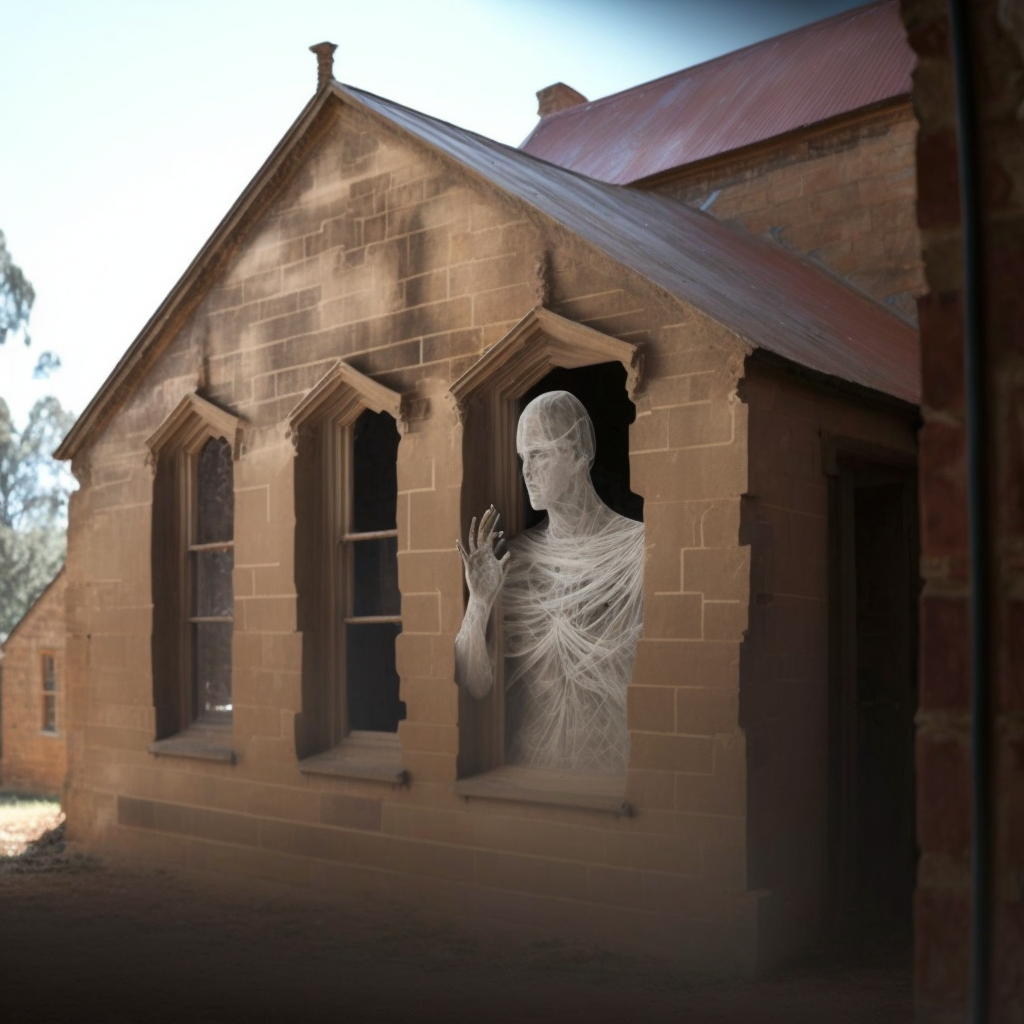
Bertie showed Zara around the church, a small building made of sandstone, but no ghost appeared in the bright heat of the afternoon. He took her on a little tour of Camden, once a tiny outpost but now a suburb of the city, pointing out all the original buildings, in particular the ones that Isaac had built. The church was walking distance of Bertie’s house and Zara decided to slip out and stroll over there after everyone had gone to bed.
Bertie had kindly allowed Pretty Girl to stay in the guest bedroom with her, safe from the cats, and Zara intended that the parrot stay in the room, but Pretty Girl was having none of it and insisted on joining her.
“Alright then, but no talking! I don’t want you scaring any ghost away so just keep a low profile!”
The moon was nearly full and it was a pleasant walk to the church. Pretty Girl fluttered from tree to tree along the sidewalk quietly. Enchanting aromas of exotic scented flowers wafted into her nostrils and Zara felt warmly relaxed and optimistic.
Zara was disappointed to find that the church was locked for the night, and realized with a sigh that she should have expected this to be the case. She wandered around the outside, trying to peer in the windows but there was nothing to be seen as the glass reflected the street lights. These things are not done in a hurry, she reminded herself, be patient.
Sitting under a tree on the grassy lawn attempting to open her mind to receiving ghostly communications (she wasn’t quite sure how to do that on purpose, any ghosts she’d seen previously had always been accidental and unexpected) Pretty Girl landed on her shoulder rather clumsily, pressing something hard and chill against her cheek.
“I told you to keep a low profile!” Zara hissed, as the parrot dropped the key into her lap. “Oh! is this the key to the church door?”
It was hard to see in the dim light but Zara was sure the parrot nodded, and was that another avian eye roll?
Zara walked slowly over the grass to the church door, tingling with anticipation. Pretty Girl hopped along the ground behind her. She turned the key in the lock and slowly pushed open the heavy door and walked inside and up the central aisle, looking around. And then she saw him.
Zara gasped. For a breif moment as the spectral wisps cleared, he looked almost solid. And she could see his tattoos.
“Oh my god,” she whispered, “It is really you. I recognize those tattoos from the description in the criminal registers. Some of them anyway, it seems you have a few more tats since you were transported.”
“Aye, I did that, wench. I were allays fond o’ me tats, does tha like ’em?”
He actually spoke to me! This was beyond Zara’s wildest hopes. Quick, ask him some questions!
“If you don’t mind me asking, Isaac, why did you lie about who your father was on your marriage register? I almost thought it wasn’t you, you know, that I had the wrong Isaac Stokes.”
A deafening rumbling laugh filled the building with echoes and the apparition dispersed in a labyrinthine swirl of tattood wisps.
“A story for another day,” whispered Zara, “Time to go back to Berties. Come on Pretty Girl. And put that key back where you found it.”
 December 6, 2022 at 2:17 pm #6350
In reply to: Family Stories From The Other Side ~ Book Two
Transportation
Isaac Stokes 1804-1877
Isaac was born in Churchill, Oxfordshire in 1804, and was the youngest brother of my 4X great grandfather Thomas Stokes. The Stokes family were stone masons for generations in Oxfordshire and Gloucestershire, and Isaac’s occupation was a mason’s labourer in 1834 when he was sentenced at the Lent Assizes in Oxford to fourteen years transportation for stealing tools.
Churchill where the Stokes stonemasons came from: on 31 July 1684 a fire destroyed 20 houses and many other buildings, and killed four people. The village was rebuilt higher up the hill, with stone houses instead of the old timber-framed and thatched cottages. The fire was apparently caused by a baker who, to avoid chimney tax, had knocked through the wall from her oven to her neighbour’s chimney.
Isaac stole a pick axe, the value of 2 shillings and the property of Thomas Joyner of Churchill; a kibbeaux and a trowel value 3 shillings the property of Thomas Symms; a hammer and axe value 5 shillings, property of John Keen of Sarsden.
(The word kibbeaux seems to only exists in relation to Isaac Stokes sentence and whoever was the first to write it was perhaps being creative with the spelling of a kibbo, a miners or a metal bucket. This spelling is repeated in the criminal reports and the newspaper articles about Isaac, but nowhere else).
In March 1834 the Removal of Convicts was announced in the Oxford University and City Herald: Isaac Stokes and several other prisoners were removed from the Oxford county gaol to the Justitia hulk at Woolwich “persuant to their sentences of transportation at our Lent Assizes”.
via digitalpanopticon:
Hulks were decommissioned (and often unseaworthy) ships that were moored in rivers and estuaries and refitted to become floating prisons. The outbreak of war in America in 1775 meant that it was no longer possible to transport British convicts there. Transportation as a form of punishment had started in the late seventeenth century, and following the Transportation Act of 1718, some 44,000 British convicts were sent to the American colonies. The end of this punishment presented a major problem for the authorities in London, since in the decade before 1775, two-thirds of convicts at the Old Bailey received a sentence of transportation – on average 283 convicts a year. As a result, London’s prisons quickly filled to overflowing with convicted prisoners who were sentenced to transportation but had no place to go.
To increase London’s prison capacity, in 1776 Parliament passed the “Hulks Act” (16 Geo III, c.43). Although overseen by local justices of the peace, the hulks were to be directly managed and maintained by private contractors. The first contract to run a hulk was awarded to Duncan Campbell, a former transportation contractor. In August 1776, the Justicia, a former transportation ship moored in the River Thames, became the first prison hulk. This ship soon became full and Campbell quickly introduced a number of other hulks in London; by 1778 the fleet of hulks on the Thames held 510 prisoners.
Demand was so great that new hulks were introduced across the country. There were hulks located at Deptford, Chatham, Woolwich, Gosport, Plymouth, Portsmouth, Sheerness and Cork.The Justitia via rmg collections:
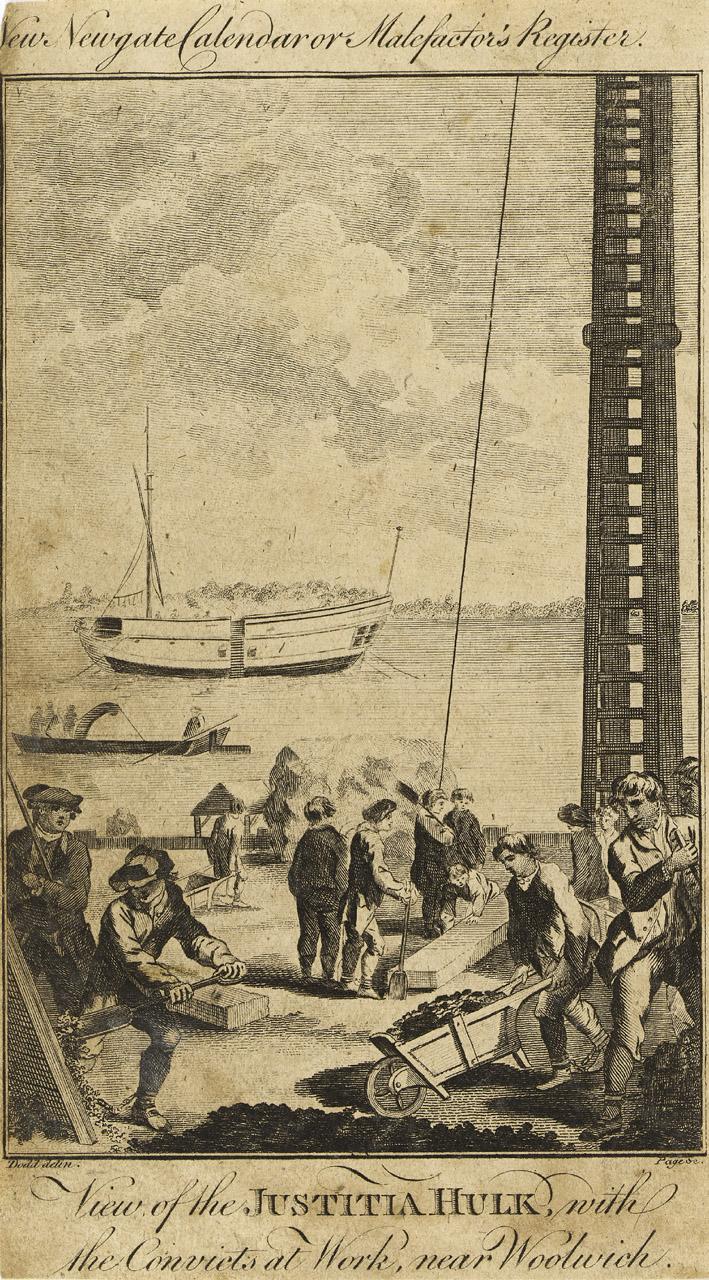
Convicts perform hard labour at the Woolwich Warren. The hulk on the river is the ‘Justitia’. Prisoners were kept on board such ships for months awaiting deportation to Australia. The ‘Justitia’ was a 260 ton prison hulk that had been originally moored in the Thames when the American War of Independence put a stop to the transportation of criminals to the former colonies. The ‘Justitia’ belonged to the shipowner Duncan Campbell, who was the Government contractor who organized the prison-hulk system at that time. Campbell was subsequently involved in the shipping of convicts to the penal colony at Botany Bay (in fact Port Jackson, later Sydney, just to the north) in New South Wales, the ‘first fleet’ going out in 1788.
While searching for records for Isaac Stokes I discovered that another Isaac Stokes was transported to New South Wales in 1835 as well. The other one was a butcher born in 1809, sentenced in London for seven years, and he sailed on the Mary Ann. Our Isaac Stokes sailed on the Lady Nugent, arriving in NSW in April 1835, having set sail from England in December 1834.
Lady Nugent was built at Bombay in 1813. She made four voyages under contract to the British East India Company (EIC). She then made two voyages transporting convicts to Australia, one to New South Wales and one to Van Diemen’s Land (Tasmania). (via Wikipedia)
via freesettlerorfelon website:
On 20 November 1834, 100 male convicts were transferred to the Lady Nugent from the Justitia Hulk and 60 from the Ganymede Hulk at Woolwich, all in apparent good health. The Lady Nugent departed Sheerness on 4 December 1834.
SURGEON OLIVER SPROULE
Oliver Sproule kept a Medical Journal from 7 November 1834 to 27 April 1835. He recorded in his journal the weather conditions they experienced in the first two weeks:
‘In the course of the first week or ten days at sea, there were eight or nine on the sick list with catarrhal affections and one with dropsy which I attribute to the cold and wet we experienced during that period beating down channel. Indeed the foremost berths in the prison at this time were so wet from leaking in that part of the ship, that I was obliged to issue dry beds and bedding to a great many of the prisoners to preserve their health, but after crossing the Bay of Biscay the weather became fine and we got the damp beds and blankets dried, the leaks partially stopped and the prison well aired and ventilated which, I am happy to say soon manifested a favourable change in the health and appearance of the men.
Besides the cases given in the journal I had a great many others to treat, some of them similar to those mentioned but the greater part consisted of boils, scalds, and contusions which would not only be too tedious to enter but I fear would be irksome to the reader. There were four births on board during the passage which did well, therefore I did not consider it necessary to give a detailed account of them in my journal the more especially as they were all favourable cases.
Regularity and cleanliness in the prison, free ventilation and as far as possible dry decks turning all the prisoners up in fine weather as we were lucky enough to have two musicians amongst the convicts, dancing was tolerated every afternoon, strict attention to personal cleanliness and also to the cooking of their victuals with regular hours for their meals, were the only prophylactic means used on this occasion, which I found to answer my expectations to the utmost extent in as much as there was not a single case of contagious or infectious nature during the whole passage with the exception of a few cases of psora which soon yielded to the usual treatment. A few cases of scurvy however appeared on board at rather an early period which I can attribute to nothing else but the wet and hardships the prisoners endured during the first three or four weeks of the passage. I was prompt in my treatment of these cases and they got well, but before we arrived at Sydney I had about thirty others to treat.’
The Lady Nugent arrived in Port Jackson on 9 April 1835 with 284 male prisoners. Two men had died at sea. The prisoners were landed on 27th April 1835 and marched to Hyde Park Barracks prior to being assigned. Ten were under the age of 14 years.
The Lady Nugent:
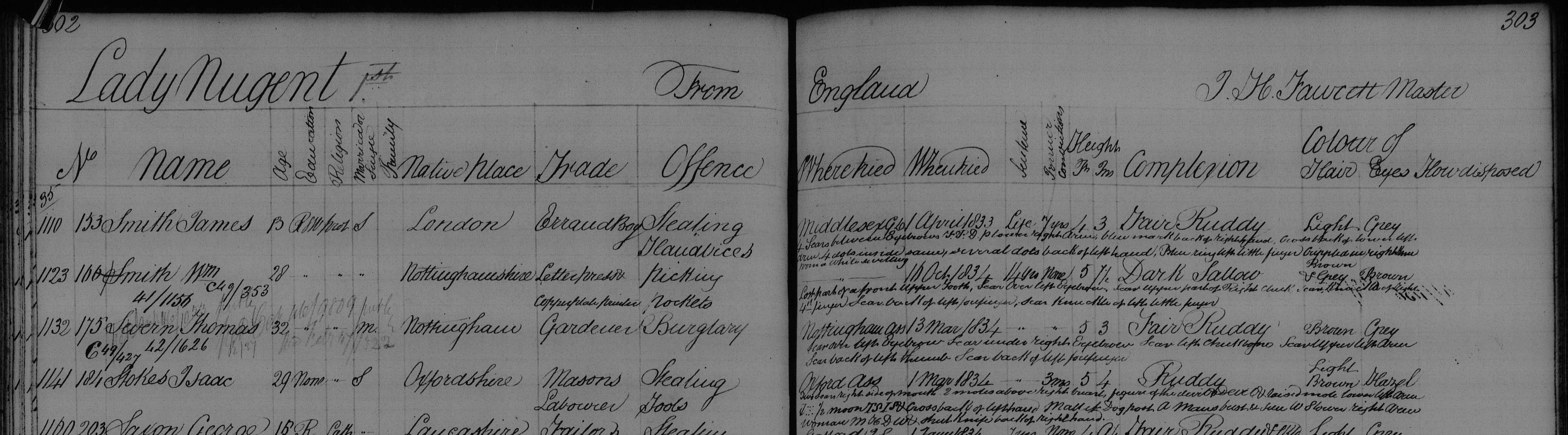
Isaac’s distinguishing marks are noted on various criminal registers and record books:
“Height in feet & inches: 5 4; Complexion: Ruddy; Hair: Light brown; Eyes: Hazel; Marks or Scars: Yes [including] DEVIL on lower left arm, TSIS back of left hand, WS lower right arm, MHDW back of right hand.”
Another includes more detail about Isaac’s tattoos:
“Two slight scars right side of mouth, 2 moles above right breast, figure of the devil and DEVIL and raised mole, lower left arm; anchor, seven dots half moon, TSIS and cross, back of left hand; a mallet, door post, A, mans bust, sun, WS, lower right arm; woman, MHDW and shut knife, back of right hand.”
From How tattoos became fashionable in Victorian England (2019 article in TheConversation by Robert Shoemaker and Zoe Alkar):
“Historical tattooing was not restricted to sailors, soldiers and convicts, but was a growing and accepted phenomenon in Victorian England. Tattoos provide an important window into the lives of those who typically left no written records of their own. As a form of “history from below”, they give us a fleeting but intriguing understanding of the identities and emotions of ordinary people in the past.
As a practice for which typically the only record is the body itself, few systematic records survive before the advent of photography. One exception to this is the written descriptions of tattoos (and even the occasional sketch) that were kept of institutionalised people forced to submit to the recording of information about their bodies as a means of identifying them. This particularly applies to three groups – criminal convicts, soldiers and sailors. Of these, the convict records are the most voluminous and systematic.
Such records were first kept in large numbers for those who were transported to Australia from 1788 (since Australia was then an open prison) as the authorities needed some means of keeping track of them.”On the 1837 census Isaac was working for the government at Illiwarra, New South Wales. This record states that he arrived on the Lady Nugent in 1835. There are three other indent records for an Isaac Stokes in the following years, but the transcriptions don’t provide enough information to determine which Isaac Stokes it was. In April 1837 there was an abscondment, and an arrest/apprehension in May of that year, and in 1843 there was a record of convict indulgences.
From the Australian government website regarding “convict indulgences”:
“By the mid-1830s only six per cent of convicts were locked up. The vast majority worked for the government or free settlers and, with good behaviour, could earn a ticket of leave, conditional pardon or and even an absolute pardon. While under such orders convicts could earn their own living.”
In 1856 in Camden, NSW, Isaac Stokes married Catherine Daly. With no further information on this record it would be impossible to know for sure if this was the right Isaac Stokes. This couple had six children, all in the Camden area, but none of the records provided enough information. No occupation or place or date of birth recorded for Isaac Stokes.
I wrote to the National Library of Australia about the marriage record, and their reply was a surprise! Issac and Catherine were married on 30 September 1856, at the house of the Rev. Charles William Rigg, a Methodist minister, and it was recorded that Isaac was born in Edinburgh in 1821, to parents James Stokes and Sarah Ellis! The age at the time of the marriage doesn’t match Isaac’s age at death in 1877, and clearly the place of birth and parents didn’t match either. Only his fathers occupation of stone mason was correct. I wrote back to the helpful people at the library and they replied that the register was in a very poor condition and that only two and a half entries had survived at all, and that Isaac and Catherines marriage was recorded over two pages.
I searched for an Isaac Stokes born in 1821 in Edinburgh on the Scotland government website (and on all the other genealogy records sites) and didn’t find it. In fact Stokes was a very uncommon name in Scotland at the time. I also searched Australian immigration and other records for another Isaac Stokes born in Scotland or born in 1821, and found nothing. I was unable to find a single record to corroborate this mysterious other Isaac Stokes.
As the age at death in 1877 was correct, I assume that either Isaac was lying, or that some mistake was made either on the register at the home of the Methodist minster, or a subsequent mistranscription or muddle on the remnants of the surviving register. Therefore I remain convinced that the Camden stonemason Isaac Stokes was indeed our Isaac from Oxfordshire.
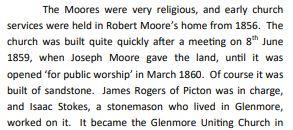
I found a history society newsletter article that mentioned Isaac Stokes, stone mason, had built the Glenmore church, near Camden, in 1859.

From the Wollondilly museum April 2020 newsletter:
From the Camden History website:
“The stone set over the porch of Glenmore Church gives the date of 1860. The church was begun in 1859 on land given by Joseph Moore. James Rogers of Picton was given the contract to build and local builder, Mr. Stokes, carried out the work. Elizabeth Moore, wife of Edward, laid the foundation stone. The first service was held on 19th March 1860. The cemetery alongside the church contains the headstones and memorials of the areas early pioneers.”
Isaac died on the 3rd September 1877. The inquest report puts his place of death as Bagdelly, near to Camden, and another death register has put Cambelltown, also very close to Camden. His age was recorded as 71 and the inquest report states his cause of death was “rupture of one of the large pulmonary vessels of the lung”. His wife Catherine died in childbirth in 1870 at the age of 43.
Isaac and Catherine’s children:
William Stokes 1857-1928
Catherine Stokes 1859-1846
Sarah Josephine Stokes 1861-1931
Ellen Stokes 1863-1932
Rosanna Stokes 1865-1919
Louisa Stokes 1868-1844.
It’s possible that Catherine Daly was a transported convict from Ireland.
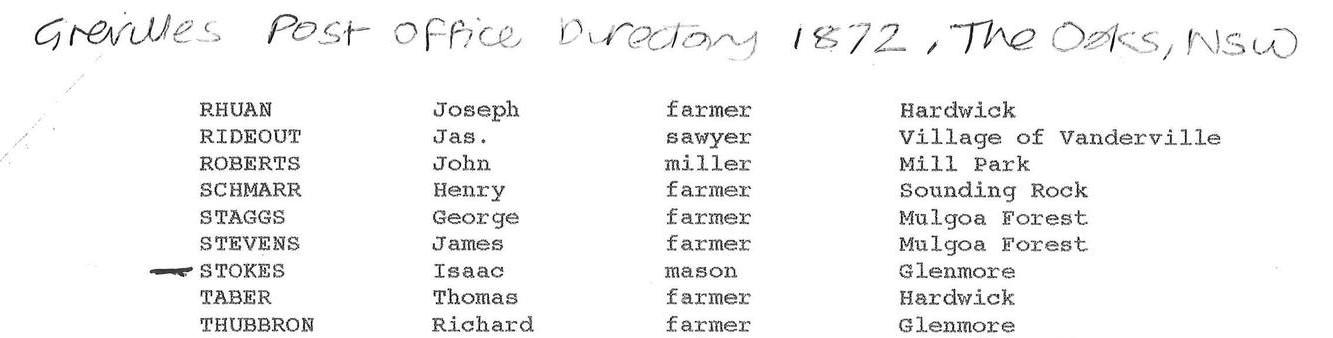
Some time later I unexpectedly received a follow up email from The Oaks Heritage Centre in Australia.
“The Gaudry papers which we have in our archive record him (Isaac Stokes) as having built: the church, the school and the teachers residence. Isaac is recorded in the General return of convicts: 1837 and in Grevilles Post Office directory 1872 as a mason in Glenmore.”
 November 13, 2022 at 10:29 pm #6345
In reply to: Family Stories From The Other Side ~ Book Two
Crime and Punishment in Tetbury
I noticed that there were quite a number of Brownings of Tetbury in the newspaper archives involved in criminal activities while doing a routine newspaper search to supplement the information in the usual ancestry records. I expanded the tree to include cousins, and offsping of cousins, in order to work out who was who and how, if at all, these individuals related to our Browning family.
I was expecting to find some of our Brownings involved in the Swing Riots in Tetbury in 1830, but did not. Most of our Brownings (including cousins) were stone masons. Most of the rioters in 1830 were agricultural labourers.
The Browning crimes are varied, and by todays standards, not for the most part terribly serious ~ you would be unlikely to receive a sentence of hard labour for being found in an outhouse with the intent to commit an unlawful act nowadays, or for being drunk.
The central character in this chapter is Isaac Browning (my 4x great grandfather), who did not appear in any criminal registers, but the following individuals can be identified in the family structure through their relationship to him.
RICHARD LOCK BROWNING born in 1853 was Isaac’s grandson, his son George’s son. Richard was a mason. In 1879 he and Henry Browning of the same age were sentenced to one month hard labour for stealing two pigeons in Tetbury. Henry Browning was Isaac’s nephews son.
In 1883 Richard Browning, mason of Tetbury, was charged with obtaining food and lodging under false pretences, but was found not guilty and acquitted.
In 1884 Richard Browning, mason of Tetbury, was sentenced to one month hard labour for game trespass.Richard had been fined a number of times in Tetbury:
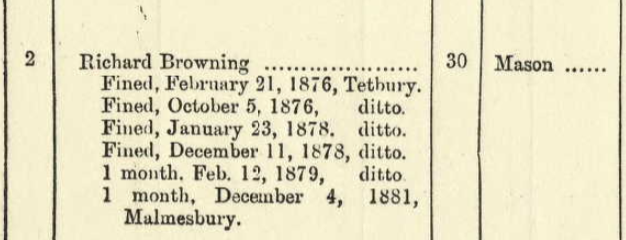
Richard Lock Browning was five feet eight inches tall, dark hair, grey eyes, an oval face and a dark complexion. He had two cuts on the back of his head (in February 1879) and a scar on his right eyebrow.
HENRY BROWNING, who was stealing pigeons with Richard Lock Browning in 1879, (Isaac’s brother Williams grandson, son of George Browning and his wife Charity) was charged with being drunk in 1882 and ordered to pay a fine of one shilling and costs of fourteen shillings, or seven days hard labour.
Henry was found guilty of gaming in the highway at Tetbury in 1872 and was sentenced to seven days hard labour. In 1882 Henry (who was also a mason) was charged with assault but discharged.
Henry was five feet five inches tall, brown hair and brown eyes, a long visage and a fresh complexion.
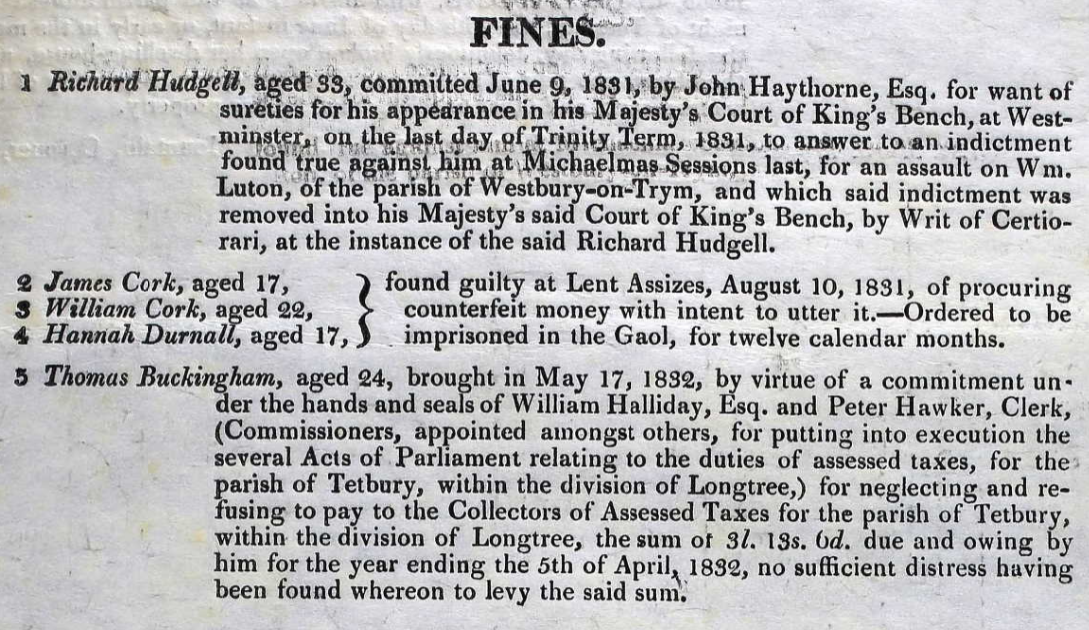
Henry emigrated with his daughter to Canada in 1913, and died in Vancouver in 1919.THOMAS BUCKINGHAM 1808-1846 (Isaacs daughter Janes husband) was charged with stealing a black gelding in Tetbury in 1838. No true bill. (A “no true bill” means the jury did not find probable cause to continue a case.)
Thomas did however neglect to pay his taxes in 1832:
LEWIN BUCKINGHAM (grandson of Isaac, his daughter Jane’s son) was found guilty in 1846 stealing two fowls in Tetbury when he was sixteen years old.
In 1846 he was sentence to one month hard labour (or pay ten shillings fine and ten shillings costs) for loitering with the intent to trespass in search of conies.
A year later in 1847, he and three other young men were sentenced to four months hard labour for larceny.
Lewin was five feet three inches tall, with brown hair and brown eyes, long visage, sallow complexion, and had a scar on his left arm.JOHN BUCKINGHAM born circa 1832, a Tetbury labourer (Isaac’s grandson, Lewin’s brother) was sentenced to six weeks hard labour for larceny in 1855 for stealing a duck in Cirencester. The notes on the register mention that he had been employed by Mr LOCK, Angel Inn. (John’s grandmother was Mary Lock so this is likely a relative).
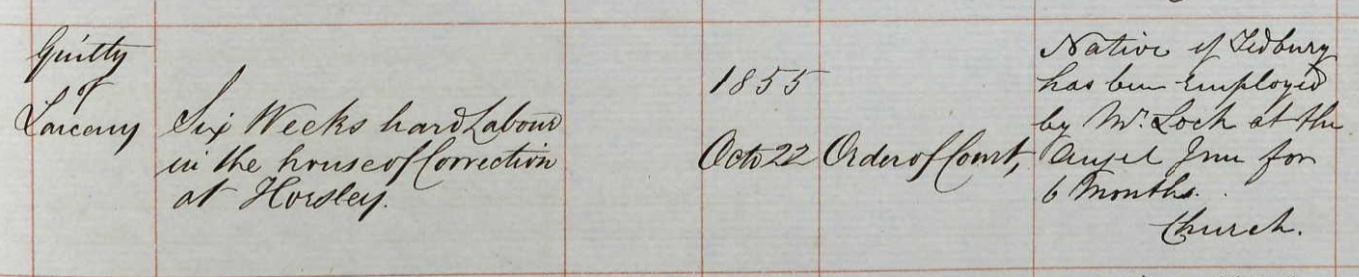
The previous year in 1854 John was sentenced to one month or a one pound fine for assaulting and beating W. Wood.
John was five feet eight and three quarter inches tall, light brown hair and grey eyes, an oval visage and a fresh complexion. He had a scar on his left arm and inside his right knee.JOSEPH PERRET was born circa 1831 and he was a Tetbury labourer. (He was Isaac’s granddaughter Charlotte Buckingham’s husband)
In 1855 he assaulted William Wood and was sentenced to one month or a two pound ten shilling fine. Was it the same W Wood that his wifes cousin John assaulted the year before?
In 1869 Joseph was sentenced to one month hard labour for feloniously receiving a cupboard known to be stolen.JAMES BUCKINGAM born circa 1822 in Tetbury was a shoemaker. (Isaac’s nephew, his sister Hannah’s son)
In 1854 the Tetbury shoemaker was sentenced to four months hard labour for stealing 30 lbs of lead off someones house.
In 1856 the Tetbury shoemaker received two months hard labour or pay £2 fine and 12 s costs for being found in pursuit of game.
In 1868 he was sentenced to two months hard labour for stealing a gander. A unspecified previous conviction is noted.
1871 the Tetbury shoemaker was found in an outhouse for an unlawful purpose and received ten days hard labour. The register notes that his sister is Mrs Cook, the Green, Tetbury. (James sister Prudence married Thomas Cook)
James sister Charlotte married a shoemaker and moved to UTAH.
James was five feet eight inches tall, dark hair and blue eyes, a long visage and a florid complexion. He had a scar on his forehead and a mole on the right side of his neck and abdomen, and a scar on the right knee.November 10, 2022 at 12:08 pm #6344In reply to: Family Stories From The Other Side ~ Book Two
The Tetbury Riots
While researching the Tetbury riots (I had found some Browning names in the newspaper archives in association with the uprisings) I came across an article called “Elizabeth Parker, the Swing Riots, and the Tetbury parish clerk” by Jill Evans.
I noted the name of the parish clerk, Daniel Cole, because I know someone else of that name. The incident in the article was 1830.
I found the 1826 marriage in the Tetbury parish registers (where Daniel was the parish clerk) of my 4x great grandmothers sister Hesther Lock. One of the witnesses was her brother Charles, and the other was Daniel Cole, the parish clerk.
Marriage of Lewin Chandler and Hesther Lock in 1826:
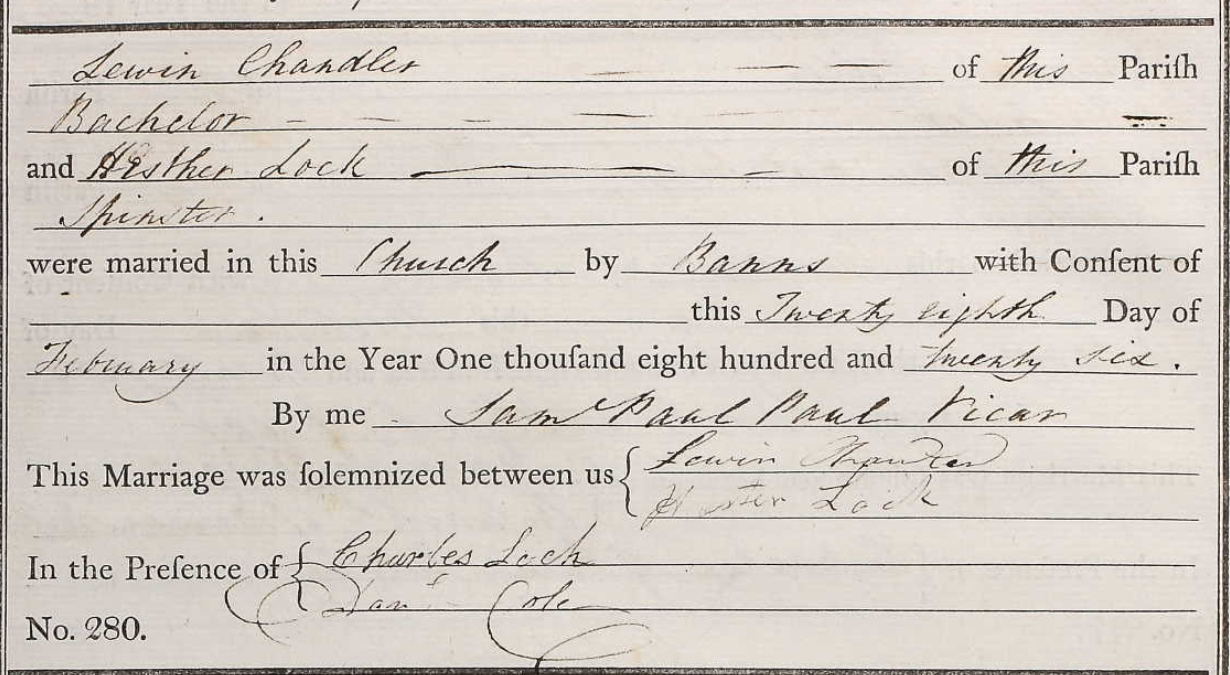
from the article:
“The Swing Riots were disturbances which took place in 1830 and 1831, mostly in the southern counties of England. Agricultural labourers, who were already suffering due to low wages and a lack of work after several years of bad harvests, rose up when their employers introduced threshing machines into their workplaces. The riots got their name from the threatening letters which were sent to farmers and other employers, which were signed “Captain Swing.”
The riots spread into Gloucestershire in November 1830, with the Tetbury area seeing the worst of the disturbances. Amongst the many people arrested afterwards was one woman, Elizabeth Parker. She has sometimes been cited as one of only two females who were transported for taking part in the Swing Riots. In fact, she was sentenced to be transported for this crime, but never sailed, as she was pardoned a few months after being convicted. However, less than a year after being released from Gloucester Gaol, she was back, awaiting trial for another offence. The circumstances in both of the cases she was tried for reveal an intriguing relationship with one Daniel Cole, parish clerk and assistant poor law officer in Tetbury….
….Elizabeth Parker was committed to Gloucester Gaol on 4 December 1830. In the Gaol Registers, she was described as being 23 and a “labourer”. She was in fact a prostitute, and she was unusual for the time in that she could read and write. She was charged on the oaths of Daniel Cole and others with having been among a mob which destroyed a threshing machine belonging to Jacob Hayward, at his farm in Beverstone, on 26 November.
…..Elizabeth Parker was granted royal clemency in July 1831 and was released from prison. She returned to Tetbury and presumably continued in her usual occupation, but on 27 March 1832, she was committed to Gloucester Gaol again. This time, she was charged with stealing 2 five pound notes, 5 sovereigns and 5 half sovereigns, from the person of Daniel Cole.
Elizabeth was tried at the Lent Assizes which began on 28 March, 1832. The details of her trial were reported in the Morning Post. Daniel Cole was in the “Boat Inn” (meaning the Boot Inn, I think) in Tetbury, when Elizabeth Parker came in. Cole “accompanied her down the yard”, where he stayed with her for about half an hour. The next morning, he realised that all his money was gone. One of his five pound notes was identified by him in a shop, where Parker had bought some items.
Under cross-examination, Cole said he was the assistant overseer of the poor and collector of public taxes of the parish of Tetbury. He was married with one child. He went in to the inn at about 9 pm, and stayed about 2 hours, drinking in the parlour, with the landlord, Elizabeth Parker, and two others. He was not drunk, but he was “rather fresh.” He gave the prisoner no money. He saw Elizabeth Parker next morning at the Prince and Princess public house. He didn’t drink with her or give her any money. He did give her a shilling after she was committed. He never said that he would not have prosecuted her “if it was not for her own tongue”. (Presumably meaning he couldn’t trust her to keep her mouth shut.)”
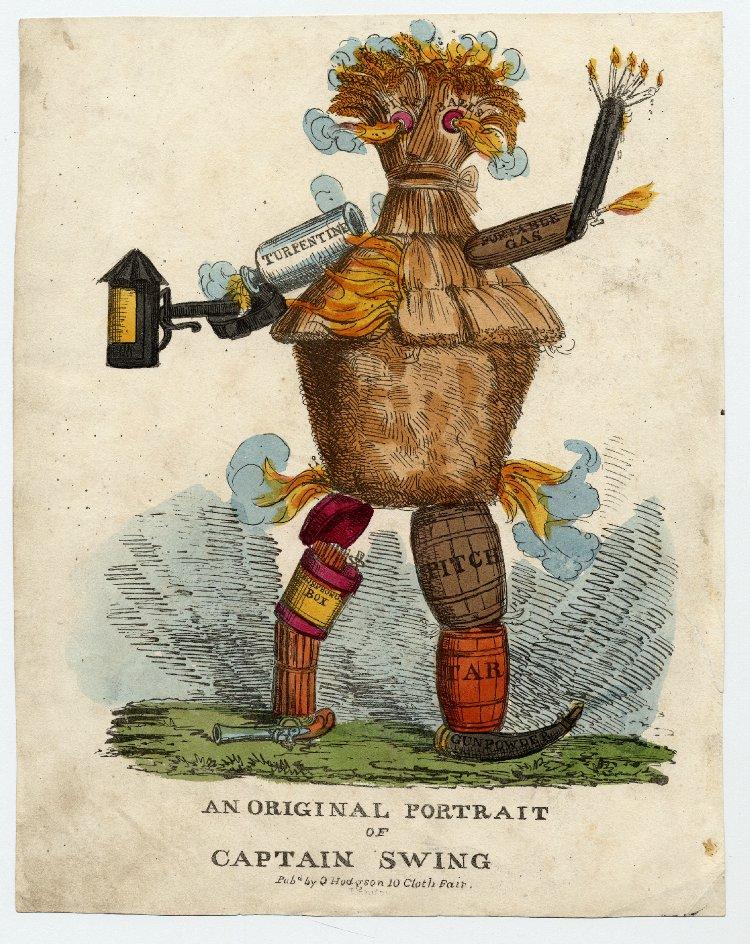
Contemporary illustration of the Swing riots:
Captain Swing was the imaginary leader agricultural labourers who set fire to barns and haystacks in the southern and eastern counties of England from 1830. Although the riots were ruthlessly put down (19 hanged, 644 imprisoned and 481 transported), the rural agitation led the new Whig government to establish a Royal Commission on the Poor Laws and its report provided the basis for the 1834 New Poor Law enacted after the Great Reform Bills of 1833.
An original portrait of Captain Swing hand coloured lithograph circa 1830:
 November 4, 2022 at 2:19 pm #6342
In reply to: Family Stories From The Other Side ~ Book Two
Brownings of Tetbury
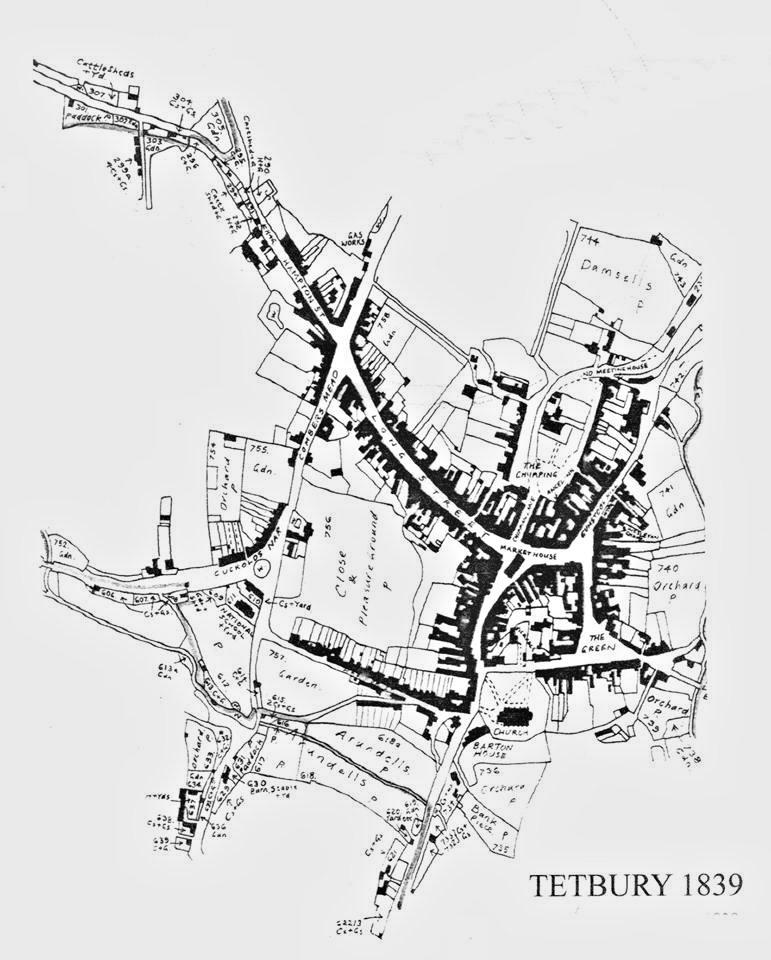
Isaac Browning (1784-1848) married Mary Lock (1787-1870) in Tetbury in 1806. Both of them were born in Tetbury, Gloucestershire. Isaac was a stone mason. Between 1807 and 1832 they baptised fourteen children in Tetbury, and on 8 Nov 1829 Isaac and Mary baptised five daughters all on the same day.
I considered that they may have been quintuplets, with only the last born surviving, which would have answered my question about the name of the house La Quinta in Broadway, the home of Eliza Browning and Thomas Stokes son Fred. However, the other four daughters were found in various records and they were not all born the same year. (So I still don’t know why the house in Broadway had such an unusual name).
Their son George was born and baptised in 1827, but Louisa born 1821, Susan born 1822, Hesther born 1823 and Mary born 1826, were not baptised until 1829 along with Charlotte born in 1828. (These birth dates are guesswork based on the age on later censuses.) Perhaps George was baptised promptly because he was sickly and not expected to survive. Isaac and Mary had a son George born in 1814 who died in 1823. Presumably the five girls were healthy and could wait to be done as a job lot on the same day later.
Eliza Browning (1814-1886), my great great great grandmother, had a baby six years before she married Thomas Stokes. Her name was Ellen Harding Browning, which suggests that her fathers name was Harding. On the 1841 census seven year old Ellen was living with her grandfather Isaac Browning in Tetbury. Ellen Harding Browning married William Dee in Tetbury in 1857, and they moved to Western Australia.
Ellen Harding Browning Dee: (photo found on ancestry website)
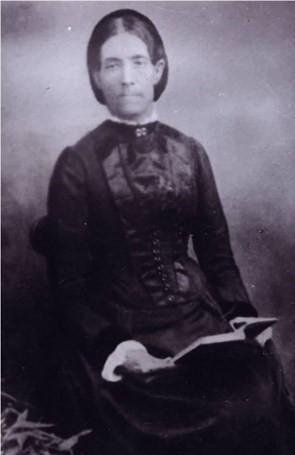
OBITUARY. MRS. ELLEN DEE.
A very old and respected resident of Dongarra, in the person of Mrs. Ellen Dee, passed peacefully away on Sept. 27, at the advanced age of 74 years.The deceased had been ailing for some time, but was about and actively employed until Wednesday, Sept. 20, whenn she was heard groaning by some neighbours, who immediately entered her place and found her lying beside the fireplace. Tho deceased had been to bed over night, and had evidently been in the act of lighting thc fire, when she had a seizure. For some hours she was conscious, but had lost the power of speech, and later on became unconscious, in which state she remained until her death.
The deceased was born in Gloucestershire, England, in 1833, was married to William Dee in Tetbury Church 23 years later. Within a month she left England with her husband for Western Australian in the ship City oí Bristol. She resided in Fremantle for six months, then in Greenough for a short time, and afterwards (for 42 years) in Dongarra. She was, therefore, a colonist of about 51 years. She had a family of four girls and three boys, and five of her children survive her, also 35 grandchildren, and eight great grandchildren. She was very highly respected, and her sudden collapse came as a great shock to many.
Eliza married Thomas Stokes (1816-1885) in September 1840 in Hempstead, Gloucestershire. On the 1841 census, Eliza and her mother Mary Browning (nee Lock) were staying with Thomas Lock and family in Cirencester. Strangely, Thomas Stokes has not been found thus far on the 1841 census, and Thomas and Eliza’s first child William James Stokes birth was registered in Witham, in Essex, on the 6th of September 1841.
I don’t know why William James was born in Witham, or where Thomas was at the time of the census in 1841. One possibility is that as Thomas Stokes did a considerable amount of work with circus waggons, circus shooting galleries and so on as a journeyman carpenter initially and then later wheelwright, perhaps he was working with a traveling circus at the time.
But back to the Brownings ~ more on William James Stokes to follow.
One of Isaac and Mary’s fourteen children died in infancy: Ann was baptised and died in 1811. Two of their children died at nine years old: the first George, and Mary who died in 1835. Matilda was 21 years old when she died in 1844.
Jane Browning (1808-) married Thomas Buckingham in 1830 in Tetbury. In August 1838 Thomas was charged with feloniously stealing a black gelding.
Susan Browning (1822-1879) married William Cleaver in November 1844 in Tetbury. Oddly thereafter they use the name Bowman on the census. On the 1851 census Mary Browning (Susan’s mother), widow, has grandson George Bowman born in 1844 living with her. The confusion with the Bowman and Cleaver names was clarified upon finding the criminal registers:
30 January 1834. Offender: William Cleaver alias Bowman, Richard Bunting alias Barnfield and Jeremiah Cox, labourers of Tetbury. Crime: Stealing part of a dead fence from a rick barton in Tetbury, the property of Robert Tanner, farmer.
And again in 1836:
29 March 1836 Bowman, William alias Cleaver, of Tetbury, labourer age 18; 5’2.5” tall, brown hair, grey eyes, round visage with fresh complexion; several moles on left cheek, mole on right breast. Charged on the oath of Ann Washbourn & others that on the morning of the 31 March at Tetbury feloniously stolen a lead spout affixed to the dwelling of the said Ann Washbourn, her property. Found guilty 31 March 1836; Sentenced to 6 months.
On the 1851 census Susan Bowman was a servant living in at a large drapery shop in Cheltenham. She was listed as 29 years old, married and born in Tetbury, so although it was unusual for a married woman not to be living with her husband, (or her son for that matter, who was living with his grandmother Mary Browning), perhaps her husband William Bowman alias Cleaver was in trouble again. By 1861 they are both living together in Tetbury: William was a plasterer, and they had three year old Isaac and Thomas, one year old. In 1871 William was still a plasterer in Tetbury, living with wife Susan, and sons Isaac and Thomas. Interestingly, a William Cleaver is living next door but one!
Susan was 56 when she died in Tetbury in 1879.
Three of the Browning daughters went to London.
Louisa Browning (1821-1873) married Robert Claxton, coachman, in 1848 in Bryanston Square, Westminster, London. Ester Browning was a witness.
Ester Browning (1823-1893)(or Hester) married Charles Hudson Sealey, cabinet maker, in Bethnal Green, London, in 1854. Charles was born in Tetbury. Charlotte Browning was a witness.
Charlotte Browning (1828-1867?) was admitted to St Marylebone workhouse in London for “parturition”, or childbirth, in 1860. She was 33 years old. A birth was registered for a Charlotte Browning, no mothers maiden name listed, in 1860 in Marylebone. A death was registered in Camden, buried in Marylebone, for a Charlotte Browning in 1867 but no age was recorded. As the age and parents were usually recorded for a childs death, I assume this was Charlotte the mother.
I found Charlotte on the 1851 census by chance while researching her mother Mary Lock’s siblings. Hesther Lock married Lewin Chandler, and they were living in Stepney, London. Charlotte is listed as a neice. Although Browning is mistranscribed as Broomey, the original page says Browning. Another mistranscription on this record is Hesthers birthplace which is transcribed as Yorkshire. The original image shows Gloucestershire.
Isaac and Mary’s first son was John Browning (1807-1860). John married Hannah Coates in 1834. John’s brother Charles Browning (1819-1853) married Eliza Coates in 1842. Perhaps they were sisters. On the 1861 census Hannah Browning, John’s wife, was a visitor in the Harding household in a village called Coates near Tetbury. Thomas Harding born in 1801 was the head of the household. Perhaps he was the father of Ellen Harding Browning.
George Browning (1828-1870) married Louisa Gainey in Tetbury, and died in Tetbury at the age of 42. Their son Richard Lock Browning, a 32 year old mason, was sentenced to one month hard labour for game tresspass in Tetbury in 1884.
Isaac Browning (1832-1857) was the youngest son of Isaac and Mary. He was just 25 years old when he died in Tetbury.
May 21, 2022 at 8:28 am #6298Topic: The Sexy Wooden Leg
in forum Yurara Fameliki’s StoriesThe Rootians invaded Oocrane when everybody was busy looking elsewhere. They entered through the Dumbass region under the pretense of freeing it from Lazies who had infiltrated administrations and media. They often cited a recent short movie from president Voldomeer Zumbaskee in which he appeared in purple leather panties adorned with diamonds, showing unashamedly his wooden leg. The same wooden leg that gave him the status of sexiest man of Oocrane and got him elected. In one of his famous discourses, he accused the Rootian president, Valdamir Potomsky of wanting to help himself to their crops of turnip and weed of which the world depended. And he told him if he expected Lazies he would be surprised by their resolution to defend their country.
By a simple game of chance that reality is so fond of, the man who made the president’s very wooden leg was also called Voldomeer Zumbasky. They might share a common ancestor, but many times in the past population records were destroyed and it was difficult to tell. That man lived in the small city of Duckailingtown in Dumbass, near the Rootian border. He was renowned to be a great carpenter and sculptor and before the war people would come from the neighbooring countries to buy his work.
During the invasion, crops and forests were burnt, buildings were destroyed and Dumbass Voldomeer lost one leg. There were no more trees or beams that hadn’t been turned to ashes, and he had only one block of wood left. Enough to make another wooden leg for himself. But he wondered: wasn’t there something more useful he could do with that block of wood ?
One morning of spring, one year after the war started. Food was scarce in Duckailingtown and Voldomeer’s belly growled as he walked past the nest of a couple of swans. He counted nine beautiful eggs that the parents were arranging with their beaks before lying on top to keep them warm. He found it so touching to see life in this place that he couldn’t bear the idea of simply stealing the eggs.
He went back home, a shelter made of bricks, his stomach aching from starvation. Looking at the block of wood on the floor, he got an idea. He spent the rest of the day and night to carve nine beautiful eggs so smooth that they appeared warm to the touch. He put so much care and love in his work that the swans would see no difference.
The next morning he went back to the nest with a leather bag, hopping heartily on his lone leg. The eggs were still there and by chance both the parents were missing. He didn’t care why. He took the eggs and replaced them with the wooden ones.
That day, he ate the best omelet with his friend Rooby, and as far as one could tell the swans were still brooding by the end of summer.
February 2, 2022 at 11:53 am #6265In reply to: The Elusive Samuel Housley and Other Family Stories
From Tanganyika with Love
continued ~ part 6
With thanks to Mike Rushby.
Mchewe 6th June 1937
Dearest Family,
Home again! We had an uneventful journey. Kate was as good as gold all the
way. We stopped for an hour at Bulawayo where we had to change trains but
everything was simplified for me by a very pleasant man whose wife shared my
compartment. Not only did he see me through customs but he installed us in our new
train and his wife turned up to see us off with magazines for me and fruit and sweets for
Kate. Very, very kind, don’t you think?Kate and I shared the compartment with a very pretty and gentle girl called
Clarice Simpson. She was very worried and upset because she was going home to
Broken Hill in response to a telegram informing her that her young husband was
dangerously ill from Blackwater Fever. She was very helpful with Kate whose
cheerfulness helped Clarice, I think, though I, quite unintentionally was the biggest help
at the end of our journey. Remember the partial dentures I had had made just before
leaving Cape Town? I know I shall never get used to the ghastly things, I’ve had them
two weeks now and they still wobble. Well this day I took them out and wrapped them
in a handkerchief, but when we were packing up to leave the train I could find the
handkerchief but no teeth! We searched high and low until the train had slowed down to
enter Broken Hill station. Then Clarice, lying flat on the floor, spied the teeth in the dark
corner under the bottom bunk. With much stretching she managed to retrieve the
dentures covered in grime and fluff. My look of horror, when I saw them, made young
Clarice laugh. She was met at the station by a very grave elderly couple. I do wonder
how things turned out for her.I stayed overnight with Kate at the Great Northern Hotel, and we set off for
Mbeya by plane early in the morning. One of our fellow passengers was a young
mother with a three week old baby. How ideas have changed since Ann was born. This
time we had a smooth passage and I was the only passenger to get airsick. Although
there were other women passengers it was a man once again, who came up and
offered to help. Kate went off with him amiably and he entertained her until we touched
down at Mbeya.George was there to meet us with a wonderful surprise, a little red two seater
Ford car. She is a bit battered and looks a bit odd because the boot has been
converted into a large wooden box for carrying raw salt, but she goes like the wind.
Where did George raise the cash to buy a car? Whilst we were away he found a small
cave full of bat guano near a large cave which is worked by a man called Bob Sargent.
As Sargent did not want any competition he bought the contents of the cave from
George giving him the small car as part payment.It was lovely to return to our little home and find everything fresh and tidy and the
garden full of colour. But it was heartbreaking to go into the bedroom and see George’s
precious forgotten boots still standing by his empty bed.With much love,
Eleanor.Mchewe 25th June 1937
Dearest Family,
Last Friday George took Kate and me in the little red Ford to visit Mr Sargent’s
camp on the Songwe River which cuts the Mbeya-Mbosi road. Mr Sargent bought
Hicky-Wood’s guano deposit and also our small cave and is making a good living out of
selling the bat guano to the coffee farmers in this province. George went to try to interest
him in a guano deposit near Kilwa in the Southern Province. Mr Sargent agreed to pay
25 pounds to cover the cost of the car trip and pegging costs. George will make the trip
to peg the claim and take samples for analysis. If the quality is sufficiently high, George
and Mr Sargent will go into partnership. George will work the claim and ship out the
guano from Kilwa which is on the coast of the Southern Province of Tanganyika. So now
we are busy building castles in the air once more.On Saturday we went to Mbeya where George had to attend a meeting of the
Trout Association. In the afternoon he played in a cricket match so Kate and I spent the
whole day with the wife of the new Superintendent of Police. They have a very nice
new house with lawns and a sunken rose garden. Kate had a lovely romp with Kit, her
three year old son.Mrs Wolten also has two daughters by a previous marriage. The elder girl said to
me, “Oh Mrs Rushby your husband is exactly like the strong silent type of man I
expected to see in Africa but he is the only one I have seen. I think he looks exactly like
those men in the ‘Barney’s Tobacco’ advertisements.”I went home with a huge pile of magazines to keep me entertained whilst
George is away on the Kilwa trip.Lots of love,
Eleanor.Mchewe 9th July 1937
Dearest Family,
George returned on Monday from his Kilwa safari. He had an entertaining
tale to tell.Before he approached Mr Sargent about going shares in the Kilwa guano
deposit he first approached a man on the Lupa who had done very well out of a small
gold reef. This man, however said he was not interested so you can imagine how
indignant George was when he started on his long trip, to find himself being trailed by
this very man and a co-driver in a powerful Ford V8 truck. George stopped his car and
had some heated things to say – awful threats I imagine as to what would happen to
anyone who staked his claim. Then he climbed back into our ancient little two seater and
went off like a bullet driving all day and most of the night. As the others took turns in
driving you can imagine what a feat it was for George to arrive in Kilwa ahead of them.
When they drove into Kilwa he met them with a bright smile and a bit of bluff –
quite justifiable under the circumstances I think. He said, you chaps can have a rest now,
you’re too late.” He then whipped off and pegged the claim. he brought some samples
of guano back but until it has been analysed he will not know whether the guano will be
an economic proposition or not. George is not very hopeful. He says there is a good
deal of sand mixed with the guano and that much of it was damp.The trip was pretty eventful for Kianda, our houseboy. The little two seater car
had been used by its previous owner for carting bags of course salt from his salt pans.
For this purpose the dicky seat behind the cab had been removed, and a kind of box
built into the boot of the car. George’s camp kit and provisions were packed into this
open box and Kianda perched on top to keep an eye on the belongings. George
travelled so fast on the rough road that at some point during the night Kianda was
bumped off in the middle of the Game Reserve. George did not notice that he was
missing until the next morning. He concluded, quite rightly as it happened, that Kianda
would be picked up by the rival truck so he continued his journey and Kianda rejoined
him at Kilwa.Believe it or not, the same thing happened on the way back but fortunately this
time George noticed his absence. He stopped the car and had just started back on his
tracks when Kianda came running down the road still clutching the unlighted storm lamp
which he was holding in his hand when he fell. The glass was not even cracked.
We are finding it difficult just now to buy native chickens and eggs. There has
been an epidemic amongst the poultry and one hesitates to eat the survivors. I have a
brine tub in which I preserve our surplus meat but I need the chickens for soup.
I hope George will be home for some months. He has arranged to take a Mr
Blackburn, a wealthy fruit farmer from Elgin, Cape, on a hunting safari during September
and October and that should bring in some much needed cash. Lillian Eustace has
invited Kate and me to spend the whole of October with her in Tukuyu.
I am so glad that you so much enjoy having Ann and George with you. We miss
them dreadfully. Kate is a pretty little girl and such a little madam. You should hear the
imperious way in which she calls the kitchenboy for her meals. “Boy Brekkis, Boy Lunch,
and Boy Eggy!” are her three calls for the day. She knows no Ki-Swahili.Eleanor
Mchewe 8th October 1937
Dearest Family,
I am rapidly becoming as superstitious as our African boys. They say the wild
animals always know when George is away from home and come down to have their
revenge on me because he has killed so many.I am being besieged at night by a most beastly leopard with a half grown cub. I
have grown used to hearing leopards grunt as they hunt in the hills at night but never
before have I had one roaming around literally under the windows. It has been so hot at
night lately that I have been sleeping with my bedroom door open onto the verandah. I
felt quite safe because the natives hereabouts are law-abiding and in any case I always
have a boy armed with a club sleeping in the kitchen just ten yards away. As an added
precaution I also have a loaded .45 calibre revolver on my bedside table, and Fanny
our bullterrier, sleeps on the mat by my bed. I am also looking after Barney, a fine
Airedale dog belonging to the Costers. He slept on a mat by the open bedroom door
near a dimly burning storm lamp.As usual I went to sleep with an easy mind on Monday night, but was awakened
in the early hours of Tuesday by the sound of a scuffle on the front verandah. The noise
was followed by a scream of pain from Barney. I jumped out of bed and, grabbing the
lamp with my left hand and the revolver in my right, I rushed outside just in time to see
two animal figures roll over the edge of the verandah into the garden below. There they
engaged in a terrific tug of war. Fortunately I was too concerned for Barney to be
nervous. I quickly fired two shots from the revolver, which incidentally makes a noise like
a cannon, and I must have startled the leopard for both animals, still locked together,
disappeared over the edge of the terrace. I fired two more shots and in a few moments
heard the leopard making a hurried exit through the dry leaves which lie thick under the
wild fig tree just beyond the terrace. A few seconds later Barney appeared on the low
terrace wall. I called his name but he made no move to come but stood with hanging
head. In desperation I rushed out, felt blood on my hands when I touched him, so I
picked him up bodily and carried him into the house. As I regained the verandah the boy
appeared, club in hand, having been roused by the shots. He quickly grasped what had
happened when he saw my blood saturated nightie. He fetched a bowl of water and a
clean towel whilst I examined Barney’s wounds. These were severe, the worst being a
gaping wound in his throat. I washed the gashes with a strong solution of pot permang
and I am glad to say they are healing remarkably well though they are bound to leave
scars. Fanny, very prudently, had taken no part in the fighting except for frenzied barking
which she kept up all night. The shots had of course wakened Kate but she seemed
more interested than alarmed and kept saying “Fanny bark bark, Mummy bang bang.
Poor Barney lots of blood.”In the morning we inspected the tracks in the garden. There was a shallow furrow
on the terrace where Barney and the leopard had dragged each other to and fro and
claw marks on the trunk of the wild fig tree into which the leopard climbed after I fired the
shots. The affair was of course a drama after the Africans’ hearts and several of our
shamba boys called to see me next day to make sympathetic noises and discuss the
affair.I went to bed early that night hoping that the leopard had been scared off for
good but I must confess I shut all windows and doors. Alas for my hopes of a restful
night. I had hardly turned down the lamp when the leopard started its terrifying grunting
just under the bedroom windows. If only she would sniff around quietly I should not
mind, but the noise is ghastly, something like the first sickening notes of a braying
donkey, amplified here by the hills and the gorge which is only a stones throw from the
bedroom. Barney was too sick to bark but Fanny barked loud enough for two and the more
frantic she became the hungrier the leopard sounded. Kate of course woke up and this
time she was frightened though I assured her that the noise was just a donkey having
fun. Neither of us slept until dawn when the leopard returned to the hills. When we
examined the tracks next morning we found that the leopard had been accompanied by
a fair sized cub and that together they had prowled around the house, kitchen, and out
houses, visiting especially the places to which the dogs had been during the day.
As I feel I cannot bear many more of these nights, I am sending a note to the
District Commissioner, Mbeya by the messenger who takes this letter to the post,
asking him to send a game scout or an armed policeman to deal with the leopard.
So don’t worry, for by the time this reaches you I feel sure this particular trouble
will be over.Eleanor.
Mchewe 17th October 1937
Dearest Family,
More about the leopard I fear! My messenger returned from Mbeya to say that
the District Officer was on safari so he had given the message to the Assistant District
Officer who also apparently left on safari later without bothering to reply to my note, so
there was nothing for me to do but to send for the village Nimrod and his muzzle loader
and offer him a reward if he could frighten away or kill the leopard.The hunter, Laza, suggested that he should sleep at the house so I went to bed
early leaving Laza and his two pals to make themselves comfortable on the living room
floor by the fire. Laza was armed with a formidable looking muzzle loader, crammed I
imagine with nuts and bolts and old rusty nails. One of his pals had a spear and the other
a panga. This fellow was also in charge of the Petromax pressure lamp whose light was
hidden under a packing case. I left the campaign entirely to Laza’s direction.
As usual the leopard came at midnight stealing down from the direction of the
kitchen and announcing its presence and position with its usual ghastly grunts. Suddenly
pandemonium broke loose on the back verandah. I heard the roar of the muzzle loader
followed by a vigourous tattoo beaten on an empty paraffin tin and I rushed out hoping
to find the dead leopard. however nothing of the kind had happened except that the
noise must have scared the beast because she did not return again that night. Next
morning Laza solemnly informed me that, though he had shot many leopards in his day,
this was no ordinary leopard but a “sheitani” (devil) and that as his gun was no good
against witchcraft he thought he might as well retire from the hunt. Scared I bet, and I
don’t blame him either.You can imagine my relief when a car rolled up that afternoon bringing Messers
Stewart and Griffiths, two farmers who live about 15 miles away, between here and
Mbeya. They had a note from the Assistant District Officer asking them to help me and
they had come to set up a trap gun in the garden. That night the leopard sniffed all
around the gun and I had the added strain of waiting for the bang and wondering what I
should do if the beast were only wounded. I conjured up horrible visions of the two little
totos trotting up the garden path with the early morning milk and being horribly mauled,
but I needn’t have worried because the leopard was far too wily to be caught that way.
Two more ghastly nights passed and then I had another visitor, a Dr Jackson of
the Tsetse Department on safari in the District. He listened sympathetically to my story
and left his shotgun and some SSG cartridges with me and instructed me to wait until the
leopard was pretty close and blow its b—– head off. It was good of him to leave his
gun. George always says there are three things a man should never lend, ‘His wife, his
gun and his dog.’ (I think in that order!)I felt quite cheered by Dr Jackson’s visit and sent
once again for Laza last night and arranged a real show down. In the afternoon I draped
heavy blankets over the living room windows to shut out the light of the pressure lamp
and the four of us, Laza and his two stooges and I waited up for the leopard. When we
guessed by her grunts that she was somewhere between the kitchen and the back door
we all rushed out, first the boy with the panga and the lamp, next Laza with his muzzle
loader, then me with the shotgun followed closely by the boy with the spear. What a
farce! The lamp was our undoing. We were blinded by the light and did not even
glimpse the leopard which made off with a derisive grunt. Laza said smugly that he knew
it was hopeless to try and now I feel tired and discouraged too.This morning I sent a runner to Mbeya to order the hotel taxi for tomorrow and I
shall go to friends in Mbeya for a day or two and then on to Tukuyu where I shall stay
with the Eustaces until George returns from Safari.Eleanor.
Mchewe 18th November 1937
My darling Ann,
Here we are back in our own home and how lovely it is to have Daddy back from
safari. Thank you very much for your letter. I hope by now you have got mine telling you
how very much I liked the beautiful tray cloth you made for my birthday. I bet there are
not many little girls of five who can embroider as well as you do, darling. The boy,
Matafari, washes and irons it so carefully and it looks lovely on the tea tray.Daddy and I had some fun last night. I was in bed and Daddy was undressing
when we heard a funny scratching noise on the roof. I thought it was the leopard. Daddy
quickly loaded his shotgun and ran outside. He had only his shirt on and he looked so
funny. I grabbed the loaded revolver from the cupboard and ran after Dad in my nightie
but after all the rush it was only your cat, Winnie, though I don’t know how she managed
to make such a noise. We felt so silly, we laughed and laughed.Kate talks a lot now but in such a funny way you would laugh to her her. She
hears the houseboys call me Memsahib so sometimes instead of calling me Mummy
she calls me “Oompaab”. She calls the bedroom a ‘bippon’ and her little behind she
calls her ‘sittendump’. She loves to watch Mandawi’s cattle go home along the path
behind the kitchen. Joseph your donkey, always leads the cows. He has a lazy life now.
I am glad you had such fun on Guy Fawkes Day. You will be sad to leave
Plumstead but I am sure you will like going to England on the big ship with granny Kate.
I expect you will start school when you get to England and I am sure you will find that
fun.God bless my dear little girl. Lots of love from Daddy and Kate,
and MummyMchewe 18th November 1937
Hello George Darling,
Thank you for your lovely drawing of Daddy shooting an elephant. Daddy says
that the only thing is that you have drawn him a bit too handsome.I went onto the verandah a few minutes ago to pick a banana for Kate from the
bunch hanging there and a big hornet flew out and stung my elbow! There are lots of
them around now and those stinging flies too. Kate wears thick corduroy dungarees so
that she will not get her fat little legs bitten. She is two years old now and is a real little
pickle. She loves running out in the rain so I have ordered a pair of red Wellingtons and a
tiny umbrella from a Nairobi shop for her Christmas present.Fanny’s puppies have their eyes open now and have very sharp little teeth.
They love to nip each other. We are keeping the fiercest little one whom we call Paddy
but are giving the others to friends. The coffee bushes are full of lovely white flowers
and the bees and ants are very busy stealing their honey.Yesterday a troop of baboons came down the hill and Dad shot a big one to
scare the others off. They are a nuisance because they steal the maize and potatoes
from the native shambas and then there is not enough food for the totos.
Dad and I are very proud of you for not making a fuss when you went to the
dentist to have that tooth out.Bye bye, my fine little son.
Three bags full of love from Kate, Dad and Mummy.Mchewe 12th February, 1938
Dearest Family,
here is some news that will please you. George has been offered and has
accepted a job as Forester at Mbulu in the Northern Province of Tanganyika. George
would have preferred a job as Game Ranger, but though the Game Warden, Philip
Teare, is most anxious to have him in the Game Department, there is no vacancy at
present. Anyway if one crops up later, George can always transfer from one
Government Department to another. Poor George, he hates the idea of taking a job. He
says that hitherto he has always been his own master and he detests the thought of
being pushed around by anyone.Now however he has no choice. Our capitol is almost exhausted and the coffee
market shows no signs of improving. With three children and another on the way, he
feels he simply must have a fixed income. I shall be sad to leave this little farm. I love
our little home and we have been so very happy here, but my heart rejoices at the
thought of overseas leave every thirty months. Now we shall be able to fetch Ann and
George from England and in three years time we will all be together in Tanganyika once
more.There is no sale for farms so we will just shut the house and keep on a very small
labour force just to keep the farm from going derelict. We are eating our hens but will
take our two dogs, Fanny and Paddy with us.One thing I shall be glad to leave is that leopard. She still comes grunting around
at night but not as badly as she did before. I do not mind at all when George is here but
until George was accepted for this forestry job I was afraid he might go back to the
Diggings and I should once more be left alone to be cursed by the leopard’s attentions.
Knowing how much I dreaded this George was most anxious to shoot the leopard and
for weeks he kept his shotgun and a powerful torch handy at night.One night last week we woke to hear it grunting near the kitchen. We got up very
quietly and whilst George loaded the shotgun with SSG, I took the torch and got the
heavy revolver from the cupboard. We crept out onto the dark verandah where George
whispered to me to not switch on the torch until he had located the leopard. It was pitch
black outside so all he could do was listen intently. And then of course I spoilt all his
plans. I trod on the dog’s tin bowl and made a terrific clatter! George ordered me to
switch on the light but it was too late and the leopard vanished into the long grass of the
Kalonga, grunting derisively, or so it sounded.She never comes into the clearing now but grunts from the hillside just above it.
Eleanor.
Mbulu 18th March, 1938
Dearest Family,
Journeys end at last. here we are at Mbulu, installed in our new quarters which are
as different as they possibly could be from our own cosy little home at Mchewe. We
live now, my dears, in one wing of a sort of ‘Beau Geste’ fort but I’ll tell you more about
it in my next letter. We only arrived yesterday and have not had time to look around.
This letter will tell you just about our trip from Mbeya.We left the farm in our little red Ford two seater with all our portable goods and
chattels plus two native servants and the two dogs. Before driving off, George took one
look at the flattened springs and declared that he would be surprised if we reached
Mbeya without a breakdown and that we would never make Mbulu with the car so
overloaded.However luck was with us. We reached Mbeya without mishap and at one of the
local garages saw a sturdy used Ford V8 boxbody car for sale. The garage agreed to
take our small car as part payment and George drew on our little remaining capitol for the
rest. We spent that night in the house of the Forest Officer and next morning set out in
comfort for the Northern Province of Tanganyika.I had done the journey from Dodoma to Mbeya seven years before so was
familiar with the scenery but the road was much improved and the old pole bridges had
been replaced by modern steel ones. Kate was as good as gold all the way. We
avoided hotels and camped by the road and she found this great fun.
The road beyond Dodoma was new to me and very interesting country, flat and
dry and dusty, as little rain falls there. The trees are mostly thorn trees but here and there
one sees a giant baobab, weird trees with fantastically thick trunks and fat squat branches
with meagre foliage. The inhabitants of this area I found interesting though. They are
called Wagogo and are a primitive people who ape the Masai in dress and customs
though they are much inferior to the Masai in physique. They are also great herders of
cattle which, rather surprisingly, appear to thrive in that dry area.The scenery alters greatly as one nears Babati, which one approaches by a high
escarpment from which one has a wonderful view of the Rift Valley. Babati township
appears to be just a small group of Indian shops and shabby native houses, but I
believe there are some good farms in the area. Though the little township is squalid,
there is a beautiful lake and grand mountains to please the eye. We stopped only long
enough to fill up with petrol and buy some foodstuffs. Beyond Babati there is a tsetse
fly belt and George warned our two native servants to see that no tsetse flies settled on
the dogs.We stopped for the night in a little rest house on the road about 80 miles from
Arusha where we were to spend a few days with the Forest Officer before going on to
Mbulu. I enjoyed this section of the road very much because it runs across wide plains
which are bounded on the West by the blue mountains of the Rift Valley wall. Here for
the first time I saw the Masai on their home ground guarding their vast herds of cattle. I
also saw their strange primitive hovels called Manyattas, with their thorn walled cattle
bomas and lots of plains game – giraffe, wildebeest, ostriches and antelope. Kate was
wildly excited and entranced with the game especially the giraffe which stood gazing
curiously and unafraid of us, often within a few yards of the road.Finally we came across the greatest thrill of all, my first view of Mt Meru the extinct
volcano about 16,000 feet high which towers over Arusha township. The approach to
Arusha is through flourishing coffee plantations very different alas from our farm at Mchewe. George says that at Arusha coffee growing is still a paying proposition
because here the yield of berry per acre is much higher than in the Southern highlands
and here in the North the farmers have not such heavy transport costs as the railway runs
from Arusha to the port at Tanga.We stayed overnight at a rather second rate hotel but the food was good and we
had hot baths and a good nights rest. Next day Tom Lewis the Forest Officer, fetched
us and we spent a few days camping in a tent in the Lewis’ garden having meals at their
home. Both Tom and Lillian Lewis were most friendly. Tom lewis explained to George
what his work in the Mbulu District was to be, and they took us camping in a Forest
Reserve where Lillian and her small son David and Kate and I had a lovely lazy time
amidst beautiful surroundings. Before we left for Mbulu, Lillian took me shopping to buy
material for curtains for our new home. She described the Forest House at Mbulu to me
and it sounded delightful but alas, when we reached Mbulu we discovered that the
Assistant District Officer had moved into the Forest House and we were directed to the
Fort or Boma. The night before we left Arusha for Mbulu it rained very heavily and the
road was very treacherous and slippery due to the surface being of ‘black cotton’ soil
which has the appearance and consistency of chocolate blancmange, after rain. To get to
Mbulu we had to drive back in the direction of Dodoma for some 70 miles and then turn
to the right and drive across plains to the Great Rift Valley Wall. The views from this
escarpment road which climbs this wall are magnificent. At one point one looks down
upon Lake Manyara with its brilliant white beaches of soda.The drive was a most trying one for George. We had no chains for the wheels
and several times we stuck in the mud and our two houseboys had to put grass and
branches under the wheels to stop them from spinning. Quite early on in the afternoon
George gave up all hope of reaching Mbulu that day and planned to spend the night in
a little bush rest camp at Karatu. However at one point it looked as though we would not
even reach this resthouse for late afternoon found us properly bogged down in a mess
of mud at the bottom of a long and very steep hill. In spite of frantic efforts on the part of
George and the two boys, all now very wet and muddy, the heavy car remained stuck.
Suddenly five Masai men appeared through the bushes beside the road. They
were all tall and angular and rather terrifying looking to me. Each wore only a blanket
knotted over one shoulder and all were armed with spears. They lined up by the side of
the road and just looked – not hostile but simply aloof and supercilious. George greeted
them and said in Ki-Swahili, “Help to push and I will reward you.” But they said nothing,
just drawing back imperceptibly to register disgust at the mere idea of manual labour.
Their expressions said quite clearly “A Masai is a warrior and does not soil his hands.”
George then did something which startled them I think, as much as me. He
plucked their spears from their hands one by one and flung them into the back of the
boxbody. “Now push!” he said, “And when we are safely out of the mud you shall have
your spears back.” To my utter astonishment the Masai seemed to applaud George’s
action. I think they admire courage in a man more than anything else. They pushed with a
will and soon we were roaring up the long steep slope. “I can’t stop here” quoth George
as up and up we went. The Masai were in mad pursuit with their blankets streaming
behind. They took a very steep path which was a shortcut to the top. They are certainly
amazing athletes and reached the top at the same time as the car. Their route of course
was shorter but much more steep, yet they came up without any sign of fatigue to claim
their spears and the money which George handed out with a friendly grin. The Masai
took the whole episode in good heart and we parted on the most friendly terms.After a rather chilly night in the three walled shack, we started on the last lap of our
journey yesterday morning in bright weather and made the trip to Mbulu without incident.Eleanor.
Mbulu 24th March, 1938
Dearest Family,
Mbulu is an attractive station but living in this rather romantic looking fort has many
disadvantages. Our quarters make up one side of the fort which is built up around a
hollow square. The buildings are single storied but very tall in the German manner and
there is a tower on one corner from which the Union Jack flies. The tower room is our
sitting room, and one has very fine views from the windows of the rolling country side.
However to reach this room one has to climb a steep flight of cement steps from the
court yard. Another disadvantage of this tower room is that there is a swarm of bees in
the roof and the stray ones drift down through holes in the ceiling and buzz angrily
against the window panes or fly around in a most menacing manner.Ours are the only private quarters in the Fort. Two other sides of the Fort are
used as offices, storerooms and court room and the fourth side is simply a thick wall with
battlements and loopholes and a huge iron shod double door of enormous thickness
which is always barred at sunset when the flag is hauled down. Two Police Askari always
remain in the Fort on guard at night. The effect from outside the whitewashed fort is very
romantic but inside it is hardly homely and how I miss my garden at Mchewe and the
grass and trees.We have no privacy downstairs because our windows overlook the bare
courtyard which is filled with Africans patiently waiting to be admitted to the courtroom as
witnesses or spectators. The outside windows which overlook the valley are heavily
barred. I can only think that the Germans who built this fort must have been very scared
of the local natives.Our rooms are hardly cosy and are furnished with typical heavy German pieces.
We have a vast bleak bedroom, a dining room and an enormous gloomy kitchen in
which meals for the German garrison were cooked. At night this kitchen is alive with
gigantic rats but fortunately they do not seem to care for the other rooms. To crown
everything owls hoot and screech at night on the roof.On our first day here I wandered outside the fort walls with Kate and came upon a
neatly fenced plot enclosing the graves of about fifteen South African soldiers killed by
the Germans in the 1914-18 war. I understand that at least one of theses soldiers died in
the courtyard here. The story goes, that during the period in the Great War when this fort
was occupied by a troop of South African Horse, a German named Siedtendorf
appeared at the great barred door at night and asked to speak to the officer in command
of the Troop. The officer complied with this request and the small shutter in the door was
opened so that he could speak with the German. The German, however, had not come
to speak. When he saw the exposed face of the officer, he fired, killing him, and
escaped into the dark night. I had this tale on good authority but cannot vouch for it. I do
know though, that there are two bullet holes in the door beside the shutter. An unhappy
story to think about when George is away, as he is now, and the moonlight throws queer
shadows in the court yard and the owls hoot.However though I find our quarters depressing, I like Mbulu itself very much. It is
rolling country, treeless except for the plantations of the Forestry Dept. The land is very
fertile in the watered valleys but the grass on hills and plains is cropped to the roots by
the far too numerous cattle and goats. There are very few Europeans on the station, only
Mr Duncan, the District Officer, whose wife and children recently left for England, the
Assistant District Officer and his wife, a bachelor Veterinary Officer, a Road Foreman and
ourselves, and down in the village a German with an American wife and an elderly
Irishman whom I have not met. The Government officials have a communal vegetable
garden in the valley below the fort which keeps us well supplied with green stuff.Most afternoons George, Kate and I go for walks after tea. On Fridays there is a
little ceremony here outside the fort. In the late afternoon a little procession of small
native schoolboys, headed by a drum and penny whistle band come marching up the
road to a tune which sounds like ‘Two lovely black eyes”. They form up below our tower
and as the flag is lowered for the day they play ‘God save the King’, and then march off
again. It is quite a cheerful little ceremony.The local Africans are a skinny lot and, I should say, a poor tribe. They protect
themselves against the cold by wrapping themselves in cotton blankets or a strip of
unbleached sheeting. This they drape over their heads, almost covering their faces and
the rest is wrapped closely round their bodies in the manner of a shroud. A most
depressing fashion. They live in very primitive comfortless houses. They simply make a
hollow in the hillside and build a front wall of wattle and daub. Into this rude shelter at night
go cattle and goats, men, women, and children.Mbulu village has the usual mud brick and wattle dukas and wattle and daub
houses. The chief trader is a Goan who keeps a surprisingly good variety of tinned
foodstuffs and also sells hardware and soft goods.The Europeans here have been friendly but as you will have noted there are
only two other women on station and no children at all to be companions for Kate.Eleanor.
Mbulu 20th June 1938
Dearest Family,
Here we are on Safari with George at Babati where we are occupying a rest
house on the slopes of Ufiome Mountain. The slopes are a Forest Reserve and
George is supervising the clearing of firebreaks in preparation for the dry weather. He
goes off after a very early breakfast and returns home in the late afternoon so Kate and I
have long lazy days.Babati is a pleasant spot and the resthouse is quite comfortable. It is about a mile
from the village which is just the usual collection of small mud brick and corrugated iron
Indian Dukas. There are a few settlers in the area growing coffee, or going in for mixed
farming but I don’t think they are doing very well. The farm adjoining the rest house is
owned by Lord Lovelace but is run by a manager.George says he gets enough exercise clambering about all day on the mountain,
so Kate and I do our walking in the mornings when George is busy, and we all relax in
the evenings when George returns from his field work. Kate’s favourite walk is to the big
block of mtama (sorghum) shambas lower down the hill. There are huge swarms of tiny
grain eating birds around waiting the chance to plunder the mtama, so the crops are
watched from sunrise to sunset.Crude observation platforms have been erected for this purpose in the centre of
each field and the women and the young boys of the family concerned, take it in turn to
occupy the platform and scare the birds. Each watcher has a sling and uses clods of
earth for ammunition. The clod is placed in the centre of the sling which is then whirled
around at arms length. Suddenly one end of the sling is released and the clod of earth
flies out and shatters against the mtama stalks. The sling makes a loud whip like crack and
the noise is quite startling and very effective in keeping the birds at a safe distance.Eleanor.
Karatu 3rd July 1938
Dearest Family,
Still on safari you see! We left Babati ten days ago and passed through Mbulu
on our way to this spot. We slept out of doors one night beside Lake Tiawa about eight
miles from Mbulu. It was a peaceful spot and we enjoyed watching the reflection of the
sunset on the lake and the waterhens and duck and pelicans settling down for the night.
However it turned piercingly cold after sunset so we had an early supper and then all
three of us lay down to sleep in the back of the boxbody (station wagon). It was a tight
fit and a real case of ‘When Dad turns, we all turn.’Here at Karatu we are living in a grass hut with only three walls. It is rather sweet
and looks like the setting for a Nativity Play. Kate and I share the only camp bed and
George and the dogs sleep on the floor. The air here is very fresh and exhilarating and
we all feel very fit. George is occupied all day supervising the cutting of firebreaks
around existing plantations and the forest reserve of indigenous trees. Our camp is on
the hillside and below us lie the fertile wheat lands of European farmers.They are mostly Afrikaners, the descendants of the Boer families who were
invited by the Germans to settle here after the Boer War. Most of them are pro-British
now and a few have called in here to chat to George about big game hunting. George
gets on extremely well with them and recently attended a wedding where he had a
lively time dancing at the reception. He likes the older people best as most are great
individualists. One fine old man, surnamed von Rooyen, visited our camp. He is a Boer
of the General Smuts type with spare figure and bearded face. George tells me he is a
real patriarch with an enormous family – mainly sons. This old farmer fought against the
British throughout the Boer War under General Smuts and again against the British in the
German East Africa campaign when he was a scout and right hand man to Von Lettow. It
is said that Von Lettow was able to stay in the field until the end of the Great War
because he listened to the advise given to him by von Rooyen. However his dislike for
the British does not extend to George as they have a mutual interest in big game
hunting.Kate loves being on safari. She is now so accustomed to having me as her nurse
and constant companion that I do not know how she will react to paid help. I shall have to
get someone to look after her during my confinement in the little German Red Cross
hospital at Oldeani.George has obtained permission from the District Commissioner, for Kate and
me to occupy the Government Rest House at Oldeani from the end of July until the end
of August when my baby is due. He will have to carry on with his field work but will join
us at weekends whenever possible.Eleanor.
Karatu 12th July 1938
Dearest Family,
Not long now before we leave this camp. We have greatly enjoyed our stay
here in spite of the very chilly earl mornings and the nights when we sit around in heavy
overcoats until our early bed time.Last Sunday I persuaded George to take Kate and me to the famous Ngoro-
Ngoro Crater. He was not very keen to do so because the road is very bumpy for
anyone in my interesting condition but I feel so fit that I was most anxious to take this
opportunity of seeing the enormous crater. We may never be in this vicinity again and in
any case safari will not be so simple with a small baby.What a wonderful trip it was! The road winds up a steep escarpment from which
one gets a glorious birds eye view of the plains of the Great Rift Valley far, far below.
The crater is immense. There is a road which skirts the rim in places and one has quite
startling views of the floor of the crater about two thousand feet below.A camp for tourists has just been built in a clearing in the virgin forest. It is most
picturesque as the camp buildings are very neatly constructed log cabins with very high
pitched thatched roofs. We spent about an hour sitting on the grass near the edge of the
crater enjoying the sunshine and the sharp air and really awe inspiring view. Far below us
in the middle of the crater was a small lake and we could see large herds of game
animals grazing there but they were too far away to be impressive, even seen through
George’s field glasses. Most appeared to be wildebeest and zebra but I also picked
out buffalo. Much more exciting was my first close view of a wild elephant. George
pointed him out to me as we approached the rest camp on the inward journey. He
stood quietly under a tree near the road and did not seem to be disturbed by the car
though he rolled a wary eye in our direction. On our return journey we saw him again at
almost uncomfortably close quarters. We rounded a sharp corner and there stood the
elephant, facing us and slap in the middle of the road. He was busily engaged giving
himself a dust bath but spared time to give us an irritable look. Fortunately we were on a
slight slope so George quickly switched off the engine and backed the car quietly round
the corner. He got out of the car and loaded his rifle, just in case! But after he had finished
his toilet the elephant moved off the road and we took our chance and passed without
incident.One notices the steepness of the Ngoro-Ngoro road more on the downward
journey than on the way up. The road is cut into the side of the mountain so that one has
a steep slope on one hand and a sheer drop on the other. George told me that a lorry
coming down the mountain was once charged from behind by a rhino. On feeling and
hearing the bash from behind the panic stricken driver drove off down the mountain as
fast as he dared and never paused until he reached level ground at the bottom of the
mountain. There was no sign of the rhino so the driver got out to examine his lorry and
found the rhino horn embedded in the wooden tail end of the lorry. The horn had been
wrenched right off!Happily no excitement of that kind happened to us. I have yet to see a rhino.
Eleanor.
Oldeani. 19th July 1938
Dearest Family,
Greetings from a lady in waiting! Kate and I have settled down comfortably in the
new, solidly built Government Rest House which comprises one large living room and
one large office with a connecting door. Outside there is a kitchen and a boys quarter.
There are no resident Government officials here at Oldeani so the office is in use only
when the District Officer from Mbulu makes his monthly visit. However a large Union
Jack flies from a flagpole in the front of the building as a gentle reminder to the entirely
German population of Oldeani that Tanganyika is now under British rule.There is quite a large community of German settlers here, most of whom are
engaged in coffee farming. George has visited several of the farms in connection with his
forestry work and says the coffee plantations look very promising indeed. There are also
a few German traders in the village and there is a large boarding school for German
children and also a very pleasant little hospital where I have arranged to have the baby.
Right next door to the Rest House is a General Dealers Store run by a couple named
Schnabbe. The shop is stocked with drapery, hardware, china and foodstuffs all
imported from Germany and of very good quality. The Schnabbes also sell local farm
produce, beautiful fresh vegetables, eggs and pure rich milk and farm butter. Our meat
comes from a German butchery and it is a great treat to get clean, well cut meat. The
sausages also are marvellous and in great variety.The butcher is an entertaining character. When he called round looking for custom I
expected him to break out in a yodel any minute, as it was obvious from a glance that
the Alps are his natural background. From under a green Tyrollean hat with feather,
blooms a round beefy face with sparkling small eyes and such widely spaced teeth that
one inevitably thinks of a garden rake. Enormous beefy thighs bulge from greasy
lederhosen which are supported by the traditional embroidered braces. So far the
butcher is the only cheery German, male or female, whom I have seen, and I have met
most of the locals at the Schnabbe’s shop. Most of the men seem to have cultivated
the grim Hitler look. They are all fanatical Nazis and one is usually greeted by a raised
hand and Heil Hitler! All very theatrical. I always feel like crying in ringing tones ‘God
Save the King’ or even ‘St George for England’. However the men are all very correct
and courteous and the women friendly. The women all admire Kate and cry, “Ag, das
kleine Englander.” She really is a picture with her rosy cheeks and huge grey eyes and
golden curls. Kate is having a wonderful time playing with Manfried, the Scnabbe’s small
son. Neither understands a word said by the other but that doesn’t seem to worry them.Before he left on safari, George took me to hospital for an examination by the
nurse, Sister Marianne. She has not been long in the country and knows very little
English but is determined to learn and carried on an animated, if rather quaint,
conversation with frequent references to a pocket dictionary. She says I am not to worry
because there is not doctor here. She is a very experienced midwife and anyway in an
emergency could call on the old retired Veterinary Surgeon for assistance.
I asked sister Marianne whether she knew of any German woman or girl who
would look after Kate whilst I am in hospital and today a very top drawer German,
bearing a strong likeness to ‘Little Willie’, called and offered the services of his niece who
is here on a visit from Germany. I was rather taken aback and said, “Oh no Baron, your
niece would not be the type I had in mind. I’m afraid I cannot pay much for a companion.”
However the Baron was not to be discouraged. He told me that his niece is seventeen
but looks twenty, that she is well educated and will make a cheerful companion. Her
father wishes her to learn to speak English fluently and that is why the Baron wished her
to come to me as a house daughter. As to pay, a couple of pounds a month for pocket
money and her keep was all he had in mind. So with some misgivings I agreed to take
the niece on as a companion as from 1st August.Eleanor.
Oldeani. 10th August 1938
Dearest Family,
Never a dull moment since my young companion arrived. She is a striking looking
girl with a tall boyish figure and very short and very fine dark hair which she wears
severely slicked back. She wears tweeds, no make up but has shiny rosy cheeks and
perfect teeth – she also,inevitably, has a man friend and I have an uncomfortable
suspicion that it is because of him that she was planted upon me. Upon second
thoughts though, maybe it was because of her excessive vitality, or even because of
her healthy appetite! The Baroness, I hear is in poor health and I can imagine that such
abundant health and spirit must have been quite overpowering. The name is Ingeborg,
but she is called Mouche, which I believe means Mouse. Someone in her family must
have a sense of humour.Her English only needed practice and she now chatters fluently so that I know her
background and views on life. Mouche’s father is a personal friend of Goering. He was
once a big noise in the German Airforce but is now connected with the car industry and
travels frequently and intensively in Europe and America on business. Mouche showed
me some snap shots of her family and I must say they look prosperous and charming.
Mouche tells me that her father wants her to learn to speak English fluently so that
she can get a job with some British diplomat in Cairo. I had immediate thought that I
might be nursing a future Mata Hari in my bosom, but this was immediately extinguished
when Mouche remarked that her father would like her to marry an Englishman. However
it seems that the mere idea revolts her. “Englishmen are degenerates who swill whisky
all day.” I pointed out that she had met George, who was a true blue Englishman, but
was nevertheless a fine physical specimen and certainly didn’t drink all day. Mouche
replied that George is not an Englishman but a hunter, as though that set him apart.
Mouche is an ardent Hitler fan and an enthusiastic member of the Hitler Youth
Movement. The house resounds with Hitler youth songs and when she is not singing,
her gramophone is playing very stirring marching songs. I cannot understand a word,
which is perhaps as well. Every day she does the most strenuous exercises watched
with envy by me as my proportions are now those of a circus Big Top. Mouche eats a
fantastic amount of meat and I feel it is a blessing that she is much admired by our
Tyrollean butcher who now delivers our meat in person and adds as a token of his
admiration some extra sausages for Mouche.I must confess I find her stimulating company as George is on safari most of the
time and my evenings otherwise would be lonely. I am a little worried though about
leaving Kate here with Mouche when I go to hospital. The dogs and Kate have not taken
to her. I am trying to prepare Kate for the separation but she says, “She’s not my
mummy. You are my dear mummy, and I want you, I want you.” George has got
permission from the Provincial Forestry Officer to spend the last week of August here at
the Rest House with me and I only hope that the baby will be born during that time.
Kate adores her dad and will be perfectly happy to remain here with him.One final paragraph about Mouche. I thought all German girls were domesticated
but not Mouche. I have Kesho-Kutwa here with me as cook and I have engaged a local
boy to do the laundry. I however expected Mouche would take over making the
puddings and pastry but she informed me that she can only bake a chocolate cake and
absolutely nothing else. She said brightly however that she would do the mending. As
there is none for her to do, she has rescued a large worn handkerchief of George’s and
sits with her feet up listening to stirring gramophone records whilst she mends the
handkerchief with exquisite darning.Eleanor.
Oldeani. 20th August 1938
Dearest Family,
Just after I had posted my last letter I received what George calls a demi official
letter from the District Officer informing me that I would have to move out of the Rest
House for a few days as the Governor and his hangers on would be visiting Oldeani
and would require the Rest House. Fortunately George happened to be here for a few
hours and he arranged for Kate and Mouche and me to spend a few days at the
German School as borders. So here I am at the school having a pleasant and restful
time and much entertained by all the goings on.The school buildings were built with funds from Germany and the school is run on
the lines of a contemporary German school. I think the school gets a grant from the
Tanganyika Government towards running expenses, but I am not sure. The school hall is
dominated by a more than life sized oil painting of Adolf Hitler which, at present, is
flanked on one side by the German Flag and on the other by the Union Jack. I cannot
help feeling that the latter was put up today for the Governor’s visit today.
The teachers are very amiable. We all meet at mealtimes, and though few of the
teachers speak English, the ones who do are anxious to chatter. The headmaster is a
scholarly man but obviously anti-British. He says he cannot understand why so many
South Africans are loyal to Britain – or rather to England. “They conquered your country
didn’t they?” I said that that had never occurred to me and that anyway I was mainly of
Scots descent and that loyalty to the crown was natural to me. “But the English
conquered the Scots and yet you are loyal to England. That I cannot understand.” “Well I
love England,” said I firmly, ”and so do all British South Africans.” Since then we have
stuck to English literature. Shakespeare, Lord Byron and Galsworthy seem to be the
favourites and all, thank goodness, make safe topics for conversation.
Mouche is in her element but Kate and I do not enjoy the food which is typically
German and consists largely of masses of fat pork and sauerkraut and unfamiliar soups. I
feel sure that the soup at lunch today had blobs of lemon curd in it! I also find most
disconcerting the way that everyone looks at me and says, “Bon appetite”, with much
smiling and nodding so I have to fight down my nausea and make a show of enjoying
the meals.The teacher whose room adjoins mine is a pleasant woman and I take my
afternoon tea with her. She, like all the teachers, has a large framed photo of Hitler on her
wall flanked by bracket vases of fresh flowers. One simply can’t get away from the man!
Even in the dormitories each child has a picture of Hitler above the bed. Hitler accepting
flowers from a small girl, or patting a small boy on the head. Even the children use the
greeting ‘Heil Hitler’. These German children seem unnaturally prim when compared with
my cheerful ex-pupils in South Africa but some of them are certainly very lovely to look
at.Tomorrow Mouche, Kate and I return to our quarters in the Rest House and in a
few days George will join us for a week.Eleanor.
Oldeani Hospital. 9th September 1938
Dearest Family,
You will all be delighted to hear that we have a second son, whom we have
named John. He is a darling, so quaint and good. He looks just like a little old man with a
high bald forehead fringed around the edges with a light brown fluff. George and I call
him Johnny Jo because he has a tiny round mouth and a rather big nose and reminds us
of A.A.Milne’s ‘Jonathan Jo has a mouth like an O’ , but Kate calls him, ‘My brother John’.
George was not here when he was born on September 5th, just two minutes
before midnight. He left on safari on the morning of the 4th and, of course, that very night
the labour pains started. Fortunately Kate was in bed asleep so Mouche walked with
me up the hill to the hospital where I was cheerfully received by Sister Marianne who
had everything ready for the confinement. I was lucky to have such an experienced
midwife because this was a breech birth and sister had to manage single handed. As
there was no doctor present I was not allowed even a sniff of anaesthetic. Sister slaved
away by the light of a pressure lamp endeavouring to turn the baby having first shoved
an inverted baby bath under my hips to raise them.What a performance! Sister Marianne was very much afraid that she might not be
able to save the baby and great was our relief when at last she managed to haul him out
by the feet. One slap and the baby began to cry without any further attention so Sister
wrapped him up in a blanket and took Johnny to her room for the night. I got very little
sleep but was so thankful to have the ordeal over that I did not mind even though I
heard a hyaena cackling and calling under my window in a most evil way.
When Sister brought Johnny to me in the early morning I stared in astonishment.
Instead of dressing him in one of his soft Viyella nighties, she had dressed him in a short
sleeved vest of knitted cotton with a cotton cloth swayed around his waist sarong
fashion. When I protested, “But Sister why is the baby not dressed in his own clothes?”
She answered firmly, “I find it is not allowed. A baby’s clotheses must be boiled and I
cannot boil clotheses of wool therefore your baby must wear the clotheses of the Red
Cross.”It was the same with the bedding. Poor Johnny lies all day in a deep wicker
basket with a detachable calico lining. There is no pillow under his head but a vast kind of
calico covered pillow is his only covering. There is nothing at all cosy and soft round my
poor baby. I said crossly to the Sister, “As every thing must be so sterile, I wonder you
don’t boil me too.” This she ignored.When my message reached George he dashed back to visit us. Sister took him
first to see the baby and George was astonished to see the baby basket covered by a
sheet. “She has the poor little kid covered up like a bloody parrot,” he told me. So I
asked him to go at once to buy a square of mosquito netting to replace the sheet.
Kate is quite a problem. She behaves like an Angel when she is here in my
room but is rebellious when Sister shoos her out. She says she “Hates the Nanny”
which is what she calls Mouche. Unfortunately it seems that she woke before midnight
on the night Johnny Jo was born to find me gone and Mouche in my bed. According to
Mouche, Kate wept all night and certainly when she visited me in the early morning
Kate’s face was puffy with crying and she clung to me crying “Oh my dear mummy, why
did you go away?” over and over again. Sister Marianne was touched and suggested
that Mouche and Kate should come to the hospital as boarders as I am the only patient
at present and there is plenty of room. Luckily Kate does not seem at all jealous of the
baby and it is a great relief to have here here under my eye.Eleanor.
April 24, 2020 at 9:27 am #6067In reply to: Two Aunties au Pair and Their Pert Carouses
Since the sudden disappearance of the two au pair maids, a lot had happened. But for August Finest it has been a lot of the same routine going on.
He wakes up in the early, early morning, his eyelids rubs on his eyeballs as if they are made of sandpaper. He seizes his belly with his hands, feels a little guilty about the nice meals prepared by Noor Mary especially for him since the start of the confinement. His six packs have started to fade away under a layer of fatty insulation and he tries to compensate by a daily routine in white T-shirt and underwear.
The coffee machine has detected his movements and starts to make what it does. It’s always cleaned and replenished by the discrete Mary. The noise and the smell creates an ambiance and when it rings he eats breakfast before taking his shower.
When he’s dressed up, his real work starts. It had not been easy for a man of his origins to appear as the best choice for the job under the Lump administration. President Lump was known to make bad jokes about his tan and him having spent too much time at the beach, and other worse things. But his worth was in the network he could connect the president with, his high discretion, which Lump was in dire need to compensate his innate tendency to boasting, and a strong adaptability to fix the president’s frequent messing around.
If August Finest had once admired the man and accepted the job for him, it soon changed when he realised there was nothing more underneath the boasting than more boasting and unpredictability. At the moment the only thing that make him continue was his ability to go stealth when the president had a fit of nerves, and the imposed confinement that made it impossible to leave the Beige House.
After the morning meeting during which the president asked him to fire a few members of the staff, August had to prepare a press conference. President Lump said he had thought about a few remarks about China and making a connection with the Mexican immigrants threatening the country by stealing the masks of the American People. After which, he had to plan a charity with first Lady Mellie Noma and redefine what a Masquerade meant. He had been asked to invite nurses and medical personnel, meaning republican and good looking in a blouse with a medical mask to make the promotion of the new mask industry Made in America. One of Mr Lump’s friend had just started a brand and was in need of some media promotion.
August reread the memo to be addressed to the director of the FBI, a good friend of his. A special cell at the FBI had been created especially since Lump came to power. For this particular occasion, agents posing as patients victims of the virus would be sent in the best ranked hospitals in the country with the task to look for the best nurse and doctor candidates and send them an invitation printed by Lump’s nephew’s printing company.
As Lump always said: “America Fist! And don’t forget people, I am America.”
August hit the enter button and closed the window of his professional mail account, leaving the draft of a personal mail on screen. He wasn’t sure if he could send this one. It was addressed to Noor Mary and he feared she would misunderstand the meaning of it.
January 18, 2020 at 9:06 am #5613In reply to: The Chronicles of the Flying Fish Inn
Aunt Idle:
Well, it wasn’t what I expected. but once I got over being slightly miffed that it was all about Mater, stealing the limelight again, I realized that I would get my wish after all, if Corrie and Clove and the others were going to come back for a visit. When they arrived, they could tell me all about what had been happening. The twins and Pan were to set off soon, on a sea worthy raft they’d been working on. It would be a long trip and hard to judge how long it would take. The waters were uncharted in places, Corrie mentioned in the letter, given that the waters had risen in so many places, but it also meant there was a chance of safe passage by water in places that had previously been dry land. Narrow canals had become wide shallow lakes, so they’d heard. Pan would be able to dive to his hearts content along the way, and they were all excited about the coming adventure.
“We will continue to communicate telepathically during the trip, Auntie”, Corrie had written, which gave me a glow of pride and satisfaction. I hadn’t been making it up, we truly had been exchanging messages all along.
I wasn’t sure how easy it was going to be dealing with Mater in the meantime, though. She was demanding plastic surgery now.
“Plastic surgery?” I said, “You can’t even get a decent tupperware these days, lid or no lid. Where on earth are we supposed to get plastic surgery from?”
Almost a hundred years old, and still vain. I ask you. “Do you see me fussing over my looks?”
“Quite” she replied, and pursed her shriveled lips.
August 1, 2019 at 6:57 am #4733In reply to: The Chronicles of the Flying Fish Inn
I have never seen so many guests at once at the Inn. Even old Bert is ferreting around, I’ve seen him many times near the shed or near the garage door. Mater knows about it of course. I’ve seen her looking at him from the corner of her eyes. I wonder if she knows about the hidden gold. I’m sure Bert knows, and that’s why he’s always been lurking around when we were kids.
Mater, she hadn’t said anything when I came back and took my old room as if I never left. She just grunted and gave me some work to do.
“It’s not good to stay idle all the time,” she had said, making me chuckle as I saw aunt Idle sneaking out to take care of her weed plot in the back yard. As if Mater didn’t know about it. I know she tried to chew some when Idle was in India and she didn’t like the taste of the raw plant, so I had showed her how to smoke it. After the coughing spell had passed, she had seemed to enjoy the experience then, but I don’t know if she had ever used some again afterward. She’s as stern as she used to be. But I like her that way. She’s the spine of the Flying Fish Inn. I’m not sure Idle could manage it all, especially I doubt Finly would stay more than a few days if Idle was the manager here.
Although, I’m suspecting Finly to sell weeds to the guests. She’s been acting weird and I’ve come upon her and Idle arguing in the kitchen upon a loafed bush lizard. Dido was accusing Finly of stealing her last crop and Finley… Well, I don’t really care about what they do.
I’ll just have to find some quiet time to go inspect the cellar. If what the man on the Harley had told me is true, I want to find the tunnels below the Inn.
June 27, 2018 at 3:18 am #4492In reply to: Pop﹡in People Tribulations
When Jerk came for his shift at the WholeDay*Mart, it was still early in the morning. He liked this shift best. Early customers were always a bit sleepy, except for a few of the early riser soccer moms up for a jog, and usually were far less chatty than the midday crowds.
One had to find ways to keep awake though. What he liked best were the invisible people. There was one in particular who’d caught his attention for the past few days. She had the insolent smile of people in the know, piercing eyes that would go straight to you without care for the social barriers, or untold rules and rites of the place. In short, she’d struck him as the only awake person in the lot, almost winkfully so.
And to his surprise, nobody seemed aware of that. It was as though she was in the background of the other drone people, who just couldn’t register such oddity into their daily computation.He suspected for a while that she had found some way to trick the self-checkout line, as her whole demeanour looked more bag lady than suburban heiress, and her cart always seemed well stocked.
He couldn’t care less — after all, for a meager pay, he wasn’t there to police. He was just intrigued by how she would seem to get away with it and be totally unnoticed.
April 12, 2017 at 1:54 am #4296In reply to: Seven Twines and the Dragon Heartwoods
That night Glynnis had a strange dream. She knew that it was no ordinary dream and in the morning diligently recorded it in her dream journal.
I was walking on a windy path through the forest. A young woman with bizarre hair and a cackling laugh appeared before me, blocking my path.
“Tell me your name!” I commanded.
“My name is Eleri, and I have a parrot to accompany you on your journey.”
“A parrot! What would I do with a parrot?”
“This is no ordinary parrot. This parrot can tell jokes,” responded the woman.
“A funny parrot! Well why didn’t you tell me that in the first place. Give me the parrot and I will be on my way.”
“Hold your horses. It’s not such an easy thing as that,” said the woman. “It never is you know. First you must tell me what is going on.”
I sighed and handed her a manuscript. “Read this a dozen times and all will be made clear.”
A look of petulant fury distorted the young woman’s face.
“ Tell me what is going on, you rude tart!“ she said crossly.
Here is what I told her:Glynnis is a young woman living in the enchanted forest in an abandoned mansion. She practices magic and has a great affinity for nature. She also has the face of dragon after she annoyed a powerful sorcerer. She is being troubled by dreams which seem to be calling her on a mission—the purpose of which she is unsure. Glynnis sells her potions at a stall in the city. One day she finds a map hidden behind a painting and knows that she needs to follow the path shown on the map.
Rushkan is fae. He works as the city ‘chief overseer’ looking after the clock tower. He isn’t that keen on his job. Rushkan has a half-formed vision to assemble a team but for what purpose he is not sure. He has also discovered something worrying, dark even, about the clock tower.
One day, Rushkan uses his magic to call for an Oliphant. He packs a small bag of belongs and departs on a journey. Before departing, he leaves a gift for Olliver, the office errand boy.
Rushkan is a little irritated to find that the forest has been fenced off and a toll-booth erected—who wouldn’t be annoyed by this needless bureaucracy? Anyway, after farewelling the helpful Oliphant he continues his journey on foot.
He hears a cry for help and comes across a dying Gibbon. The Gibbon entrusts her infant to his care. He takes the baby—named Tak—to an old woman who lives in a lodge close to the Dragon Heartwood: Margoritt Loursenoir, a writer. It seems Tak is a shape-shifter and can also take the form of a child. Perhaps that is his true form. Rushkan stays with Margoritt for a while to recoup but it isn’t very long before he feels compelled to continue his journey to find the hermit, Kumihimo,in the forest. Kumihimo seems to be weaving seven braids.
To get to the hermit Rushkan has to cross Fae land. He isn’t overjoyed about this because he has left the ‘old ways’ of his people. Rushkan has to declare his presence to the Fae people—it’s a rule. The Queen is a bit annoyed because her empire is not as powerful as it once was and she has had to use precious resources to protect Rushkan on his journey. Anyway, she doesn’t stay uppity for long and ends up in bed with him.
Gorash is a dwarf statue who abides in the grounds of the deserted mansion in the enchanted forest. At night he comes to life. He has a friend called Rainbow. Gorash assists Rainbow in stealing Glynis’s magic potions and they make seven colourful eggs which Rainbow is infatuated with.
Mr Fox lives in a hut outside the city walls. At sunset he can shapeshift into a fox. He prefers being in animal form. Fox is quite a character. Not much gets past him.
Fox’s master is a Gibbon who taught him how to shapeshift. After going on a journey into the forest to find Gibbon, Fox is told that it is time to learn the wisdom of the Heart. Gibbon gives Fox an assignment: “You’ll find a lost soul in the enchanted forest. Bring it back to its rightful owner. Then you shall find your master.”
Fox goes back to the mansion in the deserted forest just as Glynnis is leaving on her journey. He befriends Gorash who has become increasingly lonely since Rainbow now has the eggs.“That’s brilliant,” said the woman called Eleri. “You should probably get lots of points for doing that.” She gave one more loud cackle and shouted: “I am off to pick some mushrooms. You will find the parrot when you wake up from this crazy dream!”
December 14, 2016 at 12:06 am #4247In reply to: Seven Twines and the Dragon Heartwoods
Fox awakened from an agitated night in the forest. He was feeling weak and not so hungry. His stomach growled. Fox hoped it was not the precursor of another discharge of his bowels, but silence settled in. His body relaxed. He had the strange impression it helped him being more present. Anyhow, he couldn’t keep on running like that now. He needed to find food to refuel his body.
Don’t take advantage of your invisibility, had said the woman.
Fox thought there were two ways to look at his little misadventure. Either it was retribution for stealing that meatloaf, the meatloaf karma theory, or he had helped a poor family to avoid being sick all night. Which is just another expression of the meatloaf karma theory. All in all, the karma account was still balanced.
Fox smelled the forest wind. It was full of earth and water. Not so much fire with all this morning dew, he thought. There were also the scents of little animals, and mushrooms. Among it all, he was surprised to feel sadness. It was not so much about himself and his condition. He had been through worse. And it was more a quality of the atmosphere than a physical smell. It was as though the whole forest was feeling sad. Fox felt the tears at the corner of his eyes.
“I can’t continue running around like that,” he said.
“Good,” answered a deep voice.
July 6, 2016 at 9:20 am #4103In reply to: Cakletown and the Lone Chancers of Custard
“Give that to me, Funley. You can’t go rifling through my trash can. How many times have I told you? It’s practically stealing.” Ed made a grab for the piece of paper in Funley’s grasp but she held it at arm’s length.
“I think not, Mr Steam. Not until you have explained this!” She shook the piece of paper in her hand.
Duncan leaned forward and regarded it quizzically. “It looks like a recipe for bone broth.”
“Oh what!” said Funley. “Damn it! there must have been another reboot.”
January 7, 2016 at 9:01 am #3860In reply to: Cakletown and the Lone Chancers of Custard
Bea decided that she needed to put herself back to sleep quickly. She had to wake up to a different external reality than loud cackles, lisps and pyramid-stealing rats with a bindle and attitude to boot.
She was glad there was some of her sleep inducing medication left. This time apparently, they looked like Chinese medicine, gooish and blue in colour, with pungent smell of dried sea cucumber mixed with dirty alloys of slit nosed bat’s snot.
Maybe the weird scenarios were a resurgence of the ego… She would have to meditate more on what these false egos and contrived characters appearances truly meant.
December 1, 2014 at 3:32 am #3592In reply to: The Chronicles of the Flying Fish Inn
I don’t know what possessed Mater, but I like the new version of her.
She’s a true inspiration. The way she commandeers, how she pays attention to the little things. If she wasn’t so wrinkled, I’d want to become her.
She doesn’t seem to need anyone in her life, maybe that’s why she’s so strong.I don’t know how this all happened, but we now seem to do well enough. We have one paying guest (he seems to pay on time too, I don’t know where he gets that kind of money around that place), and it seems we can afford some manservant. Well, that’s something Aunt Idle would call that nice lady, surely not Mater. She was very kind to her.
Hope she doesn’t get funny ideas like she should become some sort of Mary Poppins or the like.The way Mater was sad after her piggy passed, I realized having a dog is a huge commitment. I told Battista I lied and I was sorry, but we couldn’t have the puppy. I knew she wouldn’t mind, she likes to keep dogs around.
Instead, I thought I could start breeding guinea pigs; they don’t live too long. Everybody thought stealing the fish was just a prank, but I wanted to pawn it to kick-start my business. The sad truth is that it isn’t worth a dime.
Luckily, Bert who noticed me, said he would help.
I wonder why the only persons I can relate to are more than ten times my age… Sometimes I’m like an alien in my own family.June 5, 2014 at 8:40 pm #3188In reply to: The Time-Dragglers’ Extravaganzas
There was a lot of commotion that night.
It all started a little bit before 6 PM, while the winter sun was very pale and slowly rolling behind the horizon. Jean-Pierre Duroy of the Royal Intendancy had the maids rounded up in matching uniforms to finish the cleaning of the Opera House, and ready to start to light the thousands of beeswax candles with almost military precision. This didn’t go without hiccup of course, but they did mostly well, and the Opera House was ready for the comedians before 5:55, leaving them with 5 spare minutes to catch their breath before the eighteen rings of the bell.
Even a little bit before that, Nicole du Hausset who had spent the whole dreaded day in anguish about the Queen’s lost ferrets, while attending to Madame’s every whims, realized after scouring through the Palace and hearing through the grapevine of the maids’ ring of deals in stolen goods that she should slide a word to the Royal Intendant through some unofficial channels (she knew well Helper, who was a great influence on Cook, who then could talk discreetly to Annie Duroy, of the Royal Pastries and Cookies) so an investigation could be carried out without any particular mention of the ferrets. As she would realize later the morrow, not only would the ferrets be retrieved at the Opera House and the Royal Chapel, one for each location, except slightly lighter and cut open, an act that would be seen as a hidden message and possible attempt on the Good Queen’s life, and dealt with appropriately by a specially appointed Inquisitor —but also, and notwithstanding any longwindedness, that it would make little difference as the perpetrators would be nowhere to be found the next day, having vanished, it seemed, in the ensuing confusion (of which we will come to in a minute), stealing in the process the Royal Balloon and a few chouquettes from the Royal Cuisines.
Her duties fulfilled, and being now on the other side of the fateful date of Jan. 5th, 1757, at 17:57 without any significant change to her reality or life, she deducted her mission as the safekeeper of the time-smuggled ferrets was by then accomplished, and she could focus on her more pressing duties.It was only 5:57 PM shy of a few more seconds, that Madame Pompadour, powdered like there was no tomorrow, would be helped by her two maids into her gorgeous John Pol Goatier designer dress, and her lambswool petticoats. She was dressed to kill, and that made her all the more suspicious in the minutes to come, but we are getting ahead of ourselves.
Madame de Pompadour’s schedule for the soirée was very precise. At 6 PM, she would greet her guests, and the King back from his afternoon at the Parliament at the entrance of the Palace, so they could all head to the Royal Opera, passing through the Chapel into the brightly candelight-lit half-built building where the show would take place.
There was to be a toast first, from fine champagne delivered the morning in zebra carriage (one of the Queens’ daughters idea, which had pleased enough the King that he’d booked them for an evening ride into the Gardens). She was all set, and with great dignity and carefulness, arrived at the spot a mere seconds after her Grace to great the King.At the same time, Jean-Pierre Duroy, who had not seen them as he’d passed through the Chapel the first time (ungagged but still under sleeping curse and tucked in the corner of the stained glass windows depicting the martyrdom of Christ), and as he was getting anxious at the lack of punctuality of the comedians whom he’d thought sleeping in their trailer parked nearby, was notified that the trailer had been found empty by the bellboy he had sent to remind the comedians to be ready in 10.
A man of great resources, always ready with plans B to Z (he wouldn’t boast, but the zebras being one of such past plan Z, second only to an unlikely belching toad plan, the details of which we won’t get into just now), the Royal Intendant was ready to put in motion said plans, but the comedians suddenly emerged from the Chapel slightly groggy but apparently ready to take over their duties —especially the two ladies, who were bickering with the two men about being the Controllers of the Ascension. Little did all of them know at this moment that the hot air balloon was being highjacked by a team of rogue maids in cahoots with the Russian Ballet props technicians who had arrived some days before the bulk of the Russian troupe trainees.
The Russian ballet dancers were indeed still stuck in the heavy snows somewhere along their trip to Versailles, so the four comedians with their balloon and tricks were technically, already a Plan B.By then, it was well into 5:59 PM, and the next minute would seem to stretch forever, but for the sake of a patient audience, we will not make it over 10.
In the first half of this fatefulest minute, Casanova had arrived with Father Balbi, his travelling companion, followed by none other than St Germain, all dapper and heavily scented. A score of less important nobilities the names of which we won’t go through were also here.
There were seconds enough in that first half minute, to rub cheeks and say plaisanteries and even utter a few rude witty comments with sweet tongues laced in vinegar, whatever that meant, and also enjoy the sparkling wine served at perfect chilly temperature.
It was only as we entered the second half of this minute that the King arrived, padded in heavy and warm coats and looking exhausted.
Seconds were spent in the same proceedings as above mentioned, if only in a slightly accelerated fashion, and slightly and almost unnoticeably higher pitched voices.That’s only when the mission bell’s sang Welcome to the Eighteenth’s Hour et ali (for naught), in loud and ringing dongs that the unthinkable happened, living all witnesses traumatized enough that nobody could think of anything to do before the third dong had elapsed.
The King collapsed, a knife in his ribs. The perpetrator was caught by the guards before the end of the last dong.While the King was rushed to the RER (Royal Emergency Room), and attended to by Royal Leechers and Clyster Masters who felt it was wise to call the Royal Priest seeing that there was little blood to leech, back at the Chapel and Opera House, the maids and Jean-Pierre were in a rush to blow out the candles, as it was obvious their attention was required elsewhere, and that the show would be cancelled.
Everyone would sigh in relief, but not before a few more hours of the drama, when they realized the King’s heavy padding had saved his life, and that the gapping wound everyone was dreading was no more than a pen’s prick. This would encourage Annie to admonish her children when they wouldn’t eat more of her delightful pastries.Meanwhile, using one of the last candles, the maids and their Russian lovers had lit the tub of lard of the hot air balloon, which rose slowly in the night sky, out of sight when most of the attention was directed towards the King’s fate hanging on a thread.
The four actors where vaguely wondering if they were still dreaming when they saw the carriage of thousands of tinsy frogs croaking through a portal, with brightly coloured dressed lady-men inside, and driven by an unkempt man with a wild gaze and an air of sheer insanity.
Of course, by then, they knew better than to discard it as a mere dream.
April 5, 2009 at 6:39 pm #2505In reply to: Strings of Nines
Yann was excited, he just had a mail from the cattery “The Laughing Cats” telling him they would send him pictures of the new litter. The little kittens had just opened their eyes and apparently they were very cute.
When they went to that cat exhibition with Ewrick in March, Yann thought it was just to meet a friend of his who was a cat breeder himself, and they actually met him. His cat was gorgeous and seemed so comfortable that you could have thought he had been drugged. Yann’s friend told them he was always like a big stuffed toy.
They chatted a bit and Ewrick and Yann wandered about to have a look at the other cats, and that’s when Yann saw the Abyssinian cats of the Carnelian cattery. The cats were solar and majestic, their cinnamon coat were stealing Yann’s heart. He knew he would get one… soon.
After a few weeks looking on the Internet at the different catteries, the different websites about this particular race, Yann decided to take his phone and make a call. He’d selected a few numbers and decided to just have another look on the net and found the Laughing Cat cattery, they got new kittens since a few days only and there was one of them whose coat was cinnamon. It seemed it was the perfect one, so Yann called that cattery first and the guy told him there were no call for this one color yet though he had many calls from Russian or other European breeders for the others…
Yann asked if they already had pictures but apparently the kittens had still their eyes closed and he was waiting a bit to take pictures… “they looks like rats you know”… no matter, he’d wait.
And they had opened their eyes now, he’d get pictures very soon now.
October 22, 2008 at 3:56 pm #1169In reply to: Circle of Eights, Stories
Antarctic Ocean, International subwaters
“ Good job my dear ones! “ the voice of the Baron was echoing strangely inside the metallic hull of the submarine.
In front of the screen, Pavel, Claude and Jarvis were sipping vodka martinis in celebration of their new crystal skull acquisition.
“It’s got a really extraordinary quality.” Jarvis answered after a moment of silence “I’ve been starting to study the skull and it’s taking some sort of aquamarine colour with the pressure variations, it’s impressive. And it seems we’re attracting an unusual amount of cetaceans in our trail too…”
“Fascinating! I can’t wait for you to bring it to me”
“Baron?”
“What?”
“What do we do with your old friend?”
“Phoebe?”
“Yes. We made sure she was properly treated, as per your orders, and she’s got access to the bare minimum so that she doesn’t play any trick on us.”
“Good. Well, I suppose you can release her on any friendly coast of your liking. She is greatly able to go on from there, though she will probably not like having been outwitted in stealing abilities… Whatever. Do as I said, and don’t get too mollified by her apparent frailty, she’s tougher than she seems.”
“Okay. See you at the meeting point then.”
-
AuthorSearch Results
Search Results for 'stealing'
-
Search Results
-
Topic: The Sexy Wooden Leg
The Rootians invaded Oocrane when everybody was busy looking elsewhere. They entered through the Dumbass region under the pretense of freeing it from Lazies who had infiltrated administrations and media. They often cited a recent short movie from president Voldomeer Zumbaskee in which he appeared in purple leather panties adorned with diamonds, showing unashamedly his wooden leg. The same wooden leg that gave him the status of sexiest man of Oocrane and got him elected. In one of his famous discourses, he accused the Rootian president, Valdamir Potomsky of wanting to help himself to their crops of turnip and weed of which the world depended. And he told him if he expected Lazies he would be surprised by their resolution to defend their country.
By a simple game of chance that reality is so fond of, the man who made the president’s very wooden leg was also called Voldomeer Zumbasky. They might share a common ancestor, but many times in the past population records were destroyed and it was difficult to tell. That man lived in the small city of Duckailingtown in Dumbass, near the Rootian border. He was renowned to be a great carpenter and sculptor and before the war people would come from the neighbooring countries to buy his work.
During the invasion, crops and forests were burnt, buildings were destroyed and Dumbass Voldomeer lost one leg. There were no more trees or beams that hadn’t been turned to ashes, and he had only one block of wood left. Enough to make another wooden leg for himself. But he wondered: wasn’t there something more useful he could do with that block of wood ?
One morning of spring, one year after the war started. Food was scarce in Duckailingtown and Voldomeer’s belly growled as he walked past the nest of a couple of swans. He counted nine beautiful eggs that the parents were arranging with their beaks before lying on top to keep them warm. He found it so touching to see life in this place that he couldn’t bear the idea of simply stealing the eggs.
He went back home, a shelter made of bricks, his stomach aching from starvation. Looking at the block of wood on the floor, he got an idea. He spent the rest of the day and night to carve nine beautiful eggs so smooth that they appeared warm to the touch. He put so much care and love in his work that the swans would see no difference.
The next morning he went back to the nest with a leather bag, hopping heartily on his lone leg. The eggs were still there and by chance both the parents were missing. He didn’t care why. He took the eggs and replaced them with the wooden ones.
That day, he ate the best omelet with his friend Rooby, and as far as one could tell the swans were still brooding by the end of summer.