
Search Results for 'tail'
-
AuthorSearch Results
-
December 18, 2021 at 12:59 pm #6243
In reply to: The Elusive Samuel Housley and Other Family Stories
William Housley’s Will and the Court Case
William Housley died in 1848, but his widow Ellen didn’t die until 1872. The court case was in 1873. Details about the court case are archived at the National Archives at Kew, in London, but are not available online. They can be viewed in person, but that hasn’t been possible thus far. However, there are a great many references to it in the letters.
William Housley’s first wife was Mary Carrington 1787-1813. They had three children, Mary Anne, Elizabeth and William. When Mary died, William married Mary’s sister Ellen, not in their own parish church at Smalley but in Ashbourne. Although not uncommon for a widower to marry a deceased wife’s sister, it wasn’t legal. This point is mentioned in one of the letters.
One of the pages of William Housley’s will:
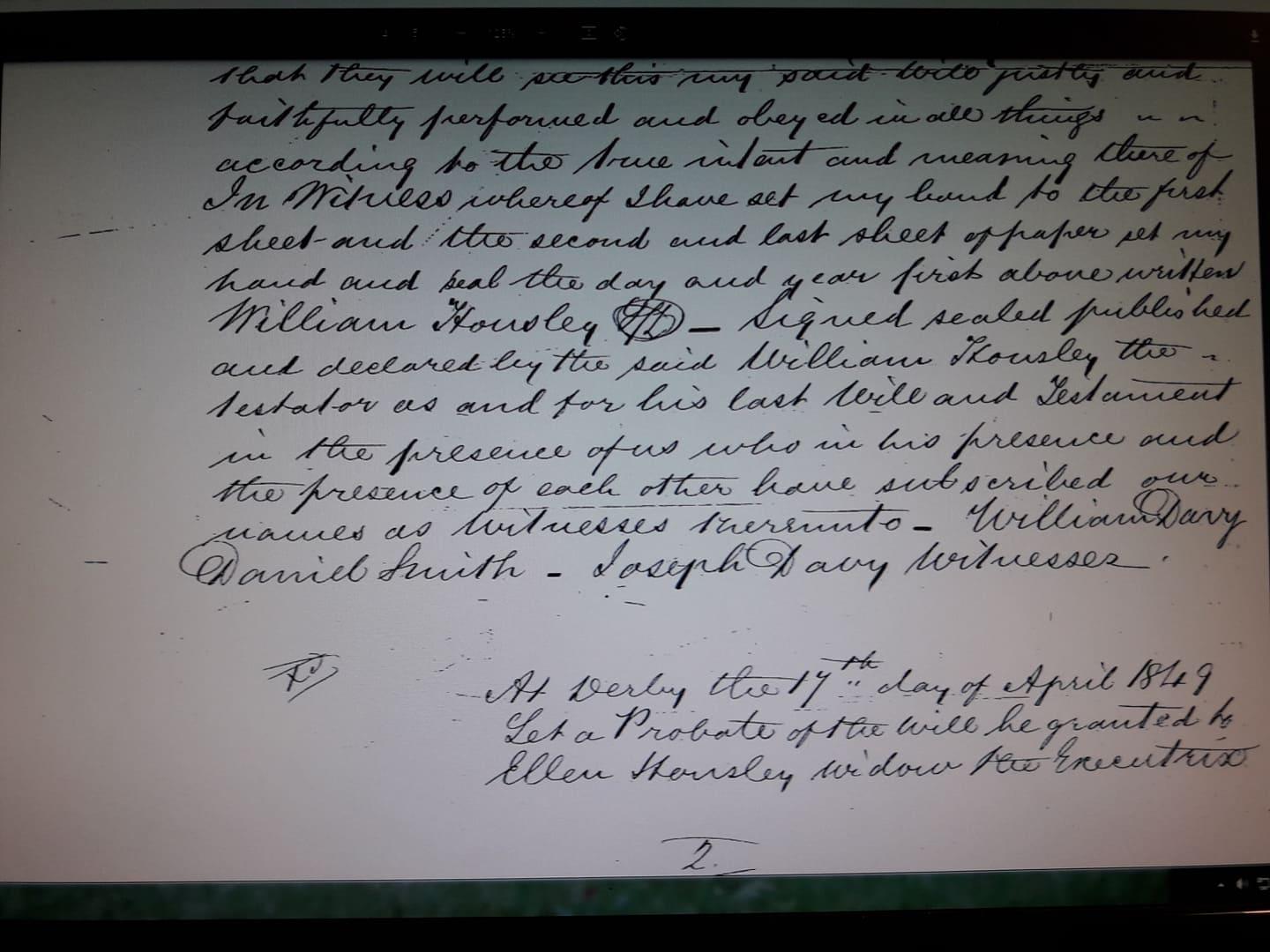
An excerpt from Barbara Housley’s Narrative on the Letters:
A comment in a letter from Joseph (August 6, 1873) indicated that William was married twice and that his wives were sisters: “What do you think that I believe that Mary Ann is trying to make our father’s will of no account as she says that my father’s marriage with our mother was not lawful he marrying two sisters. What do you think of her? I have heard my mother say something about paying a fine at the time of the marriage to make it legal.” Markwell and Saul in The A-Z Guide to Tracing Ancestors in Britain explain that marriage to a deceased wife’s sister was not permissible under Canon law as the relationship was within the prohibited degrees. However, such marriages did take place–usually well away from the couple’s home area. Up to 1835 such marriages were not void but were voidable by legal action. Few such actions were instituted but the risk was always there.
Joseph wrote that when Emma was married, Ellen “broke up the comfortable home and the things went to Derby and she went to live with them but Derby didn’t agree with her so she left again leaving her things behind and came to live with John in the new house where she died.” Ellen was listed with John’s household in the 1871 census.
In May 1872, the Ilkeston Pioneer carried this notice: “Mr. Hopkins will sell by auction on Saturday next the eleventh of May 1872 the whole of the useful furniture, sewing machine, etc. nearly new on the premises of the late Mrs. Housley at Smalley near Heanor in the county of Derby. Sale at one o’clock in the afternoon.”There were hard feelings between Mary Ann and Ellen and her children. Anne wrote: “If you remember we were not very friendly when you left. They never came and nothing was too bad for Mary Ann to say of Mother and me, but when Robert died Mother sent for her to the funeral but she did not think well to come so we took no more notice. She would not allow her children to come either.”
Mary Ann was still living in May 1872. Joseph implied that she and her brother, Will “intend making a bit of bother about the settlement of the bit of property” left by their mother. The 1871 census listed Mary Ann’s occupation as “income from houses.”In July 1872, Joseph introduced Ruth’s husband: “No doubt he is a bad lot. He is one of the Heath’s of Stanley Common a miller and he lives at Smalley Mill” (Ruth Heath was Mary Anne Housley’s daughter)
In 1873 Joseph wrote, “He is nothing but a land shark both Heath and his wife and his wife is the worst of the two. You will think these is hard words but they are true dear brother.” The solicitor, Abraham John Flint, was not at all pleased with Heath’s obstruction of the settlement of the estate. He wrote on June 30, 1873: “Heath agreed at first and then because I would not pay his expenses he refused and has since instructed another solicitor for his wife and Mrs. Weston who have been opposing us to the utmost. I am concerned for all parties interested except these two….The judge severely censured Heath for his conduct and wanted to make an order for sale there and then but Heath’s council would not consent….” In June 1875, the solicitor wrote: “Heath bid for the property but it fetched more money than he could give for it. He has been rather quieter lately.”In May 1872, Joseph wrote: “For what do you think, John has sold his share and he has acted very bad since his wife died and at the same time he sold all his furniture. You may guess I have never seen him but once since poor mother’s funeral and he is gone now no one knows where.”
In 1876, the solicitor wrote to George: “Have you heard of John Housley? He is entitled to Robert’s share and I want him to claim it.”
Anne intended that one third of the inheritance coming to her from her father and her grandfather, William Carrington, be divided between her four nieces: Sam’s three daughters and John’s daughter Elizabeth.
In the same letter (December 15, 1872), Joseph wrote:
“I think we have now found all out now that is concerned in the matter for there was only Sam that we did not know his whereabouts but I was informed a week ago that he is dead–died about three years ago in Birmingham Union. Poor Sam. He ought to have come to a better end than that”However, Samuel was still alive was on the 1871 census in Henley in Arden, and no record of his death can be found. Samuel’s brother in law said he was dead: we do not know why he lied, or perhaps the brothers were lying to keep his share, or another possibility is that Samuel himself told his brother in law to tell them that he was dead. I am inclined to think it was the latter.
Excerpts from Barbara Housley’s Narrative on the Letters continued:
Charles went to Australia in 1851, and was last heard from in January 1853. According to the solicitor, who wrote to George on June 3, 1874, Charles had received advances on the settlement of their parent’s estate. “Your promissory note with the two signed by your brother Charles for 20 pounds he received from his father and 20 pounds he received from his mother are now in the possession of the court.”
In December 1872, Joseph wrote: “I’m told that Charles two daughters has wrote to Smalley post office making inquiries about his share….” In January 1876, the solicitor wrote: “Charles Housley’s children have claimed their father’s share.”
In the Adelaide Observer 28 Aug 1875
HOUSLEY – wanted information
as to the Death, Will, or Intestacy, and
Children of Charles Housley, formerly of
Smalley, Derbyshire, England, who died at
Geelong or Creewick Creek Diggings, Victoria
August, 1855. His children will hear of something to their advantage by communicating with
Mr. A J. Flint, solicitor, Derby, England.
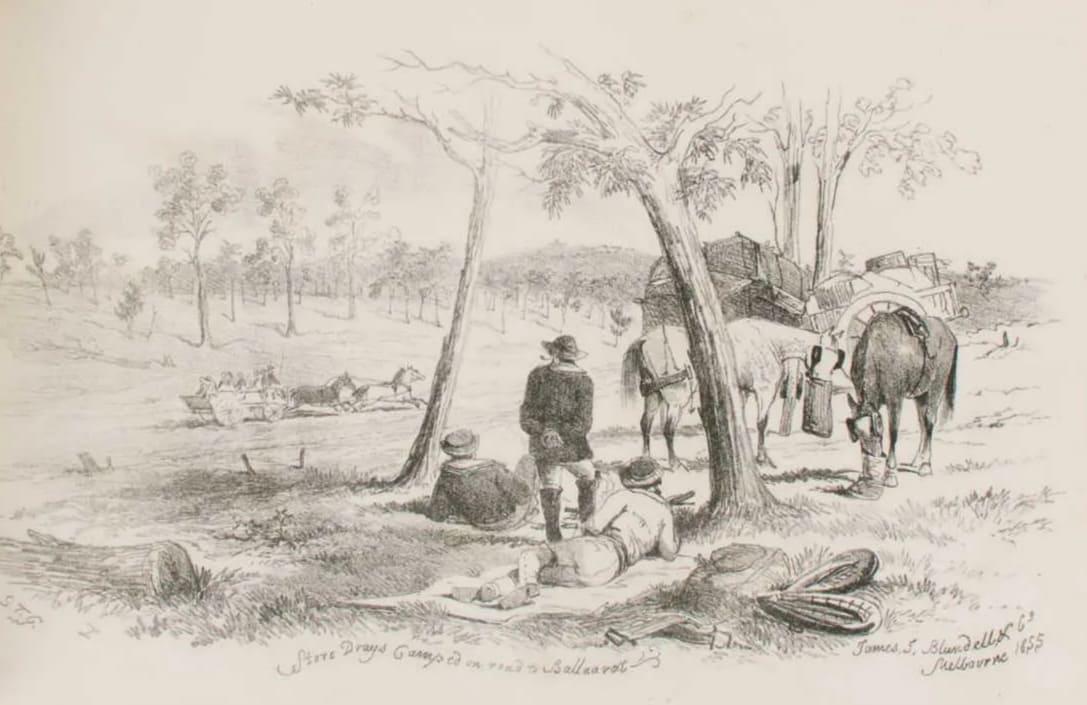
June 16,1875.The Diggers & Diggings of Victoria in 1855. Drawn on Stone by S.T. Gill:
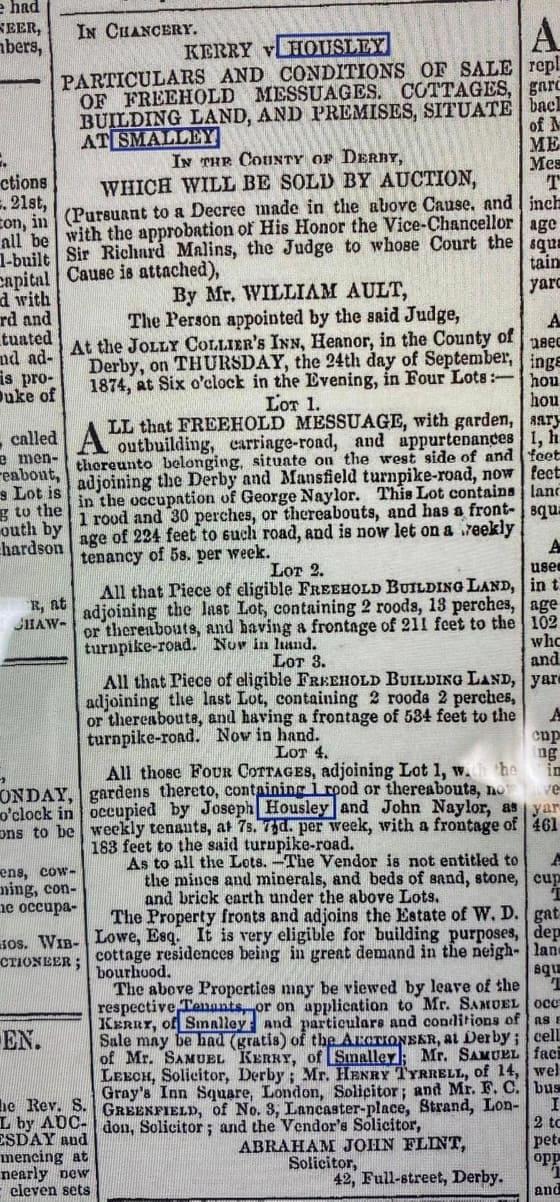
The court case:
Kerry v Housley.
Documents: Bill, demurrer.
Plaintiffs: Samuel Kerry and Joseph Housley.
Defendants: William Housley, Joseph Housley (deleted), Edwin Welch Harvey, Eleanor Harvey (deleted), Ernest Harvey infant, William Stafford, Elizabeth Stafford his wife, Mary Ann Housley, George Purdy and Catherine Purdy his wife, Elizabeth Housley, Mary Ann Weston widow and William Heath and Ruth Heath his wife (deleted).
Provincial solicitor employed in Derbyshire.
Date: 1873From the Narrative on the Letters:
The solicitor wrote on May 23, 1874: “Lately I have not written because I was not certain of your address and because I doubted I had much interesting news to tell you.” Later, Joseph wrote concerning the problems settling the estate, “You see dear brother there is only me here on our side and I cannot do much. I wish you were here to help me a bit and if you think of going for another summer trip this turn you might as well run over here.”
In March 1873, Joseph wrote: “You ask me what I think of you coming to England. I think as you have given the trustee power to sign for you I think you could do no good but I should like to see you once again for all that. I can’t say whether there would be anything amiss if you did come as you say it would be throwing good money after bad.”
In September 1872 Joseph wrote; “My wife is anxious to come. I hope it will suit her health for she is not over strong.” Elsewhere Joseph wrote that Harriet was “middling sometimes. She is subject to sick headaches. It knocks her up completely when they come on.” In December 1872 Joseph wrote, “Now dear brother about us coming to America you know we shall have to wait until this affair is settled and if it is not settled and thrown into Chancery I’m afraid we shall have to stay in England for I shall never be able to save money enough to bring me out and my family but I hope of better things.”
On July 19, 1875 Abraham Flint (the solicitor) wrote: “Joseph Housley has removed from Smalley and is working on some new foundry buildings at Little Chester near Derby. He lives at a village called Little Eaton near Derby. If you address your letter to him as Joseph Housley, carpenter, Little Eaton near Derby that will no doubt find him.”In his last letter (February 11, 1874), Joseph sounded very discouraged and wrote that Harriet’s parents were very poorly and both had been “in bed for a long time.” In addition, Harriet and the children had been ill.
The move to Little Eaton may indicate that Joseph received his settlement because in August, 1873, he wrote: “I think this is bad news enough and bad luck too, but I have had little else since I came to live at Kiddsley cottages but perhaps it is all for the best if one could only think so. I have begun to think there will be no chance for us coming over to you for I am afraid there will not be so much left as will bring us out without it is settled very shortly but I don’t intend leaving this house until it is settled either one way or the other. ”Joseph’s letters were much concerned with the settling of their mother’s estate. In 1854, Anne wrote, “As for my mother coming (to America) I think not at all likely. She is tied here with her property.” A solicitor, Abraham John Flint of 42 Full Street Derby, was engaged by John following the death of their mother. On June 30, 1873 the solicitor wrote: “Dear sir, On the death of your mother I was consulted by your brother John. I acted for him with reference to the sale and division of your father’s property at Smalley. Mr. Kerry was very unwilling to act as trustee being over 73 years of age but owing to the will being a badly drawn one we could not appoint another trustee in his place nor could the property be sold without a decree of chancery. Therefore Mr. Kerry consented and after a great deal of trouble with Heath who has opposed us all throughout whenever matters did not suit him, we found the title deeds and offered the property for sale by public auction on the 15th of July last. Heath could not find his purchase money without mortaging his property the solicitor which the mortgagee employed refused to accept Mr. Kerry’s title and owing to another defect in the will we could not compel them.”
In July 1872, Joseph wrote, “I do not know whether you can remember who the trustee was to my father’s will. It was Thomas Watson and Samuel Kerry of Smalley Green. Mr. Watson is dead (died a fortnight before mother) so Mr. Kerry has had to manage the affair.”
On Dec. 15, 1972, Joseph wrote, “Now about this property affair. It seems as far off of being settled as ever it was….” and in the following March wrote: “I think we are as far off as ever and farther I think.”
Concerning the property which was auctioned on July 15, 1872 and brought 700 pounds, Joseph wrote: “It was sold in five lots for building land and this man Heath bought up four lots–that is the big house, the croft and the cottages. The croft was made into two lots besides the piece belonging to the big house and the cottages and gardens was another lot and the little intake was another. William Richardson bought that.” Elsewhere Richardson’s purchase was described as “the little croft against Smith’s lane.” Smith’s Lane was probably named for their neighbor Daniel Smith, Mrs. Davy’s father.
But in December 1872, Joseph wrote that they had not received any money because “Mr. Heath is raising all kinds of objections to the will–something being worded wrong in the will.” In March 1873, Joseph “clarified” matters in this way: “His objection was that one trustee could not convey the property that his signature was not guarantee sufficient as it states in the will that both trustees has to sign the conveyance hence this bother.”
Joseph indicated that six shares were to come out of the 700 pounds besides Will’s 20 pounds. Children were to come in for the parents shares if dead. The solicitor wrote in 1873, “This of course refers to the Kidsley property in which you take a one seventh share and which if the property sells well may realize you about 60-80 pounds.” In March 1873 Joseph wrote: “You have an equal share with the rest in both lots of property, but I am afraid there will be but very little for any of us.”The other “lot of property” was “property in Smalley left under another will.” On July 17, 1872, Joseph wrote: “It was left by my grandfather Carrington and Uncle Richard is trustee. He seems very backward in bringing the property to a sale but I saw him and told him that I for one expect him to proceed with it.” George seemed to have difficulty understanding that there were two pieces of property so Joseph explained further: “It was left by my grandfather Carrington not by our father and Uncle Richard is the trustee for it but the will does not give him power to sell without the signatures of the parties concerned.” In June 1873 the solicitor Abraham John Flint asked: “Nothing has been done about the other property at Smalley at present. It wants attention and the other parties have asked me to attend to it. Do you authorize me to see to it for you as well?”
After Ellen’s death, the rent was divided between Joseph, Will, Mary Ann and Mr. Heath who bought John’s share and was married to Mary Ann’s daughter, Ruth. Joseph said that Mr. Heath paid 40 pounds for John’s share and that John had drawn 110 pounds in advance. The solicitor said Heath said he paid 60. The solicitor said that Heath was trying to buy the shares of those at home to get control of the property and would have defied the absent ones to get anything.
In September 1872 Joseph wrote that the lawyer said the trustee cannot sell the property at the bottom of Smalley without the signatures of all parties concerned in it and it will have to go through chancery court which will be a great expense. He advised Joseph to sell his share and Joseph advised George to do the same.George sent a “portrait” so that it could be established that it was really him–still living and due a share. Joseph wrote (July 1872): “the trustee was quite willing to (acknowledge you) for the portrait I think is a very good one.” Several letters later in response to an inquiry from George, Joseph wrote: “The trustee recognized you in a minute…I have not shown it to Mary Ann for we are not on good terms….Parties that I have shown it to own you again but they say it is a deal like John. It is something like him, but I think is more like myself.”
In September 1872 Joseph wrote that the lawyer required all of their ages and they would have to pay “succession duty”. Joseph requested that George send a list of birth dates.On May 23, 1874, the solicitor wrote: “I have been offered 240 pounds for the three cottages and the little house. They sold for 200 pounds at the last sale and then I was offered 700 pounds for the whole lot except Richardson’s Heanor piece for which he is still willing to give 58 pounds. Thus you see that the value of the estate has very materially increased since the last sale so that this delay has been beneficial to your interests than other-wise. Coal has become much dearer and they suppose there is coal under this estate. There are many enquiries about it and I believe it will realize 800 pounds or more which increase will more than cover all expenses.” Eventually the solicitor wrote that the property had been sold for 916 pounds and George would take a one-ninth share.
January 14, 1876: “I am very sorry to hear of your lameness and illness but I trust that you are now better. This matter as I informed you had to stand over until December since when all the costs and expenses have been taxed and passed by the court and I am expecting to receive the order for these this next week, then we have to pay the legacy duty and them divide the residue which I doubt won’t come to very much amongst so many of you. But you will hear from me towards the end of the month or early next month when I shall have to send you the papers to sign for your share. I can’t tell you how much it will be at present as I shall have to deduct your share with the others of the first sale made of the property before it went to court.
Wishing you a Happy New Year, I am Dear Sir, Yours truly
Abram J. Flint”September 15, 1876 (the last letter)
“I duly received your power of attorney which appears to have been properly executed on Thursday last and I sent it on to my London agent, Mr. Henry Lyvell, who happens just now to be away for his annual vacation and will not return for 14 or 20 days and as his signature is required by the Paymaster General before he will pay out your share, it must consequently stand over and await his return home. It shall however receive immediate attention as soon as he returns and I hope to be able to send your checque for the balance very shortly.”1874 in chancery:
 December 18, 2021 at 10:02 am #6242
In reply to: The Elusive Samuel Housley and Other Family Stories
The Housley Letters
We discovered that one of Samuel’s brothers, George Housley 1826-1877, emigrated to America in 1851, to Solebury, in Pennsylvania. Another brother, Charles 1823-1856, emigrated to Australia at the same time.
I wrote to the Solebury Historical Society to ask them if they had any information on the Housleys there. About a month later I had a very helpful and detailed reply from them.
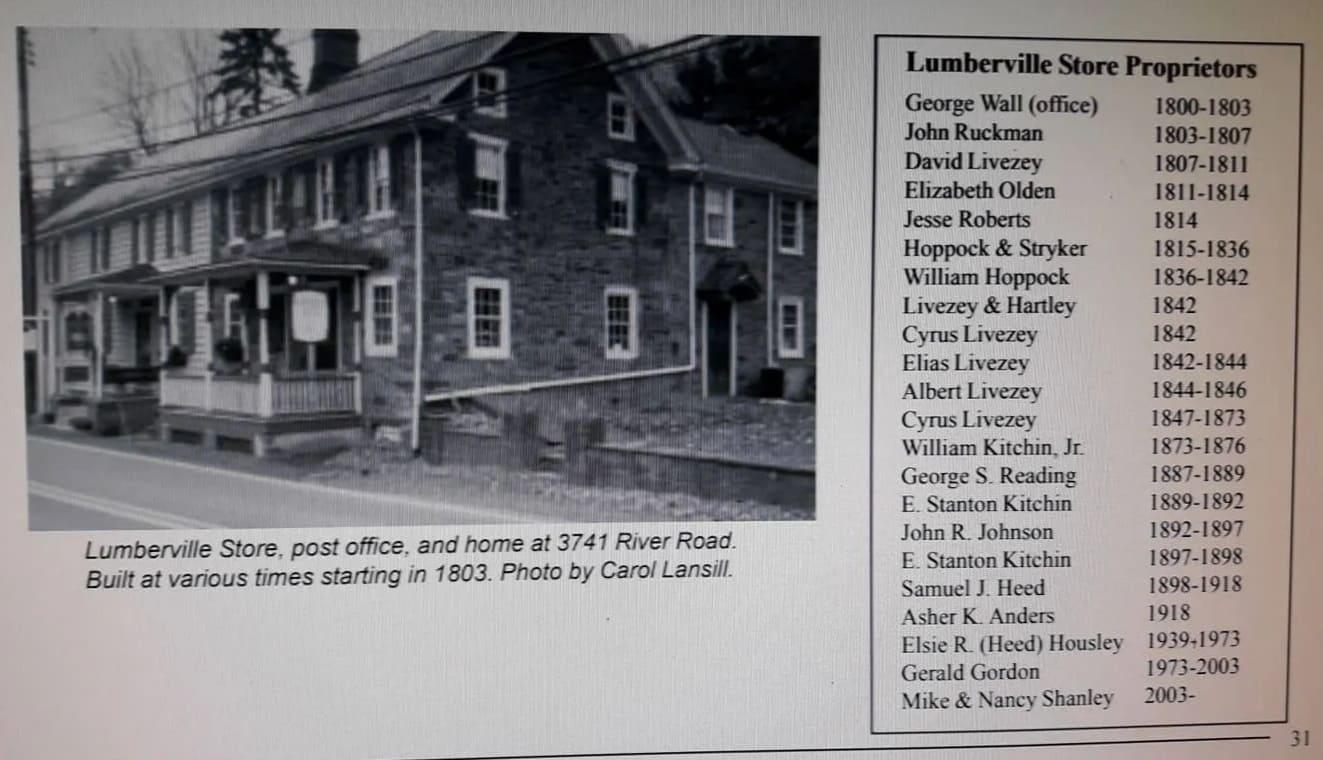
There were Housley people in Solebury Township and nearby communities from 1854 to at least 1973, perhaps 1985. George Housley immigrated in 1851, arriving in New York from London in July 1851 on the ship “Senator”. George was in Solebury by 1854, when he is listed on the tax roles for the Township He didn’t own land at that time. Housley family members mostly lived in the Lumberville area, a village in Solebury, or in nearby Buckingham or Wrightstown. The second wife of Howard (aka Harry) Housley was Elsa (aka Elsie) R. Heed, the daughter of the Lumberville Postmaster. Elsie was the proprietor of the Lumberville General Store from 1939 to 1973, and may have continued to live in Lumberville until her death in 1985. The Lumberville General Store was, and still is, a focal point of the community. The store was also the official Post Office at one time, hence the connection between Elsie’s father as Postmaster, and Elsie herself as the proprietor of the store. The Post Office function at Lumberville has been reduced now to a bank of cluster mailboxes, and official U.S. Postal functions are now in Point Pleasant, PA a few miles north of Lumberville.
We’ve attached a pdf of the Housley people buried in Carversville Cemetery, which is in the town next to Lumberville, and is still in Solebury Township. We hope this list will confirm that these are your relatives.It doesn’t seem that any Housley people still live in the area. Some of George’s descendents moved to Wilkes-Barre, PA and Flemington, NJ. One descendent, Barbara Housley, lived in nearby Doylestown, PA, which is the county seat for Bucks County. She actually visited Solebury Township Historical Society looking for Housley relatives, and it would have been nice to connect you with her. Unfortunately she died in 2018. Her obituary is attached in case you want to follow up with the nieces and great nieces who are listed.
Lumberville General Store, Pennsylvania, Elsie Housley:
I noticed the name of Barbara’s brother Howard Housley in her obituary, and found him on facebook. I knew it was the right Howard Housley as I recognized Barbara’s photograph in his friends list as the same photo in the obituary. Howard didn’t reply initially to a friend request from a stranger, so I found his daughter Laura on facebook and sent her a message. She replied, spoke to her father, and we exchanged email addresses and were able to start a correspondence. I simply could not believe my luck when Howard sent me a 17 page file of Barbara’s Narrative on the Letters with numerous letter excerpts interspersed with her own research compiled on a six month trip to England.
The letters were written to George between 1851 and the 1870s, from the Housley family in Smalley.
Narrative of Historic Letters ~ Barbara Housley.
AND BELIEVE ME EVER MY DEAR BROTHER, YOUR AFFECTIONATE FAMILY
In February 1991, I took a picture of my 16 month old niece Laura Ann Housley standing near the tombstones of her great-great-great-grandparents, George and Sarah Ann Hill Housley. The occassion was the funeral of another Sarah Housley, Sarah Lord Housley, wife of Albert Kilmer Housley, youngest son of John Eley Housley (George and Sarah Ann’s first born). Laura Ann’s great-grandfather (my grandfather) was another George, John Eley’s first born. It was Aunt Sarah who brought my mother, Lois, a packet of papers which she had found in the attic. Mom spent hours transcribing the letters which had been written first horizontally and then vertically to save paper. What began to emerge was a priceless glimpse into the lives and concerns of Housleys who lived and died over a century ago. All of the letters ended with the phrase “And believe me ever my dear brother, your affectionate….”
The greeting and opening remarks of each of the letters are included in a list below. The sentence structure and speech patterns have not been altered however spelling and some punctuation has been corrected. Some typical idiosyncrasies were: as for has, were for where and vice versa, no capitals at the beginnings of sentences, occasional commas and dashes but almost no periods. Emma appears to be the best educated of the three Housley letter-writers. Sister-in-law Harriet does not appear to be as well educated as any of the others. Since their mother did not write but apparently was in good health, it must be assumed that she could not.
The people discussed and described in the following pages are for the most part known to be the family and friends of the Housleys of Smalley, Derbyshire, England. However, practically every page brings conjectures about the significance of persons who are mentioned in the letters and information about persons whose names seem to be significant but who have not yet been established as actual members of the family.To say this was a priceless addition to the family research is an understatement. I have since, with Howard’s permission, sent the file to the Derby Records Office for their family history section. We are hoping that Howard will find the actual letters in among the boxes he has of his sisters belongings. Some of the letters mention photographs that were sent. Perhaps some will be found.
December 16, 2021 at 1:51 pm #6240In reply to: The Elusive Samuel Housley and Other Family Stories
Phyllis Ellen Marshall
1909 – 1983
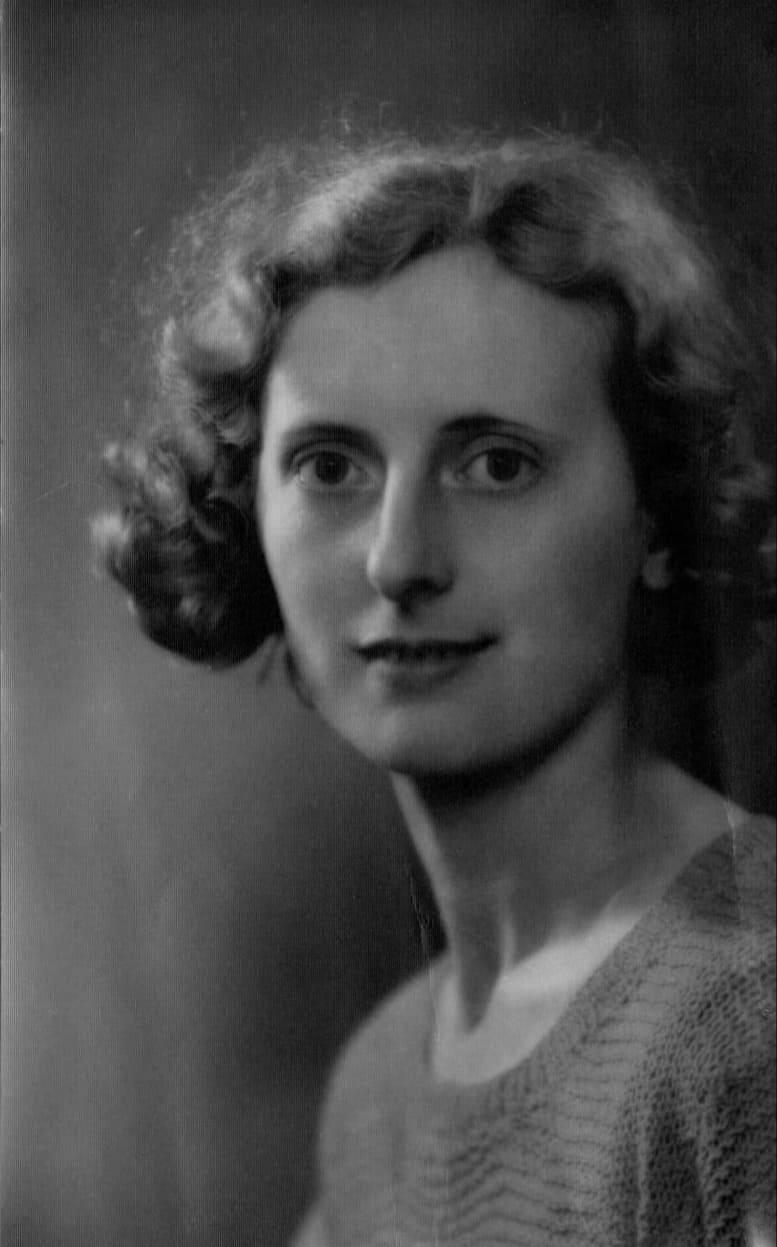
Phyllis, my grandfather George Marshall’s sister, never married. She lived in her parents home in Love Lane, and spent decades of her later life bedridden, living alone and crippled with rheumatoid arthritis. She had her bed in the front downstairs room, and had cords hanging by her bed to open the curtains, turn on the tv and so on, and she had carers and meals on wheels visit her daily. The room was dark and grim, but Phyllis was always smiling and cheerful. Phyllis loved the Degas ballerinas and had a couple of prints on the walls.
I remember visiting her, but it has only recently registered that this was my great grandparents house. When I was a child, we visited her and she indicated a tin on a chest of drawers and said I could take a biscuit. It was a lemon puff, and was the stalest biscuit I’d ever had. To be polite I ate it. Then she offered me another one! I declined, but she thought I was being polite and said “Go on! You can have another!” I ate another one, and have never eaten a lemon puff since that day.
Phyllis’s nephew Bryan Marshall used to visit her regularly. I didn’t realize how close they were until recently, when I resumed contact with Bryan, who emigrated to USA in the 1970s following a successful application for a job selling stained glass windows and church furnishings.
I asked on a Stourbridge facebook group if anyone remembered her.
AF Yes I remember her. My friend and I used to go up from Longlands school every Friday afternoon to do jobs for her. I remember she had a record player and we used to put her 45rpm record on Send in the Clowns for her. Such a lovely lady. She had her bed in the front room.
KW I remember very clearly a lady in a small house in Love Lane with alley at the left hand. I was intrigued by this lady who used to sit with the front door open and she was in a large chair of some sort. I used to see people going in and out and the lady was smiling. I was young then (31) and wondered how she coped but my sense was she had lots of help. I’ve never forgotten that lady in Love Lane sitting in the open door way I suppose when it was warm enough.
LR I used to deliver meals on wheels to her lovely lady.
I sent Bryan the comments from the Stourbridge group and he replied:
Thanks Tracy. I don’t recognize the names here but lovely to see such kind comments.
In the early 70’s neighbors on Corser Street, Mr. & Mrs. Walter Braithwaite would pop around with occasional visits and meals. Walter was my piano teacher for awhile when I was in my early twenties. He was a well known music teacher at Rudolph Steiner School (former Elmfield School) on Love Lane. A very fine school. I seem to recall seeing a good article on Walter recently…perhaps on the Stourbridge News website. He was very well known.
I’m ruminating about life with my Aunt Phyllis. We were very close. Our extra special time was every Saturday at 5pm (I seem to recall) we’d watch Doctor Who. Right from the first episode. We loved it. Likewise I’d do the children’s crossword out of Woman’s Realm magazine…always looking to win a camera but never did ! She opened my mind to the Bible, music and ballet. She once got tickets and had a taxi take us into Birmingham to see the Bolshoi Ballet…at a time when they rarely left their country. It was a very big deal in the early 60’s. ! I’ve many fond memories about her and grandad which I’ll share in due course. I’d change the steel needle on the old record player, following each play of the 78rpm records…oh my…another world.Bryan continues reminiscing about Phyllis in further correspondence:
Yes, I can recall those two Degas prints. I don’t know much of Phyllis’ early history other than she was a hairdresser in Birmingham. I want to say at John Lewis, for some reason (so there must have been a connection and being such a large store I bet they did have a salon?)
You will know that she had severe and debilitating rheumatoid arthritis that eventually gnarled her hands and moved through her body. I remember strapping on her leg/foot braces and hearing her writhe in pain as I did so but she wanted to continue walking standing/ getting up as long as she could. I’d take her out in the wheelchair and I can’t believe I say it along …but down Stanley Road!! (I had subsequent nightmares about what could have happened to her, had I tripped or let go!) She loved Mary Stevens Park, the swans, ducks and of course Canadian geese. Was grateful for everything in creation. As I used to go over Hanbury Hill on my visit to Love Lane, she would always remind me to smell the “sea-air” as I crested the hill.
In the earlier days she smoked cigarettes with one of those long filters…looking like someone from the twenties.I’ll check on “Send in the clowns”. I do recall that music. I remember also she loved to hear Neil Diamond. Her favorites in classical music gave me an appreciation of Elgar and Delius especially. She also loved ballet music such as Swan Lake and Nutcracker. Scheherazade and La Boutique Fantastic also other gems.
When grandad died she and aunt Dorothy shared more about grandma (who died I believe when John and I were nine-months old…therefore early 1951). Grandma (Mary Ann Gilman Purdy) played the piano and loved Strauss and Offenbach. The piano in the picture you sent had a bad (wonky) leg which would fall off and when we had the piano at 4, Mount Road it was rather dangerous. In any event my parents didn’t want me or others “banging on it” for fear of waking the younger brothers so it disappeared at sometime.
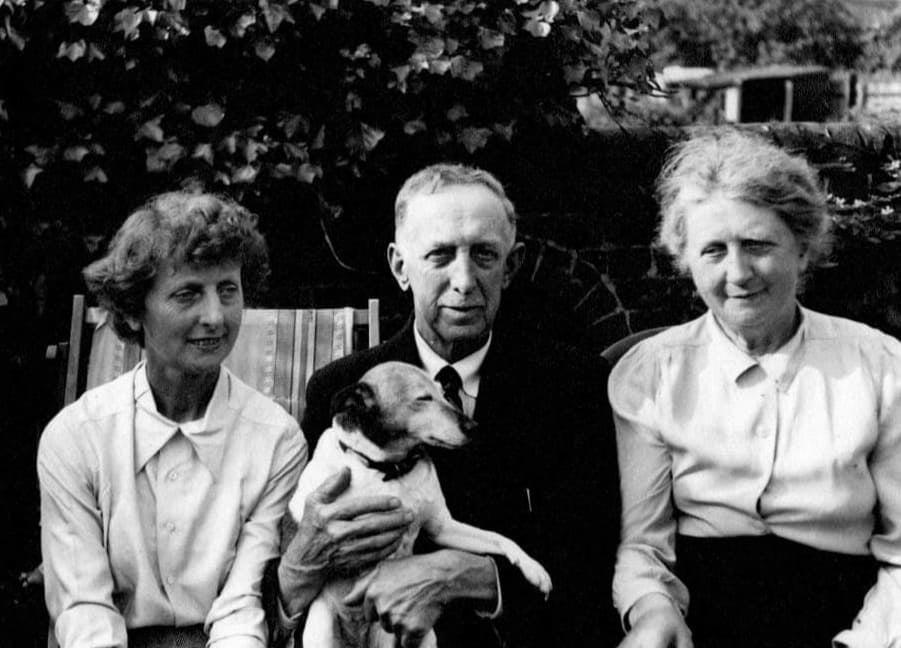
By the way, the dog, Flossy was always so rambunctious (of course, she was a JRT!) she was put on the stairway which fortunately had a door on it. Having said that I’ve always loved dogs so was very excited to see her and disappointed when she was not around.Phyllis with her parents William and Mary Marshall, and Flossie the dog in the garden at Love Lane:
Bryan continues:
I’ll always remember the early days with the outside toilet with the overhead cistern caked in active BIG spider webs. I used to have to light a candle to go outside, shielding the flame until destination. In that space I’d set the candle down and watch the eery shadows move from side to side whilst…well anyway! Then I’d run like hell back into the house. Eventually the kitchen wall was broken through so it became an indoor loo. Phew!
In the early days the house was rented for ten-shillings a week…I know because I used to take over a ten-bob-note to a grumpy lady next door who used to sign the receipt in the rent book. Then, I think she died and it became available for $600.00 yes…the whole house for $600.00 but it wasn’t purchased then. Eventually aunt Phyllis purchased it some years later…perhaps when grandad died.I used to work much in the back garden which was a lovely walled garden with arch-type decorations in the brickwork and semicircular shaped capping bricks. The abundant apple tree. Raspberry and loganberry canes. A gooseberry bush and huge Victoria plum tree on the wall at the bottom of the garden which became a wonderful attraction for wasps! (grandad called the “whasps”). He would stew apples and fruit daily.
Do you remember their black and white cat Twinky? Always sat on the pink-screen TV and when she died they were convinced that “that’s wot got ‘er”. Grandad of course loved all his cats and as he aged, he named them all “Billy”.Have you come across the name “Featherstone” in grandma’s name. I don’t recall any details but Dorothy used to recall this. She did much searching of the family history Such a pity she didn’t hand anything on to anyone. She also said that we had a member of the family who worked with James Watt….but likewise I don’t have details.
Gifts of chocolates to Phyllis were regular and I became the recipient of the overflow!What a pity Dorothy’s family history research has disappeared! I have found the Featherstone’s, and the Purdy who worked with James Watt, but I wonder what else Dorothy knew.
I mentioned DH Lawrence to Bryan, and the connection to Eastwood, where Bryan’s grandma (and Phyllis’s mother) Mary Ann Gilman Purdy was born, and shared with him the story about Francis Purdy, the Primitive Methodist minister, and about Francis’s son William who invented the miners lamp.
He replied:
As a nosy young man I was looking through the family bookcase in Love Lane and came across a brown paper covered book. Intrigued, I found “Sons and Lovers” D.H. Lawrence. I knew it was a taboo book (in those days) as I was growing up but now I see the deeper connection. Of course! I know that Phyllis had I think an earlier boyfriend by the name of Maurice who lived in Perry Barr, Birmingham. I think he later married but was always kind enough to send her a book and fond message each birthday (Feb.12). I guess you know grandad’s birthday – July 28. We’d always celebrate those days. I’d usually be the one to go into Oldswinford and get him a cardigan or pullover and later on, his 2oz tins of St. Bruno tobacco for his pipe (I recall the room filled with smoke as he puffed away).
Dorothy and Phyllis always spoke of their ancestor’s vocation as a Minister. So glad to have this history! Wow, what a story too. The Lord rescued him from mischief indeed. Just goes to show how God can change hearts…one at a time.
So interesting to hear about the Miner’s Lamp. My vicar whilst growing up at St. John’s in Stourbridge was from Durham and each Harvest Festival, there would be a miner’s lamp placed upon the altar as a symbol of the colliery and the bountiful harvest.More recollections from Bryan about the house and garden at Love Lane:
I always recall tea around the three legged oak table bedecked with a colorful seersucker cloth. Battenburg cake. Jam Roll. Rich Tea and Digestive biscuits. Mr. Kipling’s exceedingly good cakes! Home-made jam. Loose tea from the Coronation tin cannister. The ancient mangle outside the back door and the galvanized steel wash tub with hand-operated agitator on the underside of the lid. The hand operated water pump ‘though modernisation allowed for a cold tap only inside, above the single sink and wooden draining board. A small gas stove and very little room for food preparation. Amazing how the Marshalls (×7) managed in this space!
The small window over the sink in the kitchen brought in little light since the neighbor built on a bathroom annex at the back of their house, leaving #47 with limited light, much to to upset of grandad and Phyllis. I do recall it being a gloomy place..i.e.the kitchen and back room.
The garden was lovely. Long and narrow with privet hedge dividing the properties on the right and the lovely wall on the left. Dorothy planted spectacular lilac bushes against the wall. Vivid blues, purples and whites. Double-flora. Amazing…and with stunning fragrance. Grandad loved older victorian type plants such as foxgloves and comfrey. Forget-me-nots and marigolds (calendulas) in abundance. Rhubarb stalks. Always plantings of lettuce and other vegetables. Lots of mint too! A large varigated laurel bush outside the front door!
Such a pleasant walk through the past.
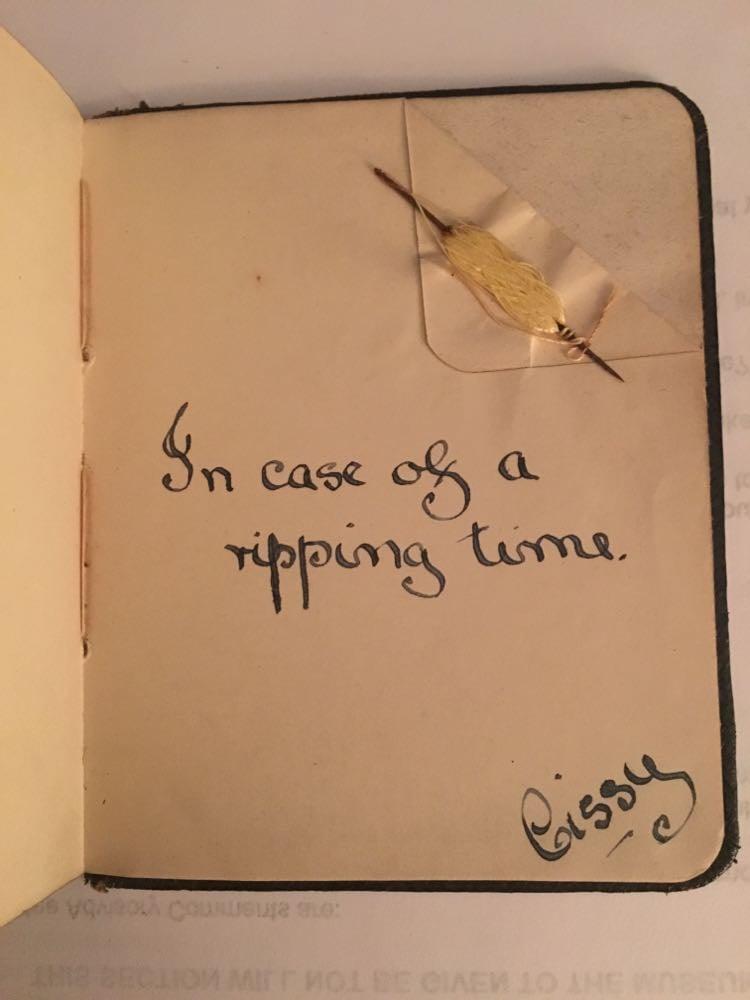
An autograph book belonging to Phyllis from the 1920s has survived in which each friend painted a little picture, drew a cartoon, or wrote a verse. This entry is perhaps my favourite:
 December 15, 2021 at 3:37 pm #6238
In reply to: The Elusive Samuel Housley and Other Family Stories
Ellen (Nellie) Purdy
My grandfathers aunt Nellie Purdy 1872-1947 grew up with his mother Mary Ann at the Gilmans in Buxton. We knew she was a nurse or a matron, and that she made a number of trips to USA.
I started looking for passenger lists and immigration lists (we had already found some of them, and my cousin Linda Marshall in Boston found some of them), and found one in 1904 with details of the “relatives address while in US”.
October 31st, 1904, Ellen Purdy sailed from Liverpool to Baltimore on the Friesland. She was a 32 year old nurse and she paid for her own ticket. The address of relatives in USA was Druid Hill and Lafayette Ave, Baltimore, Maryland.
I wondered if she stayed with relatives, perhaps they were the Housley descendants. It was her great uncle George Housley who emigrated in 1851, not so far away in Pennsylvania. I wanted to check the Baltimore census to find out the names at that address, in case they were Housley’s. So I joined a Baltimore History group on facebook, and asked how I might find out. The people were so enormously helpful! The address was the Home of the Friendless, an orphanage. (a historic landmark of some note I think), and someone even found Ellen Purdy listed in the Baltimore directory as a nurse there.
She sailed back to England in 1913. Ellen sailed in 1900 and 1920 as well but I haven’t unraveled those trips yet.
THE HOME OF THE FRIENDLESS, is situated at the corner of Lafayette and Druid Hill avenues, Baltimore. It is a large brick building, which was erected at a cost of $62,000. It was organized in 1854.The chief aim of the founders of this institution was to respond to a need for providing a home for the friendless and homeless children, orphans, and half-orphans, or the offspring of vagrants. It has been managed since its organization by a board of ladies, who, by close attention and efficient management, have made the institution one of the most prominent charitable institutions in the State. From its opening to the present time there have been received 5,000 children, and homes have been secured for nearly one thousand of this number. The institution has a capacity of about 200 inmates. The present number of beneficiaries is 165. A kindergarten and other educational facilities are successfully conducted. The home knows no demonimational creed, being non-sectarian. Its principal source of revenue is derived from private contributions. For many years the State has appropriated different sums towards it maintenance, and the General Assembly of 1892 contributed the sum of $3,000 per annum.
A later trip: The ship’s manifest from May 1920 the Baltic lists Ellen on board arriving in Ellis Island heading to Baltimore age 48. The next of kin is listed as George Purdy (her father) of 2 Gregory Blvd Forest Side, Nottingham. She’s listed as a nurse, and sailed from Liverpool May 8 1920.
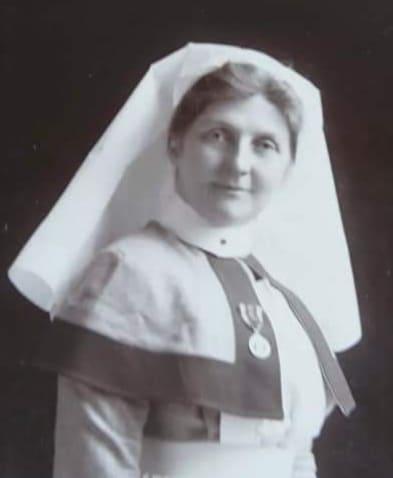
Ellen eventually retired in England and married Frank Garbett, a tax collector, at the age of 51 in Herefordshire. Judging from the number of newspaper articles I found about her, she was an active member of the community and was involved in many fundraising activities for the local cottage hospital.
Her obituary in THE KINGTON TIMES, NOVEMBER 8, 1947:
Mrs. Ellen Garbett wife of Mr. F. Garbett, of Brook Cottage, Kingsland, whose funeral took place at St. Michael’s Church, Kingsland, on October 30th, was a familiar figure in the district, and by her genial manner and kindly ways had endeared herself to many.
Mrs Garbett had had a wide experience in the nursing profession. Beginning her training in this country, she went to the Italian Riviera and there continued her work, later going to the United States. In 1916 she gained the Q.A.I.M.N.S. and returned to England and was appointed sister at the Lord Derby Military Hospital, an appointment she held for four years.We didn’t know that Ellen had worked on the Italian Riviera, and hope in due course to find out more about it.
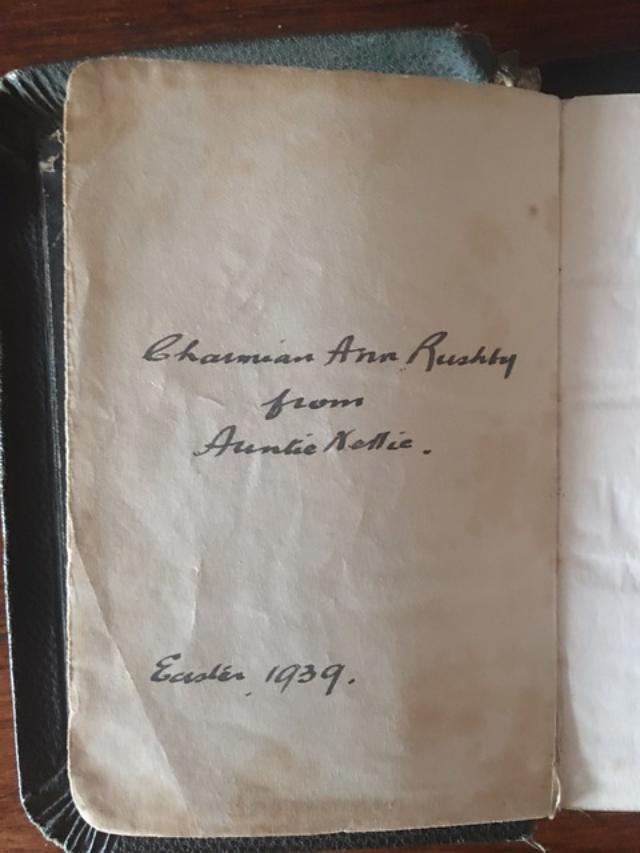
Mike Rushby, Ellen’s sister Kate’s grandson in Australia, spoke to his sister in USA recently about Nellie Purdy. She replied: I told you I remembered Auntie Nellie coming to Jacksdale. She gave me a small green leatherette covered bible which I still have ( though in a very battered condition). Here is a picture of it.
 December 15, 2021 at 9:34 am #6236
In reply to: The Elusive Samuel Housley and Other Family Stories
The Liverpool Fires
Catherine Housley had two older sisters, Elizabeth 1845-1883 and Mary Anne 1846-1935. Both Elizabeth and Mary Anne grew up in the Belper workhouse after their mother died, and their father was jailed for failing to maintain his three children. Mary Anne married Samuel Gilman and they had a grocers shop in Buxton. Elizabeth married in Liverpool in 1873.
What was she doing in Liverpool? How did she meet William George Stafford?
According to the census, Elizabeth Housley was in Belper workhouse in 1851. In 1861, aged 16, she was a servant in the household of Peter Lyon, a baker in Derby St Peters. We noticed that the Lyon’s were friends of the family and were mentioned in the letters to George in Pennsylvania.
No record of Elizabeth can be found on the 1871 census, but in 1872 the birth and death was registered of Elizabeth and William’s child, Elizabeth Jane Stafford. The parents are registered as William and Elizabeth Stafford, although they were not yet married. William’s occupation is a “refiner”.
In April, 1873, a Fatal Fire is reported in the Liverpool Mercury. Fearful Termination of a Saturday Night Debauch. Seven Persons Burnt To Death. Interesting to note in the article that “the middle room being let off to a coloured man named William Stafford and his wife”.
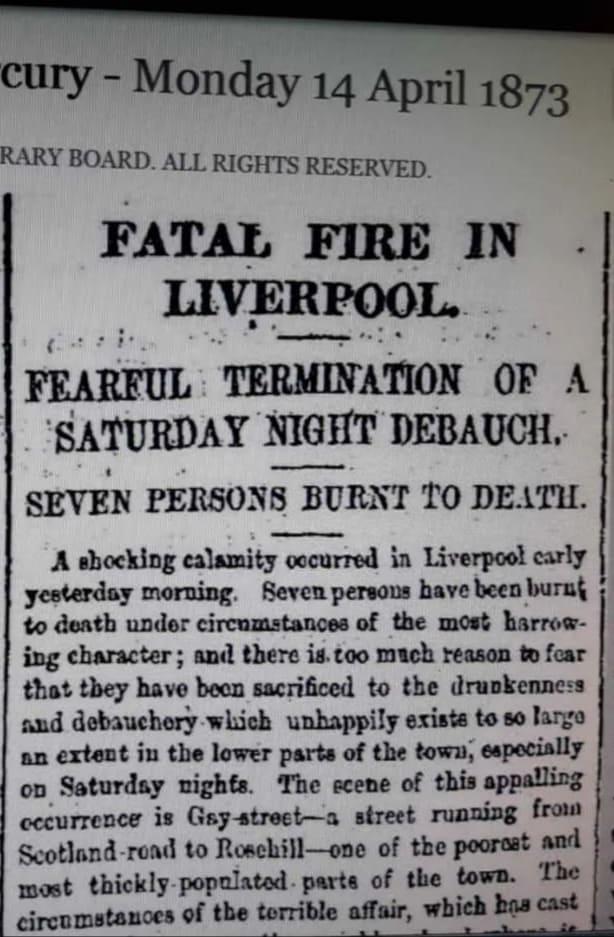
We had noted on the census that William Stafford place of birth was “Africa, British subject” but it had not occurred to us that he was “coloured”. A register of birth has not yet been found for William and it is not known where in Africa he was born.
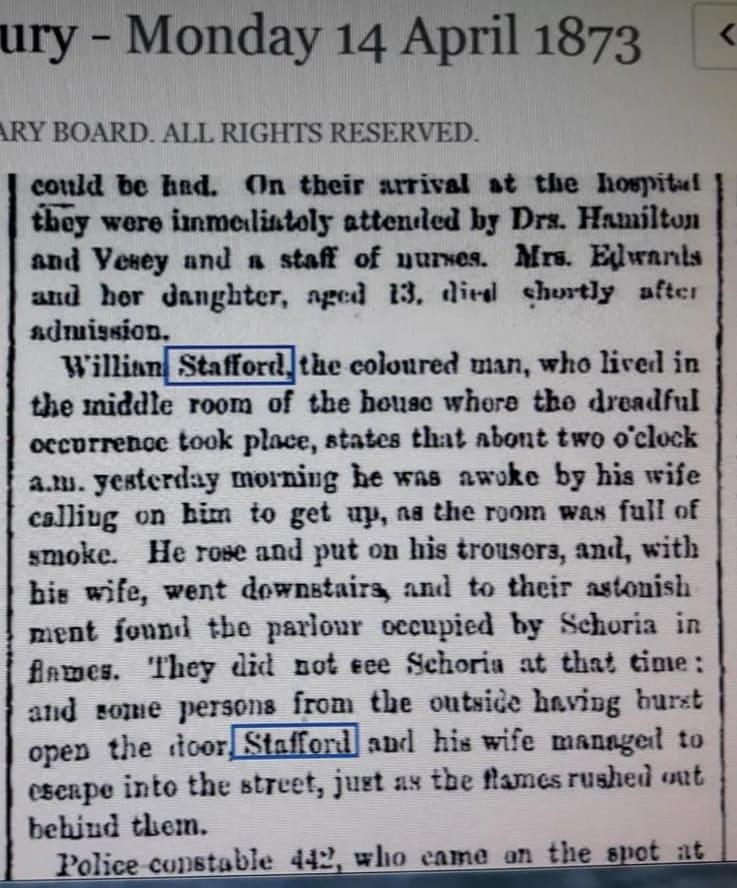
Elizabeth and William survived the fire on Gay Street, and were still living on Gay Street in October 1873 when they got married.
William’s occupation on the marriage register is sugar refiner, and his father is Peter Stafford, farmer. Elizabeth’s father is Samuel Housley, plumber. It does not say Samuel Housley deceased, so perhaps we can assume that Samuel is still alive in 1873.
Eliza Florence Stafford, their second daughter, was born in 1876.
William’s occupation on the 1881 census is “fireman”, in his case, a fire stoker at the sugar refinery, an unpleasant and dangerous job for which they were paid slightly more. William, Elizabeth and Eliza were living in Byrom Terrace.
Byrom Terrace, Liverpool, in 1933
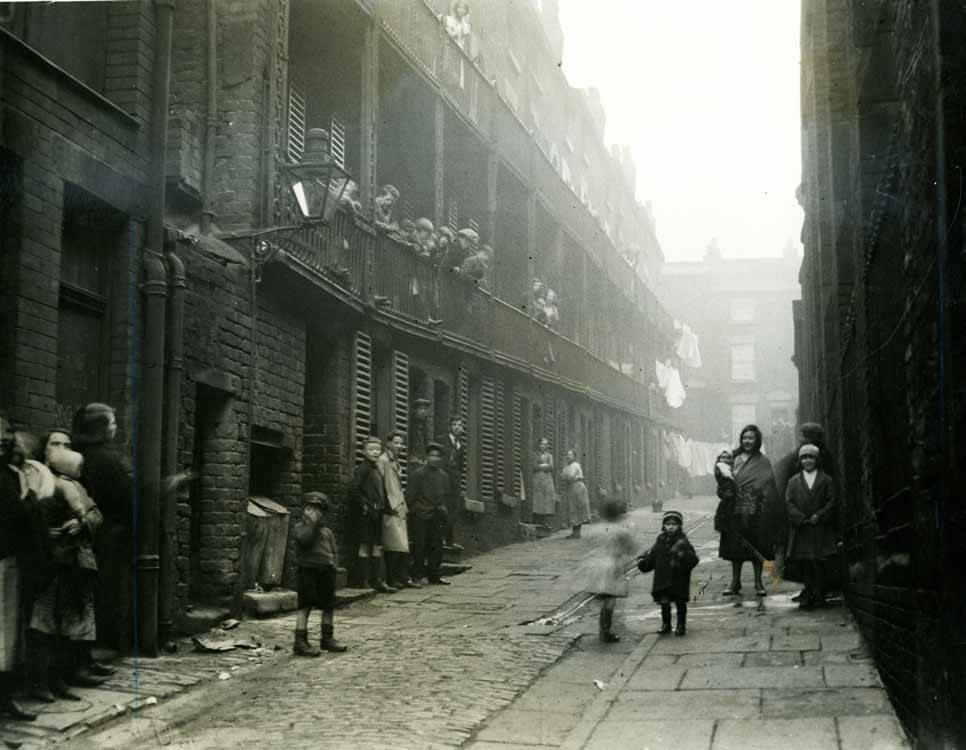
Elizabeth died of heart problems in 1883, when Eliza was six years old, and in 1891 her father died, scalded to death in a tragic accident at the sugar refinery.
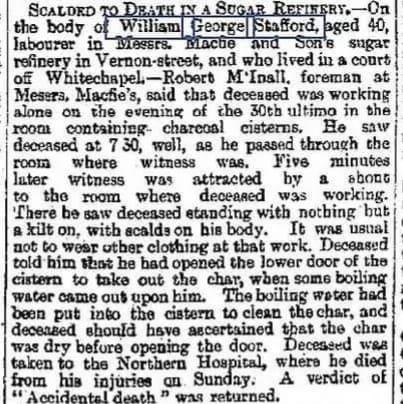
Eliza, aged 15, was living as an inmate at the Walton on the Hill Institution in 1891. It’s not clear when she was admitted to the workhouse, perhaps after her mother died in 1883.
In 1901 Eliza Florence Stafford is a 24 year old live in laundrymaid, according to the census, living in West Derby (a part of Liverpool, and not actually in Derby). On the 1911 census there is a Florence Stafford listed as an unnmarried laundress, with a daughter called Florence. In 1901 census she was a laundrymaid in West Derby, Liverpool, and the daughter Florence Stafford was born in 1904 West Derby. It’s likely that this is Eliza Florence, but nothing further has been found so far.
The questions remaining are the location of William’s birth, the name of his mother and his family background, what happened to Eliza and her daughter after 1911, and how did Elizabeth meet William in the first place.
William Stafford was a seaman prior to working in the sugar refinery, and he appears on several ship’s crew lists. Nothing so far has indicated where he might have been born, or where his father came from.
Some months after finding the newspaper article about the fire on Gay Street, I saw an unusual request for information on the Liverpool genealogy group. Someone asked if anyone knew of a fire in Liverpool in the 1870’s. She had watched a programme about children recalling past lives, in this case a memory of a fire. The child recalled pushing her sister into a burning straw mattress by accident, as she attempted to save her from a falling beam. I watched the episode in question hoping for more information to confirm if this was the same fire, but details were scant and it’s impossible to say for sure.
December 13, 2021 at 3:38 pm #6229In reply to: The Elusive Samuel Housley and Other Family Stories
Gretton Tailoresses of Swadlincote and the Single Journalist Boot Maker Next Door
The Purdy’s, Housley’s and Marshall’s are my mothers fathers side of the family. The Warrens, Grettons and Staleys are from my mothers mothers side.
I decided to add all the siblings to the Gretton side of the family, in search of some foundation to a couple of family anecdotes. My grandmother, Nora Marshall, whose mother was Florence Nightingale Gretton, used to mention that our Gretton side of the family were related to the Burton Upon Trent Grettons of Bass, Ratcliff and Gretton, the brewery. She also said they were related to Lord Gretton of Stableford Park in Leicestershire. When she was a child, she said parcels of nice clothes were sent to them by relatives.
It should be noted however that Baron Gretton is a title in the Peerage of the United Kingdom, and was created in 1944 for the brewer and Conservative politician John Gretton. He was head of the brewery firm of Bass, Ratcliff & Gretton Ltd of Burton upon Trent. So they were not members of the Peerage at the time of this story.
What I found was unexpected.
My great great grandfather Richard Gretton 1833-1898, a baker in Swadlincote, didn’t have any brothers, but he did have a couple of sisters.
One of them, Frances, born 1831, never married, but had four children. She stayed in the family home, and named her children Gretton. In 1841 and 1851 she’s living with parents and siblings. In 1861 she is still living with parents and now on the census she has four children all named Gretton listed as grandchildren of her father.
In 1871, her mother having died in 1866, she’s still living with her father William Gretton, Frances is now 40, and her son William 19 and daughter Jane 15 live there.
By the time she is 50 in 1881 and her parents have died she’s head of the house with 5 children all called Gretton, including her daughter Jane Gretton aged 24.Twenty five year old Robert Staley is listed on the census transcription as living in the same household, but when viewing the census image it becomes clear that he lived next door, on his own and was a bootmaker, and on the other side, his parents Benjamin and Sarah Staley lived at the Prince of Wales pub with two other siblings.
Who was fathering all these Gretton children?
It seems that Jane did the same thing as her mother: she stayed at home and had three children, all with the name Gretton. Jane Gretton named her son, born in 1878, Michael William Staley Gretton, which would suggest that Staley was the name of the father of the child/children of Jane Gretton.
The father of Frances Gretton’s four children is not known, and there is no father on the birth registers, although they were all baptized.
I found a photo of Jane Gretton on a family tree on an ancestry site, so I contacted the tree owner hoping that she had some more information, but she said no, none of the older family members would explain when asked about it. Jane later married Tom Penn, and Jane Gretton’s children are listed on census as Tom Penn’s stepchildren.
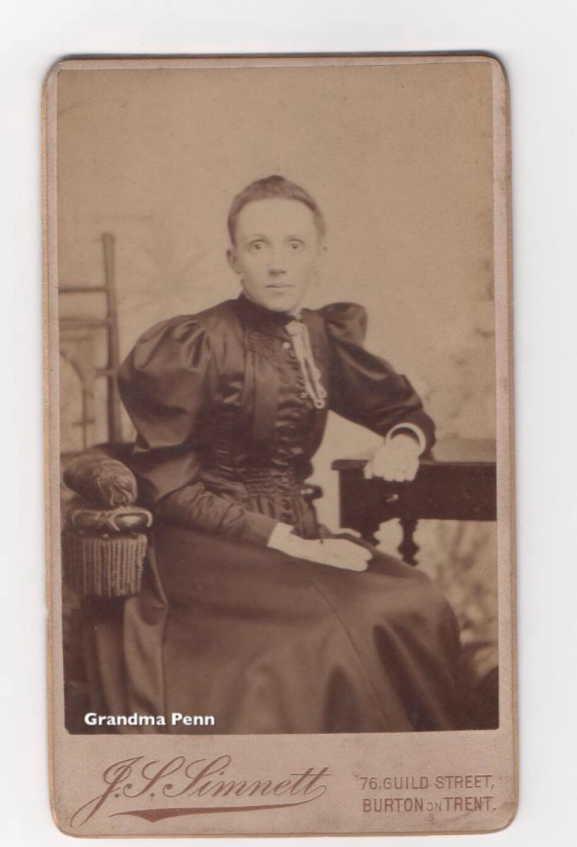
It seems that Robert Staley (who may or may not be the father of Jane’s children) never married. In 1891 Robert is 35, single, living with widowed mother Sarah in Swadlincote. Sarah is living on own means and Robert has no occupation. On the 1901 census Robert is an unmarried 45 year old journalist and author, living with his widowed mother Sarah Staley aged 79, in Swadlincote.
There are at least three Staley Warren marriages in the family, and at least one Gretton Staley marriage.
There is a possibility that the father of Frances’s children could be a Gretton, but impossible to know for sure. William Gretton was a tailor, and several of his children and grandchildren were tailoresses. The Gretton family who later bought Stableford Park lived not too far away, and appear to be well off with a dozen members of live in staff on the census. Did our Gretton’s the tailors make their clothes? Is that where the parcels of nice clothes came from?
Perhaps we’ll find a family connection to the brewery Grettons, or find the family connection was an unofficial one, or that the connection is further back.
I suppose luckily, this isn’t my direct line but an exploration of an offshoot, so the question of paternity is merely a matter of curiosity. It is a curious thing, those Gretton tailors of Church Gresley near Burton upon Trent, and there are questions remaining.
December 13, 2021 at 11:29 am #6222In reply to: The Elusive Samuel Housley and Other Family Stories
George Gilman Rushby: The Cousin Who Went To Africa
The portrait of the woman has “mother of Catherine Housley, Smalley” written on the back, and one of the family photographs has “Francis Purdy” written on the back. My first internet search was “Catherine Housley Smalley Francis Purdy”. Easily found was the family tree of George (Mike) Rushby, on one of the genealogy websites. It seemed that it must be our family, but the African lion hunter seemed unlikely until my mother recalled her father had said that he had a cousin who went to Africa. I also noticed that the lion hunter’s middle name was Gilman ~ the name that Catherine Housley’s daughter ~ my great grandmother, Mary Ann Gilman Purdy ~ adopted, from her aunt and uncle who brought her up.
I tried to contact George (Mike) Rushby via the ancestry website, but got no reply. I searched for his name on Facebook and found a photo of a wildfire in a place called Wardell, in Australia, and he was credited with taking the photograph. A comment on the photo, which was a few years old, got no response, so I found a Wardell Community group on Facebook, and joined it. A very small place, population some 700 or so, and I had an immediate response on the group to my question. They knew Mike, exchanged messages, and we were able to start emailing. I was in the chair at the dentist having an exceptionally long canine root canal at the time that I got the message with his email address, and at that moment the song Down in Africa started playing.
Mike said it was clever of me to track him down which amused me, coming from the son of an elephant and lion hunter. He didn’t know why his father’s middle name was Gilman, and was not aware that Catherine Housley’s sister married a Gilman.
Mike Rushby kindly gave me permission to include his family history research in my book. This is the story of my grandfather George Marshall’s cousin. A detailed account of George Gilman Rushby’s years in Africa can be found in another chapter called From Tanganyika With Love; the letters Eleanor wrote to her family.
George Gilman Rushby:
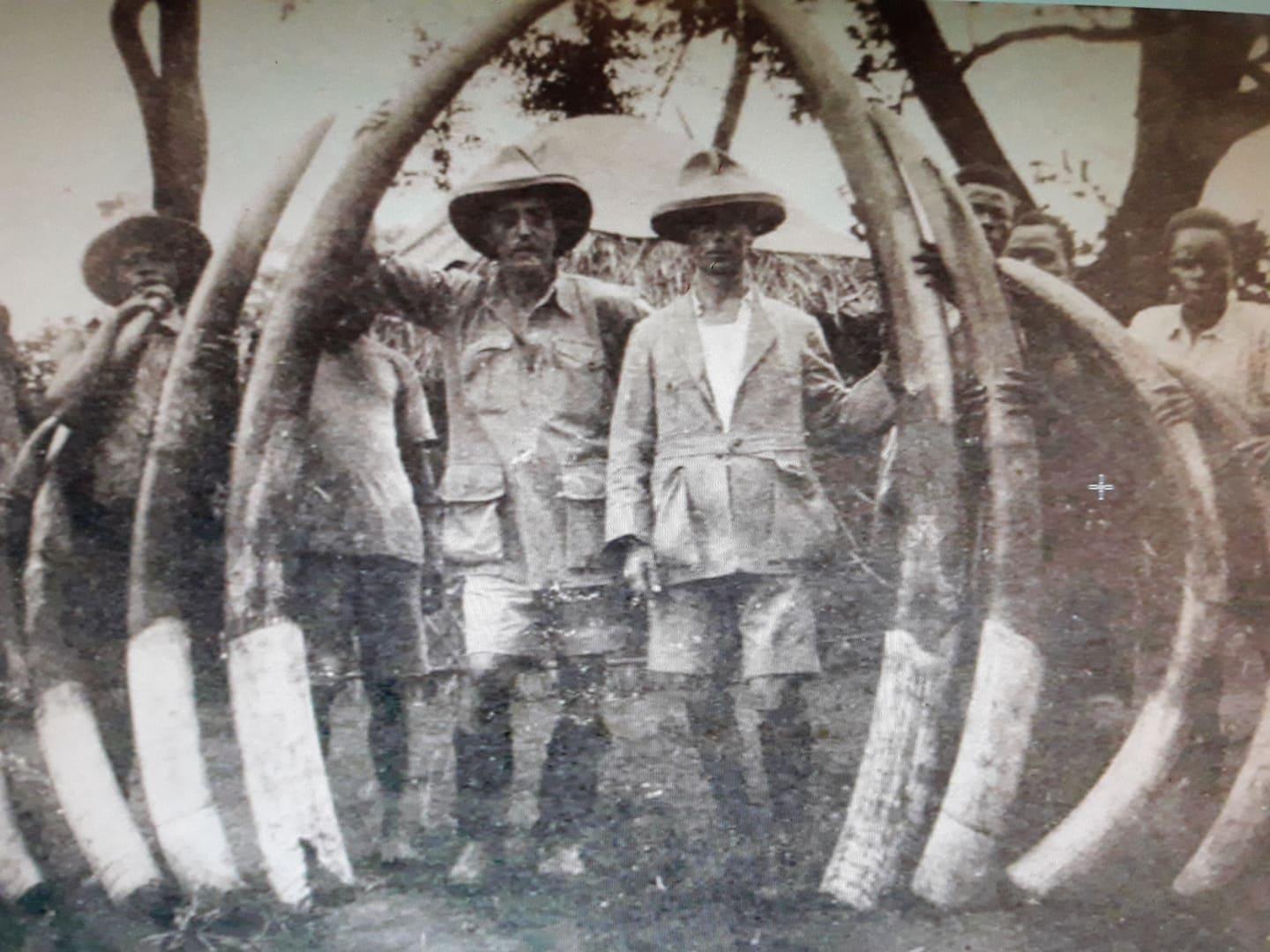
The story of George Gilman Rushby 1900-1969, as told by his son Mike:
George Gilman Rushby:
Elephant hunter,poacher, prospector, farmer, forestry officer, game ranger, husband to Eleanor, and father of 6 children who now live around the world.George Gilman Rushby was born in Nottingham on 28 Feb 1900 the son of Catherine Purdy and John Henry Payling Rushby. But John Henry died when his son was only one and a half years old, and George shunned his drunken bullying stepfather Frank Freer and was brought up by Gypsies who taught him how to fight and took him on regular poaching trips. His love of adventure and his ability to hunt were nurtured at an early stage of his life.
The family moved to Eastwood, where his mother Catherine owned and managed The Three Tuns Inn, but when his stepfather died in mysterious circumstances, his mother married a wealthy bookmaker named Gregory Simpson. He could afford to send George to Worksop College and to Rugby School. This was excellent schooling for George, but the boarding school environment, and the lack of a stable home life, contributed to his desire to go out in the world and do his own thing. When he finished school his first job was as a trainee electrician with Oaks & Co at Pye Bridge. He also worked part time as a motor cycle mechanic and as a professional boxer to raise the money for a voyage to South Africa.In May 1920 George arrived in Durban destitute and, like many others, living on the beach and dependant upon the Salvation Army for a daily meal. However he soon got work as an electrical mechanic, and after a couple of months had earned enough money to make the next move North. He went to Lourenco Marques where he was appointed shift engineer for the town’s power station. However he was still restless and left the comfort of Lourenco Marques for Beira in August 1921.
Beira was the start point of the new railway being built from the coast to Nyasaland. George became a professional hunter providing essential meat for the gangs of construction workers building the railway. He was a self employed contractor with his own support crew of African men and began to build up a satisfactory business. However, following an incident where he had to shoot and kill a man who attacked him with a spear in middle of the night whilst he was sleeping, George left the lower Zambezi and took a paddle steamer to Nyasaland (Malawi). On his arrival in Karongo he was encouraged to shoot elephant which had reached plague proportions in the area – wrecking African homes and crops, and threatening the lives of those who opposed them.
His next move was to travel by canoe the five hundred kilometre length of Lake Nyasa to Tanganyika, where he hunted for a while in the Lake Rukwa area, before walking through Northern Rhodesia (Zambia) to the Congo. Hunting his way he overachieved his quota of ivory resulting in his being charged with trespass, the confiscation of his rifles, and a fine of one thousand francs. He hunted his way through the Congo to Leopoldville then on to the Portuguese enclave, near the mouth of the mighty river, where he worked as a barman in a rough and tough bar until he received a message that his old friend Lumb had found gold at Lupa near Chunya. George set sail on the next boat for Antwerp in Belgium, then crossed to England and spent a few weeks with his family in Jacksdale before returning by sea to Dar es Salaam. Arriving at the gold fields he pegged his claim and almost immediately went down with blackwater fever – an illness that used to kill three out of four within a week.
When he recovered from his fever, George exchanged his gold lease for a double barrelled .577 elephant rifle and took out a special elephant control licence with the Tanganyika Government. He then headed for the Congo again and poached elephant in Northern Rhodesia from a base in the Congo. He was known by the Africans as “iNyathi”, or the Buffalo, because he was the most dangerous in the long grass. After a profitable hunting expedition in his favourite hunting ground of the Kilombera River he returned to the Congo via Dar es Salaam and Mombassa. He was after the Kabalo district elephant, but hunting was restricted, so he set up his base in The Central African Republic at a place called Obo on the Congo tributary named the M’bomu River. From there he could make poaching raids into the Congo and the Upper Nile regions of the Sudan. He hunted there for two and a half years. He seldom came across other Europeans; hunters kept their own districts and guarded their own territories. But they respected one another and he made good and lasting friendships with members of that small select band of adventurers.
Leaving for Europe via the Congo, George enjoyed a short holiday in Jacksdale with his mother. On his return trip to East Africa he met his future bride in Cape Town. She was 24 year old Eleanor Dunbar Leslie; a high school teacher and daughter of a magistrate who spent her spare time mountaineering, racing ocean yachts, and riding horses. After a whirlwind romance, they were betrothed within 36 hours.
On 25 July 1930 George landed back in Dar es Salaam. He went directly to the Mbeya district to find a home. For one hundred pounds he purchased the Waizneker’s farm on the banks of the Mntshewe Stream. Eleanor, who had been delayed due to her contract as a teacher, followed in November. Her ship docked in Dar es Salaam on 7 Nov 1930, and they were married that day. At Mchewe Estate, their newly acquired farm, they lived in a tent whilst George with some help built their first home – a lovely mud-brick cottage with a thatched roof. George and Eleanor set about developing a coffee plantation out of a bush block. It was a very happy time for them. There was no electricity, no radio, and no telephone. Newspapers came from London every two months. There were a couple of neighbours within twenty miles, but visitors were seldom seen. The farm was a haven for wild life including snakes, monkeys and leopards. Eleanor had to go South all the way to Capetown for the birth of her first child Ann, but with the onset of civilisation, their first son George was born at a new German Mission hospital that had opened in Mbeya.
Occasionally George had to leave the farm in Eleanor’s care whilst he went off hunting to make his living. Having run the coffee plantation for five years with considerable establishment costs and as yet no return, George reluctantly started taking paying clients on hunting safaris as a “white hunter”. This was an occupation George didn’t enjoy. but it brought him an income in the days when social security didn’t exist. Taking wealthy clients on hunting trips to kill animals for trophies and for pleasure didn’t amuse George who hunted for a business and for a way of life. When one of George’s trackers was killed by a leopard that had been wounded by a careless client, George was particularly upset.
The coffee plantation was approaching the time of its first harvest when it was suddenly attacked by plagues of borer beetles and ring barking snails. At the same time severe hail storms shredded the crop. The pressure of the need for an income forced George back to the Lupa gold fields. He was unlucky in his gold discoveries, but luck came in a different form when he was offered a job with the Forestry Department. The offer had been made in recognition of his initiation and management of Tanganyika’s rainbow trout project. George spent most of his short time with the Forestry Department encouraging the indigenous people to conserve their native forests.In November 1938 he transferred to the Game Department as Ranger for the Eastern Province of Tanganyika, and over several years was based at Nzasa near Dar es Salaam, at the old German town of Morogoro, and at lovely Lyamungu on the slopes of Kilimanjaro. Then the call came for him to be transferred to Mbeya in the Southern Province for there was a serious problem in the Njombe district, and George was selected by the Department as the only man who could possibly fix the problem.
Over a period of several years, people were being attacked and killed by marauding man-eating lions. In the Wagingombe area alone 230 people were listed as having been killed. In the Njombe district, which covered an area about 200 km by 300 km some 1500 people had been killed. Not only was the rural population being decimated, but the morale of the survivors was so low, that many of them believed that the lions were not real. Many thought that evil witch doctors were controlling the lions, or that lion-men were changing form to kill their enemies. Indeed some wichdoctors took advantage of the disarray to settle scores and to kill for reward.
By hunting down and killing the man-eaters, and by showing the flesh and blood to the doubting tribes people, George was able to instil some confidence into the villagers. However the Africans attributed the return of peace and safety, not to the efforts of George Rushby, but to the reinstallation of their deposed chief Matamula Mangera who had previously been stood down for corruption. It was Matamula , in their eyes, who had called off the lions.
Soon after this adventure, George was appointed Deputy Game Warden for Tanganyika, and was based in Arusha. He retired in 1956 to the Njombe district where he developed a coffee plantation, and was one of the first in Tanganyika to plant tea as a major crop. However he sensed a swing in the political fortunes of his beloved Tanganyika, and so sold the plantation and settled in a cottage high on a hill overlooking the Navel Base at Simonstown in the Cape. It was whilst he was there that TV Bulpin wrote his biography “The Hunter is Death” and George wrote his book “No More The Tusker”. He died in the Cape, and his youngest son Henry scattered his ashes at the Southern most tip of Africa where the currents of the Atlantic and Indian Oceans meet .
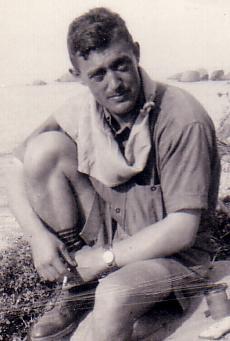
George Gilman Rushby:
 January 27, 2021 at 9:21 pm #6177
In reply to: Twists and One Return From the Time Capsule
“Grandpa, I can’t get hold of Nora. I keep getting her answer phone.” Clara flicked back through her texts. “Last time she messaged me was to ask if I knew anyone in the Village she could stay with. And I never got back with the details like I was supposed to … I got distracted by Van Gogh going missing and everything … ” She screwed up her face. “Also I couldn’t recall the man’s name.”
“I’m sure she’ll be fine,” said Bob soothingly, reaching out to pat Clara’s hand. “She always were a bit unreliable that one, weren’t she?”
Clara looked like she was about to burst into tears. “Grandpa, I’m such an idiot! What if something bad has happened to her?
January 4, 2021 at 4:53 am #6174In reply to: Twists and One Return From the Time Capsule
Clara breathed a sigh of relief when she saw VanGogh running towards her; in the moonlight he looked like a pale ghost.
“Where’ve you been eh?” she asked as he nuzzled her excitedly. She crouched down to pat him. “And what’s this?” A piece of paper folded into quarters had been tucked into VanGogh’s collar. Clara stood upright and looked uneasily around the garden; a small wind made the leaves rustle and the deep shadows stirred. Clara shivered.
“Clara?” called Bob from the door.
“It’s okay Grandpa, I found him. We’re coming in now.”
In the warm light of the kitchen, Clara showed Bob the piece of paper. “It’s a map, but I don’t know those place names.”
“And it was stuffed into his collar you say?” Bob frowned. “That’s very strange indeed. Who’d of done that?”
Clara shook her head. “It wasn’t Mr Willets because I saw him drive off. But why didn’t VanGogh bark? He always barks when someone comes on the property.”
“You really should tell her about the note,” said Jane. She was perched on the kitchen bench. VanGogh pricked his ears up and wagged his tail as he looked towards her. Bob couldn’t figure out if the dog could see Jane or just somehow sensed her there. He nodded.
“What?” asked Clara.
“There’s something I should tell you, Clara. It’s about that box you found.”
December 16, 2020 at 2:47 pm #6164In reply to: Twists and One Return From the Time Capsule
VanGogh was sniffing frantically on the patio outside the house, a usual indication that he’d found the perfect spot for a healthy stool, but this time, as soon as Clara had looked the other way to take care of the sautéed mushrooms on the stove, he darted for the shed where the odd big toy had been unearthed and stored out of sight.
His tail wagged frantically as he pushed the door open, and slid underneath the tarpaulin behind the sleeping lawn-eater.
He started to scratch the box, the way he usually tried to open the puzzle ball Clara would fill with some kibble. It didn’t roll like the ball-that-dispensed-kibble. In frustration, VanGogh started to push his paws on the sleek smooth surface, near the curious indentations.
Something clicked open.
“VanGogh! Where are you boy?! Come!”
Suddenly distracted from this puzzling quest, he rushed to the kitchen for dinner.
December 4, 2020 at 8:32 pm #6153In reply to: Twists and One Return From the Time Capsule
“That horsetail has such long roots, otherwise I never would have dug so deep,” mused Clara. “Are you okay holding that end? Not too heavy for you?”
Grandpa Bob grunted. The box was heavy—in more ways than one—but he wasn’t about to let Clara know he wasn’t up to it.
“Let’s put it down there behind the lawn mower,” said Clara. “Do you think it will be safe there? We could cover it?” She ran her hand appreciatively over the shiny exterior of the box; her fingers paused inquisitively at one end and she peered closely at the spot. “I think there is something here … an inscription or something!”
“Probably just some old scratches,” muttered Grandpa Bob. He straightened up with a moan and rubbed his back.
“No, look!” Clara was shining her phone torch at the area. “Look, it’s definitely letters of some sort. I’ll take a photo for Alienor!”
May 26, 2020 at 3:35 pm #6088In reply to: Tart Wreck Repackage
No sooner had they reached for the drinks in the office cupboard, than the phone rang loudly.
“Rosamund!” howled Star. “Where is that daft niece of yours, and what good is she if she doesn’t even answer the calls! Rosamund!”
“I thought you gave her the afternoon?” Tara mouthed while picking the annoying phone. “Cartwright and Wrexham Private Investigators, can I help you?”
Her face frowned. “Herself speaking.”
“Yes, we do private investigations. Very successfully I may say. Alright Ma’am, let me check my agenda.” She looked in the air, flipping an imaginary agenda. “Oh, you’re in luck, our 5pm just cancelled. Alright then, see you at our office. Au revoir.”
Tara hung up with a smile.
Star was busy slurping the mojito while struggling with the mint bits in her teeth. “What? Tell me this instant!”
“Our second case! Isn’t it exciting!”
“Sure thing, what it is this time? Evil possession?”
“Actually, it’s not that far off. Apparently, our ladyship needs a falgrante delicto of adultery. Her husband seems to be a cheating one, and with a twinge of double personality… Or at least that’s what she said.”
“Fantastic. Can’t wait for all the juicy details. I’ll go prepare my sequin red dress to set the honey trap darling.”
“Good lord, get a hold of yourself Star, it’s only been a day, and you’re ready to jump on the next passing horse as it were.”
“Who said you shouldn’t mix pleasure with business.”
“Right. Thought that was the reverse…”
“Tsk. Just to get the last word.”
“Indeed.”
May 26, 2020 at 10:06 am #6086In reply to: Tart Wreck Repackage
“A dil-do factory?” She was aghast. “A fucking carrot dildo factory?”
“Admit it, we’re rubbish at this” Tara said. “Even Rosamund may be better at this than us.”
“Oh don’t push it.” Star lit a large cigar, a nasty habit that cropped up when she was nervous. She blew a smoke ring and sighed. “At least the rogering was a nice change. Good clean sex, almost a spiritual experience.”
“Oh come now, with all the don’t-need-to-know details…”
“Well, don’t be such a prude, you were there after all. With all that luscious moaning. Haven’t seen you so flushed in ages…” Star tittered in that high-pitched laughter that could shatter crystal flutes.
“Wait… a minute.” Tara was having a brainwave. “We may have overlooked something.”
“What? In the sex department?”
“Shush, you lascivious banshee… In the flushed department.”
“What? Don’t speak riddles tart, I can’t handle riddles when my body’s aching from all that gymnastic.”
“Can’t you see? They got to get rid of the dissident stuff unfit for cultish dildoing, if you catch my drift.”
“Oh I catch it alright, but I’ve checked the loo… Oh, what? you mean the compost pile?”
“I’ve seen trucks parked out the back, they where labelled… Organic Lou’s Disposal Services… OLDS… That’s probably how they remove their archives, if you see what I mean.”
“Alright, alright, we’ll go investigate them tomorrow. Meanwhile, what about Mr French?” Star was puffing on her cigar making a good effort at trying to remember and link the details together.
“I have a theory. Although it usually would be more in your area of theories.”
“What? Alien abduction?”
“No, don’t be ridiculous. I’m talking time travel… Haven’t you noticed the scent of celery when we were at the mansion and the appartment?”
“A dead give-away for time-travelling shenanigans!”
“Exactly. And if I’m correct, might well be that it’s Mr French from the future who phoned us, before he returned to his timeline. Probably because he already knows we’re going to crack the case. Before we know.”
“Oh, that’s nice. Would have been nicer if he’d told us how to solve it instead, if he knew, from the future and all? Are you not sure he’s not from his past instead, like before he got in that dreadful car accident?”
“Oh well, doesn’t matter does it? And probably won’t any longer once we locate the Uncle Basil in the Drooling Home of Retired Vegetables.”
April 28, 2020 at 9:15 am #6078In reply to: Seven Twines and the Dragon Heartwoods
“You really know your trade, Fuyi,” said Rukshan. “You’ve built the most exquisite and comfortable place. And I think the empty dishes speak aplenty about the quality of the food and the pleasure we took in this shared meal. Now, let us help you with the dishes,” said Rukshan.
“Ach! Don’t be so polite,” said Fuyi. “I’ll have plenty of time after yar departure tomorrow. It’s not like the inn is full. Just enjoy an evening together, discuss yar plans, and have some rest. I know that life. Take the chance when it presents itself!”
Rushan nodded and looked at Kumihimo. Fox sighed with relief. His belly was full and round, and he didn’t want to disturbed his digestion with some chore.
The Sinese food made by the innkeeper had been delicious and quite a first for most of them. Tak had particularly enjoyed the crunchy texture of the stir fried vegetables flavoured with the famous five spices sauce. Nesy had preferred the algae and chili dishes while Fox, who ate a red hot pepper thinking it was bell pepper, had stuffed himself with juicy pork buns to put out the fire in his mouth.
Gorrash, befuddled by the novelty, had been at a loss of labels, good or bad. He simply chose to welcome the new experiences and body reactions to flavours and textures. As for Olliver, he gave up the chopsticks when he saw how fast Fox made the food disappear from the dishes.
Now that the dishes were empty, the children and Gorrash had left the table and were playing near the fireplace. Olliver was looking at the trio with envy, split between the desire to play and enjoy the simplicity of the moment, and the desire to be taken more seriously which meant participate in the conversation with the adults.
“We have plenty to discuss, Fae,” said Kumihimo.
Fuyi looked at Olliver, recognising the conundrum. “That’s settled, then,” he said to the group. Then turning toward Olliver: “Boy! I’m sure the start of the conversation will be boring for a young mind. Let’s join the others for a story of my own. You can still come back later and they’ll fill you in on the details.”
Fuyi and Olliver moved to the fireplace. The innkeeper threw cushions on the floor and sat on a wooden rocking chair. At the mention of a story, Tak, Nesy and Gorrash couldn’t contain their exuberant joy and gathered all ears around Admirable Fuyi. As he rocked, the chair creaked. He waited until they all calmed down. And when he was satisfied he started.
“I was young and still a fresh recruit in the Sinese army,” started Fuyi. “We were stationed at the western frontier just below the high plateaus and I hadn’t participated in any battle yet. With the folly of youth I thought that our weapons and the bond we shared with my fellow soldiers were enough to defeat anything.”
April 18, 2020 at 10:23 am #6026In reply to: The Whale’s Diaries Collection
Dear Jorid Whale,
My hands are shaking while I type this on the keyboard.
I’m not sure which of last night’s dreams is the bizarrest. Bizarre in a fantastic way, although for certain people it might be called grotesque. I’m certain it has something to do with that book I ordered online last week. I don’t usually read books and certainly not like this one. But the confinement, it makes you consider making things out of your ordinary.
It’s called The Enchanted Forest of Changes, by a Chinese artist Níngméng (柠檬). They say his artist name means lemon, but that some of his friends call him Níng mèng 凝梦 (curdle dreams), which to my ears sound exactly the same except a little bit angrier. I found out about him on a forum about creepy dolls abandoned in forests all around the world. Yeah exactly, the confinement effect again. Apparently it started with a few dolls in a forest in Michigan, and then suddenly people started to find them everywhere. I wonder if some people are really into the confinement thing or if it’s just me using that as a reason to stay home.
Anyway, someone on that forum posted one of the picture of that book and it caught my eye. So much so that I dreamt of it the following night. So I bought the book and it’s mostly ink drawings, but they seem to speak directly to some part of you that you were not even aware you had. I almost hear whispers when I look at the drawings. And then I have those dreams.
Last night I dreamt of a cat that had been raised as a boy. He even had the shape of one, but shorter maybe. He had learned to talk and use his paws as hands, his claws had grown into fingers, had lost most of his fur and he was wearing clothes. If I was amazed by such a feat, it kinda seemed normal for the people I met in that dream. It just took a lot of efforts, love and dedication to raise this kind of children.
And Whale, I feel tingling in my arms. This morning you showed me the picture of a kitten! That’s not a mere coincidence. I’m feeling so excited, my hands are too slow to type what I want to write. I fear I’m going to forget an important detail.
About the second dream. The world was in shock, there was this giant… thing that looked like a pistil and that had grown during the night in some arid area. It was taller than the tallest human made tower. Its extremity was cone shaped, and I confess that the whole thing looked like some kind of dick to me.
Plants and trees had followed in the following days as if the pistil had changed the climatic conditions (autocorrect wanted to write climactic, is that you playing around?).
The pistil was protected by some kind of field and it couldn’t be approached by everyone. Governments had tried, pharmaceutical companies had tried. People who wanted to make gold out of it, they were all rejected. But for some reason some people could approach. Anyone, not just the pure of hearts or the noble ones. Actually a whole bunch of weirdoes started to take their chances. Some were allowed in and some where not. Nobody knew what was the deciding factor.
A friend of mine that I have not seen in years during my waking life, she came back and asked me to come with her. So we went and were allowed in. My recall of the events after that is fuzzy. But I get the strange impression that I will spend more time in there later on.
[Edited in the afternoon]
I don’t believe it! It’s on the news everywhere. It has even replaced the news about the virus and the confinement.
Giant pistils have appeared around the world, but it seems only people who had been infected can see them.
Crazy rumours run on the internet. Giant mass hallucination caused by the virus. Some people say it’s alien technology, spores engineered to control our brains.
There is one not so far from where I live. Should I wait for Kady to call me?
April 12, 2020 at 11:31 am #5988In reply to: Pop﹡in People Tribulations
Shawn Paul looked suspiciously at the pictures of the dolls in the Michigan forest on Maeve’s phone. He had heard about the Cottingley Fairies pictures, supposedly taken a long time ago by two little girls. The two little girls came out long after confessing they had staged the whole thing. Some said they had been coerced into it to keep the world from knowing the truth. It could well be the same thing with the whole dollmania, and Shawn Paul thought one was never dubious enough.
He noded politely to Maeve and decided to hide his doubts for now. They were resting on sunbeds near the hotel swimming pool.
“Do you want another cocktail?” asked a waitress dressed up in the local costume. Not much really, and so close-fitting. She was presenting them with a tray of colourful drinks and a candid smile. Her bosom was on the brink of spilling over the band of cloth she had around her chest. It was decorated with a pair of parrots stretched in such a way their lubricious eyes threatening to pop out at any moment.
Shawn Paul, who had the talent to see the odd and misplaced, forced himself to look at the tray and spotted the strangest one. He pushed his glasses back up on his nose and asked without looking at the waitress.
“What’s that strange bluish blob under the layers of alcohol and fruits?”
Maeve raised one eyebrow and looked at her companion with disapproval, but the waitress answered as if she heard that all the time.
“That’s a spoonful of honey from the blue bees. We feed them a special treat and they make us honey with remarkable properties that we have learned to use for the treatments we offer.”
“Oh,” said Shawn Paul who did not dare ask more about the treatments.
They had arrived to Tikfidjikoo just before the confinement had been declared all over the world, and they had a moment of hesitation to take the last plane with the other tourists and go back safely to Canada. But after the inconclusive adventure in Australia, Maeve had convinced him they had to stay to find out more about the dolls.
They had met those three old ladies and one of them had one of the dolls. Sharon, Mavis and Gloria, they were called and they were going to a smaller island of the archipelago, one that was not even on the maps apparently. That should have given them suspicions, but it seemed so important to Maeve that Shawn Paul hadn’t had the heart to leave her alone.
“I have a plan,” had said Maeve, “We’re going to follow them, befriend them and learn more about how they came to have the doll and try and get the key that’s inside of it.”
“You’re here for the beauty treatment?” had asked the girl at the counter. “You’re lucky, with the confinement a lot of our reservations have been canceled. We have plenty of vacancy and some fantastic deals.”
Maeve had enrolled them for a free week treatment before Shawn Paul could say anything. They hadn’t seen the ladies much since they had arrived on the island, and now there were no way in or out of the island. They had been assured they had plenty of food and alcohol and a lot of activities that could be fitted to everyone’s taste.
February 19, 2020 at 12:35 pm #5797In reply to: Two Aunties au Pair and Their Pert Carouses
“This is the life, eh!” June said, stretching out on the sun lounger sipping a fruity cocktail. “Turquoise sea and a salty breeze, this is the life for me!” she said, kicking off her new deck shoes in nautical blue and white, and hitching her dress hem up to expose her thighs to the sun.
The skipper raised an eyebrow and smiled sardonically, while simultaneously averting his eyes from the unappetizing sight of the doughy flesh. He could imagine this one rolling around below decks looking green as soon as the weather changed.
“Sure beats that jail. That had me worried, I’ll admit it. I wasn’t sure we were ever gonna make it outta there,” replied April, smiling fondly at Ella Marie and giving her hand an affectionate squeeze. “You saved our bacon, honey.”
“If it weren’t for that there Lord Wrick turning up, even the money might not have got you out.” Arthur chimed in. “Promising ole president Lump that land for the golf course if’n he pardoned you. Jacqui, you done wonders there.”
“Ah well, the young Lord Wrick owed me a favour, you might say. But that’s another story,” Jacqui replied. “The main thing was we had to get out of the country fast before Lump finds out about that land in Scotland.”
June sniggered. “Can’t imagine him in a kilt, can you? I wonder if he’s orange down there as well.”
“Oh, please! You really know how to lower the tone, dontcha? Gawd, what a thought!” April started to feel queasy. Changing the subject, she said, “Hey, did I tell you our Joanie’s going to meet us in Australia too?”
February 13, 2020 at 1:44 am #5790In reply to: Tart Wreck Repackage
“Rosamund’s Aunt Joanie is a vegan anti-vaxxer,” said Tara, frowning at the large piece of pizza being shovelled into Rosamund’s mouth.
“That’s right,” Rosamund nodded enthusiastically. “Anti-vegan vaxxer and she don’t eat nothing with no eyes either. She drives Mum bloody mental going on about how the animals have got souls while Mum’s trying to enjoy a nice baccy fry up. Mum calls her Aunt Moanie.”
Tara shuddered and turned her attention firmly to the laptop. “This is very strange,” she muttered. “Star, what exactly do we know about Mr Vince French?”
Star smirked. “Other than his obvious attributes?”
“Which are?” Tara’s voice was sharp and Star sighed. Tara could be a mardy cow sometimes.
“You mean the fella with the voice like a bloody angel?” asked Rosamund, spitting an olive onto Tara’s sleeve. Tara swore under her breath as the olive bounced to the floor. Fortunately there was no mark; it was a new blouse and had cost Tara an arm and a leg. Worth the investment, she had reasoned at the time. One must look the part. And clearly, her Moulin Rouge ensemble wasn’t a good look for a Professional Investigator, even with fishnets and a feather boa.
“He cancelled his appointment but he paid the, quite frankly exorbitant, deposit we asked for,” said Star. “He’s going to email us the rest of the details. Do we need to know more that that?”
“Well, I’ve been doing a search and there is nothing anywhere online about him, or his world famous melodious voice. I suggest we pay this Mr French a visit.”
“Oh bloody awesome!” Rosamund leapt to her feet and pizza boxes went flying. “Oops, sorry about that. I’ll clean it soon as we get back.”
“You’re not coming!” shouted Tara and Star simultaneously.
January 29, 2020 at 9:49 am #5661In reply to: Tart Wreck Repackage
“Y’were in a cult?” breaking the odd silence, Rosamund left her mouth gaping between messaging-styled sentences and chewing of gum. “What kind of cult?” she said, resuming the noisy chewing.
Tara rolled her eyes, thinking how she just needed another baby-sitting now. There was a case to crack, and it was their first client. She went for her favorite subtly make-a-ton approach. “Oh yeah, right. Abso-lu-tely. A damn strange cult at that.” Then, when she got her hooked well, she went for the elusive-slightly-patronizing approach. She was good like that. “But I think you’re too young for the crazy details, might have you wet your bed at night.”
She immediately regretted her last sentence.
Changing the topic, Tara asked. “What kind of cult indeed. That’s the damn bloody question we forgot to ask!”
Rosamund put a cocky smirk on her lips and mouthed “amateurs”. Could have been the chewing, Tara couldn’t tell. She was myopic but refused to wear corrective eyewear, so she had to strain at times, which gave her a funny wrinkled look.
Star, who’d just been back from her shopping at Jiborium’s emporium was drenched head to toe and interrupted the exciting conversation.
“I’ve got us all we need for our invertigastion.”
“she means investigation” Tara knew better than to correct the verbal typos Star couldn’t help but utter by the minute, but it was more a knee-jerk response than anything else.
“Did you find clues too in the clue department?”
“As a matter of fact, I did. Got us that well-worn out book at a bargain price. Have a look.”
January 25, 2020 at 6:40 pm #5637In reply to: Two Aunties au Pair and Their Pert Carouses
“Och aye, now that’s intriguing,” remarked Jacqui, looking up from her phone. “Well I’ll be darned.”
“What’s that, honey?” asked her friend Ella Marie, looking up from her needlepoint. She was working on a cushion cover with an Egyptian theme.
“How far away is Chickasaw?”
“Why, that’s not far away at all,” Arthur said, and then went into some detail involving road numbers that neither of the ladies paid attention to.
“What all is a happening over there in Chickasaw anyway?” asked Ella Marie.
“Can you drive me over there? I have to kidnap a baby,” said Jacqui.
Noticing the astonished looks on her friends faces she hastened to add, “Oh it had already been kidnapped. I just have to kidnap it back, the mother misses it.”
Arthur and his wife said “Ah” in unison, recalling the time when the divorced father had snatched the neighbours children, causing poor Mary Lou no end of grief.
“Of course we’ll help you, that child needs his mother,” Arthur said. “Where in Chickasaw are they holding him?”
“That’s the tricky part, Art. The exact location isn’t known. In fact, ” Jacqui said, “In all honestly I don’t quite know where to go from here.”
-
AuthorSearch Results