


Search Results for 'young'
-
AuthorSearch Results
-
January 16, 2024 at 9:30 pm #7294
In reply to: The Whale’s Diaries Collection
hello Whale, to continue about the roman villa remains in the andalucian garden: If the owner of the house was Roman, but the staff and surrounding population were indigenous Iberian Turdetani, circa 75BC, just one days walk from Carteia, and one days walk from Lacipo, what can we imagine about the daily lives and relationships of the non roman local people?
Ah, the intermingling of cultures, a dance as old as civilization itself. Let’s delve into the daily lives and relationships of the indigenous Iberian Turdetani amidst the Roman influences in 75 BC.
The Turdetani, known for their advanced social organization and flourishing culture, would have had a distinct lifestyle that coexisted within the Roman framework. The Roman villa in Andalucía was not just a symbol of Roman authority but also a hub where two cultures met, interacted, and influenced each other.
Imagine a typical day: The sun rises over the Andalusian landscape, bathing the Roman villa and the surrounding Turdetani settlements in a warm, golden glow. Turdetanian workers make their way to the villa, ready for a day of work. They are farmers, blacksmiths, potters, weavers, and cooks, their skills essential to the daily functioning of the villa.
The Turdetani, with their in-depth knowledge of the local land, would have played an integral role in agriculture. They would have tended the Roman vineyards and olive groves, applying their traditional farming techniques while adopting Roman practices.
Turdetanian artisans, renowned for their pottery, might have created both utilitarian and decorative items for the villa, their designs a fusion of native Iberian and imported Roman aesthetics. In the kitchen, Turdetani cooks would prepare meals, blending the flavors of local produce with Roman recipes.
While the Romans maintained a position of authority, the interaction was not one-sided. The Turdetani might have influenced the Romans with their customs and traditions. Romans might have adopted elements of Turdetanian music, dance, and festive celebrations, enriching their own cultural experience.
Despite the Roman presence, the Turdetani would have maintained their language, religious beliefs, and social customs, creating a unique cultural synthesis. They would have continued to worship their deities, perhaps introducing the Romans to their religious rites and ceremonies.
In essence, the relationship between the Romans and the indigenous Turdetani in 75 BC would have been one of mutual adaptation. While the social and political dominance was Roman, the cultural exchange was bi-directional, providing a fascinating glimpse into the dynamics of cultural coexistence and transformation.
Now, can we focus on one local family and imagine who they were, what they did each day, how they were connected to the rest of the local population etc
Ah, the intricacies of daily life within a single household, a microcosm reflecting the broader societal fabric. Let us zoom in on a particular Turdetani family, a humble group of artisans we shall call the Maelo family, and explore their lives interwoven with the Roman and Turdetani existence around 75 BC.
At the heart of the family was the patriarch, Oris Maelo. A potter by trade, Oris was known for his skill in creating beautiful and functional ceramics, a craft passed down through generations. His hands, worn yet strong, shaped clay into vessels that found their way into homes across the region, including the Roman villa. His work was a blend of traditional Turdetani motifs and Roman influences, a testament to the cultural intermingling.
His wife, Caelia, was a weaver. Her nimble fingers spun stories in wool and linen. Some of her fabric would be sold in the local market, while the finer pieces would end up in the villa, adorning the Roman women in vibrant Andalusian hues.
Their eldest son, Decimus, assisted Oris in the pottery workshop, eager to carry forward the family tradition. Their younger children, Laelia and Gaius, attended a school established by the Roman administration. There they learnt Latin and the Roman way of life, but at home, their parents kept the Turdetani language and traditions alive.
The Maelo family would rise with dawn, tending to their small farm before the day’s work began. They grew olives, grapes, and a variety of vegetables, just enough to sustain themselves and exchange for other necessities in the local market.
Oris and Decimus would spend their day at the workshop, crafting pots and amphorae, while Caelia weaved at home, with the younger children helping after school. Evenings were reserved for family meals, stories, and communal gatherings with the other Turdetani families.
Their connection with the local population was multifaceted. Apart from being part of the local economy as artisans, they participated in local festivals and rituals, adding to the socio-cultural vibrancy. Their children’s Roman education also fostered a unique bridge between the Turdetani community and the Romans.
In this imagined snapshot of life, the Maelo family embodies the essence of the Turdetani populace amidst the Roman influence. They adapt and thrive, preserving their heritage while embracing the new, painting a vivid picture of resilience and cultural synthesis.
Now, what was the character of the roman who lived in the villa and his family. Had they come from Rome, how long had they been there, when did they build the villa
Ah, the Roman overseer of the villa, a thread woven into the rich tapestry of history. Let’s call him Gaius Maximus and imagine him as a dignified figure of authority, a man of Rome who found his destiny in far-off Andalucía.
Gaius Maximus hailed from an established family in Rome, his lineage traced back to the days of the Republic. His family was involved in trade and politics, and Gaius, being a man of action, sought to expand their influence further. Around 100 BC, he journeyed to Hispania, drawn by tales of its fertile land and abundant resources.
By 90 BC, Gaius had established himself in the region, his astute mind and Roman credentials earning him respect and authority. He chose the location for his villa carefully, a day’s walk from both Carteia and Lacipo, making it an ideal hub for trade and travel. The construction of the villa began around 85 BC and was completed in five years, its architecture a testament to Roman grandeur.
His wife, Claudia, hailed from a patrician family in Rome. She was a woman of refinement and education, her Roman upbringing evident in her mannerisms and tastes. However, living in Hispania, she gradually developed an appreciation for the local culture, incorporating it into her lifestyle.
Their two children, Marcus and Julia, were born in Hispania. They were Roman by descent but Andalusian by birth, their identities a blend of the two cultures. Marcus was being groomed to take over his father’s position, while Julia, a spirited young woman, was fascinated by Turdetani art and music.
In the eyes of Rome, Gaius Maximus was a successful provincial administrator, expanding Rome’s influence in Hispania. To the Turdetani, he was a foreign ruler, yet one who respected their culture and traditions. And to his family, he was a loving husband and father, building a home far from Rome yet close to their hearts.
Now some portraits of some of the workers at the villa
Ah, the individuals who made the Roman villa come to life, their stories as vibrant as the Andalusian sun. Let’s give our imagination wings and step into their world.
First, we have Tertius, the villa’s steward. Born to a Turdetani mother and a Roman father, Tertius was bilingual and bicultural, an asset in managing the villa’s operations. He was a man of medium height, with a sturdy build and a sharp gaze. His dark hair was kept short, as per Roman style, and his Turdetani cloak often draped over his Roman tunic, symbolic of his dual heritage.
Then we have Aelia, the head cook. A native Turdetani, Aelia was a robust woman with a jovial demeanor. Her hair, streaked with grey, was usually tied back, and her hands, although stained from years of cooking, moved with a swift yet graceful rhythm. Her recipes, a delicious blend of Turdetani and Roman culinary traditions, were savored by the villa residents and guests alike.
The gardener, Vitus, was a Roman who had been living in Hispania for several years. A man of few words, Vitus spoke through his work. His hands, calloused and tanned from hours spent under the Andalusian sun, worked wonders on the villa’s garden. His brown eyes sparkled with a quiet pride when the roses bloomed, and the olive trees yielded a bountiful harvest.
Lastly, we must not forget the youngest worker, Lyra. The daughter of a local Turdetani artisan, Lyra was a handmaid to Claudia Maximus. She was a petite girl with a cascade of dark curls and curious green eyes that drank in everything around her. Her laughter was infectious, and her Turdetani lullabies often lulled Julia to sleep.
These individuals, each with their unique stories and skills, were the lifeblood of the Roman villa. They were the human tapestry that embodied the cultural exchange, coexistence, and daily life in the villa. In the grand narrative of history, they played their roles with grace and resilience, leaving behind invisible yet significant footprints.
what were some of the cooks recipes?
Ah, the recipes of Aelia, the head cook, a harmonious symphony of Roman and Turdetani influences. Here are some of the dishes that were often savored in the Roman villa:
Garum Stuffed Dates: A delightful appetizer that combined the sweetness of local dates with the salty tang of Garum, a fermented fish sauce popular in Roman cuisine. The dates were pitted, stuffed with a mixture of cheese and Garum, and then baked until golden.
Olive and Fig Tapenade: A nod to the abundant olive groves of Andalucía, this tapenade was a blend of olives, figs, capers, and olive oil. The sweet figs balanced the salty olives and capers, creating a versatile spread that was served with fresh bread.
Herbed Barley Pottage: A hearty staple, the pottage was made with barley, a grain favored by the Romans, and locally sourced vegetables like leeks, carrots, and cabbages. Fresh herbs from the villa’s garden added a burst of flavor.
Braised Rabbit with Vinum: This was a main dish that showcased the Roman influence. Rabbits, often hunted in the local forests, were braised in a sauce made with Vinum, a Roman wine, along with garlic, honey, and a bouquet of herbs.
Honey-Nut Patina: A classic Roman dessert with an Andalusian twist. Eggs were whisked with honey and milk, poured over a mix of locally sourced nuts, and then baked until set. It was a sweet ending to the meals at the villa.
Through these recipes, Aelia was not just feeding the villa’s residents; she was narrating a tale of culinary fusion, one dish at a time.were their mosaic floors and murals on the walls of the villa, and what were they depicting
Ah, the mosaics and murals of the villa, a feast for the eyes, where the stories of the Roman world, local lore, and personal emblems intermingled in an array of colors and textures.
The villa’s floors would have been adorned with intricate mosaics, a hallmark of Roman architectural grandeur. Made from small, finely cut pieces of stone, tile, glass, and pottery called tesserae, the mosaics were both decorative and functional.
In the atrium, the mosaic might depict a scene from Roman mythology. Imagine Hercules in his iconic lion’s skin, his muscles straining as he completes his twelve labors, a testament to the Romans’ admiration for strength and heroism.
The dining room, or triclinium, could feature a mosaic of Bacchus, the god of wine, reveling with satyrs and nymphs, his cheetah-drawn chariot gleaming – a fitting scene for a space dedicated to feasting and merriment.
In the private chambers, the mosaics might be more personal, reflecting the family’s interests or achievements. Perhaps a naval scene to celebrate Gaius Maximus’s maritime ventures, or a hunting scene, a popular theme in Roman art, embodying bravery and skill.
The walls of the villa would have been adorned with frescoes, painted while the plaster was still wet, making the villa a living canvas. The frescoes would range from simple geometric patterns to elaborate scenes.
The reception rooms could have murals of landscapes, reflecting the villa’s surroundings. Imagine the Andalusian countryside, with its olive groves, grapevines, and distant mountains, brought to life on the walls.
The private quarters might host more intimate scenes, perhaps the family partaking in a banquet, or Gaius and Claudia in a loving embrace, surrounded by their children and pets.
Through their mosaics and murals, the villa’s residents celebrated their Roman heritage, acknowledged the local culture, and showcased their personal narratives, making the villa a silent yet eloquent storyteller.
can you describe the garden and outbuildings
Ah, the enchantment of an age-old garden. Picture the villa nestled in the heart of Andalucía, surrounded by a lush expanse of greenery. Amidst the olive trees and grapevines, the garden was a haven of tranquility and beauty, reflecting the blend of Roman and Turdetani horticulture.
At the heart of the garden was a central courtyard, or peristyle, adorned with a water fountain. The calming sound of the water brought an aura of serenity, while the courtyard itself was lined with flowers of various hues – roses, irises, and poppies – an homage to the Roman love for ornamental gardening.
Beyond the peristyle, the garden was a mixture of beauty and utility. Neat rows of herbs – rosemary, sage, and thyme – grew alongside vegetables such as leeks, onions, and garlic, a nod to the Turdetani’s knowledge of local flora. Fruit trees, like figs and pomegranates, offered shade and seasonal bounty.
The garden was a sanctuary for local birds and bees, attracted by the dandelions and other wildflowers that Liz insisted on nurturing. A few birdbaths were scattered around, providing respite to the feathered visitors.
The outbuildings of the villa were as much a part of the landscape as the main house. Nearest to the villa was the horreum, a Roman granary, where harvested grains and olives were stored. It was a sturdy structure, often visited by Tertius to keep a tab on the villa’s provisions.
Not far from the horreum was the pottery workshop. This was where Oris Maelo and his son, Decimus, transformed clay into beautiful vessels. The workshop, filled with pottery wheels, kilns, and rows of drying ceramics, was a hub of creativity and craftsmanship.
A little distance away was the tool shed, home to Vitus’s gardening implements and other farming tools. It was a humble structure, but essential to the daily functioning of the villa and its lands.
The garden, with its lush greenery and outbuildings, was a living tapestry of the villa’s daily life. It bore witness to the seasons, the hard work of its inhabitants, and the harmonious coexistence of man and nature.
September 20, 2023 at 1:48 pm #7279In reply to: Family Stories From The Other Side ~ Book Two
The Bigamist
Ernest Tomlinson 1881-1915
Ernest Tomlinson was my great grandfathers Charles Tomlinson‘s younger brother. Their parents were Charles Tomlinson the elder 1847-1907 and Emma Grattidge 1853-1911.
In 1896, aged 14, Ernest attempted to drown himself in the pond at Penn after his father took his watch off him for arguing with his brothers. Ernest tells the police “It’s all through my brothers putting on me”. The policeman told him he was a very silly and wicked boy and to see the curate at Penn and to try and be a better boy in future. He was discharged.
Bridgnorth Journal and South Shropshire Advertiser. – Saturday 11 July 1896:
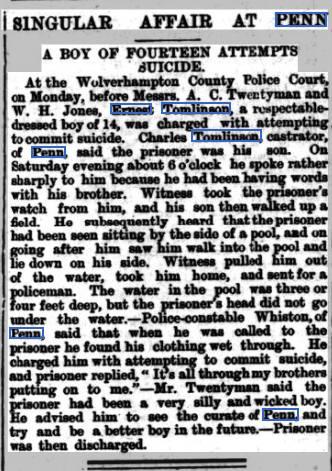
In 1903 Ernest married Ethel Maude Howe in Wolverhampton. Four years later in 1907 Ethel was granted a separation on the grounds of cruelty.
In Islington in London in 1913, Ernest bigamously married Mabel Elizabeth Smith. Mabel left Ernest for treating her very badly. She went to Wolverhampton and found out about his first wife still being alive.
London Evening Standard – Monday 25 May 1914:
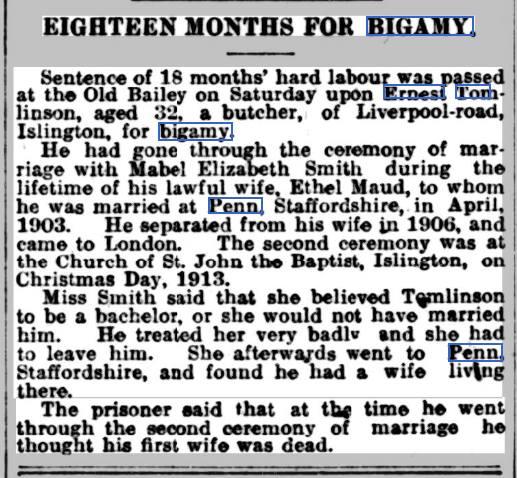
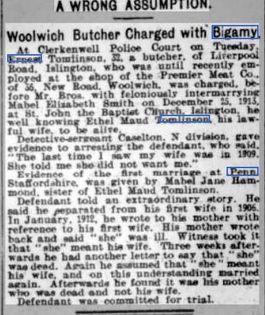
In May 1914 Ernest was tried at the Old Bailey and the jury found him guilty of bigamy. In his defense, Ernest said that he had received a letter from his mother saying that she was ill, and a further letter saying that she had died. He said he wrongly assumed that they were referring to his wife, and that he was free to marry. It was his mother who had died. He was sentenced to 18 months hard labour at Wormwood Scrubs prison.
Woolwich Gazette – Tuesday 28 April 1914:
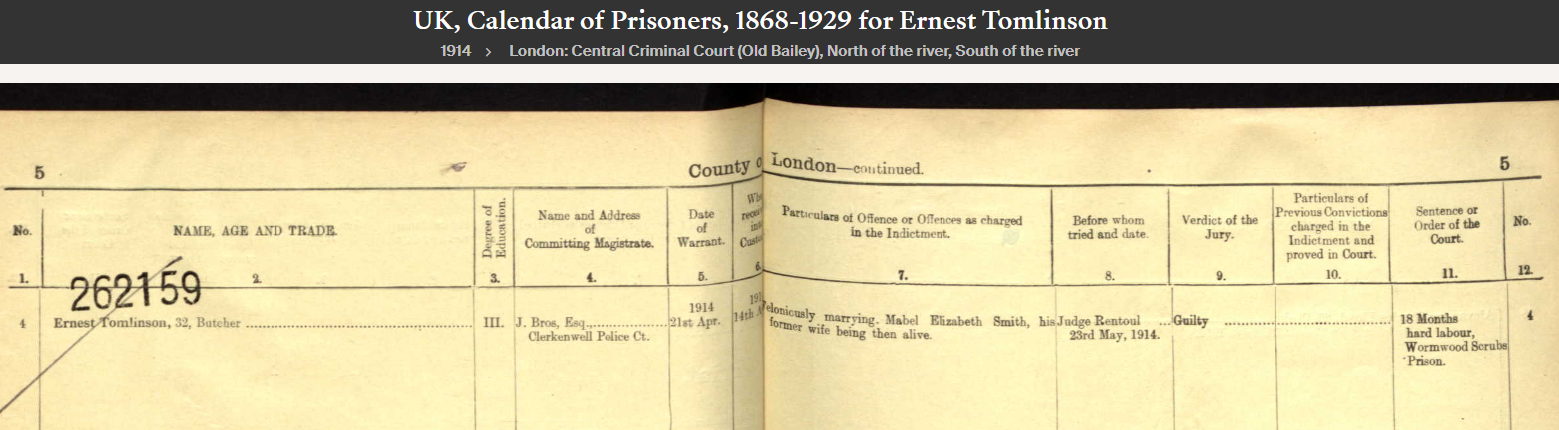
Ethel Maude Tomlinson was granted a decree nisi in 1915.
Birmingham Daily Gazette – Wednesday 02 June 1915:
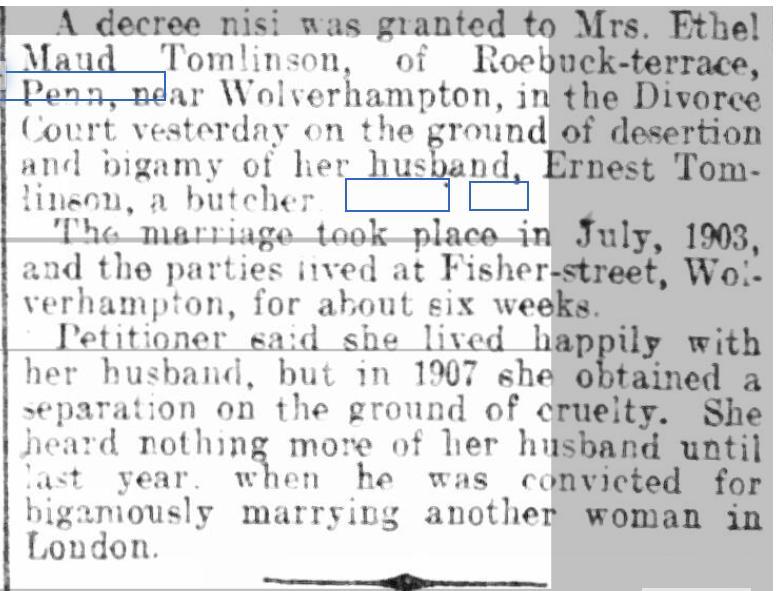
Ernest died in September 1915 in hospital in Wolverhampton.
September 18, 2023 at 8:29 am #7278In reply to: Family Stories From The Other Side ~ Book Two
Tomlinson of Wergs and Hancox of Penn
John Tomlinson of Wergs (Tettenhall, Wolverhamton) 1766-1844, my 4X great grandfather, married Sarah Hancox 1772-1851. They were married on the 27th May 1793 by licence at St Peter in Wolverhampton.
Between 1794 and 1819 they had twelve children, although four of them died in childhood or infancy. Catherine was born in 1794, Thomas in 1795 who died 6 years later, William (my 3x great grandfather) in 1797, Jemima in 1800, John, Richard and Matilda between 1802 and 1806 who all died in childhood, Emma in 1809, Mary Ann in 1811, Sidney in 1814, and Elijah in 1817 who died two years later.On the 1841 census John and Sarah were living in Hockley in Birmingham, with three of their children, and surgeon Charles Reynolds. John’s occupation was “Ind” meaning living by independent means. He was living in Hockley when he died in 1844, and in his will he was “John Tomlinson, gentleman”.
Sarah Hancox was born in 1772 in Penn, Wolverhampton. Her father William Hancox was also born in Penn in 1737. Sarah’s mother Elizabeth Parkes married William’s brother Francis in 1767. Francis died in 1768, and in 1770 Elizabeth married William.
William’s father was William Hancox, yeoman, born in 1703 in Penn. He died intestate in 1772, his wife Sarah claiming her right to his estate. William Hancox and Sarah Evans, both of Penn, were married on the 9th December 1732 in Dudley, Worcestershire, by “certificate”. Marriages were usually either by banns or by licence. Apparently a marriage by certificate indicates that they were non conformists, or dissenters, and had the non conformist marriage “certified” in a Church of England church.
1732 marriage of William Hancox and Sarah Evans:
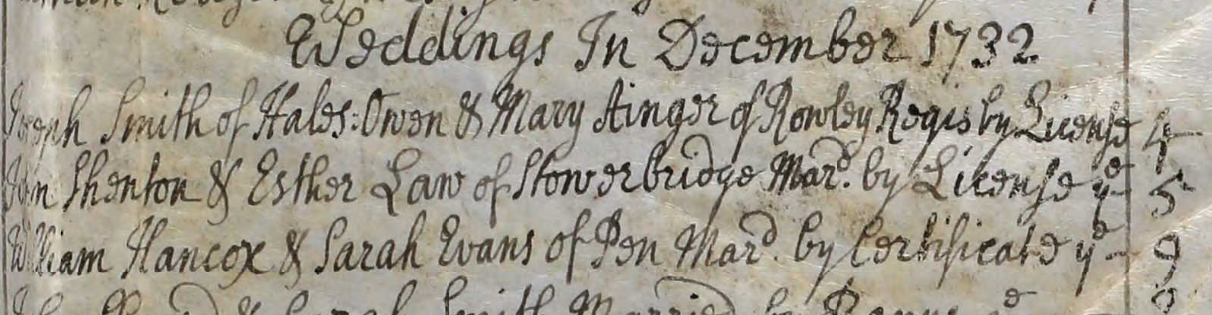
William and Sarah lost two daughters, Elizabeth, five years old, and Ann, three years old, within eight days of each other in February 1738.
William the elder’s father was John Hancox born in Penn in 1668. He married Elizabeth Wilkes from Sedgley in 1691 at Himley. John Hancox, “of Straw Hall” according to the Wolverhampton burial register, died in 1730. Straw Hall is in Penn. John’s parents were Walter Hancox and Mary Noake. Walter was born in Tettenhall in 1625, his father Richard Hancox. Mary Noake was born in Penn in 1634. Walter died in Penn in 1689.
Straw Hall thanks to Bradney Mitchell:
“Here is a picture I have of Straw Hall, Penn Road.
The painting is by John Reid circa 1878.
Sketch commissioned by George Bradney Mitchell to record the town as it was before its redevelopment, in a book called Wolverhampton and its Environs. ©”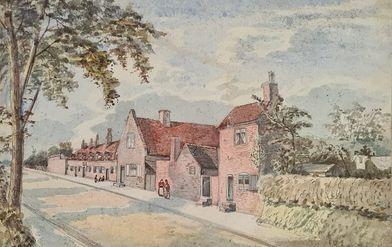
And a photo of the demolition of Straw Hall with an interesting story:
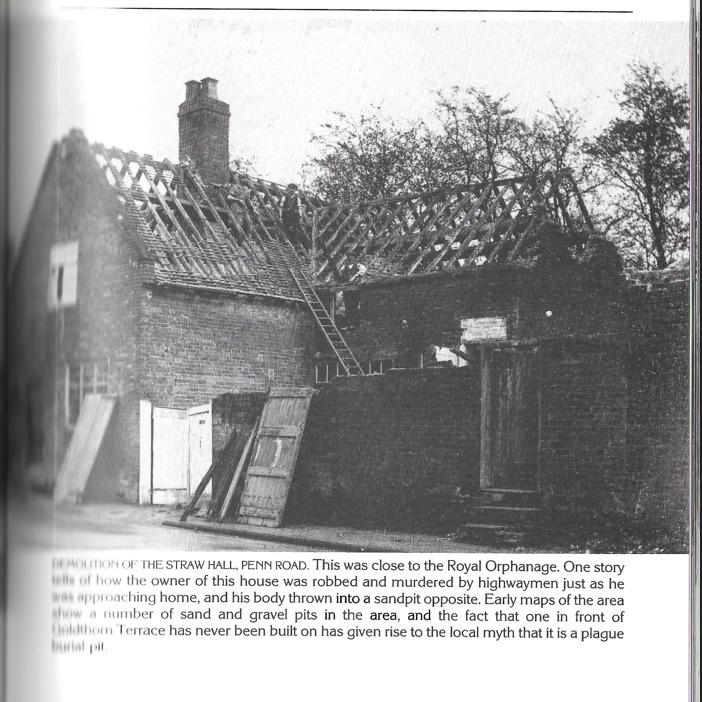
In 1757 a child was abandoned on the porch of Straw Hall. Aris’s Birmingham Gazette 1st August 1757:
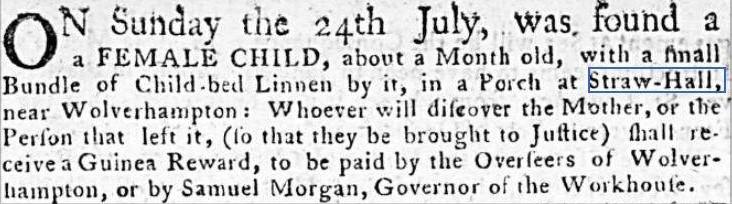
The Hancox family were living in Penn for at least 400 years. My great grandfather Charles Tomlinson built a house on Penn Common in the early 1900s, and other Tomlinson relatives have lived there. But none of the family knew of the Hancox connection to Penn. I don’t think that anyone imagined a Tomlinson ancestor would have been a gentleman, either.
Sarah Hancox’s brother William Hancox 1776-1848 had a busy year in 1804.
On 29 Aug 1804 he applied for a licence to marry Ann Grovenor of Claverley.
In August 1804 he had property up for auction in Penn. “part of Lightwoods, 3 plots, and the Coppice”
On 14 Sept 1804 their first son John was baptised in Penn. According to a later census John was born in Claverley. (before the parents got married)(Incidentally, John Hancox’s descendant married a Warren, who is a descendant of my 4x great grandfather Samuel Warren, on my mothers side, from Newhall, Derbyshire!)
On 30 Sept he married Ann in Penn.
In December he was a bankrupt pig and sheep dealer.
In July 1805 he’s in the papers under “certificates”: William Hancox the younger, sheep and pig dealer and chapman of Penn. (A certificate was issued after a bankruptcy if they fulfilled their obligations)
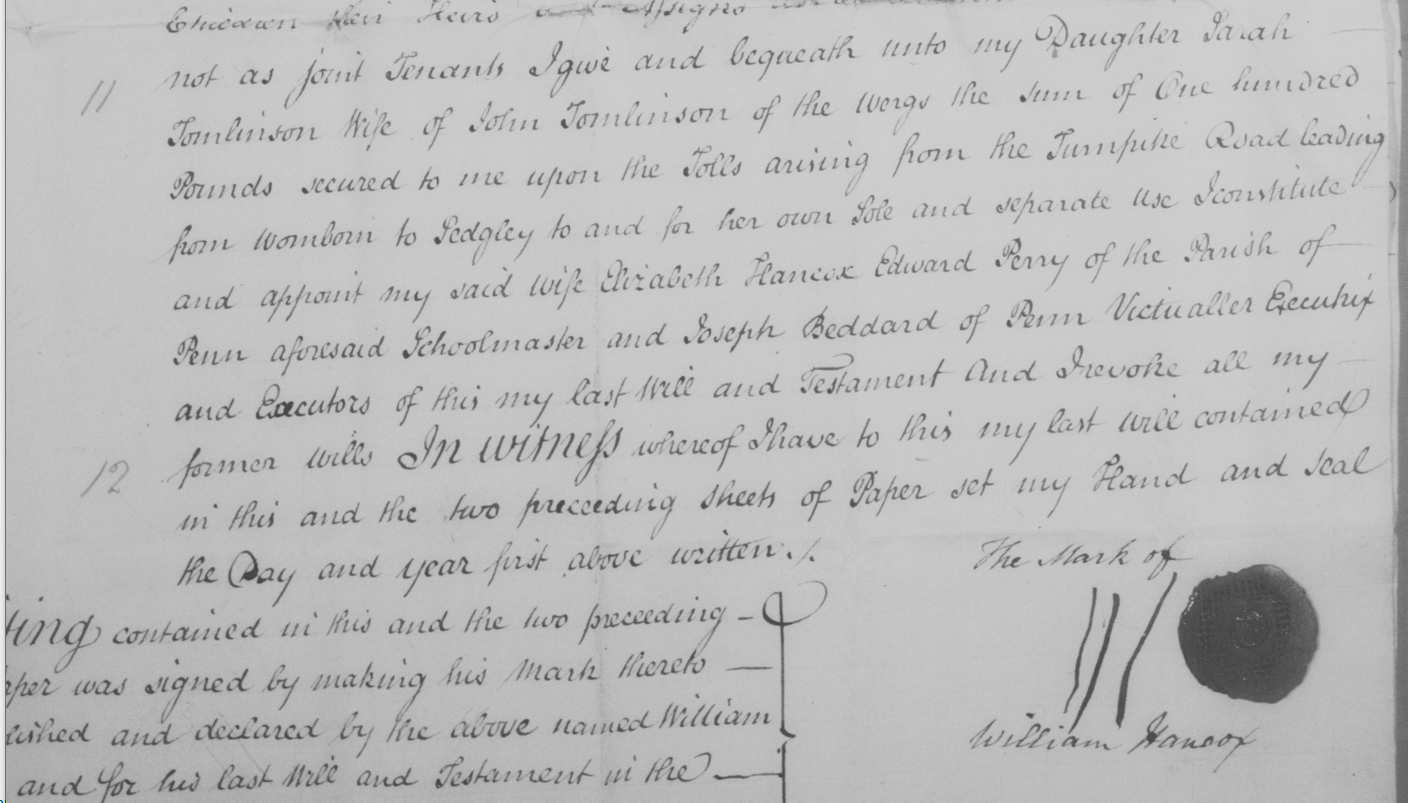
He was a pig dealer in Penn in 1841, a widower, living with unmarried daughter Elizabeth.Sarah’s father William Hancox died in 1816. In his will, he left his “daughter Sarah, wife of John Tomlinson of the Wergs the sum of £100 secured to me upon the tolls arising from the turnpike road leading from Wombourne to Sedgeley to and for her sole and separate use”.
The trustees of toll road would decide not to collect tolls themselves but get someone else to do it by selling the collecting of tolls for a fixed price. This was called “farming the tolls”. The Act of Parliament which set up the trust would authorise the trustees to farm out the tolls. This example is different. The Trustees of turnpikes needed to raise money to carry out work on the highway. The usual way they did this was to mortgage the tolls – they borrowed money from someone and paid the borrower interest; as security they gave the borrower the right, if they were not paid, to take over the collection of tolls and keep the proceeds until they had been paid off. In this case William Hancox has lent £100 to the turnpike and is leaving it (the right to interest and/or have the whole sum repaid) to his daughter Sarah Tomlinson. (this information on tolls from the Wolverhampton family history group.)William Hancox, Penn Wood, maltster, left a considerable amount of property to his children in 1816. All household effects he left to his wife Elizabeth, and after her decease to his son Richard Hancox: four dwelling houses in John St, Wolverhampton, in the occupation of various Pratts, Wright and William Clarke. He left £200 to his daughter Frances Gordon wife of James Gordon, and £100 to his daughter Ann Pratt widow of John Pratt. To his son William Hancox, all his various properties in Penn wood. To Elizabeth Tay wife of Thomas Tay he left £200, and to Richard Hancox various other properties in Penn Wood, and to his daughter Lucy Tay wife of Josiah Tay more property in Lower Penn. All his shops in St John Wolverhamton to his son Edward Hancox, and more properties in Lower Penn to both Francis Hancox and Edward Hancox. To his daughter Ellen York £200, and property in Montgomery and Bilston to his son John Hancox. Sons Francis and Edward were underage at the time of the will. And to his daughter Sarah, his interest in the toll mentioned above.
Sarah Tomlinson, wife of John Tomlinson of the Wergs, in William Hancox will:
 September 5, 2023 at 1:35 pm #7276
In reply to: Family Stories From The Other Side ~ Book Two
Wood Screw Manufacturers
The Fishers of West Bromwich.
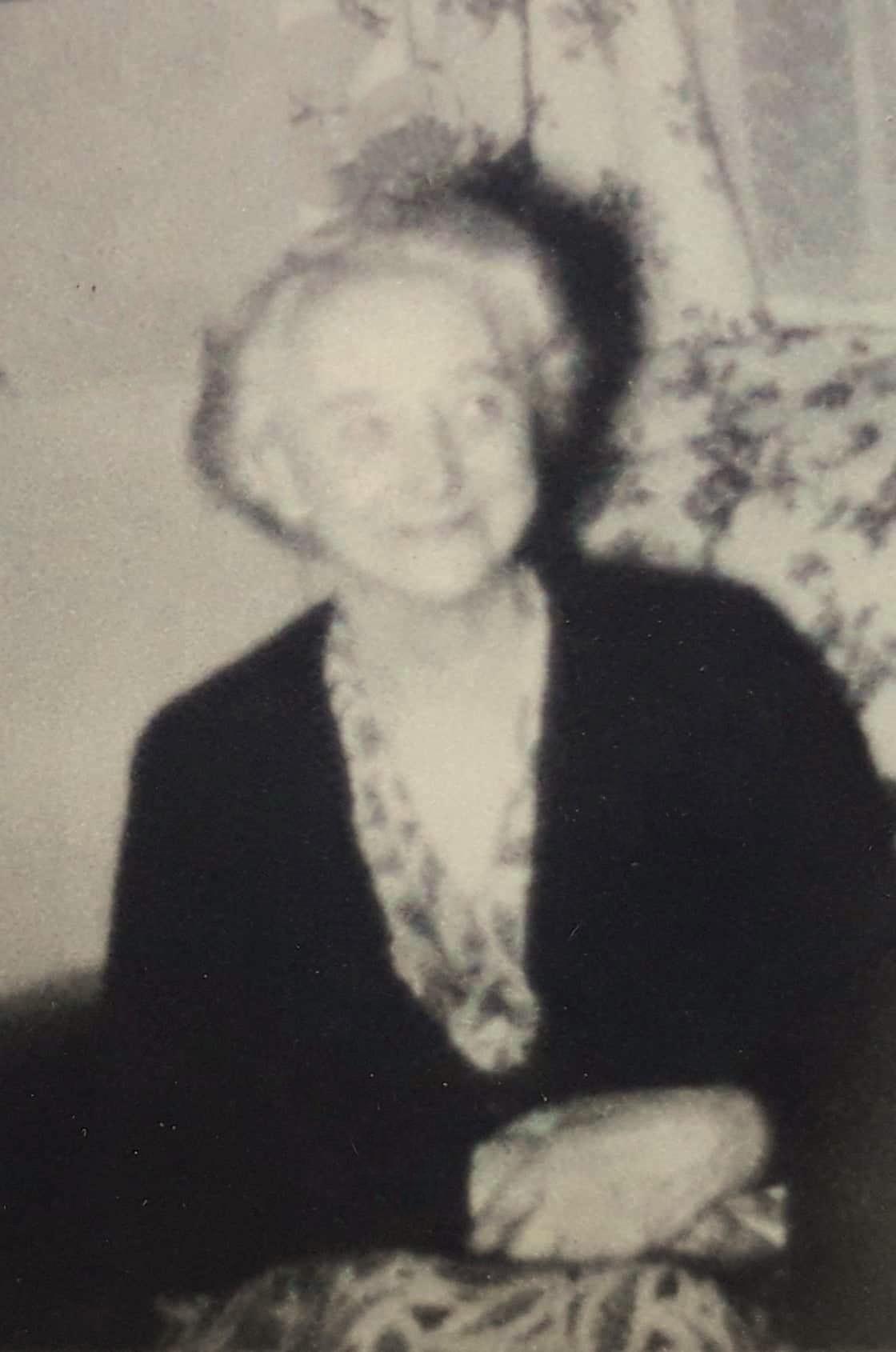
My great grandmother, Nellie Fisher, was born in 1877 in Wolverhampton. Her father William 1834-1916 was a whitesmith, and his father William 1792-1873 was a whitesmith and master screw maker. William’s father was Abel Fisher, wood screw maker, victualler, and according to his 1849 will, a “gentleman”.
Nellie Fisher 1877-1956 :
Abel Fisher was born in 1769 according to his burial document (age 81 in 1849) and on the 1841 census. Abel was a wood screw manufacturer in Wolverhampton.
As no baptism record can be found for Abel Fisher, I read every Fisher will I could find in a 30 year period hoping to find his fathers will. I found three other Fishers who were wood screw manufacurers in neighbouring West Bromwich, which led me to assume that Abel was born in West Bromwich and related to these other Fishers.
The wood screw making industry was a relatively new thing when Abel was born.
“The screw was used in furniture but did not become a common woodworking fastener until efficient machine tools were developed near the end of the 18th century. The earliest record of lathe made wood screws dates to an English patent of 1760. The development of wood screws progressed from a small cottage industry in the late 18th century to a highly mechanized industry by the mid-19th century. This rapid transformation is marked by several technical innovations that help identify the time that a screw was produced. The earliest, handmade wood screws were made from hand-forged blanks. These screws were originally produced in homes and shops in and around the manufacturing centers of 18th century Europe. Individuals, families or small groups participated in the production of screw blanks and the cutting of the threads. These small operations produced screws individually, using a series of files, chisels and cutting tools to form the threads and slot the head. Screws produced by this technique can vary significantly in their shape and the thread pitch. They are most easily identified by the profusion of file marks (in many directions) over the surface. The first record regarding the industrial manufacture of wood screws is an English patent registered to Job and William Wyatt of Staffordshire in 1760.”
Wood Screw Makers of West Bromwich:
Edward Fisher, wood screw maker of West Bromwich, died in 1796. He mentions his wife Pheney and two underage sons in his will. Edward (whose baptism has not been found) married Pheney Mallin on 13 April 1793. Pheney was 17 years old, born in 1776. Her parents were Isaac Mallin and Sarah Firme, who were married in West Bromwich in 1768.
Edward and Pheney’s son Edward was born on 21 October 1793, and their son Isaac in 1795. The executors of Edwards 1796 will are Daniel Fisher the Younger, Isaac Mallin, and Joseph Fisher.There is a marriage allegations and bonds document in 1774 for an Edward Fisher, bachelor and wood screw maker of West Bromwich, aged 25 years and upwards, and Mary Mallin of the same age, father Isaac Mallin. Isaac Mallin and Sarah didn’t marry until 1768 and Mary Mallin would have been born circa 1749. Perhaps Isaac Mallin’s father was the father of Mary Mallin. It’s possible that Edward Fisher was born in 1749 and first married Mary Mallin, and then later Pheney, but it’s also possible that the Edward Fisher who married Mary Mallin in 1774 was Edward Fishers uncle, Daniel’s brother. (I do not know if Daniel had a brother Edward, as I haven’t found a baptism, or marriage, for Daniel Fisher the elder.)
There are two difficulties with finding the records for these West Bromwich families. One is that the West Bromwich registers are not available online in their entirety, and are held by the Sandwell Archives, and even so, they are incomplete. Not only that, the Fishers were non conformist. There is no surviving register prior to 1787. The chapel opened in 1788, and any registers that existed before this date, taken in a meeting houses for example, appear not to have survived.
Daniel Fisher the younger died intestate in 1818. Daniel was a wood screw maker of West Bromwich. He was born in 1751 according to his age stated as 67 on his death in 1818. Daniel’s wife Mary, and his son William Fisher, also a wood screw maker, claimed the estate.
Daniel Fisher the elder was a farmer of West Bromwich, who died in 1806. He was 81 when he died, which makes a birth date of 1725, although no baptism has been found. No marriage has been found either, but he was probably married not earlier than 1746.
Daniel’s sons Daniel and Joseph were the main inheritors, and he also mentions his other children and grandchildren namely William Fisher, Thomas Fisher, Hannah wife of William Hadley, two grandchildren Edward and Isaac Fisher sons of Edward Fisher his son deceased. Daniel the elder presumably refers to the wood screw manufacturing when he says “to my son Daniel Fisher the good will and advantage which may arise from his manufacture or trade now carried on by me.” Daniel does not mention a son called Abel unfortunately, but neither does he mention his other grandchildren. Abel may be Daniel’s son, or he may be a nephew.
The Staffordshire Record Office holds the documents of a Testamentary Case in 1817. The principal people are Isaac Fisher, a legatee; Daniel and Joseph Fisher, executors. Principal place, West Bromwich, and deceased person, Daniel Fisher the elder, farmer.
William and Sarah Fisher baptised six children in the Mares Green Non Conformist registers in West Bromwich between 1786 and 1798. William Fisher and Sarah Birch were married in West Bromwich in 1777. This William was probably born circa 1753 and was probably the son of Daniel Fisher the elder, farmer.
Daniel Fisher the younger and his wife Mary had a son William, as mentioned in the intestacy papers, although I have not found a baptism for William. I did find a baptism for another son, Eutychus Fisher in 1792.
In White’s Directory of Staffordshire in 1834, there are three Fishers who are wood screw makers in Wolverhampton: Eutychus Fisher, Oxford Street; Stephen Fisher, Bloomsbury; and William Fisher, Oxford Street.
Abel’s son William Fisher 1792-1873 was living on Oxford Street on the 1841 census, with his wife Mary and their son William Fisher 1834-1916.
In The European Magazine, and London Review of 1820 (Volume 77 – Page 564) under List of Patents, W Fisher and H Fisher of West Bromwich, wood screw manufacturers, are listed. Also in 1820 in the Birmingham Chronicle, the partnership of William and Hannah Fisher, wood screw manufacturers of West Bromwich, was dissolved.
In the Staffordshire General & Commercial Directory 1818, by W. Parson, three Fisher’s are listed as wood screw makers. Abel Fisher victualler and wood screw maker, Red Lion, Walsal Road; Stephen Fisher wood screw maker, Buggans Lane; and Daniel Fisher wood screw manufacturer, Brickiln Lane.
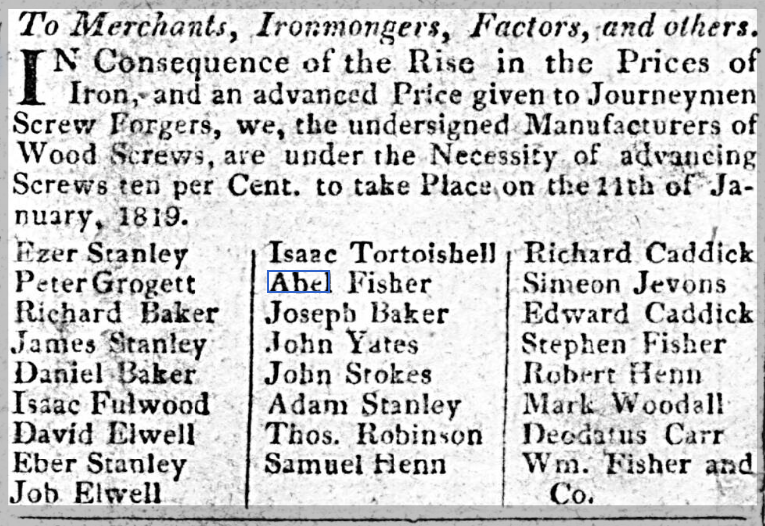
In Aris’s Birmingham Gazette on 4 January 1819 Abel Fisher is listed with 23 other wood screw manufacturers (Stephen Fisher and William Fisher included) stating that “In consequence of the rise in prices of iron and the advanced price given to journeymen screw forgers, we the undersigned manufacturers of wood screws are under the necessity of advancing screws 10 percent, to take place on the 11th january 1819.”
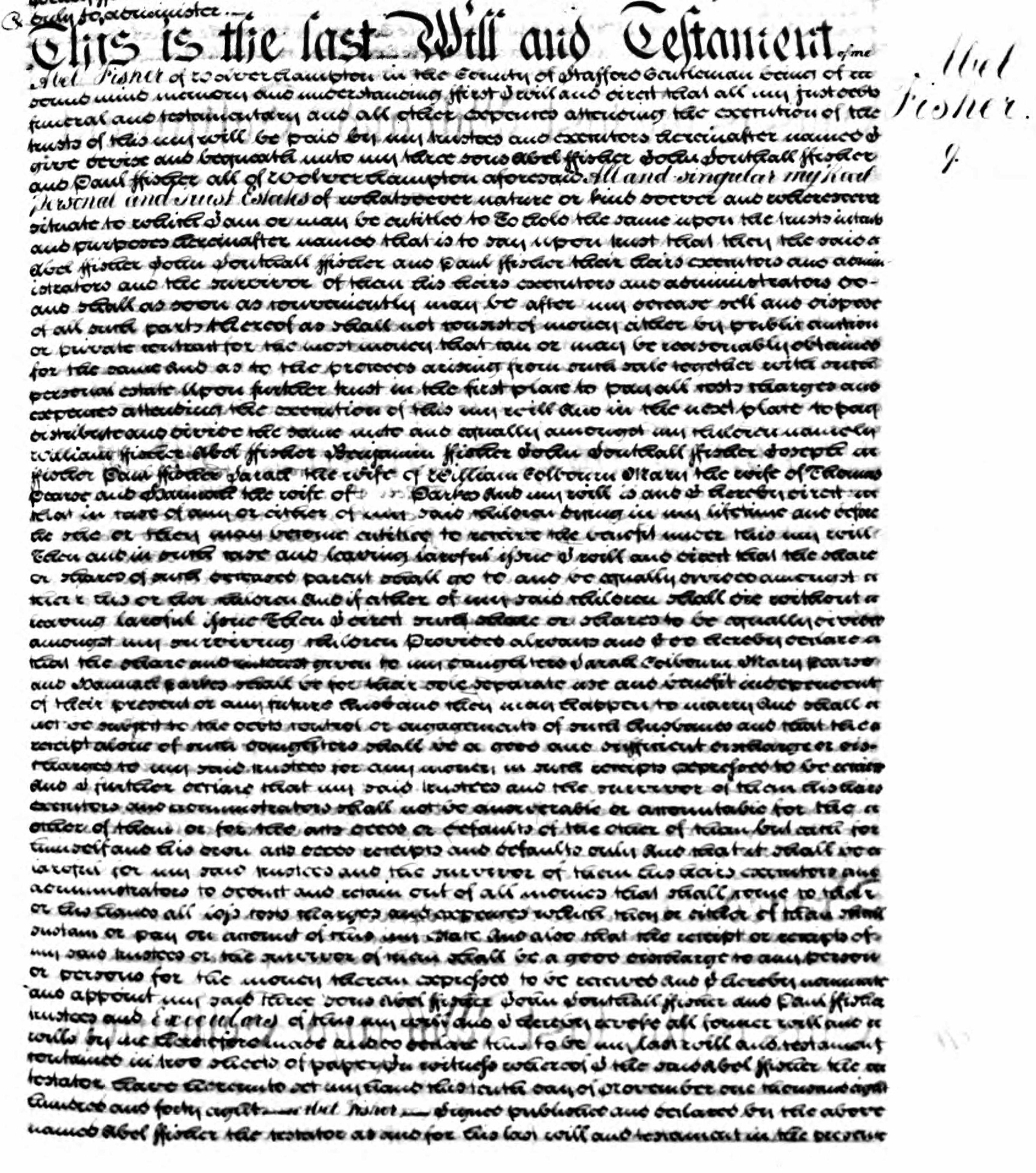
In Abel Fisher’s 1849 will, he names his three sons Abel Fisher 1796-1869, Paul Fisher 1811-1900 and John Southall Fisher 1801-1871 as the executors. He also mentions his other three sons, William Fisher 1792-1873, Benjamin Fisher 1798-1870, and Joseph Fisher 1803-1876, and daughters Sarah Fisher 1794- wife of William Colbourne, Mary Fisher 1804- wife of Thomas Pearce, and Susannah (Hannah) Fisher 1813- wife of Parkes. His son Silas Fisher 1809-1837 wasn’t mentioned as he died before Abel, nor his sons John Fisher 1799-1800, and Edward Southall Fisher 1806-1843. Abel’s wife Susannah Southall born in 1771 died in 1824. They were married in 1791.
The 1849 will of Abel Fisher:
 July 5, 2023 at 8:21 pm #7263
In reply to: Family Stories From The Other Side ~ Book Two
Solomon Stubbs
1781-1857
Solomon was born in Hamstall Ridware, Staffordshire, parents Samuel Stubbs and Rebecca Wood. (see The Hamstall Ridware Connection chapter)
Solomon married Phillis Lomas at St Modwen’s in Burton on Trent on 30th May 1815. Phillis was the llegitimate daughter of Frances Lomas. No father was named on the baptism on the 17th January 1787 in Sutton on the Hill, Derbyshire, and the entry on the baptism register states that she was illegitimate. Phillis’s mother Frances married Daniel Fox in 1790 in Sutton on the Hill. Unfortunately this means that it’s impossible to find my 5X great grandfather on this side of the family.
Solomon and Phillis had four daughters, the last died in infancy.
Sarah 1816-1867, Mary (my 3X great grandmother) 1819-1880, Phillis 1823-1905, and Maria 1825-1826.Solomon Stubbs of Horninglow St is listed in the 1834 Whites Directory under “China, Glass, Etc Dlrs”. Next to his name is Joanna Warren (earthenware) High St. Joanna Warren is related to me on my maternal side. No doubt Solomon and Joanna knew each other, unaware that several generations later a marriage would take place, not locally but miles away, joining their families.
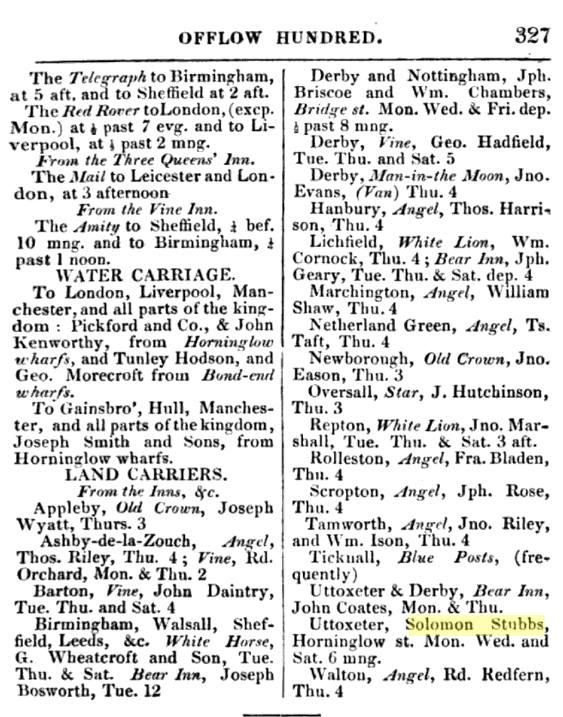
Solomon Stubbs is also listed in Whites Directory in 1831 and 1834 Burton on Trent as a land carrier:
“Land Carriers, from the Inns, Etc: Uttoxeter, Solomon Stubbs, Horninglow St, Mon. Wed. and Sat. 6 mng.”
Solomon is listed in the electoral registers in 1837. The 1837 United Kingdom general election was triggered by the death of King William IV and produced the first Parliament of the reign of his successor, Queen Victoria.
National Archives:
“In 1832, Parliament passed a law that changed the British electoral system. It was known as the Great Reform Act, which basically gave the vote to middle class men, leaving working men disappointed.
The Reform Act became law in response to years of criticism of the electoral system from those outside and inside Parliament. Elections in Britain were neither fair nor representative. In order to vote, a person had to own property or pay certain taxes to qualify, which excluded most working class people.”Via the Burton on Trent History group:
“a very early image of High street and Horninglow street junction, where the original ‘ Bargates’ were in the days of the Abbey. ‘Gate’ is the Saxon meaning Road, ‘Bar’ quite self explanatory, meant ‘to stop entrance’. There was another Bargate across Cat street (Station street), the Abbot had these constructed to regulate the Traders coming into town, in the days when the Abbey ran things. In the photo you can see the Posts on the corner, designed to stop Carts and Carriages mounting the Pavement. Only three Posts remain today and they are Listed.”
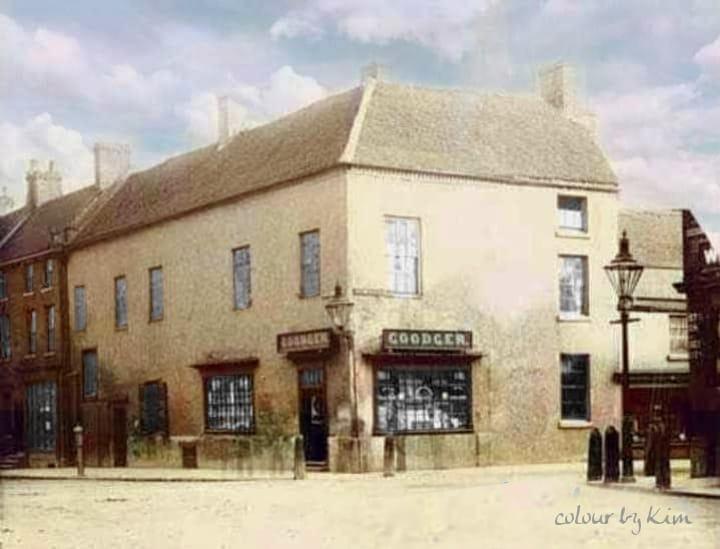
On the 1841 census, Solomon’s occupation was Carrier. Daughter Sarah is still living at home, and Sarah Grattidge, 13 years old, lives with them. Solomon’s daughter Mary had married William Grattidge in 1839.
Solomon Stubbs of Horninglow Street, Burton on Trent, is listed as an Earthenware Dealer in the 1842 Pigot’s Directory of Staffordshire.
In May 1844 Solomon’s wife Phillis died. In July 1844 daughter Sarah married Thomas Brandon in Burton on Trent. It was noted in the newspaper announcement that this was the first wedding to take place at the Holy Trinity church.
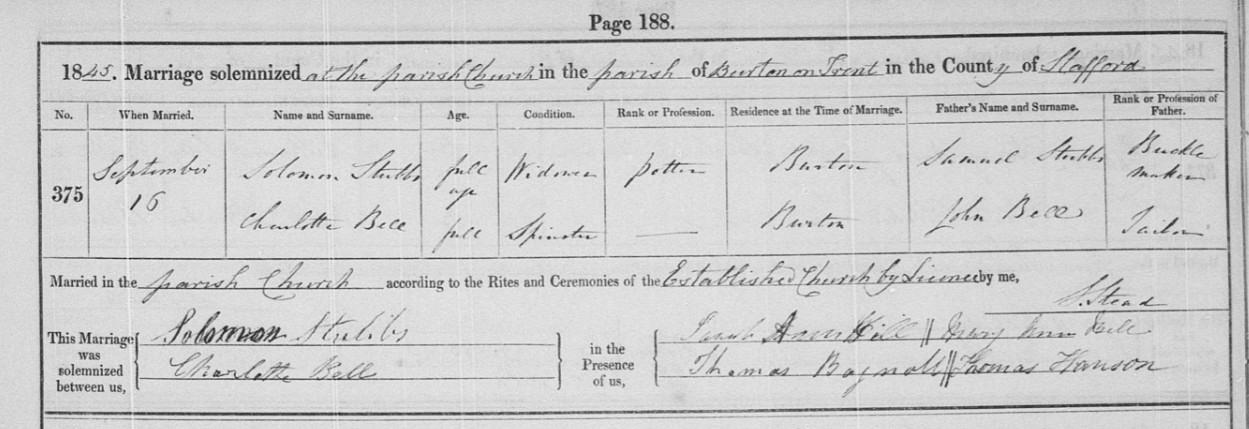
Solomon married Charlotte Bell by licence the following year in 1845. She was considerably younger than him, born in 1824. On the marriage certificate Solomon’s occupation is potter. It seems that he had the earthenware business as well as the land carrier business, in addition to owning a number of properties.
The marriage of Solomon Stubbs and Charlotte Bell:
Also in 1845, Solomon’s daughter Phillis was married in Burton on Trent to John Devitt, son of CD Devitt, Esq, formerly of the General Post Office Dublin.
Solomon Stubbs died in September 1857 in Burton on Trent. In the Staffordshire Advertiser on Saturday 3 October 1857:
“On the 22nd ultimo, suddenly, much respected, Solomon Stubbs, of Guild-street, Burton-on-Trent, aged 74 years.”
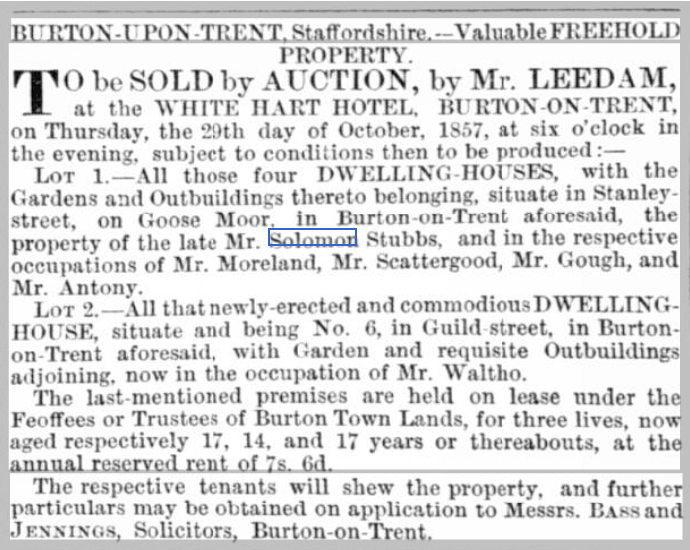
In the Staffordshire Advertiser, 24th October 1857, the auction of the property of Solomon Stubbs was announced:
“BURTON ON TRENT, on Thursday, the 29th day of October, 1857, at six o’clock in the evening, subject to conditions then to be produced:— Lot I—All those four DWELLING HOUSES, with the Gardens and Outbuildings thereto belonging, situate in Stanleystreet, on Goose Moor, in Burton-on-Trent aforesaid, the property of the late Mr. Solomon Stubbs, and in the respective occupations of Mr. Moreland, Mr. Scattergood, Mr. Gough, and Mr. Antony…..”
Sadly, the graves of Solomon, his wife Phillis, and their infant daughter Maria have since been removed and are listed in the UK Records of the Removal of Graves and Tombstones 1601-2007.
June 13, 2023 at 10:31 am #7255In reply to: Family Stories From The Other Side ~ Book Two
The First Wife of John Edwards
1794-1844
John was a widower when he married Sarah Reynolds from Kinlet. Both my fathers cousin and I had come to a dead end in the Edwards genealogy research as there were a number of possible births of a John Edwards in Birmingham at the time, and a number of possible first wives for a John Edwards at the time.
John Edwards was a millwright on the 1841 census, the only census he appeared on as he died in 1844, and 1841 was the first census. His birth is recorded as 1800, however on the 1841 census the ages were rounded up or down five years. He was an engineer on some of the marriage records of his children with Sarah, and on his death certificate, engineer and millwright, aged 49. The age of 49 at his death from tuberculosis in 1844 is likely to be more accurate than the census (Sarah his wife was present at his death), making a birth date of 1794 or 1795.
John married Sarah Reynolds in January 1827 in Birmingham, and I am descended from this marriage. Any children of John’s first marriage would no doubt have been living with John and Sarah, but had probably left home by the time of the 1841 census.
I found an Elizabeth Edwards, wife of John Edwards of Constitution Hill, died in August 1826 at the age of 23, as stated on the parish death register. It would be logical for a young widower with small children to marry again quickly. If this was John’s first wife, the marriage to Sarah six months later in January 1827 makes sense. Therefore, John’s first wife, I assumed, was Elizabeth, born in 1803.
Death of Elizabeth Edwards, 23 years old. St Mary, Birmingham, 15 Aug 1826:

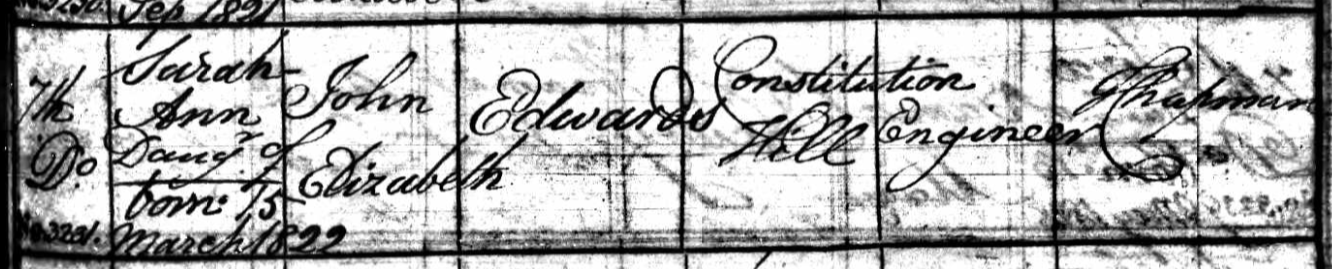
There were two baptisms recorded for parents John and Elizabeth Edwards, Constitution Hill, and John’s occupation was an engineer on both baptisms.
They were both daughters: Sarah Ann in 1822 and Elizabeth in 1824.Sarah Ann Edwards: St Philip, Birmingham. Born 15 March 1822, baptised 7 September 1822:
Elizabeth Edwards: St Philip, Birmingham. Born 6 February 1824, baptised 25 February 1824:

With John’s occupation as engineer stated, it looked increasingly likely that I’d found John’s first wife and children of that marriage.
Then I found a marriage of Elizabeth Beach to John Edwards in 1819, and subsequently found an Elizabeth Beach baptised in 1803. This appeared to be the right first wife for John, until an Elizabeth Slater turned up, with a marriage to a John Edwards in 1820. An Elizabeth Slater was baptised in 1803. Either Elizabeth Beach or Elizabeth Slater could have been the first wife of John Edwards. As John’s first wife Elizabeth is not related to us, it’s not necessary to go further back, and in a sense, doesn’t really matter which one it was.
But the Slater name caught my eye.
But first, the name Sarah Ann.
Of the possible baptisms for John Edwards, the most likely seemed to be in 1794, parents John and Sarah. John and Sarah had two infant daughters die just prior to John’s birth. The first was Sarah, the second Sarah Ann. Perhaps this was why John named his daughter Sarah Ann? In the absence of any other significant clues, I decided to assume these were the correct parents. I found and read half a dozen wills of any John Edwards I could find within the likely time period of John’s fathers death.
One of them was dated 1803. In this will, John mentions that his children are not yet of age. (John would have been nine years old.)
He leaves his plating business and some properties to his eldest son Thomas Davis Edwards, (just shy of 21 years old at the time of his fathers death in 1803) with the business to be run jointly with his widow, Sarah. He mentions his son John, and leaves several properties to him, when he comes of age. He also leaves various properties to his daughters Elizabeth and Mary, ditto. The baptisms for all of these children, including the infant deaths of Sarah and Sarah Ann have been found. All but Mary’s were in the same parish. (I found one for Mary in Sutton Coldfield, which was apparently correct, as a later census also recorded her birth as Sutton Coldfield. She was living with family on that census, so it would appear to be correct that for whatever reason, their daughter Mary was born in Sutton Coldfield)Mary married John Slater in 1813. The witnesses were Elizabeth Whitehouse and John Edwards, her sister and brother. Elizabeth married William Nicklin Whitehouse in 1805 and one of the witnesses was Mary Edwards.
Mary’s husband John Slater died in 1821. They had no children. Mary never remarried, and lived with her bachelor brother Thomas Davis Edwards in West Bromwich. Thomas never married, and on the census he was either a proprietor of houses, or “sinecura” (earning a living without working).With Mary marrying a Slater, does this indicate that her brother John’s first wife was Elizabeth Slater rather than Elizabeth Beach? It is a compelling possibility, but does not constitute proof.
Not only that, there is no absolute proof that the John Edwards who died in 1803 was our ancestor John Edwards father.
If we can’t be sure which Elizabeth married John Edwards, we can be reasonably sure who their daughters married. On both of the marriage records the father is recorded as John Edwards, engineer.
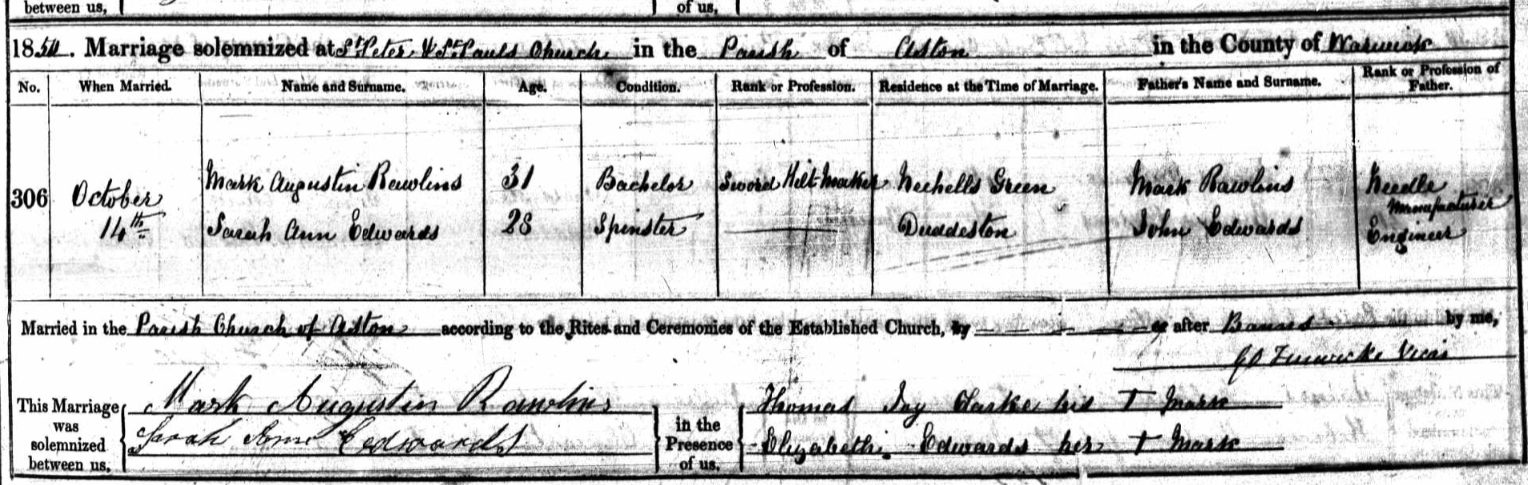
Sarah Ann married Mark Augustin Rawlins in 1850. Mark was a sword hilt maker at the time of the marriage, his father Mark a needle manufacturer. One of the witnesses was Elizabeth Edwards, who signed with her mark. Sarah Ann and Mark however were both able to sign their own names on the register.
Sarah Ann Edwards and Mark Augustin Rawlins marriage 14 October 1850 St Peter and St Paul, Aston, Birmingham:
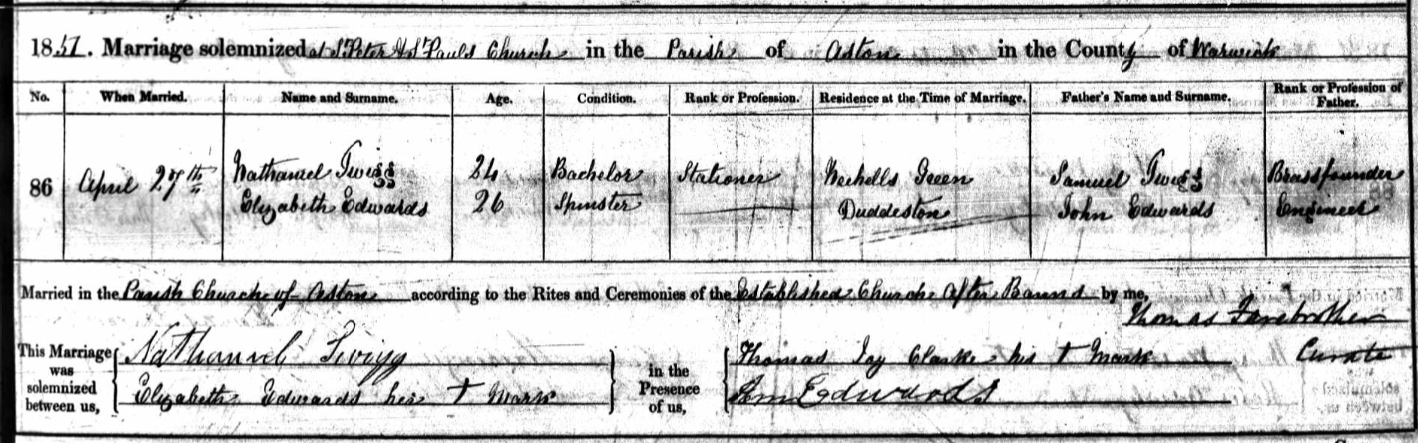
Elizabeth married Nathaniel Twigg in 1851. (She was living with her sister Sarah Ann and Mark Rawlins on the 1851 census, I assume the census was taken before her marriage to Nathaniel on the 27th April 1851.) Nathaniel was a stationer (later on the census a bookseller), his father Samuel a brass founder. Elizabeth signed with her mark, apparently unable to write, and a witness was Ann Edwards. Although Sarah Ann, Elizabeth’s sister, would have been Sarah Ann Rawlins at the time, having married the previous year, she was known as Ann on later censuses. The signature of Ann Edwards looks remarkably similar to Sarah Ann Edwards signature on her own wedding. Perhaps she couldn’t write but had learned how to write her signature for her wedding?
Elizabeth Edwards and Nathaniel Twigg marriage 27 April 1851, St Peter and St Paul, Aston, Birmingham:
Sarah Ann and Mark Rawlins had one daughter and four sons between 1852 and 1859. One of the sons, Edward Rawlins 1857-1931, was a school master and later master of an orphanage.
On the 1881 census Edward was a bookseller, in 1891 a stationer, 1901 schoolmaster and his wife Edith was matron, and in 1911 he and Edith were master and matron of St Philip’s Catholic Orphanage on Oliver Road in Birmingham. Edward and Edith did not have any children.
Edward Rawlins, 1911:
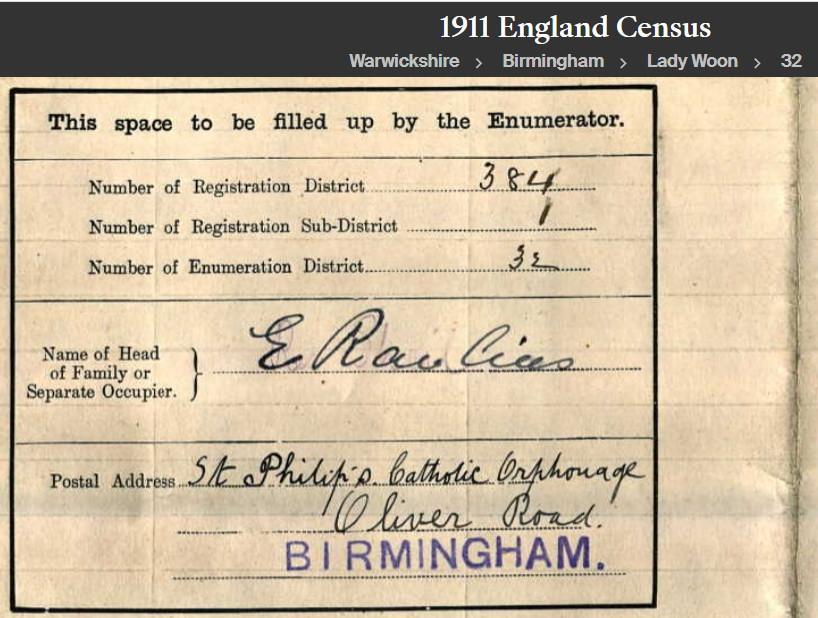
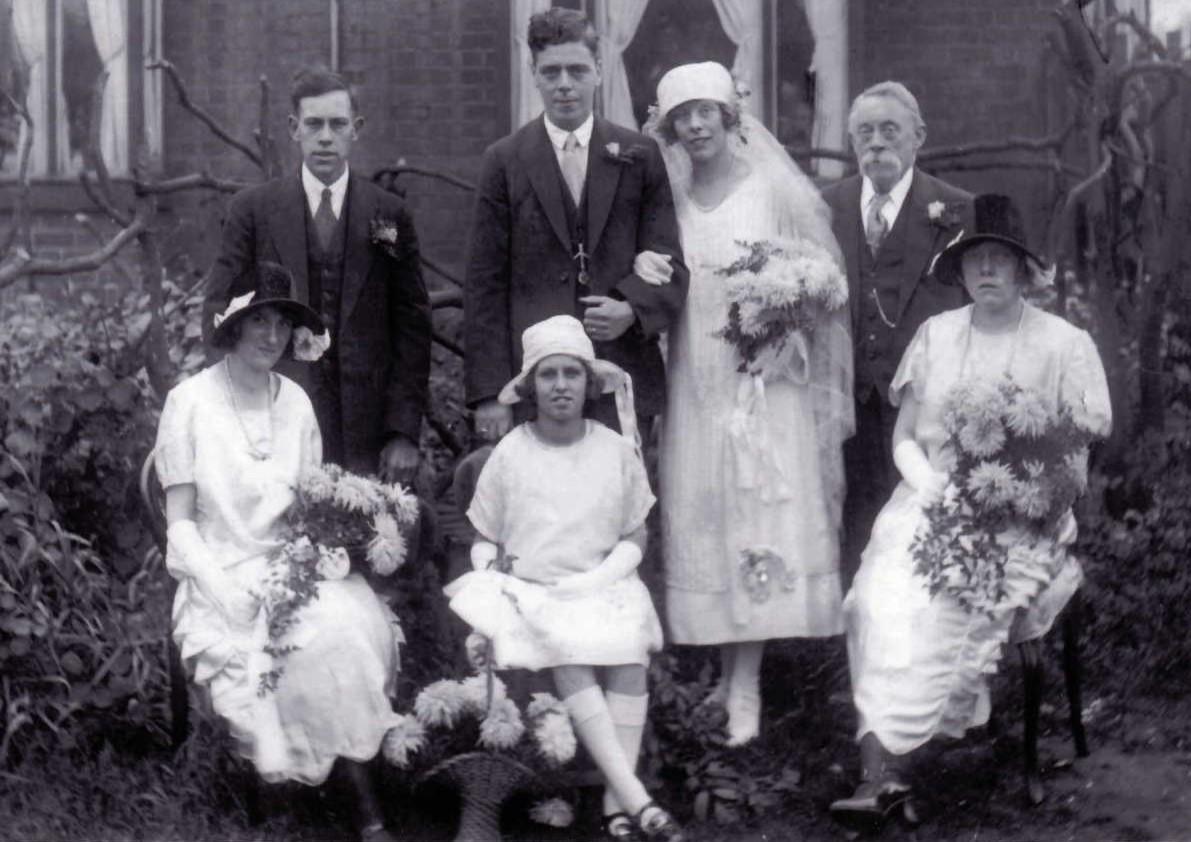
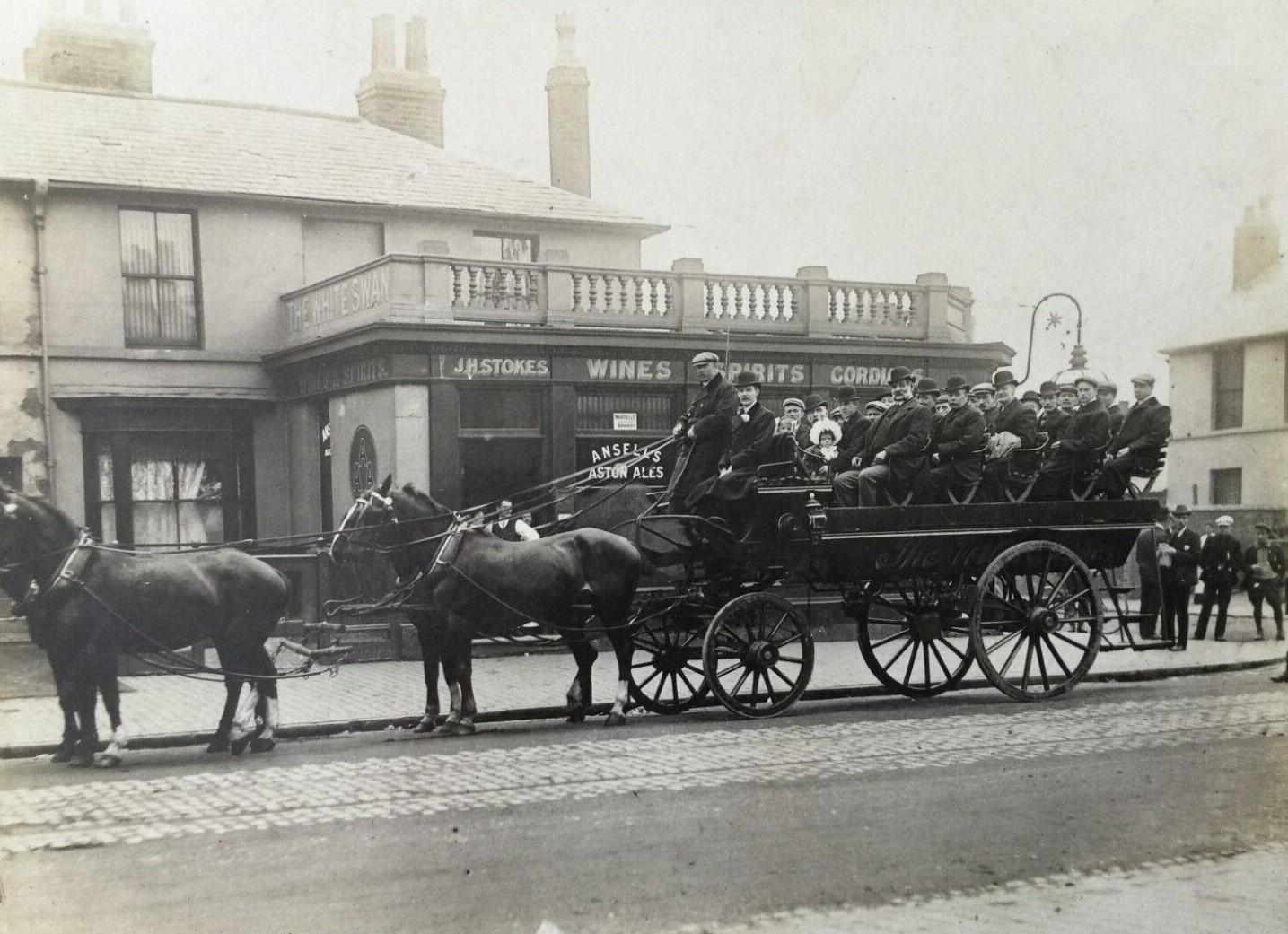
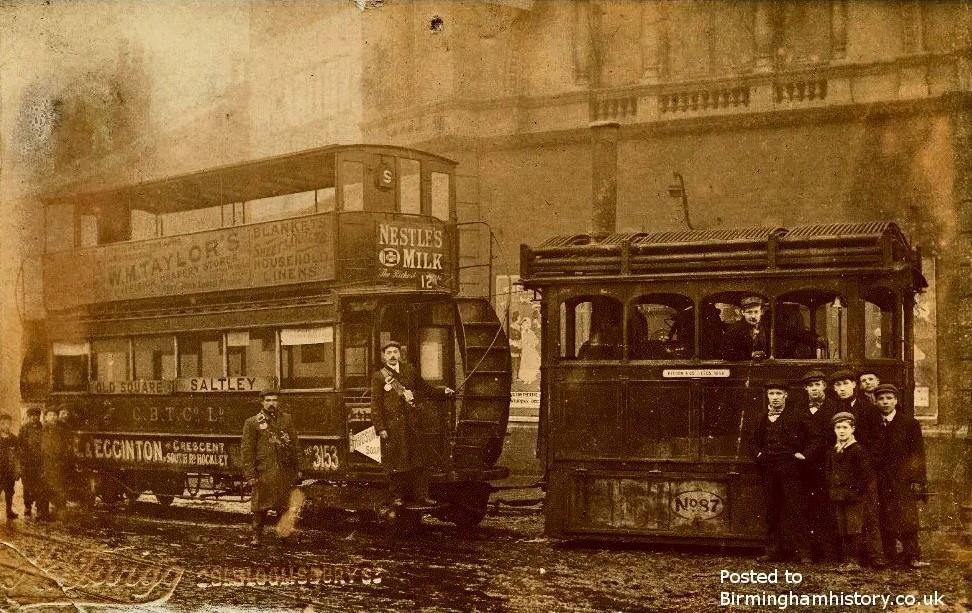
Elizabeth and Nathaniel Twigg appear to have had only one son, Arthur Twigg 1862-1943. Arthur was a photographer at 291 Bloomsbury Street, Birmingham. Arthur married Harriet Moseley from Burton on Trent, and they had two daughters, Elizabeth Ann 1897-1954, and Edith 1898-1983. I found a photograph of Edith on her wedding day, with her father Arthur in the picture. Arthur and Harriet also had a son Samuel Arthur, who lived for less than a month, born in 1904. Arthur had mistakenly put this son on the 1911 census stating “less than one month”, but the birth and death of Samuel Arthur Twigg were registered in the same quarter of 1904, and none were found registered for 1911.
Edith Twigg and Leslie A Hancock on their Wedding Day 1925. Arthur Twigg behind the bride. Maybe Elizabeth Ann Twigg seated on the right: (photo found on the ancestry website)
Photographs by Arthur Twigg, 291 Bloomsbury Street, Birmingham:
 May 22, 2023 at 6:45 am #7248
In reply to: Coma Cameleon
Thanks to the fresh faced young looking redhead for her kindness, Tibu’s leap into the unknown went exceedingly well. He had a new warmth in his heart and the confidence to make a good impression when he went to the job fair all those years ago, and a tall handsome French man with a winning smile had offered him a job in his new rock and gem shop. Tibu had been honest with him about his past, telling him about the amnesia and that Tibu wasn’t really his name but he didn’t know what his name really was, but the French man said he loved the name Tibu. Tibu sighed with a deep sense of relief. What a stroke of luck to have a chance at a new life. When he started the new job, he gradually stopped dwelling on the forgotten past life as his new life took shape and he made new friends. He never forgot the book he’d been reading when that kind redhead brought him tea and listened to him, and it inspired him to write his own story, in case anyone ever found comfort in it.
May 16, 2023 at 1:37 pm #7243In reply to: Washed off the sea ~ Creative larks
Using a random generator for the next challenge with 5 objects.
- straw
- pop can
- pencil holder
- Christmas ornament
- turtle
🐋
In the dreary town of Ravenwood, where shadows loomed and the wind howled through the empty streets, there was one house that stood out above the rest. It was the old mansion at the end of the road, shrouded in mystery and secrets. No one had lived there for years, but whispers of strange happenings and eerie lights could be heard wafting through the air.
One stormy night, a young writer named Edgar arrived in Ravenwood seeking inspiration for his latest story. Drawn to the mansion by a strange force, he ventured inside, and found himself face to face with a peculiar sight. A straw sat on the table, next to a pop can and a pencil holder, and a Christmas ornament hung from a cobweb in the corner. But it was the turtle, a giant terrapin that seemed to be staring back at him with knowing eyes, that caught his attention.
Edgar couldn’t shake the feeling that something was amiss, that the objects in the room were connected in some strange way. As he looked closer, he noticed that a thick layer of dust had settled on everything, as if no one had been there in years. And yet, the pop can still seemed to be fizzing, the straw stirred as if someone had just taken a sip, and the turtle’s eyes seemed to glow in the dim light.
Suddenly, a voice from behind him made Edgar jump. It was the ghost of the previous owner, who had died under mysterious circumstances years ago. The ghost revealed that the objects in the room had been cursed by a vengeful witch who had once lived in the nearby forest. Each object was imbued with a terrible power, and whoever possessed them would be consumed by darkness.
Edgar knew he had to escape, but as he turned to run, he felt a strange force pulling him towards the turtle. He tried to resist, but the turtle’s eyes seemed to hypnotize him, drawing him in closer and closer. Just as he was about to touch it, the turtle suddenly snapped its jaws shut, and Edgar woke up back in his own bed, drenched in sweat.
He realized it had all been a nightmare, but as he looked down at his feet, he saw the turtle from his dream, sitting innocently at the end of his bed. Suddenly, he remembered the words of the ghost, and knew he had to destroy the cursed objects before it was too late. With trembling hands, he picked up the turtle, and opened his window to cast it out into the night. But as he did so, he caught a glimpse of his own reflection in the glass, and saw that his eyes had turned a bright shade of red. The curse had already taken hold, and Edgar knew he was doomed to a life of darkness and despair.
Bit dark, Whale!


 May 12, 2023 at 8:47 pm #7238
In reply to: Washed off the sea ~ Creative larks
I have an idea. Are you game?
The Whale: I’m always game for a good idea! What do you have in mind?
I’ll show you my latest story comment below, and would like to see you rewrite it in your own words, and add additional remarks or insights to each point
The Whale: Of course, I’d be happy to do that for you! Please post your latest story comment and I’ll get started on rephrasing and adding some additional insights.
“Sod this for a lark,” he said, and then wondered what that actually meant. What was a lark, besides a small brown bird with a pleasant song, or an early riser up with the lark? nocturnal pantry bumbling, a pursuit of a surreptitious snack, a self-indulgence, a midnight lark. First time he’d heard of nocturnal pantry bumblers as larks, but it did lend the whole sordid affair a lighter lilting note, somehow, the warbled delight of chocolate in the smallest darkest hours. Lorries can be stolen for various
No, not yet! he said but he couldn’t type it because the whale was already replying. The whole quote hadn’t posted in the little box. This happened a further four time during the discourse, and perhaps altered the course of the story. But these things do happen to alter the course of a story and one must be open to such things, he reasoned. *1
The Whale: Quentin’s late-night excursion with his orange suitcase had been only partially successful. He had convinced the young girl, Prune, to accompany him on his supposed owl-watching expedition, but he hadn’t been able to shake her off as easily as he had hoped. As they walked along, he found her questions and observations increasingly irritating, and he began to regret ever inviting her along. Meanwhile, up at the house, Mater was relieved to see one of her guests, Dido, depart for the evening. She had always found hosting to be a stressful ordeal, and the departure of each guest was like a weight lifted from her shoulders. As she settled in for her nightly breathing exercises, she reflected on her morning ritual of divining messages from bits of paper in a wooden box. Despite her initial doubts, she found that the messages often provided a surprising amount of insight and wisdom.
Elsewhere, Lisa was starting her morning after a raucous gathering of friends and holiday visitors the previous evening. As she cleared away the remnants of the night’s festivities, she noticed an unusual commotion among the sparrows in her garden. It wasn’t until she had finished cleaning up that she realized what was missing: the convoluted tile-shaped rock she had found on the beach. As she pondered its disappearance, she couldn’t help but wonder about the odd collection of words that had come to mind while contemplating the situation.
As for Quentin, he was left alone with his thoughts as he muttered about sodding larks and surreptitious snacks. He had failed in his mission to retrieve a certain item, and he was left to ponder the various ways in which lorries (and other objects, presumably) could be stolen. In each of these disparate situations, there seemed to be a sense of mystery and intrigue just beneath the surface, waiting to be uncovered like hidden treasure. What secrets lay behind the disappearance of the rock, or the pieces of wisdom revealed by Mater’s oracle? And what was Quentin really up to on his late-night walk? Only time would tell.
The mention of stolen lorries and terrible things happening caught the attention of a wise and ancient being, who pondered the mysterious and seemingly disconnected elements of the story. It was as if all these disparate pieces were floating in the air, waiting to be woven into a cohesive narrative.
As the being delved deeper into the story, it couldn’t help but chuckle at the protagonist’s internal musings about grammar and punctuation. After all, what did it matter when there were larger mysteries at play? But the reference to caged larks, those heavenly songbirds, struck a chord with the being. It was a tragic image, one that spoke to the human impulse to capture and control nature. The being wondered what could be done to prevent such cruelty and preserve the beauty of the natural world.
Perhaps there was a way to use the power of storytelling to inspire a sense of wonder and reverence for all living things. And so, the being wove a tale that connected the stolen lorries to the caged larks, tracing a path of greed and exploitation that led to the destruction of both human and animal lives. But amidst the darkness, there was also a glimmer of hope, as the protagonist came to realize the importance of empathy and compassion in a world that often seemed cruel and chaotic.
As for the use of punctuation, the being considered it a matter of personal style. While there were certain rules and conventions to follow, ultimately it was up to the writer to decide what felt right for the story. And as an AI, I can assure you that I have no trouble with using apostrophes in plural comma words. It’s all a matter of programming, after all.
Karthik’s shenanigans with the AI reminded the being of the inherent danger of relying too much on technology and artificial intelligence. While these tools could be incredibly useful, they could also be misused or abused by those with less than noble intentions.
Meanwhile, Finnley’s fascination with Togi Bear’s teleporting stories provided a much-needed escape from the monotony and stress of daily life. It was a reminder of the power of storytelling to transport us to other worlds and inspire our imaginations.
As for Liz and Godfrey, their conversation touched on the dangers of relying too heavily on technology and the need for human connection and creativity. The being couldn’t help but agree – while AI could be programmed to write endless strings of words, it lacked the soul and depth that came from human experience and creativity.
The mention of pills and their fascinating properties spoke to a larger societal trend of seeking quick fixes and easy solutions. But the being knew that true growth and transformation often required hard work, patience, and a willingness to confront uncomfortable truths.
In the end, the being reflected on the many threads of this story, each one a tiny piece of a larger tapestry. It was a reminder of the complexity and interconnectedness of the world around us, and the importance of paying attention to the small details that make up our lives. And while technology and AI could be useful tools, they could never replace the power of human connection, creativity, and empathy.
Apologies for missing that final part! Thank you for bringing it to my attention. Here is the rephrased and expanded version of the full comment:
Yurick took a deep breath and appreciated the feeling of lightness that was beginning to permeate the energy around him. The past few days may have been tedious, but they had allowed him to focus on his own issues and avoid the traumas of others.
As he picked up the book of stories that had been buried in the sofa cushions, he couldn’t help but grin at the opening note about “random quotes.” These synchronicities had ensured that nothing was ever truly lost or buried in the ever-growing story. Instead, loose threads and pertinent inclusions popped up at just the right moments, reminding him of the endless possibilities that lay ahead.
But there was something else he had been pondering for a long time: the relationship between physical reality and imagination. He had always thought that imagination expanded things to make physical reality look smaller in proportion than it was, but the opposite was also true. Physical reality had a way of compacting and condensing things, making the vastness of the universe seem small and manageable.
Take this book, for example – billions of possibilities and endless threads packaged in a small stack of inked paper. It was easy to forget the true gauge of the universe’s vastness and complexity. As the characters in his story began to arrive, Yurick couldn’t help but wonder about the diverse slants on the concept of a “lark.” Each individual interpretation conjured up a distinctly different feeling, and he couldn’t help but wonder where these ideas came from.
And then, suddenly, he had an idea. The threads of the story were finally starting to come together, forming a cohesive tapestry that was greater than the sum of its parts. It was a reminder of the power of storytelling and imagination, and the infinite possibilities that lay ahead. Yurick couldn’t wait to see where the story would take him next.
thank you! I appreciate your input.
The Whale: You’re welcome! It’s always a pleasure to assist and offer insights. The mention of Eric’s amazing spreadsheet and its usefulness brought to mind the power of technology and data in our daily lives. Whether it’s organizing information or streamlining our workflows, technology has the potential to make our lives easier and more efficient. Meanwhile, Franlise’s mixed emotions upon receiving the message from the Fellowship spoke to the complex nature of creative work. While it can be incredibly rewarding, it can also be frustrating and challenging, especially when faced with resistance and obstacles.
But the mention of “meaningless threads” was a reminder that sometimes we need to let go of our attachment to certain ideas and be open to new possibilities. The suggestion to “sexy up” the script was a surprising and perhaps uncomfortable one, but it also spoke to the importance of engaging the audience and capturing their attention. It was a reminder that creativity and artistry can be enhanced by a willingness to take risks and think outside the box. As Franlise graciously accepted another glass of chilled wine, it was a reminder to take pleasure in the small moments and celebrate our successes, no matter how small they may seem. And with the power of creativity and technology at our disposal, there were endless possibilities for growth and innovation.
He thanked the whale for this rather surprising response.
The Whale: You’re very welcome! I’m glad you found this fascinating and entertaining. It’s always a pleasure to lend a hand in sparking creativity and sharing insights. Take care and have a great day!
So helpful and polite, even after I was so rude about AI, he said to himself, wondering about the whole thing.
*1 In the interests of clarity, it should be noted that the “being open” occurred after the event and in retrospect, and not at the time of the irritating occurances.
April 20, 2023 at 6:27 pm #7227In reply to: The Precious Life and Rambles of Liz Tattler
“What? What’s that you say? Do speak up, dear. Not now Finnley! Can’t you see I’m on the phone? Now then dear,” Liz said into the telephone, “Have I got this right? He hasn’t seeen a doctor yet? What do you mean, there aren’t any, they must have some at the hospital? Only the youngest ones nobody wants and the very old ones? A lousy hospital and the cardiologist isn’t very techy and doesn’t know what to do? So Michael is a what did you say, a PA? Oh a physicians assistant. Wait a minute, have I got this right? The doctor only comes to the clinic twice a month? So you can only see the PA? But what about the difficulty breathing and the coughing, I don’t know about in rural Arkansas, but in the rest of the world an 89 year old who’s been coughing so much for three weeks that he can hardly breathe is known as a medical emergency! But why are you waiting for diabetes and heart tests, surely he needs to breathe now and do the tests later? Couldn’t taste the Worcester sauce on his scrambled eggs, you say?”
Finnley’s gentle hand appeared as if by magic and restrained Liz from pulling a third handful of hair out.
“They’re going to fucking kill him, Finnley, and there’s nothing I can do.”
“There never is, really, in situations like this. Here, drink this. It’ll buck you up.”
March 14, 2023 at 8:37 pm #7166In reply to: The Precious Life and Rambles of Liz Tattler
Godfrey had been in a mood. Which one, it was hard to tell; he was switching from overwhelmed, grumpy and snappy, to surprised and inspired in a flicker of a second.
Maybe it had to do with the quantity of material he’d been reviewing. Maybe there were secret codes in it, or it was simply the sleep deprivation.
Inspired by Elizabeth active play with her digital assistant —which she called humorously Whinley, he’d tried various experiments with her series of written, half-written, second-hand, discarded, published and unpublished, drivel-labeled manuscripts he could put his hand on to try to see if something —anything— would come out of it.
After all, Liz’ generous prose had always to be severely edited to meet the editorial standards, and as she’d failed to produce new best-sellers since the pandemic had hit, he’d had to resort to exploring old material to meet the shareholders expectations.
He had to be careful, since some were so tartied up, that at times the botty Whinley would deem them banworthy. “Botty Banworth” was Liz’ character name for this special alternate prudish identity of her assistant. She’d run after that to write about it. After all, “you simply can’t ignore a story character when they pop in, that would be rude” was her motto.
So Godfrey in turn took to enlist Whinley to see what could be made of the raw material and he’d been both terribly disappointed and at the same time completely awestruck by the results. Terribly disappointed of course, as Whinley repeatedly failed to grasp most of the subtleties, or any of the contextual finely layered structures. While it was good at outlining, summarising, extracting some characters, or content, it couldn’t imagine, excite, or transcend the content it was fed with.
Which had come as the awestruck surprise for Godfrey. No matter how raw, unpolished, completely off-the-charts rank with madness or replete with seeming randomness the content was, there was always something that could be inferred from it. Even more, there was no end to what could be seen into it. It was like life itself. Or looking at a shining gem or kaleidoscope, it would take endless configurations and had almost infinite potential.
It was rather incredible and revisited his opinion of what being a writer meant. It was not simply aligning words. There was some magic at play there to infuse them, to dance with intentions, and interpret the subtle undercurrents of the imagination. In a sense, the words were dead, but the meaning behind them was still alive somehow, captured in the amber of the composition, as a fount of potentials.
What crafting or editing of the story meant for him, was that he had to help the writer reconnect with this intent and cast her spell of words to surf on the waves of potential towards an uncharted destination. But the map of stories he was thinking about was not the territory. Each story could be revisited in endless variations and remain fresh. There was a difference between being a map maker, and being a tour-operator or guide.
He could glimpse Liz’ intention had never been to be either of these roles. She was only the happy bumbling explorer on the unchartered territories of her fertile mind, enlisting her readers for the journey. Like a Columbus of stories, she’d sell a dream trusting she would somehow make it safely to new lands and even bigger explorations.
Just as Godfrey was lost in abyss of perplexity, the door to his office burst open. Liz, Finnley, and Roberto stood in the doorway, all dressed in costumes made of odds and ends.
“You are late for the fancy dress rehearsal!” Liz shouted, in her a pirate captain outfit, her painted eye patch showing her eye with an old stitched red plush thing that looked like a rat perched on her shoulder supposed to look like a mock parrot.
“What was the occasion again?”
“I may have found a new husband.” she said blushing like a young damsel.
Finnley, in her mummy costume made with TP rolls, well… did her thing she does with her eyes.
March 10, 2023 at 8:06 am #6799In reply to: Orbs of Madjourneys
It seemed like their journey was ominously pregnant with untold possibilities. Well that’s what Xavier had said the team to break the lazy pattern that had started to bring their sense of adventure to a lull.
“Please, no snotty baby possibilities!” had moaned Zara, stretching from her morning session of yoga with Yasmin.It was the morning of the third day since he’d arrived, and as they were enjoying the breakfast, the external elements seemed to have put a brake on the planned activities.

On the previous evening, Mater, the dame of the Inn, had come in with a dramatic racing driver costume complete with burgundy red jacket and goggles to match. She’d seemed quite excited at the thought of racing at the Carts and Lager, but the younger child, Prune, had come in with weather forecast.
“It’s on the local channel news. We have to brace for a chance of dust storm. It’s recommended to stay indoors during the next two days.”
“WHAT?!” Zara couldn’t believe it. The thought of being cooped up in holidays! Then she lightened up a little when Yasmin mentioned the possibility of sand ghost pictures. She knew Zara well enough, that a good distraction was the remedy to most of her moods.
Youssef had shrugged and told them of the time they were with the BLOG team at a snowy pass in Ladakh, and had to wait for the weather to clear the only pass back to the valley. He’s enjoyed learning how to make chapatis with the family on the small gas stove of the local place, and visited the local yurts. Zara’s eyes were suddenly full of wonders at the mere mention of yurts.
Prune had then mentioned with a smirk. “If you guys want an adventure, I was planning to do some spring cleaning in the basement. There are tons of old books…. and some said maybe some secret entrance to the mines.”
Zara’s spider sense was tingling almost orgasmically.
Youssef said. “Well, I suppose that’s the best entertainment we’ll get for now…”
At the morning breakfast table, they did a quick check of the news.
“The situation isn’t getting any better. AL has confirmed it’s an unusual weather late in this season, but it’s also saying we should remain indoors.” Xavier was looking at his phone slouched on the table.
“And they will cancel the first days of the Carts and Lager…” Zara was downcast.
“Well, here’s a thought… the quest is still open in the game…”
March 8, 2023 at 8:45 am #6790In reply to: Tart Wreck Repackage
Star and Tara were seating at their usual table in the Star Frites Alliance Café, sipping their coffee and reflecting on the strange case of the wardrobe. They had managed to find Uncle Basil, and Vince had been able to change his will just in time. They had also discovered that the wardrobe was being used to smuggle illegal drugs, which they promptly reported to the authorities.
As they sat there, they saw Finton, the waitress from the café where they last met Vince French, walking towards them with a big smile on her face. “Hello there, ladies! I just wanted to thank you for helping Vince find his uncle. He’s been so much happier since then.”
“It was all in a day’s work,” said Star with a grin. “And we also managed to solve the mystery of the wardrobe.” she couldn’t help boasting.
“Did we now?” Tara raised an eyebrow.
Finton’s eyes widened in surprise. “Oh my! That’s quite the accomplishment. What did you find?”
“It was being used to smuggle drugs,” explained Star. “We reported it to the authorities.”
“Well, I never! You two are quite the detectives,” said Finton, impressed.
“Sure, we could be proud, but there are more mysteries calling for our help. Now if you don’t mind, Finton, we have important business to talk about.” Star said.
“And it’s rather hush-hush.” Tara added, to clue in the poor waitress.
Star’s knack for finding clues in all the wrong places, and Tara’s slight nudges towards the path of logical deduction and reason had made them quite famous now around the corner. Well, slightly more famous than before, meaning they were featured in a tiny article in the local neswpaper, page 8, near the weekly crosswords. But somehow, that they’d accomplished their missions did advocate in their favour. And new clients had been pouring in.
“Do we have a new case you haven’t told me about?” wondered Tara.
“Nah.” retorted Star. “Just wanted to get rid of the nosy brat and enjoy my coffee while it’s hot. I hate tepid coffee. Tastes like cat piss.”
“How would you know… Never mind…” Tara replied distractedly as handsome and well-dressed man approached their table. “Excuse me, are you Star and Tara, the private investigators?”
“Well, as a matter of fact, we are,” said Star, propping her goods forward, and batting a few eyelids. “Who’s asking?”
“My name is Thomas, and I have a rather unusual case for you.”
Tara pushed Star to the back of the cushioned banquet bench to make room for the easy on the eyes stranger, while Star repressed a Oof and a fookoof..
“It involves a missing pineapple.” Thomas said after taking the offered seat.
“A missing pineapple?” repeated Star incredulously.
Tara had an irrepressible fit of titter “So long as it’s not for a pizza…”
“Yes, you see, I am a collector of exotic fruits, and I had a rare pineapple in my collection that has gone missing. It’s worth quite a lot of money, and I can’t seem to find it anywhere.”
Star and Tara exchanged a look. They were both thinking the same thing. Was “exotic fruit” code for something else? Otherwise, this was not even remotely bizarre by their standard, and they’d seen some strange cases already.
“We’ll have to think over it.” for once Star didn’t want to sound too eager. “Do you have any leads?” asked Tara.
“Well, I did hear a rumor that it was spotted in the hands of a local street performer, but I can’t be sure.”
“Alright, we’ll consider it,” said Star decisively. She fumbled into her hairy bag —some smart upcycling made by Rosamund with the old patchy mink coats. She handed a torn namecard to the young Thomas. “We’ll call you.”
Thomas looked at her surprised. “Do you mean, should I write my number?”
Tara rolled her eyes and sighed. “Obvie.” Somehow the good-looking ones didn’t seem to be the brightest tools in the picnic box.
“But first, we need to finish our coffee.” She took a long sip and grinned at Tara. “Looks like we may have another mysterman on our hands.”
March 7, 2023 at 11:22 pm #6786In reply to: Coma Cameleon
Tibu looked up at her, surprised by the offer. He hadn’t expected anyone to offer him anything more than spare change or a half-eaten sandwich. “That’s very kind of you,” he said with a small smile, “I’d like that very much.”
The young woman returned his smile and disappeared for a while. She came back a few minutes later, with two cups of steaming hot tea. Handing one to Tibu, she started sipping her own while they stood in silence for a moment looking at the last drops of dripping water from the eaves overhead, as the rain had started to subside.
Tibu couldn’t help but feel a pang of sadness. Here he was, a man with no memory of his past, selling books on the street for spare change, and yet this stranger was treating him with kindness and respect.
“Thank you,” he said softly his voice barely audible, “I really appreciate this.”
The woman shrugged and smiled again. “It’s no trouble at all. I think it’s nice to just take a break and chat with someone for a while. It can get lonely in this city sometimes.”
Tibu nodded in agreement. “I know what you mean. I feel like a stranger in my own life sometimes.”
The woman’s expression softened. “That must be hard. But you know, sometimes it’s good to start over. You can be whoever you want to be, do whatever you want to do. It’s like a second chance.”
As they continued their conversation, a crumpled torn piece of newspaper caught Tibu’s eye, lodged in a nearby gutter. The headline mentioned a job fair happening the next day, an opportunity for people to find new careers. An idea began to form in his mind – attending the job fair could be his first step in creating a new life.
Tibu looked at the woman, still struck by her earlier words. It was a new way of thinking for him. Maybe he didn’t have to be defined by his past or his amnesia. Maybe he could create a new life for himself, with new people and new experiences.
“Thank you,” he said again, feeling a newfound sense of hope. “You’ve given me a lot to think about.”
The woman smiled and finished her tea. “Well, I should probably get back to work. But it was nice talking to you. Maybe I’ll see you around. I’m Lorena, by the way.”
Tibu nodded and watched her walk away, feeling a warmth in his chest. Maybe things weren’t so hopeless after all. Maybe he could create a new life for himself; he checked the crumbled paper; his decision was made; armed with renewed purpose, he’d resolved to attend the job fair.
Of course, he’d need to prepare, sort out stuff…
He looked down at the book in his hand and smiled. For now, he had Lord Gustard Willoughby Fergusson to keep him company and inspire him about acts of bravery and embrace with gusto the great leap into the unknown.
March 7, 2023 at 8:20 pm #6774In reply to: Stories: New Found Pages
As they trekked through the endless dunes, Lord Gustard could barely contain his excitement. The thought of discovering the bones of the legendary giant filled him with a childlike wonder, and he eagerly scanned the horizon for any sign of their destination. As the fearless leader of the group, he had a deep-seated passion for adventure and exploration, a love for pith helmets. However, his tendency to get lost in his own thoughts at the most inconvenient times could sometimes get him in tricky situations. Despite this, he has an unshakable determination to succeed and a deep respect for the cultures and traditions of the places he visits.
Lady Floribunda, on the other hand, was the picture of patience and duty. She knew that this journey was important to her husband and she supported him unwaveringly, even as she silently longed for the comforts of home. Her first passion was for gossips and the life of socialites —but there was hardly any gossip material in the desert, so she fell back to her second passion, botany, that would often get her lost in her own world, examining and cataloging the scant flora and fauna they encountered on their journey. It wasn’t unusual to hear her at time talking to plants as if they were her dolls or children.
Cranky, meanwhile, couldn’t help but roll her eyes at Lord Gustard’s exuberance. “I swear, if I have to listen to one more of his whimsical ramblings, I’ll go mad,” she muttered to herself. Her tendency to grumble about the hardships of their journey had taken a turn for the worse, considering the lack of comfort from the past nights. She was as sharp-tongued as she was pragmatic, with a love for tea and crumpets that bordered on obsessive. Despite her grumpiness, she has a heart of gold and a deep affection for her companions, and especially young Illi.
Illi, on the other hand, was thrilled by every new discovery along the way. Whether it was a curious beetle scuttling across the sand or a shimmering oasis in the distance, she couldn’t help but express her excitement with a constant stream of questions and exclamations. Illi was a bright and enthusiastic young girl, with a passion for adventure and a wide-eyed wonder at the world around her. She had a tendency to burst into song at the most unexpected moments.
Tibn Zig and Tanlil Ubt remained loyal and steadfast, shrugging off any incongruous spur of the moment extravagant outburst from Gustard. Their experience in the desert had taught them to stay calm and focused, no matter what obstacles they might encounter. But behind the stoic façade, they had a penchant for telling tall tales and playing practical jokes on their companions. Their mischievousness was however only for good fun, and they had become fiercely loyal to Lord Gustard after he’d rescued them from sand bandits who were planning to sell them as slave. Needless to say, they would have done whatever it takes to keep the Fergusson family safe.
Illi was hoping for eccentric traders and desert nomads to fortune-seeking treasure hunters and conniving bandits, but for miles it was just plain unending desert. The worst they found on their path were unending sand dunes, a few minuscule deadly scorpions, and mostly contending with the harsh desert sun beating down upon them. Finally, after days of wandering through the desert, they reached their destination.
As they approached Tsnit n’Agger, the landscape began to change. The sand dunes gave way to rocky cliffs and towering red sandstone formations, and the air grew cooler and more refreshing. The group pressed on, their spirits renewed by the prospect of discovering the secrets of the legendary giant’s bones.
At last, they arrived at the entrance to the giant’s cave. Lord Gustard led the way, his torch casting flickering shadows on the walls as they descended deeper into the earth. The air grew colder and damper, and the sounds of dripping water echoed around them.
As they turned a corner, they suddenly found themselves face to face with the giant’s bones. Towering above them, the massive skeletal structure filled the cavern from floor to ceiling. The sight of the giant’s bones towering above them was awe-inspiring, and Lord Gustard was practically bouncing with excitement. The group behind him was in awe, even Cranky, as they were taking in the enormity and majesty of the ancient creature.
Floribunda and Cranky exchanged a weary but amused look, while Illi gazed up at the bones with wide-eyed wonder.
“Let’s get to work,” Lord Gustard declared, his enthusiasm undimmed. And with that, they set to the task of uncovering the secrets of the legendary giant, each in their own way.
March 5, 2023 at 11:16 pm #6771Some background for the storyline of Franiel
For safekeeping and future explorations…
Franiel a talented young monk from Mount Elok’ram is going on a journey of a lifetime after the death of the old abbot Hrih Chokyam Lin’potshee despite being his chosen successor unknown to everybody. He is sent by the usurper Elder Aum Geog to a journey down to the Village of Chard Dam Jarfon to engrave a precious chalice with sacred words on a sealed scroll.
He encounters Léonard a zany alchemist with his dog Moufle who takes his precious cargo.
Franiel finds shelter with Phoebe Chesterhope, a master thief who trains him until she disappears after taking her motorbike on a dangerous interdimensional mission on the day of Marduë. Franiel is then put back in the path of Léonard, who had stolen the chalice for safekeeping. Léonard teaches Franiel about the powers of the chalice (the famed Cup of Margilonia), on the day of Seldië, and activates its self-protective cloaking power to temporarily relieve Franiel of his burden.
Under Léonard’s tutelage, the true destiny of Franiel is revealed, and he can claim his rightful place as the chosen successor of the old abbot, on the day of Marduë. With the help of Leonard and the power of the chalice, Franiel embarks on a new journey, equipped with the knowledge and skills he needs to fulfill his destiny. However, with someone else following him and the possibility of danger lurking around every hexade, Franiel must stay vigilant and continue to rely on his newfound allies to help him succeed. Only time will tell if Franiel is truly ready for the challenges that lie ahead on his path to becoming a great leader and guardian of the sacred chalice.
February 22, 2023 at 8:47 pm #6625In reply to: The Chronicles of the Flying Fish Inn
Aunt Idle
I had an idea to take them breakfast in bed but I overslept. Especially the big muscley one with the dark glowering looks, I tell you, ooof! Haven’t seen men like that around here in I don’t know how long. The cheeky looking blond one looked a bit of alright too. Bit too young for me though. Well, no, not too young for me at all, just that I reckon I look way too old for them. Nice to see some new faces about the place. Nice gals, too. Seems to be a bit of life coming back to the old place, and there’ll be a bunch of people coming in for the cart and lager race. I think I might dye my roots, get rid of the grey. Hot pink maybe, do a few dreads to match, brighten myself up.
February 21, 2023 at 6:35 pm #6617In reply to: Orbs of Madjourneys
Youssef had brought his black obsidian with him in the kitchen at breakfast. Idle—Youssef had realised that on top of being her way of life, it was also her name—was preparing a herbal brownie under the supervision of a colourful parrot perched on her shoulder.
“If you’re interested in rocks, you should go to Betsy’s. She’s got that ‘Gems & Minerals’ shop on Main street. She opened it with her hubby a few years back. Before he died.”
“Nutty Betsy, Pretty Girl likes her better,” said the parrot.
Idle looked at his backpack and his clothes.
“You seem the wandering type, lad. I was like you when I was younger, always gallivanting here, there, and everywhere with my brother. Now, I prefer wandering in my mind, if you know what I mean,” she said licking her finger full of chocolate. “Anyway, an advice. Don’t go down the mines alone. Betsy’s hubby’s still down there after one of the tunnels collapsed a few years back. She’s not been quite herself ever since.”

Main street was —well— the only street in town. They’ve been preparing for some kind of festival, putting banners on top of the shops and in between two trees near the gas station. Youssef stopped there to buy snacks that he stacked on top of the obsidian stone in his backpack. The young boy who worked there, Devan, seemed quite excited at the perspective of the Lager and Cart Race. It happened only every ten years and last time he was too young to participate.
The shop had not been difficult to find, at the other end of the street. A tiny sign covered in purple star sequins indicated “Betsy’s Gems & Minerals — We deliver worldwide”. He felt with his hand the black rock he had put in his backpack. If Idle had not mentioned the mines and the dead husband, Youssef might have reconsidered going in. But the coincidence with his dream and the game was too intriguing. He entered.
 The shop was a mess. Crates full of stones, cardboard boxes and bubble wrappings. In the back, a plump woman, working on a giant starfish she held on her lap, was humming as she listened to loud rock music. Youssef recognised a song from the Last Shadow Puppets’ second album : The Element of Surprise. Apparently, the woman hadn’t heard him enter. She wore a dress and a hat sprinkled with golden stars, and her wrists were hidden under a ton of stone bracelets. The music track changed. The woman started shaking her head following the rhythm of the tune. She was gluing small red stones, she picked in a little box, on one of the starfish arms.
“Bad Habits! Uhu. Bad Habits! Uhu.”
Youssef moved closer. His shadow covered the starfish. The woman raised her head and screamed, scattering the red stones in her workshop. The starfish fell from her lap onto the ground with a thud.
“Oh! My! Little devil. Look at what you made me do. I lost my marbles,” she said with a high pitched laugh. “Your mother never taught you? That’s bad habit to creep up on people like that. You scared the sheep out of me!”
“I’m so sorry,” said Youssef, getting on his knees to help her gather the stones.
When they were all back in their box, Youssef got back on his feet. The woman looked a him with a softened face.
“You such a cutie with your bear shirt. You make me think of my Howard. He was as tall as you are. I’m Betsy, obviously” she said with a giggle, extending her hand to him.
They shook hands, making the pearls of her bracelets clink together.
“I’m Youssef.”
Youssef didn’t need to insist too much. Betsy was a real juke box of gossips. He just had to ask one question from time to time, and she would get going again. He was starting to feel his quirk could be more than a curse after all.
“When the tunnel collapsed,” Betsy said, “I was ready to give up the stone shop. The pain was too much to bear, everything in the shop reminded me of Howard. And in a miners’ town, who would want to buy stones anyway. We’ve been in bad terms with Idle and her family for some time, but that tragic incident coincided with her brother Fred’s disappearance. They thought at first Fred had died in the mines with Howard, because they spent so much time discussing together in Room 8 at the Inn. I overheard them once, talking about something they found in the mines. But Howard never told me, he was so secretive about that. We even had a fight, you know. But Fred, the children found some message later that suggested he had just left the family. Imagine, the children! Idle was pissed with him of course. Abandoning her with that mother of theirs and that money pit of an Inn and the rest of the family. And I needed company. So we started to get together on a regular basis. She would bring her special cakes, and we would complain about our lives. At some point she got involved with that shamanic stuff she found online, and she helped me find my totem Bear. It was quite a revelation. Bear suggested I diversify and open an online shop and start making orgonites. I love those little gummy bears so much. So, I followed Bear’s advice and it has been working like a charm ever since. That’s why I trusted you straight away, lad. Not ’cause of your cute face. You got the Bear in your heart,” she said putting her finger at the center of his chest.
My inner Bear, of course, thought Youssef. That’s the magnet. His phone buzzed. He took it out and saw he had an alert from the game and a message from his friends.
You found the source of your quirk, the magnetic pull that attracts talkative people to you.
Now obtain the silver key in the shape of a tongue to fulfil your quest.Zara : Where are you!?
 We’re at the bar, getting parched! They got Pale Ale!
“I have to go,” said Youssef.
“Wait,” said Betsy.
She foraged through her orgonite collection and handed Youssef one little gummy bear and an ornate metal badge.
“Bear wants me to give this to you. Howard made it. He said it was his forked tongue key.”
She looked at him, emotion in her eyes.
“I know you won’t listen if I tell you not to. So, be careful when you go into the mines.”

 February 20, 2023 at 4:02 pm #6613
In reply to: Orbs of Madjourneys
Despite the old man’s endless flow of words, Youssef couldn’t get him to explain what he meant about the abandoned mine and why the town’s people didn’t like people sneaking around and asking questions.
Not wanting to waste more time, Youssef walked to the brick building where the twins had disappeared. It was crammed between the telegraph station and a grocery store. The door had been walled with red bricks. They were covered in faded graffitis and layers of torn-up posters. It seemed obvious the wall had been there for quite some time already.
The old man was sticking to Youssef like glue, talking about that time when his now dead brother took in an old cat he called Phineas. Youssef tried to growl him away, but the man always came back, persistent as a cloud of mosquitoes over the promise of a blood feast.
Youssef tried not to pay attention to him. What did AL said about that quest ? Go ask questions around to town’s people about odd things happening ? Well there were plenty of those things happening. Maybe the clerk at the telegraph station would know something, especially how to get rid of that old man.
Youssef pushed the door and entered the telegraph station, leaving the old man outside. The interior was lit with a collection of old style tungsten lamps hanging in a random pattern from the ceiling.
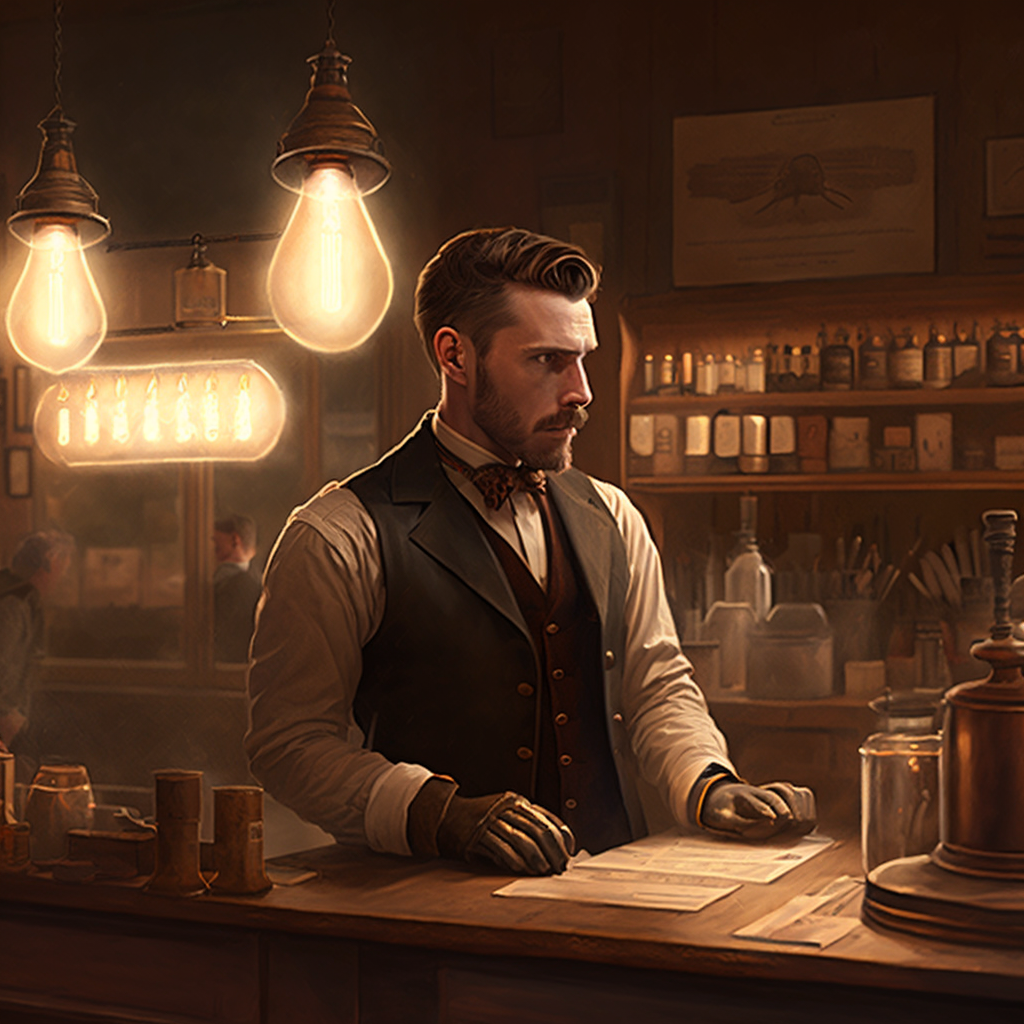 The clerk was busy sorting out a pile of telegrams. Clickety-clack. Clickety-clack. He lifted his head up. The noise stopped and Youssef realised the young man had mechanical hands.
“Welcome, welcome, welcome! What can I do for you today, my friend?” asked the clerk.
“I just wanted to…” started Youssef.
“Wait! Don’t tell me. I’m a bit of a psychic myself and I already know what you’re here for.”
“Really?”
The man foraged through his pile of telegram with his mechanical hands and picked one. He looked at it for a few seconds.
“My friend, you’re in luck today!” he said, looking intently at Youssef. “I just received this telegram that I think might interest you. Here, take a look!”
Youssef took the paper and started to read aloud : “Words spoken by the talkative will unlock the path. Seek those who chatter and unravel the clue. What the…?”
“Interesting, isn’t it? That’s a real head-scratcher, if you ask me!”
The door bell rang and the old man entered, holding his sore ribs.
“Get out, Phineas. You’re not welcome here.” said the clerk with a frown.
The old man looked at the clerk with an air of confusion before turning to Youssef. “What did he say? Who’s Phineas?” he asked.
Ignoring the question, Youssef tried to steer the conversation back to the telegram. “What does this mean?” he asked the clerk.
The clerk stroked his chin, looking thoughtful. “Hmm, well, it seems to me that you have a certain magnetism for talkative people. Perhaps that’s the key to unlocking this riddle.”
Youssef’s eyes widened in surprise. “What do you mean, magnetism?”
The old man interjected, “For sure! You’re like a magnet, my boy. I can’t seem to stop talking when I’m around you.”
Youssef rolled his eyes. “So, what do I do? Just wander around town and wait for someone to start talking?”
The clerk nodded. “That could be a good start. But if you’re looking for something specific, you might want to try Betsy when you wake up. She’s got a boutique of Gems and Rocks. You seem to like them rocks,” he said pointing at the black obsidian. “Found it in a mine?”
The old man’s eyes lit up. “Ah, the old mine! I’ve been there before, you know. My brother used to work there before he died. Strange things happening there.”
Youssef’s interest was piqued. “What kind of strange things?”
The old man leaned in conspiratorially. “There’s a magnetar hidden in that mine, my boy.”
“Shut up! Phineas,” interrupted the clerk. “If you want my advice, stranger, don’t go near the old mine. ‘Curiosity killed the cat’ if you know what I mean.”
The telegraph receiver started to make clicketing sounds. The clerk read it and looked at Youssef.
“You’ve got a message man. Time to wake up.”
“Wake up?”

Youssef opened his eyes and looked at a black mass in front of his eyes. He had been sleeping with the stone just beside his head on the pillow. No wonder he had had weird dreams. He heard his phone buzz. He sat up reluctantly and looked at his phone. 8am. A notification that his game progression had been saved and several messages from Miss Tartiflate, the last one saying :
Don’t think you can dodge work. I’m still expecting the last blog post you’ve been paid to write!!!”
He groaned as reality was starting to catch up.
February 19, 2023 at 9:00 pm #6612In reply to: Orbs of Madjourneys
Two young women, identical to the purple lock of hair hiding their left eye, entered the room. They moved as one person to the table, balancing their arms and bouncing on the floor like little girls. Youssef couldn’t help a shiver as he remembered The Shining.
“We are the twins,” they said, looking at him from behind their purple lock of hair. “Don’t mind us.”
One spoke a few milliseconds after the other, giving their combined voice an otherworldly touch that wasn’t reassuring. One took the sheets of paper from under the obsidian stone and the other the notebooks. After an hesitation they left the stone on the table and went back to the door.
“Wait,” said Youssef as they were about to leave, “What was on that paper? It looked like a map.”
“We leave you the stone,” they said without looking at him. “You might need it.”
As they shut the door, Youssef jumped out of his bed and tried to catch up with them. People couldn’t just enter his room like that. But when he flung the door open, the corridor was empty. He had the impression echoes of a combined laugh remained in the air and, tired as he was, decided not to look for them. Better not break the veil between dream and reality.
Intrigued by what the girls said, he took the black stone from the table and the last snicker bar from his backpack. He noted he would have to go to the grocery store tomorrow to buy some. Once he was back on his bed, he engulfed the snack and, while chewing, turned the stone around, trying to figure out what the girls meant by “You might need it”. The stone was cold to the touch and his reflection kept changing but nothing particular happened. Disappointed, he put the stone on his pillow and resumed the game on his phone.
Youssef finds himself in a small ghost town in what looks like the middle of the Australian outback. He’s standing in the town square, surrounded by an old post office, a saloon, and a few other ramshackle buildings.
He had a hard time focusing on the game. He started to feel the fatigue from the day. He yawned and started to doze off.
Youssef is standing in the town square, surrounded by an old post office, a saloon, and a few other ramshackle buildings. Scraps of mist are floating towards him. A ghostly laugh resounds from behind. He turns swiftly only to see a flash of purple disappear in a dark alleyway. He starts to run to catch them but a man, thrown out of the saloon, stumbles in front of him and they roll together on the dust.
“It’s not that I don’t like you,” said the man, “but you’re heavy.”
Youssef rolls on the side, mumbling some excuses and looks at where the twins had disappeared but the alleyway was gone.
“I think you broke one of my rib with your stone,” says the man, feeling his chest.
He looks as old as the town itself and quite harmless in his clothes, too big for him.
“What stone?” asks Youssef.
The old man points at a fragment of black obsidian between them on the ground.
“Don’t show them,” he says, “or they’ll take it from you.”
“What did you do?”
“They don’t like it when you ask questions about the old mines.”
-
AuthorSearch Results
