

Search Results for 'began'
-
AuthorSearch Results
-
January 28, 2022 at 1:10 pm #6260
In reply to: The Elusive Samuel Housley and Other Family Stories
From Tanganyika with Love
With thanks to Mike Rushby.
- “The letters of Eleanor Dunbar Leslie to her parents and her sister in South Africa
concerning her life with George Gilman Rushby of Tanganyika, and the trials and
joys of bringing up a family in pioneering conditions.
These letters were transcribed from copies of letters typed by Eleanor Rushby from
the originals which were in the estate of Marjorie Leslie, Eleanor’s sister. Eleanor
kept no diary of her life in Tanganyika, so these letters were the living record of an
important part of her life.Prelude
Having walked across Africa from the East coast to Ubangi Shauri Chad
in French Equatorial Africa, hunting elephant all the way, George Rushby
made his way down the Congo to Leopoldville. He then caught a ship to
Europe and had a holiday in Brussels and Paris before visiting his family
in England. He developed blackwater fever and was extremely ill for a
while. When he recovered he went to London to arrange his return to
Africa.Whilst staying at the Overseas Club he met Eileen Graham who had come
to England from Cape Town to study music. On hearing that George was
sailing for Cape Town she arranged to introduce him to her friend
Eleanor Dunbar Leslie. “You’ll need someone lively to show you around,”
she said. “She’s as smart as paint, a keen mountaineer, a very good school
teacher, and she’s attractive. You can’t miss her, because her father is a
well known Cape Town Magistrate. And,” she added “I’ve already written
and told her what ship you are arriving on.”Eleanor duly met the ship. She and George immediately fell in love.
Within thirty six hours he had proposed marriage and was accepted
despite the misgivings of her parents. As she was under contract to her
High School, she remained in South Africa for several months whilst
George headed for Tanganyika looking for a farm where he could build
their home.These details are a summary of chapter thirteen of the Biography of
George Gilman Rushby ‘The Hunter is Death “ by T.V.Bulpin.Dearest Marj,
Terrifically exciting news! I’ve just become engaged to an Englishman whom I
met last Monday. The result is a family upheaval which you will have no difficulty in
imagining!!The Aunts think it all highly romantic and cry in delight “Now isn’t that just like our
El!” Mummy says she doesn’t know what to think, that anyway I was always a harum
scarum and she rather expected something like this to happen. However I know that
she thinks George highly attractive. “Such a nice smile and gentle manner, and such
good hands“ she murmurs appreciatively. “But WHY AN ELEPHANT HUNTER?” she
ends in a wail, as though elephant hunting was an unmentionable profession.
Anyway I don’t think so. Anyone can marry a bank clerk or a lawyer or even a
millionaire – but whoever heard of anyone marrying anyone as exciting as an elephant
hunter? I’m thrilled to bits.Daddy also takes a dim view of George’s profession, and of George himself as
a husband for me. He says that I am so impulsive and have such wild enthusiasms that I
need someone conservative and steady to give me some serenity and some ballast.
Dad says George is a handsome fellow and a good enough chap he is sure, but
he is obviously a man of the world and hints darkly at a possible PAST. George says
he has nothing of the kind and anyway I’m the first girl he has asked to marry him. I don’t
care anyway, I’d gladly marry him tomorrow, but Dad has other ideas.He sat in his armchair to deliver his verdict, wearing the same look he must wear
on the bench. If we marry, and he doesn’t think it would be a good thing, George must
buy a comfortable house for me in Central Africa where I can stay safely when he goes
hunting. I interrupted to say “But I’m going too”, but dad snubbed me saying that in no
time at all I’ll have a family and one can’t go dragging babies around in the African Bush.”
George takes his lectures with surprising calm. He says he can see Dad’s point of
view much better than I can. He told the parents today that he plans to buy a small
coffee farm in the Southern Highlands of Tanganyika and will build a cosy cottage which
will be a proper home for both of us, and that he will only hunt occasionally to keep the
pot boiling.Mummy, of course, just had to spill the beans. She said to George, “I suppose
you know that Eleanor knows very little about house keeping and can’t cook at all.” a fact
that I was keeping a dark secret. But George just said, “Oh she won’t have to work. The
boys do all that sort of thing. She can lie on a couch all day and read if she likes.” Well
you always did say that I was a “Lily of the field,” and what a good thing! If I were one of
those terribly capable women I’d probably die of frustration because it seems that
African house boys feel that they have lost face if their Memsahibs do anything but the
most gracious chores.George is absolutely marvellous. He is strong and gentle and awfully good
looking too. He is about 5 ft 10 ins tall and very broad. He wears his curly brown hair cut
very short and has a close clipped moustache. He has strongly marked eyebrows and
very striking blue eyes which sometimes turn grey or green. His teeth are strong and
even and he has a quiet voice.I expect all this sounds too good to be true, but come home quickly and see for
yourself. George is off to East Africa in three weeks time to buy our farm. I shall follow as
soon as he has bought it and we will be married in Dar es Salaam.Dad has taken George for a walk “to get to know him” and that’s why I have time
to write such a long screed. They should be back any minute now and I must fly and
apply a bit of glamour.Much love my dear,
your jubilant
EleanorS.S.Timavo. Durban. 28th.October. 1930.
Dearest Family,
Thank you for the lovely send off. I do wish you were all on board with me and
could come and dance with me at my wedding. We are having a very comfortable
voyage. There were only four of the passengers as far as Durban, all of them women,
but I believe we are taking on more here. I have a most comfortable deck cabin to
myself and the use of a sumptuous bathroom. No one is interested in deck games and I
am having a lazy time, just sunbathing and reading.I sit at the Captain’s table and the meals are delicious – beautifully served. The
butter for instance, is moulded into sprays of roses, most exquisitely done, and as for
the ice-cream, I’ve never tasted anything like them.The meals are continental type and we have hors d’oeuvre in a great variety
served on large round trays. The Italians souse theirs with oil, Ugh! We also of course
get lots of spaghetti which I have some difficulty in eating. However this presents no
problem to the Chief Engineer who sits opposite to me. He simply rolls it around his
fork and somehow the spaghetti flows effortlessly from fork to mouth exactly like an
ascending escalator. Wine is served at lunch and dinner – very mild and pleasant stuff.
Of the women passengers the one i liked best was a young German widow
from South west Africa who left the ship at East London to marry a man she had never
met. She told me he owned a drapers shop and she was very happy at the prospect
of starting a new life, as her previous marriage had ended tragically with the death of her
husband and only child in an accident.I was most interested to see the bridegroom and stood at the rail beside the gay
young widow when we docked at East London. I picked him out, without any difficulty,
from the small group on the quay. He was a tall thin man in a smart grey suit and with a
grey hat perched primly on his head. You can always tell from hats can’t you? I wasn’t
surprised to see, when this German raised his head, that he looked just like the Kaiser’s
“Little Willie”. Long thin nose and cold grey eyes and no smile of welcome on his tight
mouth for the cheery little body beside me. I quite expected him to jerk his thumb and
stalk off, expecting her to trot at his heel.However she went off blithely enough. Next day before the ship sailed, she
was back and I saw her talking to the Captain. She began to cry and soon after the
Captain patted her on the shoulder and escorted her to the gangway. Later the Captain
told me that the girl had come to ask him to allow her to work her passage back to
Germany where she had some relations. She had married the man the day before but
she disliked him because he had deceived her by pretending that he owned a shop
whereas he was only a window dresser. Bad show for both.The Captain and the Chief Engineer are the only officers who mix socially with
the passengers. The captain seems rather a melancholy type with, I should say, no
sense of humour. He speaks fair English with an American accent. He tells me that he
was on the San Francisco run during Prohibition years in America and saw many Film
Stars chiefly “under the influence” as they used to flock on board to drink. The Chief
Engineer is big and fat and cheerful. His English is anything but fluent but he makes up
for it in mime.I visited the relations and friends at Port Elizabeth and East London, and here at
Durban. I stayed with the Trotters and Swans and enjoyed myself very much at both
places. I have collected numerous wedding presents, china and cutlery, coffee
percolator and ornaments, and where I shall pack all these things I don’t know. Everyone has been terribly kind and I feel extremely well and happy.At the start of the voyage I had a bit of bad luck. You will remember that a
perfectly foul South Easter was blowing. Some men were busy working on a deck
engine and I stopped to watch and a tiny fragment of steel blew into my eye. There is
no doctor on board so the stewardess put some oil into the eye and bandaged it up.
The eye grew more and more painful and inflamed and when when we reached Port
Elizabeth the Captain asked the Port Doctor to look at it. The Doctor said it was a job for
an eye specialist and telephoned from the ship to make an appointment. Luckily for me,
Vincent Tofts turned up at the ship just then and took me off to the specialist and waited
whilst he extracted the fragment with a giant magnet. The specialist said that I was very
lucky as the thing just missed the pupil of my eye so my sight will not be affected. I was
temporarily blinded by the Belladona the eye-man put in my eye so he fitted me with a
pair of black goggles and Vincent escorted me back to the ship. Don’t worry the eye is
now as good as ever and George will not have to take a one-eyed bride for better or
worse.I have one worry and that is that the ship is going to be very much overdue by
the time we reach Dar es Salaam. She is taking on a big wool cargo and we were held
up for three days in East london and have been here in Durban for five days.
Today is the ninth Anniversary of the Fascist Movement and the ship was
dressed with bunting and flags. I must now go and dress for the gala dinner.Bless you all,
Eleanor.S.S.Timavo. 6th. November 1930
Dearest Family,
Nearly there now. We called in at Lourenco Marques, Beira, Mozambique and
Port Amelia. I was the only one of the original passengers left after Durban but there we
took on a Mrs Croxford and her mother and two men passengers. Mrs C must have
something, certainly not looks. She has a flat figure, heavily mascared eyes and crooked
mouth thickly coated with lipstick. But her rather sweet old mother-black-pearls-type tells
me they are worn out travelling around the world trying to shake off an admirer who
pursues Mrs C everywhere.The one male passenger is very quiet and pleasant. The old lady tells me that he
has recently lost his wife. The other passenger is a horribly bumptious type.
I had my hair beautifully shingled at Lourenco Marques, but what an experience it
was. Before we docked I asked the Captain whether he knew of a hairdresser, but he
said he did not and would have to ask the agent when he came aboard. The agent was
a very suave Asian. He said “Sure he did” and offered to take me in his car. I rather
doubtfully agreed — such a swarthy gentleman — and was driven, not to a hairdressing
establishment, but to his office. Then he spoke to someone on the telephone and in no
time at all a most dago-y type arrived carrying a little black bag. He was all patent
leather, hair, and flashing smile, and greeted me like an old and valued friend.
Before I had collected my scattered wits tthe Agent had flung open a door and
ushered me through, and I found myself seated before an ornate mirror in what was only
too obviously a bedroom. It was a bedroom with a difference though. The unmade bed
had no legs but hung from the ceiling on brass chains.The agent beamingly shut the door behind him and I was left with my imagination
and the afore mentioned oily hairdresser. He however was very business like. Before I
could say knife he had shingled my hair with a cut throat razor and then, before I could
protest, had smothered my neck in stinking pink powder applied with an enormous and
filthy swansdown powder puff. He held up a mirror for me to admire his handiwork but I
was aware only of the enormous bed reflected in it, and hurriedly murmuring “very nice,
very nice” I made my escape to the outer office where, to my relief, I found the Chief
Engineer who escorted me back to the ship.In the afternoon Mrs Coxford and the old lady and I hired a taxi and went to the
Polana Hotel for tea. Very swish but I like our Cape Peninsula beaches better.
At Lorenco Marques we took on more passengers. The Governor of
Portuguese Nyasaland and his wife and baby son. He was a large middle aged man,
very friendly and unassuming and spoke perfect English. His wife was German and
exquisite, as fragile looking and with the delicate colouring of a Dresden figurine. She
looked about 18 but she told me she was 28 and showed me photographs of two
other sons – hefty youngsters, whom she had left behind in Portugal and was missing
very much.It was frightfully hot at Beira and as I had no money left I did not go up to the
town, but Mrs Croxford and I spent a pleasant hour on the beach under the Casurina
trees.The Governor and his wife left the ship at Mozambique. He looked very
imposing in his starched uniform and she more Dresden Sheperdish than ever in a
flowered frock. There was a guard of honour and all the trimmings. They bade me a warm farewell and invited George and me to stay at any time.The German ship “Watussi” was anchored in the Bay and I decided to visit her
and try and have my hair washed and set. I had no sooner stepped on board when a
lady came up to me and said “Surely you are Beeba Leslie.” It was Mrs Egan and she
had Molly with her. Considering Mrs Egan had not seen me since I was five I think it was
jolly clever of her to recognise me. Molly is charming and was most friendly. She fixed
things with the hairdresser and sat with me until the job was done. Afterwards I had tea
with them.Port Amelia was our last stop. In fact the only person to go ashore was Mr
Taylor, the unpleasant man, and he returned at sunset very drunk indeed.
We reached Port Amelia on the 3rd – my birthday. The boat had anchored by
the time I was dressed and when I went on deck I saw several row boats cluttered
around the gangway and in them were natives with cages of wild birds for sale. Such tiny
crowded cages. I was furious, you know me. I bought three cages, carried them out on
to the open deck and released the birds. I expected them to fly to the land but they flew
straight up into the rigging.The quiet male passenger wandered up and asked me what I was doing. I said
“I’m giving myself a birthday treat, I hate to see caged birds.” So next thing there he
was buying birds which he presented to me with “Happy Birthday.” I gladly set those
birds free too and they joined the others in the rigging.Then a grinning steward came up with three more cages. “For the lady with
compliments of the Captain.” They lost no time in joining their friends.
It had given me so much pleasure to free the birds that I was only a little
discouraged when the quiet man said thoughtfully “This should encourage those bird
catchers you know, they are sold out. When evening came and we were due to sail I
was sure those birds would fly home, but no, they are still there and they will probably
remain until we dock at Dar es Salaam.During the morning the Captain came up and asked me what my Christian name
is. He looked as grave as ever and I couldn’t think why it should interest him but said “the
name is Eleanor.” That night at dinner there was a large iced cake in the centre of the
table with “HELENA” in a delicate wreath of pink icing roses on the top. We had
champagne and everyone congratulated me and wished me good luck in my marriage.
A very nice gesture don’t you think. The unpleasant character had not put in an
appearance at dinner which made the party all the nicerI sat up rather late in the lounge reading a book and by the time I went to bed
there was not a soul around. I bathed and changed into my nighty,walked into my cabin,
shed my dressing gown, and pottered around. When I was ready for bed I put out my
hand to draw the curtains back and a hand grasped my wrist. It was that wretched
creature outside my window on the deck, still very drunk. Luckily I was wearing that
heavy lilac silk nighty. I was livid. “Let go at once”, I said, but he only grinned stupidly.
“I’m not hurting you” he said, “only looking”. “I’ll ring for the steward” said I, and by
stretching I managed to press the bell with my free hand. I rang and rang but no one
came and he just giggled. Then I said furiously, “Remember this name, George
Rushby, he is a fine boxer and he hates specimens like you. When he meets me at Dar
es Salaam I shall tell him about this and I bet you will be sorry.” However he still held on
so I turned and knocked hard on the adjoining wall which divided my cabin from Mrs
Croxfords. Soon Mrs Croxford and the old lady appeared in dressing gowns . This
seemed to amuse the drunk even more though he let go my wrist. So whilst the old
lady stayed with me, Mrs C fetched the quiet passenger who soon hustled him off. He has kept out of my way ever since. However I still mean to tell George because I feel
the fellow got off far too lightly. I reported the matter to the Captain but he just remarked
that he always knew the man was low class because he never wears a jacket to meals.
This is my last night on board and we again had free champagne and I was given
some tooled leather work by the Captain and a pair of good paste earrings by the old
lady. I have invited them and Mrs Croxford, the Chief Engineer, and the quiet
passenger to the wedding.This may be my last night as Eleanor Leslie and I have spent this long while
writing to you just as a little token of my affection and gratitude for all the years of your
love and care. I shall post this letter on the ship and must turn now and get some beauty
sleep. We have been told that we shall be in Dar es Salaam by 9 am. I am so excited
that I shall not sleep.Very much love, and just for fun I’ll sign my full name for the last time.
with my “bes respeks”,Eleanor Leslie.
Eleanor and George Rushby:
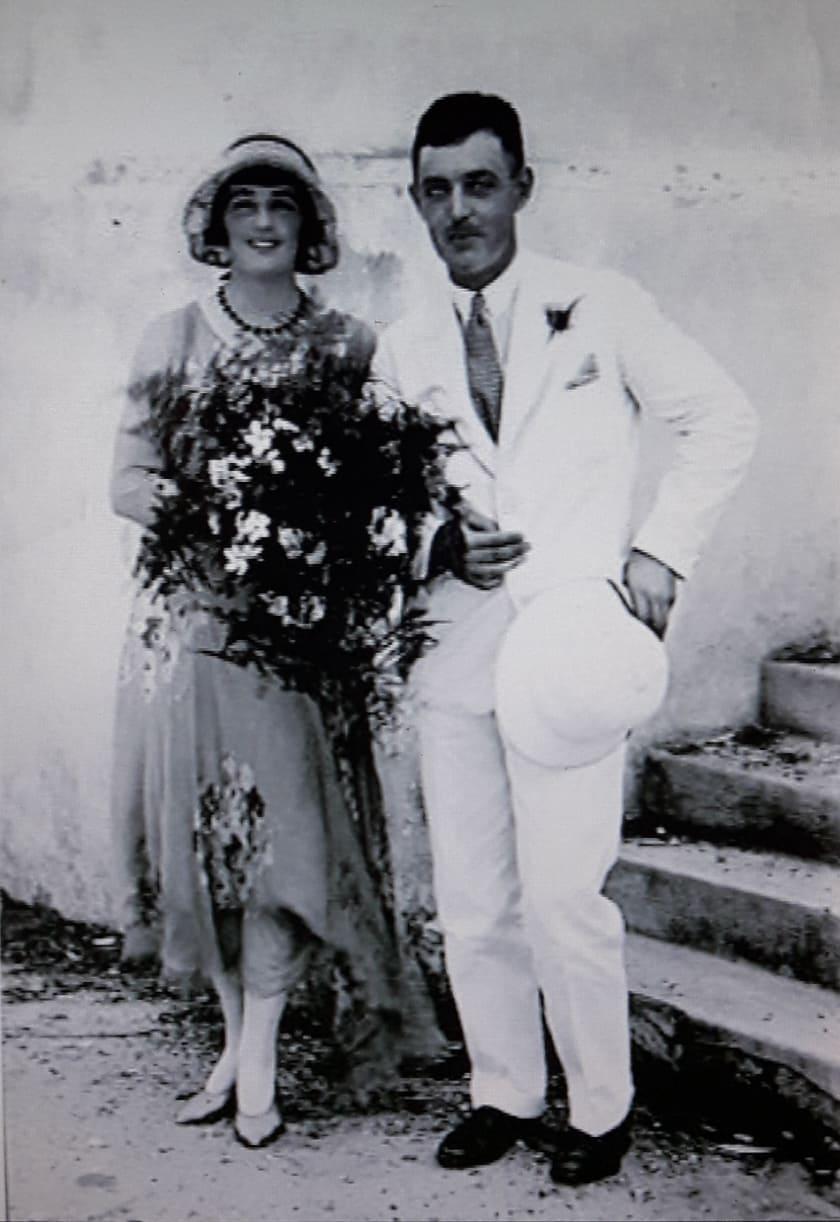
Splendid Hotel, Dar es Salaam 11th November 1930
Dearest Family,
I’m writing this in the bedroom whilst George is out buying a tin trunk in which to
pack all our wedding presents. I expect he will be gone a long time because he has
gone out with Hicky Wood and, though our wedding was four days ago, it’s still an
excuse for a party. People are all very cheery and friendly here.
I am wearing only pants and slip but am still hot. One swelters here in the
mornings, but a fresh sea breeze blows in the late afternoons and then Dar es Salaam is
heavenly.We arrived in Dar es Salaam harbour very early on Friday morning (7 th Nov).
The previous night the Captain had said we might not reach Dar. until 9 am, and certainly
no one would be allowed on board before 8 am. So I dawdled on the deck in my
dressing gown and watched the green coastline and the islands slipping by. I stood on
the deck outside my cabin and was not aware that I was looking out at the wrong side of
the landlocked harbour. Quite unknown to me George and some friends, the Hickson
Woods, were standing on the Gymkhana Beach on the opposite side of the channel
anxiously scanning the ship for a sign of me. George says he had a horrible idea I had
missed the ship. Blissfully unconscious of his anxiety I wandered into the bathroom
prepared for a good soak. The anchor went down when I was in the bath and suddenly
there was a sharp wrap on the door and I heard Mrs Croxford say “There’s a man in a
boat outside. He is looking out for someone and I’m sure it’s your George. I flung on
some clothes and rushed on deck with tousled hair and bare feet and it was George.
We had a marvellous reunion. George was wearing shorts and bush shirt and
looked just like the strong silent types one reads about in novels. I finished dressing then
George helped me bundle all the wedding presents I had collected en route into my
travelling rug and we went into the bar lounge to join the Hickson Woods. They are the
couple from whom George bought the land which is to be our coffee farm Hicky-Wood
was laughing when we joined them. he said he had called a chap to bring a couple of
beers thinking he was the steward but it turned out to be the Captain. He does wear
such a very plain uniform that I suppose it was easy to make the mistake, but Hicky
says he was not amused.Anyway as the H-W’s are to be our neighbours I’d better describe them. Kath
Wood is very attractive, dark Irish, with curly black hair and big brown eyes. She was
married before to Viv Lumb a great friend of George’s who died some years ago of
blackwater fever. They had one little girl, Maureen, and Kath and Hicky have a small son
of three called Michael. Hicky is slightly below average height and very neat and dapper
though well built. He is a great one for a party and good fun but George says he can be
bad tempered.Anyway we all filed off the ship and Hicky and Cath went on to the hotel whilst
George and I went through customs. Passing the customs was easy. Everyone
seemed to know George and that it was his wedding day and I just sailed through,
except for the little matter of the rug coming undone when George and I had to scramble
on the floor for candlesticks and fruit knives and a wooden nut bowl.
Outside the customs shed we were mobbed by a crowd of jabbering Africans
offering their services as porters, and soon my luggage was piled in one rickshaw whilst
George and I climbed into another and we were born smoothly away on rubber shod
wheels to the Splendid Hotel. The motion was pleasing enough but it seemed weird to
be pulled along by one human being whilst another pushed behind. We turned up a street called Acacia Avenue which, as its name implies, is lined
with flamboyant acacia trees now in the full glory of scarlet and gold. The rickshaw
stopped before the Splendid Hotel and I was taken upstairs into a pleasant room which
had its own private balcony overlooking the busy street.Here George broke the news that we were to be married in less than an hours
time. He would have to dash off and change and then go straight to the church. I would
be quite all right, Kath would be looking in and friends would fetch me.
I started to dress and soon there was a tap at the door and Mrs Hickson-Wood
came in with my bouquet. It was a lovely bunch of carnations and frangipani with lots of
asparagus fern and it went well with my primrose yellow frock. She admired my frock
and Leghorn hat and told me that her little girl Maureen was to be my flower girl. Then
she too left for the church.I was fully dressed when there was another knock on the door and I opened it to
be confronted by a Police Officer in a starched white uniform. I’m McCallum”, he said,
“I’ve come to drive you to the church.” Downstairs he introduced me to a big man in a
tussore silk suit. “This is Dr Shicore”, said McCallum, “He is going to give you away.”
Honestly, I felt exactly like Alice in Wonderland. Wouldn’t have been at all surprised if
the White Rabbit had popped up and said he was going to be my page.I walked out of the hotel and across the pavement in a dream and there, by the
curb, was a big dark blue police car decorated with white ribbons and with a tall African
Police Ascari holding the door open for me. I had hardly time to wonder what next when
the car drew up before a tall German looking church. It was in fact the Lutheran Church in
the days when Tanganyika was German East Africa.Mrs Hickson-Wood, very smart in mushroom coloured georgette and lace, and
her small daughter were waiting in the porch, so in we went. I was glad to notice my
friends from the boat sitting behind George’s friends who were all complete strangers to
me. The aisle seemed very long but at last I reached George waiting in the chancel with
Hicky-Wood, looking unfamiliar in a smart tussore suit. However this feeling of unreality
passed when he turned his head and smiled at me.In the vestry after the ceremony I was kissed affectionately by several complete
strangers and I felt happy and accepted by George’s friends. Outside the church,
standing apart from the rest of the guests, the Italian Captain and Chief Engineer were
waiting. They came up and kissed my hand, and murmured felicitations, but regretted
they could not spare the time to come to the reception. Really it was just as well
because they would not have fitted in at all well.Dr Shircore is the Director of Medical Services and he had very kindly lent his
large house for the reception. It was quite a party. The guests were mainly men with a
small sprinkling of wives. Champagne corks popped and there was an enormous cake
and soon voices were raised in song. The chief one was ‘Happy Days Are Here Again’
and I shall remember it for ever.The party was still in full swing when George and I left. The old lady from the ship
enjoyed it hugely. She came in an all black outfit with a corsage of artificial Lily-of-the-
Valley. Later I saw one of the men wearing the corsage in his buttonhole and the old
lady was wearing a carnation.When George and I got back to the hotel,I found that my luggage had been
moved to George’s room by his cook Lamek, who was squatting on his haunches and
clapped his hands in greeting. My dears, you should see Lamek – exactly like a
chimpanzee – receding forehead, wide flat nose, and long lip, and such splayed feet. It was quite a strain not to laugh, especially when he produced a gift for me. I have not yet
discovered where he acquired it. It was a faded mauve straw toque of the kind worn by
Queen Mary. I asked George to tell Lamek that I was touched by his generosity but felt
that I could not accept his gift. He did not mind at all especially as George gave him a
generous tip there and then.I changed into a cotton frock and shady straw hat and George changed into shorts
and bush shirt once more. We then sneaked into the dining room for lunch avoiding our
wedding guests who were carrying on the party in the lounge.After lunch we rejoined them and they all came down to the jetty to wave goodbye
as we set out by motor launch for Honeymoon Island. I enjoyed the launch trip very
much. The sea was calm and very blue and the palm fringed beaches of Dar es Salaam
are as romantic as any bride could wish. There are small coral islands dotted around the
Bay of which Honeymoon Island is the loveliest. I believe at one time it bore the less
romantic name of Quarantine Island. Near the Island, in the shallows, the sea is brilliant
green and I saw two pink jellyfish drifting by.There is no jetty on the island so the boat was stopped in shallow water and
George carried me ashore. I was enchanted with the Island and in no hurry to go to the
bungalow, so George and I took our bathing costumes from our suitcases and sent the
luggage up to the house together with a box of provisions.We bathed and lazed on the beach and suddenly it was sunset and it began to
get dark. We walked up the beach to the bungalow and began to unpack the stores,
tea, sugar, condensed milk, bread and butter, sardines and a large tin of ham. There
were also cups and saucers and plates and cutlery.We decided to have an early meal and George called out to the caretaker, “Boy
letta chai”. Thereupon the ‘boy’ materialised and jabbered to George in Ki-Swaheli. It
appeared he had no utensil in which to boil water. George, ever resourceful, removed
the ham from the tin and gave him that. We had our tea all right but next day the ham
was bad.Then came bed time. I took a hurricane lamp in one hand and my suitcase in the
other and wandered into the bedroom whilst George vanished into the bathroom. To
my astonishment I saw two perfectly bare iron bedsteads – no mattress or pillows. We
had brought sheets and mosquito nets but, believe me, they are a poor substitute for a
mattress.Anyway I arrayed myself in my pale yellow satin nightie and sat gingerly down
on the iron edge of the bed to await my groom who eventually appeared in a
handsome suit of silk pyjamas. His expression, as he took in the situation, was too much
for me and I burst out laughing and so did he.Somewhere in the small hours I woke up. The breeze had dropped and the
room was unbearably stuffy. I felt as dry as a bone. The lamp had been turned very
low and had gone out, but I remembered seeing a water tank in the yard and I decided
to go out in the dark and drink from the tap. In the dark I could not find my slippers so I
slipped my feet into George’s shoes, picked up his matches and groped my way out
of the room. I found the tank all right and with one hand on the tap and one cupped for
water I stooped to drink. Just then I heard a scratchy noise and sensed movements
around my feet. I struck a match and oh horrors! found that the damp spot on which I was
standing was alive with white crabs. In my hurry to escape I took a clumsy step, put
George’s big toe on the hem of my nightie and down I went on top of the crabs. I need
hardly say that George was awakened by an appalling shriek and came rushing to my
aid like a knight of old. Anyway, alarms and excursions not withstanding, we had a wonderful weekend on the island and I was sorry to return to the heat of Dar es Salaam, though the evenings
here are lovely and it is heavenly driving along the coast road by car or in a rickshaw.
I was surprised to find so many Indians here. Most of the shops, large and small,
seem to be owned by Indians and the place teems with them. The women wear
colourful saris and their hair in long black plaits reaching to their waists. Many wear baggy
trousers of silk or satin. They give a carnival air to the sea front towards sunset.
This long letter has been written in instalments throughout the day. My first break
was when I heard the sound of a band and rushed to the balcony in time to see The
Kings African Rifles band and Askaris march down the Avenue on their way to an
Armistice Memorial Service. They looked magnificent.I must end on a note of most primitive pride. George returned from his shopping
expedition and beamingly informed me that he had thrashed the man who annoyed me
on the ship. I felt extremely delighted and pressed for details. George told me that
when he went out shopping he noticed to his surprise that the ‘Timavo” was still in the
harbour. He went across to the Agents office and there saw a man who answered to the
description I had given. George said to him “Is your name Taylor?”, and when he said
“yes”, George said “Well my name is George Rushby”, whereupon he hit Taylor on the
jaw so that he sailed over the counter and down the other side. Very satisfactory, I feel.
With much love to all.Your cave woman
Eleanor.Mchewe Estate. P.O. Mbeya 22 November 1930
Dearest Family,
Well here we are at our Country Seat, Mchewe Estate. (pronounced
Mn,-che’-we) but I will start at the beginning of our journey and describe the farm later.
We left the hotel at Dar es Salaam for the station in a taxi crowded with baggage
and at the last moment Keith Wood ran out with the unwrapped bottom layer of our
wedding cake. It remained in its naked state from there to here travelling for two days in
the train on the luggage rack, four days in the car on my knee, reposing at night on the
roof of the car exposed to the winds of Heaven, and now rests beside me in the tent
looking like an old old tombstone. We have no tin large enough to hold it and one
simply can’t throw away ones wedding cake so, as George does not eat cake, I can see
myself eating wedding cake for tea for months to come, ants permitting.We travelled up by train from Dar to Dodoma, first through the lush vegetation of
the coastal belt to Morogoro, then through sisal plantations now very overgrown with
weeds owing to the slump in prices, and then on to the arid area around Dodoma. This
part of the country is very dry at this time of the year and not unlike parts of our Karoo.
The train journey was comfortable enough but slow as the engines here are fed with
wood and not coal as in South Africa.Dodoma is the nearest point on the railway to Mbeya so we left the train there to
continue our journey by road. We arrived at the one and only hotel in the early hours and
whilst someone went to rout out the night watchman the rest of us sat on the dismal
verandah amongst a litter of broken glass. Some bright spark remarked on the obvious –
that there had been a party the night before.When we were shown to a room I thought I rather preferred the verandah,
because the beds had not yet been made up and there was a bucket of vomit beside
the old fashioned washstand. However George soon got the boys to clean up the
room and I fell asleep to be awakened by George with an invitation to come and see
our car before breakfast.Yes, we have our own car. It is a Chev, with what is called a box body. That
means that sides, roof and doors are made by a local Indian carpenter. There is just the
one front seat with a kapok mattress on it. The tools are kept in a sort of cupboard fixed
to the side so there is a big space for carrying “safari kit” behind the cab seat.
Lamek, who had travelled up on the same train, appeared after breakfast, and
helped George to pack all our luggage into the back of the car. Besides our suitcases
there was a huge bedroll, kitchen utensils and a box of provisions, tins of petrol and
water and all Lamek’s bits and pieces which included three chickens in a wicker cage and
an enormous bunch of bananas about 3 ft long.When all theses things were packed there remained only a small space between
goods and ceiling and into this Lamek squeezed. He lay on his back with his horny feet a
mere inch or so from the back of my head. In this way we travelled 400 miles over
bumpy earth roads and crude pole bridges, but whenever we stopped for a meal
Lamek wriggled out and, like Aladdin’s genie, produced good meals in no time at all.
In the afternoon we reached a large river called the Ruaha. Workmen were busy
building a large bridge across it but it is not yet ready so we crossed by a ford below
the bridge. George told me that the river was full of crocodiles but though I looked hard, I
did not see any. This is also elephant country but I did not see any of those either, only
piles of droppings on the road. I must tell you that the natives around these parts are called Wahehe and the river is Ruaha – enough to make a cat laugh. We saw some Wahehe out hunting with spears
and bows and arrows. They live in long low houses with the tiniest shuttered windows
and rounded roofs covered with earth.Near the river we also saw a few Masai herding cattle. They are rather terrifying to
look at – tall, angular, and very aloof. They wear nothing but a blanket knotted on one
shoulder, concealing nothing, and all carried one or two spears.
The road climbs steeply on the far side of the Ruaha and one has the most
tremendous views over the plains. We spent our first night up there in the high country.
Everything was taken out of the car, the bed roll opened up and George and I slept
comfortably in the back of the car whilst Lamek, rolled in a blanket, slept soundly by a
small fire nearby. Next morning we reached our first township, Iringa, and put up at the
Colonist Hotel. We had a comfortable room in the annex overlooking the golf course.
our room had its own little dressing room which was also the bathroom because, when
ordered to do so, the room boy carried in an oval galvanised bath and filled it with hot
water which he carried in a four gallon petrol tin.When we crossed to the main building for lunch, George was immediately hailed
by several men who wanted to meet the bride. I was paid some handsome
compliments but was not sure whether they were sincere or the result of a nice alcoholic
glow. Anyhow every one was very friendly.After lunch I went back to the bedroom leaving George chatting away. I waited and
waited – no George. I got awfully tired of waiting and thought I’d give him a fright so I
walked out onto the deserted golf course and hid behind some large boulders. Soon I
saw George returning to the room and the boy followed with a tea tray. Ah, now the hue
and cry will start, thought I, but no, no George appeared nor could I hear any despairing
cry. When sunset came I trailed crossly back to our hotel room where George lay
innocently asleep on his bed, hands folded on his chest like a crusader on his tomb. In a
moment he opened his eyes, smiled sleepily and said kindly, “Did you have a nice walk
my love?” So of course I couldn’t play the neglected wife as he obviously didn’t think
me one and we had a very pleasant dinner and party in the hotel that evening.
Next day we continued our journey but turned aside to visit the farm of a sprightly
old man named St.Leger Seaton whom George had known for many years, so it was
after dark before George decided that we had covered our quota of miles for the day.
Whilst he and Lamek unpacked I wandered off to a stream to cool my hot feet which had
baked all day on the floor boards of the car. In the rather dim moonlight I sat down on the
grassy bank and gratefully dabbled my feet in the cold water. A few minutes later I
started up with a shriek – I had the sensation of red hot pins being dug into all my most
sensitive parts. I started clawing my clothes off and, by the time George came to the
rescue with the lamp, I was practically in the nude. “Only Siafu ants,” said George calmly.
Take off all your clothes and get right in the water.” So I had a bathe whilst George
picked the ants off my clothes by the light of the lamp turned very low for modesty’s
sake. Siafu ants are beastly things. They are black ants with outsized heads and
pinchers. I shall be very, very careful where I sit in future.The next day was even hotter. There was no great variety in the scenery. Most
of the country was covered by a tree called Miombo, which is very ordinary when the
foliage is a mature deep green, but when in new leaf the trees look absolutely beautiful
as the leaves,surprisingly, are soft pastel shades of red and yellow.Once again we turned aside from the main road to visit one of George’s friends.
This man Major Hugh Jones MC, has a farm only a few miles from ours but just now he is supervising the making of an airstrip. Major Jones is quite a character. He is below
average height and skinny with an almost bald head and one nearly blind eye into which
he screws a monocle. He is a cultured person and will, I am sure, make an interesting
neighbour. George and Major Jones’ friends call him ‘Joni’ but he is generally known in
this country as ‘Ropesoles’ – as he is partial to that type of footwear.
We passed through Mbeya township after dark so I have no idea what the place
is like. The last 100 miles of our journey was very dusty and the last 15 miles extremely
bumpy. The road is used so little that in some places we had to plow our way through
long grass and I was delighted when at last George turned into a side road and said
“This is our place.” We drove along the bank of the Mchewe River, then up a hill and
stopped at a tent which was pitched beside the half built walls of our new home. We
were expected so there was hot water for baths and after a supper of tinned food and
good hot tea, I climbed thankfully into bed.Next morning I was awakened by the chattering of the African workmen and was
soon out to inspect the new surroundings. Our farm was once part of Hickson Wood’s
land and is separated from theirs by a river. Our houses cannot be more than a few
hundred yards apart as the crow flies but as both are built on the slopes of a long range
of high hills, and one can only cross the river at the foot of the slopes, it will be quite a
safari to go visiting on foot . Most of our land is covered with shoulder high grass but it
has been partly cleared of trees and scrub. Down by the river George has made a long
coffee nursery and a large vegetable garden but both coffee and vegetable seedlings
are too small to be of use.George has spared all the trees that will make good shade for the coffee later on.
There are several huge wild fig trees as big as oaks but with smooth silvery-green trunks
and branches and there are lots of acacia thorn trees with flat tops like Japanese sun
shades. I’ve seen lovely birds in the fig trees, Louries with bright plumage and crested
heads, and Blue Rollers, and in the grasslands there are widow birds with incredibly long
black tail feathers.There are monkeys too and horrible but fascinating tree lizards with blue bodies
and orange heads. There are so many, many things to tell you but they must wait for
another time as James, the house boy, has been to say “Bafu tiari” and if I don’t go at
once, the bath will be cold.I am very very happy and terribly interested in this new life so please don’t
worry about me.Much love to you all,
Eleanor.Mchewe Estate 29th. November 1930
Dearest Family,
I’ve lots of time to write letters just now because George is busy supervising the
building of the house from early morning to late afternoon – with a break for lunch of
course.On our second day here our tent was moved from the house site to a small
clearing further down the slope of our hill. Next to it the labourers built a ‘banda’ , which is
a three sided grass hut with thatched roof – much cooler than the tent in this weather.
There is also a little grass lav. so you see we have every convenience. I spend most of
my day in the banda reading or writing letters. Occasionally I wander up to the house site
and watch the building, but mostly I just sit.I did try exploring once. I wandered down a narrow path towards the river. I
thought I might paddle and explore the river a little but I came round a bend and there,
facing me, was a crocodile. At least for a moment I thought it was and my adrenaline
glands got very busy indeed. But it was only an enormous monitor lizard, four or five
feet long. It must have been as scared as I was because it turned and rushed off through
the grass. I turned and walked hastily back to the camp and as I passed the house site I
saw some boys killing a large puff adder. Now I do my walking in the evenings with
George. Nothing alarming ever seems to happen when he is around.It is interesting to watch the boys making bricks for the house. They make a pile
of mud which they trample with their feet until it is the right consistency. Then they fill
wooden moulds with the clayey mud, and press it down well and turn out beautiful shiny,
dark brown bricks which are laid out in rows and covered with grass to bake slowly in the
sun.Most of the materials for the building are right here at hand. The walls will be sun
dried bricks and there is a white clay which will make a good whitewash for the inside
walls. The chimney and walls will be of burnt brick and tiles and George is now busy
building a kiln for this purpose. Poles for the roof are being cut in the hills behind the
house and every day women come along with large bundles of thatching grass on their
heads. Our windows are modern steel casement ones and the doors have been made
at a mission in the district. George does some of the bricklaying himself. The other
bricklayer is an African from Northern Rhodesia called Pedro. It makes me perspire just
to look at Pedro who wears an overcoat all day in the very hot sun.
Lamek continues to please. He turns out excellent meals, chicken soup followed
by roast chicken, vegetables from the Hickson-Woods garden and a steamed pudding
or fruit to wind up the meal. I enjoy the chicken but George is fed up with it and longs for
good red meat. The chickens are only about as large as a partridge but then they cost
only sixpence each.I had my first visit to Mbeya two days ago. I put on my very best trousseau frock
for the occasion- that yellow striped silk one – and wore my wedding hat. George didn’t
comment, but I saw later that I was dreadfully overdressed.
Mbeya at the moment is a very small settlement consisting of a bundle of small
Indian shops – Dukas they call them, which stock European tinned foods and native soft
goods which seem to be mainly of Japanese origin. There is a one storied Government
office called the Boma and two attractive gabled houses of burnt brick which house the
District Officer and his Assistant. Both these houses have lovely gardens but i saw them
only from the outside as we did not call. After buying our stores George said “Lets go to the pub, I want you to meet Mrs Menzies.” Well the pub turned out to be just three or four grass rondavels on a bare
plot. The proprietor, Ken Menzies, came out to welcome us. I took to him at once
because he has the same bush sandy eyebrows as you have Dad. He told me that
unfortunately his wife is away at the coast, and then he ushered me through the door
saying “Here’s George with his bride.” then followed the Iringa welcome all over again,
only more so, because the room was full of diggers from the Lupa Goldfields about fifty
miles away.Champagne corks popped as I shook hands all around and George was
clapped on the back. I could see he was a favourite with everyone and I tried not to be
gauche and let him down. These men were all most kind and most appeared to be men
of more than average education. However several were unshaven and looked as
though they had slept in their clothes as I suppose they had. When they have a little luck
on the diggings they come in here to Menzies pub and spend the lot. George says
they bring their gold dust and small nuggets in tobacco tins or Kruschen salts jars and
hand them over to Ken Menzies saying “Tell me when I’ve spent the lot.” Ken then
weighs the gold and estimates its value and does exactly what the digger wants.
However the Diggers get good value for their money because besides the drink
they get companionship and good food and nursing if they need it. Mrs Menzies is a
trained nurse and most kind and capable from what I was told. There is no doctor or
hospital here so her experience as a nursing sister is invaluable.
We had lunch at the Hotel and afterwards I poured tea as I was the only female
present. Once the shyness had worn off I rather enjoyed myself.Now to end off I must tell you a funny story of how I found out that George likes
his women to be feminine. You will remember those dashing black silk pyjamas Aunt
Mary gave me, with flowered “happy coat” to match. Well last night I thought I’d give
George a treat and when the boy called me for my bath I left George in the ‘banda’
reading the London Times. After my bath I put on my Japanese pyjamas and coat,
peered into the shaving mirror which hangs from the tent pole and brushed my hair until it
shone. I must confess that with my fringe and shingled hair I thought I made quite a
glamourous Japanese girl. I walked coyly across to the ‘banda’. Alas no compliment.
George just glanced up from the Times and went on reading.
He was away rather a long time when it came to his turn to bath. I glanced up
when he came back and had a slight concussion. George, if you please, was arrayed in
my very best pale yellow satin nightie. The one with the lace and ribbon sash and little
bows on the shoulder. I knew exactly what he meant to convey. I was not to wear the
trousers in the family. I seethed inwardly, but pretending not to notice, I said calmly “shall
I call for food?” In this garb George sat down to dinner and it says a great deal for African
phlegm that the boy did not drop the dishes.We conversed politely about this and that, and then, as usual, George went off
to bed. I appeared to be engrossed in my book and did not stir. When I went to the
tent some time later George lay fast asleep still in my nightie, though all I could see of it
was the little ribbon bows looking farcically out of place on his broad shoulders.
This morning neither of us mentioned the incident, George was up and dressed
by the time I woke up but I have been smiling all day to think what a ridiculous picture
we made at dinner. So farewell to pyjamas and hey for ribbons and bows.Your loving
Eleanor.Mchewe Estate. Mbeya. 8th December 1930
Dearest Family,
A mere shadow of her former buxom self lifts a languid pen to write to you. I’m
convalescing after my first and I hope my last attack of malaria. It was a beastly
experience but all is now well and I am eating like a horse and will soon regain my
bounce.I took ill on the evening of the day I wrote my last letter to you. It started with a
splitting headache and fits of shivering. The symptoms were all too familiar to George
who got me into bed and filled me up with quinine. He then piled on all the available
blankets and packed me in hot water bottles. I thought I’d explode and said so and
George said just to lie still and I’d soon break into a good sweat. However nothing of the
kind happened and next day my temperature was 105 degrees. Instead of feeling
miserable as I had done at the onset, I now felt very merry and most chatty. George
now tells me I sang the most bawdy songs but I hardly think it likely. Do you?
You cannot imagine how tenderly George nursed me, not only that day but
throughout the whole eight days I was ill. As we do not employ any African house
women, and there are no white women in the neighbourhood at present to whom we
could appeal for help, George had to do everything for me. It was unbearably hot in the
tent so George decided to move me across to the Hickson-Woods vacant house. They
have not yet returned from the coast.George decided I was too weak to make the trip in the car so he sent a
messenger over to the Woods’ house for their Machila. A Machila is a canopied canvas
hammock slung from a bamboo pole and carried by four bearers. The Machila duly
arrived and I attempted to walk to it, clinging to George’s arm, but collapsed in a faint so
the trip was postponed to the next morning when I felt rather better. Being carried by
Machila is quite pleasant but I was in no shape to enjoy anything and got thankfully into
bed in the Hickson-Woods large, cool and rather dark bedroom. My condition did not
improve and George decided to send a runner for the Government Doctor at Tukuyu
about 60 miles away. Two days later Dr Theis arrived by car and gave me two
injections of quinine which reduced the fever. However I still felt very weak and had to
spend a further four days in bed.We have now decided to stay on here until the Hickson-Woods return by which
time our own house should be ready. George goes off each morning and does not
return until late afternoon. However don’t think “poor Eleanor” because I am very
comfortable here and there are lots of books to read and the days seem to pass very
quickly.The Hickson-Wood’s house was built by Major Jones and I believe the one on
his shamba is just like it. It is a square red brick building with a wide verandah all around
and, rather astonishingly, a conical thatched roof. There is a beautiful view from the front
of the house and a nice flower garden. The coffee shamba is lower down on the hill.
Mrs Wood’s first husband, George’s friend Vi Lumb, is buried in the flower
garden. He died of blackwater fever about five years ago. I’m told that before her
second marriage Kath lived here alone with her little daughter, Maureen, and ran the farm
entirely on her own. She must be quite a person. I bet she didn’t go and get malaria
within a few weeks of her marriage.The native tribe around here are called Wasafwa. They are pretty primitive but
seem amiable people. Most of the men, when they start work, wear nothing but some
kind of sheet of unbleached calico wrapped round their waists and hanging to mid calf. As soon as they have drawn their wages they go off to a duka and buy a pair of khaki
shorts for five or six shillings. Their women folk wear very short beaded skirts. I think the
base is goat skin but have never got close enough for a good look. They are very shy.
I hear from George that they have started on the roof of our house but I have not
seen it myself since the day I was carried here by Machila. My letters by the way go to
the Post Office by runner. George’s farm labourers take it in turn to act in this capacity.
The mail bag is given to them on Friday afternoon and by Saturday evening they are
back with our very welcome mail.Very much love,
Eleanor.Mbeya 23rd December 1930
Dearest Family,
George drove to Mbeya for stores last week and met Col. Sherwood-Kelly VC.
who has been sent by the Government to Mbeya as Game Ranger. His job will be to
protect native crops from raiding elephants and hippo etc., and to protect game from
poachers. He has had no training for this so he has asked George to go with him on his
first elephant safari to show him the ropes.George likes Col. Kelly and was quite willing to go on safari but not willing to
leave me alone on the farm as I am still rather shaky after malaria. So it was arranged that
I should go to Mbeya and stay with Mrs Harmer, the wife of the newly appointed Lands
and Mines Officer, whose husband was away on safari.So here I am in Mbeya staying in the Harmers temporary wattle and daub
house. Unfortunately I had a relapse of the malaria and stayed in bed for three days with
a temperature. Poor Mrs Harmer had her hands full because in the room next to mine
she was nursing a digger with blackwater fever. I could hear his delirious babble through
the thin wall – very distressing. He died poor fellow , and leaves a wife and seven
children.I feel better than I have done for weeks and this afternoon I walked down to the
store. There are great signs of activity and people say that Mbeya will grow rapidly now
owing to the boom on the gold fields and also to the fact that a large aerodrome is to be
built here. Mbeya is to be a night stop on the proposed air service between England
and South Africa. I seem to be the last of the pioneers. If all these schemes come about
Mbeya will become quite suburban.26th December 1930
George, Col. Kelly and Mr Harmer all returned to Mbeya on Christmas Eve and
it was decided that we should stay and have midday Christmas dinner with the
Harmers. Col. Kelly and the Assistant District Commissioner came too and it was quite a
festive occasion, We left Mbeya in the early afternoon and had our evening meal here at
Hickson-Wood’s farm. I wore my wedding dress.I went across to our house in the car this morning. George usually walks across to
save petrol which is very expensive here. He takes a short cut and wades through the
river. The distance by road is very much longer than the short cut. The men are now
thatching the roof of our cottage and it looks charming. It consists of a very large living
room-dinning room with a large inglenook fireplace at one end. The bedroom is a large
square room with a smaller verandah room adjoining it. There is a wide verandah in the
front, from which one has a glorious view over a wide valley to the Livingstone
Mountains on the horizon. Bathroom and storeroom are on the back verandah and the
kitchen is some distance behind the house to minimise the risk of fire.You can imagine how much I am looking forward to moving in. We have some
furniture which was made by an Indian carpenter at Iringa, refrectory dining table and
chairs, some small tables and two armchairs and two cupboards and a meatsafe. Other
things like bookshelves and extra cupboards we will have to make ourselves. George
has also bought a portable gramophone and records which will be a boon.
We also have an Irish wolfhound puppy, a skinny little chap with enormous feet
who keeps me company all day whilst George is across at our farm working on the
house.Lots and lots of love,
Eleanor.Mchewe Estate 8th Jan 1931
Dearest Family,
Alas, I have lost my little companion. The Doctor called in here on Boxing night
and ran over and killed Paddy, our pup. It was not his fault but I was very distressed
about it and George has promised to try and get another pup from the same litter.
The Hickson-Woods returned home on the 29th December so we decided to
move across to our nearly finished house on the 1st January. Hicky Wood decided that
we needed something special to mark the occasion so he went off and killed a sucking
pig behind the kitchen. The piglet’s screams were terrible and I felt that I would not be
able to touch any dinner. Lamek cooked and served sucking pig up in the traditional way
but it was high and quite literally, it stank. Our first meal in our own home was not a
success.However next day all was forgotten and I had something useful to do. George
hung doors and I held the tools and I also planted rose cuttings I had brought from
Mbeya and sowed several boxes with seeds.Dad asked me about the other farms in the area. I haven’t visited any but there
are five besides ours. One belongs to the Lutheran Mission at Utengule, a few miles
from here. The others all belong to British owners. Nearest to Mbeya, at the foot of a
very high peak which gives Mbeya its name, are two farms, one belonging to a South
African mining engineer named Griffiths, the other to I.G.Stewart who was an officer in the
Kings African Rifles. Stewart has a young woman called Queenie living with him. We are
some miles further along the range of hills and are some 23 miles from Mbeya by road.
The Mchewe River divides our land from the Hickson-Woods and beyond their farm is
Major Jones.All these people have been away from their farms for some time but have now
returned so we will have some neighbours in future. However although the houses are
not far apart as the crow flies, they are all built high in the foothills and it is impossible to
connect the houses because of the rivers and gorges in between. One has to drive right
down to the main road and then up again so I do not suppose we will go visiting very
often as the roads are very bumpy and eroded and petrol is so expensive that we all
save it for occasional trips to Mbeya.The rains are on and George has started to plant out some coffee seedlings. The
rains here are strange. One can hear the rain coming as it moves like a curtain along the
range of hills. It comes suddenly, pours for a little while and passes on and the sun
shines again.I do like it here and I wish you could see or dear little home.
Your loving,
Eleanor.Mchewe Estate. 1st April 1931
Dearest Family,
Everything is now running very smoothly in our home. Lamek continues to
produce palatable meals and makes wonderful bread which he bakes in a four gallon
petrol tin as we have no stove yet. He puts wood coals on the brick floor of the kitchen,
lays the tin lengh-wise on the coals and heaps more on top. The bread tins are then put
in the petrol tin, which has one end cut away, and the open end is covered by a flat
piece of tin held in place by a brick. Cakes are also backed in this make-shift oven and I
have never known Lamek to have a failure yet.Lamek has a helper, known as the ‘mpishi boy’ , who does most of the hard
work, cleans pots and pans and chops the firewood etc. Another of the mpishi boy’s
chores is to kill the two chickens we eat each day. The chickens run wild during the day
but are herded into a small chicken house at night. One of the kitchen boy’s first duties is
to let the chickens out first thing in the early morning. Some time after breakfast it dawns
on Lamek that he will need a chicken for lunch. he informs the kitchen boy who selects a
chicken and starts to chase it in which he is enthusiastically joined by our new Irish
wolfhound pup, Kelly. Together they race after the frantic fowl, over the flower beds and
around the house until finally the chicken collapses from sheer exhaustion. The kitchen
boy then hands it over to Lamek who murders it with the kitchen knife and then pops the
corpse into boiling water so the feathers can be stripped off with ease.I pointed out in vain, that it would be far simpler if the doomed chickens were kept
in the chicken house in the mornings when the others were let out and also that the correct
way to pluck chickens is when they are dry. Lamek just smiled kindly and said that that
may be so in Europe but that his way is the African way and none of his previous
Memsahibs has complained.My houseboy, named James, is clean and capable in the house and also a
good ‘dhobi’ or washboy. He takes the washing down to the river and probably
pounds it with stones, but I prefer not to look. The ironing is done with a charcoal iron
only we have no charcoal and he uses bits of wood from the kitchen fire but so far there
has not been a mishap.It gets dark here soon after sunset and then George lights the oil lamps and we
have tea and toast in front of the log fire which burns brightly in our inglenook. This is my
favourite hour of the day. Later George goes for his bath. I have mine in the mornings
and we have dinner at half past eight. Then we talk a bit and read a bit and sometimes
play the gramophone. I expect it all sounds pretty unexciting but it doesn’t seem so to
me.Very much love,
Eleanor.Mchewe Estate 20th April 1931
Dearest Family,
It is still raining here and the countryside looks very lush and green, very different
from the Mbeya district I first knew, when plains and hills were covered in long brown
grass – very course stuff that grows shoulder high.Most of the labourers are hill men and one can see little patches of cultivation in
the hills. Others live in small villages near by, each consisting of a cluster of thatched huts
and a few maize fields and perhaps a patch of bananas. We do not have labour lines on
the farm because our men all live within easy walking distance. Each worker has a labour
card with thirty little squares on it. One of these squares is crossed off for each days work
and when all thirty are marked in this way the labourer draws his pay and hies himself off
to the nearest small store and blows the lot. The card system is necessary because
these Africans are by no means slaves to work. They work only when they feel like it or
when someone in the family requires a new garment, or when they need a few shillings
to pay their annual tax. Their fields, chickens and goats provide them with the food they
need but they draw rations of maize meal beans and salt. Only our headman is on a
salary. His name is Thomas and he looks exactly like the statues of Julius Caesar, the
same bald head and muscular neck and sardonic expression. He comes from Northern
Rhodesia and is more intelligent than the locals.We still live mainly on chickens. We have a boy whose job it is to scour the
countryside for reasonable fat ones. His name is Lucas and he is quite a character. He
has such long horse teeth that he does not seem able to close his mouth and wears a
perpetual amiable smile. He brings his chickens in beehive shaped wicker baskets
which are suspended on a pole which Lucas carries on his shoulder.We buy our groceries in bulk from Mbeya, our vegetables come from our
garden by the river and our butter from Kath Wood. Our fresh milk we buy from the
natives. It is brought each morning by three little totos each carrying one bottle on his
shaven head. Did I tell you that the local Wasafwa file their teeth to points. These kids
grin at one with their little sharks teeth – quite an “all-ready-to-eat-you-with-my-dear” look.
A few nights ago a message arrived from Kath Wood to say that Queenie
Stewart was very ill and would George drive her across to the Doctor at Tukuyu. I
wanted George to wait until morning because it was pouring with rain, and the mountain
road to Tukuyu is tricky even in dry weather, but he said it is dangerous to delay with any
kind of fever in Africa and he would have to start at once. So off he drove in the rain and I
did not see him again until the following night.George said that it had been a nightmare trip. Queenie had a high temperature
and it was lucky that Kath was able to go to attend to her. George needed all his
attention on the road which was officially closed to traffic, and very slippery, and in some
places badly eroded. In some places the decking of bridges had been removed and
George had to get out in the rain and replace it. As he had nothing with which to fasten
the decking to the runners it was a dangerous undertaking to cross the bridges especially
as the rivers are now in flood and flowing strongly. However they reached Tukuyu safely
and it was just as well they went because the Doctor diagnosed Queenies illness as
Spirillium Tick Fever which is a very nasty illness indeed.Eleanor.
Mchewe Estate. 20th May 1931
Dear Family,
I’m feeling fit and very happy though a bit lonely sometimes because George
spends much of his time away in the hills cutting a furrow miles long to bring water to the
house and to the upper part of the shamba so that he will be able to irrigate the coffee
during the dry season.It will be quite an engineering feat when it is done as George only has makeshift
surveying instruments. He has mounted an ordinary cheap spirit level on an old camera
tripod and has tacked two gramophone needles into the spirit level to give him a line.
The other day part of a bank gave way and practically buried two of George’s labourers
but they were quickly rescued and no harm was done. However he will not let them
work unless he is there to supervise.I keep busy so that the days pass quickly enough. I am delighted with the
material you sent me for curtains and loose covers and have hired a hand sewing
machine from Pedro-of-the-overcoat and am rattling away all day. The machine is an
ancient German one and when I say rattle, I mean rattle. It is a most cumbersome, heavy
affair of I should say, the same vintage as George Stevenson’s Rocket locomotive.
Anyway it sews and I am pleased with my efforts. We made a couch ourselves out of a
native bed, a mattress and some planks but all this is hidden under the chintz cover and
it looks quite the genuine bought article. I have some diversions too. Small black faced
monkeys sit in the trees outside our bedroom window and they are most entertaining to
watch. They are very mischievous though. When I went out into the garden this morning
before breakfast I found that the monkeys had pulled up all my carnations. There they
lay, roots in the air and whether they will take again I don’t know.I like the monkeys but hate the big mountain baboons that come and hang
around our chicken house. I am terrified that they will tear our pup into bits because he is
a plucky young thing and will rush out to bark at the baboons.George usually returns for the weekends but last time he did not because he had
a touch of malaria. He sent a boy down for the mail and some fresh bread. Old Lucas
arrived with chickens just as the messenger was setting off with mail and bread in a
haversack on his back. I thought it might be a good idea to send a chicken to George so
I selected a spry young rooster which I handed to the messenger. He, however,
complained that he needed both hands for climbing. I then had one of my bright ideas
and, putting a layer of newspaper over the bread, I tucked the rooster into the haversack
and buckled down the flap so only his head protruded.I thought no more about it until two days later when the messenger again
appeared for fresh bread. He brought a rather terse note from George saying that the
previous bread was uneatable as the rooster had eaten some of it and messed on the
rest. Ah me!The previous weekend the Hickson-Woods, Stewarts and ourselves, went
across to Tukuyu to attend a dance at the club there. the dance was very pleasant. All
the men wore dinner jackets and the ladies wore long frocks. As there were about
twenty men and only seven ladies we women danced every dance whilst the surplus
men got into a huddle around the bar. George and I spent the night with the Agricultural
Officer, Mr Eustace, and I met his fiancee, Lillian Austin from South Africa, to whom I took
a great liking. She is Governess to the children of Major Masters who has a farm in the
Tukuyu district.On the Sunday morning we had a look at the township. The Boma was an old German one and was once fortified as the Africans in this district are a very warlike tribe.
They are fine looking people. The men wear sort of togas and bands of cloth around
their heads and look like Roman Senators, but the women go naked except for a belt
from which two broad straps hang down, one in front and another behind. Not a graceful
garb I assure you.We also spent a pleasant hour in the Botanical Gardens, laid out during the last
war by the District Commissioner, Major Wells, with German prisoner of war labour.
There are beautiful lawns and beds of roses and other flowers and shady palm lined
walks and banana groves. The gardens are terraced with flights of brick steps connecting
the different levels and there is a large artificial pond with little islands in it. I believe Major
Wells designed the lake to resemble in miniature, the Lakes of Killarney.
I enjoyed the trip very much. We got home at 8 pm to find the front door locked
and the kitchen boy fast asleep on my newly covered couch! I hastily retreated to the
bedroom whilst George handled the situation.Eleanor.
December 18, 2021 at 10:02 am #6242In reply to: The Elusive Samuel Housley and Other Family Stories
The Housley Letters
We discovered that one of Samuel’s brothers, George Housley 1826-1877, emigrated to America in 1851, to Solebury, in Pennsylvania. Another brother, Charles 1823-1856, emigrated to Australia at the same time.
I wrote to the Solebury Historical Society to ask them if they had any information on the Housleys there. About a month later I had a very helpful and detailed reply from them.
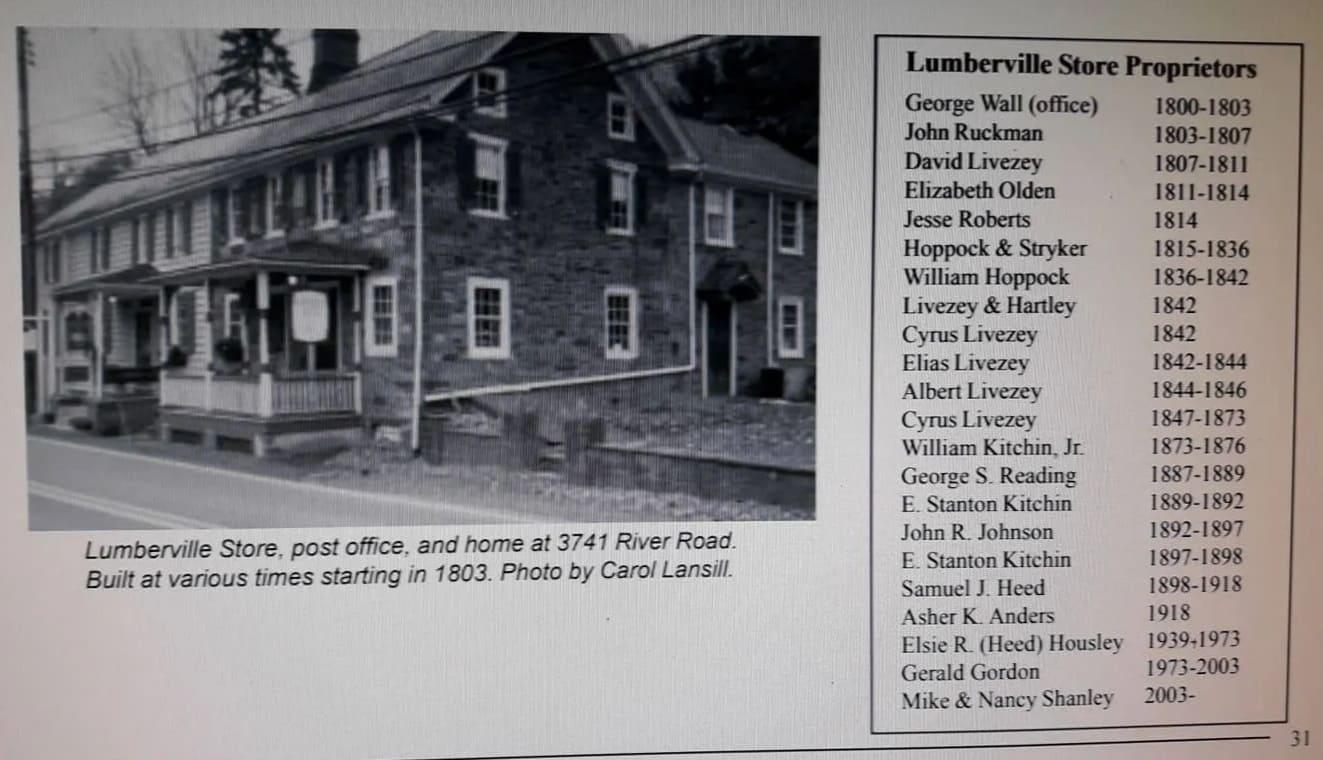
There were Housley people in Solebury Township and nearby communities from 1854 to at least 1973, perhaps 1985. George Housley immigrated in 1851, arriving in New York from London in July 1851 on the ship “Senator”. George was in Solebury by 1854, when he is listed on the tax roles for the Township He didn’t own land at that time. Housley family members mostly lived in the Lumberville area, a village in Solebury, or in nearby Buckingham or Wrightstown. The second wife of Howard (aka Harry) Housley was Elsa (aka Elsie) R. Heed, the daughter of the Lumberville Postmaster. Elsie was the proprietor of the Lumberville General Store from 1939 to 1973, and may have continued to live in Lumberville until her death in 1985. The Lumberville General Store was, and still is, a focal point of the community. The store was also the official Post Office at one time, hence the connection between Elsie’s father as Postmaster, and Elsie herself as the proprietor of the store. The Post Office function at Lumberville has been reduced now to a bank of cluster mailboxes, and official U.S. Postal functions are now in Point Pleasant, PA a few miles north of Lumberville.
We’ve attached a pdf of the Housley people buried in Carversville Cemetery, which is in the town next to Lumberville, and is still in Solebury Township. We hope this list will confirm that these are your relatives.It doesn’t seem that any Housley people still live in the area. Some of George’s descendents moved to Wilkes-Barre, PA and Flemington, NJ. One descendent, Barbara Housley, lived in nearby Doylestown, PA, which is the county seat for Bucks County. She actually visited Solebury Township Historical Society looking for Housley relatives, and it would have been nice to connect you with her. Unfortunately she died in 2018. Her obituary is attached in case you want to follow up with the nieces and great nieces who are listed.
Lumberville General Store, Pennsylvania, Elsie Housley:
I noticed the name of Barbara’s brother Howard Housley in her obituary, and found him on facebook. I knew it was the right Howard Housley as I recognized Barbara’s photograph in his friends list as the same photo in the obituary. Howard didn’t reply initially to a friend request from a stranger, so I found his daughter Laura on facebook and sent her a message. She replied, spoke to her father, and we exchanged email addresses and were able to start a correspondence. I simply could not believe my luck when Howard sent me a 17 page file of Barbara’s Narrative on the Letters with numerous letter excerpts interspersed with her own research compiled on a six month trip to England.
The letters were written to George between 1851 and the 1870s, from the Housley family in Smalley.
Narrative of Historic Letters ~ Barbara Housley.
AND BELIEVE ME EVER MY DEAR BROTHER, YOUR AFFECTIONATE FAMILY
In February 1991, I took a picture of my 16 month old niece Laura Ann Housley standing near the tombstones of her great-great-great-grandparents, George and Sarah Ann Hill Housley. The occassion was the funeral of another Sarah Housley, Sarah Lord Housley, wife of Albert Kilmer Housley, youngest son of John Eley Housley (George and Sarah Ann’s first born). Laura Ann’s great-grandfather (my grandfather) was another George, John Eley’s first born. It was Aunt Sarah who brought my mother, Lois, a packet of papers which she had found in the attic. Mom spent hours transcribing the letters which had been written first horizontally and then vertically to save paper. What began to emerge was a priceless glimpse into the lives and concerns of Housleys who lived and died over a century ago. All of the letters ended with the phrase “And believe me ever my dear brother, your affectionate….”
The greeting and opening remarks of each of the letters are included in a list below. The sentence structure and speech patterns have not been altered however spelling and some punctuation has been corrected. Some typical idiosyncrasies were: as for has, were for where and vice versa, no capitals at the beginnings of sentences, occasional commas and dashes but almost no periods. Emma appears to be the best educated of the three Housley letter-writers. Sister-in-law Harriet does not appear to be as well educated as any of the others. Since their mother did not write but apparently was in good health, it must be assumed that she could not.
The people discussed and described in the following pages are for the most part known to be the family and friends of the Housleys of Smalley, Derbyshire, England. However, practically every page brings conjectures about the significance of persons who are mentioned in the letters and information about persons whose names seem to be significant but who have not yet been established as actual members of the family.To say this was a priceless addition to the family research is an understatement. I have since, with Howard’s permission, sent the file to the Derby Records Office for their family history section. We are hoping that Howard will find the actual letters in among the boxes he has of his sisters belongings. Some of the letters mention photographs that were sent. Perhaps some will be found.
December 15, 2021 at 7:53 am #6234In reply to: The Elusive Samuel Housley and Other Family Stories
Ben Warren
Derby County and England football legend who died aged 37 penniless and ‘insane’
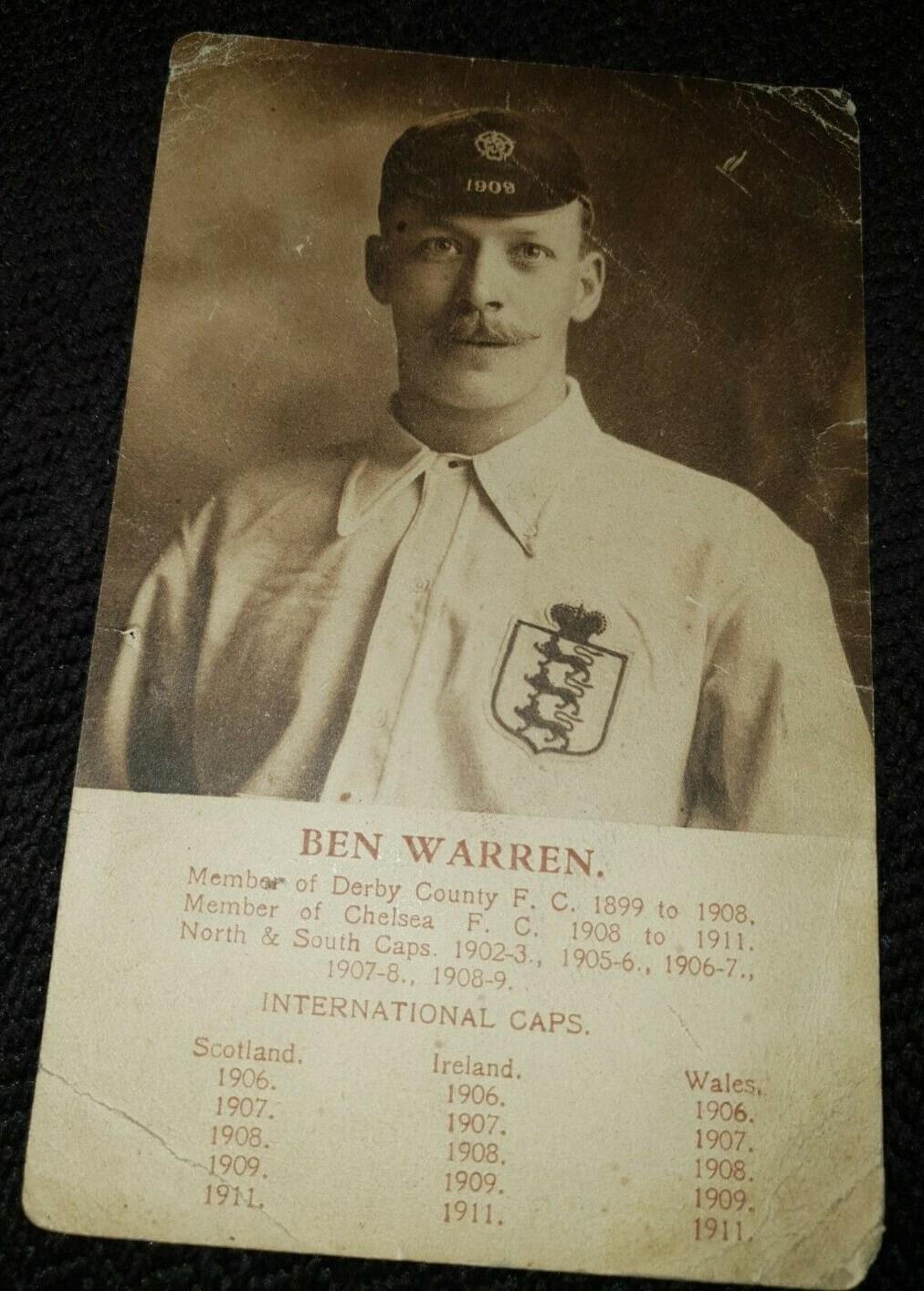
Ben Warren 1879 – 1917 was Samuel Warren’s (my great grandfather) cousin.
From the Derby Telegraph:
Just 17 months after earning his 22nd England cap, against Scotland at Everton on April 1, 1911, he was certified insane. What triggered his decline was no more than a knock on the knee while playing for Chelsea against Clapton Orient.
The knee would not heal and the longer he was out, the more he fretted about how he’d feed his wife and four children. In those days, if you didn’t play, there was no pay.
…..he had developed “brain fever” and this mild-mannered man had “become very strange and, at times, violent”. The coverage reflected his celebrity status.
On December 15, 1911, as Rick Glanvill records in his Official Biography of Chelsea FC: “He was admitted to a private clinic in Nottingham, suffering from acute mania, delusions that he was being poisoned and hallucinations of hearing and vision.”
He received another blow in February, 1912, when his mother, Emily, died. She had congestion of the lungs and caught influenza, her condition not helped, it was believed, by worrying about Ben.
She had good reason: her famous son would soon be admitted to the unfortunately named Derby County Lunatic Asylum.
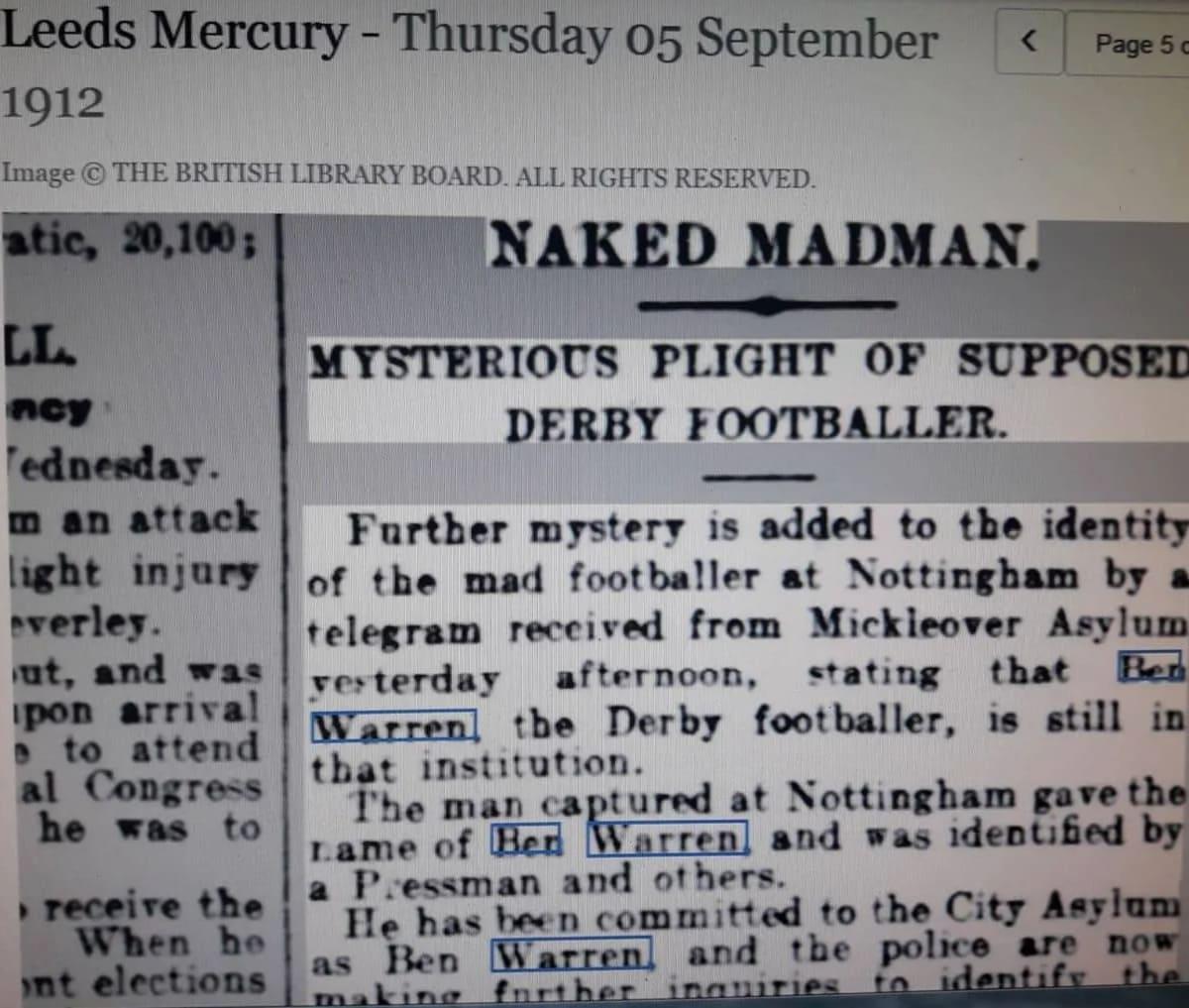
As Britain sleepwalked towards the First World War, Ben’s condition deteriorated. Glanvill writes: “His case notes from what would be a five-year stay, catalogue a devastating decline in which he is at various times described as incoherent, restless, destructive, ‘stuporose’ and ‘a danger to himself’.’”
photo: Football 27th April 1914. A souvenir programme for the testimonial game for Chelsea and England’s Ben Warren, (pictured) who had been declared insane and sent to a lunatic asylum. The game was a select XI for the North playing a select XI from The South proceeds going to Warren’s family.
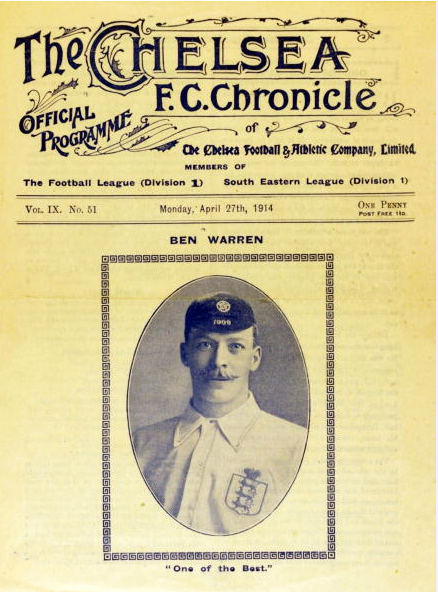
In September, that decline reached a new and pitiable low. The following is an abridged account of what The Courier called “an amazing incident” that took place on September 4.
“Spotted by a group of men while walking down Derby Road in Nottingham, a man was acting strangely, smoking a cigarette and had nothing on but a collar and tie.
“He jumped about the pavement and roadway, as though playing an imaginary game of football. When approached, he told them he was going to Trent Bridge to play in a match and had to be there by 3.30.”
Eventually he was taken to a police station and recognised by a reporter as England’s erstwhile right-half. What made the story even harder to digest was that Ben had escaped from the asylum and walked the 20 miles to Nottingham apparently unnoticed.
He had played at “Trent Bridge” many times – at least on Nottingham Forest’s adjacent City Ground.
As a shocked nation came to terms with the desperate plight of one of its finest footballers, some papers suggested his career was not yet over. And his relatives claimed that he had been suffering from nothing more than a severe nervous breakdown.
He would never be the same again – as a player or a man. He wasn’t even a shadow of the weird “footballer” who had walked 20 miles to Nottingham.
Then, he had nothing on, now he just had nothing – least of all self-respect. He ripped sheets into shreds and attempted suicide, saying: “I’m no use to anyone – and ought to be out of the way.”
“A year before his suicide attempt in 1916 the ominous symptom of ‘dry cough’ had been noted. Two months after it, in October 1916, the unmistakable signs of tuberculosis were noted and his enfeebled body rapidly succumbed.
At 11.30pm on 15 January 1917, international footballer Ben Warren was found dead by a night attendant.
He was 37 and when they buried him the records described him as a “pauper’.”
However you look at it, it is the salutary tale of a footballer worrying about money. And it began with a knock on the knee.
On 14th November 2021, Gill Castle posted on the Newhall and Swadlincote group:
I would like to thank Colin Smith and everyone who supported him in getting my great grandfather’s grave restored (Ben Warren who played for Derby, Chelsea and England)
The month before, Colin Smith posted:
My Ben Warren Journey is nearly complete.
It started two years ago when I was sent a family wedding photograph asking if I recognised anyone. My Great Great Grandmother was on there. But soon found out it was the wedding of Ben’s brother Robert to my 1st cousin twice removed, Eveline in 1910.
I researched Ben and his football career and found his resting place in St Johns Newhall, all overgrown and in a poor state with the large cross all broken off. I stood there and decided he needed to new memorial & headstone. He was our local hero, playing Internationally for England 22 times. He needs to be remembered.
After seeking family permission and Council approval, I had a quote from Art Stone Memorials, Burton on Trent to undertake the work. Fundraising then started and the memorial ordered.
Covid came along and slowed the process of getting materials etc. But we have eventually reached the final installation today.
I am deeply humbled for everyone who donated in January this year to support me and finally a massive thank you to everyone, local people, football supporters of Newhall, Derby County & Chelsea and football clubs for their donations.
Ben will now be remembered more easily when anyone walks through St Johns and see this beautiful memorial just off the pathway.
Finally a huge thank you for Art Stone Memorials Team in everything they have done from the first day I approached them. The team have worked endlessly on this project to provide this for Ben and his family as a lasting memorial. Thank you again Alex, Pat, Matt & Owen for everything. Means a lot to me.
The final chapter is when we have a dedication service at the grave side in a few weeks time,
Ben was born in The Thorntree Inn Newhall South Derbyshire and lived locally all his life.
He played local football for Swadlincote, Newhall Town and Newhall Swifts until Derby County signed Ben in May 1898. He made 242 appearances and scored 19 goals at Derby County.
28th July 1908 Chelsea won the bidding beating Leicester Fosse & Manchester City bids.
Ben also made 22 appearance’s for England including the 1908 First Overseas tour playing Austria twice, Hungary and Bohemia all in a week.
28 October 1911 Ben Injured his knee and never played football again
Ben is often compared with Steven Gerard for his style of play and team ethic in the modern era.
Herbert Chapman ( Player & Manager ) comments “ Warren was a human steam engine who played through 90 minutes with intimidating strength and speed”.
Charles Buchan comments “I am certain that a better half back could not be found, Part of the Best England X1 of all time”
Chelsea allowed Ben to live in Sunnyside Newhall, he used to run 5 miles every day round Bretby Park and had his own gym at home. He was compared to the likes of a Homing Pigeon, as he always came back to Newhall after his football matches.
Ben married Minnie Staley 21st October 1902 at Emmanuel Church Swadlincote and had four children, Harry, Lillian, Maurice & Grenville. Harry went on to be Manager at Coventry & Southend following his father in his own career as football Manager.
After Ben’s football career ended in 1911 his health deteriorated until his passing at Derby Pastures Hospital aged 37yrs
Ben’s youngest son, Grenville passed away 22nd May 1929 and is interred together in St John’s Newhall with his Father
His wife, Minnie’s ashes are also with Ben & Grenville.
Thank you again everyone.
RIP Ben Warren, our local Newhall Hero. You are remembered.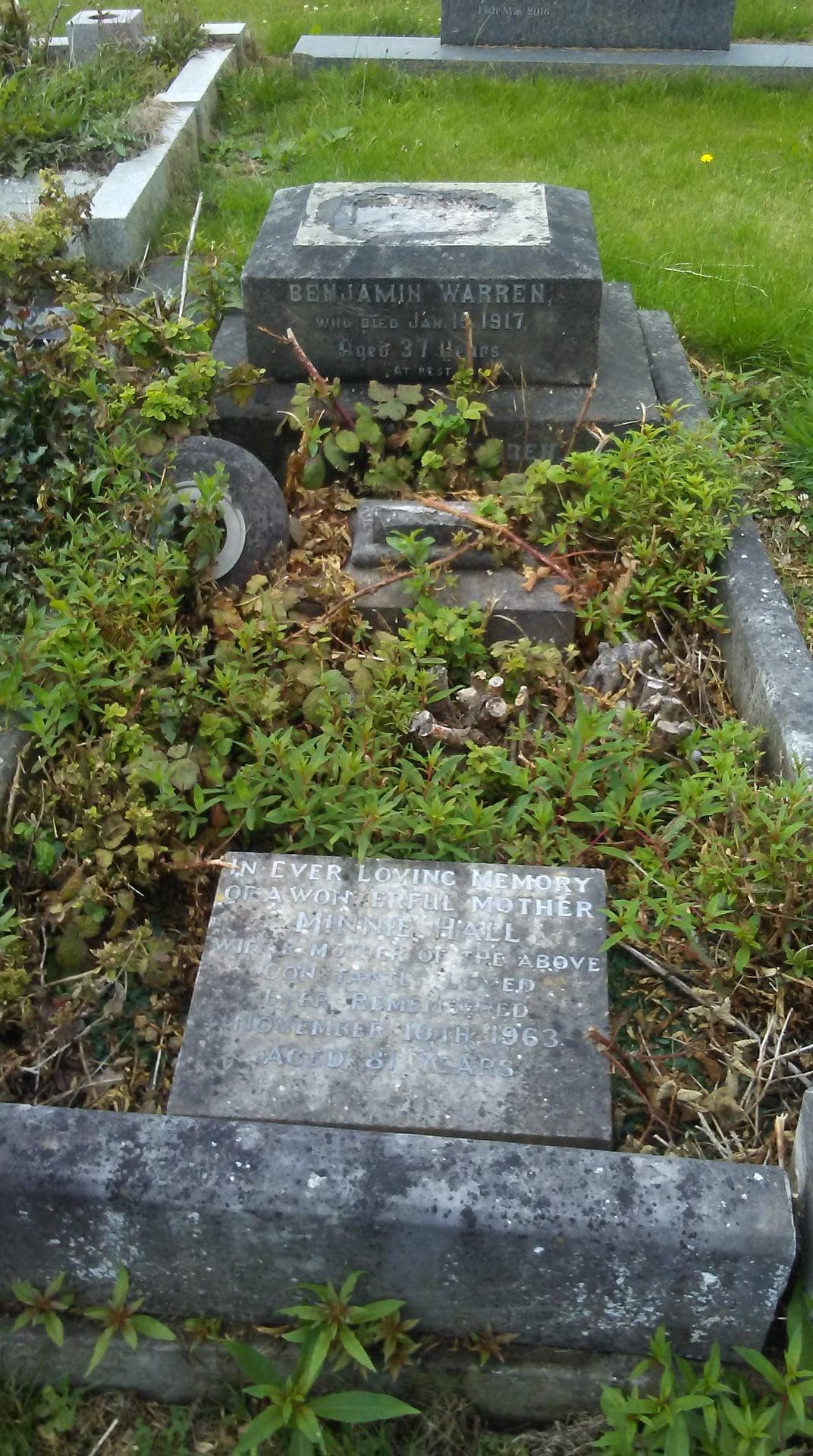
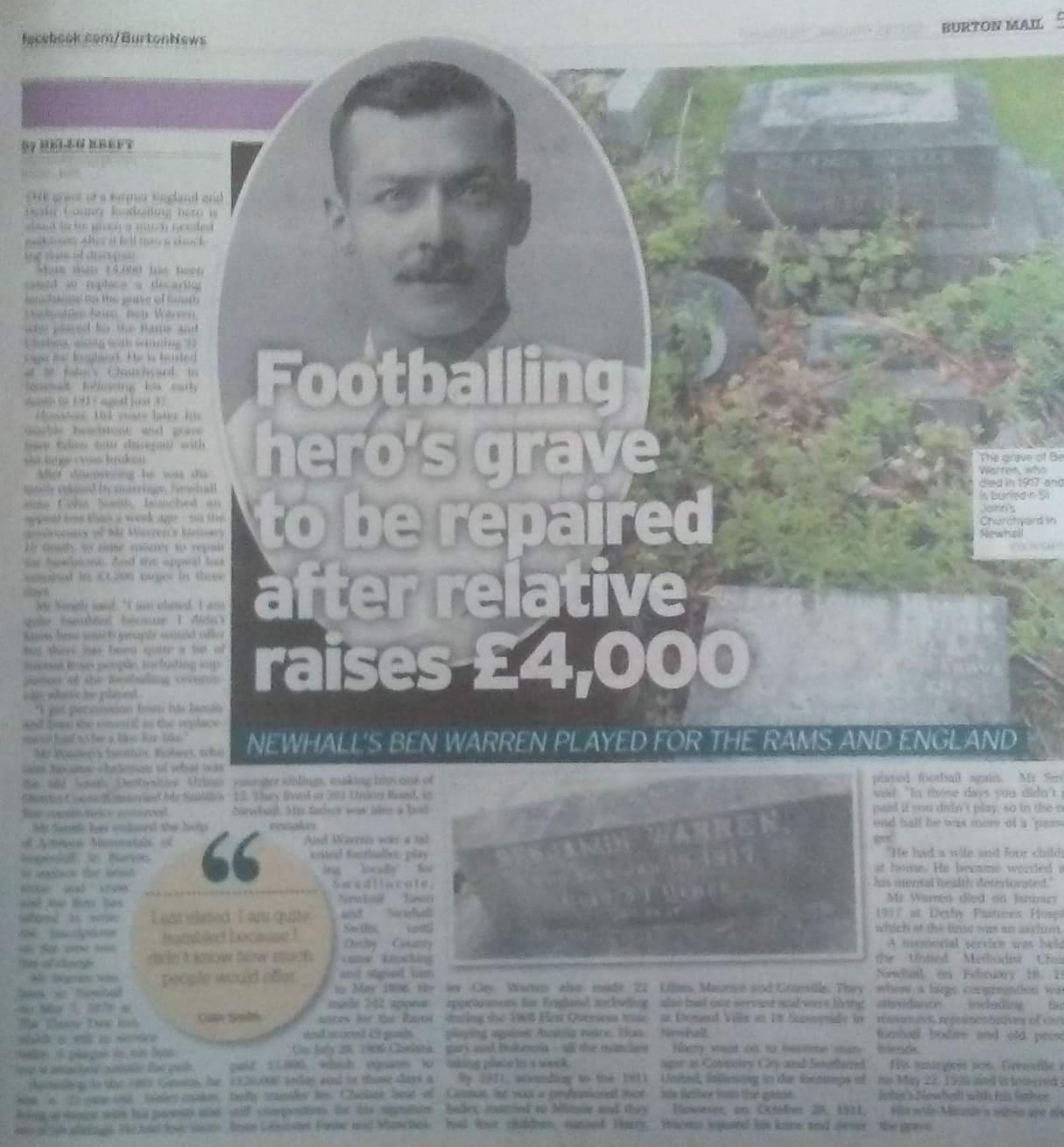
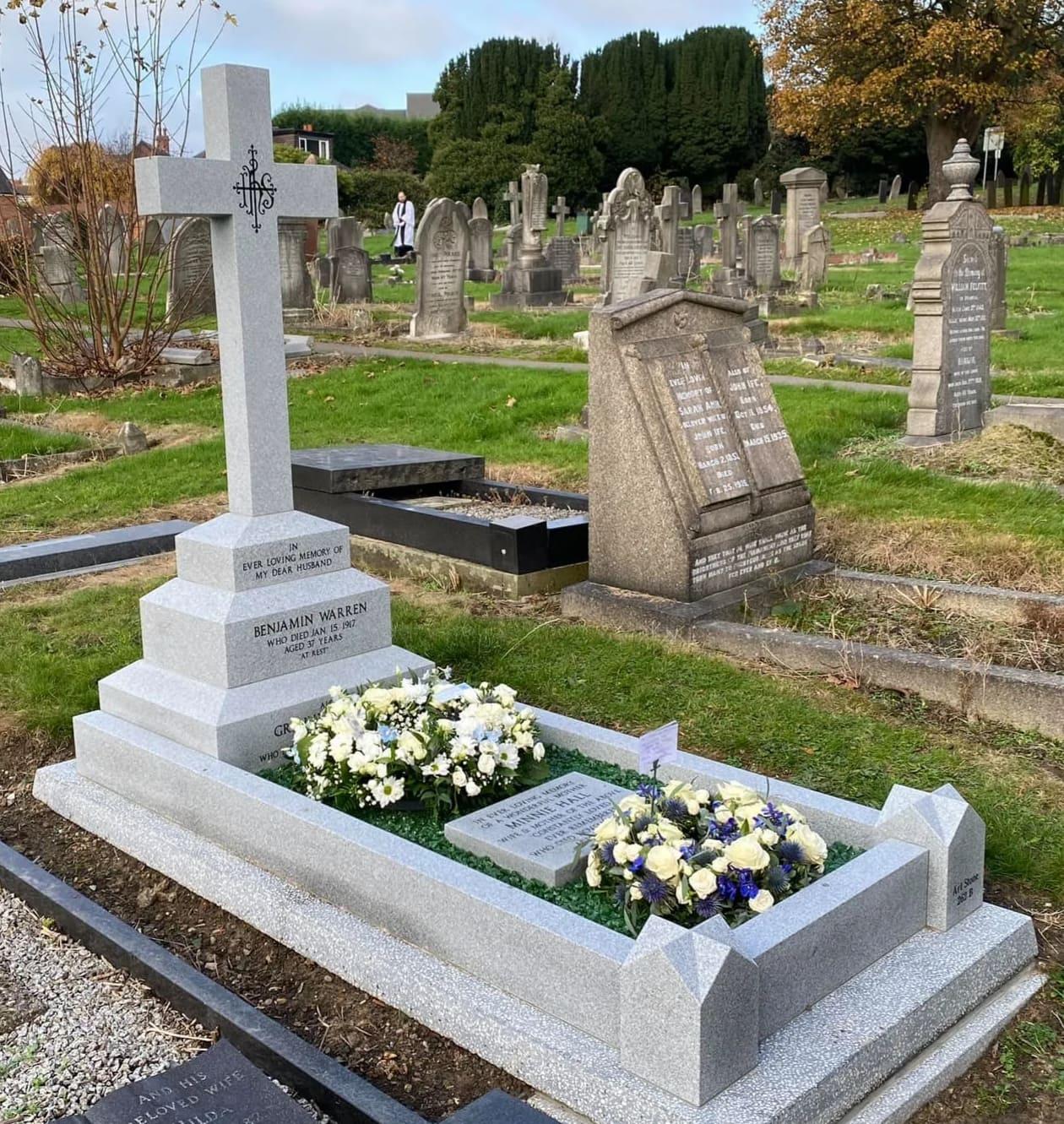 December 13, 2021 at 3:06 pm #6228
In reply to: The Elusive Samuel Housley and Other Family Stories
Francis Purdy: The Beggarlea Bulldog and Primitive Methodist Preacher
Francis Purdy was my great great grandfather. We did not know anything about the Primitive Methodists prior to this family research project, but my mother had another look through the family souvenirs and photographs and found a little book dated 1913, by William Purdy called: The History of The Primitive Methodists of Langley, Heanor, Derbyshire and District. Practical remarks on Sunday school work and a biography of the late Francis Purdy, an early local preacher. Printed by GC Brittain and sons. William Purdy was Francis son, and George’s brother.
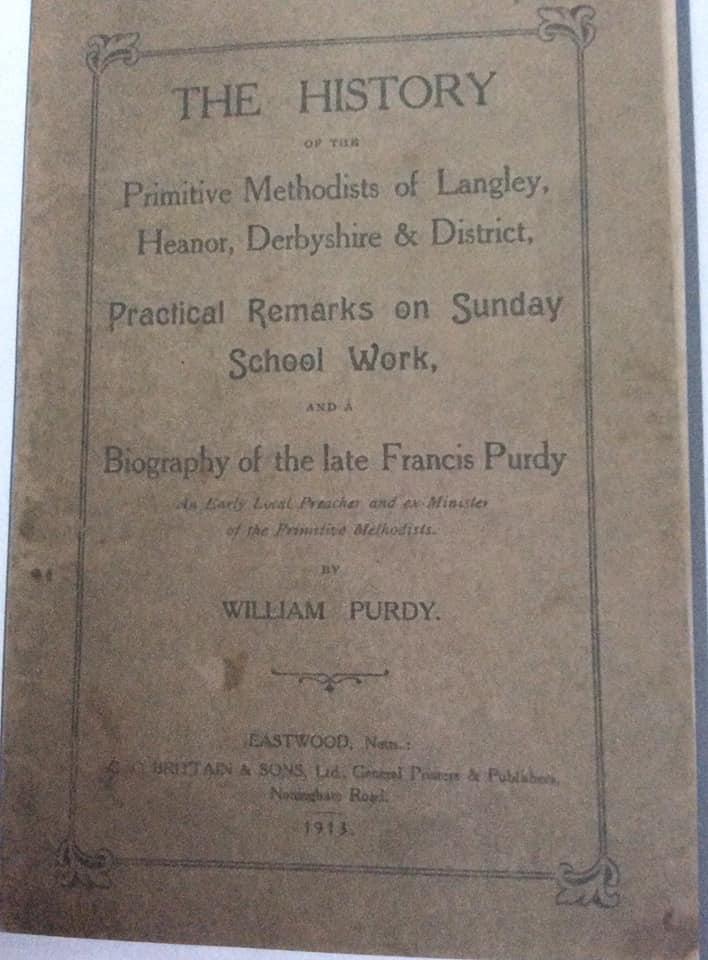
Francis Purdy:
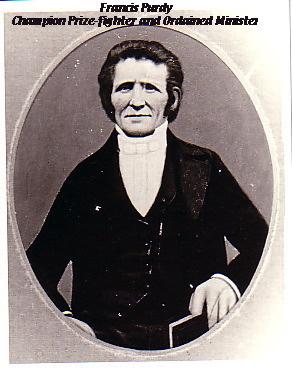
The following can be found online from various sources but I am unable to find the original source to credit with this information:
“In spite of having pious parents, Francis was a great prize-fighter and owner of champion dogs. He was known as the Beggarlee Bulldog, and fought many pitched battles. It was in 1823 that he fought on Nottingham Forest for the championship of three counties. After the fight going eleven rounds, which continued one hour and twenty minutes, he was declared victorious.”
The Primitive Methodists under the Rev Richard Whitechurch began a regular mission in Beggarlee. The locals tried to dismiss the Methodist “Ranters” by the use of intimidating tactics. Francis was prepared to release his fighting dogs during their prayer meeting, but became so interested in their faith that he instead joined them. The Methodist Church wrote: ”A strong feeling came over him, while his mates incited him to slip his dogs from the leads. He refused, and decided to return home. After concealing himself in a dyke, to listen to the Missioners on the following Sunday, he stole into the house of a Mrs Church, where a service was being held. Shortly after this, a society was formed with Francis Purdy as leader, and he was also the superintendent of the first Sunday School. After a short spell as local preacher at Beauvale, Tag Hill, Awsworth, Kimberly, Brinsley, etc., Mr Francis Purdy was ordained a minister by the Rev. Thomas King, of Nottingham, on the 17th December, 1827.”
December 13, 2021 at 11:29 am #6222In reply to: The Elusive Samuel Housley and Other Family Stories
George Gilman Rushby: The Cousin Who Went To Africa
The portrait of the woman has “mother of Catherine Housley, Smalley” written on the back, and one of the family photographs has “Francis Purdy” written on the back. My first internet search was “Catherine Housley Smalley Francis Purdy”. Easily found was the family tree of George (Mike) Rushby, on one of the genealogy websites. It seemed that it must be our family, but the African lion hunter seemed unlikely until my mother recalled her father had said that he had a cousin who went to Africa. I also noticed that the lion hunter’s middle name was Gilman ~ the name that Catherine Housley’s daughter ~ my great grandmother, Mary Ann Gilman Purdy ~ adopted, from her aunt and uncle who brought her up.
I tried to contact George (Mike) Rushby via the ancestry website, but got no reply. I searched for his name on Facebook and found a photo of a wildfire in a place called Wardell, in Australia, and he was credited with taking the photograph. A comment on the photo, which was a few years old, got no response, so I found a Wardell Community group on Facebook, and joined it. A very small place, population some 700 or so, and I had an immediate response on the group to my question. They knew Mike, exchanged messages, and we were able to start emailing. I was in the chair at the dentist having an exceptionally long canine root canal at the time that I got the message with his email address, and at that moment the song Down in Africa started playing.
Mike said it was clever of me to track him down which amused me, coming from the son of an elephant and lion hunter. He didn’t know why his father’s middle name was Gilman, and was not aware that Catherine Housley’s sister married a Gilman.
Mike Rushby kindly gave me permission to include his family history research in my book. This is the story of my grandfather George Marshall’s cousin. A detailed account of George Gilman Rushby’s years in Africa can be found in another chapter called From Tanganyika With Love; the letters Eleanor wrote to her family.
George Gilman Rushby:
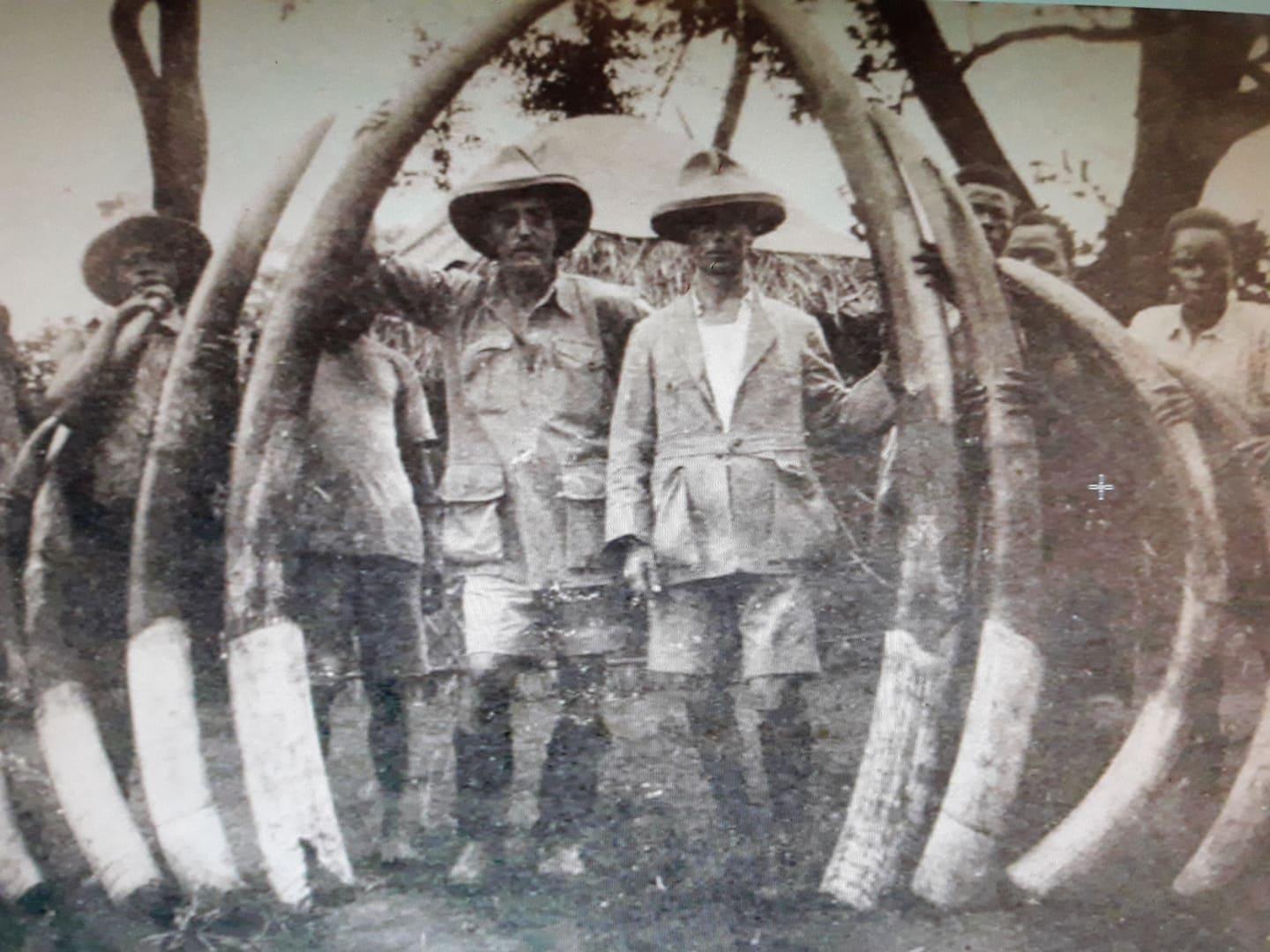
The story of George Gilman Rushby 1900-1969, as told by his son Mike:
George Gilman Rushby:
Elephant hunter,poacher, prospector, farmer, forestry officer, game ranger, husband to Eleanor, and father of 6 children who now live around the world.George Gilman Rushby was born in Nottingham on 28 Feb 1900 the son of Catherine Purdy and John Henry Payling Rushby. But John Henry died when his son was only one and a half years old, and George shunned his drunken bullying stepfather Frank Freer and was brought up by Gypsies who taught him how to fight and took him on regular poaching trips. His love of adventure and his ability to hunt were nurtured at an early stage of his life.
The family moved to Eastwood, where his mother Catherine owned and managed The Three Tuns Inn, but when his stepfather died in mysterious circumstances, his mother married a wealthy bookmaker named Gregory Simpson. He could afford to send George to Worksop College and to Rugby School. This was excellent schooling for George, but the boarding school environment, and the lack of a stable home life, contributed to his desire to go out in the world and do his own thing. When he finished school his first job was as a trainee electrician with Oaks & Co at Pye Bridge. He also worked part time as a motor cycle mechanic and as a professional boxer to raise the money for a voyage to South Africa.In May 1920 George arrived in Durban destitute and, like many others, living on the beach and dependant upon the Salvation Army for a daily meal. However he soon got work as an electrical mechanic, and after a couple of months had earned enough money to make the next move North. He went to Lourenco Marques where he was appointed shift engineer for the town’s power station. However he was still restless and left the comfort of Lourenco Marques for Beira in August 1921.
Beira was the start point of the new railway being built from the coast to Nyasaland. George became a professional hunter providing essential meat for the gangs of construction workers building the railway. He was a self employed contractor with his own support crew of African men and began to build up a satisfactory business. However, following an incident where he had to shoot and kill a man who attacked him with a spear in middle of the night whilst he was sleeping, George left the lower Zambezi and took a paddle steamer to Nyasaland (Malawi). On his arrival in Karongo he was encouraged to shoot elephant which had reached plague proportions in the area – wrecking African homes and crops, and threatening the lives of those who opposed them.
His next move was to travel by canoe the five hundred kilometre length of Lake Nyasa to Tanganyika, where he hunted for a while in the Lake Rukwa area, before walking through Northern Rhodesia (Zambia) to the Congo. Hunting his way he overachieved his quota of ivory resulting in his being charged with trespass, the confiscation of his rifles, and a fine of one thousand francs. He hunted his way through the Congo to Leopoldville then on to the Portuguese enclave, near the mouth of the mighty river, where he worked as a barman in a rough and tough bar until he received a message that his old friend Lumb had found gold at Lupa near Chunya. George set sail on the next boat for Antwerp in Belgium, then crossed to England and spent a few weeks with his family in Jacksdale before returning by sea to Dar es Salaam. Arriving at the gold fields he pegged his claim and almost immediately went down with blackwater fever – an illness that used to kill three out of four within a week.
When he recovered from his fever, George exchanged his gold lease for a double barrelled .577 elephant rifle and took out a special elephant control licence with the Tanganyika Government. He then headed for the Congo again and poached elephant in Northern Rhodesia from a base in the Congo. He was known by the Africans as “iNyathi”, or the Buffalo, because he was the most dangerous in the long grass. After a profitable hunting expedition in his favourite hunting ground of the Kilombera River he returned to the Congo via Dar es Salaam and Mombassa. He was after the Kabalo district elephant, but hunting was restricted, so he set up his base in The Central African Republic at a place called Obo on the Congo tributary named the M’bomu River. From there he could make poaching raids into the Congo and the Upper Nile regions of the Sudan. He hunted there for two and a half years. He seldom came across other Europeans; hunters kept their own districts and guarded their own territories. But they respected one another and he made good and lasting friendships with members of that small select band of adventurers.
Leaving for Europe via the Congo, George enjoyed a short holiday in Jacksdale with his mother. On his return trip to East Africa he met his future bride in Cape Town. She was 24 year old Eleanor Dunbar Leslie; a high school teacher and daughter of a magistrate who spent her spare time mountaineering, racing ocean yachts, and riding horses. After a whirlwind romance, they were betrothed within 36 hours.
On 25 July 1930 George landed back in Dar es Salaam. He went directly to the Mbeya district to find a home. For one hundred pounds he purchased the Waizneker’s farm on the banks of the Mntshewe Stream. Eleanor, who had been delayed due to her contract as a teacher, followed in November. Her ship docked in Dar es Salaam on 7 Nov 1930, and they were married that day. At Mchewe Estate, their newly acquired farm, they lived in a tent whilst George with some help built their first home – a lovely mud-brick cottage with a thatched roof. George and Eleanor set about developing a coffee plantation out of a bush block. It was a very happy time for them. There was no electricity, no radio, and no telephone. Newspapers came from London every two months. There were a couple of neighbours within twenty miles, but visitors were seldom seen. The farm was a haven for wild life including snakes, monkeys and leopards. Eleanor had to go South all the way to Capetown for the birth of her first child Ann, but with the onset of civilisation, their first son George was born at a new German Mission hospital that had opened in Mbeya.
Occasionally George had to leave the farm in Eleanor’s care whilst he went off hunting to make his living. Having run the coffee plantation for five years with considerable establishment costs and as yet no return, George reluctantly started taking paying clients on hunting safaris as a “white hunter”. This was an occupation George didn’t enjoy. but it brought him an income in the days when social security didn’t exist. Taking wealthy clients on hunting trips to kill animals for trophies and for pleasure didn’t amuse George who hunted for a business and for a way of life. When one of George’s trackers was killed by a leopard that had been wounded by a careless client, George was particularly upset.
The coffee plantation was approaching the time of its first harvest when it was suddenly attacked by plagues of borer beetles and ring barking snails. At the same time severe hail storms shredded the crop. The pressure of the need for an income forced George back to the Lupa gold fields. He was unlucky in his gold discoveries, but luck came in a different form when he was offered a job with the Forestry Department. The offer had been made in recognition of his initiation and management of Tanganyika’s rainbow trout project. George spent most of his short time with the Forestry Department encouraging the indigenous people to conserve their native forests.In November 1938 he transferred to the Game Department as Ranger for the Eastern Province of Tanganyika, and over several years was based at Nzasa near Dar es Salaam, at the old German town of Morogoro, and at lovely Lyamungu on the slopes of Kilimanjaro. Then the call came for him to be transferred to Mbeya in the Southern Province for there was a serious problem in the Njombe district, and George was selected by the Department as the only man who could possibly fix the problem.
Over a period of several years, people were being attacked and killed by marauding man-eating lions. In the Wagingombe area alone 230 people were listed as having been killed. In the Njombe district, which covered an area about 200 km by 300 km some 1500 people had been killed. Not only was the rural population being decimated, but the morale of the survivors was so low, that many of them believed that the lions were not real. Many thought that evil witch doctors were controlling the lions, or that lion-men were changing form to kill their enemies. Indeed some wichdoctors took advantage of the disarray to settle scores and to kill for reward.
By hunting down and killing the man-eaters, and by showing the flesh and blood to the doubting tribes people, George was able to instil some confidence into the villagers. However the Africans attributed the return of peace and safety, not to the efforts of George Rushby, but to the reinstallation of their deposed chief Matamula Mangera who had previously been stood down for corruption. It was Matamula , in their eyes, who had called off the lions.
Soon after this adventure, George was appointed Deputy Game Warden for Tanganyika, and was based in Arusha. He retired in 1956 to the Njombe district where he developed a coffee plantation, and was one of the first in Tanganyika to plant tea as a major crop. However he sensed a swing in the political fortunes of his beloved Tanganyika, and so sold the plantation and settled in a cottage high on a hill overlooking the Navel Base at Simonstown in the Cape. It was whilst he was there that TV Bulpin wrote his biography “The Hunter is Death” and George wrote his book “No More The Tusker”. He died in the Cape, and his youngest son Henry scattered his ashes at the Southern most tip of Africa where the currents of the Atlantic and Indian Oceans meet .
George Gilman Rushby:
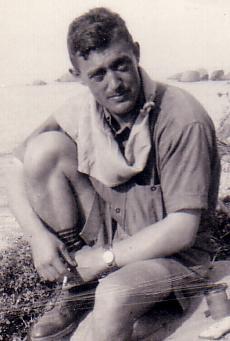 April 24, 2021 at 8:02 pm #6193
In reply to: The Whale’s Diaries Collection
I hope all this social media as they call it stands the test of time because little things like this are priceless and so few and far between, and someday someone wants to know a little thing like this to paint a picture in their mind. I don’t know if this is one of ours as they say but but he was there too and could even have been one of you or another one of me, the possibilities are endless and the charm of the random snippet is boundless.
“The gallery stairs were honeycombed on
each side by old Jonathan Beniston’s spiked
crutches, and although Jonathan could not
read, he considered himself a valuable
addition to the choir, contributing a sort of
drone bass accompaniment to the melodies. after the style of a bagpipe ” chanter.”Here’s another one I want to include in my book:
Mr. Joseph Moss, formerly a framework knitter of Woodhouse Lane, for several years kept a Diary of the principal events and incidents in the locality: a most commendable undertaking. It is much to be regretted that so few attempt anything of the kind, so useful, and always interest- ing. Besides the registration of marriages and funerals, we have notices of storms, removals, accidents, sales, robberies, police captures, festivities, re-openings of churches, and many other matters. His record begins in 1855, ^^d ends in 1881, Mr. Moss was a violinist of some ability, and was in great demand at all rural festivities. He was a good singer, and sang (inter alia) ” The Beggar’s Ramble ” with his own local variations^ in good style, and usually with much eclat. The following are a few extracts from his Diary : —
” — July. Restoration of Horsley Church. New weathercock placed on spire by Charles, son of Mr. Anthony Kerry, the builder, on the 31st. A few days later, the south arches of the nave fell down, bringing with it the roofs of nave and south aisle. The pillar next the tower had been under- mined by the making of a grave, and as soon as the gravestone over it was moved the column began to settle : a loud shout was made, and the workmen had only just time to scamper out of the building before the roof and top windows and all came down.”
January 5, 2021 at 9:03 pm #6175In reply to: Twists and One Return From the Time Capsule
“”Sorry, I’m only just telling you this about the note now, lovie. Your Grandma’s been on at me to tell you. Just in my thoughts I mean!” he added quickly.
Jane smirked and tapped her forehead. “Careful, Old Man. She’ll think you’ve completely lost it!”
Clara stared at him, a small frown creasing her brow. “So, the note said you were to call him?”
Bob nodded uneasily. Clara had that look on her face. The one that means she aren’t happy with the way things are proceeding.
“And then what?” asked Clara slowly.
“I dunno.” Bob shrugged. “Guess they’d bury it again? They was pretty clear they didn’t want it found. Now, how about I put the kettle on?” Bob stood quickly and began to busy himself filling the jug with water from the tap.
Clara shook her head firmly. “No.”
“No to a cup of tea?”
“No we can’t call this man.”
“I don’t know Clara. It’s getting odd it is. Strangers leaving maps in collars and whatnot. It’s not right.”
“Well, I agree it needs further investigation. But we can’t call him … not without knowing why and what’s in it.” She tapped her fingers on the table. “I’ll try and get hold of Nora again.”
December 18, 2020 at 9:23 pm #6166In reply to: Twists and One Return From the Time Capsule
“Grandpa,” Clara said, partly to distract him ~ poor dear was looking a little anxious ~ and partly because she was starting to get twangs of gilt about Nora, “Grandpa, do you remember that guy who used to make sculptures? I can’t recall his name and need his phone number. Do you remember, used to see him driving around with gargoyles in the back of his truck. You look awfully pale, are you alright?”
“No idea,” Bob replied weakly.
Tell her! said Jane.
“No!” Bob exclaimed, feeling vexed. He wasn’t sure why, but he didn’t want to rush into anything. Why was Clara asking about the man whose phone number was on the note? What did she know about all this? What did he, Bob, know for that matter!
“I only asked!” replied Clara, then seeing his face, patted his arm gently and said “It’s ok, Grandpa.”
For the love of god will you just tell her!
“Tell who what?” asked Clara.
“What! What did you say?” Bob wondered where this was going and if it would ever end. It began to feel surreal.
They were both relieved when the door bell rang, shattering the unaccustomed tension between them.
“Who can that be?” they asked in unison, as Clara rose from the table.
Bob waited expectantly, pushing his plate away. It would take days to settle his digestive system down after all this upset at a meal time.
“You look like you’ve just seen a ghost, Clara! Who was it?” Bob said as Clara returned from the front door. “Not the water board again to cut us off I hope!”
“It’s the neighbour, Mr Willets, he says he’s ever so sorry but his dogs, they got loose and got into some kind of a box on your property. He said…”
July 29, 2019 at 1:46 pm #4730In reply to: Seven Twines and the Dragon Heartwoods
The vegetable garden was luxurious and greener after the rain. The trees were trembling with delight in the light afternoon breeze.
Rukshan found Fox seated upright and legs crossed in between the courgettes and the purple cabbages. His eyes were closed and he didn’t flinch when the Fae approached.
“Are you meditating?” asked Rukshan who wanted to get going on the mission already.
“Kinda,” answered Fox without opening his eyes. “I’m using my imagination as a creative tool in order to make the carpenter show up and finish his work.” He breathed in deep and exhaled a humming sound.
“I think you’re mistaken. It’s not about making the other do what you want.”Fox opened his eyes. “Don’t tell me what to do,” said Fox feeling a tad tense. “It’s a technique transmitted to me by Master Gibbon.”
“I’m just saying…” began the Fae.
“Oh! You’re happy, I can’t meditate now I’m too tense,” Fox bursted out.
“I guess if you got tense that easily, you weren’t that relaxed in the first place.”Fox got up and squished a courgette. That seemed to put him into even more anger, but Rukshan couldn’t help laughing and Fox couldn’t keep angry very long. He walked on another courgette and laughed.
“I don’t like courgettes,” he said.
“I know. Glynis will not be very happy though if you crush all the vegetables.”
“Yeah. You’re certainly right. When are we leaving?”
“Mr Minn’s nephew, who’s a carpenter, was just visiting in the city and Margoritt asked them if they could help with the carpentry. You know how Mr Minn can’t resist her charms. They have collected the material from the other carpenter and they are coming tomorrow to finish the work. So we’ll be ready to go. I just have to convince Glynis to let Olli come with us.”
“Margoritt is coming back?”
“No. She’ll stay in the city. You know, her knees… and her sister being at the cottage.”
“Oh! I had forgotten about her,” said Fox raising his eyes to the sky.July 29, 2019 at 1:24 pm #4729In reply to: Pop﹡in People Tribulations
The room was not oversized and not to bright despite facing south. It had the oddest strange decor Shawn Paul would have expected from that place. It seemed to come right out of a Victorian movie with the heavy furniture that took all the space in the room and the dark and overloaded wallpaper that sucked up the light coming through the velvet curtains.
Shawn Paul sneezed. It didn’t as much feel dirty as it felt old like his grand parent’s house. He wondered how often the Inn’s staff cleaned the room. He had to move his luggage in order to open the window to get some fresh air. It was so hot and dry. There was a drug store on the other side of the dusty road and a strange man was looking at him. A feeble wind brought in some red dust and Shawn Paul sneezed again, reducing the little enthusiasm he could have had left to nothing. He imagined his clothes covered with red dust and quickly closed the window. As the man was still looking Shawn Paul shut the velvet curtain, suddenly plunging the room into darkness.
His fear of insects crept out. He had no idea where the light was so he reopened the curtain a bit.
He then checked thoroughly under the pillows, the bedcover and the bedsheet, behind the chairs and in the wardrobe. Australia was know for having the most venomous creatures and he didn’t want to have a bad surprise. He looked suspiciously at a midge flying around not knowing if it was even safe to kill it. Shawn Paul had never been the courageous type and he began to wonder why on earth he had accepted that trip. He had never traveled out of Canada before.
Needing some comfort, he looked frantically into his backpack for the granola cookies he had brought with him. With the temperature the chocolate chip had melted and he wondered at how to eat a cookie without dirtying his hands.
Someone knocked at the door making him jump with guilt like when he was a kid at his grand parents’ and would eat all the cookies in his bedroom without sharing with his cousins.
“Lunch is served,” a woman’s voice said from the other side.
Shawn Paul remembered having said with Maeve they would meet at lunchtime so he closed his luggage with an extra padlock and made sure his door was safely locked too before going downstairs.
Anxiety rushed in when he saw all the people that were already seated at the only table in the lunch room. He might have gone back to his room if Maeve hadn’t come from behind him.
“Let’s go have a seat.”
He read between the lines what he was thinking himself: Don’t leave me alone. Whether it was truly what she had meant was not important.
July 18, 2019 at 2:16 am #4689In reply to: Newsreel from the Rim of the Realm
“So, ‘ow we going to find ‘im then, Glor?” asked Sharon, taking a slurp of thick muddy-looking tea. “Ow! That’s too bloody hot. I’m going to ‘ave another word with the Matron about that Nurse, I am.”
“You do that, Sha. Nurse Trassie wasn’t it?”
Sharon nodded and pursed her lips tightly. “Bloody uppity tart. We bloody pay enough to be ‘ere, I reckon. They should get the tea bloody right.” Her eyes narrowed menacingly. “ Anyway, she’ll keep. So,‘ow we going to find ‘im then, Glor?”
“Whose that then, Shar? Oh, you mean the doctor who does the beauty treatments? I’d forget my bloody ‘ead if it weren’t screwed on, wouldn I!”
Gloria scratched her head vigorously, perhaps checking it was still there, before taking a moment to examine her fingernails.
“Wot’d Mavis say then?” she asked at last. “When you did that texting thing to ‘er?”
“‘Ere let me find my phone and I’ll read it out loud to you. Oh, blimey, ‘ave you seen my glasses, Glor?”
Gloria’s generous curves wobbled and gyrated as she convulsed into fits of laughter.
“They’re on yer bloody ‘ead!” she said pointing and gasping for breath. “Oh, I nearly peeed myself, ya blimmen muppet!”
“Thanks, Glor. Wot I’d do without you, I don’t bloody know. Don’t mean to make you pee yerself though. It’s ‘ard enough getting them nurses to give out them extra thick pantyliners. Blimmin uppity tarts. Expecially that Nurse Trassie. Anyway, she’ll keep.”
Sharon peered at her phone. “Mavis says: Wot a bloody brainwave! I need a makeover for my new fella!!’ LOL! “ She frowned. “Wot’s that word mean, LOL, Glor?”
“Oh, it’s text talk. The younguns talk like that now and our Mavis always did like to keep up with trends. Lots of lust it means. That saucy cow!”
“She always was a saucy one that, Mavis! Look at us stuck in ‘ere and ‘er with a new fella. Lucky sod. Maybe after our beauty treatment, we might get us a new fella too.”
“I don’t know ‘ow we’re going to track down the Doctor though, Shar. I don’t know ‘ow we’re going to track him down when we’re stuck in this bleedin’ ‘ole.” Gloria shoulders shook and she began to sob loudly.
“There, there, Glor. Don’t cry,” said Sharon, rubbing her friend’s back. “They’ll put you on more bloody pills if you cry. Oh! I know wot will cheer you up!”
“Wot’s that then,” asked Gloria, sniffing loudly into her hanky.
“I’ve ‘ad one of my bloody brainwaves!”
“I knew you would, Shar! You’ve always ‘ad brains. I’m all agog!”
“We’ll get Mavis to go to the papers! Put in an advert to find ‘im!”
“You’re a blimmin genius, you are, Shar!”
June 27, 2019 at 12:40 pm #4612In reply to: Eight Turns of the Wheel
Albie looked at the cat with a puzzled look. “What did the Witch mean when she said Arona was hiding in yarn from the past?”
Mandrake yawned and moved his paw swiftly on his left ear. “You haven’t paid close attention to the rhyme, have you?”
Deep in the maze of threads of past
She hides and fails to cast
A spell to help her float and ghast
Moribund characters trapped there lastAlbie found the roaring voice of the black cat smooth like a roll of pebbles in a cataract, and felt mesmerized by the words so much he couldn’t focus his attention.
“Sounds like she’s trying to help ghosts or something?”
Mandrake shrugged “… or something.”
He took one of the few pearls left, and started to work a vortex to go where it began. His earliest memory of her. Something to do with that cunning and crafty dragon… Clues were hiding in that moment he was sure. At the very least, the dragon would help power back the sabulmantium for the tracking spell…
January 28, 2019 at 6:45 am #4573In reply to: The Precious Life and Rambles of Liz Tattler
Liz gave Finnley a withering look, but the insubordinate wench wasn’t looking.
“A job? have you lost your marbles? Can’t you see how busy I am? Can’t you see the value in everything that I do? It’s not about JOBS you daft tart! Are we ever going to move on from JOBS and JOBS and JOBS…” Liz started slamming her hand down on the arm of her chair.
“Steady on, old bean,” said Finnley as Liz began to sob.
December 11, 2018 at 7:21 am #4566In reply to: Seven Twines and the Dragon Heartwoods
A strong and loud guttural roar echoed through the mountains, ferocious and hungry. Fox’s hairs stood on his arms and neck as a wave of panic rolled through his body. He looked at the others his eyes wide open.
Olliver teleported closer to Rukshan whose face seemed pale despite the warmth of the fire, and Lhamom’s jaw dropped open. Their eyes met and they swallowed in unison. “Is that…” asked Fox. His voice had been so low that he wasn’t sure someone had heard him. Rukshan nodded.“It seems you are leaving the mountains sooner than you expected,” said Kumihimo with a jolly smile as she dismounted Ronaldo. She plucked her icy lyre from which loud and rich harmonics bounced. The wind carried them along and they echoed back in defiance to the Shadow.
You must remember, seemed to whisper an echo from the cave they had used for shelter for weeks. Fox dismissed it as induced by the imminent danger.
The Shadow hissed and shrieked, clearly pissed off. The dogs howled and Kumihimo engaged in a wild and powerful rhythm on her instrument.
You must remember, said the echo again.
Everobody stood and ran in chaos, except for Fox. He was getting confused, as if under a bad spell.
Someone tried to cover the fire with a blanket of wool. “Don’t bother, we’re leaving,” said Rukshan before rushing toward the multicolour sand mandala he had made earlier that day. Accompanied by the witche’s mad arpeggios, he began chanting. The sand glowed faintly.
Lhamom told them to jump on the hellishcopter whose carpet was slowly turning in a clockwise direction. “But I want to help,” said Olliver. “You’ll help best by being ready to leave as soon as the portal opens,” said Lhamom. She didn’t wait to see if the boy followed her order and went to help Rukshan with her old magic spoon.
“Something’s wrong. I’ve already lived that part,” said Fox when the screen protecting the mandala flapped away, missing the fae’s head by a hair.
“What?” asked Olliver.
“It already happened once,” said Fox, “although I have a feeling it was a bit different. But I can’t figure out how or why.”At that moment a crow popped out of the cave’s mouth in a loud bang. The cave seemed to rebound in and out of itself for a moment, and the dark bird cawed, very pleased. It reminded Fox at once of what had happened the previous time, the pain of discovering all his friends dead and the forest burnt to the ground by the shadow. The blindness, and the despair.
The crow cawed and Fox felt the intense powers at work and the delicate balance they were all in.The Shadow had grown bigger and threatened to engulf the night. Fox had no idea what to do, but instead he let his instinct guide him.
“Come!” he shouted, pulling Olliver by the arm. He jumped on the hellishcopter and helped the boy climb after him.
“COME NOW!” he shouted louder. Rukshan and Lhamom looked at the hellishcopter and at the devouring shadow that had engulfed the night into chaos and madness.
They ran. Jumped on the carpet. Kumihimo threw an ice flute to them and Fox caught it, but this time he didn’t nod. He knew now what he had to do.“You’ll have one note!” the shaman shouted. “One note to destroy the Shadow when you arrive!” Kumihimo hit the hellishcopter as if it were a horse, and it bounced forward.
But Fox, aware of what would have come next, kept a tight rein on the hellishcarpet and turned to Olliver.
“Go get her! We need her on the other side.”
Despite the horror of the moment, the boy seemed pleased to be part of the action and he quickly disappeared. The shaman looked surprised when the boy popped in on her left and seized her arm only to bring her back on the carpet in the blink of an eye.“By the God Frey,” she said looking at a red mark on her limb, “the boy almost carved his hand on my skin.”
“Sorry if we’re being rude,” said Fox, “but we need you on the other side. It didn’t work the first time. If you don’t believe me, ask the crow.”
The bird landed on the shaman’s shoulder and cawed. “Oh,” said Kumihimo who liked some change in the scenario. “In that case you’d better hold tight.”They all clung to each other and she whistled loudly.
The hellishcopter bounced ahead through the portal like a wild horse, promptly followed by Ronaldo and the Shadow.
The wind stopped.
The dogs closed in on the portal and jumped to go through, but they only hit the wall of the powerful sound wave of Kumihimo’s ice lyra.
They howled in pain as the portal closed, denying them their hunt.November 2, 2018 at 10:33 am #4549In reply to: Seven Twines and the Dragon Heartwoods
A deep guttural roar echoed through the mountains, ferocious and hungry.
Fox’s hairs stood on his arms and neck as a wave of panic rolled through his body. He looked at the other his eyes wide open.
Olliver had teleported closer to Rukshan whose face seemed pale despite the warmth of the fire, and Lhamom’s jaw had dropped open. Their eyes met and they swallowed in unison.
“Is that…” asked Fox. His voice had been so low that he wasn’t sure someone had heard him.
Rukshan nodded.“It seems you are leaving the mountains sooner than you expected,” said Kumihimo with a jolly smile as she dismounted Ronaldo.
She plucked her icy lyre from which loud and rich harmonics bounced. The wind carried them along and they echoed back in defiance to the Shadow. It hissed and hurled back, clearly pissed off. The dogs howled and Kumihimo started to play a wild and powerful rhythm on her instrument.
It shook the group awake from their trance of terror. Everobody stood and ran in chaos.
Someone tried to cover the fire.
“Don’t bother, we’re leaving,” said Rukshan, and he himself rushed toward the multicolour sand mandala he had made earlier that day. Accompanied by the witche’s mad arpeggios, he began chanting. The sand glowed faintly. It needed something more for the magic to take the relay. Something resisted. There was a strong gush of wind and Rukshan bent forward just in time as the screen and bamboo poles flew above his head. His chanting held the sands together, but they needed to act quickly.Lhamom told the others to jump on the hellishcopter whose carpet was slowly turning in a clockwise direction. Fox didn’t wait to be told twice but Olliver stood his ground.
“But I want to help,” he said.
“You’ll help best by being ready to leave as soon as the portal opens,” said Lhamom. Not checking if the boy was following her order, she went to her messenger bag and foraged for the bottle of holy snot. On her way to the mandala, she picked the magic spoon from the steaming cauldron of stew, leaving a path of thick dark stains in the snow.Lhamom stopped beside Rukshan who had rivulets of sweat flowing on his face and his coat fluttering wildly in the angry wind. He’s barely holding the sands together, she thought. She didn’t like being rushed, it made her act mindlessly. She opened the holy snot bottle and was about to pour it in the spoon covered in sauce, but she saw Rukshan’s frown of horror. She realised the red sauce might have unforgivable influence on the portal spell. She felt a nudge on her right arm, it was Ronaldo. Lhamom didn’t think twice and held the spoon for him to lick.
“Enjoy yourself!” she said. If the sauce’s not good, what about donkey saliva? she wondered, her inner voice sounding a tad hysterical. But it was not a time for meditation. She poured the holy snot in the relatively clean spoon, pronounced the spell the Lama had told her in the ancient tongue and prayed it all worked out as she poured it in the center of the mandala.
As soon as it touched the sand, they combined together in a glossy resin. The texture spread quickly to all the mandala and a dark line appeared above it. The portal teared open. Rukshan continued to chant until it was big enough to allow the hellishcopter through.“COME NOW!” shouted Fox.
Rukshan and Lhamom looked at the hellishcopter, behind it an immense shadow had engulfed the night. It was different from the darkness of the portal that was full of potential and probabilities and energy. The Shadow was chaotic and mad and light was absent from it. It was spreading fast and Lhamom felt panic overwhelm her.They ran. Jumped on the carpet. Kumihimo threw an ice flute to them and Fox caught it not knowing what to do with it.
“You’ll have one note!” the shaman shouted. “One note to destroy the Shadow when you arrive!”
Fox nodded unable to speak. His heart was frozen by the dark presence.
Kumihimo hit the hellishcopter as if it were a horse, and it bounced forward. The shaman looked at them disappear through the tear, soon followed by the shadow.
The wind stopped. Kumihimo heard the dogs approaching. They too wanted to go through. But before they could do so, Kumihimo closed the portal with a last chord that made her lyre explode.The dogs growled menacingly, frustrated they had been denied their hunt.
They closed in slowly on Kumihimo and Ronaldo who licked a drop of sauce from his lips.October 30, 2018 at 8:39 am #4547In reply to: Seven Twines and the Dragon Heartwoods
Eleri nodded off to sleep after a warming bowl of Alexandria’s mushroom soup, followed by a large goblet of mulberry wine, and woke up to the warmth of the flickering fire her friend had lit while she’d been dozing. They sat in a companionable silence for awhile, and even the little dog was silent. Alexandria smiled encouragingly at Eleri, sensing that she had things on her mind that she wished to share.
“I had an idea, you see,” Eleri began, as Alexandria topped up her wine goblet, “To do something about Leroway. I fear it may be considered intrusive,” she said with a little frown, “but I expect it will be welcome notwithstanding. Drastic measures are called for.”
Alexandria nodded in agreement.
“The thing is, since I had this idea, I’ve remembered something that I’d forgotten. Hasamelis It’s all very well turning people into stone statues, but I must ensure they don’t reanimate, and there was the issue of the vengeful emotions on reanimation. Luckily that damn rampaging reanimated guy never caught up with me, and we don’t know where….”
“Oh but we do!” interrupted Alexandria.
“You do?” exclaimed Eleri. “Where is he?”
“He’s behind you!”
Eleri slopped wine all over her lap and she jumped up to look behind her. Sure enough, Hasamelis was lurking, thankfully immobile, in the dark corner of the room. Eleri looked at Alexandria enquiringly, “Is he..?”
“Oh yes, don’t worry. He’s quite rigid and immobile again. We found the spell you see, Yorath and I.” Eleri swallowed a frisson of jealousy as her friend continued, “ Yorath got a clue from you, when you brought the bones home. I provided the missing ingredient by accident, when I spelled Hasamelis wrong.” Alexandria chuckled merrily at the memory. “I jotted down Hamamelis instead and when Yorath saw it he said that was it, the missing ingredient: witch hazel! Witch hazel and ground bones to reverse a reanimation.”
“I say, well done!” Eleri was impressed. “But how did you administer it?” She could not imagine getting close enough to him, or him being amenable to ingest a potion.
“We ground the bones up and mixed them with distilled witch hazel and rolled them into little balls, and then catapulted them at him. I’m not very good with my aim, but Lobbocks was brilliant. We had to run like the blazes afterwards though, because it took some time to work, but Hasamelis did start to slow down after a couple of hours. He was heading this way, to your cottage, and eventually came to a standstill right here in this room. We managed to push him into that corner, out of the way.”
“I wonder..” Eleri was thinking. “If I immobilize Leroway into a statue..”
Alexandria gasped, and her hand flew to her mouth.
“If I turn Leroway into a statue, I don’t want him reanimating at all. I wonder if we incorporate the witch hazel and the ground bones into the elerium in the immobilizing process it will prevent any reanimation occurring in the first place?”
“I think you need to speak to Yorath,” suggested Alexandria. “But where is he?”
October 22, 2018 at 6:07 am #4541In reply to: Seven Twines and the Dragon Heartwoods
The full moon was high and a cluster of fireflies were flying stubbornly around a lone corkscrew bush. The baby rainbow creatures were playing like young squirrels, running and jumping around on Gorrash’s arms and head.
The dwarf was still, as if he hadn’t awoken from his curse despite the darkness of the night. He was looking at the bush illuminated by the fireflies and his the dim glows of the rainbow babies were giving his face a thoughtful look.
My life is certainly as complicated as the shrub’s twisted branches, he thought, his heart uneasy.The others all had been busy doing their own things during the day, like Glynis with her invisibility potion, or Eleri with her Operation Courtesan. Rukshan went away with a goal too, finding the source of the blue light the children had seen in their dreams and he left for the mountains with Olliver and Fox.
Margoritt was an old lady and with all the fuss about the upcoming eviction and destruction of her nice little cottage farm she had been tired and went to sleep early. Gorrash understood very well all of that.
A ball of sadness and frustration gathered in his throat. The rainbow babies stopped and looked at him with drooping eyes.“Mruiii?” they said as if asking him what it all was about.
“Don’t do that, you’re gonna make me cry,” he said. The raspiness of his voice surprised him and distracted him from the sadness.
“Mruii,” said the little creatures gathering closer to him as if to sooth him. He shed a few tears. He felt so lonely and frustrated because he couldn’t be with his friends during the day. And the summer nights were so short.Gorrash didn’t like the sadness. It made the nights seem longer, and the joyous explorations of Glynis’s garden seemed so far away.
I have to find a project for myself, he thought. Maybe find a cure to my own curse like Glynis.
Gorrash felt a tinge of bitterness in his mouth. Why? he wondered. Why didn’t my maker come lift my curse like that man came to deliver Glynis from hers?
He regretted this thought, if anything it only made him feel more miserable and lonely.An owl hooted and there was some noise coming from the house. Light was lit in the kitchen, and soon after the door opened. It was Glynis. She carried a small crate written Granola Cookies, but it was full of potions and other utensils. Her eyes looked tired but her face was shining. Since she used that potion to cure herself, she had had that inner glow, and despite himself Gorrash felt it started to warm his heart with hope.
“I will need some help,” said Glynis.
The rainbow babies ran around and changed colours rapidly.
“Sure, I can do that,” answered Gorrash. And as he said that he realised he had felt the need to talk to someone so badly.
They sat near the corkscrew shrub and Glynis began to get her stuff out of the crate. She drew the shape of a circle with a white chalk that shone under the moonlight and gave Gorrash eight candlesticks to place around the circle. Gorrash placed them a bit too conscientiously around, and he felt the need to talk become stronger, making him restless.
“Can I tell you something?” he asked, unsure if she would want to listen to his doubts.
“Of course. I need to reinforce the charm before the others arrival. It will take some time before I actually do the spell. We can talk during that time.”Encouraged by her kindness, he told her everything that had been troubling his heart.
June 25, 2018 at 8:19 am #4487In reply to: Seven Twines and the Dragon Heartwoods
Something seemed to jump from one of those anormal birds. A small dark spot in the sky at first it began to spread and look like a giant red flying squirrel and it was diving right at them. Rukshan caught Olli who was running around like mad and making the baby snoot nervous.
“Relax. I think I know who it is,” he said.
The creature landed in a geyser of sand and tumbled toward them. Rukshan pushed gently Olli to let it go its way and the ball of red hairs tumbled farther away. It sat in the sand, dazed.
“Hi, Fox,” said Rukshan. “You couldn’t be left behind, could you?”
Fox who had taken back his human form enough to speak.
“There are more of them flying over the forest. I hijacked one of them to find you. I think Leroway has found new friends. I thought I could do like those squirrels, but I think I need more practice.” He said, spitting sand from his mouth.May 7, 2018 at 8:17 am #4472In reply to: Seven Twines and the Dragon Heartwoods
With a spring in her step that she had all but forgotten she possessed, Eleri set off on her trip to speak to her old friend Jolly about her husband Leroway’s latest plan that was causing some considerable controversy among the locals. Eleri planned to make the visit a short one, and to hasten back to Margoritt’s cottage in time for the departure of the expedition ~ because she surely wanted to be a part of that. But first, she had to see Jolly, and not just about Leroway. There was a sense of a stirring, or a quickening ~ it was hard to name precisely but there was a feeling of impending movement, that was wider than the expedition plans. Was Jolly feeling it, would she be considering it too? And if not, Eleri would bid her farewell, and make arrangements with her to send a caretaker down to her cottage. And what, she wondered, would happen about care taking the cottage if Jolly’s villagers were on the move again? Eleri frowned. How much did it matter? Perhaps a stranger would find it and choose to stay there, and make of it what they wished. But what about all her statues and ingredients? Eleri felt her steps falter on the old rocky road as her mind became crowded with all manner of things relating to the cottage, and her work.
You don’t have to plan every little thing! she reminded herself sternly. None of that has to be decided now anyway! It’s wonderful day to be out walking, hark: the rustling in the undergrowth, and the distant moo and clang of a cow bell.
The dreadful flu she’d had after the drenching had left her weakly despondent and not her usual self at all. But she’d heard the others talking while she’d been moping about and it was as if a little light had come on inside her.
She still had trouble remembering all their names: ever since the flu, she had a sort of memory weakness and a peculiar inability to recall timelines correctly. Mr Minn (ah, she noted that she had not forgotten his name!) said not to worry, it was a well known side effect of that particular virus, and that as all time was simultaneous anyway, and all beings were essentially one, it hardly mattered. But Mr Minn, Eleri had replied, It makes it a devil of a job to write a story, to which he enigmatically replied, Not necessarily!
Someone had asked, Who do we want to come on the expedition, or perhaps they said Who wants to come on the expedition, but Eleri had heard it as Who wants to be a person who wants to go on an expedition, or perhaps, what kind of person do the others want as an expedition companion. But whatever it was, it made Eleri stop and realize that she wasn’t even enjoying the morose despondent helpless feeling glump that she has turned into of late, and that it was only a feeling after all and if she couldn’t change that herself, then who the devil else was going to do it for her, and so she did, bit by bit. It might feel a bit fake at first, someone had said. And it did, somewhat, but it really wasn’t long before it felt quite natural, as it used to be. It was astonishing how quickly it worked, once she had put her mind to it. Less than a week of a determined intention to appreciate the simple things of the day. Such a simple recipe. One can only wonder in amazement at such a simple thing being forgotten so easily. But perhaps that was a side effect of some virus, caught long ago.
Enjoying the feeling of warm sun on her face, interspersed with moments of cool thanks to passing clouds, Eleri noticed the wildflowers along the way, abundant thanks to all the rain and all flowering at once it seemed, instead of the more usual sequence and succession. Briefly she wondered is this was a side effect of the virus, and another manifestation of the continuity and timeline issues. Even the wildflowers had all come at once this year. She had not noticed all those yellow ones flowering at the same time as all those pink ones in previous years, but a splendid riot they were and a feast for the eyes.
The puffy clouds drifting past across the sun were joining invisible hands together and forming a crowd, and it began to look like rain again. Eleri felt a little frown start to form and quickly changed it to a beaming smile, remembering the handy weightless impermeability shield that someone (who? Glynnis?) had given her for the trip. She would not catch another dose of the drenching memory flu again, not with the handy shield.
The raindrops started spattering the path in front of her, spotting the dusty ground, and Eleri activated the device, and became quite entranced with the effects of the droplets hitting the shield and dispersing.
April 11, 2018 at 7:15 am #4446In reply to: Seven Twines and the Dragon Heartwoods
Margoritt’s left knee was painful that day. Last time it hurt so much was twenty years ago, during that notorious drought when a fire started and almost burnt the whole forest down. Only a powerful spell from the Fae people could stop it. But today they sky was clear, and the forest was enjoying a high degree of humidity from the last magic rain. Margoritt, who was not such a young lady anymore dismissed the pain as a sign of old age.
You have to accept yourself as you are at some point, she sighed.The guests were still there, and everyone was participating to the life of the community. Eleri, who had been sick had been taken care of in turn by Fox and Glynnis, while Rukshan had reorganised the functioning of the farm. They now had a second cow and produced enough milk to make cakes and butter that they sold to the neighbouring Faes, and they had a small herd of Rainbow Lamas that produced the softest already colourful wool, among other things. Gorrash, awoken at night, had formed an alliance with the owls that helped them to keep the area clear of mice and rats and was also in charge of the weekly night fireworks.
The strange colourful eggs had hatched recently giving birth to strange little creatures that were not yet sure of which shape to adopt. They sometimes looked like cuddly kittens, sometimes like cute puppies, or mischievous monkeys. They always took the form of a creature with a tail, except when they were frightened and turned into a puddle. It had been hard for Margoritt who mistook them for dog pee, but Fox had been very helpful with his keen sense of smell and washing away the poor creatures had been avoided. Nobody had any idea if they could survive once diluted in water.
The day was going great, Margoritt sat on her rocking chair enjoying a fresh nettle lassi on the terrace while doing some embroidery work on Eleri’s blouse. Her working kit was on a small stool in front of her. Working with her hands helped her forget about her knee and also made her feel useful in this youthful community where everybody wanted to help her. She was rather proud of her last design representing a young girl and a god statue holding hands together. She didn’t think of herself as a matchmaker, but sometimes you just had to give a little push when fate didn’t want to do its job.
Micawber Minn arrived, his face as long as the Lamazon river. He had the latest newspaper with him and put it on Margoritt’s lap. Surprise and a sudden sharp and burning pain in her knee made her left leg jerk forward, strewing all her needles onto the floor. Margoritt, upset, looked at the puddle of lassi sluggishly starting to covering them up.
“What…” she began.
“Read the damn paper,” said Minn.She did. The front page mentioned the reelection of Leroway as Lord Mayor, despite his poor results in developing the region.
“Well, that’s not surprising,” Margoritt said with a shrug, starting to feel angry at Minn for frightening her.
“Read further,” said Minn suddenly looking cynical.
Margoritt continued and gasped. Her face turned blank.
“That’s not possible. We need to tell the other,” she said. “We can not let Leroway build his road through the forest.” - “The letters of Eleanor Dunbar Leslie to her parents and her sister in South Africa
-
AuthorSearch Results
