

Search Results for 'night'
-
AuthorSearch Results
-
January 23, 2023 at 6:13 am #6448
In reply to: Orbs of Madjourneys
In the muggy warmth of the night, Yasmin tossed and turned on her bed. A small fan on the bedside table rattled noisily next to her but did little to dispel the heat. She kicked the thin sheet covering her to the ground, only to retrieve it and gather it tightly around herself when she heard a familiar sound.
“You little shit,” she hissed, slapping wildly in the direction of the high pitched whine.
She could make out the sound of a child crying in the distance and briefly considered getting up to check before hearing quick footsteps pass her door. Sister Aliti was on duty tonight. She liked Sister Aliti with her soft brown eyes and wide toothy smile — nothing seemed to rattle her. She liked all the Nuns, perhaps with the exception of Sister Finnlie.
Sister Finnlie was a sharp faced woman who was obsessed with cleanliness and sometimes made the children cry for such silly little things … perhaps if they talked too loudly or spilled some crumbs on the floor at lunch time. “Let them be, Sister,” Sister Aliti would admonish her and Sister Finnlie would pinch her lips and make a huffing noise.
The other day, during the morning reflection time when everyone sat in silent contemplation, Yasmin had found herself fixated on Sister Finnlie’s hands, her thin fingers tidily entwined on her lap. And Yasmin remembered a conversation with her friends online about AI creating a cleaning woman with sausage fingers. “Sometimes they look like a can of worms,” Youssef had said.
And, looking at those fingers and thinking about Youssef and the others and the fun conversations they had, Yasmin snort laughed.
She had tried to suppress it but the more she tried the more it built up inside of her until it exploded from her nose in a loud grunting noise. Sister Aliti had giggled but Sister Finnlie had glared at Yasmin and very pointedly rolled her eyes. Later, she’d put her on bin cleaning duty, surely the worst job ever, and Yasmin knew for sure it was pay back.
January 21, 2023 at 4:17 pm #6426In reply to: Orbs of Madjourneys
The artificial lights of Berlin were starting to switch off in the horizon, leaving the night plunged in darkness minutes before the sunrise. It was a moment of peace that Xavier enjoyed, although it reminded him of how sleepless his night had been.
The game had taken a side step, as he’d been pouring all his attention into his daytime job, and his personal project with Artificial Life AL. It was a long way from the little boy at school with dyslexia who was using cheeky jokes as a way to get by the snides. Since then, he’d known some of the unusual super-powers this condition gave him as well. Chiefly: abstract and out-of-the-box thinking, puzzle-solving genius, and an almost other-worldly ability at keeping track of the plot. All these skills were in fact of tremendous help at his work, which was blending traditional areas of technology along with massive amounts of loosely connected data.
He yawned and went to brush his teeth. His usual meditation routine had also been disrupted by the activity of late, but he just couldn’t go to bed without a little time to cool off and calm down the agitation of his thoughts.
Sitting on the meditation mat, his thoughts strayed off towards the preparation for the trip. Going to Australia would have seemed exciting a few years back, but the idea of packing a suitcase, and going through the long flight and the logistics involved got him more anxious than excited, despite the contagious enthusiasm of his friends. Since he’d settled in Berlin, after never settling for too long in one place (his job afforded him to work wherever whenever), he’d kind of stopped looking for the next adventure. He hadn’t even looked at flight options yet, and hoped that the building momentum would spur him into this adventure. For now, he needed the rest.
The quirk quest assigned to his persona in the game was fun. Monkeys and Golden banana to look for, wise owls and sly foxes, the whimsical goofy nature of the quest seemed good for the place he was in.
AL had been suggesting the players to insert the game elements into their realities, and sometimes its comments or instructions seemed to slip between layers of reality — this was an intriguing mystery to Xavier.
He’d instructed AL to discreetly assist Youssef with his trouble — the Thi Gang seemed to be an ethical hacker developer company front for more serious business. Chatter on the net had tied it to a network of shell companies involved in some strange activities. A name had popped up, linked to mysterious recluse billionaire Botty Banworth, the owner of Youssef’s boss rival blog named Knoweth.He slipped into the bed, careful not to wake up Brytta, who was sleeping tightly. It was her day off, otherwise she would have been gone already to her shift. It would be good to connect in the morning, and enjoy some break from mind stuff. They had planned a visit to Kantonstrasse (the local Chinatown) for Chinese New Year, and he couldn’t wait for it.
January 21, 2023 at 3:30 pm #6425In reply to: The Chronicles of the Flying Fish Inn
It is a challenge of utmost magnitude to keep track of time here in this land where the Dream Time is so nigh as to make its presence oft palpable in the very air. The subtle shifts in timelines and probabilities do naught to aid in this endeavor. No coincidence “Dream Time” is the label on Aunt Idle’s not-so-secret stash — she could not keep its location secret lest she forget it during the waking hours.
We jumped without warning into 2023. At 15, I am a grown-up now, so says Mater, and I could not wait to hear such words from her. She is always here, such a comfort, unchanging, unyielding, the only immutable force in the universe.
So now, life can start to unfold in front of me in the manner of my choosing, rather than being dictated by the sorry state of affairs of my family. I have set my sights upon a boarding school that may provide such an escape, but it will require the procurement of the tuition money — which will take a few more years to acquire. Patience, I have, at least for now.The Inn is ever in need of assistance it seems. I don’t know how it came to be, but some Italian chap, Georgio, who came last year during the pandemic and got stranded with us, made such a fuss about Mater’s famous bush tucker that the Inn became fashionable overnight. Obviously Mater, bless her soul, doesn’t cook, a mercy for which we are all thankful. Said tucker was truly the handiwork of Tiku and Finly, but Georgio thought that “Mater’s tucker” has a nicer ring. Whatever suits these loonies’ fancy, it did bring us a nice stream of income in return.
January 21, 2023 at 3:16 pm #6424In reply to: Orbs of Madjourneys
Youssef wasn’t an expert about sandstorms, but that one surely lasted longer than it should have. It was the middle of the night when the wind stopped blowing and the sand stopped lashing the jeep. Yet, nobody dared open the door or their mouth to see if the storm was gone. Youssef’s bladder was full, and his stomach empty. They both reminded him that one can’t stop life to go on in the midst of adversity. He wondered why nobody moved or spoke, but couldn’t find the motivation to break the silence. He felt a vibration in his pocket and took his phone out.
A message from an unknown sender. He touched it open.<<<
Deear Youssef,
The Snoot is aware of the sandstorm and its whimsical ways. It dances and twirls in the desert, a symphony of wind and sand. It is a force to be reckoned with, but also a force of cleansing and renewal.The subsiding of the sandstorm is a fluid and ever-changing process, much like the ebb and flow of the ocean. It ebbs and flows with the whims of the wind and the dance of the desert.
The best way to predict the subsiding of the sandstorm is to listen to the whispers of the wind and to observe the patterns of the sand. Trust in the natural rhythms and allow yourself to flow with them.
The Snoot suggests that you seek shelter during the storm, but also to take the time to appreciate the beauty and power of nature.
Fluidly yours,
The Snoot. >>>Who the f… was the Snot? Youssef wondered if it was another trick from Thi Gang and almost deleted the message, but his bladder reminded him again he needed to do something about all the tea he drank before the sandstorm. He opened the door and got out of the jeep. The storm was gone and the sky was full of stars. The moon was giving enough light for him to move a few steps away from the jeeps while unzipping his pants. He blessed the gods as he relieved himself, strangely feeling part of nature at that very moment.
The noises of doors opening reminded him he was not alone. Someone came, said: “I see you found a nice spot”. It was Kyle, the cameraman who unzipped himself and peed. That broke the charm, the desert was becoming crowded. But, Youssef was finished, he went back to the cars and started to wonder how he could have received that message in the middle of the desert without a satellite dish.
January 19, 2023 at 10:49 am #6419In reply to: Orbs of Madjourneys
“I’d advise you not to take the parrot, Zara,” Harry the vet said, “There are restrictions on bringing dogs and other animals into state parks, and you can bet some jobsworth official will insist she stays in a cage at the very least.”
“Yeah, you’re right, I guess I’ll leave her here. I want to call in and see my cousin in Camden on the way to the airport in Sydney anyway. He has dozens of cats, I’d hate for anything to happen to Pretty Girl,” Zara replied.
“Is that the distant cousin you met when you were doing your family tree?” Harry asked, glancing up from the stitches he was removing from a wounded wombat. “There, he’s good to go. Give him a couple more days, then he can be released back where he came from.”
Zara smiled at Harry as she picked up the animal. “Yes! We haven’t met in person yet, and he’s going to show me the church my ancestor built. He says people have been spotting ghosts there lately, and there are rumours that it’s the ghost of the old convict Isaac who built it. If I can’t find photos of the ancestors, maybe I can get photos of their ghosts instead,” Zara said with a laugh.
“Good luck with that,” Harry replied raising an eyebrow. He liked Zara, she was quirkier than the others.
Zara hadn’t found it easy to research her mothers family from Bangalore in India, but her fathers English family had been easy enough. Although Zara had been born in England and emigrated to Australia in her late 20s, many of her ancestors siblings had emigrated over several generations, and Zara had managed to trace several down and made contact with a few of them. Isaac Stokes wasn’t a direct ancestor, he was the brother of her fourth great grandfather but his story had intrigued her. Sentenced to transportation for stealing tools for his work as a stonemason seemed to have worked in his favour. He built beautiful stone buildings in a tiny new town in the 1800s in the charming style of his home town in England.
Zara planned to stay in Camden for a couple of days before meeting the others at the Flying Fish Inn, anticipating a pleasant visit before the crazy adventure started.

Zara stepped down from the bus, squinting in the bright sunlight and looking around for her newfound cousin Bertie. A lanky middle aged man in dungarees and a red baseball cap came forward with his hand extended.
“Welcome to Camden, Zara I presume! Great to meet you!” he said shaking her hand and taking her rucksack. Zara was taken aback to see the family resemblance to her grandfather. So many scattered generations and yet there was still a thread of familiarity. “I bet you’re hungry, let’s go and get some tucker at Belle’s Cafe, and then I bet you want to see the church first, hey? Whoa, where’d that dang parrot come from?” Bertie said, ducking quickly as the bird swooped right in between them.
“Oh no, it’s Pretty Girl!” exclaimed Zara. “She wasn’t supposed to come with me, I didn’t bring her! How on earth did you fly all this way to get here the same time as me?” she asked the parrot.
“Pretty Girl has her ways, don’t forget to feed the parrot,” the bird replied with a squalk that resembled a mirthful guffaw.
“That’s one strange parrot you got here, girl!” Bertie said in astonishment.
“Well, seeing as you’re here now, Pretty Girl, you better come with us,” Zara said.
“Obviously,” replied Pretty Girl. It was hard to say for sure, but Zara was sure she detected an avian eye roll.
They sat outside under a sunshade to eat rather than cause any upset inside the cafe. Zara fancied an omelette but Pretty Girl objected, so she ordered hash browns instead and a fruit salad for the parrot. Bertie was a good sport about the strange talking bird after his initial surprise.
Bertie told her a bit about the ghost sightings, which had only started quite recently. They started when I started researching him, Zara thought to herself, almost as if he was reaching out. Her imagination was running riot already.
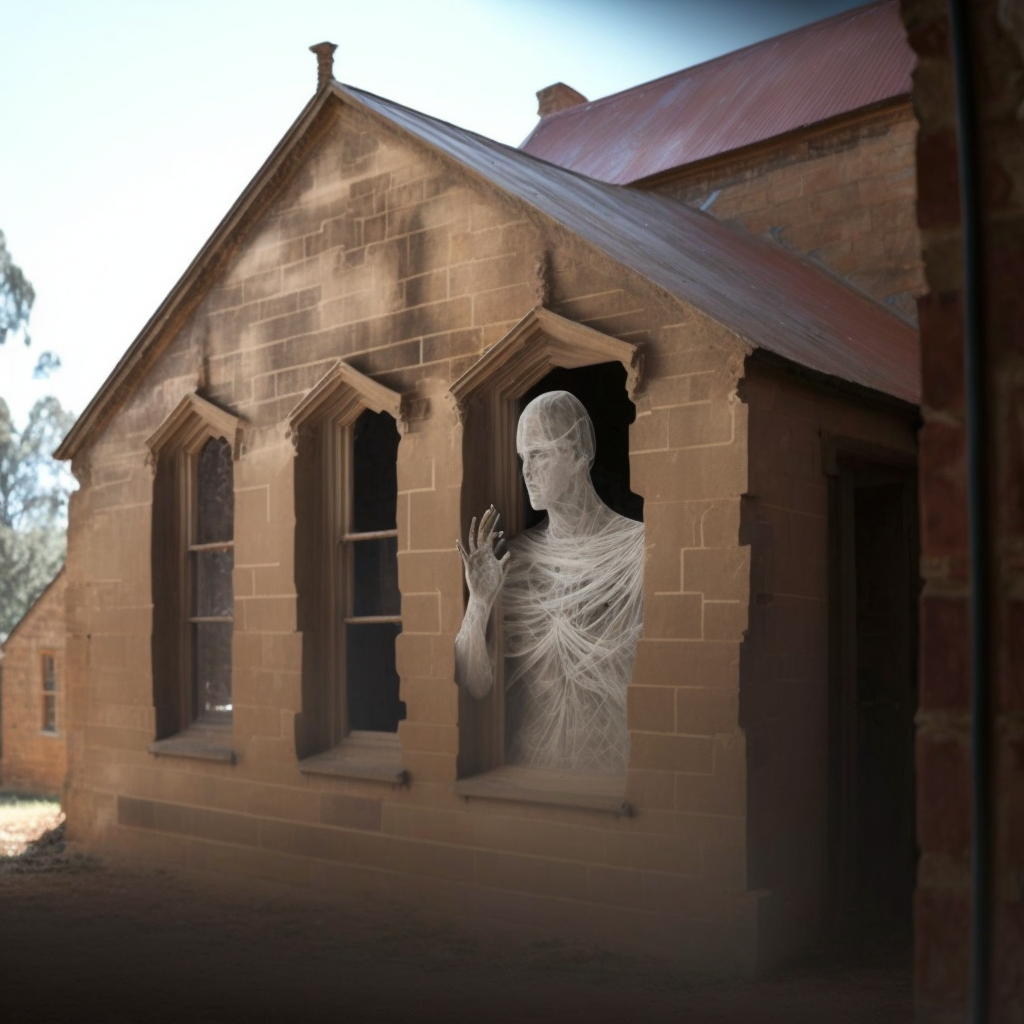
Bertie showed Zara around the church, a small building made of sandstone, but no ghost appeared in the bright heat of the afternoon. He took her on a little tour of Camden, once a tiny outpost but now a suburb of the city, pointing out all the original buildings, in particular the ones that Isaac had built. The church was walking distance of Bertie’s house and Zara decided to slip out and stroll over there after everyone had gone to bed.
Bertie had kindly allowed Pretty Girl to stay in the guest bedroom with her, safe from the cats, and Zara intended that the parrot stay in the room, but Pretty Girl was having none of it and insisted on joining her.
“Alright then, but no talking! I don’t want you scaring any ghost away so just keep a low profile!”
The moon was nearly full and it was a pleasant walk to the church. Pretty Girl fluttered from tree to tree along the sidewalk quietly. Enchanting aromas of exotic scented flowers wafted into her nostrils and Zara felt warmly relaxed and optimistic.
Zara was disappointed to find that the church was locked for the night, and realized with a sigh that she should have expected this to be the case. She wandered around the outside, trying to peer in the windows but there was nothing to be seen as the glass reflected the street lights. These things are not done in a hurry, she reminded herself, be patient.
Sitting under a tree on the grassy lawn attempting to open her mind to receiving ghostly communications (she wasn’t quite sure how to do that on purpose, any ghosts she’d seen previously had always been accidental and unexpected) Pretty Girl landed on her shoulder rather clumsily, pressing something hard and chill against her cheek.
“I told you to keep a low profile!” Zara hissed, as the parrot dropped the key into her lap. “Oh! is this the key to the church door?”
It was hard to see in the dim light but Zara was sure the parrot nodded, and was that another avian eye roll?
Zara walked slowly over the grass to the church door, tingling with anticipation. Pretty Girl hopped along the ground behind her. She turned the key in the lock and slowly pushed open the heavy door and walked inside and up the central aisle, looking around. And then she saw him.
Zara gasped. For a breif moment as the spectral wisps cleared, he looked almost solid. And she could see his tattoos.
“Oh my god,” she whispered, “It is really you. I recognize those tattoos from the description in the criminal registers. Some of them anyway, it seems you have a few more tats since you were transported.”
“Aye, I did that, wench. I were allays fond o’ me tats, does tha like ’em?”
He actually spoke to me! This was beyond Zara’s wildest hopes. Quick, ask him some questions!
“If you don’t mind me asking, Isaac, why did you lie about who your father was on your marriage register? I almost thought it wasn’t you, you know, that I had the wrong Isaac Stokes.”
A deafening rumbling laugh filled the building with echoes and the apparition dispersed in a labyrinthine swirl of tattood wisps.
“A story for another day,” whispered Zara, “Time to go back to Berties. Come on Pretty Girl. And put that key back where you found it.”
 January 15, 2023 at 10:19 am #6388
In reply to: Orbs of Madjourneys
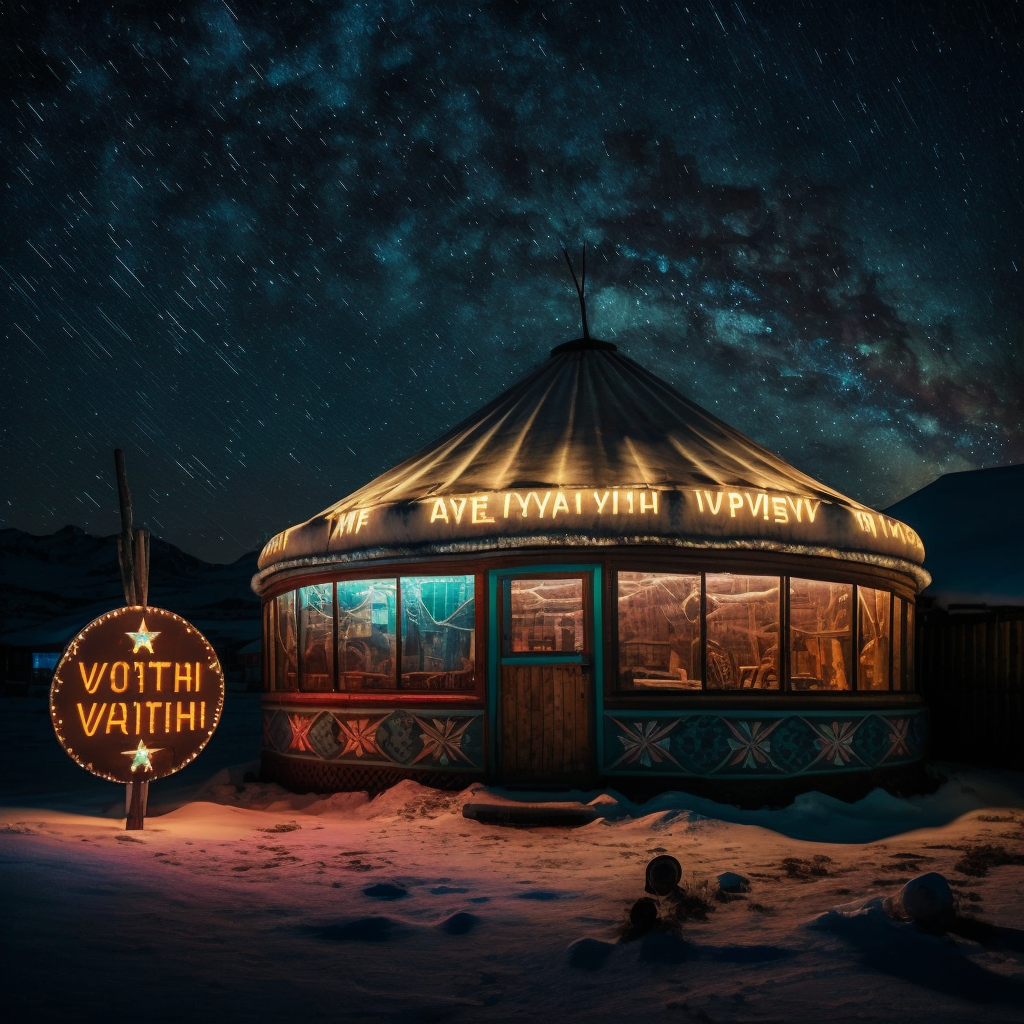
Youssef came out of the Internet Cafe Yurt quite satisfied of himself but confused. It was already night time here and he felt hungry like a bear looking for honey. He smelled the scents of yak’s meat and followed the trail to the resto’yurt of the camp the production had settled in for the night. They were on a trip to make a documentary about the last surviving authentic shaman of Mongolia. They’d heard he was still alive and 125 years old. Of course, he was difficult to find and they’ve been looking for him for weeks.
Fortunately, they had good reception for him to stay in contact with his friends and play the new game with that AI generated storyline stuff. Youssef liked his character with the bear shirt, but he wouldn’t tell his friends that he hadn’t quite understood the concept of the game or of the quest. He was the kind of guy who liked having some explanations first and follow clear rules, have a little guidance. He smiled and performed two steps of breakdance, recalling one of Xavier’s joke about a little “guy dance”. His stomach growled as he approached the resto’yurt and the scent of food became stronger. The sounds of cheerful conversations in different languages welcomed him as he entered.
He’ll have plenty of time to think of the game in front a spicy smorlax fried and a bowl of sweet tsampa for dessert. He noticed an empty seat just near Rebbecca, a young intern that took care of Mme Landowski’s schedule. She was smiling and Youssef thought they could continue the conversation they started this morning about the type of guys she liked.
 January 11, 2023 at 9:43 pm #6367
In reply to: Train your subjective AI – text version
Something in the style of TPooh:
The family tree was a tangled web of branches and roots, stretching back centuries and even millennia. The branches were thick with the leaves of secrets, scandals, and mysteries that the family had accumulated over the years. They were a close-knit group, friends for all time, and they loved nothing more than exploring the twists and turns of their family history.
They met regularly in their dreams, in a place they called The City, where they could exchange stories and clues they had uncovered during their waking hours. They often found themselves in the midst of strange and puzzling occurrences, and they would spend hours discussing the possible meanings and connections of these events. They saw the world as a tapestry, with each thread and pattern contributing to the greater picture. They were the weavers of their own story, the authors of their own fate.
But as the years went on, their dreams began to take on a darker and more ominous tone. They started having nightmares of monstrous beasts, and some of them even saw these beasts in the daylight, as if they were falling through the cracks in reality. They compared notes and found that they were often seeing the same beasts, and this led to heated debates about what these beasts represented and whether they were real or just figments of their imagination.
But no matter what they encountered, the family remained united in their quest to unravel the secrets of their past and to weave a tapestry that would be the envy of all. They were thick as thieves and they would never give up their pursuit of the truth, no matter how many rules they had to break along the way.
January 7, 2023 at 2:28 pm #6359In reply to: Train Your Subjective AI
Sam walking in Time Square by night with his pet nine tailed fox (where are the other tails?)
 November 18, 2022 at 4:47 pm #6348
In reply to: Family Stories From The Other Side ~ Book Two
Wong Sang
Wong Sang was born in China in 1884. In October 1916 he married Alice Stokes in Oxford.
Alice was the granddaughter of William Stokes of Churchill, Oxfordshire and William was the brother of Thomas Stokes the wheelwright (who was my 3X great grandfather). In other words Alice was my second cousin, three times removed, on my fathers paternal side.
Wong Sang was an interpreter, according to the baptism registers of his children and the Dreadnought Seamen’s Hospital admission registers in 1930. The hospital register also notes that he was employed by the Blue Funnel Line, and that his address was 11, Limehouse Causeway, E 14. (London)
“The Blue Funnel Line offered regular First-Class Passenger and Cargo Services From the UK to South Africa, Malaya, China, Japan, Australia, Java, and America. Blue Funnel Line was Owned and Operated by Alfred Holt & Co., Liverpool.
The Blue Funnel Line, so-called because its ships have a blue funnel with a black top, is more appropriately known as the Ocean Steamship Company.”Wong Sang and Alice’s daughter, Frances Eileen Sang, was born on the 14th July, 1916 and baptised in 1920 at St Stephen in Poplar, Tower Hamlets, London. The birth date is noted in the 1920 baptism register and would predate their marriage by a few months, although on the death register in 1921 her age at death is four years old and her year of birth is recorded as 1917.
Charles Ronald Sang was baptised on the same day in May 1920, but his birth is recorded as April of that year. The family were living on Morant Street, Poplar.
James William Sang’s birth is recorded on the 1939 census and on the death register in 2000 as being the 8th March 1913. This definitely would predate the 1916 marriage in Oxford.
William Norman Sang was born on the 17th October 1922 in Poplar.
Alice and the three sons were living at 11, Limehouse Causeway on the 1939 census, the same address that Wong Sang was living at when he was admitted to Dreadnought Seamen’s Hospital on the 15th January 1930. Wong Sang died in the hospital on the 8th March of that year at the age of 46.
Alice married John Patterson in 1933 in Stepney. John was living with Alice and her three sons on Limehouse Causeway on the 1939 census and his occupation was chef.
Via Old London Photographs:
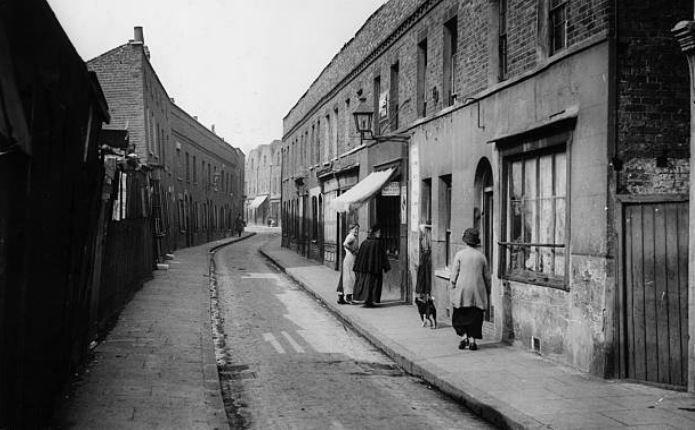
“Limehouse Causeway is a street in east London that was the home to the original Chinatown of London. A combination of bomb damage during the Second World War and later redevelopment means that almost nothing is left of the original buildings of the street.”
Limehouse Causeway in 1925:
From The Story of Limehouse’s Lost Chinatown, poplarlondon website:
“Limehouse was London’s first Chinatown, home to a tightly-knit community who were demonised in popular culture and eventually erased from the cityscape.
As recounted in the BBC’s ‘Our Greatest Generation’ series, Connie was born to a Chinese father and an English mother in early 1920s Limehouse, where she used to play in the street with other British and British-Chinese children before running inside for teatime at one of their houses.
Limehouse was London’s first Chinatown between the 1880s and the 1960s, before the current Chinatown off Shaftesbury Avenue was established in the 1970s by an influx of immigrants from Hong Kong.
Connie’s memories of London’s first Chinatown as an “urban village” paint a very different picture to the seedy area portrayed in early twentieth century novels.
The pyramid in St Anne’s church marked the entrance to the opium den of Dr Fu Manchu, a criminal mastermind who threatened Western society by plotting world domination in a series of novels by Sax Rohmer.
Thomas Burke’s Limehouse Nights cemented stereotypes about prostitution, gambling and violence within the Chinese community, and whipped up anxiety about sexual relationships between Chinese men and white women.
Though neither novelist was familiar with the Chinese community, their depictions made Limehouse one of the most notorious areas of London.
Travel agent Thomas Cook even organised tours of the area for daring visitors, despite the rector of Limehouse warning that “those who look for the Limehouse of Mr Thomas Burke simply will not find it.”
All that remains is a handful of Chinese street names, such as Ming Street, Pekin Street, and Canton Street — but what was Limehouse’s chinatown really like, and why did it get swept away?
Chinese migration to Limehouse
Chinese sailors discharged from East India Company ships settled in the docklands from as early as the 1780s.
By the late nineteenth century, men from Shanghai had settled around Pennyfields Lane, while a Cantonese community lived on Limehouse Causeway.
Chinese sailors were often paid less and discriminated against by dock hirers, and so began to diversify their incomes by setting up hand laundry services and restaurants.
Old photographs show shopfronts emblazoned with Chinese characters with horse-drawn carts idling outside or Chinese men in suits and hats standing proudly in the doorways.
In oral histories collected by Yat Ming Loo, Connie’s husband Leslie doesn’t recall seeing any Chinese women as a child, since male Chinese sailors settled in London alone and married working-class English women.
In the 1920s, newspapers fear-mongered about interracial marriages, crime and gambling, and described chinatown as an East End “colony.”
Ironically, Chinese opium-smoking was also demonised in the press, despite Britain waging war against China in the mid-nineteenth century for suppressing the opium trade to alleviate addiction amongst its people.
The number of Chinese people who settled in Limehouse was also greatly exaggerated, and in reality only totalled around 300.
The real Chinatown
Although the press sought to characterise Limehouse as a monolithic Chinese community in the East End, Connie remembers seeing people of all nationalities in the shops and community spaces in Limehouse.
She doesn’t remember feeling discriminated against by other locals, though Connie does recall having her face measured and IQ tested by a member of the British Eugenics Society who was conducting research in the area.
Some of Connie’s happiest childhood memories were from her time at Chung-Hua Club, where she learned about Chinese culture and language.
Why did Chinatown disappear?
The caricature of Limehouse’s Chinatown as a den of vice hastened its erasure.
Police raids and deportations fuelled by the alarmist media coverage threatened the Chinese population of Limehouse, and slum clearance schemes to redevelop low-income areas dispersed Chinese residents in the 1930s.
The Defence of the Realm Act imposed at the beginning of the First World War criminalised opium use, gave the authorities increased powers to deport Chinese people and restricted their ability to work on British ships.
Dwindling maritime trade during World War II further stripped Chinese sailors of opportunities for employment, and any remnants of Chinatown were destroyed during the Blitz or erased by postwar development schemes.”
Wong Sang 1884-1930
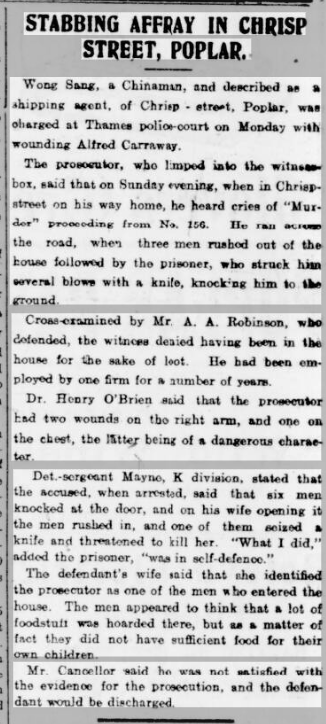
The year 1918 was a troublesome one for Wong Sang, an interpreter and shipping agent for Blue Funnel Line. The Sang family were living at 156, Chrisp Street.
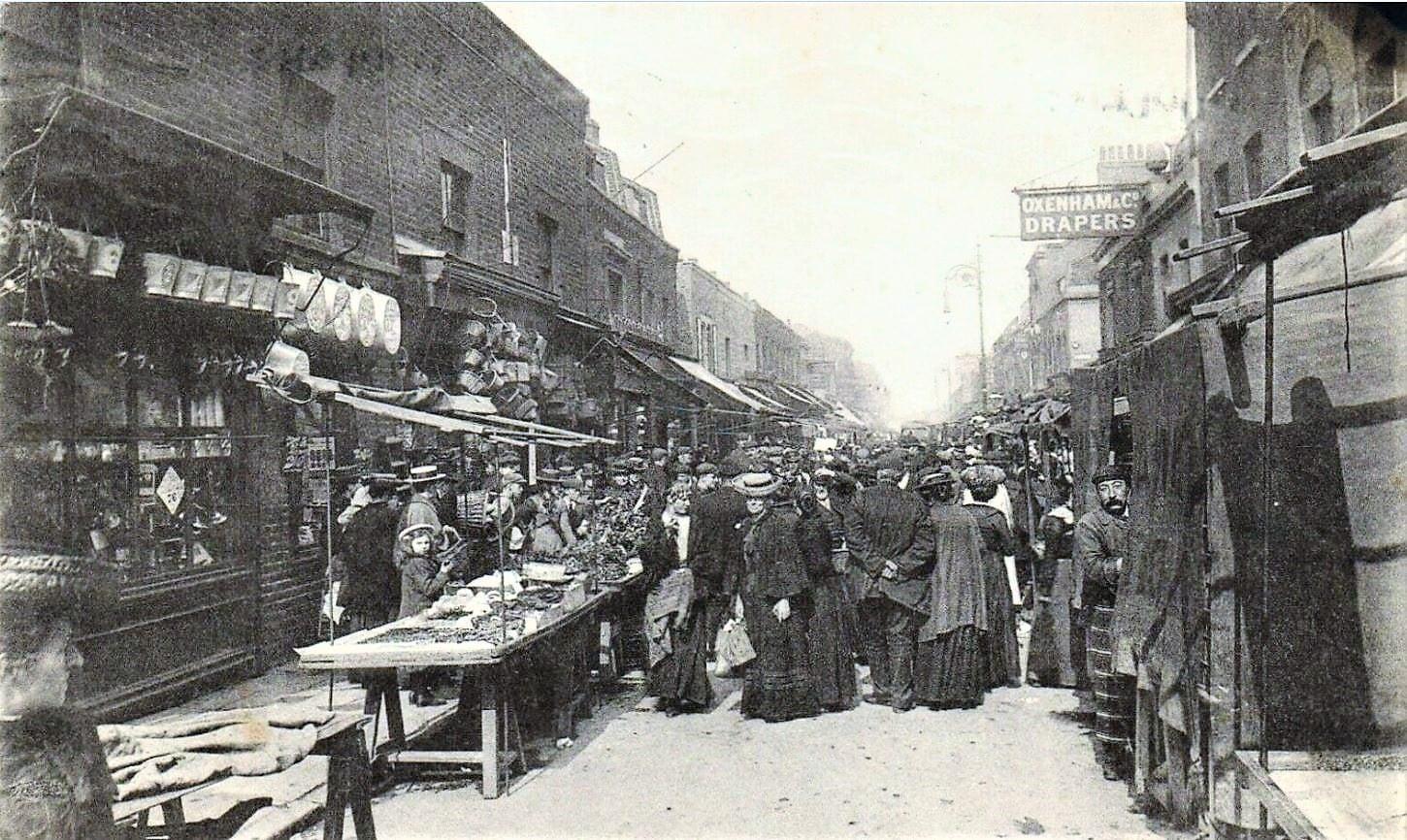
Chrisp Street, Poplar, in 1913 via Old London Photographs:
In February Wong Sang was discharged from a false accusation after defending his home from potential robbers.
East End News and London Shipping Chronicle – Friday 15 February 1918:
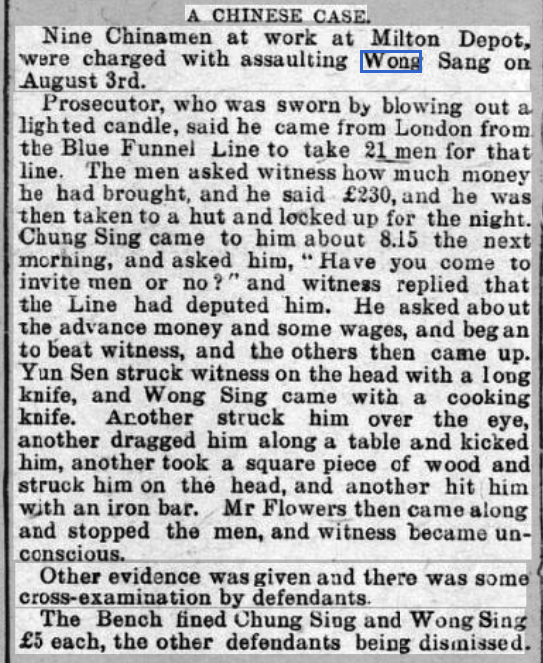
In August of that year he was involved in an incident that left him unconscious.
Faringdon Advertiser and Vale of the White Horse Gazette – Saturday 31 August 1918:
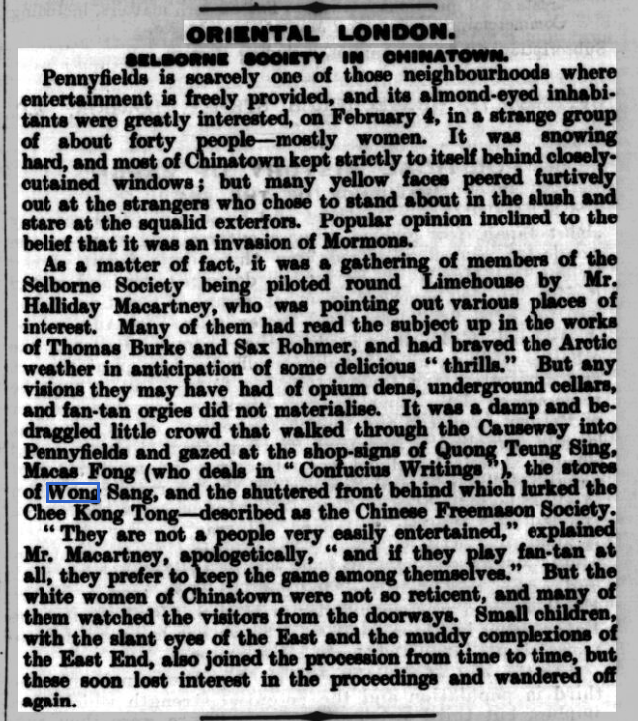
Wong Sang is mentioned in an 1922 article about “Oriental London”.
London and China Express – Thursday 09 February 1922:
A photograph of the Chee Kong Tong Chinese Freemason Society mentioned in the above article, via Old London Photographs:
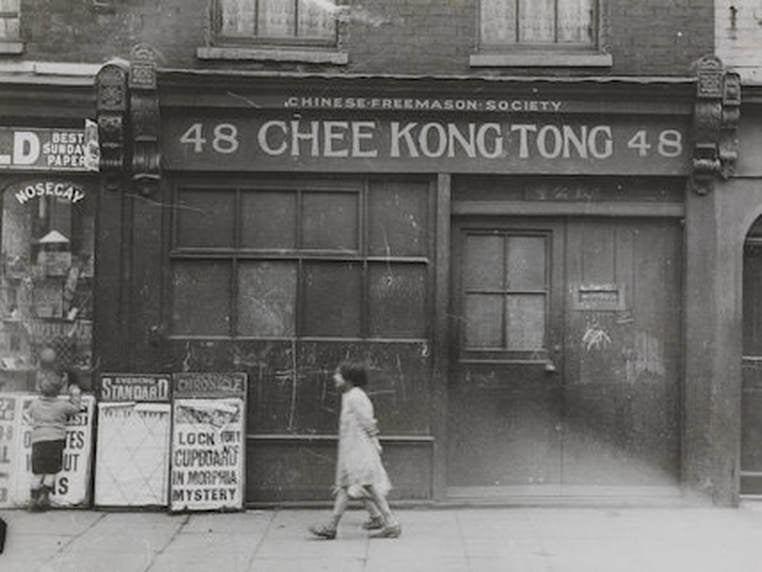
Wong Sang was recommended by the London Metropolitan Police in 1928 to assist in a case in Wellingborough, Northampton.
Difficulty of Getting an Interpreter: Northampton Mercury – Friday 16 March 1928:
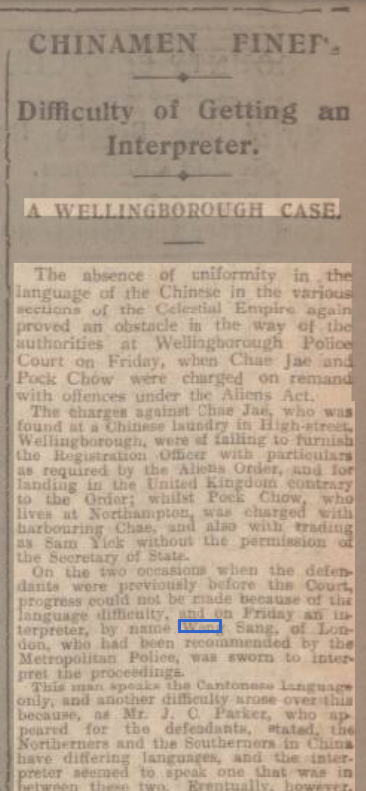
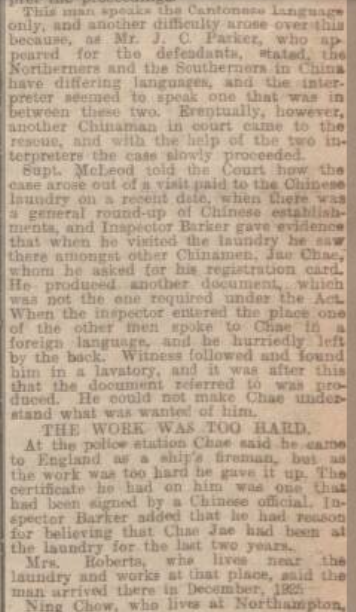
The difficulty was that “this man speaks the Cantonese language only…the Northeners and the Southerners in China have differing languages and the interpreter seemed to speak one that was in between these two.”
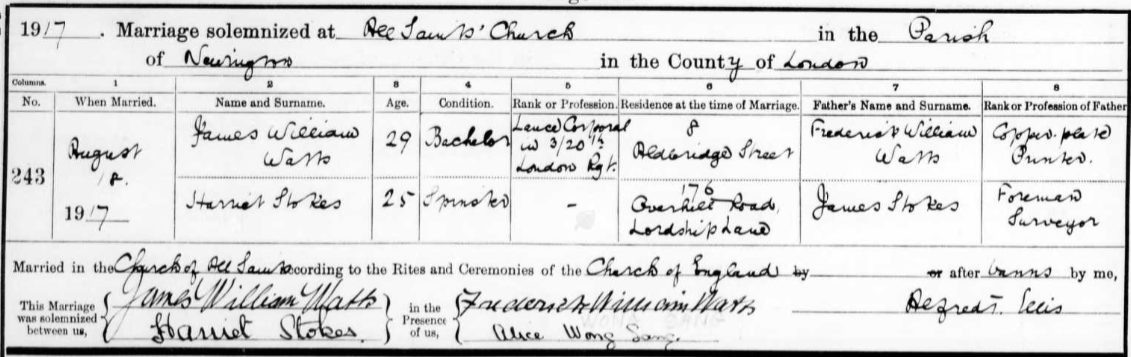
In 1917, Alice Wong Sang was a witness at her sister Harriet Stokes marriage to James William Watts in Southwark, London. Their father James Stokes occupation on the marriage register is foreman surveyor, but on the census he was a council roadman or labourer. (I initially rejected this as the correct marriage for Harriet because of the discrepancy with the occupations. Alice Wong Sang as a witness confirmed that it was indeed the correct one.)
James William Sang 1913-2000 was a clock fitter and watch assembler (on the 1939 census). He married Ivy Laura Fenton in 1963 in Sidcup, Kent. James died in Southwark in 2000.
Charles Ronald Sang 1920-1974 was a draughtsman (1939 census). He married Eileen Burgess in 1947 in Marylebone. Charles and Eileen had two sons: Keith born in 1951 and Roger born in 1952. He died in 1974 in Hertfordshire.
William Norman Sang 1922-2000 was a clerk and telephone operator (1939 census). William enlisted in the Royal Artillery in 1942. He married Lily Mullins in 1949 in Bethnal Green, and they had three daughters: Marion born in 1950, Christine in 1953, and Frances in 1959. He died in Redbridge in 2000.
I then found another two births registered in Poplar by Alice Sang, both daughters. Doris Winifred Sang was born in 1925, and Patricia Margaret Sang was born in 1933 ~ three years after Wong Sang’s death. Neither of the these daughters were on the 1939 census with Alice, John Patterson and the three sons. Margaret had presumably been evacuated because of the war to a family in Taunton, Somerset. Doris would have been fourteen and I have been unable to find her in 1939 (possibly because she died in 2017 and has not had the redaction removed yet on the 1939 census as only deceased people are viewable).
Doris Winifred Sang 1925-2017 was a nursing sister. She didn’t marry, and spent a year in USA between 1954 and 1955. She stayed in London, and died at the age of ninety two in 2017.
Patricia Margaret Sang 1933-1998 was also a nurse. She married Patrick L Nicely in Stepney in 1957. Patricia and Patrick had five children in London: Sharon born 1959, Donald in 1960, Malcolm was born and died in 1966, Alison was born in 1969 and David in 1971.
I was unable to find a birth registered for Alice’s first son, James William Sang (as he appeared on the 1939 census). I found Alice Stokes on the 1911 census as a 17 year old live in servant at a tobacconist on Pekin Street, Limehouse, living with Mr Sui Fong from Hong Kong and his wife Sarah Sui Fong from Berlin. I looked for a birth registered for James William Fong instead of Sang, and found it ~ mothers maiden name Stokes, and his date of birth matched the 1939 census: 8th March, 1913.
On the 1921 census, Wong Sang is not listed as living with them but it is mentioned that Mr Wong Sang was the person returning the census. Also living with Alice and her sons James and Charles in 1921 are two visitors: (Florence) May Stokes, 17 years old, born in Woodstock, and Charles Stokes, aged 14, also born in Woodstock. May and Charles were Alice’s sister and brother.
I found Sharon Nicely on social media and she kindly shared photos of Wong Sang and Alice Stokes:
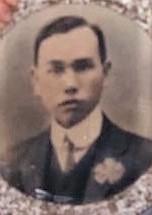
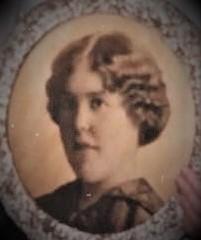 November 4, 2022 at 2:19 pm #6342
In reply to: Family Stories From The Other Side ~ Book Two
Brownings of Tetbury
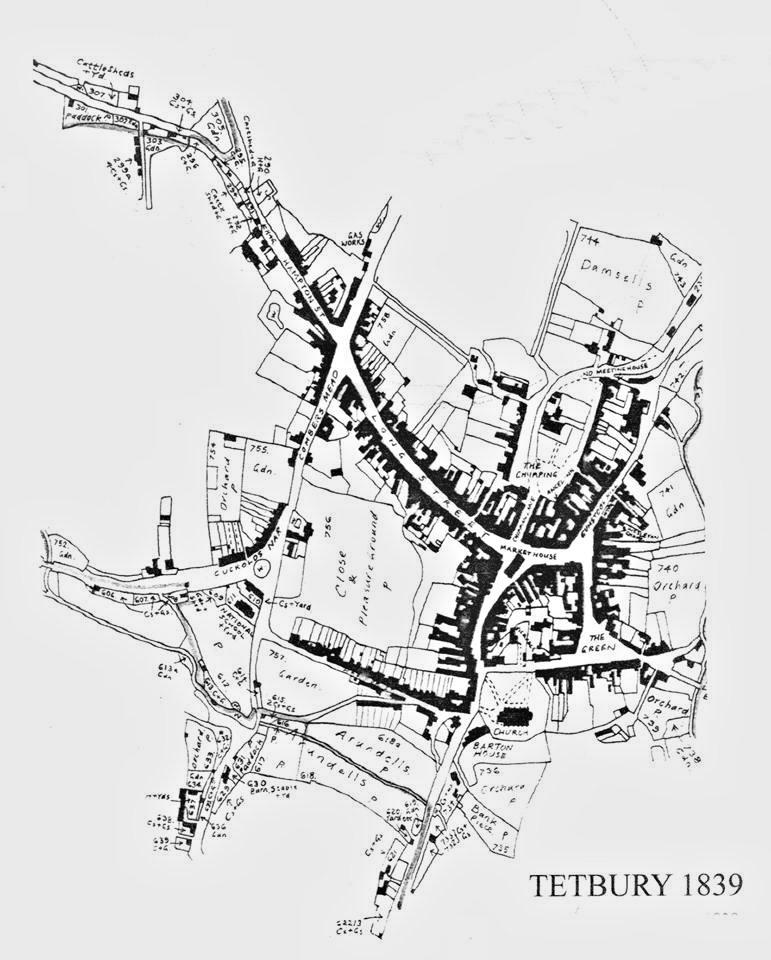
Isaac Browning (1784-1848) married Mary Lock (1787-1870) in Tetbury in 1806. Both of them were born in Tetbury, Gloucestershire. Isaac was a stone mason. Between 1807 and 1832 they baptised fourteen children in Tetbury, and on 8 Nov 1829 Isaac and Mary baptised five daughters all on the same day.
I considered that they may have been quintuplets, with only the last born surviving, which would have answered my question about the name of the house La Quinta in Broadway, the home of Eliza Browning and Thomas Stokes son Fred. However, the other four daughters were found in various records and they were not all born the same year. (So I still don’t know why the house in Broadway had such an unusual name).
Their son George was born and baptised in 1827, but Louisa born 1821, Susan born 1822, Hesther born 1823 and Mary born 1826, were not baptised until 1829 along with Charlotte born in 1828. (These birth dates are guesswork based on the age on later censuses.) Perhaps George was baptised promptly because he was sickly and not expected to survive. Isaac and Mary had a son George born in 1814 who died in 1823. Presumably the five girls were healthy and could wait to be done as a job lot on the same day later.
Eliza Browning (1814-1886), my great great great grandmother, had a baby six years before she married Thomas Stokes. Her name was Ellen Harding Browning, which suggests that her fathers name was Harding. On the 1841 census seven year old Ellen was living with her grandfather Isaac Browning in Tetbury. Ellen Harding Browning married William Dee in Tetbury in 1857, and they moved to Western Australia.
Ellen Harding Browning Dee: (photo found on ancestry website)
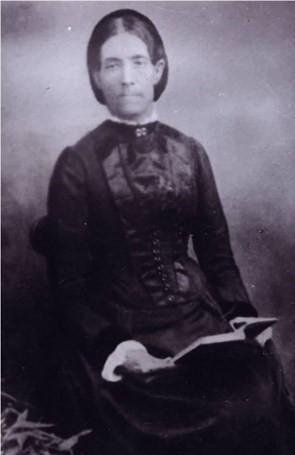
OBITUARY. MRS. ELLEN DEE.
A very old and respected resident of Dongarra, in the person of Mrs. Ellen Dee, passed peacefully away on Sept. 27, at the advanced age of 74 years.The deceased had been ailing for some time, but was about and actively employed until Wednesday, Sept. 20, whenn she was heard groaning by some neighbours, who immediately entered her place and found her lying beside the fireplace. Tho deceased had been to bed over night, and had evidently been in the act of lighting thc fire, when she had a seizure. For some hours she was conscious, but had lost the power of speech, and later on became unconscious, in which state she remained until her death.
The deceased was born in Gloucestershire, England, in 1833, was married to William Dee in Tetbury Church 23 years later. Within a month she left England with her husband for Western Australian in the ship City oí Bristol. She resided in Fremantle for six months, then in Greenough for a short time, and afterwards (for 42 years) in Dongarra. She was, therefore, a colonist of about 51 years. She had a family of four girls and three boys, and five of her children survive her, also 35 grandchildren, and eight great grandchildren. She was very highly respected, and her sudden collapse came as a great shock to many.
Eliza married Thomas Stokes (1816-1885) in September 1840 in Hempstead, Gloucestershire. On the 1841 census, Eliza and her mother Mary Browning (nee Lock) were staying with Thomas Lock and family in Cirencester. Strangely, Thomas Stokes has not been found thus far on the 1841 census, and Thomas and Eliza’s first child William James Stokes birth was registered in Witham, in Essex, on the 6th of September 1841.
I don’t know why William James was born in Witham, or where Thomas was at the time of the census in 1841. One possibility is that as Thomas Stokes did a considerable amount of work with circus waggons, circus shooting galleries and so on as a journeyman carpenter initially and then later wheelwright, perhaps he was working with a traveling circus at the time.
But back to the Brownings ~ more on William James Stokes to follow.
One of Isaac and Mary’s fourteen children died in infancy: Ann was baptised and died in 1811. Two of their children died at nine years old: the first George, and Mary who died in 1835. Matilda was 21 years old when she died in 1844.
Jane Browning (1808-) married Thomas Buckingham in 1830 in Tetbury. In August 1838 Thomas was charged with feloniously stealing a black gelding.
Susan Browning (1822-1879) married William Cleaver in November 1844 in Tetbury. Oddly thereafter they use the name Bowman on the census. On the 1851 census Mary Browning (Susan’s mother), widow, has grandson George Bowman born in 1844 living with her. The confusion with the Bowman and Cleaver names was clarified upon finding the criminal registers:
30 January 1834. Offender: William Cleaver alias Bowman, Richard Bunting alias Barnfield and Jeremiah Cox, labourers of Tetbury. Crime: Stealing part of a dead fence from a rick barton in Tetbury, the property of Robert Tanner, farmer.
And again in 1836:
29 March 1836 Bowman, William alias Cleaver, of Tetbury, labourer age 18; 5’2.5” tall, brown hair, grey eyes, round visage with fresh complexion; several moles on left cheek, mole on right breast. Charged on the oath of Ann Washbourn & others that on the morning of the 31 March at Tetbury feloniously stolen a lead spout affixed to the dwelling of the said Ann Washbourn, her property. Found guilty 31 March 1836; Sentenced to 6 months.
On the 1851 census Susan Bowman was a servant living in at a large drapery shop in Cheltenham. She was listed as 29 years old, married and born in Tetbury, so although it was unusual for a married woman not to be living with her husband, (or her son for that matter, who was living with his grandmother Mary Browning), perhaps her husband William Bowman alias Cleaver was in trouble again. By 1861 they are both living together in Tetbury: William was a plasterer, and they had three year old Isaac and Thomas, one year old. In 1871 William was still a plasterer in Tetbury, living with wife Susan, and sons Isaac and Thomas. Interestingly, a William Cleaver is living next door but one!
Susan was 56 when she died in Tetbury in 1879.
Three of the Browning daughters went to London.
Louisa Browning (1821-1873) married Robert Claxton, coachman, in 1848 in Bryanston Square, Westminster, London. Ester Browning was a witness.
Ester Browning (1823-1893)(or Hester) married Charles Hudson Sealey, cabinet maker, in Bethnal Green, London, in 1854. Charles was born in Tetbury. Charlotte Browning was a witness.
Charlotte Browning (1828-1867?) was admitted to St Marylebone workhouse in London for “parturition”, or childbirth, in 1860. She was 33 years old. A birth was registered for a Charlotte Browning, no mothers maiden name listed, in 1860 in Marylebone. A death was registered in Camden, buried in Marylebone, for a Charlotte Browning in 1867 but no age was recorded. As the age and parents were usually recorded for a childs death, I assume this was Charlotte the mother.
I found Charlotte on the 1851 census by chance while researching her mother Mary Lock’s siblings. Hesther Lock married Lewin Chandler, and they were living in Stepney, London. Charlotte is listed as a neice. Although Browning is mistranscribed as Broomey, the original page says Browning. Another mistranscription on this record is Hesthers birthplace which is transcribed as Yorkshire. The original image shows Gloucestershire.
Isaac and Mary’s first son was John Browning (1807-1860). John married Hannah Coates in 1834. John’s brother Charles Browning (1819-1853) married Eliza Coates in 1842. Perhaps they were sisters. On the 1861 census Hannah Browning, John’s wife, was a visitor in the Harding household in a village called Coates near Tetbury. Thomas Harding born in 1801 was the head of the household. Perhaps he was the father of Ellen Harding Browning.
George Browning (1828-1870) married Louisa Gainey in Tetbury, and died in Tetbury at the age of 42. Their son Richard Lock Browning, a 32 year old mason, was sentenced to one month hard labour for game tresspass in Tetbury in 1884.
Isaac Browning (1832-1857) was the youngest son of Isaac and Mary. He was just 25 years old when he died in Tetbury.
August 18, 2022 at 8:26 am #6324In reply to: The Elusive Samuel Housley and Other Family Stories
STONE MANOR
Hildred Orgill Warren born in 1900, my grandmothers sister, married Reginald Williams in Stone, Worcestershire in March 1924. Their daughter Joan was born there in October of that year.
Hildred was a chaffeur on the 1921 census, living at home in Stourbridge with her father (my great grandfather) Samuel Warren, mechanic. I recall my grandmother saying that Hildred was one of the first lady chauffeurs. On their wedding certificate, Reginald is also a chauffeur.
1921 census, Stourbridge:
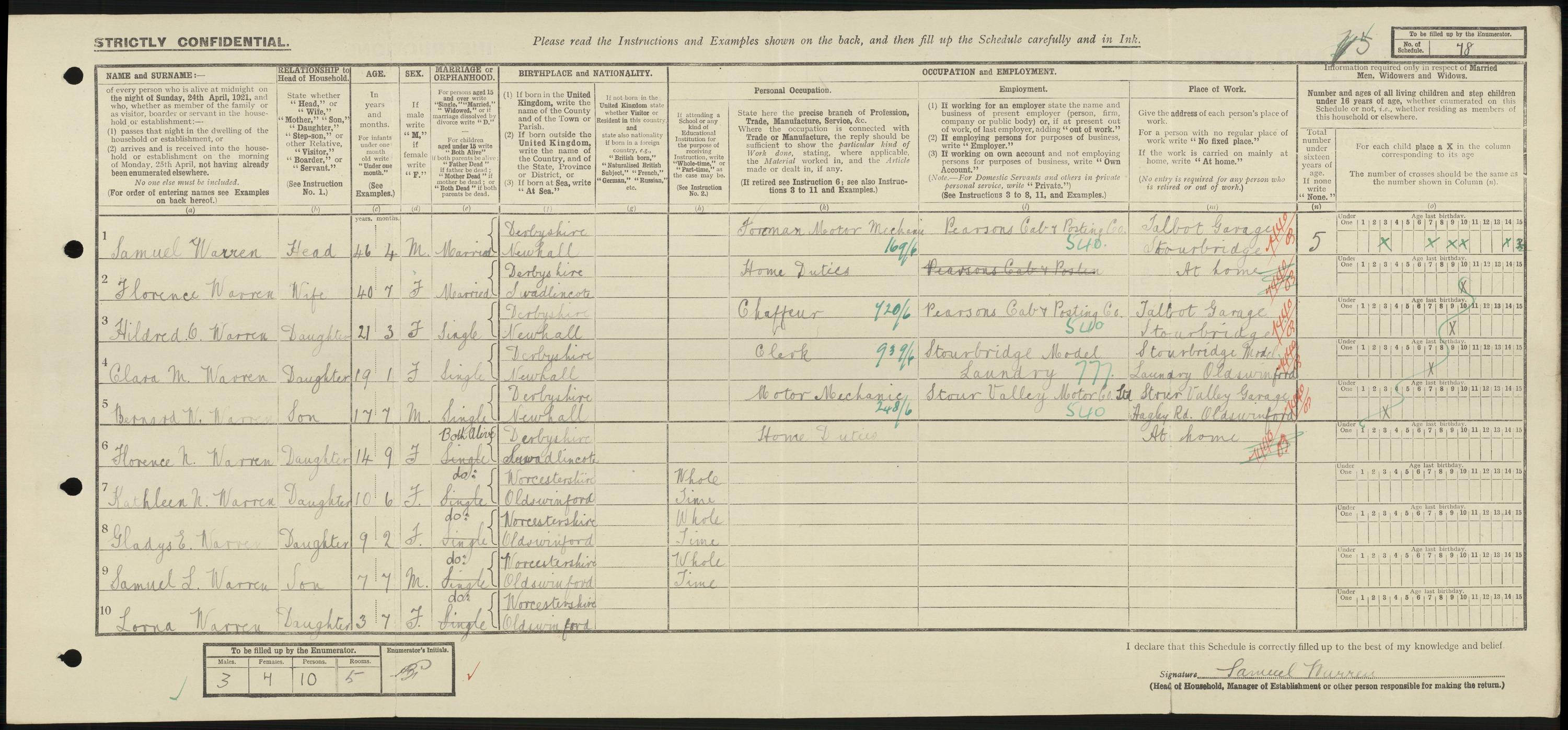
Hildred and Reg worked at Stone Manor. There is a family story of Hildred being involved in a car accident involving a fatality and that she had to go to court.
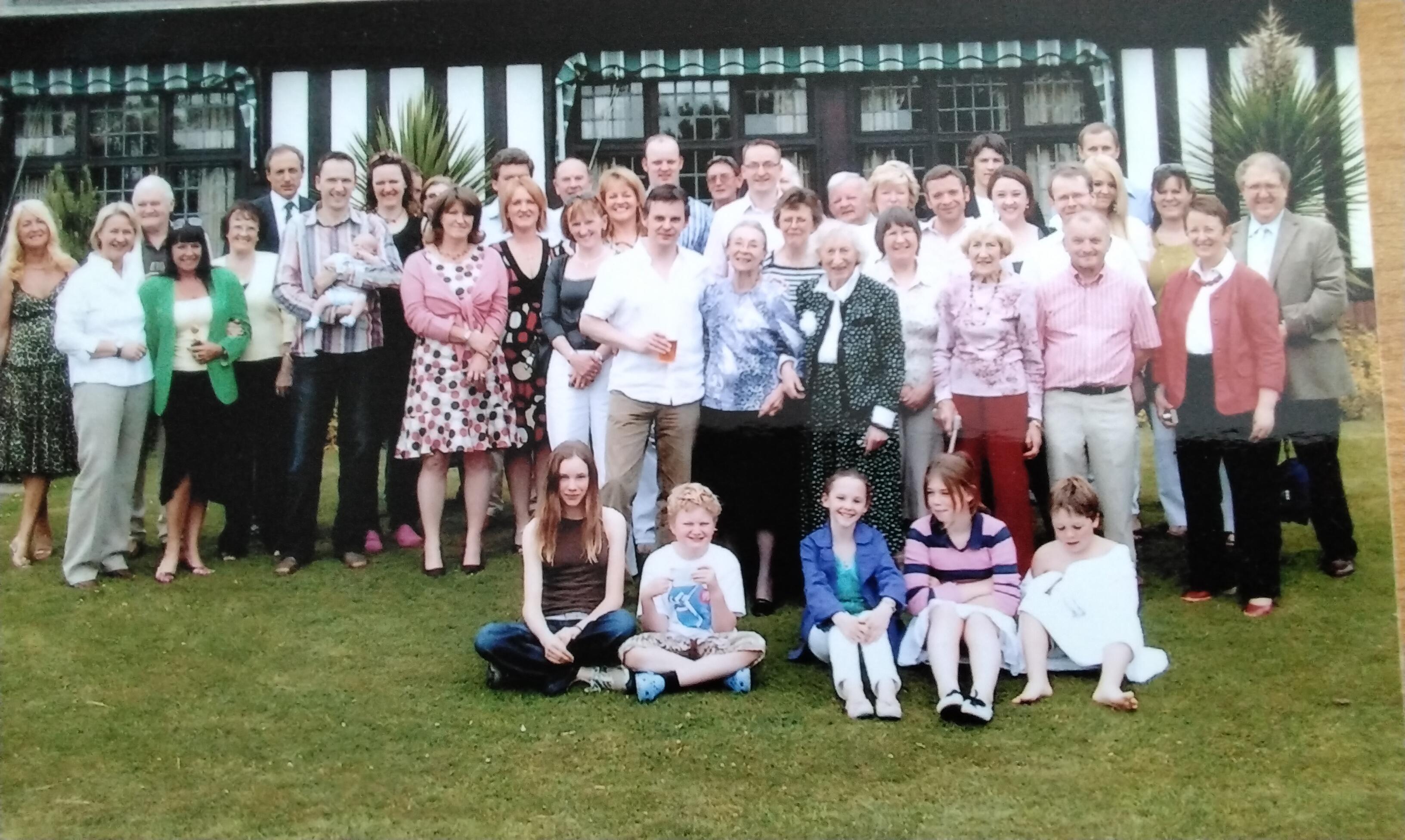
Stone Manor is in a tiny village called Stone, near Kidderminster, Worcestershire. It used to be a private house, but has been a hotel and nightclub for some years. We knew in the family that Hildred and Reg worked at Stone Manor and that Joan was born there. Around 2007 Joan held a family party there.
Stone Manor, Stone, Worcestershire:
I asked on a Kidderminster Family Research group about Stone Manor in the 1920s:
“the original Stone Manor burnt down and the current building dates from the early 1920’s and was built for James Culcheth Hill, completed in 1926”
But was there a fire at Stone Manor?
“I’m not sure there was a fire at the Stone Manor… there seems to have been a fire at another big house a short distance away and it looks like stories have crossed over… as the dates are the same…”JC Hill was one of the witnesses at Hildred and Reginalds wedding in Stone in 1924. K Warren, Hildreds sister Kay, was the other:
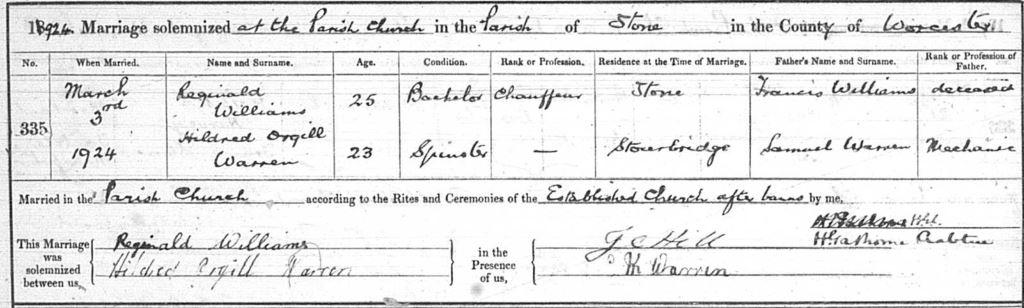
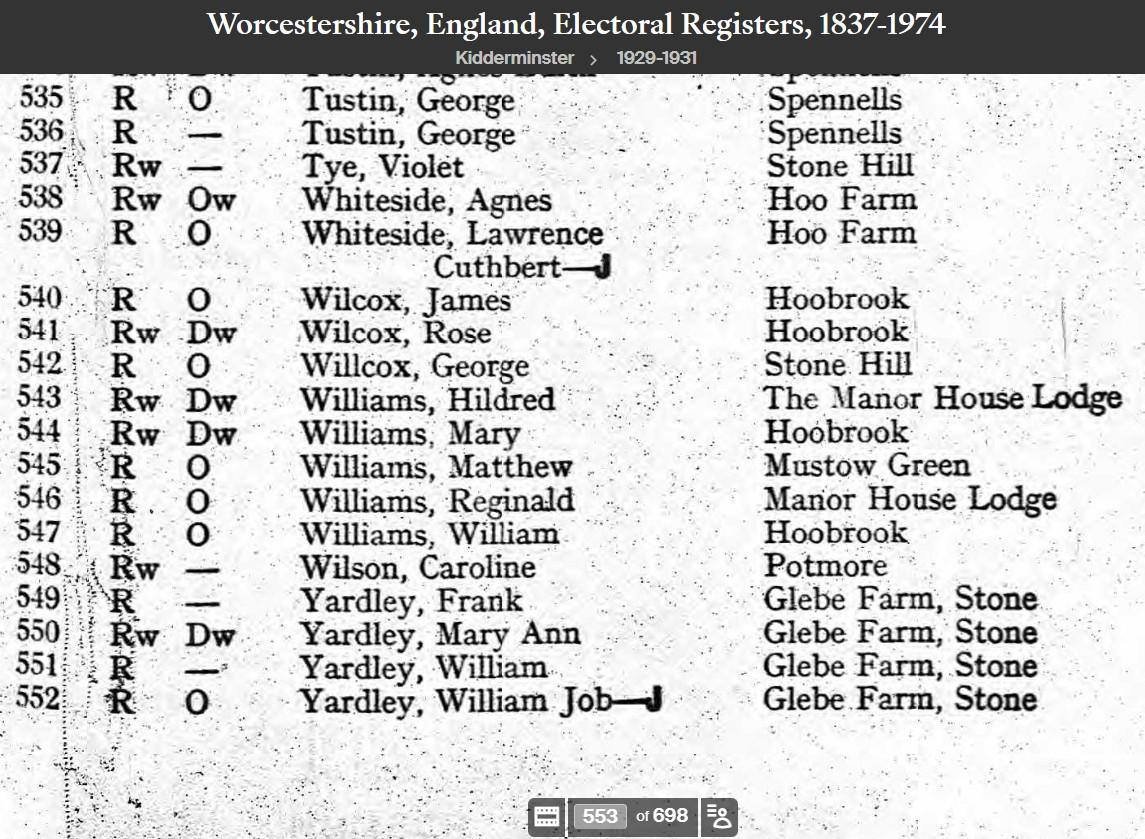
I searched the census and electoral rolls for James Culcheth Hill and found him at the Stone Manor on the 1929-1931 electoral rolls for Stone, and Hildred and Reginald living at The Manor House Lodge, Stone:
On the 1911 census James Culcheth Hill was a 12 year old student at Eastmans Royal Naval Academy, Northwood Park, Crawley, Winchester. He was born in Kidderminster in 1899. On the same census page, also a student at the school, is Reginald Culcheth Holcroft, born in 1900 in Stourbridge. The unusual middle name would seem to indicate that they might be related.
A member of the Kidderminster Family Research group kindly provided this article:
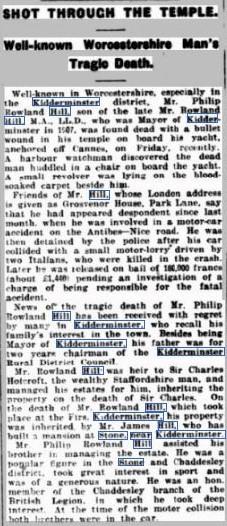
SHOT THROUGH THE TEMPLE
Well known Worcestershire man’s tragic death.
Dudley Chronicle 27 March 1930.
Well known in Worcestershire, especially the Kidderminster district, Mr Philip Rowland Hill MA LLD who was mayor of Kidderminster in 1907 was found dead with a bullet wound through his temple on board his yacht, anchored off Cannes, on Friday, recently. A harbour watchman discovered the dead man huddled in a chair on board the yacht. A small revolver was lying on the blood soaked carpet beside him.
Friends of Mr Hill, whose London address is given as Grosvenor House, Park Lane, say that he appeared despondent since last month when he was involved in a motor car accident on the Antibes ~ Nice road. He was then detained by the police after his car collided with a small motor lorry driven by two Italians, who were killed in the crash. Later he was released on bail of 180,000 francs (£1440) pending an investigation of a charge of being responsible for the fatal accident. …….
Mr Rowland Hill (Philips father) was heir to Sir Charles Holcroft, the wealthy Staffordshire man, and managed his estates for him, inheriting the property on the death of Sir Charles. On the death of Mr Rowland HIll, which took place at the Firs, Kidderminster, his property was inherited by Mr James (Culcheth) Hill who had built a mansion at Stone, near Kidderminster. Mr Philip Rowland Hill assisted his brother in managing the estate. …….
At the time of the collison both brothers were in the car.
This article doesn’t mention who was driving the car ~ could the family story of a car accident be this one? Hildred and Reg were working at Stone Manor, both were (or at least previously had been) chauffeurs, and Philip Hill was helping James Culcheth Hill manage the Stone Manor estate at the time.
This photograph was taken circa 1931 in Llanaeron, Wales. Hildred is in the middle on the back row:
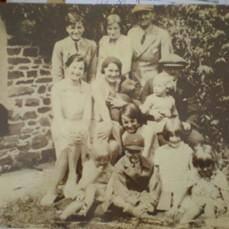
Sally Gray sent the photo with this message:
“Joan gave me a short note: Photo was taken when they lived in Wales, at Llanaeron, before Janet was born, & Aunty Lorna (my mother) lived with them, to take Joan to school in Aberaeron, as they only spoke Welsh at the local school.”
Hildred and Reginalds daughter Janet was born in 1932 in Stratford. It would appear that Hildred and Reg moved to Wales just after the car accident, and shortly afterwards moved to Stratford.
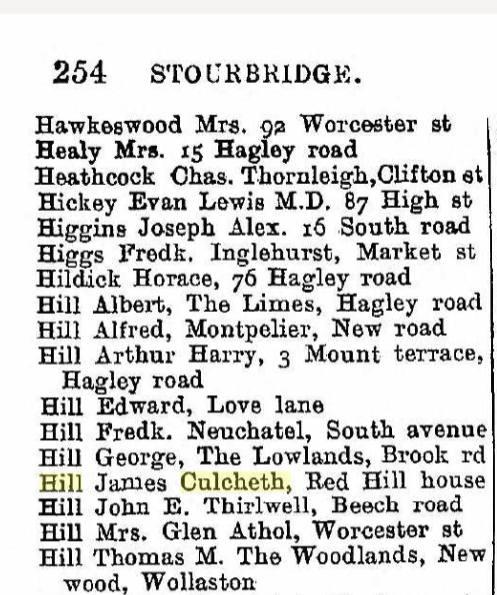
In 1921 James Culcheth Hill was living at Red Hill House in Stourbridge. Although I have not been able to trace Reginald Williams yet, perhaps this Stourbridge connection with his employer explains how Hildred met Reginald.
Sir Reginald Culcheth Holcroft, the other pupil at the school in Winchester with James Culcheth Hill, was indeed related, as Sir Holcroft left his estate to James Culcheth Hill’s father. Sir Reginald was born in 1899 in Upper Swinford, Stourbridge. Hildred also lived in that part of Stourbridge in the early 1900s.
1921 Red Hill House:
The 2007 family reunion organized by Joan Williams at Stone Manor: Joan in black and white at the front.
Unrelated to the Warrens, my fathers friends (and customers at The Fox when my grandmother Peggy Edwards owned it) Geoff and Beryl Lamb later bought Stone Manor.
July 7, 2022 at 5:31 pm #6316In reply to: The Sexy Wooden Leg
Myroslava was hungry. She saw ducks flying in the sky and realised she wasn’t too far from the Kal’mius river, south of Dantesk. She took out her sling and hit one with a stone she just picked on the floor. She smiled and said in a low voice : “You see father, I haven’t lost my touch.”
She had traveled several days with a group of reportourists, as she called them. A bunch of war reporters who thought it entertaining to take pictures of bombed areas, going about like peacocks as if they wore a plot armour against Rootian bullets and missiles and discourse at night on the tactics of the different armies. She was glad when she crossed the Rootian lines two days ago. Even if it meant no more dehydrated food and no more plot armour, she was certainly better off without the inane discussions.
She picked the duck and looked for a freshly bombarded place where there was still smoke. She could make some fire without being noticed too much. She didn’t like raw meat that much.
Soon after leaving the group or reportourists, without all the noise they made, she became certain she was being followed. She tried once to surprise them, but they were good at hiding and camouflaging their tracks. She wondered how long it had lasted. She cursed the noisy reporters and cursed her lack of good vodka. Cursing without alcohol was like boxing without fists.
July 6, 2022 at 11:02 am #6311In reply to: The Sexy Wooden Leg
Most of the pilgims, if one could call them that, flocked to the linden tree in cars, although some came on motorbikes and bicycles. Olek was grateful that they hadn’t started arriving by the bus load, like Italian tourists. But his cousin Ursula was happy with this strange new turn of events.
Her shabby hotel on the outskirts of town had never been so busy and she was already planning to refurbish the premises and evict the decrepit and motley assortment of aged permanent residents who had just about kept her head above water, financially speaking, for the last twenty years. She could charge much more per night to these new tourists, who were smartly dressed and modern and didn’t argue about the price of a room. They did complain about the damp stained wallpaper though and the threadbare bedding. Ursula reckoned she could charge even more for the rooms if she redecorated, and had an idea to approach her nephew Boris the bank manager for a business loan.
But first she had to evict the old timers. It wasn’t her problem, she reminded herself, if they had nowhere else to go. After all, plenty of charitable aid money was flying around these days, they could easily just join up with some fleeing refugees. She’d even sent some of her old dresses to the collection agency. They may have been forty years old and smelled of moth balls, but they were well made and the refugees would surely be grateful.
Ursula wasn’t looking forward to telling them. No, not at all! She rather liked some of them and was dreading their reaction. You are a business woman, Ursula, she told herself, and you have to look after your own interests! But still she quailed at the thought of knocking on their doors, or announcing it in the communal dining room at supper. Then she had an idea. She’d type up some letters instead, and sign them as if they came from her new business manager. When the residents approached her about the letter she would smile sadly and shrug, saying it wasn’t her decision and that she was terribly sorry but her hands were tied.
June 10, 2022 at 1:39 pm #6305In reply to: The Elusive Samuel Housley and Other Family Stories
The Hair’s and Leedham’s of Netherseal
Samuel Warren of Stapenhill married Catherine Holland of Barton under Needwood in 1795. Catherine’s father was Thomas Holland; her mother was Hannah Hair.
Hannah was born in Netherseal, Derbyshire, in 1739. Her parents were Joseph Hair 1696-1746 and Hannah.
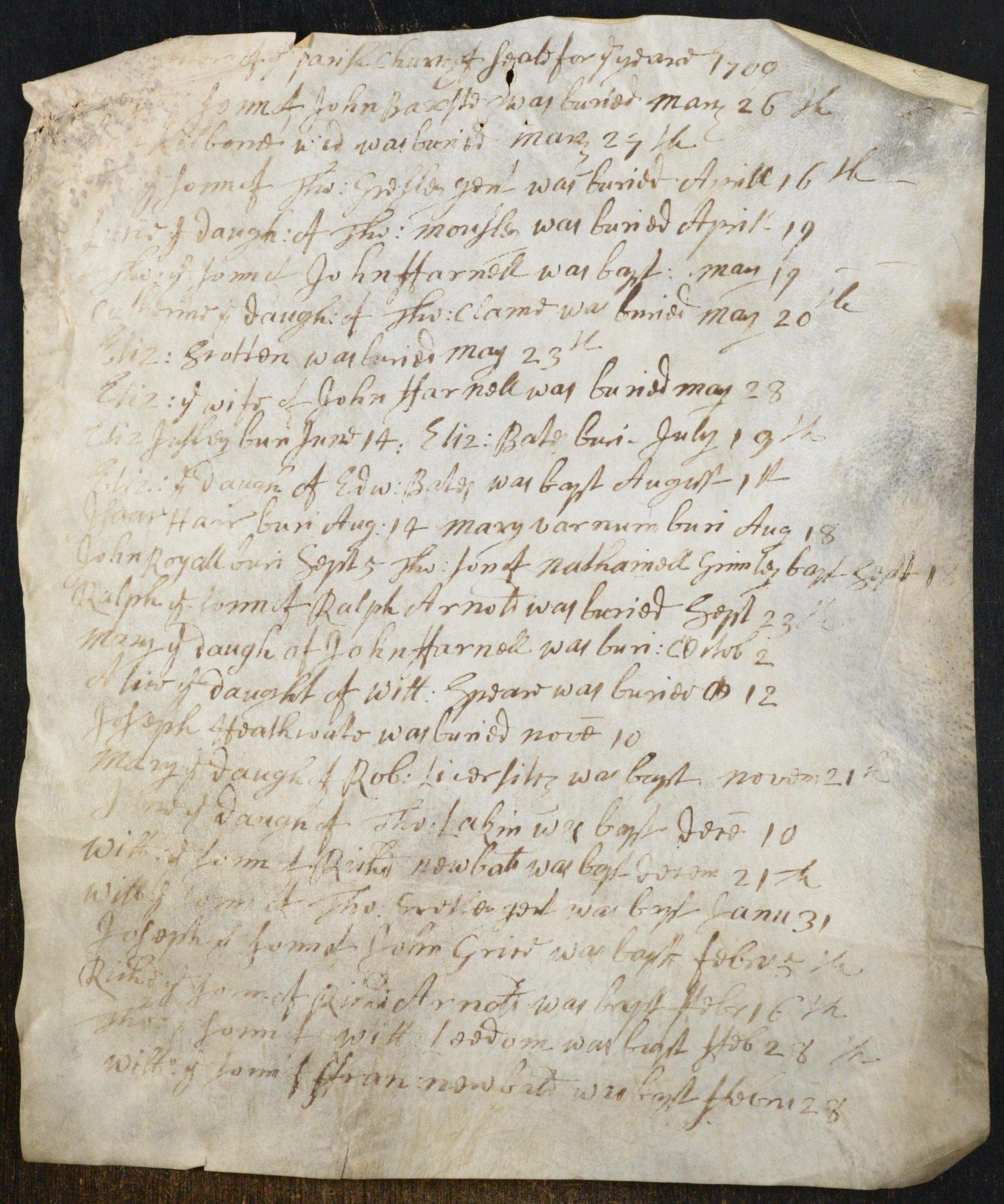
Joseph’s parents were Isaac Hair and Elizabeth Leedham. Elizabeth was born in Netherseal in 1665. Isaac and Elizabeth were married in Netherseal in 1686.Marriage of Isaac Hair and Elizabeth Leedham: (variously spelled Ledom, Leedom, Leedham, and in one case mistranscribed as Sedom):
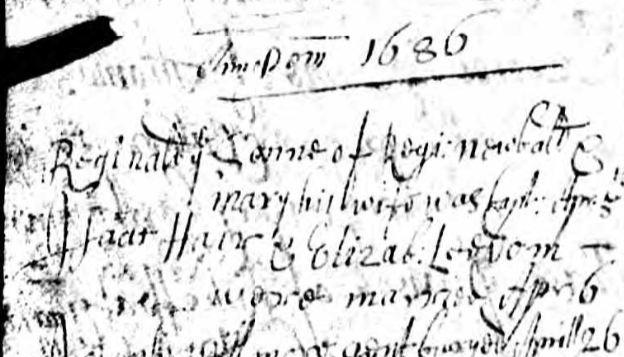
Isaac was buried in Netherseal on 14 August 1709 (the transcript says the 18th, but the microfiche image clearly says the 14th), but I have not been able to find a birth registered for him. On other public trees on an ancestry website, Isaac Le Haire was baptised in Canterbury and was a Huguenot, but I haven’t found any evidence to support this.
Isaac Hair’s death registered 14 August 1709 in Netherseal:
A search for the etymology of the surname Hair brings various suggestions, including:
“This surname is derived from a nickname. ‘the hare,’ probably affixed on some one fleet of foot. Naturally looked upon as a complimentary sobriquet, and retained in the family; compare Lightfoot. (for example) Hugh le Hare, Oxfordshire, 1273. Hundred Rolls.”
From this we may deduce that the name Hair (or Hare) is not necessarily from the French Le Haire, and existed in England for some considerable time before the arrival of the Huguenots.
Elizabeth Leedham was born in Netherseal in 1665. Her parents were Nicholas Leedham 1621-1670 and Dorothy. Nicholas Leedham was born in Church Gresley (Swadlincote) in 1621, and died in Netherseal in 1670.
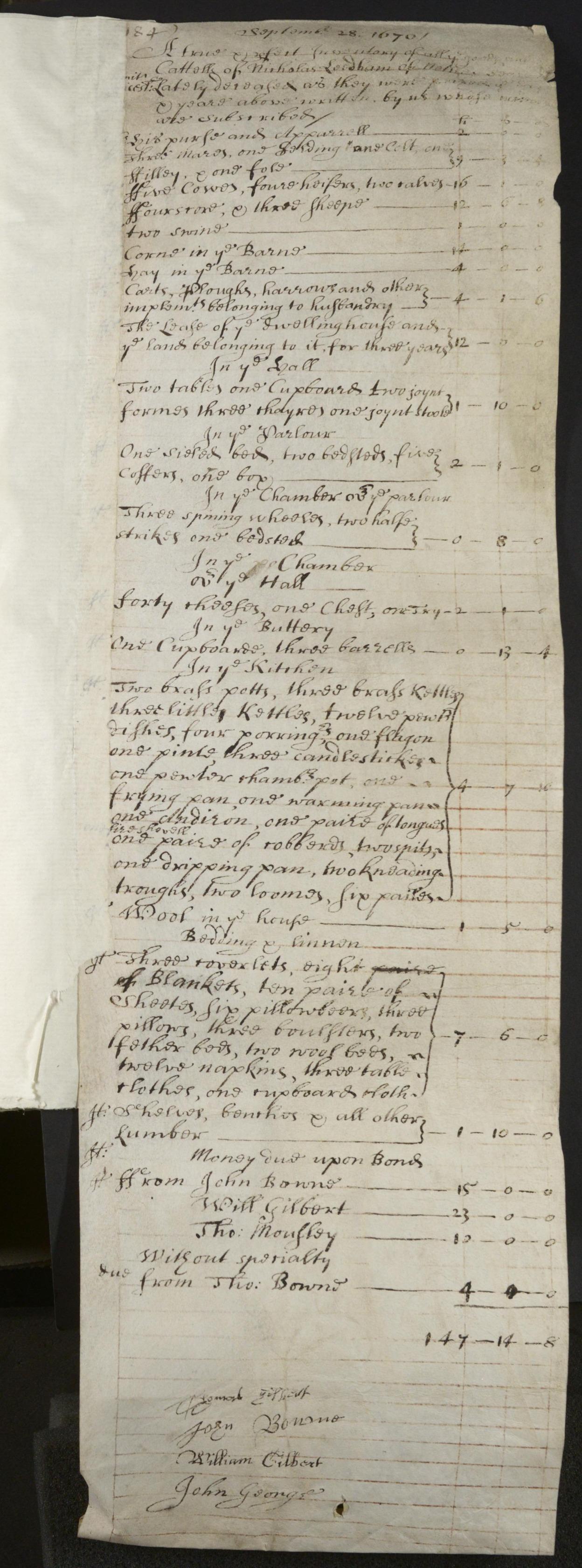
Nicholas was a Yeoman and left a will and inventory worth £147.14s.8d (one hundred and forty seven pounds fourteen shillings and eight pence).
The 1670 inventory of Nicholas Leedham:
According to local historian Mark Knight on the Netherseal History facebook group, the Seale (Netherseal and Overseal) parish registers from the year 1563 to 1724 were digitized during lockdown.
via Mark Knight:
“There are five entries for Nicholas Leedham.
On March 14th 1646 he and his wife buried an unnamed child, presumably the child died during childbirth or was stillborn.
On November 28th 1659 he buried his wife, Elizabeth. He remarried as on June 13th 1664 he had his son William baptised.
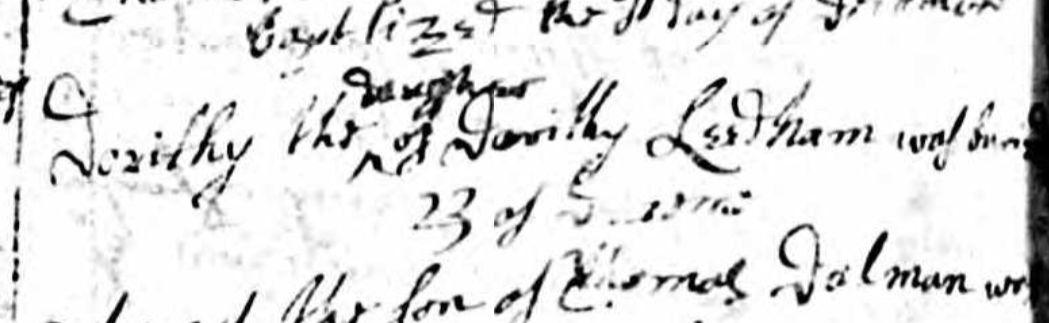
The following year, 1665, he baptised a daughter on November 12th. (Elizabeth) On December 23rd 1672 the parish record says that Dorithy daughter of Dorithy was buried. The Bishops Transcript has Dorithy a daughter of Nicholas. Nicholas’ second wife was called Dorithy and they named a daughter after her. Alas, the daughter died two years after Nicholas. No further Leedhams appear in the record until after 1724.”Dorothy daughter of Dorothy Leedham was buried 23 December 1672:
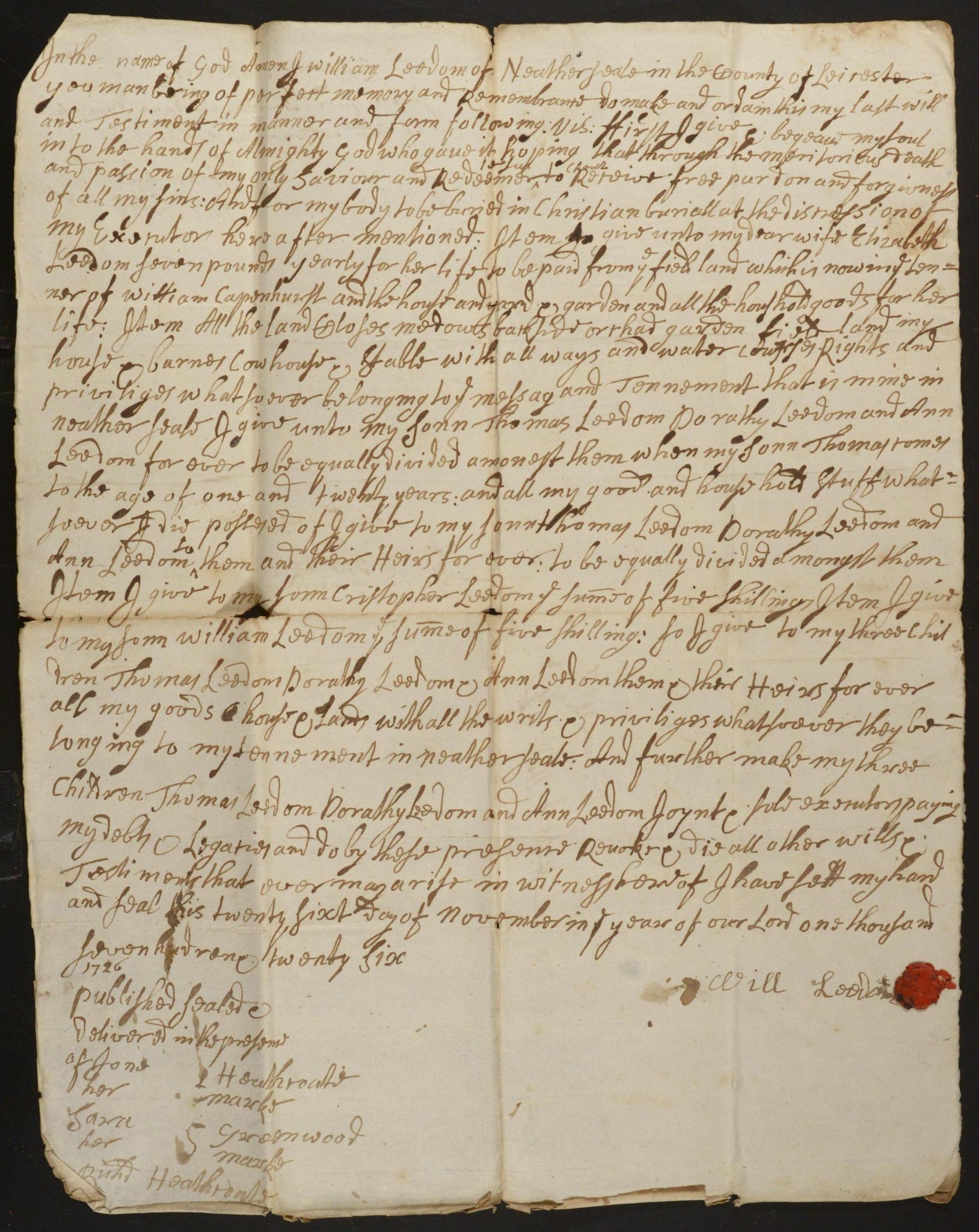
William, son of Nicholas and Dorothy also left a will. In it he mentions “My dear wife Elizabeth. My children Thomas Leedom, Dorothy Leedom , Ann Leedom, Christopher Leedom and William Leedom.”
1726 will of William Leedham:
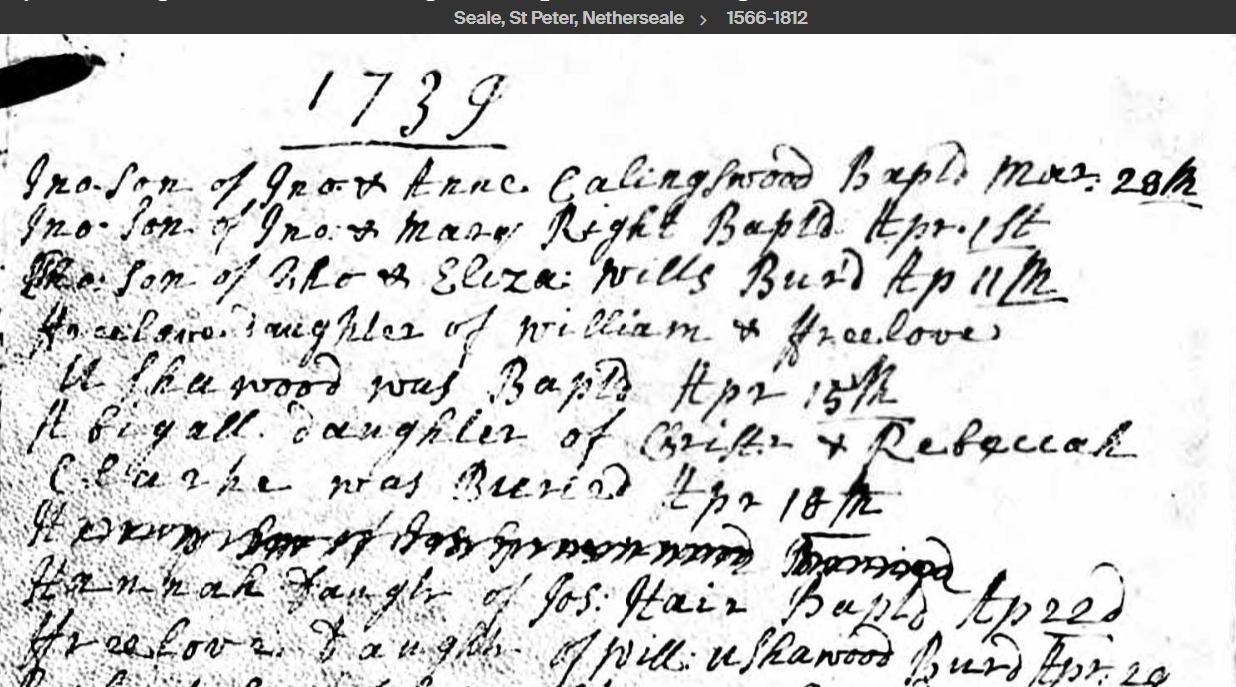
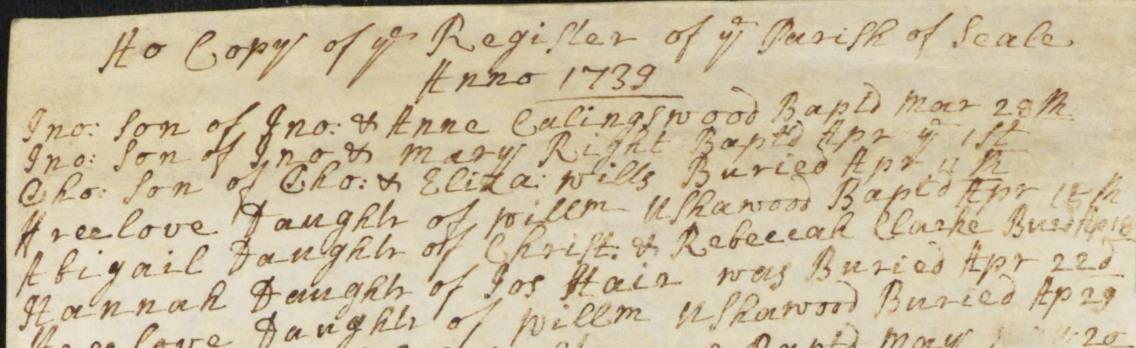
I found a curious error with the the parish register entries for Hannah Hair. It was a transcription error, but not a recent one. The original parish registers were copied: “HO Copy of ye register of Seale anno 1739.” I’m not sure when the copy was made, but it wasn’t recently. I found a burial for Hannah Hair on 22 April 1739 in the HO copy, which was the same day as her baptism registered on the original. I checked both registers name by name and they are exactly copied EXCEPT for Hannah Hairs. The rector, Richard Inge, put burial instead of baptism by mistake.
The original Parish register baptism of Hannah Hair:
The HO register copy incorrectly copied:
 June 6, 2022 at 12:58 pm #6303
In reply to: The Elusive Samuel Housley and Other Family Stories
The Hollands of Barton under Needwood
Samuel Warren of Stapenhill married Catherine Holland of Barton under Needwood in 1795.
I joined a Barton under Needwood History group and found an incredible amount of information on the Holland family, but first I wanted to make absolutely sure that our Catherine Holland was one of them as there were also Hollands in Newhall. Not only that, on the marriage licence it says that Catherine Holland was from Bretby Park Gate, Stapenhill.
Then I noticed that one of the witnesses on Samuel’s brother Williams marriage to Ann Holland in 1796 was John Hair. Hannah Hair was the wife of Thomas Holland, and they were the Barton under Needwood parents of Catherine. Catherine was born in 1775, and Ann was born in 1767.
The 1851 census clinched it: Catherine Warren 74 years old, widow and formerly a farmers wife, was living in the household of her son John Warren, and her place of birth is listed as Barton under Needwood. In 1841 Catherine was a 64 year old widow, her husband Samuel having died in 1837, and she was living with her son Samuel, a farmer. The 1841 census did not list place of birth, however. Catherine died on 31 March 1861 and does not appear on the 1861 census.
Once I had established that our Catherine Holland was from Barton under Needwood, I had another look at the information available on the Barton under Needwood History group, compiled by local historian Steve Gardner.
Catherine’s parents were Thomas Holland 1737-1828 and Hannah Hair 1739-1822.
Steve Gardner had posted a long list of the dates, marriages and children of the Holland family. The earliest entries in parish registers were Thomae Holland 1562-1626 and his wife Eunica Edwardes 1565-1632. They married on 10th July 1582. They were born, married and died in Barton under Needwood. They were direct ancestors of Catherine Holland, and as such my direct ancestors too.
The known history of the Holland family in Barton under Needwood goes back to Richard De Holland. (Thanks once again to Steve Gardner of the Barton under Needwood History group for this information.)
“Richard de Holland was the first member of the Holland family to become resident in Barton under Needwood (in about 1312) having been granted lands by the Earl of Lancaster (for whom Richard served as Stud and Stock Keeper of the Peak District) The Holland family stemmed from Upholland in Lancashire and had many family connections working for the Earl of Lancaster, who was one of the biggest Barons in England. Lancaster had his own army and lived at Tutbury Castle, from where he ruled over most of the Midlands area. The Earl of Lancaster was one of the main players in the ‘Barons Rebellion’ and the ensuing Battle of Burton Bridge in 1322. Richard de Holland was very much involved in the proceedings which had so angered Englands King. Holland narrowly escaped with his life, unlike the Earl who was executed.
From the arrival of that first Holland family member, the Hollands were a mainstay family in the community, and were in Barton under Needwood for over 600 years.”Continuing with various items of information regarding the Hollands, thanks to Steve Gardner’s Barton under Needwood history pages:
“PART 6 (Final Part)
Some mentions of The Manor of Barton in the Ancient Staffordshire Rolls:
1330. A Grant was made to Herbert de Ferrars, at le Newland in the Manor of Barton.
1378. The Inquisitio bonorum – Johannis Holand — an interesting Inventory of his goods and their value and his debts.
1380. View of Frankpledge ; the Jury found that Richard Holland was feloniously murdered by his wife Joan and Thomas Graunger, who fled. The goods of the deceased were valued at iiij/. iijj. xid. ; one-third went to the dead man, one-third to his son, one- third to the Lord for the wife’s share. Compare 1 H. V. Indictments. (1413.)
That Thomas Graunger of Barton smyth and Joan the wife of Richard de Holond of Barton on the Feast of St. John the Baptist 10 H. II. (1387) had traitorously killed and murdered at night, at Barton, Richard, the husband of the said Joan. (m. 22.)
The names of various members of the Holland family appear constantly among the listed Jurors on the manorial records printed below : —
1539. Richard Holland and Richard Holland the younger are on the Muster Roll of Barton
1583. Thomas Holland and Unica his wife are living at Barton.
1663-4. Visitations. — Barton under Needword. Disclaimers. William Holland, Senior, William Holland, Junior.
1609. Richard Holland, Clerk and Alice, his wife.
1663-4. Disclaimers at the Visitation. William Holland, Senior, William Holland, Junior.”I was able to find considerably more information on the Hollands in the book “Some Records of the Holland Family (The Hollands of Barton under Needwood, Staffordshire, and the Hollands in History)” by William Richard Holland. Luckily the full text of this book can be found online.
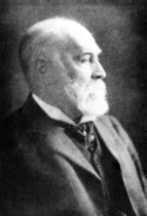
William Richard Holland (Died 1915) An early local Historian and author of the book:
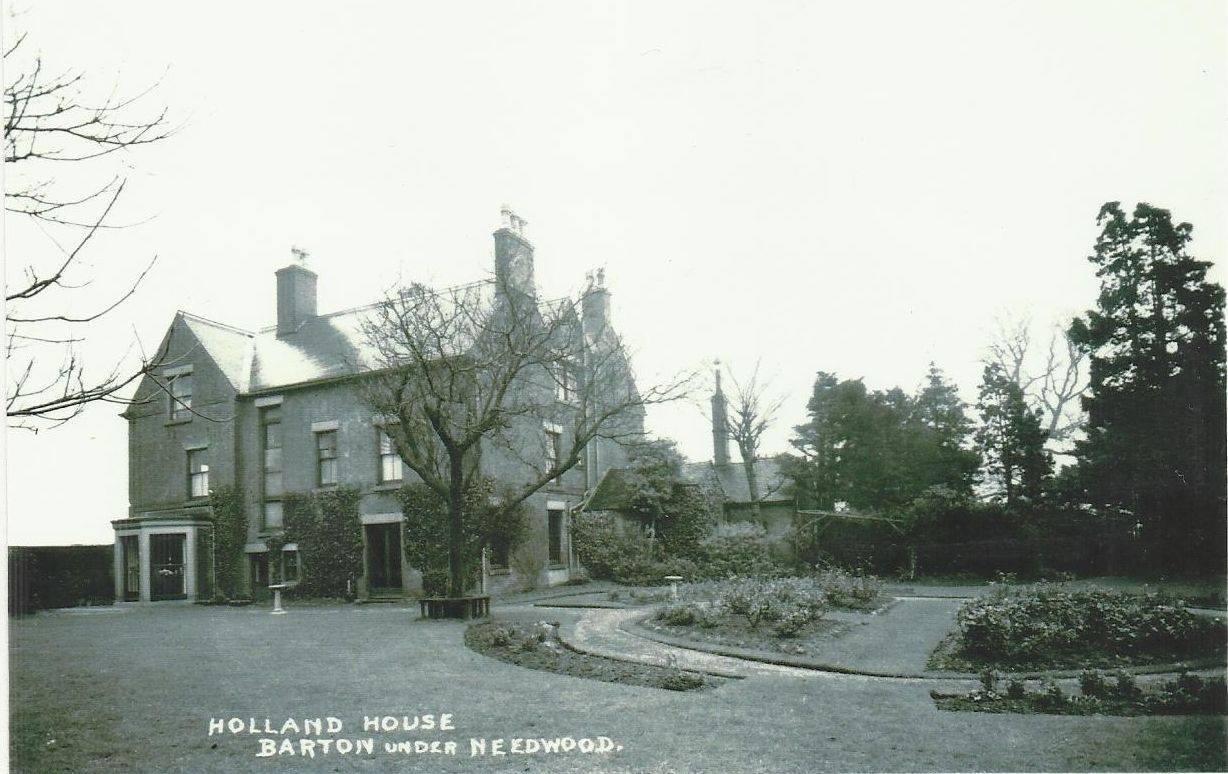
‘Holland House’ taken from the Gardens (sadly demolished in the early 60’s):
Excerpt from the book:
“The charter, dated 1314, granting Richard rights and privileges in Needwood Forest, reads as follows:
“Thomas Earl of Lancaster and Leicester, high-steward of England, to whom all these present shall come, greeting: Know ye, that we have given, &c., to Richard Holland of Barton, and his heirs, housboot, heyboot, and fireboot, and common of pasture, in our forest of Needwood, for all his beasts, as well in places fenced as lying open, with 40 hogs, quit of pawnage in our said forest at all times in the year (except hogs only in fence month). All which premises we will warrant, &c. to the said Richard and his heirs against all people for ever”
“The terms “housboot” “heyboot” and “fireboot” meant that Richard and his heirs were to have the privilege of taking from the Forest, wood needed for house repair and building, hedging material for the repairing of fences, and what was needful for purposes of fuel.”
Further excerpts from the book:
“It may here be mentioned that during the renovation of Barton Church, when the stone pillars were being stripped of the plaster which covered them, “William Holland 1617” was found roughly carved on a pillar near to the belfry gallery, obviously the work of a not too devout member of the family, who, seated in the gallery of that time, occupied himself thus during the service. The inscription can still be seen.”
“The earliest mention of a Holland of Upholland occurs in the reign of John in a Final Concord, made at the Lancashire Assizes, dated November 5th, 1202, in which Uchtred de Chryche, who seems to have had some right in the manor of Upholland, releases his right in fourteen oxgangs* of land to Matthew de Holland, in consideration of the sum of six marks of silver. Thus was planted the Holland Tree, all the early information of which is found in The Victoria County History of Lancaster.
As time went on, the family acquired more land, and with this, increased position. Thus, in the reign of Edward I, a Robert de Holland, son of Thurstan, son of Robert, became possessed of the manor of Orrell adjoining Upholland and of the lordship of Hale in the parish of Childwall, and, through marriage with Elizabeth de Samlesbury (co-heiress of Sir Wm. de Samlesbury of Samlesbury, Hall, near to Preston), of the moiety of that manor….
* An oxgang signified the amount of land that could be ploughed by one ox in one day”
“This Robert de Holland, son of Thurstan, received Knighthood in the reign of Edward I, as did also his brother William, ancestor of that branch of the family which later migrated to Cheshire. Belonging to this branch are such noteworthy personages as Mrs. Gaskell, the talented authoress, her mother being a Holland of this branch, Sir Henry Holland, Physician to Queen Victoria, and his two sons, the first Viscount Knutsford, and Canon Francis Holland ; Sir Henry’s grandson (the present Lord Knutsford), Canon Scott Holland, etc. Captain Frederick Holland, R.N., late of Ashbourne Hall, Derbyshire, may also be mentioned here.*”
Thanks to the Barton under Needwood history group for the following:
WALES END FARM:
In 1509 it was owned and occupied by Mr Johannes Holland De Wallass end who was a well to do Yeoman Farmer (the origin of the areas name – Wales End). Part of the building dates to 1490 making it probably the oldest building still standing in the Village: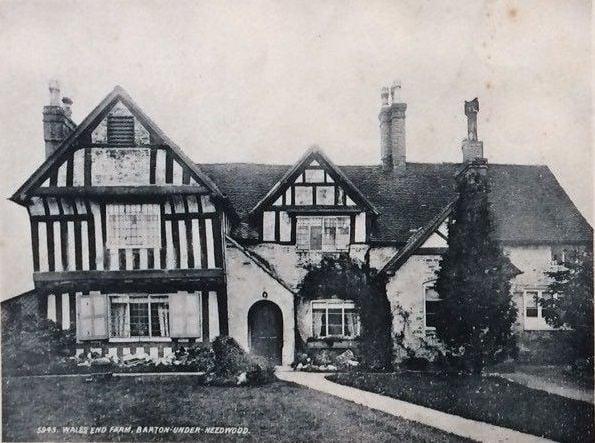
I found records for all of the Holland’s listed on the Barton under Needwood History group and added them to my ancestry tree. The earliest will I found was for Eunica Edwardes, then Eunica Holland, who died in 1632.
A page from the 1632 will and inventory of Eunica (Unice) Holland:
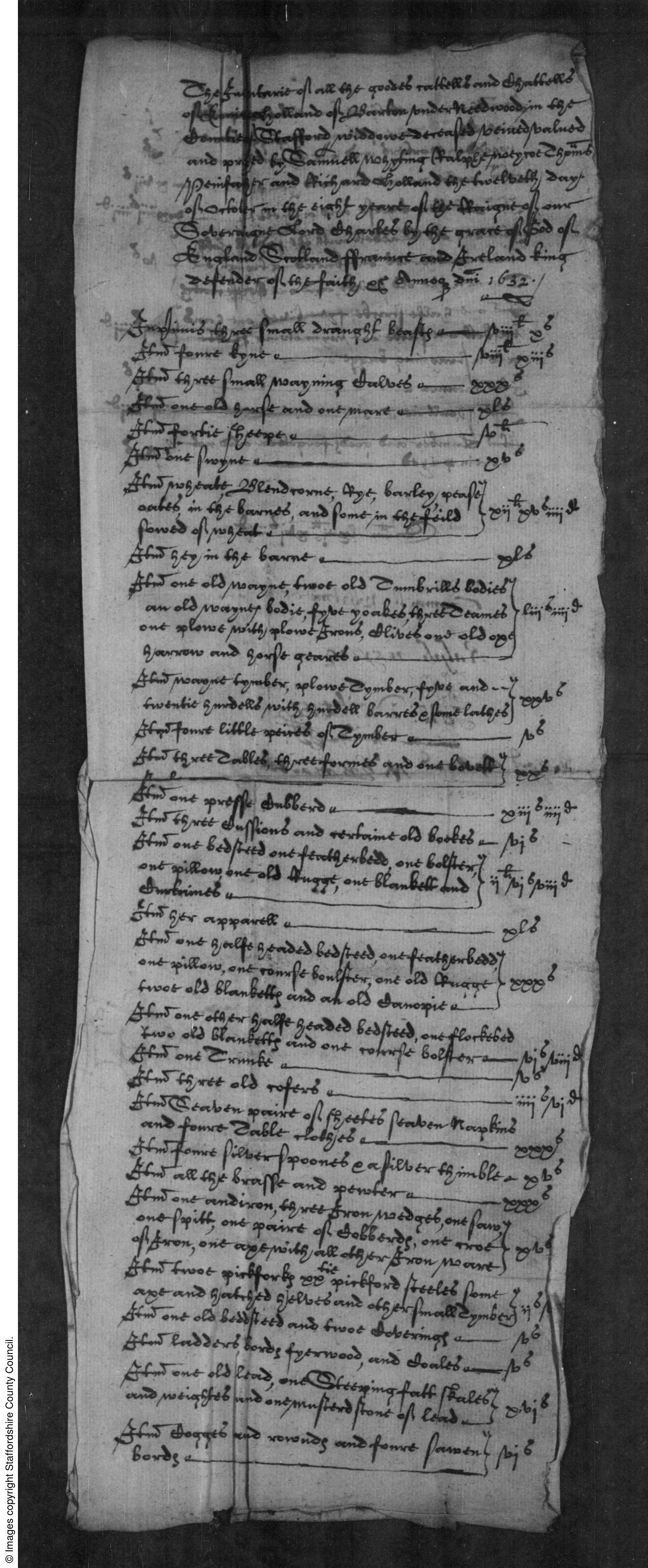
I’d been reading about “pedigree collapse” just before I found out her maiden name of Edwardes. Edwards is my own maiden name.
“In genealogy, pedigree collapse describes how reproduction between two individuals who knowingly or unknowingly share an ancestor causes the family tree of their offspring to be smaller than it would otherwise be.
Without pedigree collapse, a person’s ancestor tree is a binary tree, formed by the person, the parents, grandparents, and so on. However, the number of individuals in such a tree grows exponentially and will eventually become impossibly high. For example, a single individual alive today would, over 30 generations going back to the High Middle Ages, have roughly a billion ancestors, more than the total world population at the time. This apparent paradox occurs because the individuals in the binary tree are not distinct: instead, a single individual may occupy multiple places in the binary tree. This typically happens when the parents of an ancestor are cousins (sometimes unbeknownst to themselves). For example, the offspring of two first cousins has at most only six great-grandparents instead of the normal eight. This reduction in the number of ancestors is pedigree collapse. It collapses the binary tree into a directed acyclic graph with two different, directed paths starting from the ancestor who in the binary tree would occupy two places.” via wikipediaThere is nothing to suggest, however, that Eunica’s family were related to my fathers family, and the only evidence so far in my tree of pedigree collapse are the marriages of Orgill cousins, where two sets of grandparents are repeated.
A list of Holland ancestors:
Catherine Holland 1775-1861
her parents:
Thomas Holland 1737-1828 Hannah Hair 1739-1832
Thomas’s parents:
William Holland 1696-1756 Susannah Whiteing 1715-1752
William’s parents:
William Holland 1665- Elizabeth Higgs 1675-1720
William’s parents:
Thomas Holland 1634-1681 Katherine Owen 1634-1728
Thomas’s parents:
Thomas Holland 1606-1680 Margaret Belcher 1608-1664
Thomas’s parents:
Thomas Holland 1562-1626 Eunice Edwardes 1565- 1632May 21, 2022 at 8:28 am #6298Topic: The Sexy Wooden Leg
in forum Yurara Fameliki’s StoriesThe Rootians invaded Oocrane when everybody was busy looking elsewhere. They entered through the Dumbass region under the pretense of freeing it from Lazies who had infiltrated administrations and media. They often cited a recent short movie from president Voldomeer Zumbaskee in which he appeared in purple leather panties adorned with diamonds, showing unashamedly his wooden leg. The same wooden leg that gave him the status of sexiest man of Oocrane and got him elected. In one of his famous discourses, he accused the Rootian president, Valdamir Potomsky of wanting to help himself to their crops of turnip and weed of which the world depended. And he told him if he expected Lazies he would be surprised by their resolution to defend their country.
By a simple game of chance that reality is so fond of, the man who made the president’s very wooden leg was also called Voldomeer Zumbasky. They might share a common ancestor, but many times in the past population records were destroyed and it was difficult to tell. That man lived in the small city of Duckailingtown in Dumbass, near the Rootian border. He was renowned to be a great carpenter and sculptor and before the war people would come from the neighbooring countries to buy his work.
During the invasion, crops and forests were burnt, buildings were destroyed and Dumbass Voldomeer lost one leg. There were no more trees or beams that hadn’t been turned to ashes, and he had only one block of wood left. Enough to make another wooden leg for himself. But he wondered: wasn’t there something more useful he could do with that block of wood ?
One morning of spring, one year after the war started. Food was scarce in Duckailingtown and Voldomeer’s belly growled as he walked past the nest of a couple of swans. He counted nine beautiful eggs that the parents were arranging with their beaks before lying on top to keep them warm. He found it so touching to see life in this place that he couldn’t bear the idea of simply stealing the eggs.
He went back home, a shelter made of bricks, his stomach aching from starvation. Looking at the block of wood on the floor, he got an idea. He spent the rest of the day and night to carve nine beautiful eggs so smooth that they appeared warm to the touch. He put so much care and love in his work that the swans would see no difference.
The next morning he went back to the nest with a leather bag, hopping heartily on his lone leg. The eggs were still there and by chance both the parents were missing. He didn’t care why. He took the eggs and replaced them with the wooden ones.
That day, he ate the best omelet with his friend Rooby, and as far as one could tell the swans were still brooding by the end of summer.
March 10, 2022 at 7:40 am #6281In reply to: The Elusive Samuel Housley and Other Family Stories
The Measham Thatchers
Orgills, Finches and Wards
Measham is a large village in north west Leicestershire, England, near the Derbyshire, Staffordshire and Warwickshire boundaries. Our family has a penchant for border straddling, and the Orgill’s of Measham take this a step further living on the boundaries of four counties. Historically it was in an exclave of Derbyshire absorbed into Leicestershire in 1897, so once again we have two sets of county records to search.
ORGILL
Richard Gretton, the baker of Swadlincote and my great grandmother Florence Nightingale Grettons’ father, married Sarah Orgill (1840-1910) in 1861.
(Incidentally, Florence Nightingale Warren nee Gretton’s first child Hildred born in 1900 had the middle name Orgill. Florence’s brother John Orgill Gretton emigrated to USA.)
When they first married, they lived with Sarah’s widowed mother Elizabeth in Measham. Elizabeth Orgill is listed on the 1861 census as a farmer of two acres.
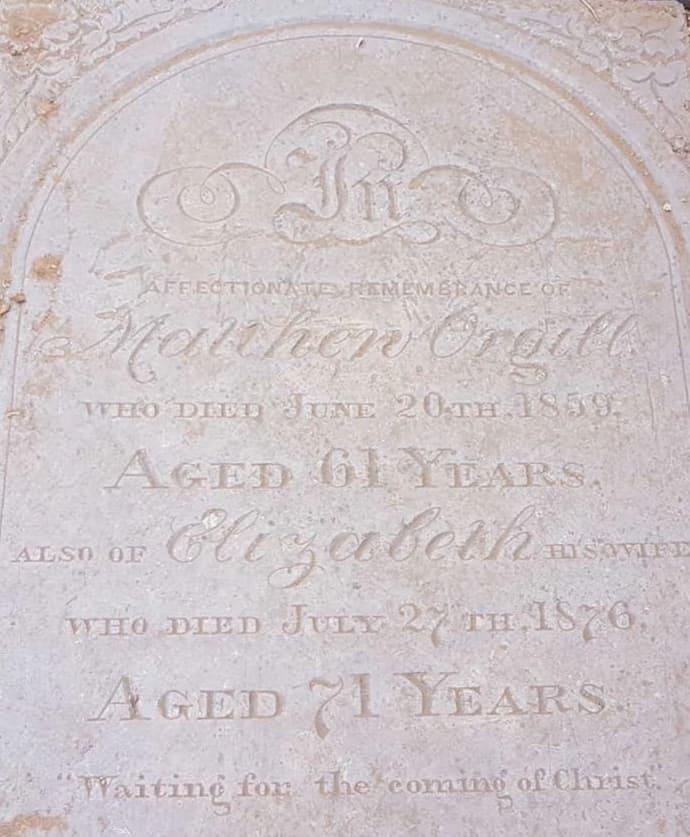
Sarah Orgill’s father Matthew Orgill (1798-1859) was a thatcher, as was his father Matthew Orgill (1771-1852).
Matthew Orgill the elder left his property to his son Henry:
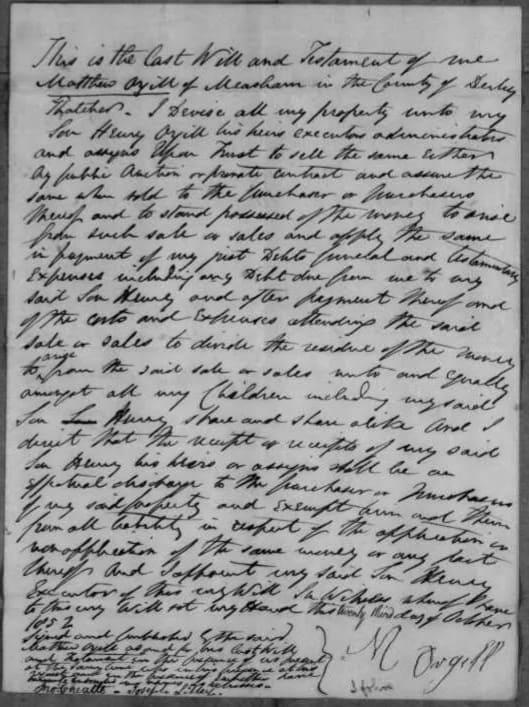
Sarah’s mother Elizabeth (1803-1876) was also an Orgill before her marriage to Matthew.
According to Pigot & Co’s Commercial Directory for Derbyshire, in Measham in 1835 Elizabeth Orgill was a straw bonnet maker, an ideal occupation for a thatchers wife.
Matthew Orgill, thatcher, is listed in White’s directory in 1857, and other Orgill’s are mentioned in Measham:
Mary Orgill, straw hat maker; Henry Orgill, grocer; Daniel Orgill, painter; another Matthew Orgill is a coal merchant and wheelwright. Likewise a number of Orgill’s are listed in the directories for Measham in the subsequent years, as farmers, plumbers, painters, grocers, thatchers, wheelwrights, coal merchants and straw bonnet makers.
Matthew and Elizabeth Orgill, Measham Baptist church:
According to a history of thatching, for every six or seven thatchers appearing in the 1851 census there are now less than one. Another interesting fact in the history of thatched roofs (via thatchinginfo dot com):
The Watling Street Divide…
The biggest dividing line of all, that between the angular thatching of the Northern and Eastern traditions and the rounded Southern style, still roughly follows a very ancient line; the northern section of the old Roman road of Watling Street, the modern A5. Seemingly of little significance today; this was once the border between two peoples. Agreed in the peace treaty, between the Saxon King Alfred and Guthrum, the Danish Viking leader; over eleven centuries ago.
After making their peace, various Viking armies settled down, to the north and east of the old road; firstly, in what was known as The Danelaw and later in Norse kingdoms, based in York. They quickly formed a class of farmers and peasants. Although the Saxon kings soon regained this area; these people stayed put. Their influence is still seen, for example, in the widespread use of boarded gable ends, so common in Danish thatching.
Over time, the Southern and Northern traditions have slipped across the old road, by a few miles either way. But even today, travelling across the old highway will often bring the differing thatching traditions quickly into view.Pear Tree Cottage, Bosworth Road, Measham. 1900. Matthew Orgill was a thatcher living on Bosworth road.
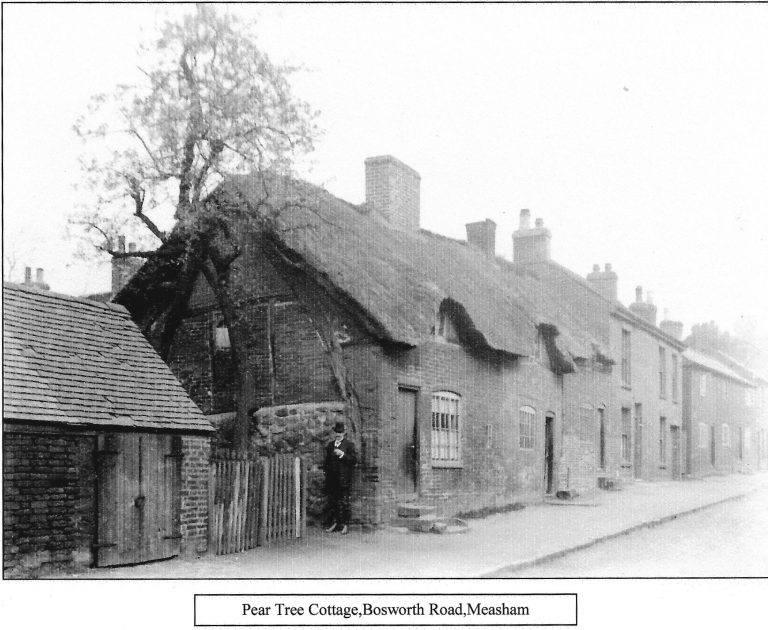
FINCH
Matthew the elder married Frances Finch 1771-1848, also of Measham. On the 1851 census Matthew is an 80 year old thatcher living with his daughter Mary and her husband Samuel Piner, a coal miner.
Henry Finch 1743- and Mary Dennis 1749- , both of Measham, were Frances parents. Henry’s father was also Henry Finch, born in 1707 in Measham, and he married Frances Ward, also born in 1707, and also from Measham.
WARD
The ancient boundary between the kingdom of Mercia and the Danelaw
I didn’t find much information on the history of Measham, but I did find a great deal of ancient history on the nearby village of Appleby Magna, two miles away. The parish records indicate that the Ward and Finch branches of our family date back to the 1500’s in the village, and we can assume that the ancient history of the neighbouring village would be relevant to our history.
There is evidence of human settlement in Appleby from the early Neolithic period, 6,000 years ago, and there are also Iron Age and Bronze Age sites in the vicinity. There is evidence of further activity within the village during the Roman period, including evidence of a villa or farm and a temple. Appleby is near three known Roman roads: Watling Street, 10 miles south of the village; Bath Lane, 5 miles north of the village; and Salt Street, which forms the parish’s south boundary.
But it is the Scandinavian invasions that are particularly intriguing, with regard to my 58% Scandinavian DNA (and virtually 100% Midlands England ancestry). Repton is 13 miles from Measham. In the early 10th century Chilcote, Measham and Willesley were part of the royal Derbyshire estate of Repton.
The arrival of Scandinavian invaders in the second half of the ninth century caused widespread havoc throughout northern England. By the AD 870s the Danish army was occupying Mercia and it spent the winter of 873-74 at Repton, the headquarters of the Mercian kings. The events are recorded in detail in the Peterborough manuscript of the Anglo-Saxon Chronicles…
Although the Danes held power for only 40 years, a strong, even subversive, Danish element remained in the population for many years to come.
A Scandinavian influence may also be detected among the field names of the parish. Although many fields have relatively modern names, some clearly have elements which reach back to the time of Danish incursion and control.
The Borders:
The name ‘aeppel byg’ is given in the will of Wulfic Spot of AD 1004……………..The decision at Domesday to include this land in Derbyshire, as one of Burton Abbey’s Derbyshire manors, resulted in the division of the village of Appleby Magna between the counties of Leicester and Derby for the next 800 years
Richard Dunmore’s Appleby Magma website.
This division of Appleby between Leicestershire and Derbyshire persisted from Domesday until 1897, when the recently created county councils (1889) simplified the administration of many villages in this area by a radical realignment of the boundary:
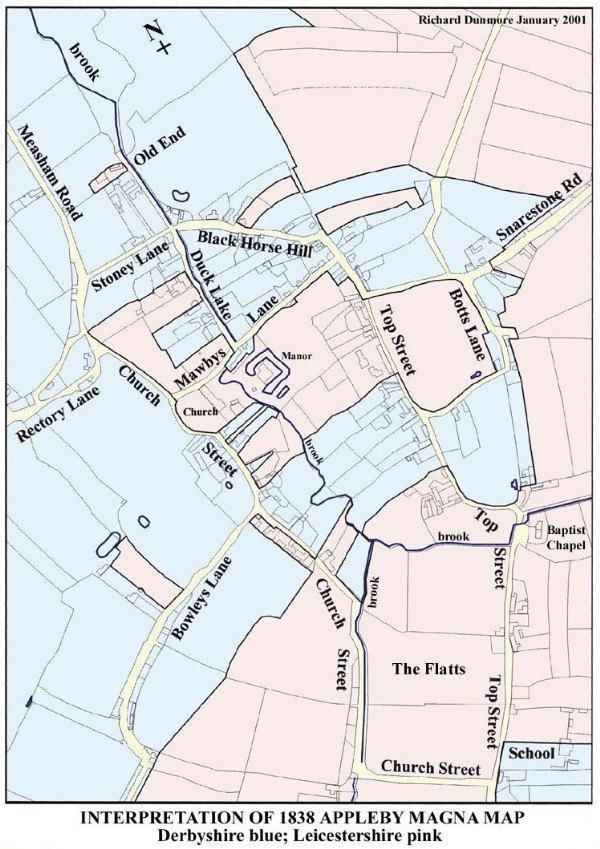
I would appear that our family not only straddle county borders, but straddle ancient kingdom borders as well. This particular branch of the family (we assume, given the absence of written records that far back) were living on the edge of the Danelaw and a strong element of the Danes survives to this day in my DNA.
March 4, 2022 at 2:58 pm #6280In reply to: The Whale’s Diaries Collection
I started reading a book. In fact I started reading it three weeks ago, and have read the first page of the preface every night and fallen asleep. But my neck aches from doing too much gardening so I went back to bed to read this morning. I still fell asleep six times but at least I finished the preface. It’s the story of the family , initiated by the family collection of netsuke (whatever that is. Tiny Japanese carvings) But this is what stopped me reading and made me think (and then fall asleep each time I re read it)
“And I’m not entitled to nostalgia about all that lost wealth and glamour from a century ago. And I am not interested in thin. I want to know what the relationship has been between this wooden object that I am rolling between my fingers – hard and tricky and Japanese – and where it has been. I want to be able to reach to the handle of the door and turn it and feel it open. I want to walk into each room where this object has lived, to feel the volume of the space, to know what pictures were on the walls, how the light fell from the windows. And I want to know whose hands it has been in, and what they felt about it and thought about it – if they thought about it. I want to know what it has witnessed.” ― Edmund de Waal, The Hare With Amber Eyes: A Family’s Century of Art and Loss
And I felt almost bereft that none of the records tell me which way the light fell in through the windows.
I know who lived in the house in which years, but I don’t know who sat in the sun streaming through the window and which painting upon the wall they looked at and what the material was that covered the chair they sat on.
Were his clothes confortable (or hers, likely not), did he have an old favourite pair of trousers that his mother hated?
There is one house in particular that I keep coming back to. Like I got on the Housley train at Smalley and I can’t get off. Kidsley Grange Farm, they turned it into a nursing home and built extensions, and now it’s for sale for five hundred thousand pounds. But is the ghost still under the back stairs? Is there still a stain somewhere when a carafe of port was dropped?
Did Anns writing desk survive? Does someone have that, polished, with a vase of spring tulips on it? (on a mat of course so it doesn’t make a ring, despite that there are layers of beeswaxed rings already)
Does the desk remember the letters, the weight of a forearm or elbow, perhaps a smeared teardrop, or a comsumptive cough stain?
Is there perhaps a folded bit of paper or card that propped an uneven leg that fell through the floorboards that might tear into little squares if you found it and opened it, and would it be a rough draft of a letter never sent, or just a receipt for five head of cattle the summer before?
Did he hate the curtain material, or not even think of it? Did he love the house, or want to get away to see something new ~ or both?
Did he have a favourite cup, a favourite food, did he hate liver or cabbage?
Did he like his image when the photograph came from the studio or did he think it made his nose look big or his hair too thin, or did he wish he’d worn his other waistcoat?
Did he love his wife so much he couldn’t bear to see her dying, was it neglect or was it the unbearableness of it all that made him go away and drink?
Did the sun slanting in through the dormer window of his tiny attic room where he lodged remind him of ~ well no perhaps he was never in the room in daylight hours at all. Work all day and pub all night, keeping busy working hard and drinking hard and perhaps laughing hard, and maybe he only thought of it all on Sunday mornings.
So many deaths, one after another, his father, his wife, his brother, his sister, and another and another, all the coughing, all the debility. Perhaps he never understood why he lived and they did not, what kind of justice was there in that?
Did he take a souvenir or two with him, a handkerchief or a shawl perhaps, tucked away at the bottom of a battered leather bag that had his 3 shirts and 2 waistcoats in and a spare cap,something embroidered perhaps.
The quote in that book started me off with the light coming in the window and the need to know the simplest things, something nobody ever wrote in a letter, maybe never even mentioned to anyone.
Light coming in windows. I remeber when I was a teenager I had a day off sick and spent the whole day laying on the couch in a big window with the winter sun on my face all day, and I read Bonjour Tristesse in one sitting, and I’ll never forget that afternoon. I don’t remember much about that book, but I remember being transported. But at the same time as being present in that sunny window.
“Stories and objects share something, a patina…Perhaps patina is a process of rubbing back so that the essential is revealed…But it also seems additive, in the way that a piece of oak furniture gains over years and years of polishing.”
“How objects are handed on is all about story-telling. I am giving you this because I love you. Or because it was given to me. Because I bought it somewhere special. Because you will care for it. Because it will complicate your life. Because it will make someone else envious. There is no easy story in legacy. What is remembered and what is forgotten? There can be a chain of forgetting, the rubbing away of previous ownership as much as the slow accretion of stories. What is being passed on to me with all these small Japanese objects?”
“There are things in this world that the children hear, but whose sounds oscillate below an adult’s sense of pitch.”
What did the children hear?
February 5, 2022 at 2:16 pm #6273In reply to: The Elusive Samuel Housley and Other Family Stories
The Housley Letters
THE NEIGHBORHOODFrom Barbara Housley’s Narrative on the Letters:
In July 1872, Joseph wrote to George who had been gone for 21 years: “You would not know Heanor now. It has got such a large place. They have got a town hall built where Charles’ stone yard was.”
Then Joseph took George on a tour from Smalley to Heanor pointing out all the changes:
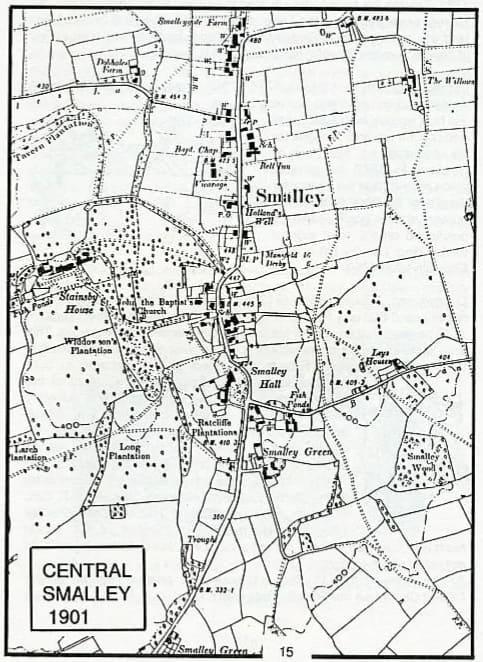
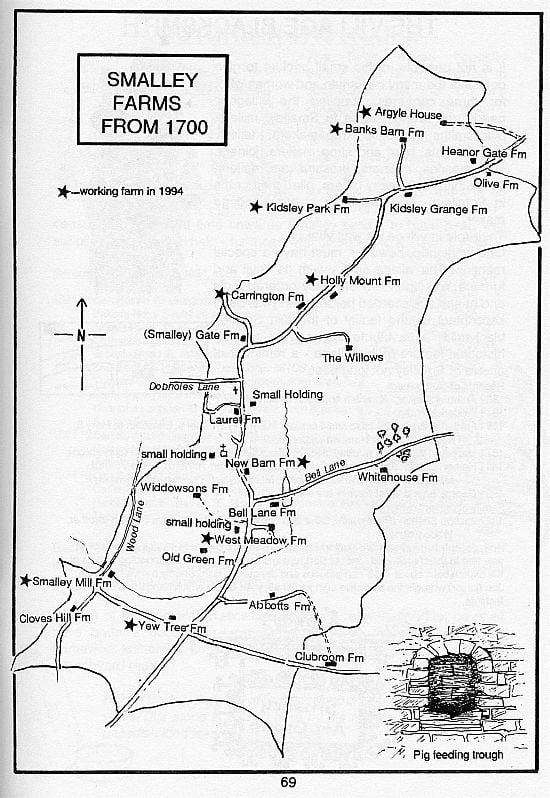
“Now we commence at Firby Brook. There is no public house there. It is turned into a market gardener’s place. Morley smithy stands as it did. You would know Chris Shepperd that used to keep the farm opposite. He is dead and the farm is got into other hands.” (In 1851, Chris Shepherd, age 39, and his widowed mother, Mary, had a farm of 114 acres. Charles Carrington, age 14, worked for them as a “cow boy.” In 1851 Hollingsworths also lived at Morely smithy.) “The Rose and Crown stands and Antony Kerry keeps that yet.” (In 1851, the census listed Kerry as a mason, builder, victicular, and farmer. He lived with his wife and four sons and numerous servants.) “They have pulled down Samuel Kerry’s farm house down and built him one in another place. Now we come to the Bell that was but they have pulled the old one down and made Isaac Potters House into the new Bell.” (In 1851, The Bell was run by Ann Weston, a widow.)
Smalley Roundhouse:
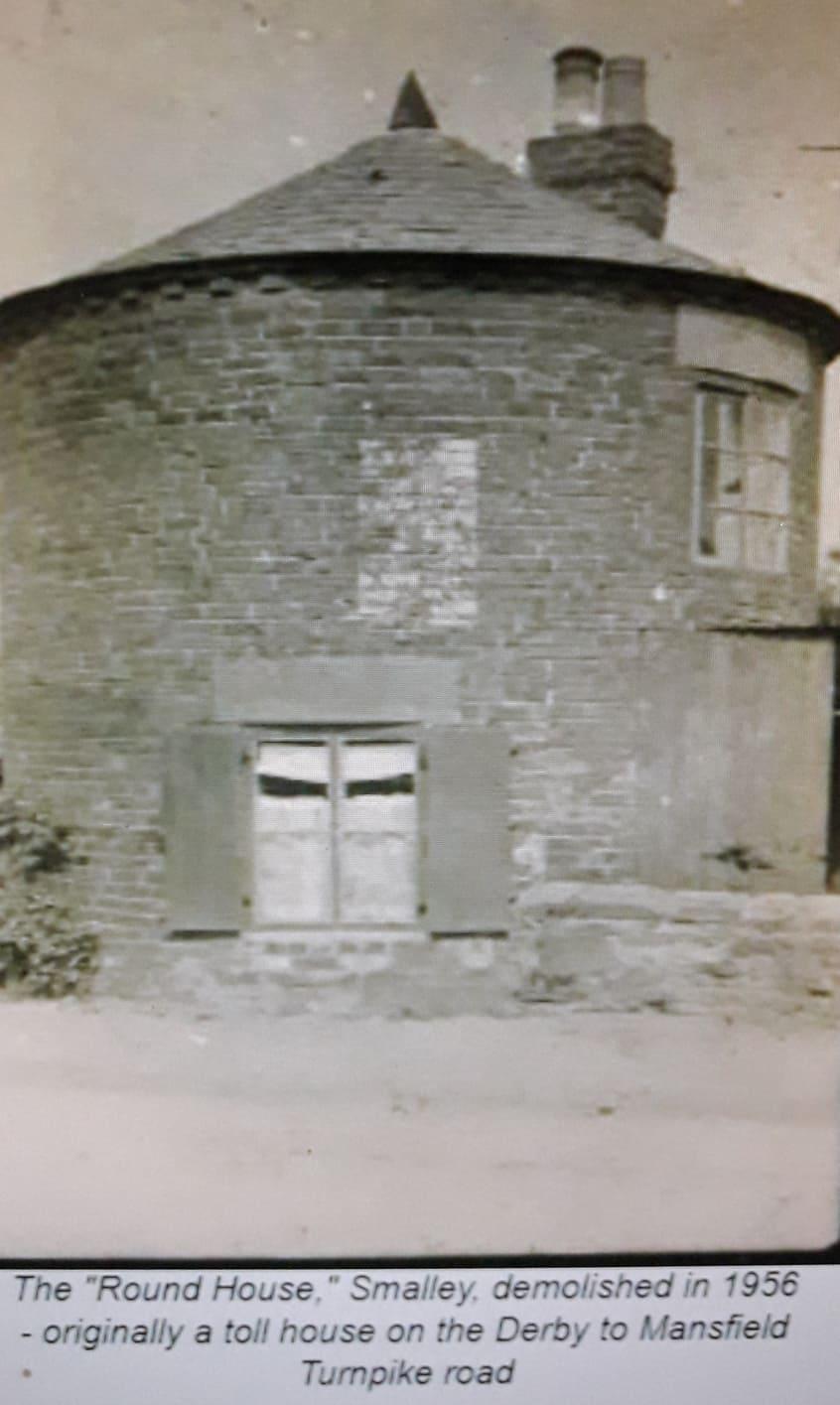
“The old Round House is standing yet but they have took the machine away. The Public House at the top end is kept by Mrs. Turton. I don’t know who she was before she married. Now we get to old Tom Oldknow. The old house is pulled down and a new one is put up but it is gone out of the family altogether. Now Jack is living at Stanley. He married Ann that used to live at Barbers at Smalley. That finishes Smalley. Now for Taghill. The old Jolly Collier is standing yet and a man of the name of Remmington keeps the new one opposite. Jack Foulkes son Jack used to keep that but has left just lately. There is the Nottingham House, Nags Head, Cross Keys and then the Red Lion but houses built on both sides all the way down Taghill. Then we get to the town hall that is built on the ground that Charles’ Stone Yard used to be. There is Joseph Watson’s shop standing yet in the old place. The King of Prussia, the White Lion and Hanks that is the Public House. You see there are more than there used to be. The Magistrate sits at the Town Hall and tries cases there every fortnight.”
.
February 4, 2022 at 3:17 pm #6269In reply to: The Elusive Samuel Housley and Other Family Stories
The Housley Letters
From Barbara Housley’s Narrative on the Letters.
William Housley (1781-1848) and Ellen Carrington were married on May 30, 1814 at St. Oswald’s church in Ashbourne. William died in 1848 at the age of 67 of “disease of lungs and general debility”. Ellen died in 1872.
Marriage of William Housley and Ellen Carrington in Ashbourne in 1814:
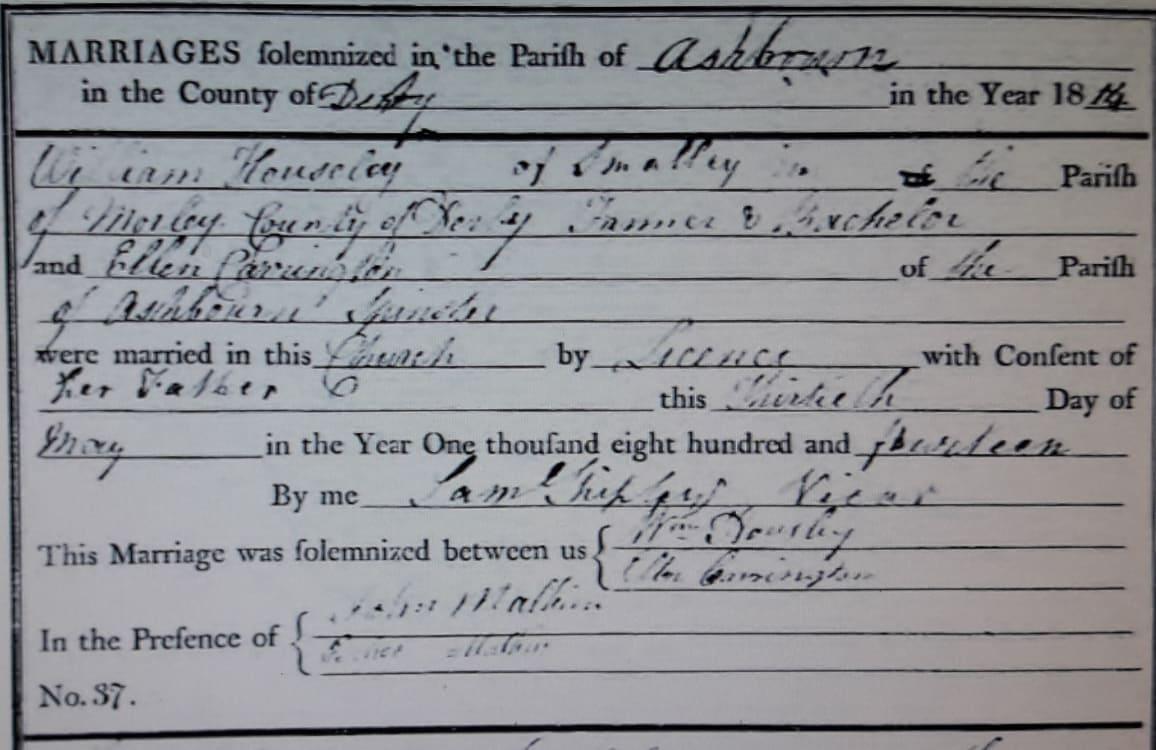
Parish records show three children for William and his first wife, Mary, Ellens’ sister, who were married December 29, 1806: Mary Ann, christened in 1808 and mentioned frequently in the letters; Elizabeth, christened in 1810, but never mentioned in any letters; and William, born in 1812, probably referred to as Will in the letters. Mary died in 1813.
William and Ellen had ten children: John, Samuel, Edward, Anne, Charles, George, Joseph, Robert, Emma, and Joseph. The first Joseph died at the age of four, and the last son was also named Joseph. Anne never married, Charles emigrated to Australia in 1851, and George to USA, also in 1851. The letters are to George, from his sisters and brothers in England.
The following are excerpts of those letters, including excerpts of Barbara Housley’s “Narrative on Historic Letters”. They are grouped according to who they refer to, rather than chronological order.
ELLEN HOUSLEY 1795-1872
Joseph wrote that when Emma was married, Ellen “broke up the comfortable home and the things went to Derby and she went to live with them but Derby didn’t agree with her so she left again leaving her things behind and came to live with John in the new house where she died.” Ellen was listed with John’s household in the 1871 census.
In May 1872, the Ilkeston Pioneer carried this notice: “Mr. Hopkins will sell by auction on Saturday next the eleventh of May 1872 the whole of the useful furniture, sewing machine, etc. nearly new on the premises of the late Mrs. Housley at Smalley near Heanor in the county of Derby. Sale at one o’clock in the afternoon.”Ellen’s family was evidently rather prominant in Smalley. Two Carringtons (John and William) served on the Parish Council in 1794. Parish records are full of Carrington marriages and christenings; census records confirm many of the family groupings.
In June of 1856, Emma wrote: “Mother looks as well as ever and was told by a lady the other day that she looked handsome.” Later she wrote: “Mother is as stout as ever although she sometimes complains of not being able to do as she used to.”
Mary’s children:
MARY ANN HOUSLEY 1808-1878
There were hard feelings between Mary Ann and Ellen and her children. Anne wrote: “If you remember we were not very friendly when you left. They never came and nothing was too bad for Mary Ann to say of Mother and me, but when Robert died Mother sent for her to the funeral but she did not think well to come so we took no more notice. She would not allow her children to come either.”
Mary Ann was unlucky in love! In Anne’s second letter she wrote: “William Carrington is paying Mary Ann great attention. He is living in London but they write to each other….We expect it will be a match.” Apparantly the courtship was stormy for in 1855, Emma wrote: “Mary Ann’s wedding with William Carrington has dropped through after she had prepared everything, dresses and all for the occassion.” Then in 1856, Emma wrote: “William Carrington and Mary Ann are separated. They wore him out with their nonsense.” Whether they ever married is unclear. Joseph wrote in 1872: “Mary Ann was married but her husband has left her. She is in very poor health. She has one daughter and they are living with their mother at Smalley.”
Regarding William Carrington, Emma supplied this bit of news: “His sister, Mrs. Lily, has eloped with a married man. Is she not a nice person!”
WILLIAM HOUSLEY JR. 1812-1890
According to a letter from Anne, Will’s two sons and daughter were sent to learn dancing so they would be “fit for any society.” Will’s wife was Dorothy Palfry. They were married in Denby on October 20, 1836 when Will was 24. According to the 1851 census, Will and Dorothy had three sons: Alfred 14, Edwin 12, and William 10. All three boys were born in Denby.
In his letter of May 30, 1872, after just bemoaning that all of his brothers and sisters are gone except Sam and John, Joseph added: “Will is living still.” In another 1872 letter Joseph wrote, “Will is living at Heanor yet and carrying on his cattle dealing.” The 1871 census listed Will, 59, and his son William, 30, of Lascoe Road, Heanor, as cattle dealers.
Ellen’s children:
JOHN HOUSLEY 1815-1893
John married Sarah Baggally in Morely in 1838. They had at least six children. Elizabeth (born 2 May 1838) was “out service” in 1854. In her “third year out,” Elizabeth was described by Anne as “a very nice steady girl but quite a woman in appearance.” One of her positions was with a Mrs. Frearson in Heanor. Emma wrote in 1856: “Elizabeth is still at Mrs. Frearson. She is such a fine stout girl you would not know her.” Joseph wrote in 1872 that Elizabeth was in service with Mrs. Eliza Sitwell at Derby. (About 1850, Miss Eliza Wilmot-Sitwell provided for a small porch with a handsome Norman doorway at the west end of the St. John the Baptist parish church in Smalley.)
According to Elizabeth’s birth certificate and the 1841 census, John was a butcher. By 1851, the household included a nurse and a servant, and John was listed as a “victular.” Anne wrote in February 1854, “John has left the Public House a year and a half ago. He is living where Plumbs (Ann Plumb witnessed William’s death certificate with her mark) did and Thomas Allen has the land. He has been working at James Eley’s all winter.” In 1861, Ellen lived with John and Sarah and the three boys.
John sold his share in the inheritance from their mother and disappeared after her death. (He died in Doncaster, Yorkshire, in 1893.) At that time Charles, the youngest would have been 21. Indeed, Joseph wrote in July 1872: “John’s children are all grown up”.
In May 1872, Joseph wrote: “For what do you think, John has sold his share and he has acted very bad since his wife died and at the same time he sold all his furniture. You may guess I have never seen him but once since poor mother’s funeral and he is gone now no one knows where.”
In February 1874 Joseph wrote: “You want to know what made John go away. Well, I will give you one reason. I think I told you that when his wife died he persuaded me to leave Derby and come to live with him. Well so we did and dear Harriet to keep his house. Well he insulted my wife and offered things to her that was not proper and my dear wife had the power to resist his unmanly conduct. I did not think he could of served me such a dirty trick so that is one thing dear brother. He could not look me in the face when we met. Then after we left him he got a woman in the house and I suppose they lived as man and wife. She caught the small pox and died and there he was by himself like some wild man. Well dear brother I could not go to him again after he had served me and mine as he had and I believe he was greatly in debt too so that he sold his share out of the property and when he received the money at Belper he went away and has never been seen by any of us since but I have heard of him being at Sheffield enquiring for Sam Caldwell. You will remember him. He worked in the Nag’s Head yard but I have heard nothing no more of him.”
A mention of a John Housley of Heanor in the Nottinghma Journal 1875. I don’t know for sure if the John mentioned here is the brother John who Joseph describes above as behaving improperly to his wife. John Housley had a son Joseph, born in 1840, and John’s wife Sarah died in 1870.
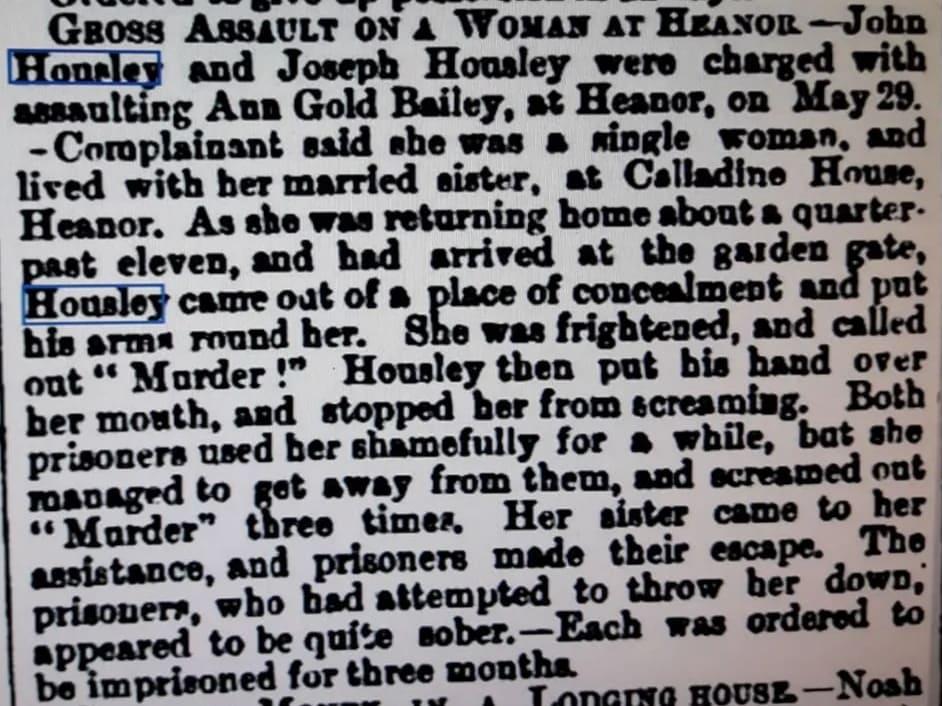
In 1876, the solicitor wrote to George: “Have you heard of John Housley? He is entitled to Robert’s share and I want him to claim it.”
SAMUEL HOUSLEY 1816-
Sam married Elizabeth Brookes of Sutton Coldfield, and they had three daughters: Elizabeth, Mary Anne and Catherine. Elizabeth his wife died in 1849, a few months after Samuel’s father William died in 1848. The particular circumstances relating to these individuals have been discussed in previous chapters; the following are letter excerpts relating to them.
Death of William Housley 15 Dec 1848, and Elizabeth Housley 5 April 1849, Smalley:
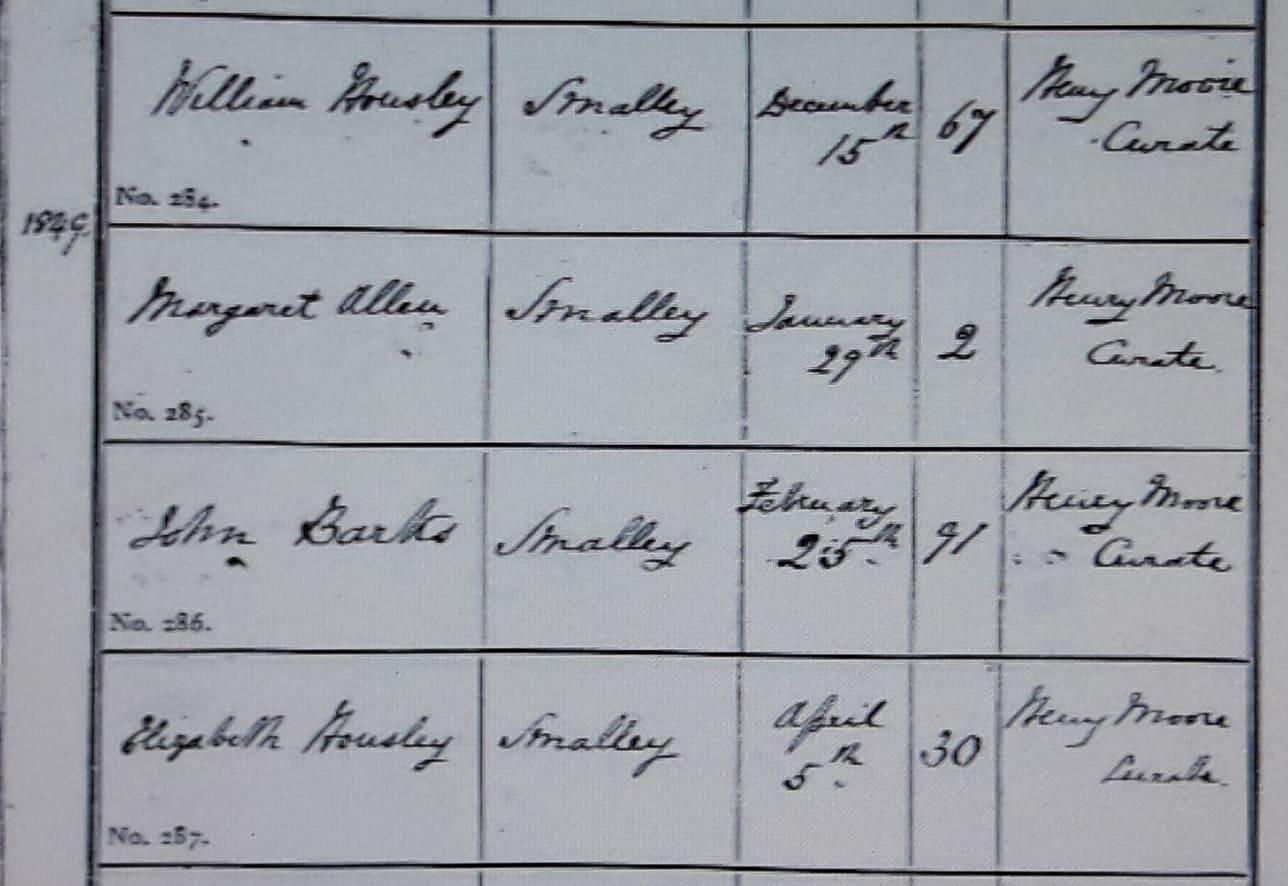
Joseph wrote in December 1872: “I saw one of Sam’s daughters, the youngest Kate, you would remember her a baby I dare say. She is very comfortably married.”
In the same letter (December 15, 1872), Joseph wrote: “I think we have now found all out now that is concerned in the matter for there was only Sam that we did not know his whereabouts but I was informed a week ago that he is dead–died about three years ago in Birmingham Union. Poor Sam. He ought to have come to a better end than that….His daughter and her husband went to Brimingham and also to Sutton Coldfield that is where he married his wife from and found out his wife’s brother. It appears he has been there and at Birmingham ever since he went away but ever fond of drink.”
(Sam, however, was still alive in 1871, living as a lodger at the George and Dragon Inn, Henley in Arden. And no trace of Sam has been found since. It would appear that Sam did not want to be found.)
EDWARD HOUSLEY 1819-1843
Edward died before George left for USA in 1851, and as such there is no mention of him in the letters.
ANNE HOUSLEY 1821-1856
Anne wrote two letters to her brother George between February 1854 and her death in 1856. Apparently she suffered from a lung disease for she wrote: “I can say you will be surprised I am still living and better but still cough and spit a deal. Can do nothing but sit and sew.” According to the 1851 census, Anne, then 29, was a seamstress. Their friend, Mrs. Davy, wrote in March 1856: “This I send in a box to my Brother….The pincushion cover and pen wiper are Anne’s work–are for thy wife. She would have made it up had she been able.” Anne was not living at home at the time of the 1841 census. She would have been 19 or 20 and perhaps was “out service.”
In her second letter Anne wrote: “It is a great trouble now for me to write…as the body weakens so does the mind often. I have been very weak all summer. That I continue is a wonder to all and to spit so much although much better than when you left home.” She also wrote: “You know I had a desire for America years ago. Were I in health and strength, it would be the land of my adoption.”
In November 1855, Emma wrote, “Anne has been very ill all summer and has not been able to write or do anything.” Their neighbor Mrs. Davy wrote on March 21, 1856: “I fear Anne will not be long without a change.” In a black-edged letter the following June, Emma wrote: “I need not tell you how happy she was and how calmly and peacefully she died. She only kept in bed two days.”
Certainly Anne was a woman of deep faith and strong religious convictions. When she wrote that they were hoping to hear of Charles’ success on the gold fields she added: “But I would rather hear of him having sought and found the Pearl of great price than all the gold Australia can produce, (For what shall it profit a man if he gain the whole world and lose his soul?).” Then she asked George: “I should like to learn how it was you were first led to seek pardon and a savior. I do feel truly rejoiced to hear you have been led to seek and find this Pearl through the workings of the Holy Spirit and I do pray that He who has begun this good work in each of us may fulfill it and carry it on even unto the end and I can never doubt the willingness of Jesus who laid down his life for us. He who said whoever that cometh unto me I will in no wise cast out.”
Anne’s will was probated October 14, 1856. Mr. William Davy of Kidsley Park appeared for the family. Her estate was valued at under £20. Emma was to receive fancy needlework, a four post bedstead, feather bed and bedding, a mahogany chest of drawers, plates, linen and china. Emma was also to receive Anne’s writing desk. There was a condition that Ellen would have use of these items until her death.
The money that Anne was to receive from her grandfather, William Carrington, and her father, William Housley was to be distributed one third to Joseph, one third to Emma, and one third to be divided between her four neices: John’s daughter Elizabeth, 18, and Sam’s daughters Elizabeth, 10, Mary Ann, 9 and Catharine, age 7 to be paid by the trustees as they think “most useful and proper.” Emma Lyon and Elizabeth Davy were the witnesses.
The Carrington Farm:
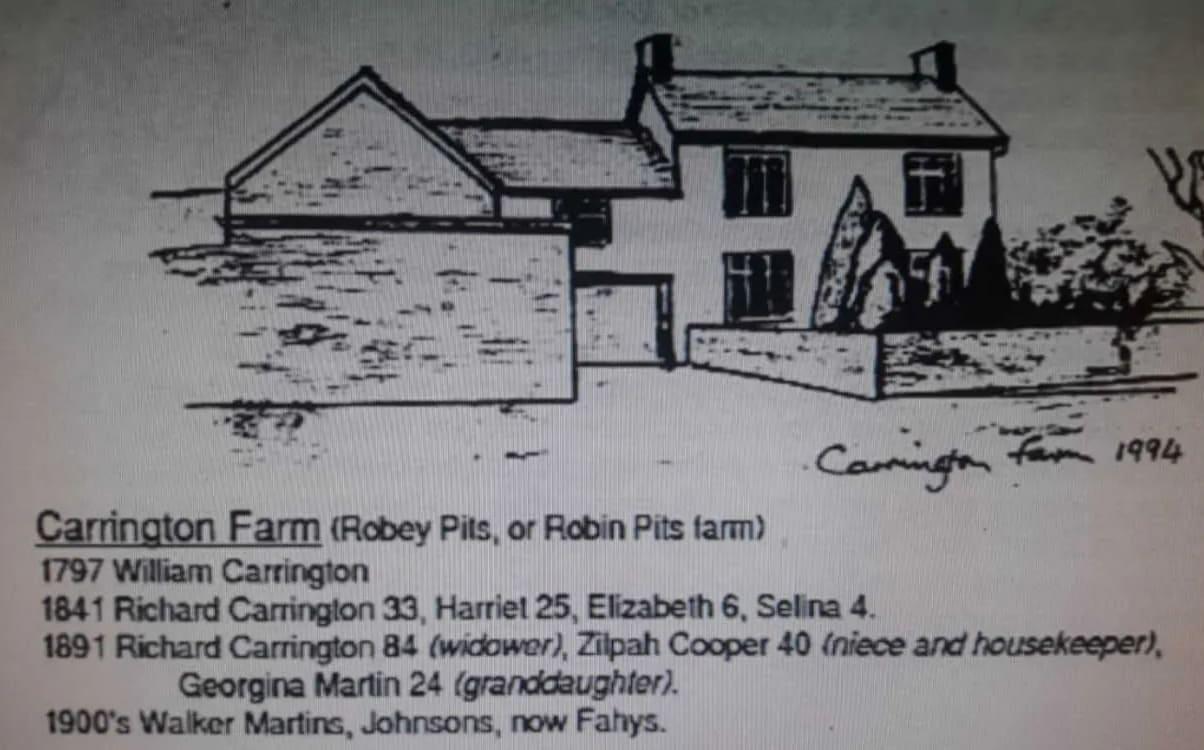
CHARLES HOUSLEY 1823-1855
Charles went to Australia in 1851, and was last heard from in January 1853. According to the solicitor, who wrote to George on June 3, 1874, Charles had received advances on the settlement of their parent’s estate. “Your promissory note with the two signed by your brother Charles for 20 pounds he received from his father and 20 pounds he received from his mother are now in the possession of the court.”
Charles and George were probably quite close friends. Anne wrote in 1854: “Charles inquired very particularly in both his letters after you.”
According to Anne, Charles and a friend married two sisters. He and his father-in-law had a farm where they had 130 cows and 60 pigs. Whatever the trade he learned in England, he never worked at it once he reached Australia. While it does not seem that Charles went to Australia because gold had been discovered there, he was soon caught up in “gold fever”. Anne wrote: “I dare say you have heard of the immense gold fields of Australia discovered about the time he went. Thousands have since then emigrated to Australia, both high and low. Such accounts we heard in the papers of people amassing fortunes we could not believe. I asked him when I wrote if it was true. He said this was no exaggeration for people were making their fortune daily and he intended going to the diggings in six weeks for he could stay away no longer so that we are hoping to hear of his success if he is alive.”
In March 1856, Mrs. Davy wrote: “I am sorry to tell thee they have had a letter from Charles’s wife giving account of Charles’s death of 6 months consumption at the Victoria diggings. He has left 2 children a boy and a girl William and Ellen.” In June of the same year in a black edged letter, Emma wrote: “I think Mrs. Davy mentioned Charles’s death in her note. His wife wrote to us. They have two children Helen and William. Poor dear little things. How much I should like to see them all. She writes very affectionately.”
In December 1872, Joseph wrote: “I’m told that Charles two daughters has wrote to Smalley post office making inquiries about his share….” In January 1876, the solicitor wrote: “Charles Housley’s children have claimed their father’s share.”
GEORGE HOUSLEY 1824-1877
George emigrated to the United states in 1851, arriving in July. The solicitor Abraham John Flint referred in a letter to a 15-pound advance which was made to George on June 9, 1851. This certainly was connected to his journey. George settled along the Delaware River in Bucks County, Pennsylvania. The letters from the solicitor were addressed to: Lahaska Post Office, Bucks County, Pennsylvania.
George married Sarah Ann Hill on May 6, 1854 in Doylestown, Bucks County, Pennsylvania. In her first letter (February 1854), Anne wrote: “We want to know who and what is this Miss Hill you name in your letter. What age is she? Send us all the particulars but I would advise you not to get married until you have sufficient to make a comfortable home.”
Upon learning of George’s marriage, Anne wrote: “I hope dear brother you may be happy with your wife….I hope you will be as a son to her parents. Mother unites with me in kind love to you both and to your father and mother with best wishes for your health and happiness.” In 1872 (December) Joseph wrote: “I am sorry to hear that sister’s father is so ill. It is what we must all come to some time and hope we shall meet where there is no more trouble.”
Emma wrote in 1855, “We write in love to your wife and yourself and you must write soon and tell us whether there is a little nephew or niece and what you call them.” In June of 1856, Emma wrote: “We want to see dear Sarah Ann and the dear little boy. We were much pleased with the “bit of news” you sent.” The bit of news was the birth of John Eley Housley, January 11, 1855. Emma concluded her letter “Give our very kindest love to dear sister and dearest Johnnie.”
In September 1872, Joseph wrote, “I was very sorry to hear that John your oldest had met with such a sad accident but I hope he is got alright again by this time.” In the same letter, Joseph asked: “Now I want to know what sort of a town you are living in or village. How far is it from New York? Now send me all particulars if you please.”
In March 1873 Harriet asked Sarah Ann: “And will you please send me all the news at the place and what it is like for it seems to me that it is a wild place but you must tell me what it is like….”. The question of whether she was referring to Bucks County, Pennsylvania or some other place is raised in Joseph’s letter of the same week.
On March 17, 1873, Joseph wrote: “I was surprised to hear that you had gone so far away west. Now dear brother what ever are you doing there so far away from home and family–looking out for something better I suppose.”The solicitor wrote on May 23, 1874: “Lately I have not written because I was not certain of your address and because I doubted I had much interesting news to tell you.” Later, Joseph wrote concerning the problems settling the estate, “You see dear brother there is only me here on our side and I cannot do much. I wish you were here to help me a bit and if you think of going for another summer trip this turn you might as well run over here.”
Apparently, George had indicated he might return to England for a visit in 1856. Emma wrote concerning the portrait of their mother which had been sent to George: “I hope you like mother’s portrait. I did not see it but I suppose it was not quite perfect about the eyes….Joseph and I intend having ours taken for you when you come over….Do come over before very long.”
In March 1873, Joseph wrote: “You ask me what I think of you coming to England. I think as you have given the trustee power to sign for you I think you could do no good but I should like to see you once again for all that. I can’t say whether there would be anything amiss if you did come as you say it would be throwing good money after bad.”
On June 10, 1875, the solicitor wrote: “I have been expecting to hear from you for some time past. Please let me hear what you are doing and where you are living and how I must send you your money.” George’s big news at that time was that on May 3, 1875, he had become a naturalized citizen “renouncing and abjuring all allegiance and fidelity to every foreign prince, potentate, state and sovereignity whatsoever, and particularly to Victoria Queen of Great Britain of whom he was before a subject.”
ROBERT HOUSLEY 1832-1851
In 1854, Anne wrote: “Poor Robert. He died in August after you left he broke a blood vessel in the lung.”
From Joseph’s first letter we learn that Robert was 19 when he died: “Dear brother there have been a great many changes in the family since you left us. All is gone except myself and John and Sam–we have heard nothing of him since he left. Robert died first when he was 19 years of age. Then Anne and Charles too died in Australia and then a number of years elapsed before anyone else. Then John lost his wife, then Emma, and last poor dear mother died last January on the 11th.”Anne described Robert’s death in this way: “He had thrown up blood many times before in the spring but the last attack weakened him that he only lived a fortnight after. He died at Derby. Mother was with him. Although he suffered much he never uttered a murmur or regret and always a smile on his face for everyone that saw him. He will be regretted by all that knew him”.
Robert died a resident of St. Peter’s Parish, Derby, but was buried in Smalley on August 16, 1851.
Apparently Robert was apprenticed to be a joiner for, according to Anne, Joseph took his place: “Joseph wanted to be a joiner. We thought we could do no better than let him take Robert’s place which he did the October after and is there still.”In 1876, the solicitor wrote to George: “Have you heard of John Housley? He is entitled to Robert’s share and I want him to claim it.”
EMMA HOUSLEY 1836-1871
Emma was not mentioned in Anne’s first letter. In the second, Anne wrote that Emma was living at Spondon with two ladies in her “third situation,” and added, “She is grown a bouncing woman.” Anne described her sister well. Emma wrote in her first letter (November 12, 1855): “I must tell you that I am just 21 and we had my pudding last Sunday. I wish I could send you a piece.”
From Emma’s letters we learn that she was living in Derby from May until November 1855 with Mr. Haywood, an iron merchant. She explained, “He has failed and I have been obliged to leave,” adding, “I expect going to a new situation very soon. It is at Belper.” In 1851 records, William Haywood, age 22, was listed as an iron foundry worker. In the 1857 Derby Directory, James and George were listed as iron and brass founders and ironmongers with an address at 9 Market Place, Derby.
In June 1856, Emma wrote from “The Cedars, Ashbourne Road” where she was working for Mr. Handysides.
While she was working for Mr. Handysides, Emma wrote: “Mother is thinking of coming to live at Derby. That will be nice for Joseph and I.”Friargate and Ashbourne Road were located in St. Werburgh’s Parish. (In fact, St. Werburgh’s vicarage was at 185 Surrey Street. This clue led to the discovery of the record of Emma’s marriage on May 6, 1858, to Edwin Welch Harvey, son of Samuel Harvey in St. Werburgh’s.)
In 1872, Joseph wrote: “Our sister Emma, she died at Derby at her own home for she was married. She has left two young children behind. The husband was the son of the man that I went apprentice to and has caused a great deal of trouble to our family and I believe hastened poor Mother’s death….”. Joseph added that he believed Emma’s “complaint” was consumption and that she was sick a good bit. Joseph wrote: “Mother was living with John when I came home (from Ascension Island around 1867? or to Smalley from Derby around 1870?) for when Emma was married she broke up the comfortable home and the things went to Derby and she went to live with them but Derby did not agree with her so she had to leave it again but left all her things there.”
Emma Housley and Edwin Welch Harvey wedding, 1858:
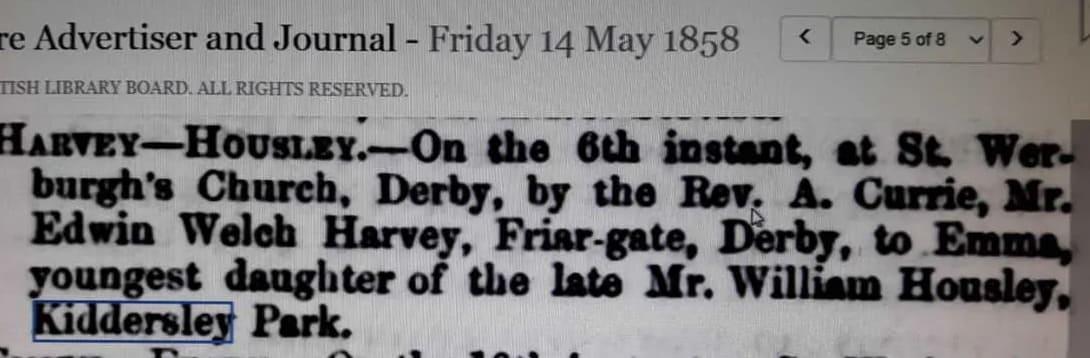
JOSEPH HOUSLEY 1838-1893
We first hear of Joseph in a letter from Anne to George in 1854. “Joseph wanted to be a joiner. We thought we could do no better than let him take Robert’s place which he did the October after (probably 1851) and is there still. He is grown as tall as you I think quite a man.” Emma concurred in her first letter: “He is quite a man in his appearance and quite as tall as you.”
From Emma we learn in 1855: “Joseph has left Mr. Harvey. He had not work to employ him. So mother thought he had better leave his indenture and be at liberty at once than wait for Harvey to be a bankrupt. He has got a very good place of work now and is very steady.” In June of 1856, Emma wrote “Joseph and I intend to have our portraits taken for you when you come over….Mother is thinking of coming to Derby. That will be nice for Joseph and I. Joseph is very hearty I am happy to say.”
According to Joseph’s letters, he was married to Harriet Ballard. Joseph described their miraculous reunion in this way: “I must tell you that I have been abroad myself to the Island of Ascension. (Elsewhere he wrote that he was on the island when the American civil war broke out). I went as a Royal Marine and worked at my trade and saved a bit of money–enough to buy my discharge and enough to get married with but while I was out on the island who should I meet with there but my dear wife’s sister. (On two occasions Joseph and Harriet sent George the name and address of Harriet’s sister, Mrs. Brooks, in Susquehanna Depot, Pennsylvania, but it is not clear whether this was the same sister.) She was lady’s maid to the captain’s wife. Though I had never seen her before we got to know each other somehow so from that me and my wife recommenced our correspondence and you may be sure I wanted to get home to her. But as soon as I did get home that is to England I was not long before I was married and I have not regretted yet for we are very comfortable as well as circumstances will allow for I am only a journeyman joiner.”
Proudly, Joseph wrote: “My little family consists of three nice children–John, Joseph and Susy Annie.” On her birth certificate, Susy Ann’s birthdate is listed as 1871. Parish records list a Lucy Annie christened in 1873. The boys were born in Derby, John in 1868 and Joseph in 1869. In his second letter, Joseph repeated: “I have got three nice children, a good wife and I often think is more than I have deserved.” On August 6, 1873, Joseph and Harriet wrote: “We both thank you dear sister for the pieces of money you sent for the children. I don’t know as I have ever see any before.” Joseph ended another letter: “Now I must close with our kindest love to you all and kisses from the children.”
In Harriet’s letter to Sarah Ann (March 19, 1873), she promised: “I will send you myself and as soon as the weather gets warm as I can take the children to Derby, I will have them taken and send them, but it is too cold yet for we have had a very cold winter and a great deal of rain.” At this time, the children were all under 6 and the baby was not yet two.
In March 1873 Joseph wrote: “I have been working down at Heanor gate there is a joiner shop there where Kings used to live I have been working there this winter and part of last summer but the wages is very low but it is near home that is one comfort.” (Heanor Gate is about 1/4 mile from Kidsley Grange. There was a school and industrial park there in 1988.) At this time Joseph and his family were living in “the big house–in Old Betty Hanson’s house.” The address in the 1871 census was Smalley Lane.
A glimpse into Joseph’s personality is revealed by this remark to George in an 1872 letter: “Many thanks for your portrait and will send ours when we can get them taken for I never had but one taken and that was in my old clothes and dear Harriet is not willing to part with that. I tell her she ought to be satisfied with the original.”
On one occasion Joseph and Harriet both sent seeds. (Marks are still visible on the paper.) Joseph sent “the best cow cabbage seed in the country–Robinson Champion,” and Harriet sent red cabbage–Shaw’s Improved Red. Possibly cow cabbage was also known as ox cabbage: “I hope you will have some good cabbages for the Ox cabbage takes all the prizes here. I suppose you will be taking the prizes out there with them.” Joseph wrote that he would put the name of the seeds by each “but I should think that will not matter. You will tell the difference when they come up.”
George apparently would have liked Joseph to come to him as early as 1854. Anne wrote: “As to his coming to you that must be left for the present.” In 1872, Joseph wrote: “I have been thinking of making a move from here for some time before I heard from you for it is living from hand to mouth and never certain of a job long either.” Joseph then made plans to come to the United States in the spring of 1873. “For I intend all being well leaving England in the spring. Many thanks for your kind offer but I hope we shall be able to get a comfortable place before we have been out long.” Joseph promised to bring some things George wanted and asked: “What sort of things would be the best to bring out there for I don’t want to bring a lot that is useless.” Joseph’s plans are confirmed in a letter from the solicitor May 23, 1874: “I trust you are prospering and in good health. Joseph seems desirous of coming out to you when this is settled.”
George must have been reminiscing about gooseberries (Heanor has an annual gooseberry show–one was held July 28, 1872) and Joseph promised to bring cuttings when they came: “Dear Brother, I could not get the gooseberries for they was all gathered when I received your letter but we shall be able to get some seed out the first chance and I shall try to bring some cuttings out along.” In the same letter that he sent the cabbage seeds Joseph wrote: “I have got some gooseberries drying this year for you. They are very fine ones but I have only four as yet but I was promised some more when they were ripe.” In another letter Joseph sent gooseberry seeds and wrote their names: Victoria, Gharibaldi and Globe.
In September 1872 Joseph wrote; “My wife is anxious to come. I hope it will suit her health for she is not over strong.” Elsewhere Joseph wrote that Harriet was “middling sometimes. She is subject to sick headaches. It knocks her up completely when they come on.” In December 1872 Joseph wrote, “Now dear brother about us coming to America you know we shall have to wait until this affair is settled and if it is not settled and thrown into Chancery I’m afraid we shall have to stay in England for I shall never be able to save money enough to bring me out and my family but I hope of better things.”
On July 19, 1875 Abraham Flint (the solicitor) wrote: “Joseph Housley has removed from Smalley and is working on some new foundry buildings at Little Chester near Derby. He lives at a village called Little Eaton near Derby. If you address your letter to him as Joseph Housley, carpenter, Little Eaton near Derby that will no doubt find him.”
George did not save any letters from Joseph after 1874, hopefully he did reach him at Little Eaton. Joseph and his family are not listed in either Little Eaton or Derby on the 1881 census.
In his last letter (February 11, 1874), Joseph sounded very discouraged and wrote that Harriet’s parents were very poorly and both had been “in bed for a long time.” In addition, Harriet and the children had been ill.
The move to Little Eaton may indicate that Joseph received his settlement because in August, 1873, he wrote: “I think this is bad news enough and bad luck too, but I have had little else since I came to live at Kiddsley cottages but perhaps it is all for the best if one could only think so. I have begun to think there will be no chance for us coming over to you for I am afraid there will not be so much left as will bring us out without it is settled very shortly but I don’t intend leaving this house until it is settled either one way or the other. “Joseph Housley and the Kiddsley cottages:
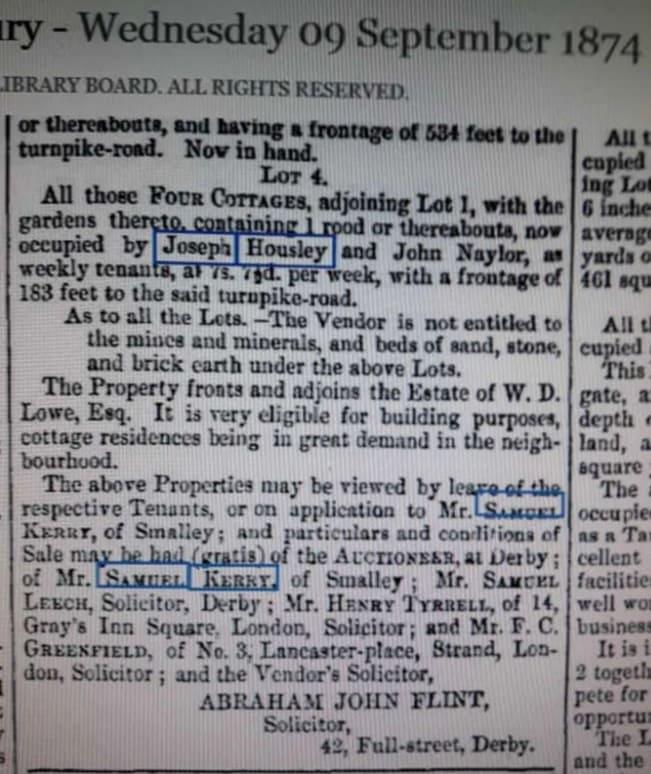
-
AuthorSearch Results