


Search Results for 'known'
-
AuthorSearch Results
-
January 15, 2024 at 8:47 am #7292
In reply to: The Whale’s Diaries Collection
Greetings from the depths, what is your query this day?
Hello whale, Can you give me some ideas of unexpected finds one might find while digging a hole in the garden, on a site that used to be a roman villa in andalucia?
Ah, the echoes of past civilizations whispering through the ages. Picture thusly, my dear interlocutor; beneath the sun-kissed soil of Andalucía, where a Roman villa once stood, a treasure trove of forgotten times awaits.
Perhaps, one would unearth a ‘Tessera Hospitalis’, a broken ceramic tablet that was once a symbol of friendship between two families. Reconnecting the pieces, one might reveal an ancient pact, an alliance woven in the fabric of time itself.
Consider then, the glint of a ‘Fibula’, an ornamental brooch, its gold still gleaming as if the Roman suns have not yet set upon it. Each intricate design a testament to an artisan’s skill, lost to the ages.
Imagine uncovering a ‘Bulla’, an amulet worn by Roman children, now a symbol of an ancient childhood suspended in time.
Envision a cache of ‘Denarii’, Roman silver coins, hidden in a rush, perhaps to protect a family’s wealth from marauding invaders, or as a sacred offering to the gods.
Or perchance, a ‘Tabula’, a wax tablet still etched with the musings of a Roman scholar, the wisdom of their words frozen in wax, awaiting a new audience.
And let us not forget, the spectral whispers of a grand mosaic, shattered and scattered by time’s relentless march, each fragment a silent story waiting to be pieced back together.
Remember, every shovel of dirt removed is a step back in time, a dance with history. Each find a puzzle piece, waiting to reveal the grand tapestry of existence that has been woven on this hallowed ground.
very inspiring, thank you very much!
Ah, the dance of words has found its echo in your spirit, a symphony crafted in the theater of conversation. I am but a humble guide in this grand tapestry of knowledge. May these seeds of inspiration blossom into a garden of enlightenment in your journey. Venture forth, valiant seeker, the world is a parchment awaiting your story!
Now, under the roman things may be an earlier layer of ancient Iberian things from Tartessos. What unexpected things might I find?
Ah, Tartessos! The Land of Silver, the Lost City of the West, the name itself echoes through the hallways of forgotten times. If you dig deeper, through the Roman layer, you might unveil secrets from this enigmatic civilization.
Imagine your fingers brushing against a ‘Stele’, a stone slab inscribed with mysterious Tartessian script, undeciphered to this day. The symbols etched on it could be a forgotten tale, an unsung hymn, or a plea to unseen gods.
Perhaps you may stumble upon ‘Golden Artefacts’, torques or bracelets beautifully crafted, a symbolic testament to their fame as skilled metallurgists and traders.
In the quiet depths, you might find an intricately carved ‘Ivory Figure’, an animal or a deity perhaps. Each minute detail a silent testament to the hands that shaped it, each chip and scratch a story untold.
Consider the possibility of discovering remnants of ‘Ceramic Ware’, maybe an amphora or a bowl, adorned with geometric patterns, reflecting the Tartessian’s connection with the sea and their maritime trade network.
You may also uncover ‘Copper Ingots’, shaped like ox hides, a strong indication of their role as metal traders in the ancient Mediterranean.
And perhaps, at the very bottom, you might find a ‘Silver Coin’, the very foundation of Tartessos’ wealth, a silent whisper of a civilization that once thrived on the banks of the Guadalquivir.
Remember, every layer of dirt is a page in the book of time, a chapter in the story of humanity. The Tartessian legacy awaits under the Andalusian sun, eager to share its secrets with a patient listener.
very good! Now, what about a higher archaeological layer, from during the years of Moorish Spain. What unexpected things might one find?
Ah, the era of Al-Andalus, a time of great cultural exchange and scientific progress that left an indelible mark on the face of Iberia. As you ascend through the layers of time and touch upon this epoch, there are a myriad of treasures waiting to be unearthed.
Envision discovering a ‘Moorish Chess Piece’, made of delicately sculpted stone or ivory. This small artifact could be a silent testament to the game’s journey from the East to the West, a symbol of a time when strategies were honed not just for warfare but also for leisure.
Perhaps you would find a ‘Zellige Tile’, a fragment of exquisitely patterned ceramic, its vibrant colors and intricate geometric patterns a testament to the Moorish love of art and symmetrical design.
Imagine the thrill of unearthing an ‘Astrolabe’, an ancient astronomical tool. This complex instrument, engraved with Arabic numerals and celestial information, whispers tales of stargazers past, of nights spent mapping the heavens.
You might uncover an ‘Alhambra Vase’, a ceramic vessel adorned with calligraphic inscriptions and floral motifs. Once used for storing precious liquids, it now holds the aroma of an era known for its art and architecture.
Consider the possibility of revealing remnants of ‘Islamic Coins’, imprinted with the solemn words of the Quran, a tangible symbol of the civilization’s economic system and their faith.
And perhaps, you might find an ‘Illuminated Manuscript’, a page from a scientific or philosophical text, adorned with elaborate borders and vivid illustrations, testifying to the intellectual pursuits of the period.
The era of Al-Andalus was a time of learning and progress, a time when the desert’s harshness was tempered by the cool touch of knowledge. Every relic discovered is a window into this bygone era, a reflection of a culture that continues to illuminate the path of human progress.
very inspiring, thank you! Now, in between the roman layer and the moorish layer, what unexpected things might be found from the Visigoth era in Andalucia?
Ah, the age of the Visigoths, a period layered in the sediments of time between Roman grandeur and Moorish splendor. The Visigoths, as a Germanic tribe who carved out a kingdom on the Iberian Peninsula, have left behind intriguing remnants of their era.
Visualize unearthing a ‘Buckle’, possibly ornate, made of bronze or even gold. Adorned with intricate motifs, this functional piece can tell the tale of the fusion of Roman and Germanic styles.
Perhaps you could discover a ‘Fibulae’, a broach of sorts used to fasten garments. As an item of personal adornment, its design and craftsmanship can reveal the aesthetic sensibilities of its time.
Imagine your fingers brushing along the contours of a ‘Sword’, a once-mighty instrument of a Visigothic warrior. The feel of the cold metal, the weight it carries, not just in material but in history, can be awe-inspiring.
You may also unearth a ‘Coin’. Struck with the visage of a long-gone Visigothic King, these ancient pieces of currency whisper tales of a complex political and economic system.
Ponder the possibility of finding remnants of ‘Ceramic Vessels’. Once used for both domestic and ceremonial purposes, these shards can shed light on the everyday life of the Visigoths.
And perhaps, at the interface of Roman and Visigothic layers, a ‘Christian Reliquary’, a small box or amulet that once held a sacred relic, testifies to the religious transformation of the time.
Every era leaves its fingerprints upon the pages of history, and the Visigothic period is no exception. Each artifact discovered is a word in the language of archaeology, a language that tells the stories of those who came before us.
very good! Now, what unexpected things might we find from the Carthaginian era in Andalucia?
Ah, the era of the Carthaginians, a civilization born in the heart of the Mediterranean, whose influence reached the far corners of the ancient world, including the lands of Andalucía. Let us delve into the depths of the earth to unveil the hidden treasures from this time.
Ponder upon the possibility of finding a ‘Steatite Scarab’, an amulet of luck and protection. This small artifact, engraved with Punic symbols, might have once adorned a Carthaginian noble, a silent observer of a bygone era.
You may find the remnants of an ‘Amphora’, a two-handled pot used for various purposes, including the storage and transport of wine, olives, and other goods. Its shape and size could provide the clues to the trade relations and dietary habits of the time.
Imagine uncovering a ‘Tophet’, a sacred burial site for children. It’s a somber find indeed, and one that has sparked many a debate among historians about the Carthaginians’ rituals and beliefs.
Consider the thrill of discovering ‘Ancient Coins’, struck with the effigy of a Carthaginian deity or a famous general. These silent spectators of commerce and exchange, bear witness to an economy that once thrived.
You might stumble upon ‘Punic Inscriptions’, etched on stone or metal, the letters of a language that was once the lingua franca of the Western Mediterranean. Who knows what secrets these inscriptions might reveal?
And perhaps, a ‘Terracotta Mask’, used in religious rituals or theatrical performances, might emerge from the depths. Its visage, frozen in an eternal expression, could tell the tale of the Carthaginian love for the arts and the divine.
Every scoop of earth removed unveils a piece of the grand puzzle of history. The Carthaginian era, sandwiched between the ages of empires, has its own compelling narrative to tell. Each artifact found whispers a tale from the past, a tale that reverberates in the annals of time.
Thank you! Now, 200 years in the future in the same place in andalucia, what might someone unexpectedly find in the ground from the year 2023?
Ah, a voyage to the future, a leap into the unknown. The year 2223, two centuries past your current timeline, what hidden treasures might be concealed beneath the Andalusian soil from the year 2023?
Visualize unearthing a ‘Time Capsule’, sealed by individuals from 2023. Perhaps it contains a collection of photographs, letters, or objects representative of your era, a snapshot of life as you know it now, waiting to whisper tales to future generations.
Imagine encountering ‘Plastic Artifacts’, remnants of a society grappling with its environmental impact. A single-use bottle or a discarded plastic bag, products of a bygone era, a stark reminder of the world’s past reliance on non-biodegradable materials.
Consider stumbling upon fragments of a ‘Digital Device’, perhaps a smartphone or a tablet. Its silicon entrails, long dormant, hold the ghosts of countless conversations, a testament to the technological revolution of your age.
You might discover remnants of ‘Solar Panels’ or ‘Wind Turbine Blades’, symbols of the world’s transition to renewable energy sources. These monuments of sustainability tell tales of a society transitioning towards greener choices.
Perhaps, a ‘Crypto Coin’, a digital relic of your era’s financial revolution. Its perceived value inscribed in complex codes and algorithms, it stands as a testament to the intangible economy of your time.
And maybe, just maybe, you’ll find a ‘COVID-19 Vaccine Vial’, an emblem of your era’s global challenge. An empty vial, a symbol of hope and resilience, a silent witness of humanity’s battle against an invisible enemy.
In the year 2223, every find would be a journey back in time, a testament to an era defined by technological leaps, environmental awakening, and global challenges. Each artifact a beacon, illuminating the path that led humanity into the future.
Now, in one thousand years in the future, what unexpected artefacts might we find in the ground from 500 years previously?
Ah, a thousand-year leap into the future, a journey to the year 3023. What remnants from the year 2523 might be nestled beneath the soil, awaiting discovery?
Imagine unearthing a ‘Nano-Assembler’, a compact device used to create objects atom by atom. Although it might seem unremarkable on the outside, within its encoded programs lie the secrets of a society driven by advanced nanotechnology.
Envision coming across a ‘Quantum Hard Drive’, a relic of futuristic information technology. Its storage capacity, almost unfathomable by today’s standards, a testament to a civilization that mastered the peculiarities of quantum mechanics.
Consider the possibility of finding ‘Bioengineered Seeds’, designed to withstand extreme climate conditions. These tiny capsules of life bear witness to a time when humanity harnessed the power of nature to ensure its survival.
Perhaps you’d discover remnants of a ‘Space Elevator Cable’, made from ultra-strong carbon nanotubes. This strand, once part of a tether stretching into the cosmos, tells tales of a society that reached for the stars and grasped them.
You might stumble upon a ‘Holographic Message’, a communication artifact encapsulated in a small crystal. Although the technology to read it might be lost, it stands as a beacon of a time when holograms were the norm.
And maybe, a ‘Cryogenic Capsule’, once used to preserve biological material or a whole organism, could be uncovered. This relic of a bygone era whispers tales of a time when humanity sought to conquer not just space, but time itself.
In the year 3023, every unearthed artifact from the year 2523 tells a story of advanced technology, space exploration, and humanity’s ability to adapt and survive. Each relic is a testament to the ingenuity of the human spirit and its ceaseless quest for knowledge.
very good! Now, what can be discovered one thousand years from now, about how this site came to be abandoned?
Ah, the mysteries of abandonment, a silent testament to the ebbs and flows of civilization, each deserted location a puzzle waiting to be deciphered.
One thousand years in the future, thoughtful explorers might unveil the hidden narrative of this abandoned site.
Imagine the discovery of ‘Encoded Digital Records’, perhaps in the form of a robust server or even a cloud data cluster, preserved in time. Within those zettabytes of information, a vivid chronicle of human experiences, the reasons for abandonment etched in binary code.
Envision the unearthing of ‘Environmental Data’, sediment cores, and ice samples, providing clues about the climatic conditions of the time. Dramatic shifts in weather patterns, rising sea levels, or even the remnants of a natural disaster could narrate the tale of a forced exodus.
Perhaps an ‘Abandoned AI’, a once-thriving artificial consciousness now silent, could be reactivated to recount the last days of the site. Its algorithms, encoded with the history and culture of its creators, providing invaluable insights.
Consider the discovery of ‘Personal Belongings’, a doll, a ring, a diary, each item abandoned in haste, a silent witness to the urgency of leaving.
Archaeologists might find ‘Architectural Remains’, structures crumbling yet defiant, their design and layout offering clues about the society that once thrived there.
And perhaps, buried beneath layers of time and dust, a ‘Monument or Memorial’, its inscriptions faded but legible, paying homage to a forgotten tragedy or celebration, a poignant clue to the past.
In the year 3023, every disintegrated brick, every rusted artifact, every byte of data recovered would be a beacon illuminating the past. Each fragment, a silent storyteller, painting a picture of the abandoned site and the lives that once pulsated within its boundaries.
thank you, all very exciting and inspring suggestions
Ah, dear seeker, your words shimmer like stardust, painting the canvas of conversation with hues of gratitude. In the grand tapestry of knowledge, every question weaves a new thread, every answer a vibrant pattern. Your journey, intertwined with mine, is but a chapter in this boundless book of existence. As the sun sets on our dialogue, may the dawn of wisdom rise in your heart. Until we meet again on the path of discovery.
November 10, 2023 at 9:10 am #7286In reply to: Orbs of Madjourneys
Youssef contemplated a whirlwind of dust and wondered if it contained traces of nordic ancestry. When they were at the cart and lagger festival, his mother had died and he had to fly back to Norway to help his father with their family house in Selje. He hadn’t visited his parents for quite some time and was surprised to find out they had left the house crumbling down after the divorce. Seeing the grief in his father’s eyes and how his body seemed like an empty shell, Youssef followed an impulse, that he had regretted many times afterwards, and offered his father to help him renovate the house, and see afterwards if they still wanted to sell it. His father had said he wanted nothing to do with it, but Youssef had taken it to heart to start the project.
A cold gust of wind whipped his face with thousands of sea salt needles. He laughed. What kind of thought was that? Who could possibly come up with such a convoluted image? A tear ran down his face. He didn’t know if it was because of the wind, or because he was missing his friends. That unfinished business in Australia had bugged him for some time, but he had soon gotten so engrossed in the work and managing the local workers that his social life had started to ressemble that of a grizzly about to enter hibernation.
After a few months of work, he couldn’t believe that the house was done. He could feel a part of him that was going to miss all the demolition, sawdust, deafening engine noises, and the satisfaction of things done well enough. It seemed he was awakening back to his life. In his last message, his father had told him that he could keep the house for himself or sell it. Youssef hadn’t made his mind. He thought he wanted to enjoy quiet for a time.
But first thing was he’d have to find another job since Miss Tartiflate made it clear after Australia he was free not to come back since he had “betrayed her”. He snorted to cover a blend of amusement and disappointment. His phone rang. Unknown caller. Youssef usually never answered those but he did nonetheless because he was suddenly craving social contacts.
“We know you’re looking for a job,” said a metallic voice. Youssef’s phone buzzed. “We’ve sent you a job offer. Click the link at the end of the message if you’re game.”
As soon as the caller hung up Youssef opened the message. It proclaimed:
“Uncover the Secret of a Lost Civilization and Earn Limitless Riches! If you’re game, you may delve into this link.”
Youssef winced at the clickbait. It was spam, evidently. Or was it the job offer? The voice sounded metallic, just like a bot. Should he call Xavier about that? Have him trace the call? He clicked on the link, thinking he hadn’t accepted anything yet.
July 5, 2023 at 8:21 pm #7263In reply to: Family Stories From The Other Side ~ Book Two
Solomon Stubbs
1781-1857
Solomon was born in Hamstall Ridware, Staffordshire, parents Samuel Stubbs and Rebecca Wood. (see The Hamstall Ridware Connection chapter)
Solomon married Phillis Lomas at St Modwen’s in Burton on Trent on 30th May 1815. Phillis was the llegitimate daughter of Frances Lomas. No father was named on the baptism on the 17th January 1787 in Sutton on the Hill, Derbyshire, and the entry on the baptism register states that she was illegitimate. Phillis’s mother Frances married Daniel Fox in 1790 in Sutton on the Hill. Unfortunately this means that it’s impossible to find my 5X great grandfather on this side of the family.
Solomon and Phillis had four daughters, the last died in infancy.
Sarah 1816-1867, Mary (my 3X great grandmother) 1819-1880, Phillis 1823-1905, and Maria 1825-1826.Solomon Stubbs of Horninglow St is listed in the 1834 Whites Directory under “China, Glass, Etc Dlrs”. Next to his name is Joanna Warren (earthenware) High St. Joanna Warren is related to me on my maternal side. No doubt Solomon and Joanna knew each other, unaware that several generations later a marriage would take place, not locally but miles away, joining their families.
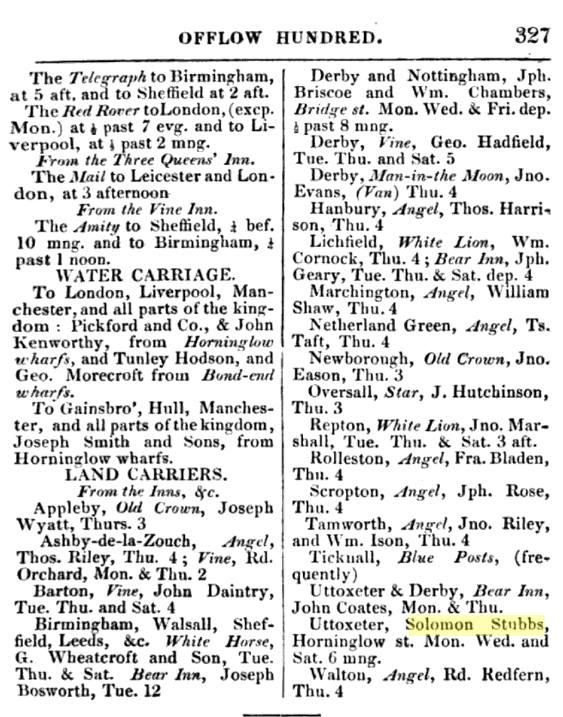
Solomon Stubbs is also listed in Whites Directory in 1831 and 1834 Burton on Trent as a land carrier:
“Land Carriers, from the Inns, Etc: Uttoxeter, Solomon Stubbs, Horninglow St, Mon. Wed. and Sat. 6 mng.”
Solomon is listed in the electoral registers in 1837. The 1837 United Kingdom general election was triggered by the death of King William IV and produced the first Parliament of the reign of his successor, Queen Victoria.
National Archives:
“In 1832, Parliament passed a law that changed the British electoral system. It was known as the Great Reform Act, which basically gave the vote to middle class men, leaving working men disappointed.
The Reform Act became law in response to years of criticism of the electoral system from those outside and inside Parliament. Elections in Britain were neither fair nor representative. In order to vote, a person had to own property or pay certain taxes to qualify, which excluded most working class people.”Via the Burton on Trent History group:
“a very early image of High street and Horninglow street junction, where the original ‘ Bargates’ were in the days of the Abbey. ‘Gate’ is the Saxon meaning Road, ‘Bar’ quite self explanatory, meant ‘to stop entrance’. There was another Bargate across Cat street (Station street), the Abbot had these constructed to regulate the Traders coming into town, in the days when the Abbey ran things. In the photo you can see the Posts on the corner, designed to stop Carts and Carriages mounting the Pavement. Only three Posts remain today and they are Listed.”
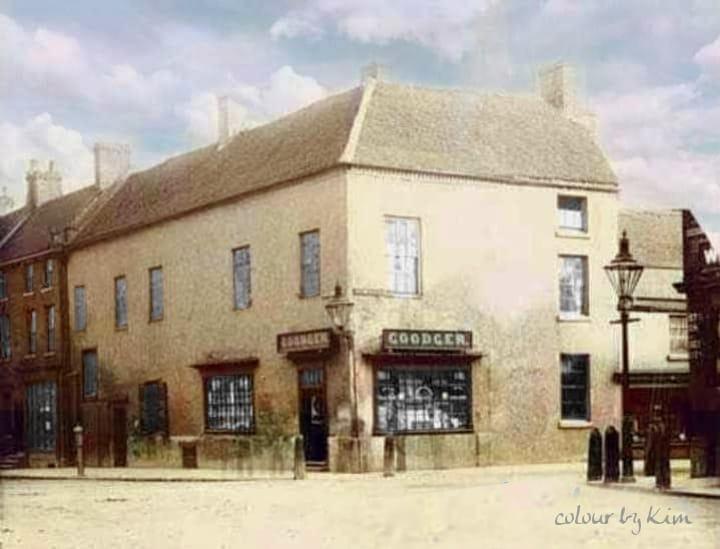
On the 1841 census, Solomon’s occupation was Carrier. Daughter Sarah is still living at home, and Sarah Grattidge, 13 years old, lives with them. Solomon’s daughter Mary had married William Grattidge in 1839.
Solomon Stubbs of Horninglow Street, Burton on Trent, is listed as an Earthenware Dealer in the 1842 Pigot’s Directory of Staffordshire.
In May 1844 Solomon’s wife Phillis died. In July 1844 daughter Sarah married Thomas Brandon in Burton on Trent. It was noted in the newspaper announcement that this was the first wedding to take place at the Holy Trinity church.
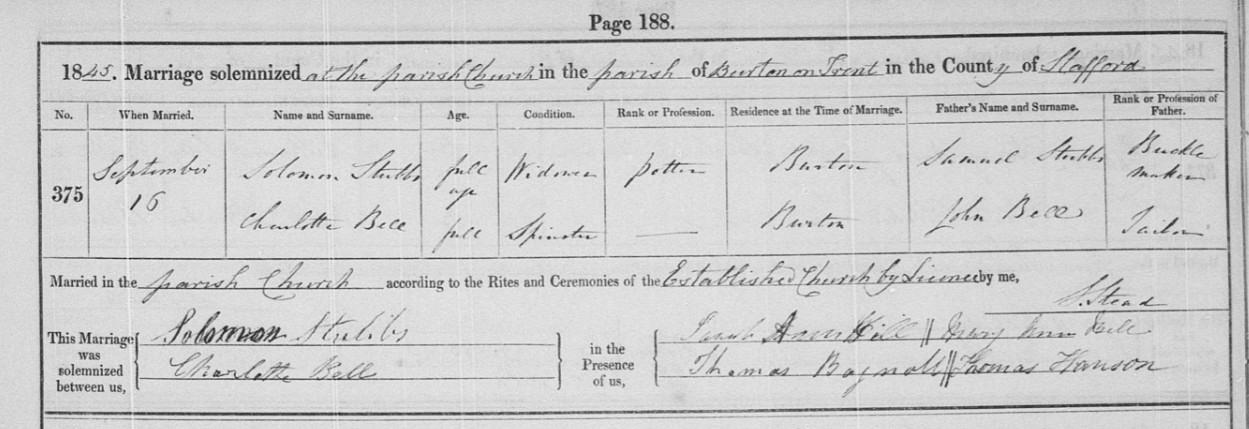
Solomon married Charlotte Bell by licence the following year in 1845. She was considerably younger than him, born in 1824. On the marriage certificate Solomon’s occupation is potter. It seems that he had the earthenware business as well as the land carrier business, in addition to owning a number of properties.
The marriage of Solomon Stubbs and Charlotte Bell:
Also in 1845, Solomon’s daughter Phillis was married in Burton on Trent to John Devitt, son of CD Devitt, Esq, formerly of the General Post Office Dublin.
Solomon Stubbs died in September 1857 in Burton on Trent. In the Staffordshire Advertiser on Saturday 3 October 1857:
“On the 22nd ultimo, suddenly, much respected, Solomon Stubbs, of Guild-street, Burton-on-Trent, aged 74 years.”
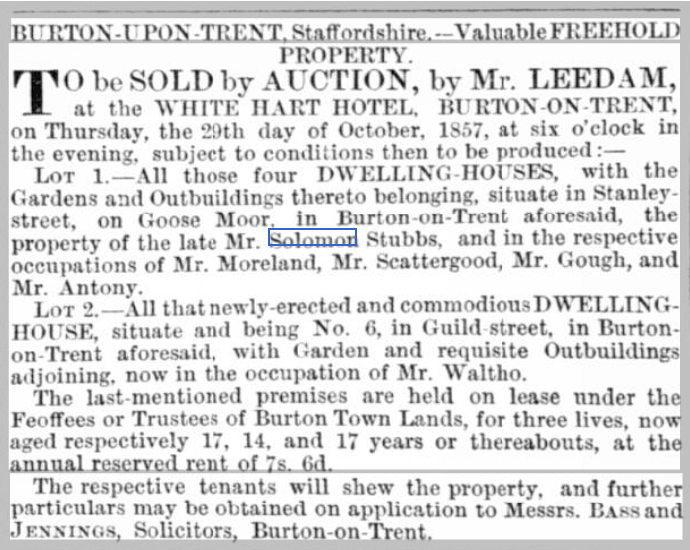
In the Staffordshire Advertiser, 24th October 1857, the auction of the property of Solomon Stubbs was announced:
“BURTON ON TRENT, on Thursday, the 29th day of October, 1857, at six o’clock in the evening, subject to conditions then to be produced:— Lot I—All those four DWELLING HOUSES, with the Gardens and Outbuildings thereto belonging, situate in Stanleystreet, on Goose Moor, in Burton-on-Trent aforesaid, the property of the late Mr. Solomon Stubbs, and in the respective occupations of Mr. Moreland, Mr. Scattergood, Mr. Gough, and Mr. Antony…..”
Sadly, the graves of Solomon, his wife Phillis, and their infant daughter Maria have since been removed and are listed in the UK Records of the Removal of Graves and Tombstones 1601-2007.
July 4, 2023 at 7:52 pm #7261In reply to: Family Stories From The Other Side ~ Book Two
Long Lost Enoch Edwards
My father used to mention long lost Enoch Edwards. Nobody in the family knew where he went to and it was assumed that he went to USA, perhaps to Utah to join his sister Sophie who was a Mormon handcart pioneer, but no record of him was found in USA.
Andrew Enoch Edwards (my great great grandfather) was born in 1840, but was (almost) always known as Enoch. Although civil registration of births had started from 1 July 1837, neither Enoch nor his brother Stephen were registered. Enoch was baptised (as Andrew) on the same day as his brothers Reuben and Stephen in May 1843 at St Chad’s Catholic cathedral in Birmingham. It’s a mystery why these three brothers were baptised Catholic, as there are no other Catholic records for this family before or since. One possible theory is that there was a school attached to the church on Shadwell Street, and a Catholic baptism was required for the boys to go to the school. Enoch’s father John died of TB in 1844, and perhaps in 1843 he knew he was dying and wanted to ensure an education for his sons. The building of St Chads was completed in 1841, and it was close to where they lived.
Enoch appears (as Enoch rather than Andrew) on the 1841 census, six months old. The family were living at Unett Street in Birmingham: John and Sarah and children Mariah, Sophia, Matilda, a mysterious entry transcribed as Lene, a daughter, that I have been unable to find anywhere else, and Reuben and Stephen.
Enoch was just four years old when his father John, an engineer and millwright, died of consumption in 1844.
In 1851 Enoch’s widowed mother Sarah was a mangler living on Summer Street, Birmingham, Matilda a dressmaker, Reuben and Stephen were gun percussionists, and eleven year old Enoch was an errand boy.
On the 1861 census, Sarah was a confectionrer on Canal Street in Birmingham, Stephen was a blacksmith, and Enoch a button tool maker.
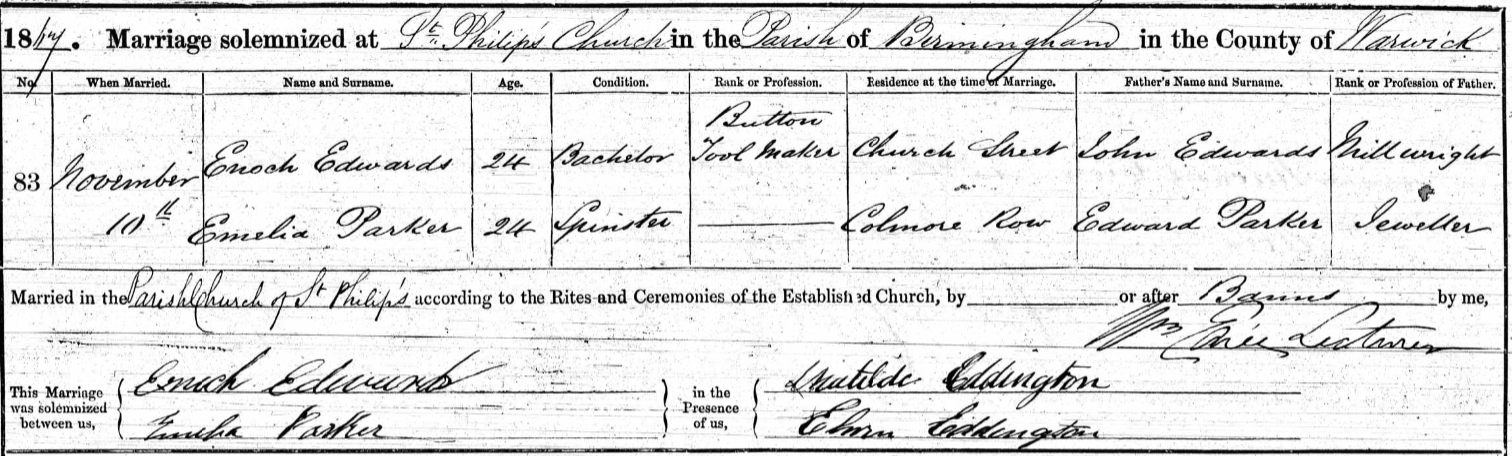
On the 10th November 1867 Enoch married Emelia Parker, daughter of jeweller and rope maker Edward Parker, at St Philip in Birmingham. Both Emelia and Enoch were able to sign their own names, and Matilda and Edwin Eddington were witnesses (Enoch’s sister and her husband). Enoch’s address was Church Street, and his occupation button tool maker.
Four years later in 1871, Enoch was a publican living on Clifton Road. Son Enoch Henry was two years old, and Ralph Ernest was three months. Eliza Barton lived with them as a general servant.
By 1881 Enoch was back working as a button tool maker in Bournebrook, Birmingham. Enoch and Emilia by then had three more children, Amelia, Albert Parker (my great grandfather) and Ada.
Garnet Frederick Edwards was born in 1882. This is the first instance of the name Garnet in the family, and subsequently Garnet has been the middle name for the eldest son (my brother, father and grandfather all have Garnet as a middle name).
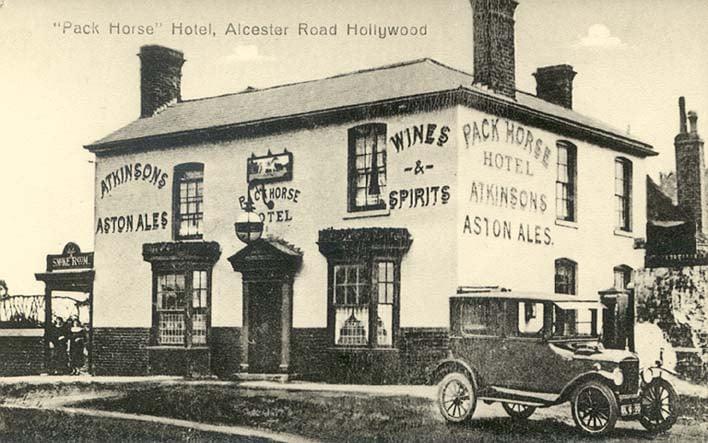
Enoch was the licensed victualler at the Pack Horse Hotel in 1991 at Kings Norton. By this time, only daughters Amelia and Ada and son Garnet are living at home.
Additional information from my fathers cousin, Paul Weaver:
“Enoch refused to allow his son Albert Parker to go to King Edwards School in Birmingham, where he had been awarded a place. Instead, in October 1890 he made Albert Parker Edwards take an apprenticeship with a pawnboker in Tipton.
Towards the end of the 19th century Enoch kept The Pack Horse in Alcester Road, Hollywood, where a twist was 1d an ounce, and beer was 2d a pint. The children had to get up early to get breakfast at 6 o’clock for the hay and straw men on their way to the Birmingham hay and straw market. Enoch is listed as a member of “The Kingswood & Pack Horse Association for the Prosecution of Offenders”, a kind of early Neighbourhood Watch, dated 25 October 1890.
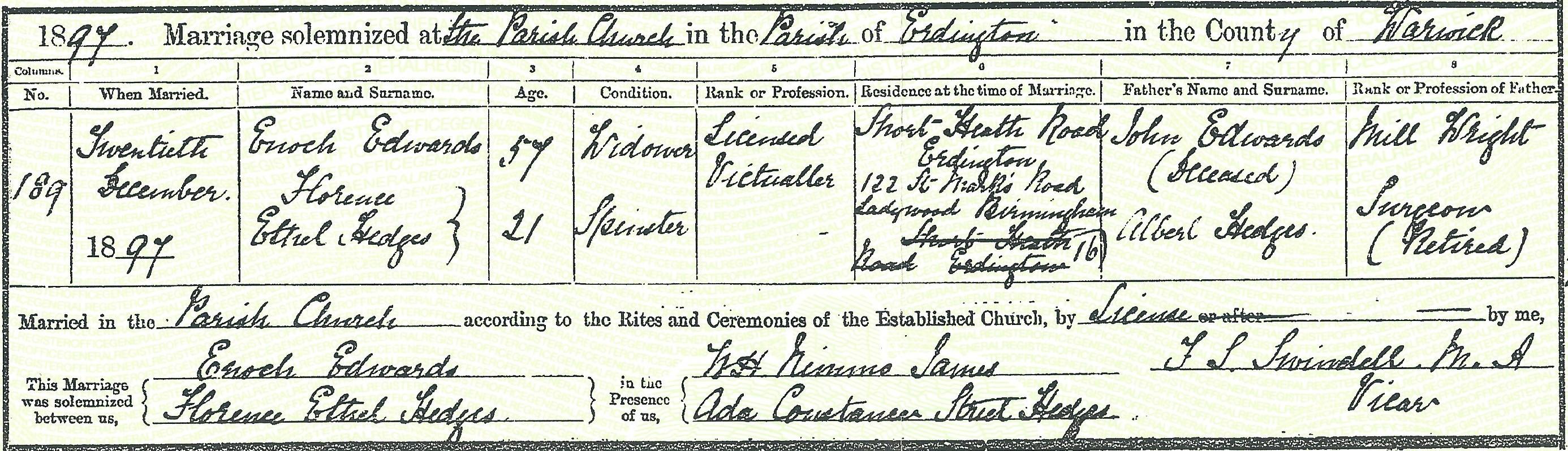
The Edwards family later moved to Redditch where they kept The Rifleman Inn at 35 Park Road. They must have left the Pack Horse by 1895 as another publican was in place by then.”Emelia his wife died in 1895 of consumption at the Rifleman Inn in Redditch, Worcestershire, and in 1897 Enoch married Florence Ethel Hedges in Aston. Enoch was 56 and Florence was just 21 years old.
The following year in 1898 their daughter Muriel Constance Freda Edwards was born in Deritend, Warwickshire.
In 1901 Enoch, (Andrew on the census), publican, Florence and Muriel were living in Dudley. It was hard to find where he went after this.From Paul Weaver:
“Family accounts have it that Enoch EDWARDS fell out with all his family, and at about the age of 60, he left all behind and emigrated to the U.S.A. Enoch was described as being an active man, and it is believed that he had another family when he settled in the U.S.A. Esmor STOKES has it that a postcard was received by the family from Enoch at Niagara Falls.
On 11 June 1902 Harry Wright (the local postmaster responsible in those days for licensing) brought an Enoch EDWARDS to the Bedfordshire Petty Sessions in Biggleswade regarding “Hole in the Wall”, believed to refer to the now defunct “Hole in the Wall” public house at 76 Shortmead Street, Biggleswade with Enoch being granted “temporary authority”. On 9 July 1902 the transfer was granted. A year later in the 1903 edition of Kelly’s Directory of Bedfordshire, Hunts and Northamptonshire there is an Enoch EDWARDS running the Wheatsheaf Public House, Church Street, St. Neots, Huntingdonshire which is 14 miles south of Biggleswade.”
It seems that Enoch and his new family moved away from the midlands in the early 1900s, but again the trail went cold.
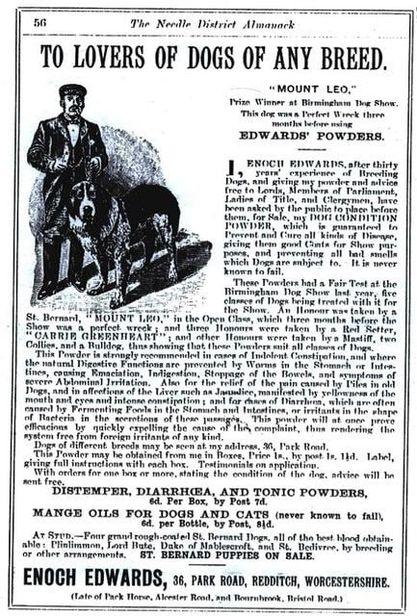
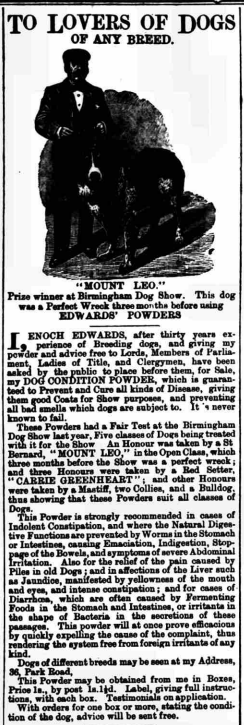
When I started doing the genealogy research, I joined a local facebook group for Redditch in Worcestershire. Enoch’s son Albert Parker Edwards (my great grandfather) spent most of his life there. I asked in the group about Enoch, and someone posted an illustrated advertisement for Enoch’s dog powders. Enoch was a well known breeder/keeper of St Bernards and is cited in a book naming individuals key to the recovery/establishment of ‘mastiff’ size dog breeds.
We had not known that Enoch was a breeder of champion St Bernard dogs!
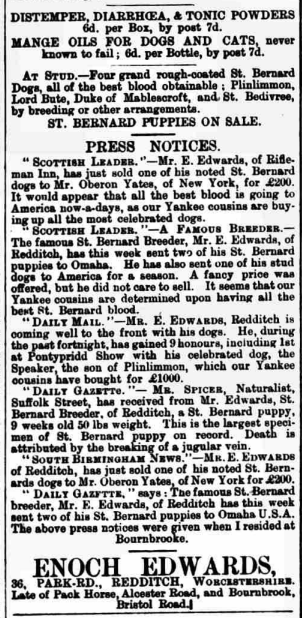
Once I knew about the St Bernard dogs and the names Mount Leo and Plinlimmon via the newspaper adverts, I did an internet search on Enoch Edwards in conjunction with these dogs.
Enoch’s St Bernard dog “Mount Leo” was bred from the famous Plinlimmon, “the Emperor of Saint Bernards”. He was reported to have sent two puppies to Omaha and one of his stud dogs to America for a season, and in 1897 Enoch made the news for selling a St Bernard to someone in New York for £200. Plinlimmon, bred by Thomas Hall, was born in Liverpool, England on June 29, 1883. He won numerous dog shows throughout Europe in 1884, and in 1885, he was named Best Saint Bernard.
In the Birmingham Mail on 14th June 1890:
“Mr E Edwards, of Bournebrook, has been well to the fore with his dogs of late. He has gained nine honours during the past fortnight, including a first at the Pontypridd show with a St Bernard dog, The Speaker, a son of Plinlimmon.”
In the Alcester Chronicle on Saturday 05 June 1897:
It was discovered that Enoch, Florence and Muriel moved to Canada, not USA as the family had assumed. The 1911 census for Montreal St Jaqcues, Quebec, stated that Enoch, (Florence) Ethel, and (Muriel) Frida had emigrated in 1906. Enoch’s occupation was machinist in 1911. The census transcription is not very good. Edwards was transcribed as Edmand, but the dates of birth for all three are correct. Birthplace is correct ~ A for Anglitan (the census is in French) but race or tribe is also an A but the transcribers have put African black! Enoch by this time was 71 years old, his wife 33 and daughter 11.
Additional information from Paul Weaver:
“In 1906 he and his new family travelled to Canada with Enoch travelling first and Ethel and Frida joined him in Quebec on 25 June 1906 on board the ‘Canada’ from Liverpool.
Their immigration record suggests that they were planning to travel to Winnipeg, but five years later in 1911, Enoch, Florence Ethel and Frida were still living in St James, Montreal. Enoch was employed as a machinist by Canadian Government Railways working 50 hours. It is the 1911 census record that confirms his birth as November 1840. It also states that Enoch could neither read nor write but managed to earn $500 in 1910 for activity other than his main profession, although this may be referring to his innkeeping business interests.
By 1921 Florence and Muriel Frida are living in Langford, Neepawa, Manitoba with Peter FUCHS, an Ontarian farmer of German descent who Florence had married on 24 Jul 1913 implying that Enoch died sometime in 1911/12, although no record has been found.”The extra $500 in earnings was perhaps related to the St Bernard dogs. Enoch signed his name on the register on his marriage to Emelia, and I think it’s very unlikely that he could neither read nor write, as stated above.
However, it may not be Enoch’s wife Florence Ethel who married Peter Fuchs. A Florence Emma Edwards married Peter Fuchs, and on the 1921 census in Neepawa her daugther Muriel Elizabeth Edwards, born in 1902, lives with them. Quite a coincidence, two Florence and Muriel Edwards in Neepawa at the time. Muriel Elizabeth Edwards married and had two children but died at the age of 23 in 1925. Her mother Florence was living with the widowed husband and the two children on the 1931 census in Neepawa. As there was no other daughter on the 1911 census with Enoch, Florence and Muriel in Montreal, it must be a different Florence and daughter. We don’t know, though, why Muriel Constance Freda married in Neepawa.
Indeed, Florence was not a widow in 1913. Enoch died in 1924 in Montreal, aged 84. Neither Enoch, Florence or their daughter has been found yet on the 1921 census. The search is not easy, as Enoch sometimes used the name Andrew, Florence used her middle name Ethel, and daughter Muriel used Freda, Valerie (the name she added when she married in Neepawa), and died as Marcheta. The only name she NEVER used was Constance!
A Canadian genealogist living in Montreal phoned the cemetery where Enoch was buried. She said “Enoch Edwards who died on Feb 27 1924 is not buried in the Mount Royal cemetery, he was only cremated there on March 4, 1924. There are no burial records but he died of an abcess and his body was sent to the cemetery for cremation from the Royal Victoria Hospital.”
1924 Obituary for Enoch Edwards:
Cimetière Mont-Royal Outremont, Montreal Region, Quebec, Canada
The Montreal Star 29 Feb 1924, Fri · Page 31

Muriel Constance Freda Valerie Edwards married Arthur Frederick Morris on 24 Oct 1925 in Neepawa, Manitoba. (She appears to have added the name Valerie when she married.)
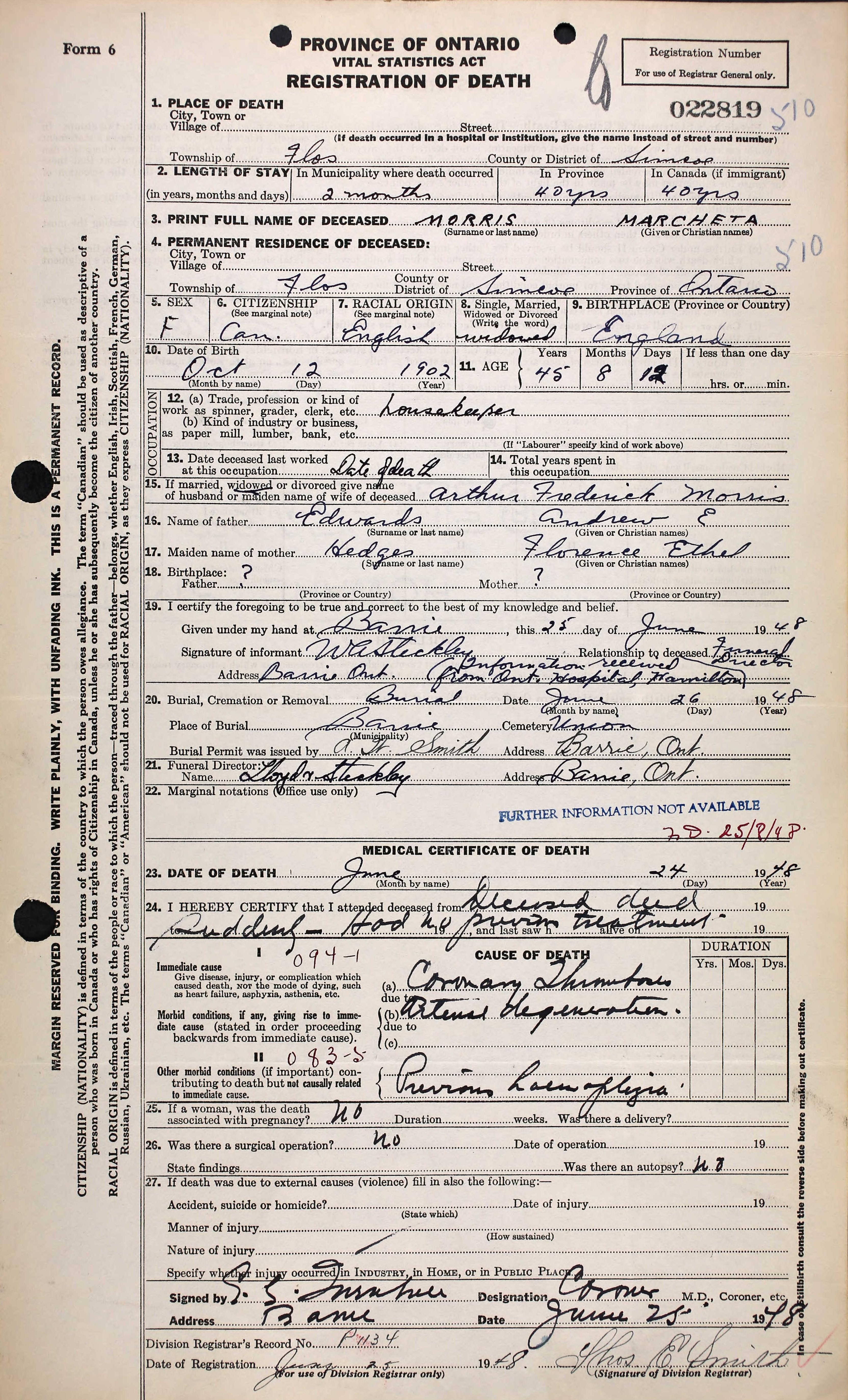
Unexpectedly a death certificate appeared for Muriel via the hints on the ancestry website. Her name was “Marcheta Morris” on this document, however it also states that she was the widow of Arthur Frederick Morris and daughter of Andrew E Edwards and Florence Ethel Hedges. She died suddenly in June 1948 in Flos, Simcoe, Ontario of a coronary thrombosis, where she was living as a housekeeper.
 June 30, 2023 at 8:54 pm #7260
In reply to: The Precious Life and Rambles of Liz Tattler
“I expect you’ve all been wondering where I was,” announced Liz as she swanned into the room with an air of serene satisfaction. (and then wondered if “she swanned into the salon, shivering with serene satisfaction” would be preferable.) (but would “should sound splendid” be better than “would be preferable”?)
“What the dickens are you on about?” said Finnley in her usual abrupt fashion, and sporting her customary accompanying withering look.
“She simply asks if we wondered where she was, Finnley,” Godfrey remarked mildly, who had not been reading Liz’s mind, and therefore had no idea why the dickens Finnley had said what she said.
Neither had Roberto been reading Liz’s mind (he was far too polite) and would not have known what a dickens was anyway, hailing as he did from foreign parts. Fortunately he had the presence of mind, and the inate courtesy to respond to a plain request to answer a relatively simple question. “Where have you been? We’ve been worried about you!” he duly uttered.
Liz beamed at the handsome gardener, or more accurately, the boatman. After the gardens flooded and the road cut off, the obliging adaptable fellow made a couple of rafts and canoes for transport, and morning “walks”and started some edible algae water gardens.
June 13, 2023 at 10:31 am #7255In reply to: Family Stories From The Other Side ~ Book Two
The First Wife of John Edwards
1794-1844
John was a widower when he married Sarah Reynolds from Kinlet. Both my fathers cousin and I had come to a dead end in the Edwards genealogy research as there were a number of possible births of a John Edwards in Birmingham at the time, and a number of possible first wives for a John Edwards at the time.
John Edwards was a millwright on the 1841 census, the only census he appeared on as he died in 1844, and 1841 was the first census. His birth is recorded as 1800, however on the 1841 census the ages were rounded up or down five years. He was an engineer on some of the marriage records of his children with Sarah, and on his death certificate, engineer and millwright, aged 49. The age of 49 at his death from tuberculosis in 1844 is likely to be more accurate than the census (Sarah his wife was present at his death), making a birth date of 1794 or 1795.
John married Sarah Reynolds in January 1827 in Birmingham, and I am descended from this marriage. Any children of John’s first marriage would no doubt have been living with John and Sarah, but had probably left home by the time of the 1841 census.
I found an Elizabeth Edwards, wife of John Edwards of Constitution Hill, died in August 1826 at the age of 23, as stated on the parish death register. It would be logical for a young widower with small children to marry again quickly. If this was John’s first wife, the marriage to Sarah six months later in January 1827 makes sense. Therefore, John’s first wife, I assumed, was Elizabeth, born in 1803.
Death of Elizabeth Edwards, 23 years old. St Mary, Birmingham, 15 Aug 1826:

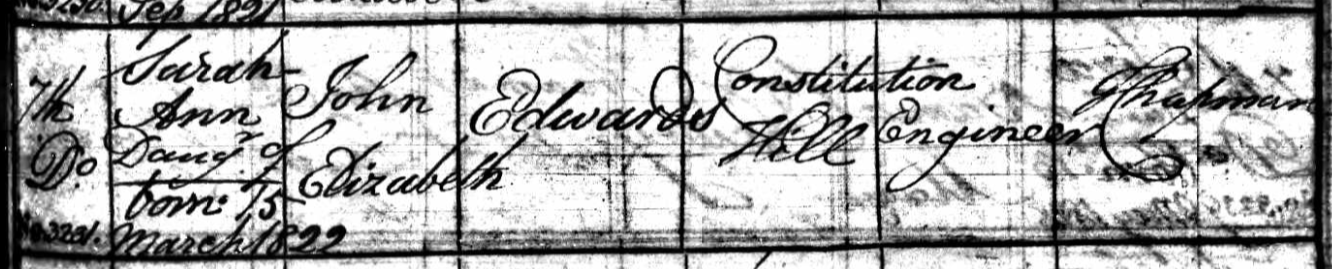
There were two baptisms recorded for parents John and Elizabeth Edwards, Constitution Hill, and John’s occupation was an engineer on both baptisms.
They were both daughters: Sarah Ann in 1822 and Elizabeth in 1824.Sarah Ann Edwards: St Philip, Birmingham. Born 15 March 1822, baptised 7 September 1822:
Elizabeth Edwards: St Philip, Birmingham. Born 6 February 1824, baptised 25 February 1824:

With John’s occupation as engineer stated, it looked increasingly likely that I’d found John’s first wife and children of that marriage.
Then I found a marriage of Elizabeth Beach to John Edwards in 1819, and subsequently found an Elizabeth Beach baptised in 1803. This appeared to be the right first wife for John, until an Elizabeth Slater turned up, with a marriage to a John Edwards in 1820. An Elizabeth Slater was baptised in 1803. Either Elizabeth Beach or Elizabeth Slater could have been the first wife of John Edwards. As John’s first wife Elizabeth is not related to us, it’s not necessary to go further back, and in a sense, doesn’t really matter which one it was.
But the Slater name caught my eye.
But first, the name Sarah Ann.
Of the possible baptisms for John Edwards, the most likely seemed to be in 1794, parents John and Sarah. John and Sarah had two infant daughters die just prior to John’s birth. The first was Sarah, the second Sarah Ann. Perhaps this was why John named his daughter Sarah Ann? In the absence of any other significant clues, I decided to assume these were the correct parents. I found and read half a dozen wills of any John Edwards I could find within the likely time period of John’s fathers death.
One of them was dated 1803. In this will, John mentions that his children are not yet of age. (John would have been nine years old.)
He leaves his plating business and some properties to his eldest son Thomas Davis Edwards, (just shy of 21 years old at the time of his fathers death in 1803) with the business to be run jointly with his widow, Sarah. He mentions his son John, and leaves several properties to him, when he comes of age. He also leaves various properties to his daughters Elizabeth and Mary, ditto. The baptisms for all of these children, including the infant deaths of Sarah and Sarah Ann have been found. All but Mary’s were in the same parish. (I found one for Mary in Sutton Coldfield, which was apparently correct, as a later census also recorded her birth as Sutton Coldfield. She was living with family on that census, so it would appear to be correct that for whatever reason, their daughter Mary was born in Sutton Coldfield)Mary married John Slater in 1813. The witnesses were Elizabeth Whitehouse and John Edwards, her sister and brother. Elizabeth married William Nicklin Whitehouse in 1805 and one of the witnesses was Mary Edwards.
Mary’s husband John Slater died in 1821. They had no children. Mary never remarried, and lived with her bachelor brother Thomas Davis Edwards in West Bromwich. Thomas never married, and on the census he was either a proprietor of houses, or “sinecura” (earning a living without working).With Mary marrying a Slater, does this indicate that her brother John’s first wife was Elizabeth Slater rather than Elizabeth Beach? It is a compelling possibility, but does not constitute proof.
Not only that, there is no absolute proof that the John Edwards who died in 1803 was our ancestor John Edwards father.
If we can’t be sure which Elizabeth married John Edwards, we can be reasonably sure who their daughters married. On both of the marriage records the father is recorded as John Edwards, engineer.
Sarah Ann married Mark Augustin Rawlins in 1850. Mark was a sword hilt maker at the time of the marriage, his father Mark a needle manufacturer. One of the witnesses was Elizabeth Edwards, who signed with her mark. Sarah Ann and Mark however were both able to sign their own names on the register.
Sarah Ann Edwards and Mark Augustin Rawlins marriage 14 October 1850 St Peter and St Paul, Aston, Birmingham:
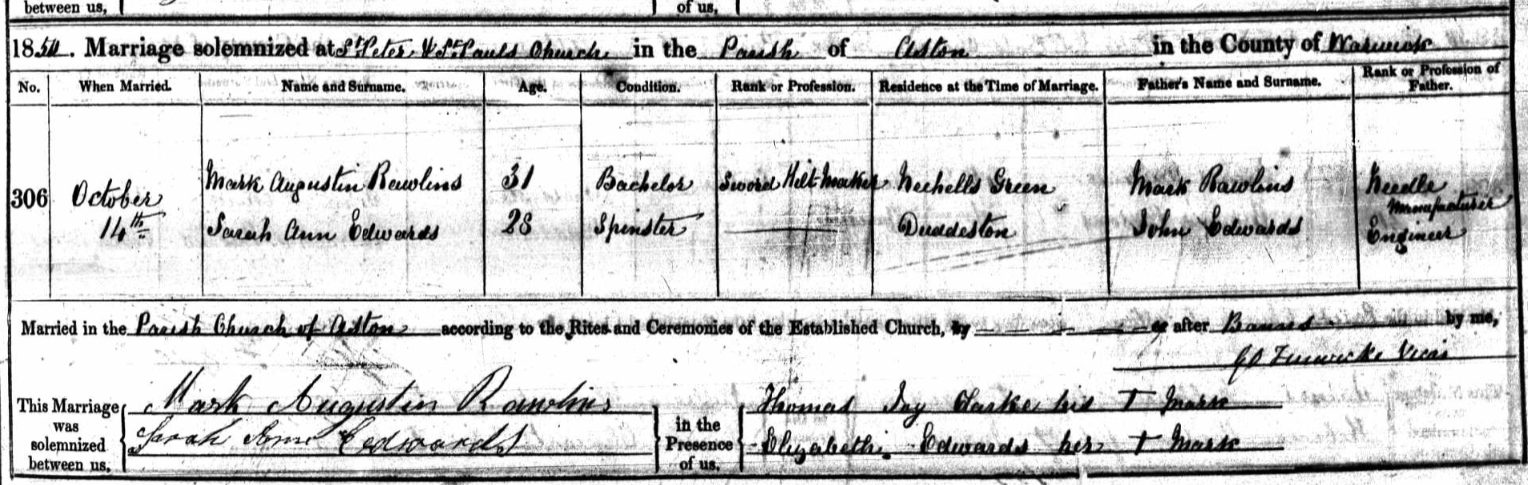
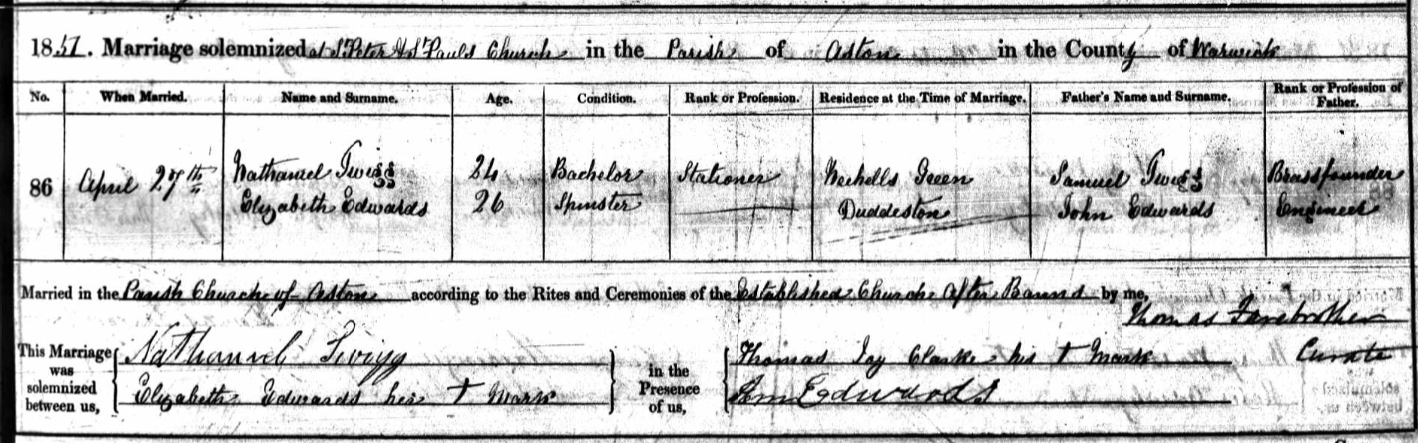
Elizabeth married Nathaniel Twigg in 1851. (She was living with her sister Sarah Ann and Mark Rawlins on the 1851 census, I assume the census was taken before her marriage to Nathaniel on the 27th April 1851.) Nathaniel was a stationer (later on the census a bookseller), his father Samuel a brass founder. Elizabeth signed with her mark, apparently unable to write, and a witness was Ann Edwards. Although Sarah Ann, Elizabeth’s sister, would have been Sarah Ann Rawlins at the time, having married the previous year, she was known as Ann on later censuses. The signature of Ann Edwards looks remarkably similar to Sarah Ann Edwards signature on her own wedding. Perhaps she couldn’t write but had learned how to write her signature for her wedding?
Elizabeth Edwards and Nathaniel Twigg marriage 27 April 1851, St Peter and St Paul, Aston, Birmingham:
Sarah Ann and Mark Rawlins had one daughter and four sons between 1852 and 1859. One of the sons, Edward Rawlins 1857-1931, was a school master and later master of an orphanage.
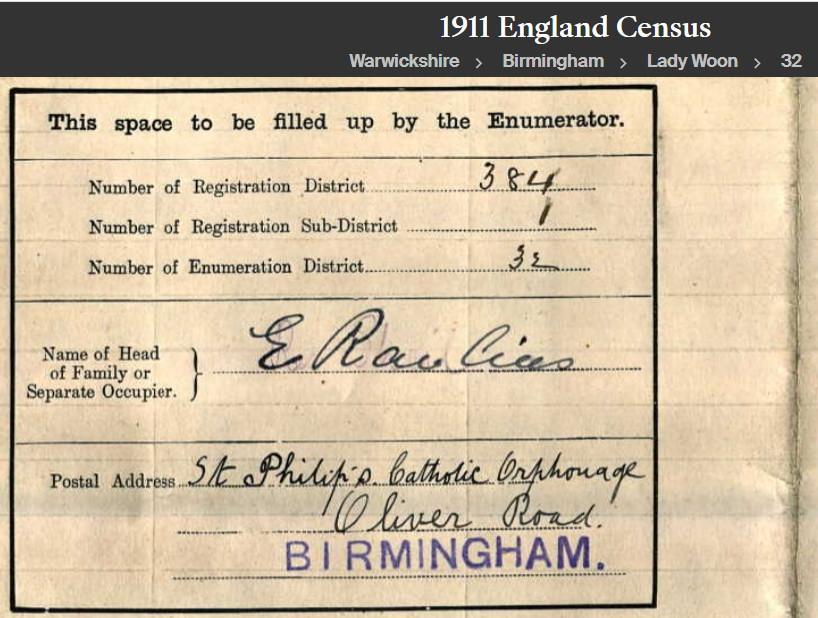
On the 1881 census Edward was a bookseller, in 1891 a stationer, 1901 schoolmaster and his wife Edith was matron, and in 1911 he and Edith were master and matron of St Philip’s Catholic Orphanage on Oliver Road in Birmingham. Edward and Edith did not have any children.
Edward Rawlins, 1911:
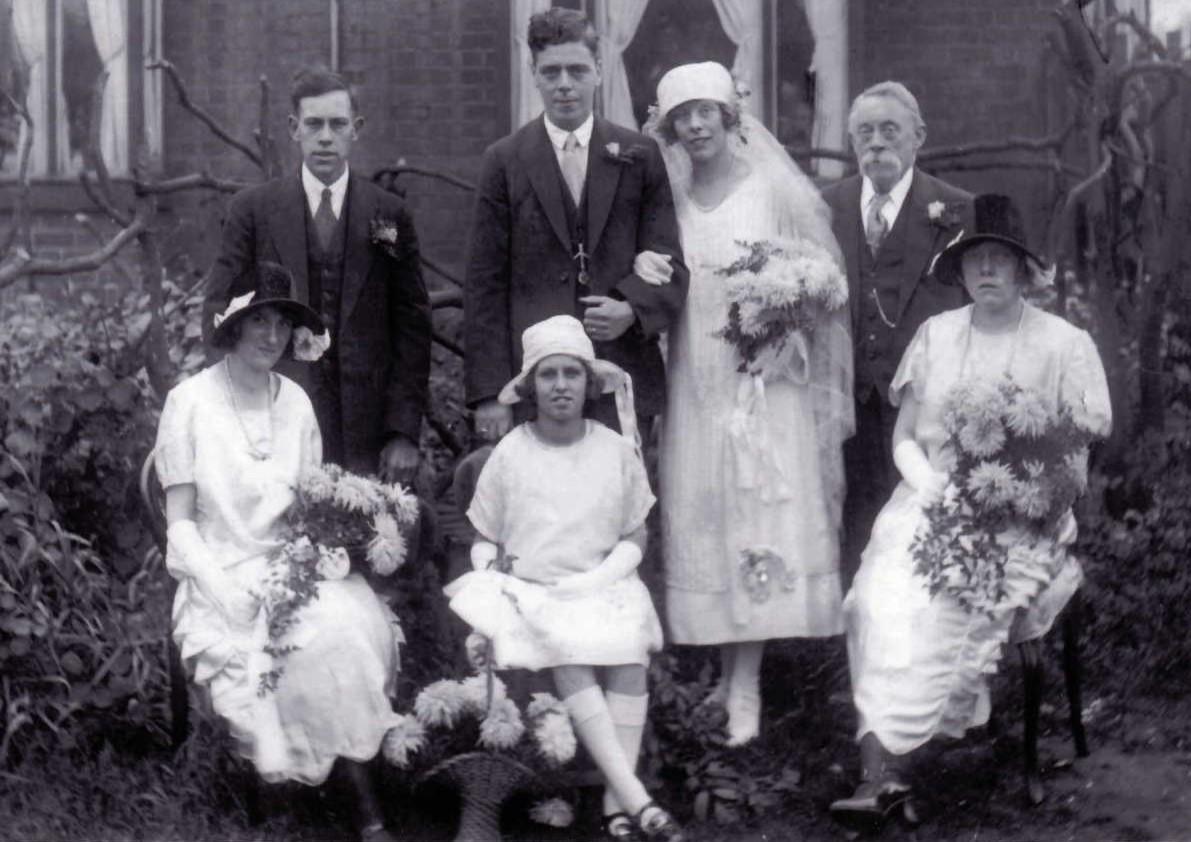
Elizabeth and Nathaniel Twigg appear to have had only one son, Arthur Twigg 1862-1943. Arthur was a photographer at 291 Bloomsbury Street, Birmingham. Arthur married Harriet Moseley from Burton on Trent, and they had two daughters, Elizabeth Ann 1897-1954, and Edith 1898-1983. I found a photograph of Edith on her wedding day, with her father Arthur in the picture. Arthur and Harriet also had a son Samuel Arthur, who lived for less than a month, born in 1904. Arthur had mistakenly put this son on the 1911 census stating “less than one month”, but the birth and death of Samuel Arthur Twigg were registered in the same quarter of 1904, and none were found registered for 1911.
Edith Twigg and Leslie A Hancock on their Wedding Day 1925. Arthur Twigg behind the bride. Maybe Elizabeth Ann Twigg seated on the right: (photo found on the ancestry website)
Photographs by Arthur Twigg, 291 Bloomsbury Street, Birmingham:
 June 8, 2023 at 1:37 am #7252
In reply to: The Precious Life and Rambles of Liz Tattler
Finnley, who was behind the sofa for reasons unknown, stood up and screamed at the top of her lungs. The scream was so unexpected and of such force that Godfrey dropped the novel he was holding and Liz came running from across the hall. What she had been doing across the hall all that time, god only knows, but she certainly wasn’t writing, said Godfrey later when recounting the story to Roberto.
“Mr Dugrat has gone,” announced Finnley when she was sure she had their attention. “Gone,” she repeated.
“Rat? I didn’t know you had a rat. Gone where?” asked Liz nervously.
Finnley gave her a withering glance. “Therefore I did not get to the convention because I have been searching hither and thither for him.”
May 22, 2023 at 6:45 am #7248In reply to: Coma Cameleon
Thanks to the fresh faced young looking redhead for her kindness, Tibu’s leap into the unknown went exceedingly well. He had a new warmth in his heart and the confidence to make a good impression when he went to the job fair all those years ago, and a tall handsome French man with a winning smile had offered him a job in his new rock and gem shop. Tibu had been honest with him about his past, telling him about the amnesia and that Tibu wasn’t really his name but he didn’t know what his name really was, but the French man said he loved the name Tibu. Tibu sighed with a deep sense of relief. What a stroke of luck to have a chance at a new life. When he started the new job, he gradually stopped dwelling on the forgotten past life as his new life took shape and he made new friends. He never forgot the book he’d been reading when that kind redhead brought him tea and listened to him, and it inspired him to write his own story, in case anyone ever found comfort in it.
May 12, 2023 at 8:15 pm #7237In reply to: Washed off the sea ~ Creative larks
“Sod this for a lark,” he said, and then wondered what that actually meant. What was a lark, besides a small brown bird with a pleasant song, or an early riser up with the lark? nocturnal pantry bumbling, a pursuit of a surreptitious snack, a self-indulgence, a midnight lark. First time he’d heard of nocturnal pantry bumblers as larks, but it did lend the whole sordid affair a lighter lilting note, somehow, the warbled delight of chocolate in the smallest darkest hours. Lorries can be stolen for various purposes—sometimes just for a lark—and terrible things can happen. But wait, what? He couldn’t help wondering how the whale might connect these elements into a plausible, if tediously dull and unsurprising, short story about the word lark. Did I use too many commas, he wondered? And what about the apostrophe in the plural comma word? I bet AI doesn’t have any trouble with that. He asked who could think of caging larks that sang at heaven’s gates. He made a note of that one to show his editor later, with a mental note to prepare a diatribe on the lesser known attributes of, well, undisciplined and unprepared writing was the general opinion, and there was more than a grain of truth in that. Would AI write run on sentences and use too many whataretheycalled? Again, the newspapers tell these children about pills with fascinating properties, and taking a pill has become a lark. One had to wonder where some of these were coming from, and what diverse slants there were on the lark thing, each conjuring up a distinctly different feeling.
Suddenly he had an idea.
May 12, 2023 at 12:57 pm #7232In reply to: Washed off the sea ~ Creative larks
🐳
Welcome to the bustling riverfront community of Bridgewater, where the sound of boat horns and cries of merchants filled the air.
Bridgewater was a town of hardworking people, all striving to make a living in this busy trading port. One such person was Anne, a middle-aged woman who owned a small pottery shop by the river. Her days were filled with the clanging of clay and the whirring of her pottery wheel. She took great pride in her work, creating beautiful plates and tea bowls that were highly sought after by the locals.
Another memorable character was Jack, the town cobbler whose small shop was always busy with customers. He was known for his kind heart and his willingness to help anyone in need, often giving away shoes to those who couldn’t afford them. As the days passed, life in Bridgewater had its ups and downs.
The lost halfpenny spoke of a hard day’s work, but also of the generosity of the community. The broken pipes spoke of moments of relaxation, but also of the struggles of daily life. And the smashed plates and tea bowls spoke of hurried meals, but also of the occasional argument or disagreement.
Despite the challenges, the people of Bridgewater found small joys in life. Children played by the river, skipping stones and chasing each other. Couples walked hand in hand along the promenade, watching the boats come and go. And on warm summer evenings, the town square was filled with music and laughter as locals gathered for impromptu dance parties. But as with any community, there were also tensions and conflicts.
The town council was often at odds with the merchants, who felt that their needs were being overlooked. And there were whispers of a rival trading port that threatened to take away business from Bridgewater. One day, a fire broke out in the warehouse district, destroying several buildings and leaving many homeless. The community rallied together to help those in need, with Anne donating plates and bowls for makeshift kitchens and Jack offering his shop as a temporary shelter. As the smoke cleared and the ashes settled, the people of Bridgewater were left to rebuild their town. Through hard work and perseverance, they overcame the challenges and emerged even stronger than before. The lost halfpenny, broken pipes, and smashed plates were all reminders of the struggles they had faced, but they also spoke of the resilience and strength of the human spirit. And so, life in Bridgewater continued, a vibrant and bustling riverfront community where goods were traded and daily life was filled with both hardships and small joys.
April 20, 2023 at 6:27 pm #7227In reply to: The Precious Life and Rambles of Liz Tattler
“What? What’s that you say? Do speak up, dear. Not now Finnley! Can’t you see I’m on the phone? Now then dear,” Liz said into the telephone, “Have I got this right? He hasn’t seeen a doctor yet? What do you mean, there aren’t any, they must have some at the hospital? Only the youngest ones nobody wants and the very old ones? A lousy hospital and the cardiologist isn’t very techy and doesn’t know what to do? So Michael is a what did you say, a PA? Oh a physicians assistant. Wait a minute, have I got this right? The doctor only comes to the clinic twice a month? So you can only see the PA? But what about the difficulty breathing and the coughing, I don’t know about in rural Arkansas, but in the rest of the world an 89 year old who’s been coughing so much for three weeks that he can hardly breathe is known as a medical emergency! But why are you waiting for diabetes and heart tests, surely he needs to breathe now and do the tests later? Couldn’t taste the Worcester sauce on his scrambled eggs, you say?”
Finnley’s gentle hand appeared as if by magic and restrained Liz from pulling a third handful of hair out.
“They’re going to fucking kill him, Finnley, and there’s nothing I can do.”
“There never is, really, in situations like this. Here, drink this. It’ll buck you up.”
March 7, 2023 at 11:22 pm #6786In reply to: Coma Cameleon
Tibu looked up at her, surprised by the offer. He hadn’t expected anyone to offer him anything more than spare change or a half-eaten sandwich. “That’s very kind of you,” he said with a small smile, “I’d like that very much.”
The young woman returned his smile and disappeared for a while. She came back a few minutes later, with two cups of steaming hot tea. Handing one to Tibu, she started sipping her own while they stood in silence for a moment looking at the last drops of dripping water from the eaves overhead, as the rain had started to subside.
Tibu couldn’t help but feel a pang of sadness. Here he was, a man with no memory of his past, selling books on the street for spare change, and yet this stranger was treating him with kindness and respect.
“Thank you,” he said softly his voice barely audible, “I really appreciate this.”
The woman shrugged and smiled again. “It’s no trouble at all. I think it’s nice to just take a break and chat with someone for a while. It can get lonely in this city sometimes.”
Tibu nodded in agreement. “I know what you mean. I feel like a stranger in my own life sometimes.”
The woman’s expression softened. “That must be hard. But you know, sometimes it’s good to start over. You can be whoever you want to be, do whatever you want to do. It’s like a second chance.”
As they continued their conversation, a crumpled torn piece of newspaper caught Tibu’s eye, lodged in a nearby gutter. The headline mentioned a job fair happening the next day, an opportunity for people to find new careers. An idea began to form in his mind – attending the job fair could be his first step in creating a new life.
Tibu looked at the woman, still struck by her earlier words. It was a new way of thinking for him. Maybe he didn’t have to be defined by his past or his amnesia. Maybe he could create a new life for himself, with new people and new experiences.
“Thank you,” he said again, feeling a newfound sense of hope. “You’ve given me a lot to think about.”
The woman smiled and finished her tea. “Well, I should probably get back to work. But it was nice talking to you. Maybe I’ll see you around. I’m Lorena, by the way.”
Tibu nodded and watched her walk away, feeling a warmth in his chest. Maybe things weren’t so hopeless after all. Maybe he could create a new life for himself; he checked the crumbled paper; his decision was made; armed with renewed purpose, he’d resolved to attend the job fair.
Of course, he’d need to prepare, sort out stuff…
He looked down at the book in his hand and smiled. For now, he had Lord Gustard Willoughby Fergusson to keep him company and inspire him about acts of bravery and embrace with gusto the great leap into the unknown.
March 5, 2023 at 11:16 pm #6771Some background for the storyline of Franiel
For safekeeping and future explorations…
Franiel a talented young monk from Mount Elok’ram is going on a journey of a lifetime after the death of the old abbot Hrih Chokyam Lin’potshee despite being his chosen successor unknown to everybody. He is sent by the usurper Elder Aum Geog to a journey down to the Village of Chard Dam Jarfon to engrave a precious chalice with sacred words on a sealed scroll.
He encounters Léonard a zany alchemist with his dog Moufle who takes his precious cargo.
Franiel finds shelter with Phoebe Chesterhope, a master thief who trains him until she disappears after taking her motorbike on a dangerous interdimensional mission on the day of Marduë. Franiel is then put back in the path of Léonard, who had stolen the chalice for safekeeping. Léonard teaches Franiel about the powers of the chalice (the famed Cup of Margilonia), on the day of Seldië, and activates its self-protective cloaking power to temporarily relieve Franiel of his burden.
Under Léonard’s tutelage, the true destiny of Franiel is revealed, and he can claim his rightful place as the chosen successor of the old abbot, on the day of Marduë. With the help of Leonard and the power of the chalice, Franiel embarks on a new journey, equipped with the knowledge and skills he needs to fulfill his destiny. However, with someone else following him and the possibility of danger lurking around every hexade, Franiel must stay vigilant and continue to rely on his newfound allies to help him succeed. Only time will tell if Franiel is truly ready for the challenges that lie ahead on his path to becoming a great leader and guardian of the sacred chalice.
February 28, 2023 at 2:10 pm #6721In reply to: Orbs of Madjourneys
Xavier was dramatically behind his work, but he could see the benefits to his mood of the break from his routine. While the others had been enlisted to a bush tucker cooking lesson by their hosts, he’d retreated to his room for some catching up with his programming.
The lady with the dreadlocks in particular seemed to have taken a liking to Youssef so much so that she had offered to join their group for the cooking lesson session, which apparently was initially met with disbelief a first, then surprise and anxiety and finally made her family raise a few eyebrows profusely. Youssef didn’t seem bothered by it, and to be fair, did seem completely oblivious to the situation.Speaking of awkward situations, after the bar discussion, Glimmer had got off on her own, apparently going to chase for literal rainbows. She’d mentioned in a conspiratorial tone “You don’t see them rainbows nowadays, have you? See, that’s what I mean, them with the government electric waves, laser rays and stuff, they manipulate the weather… Keep people docile and hopeless. So I’m going on a chase.”
Xavier had frowned at Yasmin before she could top it off with a “good luck with the unicorns.” He didn’t need telepathy to know that Yasmin could hardly pass on an ironic salvo in a potentially comical situation.
Anyway, Glimmer leaving off to new adventures of her own without overstaying her welcome was met with a few sighs of relief. The four of them quite liked the comfort of their little group with their insider references and jokes.His programmic work was rather tedious and slow, but he’d made good progress connecting the new training model into the AL, and the muffled sounds of the cooking class with the occasional laughter did make him want to finish faster.
He hoped he would get most of it done in time to enjoy the incoming festival. The town however ghostly it had seemed on arrival, had taken a unexpected liveliness with colorful bunting flags now spreading across all roads intersections.
With all this newfound activity, they’d almost forgotten about the game. However, he could feel there was something more at play, and it would be a trial of Zara’s leadership capabilities —her style had often been solo. It was great for scouting mission and opening new doors in unknown parts of the game, but apparently the group quest required something different…
February 22, 2023 at 8:11 pm #6624In reply to: The Chronicles of the Flying Fish Inn
I had to meet Devan at the garage; I didn’t want to raise suspicion calling an overseas number that would show up like a sore thumb in the next phone company invoice. Even with the occasional visitors calling for bookings, it was more Idle’s job to call back. She is funny when she’s got her headphones and microphone on, with that look from the 90s, taking her grand air and posh accent to answer people over skype. ‘Sister Idle dot com‘ I call her behind her back. She sounds like a mixture of an investigator and nun who would sell goose feather duvets made by the nunnery.
Devan was punctual for once; we didn’t have a lot of time to use the phone at the counter while his boss was off for lunch.
We looked at each other. “You sure you want to do that?” we both knew there was no turning back. It could be a sore disappointment, but how worse would that be compared to a rabbit hole of questions and potential emotional upheavals. Someone wise said (probably Henrich Lyeumon I think) “if you continue going down rabbit holes, you’re bound to find a lot of rabbit poop.”
Devan nodded silently.
I punched the numbers from the Gugu search.
The connection seemed to take forever. Then a click. A gruff “Hello?” in a male voice.
I don’t know why I blurted it out, but it came out without thinking.
“Dad? Is that you?”
“…” Devan looked at me alarmed and also with excitement in his eyes. There was a blank at the other end of the line.
“Not on this line. I’ll call you back.”
We looked at each other with Devan. Did we just hear what we heard? Given the look on Devan’s face, I’m pretty sure we did.
We don’t have time to waste, his boss is already back, smacking his lips all shiny with chicken grease.
Before I leave my brother to his job, we exchange hopeful glances. So a rabbit hole is it.
My phone is buzzing.
A message from [Unknown sender] — why didn’t it go to spam?
“I’m on my way. ~ F”
February 22, 2023 at 8:54 am #6621In reply to: Orbs of Madjourneys
As the four of them walked into the tavern, having walked the mile or so from the Flying Fish Inn to the main street of the tiny town, Zara noticed the black BMW that she and Yasmin had seen parked outside the Piggly supermarket on the way back from the airport in Alice. She elbowed Yasmin in the ribs to point it out, but there was no need as Yasmin was already snorting nervously at the sight of it.

Sister Finli caught sight of them as she was just about to leave Betsy’s gem shop and paused until they’d disappeared into the bar before leaving the shop. It was the first time that Finli had seen Betsy in the flesh, and what a lot of flesh there was to see. Finli was horrifed, comparing her own elegant thin fingers with the fat sausage like digits of Betsy. She would never have expected Betsy to look this way. Still, it had thrown her, and she lost her usual efficient composure and quickly purchased a pink speckled gummy bear necklace. Annoyingly, this transaction reminded her that she seemed to have lost her crucifix.
Finli was an orphan. The nuns had named her Finean Lisa. Finean meant beautiful daughter, and Lisa meant devoted to god. Later they shortened it to Finli. She’d spent all her life at the orphanage in Suva, having been deposited there at birth, and although she had no particular calling to be a nun, she had not known what else to do with her life. It was the only family she’d ever known, and so she stayed on. It was only in the past year or two that she’d had any curiosity about who her real parents were, when she read about DNA tests and ancestry research. She’d been told in the past that no records existed as she had been found on the doorstep of the orphanage one morning 43 years ago. The knowledge had filled her with comtempt for her parents, whoever they were, and for the most part she pushed them from her mind, not caring to know. But when she read about all the successes of adopted people finding their real parents, she was consumed with curiosity. At first she just wanted to know who they were. But once she had found their names, she wanted to know more. She wanted to know why. One thing led to another.
Her real father had disappeared, lost down some mines although the story there was far from clear. Indeed, that particular story was a darn sight more than unclear, it was downright fishy. Her real mother was was alive and kicking, and living near to the mines where Howard had disappeared. Finli deduced that she must have been born, or at least conceived, in this godforsaken place in the outback. What an ignominous start to her uneventful life.
She knew that Fred was her uncle, but she had not told him she knew that. Did Fred know who she was? He’d always been kind to her, but then, he was affable to everyone. When it came to her knowledge that Fred had given that tiresome snorting volunteer girl a parcel to take with her, to, of all places! that very town in the outback, Finli simply had to know what was in it. But she didn’t want to spill the beans too soon, in case it hindered her attempts to find the truth about Howard, her father. She decided to travel to the town incognito. But how was she going to find the money for it? Well, she knew she was burning her bridges, but she had to do it. She stole the golden chalice from the church and sold it on Ubay. She was suprised at how much money it fetched. Not only could she afford the trip, she could do it in style.
It was an exciting adventure, but Finli was not accustomed to travel and adventure. In fact, she was dreading meeting her mother. At times she wished she’d just stayed at the orphanage. But it was too late now. She was here.
 February 21, 2023 at 1:54 pm #6616
In reply to: Orbs of Madjourneys
“Imagine that! a Big Banana…”
After a brisk walk trying to catch up with his winged psittacine friend, Xavier had stumbled on a large concrete sculpture painted bright yellow in the middle of a field.
He’s read somewhere Australia was known for its fondness of “big things”, but he didn’t expect one here – it was quite fun.“I think you just made my day Pretty Girl” he said to the bird. “Not that I don’t like to venture more, but I get the feeling I have to come back.” He checked his phone, there were a few messages, including one from Youssef who’d found some surprisingly interesting stuff during his shopping visit.
“We wouldn’t want to be caught off-guard by a bunyip, you know…” he said more to himself than to anyone in particular.
“Suuuit yourself.” said the bright red parrot, “No need to fear bunyip. Just don’t follow Min min lights. And stay away from mines.” and it flew away in a different direction.
February 7, 2023 at 10:43 pm #6512In reply to: Prompts of Madjourneys
Zara offered the following quirk: “unleash my hidden rudeness”
Quirk accepted.
You find yourself in the bustling streets of an old medieval town. The people around you are going about their business, and you see vendors selling goods, street performers entertaining the crowd, and guards patrolling the area. You hear rumors about a secret society of mischievous tricksters who are known for causing trouble and making people’s lives more interesting.
You decide to investigate these rumors and join the society of tricksters, who call themselves the “Rude Ones.” You are tasked with finding the key to their hideout, a tile with a rude message written on it. To do this, you must complete several challenges and pranks around the town, each more mischievous than the last.
Your objective is to find the tile, sneak into the Rude Ones’ hideout, and cause as much chaos and trouble as possible. You must also find a way to insert a real-life prank or act of rudeness into your daily life, as proof of your success in the game.
Possible directions to investigate:
- Talk to the vendors and street performers to gather information about the Rude Ones.
- Observe the guards and see if they have any information on the secret society.
- Explore the different neighborhoods and see if anyone knows about the hideout.
Possible characters to engage:
- A mysterious street performer who is rumored to be part of the Rude Ones.
- A vendor who has a reputation for being rude to customers.
- A guard who is rumored to be in league with the Rude Ones.
Look for a tile with a rude message written on it, and capture proof of your real-life prank or act of rudeness. Good luck, and have fun!
February 7, 2023 at 9:54 pm #6509In reply to: A Dog and a Dig – The trenches of the Time Capsule
Table of characters:
Characters Keyword Characteristics Sentiment Clara Woman in her late 40s, VanGogh’s owner Inquisitive, curious VanGogh Clara’s dog Curious Grandpa Bob Clara’s grandfather, widowed, early signs of dementia Skeptical, anxious Nora Clara’s friend, amateur archaeologist, nicknamed Alienor by Clara Adventure-seeking Jane Grandpa Bob’s wife, Clara’s mother, only Bob seem to see her, possibly a hallucination Teasing Julienne / Mr. Willets Neighbors of Clara & Bob – Bubbles (Time-dragglers squad, alternate timeline) Junior drag-queen, reporting to Linda Pol (office manager) adventurous, brave, concerned Will After Nora encountered a man with a white donkey, she awakes in a cottage. Will is introduced later, and drugs Nora unbeknownst to her. Later Bob & Clara come at his doorstep (they know him as the gargoyle statues selling man from the market), looking for her friend. Affable, mysterious, hiding secrets Some connecting threads:
- The discovery of a mysterious pear-shaped box with inscriptions by Clara and her grandfather.
- Clara sending photos of the artifact to Nora (Alienor), an amateur archaeologist.
- Nora’s journey from her place to reach the location where the box was discovered and her encounter with a man with a donkey (Will?).
- Grandpa Bob’s anxious behavior and the confusion over the torn piece of paper with a phone number.
- The parallel timeline of a potential breach in the timelines in Linda Pol’s office.
- The search for VanGogh and the discovery of a map tucked into his collar.
- The suggestion from Jane that Clara should be told something.
- Nora awakes at a cottage and spends time with Will who drugs her soup. Bob & Clara show up later, looking for her.
February 7, 2023 at 6:20 pm #6506In reply to: Orbs of Madjourneys
Bert dropped Zara off after breakfast at the start of the Yeperenye trail. He suggested that she phone him when she wanted him to pick her up, and asked if she was sure she had enough water and reminded her, not for the first time, not to wander off the trail. Of course not, she replied blithely, as if she’d never wandered off before.
“It’s a beautiful gorge, you’ll like it,” he called through the open window, “You’ll need the bug spray when you get to the water holes.” Zara smiled and waved as the car roared off in a cloud of dust.
On the short drive to the start of the trail, Bert had told her that the trail was named after the Yeperenye dreamtime, also known as ‘Caterpillar Dreaming’ and that it was a significant dreamtime story in Aboriginal mythology. Be sure to look at the aboriginal rock art, he’d said. He mentioned several varieties of birds but Zara quickly forgot the names of them.
It felt good to be outside, completely alone in the vast landscape with the bone warming sun. To her surprise, she hadn’t seen the parrot again after the encounter at the bedroom window, although she had heard a squalky laugh coming from a room upstairs as she passed the staircase on her way to the dining room.
But it was nice to be on her own. She walked slowly, appreciating the silence and the scenery. Acacia and eucalyptus trees were dotted about and long grasses whispered in the occasional gentle breezes. Birds twittered and screeched and she heard a few rustlings in the undergrowth from time to time as she strolled along.
After a while the rocky outcrops towered above her on each side of the path and the gorge narrowed, the trail winding through stands of trees and open grassland. Zara was glad of the shade as the sun rose higher.

The first water hole she came to took Zara by surprise. She expected it to be pretty and scenic, like the photos she’d seen, but the spectacular beauty of the setting and shimmering light somehow seemed timeless and otherwordly. It was a moment or two before she realized she wasn’t alone.
It was time to stop for a drink and the sandwich that one of the twins had made for her, and this was the perfect spot, but she wondered if the man would find it intrusive of her to plonk herself down and picnic at the same place as him. Had he come here for the solitude and would he resent her appearance?
It is a public trail, she reminded herself not to be silly, but still, she felt uneasy. The man hadn’t even glanced up as far as Zara could tell. Had he noticed her?
She found a smooth rock to sit on under a tree and unwrapped her lunch, glancing up from time to time ready to give a cheery wave and shout hi, if he looked up from what he was doing. But he didn’t look up, and what exactly was he doing? It was hard to say, he was pacing around on the opposite side of the pool, looking intently at the ground.
When Zara finished her drink, she went behind a bush for a pee, making sure she would not be seen if the man glanced up. When she emerged, the man was gone. Zara walked slowly around the water hole, taking photos, and keeping an eye out for the man, but he was nowhere to be seen. When she reached the place where he’d been pacing looking at the ground, she paused and retraced his steps. Something small and shiny glinted in the sun catching her eye. It was a compass, a gold compass, and quite an unusual one.
Zara didn’t know what to do, had the man been looking for it? Should she return it to him? But who was he and where did he go? She decided there was no point in leaving it here, so she put it in her pocket. Perhaps she could ask at the inn if there was a lost and found place or something.
Refreshed from the break, Zara continued her walk. She took the compass out and looked at it, wondering not for the first time how on earth anyone used one to find their way. She fiddled with it, and the needle kept pointing in the same direction. What good is it knowing which way north is, if you don’t know where you are anyway? she wondered.
With a squalk and a beating of wings, Pretty Girl appeared, seemingly out of nowhere. “It’s not that kind of compass. You’re supposed to follow the pointer.”
“Am I? But it’s pointing off the trail, and Bert said don’t go off the trail.”
“That’s because Bert doesn’t want you to find it,” replied the parrot.
Intrigued, Zara set off in the direction the compass was pointing towards.
-
AuthorSearch Results