


Search Results for 'three'
-
AuthorSearch Results
-
December 23, 2024 at 11:20 am #7708
In reply to: Quintessence: Reversing the Fifth
Elara — Nov 2021: The End of Genealogix
The numbers on the screen were almost comical in their smallness. Elara stared at the royalty statement, her lips pressed into a tight line as the cursor blinked on the final transaction: £12.37, marked Genealogix Royalty Deposit. Below it, the stark words: Final Payout.
She leaned back in her chair, pushing her glasses up onto her forehead, and sighed. The end wasn’t a surprise. For years, she’d known her genetic algorithm would be replaced by something faster, smarter, and infinitely more marketable. The AI companies had come, sweeping up data and patents like vultures at a sky burial. Genealogix, her improbable golden goose, had simply been outpaced.
Still, staring at the zero balance in the account felt oddly final, as if a door had quietly closed on a chapter of her life. She glanced toward the window, where the Tuscan hills rolled gently under the late afternoon sun. Most of the renovation work on the farmhouse had been finished, albeit slowly, over the years. There was no urgent financial burden, but the thought of her remaining savings made her stomach tighten all the same.
Elara had stumbled into success with Genealogix, though not without effort. It was one of her many patents—most of them quirky solutions to problems nobody else seemed interested in solving. A self-healing chalkboard coating? Useless. A way to chart audio waveforms onto three-dimensional paper models? Intriguing but commercially barren. Genealogix had been an afterthought at the time, something she tinkered with while traveling through Europe on a teaching fellowship.
When the royalties started rolling in unexpectedly, it had felt like a cosmic joke. “Finally,” she’d muttered to herself as she cashed her first sizeable check, “they like something useless.”
The freedom that money brought was a relief. It allowed her to drop the short-term contracts that tethered her to institutions and pursue science on her own terms. No rigid conventions, no endless grant applications, no academic politics. She’d call it “investigation,” free from the dogma that so often suffocated creativity.
And yet, she was no fool. She’d known Genealogix was a fluke, its lifespan limited.

She clicked away from the bank statement and opened her browser, absently scrolling through her bookmarked social accounts. An old post from Lucien caught her eye—a photograph of a half-finished painting, the colors dark and chaotic. His caption read: “When the labyrinth swallows the light.”
Her brow furrowed. She’d been quietly following Lucien for years, watching his work evolve through fits and starts. It was obvious he was struggling. This post was old, maybe Lucian had stopped updating after the pandemic. She’d sent anonymous payments to buy his paintings more than once, under names that would mean nothing to him —”Darlara Ameilikian” was a bit on the nose, but unlike Amei, Elara loved a good wink.
Her mind wandered to Darius, and her suggesting he looked into 1-euro housing schemes available in Italy. It had been during a long phone call, back when she was scouting options for herself. They still had tense exchanges, and he was smart to avoid any mention of his odd friends, otherwise she’d had hung the phone faster than a mouse chased by a pack of dogs. “You’d thrive in something like that,” she’d told him. “Build it with your own hands. Make it something meaningful.” He’d laughed but had sounded intrigued. She wondered if he’d ever followed up on it.
As for Amei—Elara had sent her a birthday gift earlier that year, a rare fabric she’d stumbled across in a tiny local shop. Amei hadn’t known it was from her, of course. That was Elara’s way. She preferred to keep her gestures quiet, almost random —it was best that way, she was rubbish at remembering the small stuff that mattered so much to people, she wasn’t even sure of Amei’s birthday to be honest; so she preferred to scatter little nods like seeds to the wind.
Her eyes drifted to a framed ticket stub on the bookshelf, a relic from 2007: Eliane Radigue — Naldjorlak II, Aarau Festival (Switzerland). Funny how the most unlikely event had made them into a group of friends. That concert had been a weird and improbable anchor point in their lives, a moment of serendipity that had drawn them toward something more than their own parts.
By that time, they were already good friends with Amei, and she’d agreed to join her to discover the music, although she could tell it was more for the strange appeal of something almost alien in experience, than for the hurdles of travel and logistics. But Elara’s enthusiasm and devil-may-care had won her over, and they were here.
Radigue’s strange sound sculptures, had rippled through the darkened festival scene, wavering and hauntingly delicate, and at the same time slow and deliberate, leading them towards an inevitability. Elara had been mesmerized, sitting alone near the back as Amei had gone for refreshments, when a stranger beside her had leaned over to ask, “What’s that sound? A bell? Or a drone?”
It was Lucien. Their conversation had lasted through the intermission soon joined by Amei, and spilled into a café afterward, where Darius had eventually joined them. They’d formed a bond that night, one that felt strange and tenuous at the time but proved to be resilient, even as the years pulled them apart.
Elara closed the laptop, resting her hand on its warm surface for a moment before standing. She walked to the window, the sun dipping lower over the horizon, casting long shadows across the vineyard. The farmhouse had been a gamble, a piece of the future she wasn’t entirely sure she believed in when she’d bought it. But now, as the light shifted and the hills glowed gold, she felt a quiet satisfaction.
The patent was gone, the money would fade, but she still had this. And perhaps, that was enough.
December 19, 2024 at 9:52 am #7698In reply to: Quintessence: Reversing the Fifth
December 2023
Lights and Christmas decorations were starting to pop up everywhere, like frost and icicles after a frozen winter night. Lucien—no, Julien, as he had started calling himself a few years ago—enjoyed walking in the streets at the end of the day, when the balance between light and night shifted into the darkness. That was the time when decorations would start to come to life like a swarm of fireflies, flickering in time with the city’s heartbeat.
It was Julien’s first time in Paris after Lucien’s three years of exile, far from all his concerns and the glacial grasp of the dark couple. Julien had enjoyed his time traveling the world, discovering Asia, South America and even certain parts of Africa he would never have imagined he would dare enter. Julien made friends along the way, always curious about their ways of living and the way they looked at the world. But always the voice of Lucien made him wary of staying too long. He had the impression it would increase the possibility of chance encounters with Darius. And he longed to reconnect with his friend and his former life, it would lead to awkward moments, and he would have to give some explanations. But he feared it would make him want to go back, with the risk of attracting unwanted attention. So Julien had to leave in order to be free. That was the price he was willing to pay.
But in the end, it was the longing of French winter time that made him come back home.
“Lucien! Is that you?”
December 6, 2024 at 8:44 am #7648In reply to: Quintessence: Reversing the Fifth
Spring 2024
Matteo was wandering through the streets of Avignon, the spring air heavy with the scent of blooming flowers and sun-warmed stone. The hum of activity surrounded him—shopkeepers arranging displays, the occasional burst of laughter from a café terrace. He walked with no particular destination, drawn more by instinct than intent, until a splash of colour caught his eye.
On the cobblestones ahead, an artist crouched over a sprawling chalk drawing. It was a labyrinthine map, its intricate paths winding across the ground with deliberate precision. Matteo froze, his breath catching. The resemblance to the map he’d found at the vineyard office was uncanny—the same loops and spirals, the same sense of motion and stillness intertwined. But it wasn’t the map itself that held him in place. It was the faces.
Four of them, scattered in different corners of the design, each rendered with surprising detail. Beneath them were names. Matteo felt a shiver crawl up his spine. He knew three of those faces. Amei, Elara, Darius… he had met each of them once, in moments that now felt distant and fragmented. Strangers to him, but not quite.
The artist shifted, brushing dark, rain-damp curls from his forehead. His scarf, streaked faintly with paint, hung loosely around his neck. Matteo stepped closer, his curiosity overpowering any hesitation. “Is that your name?” he asked, gesturing toward the face labeled Lucien.
The artist straightened, his hand resting lightly on a piece of green chalk. He studied Matteo for a moment, his expression unreadable. “Yes,” he said simply, his voice low but clear.
Matteo crouched beside him, tracing the edge of the map with his eyes. “It’s incredible,” he said. “The detail, the connections. Why the faces?”
Lucien hesitated, glancing at the names scattered across his work. “Because that’s how it is,” he said softly. “We’re all here, but… not together.”
Matteo tilted his head, intrigued. “You mean you’ve drifted?”
Lucien nodded, his gaze dropping to the chalk in his hand. “Something like that. Paths cross, then they don’t. People take their turns.”
Matteo studied the map again, its intertwining lines seeming both chaotic and deliberate. The faces stared back at him, and he felt the pull of the map he no longer carried. “Do you think paths can lead back?” he asked, his voice thoughtful.
Lucien glanced at him, something flickering briefly in his eyes. “Sometimes. If you follow them long enough.”
Matteo smiled faintly, standing. His curiosity shifted as he turned his attention to the artist himself. “Do you know where I can find absinthe?” he asked.
Lucien raised an eyebrow. “Absinthe? Haven’t heard anyone ask for that in a while.”
“Just something I’ve been chasing,” Matteo replied lightly, his tone almost playful.
Lucien gestured vaguely toward a café down the street. “You might try there. They keep the old things alive.”
“Thanks,” Matteo said, offering a nod. He took a few steps away but paused, turning back to the artist still crouched over his map. “It’s a good drawing,” he said. “Hope your paths cross again.”
Lucien didn’t reply, but his hand moved back to the chalk, drawing a faint line that connected two of the faces. Matteo watched for a moment longer before continuing down the street, the memory of the map and the names lingering in his mind like an unanswered question. Paths crossed, he thought, but maybe they didn’t always stay apart.
For the first time in days, Matteo felt a strange sense of possibility. The map was gone, but perhaps it had done what it was meant to do—leave its mark.
December 4, 2024 at 11:58 pm #7644In reply to: Quintessence: Reversing the Fifth
From Decay to Birth: a Map of Paths and Connections
7. Darius’s Encounter (November 2024)
Moments before the reunion with Lucien and his friends, Darius was wandering the bouquinistes along the Seine when he spotted this particular map among a stack of old prints. The design struck him immediately—the spirals, the loops, the faint shimmer of indigo against yellowed paper.
He purchased it without hesitation. As he would examine it more closely, he would notice faint marks along the edges—creases that had come from a vineyard pin, and a smudge of red dust, from Catalonia.
When the bouquiniste had mentioned that the map had come from a traveler passing through, Darius had felt a strange familiarity. It wasn’t the map itself but the echoes of its journey— quiet connections he couldn’t yet place.
6. Matteo’s Discovery (near Avignon, Spring 2024)
The office at the edge of the vineyard was a ruin, its beams sagging and its walls cracked. Matteo had wandered in during a quiet afternoon, drawn by the promise of shade and a moment of solitude.
His eyes scanned the room—a rusted typewriter, ledgers crumbling into dust, and a paper pinned to the wall, its edges curling with age. Matteo stepped closer, pulling the pin free and unfolding what turned out to be a map.
Its lines twisted and looped in ways that seemed deliberate yet impossible to follow. Matteo traced one path with his finger, feeling the faint grooves where the ink had sunk into the paper. Something about it unsettled him, though he couldn’t say why.
Days later, while sharing a drink with a traveler at the local inn, Matteo showed him the map.
“It’s beautiful,” the traveler said, running his hand over the faded indigo lines. “But it doesn’t belong here.”
Matteo nodded. “Take it, then. Maybe you’ll figure it out.”
The traveler left with the map that night, and Matteo returned to the vineyard, feeling lighter somehow.
5. From Hand to Hand (1995–2024)
By the time Matteo found it in the spring of 2024, the map had long been forgotten, its intricate lines dulled by dust and time.
2012: A vineyard owner near Avignon purchased it at an estate sale, pinning it to the wall of his office without much thought.
2001: A collector in Marseille framed it in her study, claiming it was a lost artifact of a secret cartographer society, though she later sold it when funds ran low.
1997: A scholar in Barcelona traded an old atlas for it, drawn to its artistry but unable to decipher its purpose.
The map had passed through many hands over the previous three decades and each owner puzzling over, and finally adding their own meaning to its lines.
4. The Artist (1995)
The mapmaker was a recluse, known only as Almadora to the handful of people who bought her work. Living in a sunlit attic in Girona, she spent her days tracing intricate patterns onto paper, claiming to chart not geography but connections.
“I don’t map what is,” she once told a curious buyer. “I map what could be.”
In 1995, Almadora began work on the labyrinthine map. She used a pale paper from Girona and indigo ink from India, layering lines that seemed to twist and spiral outward endlessly. The map wasn’t signed, nor did it bear any explanations. When it was finished, Almadora sold it to a passing merchant for a handful of coins, its journey into the world beginning quietly, without ceremony.
3. The Ink (1990s)
The ink came from a different path altogether. Indigo plants, or aviri, grown on Kongarapattu, were harvested, fermented, and dried into cakes of pigment. The process was ancient, perfected over centuries, and the resulting hue was so rich it seemed to vibrate with unexplored depth.
From the harbour of Pondicherry, this particular batch of indigo made its way to an artisan in Girona, who mixed it with oils and resins to create a striking ink. Its journey intersected with Amei’s much later, when remnants of the same batch were used to dye textiles she would work with as a designer. But in the mid-1990s, it served a singular purpose: to bring a recluse artist’s vision to life.
2. The Paper (1980)
The tree bore laughter and countless other sounds of nature and passer-by’s arguments for years, a sturdy presence, unwavering in a sea of shifting lives. Even after the farmhouse was sold, long after the sisters had grown apart, the tree remained. But time is merciless, even to the strongest roots.
By 1979, battered by storms and neglect, the great tree cracked and fell, its once-proud form reduced to timber for a nearby mill.
The tree’s journey didn’t end in the mill; it transformed. Its wood was stripped, pulped, and pressed into paper. Some sheets were coarse and rough, destined for everyday use. But a few, including one particularly smooth and pale sheet, were set aside as high-quality stock for specialized buyers.
This sheet traveled south to Catalonia, where it sat in a shop in Girona for years, its surface untouched but full of potential. By the time the artist found it in the mid-1990s, it had already begun to yellow at the edges, carrying the faint scent of age.
1. The Seed (1950s)
It began in a forgotten corner of Kent, where a seed took root beneath a patch of open sky. The tree grew tall and sprawling over decades, its branches a canopy for birds and children alike. By 1961, it had become the centerpiece of the small farmhouse where two young sisters, Vanessa and Elara, played beneath its shade.
“Elara, you’re too slow!” Vanessa called, her voice sharp with mock impatience. Elara, only six years old, trailed behind, clutching a wooden stick she used to scratch shapes into the dirt. “I’m making a map!” she announced, her curls bouncing as she ran to catch up.
Vanessa rolled her eyes, already halfway up the tree’s lowest branch. “You and your maps. You think you’re going somewhere?”
December 1, 2024 at 5:08 pm #7617“Who sees that the habit-energy of the projections of the beginningless past is the cause of the three realms and who understands that the tathagata stage is free from projections or anything that arises, attains the personal realisation of buddha knowledge and effortless mastery over their own minds” —The Lankavatara Sutra, 2.8 (trans. Red Pine).
“To trace the ripples of a beginningless sea is to chase a horizon that vanishes with each step; only by stilling the waves does the ocean reveal its boundless, unbroken clarity.”
~Echoes of the Vanished Shore, Selwyn Lemone.
What if the story would unfold in reverse this time? Would the struggle subsist, to remember the past events written comment after comment? Rather than writing towards a future, and —maybe— an elusive ending, would remembering layer after layers of events from the past change our outlook on why we write at all?
Let’s just have ourselves a new playground, a new experiment as this year draws to a close.
Four friends meet unexpectedly in a busy café, after five years not having seen each other.
Matteo, the server arrives, like a resonant fifth, bringing resolution to the root note —they all seem to know him, but why.
Answers are in their pasts. And story has to unfold backwards, a step at a time, to a beginningless past.
November 18, 2024 at 5:53 pm #7604In reply to: The Precious Life and Rambles of Liz Tattler
After three weeks of fog, a gota fría had settled over Tatler Manor. Torrents of rain poured down on the garden, transforming it into a river. From her drawing room, Liz surveyed the scene, imagining herself drifting across the flood in a boat planned with Walter Melon, once the skies cleared.
Down below, the ever-dedicated Roberto stood ankle deep in the rising waters, glaring at the devastation with a mixture of despair and stubborn determination. He hated rubber boots, because he was allergic to them, but they were the only thing allowing him to trudge through the flooded garden.
The day before, he had risked the elements to save the dahlias, but five minutes in the water had turned his feet a swollen itchy mess. Now, he paced the edge of the garden, muttering curses under his breath, while Liz called him from the window above.
“Roberto! When this all clears, I’m thinking of a little boating expedition with Walter Melon. Perhaps you can fashion me a raft from the greenhouse planks?”
Roberto looked up at her, rain dripping from his cap. “With all due respect Señora, you might need a tetanus shot first.”
Liz laughed, unbothered by his dry tone. “Oh, don’t be such a pessimist. Look at it! It’s practically Venice down there.”
“It’s a disaster,” Roberto grumbled, tugging at the hem of his soggy jacket. “And if you want Venice, Señora, you’ll have to find another gondolier.”
Liz smiled to herself. She enjoyed Roberto’s pragmatism almost as much as she enjoyed teasing him. She knew he cared too much about the garden to abandon it, even in its current state, and she admired his quiet devotion.
As Roberto turned back to inspect the flooded beds, Liz leaned out the window, imagining her boat gliding through the submerged roman pool, the perfect escape from the monotony of the storm.
November 6, 2024 at 12:03 am #7584In reply to: The Incense of the Quadrivium’s Mystiques
Frella considered the box of props, Truella’s request still echoing in her mind. Or perhaps “command” was more accurate? She had been tempted to tell Tru to put together her own prop box. Regardless, Frella, being uncommonly good-natured, decided to indulge her friend. After all, poor Truella deserved a bit of indulgence after her recent ordeal.
It was curious, even ironic, that a witch as formidable as Truella had found herself spirited away by Thomas Cromwell. The incident left Frella baffled, but Truella, true to form, had been vague about the whole affair, refusing to provide even a brief synopsis. And any hope of clarification had been swallowed by Truella’s recent hobby: deleting gifs on her phone—a pastime that Frella was convinced had reached the level of an obsession.
Shaking her head, Frella returned to her task. The box needed to be extraordinary, full of magic tailored to delight, surprise, and assist even the most accomplished witch. With a whispered spell, she conjured a feather-light coat woven from shimmering starlight, and folded it carefully into the box. Depending on the moon’s phase, the coat could cloak its wearer in illusions or make them vanish entirely.
Next came a pair of Ug Boots enchanted with swiftness, rendering the wearer light as air and nearly impossible to catch. Beside them, she placed a midnight-blue satchel with a mind of its own—returning lost items to their rightful owners, whether or not they wanted to be found.
Frella paused, her hands hovering above the box. What else? After some thought, she conjured a delicate chemise spun from moonlight, its diaphanous fabric especially created to ward off hexes. “Truella should get plenty of use out of this one,” Frella mused, remembering past escapades. “Not that I’m calling her a tart or anything.”
She followed it with iridescent sunglasses. The lenses could decode ancient texts or, failing that, soften a cutting glare. A golden phoenix brooch came next. Pinned to fabric, it could either blaze into a protective flame or summon a fiery companion to light the way.
With a snigger, Frella crafted a magical moustache—a silky, distinguished creation. It granted the wearer an air of nobility, perfect for moments when one needed gravitas, especially if Truella found herself back in the 16th century (or whenever it was).
A string of enchanted pearls nestled into the box, each bead holding a spell: one for charm, another to quell hunger, and a third to lower prices at the supermarket. Truella was always banging on about her budget.
Frella added three wigs: a flaming red one for irresistible allure, a sleek black bob for perfect recall, and a powdered peruke for communing with spirits of the past.
For good measure, she added a selection of headgear: a knitted beanie for quick thinking and to keep warm, a velvet-trimmed bonnet to ward off insults, and a silk turban that blocked eavesdropping and mind-reading.
Finally, she included a pretty peacock-feathered fan. A mere flick of the wrist could shift the weather or create a gust strong enough to fend off any ill intentions.
The box now brimmed with marvels; would these treasures aid Truella and perhaps shield her from whatever tangled fate had ensnared her with Thomas Cromwell?
Frella could only hope so.
November 4, 2024 at 8:02 pm #7580In reply to: The Incense of the Quadrivium’s Mystiques
When Eris arrived at the meeting room, she overheard Malové requesting yet another of those delicious licorice spider. Jeezel sprang to her feet, flashing what looked like a welcoming gesture toward Eris, in fact asking to join her at the treats table.
“She arrived so tense,” Jeezel said, seizing the bowl of licorice spiders. “I was worried she’d pick up that something was off, but the incense you prepared, combined with my sigils, worked like a charm.” She winked. “Now she’s as mellow as a sweet old grandma. And I must say she’s actually enjoying the party.”
“I’m wondering if we didn’t went too far on the relaxing part,” Frella remarked as she joined her sisters at the treats table. “Malové just asked when we’re starting the karaoke.
“Now, that is spooky,” Eris replied, smirking, “but I suppose it’s in keeping with today’s theme. I think the spell she’s under is reacting to our own enchantments. By the way, where is Truella?”
Frella, sighed, slightly uneasy. “She mentioned a leak in the historic artifacts warehouse—or maybe a flood? Hard to tell with all the gurgling sounds in the background. Then the line cut off, and I haven’t been able to reach her since.”
“I’m afraid we’ll have to start without her,” said Eris, a hint of concern in her voice. “Echo,” she said to her familiar who just appeared in a rainbow swirl at the mention of its name, “do whatever it takes to reach her, see if she needs our help. She still has with her an essential element for our spell.”
Echo nodded before vanishing just as swiftly as it had arrived, leaving a trail of iridescent light in its wake.
“It’s so beautiful,” said Malové, suddenly appearing behind them and startling the three witches. “I want one too. You’re naughty to leave me alone at the big table, as if I were being punished.” She pouted playfully, her eyes darting toward the array of treats and decorations that had caught her attention.
Jeezel exchanged a quick, amused glance with Eris, who quickly composed herself. It was going to be one of those long meetings.
August 21, 2024 at 12:27 pm #7546In reply to: The Elusive Samuel Housley and Other Family Stories
The Potters of Darley Bridge
Rebecca Knowles 1745-1823, my 5x great grandmother, married Charles Marshall 1742-1819, the churchwarden of Elton, in Darley, Derbyshire, in 1767. Rebecca was born in Darley in 1745, the youngest child of Roger Knowles 1695-1784, and Martha Potter 1702?-1772.
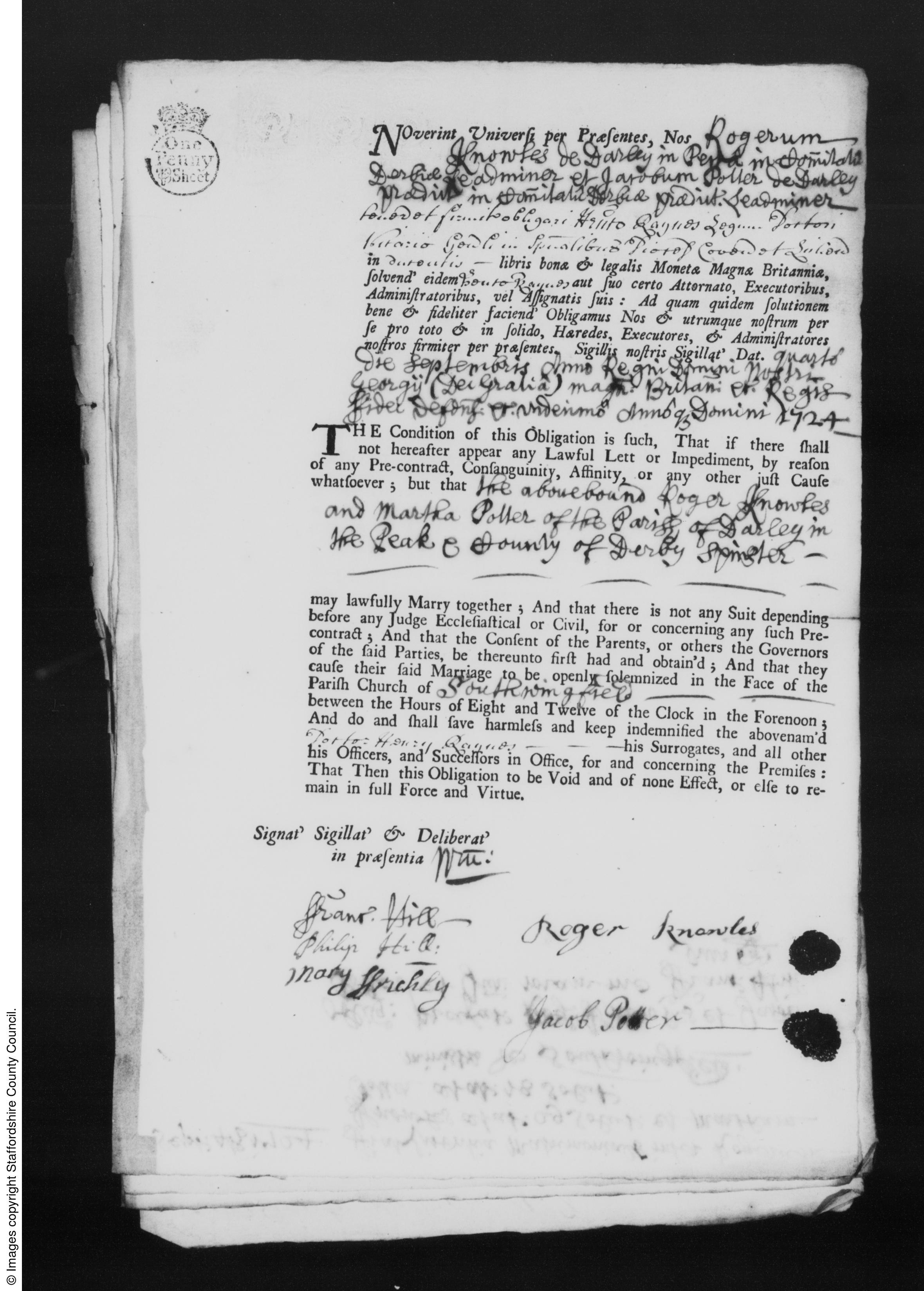
Although Roger and Martha were both from Darley, they were married in South Wingfield by licence in 1724. Roger’s occupation on the marriage licence was lead miner. (Lead miners in Derbyshire at that time usually mined their own land.) Jacob Potter signed the licence so I assumed that Jacob Potter was her father.
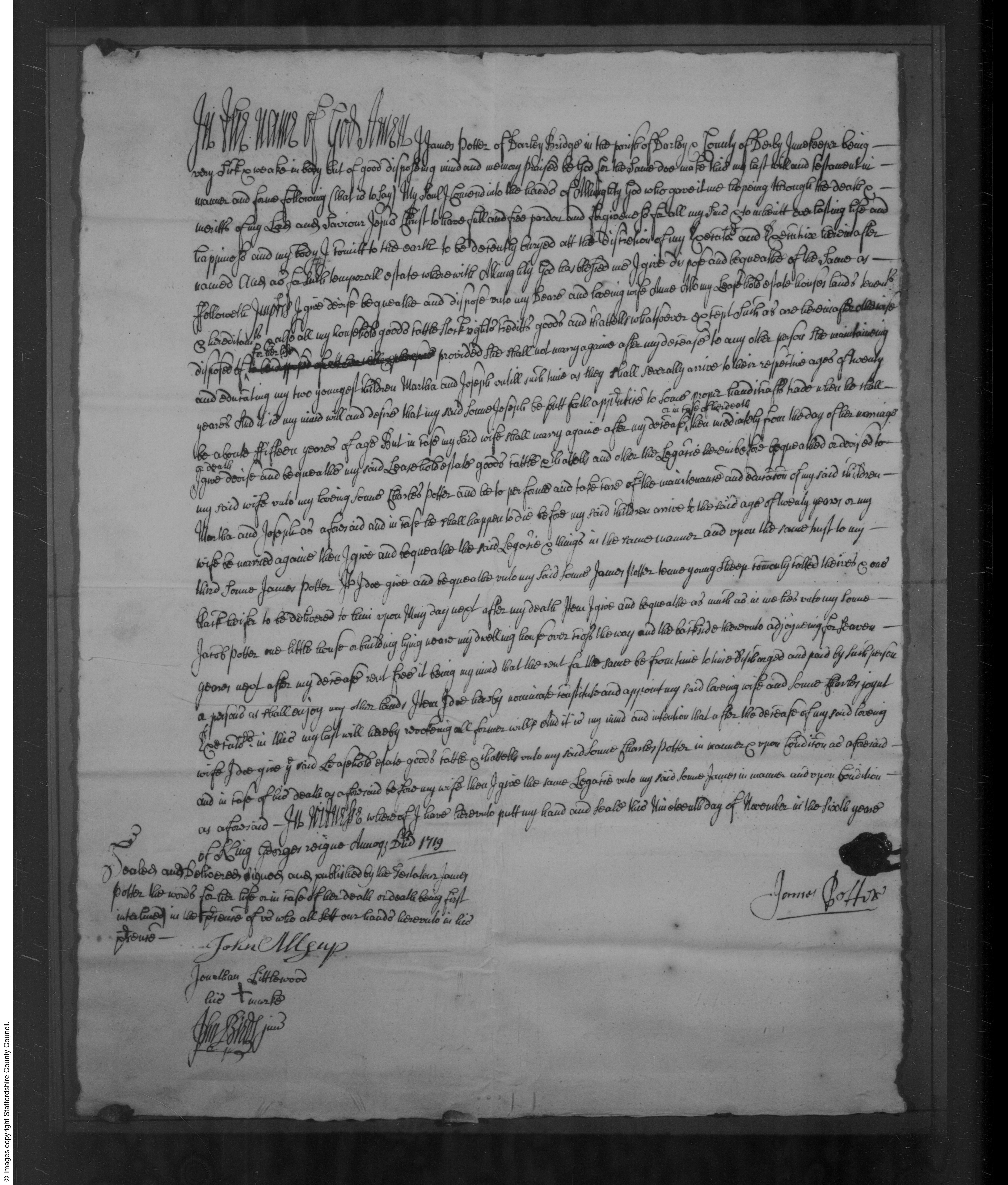
I then found the will of Jacobi Potter who died in 1719. However, he signed the will James Potter. Jacobi is latin for James. James Potter mentioned his daughter Martha in his will “when she comes of age”. Martha was the youngest child of James. James also mentioned in his will son James AND son Jacob, so there were both James’s and Jacob’s in the family, although at times in the documents James is written as Jacobi!
Jacob Potter who signed Martha’s marriage licence was her brother Jacob.
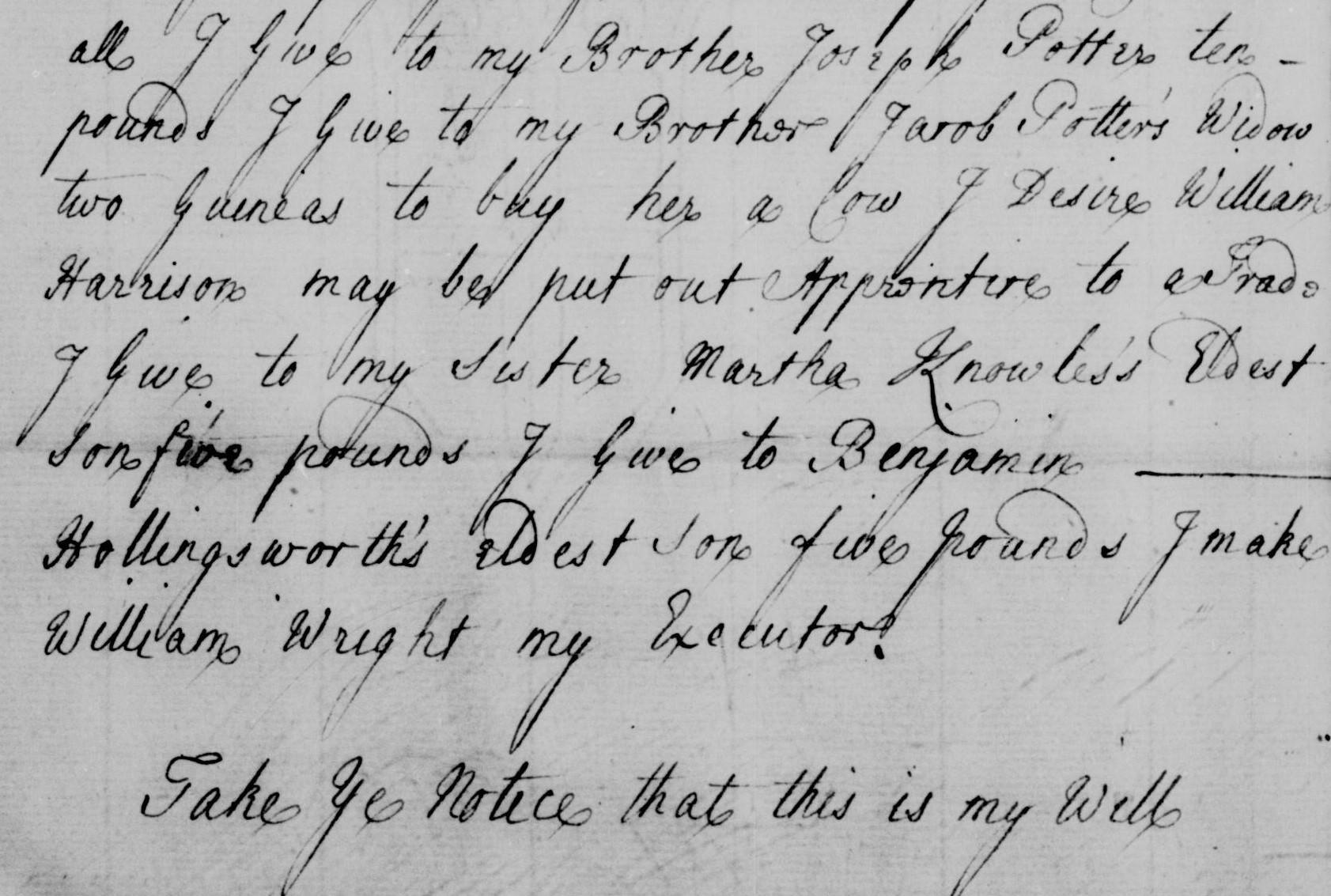
Martha’s brother James mentioned his sister Martha Knowles in his 1739 will, as well as his brother Jacob and his brother Joseph.
Martha’s father James Potter mentions his wife Ann in his 1719 will. James Potter married Ann Waterhurst in 1690 in Wirksworth, some seven miles from Darley. James occupation was innkeeper at Darley Bridge.
I did a search for Waterhurst (there was only a transcription available for that marriage, not a microfilm) and found no Waterhursts anywhere, but I did find many Warhursts in Derbyshire. In the older records, Warhust is also spelled Wearhurst and in a number of other ways. A Martha Warhurst died in Peak Forest, Derbyshire, in 1681. Her husbands name was missing from the deteriorated register pages. This may or may not be Martha Potter’s grandmother: the records for the 1600s are scanty if they exist at all, and often there are bits missing and illegible entries.
The only inn at Darley Bridge was The Three Stags Heads, by the bridge. It is now a listed building, and was on a medieval packhorse route. The current building was built in 1736, however there is a late 17th century section at rear of the cross wing. The Three Stags Heads was up for sale for £430,000 in 2022, the closure a result of the covid pandemic.

Another listed building in Darley Bridge is Potters Cottage, with a plaque above the door that says “Jonathan and Alice Potter 1763”. Jonathan Potter 1725-1785 was James grandson, the son of his son Charles Potter 1691-1752. His son Charles was also an innkeeper at Darley Bridge: James left the majority of his property to his son Charles.
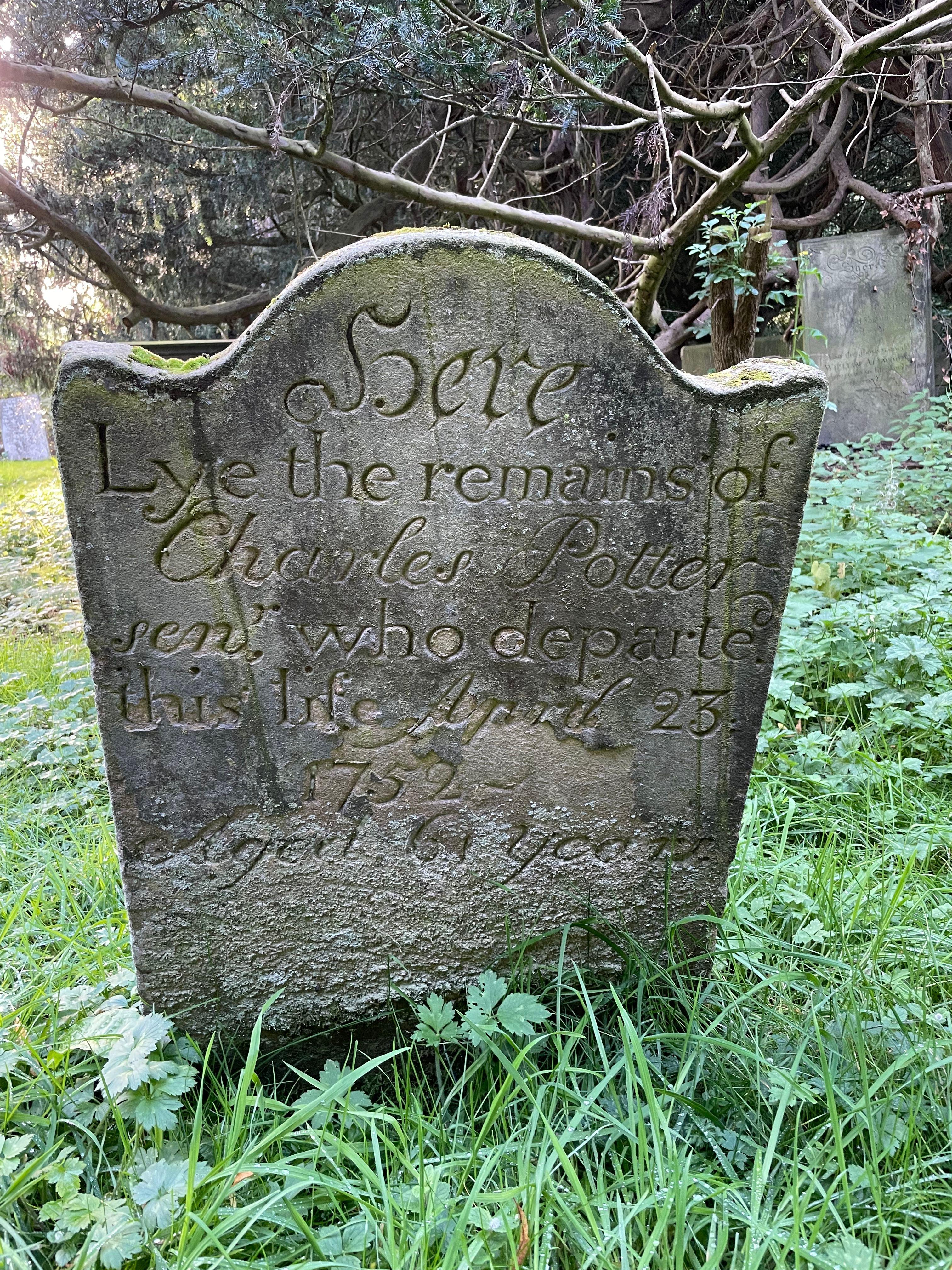
Charles is the only child of James Potter that we know the approximate date of birth, because his age was on his grave stone. I haven’t found any of their baptisms, but did note that many Potters were baptised in non conformist registers in Chesterfield.
Potters Cottage
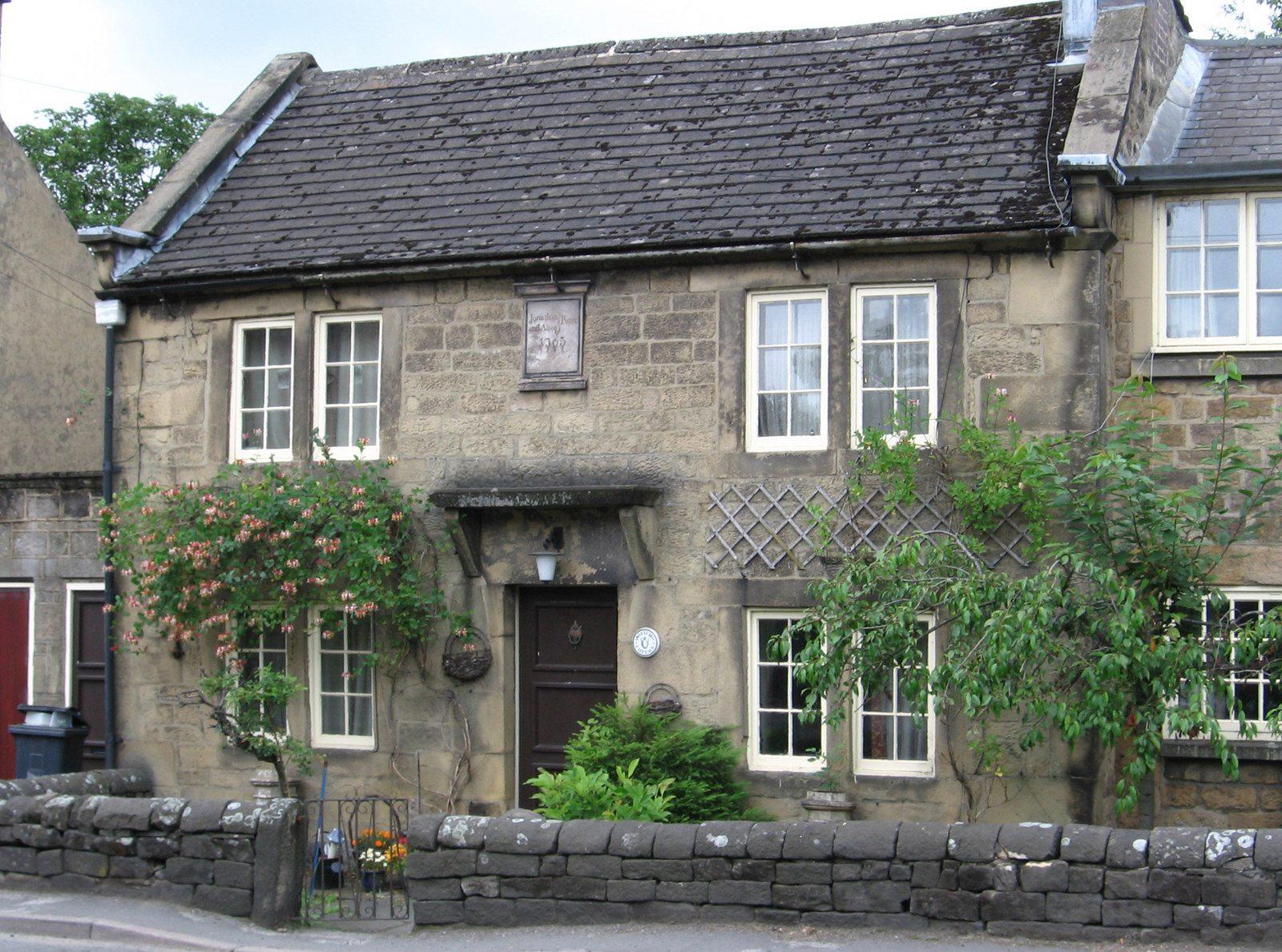
Jonathan Potter of Potters Cottage married Alice Beeley in 1748.
“Darley Bridge was an important packhorse route across the River Derwent. There was a packhorse route from here up to Beeley Moor via Darley Dale. A reference to this bridge appears in 1504… Not far to the north of the bridge at Darley Dale is Church Lane; in 1635 it was known as Ghost Lane after a Scottish pedlar was murdered there. Pedlars tended to be called Scottish only because they sold cheap Scottish linen.”
via Derbyshire Heritage website.
According to Wikipedia, the bridge dates back to the 15th century.
August 16, 2024 at 2:56 pm #7544In reply to: The Elusive Samuel Housley and Other Family Stories
Youlgreave
The Frost Family and The Big Snow
The Youlgreave parish registers are said to be the most complete and interesting in the country. Starting in 1558, they are still largely intact today.
“The future historian of this parish will find a vast stock of material ready to hand, and if such a work was ever accomplished it would once more be seen how the history of even a remote village is but the history of the nation in little; how national victories were announced on the church bells, and national disasters by the proclamation of a form of prayer…”
J. Charles Cox, Notes on the Churches of Derbyshire, 1877.
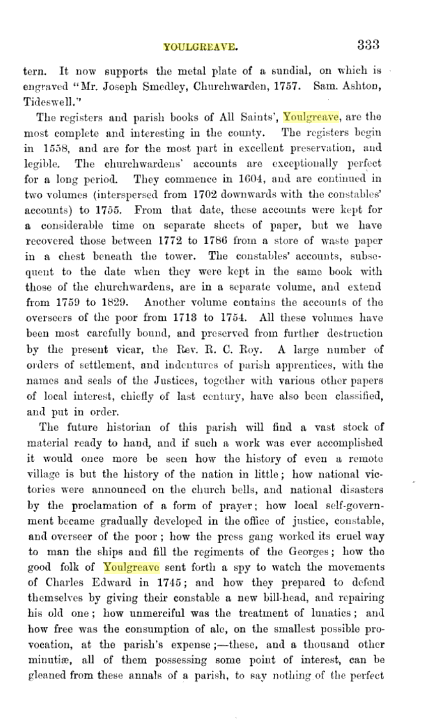
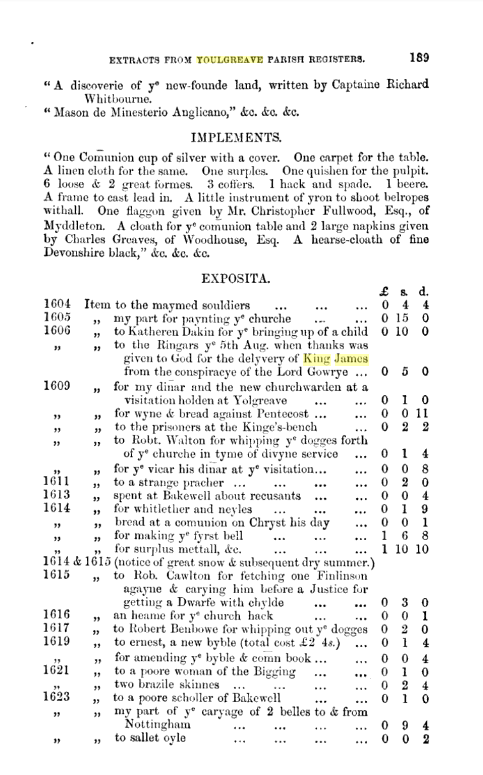
Although the Youlgreave parish registers are available online on microfilm, just the baptisms, marriages and burials are provided on the genealogy websites. However, I found some excerpts from the churchwardens accounts in a couple of old books, The Reliquary 1864, and Notes on Derbyshire Churches 1877.
Hannah Keeling, my 4x great grandmother, was born in Youlgreave, Derbyshire, in 1767. In 1791 she married Edward Lees of Hartington, Derbyshire, a village seven and a half miles south west of Youlgreave. Edward and Hannah’s daughter Sarah Lees, born in Hartington in 1808, married Francis Featherstone in 1835. The Featherstone’s were farmers. Their daughter Emma Featherstone married John Marshall from Elton. Elton is just three miles from Youlgreave, and there are a great many Marshall’s in the Youlgreave parish registers, some no doubt distantly related to ours.
Hannah Keeling’s parents were John Keeling 1734-1823, and Ellen Frost 1739-1805, both of Youlgreave.
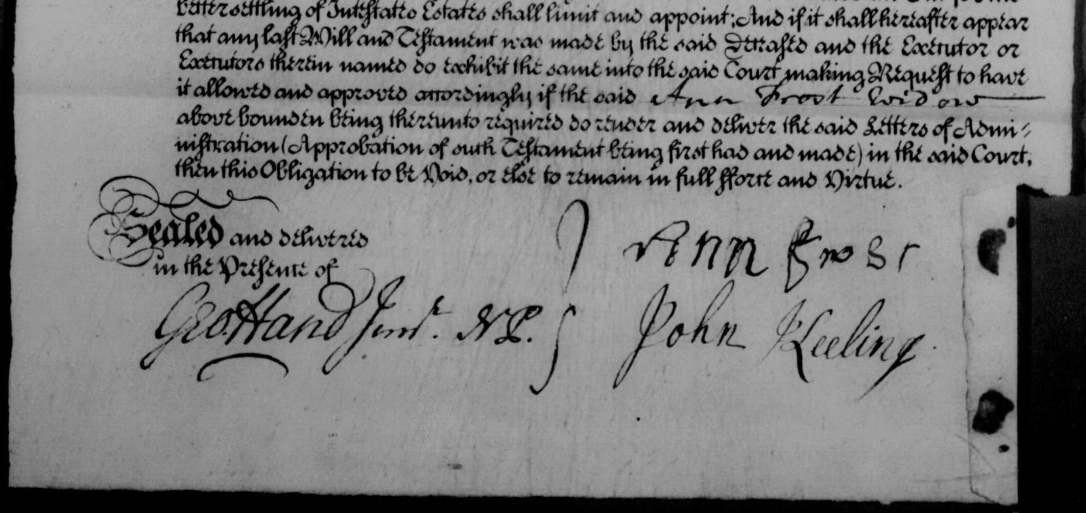
On the burial entry in the parish registers in Youlgreave in 1823, John Keeling was 88 years old when he died, and was the “late parish clerk”, indicating that my 5x great grandfather played a part in compiling the “best parish registers in the country”. In 1762 John’s father in law John Frost died intestate, and John Keeling, cordwainer, co signed the documents with his mother in law Ann. John Keeling was a shoe maker and a parish clerk.
John Keeling’s father was Thomas Keeling, baptised on the 9th of March 1709 in Youlgreave and his parents were John Keeling and Ann Ashmore. John and Ann were married on the 6th April 1708. Some of the transcriptions have Thomas baptised in March 1708, which would be a month before his parents married. However, this was before the Julian calendar was replaced by the Gregorian calendar, and prior to 1752 the new year started on the 25th of March, therefore the 9th of March 1708 was eleven months after the 6th April 1708.
Thomas Keeling married Dorothy, which we know from the baptism of John Keeling in 1734, but I have not been able to find their marriage recorded. Until I can find my 6x great grandmother Dorothy’s maiden name, I am unable to trace her family further back.
Unfortunately I haven’t found a baptism for Thomas’s father John Keeling, despite that there are Keelings in the Youlgrave registers in the early 1600s, possibly it is one of the few illegible entries in these registers.
The Frosts of Youlgreave
Ellen Frost’s father was John Frost, born in Youlgreave in 1707. John married Ann Staley of Elton in 1733 in Youlgreave.
(Note that this part of the family tree is the Marshall side, but we also have Staley’s in Elton on the Warren side. Our branch of the Elton Staley’s moved to Stapenhill in the mid 1700s. Robert Staley, born 1711 in Elton, died in Stapenhill in 1795. There are many Staley’s in the Youlgreave parish registers, going back to the late 1500s.)
John Frost (my 6x great grandfather), miner, died intestate in 1762 in Youlgreave. Miner in this case no doubt means a lead miner, mining his own land (as John Marshall’s father John was in Elton. On the 1851 census John Marshall senior was mining 9 acres). Ann Frost, as the widow and relict of the said deceased John Frost, claimed the right of administration of his estate. Ann Frost (nee Staley) signed her own name, somewhat unusual for a woman to be able to write in 1762, as well as her son in law John Keeling.
John’s parents were David Frost and Ann. David was baptised in 1665 in Youlgreave. Once again, I have not found a marriage for David and Ann so I am unable to continue further back with her family. Marriages were often held in the parish of the bride, and perhaps those neighbouring parish records from the 1600s haven’t survived.
David’s parents were William Frost and Ellen (or Ellin, or Helen, depending on how the parish clerk chose to spell it). Once again, their marriage hasn’t been found, but was probably in a neighbouring parish.
William Frost’s wife Ellen, my 8x great grandmother, died in Youlgreave in 1713. In her will she left her daughter Catherine £20. Catherine was born in 1665 and was apparently unmarried at the age of 48 in 1713. She named her son Isaac Frost (born in 1662) executor, and left him the remainder of her “goods, chattels and cattle”.
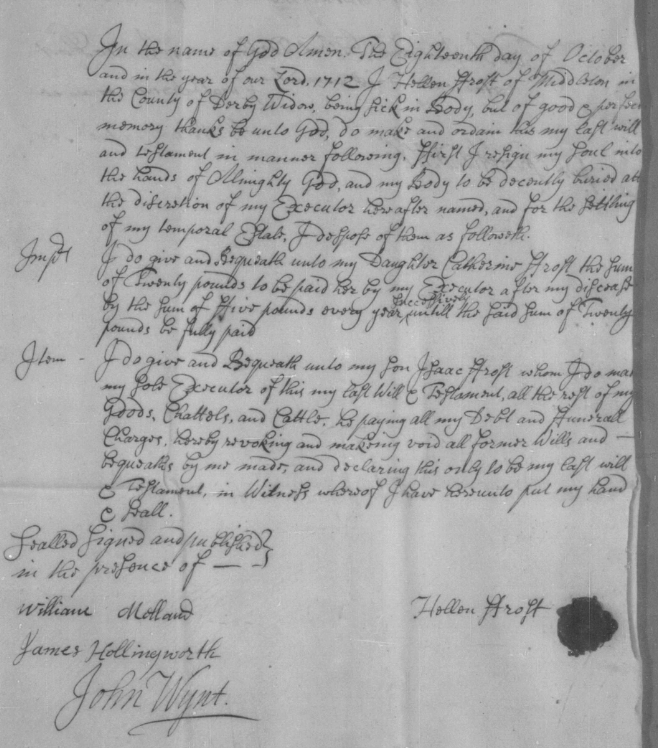
William Frost was baptised in Youlgreave in 1627, his parents were William Frost and Anne.
William Frost senior, husbandman, was probably born circa 1600, and died intestate in 1648 in Middleton, Youlgreave. His widow Anna was named in the document. On the compilation of the inventory of his goods, Thomas Garratt, Will Melland and A Kidiard are named.(Husbandman: The old word for a farmer below the rank of yeoman. A husbandman usually held his land by copyhold or leasehold tenure and may be regarded as the ‘average farmer in his locality’. The words ‘yeoman’ and ‘husbandman’ were gradually replaced in the later 18th and 19th centuries by ‘farmer’.)
Unable to find a baptism for William Frost born circa 1600, I read through all the pages of the Youlgreave parish registers from 1558 to 1610. Despite the good condition of these registers, there are a number of illegible entries. There were three Frost families baptising children during this timeframe and one of these is likely to be Willliam’s.
Baptisms:
1581 Eliz Frost, father Michael.
1582 Francis f Michael. (must have died in infancy)
1582 Margaret f William.
1585 Francis f Michael.
1586 John f Nicholas.
1588 Barbara f Michael.
1590 Francis f Nicholas.
1591 Joane f Michael.
1594 John f Michael.
1598 George f Michael.
1600 Fredericke (female!) f William.Marriages in Youlgreave which could be William’s parents:
1579 Michael Frost Eliz Staley
1587 Edward Frost Katherine Hall
1600 Nicholas Frost Katherine Hardy.
1606 John Frost Eliz Hanson.Michael Frost of Youlgreave is mentioned on the Derbyshire Muster Rolls in 1585.
(Muster records: 1522-1649. The militia muster rolls listed all those liable for military service.)
Frideswide:
A burial is recorded in 1584 for Frideswide Frost (female) father Michael. As the father is named, this indicates that Frideswide was a child.
(Frithuswith, commonly Frideswide c. 650 – 19 October 727), was an English princess and abbess. She is credited as the foundress of a monastery later incorporated into Christ Church, Oxford. She was the daughter of a sub-king of a Merica named Dida of Eynsham whose lands occupied western Oxfordshire and the upper reaches of the River Thames.)
An unusual name, and certainly very different from the usual names of the Frost siblings. As I did not find a baptism for her, I wondered if perhaps she died too soon for a baptism and was given a saints name, in the hope that it would help in the afterlife, given the beliefs of the times. Or perhaps it wasn’t an unusual name at the time in Youlgreave. A Fridesweda Gilbert was buried in Youlgreave in 1604, the spinster daughter of Francis Gilbert. There is a small brass effigy in the church, underneath is written “Frideswide Gilbert to the grave, Hath resigned her earthly part…”
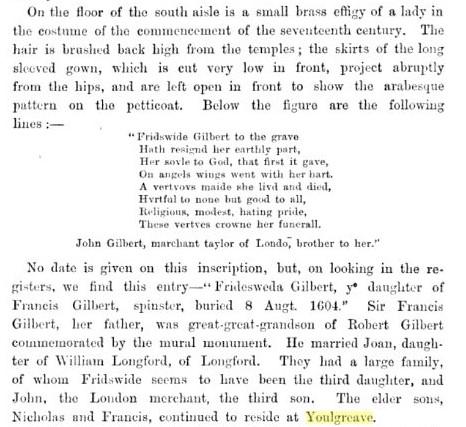
J. Charles Cox, Notes on the Churches of Derbyshire, 1877.
King James
A parish register entry in 1603:
“1603 King James of Skottland was proclaimed kinge of England, France and Ireland at Bakewell upon Monday being the 29th of March 1603.” (March 1603 would be 1604, because of the Julian calendar in use at the time.)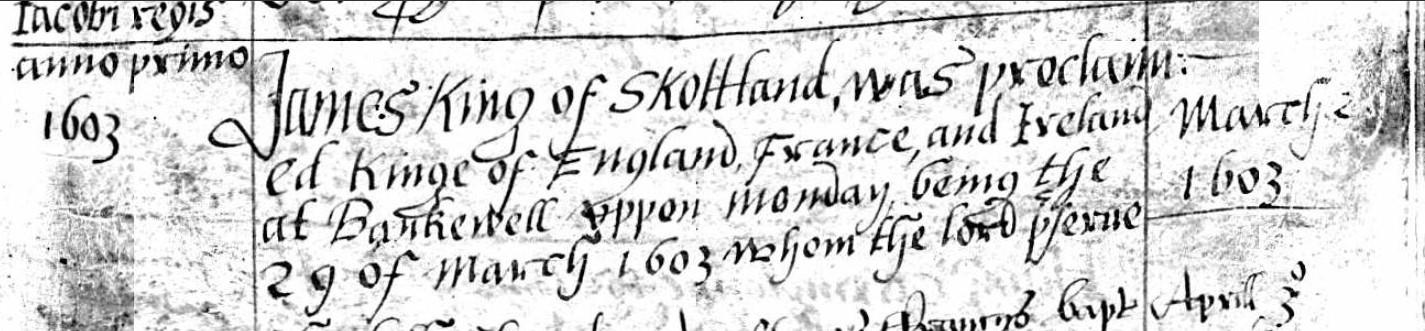
The Big Snow
“This year 1614/5 January 16th began the greatest snow whichever fell uppon the earth within man’s memorye. It covered the earth fyve quarters deep uppon the playne. And for heaps or drifts of snow, they were very deep; so that passengers both horse or foot passed over yates, hedges and walles. ….The spring was so cold and so late that much cattel was in very great danger and some died….”
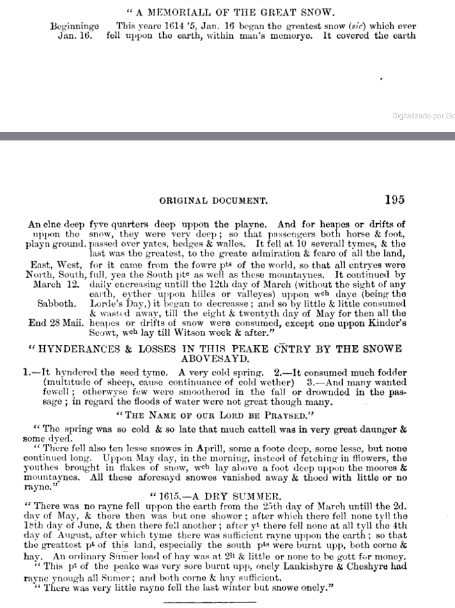
From the Youlgreave parish registers.
Our ancestor William Frost born circa 1600 would have been a teenager during the big snow.
July 23, 2024 at 8:03 am #7540In reply to: The Incense of the Quadrivium’s Mystiques
“When did you arrive?” asked Truella when they found her in her at her Cloacina booth in faux-fur waterproof boots and a faux-bear-fur cape with a waterproofed silk hood to protect her perfect hairdo from the incessant drizzle. It gave her a look of one of those Fantasy warrior-goddess ready to intervene at the last minute to save her chosen champions from complete destruction by the forces of evil.
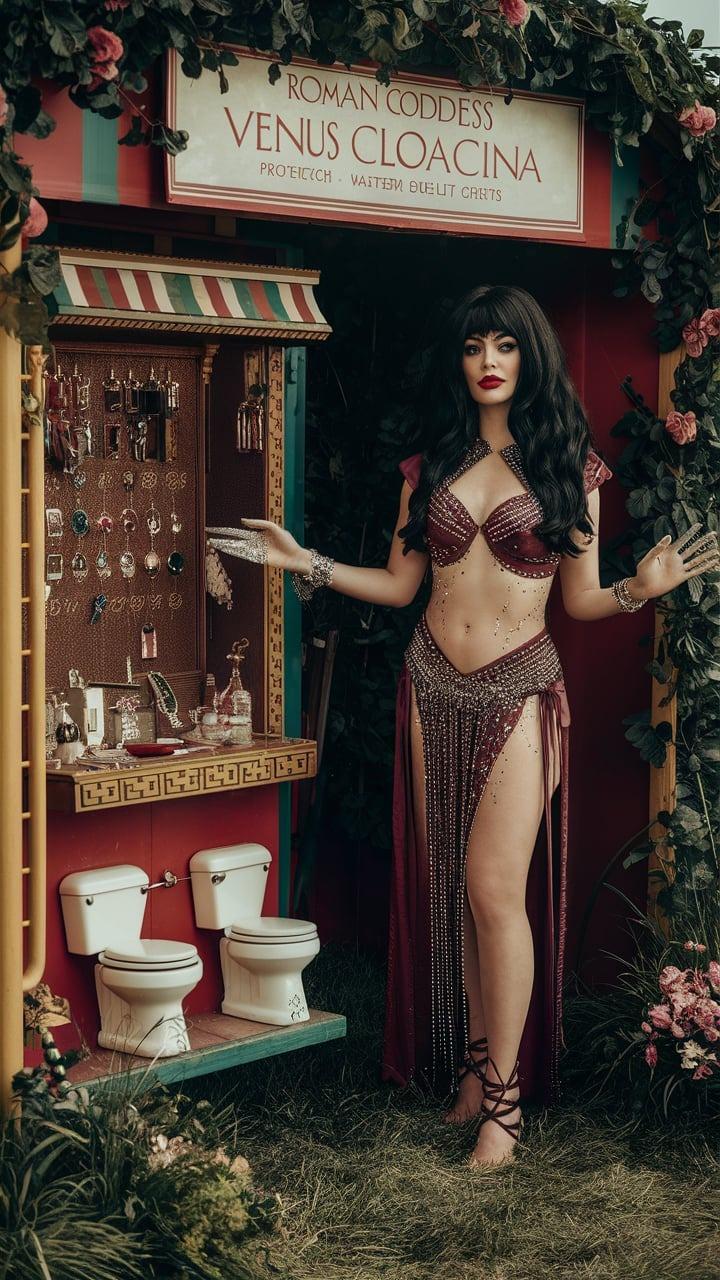
“Well, I’ve been there all along,” retorted the glamour witch, moving two little loos in front of the booth closer together. “I’ve been living in Limerick since the start of this story, even if it wasn’t clear where. Granny Linda thinks I’m living in Glamorheaven and Finnley think I’m living in London, but I’m pretty sure it’s Limerick. At least it is in my mind manor,” she said as if for herself. “There!” she said. Her face lit up as she just found the perfect orientation for the loos. “Don’t those miniature loos look cute?”
“Sure,” said Truella. At the same time she looked at Frella as if their friend had gone nut.
“Don’t ask me,” said Frella. “I didn’t make the selection of the goddesses for the olympic set.”
Jeezel took three cups, dipped them into one of the toilet bowl and offered them to her friends to drink.
Truella grimaced.
“I prefer not to drink that early in the morning,” said Frella with a polite smile.
Jeezel lifted the cup to her nose and inhaled deeply before taking a sip. “It’s connected to the purest water source on Earth through a little time sewer spell coupled with a little pump and filter and a nice chime when you throw your worries in. It’s perfectly safe and drinkable sparkling water, and it smells of roses.”
“My gran used to spray rose scent in the bathroom after she used it,” said Truella, cackling nervously.
Frella took the cup, smelled it and continued smiling.
“Anyways, those cuties are for the cleansing prayers,” said Jeezel. “Cleansing and release,” she added pointing her finger up at the banner. “That’s Cloacina’s motto. At least at this booth. And, as I’m sure you asked, I didn’t answer all your messages because I’ve been kept busy with preparing all of those. Here, Truelle, take one of those Sacred Bath Salts. I have two flavors, Moonlight Mist and Sunset Serenity. Take the second one, it’s a blend of Himalayan pink salt and rose petals. It’ll help keep you warm as the salts will absorb the extra humidity, and as an extra it’ll make you think of your gran”, she added with a grin. “As for my friend Frella…”
Truella grabbed the pouch of salts and smelled it. “The smell is not so bad,” she conceded. “And Bubona knows I need their warming qualities,” she said shaking her head to get rid of irritating water drops.
Jeezel then turned to the potion and elixirs section. “No, not purification for Frella, and neither of you need the Lover’s Elixir… Oh! Here it is, take that. A soap made of goat’s milk, honey and calendula oil for radiant skin. And good to keep the hinges perfectly oiled. And as my future gran will say, remember, keeping those hinges oiled is key to avoiding squeaky situations.”
Frella took the soap and chuckled. “Thanks.” She scratched the surface with her nail. “It’s seems good quality. And it smells good. That reminds me I have to prepare my own booth. See you later girls.”
As soon as she left. Truella leaned towards her friend and asked in a conspiratory voice: “Did you know Malove was here?”
“What?”
July 18, 2024 at 2:29 pm #7535In reply to: The Incense of the Quadrivium’s Mystiques
It made sense to go to Ireland during the hot Andalucian summer, and it hadn’t taken much to convince Truella to take a break from her dig and her research. Thousands of years of history would still be there waiting for her when she got home, and it would be a pleasure to see some green lawns and fields. Maybe it would rain, indeed, it was likely that it would. And by the time the Roman Games were over, there would be less of the hot summer at home to endure. Still, it was a nuisance to have to get her winter clothes down out of the attic. She was sure to find it chilly, even cold.
Truella was not fond of water sports (or any sports, but particularly those involving water) and unfortunately the focus of the games seemed to be on swimming and boating. But one of the events has captured her interest. A miniaturisation spell was required, which contestants had to provide themselves, for the Puddles in Potholes races. The worst road in Limerick would be cordoned off and all the potholes filled with water (if they weren’t already full of rain water, which was likely). When Eris pointed out that a miniaturised person could drown in a puddle as easily as a full sized one could drown in a lake, Truella was ready with her answer. If she was drowning, she would immediately reverse the spell and resume her full size. Eris had raised an eyebrow, remarking that she had better make sure her spell was up to scratch, unlike her incense spells had been. Jeezel had wanted to know why she couldn’t just make an enlarging spell and just swim in the river, to which Truella has replied that she didn’t know how deep the river was and how much enlarging would be required. Snorting, Frella said she obviously didn’t know how deep the potholes in Limerick were.
Austreberthe had put their names down for the donkey chariot races, for which they had three days when they arrived to construct the cart and make the costumes. Luckily Frella had plenty of local contacts, and had willingly taken charge of assembling all the materials.
The Booths of the Gods would require some thought. Which Roman god would she choose to be? Which special godly power could she make a spell for? Truella sighed, and went to find her book of Roman gods and goddesses.
June 19, 2024 at 8:33 am #7504In reply to: The Incense of the Quadrivium’s Mystiques
After the meeting, Jeezel and Silas agreed on what the six rituals would be. The integration rituals were designed to unite the groups symbolically and spiritually. They were multifaceted ceremonies that combine elements from each group’s traditions to forge a shared sense of purpose and harmony, mediated by the mortician’s guild. Given the diverse nature of the witches, nuns, and morticians, these rituals needed to be both inclusive and meaningful, drawing on the unique strengths and spiritual practices of each faction.
The program they distributed to each participant was as follow:
Under the guidance of the Ancient Telluric Forces of the Dragons
1. The Invocation of Unity
Purpose: To call upon the spiritual and magical forces that guide each group and seek their blessings for the union.
Components:- Witches: Incantations and invocations to elemental spirits and deities.
- Nuns: Hymns and prayers invoking divine blessings.
- Morticians: Rituals honoring the spirits of the departed, seeking their guidance and protection.
Symbolism: This ritual emphasizes the shared respect for higher powers and the mutual desire for harmonious collaboration.
2. The Weaving of Fate
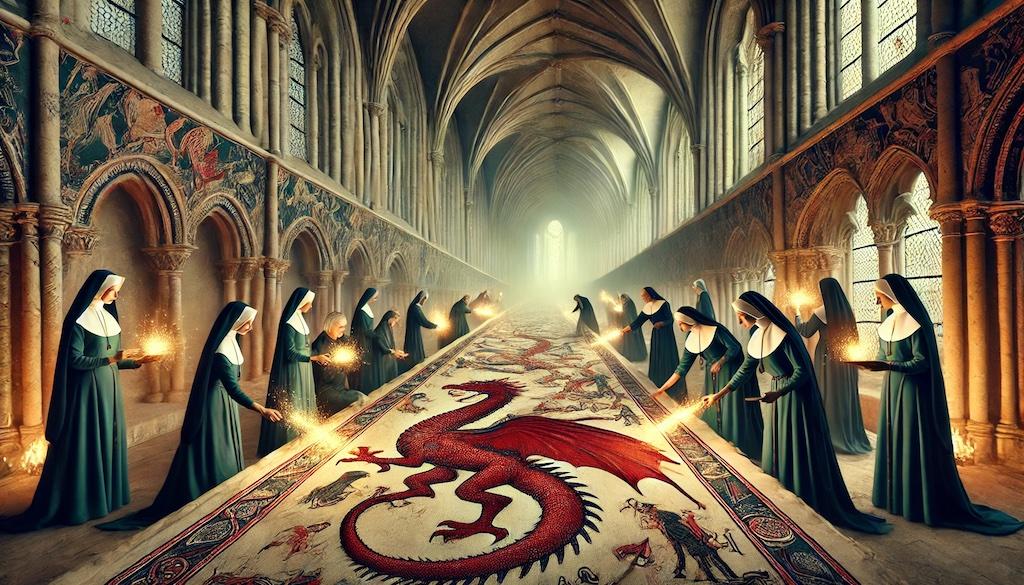
Purpose: To create a physical symbol of their intertwined destinies.
Components:- Witches: Magical threads imbued with protective charms and blessings.
- Nuns: Sacred textiles woven with prayers and religious symbols.
- Morticians: Ribbons representing life, death, and the transition between them.
Symbolism: By weaving these threads together into a single tapestry, the groups create a tangible manifestation of their unified path forward.
3. The Concordia Cauldron
Purpose: To brew a potion that represents their collective energy and intent.
Components:
- Witches: Magical herbs, crystals, and other mystical ingredients.
- Nuns: Holy water and sacred relics.
- Morticians: Ashes from ritual fires and symbols of purification.
Symbolism: The potion, once blessed and distributed, serves as a means of internalizing the collective spirit and shared goals of the unified group.
4. The Harmonious Choir
Purpose: To blend their voices and energies in a powerful, resonant harmony.
Components:
- Witches: Chants and spells sung in unison.
- Nuns: Choir hymns and sacred music.
- Morticians: Melodic recitations of ancient rites.
Symbolism: The act of creating music together represents the harmony they strive to achieve in their collaboration, with each voice contributing to a greater whole.
5. The Altar of Convergence
Purpose: To create a shared sacred space where offerings and symbols from each group are placed.
Components:
- Witches: Ritual objects, such as wands, crystals, and candles.
- Nuns: Holy relics, icons, and prayer books.
- Morticians: Mementos of the deceased, symbolizing the continuity of life and death.
Symbolism: The combined altar serves as a focal point for their united efforts, a place where they can come together to seek guidance and reaffirm their commitment to the union.
6. The Ceremony of Reflection and Projection
Purpose: To reflect on the past, acknowledge individual and collective strengths, and set intentions for the future.
Components:
- Witches: Scrying mirrors and crystal balls for reflection and foresight.
- Nuns: Candles representing illumination and enlightenment.
- Morticians: Artifacts representing the cyclical nature of life and death.
Symbolism: This ceremony encourages each member to contemplate their role within the new union and visualize the path ahead, fostering a sense of shared vision and purpose.
Supervision by Jeezel and Silas
Jeezel: With her deep connection to magical energies and her knack for emotional resonance, she will ensure that each ritual maintains its mystical integrity and spiritual depth. She will guide the participants in channeling their energies harmoniously and with clear intent.
Silas: His analytical mind and authoritative presence will bring structure and order to the rituals. He will ensure that each component is meticulously planned and executed, maintaining the balance between tradition and innovation.
Together, Jeezel and Silas will oversee the integration rituals, blending their unique approaches to create a unified and cohesive experience that honors the diverse traditions of the witches, nuns, and morticians. Their combined leadership will ensure that the rituals not only symbolize but also spiritually solidify the union of these distinct groups.
Now, all that remained was to ask for volunteers or to assign the roles in the rituals to everyone. And for Jeezel to reveal the hidden mission to her three friends.
June 8, 2024 at 9:23 am #7461In reply to: The Incense of the Quadrivium’s Mystiques
Once again, the Quadrivium headquarters buzzed with an undercurrent of tension and anticipation. Malové stood at the helm, her gaze as steely and unwavering as ever. The coven’s regular meetings had taken on a new urgency in the face of mounting market pressures and the ever-accelerating pace of competition.
The witches assembled in the grand hall, each carrying the weight of their individual concerns and collective anxieties. A large screen was projecting the agenda in flashy neon colours with a glamourous photo of their leader. The event was broadcast across many locations, not all witches able to join physically as the ongoing Worldwide Roman Games preparation and the 333th celebration of the Treaty of Limerick ending the Williamite War, had made the city impenetrable due to the convergence of world leaders.
Not only for those present, all of them seated in-person, or remotely connected had felt the tremors of change, the subtle yet insistent push towards transformation. Yet despite their best efforts, a cohesive vision for the coven’s future remained elusive.
As the last witch took her seat and the various technical glitches got sorted, Malové stepped forward, her presence commanding immediate silence. With a flick of her wrist, a spectral map materialized before them, shimmering with points of light that represented their past achievements and future challenges.
“Listen well,” Malové began, her voice echoing through the hall with the gravity of an ancient spell. “We stand at a crossroads, a juncture where our past accomplishments meet the demands of an unforgiving future. Our strength has always been in our unity and our mastery of the arcane, but now, we must also master the art of transformation.”
She paused, allowing her words to sink in. The witches leaned forward, their eyes locked onto their formidable leader.
“Transformation,” she continued, “is not merely a matter of adapting to external pressures. It requires a boldness of spirit and a willingness to steer the deepest currents of our inner selves. It demands that we break free from the confines of tradition without losing our core essence.”
Malové waved her hand, and the map shifted to reveal a complex network of interconnected pathways. “Our path forward will not be linear. It will be a labyrinth, requiring both cunning and courage. But fear not, for I have charted a course that will lead us through.”
She pointed to three glowing nodes on the map. “First, we shall innovate. Our magical incense blends have always been our hallmark, but we must go beyond. We will delve into new realms of magic, combining our ancient practices with cutting-edge techniques. Each of you will be tasked with researching and developing a new blend that can transform not just our coven, but the world.”
The witches exchanged glances, a mixture of excitement and apprehension flickering in their eyes.
“Second,” Malové continued, “we must strengthen our alliances. The world is vast, and we are not alone in our quest for magical mastery. We will forge new partnerships with other covens, magical beings, and even those who walk the line between the mundane and the mystical. Together, we will create a network of power and influence that none can rival.”
The map expanded, showing potential allies and strategic locations across the globe. The witches nodded, recognizing the necessity of this bold move.
“Lastly,” Malové said, her voice softening yet losing none of its intensity, “we must look within. Inner transformation is the crucible in which true power is forged. Each of you will undergo a rigorous process of self-examination and growth. You will face your fears, confront your weaknesses, and emerge stronger and more resilient. Only then can we hope to lead others through their own transformations.”
She paused, meeting the eyes of each witch in turn. “I will be with you every step of the way. My role is not just to lead, but to guide and support you. We will hold workshops, retreats, and one-on-one sessions to ensure that every member of the Quadrivium is prepared for the journey ahead.”
Truella, who had tuned in remotely, winced softly behind her screen – she quickly checked. Phew, she had been on mute the whole time.
Malové’s voice grew softer still, almost a whisper, but it carried the weight of an ancient prophecy. “We are the Quadrivium. We are woven together by threads of magic and destiny. Our future is not written in stone, but in the stars. Together, we will reach for those stars and make them our own.”
The hall was silent, the witches absorbing the magnitude of Malové’s words. Slowly, a sense of resolve began to build, a collective determination to embrace the path laid out before them.
As the meeting drew to a close, Malové turned back to the spectral map, her eyes reflecting the myriad possibilities that lay ahead. “Remember this day, for it marks the beginning of our grand transformation. We will not be merely a coven. We will be a force of nature, a symphony of magic that weaves through time and space.”
With a final wave of her hand, the map vanished, leaving only the echoes of her words and the indomitable spirit of the Quadrivium, and throngs of witches left more confused as they exited the halls in hushed tones.
April 9, 2024 at 9:48 pm #7422In reply to: The Incense of the Quadrivium’s Mystiques
“Are you no longer even trying?” Eris raised an eyebrow at the invitation sent by Truella on the innerwitch cobweb.
“What do you mean?” Truella replied with a puzzled avatart jiggling her head in discombobulation.
“Posting verbatim from your Oracl’Liz. It shows. And I’m not sure you’re going to influence Malové like that; this is low-end jinx, she would have like 10 counterspells ready for that…”.
Truella’s avatar raised her shoulders lazily in a “if there’s a chance it does the job” fashion that said it all.
Eris’ head had a hard time to stabilise from the elephant ordeal. Ideas were still colliding in massive cacophony in her head and minute sounds and echoes of voices had her startled for nothing. Malové’s ineffable strategy —saying less, and leaving others guess will make you the smarter one in the room, dear. That sort of thing was starting to get on her nerves.
Eris wasn’t sure that Malové would fall for a theme ball, when she was grappling for cash for the Coven. Or to keep appearances towards the other Covens, that much was a possibility.They had moved offices this week… Again. It was their third time in the past three months. At least the intermediary one was an excuse for more spells-at-home time, but now with the new one, they were all suppose to clock-in at least four days a week.
Two days for that strategy meet in Adare Manor… The organising committee, mostly sycophantic witches had sent a meagre agenda, that talked about exciting workshops, brainstorming sessions and other meaningless stuff… and a survey. “How excited are you to join?” on a scale of 10. Eris had wanted to be more covenrporate, but her fingers had slipped… on a 2. Too bad if the survey wasn’t anonymous, maybe that’d get some attention.
February 16, 2024 at 11:19 am #7377In reply to: The Incense of the Quadrivium’s Mystiques
With the carnival in full swing, Truella was finding it hard to focus on everything that was going on. Was this mission more chaotic than usual, or did it seem that way because she wasn’t giving it her full attention? She hadn’t thought too much about Jezeel not closing the portal. She was having enough trouble stabilizing her own bilocation spell.
Where was Frigella when she needed her? And what was going on with that Cedric guy? Truella decided to go in search of her. Frigella was always good at explaining and clarifying things that she hadn’t been paying attention to.
Outside on the pavement, Truella paused to light a cigarette. The street were a cocophany of raucus banter and gay shreiks, a riot of colour and imagination and Truella stood rapt at the sights and sounds. Such a contrast from her quiet life at home in the garden with only ghosts for company. In a way Truella was glad that Roger was still missing with the pack of monkeys, rather than leaving him alone at home.
“Aye, look at all them monkey costumes, our Mavis, they’m really good int they, look just like real monkeys,” a chubby Englishwoman in a garish pink outfit said, passing by where Truella was standing.
“That’s because they ARE real monkeys, ya daft cow,” retorted her companion. “And they’re all following that big fella.”
“Ooh, that big burly chap?” piped up the third woman in the group. “I clocked him right off, come on girls, let’s go after the big boy.”
“Ooh, Sha, what are you like, ya tart.”
As the three women cackled and trotted off after the monkeys, Truella’s peaceful interlude came to an abrupt halt. What burly man with a pack of monkeys? Surely not, surely Roger and his monkeys hadn’t entered that portal that Jez forgot to close?
February 15, 2024 at 11:38 am #7374In reply to: The Incense of the Quadrivium’s Mystiques
Jeezel had quickly come back to her sense, despite the gnawing sense that she should have closed the portal quicker and that something —someone?— could have followed them here. She could have done a debugging spell, but for now it would have to wait. Malové was growing antsy, and was getting prone to fits of winking that couldn’t bode well.
Jeezel had found the perfect spot for them to install the apparatus that was hidden inside the bag of infinite depth that Fingella was carrying with her. Truth was, Echo had been of help. When asked, the familiar sprite had quickly scanned the area and shared: The Sambódromo, too obvious. Copacabana, too crowded. Try the old district of Santa Teresa. Charm, history, and the right kind of energy, plus the tourists tend to overlook it.
Meanwhile, Truella was suffering from the side effects of the portal’s severance, finding it more difficult to maintain her bilocation across the continents without the supporting effect of the portal. She was given a potion to realign her energies that gave her chills down to her teeth, and had chosen to go for a rest here in Rio, which could allow her to focus on her other self as it was still late afternoon in Europe.
“Only three days before the grand finale of the Carnival, where energies will be at their peak!” Malové had encouraged them. “Let’s get moving!”
Eris who’d remained quiet, patrolling the energy perimeter they’d set up to cloak themselves looked at them with a concerned look. “It shouldn’t be the case with the protection spells, but I think we are being observed.”
“Time to switch disguises maybe?” Jeezel was yearning for a change, as the lycra of the nurse outfit was not mixing well with the damp weather.
February 15, 2024 at 11:04 am #7373In reply to: The Incense of the Quadrivium’s Mystiques
The disturbance had been felt in the bustling heart of Rio.
The warmth of the night had amplified the vibrant energy of the Carnival in Rio, a pulsating heart that reverberated through the city’s veins. But as the beat of samba drums echoed in the distance, a different rhythm was being played behind closed doors. Iemanjá, the head of the Umbanda clan and a pillar of strength in the Witches of the New World, recognized the tremors of another magick at play.
Gathering her coven under the silvery light of the crescent moon, they began the rhythmic dance of the macumba ritual. The air grew heavy, scented with copal and the salty tang of the ocean. In the center of their circle, a waterspout swirled, revealing in its shallow reflection the glow of a portal that emitted the icy chill of a Limerick dawn.
Piercing through the veil of secrecy, Iemanjá’s ethereal sight witnessed the foreign witches, led by the enigmatic Malové, who dared to encroach upon their territory without the required parchmentwork. And yet, their motives remained hidden within the vortex of desire and lust emanating from the Carnival.
A murmur of discontent rippled through the Umbanda clan. Mesmirah, her second, couldn’t stop herself shouting Sacrilégio! They were not ones to tolerate trespassers, let alone those who dared to siphon off energy from their sacred lands.
Silêncio! Iemanjá commanded the crowd. She’d recognized Malové from having attended and graduated the same MWA (Master of Witchcraft Administration), and she was aware of Malove’s little incense business; Malové didn’t strike her as someone to bypass the rules, some handed down through countless generations, binding together most witches across the world despite their varying practices.
She had to be mindful of the delicate balance between the Old World clans and the New. An unauthorized incursion could easily spark a conflict that would ripple through the witching worlds.
Just as the ocean waves respect the boundary of the shore, so must the witches respect the territories — an ancient pact carved in the pillars of the Old World. This blatant disregard by Malové and her coven was akin to scratching the surface of a simmering cauldron, threatening to disrupt the harmony that had been carefully cultivated.
As the revelation sunk in, Iemanjá knew they had to tread carefully. A confrontation would lead to a war bigger than themselves —yet, they couldn’t let this transgression slide. Their pride and the protection of their territory demanded action.
Mesmirah! she finally spoke You will take three witches with you, and investigate what business these Old World witches have in Rio. You will report to me.
Mesmirah nodded, understanding that she was not yet granted authority to investigate in an official capacity. Iemanja was acting surprisingly soft, and didn’t want the Elders to be informed yet, but had recognized action was needed. Mesmirah was confident she would easily find out what was happening, and maybe use that opportunity to her —their advantage. The game of power was on.
February 15, 2024 at 10:34 am #7372In reply to: The Incense of the Quadrivium’s Mystiques
After a long, long-haul flight, Sha was woken up by the ding of the landing announcement. Glor was still snoring loudly spread over the limited space of their economy places, her mouth agape, the armrest dangerously stuck in her ample forms. They were finally landing in Rio for the Carnival!
Sha: “Glor, Glor! Wake up, love, we’re almost there! Can’t believe that Bingo win’s got us all the way to Rio!”
Glo: “Eh? Wha’? Oh crikey, we’re not on the number 52 bus to Piccadilly? My bunions were having the most delightful dream.”
Mavis popped her head from the place behind them. The attendant signaled her with a rude gesture to stay seated, as the engines were stating to roar announcing the close landing.
Mavis: “Oh, I do hope they have those fancy coxcombs at the carnival. You know, the ones with all the feathers and sparkles. Our Bernard used to say I looked like a proper mopsy with one on me head.”
Sha: “Now Mavis, don’t you go getting ideas above your station. We’re here for the festivities, not to join the parade! Though, a little samba wouldn’t hurt, eh?”
Glo: “Samba? I thought that was a kind of sandwich. I ain’t dancing, not with my sciatica. I’ll just sit and supervise, yeah?”
Mavis: “I brought me camera, you know, the one with the clicky button. Gonna take pictures of all the costumes and such. Might even sneak in a selfie, show it off at the bingo hall.”
Sha: “Pack it in, you two. Let’s just make sure we find our hotel. You remember what happened last time. Glor here thought the luggage conveyor was a ride and we spent three hours in customs!”
Glo: “Not my fault, Sha. It was moving and I thought, ‘Why not?’ Adventure is the spice of life, ain’t it?”
Mavis: “Well, as long as there’s a good cuppa at the end of it, I’m game for anything. Let’s get this carnival caper started, girls!”
February 11, 2024 at 10:32 am #7364In reply to: The Incense of the Quadrivium’s Mystiques
“Witches, assemble!” It was hard for Malové to forget the theatrics, even in presence of a limited number of persons.
The three witches had come in a hurry, summoned for some of them by a loud howler in the early light. Admittedly, Malové had to compensate for the usual tardiness of some, and her impeccable spells had been calling for the trio at just the right time for each to arrive precisely to the Quadrivium’s Headquarter in less than a minute’s space one from the other.
“Unbelievable” Frigella had muttered when she saw Truella already there.
“Hoy, don’t get your knickers in a twist Love, I’ve been called to that meeting only two days ago!”
Frigella didn’t have time to retort with a snark that she’d been summoned less than fifteen minutes before, as another popping sound and a flush indicated the arrival of Eris from the Quadrivium’s Emporium backdoor in the lady’s room.
“And where is Jeezel?” Truella wondered. “I haven’t seen her yet.”
“Oh, you know, there’s no accounting for wig time preparation even with Malové superb spells skills” Eris said pragmatically.
“I wouldn’t say that.” The voice of Malové, stern but not devoid of warmth, signaled the end of the chatty banter. “She was doing some chores for me, but she’ll be back in a second.” She clapped her hands elegantly, each hand barely touching the other, yet ripples of powerful energies resounded throughout the space.
The doors flung open, revealing Jeezel in a gorgeous golden fitting ensemble, the chiffon kerchief she had before to do her chores replaced by a subtly glittering tiara standing proud on the loveliest curly wig of luscious magpie dark hair reflecting a striking metallic blue in their shine.
Jeezel, who had been secretly crying over the punishment touched her cheeks for signs of blurred cracked mascara, but instead, she could feel her cheeks were delicately powdered, her eyes contoured to perfection.
“What?…” she for once couldn’t voice her emotions.
“Silly goose,” Malové smiled in a hard to decipher rictus. “You have forgotten the evil witch and the fairy godmother are all part of the same cabal. Now,” and she turned intently to the other assembled witches.
“Are we getting punished too?” Asked Truella who couldn’t refrain to hide her rebellious nature “I won’t…”
Before she could say more, Malové raised her hand and said “Enough with this punishment nonsense. Even that foul-mouthed Finnlee with her down-to-earth mores knows that there is nothing like a little cleaning to clear up the space.”
A sigh of relief from the four friends. So if punishment wasn’t in order, what was it about?
“So where was I? It’s going to get me a whole new comment to get to where I…” She started to get flustered with exasperation from all the interruptions. The four witches were silent except for long agitated side glances at each other.
That’s when the door bell started to ring relentlessly. She thought to let it pass, probably a delivery person for the staff. But it wasn’t stopping.
“What is it?” her voice as honey-coated as the raspy tongue of a feral hellcat.
“It’s Finnlee, M’am Witch, erm, HeadTwitch. I forgot my keys, open the door if you don’t want this place to go to more waste. Mark my words. So much staff has come and gone, it’s a miracle I’m still here with …”
Malové rolled her eyes, and flipped her hands in a savant motion, opening the gates remotely for the cursing cleaning lady. She was right, one couldn’t get the staff these days. And there was nothing like a good solid floor scrubbing, no magic involved but elbow grease. Magic rarely stuck enough, and honestly, it would be such a waste of energy.
-
AuthorSearch Results
