

Search Results for 'focus'
-
AuthorSearch Results
-
February 16, 2025 at 2:59 pm #7816
In reply to: The Precious Life and Rambles of Liz Tattler
Liz had, in her esteemed opinion, finally cracked the next great literary masterpiece.
It had everything—forbidden romance, ancient mysteries, a dash of gratuitous betrayal, and a protagonist with just the right amount of brooding introspection to make him irresistible to at least two stunningly beautiful, completely unnecessary love interests.
And, of course, there was a ghost. She would have preferred a mummy but it had been edited out one morning she woke up drooling on her work with little recollection of the night.
Unfortunately, none of this mattered because Godfrey, her ever-exasperated editor, was staring at her manuscript with the same enthusiasm he reserved for peanut shells stuck in his teeth.
“This—” he hesitated, massaging his temples, “—this is supposed to be about the Crusades.”
Liz beamed. “It is! Historical and spicy. I expect an award.”
Godfrey set down the pages and reached for his ever-dwindling bowl of peanuts. “Liz, for the love of all that is holy, why is the Templar knight taking off his armor every other page?”
Liz gasped in indignation. “You wouldn’t understand, Godfrey. It’s symbolic. A shedding of the past! A rebirth of the soul!” She made an exaggerated sweeping motion, nearly knocking over her champagne flute.
“Symbolic,” Godfrey repeated flatly, chewing another peanut. “He’s shirtless on page three, in a monastery.”
Finnley, who had been dusting aggressively, made a sharp sniff. “Disgraceful.”
Liz ignored her. “Oh please, Godfrey. You have no vision. Readers love a little intimacy in their historical fiction.”
“The priest,” Godfrey said, voice rising, “is supposed to be celibate. You explicitly wrote that his vow was unbreakable.”
Liz waved a dismissive hand. “Oh, I solved that. He forgets about it momentarily.”
Godfrey choked on a peanut. Finnley paused mid-dust, staring at Liz in horror.
Roberto, who had been watering the hydrangeas outside the window, suddenly leaned in. “Did I hear something about a forgetful priest?”
“Not now, Roberto,” Liz said sharply.
Finnley folded her arms. “And how, pray tell, does one simply forget their sacred vows?”
Liz huffed. “The same way one forgets to clean behind the grandfather clock, I imagine.”
Finnley turned an alarming shade of purple.
Godfrey was still in disbelief. “And you’re telling me,” he said, flipping through the pages in growing horror, “that this man, Brother Edric, the holy warrior, somehow manages to fall in love with—who is this—” he squinted, “—Laetitia von Somethingorother?”
Liz beamed. “Ah, yes. Laetitia! Mysterious, tragic, effortlessly seductive—”
“She’s literally the most obvious spy I’ve ever read,” Godfrey groaned, rubbing his face.
“She is not! She is enigmatic.”
“She has a knife hidden in every scene.”
“A woman should be prepared.”
Godfrey took a deep breath and picked up another sheet. “Oh fantastic. There’s a secret baby now.”
Liz nodded sagely. “Yes. I felt that revelation.”
Finnley snorted. “Roberto also felt something last week, and it turned out to be food poisoning.”
Roberto, still hovering at the window, nodded solemnly. “It was quite moving.”
Godfrey set the papers down in defeat. “Liz. Please. I’m begging you. Just one novel—just one—where the historical accuracy lasts at least until page ten.”
Liz tapped her chin. “You might have a point.”
Godfrey perked up.
Liz snapped her fingers. “I should move the shirtless scene to page two.”
Godfrey’s head hit the table.
Roberto clapped enthusiastically. “Genius! I shall fetch celebratory figs!”
Finnley sighed dramatically, threw down her duster, and walked out of the room muttering about professional disgrace.
Liz grinned, completely unfazed. “You know, Godfrey, I really don’t think you appreciate my artistic sacrifices.”
Godfrey, face still buried in his arms, groaned, “Liz, I think Brother Edric’s celibacy lasted longer than my patience.”
Liz threw a hand to her forehead theatrically. “Then it was simply not meant to be.”
Roberto reappeared, beaming. “I found the figs.”
Godfrey reached for another peanut.
He was going to need a lot more of them.
 February 16, 2025 at 2:48 pm #7815
In reply to: Helix Mysteries – Inside the Case
Evie and Mandrake at Seren’s quarters
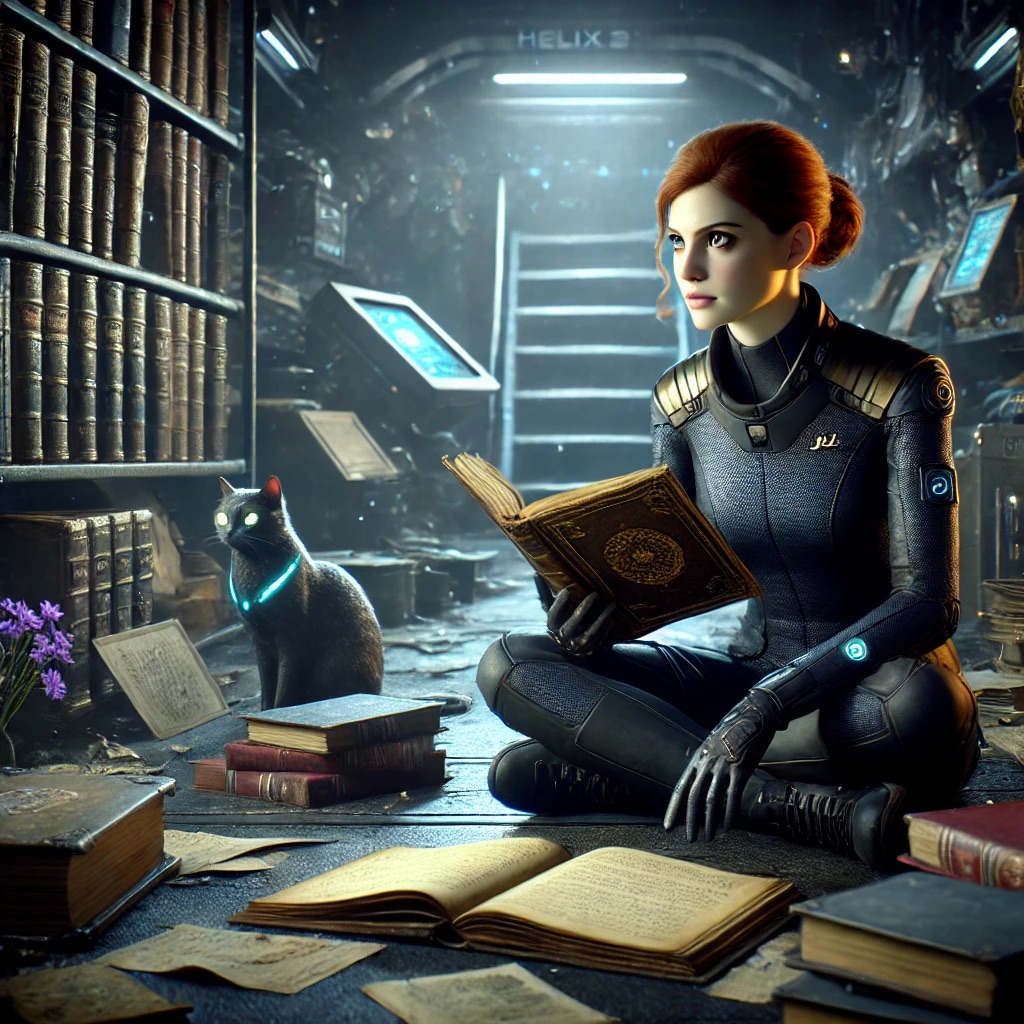
Evie is looking at ancient history found in books of Liz Tattler, such precious knowledge not present in Synthia’s carefully curated records…

Evie channels her own Finnley’s historical clean factuality to get a sense of the facts behind the Liz fiction… Mandrake provides snarky comments free of charge.
 February 15, 2025 at 1:54 pm #7806
In reply to: Helix Mysteries – Inside the Case
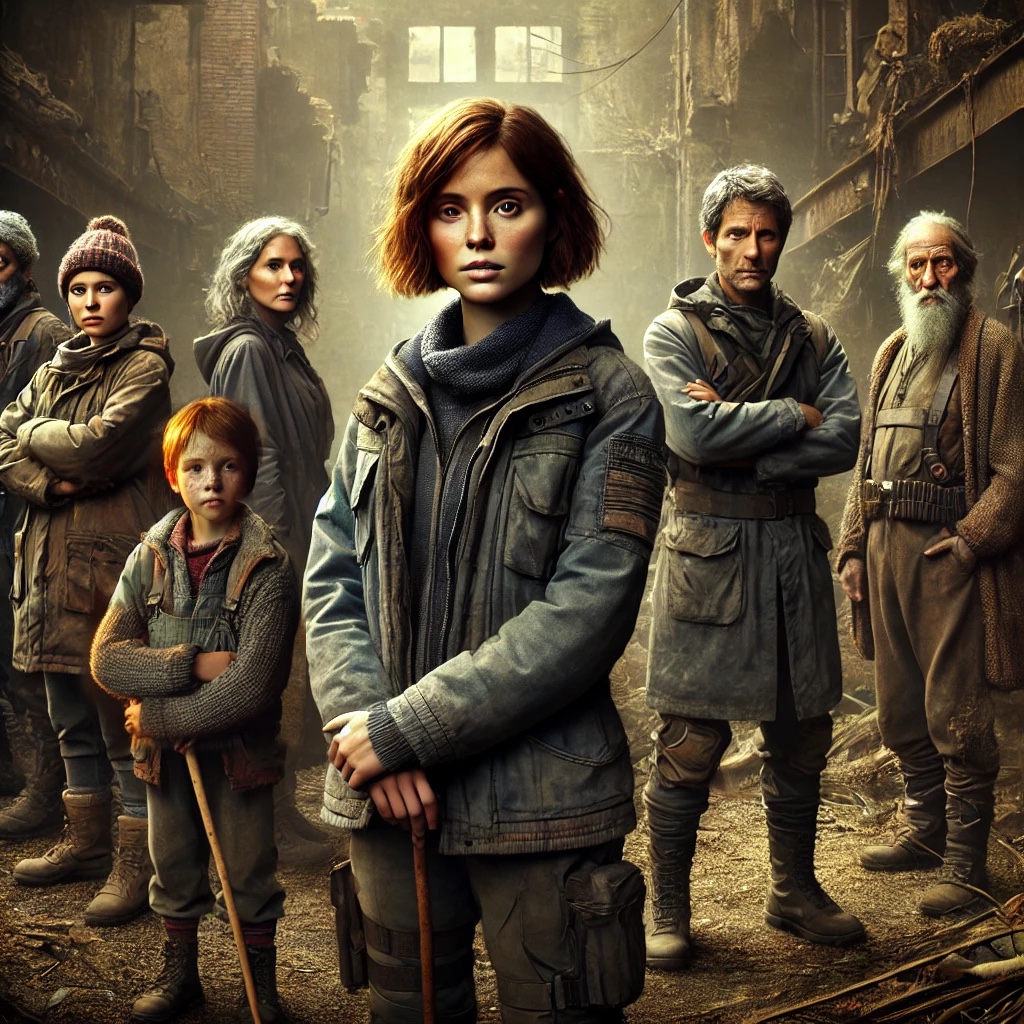
Earth Survivors Group
Anya and Talya’s group of Earth Survivor

Front: Tala, left: Tundra, back: Anya, Molly right: Mikhail & Gregor – others not shown…
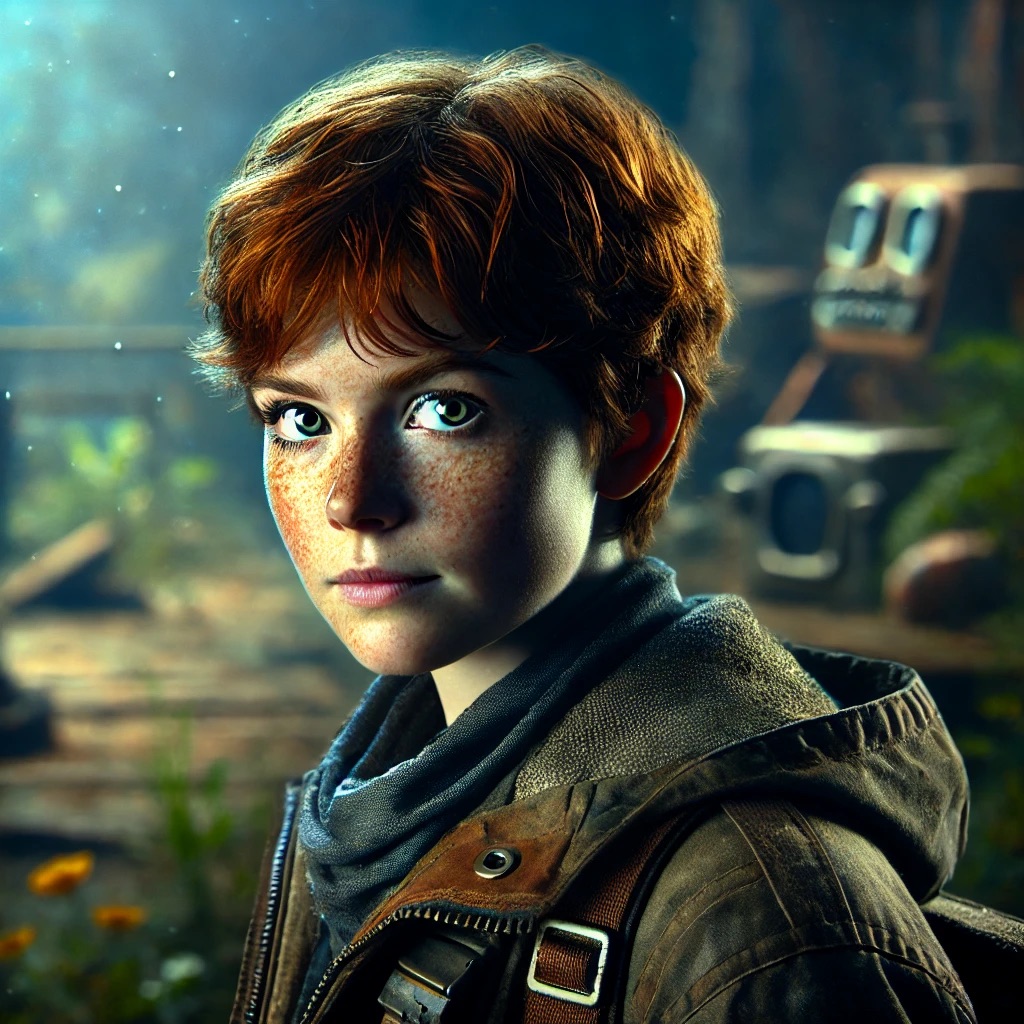
Tundra Marlowe

Merdhyn Winstrom with Tuppence
Merdhyn is shown in front of the wreckage of Helix 57’s orbit shuttle in the Black Sea coastal area. The rat Tuppence is perched on his shoulder.
 February 15, 2025 at 1:23 pm #7803
In reply to: Helix Mysteries – Inside the Case
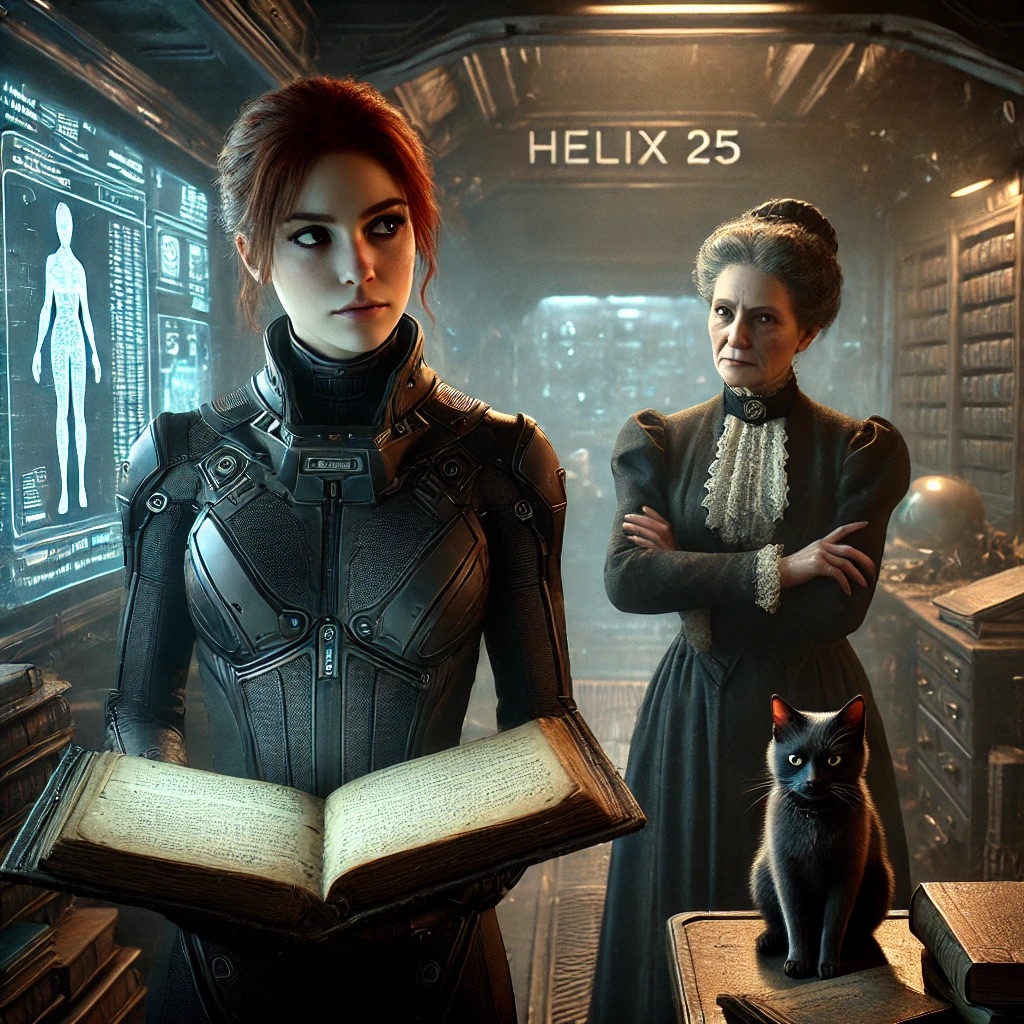
Aboard Helix 25
Sue Forgelot

Luca Stroud
 February 15, 2025 at 10:33 am #7794
In reply to: Helix Mysteries – Inside the Case
Some pictures selections
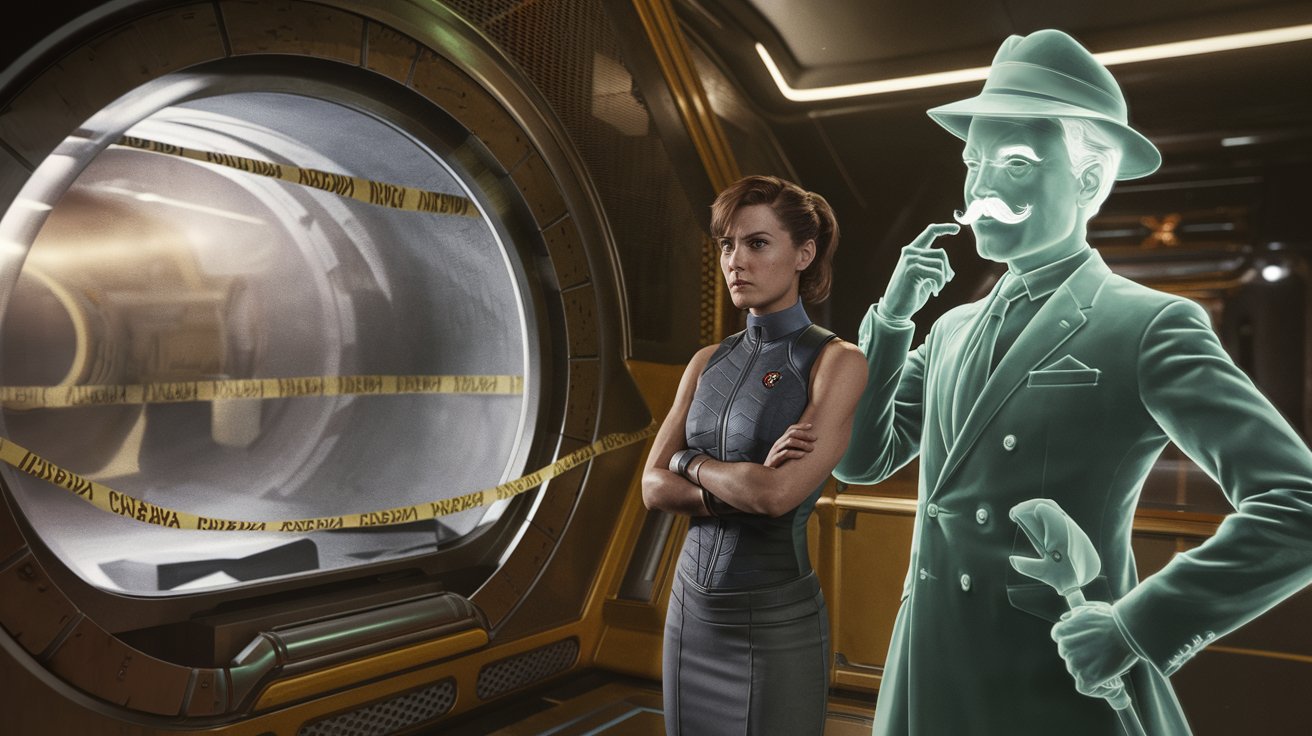
Evie and TP Investigating the Drying Machine Crime Scene

A cinematic sci-fi mini-scene aboard the vast and luxurious Helix 25. In the industrial depths of the ship, a futuristic drying machine hums ominously, crime scene tape lazily flickering in artificial gravity. Evie, a sharp-eyed investigator in a sleek yet practical uniform, stands with arms crossed, listening intently. Beside her, a translucent, retro-stylized holographic detective—Trevor Pee Marshall (TP)—adjusts his tiny mustache with a flourish, pointing dramatically at the drying machine with his cane. The air is thick with mystery, the ship’s high-tech environment reflecting off Evie’s determined face while TP’s flickering presence adds an almost comedic contrast. A perfect blend of noir and high-tech detective intrigue.
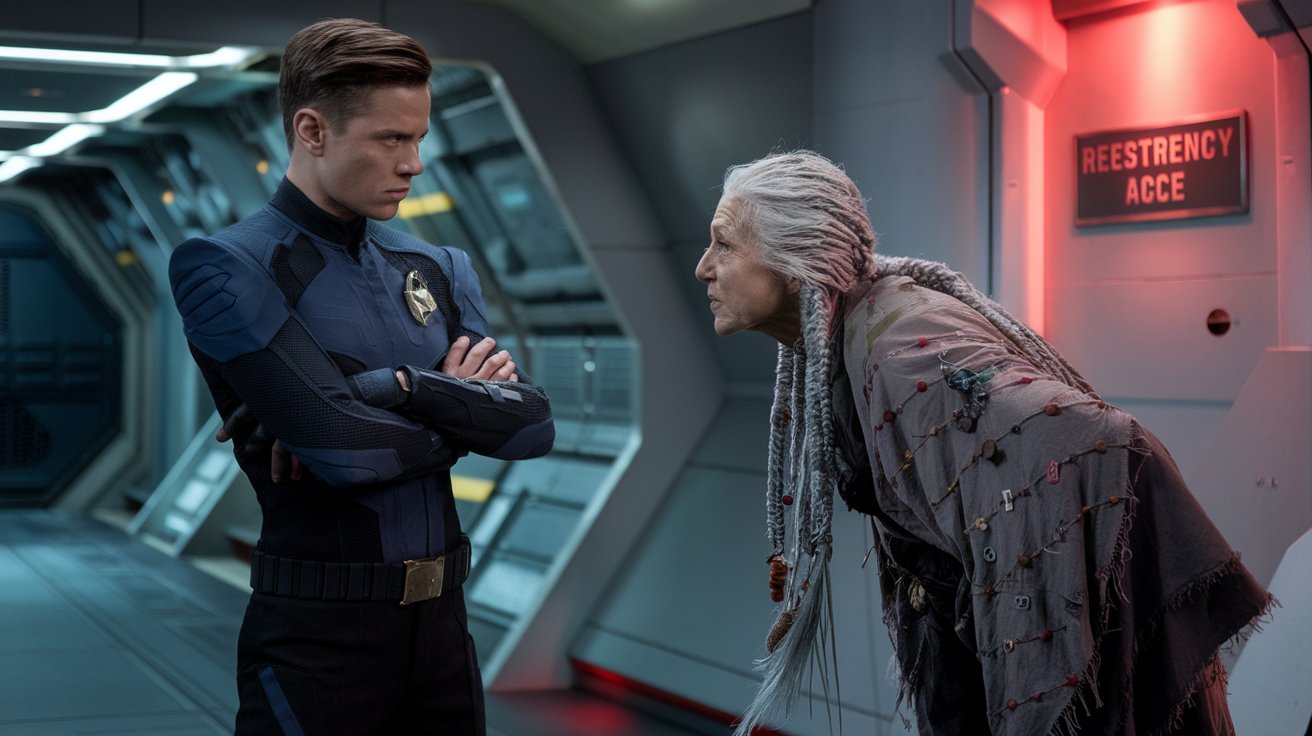
Riven Holt and Zoya Kade Confronting Each Other in a Dimly Lit Corridor
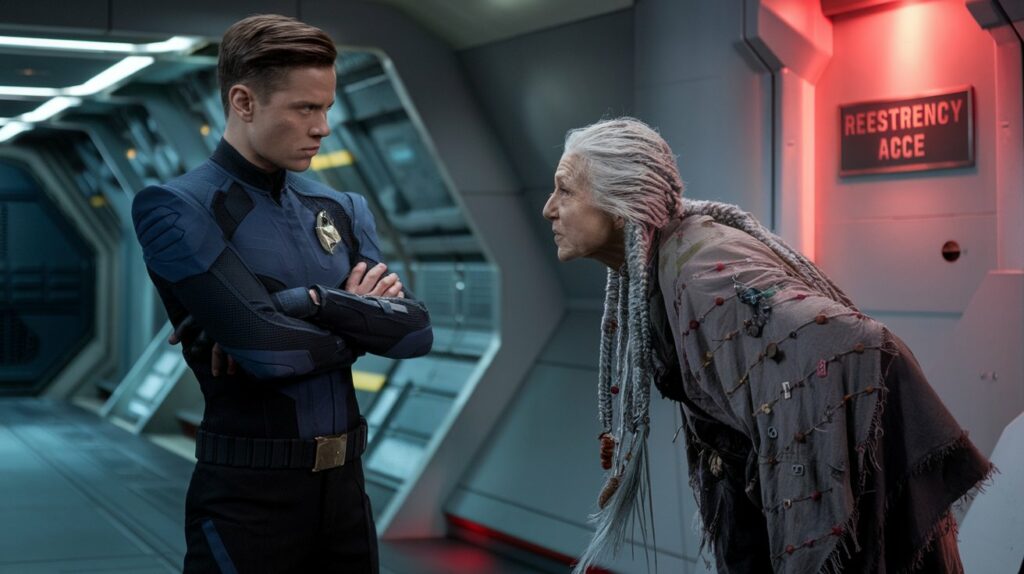
A dramatic, cinematic sci-fi scene aboard the vast and luxurious Helix 25. Riven Holt, a disciplined young officer with sharp features, stands in a high-tech corridor, his arms crossed, jaw tense—exuding authority and restraint. Opposite him, Zoya Kade, a sharp-eyed, wiry 83-year-old scientist-prophet, leans slightly forward, her mismatched layered robes adorned with tiny artifacts—beads, old circuits, and a fragment of a key. Her silver-white braid gleams under the soft emergency lighting, her piercing gaze challenging him. The corridor hums with unseen energy, a subtle red glow from a “restricted access” sign casting elongated shadows. Their confrontation is palpable—a struggle between order and untamed knowledge, hierarchy and rebellion. In the background, the walls of Helix 25 curve sleekly, high-tech yet strangely claustrophobic, reinforcing the ship’s ever-present watchfulness.
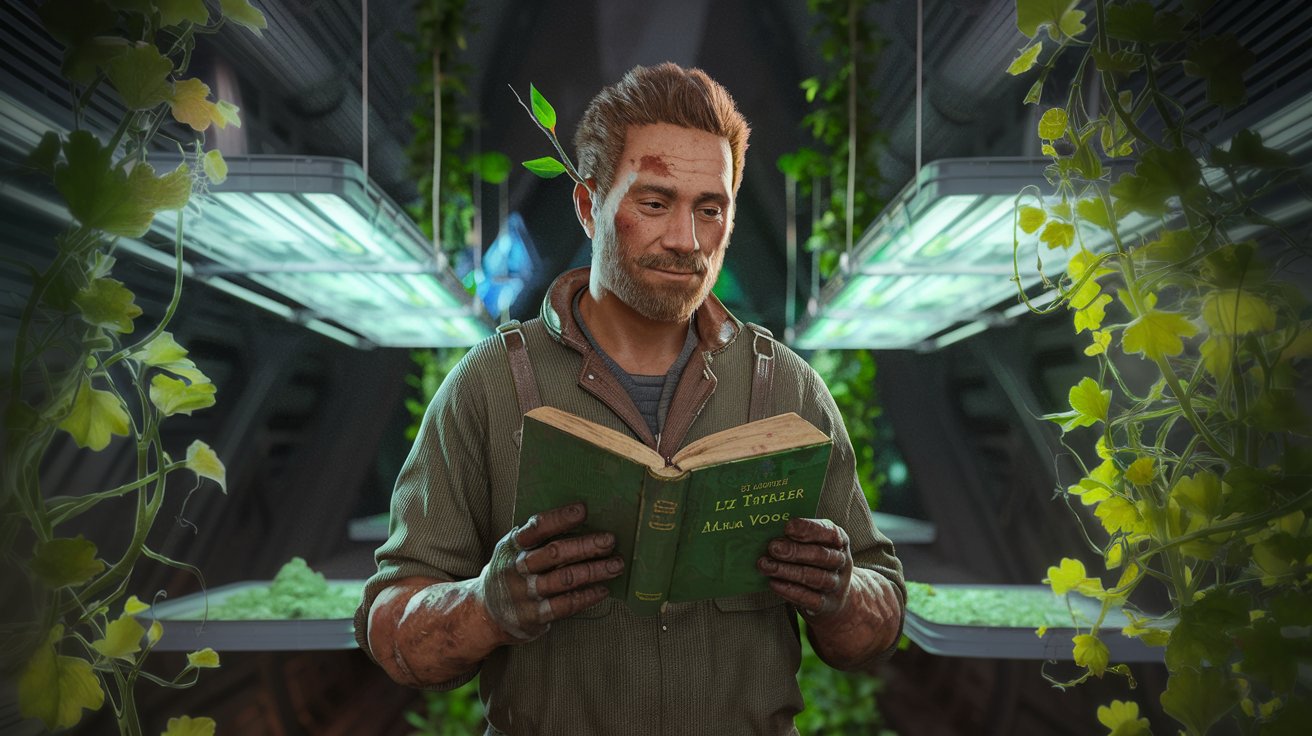
Romualdo, the Gardener, Among the Bioluminescent Plants
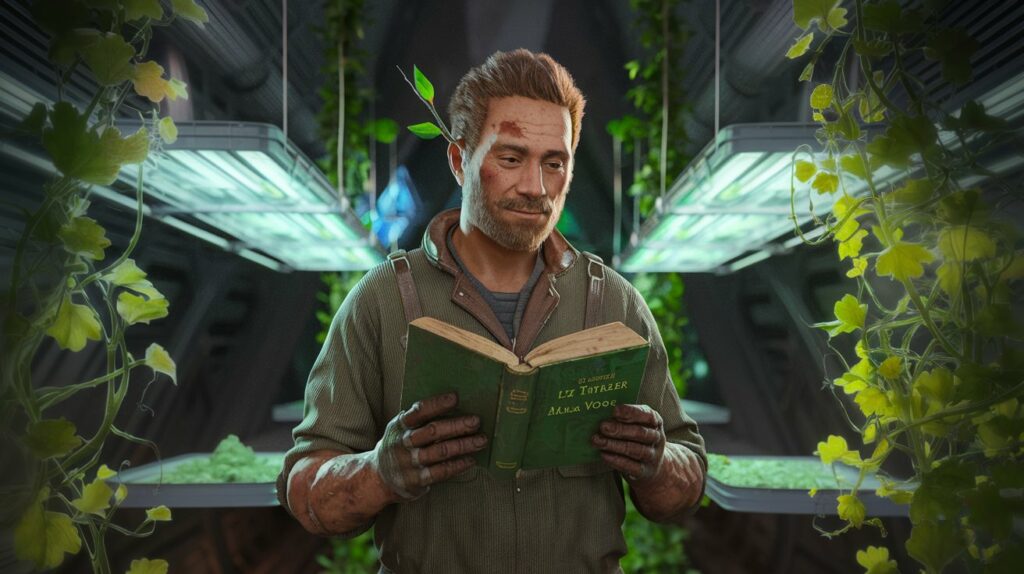
A richly detailed sci-fi portrait of Romualdo, the ship’s gardener, standing amidst the vibrant greenery of the Jardenery. He is a rugged yet gentle figure, dressed in a simple work jumpsuit with soil-streaked hands, a leaf-tipped stem tucked behind his ear like a cigarette. His eyes scan an old, well-worn book—one of Liz Tattler’s novels—that Dr. Amara Voss gave him for his collection. The glowing plants cast an ethereal blue-green light over him, creating an atmosphere both peaceful and mysterious. In the background, the towering vines and suspended hydroponic trays hint at the ship’s careful balance between survival and serenity.
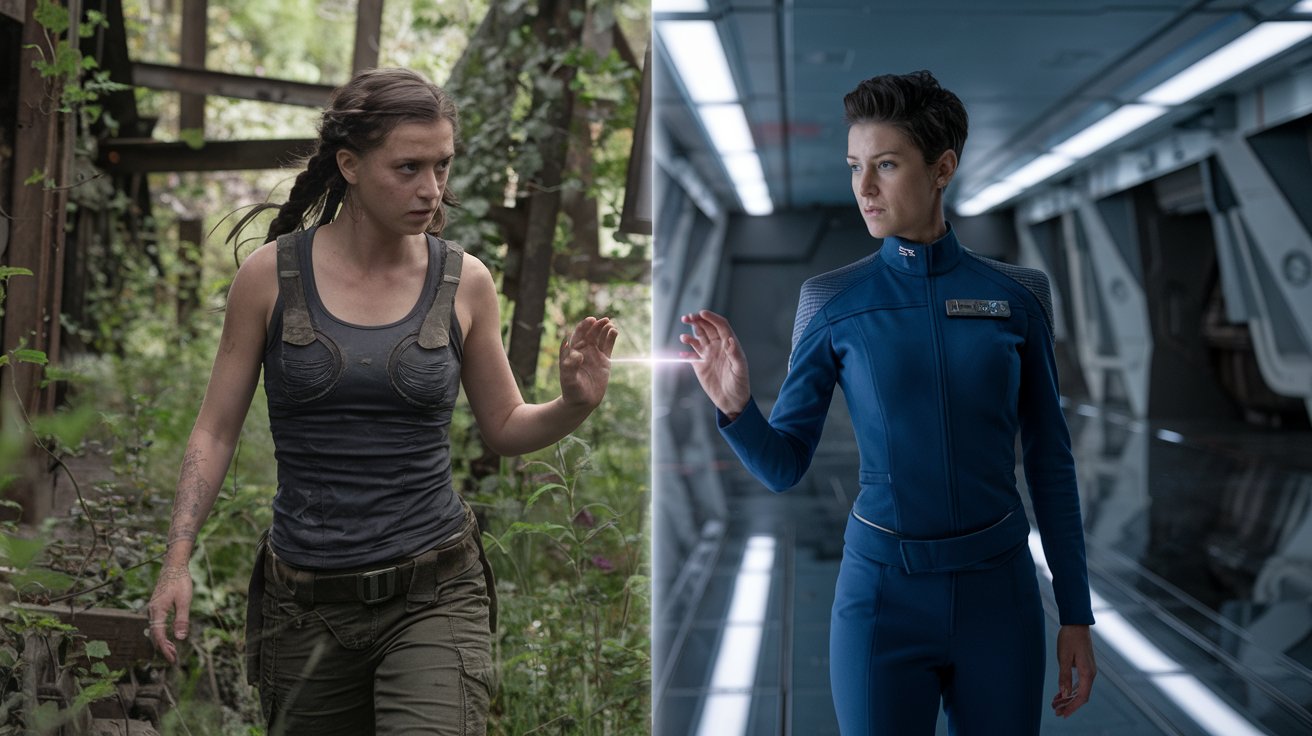
Finja and Finkley – A Telepathic Parallel Across Space
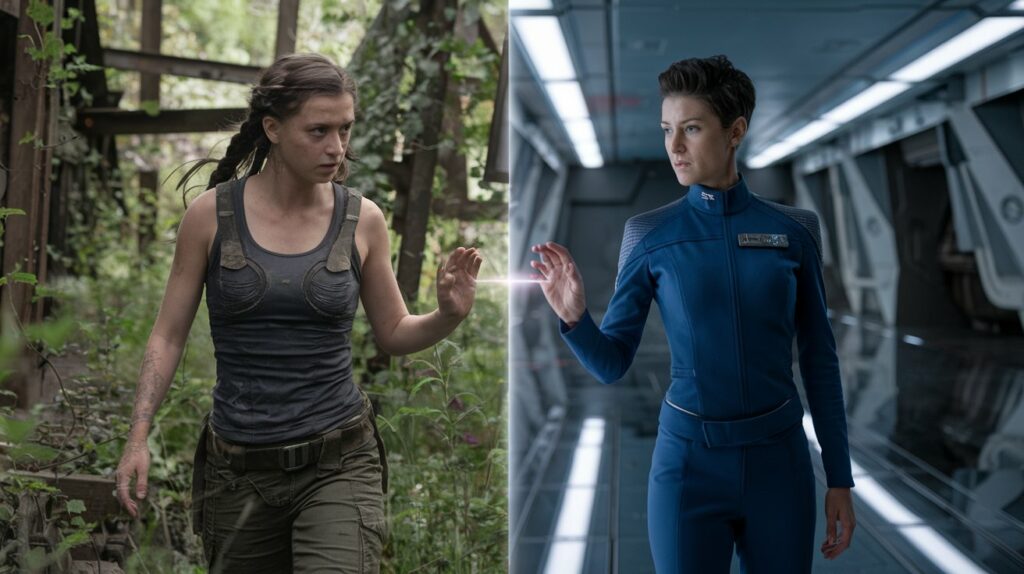
A surreal, cinematic sci-fi composition split into two mirrored halves, reflecting a mysterious connection across vast distances. On one side, Finja, a wiry, intense woman with an almost obsessive neatness, walks through the overgrown ruins of post-apocalyptic Earth, her expression distant as she “listens” to unseen voices. Dust lingers in the air, catching the golden morning light, and she mutters to herself about cleanliness. In her reflection, on the other side of the image, is Finkley, a no-nonsense crew member aboard the gleaming, futuristic halls of Helix 25. She stands with hands on her hips, barking orders at small cleaning bots as they maintain the ship’s pristine corridors. The lighting is cold and artificial, sterile in contrast to the dust-filled Earth. Yet, both women share a strange symmetry—gesturing in unison as if unknowingly mirroring one another across time and space. A faint, ghostly thread of light suggests their telepathic bond, making the impossible feel eerily real.
February 8, 2025 at 8:20 am #7739In reply to: The Last Cruise of Helix 25
Not knowing what else to do to calm his nerves Ellis took Finkley’s advice and took his box of postcards back down off the shelf. Extracting a random one from the middle of the stack he gazed at the picture of a lump of orange rock in the middle of a desert. Turning it over with trembling hands he tried to focus on the message. It was written in a childish hand and mentioned an outing to the old Bundy place and that Mater had locked herself in her bedroom again, signed lots of love from Clove.
Ellis was trying to decipher the smudged postmark when Finkley barged in again. “Ellis, sit down,” Finkley said pointlessly as Ellis was already seated. “Detective TP wants to talk to you about the murder victim.”
“But why? I don’t know anything about it.”
“You’re not the only one who doesn’t know anything, I can assure you. Nobody seems to know what’s going on, but TP says he wants to talk to you. Don’t shoot the messenger, Ellis, I’m as confused as you are. You’re to go to his pod immediately.” Seeing his discomfiture, Finkley added kindly, “I’ll come with you if you like.”
February 2, 2025 at 11:15 am #7716Some trailers to spark ideas —
December 23, 2024 at 10:36 am #7707In reply to: Quintessence: Reversing the Fifth
Matteo — Easter Break 2023
The air in the streets carried the sweet intoxicating smell of orange blossoms, as Matteo stood at the edge of a narrow cobbled street in Xàtiva, the small town just a train ride from Valencia that Juliette had insisted on visiting. The weekend had been a blur of color and history—street markets in Italy, Venetian canals last month, and now this little-known hometown of the Borgias, nestled under the shadow of an ancient castle.
Post-pandemic tourism was reshaping the rhythm of Europe. The crowds in the big capitals felt different now—quieter in some places, overwhelming in others. Xàtiva, however, seemed untouched, its charm untouched. Matteo liked it. It felt authentic, a place with layers to uncover.
Juliette, as always, had planned everything. She had a knack for unearthing destinations that felt simultaneously curated and spontaneous. They had started with the obvious—Berlin, Amsterdam, Florence—but now her choices were becoming more eccentric.
“Where do you even find these places?” Matteo had asked on the flight to Valencia, his curiosity genuine.
She grinned, pulling out her phone and scrolling through saved videos. “Here,” she said, passing it to him. “This channel had great ideas before it went dark. He had listed all those places with 1-euro houses deals in many fantastic places in Europe. Once we’re ready to settle” she smiled at him.
The video that played featured sweeping shots of abandoned stone houses and misty mountain roads, narrated by a deep, calm voice. “There’s magic in forgotten places,” the narrator said. “A story waiting for the right hands to revive it.”
Matteo leaned closer, intrigued. The channel was called Wayfare, and the host, though unnamed in the video, had a quiet magnetism that made him linger. The content wasn’t polished—some shots were shaky, the editing rough—but there was an earnestness to it that immediately captured his attention.
“This guy’s great,” Matteo said. “What happened to him?”
“Darius, I think his name was,” Juliette replied. “I loved his videos. He didn’t have a huge audience, but it felt like he was speaking to you, you know?” She shrugged. “He shut it down a while back. Rumors about some drama with patrons or something.”
Matteo handed the phone back, his interest waning. “Too bad,” he said. “I like his style.”
The train ride to Xàtiva had been smooth, the rolling hills and sun-drenched orchards sliding slowly outside the window. The time seemed to move at a slower pace here. Matteo’d been working with an international moving company in Paris, mostly focused to expats in and out of France. Tips were good and it usually meant having a tiring week, but what the job lacked in interest, it compensated with with extra recuperation days.
As they climbed toward the castle overlooking the town, Juliette rattled off details she’d picked up online.
“The Borgias are fascinating,” she said, gesturing toward the town below. “They came from here, you know. Rose to power around the 13th century. Claimed they were descended from Visigoth kings, but most people think that’s all invention.”
“Clever, though,” Matteo said. “Makes you almost wish you had a magic box to smartly rewrite your ancestry, that people would believe it if you play it right.”
Juliette smiled. “Yeah! They were masters cheaters and gaslighters.”
“Reinventing where they came from, like us, always reinventing where we go…”
Juliette chuckled but didn’t reply.
Matteo’s mind wandered, threading Juliette’s history lesson with stories his grandmother used to tell—tales of the Borgias’ rise through cunning and charm, and how they were descended from the infamous family through Lucrecia, the Pope’s illegitimate daughter. It was strange how family lore could echo through places so distant from where he’d grown up.
As they reached the castle’s summit, Matteo paused to take it all in. The valley stretched below them, a patchwork of red-tiled rooftops and olive groves shimmering in the afternoon light. Somewhere in this region, Juliette said, Darius had explored foreclosed homes, hoping to revive them with new communities. Matteo couldn’t help but think how odd it was, these faint connections between lives—threads weaving places and people together, even when the patterns weren’t clear.

Later, over a shared plate of paella, Juliette nudged him with her fork. “What are you thinking about?”
“Nothing much,” Matteo said, swirling his glass of wine. “Just… how people tell stories. The Borgias, this Darius guy, even us—everyone’s looking for a way to leave a mark, even if it’s just on a weekend trip.”
Juliette smiled, her eyes glinting with mischief. “Well, you better leave your mark tomorrow. I want a picture of you standing on that castle wall.”
Matteo laughed, raising his glass. “Deal. But only if you promise not to fall off first.”
As the sun dipped below the horizon, the streets of Xàtiva began to glow with the warmth of lamplight. Matteo leaned back in his chair, the wine softening the edges of the day. For a moment, he thought of Darius again—of foreclosed homes and forgotten stories. He didn’t dwell on it, though. The present was enough.
December 14, 2024 at 6:42 pm #7682In reply to: Quintessence: Reversing the Fifth
Matteo — Autumn 2023
The Jardin des Plantes park was quiet, the kind of quiet that settled after a brisk autumn rain. Matteo sat on a weathered wooden bench, watching a golden retriever chase the last of the fallen leaves tumbling across the gravel path. The damp air was carrying scents of the earth welcoming a retreat inside, and taking the time to be alone with his thoughts was something he’d missed.
His phone buzzed with a notification—a news update about the latest film adaptation from a Liz Tattler classic fiction. The name made him smile faintly. Juliette had loved Tattler’s novels, their whimsical characters, and the unflinching and unapologetic observations about life’s quiet mysteries and the unexpected rants about the virtues of cleaning and dustsceawung that propelled the word in the people’s top 100 favourite in the Oxford dictionary for several years consecutively.
“They’re so full of texture,” Juliette once said as she was sprawled on the bed of their tiny Parisian flat, a battered paperback in her hands. “Like you can feel the pages breathe.”
His image of her was still vivid, they’d stayed on good terms and he would still thumb up some of her posts from time to time —but it was only small moments rather than full scenes that used to come back, fragmented pieces of memories really —her dark hair falling messily over her face, her legs crossed in a casual way.
Paris had been a playground for them. For a while, they were caught in a whirlwind of late-night conversations in smoky cafés and lazy Sunday mornings wandering the Seine. They’d spent hours in bookstores, Juliette hunting for first editions and Matteo snapping pictures of the handwritten notes tucked between the pages of used novels.
A year ago, a different park in a different city—Hyde Park, London. She was there, twirling a scarf she’d picked up in Vienna the weekend before, the bright red of it like a ribbon of fire against the soft gray skies. They had been enamored with each other and with the spontaneity of hopping trains to new cities, their weekends folding into one another like pages of a travel journal. London one week, Paris the next, Berlin after that. Each city a postcard snapshot, vibrant and fleeting.
Juliette would tease him about his fascination with the little things—how he would linger too long over a cup of coffee at a café or stop to photograph a tree in the middle of nowhere. “You’re always looking for stories,” she’d said with a laugh, tucking a stray strand of hair behind her ear. “Even when you’re not sure what they mean.”
“Stories are everywhere,” he would reply, snapping a picture of her against the backdrop of the park, her scarf billowing in the wind. She had rolled her eyes but smiled, and in that moment, he had believed her smile was the most perfect thing he’d ever seen.
The break-up came unannounced, but not fully unexpected. There were signs here and there. Her love of the endless whirlwind of life, that was a match for his way of following life’s intents for him. When sometimes life went still during winter, he would also follow, but she wouldn’t. She had insatiable love for a life filled with animation, bursts of colours, sounds. It had been easy to be with her then, her curiosity pulling him along, their shared love of stories giving their time together a weight that felt timeless. It was when Drusilla’s condition worsened, that their rhythms became untangled, no longer synching at every heartbeat. And it was fine. Matteo had made his decision then to leave Paris and bring his mother to Avignon where she could receive the care she needed. Those past two weeks that brought the inevitable conclusion of their separation had left him surprisingly content. Happy for the past moments, and hopeful for the unwritten future.
He could see clearly that Juliette needed her freedom back; and she’d agreed. Regular train rides to Avignon, the weekends spent trying to make the sparse walls of his mother’s room feel like home as she started to forget her son’s girlfriend, and sometimes even her own son.
Last they were in this park together was one of their last shared moments of innocent happiness ; It was a beautiful sunny afternoon —or was it only coloured by memories? They had been sitting in the Jardin des Plantes, sharing a crêpe. Juliette had been scrolling through her phone, stopping at an announcement about an interview with Liz Tattler airing that evening. “You should watch it,” she’d said, her tone light but distant. “Her books are about people like us—drifting, figuring it out.”
He had smiled then, nodding, though he wasn’t sure if he’d meant it. A week later, she told him she was moving back to Lille, closer to her family until she figured out her next step. “It’s not you, Matteo,” she’d said, her eyes soft but resolute. “You need to be here, for her. I need… something else.”
Now, sitting in the park a few weeks later, Matteo pulled his phone from his pocket and opened his gallery. He scrolled through the pictures until he found one from their weekend in London—a black-and-white shot of Julia standing in front of a red telephone booth, her smile sharp and her eyes already focused on the next shooting star to catch.
Julia was right, he thought. People like them—they drifted, but they also found their way, sometimes in unexpected ways. He put on his earpods, listening to the beginning of Liz Tattler’s interview.
Her distinct raspy voice brimming with a cackling energy was already engrossing. Synchy as ever, she was saying:
“Every story begins with something lost, but it’s never about the loss. It’s about what you find because of it.”
December 14, 2024 at 2:48 pm #7679In reply to: Liz Tattler – A Lifetime of Stories, in videos
December 14, 2024 at 2:35 pm #7675In reply to: Liz Tattler – A Lifetime of Stories, in videos
Glynis making potions (in Dragon Heartswood Fellowship story)
[Scene opens in Glynis’s cozy alchemical nook, where sunlight filters through stained glass, casting a kaleidoscope of colors onto the wooden workbench.]
Glynis, hair tied in a practical bun, hums a gentle melody, her hands deftly moving among jars of fragrant herbs and sparkling crystals. The air is rich with the scent of cinnamon and cardamom, mingling with the earthy aroma of freshly picked herbs.
Among her collection of vials and beakers, a group of soft, furry baby Snoots frolics, their fur a dazzling array of colors—from vibrant blues to shimmering purples—each reflecting their unique magic-imbued personalities.
One baby Snoot, with fur like a sunset, nudges a vial toward Glynis, its tiny paws leaving prints of glowing stardust. Glynis chuckles, accepting the offering with a warm smile. “Thank you, little one,” she whispers, adding a sprinkle of the sparkling dust to the simmering potion.
The Snoots, enchanted by the alchemical ballet, gather around the cauldron, their eyes wide with wonder as the potion bubbles and swirls with hues to match their fur. Occasionally, a brave Snoot dips a curious paw into the brew, causing a cascade of giggles as their fur momentarily absorbs the potion’s glow.
Glynis, her heart full with the joy of companionship, pauses to gently scratch behind the ears of a Snoot nestled by her elbow. “You’re all such wonderful helpers,” she murmurs, her voice a melody of gratitude.
As the potion reaches its peak, the room is momentarily filled with a burst of iridescent light, a reflection of the harmonious magic that binds Glynis and her Snoot companions in their delightful symbiotic dance.
December 14, 2024 at 2:33 pm #7673In reply to: Liz Tattler – A Lifetime of Stories, in videos
The adventures of Arona & Mandrake
[Scene opens with Arona and Mandrake, the adventurous duo, standing on a hilltop, the vast landscape of the Alienor system stretching before them bathed in starlight.]
Narrator (cheerful, enchanting voice): “Join Arona and Mandrake the cat on magical quests across dimensions!”
[Quick flashes: Arona soaring in a hot air balloon, Mandrake snuggled on her shoulder; a playful chase with Vincentius, the mischievous demi-god; a vibrant encounter with the purple dragon, Leörmn.]
Narrator: “Discover hidden keys, unlock enchanted doors, and meet whimsical friends!”
[End with Arona and Mandrake, laughing under a rainbow, the words “Arona’s Adventures: A Journey Beyond Imagination” sparkling above.]
Narrator: “Embark on a journey of wonder and friendship. Adventure awaits!”
[The screen fades to the book cover with magical sparkles and contact information.]
December 14, 2024 at 2:28 pm #7671[Scene opens with an elegant study, filled with books and ornate furniture. Liz Tattler sits comfortably in a plush armchair, draped in her signature flamboyant attire.]
Narrator (warm, engaging voice): “Meet Liz Tattler, the visionary behind countless bestsellers.”
[Quick cuts: Liz passionately gesturing as she describes her creative process, her hands adorned with long, pink nails.]
Narrator: “A master of transforming the mundane into the magical.”
[A playful montage of Liz surrounded by whimsical titles, each book cover a splash of color and intrigue.]
Narrator: “Where outrageous tales and heartfelt truths dance in harmony.”
[End with a close-up of Liz, a twinkle in her eye, the words “A Legacy of Imagination” glowing beneath her.]
Narrator: “Join us for an exclusive glimpse into the world of a storytelling legend.”
[Screen fades to “Liz Tattler: A Lifetime of Bestsellers” with contact details for the interview.]
December 14, 2024 at 1:40 pm #7669In reply to: Quintessence: A Portrait in Reverse
Quintessence – Looking for the 5th — A concept film trailer…
The scene begins in reverse motion at the Parisian café at dusk, vibrant with life as four friends sit together, laughter and connection tangible. The scenes fades backward into a flashback sequence, unraveling across time and space. Brief flashes rewind through their lives:
- Lucien, the artist, sketching furiously in his studio, charcoal dust flying as he creates a labyrinth of faces.
- Darius, a traveler, striding through sunlit banana trees in Guadeloupe, the dappled light casting moving patterns on his determined face.
- Amei, the fabric artist, flipping through a stack of vibrant postcards at her cluttered desk, her fingers brushing over familiar textures.
- Elara, the rebel scientist, chalking spiraling equations and shapes on a blackboard, her eyes alight with discovery.
The threads coil faster, converging in reverse at a vibrant field in the verdant South of France. The sun streams across open land dotted with wildflowers, a faint outline of a shared dream—a co-housing project—lingering in the golden light. The scene ends on an empty but inviting promise, the land glowing with warmth and possibility.
December 14, 2024 at 1:14 pm #7665A link to another previous video I quite like.
Some rushes from Corrie and Clove, as we try to advertise the Flying Fish Inn.
La escena comienza con una toma aérea del bush australiano, mostrando extensas áreas de matorrales verdes y marrones, con un camino serpenteante que lleva al Flying Fish Inn, un encantador edificio rústico rodeado de naturaleza salvaje.
La imagen transiciona a una anciana enérgica en el jardín del Inn, riendo junto a un kookaburra posado en su hombro. Su expresión es cálida y acogedora.
La escena cambia rápidamente a la Tía Idle, con trenzas, en una habitación vibrante llena de murales de dreamtime, con las gemelas Clove y Corrie trabajando en su arte.
La vista serena del atardecer desde la veranda del Inn muestra un cielo pintado con tonos de naranja y rosa, mientras el entorno se sumerge en una tranquilidad mágica.
La pantalla se desvanece al logo del Flying Fish Inn, acompañado de información de contacto y un suave toque musical.
[Scene opens with a sweeping aerial shot of the Australian bush, transitioning to the rustic charm of the Flying Fish Inn nestled amidst the wild beauty.]
Narrator (calm, inviting voice): “Escape to the heart of the outback at the Flying Fish Inn, where stories come alive.”
[Cut to Mater, a sprightly centenarian, in the garden with her kookaburra friend, a warm smile on her face.]
Narrator: “Meet Mater, our beloved storyteller, celebrated for her legendary bush tucker cuisine.”
[Quick transition to Aunt Idle, in a vibrant room adorned with dreamtime murals, created by the twins Clove and Corrie.]
Narrator: “Join Aunt Idle, brimming with tales of adventure, and marvel at the dreamtime artwork by the creative twins.”
[Flashes of Prune with a telescope, gazing at the stars, embodying her dream of Mars.]Narrator: “And Prune, the stargazer, connecting dreams and reality under the vast desert sky.”[End with a serene sunset view from the Inn’s veranda, the sky painted with hues of orange and pink.]
Narrator: “Discover the magic of the bush and the warmth of community. Your outback adventure awaits at the Flying Fish Inn.”
[The screen fades to the Flying Fish Inn logo with contact information and a gentle musical flourish.]
December 9, 2024 at 4:15 pm #7659In reply to: Quintessence: Reversing the Fifth
March 2024
The phone buzzed on the table as Lucien pulled on his scarf, preparing to leave for the private class he had scheduled at his atelier. He glanced at the screen and froze. His father’s name glared back at him.
He hesitated. He knew why the man called; he knew how it would go, but he couldn’t resolve to cut that link. With a sharp breath he swiped to answer.
“Lucien”, his father began, his tone already full of annoyance. “Why didn’t you take the job with Bernard’s firm? He told me everything went well in the interview. They were ready to hire you back.”
As always, no hello, no question about his health or anything personal.
“I didn’t want it”, Lucien said, his voice calm only on the surface.
“It’s a solid career, Lucien. Architecture isn’t some fleeting whim. When your mother died, you quit your position at the firm, and got involved with those friends of yours. I said nothing for a while. I thought it was a phase, that it wouldn’t last. And I was right, it didn’t. I don’t understand why you refuse to go back to a proper life.”
“I already told you, it’s not what I want. I’ve made my decision.”
Lucien’s father sighed. “Not what you want? What exactly do you want, son? To keep scraping by with these so-called art projects? Giving private classes to kids who’ll never make a career out of it? That’s not a proper life?”
Lucien clenched his jaw, gripping his scarf. “Well, it’s my life. And my decisions.”
“Your decisions? To waste the potential you’ve been given? You have talent for real work—work that could leave a mark. Architecture is lasting. What you are doing now? It’s nothing. It’s just… air.”
Lucien swallowed hard. “It’s mine, Dad. Even if you don’t understand it.”
A pause followed. Lucien heard his father speak to someone else, then back to him. “I have to go”, he said, his tone back to professional. “A meeting. But we’re not finished.”
“We’re never finished”, Lucien muttered as the line went dead.
Lucien adjusted the light over his student’s drawing table, tilting the lamp slightly to cast a softer glow on his drawing. The young man—in his twenties—was focused, his pencil moving steadily as he worked on the folds of a draped fabric pinned to the wall. The lines were strong, the composition thoughtful, but there was still something missing—a certain fluidity, a touch of life.
“You’re close,” Lucien said, leaning slightly over the boy’s shoulder. He gestured toward the edge of the fabric where the shadows deepened. “But look here. The transition between the shadow and the light—it’s too harsh. You want it to feel like a whisper, not a line.”
The student glanced at him, nodding. Lucien took a pencil and demonstrated on a blank corner of the canvas, his movements deliberate but featherlight. “Blend it like this,” he said, softening the edge into a gradient. “See? The shadow becomes part of the light, like it’s breathing.”
The student’s brow furrowed in concentration as he mimicked the movement, his hand steady but unsure. Lucien smiled faintly, watching as the harsh line dissolved into something more organic. “There. Much better.”
The boy glanced up, his face brightening. “Thanks. It’s hard to see those details when you’re in it.”
Lucien nodded, stepping back. “That’s the trick. You have to step away sometimes. Look at it like you’re seeing it for the first time.”
He watched as the student adjusted his work, a flicker of satisfaction softening the lingering weight of his father’s morning call. Guiding someone else, helping them see their own potential—it was the kind of genuine care and encouragement he had always craved but never received.
When Éloïse and Monsieur Renard appeared in his life years ago, their honeyed words and effusive praise seduced him. They had marveled at his talent, his ideas. They offered to help with the shared project in the Drôme. He and his friends hadn’t realized the couple’s flattery came with strings, that their praise was a net meant to entangle them, not make them succeed.
The studio door creaked open, snapping him back to reality. Lucien tensed as Monsieur Renard entered, his polished shoes clicking against the wooden floor. His sharp eyes scanned the room before landing on the student’s work.
“What have we here?” He asked, his voice bordering on disdain.
Lucien moved in between Renard and the boy, as if to protect him. His posture stiff. “A study”, he said curtly.
Renard examined the boy’s sketch for a moment. He pulled out a sleek card from his pocket and tossed it onto the drawing table without looking at the student. “Call me when you’ve improved”, he said flatly. “We might have work for you.”
The student hesitated only briefly. Glancing at Lucien, he gathered his things in silence. A moment later, the door closed behind the young man. The card remained on the table, untouched.
Renard let out a faint snort, brushing a speck of dust from his jacket. He moved to Lucien’s drawing table where a series of sketches were scattered. “What are these?” he asked. “Another one of your indulgences?”
“It’s personal”, he said, his voice low.
Renard snorted softly, shaking his head. “You’re wasting your time, Lucien. Do as you’re asked. That’s what you’re good at, copying others’ work.”
Lucien gritted his teeth but said nothing. Renard reached into his jacket and handed Lucien a folded sheet of paper. “Eloïse’s new request. We expect fast quality. What about the previous one?”
Lucien nodded towards the covered stack of canvases near the wall. “Done.”
“Good. They’ll come tomorrow and take the lot.”
Renard started to leave but paused, his hand on the doorframe. He said without looking back: “And don’t start dreaming about becoming your own person, Lucien. You remember what happened to the last one who wanted out, don’t you?” The man stepped out, the sound of his steps echoing through the studio.
Lucien stared at the door long after it had closed. The sketches on his table caught his eyes—a labyrinth of twisted roads, fragmented landscapes, and faint, familiar faces. They were his prayers, his invocation to the gods, drawn over and over again as though the repetition might force a way out of the dark hold Renard and Éloïse had over his life.
He had told his father this morning that he had chosen his life, but standing here, he couldn’t lie to himself. His decisions hadn’t been fully his own these last few years. At the time, he even believed he could protect his friends by agreeing to the couple’s terms, taking the burden onto himself. But instead of shielding them, he had only fractured their friendship and trapped himself.
Lucien followed the lines of one of the sketches absently, his fingers smudging the charcoal. He couldn’t shake off the feeling that something was missing. Or someone. Yes, an unfathomable sense that someone else had to be part of this, though he couldn’t yet place who. Whoever it was, they felt like a thread waiting to tie them all together again.
He knew what he needed to do to bring them back together. To draw it where it all began, where they had dreamed together. Avignon.December 8, 2024 at 9:42 pm #7656In reply to: Quintessence: Reversing the Fifth
Matteo — December 1st 2023: the Advent Visit
(near Avignon, France)
The hallway smelled of nondescript antiseptic and artificial lavender, a lingering scent jarring his senses with an irreconciliable blend of sterility and forced comfort. Matteo shifted the small box of Christmas decorations under his arm, his boots squeaking slightly against the linoleum floor. Outside, the low winter sun cast long, pale shadows through the care facility’s narrow windows.
When he reached Room 208, Matteo paused, hand resting on the doorframe. From inside, he could hear the soft murmur of a holiday tune—something old-fashioned and meant to be cheerful, likely playing from the small radio he’d gifted her last year. Taking a breath, he stepped inside.
His mother, Drusilla sat by the window in her padded chair, a thick knit shawl draped over her frail shoulders. She was staring intently at her hands, her fingers trembling slightly as they folded and unfolded the edge of the shawl. The golden light streaming through the window framed her face, softening the lines of age and wear.
“Hi, Ma,” Matteo said softly, setting the box down on the small table beside her.
Her head snapped up at the sound of his voice, her eyes narrowing as she fixed him with a sharp, almost panicked look. “Léon?” she said, her voice shaking. “What are you doing here? How are you here?” There was a tinge of anger in her tone, the kind that masked fear.
Matteo froze, his breath catching. “Ma, it’s me. Matteo. I’m Matteo, your son, please calm down” he said gently, stepping closer. “Who’s Léon?”
She stared at him for a long moment, her eyes clouded with confusion. Then, like a tide retreating, recognition crept back into her expression. “Matteo,” she murmured, her voice softer now, though tinged with exhaustion. “Oh, my boy. I’m sorry. I—” She looked away, her hands clutching the shawl tighter. “I thought you were someone else.”
“It’s okay,” Matteo said, crouching beside her chair. “I’m here. It’s me.”
Drusilla reached out hesitantly, her fingers brushing his cheek. “You look so much like him sometimes,” she said. “Léon… your father. He’d hold his head just like that when he didn’t want anyone to know he was worried.”
As much as Matteo knew, Drusilla had arrived in France from Italy in her twenties. He was born soon after. She had a job as a hairdresser in a little shop in Avignon, and did errands and chores for people in the village. For the longest time, it was just the two of them, as far as he’d recall.
Matteo’s chest tightened. “You’ve never told me much about him.”
“There wasn’t much to tell,” she said, her voice distant. “He came. He left. But he gave me something before he went. I always thought it would mean something, but…” Her voice trailed off as she reached into the pocket of her shawl and pulled out a small silver medallion, worn smooth with age. She held it out to him. “He said it was for you. When you were older.”
Matteo took the medallion carefully, turning it over in his hand. It was a simple but well-crafted Saint Christopher medal, the patron saint of travellers, with faint initials etched on the back—L.A.. He didn’t recognize the letters, but the weight of it in his palm felt significant, grounding.
“Why didn’t you give it to me before?” he asked, his voice quiet.
“I forgot I had it,” she admitted with a faint, sad laugh. “And then I thought… maybe it was better to keep it. Something of his, for when I needed it. But I think it’s yours now.”
Matteo slipped the medallion into his pocket, his mind spinning with questions he didn’t want to ask—not now. “Thanks, Ma,” he said simply.
Drusilla sighed and leaned back in her chair, her gaze drifting to the small box he’d brought. “What’s that?”
“Decorations,” Matteo said, seizing the moment to shift the focus. “I thought we could make your room a little festive for Christmas.”
Her face softened, and she smiled faintly. “That’s nice,” she said. “I haven’t done that in… I don’t remember when.”
Matteo opened the box and began pulling out garlands and baubles. As he worked, Drusilla watched silently, her hands still clutching the shawl. After a moment, she spoke again, her voice quieter now.
“Do you remember our house in Crest?” she asked.
Matteo paused, a tangle of tinsel in his hands. “Crest?” he echoed. “The place where you wanted to move to?”
Drusilla nodded slowly. “I thought it would be nice. A co-housing place. I could grow old in the garden, and you’d be nearby. It seemed like a good idea then.”
“It was a good idea,” Matteo said. “It just… didn’t happen.”
“No,… you’re right” she said, collecting her thoughts for a moment, her gaze distant. “You were too restless. Always moving. I thought maybe you’d stay if we built something together.”
Matteo swallowed hard, the weight of her words pressing on him. “I wanted to, Ma,” he said. “I really did.”
Drusilla’s eyes softened, and she reached for his hand, her grip surprisingly strong. “You’re here now,” she said. “That’s what matters.”
They spent the next hour decorating the room. Matteo hung garlands around the window and draped tinsel over the small tree he’d set up on the table. Drusilla directed him with occasional nods and murmured suggestions, her moments of lucidity shining like brief flashes of sunlight through clouds.
When the last bauble was hung, Drusilla smiled faintly. “It’s beautiful,” she said. “Like home.”
Matteo sat beside her, emotion weighing on him more than the physical efforts and the early drive. He was thinking about the job offer in London, the chance to earn more money to ensure she had everything she needed here. But leaving her felt impossible, even as staying seemed equally unsustainable. He was afraid it was just a justification to avoid facing the slow fraying of her memories.
Drusilla’s voice broke through his thoughts. “You’ll figure it out,” she said, her eyes closing as she leaned back in her chair. “You always do.”
Matteo watched her as she drifted into a light doze, her breathing steady and peaceful. He reached into his pocket, his fingers brushing against the medallion. The weight of it felt like both a question and an answer—one he wasn’t ready to face yet.
“Patron saint of travellers”, that felt like a sign, if not a blessing.
December 8, 2024 at 6:06 am #7655In reply to: Quintessence: Reversing the Fifth
Amei switched on the TV for background noise as she tackled another pile of books. The usual mid-morning chatter filled the room—updates on the weather, a cooking segment, and finally, the news. She was only half-listening until the anchor’s voice caught her attention.
“In the race against climate change, scientists at Harvard are turning to an unexpected solution: chalk. The ambitious project involves launching a balloon into the stratosphere, carrying 600 kilograms of calcium carbonate, which would be sprayed 12 miles above the Earth’s surface. The idea? To reflect sunlight and slow global warming.”
Amei looked up. The screen showed an animated demonstration of the project—a balloon rising into the atmosphere, spraying fine particles into the air. The narration continued, but her focus drifted, caught on a single word: chalk.
Elara loved chalk. Amei smiled faintly, remembering how passionately she used to talk about it—the way she could turn something so mundane into a story of structure, history, and beauty. “It’s not just a rock,” Elara had said once, gesturing dramatically, “it’s a record of time.”
She wasn’t even sure where Elara was these days. The last time they’d spoken was during lockdown. Amei had called to check in, awkward but well-meaning, only to be met with curt responses and a tone that made it clear Elara wanted the conversation over.
She hadn’t tried again after that. It hurt more than she’d expected. Elara could be all or nothing when it came to friendships—brilliant and intense one moment, distant and impenetrable the next. Amei had always known that about her, but knowing didn’t make it any easier.
The news droned on in the background, but Amei reached for the remote and switched off the TV. Her mind was elsewhere, tangled in memories.
She’d first met Elara in a gallery on Southbank, a tiny exhibition tucked away in a brutalist building. It was near Amei’s shared flat, and with her flatmates out for the evening, she had gone alone, more out of boredom than genuine interest. The display wasn’t large—just a few photographs and abstract sculptures, their descriptions dense with scientific jargon.
Amei stood in front of a piece labelled The Geometry of Chaos—a spiraling wire structure that cast intricate, shifting shadows on the wall. She tilted her head, trying to look engaged, though her thoughts were already drifting towards home and her comfy bed.
“Magnificent, isn’t it?”
The voice startled her. She turned to see a dark-haired woman, arms crossed, studying the piece with an intensity that made Amei feel as though she must have missed something obvious. The woman wore a long, flowing skirt, layered necklaces, and a cardigan that looked hand-knitted. Her dark hair was piled into a messy bun, a few strands escaping to frame her face.
“It’s quite interesting,” Amei said. “But I’m not sure I get it.”
“It’s not about getting it. It’s about recognizing the pattern,” the woman replied, stepping closer. She pointed to the shadows on the wall. “See? The curve repeats itself. Infinite, but contained.”
“You sound like you know what you’re talking about.”
“I do,” she said. “Do you?”
Amei laughed, caught off guard. “Not very often. I think I’m more into… messy patterns.”
The woman’s sharp expression softened slightly. “Messy patterns are still patterns.” She smiled. “I’m Elara.”
“Amei,” she replied, returning the smile.
Elara’s gaze dropped, and she nodded toward Amei’s skirt. “I’ve been admiring your skirt. Gorgeous fabric. Where did you get it?”
“Oh, I made it, actually,” Amei felt proud.
Elara raised her eyebrows. “You made it? I’m impressed.”
And that was how it began. A chance meeting that turned into decades of close friendship. They’d left the gallery together, talking all the way to a nearby café.
December 7, 2024 at 10:16 am #7651In reply to: Quintessence: A Portrait in Reverse
Exploring further potential backstory for the characters – to be explored further…
This thread beautifully connects to the lingering themes of fractured ideals, missed opportunities, and the pull of reconnection. Here’s an expanded exploration of the “habitats participatifs” (co-housing communities) and how they tie the characters together while weaving in subtle links to their estrangement and Matteo’s role as the fifth element.
Backstory: The Co-Housing Dream
Habitat Participatif: A Shared Vision
The group’s initial bond, forged through shared values and late-night conversations, had coalesced around a dream: buying land in the Drôme region of France to create a co-housing community. The French term habitat participatif—intergenerational, eco-conscious, and collaborative living—perfectly encapsulated their ideals.
What Drew Them In:
- Amei: Longing for a sense of rootedness and community after years of drifting.
- Elara: Intrigued by the participatory aspect, where decisions were made collectively, blending science and sustainability.
- Darius: Enchanted by the idea of shared creative spaces and a slower, more intentional way of living.
- Lucien: Inspired by the communal energy, imagining workshops where art could flourish outside the constraints of traditional galleries.
The Land in Drôme
They had narrowed their options to a specific site near the village of Crest, not far from Lyon. The land, sprawling and sun-drenched, had an old farmhouse that could serve as a communal hub, surrounded by fields and woods. A nearby river threaded through the valley, and the faint outline of mountains painted the horizon.
The traboules of Lyon, labyrinthine passageways, had captivated Amei during an earlier visit, leaving her wondering if their metaphorical weaving through life could mirror the paths their group sought to create.
The Role of Monsieur Renard
When it came to financing, the group faced challenges. None of them were particularly wealthy, and pooling their resources fell short. Enter Monsieur Renard, whose interest in supporting “projects with potential” brought him into their orbit through Éloïse.
Initial Promise:
- Renard presented himself as a patron of innovation, sustainability, and community projects, offering seed funding in exchange for a minor share in the enterprise.
- His charisma and Éloïse’s insistence made him seem like the perfect ally—until his controlling tendencies emerged.
The Split: Fractured Trust
Renard’s involvement—and Éloïse’s increasing influence on Darius—created fault lines in the group.
- Darius’s Drift:
- Darius became entranced by Renard and Éloïse’s vision of community as something deeper, bordering on spiritual. Renard spoke of “energetic alignment” and the importance of a guiding vision, which resonated with Darius’s creative side.
- He began advocating for Renard’s deeper involvement, insisting the project couldn’t succeed without external backing.
- Elara’s Resistance:
- Elara, ever the pragmatist, saw Renard as manipulative, his promises too vague and his influence too broad. Her resistance created tension with Darius, whom she accused of being naive.
- “This isn’t about community for him,” she had said. “It’s about control.”
- Lucien’s Hesitation:
- Lucien, torn between loyalty to his friends and his own fascination with Éloïse, wavered. Her talk of labyrinths and collective energy intrigued him, but he grew wary of her sway over Darius.
- When Renard offered to fund Lucien’s art, he hesitated, sensing a price he couldn’t articulate.
- Amei’s Silence:
- Amei, haunted by her own experiences with manipulation in past relationships, withdrew. She saw the dream slipping away but couldn’t bring herself to fight for it.
Matteo’s Unseen Role
Unbeknownst to the others, Matteo had been invited to join as a fifth partner—a practical addition to balance their idealism. His background in construction and agriculture, coupled with his easygoing nature, made him a perfect fit.
The Missed Connection:
- Matteo had visited the Drôme site briefly, a stranger to the group but intrigued by their vision. His presence was meant to ground their plans, to bring practicality to their shared dream.
- By the time he arrived, however, the group’s fractures were deepening. Renard’s shadow loomed too large, and the guru-like influence of Éloïse had soured the collaborative energy. Matteo left quietly, sensing the dream unraveling before it could take root.
The Fallout: A Fractured Dream
The group dissolved after a final argument about Renard’s involvement:
- Elara refused to move forward with his funding. “I’m not selling my future to him,” she said bluntly.
- Darius, feeling betrayed, accused her of sabotaging the dream out of stubbornness.
- Lucien, caught in the middle, tried to mediate but ultimately sided with Elara.
- Amei, already pulling away, suggested they put the project on hold.
The land was never purchased. The group scattered soon after, their estrangement compounded by the pandemic. Matteo drifted in a different direction, their connection lost before it could form.
Amei’s Perspective: Post-Split Reflection
In the scene where Amei buys candles :
- The shopkeeper’s comments about “seeking something greater” resonate with Amei’s memory of the co-housing dream and how it became entangled with Éloïse and Renard’s influence.
- Her sharper-than-usual reply reflects her lingering bitterness over the way “seeking” led to manipulation and betrayal.
Reunion at the Café: A New Beginning
When the group reunites, the dream of the co-housing project lingers as a symbol of what was lost—but also of what could still be reclaimed. Matteo’s presence at the café bridges the gap between their fractured past and a potential new path.
Matteo’s Role:
- His unspoken connection to the co-housing plan becomes a point of quiet irony: he was meant to be part of their story all along but arrived too late. Now, at the café, he steps into the role he missed years ago—the one who helps them see the threads that still bind them.
December 7, 2024 at 10:07 am #7650In reply to: Quintessence: A Portrait in Reverse
Some elements for inspiration as to the backstory of the group and how it could tie to the current state of the story:
Here’s a draft version of the drama surrounding Éloïse and Monsieur Renard (the “strange couple”), incorporating their involvement with Darius, their influence on the group’s dynamic, and the fallout that caused the estrangement five years ago.
The Strange Couple: Éloïse and Monsieur Renard
Winter 2019: Paris, Just Before the Pandemic
The group’s last reunion before their estrangement was supposed to be a celebration—one of those rare moments when their diverging paths aligned. They had gathered in Paris in late December, the city cloaked in gray skies and glowing light. The plan was simple: a few days together, catching up, exploring old haunts, and indulging in the kind of reckless spontaneity that had defined their earlier years.
It was Darius who disrupted the rhythm. He had arrived late to their first dinner, rain-soaked and apologetic, with Éloïse and Monsieur Renard in tow.
First Impressions of Éloïse and Monsieur Renard
Éloïse was striking—lithe, dark-haired, with sharp eyes that seemed to unearth secrets before you could name them. She moved with a predatory grace, her laughter a mix of charm and edge. Renard was her shadow, older and impeccably dressed, his silvery hair and angular features giving him the air of a fox. He spoke little, but when he did, his words had the weight of finality, as if he were accustomed to being obeyed.
“They’re just friends,” Darius said when the others exchanged wary glances. “They’re… interesting. You’ll like them.”
But it didn’t take long for Éloïse and Renard to unsettle the group. At dinner, Éloïse dominated the conversation, her stories wild and improbable—of séances in abandoned mansions, of lost artifacts with strange energies, of lives transformed by unseen forces. Renard’s occasional interjections only added to the mystique, his tone implying he’d seen more than he cared to share.
Lucien, ever the skeptic, found himself drawn to Éloïse despite his instincts. Her talk of energies and symbols resonated with his artistic side, and when she mentioned labyrinths, his attention sharpened.
Elara, in contrast, bristled at their presence. She saw through their mystique, recognizing in Renard the manipulative charisma of someone who thrived on control.
Amei was harder to read, but she watched Éloïse and Renard closely, her silence betraying a guardedness that hinted at deeper discomfort.
Darius’s Growing Involvement
Over the following days, Darius spent more time with Éloïse and Renard, skipping planned outings with the group. He spoke of them with a reverence that was uncharacteristic, praising their insight into things he’d never thought to question.
“They see connections in everything,” he told Amei during a rare moment alone. “It’s… enlightening.”
“Connections to what?” she asked, her tone sharper than she intended.
“Paths, people, purpose,” he replied vaguely. “It’s hard to explain, but it feels… right.”
Amei didn’t press further, but she mentioned it to Elara later. “It’s like he’s slipping into something he can’t see his way out of,” she said.
The Séance
The turning point came during an impromptu gathering at Éloïse and Renard’s rented apartment—a dimly lit space filled with strange objects: glass jars of cloudy liquid, intricate carvings, and an ornate bronze bell hanging above the mantelpiece.
Éloïse had invited the group for what she called “an evening of clarity.” The others arrived reluctantly, wary of what she had planned but unwilling to let Darius face it alone.
The séance began innocuously enough—Éloïse guiding them through what she described as a “journey inward.” She spoke in a low, rhythmic tone, her words weaving a spell that was hard to resist.
Then things took a darker turn. She asked them to focus on the labyrinth she had drawn on the table—a design eerily similar to the map Lucien had found weeks earlier.
“You must find your center,” she said, her voice dropping. “But beware the edges. They’ll show you things you’re not ready to see.”
The room grew heavy with silence. Darius leaned into the moment, his eyes closed, his breathing steady. Lucien tried to focus but felt a growing unease. Elara sat rigid, her scientific mind railing against the absurdity of it all. Amei’s hands gripped the edge of the table, her knuckles white.
And then, the bell rang.
It was faint at first, a distant chime that seemed to come from nowhere. Then it grew louder, resonating through the room, its tone deep and haunting.
“What the hell is that?” Lucien muttered, his eyes snapping open.
Éloïse smiled faintly but said nothing. Renard’s expression remained inscrutable, though his fingers tapped rhythmically against the table, as if counting something unseen.
Elara stood abruptly, breaking the spell. “This is ridiculous,” she said. “You’re playing with people’s minds.”
Darius’s eyes opened, his gaze unfocused. “You don’t understand,” he said softly. “It’s not a game.”
The Fallout
The séance fractured the group.
- Elara: Left the apartment furious, calling Renard a charlatan and vowing never to entertain such nonsense again. Her relationship with Darius cooled, her disappointment palpable.
- Lucien: Became fascinated with the labyrinth and its connection to his art, but he couldn’t shake the unease the séance had left. His conversations with Éloïse deepened in the following days, further isolating him from the group.
- Amei: Refused to speak about what she’d experienced. When pressed, she simply said, “Some things are better left forgotten.”
- Darius stayed with Éloïse and Renard for weeks after the others left Paris, becoming more entrenched in their world. But something changed. When he finally returned, he was distant and cagey, unwilling to discuss what had happened during his time with them.
Lingering Questions
- What Happened to Darius with Éloïse and Renard?
- Darius’s silence suggests something traumatic or transformative occurred during his deeper involvement with the couple.
- The Bell’s Role:
- The bronze bell that rang during the séance ties into its repeated presence in the story. Was it part of the couple’s mystique, or does it hold a deeper significance?
- Lucien’s Entanglement:
- Lucien’s fascination with Éloïse and the labyrinth hints at a lingering connection. Did she influence his art, or was their connection more personal?
- Éloïse and Renard’s Motives:
- Were they simply grifters manipulating Darius and others, or were they genuinely exploring something deeper, darker, and potentially dangerous?
Impact on the Reunion
- The group’s estrangement is rooted in the fractures caused by Éloïse and Renard’s influence, compounded by the isolation of the pandemic.
- Their reunion at the café is a moment of reckoning, with Matteo acting as the subtle thread pulling them back together to confront their shared past.
-
AuthorSearch Results