

Search Results for 'non'
-
AuthorSearch Results
-
December 8, 2024 at 9:42 pm #7656
In reply to: Quintessence: Reversing the Fifth
Matteo — December 1st 2023: the Advent Visit
(near Avignon, France)
The hallway smelled of nondescript antiseptic and artificial lavender, a lingering scent jarring his senses with an irreconciliable blend of sterility and forced comfort. Matteo shifted the small box of Christmas decorations under his arm, his boots squeaking slightly against the linoleum floor. Outside, the low winter sun cast long, pale shadows through the care facility’s narrow windows.
When he reached Room 208, Matteo paused, hand resting on the doorframe. From inside, he could hear the soft murmur of a holiday tune—something old-fashioned and meant to be cheerful, likely playing from the small radio he’d gifted her last year. Taking a breath, he stepped inside.
His mother, Drusilla sat by the window in her padded chair, a thick knit shawl draped over her frail shoulders. She was staring intently at her hands, her fingers trembling slightly as they folded and unfolded the edge of the shawl. The golden light streaming through the window framed her face, softening the lines of age and wear.
“Hi, Ma,” Matteo said softly, setting the box down on the small table beside her.
Her head snapped up at the sound of his voice, her eyes narrowing as she fixed him with a sharp, almost panicked look. “Léon?” she said, her voice shaking. “What are you doing here? How are you here?” There was a tinge of anger in her tone, the kind that masked fear.
Matteo froze, his breath catching. “Ma, it’s me. Matteo. I’m Matteo, your son, please calm down” he said gently, stepping closer. “Who’s Léon?”
She stared at him for a long moment, her eyes clouded with confusion. Then, like a tide retreating, recognition crept back into her expression. “Matteo,” she murmured, her voice softer now, though tinged with exhaustion. “Oh, my boy. I’m sorry. I—” She looked away, her hands clutching the shawl tighter. “I thought you were someone else.”
“It’s okay,” Matteo said, crouching beside her chair. “I’m here. It’s me.”
Drusilla reached out hesitantly, her fingers brushing his cheek. “You look so much like him sometimes,” she said. “Léon… your father. He’d hold his head just like that when he didn’t want anyone to know he was worried.”
As much as Matteo knew, Drusilla had arrived in France from Italy in her twenties. He was born soon after. She had a job as a hairdresser in a little shop in Avignon, and did errands and chores for people in the village. For the longest time, it was just the two of them, as far as he’d recall.
Matteo’s chest tightened. “You’ve never told me much about him.”
“There wasn’t much to tell,” she said, her voice distant. “He came. He left. But he gave me something before he went. I always thought it would mean something, but…” Her voice trailed off as she reached into the pocket of her shawl and pulled out a small silver medallion, worn smooth with age. She held it out to him. “He said it was for you. When you were older.”
Matteo took the medallion carefully, turning it over in his hand. It was a simple but well-crafted Saint Christopher medal, the patron saint of travellers, with faint initials etched on the back—L.A.. He didn’t recognize the letters, but the weight of it in his palm felt significant, grounding.
“Why didn’t you give it to me before?” he asked, his voice quiet.
“I forgot I had it,” she admitted with a faint, sad laugh. “And then I thought… maybe it was better to keep it. Something of his, for when I needed it. But I think it’s yours now.”
Matteo slipped the medallion into his pocket, his mind spinning with questions he didn’t want to ask—not now. “Thanks, Ma,” he said simply.
Drusilla sighed and leaned back in her chair, her gaze drifting to the small box he’d brought. “What’s that?”
“Decorations,” Matteo said, seizing the moment to shift the focus. “I thought we could make your room a little festive for Christmas.”
Her face softened, and she smiled faintly. “That’s nice,” she said. “I haven’t done that in… I don’t remember when.”
Matteo opened the box and began pulling out garlands and baubles. As he worked, Drusilla watched silently, her hands still clutching the shawl. After a moment, she spoke again, her voice quieter now.
“Do you remember our house in Crest?” she asked.
Matteo paused, a tangle of tinsel in his hands. “Crest?” he echoed. “The place where you wanted to move to?”
Drusilla nodded slowly. “I thought it would be nice. A co-housing place. I could grow old in the garden, and you’d be nearby. It seemed like a good idea then.”
“It was a good idea,” Matteo said. “It just… didn’t happen.”
“No,… you’re right” she said, collecting her thoughts for a moment, her gaze distant. “You were too restless. Always moving. I thought maybe you’d stay if we built something together.”
Matteo swallowed hard, the weight of her words pressing on him. “I wanted to, Ma,” he said. “I really did.”
Drusilla’s eyes softened, and she reached for his hand, her grip surprisingly strong. “You’re here now,” she said. “That’s what matters.”

They spent the next hour decorating the room. Matteo hung garlands around the window and draped tinsel over the small tree he’d set up on the table. Drusilla directed him with occasional nods and murmured suggestions, her moments of lucidity shining like brief flashes of sunlight through clouds.
When the last bauble was hung, Drusilla smiled faintly. “It’s beautiful,” she said. “Like home.”
Matteo sat beside her, emotion weighing on him more than the physical efforts and the early drive. He was thinking about the job offer in London, the chance to earn more money to ensure she had everything she needed here. But leaving her felt impossible, even as staying seemed equally unsustainable. He was afraid it was just a justification to avoid facing the slow fraying of her memories.
Drusilla’s voice broke through his thoughts. “You’ll figure it out,” she said, her eyes closing as she leaned back in her chair. “You always do.”
Matteo watched her as she drifted into a light doze, her breathing steady and peaceful. He reached into his pocket, his fingers brushing against the medallion. The weight of it felt like both a question and an answer—one he wasn’t ready to face yet.
“Patron saint of travellers”, that felt like a sign, if not a blessing.
December 7, 2024 at 10:48 pm #7654In reply to: Quintessence: Reversing the Fifth
The first one to find the bar buys the drinks, Darius had said, and they’d all laughed, but it was no laughing matter being lost in those woods.
Siiting on a cushion on the floor surrounded by cardboard shoeboxes and piles of photos and letters, Elara leaned towards the lamp to better see the photograph. The white bull.
Lucien had refused when Elara asked him to do a painting of the white bull, and then relented and said he would. But he hadn’t, not that she knew of anyway. The incident had happened the year before the pandemic, the spring of 2019. Not long before they all went their separate ways. Elara had been visiting her father in Andalucia for his 90th birthday when a neighbour of his had told her about the stone in the woods. She knew the others would be interested and had invited them over; her father Roland had plenty of room at his finca overlooking the Hozgarganta river, and had no objections.
Darius had wanted to bring those people to see the pyramidal stone in the woods, and Elara was having none of it. I was told in private about that, I shouldn’t have shown anyone, Darius, not even you, she had told him. Resentfully, Darius had tried to argue his point: that it was for the greater good, shouldn’t be kept secret, and how could he keep it from them anyway, they would know he was hiding something.
You may not be able to find it again, look at the trouble we had. You might get attacked by wild boar or fall off a precipice into the gorge, Amei added, not relishing the idea of sharing the discovery with those people either. She couldn’t help thinking it wouldn’t be a bad thing if those people did disappear without a trace. Darius hadn’t been the same since getting sucked into their cultish clutches.
They had lost their way in the gloomy trackless forest trying to find the stone, impossible to see further than the next few trees. Increasingly alarmed at the boar tracks and the fading late afternoon light, Elara had suggested they give up and try and retrace their steps, rather than penetrating further down into the woods. And then suddenly Lucien shouted There is it! That’s it! and there it stood, rising above the tree canopy, the sharp grey stone sides contrasting gloriously with the thick tangled foliage.
Rushing towards it, they fanned out circling it, touching it, gazing up at the smooth sides. Solid stone, not constructed with blocks, its purpose indecipherable, astonishingly incongruous to the location.
Look, we need to start making our way back to the car, Elara had said, It’ll be dark in a couple of hours.
Amei had helped her convince Lucien and Darius who were reluctant to leave, promising another visit. Now we know where it is, she said, although she wasn’t sure if they did know how to find it again. It had appeared while they were lost, after all.The scramble back to the car had been no less confusing than the walk down to the stone, they only knew they had to go uphill to find the unpaved forest road.
Squinting as they emerged from trees into the sunlight, a spontaneous cheer was immediately silenced at the sight of the white bull lying serenely by the site of the road, glowing like white marble, implacable, wise, and godly.
Is it real? whispered Amei, awestruck.I wonder if Darius ever did take those people there, Elara wondered. It had never been mentioned again, but then, things started to change after that. So many things were left unsaid. Elara had never been back, but the white bull had stayed in her mind perhaps more even than the stone pyramid had. I wonder if Lucien ever did that painting of it? Elara propped the photo up behind a candlestick on the fireplace mantel. Now that she was retired, maybe she’d do a painting of it herself.
December 7, 2024 at 11:52 am #7653In reply to: Quintessence: Reversing the Fifth
Matteo — Winter 2023: The Move
The rumble of the moving truck echoed faintly in the quiet residential street as Matteo leaned against the open door, arms crossed, waiting for the signal to load the boxes. He glanced at the crisp winter sky, a pale gray threatening snow, and then at the house behind him. Its windows were darkened by empty rooms, their once-lived-in warmth replaced by the starkness of transition. The ornate names artistically painted on the mailbox struck him somehow. Amei & Tabitha M.: his clients for the day.
The cold damp of London’s suburbia was making him long even more for the warmth of sunny days. With the past few moves he’s been managing for his company, the tipping had been generous; he could probably plan a spring break in South of France, or maybe make a more permanent move there.
The sound of the doorbell brought him back from his rêverie.
Inside the house, the faint sounds of boxes being taped and last-minute goodbyes carried through the hallways. Matteo had been part of these moves too many times to count now. People always left a little bit of themselves behind—forgotten trinkets, echoes of old conversations, or the faint imprint of a life lived. It was a rhythm he’d come to expect, and he knew his part in it: lift, carry, and disappear into the background.
Matteo straightened as the door opened and a girl that could have been in her early twenties, but looked like a teenager stepped out, bundled against the cold. She held a steaming mug in one hand and balanced a box awkwardly on her hip with the other.
“That’s the last of it,” she called over her shoulder. “Mum, are you sure you don’t want me to take the notebooks?”
“They’re fine in the car, Tabitha!” A voice—calm and steady, maybe tinged with weariness—floated from inside.
The girl named Tabitha turned to Matteo, offering the box. “This is fragile,” she said, a smile tugging at her lips. “Be nice to it.”
Matteo took the box carefully, glancing at the mug in her hand. “You’re not leaving that behind, are you?” he asked with a faint smile.
Tabitha laughed. “This? No way. That’s my lifeline. The mug stays.”
As Matteo carried the box to the truck, his eyes caught on something inside—a weathered postcard tucked haphazardly between the pages of a journal. The image on the front was striking: a swirling green fairy, dancing above a glass of absinthe. La Fée Verte was scrawled in looping letters across the top.
“Tabitha!” Her mother’s voice carried out to the driveway, and Matteo turned instinctively. She stepped out onto the porch, her scarf wrapped loosely around her neck, her breath visible in the chilly air. Matteo could see the resemblance—the same poise and humor in her gaze, though softened by something older, quieter.
“Put this somewhere, will you” she said, holding up another postcard, this one with a faded image of a winding mountain road.
Tabitha grinned, stepping forward to take it. “Thanks, Mum. That one’s special.” She tucked it into her coat pocket.
“Special how?” her mother asked lightly.
“It’s from Darius,” Tabitha said, her tone almost teasing. “… The one you never want to talk about.” she leaned teasingly. “One of his cryptic postcards —too bad I was too young to really remember him, he must have been fun to be around.”
Matteo’s ears perked at the name, though he kept his head down, settling the box in place. It wasn’t unusual to overhear snippets like this during a move, but something about the unusual name roused his curiosity.
“Why you want to keep those?” Amei asked, tilting her head.
Tabitha shrugged. “They’re kind of… a map, I guess. Of people, not places.”
Amei paused, her expression softening. “He was always good at that,” she murmured, almost to herself.
The conversation lingered in Matteo’s mind as the day went on. By the time the truck was loaded, and he’d helped arrange the last of the boxes in Amei’s new, smaller apartment, the name and the postcard had taken root.
As Matteo stacked the final piece of furniture—a worn bookshelf—against the living room wall, he noticed Amei lingering near a window, her gaze distant.
“It’s different, isn’t it?” she said suddenly, not looking at him.
“Moving?” Matteo asked, unsure if the question was for him.
“Starting over,” she clarified, her voice quieter now. “Feels smaller, even when it’s supposed to be lighter.”
Matteo didn’t reply, sensing she wasn’t looking for an answer. He stepped back, nodding politely as she thanked him and disappeared into the kitchen.
The postcard stuck in his mind for days after. Matteo had heard of absinthe before, of course—its mystique, its history—but something about the way Tabitha had called the postcard a “map of people” resonated.
By the time spring arrived, Matteo was wandering through Avignon, chasing vague curiosities and half-formed questions. When he saw Lucien crouched over his chalk labyrinth, the memory of the postcard rose unbidden.
“Do you know where I can find absinthe?” he asked, the question more instinct than intent.
Lucien’s raised eyebrow and faint smile felt like another piece clicking into place. The connections were there—threads woven in patterns he couldn’t yet see. But for the first time in months, Matteo felt he was back on the right path.
December 7, 2024 at 10:16 am #7651In reply to: Quintessence: A Portrait in Reverse
Exploring further potential backstory for the characters – to be explored further…
This thread beautifully connects to the lingering themes of fractured ideals, missed opportunities, and the pull of reconnection. Here’s an expanded exploration of the “habitats participatifs” (co-housing communities) and how they tie the characters together while weaving in subtle links to their estrangement and Matteo’s role as the fifth element.
Backstory: The Co-Housing Dream
Habitat Participatif: A Shared Vision
The group’s initial bond, forged through shared values and late-night conversations, had coalesced around a dream: buying land in the Drôme region of France to create a co-housing community. The French term habitat participatif—intergenerational, eco-conscious, and collaborative living—perfectly encapsulated their ideals.
What Drew Them In:
- Amei: Longing for a sense of rootedness and community after years of drifting.
- Elara: Intrigued by the participatory aspect, where decisions were made collectively, blending science and sustainability.
- Darius: Enchanted by the idea of shared creative spaces and a slower, more intentional way of living.
- Lucien: Inspired by the communal energy, imagining workshops where art could flourish outside the constraints of traditional galleries.
The Land in Drôme
They had narrowed their options to a specific site near the village of Crest, not far from Lyon. The land, sprawling and sun-drenched, had an old farmhouse that could serve as a communal hub, surrounded by fields and woods. A nearby river threaded through the valley, and the faint outline of mountains painted the horizon.
The traboules of Lyon, labyrinthine passageways, had captivated Amei during an earlier visit, leaving her wondering if their metaphorical weaving through life could mirror the paths their group sought to create.
The Role of Monsieur Renard
When it came to financing, the group faced challenges. None of them were particularly wealthy, and pooling their resources fell short. Enter Monsieur Renard, whose interest in supporting “projects with potential” brought him into their orbit through Éloïse.
Initial Promise:
- Renard presented himself as a patron of innovation, sustainability, and community projects, offering seed funding in exchange for a minor share in the enterprise.
- His charisma and Éloïse’s insistence made him seem like the perfect ally—until his controlling tendencies emerged.
The Split: Fractured Trust
Renard’s involvement—and Éloïse’s increasing influence on Darius—created fault lines in the group.
- Darius’s Drift:
- Darius became entranced by Renard and Éloïse’s vision of community as something deeper, bordering on spiritual. Renard spoke of “energetic alignment” and the importance of a guiding vision, which resonated with Darius’s creative side.
- He began advocating for Renard’s deeper involvement, insisting the project couldn’t succeed without external backing.
- Elara’s Resistance:
- Elara, ever the pragmatist, saw Renard as manipulative, his promises too vague and his influence too broad. Her resistance created tension with Darius, whom she accused of being naive.
- “This isn’t about community for him,” she had said. “It’s about control.”
- Lucien’s Hesitation:
- Lucien, torn between loyalty to his friends and his own fascination with Éloïse, wavered. Her talk of labyrinths and collective energy intrigued him, but he grew wary of her sway over Darius.
- When Renard offered to fund Lucien’s art, he hesitated, sensing a price he couldn’t articulate.
- Amei’s Silence:
- Amei, haunted by her own experiences with manipulation in past relationships, withdrew. She saw the dream slipping away but couldn’t bring herself to fight for it.
Matteo’s Unseen Role
Unbeknownst to the others, Matteo had been invited to join as a fifth partner—a practical addition to balance their idealism. His background in construction and agriculture, coupled with his easygoing nature, made him a perfect fit.
The Missed Connection:
- Matteo had visited the Drôme site briefly, a stranger to the group but intrigued by their vision. His presence was meant to ground their plans, to bring practicality to their shared dream.
- By the time he arrived, however, the group’s fractures were deepening. Renard’s shadow loomed too large, and the guru-like influence of Éloïse had soured the collaborative energy. Matteo left quietly, sensing the dream unraveling before it could take root.
The Fallout: A Fractured Dream
The group dissolved after a final argument about Renard’s involvement:
- Elara refused to move forward with his funding. “I’m not selling my future to him,” she said bluntly.
- Darius, feeling betrayed, accused her of sabotaging the dream out of stubbornness.
- Lucien, caught in the middle, tried to mediate but ultimately sided with Elara.
- Amei, already pulling away, suggested they put the project on hold.
The land was never purchased. The group scattered soon after, their estrangement compounded by the pandemic. Matteo drifted in a different direction, their connection lost before it could form.
Amei’s Perspective: Post-Split Reflection
In the scene where Amei buys candles :
- The shopkeeper’s comments about “seeking something greater” resonate with Amei’s memory of the co-housing dream and how it became entangled with Éloïse and Renard’s influence.
- Her sharper-than-usual reply reflects her lingering bitterness over the way “seeking” led to manipulation and betrayal.
Reunion at the Café: A New Beginning
When the group reunites, the dream of the co-housing project lingers as a symbol of what was lost—but also of what could still be reclaimed. Matteo’s presence at the café bridges the gap between their fractured past and a potential new path.
Matteo’s Role:
- His unspoken connection to the co-housing plan becomes a point of quiet irony: he was meant to be part of their story all along but arrived too late. Now, at the café, he steps into the role he missed years ago—the one who helps them see the threads that still bind them.
December 7, 2024 at 10:07 am #7650In reply to: Quintessence: A Portrait in Reverse
Some elements for inspiration as to the backstory of the group and how it could tie to the current state of the story:
Here’s a draft version of the drama surrounding Éloïse and Monsieur Renard (the “strange couple”), incorporating their involvement with Darius, their influence on the group’s dynamic, and the fallout that caused the estrangement five years ago.
The Strange Couple: Éloïse and Monsieur Renard
Winter 2019: Paris, Just Before the Pandemic
The group’s last reunion before their estrangement was supposed to be a celebration—one of those rare moments when their diverging paths aligned. They had gathered in Paris in late December, the city cloaked in gray skies and glowing light. The plan was simple: a few days together, catching up, exploring old haunts, and indulging in the kind of reckless spontaneity that had defined their earlier years.
It was Darius who disrupted the rhythm. He had arrived late to their first dinner, rain-soaked and apologetic, with Éloïse and Monsieur Renard in tow.
First Impressions of Éloïse and Monsieur Renard
Éloïse was striking—lithe, dark-haired, with sharp eyes that seemed to unearth secrets before you could name them. She moved with a predatory grace, her laughter a mix of charm and edge. Renard was her shadow, older and impeccably dressed, his silvery hair and angular features giving him the air of a fox. He spoke little, but when he did, his words had the weight of finality, as if he were accustomed to being obeyed.
“They’re just friends,” Darius said when the others exchanged wary glances. “They’re… interesting. You’ll like them.”
But it didn’t take long for Éloïse and Renard to unsettle the group. At dinner, Éloïse dominated the conversation, her stories wild and improbable—of séances in abandoned mansions, of lost artifacts with strange energies, of lives transformed by unseen forces. Renard’s occasional interjections only added to the mystique, his tone implying he’d seen more than he cared to share.
Lucien, ever the skeptic, found himself drawn to Éloïse despite his instincts. Her talk of energies and symbols resonated with his artistic side, and when she mentioned labyrinths, his attention sharpened.
Elara, in contrast, bristled at their presence. She saw through their mystique, recognizing in Renard the manipulative charisma of someone who thrived on control.
Amei was harder to read, but she watched Éloïse and Renard closely, her silence betraying a guardedness that hinted at deeper discomfort.
Darius’s Growing Involvement
Over the following days, Darius spent more time with Éloïse and Renard, skipping planned outings with the group. He spoke of them with a reverence that was uncharacteristic, praising their insight into things he’d never thought to question.
“They see connections in everything,” he told Amei during a rare moment alone. “It’s… enlightening.”
“Connections to what?” she asked, her tone sharper than she intended.
“Paths, people, purpose,” he replied vaguely. “It’s hard to explain, but it feels… right.”
Amei didn’t press further, but she mentioned it to Elara later. “It’s like he’s slipping into something he can’t see his way out of,” she said.
The Séance
The turning point came during an impromptu gathering at Éloïse and Renard’s rented apartment—a dimly lit space filled with strange objects: glass jars of cloudy liquid, intricate carvings, and an ornate bronze bell hanging above the mantelpiece.
Éloïse had invited the group for what she called “an evening of clarity.” The others arrived reluctantly, wary of what she had planned but unwilling to let Darius face it alone.
The séance began innocuously enough—Éloïse guiding them through what she described as a “journey inward.” She spoke in a low, rhythmic tone, her words weaving a spell that was hard to resist.
Then things took a darker turn. She asked them to focus on the labyrinth she had drawn on the table—a design eerily similar to the map Lucien had found weeks earlier.
“You must find your center,” she said, her voice dropping. “But beware the edges. They’ll show you things you’re not ready to see.”
The room grew heavy with silence. Darius leaned into the moment, his eyes closed, his breathing steady. Lucien tried to focus but felt a growing unease. Elara sat rigid, her scientific mind railing against the absurdity of it all. Amei’s hands gripped the edge of the table, her knuckles white.
And then, the bell rang.
It was faint at first, a distant chime that seemed to come from nowhere. Then it grew louder, resonating through the room, its tone deep and haunting.
“What the hell is that?” Lucien muttered, his eyes snapping open.
Éloïse smiled faintly but said nothing. Renard’s expression remained inscrutable, though his fingers tapped rhythmically against the table, as if counting something unseen.
Elara stood abruptly, breaking the spell. “This is ridiculous,” she said. “You’re playing with people’s minds.”
Darius’s eyes opened, his gaze unfocused. “You don’t understand,” he said softly. “It’s not a game.”
The Fallout
The séance fractured the group.
- Elara: Left the apartment furious, calling Renard a charlatan and vowing never to entertain such nonsense again. Her relationship with Darius cooled, her disappointment palpable.
- Lucien: Became fascinated with the labyrinth and its connection to his art, but he couldn’t shake the unease the séance had left. His conversations with Éloïse deepened in the following days, further isolating him from the group.
- Amei: Refused to speak about what she’d experienced. When pressed, she simply said, “Some things are better left forgotten.”
- Darius stayed with Éloïse and Renard for weeks after the others left Paris, becoming more entrenched in their world. But something changed. When he finally returned, he was distant and cagey, unwilling to discuss what had happened during his time with them.
Lingering Questions
- What Happened to Darius with Éloïse and Renard?
- Darius’s silence suggests something traumatic or transformative occurred during his deeper involvement with the couple.
- The Bell’s Role:
- The bronze bell that rang during the séance ties into its repeated presence in the story. Was it part of the couple’s mystique, or does it hold a deeper significance?
- Lucien’s Entanglement:
- Lucien’s fascination with Éloïse and the labyrinth hints at a lingering connection. Did she influence his art, or was their connection more personal?
- Éloïse and Renard’s Motives:
- Were they simply grifters manipulating Darius and others, or were they genuinely exploring something deeper, darker, and potentially dangerous?
Impact on the Reunion
- The group’s estrangement is rooted in the fractures caused by Éloïse and Renard’s influence, compounded by the isolation of the pandemic.
- Their reunion at the café is a moment of reckoning, with Matteo acting as the subtle thread pulling them back together to confront their shared past.
December 6, 2024 at 8:44 am #7648In reply to: Quintessence: Reversing the Fifth
Spring 2024
Matteo was wandering through the streets of Avignon, the spring air heavy with the scent of blooming flowers and sun-warmed stone. The hum of activity surrounded him—shopkeepers arranging displays, the occasional burst of laughter from a café terrace. He walked with no particular destination, drawn more by instinct than intent, until a splash of colour caught his eye.
On the cobblestones ahead, an artist crouched over a sprawling chalk drawing. It was a labyrinthine map, its intricate paths winding across the ground with deliberate precision. Matteo froze, his breath catching. The resemblance to the map he’d found at the vineyard office was uncanny—the same loops and spirals, the same sense of motion and stillness intertwined. But it wasn’t the map itself that held him in place. It was the faces.
Four of them, scattered in different corners of the design, each rendered with surprising detail. Beneath them were names. Matteo felt a shiver crawl up his spine. He knew three of those faces. Amei, Elara, Darius… he had met each of them once, in moments that now felt distant and fragmented. Strangers to him, but not quite.
The artist shifted, brushing dark, rain-damp curls from his forehead. His scarf, streaked faintly with paint, hung loosely around his neck. Matteo stepped closer, his curiosity overpowering any hesitation. “Is that your name?” he asked, gesturing toward the face labeled Lucien.
The artist straightened, his hand resting lightly on a piece of green chalk. He studied Matteo for a moment, his expression unreadable. “Yes,” he said simply, his voice low but clear.
Matteo crouched beside him, tracing the edge of the map with his eyes. “It’s incredible,” he said. “The detail, the connections. Why the faces?”
Lucien hesitated, glancing at the names scattered across his work. “Because that’s how it is,” he said softly. “We’re all here, but… not together.”
Matteo tilted his head, intrigued. “You mean you’ve drifted?”
Lucien nodded, his gaze dropping to the chalk in his hand. “Something like that. Paths cross, then they don’t. People take their turns.”
Matteo studied the map again, its intertwining lines seeming both chaotic and deliberate. The faces stared back at him, and he felt the pull of the map he no longer carried. “Do you think paths can lead back?” he asked, his voice thoughtful.
Lucien glanced at him, something flickering briefly in his eyes. “Sometimes. If you follow them long enough.”
Matteo smiled faintly, standing. His curiosity shifted as he turned his attention to the artist himself. “Do you know where I can find absinthe?” he asked.
Lucien raised an eyebrow. “Absinthe? Haven’t heard anyone ask for that in a while.”
“Just something I’ve been chasing,” Matteo replied lightly, his tone almost playful.
Lucien gestured vaguely toward a café down the street. “You might try there. They keep the old things alive.”
“Thanks,” Matteo said, offering a nod. He took a few steps away but paused, turning back to the artist still crouched over his map. “It’s a good drawing,” he said. “Hope your paths cross again.”
Lucien didn’t reply, but his hand moved back to the chalk, drawing a faint line that connected two of the faces. Matteo watched for a moment longer before continuing down the street, the memory of the map and the names lingering in his mind like an unanswered question. Paths crossed, he thought, but maybe they didn’t always stay apart.
For the first time in days, Matteo felt a strange sense of possibility. The map was gone, but perhaps it had done what it was meant to do—leave its mark.
December 4, 2024 at 11:58 pm #7644In reply to: Quintessence: Reversing the Fifth
From Decay to Birth: a Map of Paths and Connections
7. Darius’s Encounter (November 2024)
Moments before the reunion with Lucien and his friends, Darius was wandering the bouquinistes along the Seine when he spotted this particular map among a stack of old prints. The design struck him immediately—the spirals, the loops, the faint shimmer of indigo against yellowed paper.
He purchased it without hesitation. As he would examine it more closely, he would notice faint marks along the edges—creases that had come from a vineyard pin, and a smudge of red dust, from Catalonia.
When the bouquiniste had mentioned that the map had come from a traveler passing through, Darius had felt a strange familiarity. It wasn’t the map itself but the echoes of its journey— quiet connections he couldn’t yet place.
6. Matteo’s Discovery (near Avignon, Spring 2024)
The office at the edge of the vineyard was a ruin, its beams sagging and its walls cracked. Matteo had wandered in during a quiet afternoon, drawn by the promise of shade and a moment of solitude.
His eyes scanned the room—a rusted typewriter, ledgers crumbling into dust, and a paper pinned to the wall, its edges curling with age. Matteo stepped closer, pulling the pin free and unfolding what turned out to be a map.
Its lines twisted and looped in ways that seemed deliberate yet impossible to follow. Matteo traced one path with his finger, feeling the faint grooves where the ink had sunk into the paper. Something about it unsettled him, though he couldn’t say why.
Days later, while sharing a drink with a traveler at the local inn, Matteo showed him the map.
“It’s beautiful,” the traveler said, running his hand over the faded indigo lines. “But it doesn’t belong here.”
Matteo nodded. “Take it, then. Maybe you’ll figure it out.”
The traveler left with the map that night, and Matteo returned to the vineyard, feeling lighter somehow.
5. From Hand to Hand (1995–2024)
By the time Matteo found it in the spring of 2024, the map had long been forgotten, its intricate lines dulled by dust and time.
2012: A vineyard owner near Avignon purchased it at an estate sale, pinning it to the wall of his office without much thought.
2001: A collector in Marseille framed it in her study, claiming it was a lost artifact of a secret cartographer society, though she later sold it when funds ran low.
1997: A scholar in Barcelona traded an old atlas for it, drawn to its artistry but unable to decipher its purpose.
The map had passed through many hands over the previous three decades and each owner puzzling over, and finally adding their own meaning to its lines.
4. The Artist (1995)
The mapmaker was a recluse, known only as Almadora to the handful of people who bought her work. Living in a sunlit attic in Girona, she spent her days tracing intricate patterns onto paper, claiming to chart not geography but connections.
“I don’t map what is,” she once told a curious buyer. “I map what could be.”
In 1995, Almadora began work on the labyrinthine map. She used a pale paper from Girona and indigo ink from India, layering lines that seemed to twist and spiral outward endlessly. The map wasn’t signed, nor did it bear any explanations. When it was finished, Almadora sold it to a passing merchant for a handful of coins, its journey into the world beginning quietly, without ceremony.
3. The Ink (1990s)
The ink came from a different path altogether. Indigo plants, or aviri, grown on Kongarapattu, were harvested, fermented, and dried into cakes of pigment. The process was ancient, perfected over centuries, and the resulting hue was so rich it seemed to vibrate with unexplored depth.
From the harbour of Pondicherry, this particular batch of indigo made its way to an artisan in Girona, who mixed it with oils and resins to create a striking ink. Its journey intersected with Amei’s much later, when remnants of the same batch were used to dye textiles she would work with as a designer. But in the mid-1990s, it served a singular purpose: to bring a recluse artist’s vision to life.
2. The Paper (1980)
The tree bore laughter and countless other sounds of nature and passer-by’s arguments for years, a sturdy presence, unwavering in a sea of shifting lives. Even after the farmhouse was sold, long after the sisters had grown apart, the tree remained. But time is merciless, even to the strongest roots.
By 1979, battered by storms and neglect, the great tree cracked and fell, its once-proud form reduced to timber for a nearby mill.
The tree’s journey didn’t end in the mill; it transformed. Its wood was stripped, pulped, and pressed into paper. Some sheets were coarse and rough, destined for everyday use. But a few, including one particularly smooth and pale sheet, were set aside as high-quality stock for specialized buyers.
This sheet traveled south to Catalonia, where it sat in a shop in Girona for years, its surface untouched but full of potential. By the time the artist found it in the mid-1990s, it had already begun to yellow at the edges, carrying the faint scent of age.
1. The Seed (1950s)
It began in a forgotten corner of Kent, where a seed took root beneath a patch of open sky. The tree grew tall and sprawling over decades, its branches a canopy for birds and children alike. By 1961, it had become the centerpiece of the small farmhouse where two young sisters, Vanessa and Elara, played beneath its shade.
“Elara, you’re too slow!” Vanessa called, her voice sharp with mock impatience. Elara, only six years old, trailed behind, clutching a wooden stick she used to scratch shapes into the dirt. “I’m making a map!” she announced, her curls bouncing as she ran to catch up.
Vanessa rolled her eyes, already halfway up the tree’s lowest branch. “You and your maps. You think you’re going somewhere?”
December 4, 2024 at 6:22 am #7638In reply to: Quintessence: Reversing the Fifth
The Bell’s Moment: Paris, Summer 2024 – Olympic Games
The bell was dangling unassumingly from the side pocket of a sports bag, its small brass frame swinging lightly with the jostle of the crowd. The bag belonged to an American tourist, a middle-aged man in a rumpled USA Basketball T-shirt, hustling through the Olympic complex with his family in tow. They were here to cheer for his niece, a rising star on the team, and the bell—a strange little heirloom from his grandmother—had been an afterthought, clipped to the bag for luck. It seemed to fit right in with the bright chaos of the Games, blending into the swirl of flags, chants, and the hum of summer excitement.
1st Ring of the Bell: Matteo
The vineyard was quiet except for the hum of cicadas and the soft rustle of leaves. Matteo leaned against the tractor, wiping sweat from his brow with the back of his hand.
“You’ve done good work,” the supervisor said, clapping Matteo on the shoulder. “We’ll be finishing this batch by Friday.”
Matteo nodded. “And after that?”
The older man shrugged. “Some go north, some go south. You? You’ve got that look—like you already know where you’re headed.”
Matteo offered a half-smile, but he couldn’t deny it. He’d felt the tug for days, like a thread pulling him toward something undefined. The idea of returning to Paris had slipped into his thoughts quietly, as if it had been waiting for the right moment.
When his phone buzzed later that evening with a job offer to do renovation work in Paris, it wasn’t a surprise. He poured himself a small glass of wine, toasting the stars overhead.
Somewhere, miles away, the bell rang its first note.
2nd Ring of the Bell: Darius
In a shaded square in Barcelona, the air was thick with the scent of jasmine and the echo of a street performer’s flamenco guitar. Darius sprawled on a wrought-iron bench, his leather-bound journal open on his lap. He sketched absentmindedly, the lines of a temple taking shape on the page.
A man wearing a scarf of brilliant orange sat down beside him, his energy magnetic. “You’re an artist,” the man said without preamble, his voice carrying the cadence of Kolkata.
“Sometimes,” Darius replied, his pen still moving.
“Then you should come to India,” the man said, grinning. “There’s art everywhere. In the streets, in the temples, even in the food.”
Darius chuckled. “You recruiting me?”
“India doesn’t need recruiters,” the man replied. “It calls people when it’s time.”
The bell rang again in Paris, its chime faint and melodic, as Darius scribbled the words “India, autumn” in the corner of his page.
3rd Ring of the Bell: Elara
The crowd at CERN’s conference hall buzzed as physicists exchanged ideas, voices overlapping like equations scribbled on whiteboards. Elara sat at a corner table, sipping lukewarm coffee and scrolling through her messages.
The voicemail notification glared at her, and she tapped it reluctantly.
“Elara, it’s Florian. I… I’m sorry to tell you this over a message, but your mother passed away last night.”
Her coffee cup trembled slightly as she set it down.
Her relationship with her mother had been fraught, full of alternating period of silences and angry reunions, and had settled lately into careful politeness that masked deeper fractures. Years of therapy had softened the edges of her resentment but hadn’t erased it. She had come to accept that they would never truly understand each other, but the finality of death still struck her with a peculiar weight.
Her mother had been living alone in Montrouge, France, refusing to leave the little house Elara had begged her to sell for years. They had drifted apart, their conversations perfunctory and strained, like the ritual of winding a clock that no longer worked.
She would have to travel to Montrouge for the funeral arrangements.
In that moment, the bell in Les Reliques rang a third time.
4th Ring of the Bell: Lucien
The train to Lausanne glided through fields of dried up sunflowers, too early for the season, but the heat had been relentless. He could imagine the golden blooms swaying with a cracking sound in the summer breeze. Lucien stared out the window, the strap of his duffel bag wrapped tightly around his wrist.
Paris had been suffocating. The tourists swarmed the city like ants, turning every café into a photo opportunity and every quiet street into a backdrop. He hadn’t needed much convincing to take his friend up on the offer of a temporary studio in Lausanne.
He reached into his bag and pulled out a sketchbook. The pages were filled with half-finished drawings, but one in particular caught his eye: a simple doorway with an ornate bell hanging above it.
He didn’t remember drawing it, but the image felt familiar, like a memory from a dream.
The bell rang again in Paris, its resonance threading through the quiet hum of the train.
5th Ring of the Bell: …. Tabitha
In the courtyard of her university residence, Tabitha swung lazily in a hammock, her phone propped precariously on her chest.
“Goa, huh?” one of her friends asked, leaning against the tree holding up the hammock. “Think your mum will freak out?”
“She’ll probably worry herself into knots,” Tabitha replied, laughing. “But she won’t say no. She’s good at the whole supportive parent thing. Or at least pretending to be.”
Her friend raised an eyebrow. “Pretending?”
“Don’t get me wrong, I love her,” Tabitha said. “But she’s got her own stuff. You know, things she never really talks about. I think it’s why she works so much. Keeps her distracted.”
The bell rang faintly in Paris, though neither of them could hear it.
“Maybe you should tell her to come with you,” the friend suggested.
Tabitha grinned. “Now that would be a trip.”
Last Ring: The Pawn
It was now sitting on the counter at Les Reliques. Its brass surface gleamed faintly in the dim shop light, polished by the waves of time. Small and unassuming, its ring held something inexplicably magnetic.
Time seemed to settle heavily around it. In the heat of the Olympic summer, it rang six times. Each chime marked a moment that mattered, though none of the characters whose lives it touched understood why. Not yet.
“Where’d you get this?” the shopkeeper asked as the American tourist placed it down.
“It was my grandma’s,” he said, shrugging. “She said it was lucky. I just think it’s old.”
The shopkeeper ran her fingers over the brass surface, her expression unreadable. “And you’re selling it?”
“Need cash to get tickets for the USA basketball game tomorrow,” the man replied. “Quarterfinals. You follow basketball?”
“Not anymore,” the shopkeeper murmured, handing him a stack of bills.
The bell rang softly as she placed it on the velvet cloth, its sound settling into the space like a secret waiting to be uncovered.
And so it sat, quiet but full of presence, waiting for someone to claim it maybe months later, drawn by invisible threads woven through the magnetic field of lives, indifferent to the heat and chaos of the Parisian streets.
December 2, 2024 at 1:19 am #7631In reply to: Quintessence: Reversing the Fifth
Amei found the letter waiting on the narrow hallway table; her flatmate, Felix, must have left it there. They rarely crossed paths these days as he was working long shifts at the hospital. His absence suited her—mostly.
It was a novelty to get a letter! She turned it over in her hands, noting the faint coffee stain on one corner and the Paris postmark. The handwriting was sharp and angular, unmistakably Lucien’s. It felt like a relic from another life, a self she’d long ago left behind in favour of the safe existence she had built in London.
She slipped a finger under the flap and opened the envelope. It contained a single piece of paper—she read the words and Lucien’s familiar insistence leapt off the page.
Amei set the letter on the kitchen counter and stood for a moment, staring out the window. The view was of the neighbouring building—a dreary brick wall streaked with stains, its monotony interrupted only by a single trailing vine struggling to cling to life.
The flat was small but tidy, shaped by two lives that rarely intersected. Felix’s presence was minimal: a mug left on the counter, a jacket draped over a chair. The rest was hers—books stacked on shelves, notebooks brimming with half-formed ideas, and an easel by the window holding an unfinished canvas. She freelanced as a textile designer. On the desk lay fabric swatches and sketches for her latest project—a clean, modern design for a boutique client. The work was steady and paid the bills but left little room for the creative freedom she once craved.
It certainly wasn’t the life she’d envisioned for herself at twenty, or even thirty, but it was functional. Yet there was an emptiness to it all; she was good at what she did, but the passion she’d once felt for her work had dulled.
There were no children at home to fill the silence, no pets to demand her attention. Relationships had come and gone, but none had felt like forever. Felix offered a semblance of company, though their conversations had dwindled to polite exchanges or the odd humorous anecdote. Her days had settled into a rhythm of predictability, punctuated only by deadlines and occasional dinners with colleagues she liked but never truly connected with.
Amei sank into the armchair by the window. Should she go? She had to admit she was curious. It must be nearly five years since they had last been together and the events of that last occasion still haunted her.
She leaned back, her gaze trailing to the vine outside the window, and let the question linger.
December 1, 2024 at 8:26 pm #7628In reply to: Quintessence: Reversing the Fifth
The train rattled on, its rhythm almost hypnotic. Amei rested her forehead against the cool glass, watching the countryside blur into a smudge of grey fields and skeletal trees. The rain had not let up the entire trip, each station bringing her closer to Paris—and to the friends she had once thought she would never lose.
She unfolded a letter in her lap, its creased edges softened by too many readings. So old-school to have sent a letter, and yet so typical of Lucien. The message was brief, just a handful of words in his familiar scrawl: Sarah Bernhardt Cafe, November 30th , 4 PM. No excuses this time! Below the terse instruction, there was an ink smudge. Perhaps, she imagined, a moment of second-guessing himself before sealing the envelope? Vulnerability had never been Lucien’s strength.
Catching her reflection in the window, Amei frowned at her hair, unruly from the long journey. She reached for the scarf draped loosely around her neck—a gift from Elara, given years ago. It had been a token from one of their countless shared adventures, and despite everything that had unfolded since, she had never been able to let it go. She twisted the soft fabric around her fingers, its familiar texture reassuring her, before tying it over her hair.
At her feet sat a well-worn tote bag, weighed down with notebooks. It was madness to have brought so many. Maybe it was reflexive, a habit ingrained from years of recording her travels, as though every journey demanded she tell the story of her life. Or perhaps it was a subconscious offering—she couldn’t show up empty-handed, not after five years of silence.
Five years had slipped by quickly! What had started as the odd missed call or unanswered email, and one too many postponed plans had snowballed into a silence none of them seemed to know how to bridge.
Darius had tried. His postcards arrived sporadically, cryptic glimpses of his nomadic life. Amei had never written back, though she had saved the postcards, tucking them between the pages of her notebooks like fragments of a lost map.
Lucien, on the other hand, had faded into obscurity, his absence feeling strangely like betrayal. Amei had always believed he’d remain their anchor, the unspoken glue holding them together. When he didn’t, the silence felt personal, even though she knew it wasn’t. And yet, it was Lucien who had insisted on this reunion.
The train hissed into the station, jolting Amei from her thoughts. The platform was a flurry of umbrellas and hurried footsteps. Hoisting her bag onto her shoulder, she navigated the throng, letting the rhythm of the city wash over her. Paris felt foreign and familiar all at once.
By the time she reached her hotel, the rain had seeped through her boots. She stood for a long moment in the tiny room—the best she could find on her budget—and gazed at her reflection in the cracked mirror. A quiet sense of inevitability settled over her. They would have all changed, of course. How could they not? Yet there was something undeniably comforting about the fact that their paths, no matter how far they had strayed, had led them back here—to Paris, to the Sarah Bernhardt Café.
December 1, 2024 at 5:44 pm #7623In reply to: Quintessence: Reversing the Fifth
At the Café
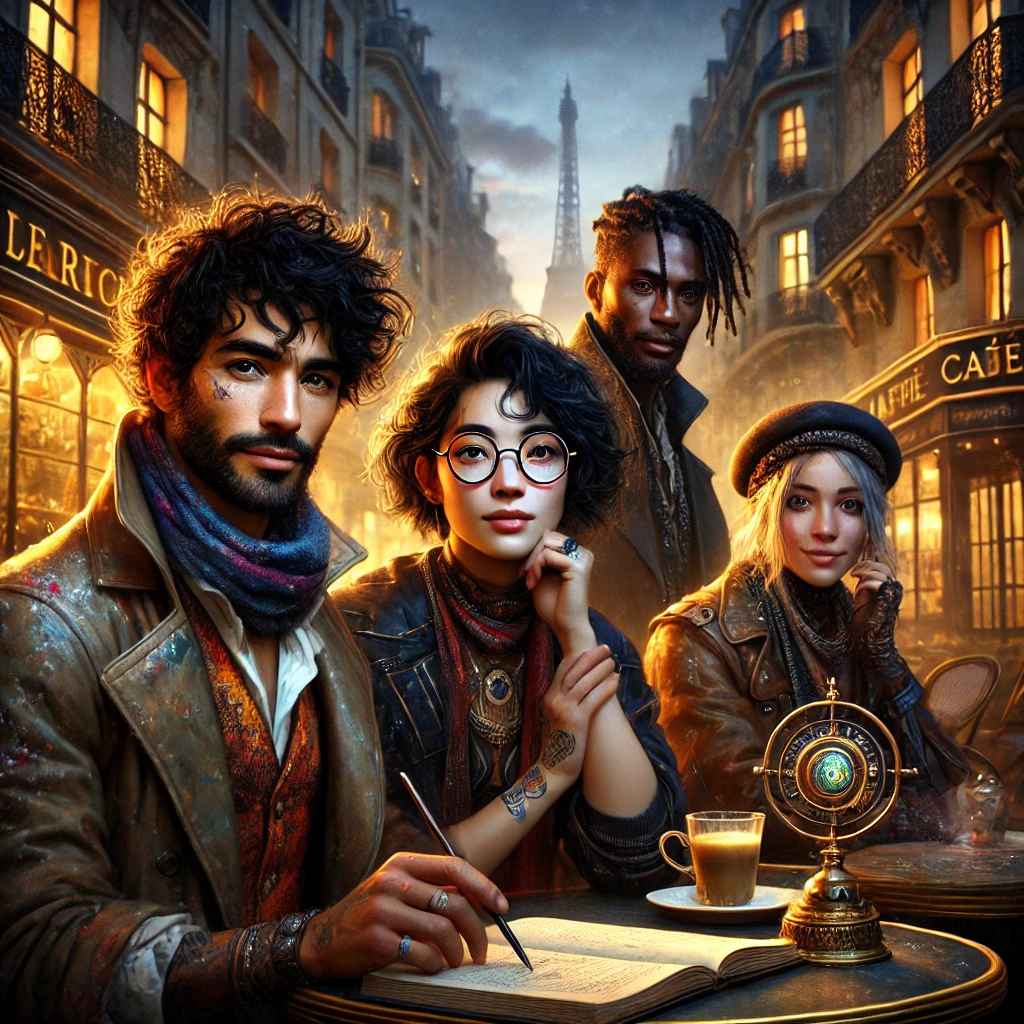
The Sarah Bernardt Café shimmered under a pale grey November sky a busy last Saturday of the “Black Week”. Golden lights spilled onto cobblestones slick with rain, and the air buzzed with the din of a city alive in the moment. Inside, the crowd pressed together, laughing, arguing, living. And in a corner table by the fogged-up window, old friends were about to quietly converged, coming to a long overdue reunion.
Lucien was the first to arrive, dragging a weathered suitcase behind him. Its wheels rattled unevenly on the cobblestones, a sound he hated. His dark curls, damp from the rain, clung to his forehead, and his scarf, streaked with old paint, hung loose around his neck. He folded himself into a corner chair, his suitcase tucked awkwardly beside him. When the server approached, Lucien waved him off with a distracted shake of his head and opened a battered sketchbook.
The next arrival was Elara. She entered briskly, shaking rain from her short gray-streaked hair, her eyes scanning the room as though searching for anomalies. A small roller bag trailed behind her, pristine and black, a sharp contrast to Lucien’s worn luggage. She stopped at the table and tilted her head.
“Still brooding?” she asked, pulling off her coat and folding it neatly over the back of a chair.
“Still talking?” Lucien didn’t look up, his pencil scratching faint lines across the page.
Elara smiled faintly. “Two minutes in, and you’re already immortalizing us? You know I hate being drawn.”
“You hate being caught off guard,” Lucien murmured. “But I never get your nose wrong.”
She laughed, the sound light but brief, and sank into her seat, placing her bag carefully beside her.
The door swung open again, and Darius entered, shaking the rain from his jacket. His presence seemed to fill the room immediately. He strode toward the table, a leather duffel slung over one shoulder and a well-worn travel pouch clutched in his hand. His boots clacked against the café’s tile floor, his movements easy, confident.
“Did you walk here?” Elara asked as he dropped his things with a thud and pulled out a chair.
“Ran into someone on the way,” he said, settling back. “Some guy selling maps. Got this one for ten euros—worth every cent.” He waved a yellowed scrap of paper that looked more fiction than cartography.
Lucien snorted. “Still paying for strangers’ stories, I see.”
“The good ones aren’t free.” Darius grinned and leaned back in his chair, propping one boot against the table leg.
The final arrival was Amei. Her entrance was quieter but no less noticeable. She unwound her scarf slowly, her layered clothing a mix of textures and colors that seemed to absorb the café’s golden light. A tote bag rested over her shoulder, bulging with what could have been books, or journals, or stories yet untold.
“You’re late,” Darius said, but his voice carried no accusation.
“Right on time,” Amei replied, lowering herself into the last chair. “You’re all just early.”
Her gaze swept across them, lingering on the bags piled at their feet. “I see I’m not the only one who came a long way.”
“Not all of us live in Paris,” Elara said, with a glance at Lucien.
“Only some of us make better life choices,” Lucien replied dryly.
The comment drew laughter—a tentative sound that loosened the air between them, thick as it was with five years of absence.
 December 1, 2024 at 5:11 pm #7618
Topic: Quintessence: Reversing the Fifth
in forum Yurara Fameliki’s StoriesMatteo Appears
Matteo approached the table, a tray balanced effortlessly in one hand, his dark eyes flicking over the group as though cataloging details in an invisible ledger. His waistcoat, sharp and clean, gave him a practiced professionalism, but there was something else—a casual, unspoken authority that drew attention.
“Good evening,” he began, his voice smooth and low, almost conspiratorial. Then, he froze for the briefest moment, his gaze shifting from face to face, the easy smile tightening at the corners.
“Well,” Matteo said finally, his smile broadening as if he’d just solved a riddle. “Here you all are. Together, at last.”
The group exchanged glances, each of them caught off-guard by the comment.
“You say that like you’ve been expecting us,” Elara said, her tone measured but sharp, as if probing for variables.
“Not expecting,” Matteo replied, his eyes glinting. “But hoping, perhaps. It’s… good to see you all like this. It fits, somehow.”
“What fits?” Darius asked, leaning forward. His voice was lighter than Elara’s but carried a weight that suggested he wouldn’t let the question drop easily.
Matteo’s smile deepened, though he didn’t answer immediately. Instead, he set down his tray and folded his hands in front of him, his posture relaxed but deliberate, as though he were balancing on the edge of some invisible line.
“You’ve never all been here before,” he said, a simple statement that landed like a challenge.
“Wait,” Amei said, narrowing her eyes. “You know us?”
“Oh, I know you,” Matteo replied, his tone as light as if they were discussing the weather. “Individually, yes. But together? This is new. And it’s… remarkable.”
“Remarkable how?” Lucien asked, his pencil stilled over his sketchbook.
Matteo tilted his head, considering the question as though weighing how much to say. “Let’s just call it a rarity. Things don’t often align so neatly. It’s not every day you see… well, this.”
He gestured toward them with a sweeping hand, as if the mere fact of their presence at the table was something extraordinary.
“You’re being cryptic,” Elara said, her voice edged with suspicion.
“It’s a talent,” Matteo replied smoothly.
“Alright, hold on.” Darius leaned back, his chair creaking under him. “How do you know us? I’ve never been here before. Not once.”
“Nor I,” Amei added, her voice soft but steady.
Matteo raised an eyebrow, his smile taking on a knowing tilt. “No, not here. But that’s not the only place to know someone, is it?”
The words hung in the air, unsettling and oddly satisfying at once.
“You’re saying we’ve met you before?” Elara asked.
Matteo inclined his head. “In a manner of speaking.”
“That doesn’t make sense,” Lucien said, his voice quiet but firm.
“Doesn’t it?” Matteo countered, his tone almost playful. “After all, do we ever truly remember every thread that weaves us together? Sometimes we only see the pattern when it’s complete.”
A pause settled over the table, heavy with unspoken questions. Matteo shifted his weight, breaking the silence with an easy gesture.
“It doesn’t matter how,” he said finally. “What matters is that you’re here. That’s what counts.”
“For what?” Amei asked, her eyes narrowing.
“For whatever happens next,” Matteo replied, as if the answer were obvious. Then he straightened, his professional mask sliding back into place with effortless grace.
“Now, what can I bring you?” he asked, his tone light again, as though the previous exchange hadn’t happened.
One by one, they placed their orders, though their minds were clearly elsewhere. Matteo scribbled in his notebook, his pen moving with deliberate strokes, and then he looked up once more.
“Thank you for being here,” he said, his voice quieter this time. “It’s been… a long time coming.”
And with that, he was gone, disappearing into the crowd with the same fluidity he’d arrived.
They sat in silence for a moment, his words pressing down on them like a hand on a wound, familiar and foreign all at once.
“What the hell was that?” Darius asked finally, breaking the spell.
“Does he seem… different to you?” Amei asked, her voice distant.
“He seems impossible,” Elara replied, her fingers tapping an unconscious rhythm on the table.
“He remembered me,” Lucien said, almost to himself. “Something about absinthe.”
“I’ve never even met him,” Elara said, her voice rising slightly. “But he knew… too much.”
“And he didn’t explain anything,” Darius added, shaking his head.
“Maybe he didn’t need to,” Amei said softly, her gaze fixed on the space Matteo had just vacated.
They lapsed into silence again, the noise of the café returning in fits and starts, like an orchestra warming up after a pause. Somewhere, a glass clinked against porcelain; outside, the violinist struck a note so low it hummed against the windowpane.
The four of them sat there, strangers and friends all at once, the questions left dangling between them like stars in a cloudy sky. Whatever Matteo had meant, it was clear this moment was no coincidence. It wasn’t an end, nor a beginning—it was the start of something unraveling, something they couldn’t yet see.
And though none of them said it aloud, the thought was the same: What had happened before?
Quintessence: Reversing the Fifth
November 7, 2024 at 9:34 pm #7591In reply to: The Incense of the Quadrivium’s Mystiques
Eris had called in sick. Even with the worst case of cold she’s had in years, she was feeling well enough to do jinx-from-home duties, and while her brain was in slow motion, she was relishing the quiet from the daily nagging of processes at the Quadrivium’s office, paperwork, tedious explaining to new hires in the ever growing coven extensions.
When Jeezel called her at the end of the day, she was glad to learn that Truella had found courage to stand up for them. Jeezel had such a colorful way of describing events, and in describing that particular scene where Truella had made her stand, it was always difficult to extract the truth from the makeup.
“You’re not really paying attention, are you?” Jeezel, ever astute to where attention was, quizzed her.
“What made you say that?” Eris didn’t try to deny.
“Oh I guess, when I started to speak about the camels in knickers going for a bath in the ball pit from all the dropped balls this year.”
“Ah, right. That would do.”
“Tell me, anything troubling you, luv’? You know you can tell me things.”
After a little moment, Eris said “Well, it’s just a thought,… but what if I’m in need of change of path?”
“What do you mean?” Jeezel tried to not sound too alarmed. “Not being a witch anymore?”
“Oh, no. Well,… why not, there’s no shame in no magic —but no. More like…”
“What? Quitting the coven?”
“… Yeah. It’s gone to madder and madder, it’s so hard to keep track with all the nonsense.” Eris corrected seeing the face of Jeezel. “Not that nonsense. You know what I mean… the daily nonsense. Our nonsense is fine. More than fine actually.”
“Phew, you had me worried though. Although…”
“I know… Quitting the coven.”
“You could be stripped of magic, if Malové learns about this…” then with more concern in her voice “WE could all be stripped of magic.”
“Yeah, I know. But look, is that what makes us happy?”
“It certainly foots the bill —or more like magically takes care of the bills.”
“Like I said, Jeez’, it’s just a thought, nothing to worry about, actually it helped to get it out.”
“I think it’s more than a thought.” Jeezel said with an air of age-old wisdom. “Let’s see where this leads. Imagine that…”
“Yeah, we’ll see. Thanks for checking in, it’s nice for a change. I don’t know what’s got into the other two these days, they’re always talking about clothing.”
“Yeah, I know. And pjs’.”
“Go figure.”
November 4, 2024 at 3:36 pm #7579In reply to: The Incense of the Quadrivium’s Mystiques
When Eris called for an urgent meeting, Malové nearly canceled. She had her own pressing concerns and little patience for the usual parade of complaints or flimsy excuses about unmet goals from her staff. Yet, feeling the weight of her own stress, she was drawn to the idea of venting a bit—and Truella or Jeezel often made for her preferred targets. Frella, though reserved, always performed consistently, leaving little room for critique. And Eris… well, Eris was always methodical, never using the word “urgent” lightly. Every meeting she arranged was meticulously planned and efficiently run, making the unexpected urgency of this gathering all the more intriguing to Malové.
Curiosity, more than duty, ultimately compelled her to step into the meeting room five minutes early. She tensed as she saw the draped dark fabrics, flickering lights, forlorn pumpkins, and the predictable stuffed creatures scattered haphazardly around. There was no mistaking the culprit behind this gaudy display and the careless use of sacred symbols.
“Speak of the devil…” she muttered as Jeezel emerged from behind a curtain, squeezed into a gown a bit too tight for her own good and wearing a witch’s hat adorned with mystical symbols and pheasant feathers. “Well, you’ve certainly outdone yourself with the meeting room,” Malové said with a subtle tone that could easily be mistaken for admiration.
Jeezel’s face lit up with joy. “Trick or treat!” she exclaimed, barely able to contain her excitement.
“What?” Malové’s eyebrows arched.
“Well, you’re supposed to say it!” Jeezel beamed. “Then I can show you the table with my carefully handcrafted Halloween treats.” She led Malové to a table heaving with treats and cauldrons bubbling with mystical mist.
Malové felt a wave of nausea at the sight of the dramatically overdone spread, brimming with sweets in unnaturally vibrant colors. “Where are the others?” she asked, pressing her lips together. “I thought this was supposed to be a meeting, not… whatever this is.”
“They should arrive shortly,” said Jeezel, gesturing grandly. “Just take your seat.”
Malové’s eyes fell on the chairs, and she stifled a sigh. Each swivel chair had been transformed into a mock throne, draped in rich, faux velvet covers of midnight blue and deep burgundy. Golden tassels dangled from the edges, and oversized, ornate backrests loomed high, adorned with intricate patterns that appeared to be hastily hand-painted in metallic hues. The armrests were festooned with faux jewels and sequins that caught the flickering light, giving the impression of a royal seat… if the royal in question had questionable taste. The final touch was a small, crowned cushion placed in the center of each seat, as if daring the occupants to take their place in this theatrical rendition of a court meeting.
When she noticed the small cards in front of each chair, neatly displaying her name and the names of her coven’s witches, Malové’s brow furrowed. So, seats had been assigned. Instinctively, her eyes darted around the room, scanning for hidden tricks or sutble charms embedded in the decor. One could never be too cautious, even among her own coven—time had taught her that lesson all too often, and not always to her liking.
Symbols, runes, sigils—even some impressively powerful ones—where scattered thoughtfully around the room. Yet none of them aligned into any coherent pattern or served any purpose beyond mild relaxation or mental clarity. Malové couldn’t help but recognize the subtlety of Jeezel’s craft. This was the work of someone who, beyond decorum, understood restraint and intention, not an amateur cobbling together spells pulled from the internet. Even her own protective amulets, attuned to detect any trace of harm, remained quiet, confirming that nothing in the room, except for those treats, posed a threat.
As the gentle aroma of burning sage and peppermint reached her nose, and Jeezel placed a hat remarkably similar to her own onto Malové’s head, the Head Witch felt herself unexpectedly beginning to relax, her initial tension and worries melting away. To her own surprise, she found herself softening to the atmosphere and, dare she admit, actually beginning to enjoy the gathering.
October 23, 2024 at 6:55 pm #7567In reply to: The Incense of the Quadrivium’s Mystiques
“I’m glad Hallowe’en is soon coming…” Eris sighed to her colleague. “Honestly, when did all the witchery stuff got outnumbered by Project Managers Officers?”
“Don’t ask me!” replied Truella in the dirt-smeared reflection of her obsidian mirror. She was still obviously distracted from her Incense-making numbers, not that she ever really cared about it —and even less since Malové got replaced for a while.
“Found anything worth scrying in your old postcards?” Jeezel affably trying to practice genuine interest in Truella’s games. Her own image was all pixellated due to the abundance of glitter on the makeup stand she was using for the conference call.
“Shht…” shushed Frella appearing in a faint halo light through her pristinely shiny scrying mirror, “Don’t encourage her, silly. There’s going to be no end of it. And Eris has a point, I may say.”
“Does she, now? And when did you start to take sides?” Truella felt like Pinocchio being told the Land of Toys wasn’t all that it was supposed to be.
“Listen,” Eris said “I’m sure you’ve realised by now, we have PM Officers for about any ridiculous thing in the Quadrivium nowadays. None of them having any magic to show for. They’re going to suffocate us in paperwork if you ask me. I suspect the Malové that came back was put under some sleeper sort of a spell; the Malové we knew would never have tolerated such nonsense.”
Eris marked a pause, looking sideways at Truella’s reflection on her Witchype screen. “And I think she’s had a fair deal of nonsense to contend with… but at least, even in a dragon fire mishap, there was magical prowess that could be harnessed.”
“I do like to get my hands dirty you know, and unravel layers of earth without the help of any spell” snickered Truella.
“That is not the matter and you know it…” Eris sighed.
“You meant to say, it’s time for a good old fashioned witchy coven spell to unravel the truth and break one maybe?” Frella ventured mockingly coyly.
“I’m in!” Jeeze jumped in suddenly “Been so bored for so long with all these timesheeting, spreadsheeting, and reportshitting if you don’t mind my French.”
“Actually I have an idea for a spell… and it may be of interest to you Truella too.” Eris continued.
Truella raised an eyebrow. She was not one to take things at face value. “Try me”
“All my ancestry research has pointed me to something we could work with. You know that bits of hair and nail are basically just middle-agey way of gathering DNA; and that DNA can act as a conduit through time and space, the same way it connects people.”
“Ooooh…” cooed Trooella.
“Exactly.” All nodded in a silent conspiring understanding.
September 16, 2024 at 6:16 pm #7556In reply to: The Incense of the Quadrivium’s Mystiques
The chill drizzle felt cold to Truella, and she wondered not for the first time if her overheated drought stricken summer longing for cold and rain would quickly change to a desire for bone warming dry heat as soon as the weather properly changed to autumn.
“Lend me a sweater and a raincoat will you, Frella? I always forget to change before teleporting over here.”
Frella gave her a look that could only be described as nonplussed. Murmuring a short incantation, with a snap of her fingers and an indescribable gesture, the requested garments appeared on Truella’s lap, as if thrown forcefully from the other side of the room.
“Steady on, Frel!” Gratefully Truella slipped the sweater on and said, “But thanks. You know what? I forget I’m a witch, that’s the trouble. I keep forgetting I can just magic things up. Honestly, you have no idea…”
“Oh, trust me, I have an idea.”
“..the trouble I go to, doing things I could do in an instant with a spell…”
“Have you only just realised?” Frella smirked.
“Hell no, I remember all the time that I always forget. How the hell did I end up in a witches coven?”
“That fake resume you concocted when you were dazzled by the allure and the mystery, and jealous that I was in it and not you?”
“Well yes, I know, but I mean, why did Malove hire me? Why am I still here?”
“I can tell you the answer to that!” announced Eris, entering the room with a wide toothy grin.
Mouth agape, Truella leaned forward to hear what Eris had to say next, but at that moment Jeezel spun round the door frame and skidded to a halt in front of the girls, clutching her forehead dramatically.
“Who is sending all the postcards! Every morning this week I’ve had dozens of old postcards in my mailbox, there were so many stuffed in there today one was poking out! No, I can’t read who sent it, I can’t decipher any of the writing on any of them.”
“Where are they sent from? What are the pictures of?” asked Truella, her curiosity aroused.
“Pictures, who cares about the pictures, I want to know who’s sending them!”
“Steady on, Jez. The pictures might provide clues to the sender and purpose of the card,” Truella said mildly, raising an eyebrow at Jezeel’s agitated state. “What’s ruffled your feathers so much about a few postcards?”
“I received a postcard too,” Frella chimed in, causing Jeezel to gasp and clutch her heart. “I wasn’t all melodramatic about it as you though, I thought it was magical and I dunno, had a nice story to it.”
Before Truella had a chance to ask Eris to expound on the previous question, and indeed before anyone got to the bottom of Jeezel’s outburst, Malove strode in with her usual menacing demeanor. Truella braced herself for tedious profit mongering coercive diatribes to inch their way along the slimy walls of time.
September 13, 2024 at 8:37 pm #7552In reply to: The Incense of the Quadrivium’s Mystiques
Frella woke with a start. The sun peeked through the curtains of her cottage, softly lighting her room. She lay there quietly trying to hang on to the dream: the bustling fair, the strange cloak-wearing girl with the black cat who said her name was —well she couldn’t remember now—, and even Cedric had made an appearance! Now he was infiltrating her dreams as well! She may need to do a spell for that. As the fog of sleep lifted, the vividness of the dream lingered at the edges of her consciousness and she played it over a few times, wondering what the message was. The fair was months ago, funny that it was coming up in her dreams now.
Her alarm buzzed on the bedside table and a warm tone chimed: “Good morning, Frella. The time is 6:45 a.m. Today’s forecast is mild with a chance of light rain in the morning. Would you like to review today’s tasks?”
Frella snorted and waved her hand in the air, silencing the digital assistant with a flicker of magic. It was far too early for that nonsense. The alarm faded into a soothing melody and the device shifted to Dream Journal mode: “It looks as though you had a vivid dream. Would you like my help to record it while it’s still fresh?”
Ignoring the prompt, Frella sat up and swung her legs over the side of the bed. Her feet made soft taps on the wooden floor as she walked over to the window. She pulled apart the curtains and opened the window, letting the cool morning air fill the room. Birds called in the distance, and she smiled as she leaned on the windowsill and let the fresh breeze stroke her face.
As she turned away from the window, her eyes fell on the postcard which had arrived in the mail yesterday, still sitting on her dressing table. The edges were slightly worn as if it had travelled a very long way to reach her and the spindly writing was indecipherable even with the help of a decrypting spell. The thought crossed her mind that perhaps it was somehow connected with her dream. She picked it up and studied it again; did that signature read Arona? Wasn’t that the name of the girl in the dream!
September 13, 2024 at 6:48 am #7550In reply to: The Incense of the Quadrivium’s Mystiques
The fair was in full swing, with vibrant tents and colourful stalls bursting with activity. The smell of freshly popped corn mingled with the fragrance of exotic spices and the occasional whiff of magical incense. Frella turned her attention back to setting up her own booth. Her thoughts were a swirl of anxiety and curiosity. Malové’s sudden appearance at the fair could not be a mere coincidence, especially given the recent disruptions in the coven.
Unbeknownst to Frella, Cedric Spellbind was nearby. His eyes, though hidden behind a pair of dark glasses, were fixated on Frella. He was torn between his duty to MAMA and his growing affection for her. He juggled his phone, checking missed calls and messages, while trying to keep a discreet distance. But he was drawn to her like moth to flame.
As Frella was adjusting her booth, she felt a sudden chill and turned to find herself face-to-face with Cedric. He quickly removed his glasses and their eyes met; Cedric’s heart skipped a beat.
Frella’s gaze was guarded. “Can I help you with something?” she asked, her tone icily polite.
Cedric, flustered, stammered, “I—uh—I’m just here to, um, look around. Your booth looks, uh, fascinating.”
Frella raised an eyebrow. “I see. Well, enjoy the fair.” She turned back to her preparations, but not before noticing a fleeting look of hurt in Cedric’s eyes.
Cedric moved away, wrestling with his conflicting emotions. He checked to make sure his tracker was working, which tracked not just Frella’s movements but those of her companions. He was determined to protect her from any potential threat, even if it meant risking his own standing with MAMA.
As the day progressed, the fair continued to buzz with magical energy and intrigue. Frella worked her booth, engaging with curious tourists, all suitably fascinated with the protective qualities of hinges. Suddenly, Frella’s attention was drawn away from her display by a burst of laughter and squeals coming from nearby. Curiosity piqued, she made her way toward the source of the commotion.
As she approached, she saw a crowd had gathered around a small, ornate tent. The tent’s entrance was framed by shimmering curtains, and an enchanting aroma of lavender and spices wafted through the air. Through the gaps in the curtains, Frella could see an array of magical trinkets and curiosities.Just as she was about to step closer, a peculiar sight caught her eye. Emerging from the tent was a girl wearing a rather large cloak and closely followed by a black cat. The girl looked bewildered, her wide eyes taking in the bustling fairground.
Frella, intrigued and somewhat amused, approached the girl. “Hello there! I couldn’t help but notice you seem a bit lost. Are you okay?”
The girl’s expression was a mix of confusion and wonder. “Oh, hello! I’m Arona, and this is Mandrake,” she said, bending down and patting the black cat, who gave a nonchalant twitch of his tail. “We were just trying to find the library in my time, and now we’re here. This isn’t a library by any chance?”
Frella raised her eyebrows. “A library? No, this is a fair—a magical fair, to be precise.”
Arona’s eyes widened further as she looked around again. “A fair? Well, it does explain the odd contraptions and the peculiar people. Anyway, that will teach me to use one of Sanso’s old time-travelling devices.”
Truella wandered over to join the conversation, her curiosity evident. “Time-travelling device? That sounds fascinating. How did you end up here?”
Arona looked sheepish. “I was trying to retrieve a rare book from a past century, and it seems I got my coordinates mixed up. Instead of the library, I ended up at this… um … delightful fair.”
Frella chuckled. “Well, don’t worry, we can help you get back on track. Maybe we can find someone who can help with your time-travelling predicament.”
Arona smiled, relieved. “Thank you! I really didn’t mean to intrude. And Mandrake here is quite good at keeping me company, but he’s not much help with directions.”
Mandrake rolled his eyes and turned away, his disinterest in the conversation evident.
As Frella and Truella led Arona to a quieter corner of the fair, Cedric Spellbind observed the scene with growing interest. His eyes were glued to Frella, but the appearance of the time-travelling girl and her cat added a new layer of intrigue. Cedric’s mission to spy on Frella had just taken an unexpected turn.
August 28, 2024 at 1:31 pm #7549In reply to: The Elusive Samuel Housley and Other Family Stories
The Tailor of Haddon
Wibberly and Newton of Over HaddonIt was noted in the Bakewell parish register in 1782 that John Wibberly 1705?-1782 (my 6x great grandfather) was “taylor of Haddon”.
James Marshall 1767-1848 (my 4x great grandfather), parish clerk of Elton, married Ann Newton 1770-1806 in Elton in 1792. In the Bakewell parish register, Ann was baptised on the 2rd of June 1770, her parents George and Dorothy Newton of Upper Haddon. The Bakewell registers at the time covered several smaller villages in the area, although what is currently known as Over Haddon was referred to as Upper Haddon in the earlier entries.
Newton:
George Newton 1728-1798 was the son of George Newton 1706- of Upper Haddon and Jane Sailes, who were married in 1727, both of Upper Haddon.
George Newton born in 1706 was the son of George Newton 1676- and Anne Carr, who were married in 1701, both of Upper Haddon.
George Newton born in 1676 was the son of John Newton 1647- and Alice who were married in 1673 in Bakewell. There is no last name for Alice on the marriage transcription.
John Newton born in 1647 (my 9x great grandfather) was the son of John Newton and Anne Buxton (my 10x great grandparents), who were married in Bakewell in 1636.
1636 marriage of John Newton and Anne Buxton:
Wibberly
Dorothy Wibberly 1731-1827 married George Newton in 1755 in Bakewell. The entry in the parish registers says that they were both of Over Haddon. Dorothy was baptised in Bakewell on the 25th June 1731, her parents were John and Mary of Over Haddon.

John Wibberly and Mary his wife baptised nine children in Bakewell between 1730 and 1750, and on all of the entries in the parish registers it is stated that they were from Over Haddon. A parish register entry for John and Mary’s marriage has not yet been found, but a marriage in Beeley, a tiny nearby village, in 1728 to Mary Mellor looks likely.
John Wibberly died in Over Haddon in 1782. The entry in the Bakewell parish register notes that he was “taylor of Haddon”.
The tiny village of Over Haddon was historically associated with Haddon Hall.
A baptism for John Wibberly has not yet been found, however, there were Wibersley’s in the Bakewell registers from the early 1600s:
1619 Joyce Wibersley married Raphe Cowper.
1621 Jocosa Wibersley married Radulphus Cowper
1623 Agnes Wibersley married Richard Palfreyman
1635 Cisley Wibberlsy married ? Mr. Mason
1653 John Wibbersly married Grace DaykenHaddon Hall
Sir Richard Vernon (c. 1390 – 1451) of Haddon Hall.
Vernon’s property was widespread and varied. From his parents he inherited the manors of Marple and Wibersley, in Cheshire. Perhaps the Over Haddon Wibersley’s origins were from Sir Richard Vernon’s property in Cheshire. There is, however, a medieval wayside cross called Whibbersley Cross situated on Leash Fen in the East Moors of the Derbyshire Peak District. It may have served as a boundary cross marking the estate of Beauchief Abbey. Wayside crosses such as this mostly date from the 9th to 15th centuries.Found in both The History and Antiquities of Haddon Hall by S Raynor, 1836, and the 1663 household accounts published by Lysons, Haddon Hall had 140 domestic staff.
In the book Haddon Hall, an Illustrated Guide, 1871, an example from the 1663 Christmas accounts:
Also in this book, an early 1600s “washing tally” from Haddon Hall:
Over Haddon
Martha Taylor, “the fasting damsel”, was born in Over Haddon in 1649. She didn’t eat for almost two years before her death in 1684. One of the Quakers associated with the Marshall Quakers of Elton, John Gratton, visited the fasting damsel while he was living at Monyash, and occasionally “went two miles to see a woman at Over Haddon who pretended to live without meat.” from The Reliquary, 1861.
August 21, 2024 at 12:27 pm #7546In reply to: The Elusive Samuel Housley and Other Family Stories
The Potters of Darley Bridge
Rebecca Knowles 1745-1823, my 5x great grandmother, married Charles Marshall 1742-1819, the churchwarden of Elton, in Darley, Derbyshire, in 1767. Rebecca was born in Darley in 1745, the youngest child of Roger Knowles 1695-1784, and Martha Potter 1702?-1772.
Although Roger and Martha were both from Darley, they were married in South Wingfield by licence in 1724. Roger’s occupation on the marriage licence was lead miner. (Lead miners in Derbyshire at that time usually mined their own land.) Jacob Potter signed the licence so I assumed that Jacob Potter was her father.
I then found the will of Jacobi Potter who died in 1719. However, he signed the will James Potter. Jacobi is latin for James. James Potter mentioned his daughter Martha in his will “when she comes of age”. Martha was the youngest child of James. James also mentioned in his will son James AND son Jacob, so there were both James’s and Jacob’s in the family, although at times in the documents James is written as Jacobi!
Jacob Potter who signed Martha’s marriage licence was her brother Jacob.
Martha’s brother James mentioned his sister Martha Knowles in his 1739 will, as well as his brother Jacob and his brother Joseph.
Martha’s father James Potter mentions his wife Ann in his 1719 will. James Potter married Ann Waterhurst in 1690 in Wirksworth, some seven miles from Darley. James occupation was innkeeper at Darley Bridge.
I did a search for Waterhurst (there was only a transcription available for that marriage, not a microfilm) and found no Waterhursts anywhere, but I did find many Warhursts in Derbyshire. In the older records, Warhust is also spelled Wearhurst and in a number of other ways. A Martha Warhurst died in Peak Forest, Derbyshire, in 1681. Her husbands name was missing from the deteriorated register pages. This may or may not be Martha Potter’s grandmother: the records for the 1600s are scanty if they exist at all, and often there are bits missing and illegible entries.
The only inn at Darley Bridge was The Three Stags Heads, by the bridge. It is now a listed building, and was on a medieval packhorse route. The current building was built in 1736, however there is a late 17th century section at rear of the cross wing. The Three Stags Heads was up for sale for £430,000 in 2022, the closure a result of the covid pandemic.

Another listed building in Darley Bridge is Potters Cottage, with a plaque above the door that says “Jonathan and Alice Potter 1763”. Jonathan Potter 1725-1785 was James grandson, the son of his son Charles Potter 1691-1752. His son Charles was also an innkeeper at Darley Bridge: James left the majority of his property to his son Charles.
Charles is the only child of James Potter that we know the approximate date of birth, because his age was on his grave stone. I haven’t found any of their baptisms, but did note that many Potters were baptised in non conformist registers in Chesterfield.
Potters Cottage

Jonathan Potter of Potters Cottage married Alice Beeley in 1748.
“Darley Bridge was an important packhorse route across the River Derwent. There was a packhorse route from here up to Beeley Moor via Darley Dale. A reference to this bridge appears in 1504… Not far to the north of the bridge at Darley Dale is Church Lane; in 1635 it was known as Ghost Lane after a Scottish pedlar was murdered there. Pedlars tended to be called Scottish only because they sold cheap Scottish linen.”
via Derbyshire Heritage website.
According to Wikipedia, the bridge dates back to the 15th century.
-
AuthorSearch Results